Child & Family Social Work · Social work
What children exposed to domestic violence value when meeting social workers: A practice-oriented systematic research review
What does a child exposed to domestic violence need in order to find a meeting with social workers helpful? At Örebro University in Sweden, Martina Vikander and Åsa Källström revisited 18 studies that give children a voice. Four dimensions emerge: basic requirements, inclusion, acknowledgement and, more unexpectedly, enjoyment.
This is a reformatted republication of What children exposed to domestic violence value when meeting social workers: A practice-oriented systematic research review, by Martina Vikander and Åsa Källström, published in Child & Family Social Work (Wiley) (2024), doi: 10.1111/cfs.13073, under a CC BY 4.0 licence. Prepared by Complexe Systémique in September 2026: the authors’ text is unchanged; the layout has been adapted for reading online, which constitutes a modification of the work under the terms of the licence. Tables are presented as lists. This edition was made neither by the authors nor by the publisher, who are not responsible for its content or for any errors. The original version prevails.
Children are less likely to disclose the violence if they blame themselves, highlighting the importance of alleviating self-blame as a crucial step in the disclosure process.
Martina Vikander and Åsa Källström
Abstract
Children exposed to domestic violence (DV) face a heightened risk of many types of short- and long-term problems. Social workers can limit these risks if the support and help they offer is perceived as valuable by the child. The aims of this review were to identify what children exposed to DV value when meeting social workers, to suggest how this knowledge can be used in practice by professionals dedicated to working with these children and to identify and suggest key areas of focus for future research. A synthesis of 18 studies reveals that, in meetings with social workers, children exposed to DV value (1) basic requirements, (2) inclusion, (3) acknowledgement and (4) enjoyment. This review offers a smorgasbord of opportunities for practitioners to meet the wishes and needs of these children. However, comparative research is needed to facilitate adaptation and to distinguish between elements valued by children that are core prerequisites for helping them disclose their experiences and/or aiding their recovery and elements that are less crucial but still valued.
1 INTRODUCTION
Being exposed to domestic violence (DV) as a child often not only includes witnessing abuse inflicted on other family members but also entails heightened risks of being the direct victim of physical or sexual abuse and developing a variety of problems, including short- and long-term posttraumatic stress, anxiety, depression, other emotional or behavioural problems and difficulties in school and with social relationships (e.g., Holt et al., 2008; Vu et al., 2016). Limiting the consequences of such exposure is therefore of the utmost importance. However, although experiencing DV as a child includes living with, fearing and having to cope with DV in many forms, it may also include turning points, transitions and hope for the future when the mother exits the abusive relationship (Arai et al., 2021). Social support is a key factor for protection, resilience and coping (Geffner et al., 2003; Guille, 2004; Owen et al., 2007). Some evidence suggests that talking about experiences of DV can prevent and reduce exposed children's problems (Graham-Bermann et al., 2011; Jouriles et al., 2009). Under recent legislation in countries such as England, Sweden and Wales, children exposed to DV are recognized as victims in their own right, and social workers have a responsibility to offer protection as well as support.
Meeting the needs of children exposed to DV poses various dilemmas and challenges for social workers. Firstly, children have varied needs. Some need to be protected from violence but have the resources they need to recover (Howell et al., 2010), while others may develop internalizing and/or externalizing problems (Holt et al., 2008). As social workers cannot know about an individual child's experiences, preferences and needs when first meeting them, some argue that trauma awareness is crucial (Levenson, 2017). Meanwhile, research considering children's own views of what they deem helpful in meetings with professionals is scarce (cf. Arai et al., 2021). Secondly, for social workers to protect and support children, they must disclose their experiences. However, children tend to keep DV a secret, and only about half of them disclose their exposure (Graham-Bermann et al., 2011; Howell et al., 2015). Whether disclosure is deemed helpful or harmful seems to be influenced by the reactions of others (Ullman, 2011). Thirdly, offering children support does not guarantee that they perceive it as supportive and as something they can benefit from. Thunberg (2022) argues that support must be adapted to each youth's perception of what is helpful in their social setting. Finally, assessing child exposure to DV and its consequences is complex, and it may seem easier to focus on physical risk and safety than on children's overall exposure (LaLiberte et al., 2010). Professionals who are insensitive can retraumatize victims (Thompson, 2017). Therefore, social workers must handle meetings with children exposed to DV with caution and sensitivity.
DV programs have been found to improve children's ability to cope with stress and conflicts, to treat symptoms of traumatic stress and behavioural disorders, to support the child–mother relationship and to provide practical support to mothers and children (e.g., Graham-Bermann et al., 2007; Jouriles et al., 2001). Evaluations are often focused on children's health-focused symptoms and disorders; however, the children themselves often include broader concepts in their understanding of intervention success (cf. Howarth et al., 2015). Such aspects have partly been included in studies of children's experiences of DV shelters (e.g. Jarvis et al., 2005). Social workers may encounter children exposed to DV in formal or informal meetings with different purposes. With this review, we therefore aim to go beyond knowledge about what programmes, models, methods and/or techniques may contribute to reducing symptoms or improving well-being and focus instead on what children exposed to DV value in formal meetings with social workers, as well as to provide a readable synthesis of the research available for this area. We believe that this can help social workers “give due weight” to the views and opinions of children in accordance with Article 12, United Nations (1989).
The overall aim of this review was to explore the experiences and perceptions of social workers among children exposed to DV. The primary research question was to identify what children value in formal meetings with social workers. Additional aims were to suggest how this knowledge could be used in practice and to identify and suggest key areas of focus for future research.
Below, we present first how we sought to answer our aim and then the actual answer, which is structured around four themes.
2 METHOD
To ensure transparency, this systematic review was undertaken in accordance with PRISMA guidelines for systematic reviews (see Page et al., 2021).
2.1 Inclusion and exclusion criteria
Studies had to satisfy five inclusion criteria: (1) being peer-reviewed, (2) being empirical, (3) having children exposed to violence or abuse between parents (stated as DV in this review) as respondents, (4) focusing on children's experiences or perceptions of formal meetings with social workers due to their exposure to DV and (5) being written in English.
Thus, studies based solely on adult respondents or documents were excluded, as were studies focusing on other social problems (e.g. child abuse, substance abuse or mental illness), violence outside the family, or meetings with the police, health care system or DV shelters Reviews or theoretical articles were also excluded, as were studies solely focusing on intervention effects or on children's behaviour in or handling of meetings with social workers. Studies not written in English or not accessible through online services or the university library were also excluded.
2.2 Literature search
In order to identify relevant studies, we conducted an electronic literature search in the databases Social Services Abstracts, ASSIA and PsychINFO. No restrictive date-range was adopted. Table 1 presents the four different combinations of search terms used and the database results.
Table 1 — Database searches.
- Month/year: May 2021; Combination of terms searched for in title, key words or abstract. Additional limits - peer-review: (Adolescen* OR children OR “young people”) AND (“intimate partner violence” OR “domestic violence”) AND (“Social Work*” OR Therap* OR intervention* OR treatment* OR counsel*); Social Service Abstracts: N = 2498; ASSIA: N = 1491; PsychINFO: N = 1870
- Month/year: April 2022; Combination of terms searched for in title, key words or abstract. Additional limits - peer-review: (Adolescen* OR children OR “young people”) AND (“domestic abuse” OR “family violence”) AND (“social work*” OR Therap* OR intervention* OR treatment* OR counsel*) NOT (“domestic violence” OR “intimate partner violence”); Social Service Abstracts: N = 952; ASSIA: N = 313; PsychINFO: N = 462
- Month/year: April 2022; Combination of terms searched for in title, key words or abstract. Additional limits - peer-review: (“child protection” OR “social service*”) AND (child OR adolescen* OR “young people”) AND (“intimate partner violence” OR “domestic violence” OR “family violence” OR “domestic abuse”) NOT (“social work*” OR Therap* OR intervention* OR treatment* OR counsel*); Social Service Abstracts: N = 2099; ASSIA: N = 179; PsychINFO: N = 261
- Month/year: April 2022; Combination of terms searched for in title, key words or abstract. Additional limits - peer-review: (Adolescen* OR children OR “young people”) AND (“intimate partner violence” OR “domestic violence”) AND (“Social Work*” OR Therap* OR intervention* OR treatment* OR counsel*). Additional limits – date: from May 2021 to April 2022; Social Service Abstracts: N = 201; ASSIA: N = 98; PsychINFO: N = 104
2.3 Selection process
In the study-selection process, studies from the database searches were exported to the software Zotero. All the steps in the inclusion process were made based on the inclusion and exclusion criteria and started with the first author screening the titles for relevant studies. Studies remaining after the screening process were reviewed by abstracts. The first author reviewed 80%, and the second author 20% of the abstracts. Studies still included were read in full text by both authors. Inclusion and exclusion decisions were made jointly to strengthen the validity of the inclusion process. Studies with social workers in DV shelters were excluded due to their different conditions and possibilities to build rapport with children living there compared with social workers only meeting children in formal meetings. To identify further studies, the first author screened the reference lists of the included studies. Two additional studies were included through this process, as they met the inclusion criteria.
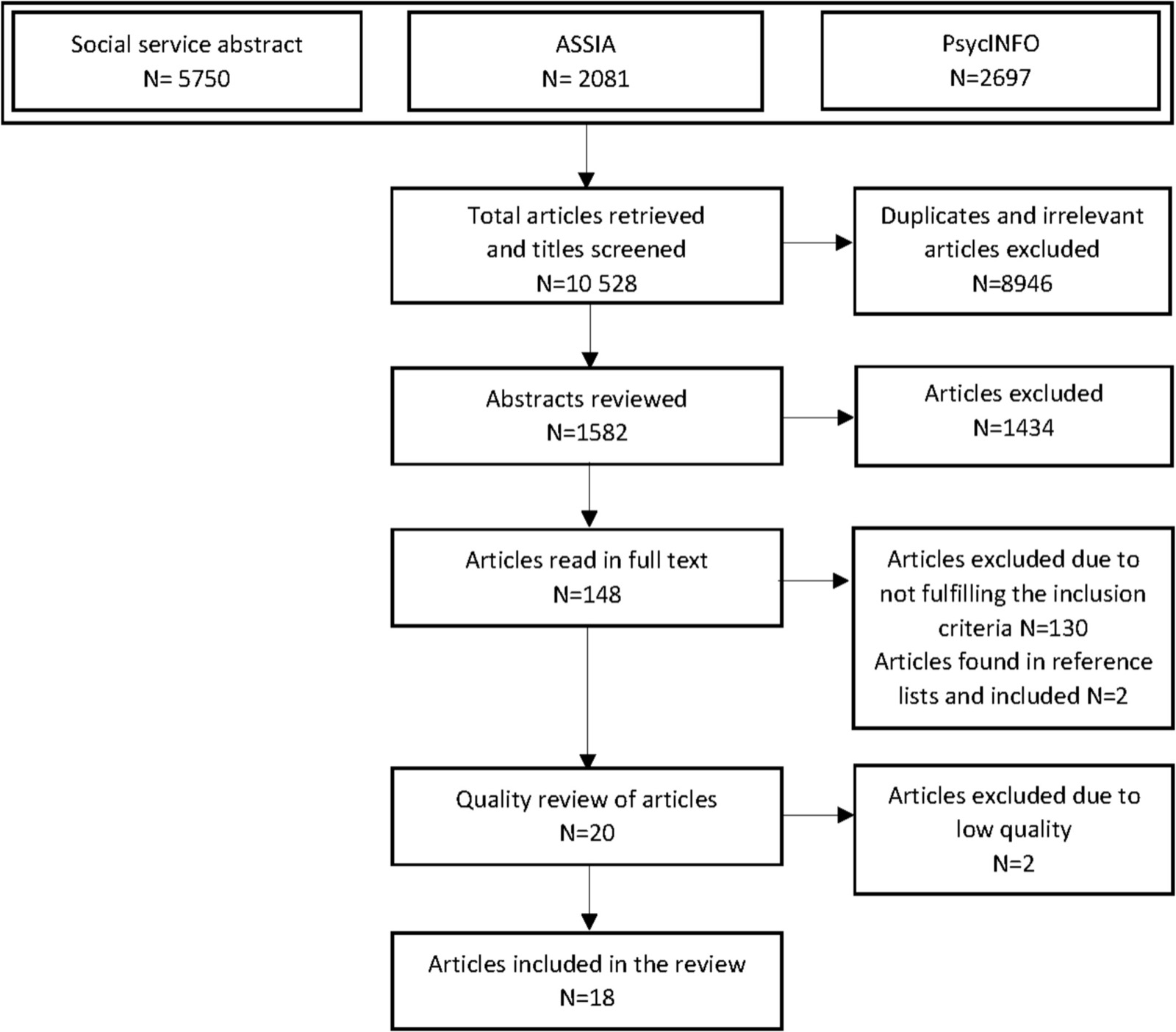
To assess the quality of the included studies, we created a checklist containing eight items deemed important to securing the quality of the review. The items included were sample size, transparency of analysis and cross checking, researcher bias, coherent presentation of results, acknowledgement of the children's age and gender, time of service and exposure to abuser, as well as the effects they could have on the result. According to our checklist, studies could receive a maximum of 12 points. Two of the studies received less than five points and were therefore excluded. With this process, a total of 18 empirical studies were included in the review. An overview of the selection process is presented in Figure 1.
2.4 Analytical process
The studies were analysed using interpretive content analysis, which is commonly used for examining texts or existing datasets (Ahuvia, 2001). This method was used to systematically code manifest, latent and contextual content in the included studies. The method to some extent resembles thematic synthesis, which is commonly used for qualitative systematic reviews that seek to identify practice and policy applications (cf. Drisko, 2020). Like thematic synthesis, interpretive content analysis can also be used to aggregate and summarize the findings into themes (cf. Ahuvia, 2001; Drisko, 2020). However, interpretive content analysis also resembles interpretative synthesis, where the general aim is to enhance or elaborate prior findings, for example, by addressing context (cf. Drisko, 2020). To make it possible to address the various contexts and the heterogeneity of participating children in the original studies included in this review, interpretative content analysis was chosen.
In the initial step, the first author reread the included studies to identify meaning units regarding children's experiences and perceptions of social workers. The units consisted of one or more sentences of quotations from the participants in the original study or the authors' interpretations. The identified meaning units were extracted and entered into a protocol. In the second step, the first author condensed the meaning units into codes. The second author reviewed the codes, and both authors jointly modified them. In the third step, the authors jointly analysed the codes to search for patterns and categorized them into 13 subthemes. In the fourth step, the same procedure was used to analyse and group the subthemes under four separate main themes. In the fifth step, an additional analysis of the results was conducted in order to search for underlying patterns regarding children's ages, time of service and type of service provided.
3 FINDINGS
The original body of research reviewed consisted of a sample of 404 children with boys, 84 identified as boys, 88 as girls and information about regarding gender missing for 232 participants. The ages of the children ranged from 4 to 19 years, and they had been in contact with social workers working as counsellors, family law investigators, CPS (child protection services) investigators or at social services. The majority of children were recruited from the service from which they received support. Of the 18 studies included in this review, 16 employed qualitative methods and 2 employed a mixed method design. Data were primarily collected through individual or group interviews. A detailed presentation of the included can be found in Table 2.
Table 2 — Overview of included articles.
- Author(s): Beetham et al. (2019); Children participating: N = 4 (girls N = 2; boys N = 2) age 7–10; Service provided: Group counselling; Time of service: Service recently ended; Exposure to abuser: None living with abuser; Method: Individual interviews; Country: UK
- Author(s): Callaghan et al. (2019); Children participating: Questionnaires: N = 45 (girls N = 28; boys N = 30 boys) age 11–19 Of these, interviews with: N = 20 (girls N = 14; boys N = 6) age 11–18; Service provided: Group intervention/counselling; Time of service: Service ongoing or recently ended; Exposure to abuser: None living with abuser; Method: Questionnaires and individual interviews; Country: Greece, Italy, Spain, England
- Author(s): Cater (2014)a; Children participating: N = 29 (girls N = 15; boys N = 14) age 4–19; Service provided: Individual counselling; Time of service: Service ongoing or recently ended; Exposure to abuser: None living with abuser; Method: Individual interviews; Country: Sweden
- Author(s): Coburn and Gormally (2014); Children participating: N = 6 (girls N = 6; boys N = 0) age 11–15; Service provided: Individual and group support/counselling; Time of service: Service ongoing; Exposure to abuser: b; Method: Individual interviews; Country: UK
- Author(s): Eriksson (2009)c; Children participating: N = 17 (girls N = 7; boys N = 10) age 8–17; Service provided: Family law investigations; Time of service: Service ended within 2 weeks to 2 years; Exposure to abuser: None living with abuser; Method: Individual interviews; Country: Sweden
- Author(s): Eriksson (2012)c; Children participating: N = 17 (girls N = 7; boys N = 10 boys) age 8–17; Service provided: Family law investigations; Time of service: Service ended within 2 weeks to 2 years; Exposure to abuser: None living with abuser; Method: Individual interviews; Country: Sweden
- Author(s): Fotheringham et al. (2013); Children participating: N = 17 (girls N = b; boys N = b) age 10–19; Service provided: Individual counselling; Time of service: Service ongoing; Exposure to abuser: b; Method: Individual interviews; Country: Canada
- Author(s): Källström and Thunberg (2019)a; Children participating: N = 9 (girls N = 5; boys N = 4) age 12–18; Service provided: Individual counselling; Time of service: Service ongoing or recently ended; Exposure to abuser: None living with abuser; Method: Individual interviews; Country: Sweden
- Author(s): McCarry et al. (2021); Children participating: Focus groups: N = 4 (girls N = 4; boys N = 0) Telephone interviews: N = 5 (girls N = b; boys N = b) age 8–18; Service provided: Individual and group counselling; Time of service: Service ongoing; Exposure to abuser: None living with abuser; Method: Focus groups and telephone interviews; Country: USA
- Author(s): McManus et al. (2013); Children participating: N = 10 (girls N = 1; boys N = 10) age 7–10; Service provided: Support programme with child–mother and peer-group sessions; Time of service: Service ongoing; Exposure to abuser: None living with the abuser; Method: Individual interviews; Country: UK
- Author(s): Pernebo and Almqvist (2016); Children participating: N = 9 (girls N = 5; boys N = 4) age 4–6; Service provided: Group counselling; Time of service: Service recently ended; Exposure to abuser: Not living with abuser N = 8, alternately living with abuser N = 1; Method: Individual interviews; Country: Sweden
- Author(s): Perry and Frampton (2018); Children participating: N = 224 (girls N = b; boys N = b) age 4–17; Service provided: Individual therapy/counselling; Time of service: Service ongoing; Exposure to abuser: None living with abuser; Method: Questionnaires; Country: UK
- Author(s): Phillips and Phillips (2010); Children participating: N = 20 (girls N = b; boys N = b) age 10–17; Service provided: Group support and counselling; Time of service: Service ongoing; Exposure to abuser: None living with abuser; Method: Participant observation, field conversations, focus groups, and individual interviews; Country: USA
- Author(s): Roy et al. (2021); Children participating: N = 3 (girls N = b; boys N = b) age 10–16; Service provided: Individual support/counselling; Time of service: Service ended; Exposure to abuser: b; Method: Individual interviews; Country: UK
- Author(s): Stanley et al. (2012); Children participating: N = 19 (girls N = 11; boys N = 8) age 10–19; Service provided: Social services and school counsellors; Time of service: b; Exposure to abuser: b; Method: Focus groups; Country: UK
- Author(s): Swanston et al. (2014); Children participating: N = 5 (girls N = 3; boys N = 2) age 8–13; Service provided: Domestic violence charities and social services; Time of service: Service ongoing or ended; Exposure to abuser: None living with abuser; Method: Individual interviews; Country: UK
- Author(s): Willis et al. (2010); Children participating: N = 14 (girls N = b; boys N = b), age approx. 14–18d¶; Service provided: Counselling; Time of service: Service ongoing; Exposure to abuser: b; Method: Focus groups; Country: USA
- Author(s): Åkerlund and Sandberg (2017); Children participating: N = 10 (girls N = 6; boys N = 4) age 11–19; Service provided: Individual counselling; Time of service: Service ended within 2 years; Exposure to abuser: None living with the abuser; Method: Interviews; Country: Sweden
a Papers from same study. b Information missing or unclear. c Papers from same study. d High school students, exact information of age is missing, according to the US school system students should be approximately 14–18 years.
It is worth noting that while the studies conducted by Eriksson (2009, 2012) use the same dataset, as do Cater (2014) and Källström and Thunberg (2019), they were included as they explored different aspects of the data.
The synthesis of data from the 18 studies included generated four main themes (dimensions) with respect to what children value in their interactions with social workers: (1) basic requirements, (2) strategies for inclusion, (3) acknowledgement and (4) enjoyment. Within each dimension, we identified between two and four different elements. These can be viewed in Table 3.
Table 3 — Dimensions and elements of what children value in meetings with social workers.
- Basic requirements. Accessibility; A safe space; Trust.
- Inclusion. Information; Flexibility; Choice; Empowerment.
- Acknowledgement. Good talking partners; Validation; Shifting the burden of responsibility; Acknowledging different identities.
- Enjoyment. Fun; Activities.
3.1 Basic requirements
The studies indicated that the basic requirements children exposed to DV valued being provided with access to a social worker, a safe space for meetings, as well as a social worker whom they perceived as trustworthy.
3.1.1 Accessibility
Studies demonstrated that children valued having easy access to social workers or contact initiated by social workers in response to concerns regarding the child (Beetham et al., 2019; Coburn & Gormally, 2014; Roy et al., 2021; Stanley et al., 2012). Coburn and Gormally (2014) found that children valued the ability to contact social workers independently and to have nearby office location that they could visit. Approachability and availability of social workers and their organizations were deemed as important (Coburn & Gormally, 2014; Roy et al., 2021). Roy et al. (2021) found that children compared the availability of children's workers in counselling with school staff and other social workers. “[…] the children's worker was perceived to provide a consistency of support which was not available elsewhere including in school or by children's social care” (Roy et al., 2021 p. 7). This indicated that having services close at hand, such as in schools, may not be helpful if children do not perceive the social workers as approachable. It is crucial to provide children with information about available services to ensure they know where to turn, and the services also need to be accessible for them.
Interestingly, none of the studies involving children age six or younger reported on accessibility. This may be because younger children rarely have the capability or opportunity to seek out social workers independently, and their access to social workers is almost exclusively through adults. Therefore, accessibility may not be something they value to the same extent.
3.1.2 A safe space
A common thread among the studies was that children of all ages perceived a safe space, free from violence and safe enough to talk about their experiences as crucial (Callaghan et al., 2019; Pernebo & Almqvist, 2016; Roy et al., 2021; Willis et al., 2010). The importance of a safe space is likely related to their experiences of an unsafe living condition. As Pernebo and Almqvist (2016 p. 125) aptly summarized, “the children in this study did not seem to assume that safety was something they could take for granted, as they explicitly stated that they appreciated being safe and protected from violence and threat while in the group”. In addition, two studies highlighted that children perceived group counselling as a safe space (Callaghan et al., 2019; Roy et al., 2021). This may be due to meeting the same peers and group leaders regularly, which creates a sense of security, stability and predictability that they often lack at home (Pernebo & Almqvist, 2016; Roy et al., 2021). Pernebo and Almqvist (2016) emphasized that a sense of security could be further enhanced by a predictable environment, such as meeting in the same room with the same furniture. Furthermore, McCarry et al. (2021) found that meeting in a school environment, which was not the children's own school in all cases, was appreciated by some of the children. Therefore, the physical environment where children meet social workers can enhance their sense of security in various ways.
3.1.3 Trust
Children exposed to DV often experience a general mistrust towards adults and authorities, rooted in fears or past experiences of breaches of confidentiality (Cater, 2014; Eriksson, 2009), inadequate support (Stanley et al., 2012; Swanston et al., 2014) or overly zealous response (Cater, 2014). This may be the reason why a lot of the studies emphasized the importance of children meeting social workers whom they perceived trustworthy (Callaghan et al., 2019; Coburn & Gormally, 2014; McCarry et al., 2021; Pernebo & Almqvist, 2016; Perry & Frampton, 2018). Pernebo and Almqvist (2016) noted that young children in group counselling considered social workers trustworthy if they appeared well-intentioned and responsible. Similarly, other studies found that children perceived social workers as trustworthy when they were supportive and helpful (Callaghan et al., 2019; Coburn & Gormally, 2014; McCarry et al., 2021). The level of trust may impact their willingness to disclose sensitive information: “being in a trusting environment enabled participants to express themselves, and to disclose things that they had not previously felt able to discuss” (Callaghan et al., 2019 p. 530). However, in some cases, building a positive relationship with the social worker is necessary for children to trust them (Cater, 2014; McCarry et al., 2021). Overall, children value social workers whom they can rely on, confide in, and who prioritize maintaining confidentiality unless consulting with them first. Establishing trust with children requires time and effort from social workers.
Social workers' accessibility and possibilities offer a safe space and help require that their organization prioritizes the needs of children exposed to DV. However, individual social workers can make inclusive decisions based on other dimensions mentioned by these children.
3.2 Inclusion
Many children emphasized the importance of inclusion when meeting with social workers, which entailed various elements such as access to information, flexibility, choice and empowerment.
3.2.1 Information
Studies highlighted that children valued social workers who provided them with information about their situation (Coburn & Gormally, 2014; Eriksson, 2009; Eriksson, 2012; Stanley et al., 2012) explained in an age-appropriate way that they can comprehend (Coburn & Gormally, 2014; Eriksson, 2009). However, many children, especially younger ones, do not receive adequate information (Beetham et al., 2019; Cater, 2014), which can become a source of worry (Beetham et al., 2019). Although some children try to handle this by asking questions or looking at social workers' notes (Eriksson, 2012), the unequal power balance between children exposed to DV and social workers must be recognized. Social workers have a responsibility for sharing information with children and should consider that doing so can alleviate children's stress and anxiety.
3.2.2 Flexibility
Children also valued social workers who were described as flexible, empathetic and sensitive to the children's needs (Cater, 2014; Eriksson, 2012; Källström & Thunberg, 2019). Flexibility was particularly referred to social workers' willingness to adapt the meeting format to the children's needs and emotional state (e.g., Eriksson, 2012; Källström & Thunberg, 2019). Therefore, it is crucial that social workers are responsive to the children's signals and adopt an age-appropriate approach that allows children to influence the meeting and conversation (e.g. Eriksson, 2012). This increases the chance of children perceiving the meeting as meaningful, which can prevent resistance among them (McManus et al., 2013; Phillips & Phillips, 2010). For instance, Källström and Thunberg (2019) reported that many teenagers had difficulty expressing themselves verbally and found direct questions to be helpful when discussing their experiences. Thus, social workers need to be willing to adjust the meeting format according to the child's age and needs.
3.2.3 Choice
Another element of inclusion that emerged from the studies was the notion of choice, which included the ability to participate in counselling on one's own terms without feeling pressured to say or do anything (Beetham et al., 2019; Callaghan et al., 2019; Cater, 2014; Coburn & Gormally, 2014; Pernebo & Almqvist, 2016). Children valued the ability to make decisions regarding their participation (Coburn & Gormally, 2014), which can give them a sense of control. However, there may be situations where it might not be appropriate to involve children in decisions such as acute protection interventions, although they can still be included in certain stages of the process. Cater (2014) described involving children in decisions regarding counselling where some were urged by social workers and other adults to try it and later decided whether to continue. However, children who were not given choices when meeting social workers during counselling or family law investigations were more likely to refuse to talk or not participate at all (Cater, 2014; Eriksson, 2012). Overall, providing children with the ability to make choices about their participation can increase their sense of control and may result in a more meaningful and positive interaction with social workers.
3.2.4 Empowerment
Studies have identified various actions by social workers that may empower children, such as taking them seriously and not treating them as inferior (Beetham et al., 2019; Callaghan et al., 2019; Källström & Thunberg, 2019; Swanston et al., 2014; Willis et al., 2010). Empowering children can have a positive impact on their confidence and ability to try new things (Callaghan et al., 2019; Källström & Thunberg, 2019). Additionally, according to Willis et al. (2010) “respect and sensitivity to aspects of their lifeworld can serve as a basis for teens' self-empowerment and for facilitating healing of injuries that aren't merely physical” (Willis et al., 2010 p. 556).
Social workers can also empower children by helping them focus on future possibilities, creating hope and easing the coping process (Callaghan et al., 2019). Stanley et al. (2012) emphasized the importance of social workers providing protection to children and their families to prevent reinforcing the children's sense of powerlessness before the abusers violence. Therefore, receiving protection is important for the children's safety and well-being, but also for their sense of control and confidence. Thus, these children value when social workers include them in establishing meeting framework and acknowledge their experiences within that framework.
3.3 Acknowledgement
Acknowledgement includes recognizing the children's need to talk about the violence, have their experiences validated, understand the limits of their responsibilities and have their different identities acknowledged.
3.3.1 Good talking partners
Children valued social workers who were approachable, friendly and easy to talk to (Coburn & Gormally, 2014; Fotheringham et al., 2013; Roy et al., 2021) and good listeners (Källström & Thunberg, 2019; Perry & Frampton, 2018; Stanley et al., 2012). Talking about their experiences of abuse with social workers made many children feel better and helped them create distance to the abuse (Källström & Thunberg, 2019; McManus et al., 2013; Pernebo & Almqvist, 2016; Perry & Frampton, 2018). Källström and Thunberg (2019 p. 556) found that “the young people described it as a relief and a pleasure that now, after the counselling, they no longer have to think about the violence all the time”. Nevertheless, some children preferred not to think or talk about the abuse (Åkerlund & Sandberg, 2017; Pernebo & Almqvist, 2016). Possibly due to fears of having past traumas resurface when they think about their experiences (Källström & Thunberg, 2019; Pernebo & Almqvist, 2016). Although some children do not feel the need to talk about the abuse themselves but recognized its value and encouraged others to do so (Åkerlund & Sandberg, 2017). Regardless, a social worker who can act as a talking partner is valued by many children and could help them to cope with their difficult experiences.
3.3.2 Validation
Studies showed that children wished to be validated by social workers, which involved active listening and understanding of their experiences of violence (Willis et al., 2010; Fotheringham et al., 2013; Stanley et al., 2012; McManus et al., 2013; Swanston et al., 2014; Pernebo & Almqvist, 2016; Beetham et al., 2019; Callaghan et al., 2019; Källström & Thunberg, 2019; McCarry et al., 2021). Despite being directly affected by violence, many children reported experiences of not being heard (Eriksson, 2009; McCarry et al., 2021; Swanston et al., 2014), not being believed when disclosing the abuse to social workers (Eriksson, 2009) and being repeatedly asked the same questions (Beetham et al., 2019). Such experiences indicate a lack of validation. Instead of being dismissive, children desired social workers who made them feel comfortable through understanding (Willis et al., 2010; Fotheringham et al., 2013) and nonjudgemental behaviour (Källström & Thunberg, 2019; Stanley et al., 2012). Stanley et al. (2012) and Källström and Thunberg (2019) demonstrated that validation could be achieved when social workers took the children seriously and responded appropriately to the severity of their situation. Thus, children living with DV often have their needs and opinions overlooked. Social workers who listens, understand and validate them can help address this and strengthen the alliance.
3.3.3 Shifting the burden of responsibility
Several studies have shown that children in counselling value social workers helping them understand their situation and the limits of their responsibility regarding the violence (Callaghan et al., 2019; Fotheringham et al., 2013). Children exposed to DV may blame themselves for not preventing the violence and the involvement of statutory services. The implicit threat of children being removed from home could negatively impact their well-being. Helping children realize they are not responsible can alleviate this burden and improve their well-being. However, Phillips and Phillips (2010) cautioned that social workers may face resistance when discussing the abuser's responsibility for the violence, especially in cases where children refuse to talk about the violence or acknowledge the violence. Therefore, it is valuable for social workers to help children shift the burden of responsibility, but it can be challenging to do so if the children have not disclosed the violence. Children are less likely to disclose the violence if they blame themselves, highlighting the importance of alleviating self-blame as a crucial step in the disclosure process.
3.3.4 Acknowledging different identities
Studies on counselling have also shown that children exposed to DV appreciated social workers who acknowledged their various identities—not only as a victim of violence (Beetham et al., 2019; Källström & Thunberg, 2019; Phillips & Phillips, 2010) or as a potential future perpetrator for being boys exposed to DV (Phillips & Phillips, 2010). Fotheringham et al.'s (2013) found that children valued social workers who made an effort to get to know them. Other studies indicated that children appreciated social workers who discussed other aspects of their lives and respected them (Beetham et al., 2019; Källström & Thunberg, 2019; Phillips & Phillips, 2010). As Beetham et al. (2019) stated, “They did not want the group to disrupt other things in their lives such as lessons, seeing friends, and other activities” (p. 571). Thus, the timing of counselling meetings should be considered as they rarely need to happen immediately. Furthermore, social workers should show interest in the children's lives and their interest in all meetings, regardless of the service being provided. While acknowledgement, in its many forms, is appreciated by children exposed to DV, they also value moments of enjoyment in these meetings.
3.4 Enjoyment
Children appreciated having fun and doing activities during meetings with social workers, as found in the studies.
3.4.1 Fun
The reviewed studies contain numerous stories of fun and play as positive experiences in counselling, indicating that this is a central aspect of enjoyment for the children (Beetham et al., 2019; Callaghan et al., 2019; Källström & Thunberg, 2019; Pernebo & Almqvist, 2016). Activities were not necessary to have fun, and some children preferred to have fun through relationships (Beetham et al., 2019; Källström & Thunberg, 2019; Pernebo & Almqvist, 2016). Joking together could reduce the seriousness of the conversation and create a more comfortable atmosphere (Callaghan et al., 2019; Källström & Thunberg, 2019). Källström and Thunberg (2019) noted that it helped children to think about the violence less, if only for a while. Pernebo and Almqvist (2016) suggested that it could also have a recovery effect on the children. Hence, children who experience fun interactions can feel positive in the moment, and the positive effects can also last longer than the meeting's duration.
3.4.2 Activities
Children also valued activities as an element of enjoyment during counselling and also during family law investigations. These activities included art-based activities (Callaghan et al., 2019; Eriksson, 2012; Fotheringham et al., 2013; Källström & Thunberg, 2019; Pernebo & Almqvist, 2016), playing games (Källström & Thunberg, 2019), having a snack (Eriksson, 2012) and physical activities such as dancing (Callaghan et al., 2019). Activities were particularly appreciated by restless children who had difficulty sitting still (Eriksson, 2012; Beetham et al., 2019; Callaghan et al., 2019), which is common among children exposed to DV. Activities served different purposes in the meetings; they symbolized welcoming and care, make it easier for children to discuss their experiences, divert their attention from the violence or enable them to take a break from it altogether (see Beetham et al., 2019; Eriksson, 2012; Källström & Thunberg, 2019; McManus et al., 2013). However, McManus et al. (2013 p. 298) described that “despite the fact that many of the activities had been designed to facilitate discussions about the abuse, some children did not feel that they had spent enough time talking about their experience”. This indicates that activities are not appreciated by all children and could take too much attention away from the topic, which shows the importance of paying attention to individual needs.
To summarize, this review shows that children exposed to DV value dimensions that span organizational prerequisites, what social workers can offer them and the decisions that social workers make during the meeting.
4 DISCUSSION
The main results of this review of the research concerning what children exposed to DV value in meetings with social workers are that they value (1) basic requirements, (2) inclusion, (3) acknowledgement and (4) enjoyment. Some of these themes and elements interlink with each other. For example, by giving a child information, a social worker can promote empowerment, and offering a child an activity during the meeting can be a way to show flexibility. It is possible that some elements that the child values require other elements; for example, a safe space, trust, a good talking partner and validation may be needed before one can address the question of responsibility for the violence. Some of these findings may be related to the fact that our study is about children, for instance, valuing a flexible format and enjoyment, which may be particularly relevant and important to young people. Other findings most likely reflect the needs and wishes of victims of violence, such as valuing a safe space, trust and acknowledgement by validation, relieving them from responsibility for the violence and acknowledging their different identities. In addition, some elements demand organizational resources, especially regarding time, for instance, that the social worker is accessible, can meet the child multiple times to build trust and perhaps that meetings last long enough to allow for activities, but most of these are actions that the individual social worker can choose to do in any meeting.
4.1 Implications for policy, services and practice
The studies included in this review seem quite consistent in what they report. Although no studies report all themes or elements, many report similar elements, resulting in a smorgasbord of opportunities for practitioners to meet the wishes and needs of children. The results thus indicate how trauma awareness (Levenson, 2017) can be put into practice to suit the needs, preferences and wishes of children exposed to DV. What the elements identified have in common is that they are all potentially relevant for professionals within the social services, CPS, police, schools, health service or NGO settings who meet child victims in their work, and many of them can be used in meetings without incurring any additional costs for the organization. By developing their practice in line with the results of this review, social workers could interact with these children in ways they value and thereby increase the current low rates of disclosure of experiences of DV (cf. Graham-Bermann et al., 2011; Howell et al., 2015; Ullman, 2011). Doing so could also help close the gap between what is offered to the children and what they perceive as supportive and able to benefit them (cf. Humphreys et al., 2011; Thunberg, 2022). Countries without well-developed DV policies and systems may read our findings as encouragement to develop services that provide accessible safe places to talk confidentially about violence.
We believe that incorporating knowledge about what children value into the conduct of meetings with them should be a goal of service delivery, particularly when children have been victimized by parents who should have protected them. It is reasonable to assume that social workers who incorporate into their practice those elements that children value will enhance their possibility of building rapport. Therefore, building on the results of this review, one can ask questions such as: Which of the elements found in this study are possible to incorporate into CPS investigations and interviews? Which can be included in handbook-structured support models? Whether this is likely to enhance effectiveness of service and improve children's well-being is an empirical question. However, this study cannot help practitioners understand which of the elements that are most crucial and prioritize among them. It does not identify whether certain of the identified elements are core prerequisites for children to open up about their experiences, as opposed to elements that children value but might be considered optional rather than essential. Thus, our findings support the call by LaLiberte et al. (2010) for training focused on ways to engage and support youth who are experiencing or have experienced DV.
4.2 Implications for future research
The review also reveals that many questions still need to be answered by research. First, this is an under-researched area, and thus, more research is needed and would be valuable for gaining a fuller understanding. Secondly, some children, such as toddlers or children with disabilities, are invisible in the research. Thirdly, information about the participating children's gender was not always specified, and several studies included a wide age-span of children without specifying whether results differed by age. Fourthly, comparative studies are entirely lacking in the field, such as in relation to children's experiences, time of the abuse, types of consequences (cf. Holt et al., 2008) and resources to resist and/or to recover (cf. Howell et al., 2010). Also, studies examining whether age, gender or cultural differences exist are warranted. In addition, as our results strongly resemble those found in research including children abused by a parent or other persons (Jernbro et al., 2017; Lev-Wiesel et al., 2014; Ungar et al., 2009), it could also be worth disentangling whether the nature of children's victimization is related to what they value in meetings with social workers. Quantitative research could contribute a better understanding of whether children of different ages or in different cultural settings who are exposed to different forms of violence or other crimes value different elements and which are valued more highly than others. Are these elements equally important to all children, or could they be ranked? Can some valued elements make up for a lack of others? For example, a couple of studies showed that even when children were not offered any strategies for inclusion, they could still perceive the meeting as positive and feel acknowledged (Cater, 2014; Eriksson, 2009). Such knowledge could be valuable for social workers seeking to improve their support and could guide them in determining whether “one size does not fit all”, as suggested by Prinz and Feerick (2003) or whether what children exposed to DV value is quite general.
Another line of research that this study suggests is to investigate whether any of these elements are related to children's recovery after experiencing DV. Do manuals that strike a different balance between techniques on the one hand, and common elements such as flexibility, acceptance and empathy on the other, suit different service-providing settings? Does it make a difference for children's resilience or recovery whether or not social workers actively address these elements? Are they more or less important for children's recovery than specific methods, particularly when including children's health-focused symptoms and disorders, as well as any broader concepts that children themselves include in their understanding of intervention success (cf. Howarth et al., 2015)?
4.3 Limitations and strengths
Some shortcomings of this review need attention. What we can report depends on what details the authors of the 18 included studies have presented. For example, the length and severity of the violence to which the children in these studies were exposed are often unclear. Also, the studies vary in how clearly they discuss the representativity of their results for the populations they researched, and they do not proportionally reflect the problem globally. In addition, we ask the reader to note that although this review includes 18 published studies, they are based on only 16 sets of data. Because of the nature of our study, we believe our results are not affected by this. Further, while some elements valued by children were identified in a greater number of studies, we would not claim that these elements are more important than elements identified in fewer studies. The strength of the review is the structured and comprehensive search process that was carried out and the comprehensive, yet brief and concentrated, overview of the field. Additional strengths of the study are that it builds on information from children and thus enables understanding based on the perspective of those directly concerned and that it provides knowledge that exceeds the original studies and may be valuable for the future development of support for these children.
4.4 Conclusions
In meetings with social workers, children exposed to DV place value on certain basic requirements, such as accessibility, a safe place to be and trust. Additionally, the children appreciate inclusion, which they can experience through receiving information, flexibility, choices and empowerment. Another important aspect for them is acknowledgement. This means having social workers who are good talking partners, give validation, help shift the burden of responsibility and acknowledging the child's different identities. Finally, the children also value enjoyment which they find through having fun and doing activities during the meeting.
Professionals who work with these children should take note of these elements as incorporating them can help the children feel more at ease and create a positive relationship with the professional. This, in turn, could help the children feel more comfortable to disclose their experiences and enable professionals to provide the children with support that matches their unique needs.
It is unclear which of these elements is most important and whether actively addressing them in practice makes an important difference. Therefore, further investigation is needed to better understand the impact these elements can have on the children and how professionals can use them to improve their work.
Complexe Systémique: key points
The merit of this review is that it starts from what children say rather than from what programmes measure. What they value is less a technique than a relational frame: a safe and predictable place, a reliable person who keeps confidentiality, information pitched at their level, the right to choose, validation of what they have lived through, being relieved of a responsibility that is not theirs, being seen beyond the status of victim, and even moments of fun. For systemic practice, the lesson echoes a long-standing intuition: it is the quality of the relationship that makes speaking possible, and a child who believes they are responsible for the violence will stay silent. Caution is still warranted: few studies, mostly British or Swedish, toddlers and disabled children absent, and no ranking between indispensable elements and merely appreciated ones. Read alongside the article on where the child is in family therapy services after family violence, and the article on mother–daughter dyads jointly exposed to domestic violence.
Notes from the original
Acknowledgements. This review was financed by Forskningsrådet om Hälsa, Arbetsliv och Välfärd (FORTE; grant number 2019-01470). The findings and conclusions are the work of the authors, and the financer has not been involved in the research.
Conflict of interest statement. The authors have no conflicts of interest to declare.
References
Ahuvia, A. (2001). Traditional, interpretive, and reception based content analyses: Improving the ability of content analysis to address issues of pragmatic and theoretical concern. Social Indicators Research, 54(2), 139–172. https://doi.org/10.1023/A:1011087813505
*Åkerlund, N., & Sandberg, L. J. (2017). Children and violence interactions: Exploring intimate partner violence and children's experiences of responses. Child Abuse Review, 26(1), 51–62. https://doi.org/10.1002/car.2438
Arai, L., Shaw, A., Feder, G., Howarth, E., MacMillan, H., Moore, T., Stanley, N., & Gregory, A. (2021). Hope, agency, and the lived experience of violence: A qualitative systematic review of children's perspectives on domestic violence and abuse. TRAUMA, VIOLENCE, & ABUSE, 22(3), 427–438. https://doi.org/10.1177/1524838019849582
*Beetham, T., Gabriel, L., & James, H. (2019). Young children's narrations of relational recovery: A school-based group for children who have experienced domestic violence. Journal of Family Violence, 34(6), 565–575. https://doi.org/10.1007/s10896-018-0028-7
*Callaghan, J. E., Fellin, L. C., & Alexander, J. H. (2019). promoting resilience and agency in children and young people who have experienced domestic violence and abuse: The “MPOWER” intervention. Journal of Family Violence, 34(6), 521–537. https://doi.org/10.1007/s10896-018-0025-x
*Cater, Å. (2014). Children's descriptions of participation processes in interventions for children exposed to intimate partner violence. Child & Adolescent Social Work Journal, 31(5), 455–473. https://doi.org/10.1007/s10560-014-0330-z
*Coburn, A., & Gormally, S. (2014). ‘They know what you are going through’: A service response to young people who have experienced the impact of domestic abuse. Journal of Youth Studies, 17(5), 642–663. https://doi.org/10.1080/13676261.2013.844779
Drisko, J. W. (2020). Qualitative research synthesis: An appreciative and critical introduction. Qualitative Social Work: QSW: Research and Practice, 19(4), 736–753. https://doi.org/10.1177/1473325019848808
*Eriksson, M. (2009). Girls and boys as victims: Social workers' approaches to children exposed to violence. Child Abuse Review, 18(6), 428–445. https://doi.org/10.1002/car.1091
*Eriksson, M. (2012). Participation for children exposed to domestic violence? Social workers' approaches and children's strategies. European Journal of Social Work, 15(2), 205–221. https://doi.org/10.1080/13691457.2010.513963
*Fotheringham, S., Dunbar, J., & Hensley, D. (2013). Speaking for themselves: Hope for children caught in high conflict custody and access disputes involving domestic violence. Journal of Family Violence, 28(4), 311–324. https://doi.org/10.1007/s10896-013-9511-3
Geffner, R., Spurling Igelman, R., & Zellner, J. (2003). The effects of intimate partner violence on children. Hayworth.
Graham-Bermann, S. A., Kulkarni, M. R., & Kanukollu, S. (2011). Is disclosure therapeutic for children following exposure to traumatic violence? Journal of Interpersonal Violence, 26(5), 1056–1076. https://doi.org/10.1177/0886260510365855
Graham-Bermann, S. A., Lynch, S., Banyard, V., DeVoe, E. R., & Halabu, H. (2007). Community-based intervention for children exposed to intimate partner violence: An efficacy trial. Journal of Consulting and Clinical Psychology, 75(2), 199–209. https://doi.org/10.1037/0022-006X.75.2.199
Guille, L. (2004). Men who batter and their children: An integrated review. Aggression and Violent Behavior, 9(2), 129–163. https://doi.org/10.1016/S1359-1789(02)00119-2
Holt, S., Buckley, H., & Whelan, S. (2008). The impact of exposure to domestic violence on children and young people: A review of the literature. Child Abuse & Neglect, 32(8), 797–810. https://doi.org/10.1016/j.chiabu.2008.02.004
Howarth, E., Moore, T. H. M., Shaw, A. R. G., Welton, N. J., Feder, G. S., Hester, M., MacMillan, H. L., & Stanley, N. (2015). The effectiveness of targeted interventions for children exposed to domestic violence: Measuring success in ways that matter to children, parents and professionals. Child Abuse Review, 24(4), 297–310. https://doi.org/10.1002/car.2408
Howell, K. H., Cater, Å. K., Miller-Graff, L. E., & Graham-Bermann, S. A. (2015). The process of reporting and receiving support following exposure to intimate partner violence during childhood. Journal of Interpersonal Violence, 30(6), 2886–2907. https://doi.org/10.1177/0886260514554289
Howell, K. H., Graham-Bermann, S. A., Czyz, E., & Lilly, M. (2010). Assessing resilience in preschool children exposed to intimate partner violence. Violence and Victims, 25(2), 150–164. https://doi.org/10.1891/0886-6708.25.2.150
Humphreys, C., Thiara, R. K., & Skamballis, A. (2011). Readiness to change: Mother-child relationship and domestic violence intervention. The British Journal of Social Work, 41(1), 166–184. https://doi.org/10.1093/bjsw/bcq046
Jarvis, K. L., Gordon, E. E., & Novaco, R. W. (2005). Psychological distress of children and mothers in domestic violence emergency shelters. Journal of Family Violence, 20, 389–402. https://doi.org/10.1007/s10896-005-7800-1
Jernbro, C., Otterman, G., Lucas, S., Tindberg, Y., & Janson, S. (2017). Disclosure of child physical abuse and perceived adult support among Swedish adolescents: Disclosure of child physical abuse. Child Abuse Review, 26(6), 451–464. https://doi.org/10.1002/car.2443
Jouriles, E. N., McDonald, R., Rosenfield, D., Stephens, N., Corbitt-Shindler, D., & Miller, P. C. (2009). Reducing conduct problems among children exposed to intimate partner violence: A randomized clinical trial examining effects of project support. Journal of Consulting and Clinical Psychology, 77(4), 705–717. https://doi.org/10.1037/a0015994
Jouriles, E. N., McDonald, R., Spiller, L., Norwood, W. D., Swank, P. R., Stephens, N., Ware, H., & Buzy, W. M. (2001). Reducing conduct problems among children of battered women. Journal of Consulting and Clinical Psychology, 69(5), 774–785. https://doi.org/10.1037//0022-006X.69.5.774
*Källström, Å., & Thunberg, S. (2019). “Like an equal, somehow” – What young people exposed to family violence value in counseling. Journal of Family Violence, 34(6), 553–563. https://doi.org/10.1007/s10896-018-00032-0
LaLiberte, T., Bills, J., Shin, N., & Edleson, J. L. (2010). Child welfare professionals' responses to domestic violence exposure among children. Children and Youth Services Review, 32(12), 1640–1647. https://doi.org/10.1016/j.childyouth.2010.06.025
Levenson, J. (2017). Trauma-informed social work practice. Social Work, 62(2), 105–113. https://doi.org/10.1093/sw/swx001
Lev-Wiesel, R., Gottfried, R., Eisikovits, Z., & First, M. (2014). Factors affecting disclosure among Israeli children in residential care due to domestic violence. Child Abuse & Neglect, 38(4), 618–626. https://doi.org/10.1016/j.chiabu.2014.02.002
*McCarry, M., Radford, L., & Baker, V. (2021). What helps? Mothers' and children's experiences of community-based early intervention programmes for domestic violence. Child Abuse Review, 30(2), 114–129. https://doi.org/10.1002/car.2671
*McManus, B., Belton, E., Barnard, M., Cotmore, R., & Taylor, J. (2013). Recovering from domestic abuse, strengthening the mother-child relationship: Mothers' and children's perspectives of a new intervention. Child Care in Practice: Northern Ireland Journal of Multi-Disciplinary Child Care Practice, 19(3), 291–310. https://doi.org/10.1080/13575279.2013.785933
Owen, A. E., Thompson, M. P., Mitchell, M. D., Kennebrew, S. Y., Paranjape, A., Reddick, T. L., Hargrove, G. L., & Kaslow, N. J. (2007). Perceived social support as a mediator of the link between intimate partner conflict and child adjustment. Journal of Family Violence, 23(4), 221–230. https://doi.org/10.1007/s10896-007-9145-4
Page, M. J., McKenzie, J. E., Bossuyt, P. M., Boutron, I., Hoffmann, T. C., Mulrow, C. D., Shamseer, L., Tetzlaff, J. M., Akl, E. A., Brennan, S. E., Chou, R., Glanville, J., Grimshaw, J. M., Hróbjartsson, A., Lalu, M. M., Li, T., Loder, E. W., Mayo-Wilson, E., McDonald, S., … Moher, D. (2021). The PRISMA 2020 statement: An updated guideline for reporting systematic reviews. BMJ, 372, n71. https://doi.org/10.1136/bmj.n71
*Pernebo, K., & Almqvist, K. (2016). Young children's experiences of participating in group treatment for children exposed to intimate partner violence: A qualitative study. Clinical Child Psychology and Psychiatry, 21(1), 119–132. https://doi.org/10.1177/1359104514558432
*Perry, S., & Frampton, I. (2018). Measuring the effectiveness of individual therapy on the well-being of children and young people who have experienced abusive relationships, particularly domestic violence: A case study. Counselling and Psychotherapy Research, 18(4), 356–368. https://doi.org/10.1002/capr.12184
*Phillips, B., & Phillips, D. A. (2010). Learning from youth exposed to domestic violence: Decentering dv and the primacy of gender stereotypes. Violence Against Women, 16(3), 291–312. https://doi.org/10.1177/1077801209359193
Prinz, R. J., & Feerick, M. M. (2003). Next steps in research on children exposed to domestic violence. Clinical Child and Family Psychology Review, 6(3), 215–219. https://doi.org/10.1023/A:1024966501143
*Roy, J., Williamson, E., Pitt, K., Stanley, N., Man, M.-S., Feder, G., & Szilassy, E. (2021). “It felt like there was always someone there for us”: Supporting children affected by domestic violence and abuse who are identified by general practice. Health & Social Care in the Community, 30, 165–174. https://doi.org/10.1111/hsc.13385
*Stanley, N., Miller, P., & Richardson Foster, H. (2012). Engaging with children's and parents' perspectives on domestic violence: Children & parents experiencing domestic violence. Child & Family Social Work, 17(2), 192–201. https://doi.org/10.1111/j.1365-2206.2012.00832.x
*Swanston, J., Bowyer, L., & Vetere, A. (2014). Towards a richer understanding of school-age children's experiences of domestic violence: The voices of children and their mothers. Clinical Child Psychology and Psychiatry, 19(2), 184–201. https://doi.org/10.1177/1359104513485082
Thompson, E. A. (2017). Addressing birth parent trauma: Pathway to reunification. In V. C. Strand & G. Sprang (Eds.), Trauma responsive child welfare systems. Springer International Publishing AG. https://doi.org/10.1007/978-3-319-64602-2_11
Thunberg, S. (2022). Young people's narrations of the meaning of support after criminal victimization. Nordic Social Work Research, 12, 552–563. https://doi.org/10.1080/2156857X.2020.1851747
Ullman, S. E. (2011). Is disclosure of sexual traumas helpful? Comparing experimental laboratory versus field study results. Journal of Aggression, Maltreatment & Trauma, 20(2), 148–162. https://doi.org/10.1080/10926771.2011.546751
Ungar, M., Tutty, L. M., McConnell, S., Barter, K., & Fairholm, J. (2009). What Canadian youth tell us about disclosing abuse. Child Abuse & Neglect, 33(10), 699–708. https://doi.org/10.1016/j.chiabu.2009.05.002
United Nations. (1989). Convention on the rights of the child. New York: Department of Public Information, United Nations.
Vu, N. L., Jouriles, E. N., McDonald, R., & Rosenfield, D. (2016). Children's exposure to intimate partner violence: A meta-analysis of longitudinal associations with child adjustment problems. Clinical Psychology Review, 46, 25–33. https://doi.org/10.1016/j.cpr.2016.04.003
*Willis, D., Hawkins, J. W., Pearce, C. W., Phalen, J., Keet, M., & Singer, C. (2010). Children who witness violence: What services do they need to heal? Issues in Mental Health Nursing, 31(9), 552–560. https://doi.org/10.3109/01612841003721461
Reformatted republication of What children exposed to domestic violence value when meeting social workers: A practice-oriented systematic research review, by Martina Vikander and Åsa Källström, Child & Family Social Work, vol. 29, no 1 (2024), doi: 10.1111/cfs.13073, under a CC BY 4.0 licence. Edition and layout: Complexe Systémique, September 2026 — the work has been modified under the terms of the licence (tables presented as lists). Neither the authors nor the publisher are responsible for this edition; the original version prevails.
This is the original article “What children exposed to domestic violence value when meeting social workers: A practice-oriented systematic research review”, published in Child & Family Social Work (2024) under a CC BY 4.0 licence. Republished by Complexe Systémique: the author’s text is unchanged; only the presentation has been adapted for reading online, as set out at the head of this page.
Read the original articleHow to cite this article
Vikander, M., et Källström, Å. (2024). What children exposed to domestic violence value when meeting social workers: A practice-oriented systematic research review. Complexe Systémique. https://app.complexe-systemique.com/en_GB/articles/what-children-exposed-to-domestic-violence-value-when-meeting-social-workers (Original work published in 2023 in Child & Family Social Work, 29(1), 287-298 (2024); republished in 2024 by Child & Family Social Work, https://onlinelibrary.wiley.com/doi/full/10.1111/cfs.13073)
To go further
- Où est l’enfant dans les services de thérapie familiale après des violences familiales ? Une étude du service norvégien de protection de la familleThe child after family violence.
- L’expérience de dyades exposées ensemble aux violences domestiques : récits de croissance, de lien et de résistanceDyads exposed to violence.
- Clinical work with family violence. Interview with Silvia MestermanClinical work with family violence.
Related articles
 Article
 Family group conference provision across the lifespan of child welfare intervention: A mixed-method realist-informed evaluation comparing three stages of welfare concern
Early help, child protection or children in care: among 155 UK families, experiences and outcomes of family group conferences vary very little by stage.
 Article
 How can we BeST? meet the needs of adoptive families? Relevant findings from a major Randomised Controlled Trial of infants in foster care in the UK
The BeST? trial (488 infants in care in the UK) reread for adoption: holistic, ongoing assessment of children and a move to dual registration.
 Article
 The Role of Parental Expressed Emotion and Loss-Specific Parental Responses in Children’s Loss-Related Outcomes Following Traumatic Loss: A Mixed-Methods Observational Study
After a road-traffic bereavement, parental criticism goes with the child's depression, positive appraisals of the loss with better well-being.
 Article
 Implementing Family Group Decision-Making within statutory child protection social work in Scotland: Challenges and opportunities
Family group decision-making offered automatically in Scottish child protection: families find a voice, social workers doubt the plans, and everyone wants it offered earlier.