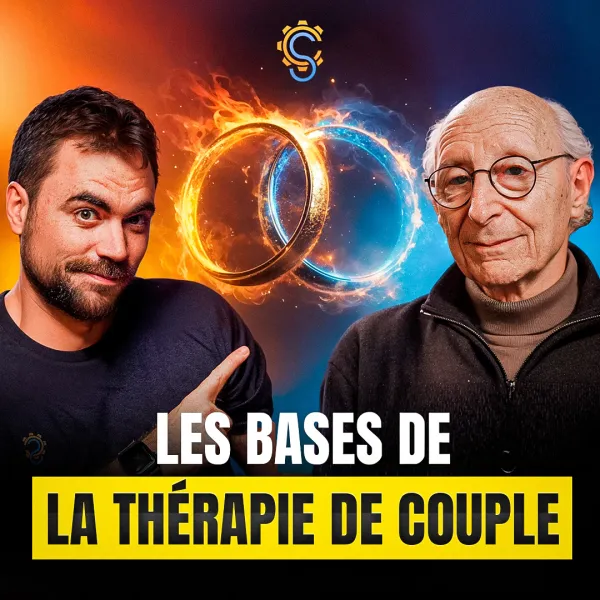
Master the foundations of couple therapy with Dr. Robert Neuburger
Couple therapy
- The beginning of therapy
- The therapeutic setting
- In person or remote
- The adequacy of the request for therapy
- Inadequate requests
- Welcoming the request
- Understanding the problem
- Circularity
- The main difficulties of couples
- Couples without couple problems
- The system’s plasticity
- The question of separation
- Sexuality
- Physical contact
- Intervening in the sexual sphere
Interview simulations
- Pierre and Nathalie - First session
- Pierre and Nathalie - Second session
- Pierre and Nathalie - Debriefing
- Danielle and Julie - First session
- Danielle and Julie - Second session
- Juliette and Thomas - Second session
- Danielle and Julie - Third session
- Danielle and Julie - Fourth session
- Danielle and Julie - Fifth session
- Rachel and Jean-Baptiste
- Juliette and Thomas - First session
Master the foundations of couple therapy with Dr. Robert Neuburger
Master the foundations of couple therapy with Dr. Robert Neuburger
A structured training to acquire a solid conceptual, clinical and technical base in systemic couple therapy.
Robert Neuburger shares here the foundations of his thinking, his reading of the conjugal bond and his singular way of intervening with couples. The pathway is built to pass on the essentials with clarity, without impoverishing clinical complexity.
In collaboration with Julien Besse, the training weaves together teaching input, pedagogical perspectives, concrete tools and debriefed simulations of fictional interviews. It has been designed to support a real increase in competence, directly reusable in practice.
The video lessons are in French, with subtitles. You start as soon as you purchase, progress at your own pace, revisit the sequences as many times as needed, and benefit from future updates at no extra cost.
Everything is included upon purchase • Unlimited, evolving access
A clear, rigorous and directly usable clinical transmission
The course clarifies the conceptual bases of systemic couple therapy and lets you enter the approach with a structured vision rather than a pile of isolated techniques.
The contents address very concrete questions: the request for therapy, the therapeutic frame, conflicts, separation, sexuality, the system’s plasticity, resistances and couples’ difficulties in session.
The simulations of fictional interviews and the clinical debriefings give access to the therapist’s reasoning, intentions and adjustments, which makes the learning much more transferable.
What this training helps you develop
- Mastering the conceptual and clinical bases of systemic couple therapy.
- Setting a flexible, containing and reassuring therapeutic frame.
- Understanding the couple’s dynamics: founding myth, rituals, intimacy, money, sexuality, the bond’s limits.
- Accompanying diverse requests: open conflicts, silences, asymmetries, ruptures, therapeutic deadlocks.
- Mobilising concrete tools to guide the intervention and support clinical practice.
Who this course is for
This training is for professionals or future professionals who wish to acquire a clear and serious base in couple therapy.
A transmission carried by a major reference in couple therapy
Robert Neuburger, psychiatrist, psychoanalyst and couple therapist of international renown, shares here his fundamental concepts, his clinical stance and his way of intervening with couples.
He is accompanied by Julien Besse, systemic psychologist and trainer, who provides a clear, current and directly assimilable pedagogical structure.
The course is also enriched by the participation of Yara Doumit Naufal, Isabelle Duret, Ivy Daure and Julie Nicol.
55 lessons organised in progressive blocks
The pathway takes you from the historical and conceptual foundations to the intervention tools and interview simulations, linking understanding, stance and practice.
Introduction
- Welcome to the pathway
- Entering the spirit of the training
History & foundations
- Why couple therapy?
- Preliminary considerations
- How it all began
- Stance and appropriation of the tools
Building the couple
- Formation of the contemporary couple
- Founding myth
- Compatibility
- Tensions between romanticism, narrative and reality
How the couple works
- Expectations and the territory of intimacy
- The couple’s limits and functional myth
- Rituals and money management
- Same-sex couples, blended families, the couple’s places
Couple therapy
- Starting therapy and the setting
- In person or remote
- Welcoming the request and spotting mismatches
- Circularity, frequent difficulties, separation, sexuality
Therapeutic techniques & tools
- Family map and problem basket
- Relatiogram, belongingogram
- Systemic cartouche and sculpting
- Couple’s coat of arms, crossed beliefs, Amour Monstre
Interview simulations
- Filmed fictional interviews
- Commentary on the therapeutic intentions
- Clinical debriefings by Robert Neuburger
- Learning as close as possible to practice
Conclusion & extensions
- Synthesis of the pathway
- A lasting resource for practice
- Regular updates included
What you receive
- Over 7 hours of video
- 55 lessons organised by chapters
- Written summaries
- Tools, exercises and practical sheets
What makes the difference
- A direct transmission from Robert Neuburger
- Structured pedagogical guidance
- Simulations of fictional interviews
- Debriefings to understand the clinical choices
What this format allows
- Start immediately
- Work at your own pace
- Return to any chapter at any time
- Use the course as a resource over time
A flexible, complete and lasting format
An evolving course, not a frozen content
Every participant benefits from the programme’s regular updates. This includes new filmed simulations, complementary thematic videos, practical sheets, templates and contributions from other invited experts.
The idea is simple: you are not buying disposable content, but a resource that keeps growing.
Entering couple therapy with a serious, lively and reusable frame
This training is designed for those who want to acquire solid foundations in couple therapy, supported by clear teaching, fictional cases, concrete tools and lasting access over time. The videos are in French, with subtitles.
1 lesson
Understanding where couple therapy comes from… and in what spirit to enter it
This first chapter lays the foundation on which the whole training unfolds. In three complementary sequences, Robert Neuburger invites us to understand why and how couple therapy established itself as a specific practice, distinct from family therapy or marriage counselling.
He also shares the stance in which he offers this transmission: not as an instruction manual, but as a sharing of tools, to be appropriated according to one’s style, one’s clinical practice, one’s values.
Through a reading that is at once historical, systemic and existential, this chapter covers:
- the emergence of couple therapy in the face of the crumbling of traditional frames (extended family, work, institutions);
- the fundamental distinction between family therapy and couple therapy, centred not on a “designated patient” but on a bond between two subjects;
- the need, for each therapist, to cultivate a singular, non-prescriptive stance, founded on the thoughtful appropriation of clinical tools.
A rigorous and committed opening that sets out from the start the contemporary stakes of couple therapy and places the training in a dialogue between experience, ethics and therapeutic freedom.
4 lessons
Between encounter, narrative and compatibility
This second chapter explores the founding dynamics of the contemporary couple, at the crossroads of the emotional, the symbolic and the pragmatic. Robert Neuburger develops a systemic reading of the process by which the conjugal bond is constituted, in three major steps.
An unprecedented context
Today’s couple forms in an unprecedented cultural and social context: plurality of configurations, decline of spontaneous commitment, rise of individualisation… all factors transforming the ways of “being a couple”.
The founding irrational
What Neuburger calls the founding myth: an imaginary narrative that gives the encounter a particular meaning and grants the couple a symbolic legitimacy.
The rational parameters
Compatibility (values, families, projects, places to live…), just as decisive for building a lasting bond — with the emergence of the pre-couple, that intermediate phase of living together to test the relationship.
The founding tensions of the couple: between romanticism and lucidity, between the desire for a sustaining “us” and the concern to preserve one’s freedom. An essential basis for understanding the clinical stakes to come.
3 lessons
From founding dynamics to the subtle adjustments of daily life
This central chapter explores the internal mechanisms of the couple, its structuring forces, its zones of vulnerability, and the many ways partners try to build a lasting, living “us”. It draws on Robert Neuburger’s thinking, the clinical contributions of systemic therapy, and the specific pedagogical developments of the Complexe Systémique.
Expectations and intimate territory
We first discover the fundamental expectations underlying conjugal commitment, often asymmetrical or silent, yet decisive. The couple is built as an intimate territory, whose cartography is as emotional as it is symbolic — with the six forms of intimacy that each relationship articulates in its own way: emotional, creative, everyday, intellectual, existential and sexual.
The essential dimensions of couple functioning
- The question of the couple’s boundaries, between openness to the world and protection of the bond.
- The role of functional myths in the identity construction of the duo.
- Money management as a revealer of power relations, values and solidarity.
- The capital importance of rituals, which can strengthen or reinvent the relationship at key moments of its life cycle.
This chapter also offers an exclusive deep dive: an original typology of conjugal rituals in three categories (ordinary, constitutive, performative), developed by Julien Besse and presented in the training “Rituals in the couple: Resources, Repairs and Reinventions”.
Two specific contexts
- Same-sex couples, who raise particular issues, notably around parenthood or the social gaze, but whose conjugal dynamics do not fundamentally differ.
- Blended couples, where loyalty conflicts, territorial issues and family entanglements demand an attentive and often differentiated systemic gaze.
The keys to understanding what holds a couple together… or makes it waver: the tensions between personal aspirations, symbolic regulations and common construction. A precious basis for refining one’s reading of conjugal dynamics and enriching one’s intervention toolkit.
10 lessons
Behind the scenes of the craft
Couple therapy is not simply the meeting between two suffering partners and a benevolent professional. It constitutes a singular, demanding, often disconcerting space, where present conflicts, inherited pasts, disappointed dreams and contradictory expectations intertwine. Intervening in this field requires great clinical finesse, ethical clarity and strategic flexibility. Robert Neuburger guides us with the clinical precision, anthropological lucidity and discreet humour that characterise him — as close as possible to the reality of the consulting room, far from rigid manuals or mechanical protocols.
The major stages we will go through together
- The beginning of therapy: how to receive a couple? What to do from the first phone call? What elements to explore to build a secure frame?
- The therapeutic setting: therapist alone or in co-therapy? In the office or remotely? What stance to adopt towards out-of-session intrusions?
- Requests for therapy: how to differentiate a request for help from an attempt at manipulation? What are the therapist’s prejudices and how do they influence the reception of the request?
- Forms of problems: from the passionless “rational” couple to the fusional couple that has fallen out of love, via parental conflicts or existential crises.
- The system’s plasticity: can it still change? How to assess the possibilities of evolution? What rituals to prescribe to test a couple’s flexibility?
- Key concepts: notably circularity, a central lever of understanding and intervention, thought of as a genuine technique of systemic decoding.
- And when separation becomes inevitable? How to accompany the end of a bond with dignity, without failure or illusion? How to protect the children and support the transition?
A dive into real sessions, with the therapist’s words, doubts, adjustments and proposals — and an invitation to build your own stance, sharpen your gaze and appropriate the concepts in a flexible, embodied, contextual way.
15 lessons
- The beginning of therapy
- The therapeutic setting
- In person or remote
- The adequacy of the request for therapy
- Inadequate requests
- Welcoming the request
- Understanding the problem
- Circularity
- The main difficulties of couples
- Couples without couple problems
- The system’s plasticity
- The question of separation
- Sexuality
- Physical contact
- Intervening in the sexual sphere
Floating objects, metaphorical devices and intervention strategies
When speech runs out of steam, mutual understanding jams or the system gets bogged down in sterile repetitions, it becomes essential to be able to rely on creative techniques and symbolic tools to relaunch the therapeutic process.
A panorama of clinical devices
This chapter offers a panorama of clinical devices from the systemic tradition, tested and proven in couple or family therapy. Some have become classics of the systemic practitioner’s toolbox (coat of arms, sculpture, problem basket), others are bold contemporary creations, such as the crossed-beliefs game or the Systemic Cartouche.
Each tool is presented in its theoretical anchoring and its practical use, through demonstrations, clinical examples and adaptation proposals — insisting on the conditions under which each tool can prove powerful, relevant, or on the contrary counter-productive.
“Floating” objects
All these objects have in common that they are floating: they circulate in the therapeutic space, escape the sole logic of the verbal, and allow a symbolic co-construction of meaning, through play, gesture, image or metaphor.
Whether you are at the beginning of the therapeutic journey or facing a blockage, these tools offer strategic and sensitive supports to stimulate the alliance, bypass resistances or reactivate the intelligence of the bond.
10 lessons
11 lessons
- Pierre and Nathalie - First session
- Pierre and Nathalie - Second session
- Pierre and Nathalie - Debriefing
- Danielle and Julie - First session
- Danielle and Julie - Second session
- Juliette and Thomas - Second session
- Danielle and Julie - Third session
- Danielle and Julie - Fourth session
- Danielle and Julie - Fifth session
- Rachel and Jean-Baptiste
- Juliette and Thomas - First session