Red Sistémica · Family and health
AIDS: family experience and emotions
“When family experience and emotions come into play: the group arises as a constructive context for an ecology of innovative ideas around the HIV-positive status of one’s children”
The authors describe a group experience of ten sessions with four mothers accompanying their sons and daughters infected with HIV. The aim was to co-create a conversational context in which suffering and isolation would be replaced by a new attitude: these mothers would thus become a salutary perturbing element within their own family system. The approach chosen is the social constructionist paradigm, according to which emotions, conduct and the sphere of action are constructed in conversational contexts. The methodology used in this action research is described, including everything that has to do with the conduct of the group.
Translator’s note
This text gives an account of an action research carried out in Italy in the mid-1990s and published in 2004. It describes what families lived through, the organisation of care and the epidemiological data of that period. It has not been updated and therefore does not reflect the current state of knowledge or of treatments.
“Blessed are those who know that suffering is not a crown of glory… Blessed is he who does not insist on being right, for no one is right, or everyone is.”
J. L. Borges
By way of introduction
This experience was born of the intention to respond to the suffering, the withdrawal and the isolation into which families very frequently fall when they learn that their own child is HIV-positive. When the diagnosis of infection by the HIV virus is confirmed, it is not uncommon to observe reactions of extreme fear and confusion in the people concerned: the one who has been infected, the partner and the parents react with despair, seeking to flee, so that there is a tendency for problems to multiply on the psychological level, but also those that have to do with the secondary prevention of the infection, with poor adherence to treatment, with suicides (seventeen times higher than the average), with psychiatric breakdowns.
A first objective, which we had set ourselves as we reflected on the usefulness of our proposal, was to find modalities of intervention capable of contributing to reversing (to inverting?) this negative tendency among the relatives informed of the child’s HIV-positive status, by fostering the construction of new languages, able to bring about a different relationship to the presence of the infection in the family as well as to the carrier of the virus. It was a matter of fostering a passage from despair towards the construction of new styles of relationship within a family context marked by a mixture of emotions — ranging from demoralisation to despair — with the main objective of interrupting the situations of isolation into which these families very often tend to fall.
Many experiences of clinical group work with HIV-positive people (self-help, psychotherapy, psychological support, etc.) have shown the value of this technical resource — regarded as an adjuvant to individual psychotherapeutic help — above all as regards fostering a new relationship to oneself within the family, to others and to the infection. In this sense, it can be affirmed that the construction of a new relational context around the HIV-positive subject can stimulate an evolutionary process at the end of which the “brute facts” (for instance the infection) and the emotions linked to them can take on an entirely new meaning: the premises are thus created for a change in the very way of approaching the problem.
We had thought that it would be useful to try to tackle these problems starting from the other end of the system created around HIV-positive status, that is to say from the parents. This idea rested on the following consideration: there is a potentially salutary impact that parents can exert within the affective and relational network built around the HIV-positive member of the family. We were relying in addition on the observations made in a field where, when relatives (generally the mothers) stand by HIV-positive people, they frequently constitute the most important everyday existential and affective support.
From self-help groups to social constructionism
The challenge consisted in creating a group with a psychotherapeutic valency, made up of parents of an HIV-positive child. An experience that had to start from premises and presuppositions different from those of traditional support groups, where the emphasis is placed very strongly on moralising aspects, often with a guilt-inducing bias, in the illusion of “educating”, by privileging strictly instructional aspects. In other words, what is stressed there is the idea that there must be within the group a consensus on what is “best and healthiest” as regards the way of relating to the infected member. According to this premise, the leader of the group adopts a maximally directive position: he suggests or imposes, more or less directly, certain behaviours on the members of the group.
We structured a group of mothers, with a number of meetings determined in advance (ten). The methodology drew its inspiration from social constructionism. This paradigm ascribes the construction of knowledge to social relations, to conversation. Knowledge is therefore regarded as an exclusively social product, mediated by language. According to this view, forms of knowledge evolve in the space between people, in the dance we dance together; interpersonal relations are systems of language and of meanings.
Once this premise is laid down, the methodological conditions are met for defining technically the conduct of the group: a moderately directive position is adopted there in the conversation. The participants, for their part, become involved with the availability of those who open themselves to novelty and to the possibility of being surprised, making the value of differences their own. From there opens up the possibility of creating consensuses that make it possible to go beyond the suffering and the rigidity of the previous relational style. One thus goes in a direction opposite to the one that aims only at confirming personal hypotheses about “how things really are”. The point of this was to create a context in which deutero-learning would be possible. This emphasis placed on epistemological aspects seeks to foster the discovery of unforeseeable paths in the face of the question each mother formulates in this situation: “how am I to relate to my child’s HIV-positive status?”
Beyond the construction of this different way of being together in conversation, it was also a matter of bringing about an awareness of the complexity of the problem, and therefore of the impossibility of creating a standardised modality of relating within the family.
Some theoretical considerations… (to be continued)
Who are the authors
José Aguayo is a psychologist and psychotherapist at the Centre for Family Therapy of Treviso.
Vittorio Foschini is coordinator of the AIDS sector at the Ministry of Public Health, in Ravenna.
Manuela Zambianchi is a psychopedagogue and researcher.
Appendix
Anonymous questionnaire
- What do I expect from these meetings?
- In your view, what do the members of your family expect from your taking part in these meetings?
- List the situations in the face of which you feel “disarmed”, or that seem to you the most problematic, in relation to the HIV-positive status of your son or your daughter.
- Taking part in these meetings can help me to…
- If I had to give a name to what I am going through today in the face of the HIV-positive status, it would be…
- If I had to give a name to what the other members of my family are going through in relation to the HIV-positive status, it would be…
- The present moment, for me, as regards living with the HIV-positive status in the family, I define as…
- For me, having an HIV-positive relative means…
- If I wanted to feel of greater help to my HIV-positive child, I would have to…
- What I hope to receive from the members of this group.
- What do I feel I can give to the members of this group?
Transcription of the answers given to the anonymous questionnaire by each of the mothers taking part in the group.
An extract
Red Sistémica publishes online only an extract of this article: the full text, with the answers of the four mothers to the questions of the appendix, appeared in no. 80 of the journal Perspectivas Sistémicas (“Couples: passion and the clinic”), of March-April 2004. Our translation covers the whole of the extract put online, and nothing more; the rest of the text is not accessible to us. Read the original extract in Spanish.
References
Abric J.C. (1989) Un approccio teorico e sperimentale allo studio delle rappresentazioni sociali in una situazione di interazione, in: M. R. Farr e S. Moscovici (a cura di) Rappresentazioni sociali, Il Mulino, Bologna.
Aguayo J. (1990) Una proposta sistemica nella ricerca psicosociale: esperienza comunitaria con un «Club de Madres» a Lima, Il Bollettino, 22, Centro Milanese di Terapia della Famiglia.
Aguayo J. e Foschini V. (1995) Dalla pragmatica all’estetica: un cambiamento necessario per un’esperienza di formazione-sostegno con volontari che assistono persone ammalate di AIDS in fase terminale, Personalità/Dipendenze, vol. 1, Modena.
Bianciardi M. e Telfener U. (a cura di) (1995) Ammalarsi di psicoterapia. Il rischio iatrogeno nella cura, Franco Angeli, Milano.
Boscolo L. e Bertrando P. (1996) Terapia sistemica individuale, Raffaello Cortina Editore, Milano.
Goudsmit A. (a cura di) (1995) L’auto organizzazione in psicoterapia. Demarcazioni di una nuova prospettiva, Guerini Studio, Milano.
Lannamann J. (1991) Interpersonal communication. Research as ideological practice, Communication Theory, 3.
Maturana, H. y Varela F. (1984) El árbol del conocimiento, OEA, Santiago.
Pearce B. and Cronen V. (1980) Communication, action and meaning, Praeger, New York.
Pearce B. (1995) Comunicazione e condizione umana, Franco Angeli, Milano.
Rigliano P. (1994) L’AIDS e il suo dolore, Ed. Gruppo Abele, Torino.
Shanasi H.C. (1971) The war without words. Structure and transcendence, Mouton, The Hague.
Shotter J. (1987) The social construction of an «us», in R. Burnett, P. McGhee and D. Clark (eds) Accounting for relationships: explanation, representation and knowledge, Methuen, London.
Sontag S. (1992) Malattia come metafora: AIDS e cancro, Einaudi, Torino.
Ugazio V. (1995) Il costruzionismo sociale: alcune conseguenze cliniche, in Epistemologia in psicologia clinica, G. P. Lombardo e M. Malagoli Togliatti (a cura di), Bollati Boringhieri, Torino.
Zambianchi M., Foschini V. e Aguayo J. (1996) Ricerca/intervento con genitori a conoscenza della sieropositività (AIDS) del proprio figlio. Acta del Congreso Internacional «Toxicodependencia y SIDA», Universidad de Rosario, Rosario-Argentina.
This article is an English translation of “SIDA: Vivencia y emociones familiares”, published by Red Sistémica (first published in Perspectivas Sistémicas, n° 80, mars-avril 2004). Translated and republished with the journal’s permission.
Read the original articleHow to cite this article
Aguayo, J., Foschini, V., & Zambianchi, M. (2022). AIDS: family experience and emotions (Complexe Systémique, Trans.). Complexe Systémique. https://app.complexe-systemique.com/en_GB/articles/aids-family-experience-and-emotions (Original work published in 2004 in Perspectivas Sistémicas, n° 80, mars-avril 2004; republished in 2022 by Red Sistémica, https://redsistemica.ar/2022/07/15/sida-vivencia-y-emociones-familiares/)
To go further
- Ecology of ideas. Constructivism, social constructionism and narratives: at the limits of the systemic approach?The underlying debate about the conversational paradigm this group experience lays claim to.
- Community family therapyAnother group arrangement that makes the network of those close to the patient the main lever of change.
- Family crisis at the disclosure of the homosexuality of one of its members. Forms of presentation, essential information, psychological supportWhat becomes of a family when a disclosure abruptly consigns it to secrecy and isolation.
Related training courses
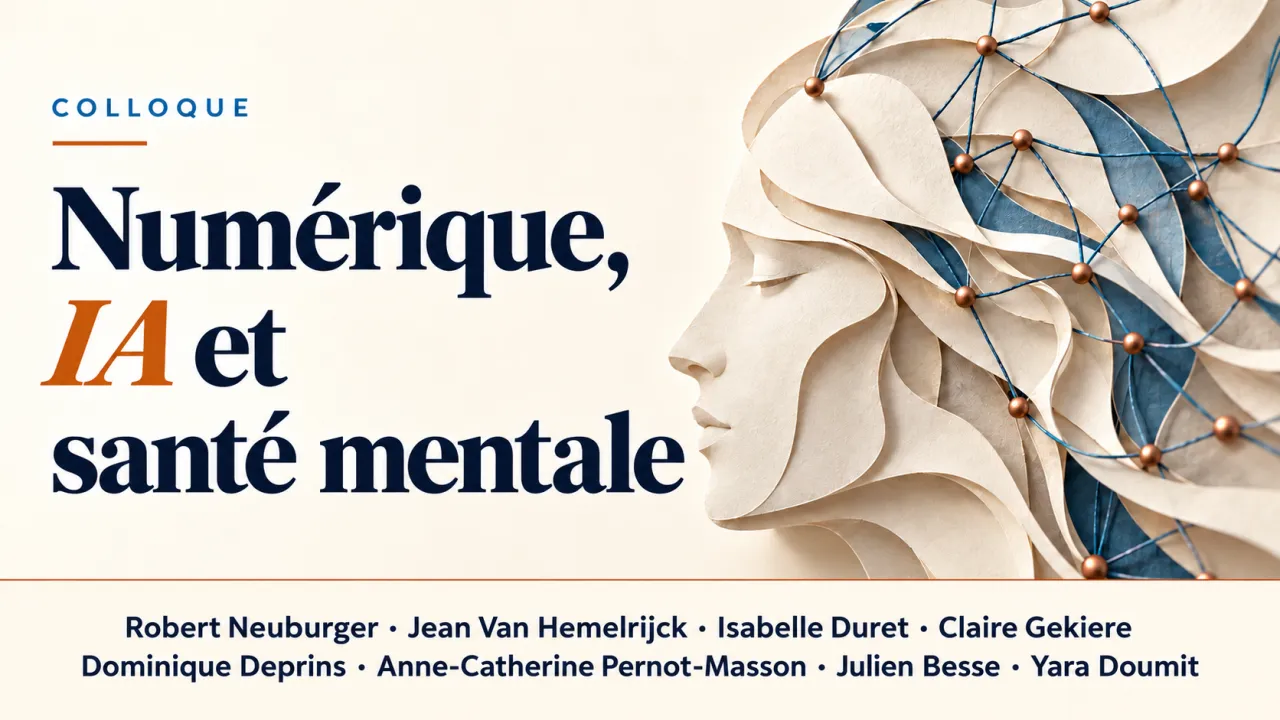 Symposium
Digital technology, AI and mental health
Conference in Lyon, 11 December 2026: digital technology, artificial intelligence and mental health. Six talks, replay for participants. In French.
 Short course
The suicidal crisis in adolescents and young adults
Training: assessing and supporting the suicidal crisis in adolescents and young adults. Clinical landmarks and systemic tools. In French.
Related articles
 Article
 The AFFIRM Model for Navigating Challenges in Continuously-Interfaith and Divergent-Interfaith Marriages
Thirty happy interfaith couples describe how they navigate their religious differences: five processes, from respecting each other’s choices to religious intimacy, gathered in the AFFIRM model.
 Article
 Toxic, narcissistic, borderline: what therapy speak does to your relationships
Narcissistic, borderline, toxic: therapy speak has left the consulting room. Julien Besse shows how these labels close the debate and relieve us of our own part.
 Article
 First Psychological Aid for Families During War: Integrating the Narrative Approach With Emotionally Focused Therapy (EFT)
Three or four meetings for families living under the threat of war: telling their story before a witness, then repairing the attachment cycle disrupted by fear.
 Article
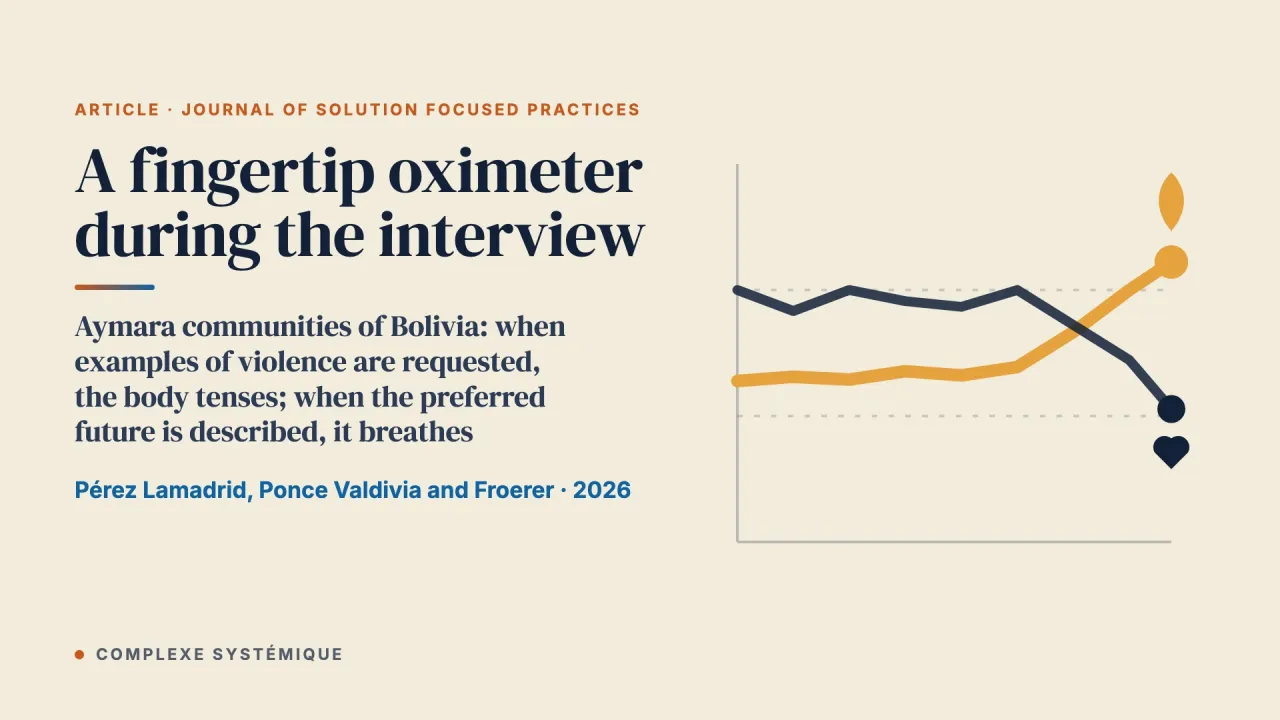
 Oxygenation and Heart Rate in Solution-Focused and Problem-Focused Interviews With Rural and Indigenous Aymara Communities (Viacha and Laja) Regarding Intersectional Violence
A fingertip oximeter on 19 Aymara people of the Altiplano: the problem-focused interview tenses when examples of violence are requested; the solution-focused one oxygenates and slows the heart.
Comments 0
Log in to join the discussion. Log in