Red Sistémica · Family therapy
Family crisis at the disclosure of the homosexuality of one of its members. Forms of presentation, essential information, psychological support
There are many kinds of events in the lives of individuals and of families. Of various sorts, of various meanings and, of course, rich in a multiplicity of turns and resolutions. There is one type of crisis that, by the very nature of my speciality, I have had occasion to see and to attempt to resolve on many occasions: I am speaking of the family crisis set off by the confession, by one of its members, of their homosexuality.
Translator’s note
This text, whose references stop at the end of the 1980s, was written by a clinical sexologist at a moment when homosexuality had just been removed from the psychiatric classifications. Its vocabulary — the “confession”, the “problem member”, “sexual identity disorders”, the use of the word “gender” to designate the orientation of desire — bears the mark of that period. We translate it as it stands, without correcting it: it documents the state of the knowledge and of the clinical reflexes of its time as much as the family crisis it describes.
“The confession of homosexuality within a family group opens onto a great variety of upsetting developments, and it is an opportunity to learn and to change.”
Juan Carlos Kusnetzoff
Phenomenal description of a few prototypical antecedents
There are two polar characteristics in the families this work is concerned with. The first is that of the family which, at the time of the consultation, reports having known “all along” that the son or the daughter had a problem of sexual identity, or at least having suspected it for good reasons. Almost always, this type of family sought psychological help as early as the childhood of the designated member, or received help of that kind. Very often the care was medical, of an organic sort, with a particular prevalence of the endocrinological side.
The second type of family, far more frequent than the other — in my experience —, presents entirely opposite histories. The family member who is a problem today never gave any sign of sexual identity disorders; he may even have gone out with and had (or claimed to have had) heterosexual sexual relations. He may or may not have received medical and psychological care, but for reasons far removed from the problems he presents today.
The first type of family (type I family) presents a family picture in which psychosomatic conditions prevail, variable in their presentation and in their course over time, and which can also be identified in the extended family: uncles and aunts, grandparents, and so on. In some cases, and where it is possible to conduct the inquiry, one finds confused family histories in the past, with a “strange” or deranged figure, dissolutions of bonds, formal divorces, emotionally charged situations of emigration in earlier generations, the death or the disappearance of a highly significant parent, and the almost mythical description of a more or less close member of the family who was homosexual but who, at the time of the clinical interview, is not named as such: he is spoken of in euphemisms, through various detours, when he is not passed over in silence altogether.
The second type of family (type II family) presents itself as “normal” (sic). There is no problem member, either in the family nucleus or in the extended family; or, if there was one, there is no dramatic emotional investment, at the time the data are gathered, bearing on today’s case. This same “pattern” is repeated, with slight variations, in the almost complete absence of bodily problems among the other members of the family or in the general medical history, and there are few significant fractures or ruptures of bonds. Many of its members may do relatively well in the tasks they carry out, but the characteristic feature is the general feeling of calm and the rarity of “storms”, whether emotional or of the order of events.
Case 1. Example of a type I family
This is a family made up of the father, the mother and two children: the boy, 26 years old, and the young woman, 19. All of them come to the consultation except the younger sister, the object of everyone’s concern. For quite some time now she has kept “strange” company, and she has lately expressed the wish to live on her own; in fact she is going to do so with the woman who is her partner, a young woman of her own age whom she has known for a year. The announcement did not come as much of a surprise, except to the father, “because they already suspected it” (sic). There have been long conversations with the brother, who “does not understand” and has tried several times to introduce male friends to her…
The two parents blame each other, repeatedly, over various matters bound up with upbringing, particularly when she was a child, a period during which two temporary separations of the parental couple occurred. They accuse each other of having abandoned the children. There is one antecedent: a distant cousin of the mother, homosexual as well, of whom nothing has been heard for sixteen years. The father is diabetic, obese and hypertensive; he was hospitalised once. He has a brother with a gastric ulcer. The mother has suffered for eleven years from polyarticular rheumatism and, for frequent metrorrhagia, underwent a hysterectomy ten years ago. The elder brother had a serious accident at eighteen: multiple traumas, loss of consciousness for forty-eight hours, hospitalisation for forty days.
Case 2. Example of a type II family
Both parents come to the consultation, extremely anxious and in a hurry to speak. Eight days ago the youngest of three children, twenty-one years old, gathered them together and confessed to them “his homosexual life choice” (sic). The parents knew nothing of it, had never suspected anything strange, and the information produced an emotional impact that has gone on for days: weeping and mutual reproaches interwoven with periods of dejection and of rage. There is no similar antecedent in the family and, apart from the ordinary complaints, “we don’t know what a doctor is” (sic).
There was a first attempt to hide the confession from the other two children, but after the first two or three days the information was “brought out into the open”, in the father’s own words.
The impact and the response
I have tried to describe in polar fashion the differential typology of these families, because the response to the impact of the news and the paths that lead to the resolution of the family conflicts are themselves different too, and can be anticipated, in their structure, from the very first moment.
The type I family, once the earliest moments are past, generally goes through stormy developments. They range from an unbridled motor agitation that may last for days to singularly serious psychopathic attitudes “of conspiracy”.
Case 1 (continued)
Once the first minutes of the interview were past, I asked for news of the problem daughter. I was told curtly that she had not been able to come. I was given a rational excuse, and I went on with my questions. I then insisted, and I was told that there would be no problem at all about her coming, “but later on” (sic). Only at the second interview was I able to learn the following: convinced that their daughter was ill and, above all, that she had been “abducted” by her homosexual partner, they had decided to “kidnap” her — by means of ruses, of course —, to inject her intravenously with a hypnotic substance and to have her admitted so that she could be “given a sleep cure and be healed” (sic) in a psychiatric clinic on the outskirts of the city. The father argued that in such cases “one must act quickly and with energy”, because afterwards “there is nothing more to be done”, and afterwards “homosexuality is beyond recovery” (sic).
Case 2 (continued)
The younger son’s confession of homosexuality produced a “cataract” of almost continuous weeping between him and his parents. The latter maintained for days that “he was surely influenced maliciously and talked into adopting homosexual attitudes by his friends and, above all, by his therapist”. The disturbances that followed did not go beyond two days of absence from work, a stubborn insomnia and, in the father, a strong forced control over the outward expression of his affects of rage.
A short digression of scientific information
Although the majority of scientists, and in particular the psychological and sociological community, endeavour to understand, to study and to conceptualise homosexuality, we shall have to acknowledge that the immense majority of the population displays various forms of rejection and/or attitudes of exclusion towards homosexual people. The ideas people form about them are steeped in prejudices and popular myths of every kind. It is not rare to find these preconceived ideas in cultivated people, or even in health professionals.
The word “homosexual” derives from the Greek root “homo”, which means “the same” (it will be noted that this is not the Latin word “homo”, which means “man”). The term is therefore to be applied to one sex as much as to the other. The term “lesbian”, which designates homosexual women, refers back to the Greek poet Sappho, who lived on the island of Lesbos some six hundred years before Christ. The fragments of poetry that have come down to us she wrote for other women; they are full of charm, of aesthetic seduction and of classical beauty.
The term “gay” — a near-synonym of the term “homosexual” — made its “official” appearance in June 1969, when a large group of homosexuals, harassed by the police in a bar in Greenwich Village, New York, rebelled with violence and determination. At the same time as the Homosexual Liberation Movement was born, so was the term “gay”, an English turn of phrase meaning “merry”. The term aims to underline the way of life far more than the genital and sexual aspects of homosexuality. This last term is loaded with disparagement and contempt, and is used connotatively in order to disqualify.
It is extremely important to make it known that, since 1974, homosexuality has no longer been considered an illness. So it was decided by the American Medical and Psychiatric Association, and only ego-dystonic homosexuality is considered a problem in the medical and psychological consultation. 1, 2
It becomes indispensable to know that the scientific term “sex”, strongly biological, is one thing, and the scientific term “gender”, strongly psychosocial, is another. On the chromosomal, anatomical and hormonal level, a person may be a woman or a man (sex), and the orientation of their sexual desire may be, wholly or partly, directed towards people of the same sex (gender).
Main operational interventions with these families
I retain a few concepts that have shown themselves to be effective with these families in crisis. “The crisis is the turning point after which things will go better or worse” 3. On the basis of this definition, and as a simple major premise, it must be understood that the confession of homosexuality within a family group opens onto a great variety of upsetting developments, and that it is an opportunity to learn and to change. We therapists have our own opportunity as well to contribute to the change of these families, and we do so by distinguishing — as far as possible — the “crisis” from the “stress”.
Difference between “crisis” and “stress”
Crisis
It presents itself as the consequence of a stress that exerts a pressure.
The changes are non-specific.
These changes disorganise, incapacitate and/or prevent problems from being solved by the usual methods of individuals or of family systems.
Stress
It is a force that exerts a pressure, breaks in and tends to distort.
The changes are specific.
What is stressful for one family may not be so for another. This is directly related to values, to expectations and to the nature of the bonds.
Family I, or the “structural crisis”
From the point of view that treats crises as variables and takes into account the difference between the various types of stress factors, I hold family I to be a matter of a “structural crisis”, and family II a matter of a “crisis in the face of unexpected events” 4.
The characteristics of the “impact-stressor factor” and, above all, the response of the system make the category of “structural crisis” the one that applies to family I. In fact, the disclosure of homosexuality exacerbates a pre-existing “pattern” within the family, and that is the distinctive trait. The triggering factor remained covered and “was waiting” for the conditions in which to surface. It is evident that this type of family reacts out of all proportion to the factor that precipitates the crisis: it obscures that factor, pushes it into the background and calls for an uncommon therapeutic effort.
For everything that has just been said, the differential diagnosis with the other type of crisis, the one presented by type II families, is crucial, since the operational action and, still more, the prognosis of the course of events are different.
For family I, learning from crises and turning them to account — and the crisis of homosexuality is only one among many others — become difficult. “All the family’s energy goes into avoiding change, no matter what stresses are mishandled along the way” 5. It is very likely that it is the characteristic “pattern” of the various crises that is gratifying, that works as a reward, and that prevents changes and the contribution of more rational solutions. The therapist will have to be forewarned of the difficulty of his role and of his position. His situation will be one of clear instability, with an uncertain future. Voluntaristic or enthusiastic attitudes have no place here, and the professional has a magnificent opportunity to observe and to learn how some of the most destructive attitudes or roles fulfil functions of alliance or of union that resist any attempt in the opposite direction.
The type II family, or the “crisis of unexpected events”
The triggering factor here — the younger son’s confession of homosexuality — falls like “a cold shower”. The crisis is set off by an explicit, unique, specific event experienced as extrinsic. Here, after the initial impact, the family closes ranks. The traumatic factor is assimilated rapidly, and its metabolisation is taken on by everyone. The event has no antecedent within the group, it could in no way have been anticipated, and there was and there is no ground for attitudes of “prevention” of a similar event. Here the therapist stands a chance of allying himself with the whole family group, of setting about administering and distributing the necessary resources and, above all, of keeping the family in working order.
The appearance of reproaches, in variable quantity, is frequent: it is an effort to find someone or something that might have avoided or attenuated the crisis. It is logical that at that moment various events from the family history or shortcomings of a personal and family order should be “brought up”, and that a variable responsibility for today’s crisis should be attributed to them. In the case of the confession of homosexuality, one typically finds the reproach of the absence of one of the parents, particularly of the father, or of the “lack of communication” between the members of the couple, or else of “hard” or “machista” attitudes towards sexuality in general in one or other of its members. The effort to contribute and to collaborate clearly predominates, however, and the old narcissistic claims recede into the background.
Key takeaway
Distinguishing the two configurations is in no way academic: it governs the place the therapist can occupy. In the type I family, the disclosure comes to reactivate a functioning that was already there; the professional works there from an unstable position, unable to count on an alliance from the outset. In the type II family, the event is experienced as having come from outside, the group closes ranks around it, and the therapist can ally himself with the whole in order to keep the family in working order.
General indications for these two types of families, faced with the same event
We shall leave for another time the detailed examination of the various obstacles that arise when these two types of families are treated. We shall dwell on the handling of the crisis, faced with that specific event which is the confession of homosexuality.
1) Acknowledging the extreme concern of everyone
This step, so simple and so obvious that it would seem not even to need mentioning, is often skipped: in the name of urgency, or of an excessive scientism that rushes through the steps of a cognitive order in order to inform and to explain in detail.
The members of the family need to be acknowledged in their surprise, their pain, their exasperation and their powerlessness. Naming these feelings several times over, understanding the situation, making it explicit in various ways that the professional “puts himself in the place” of the patients: this brings relief, as a rule, and provides a fundamental basis for going forward.
2) Identifying the family’s particular resolution
The next step consists in noting in detail — if the family does not do so spontaneously — what was done at the moment when the confession, or the coming to light of the homosexual problem, took place. This will give a first idea of the particular type of family we are dealing with, and of the resources at our disposal.
3) Information in measured doses
Only once the two preceding steps have been fully accomplished shall we be in a position to supply the relevant information.
This information involves a few characteristic themes, some of a general order, others strategic, which the professional will dose according to the type of family, according to the circumstances and according to his experience:
a) Homosexuality is not an illness.
b) Homosexuality is not an organic problem, still less a hormonal or “glandular” one; it is therefore pointless to multiply consultations with different specialists of varying prestige, since from these consultations and from the biochemical tests he will be put through there will emerge a “there is nothing wrong with him”, which will increase frustration, confusion and pain, among other things because of the time lost.
c) Encouraging — at the same time, and after the preceding point has been made explicit — consultation with other specialists, physicians or psychologists; or at least supporting that decision and seeing to it that no sign, of any kind, comes to oppose these wishes, which experience shows are always present.
d) Showing that it is pointless to go looking for “a prostitute” — in the case of boys — or to “introduce a male friend to her” — in the case of girls —, a very common manoeuvre which is part of the “popular therapeutic mythological arsenal” and which has harmful consequences for the later course of the crisis.
e) Showing oneself interested and almost always concerned — especially in the case of type I families — by the somewhat unusual attitudes, verging on violence yet “charged with love and good intentions”, regarding the solution they have found to the coming to light of their daughter’s sexual preferences. What is worth pointing out to families is also worth it, almost always, for professionals. Any omnipotent and compromising attitude ought to be discouraged, of the type: “I am going to save this young woman from filicidal parents”, or “I make myself the ally of the public prosecutor, I file a complaint and I snatch her from the clutches of the psychiatrists”, and others of the same sort. It is preferable to reframe, to offer oneself as a professional to be turned to and not as the professional “in charge of the case”, as an outside adviser, and so on. We start from the principle that, if the parents or the family are there, they already have quite enough guilt, and that it is through that guilt that they watch us act. At any moment we may ourselves fall into the clutches of the destructive stereotype, and our operational action will inexorably vanish.
f) If psychological care is already in place: making oneself available to any other professional, giving telephone numbers, sending a short note, or any other action that manifests the will to constitute an alliance “of the network type”, in collaboration, and not offering on the professional level any weak points liable to make us the privileged scapegoats that every family, in these circumstances, ardently seeks.
g) Making oneself available to the whole family group; but not hurrying to fix appointments, meetings or professional home visits straight away. The families will be very attentive and very sensitive to these movements of the adviser or the therapist and, among other things, they will have the feeling that the professional has taken advantage of them in a moment of weakness or of vulnerability “to earn money or prestige”. What is more, the manoeuvre of not hurrying leaves room for people’s autonomy and decision, and makes it possible to guard against future abandonments of the therapy, or of whatever therapeutic arrangement has been set up.
h) Showing oneself realistic in the information offered, and not letting oneself be seduced by expressions such as: “But do you see a little light at the end of the tunnel?” Insisting on a discreet operational pessimism, one that planes down any idealisation, keeps to the strict scientific truth and, above all, leaves the professional his room for manoeuvre, with a discreet possibility of effectiveness.
Who is the author
Dr J. C. Kusnetzoff is a psychiatrist and psychotherapist, specialised in clinical sexology. Director of the clinical sexology programme of the Hospital de Clínicas “José de San Martín”; director of LUDIAS.
References
1. D. S. M. III — Manual Diagnóstico y Estadístico de los Trastornos Mentales. Masson S. A. Barcelona, 1987 ; pág. 275 y siguientes.
2. Kaplan, H. S. : Evaluación de los Trastornos Sexuales. Aspectos Médicos y Psicológicos. Grijalbo. Barcelona, 1985 ; pág. 363 y siguientes.
3. Pittman, F. : Una teoría de la crisis familiar. Ideas acerca del stress y de los obstáculos. Sistemas Familiares, Año 5, N.º 1, abril 1989 ; pág. 75.
4. Pittman, F. : op. cit., pág. 78 y 83.
5. Pittman, F. : op. cit., pág. 83.
This article is an English translation of “Crisis en la familia por explicitación de la homosexualidad de uno de sus integrantes. Formas de presentación, informaciones indispensables, contención psicológica”, published by Red Sistémica (first published in Red Sistémica). Translated and republished with the journal’s permission.
Read the original articleHow to cite this article
Kusnetzoff, J. C. (2022). Family crisis at the disclosure of the homosexuality of one of its members. Forms of presentation, essential information, psychological support (Complexe Systémique, Trans.). Complexe Systémique. https://app.complexe-systemique.com/en_GB/articles/family-crisis-at-the-disclosure-of-the-homosexuality-of-one-of-its-members-forms-of-presentation-essential-inf (Original work published in 2022 in Red Sistémica; republished in 2022 by Red Sistémica, https://redsistemica.ar/2022/06/21/crisis-en-la-familia-por-explicitacion-de-la-homosexualidad-de-uno-de-sus-integrantes-formas-de-presentacion-informaciones-indispensables-contencion-psicologica/)
To go further
- Clinical questions and technical resources in approaching a consultation in crisisAnother way into the consultation in crisis, step by step, where the setting gradually widens to include those close to the patient.
- Andropause. Being reborn at fiftyBy the same author, the mid-life crisis in men read as a stage of development.
- The setting in family psychotherapyWhat the therapist sets up as a frame when a family arrives shattered and looking for an ally.
Related training courses
 Short course
The suicidal crisis in adolescents and young adults
Training: assessing and supporting the suicidal crisis in adolescents and young adults. Clinical landmarks and systemic tools. In French.
 Certifying course
Training in Systemic Therapy and Interventions – Cycle 1
Certifying training cycle in systemic therapy and interventions – year 1. Courses, supervision and practice, aligned with EFTA/SFTF. In French.
 Certifying course
Training in Systemic Therapy and Interventions – Cycle 2
Certifying training cycle in systemic therapy and interventions – year 2. Clinical complexity, supervision and practice. EFTA/SFTF aligned. In French.
 Certifying course
Training in Systemic Therapy and Interventions – Cycle 3
Certifying training cycle in systemic therapy and interventions – year 3. In-depth intervention, supervision and practice. EFTA/SFTF aligned. In French.
Related articles
 Article
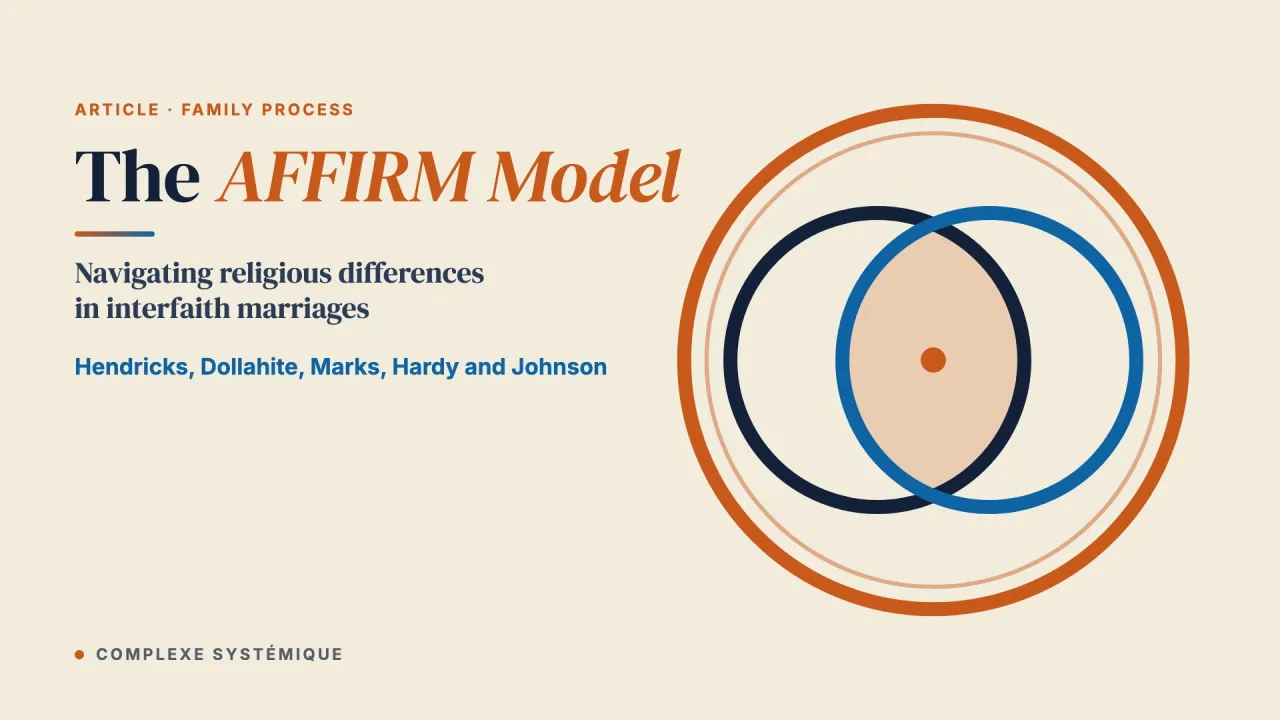
 The AFFIRM Model for Navigating Challenges in Continuously-Interfaith and Divergent-Interfaith Marriages
Thirty happy interfaith couples describe how they navigate their religious differences: five processes, from respecting each other’s choices to religious intimacy, gathered in the AFFIRM model.
 Article
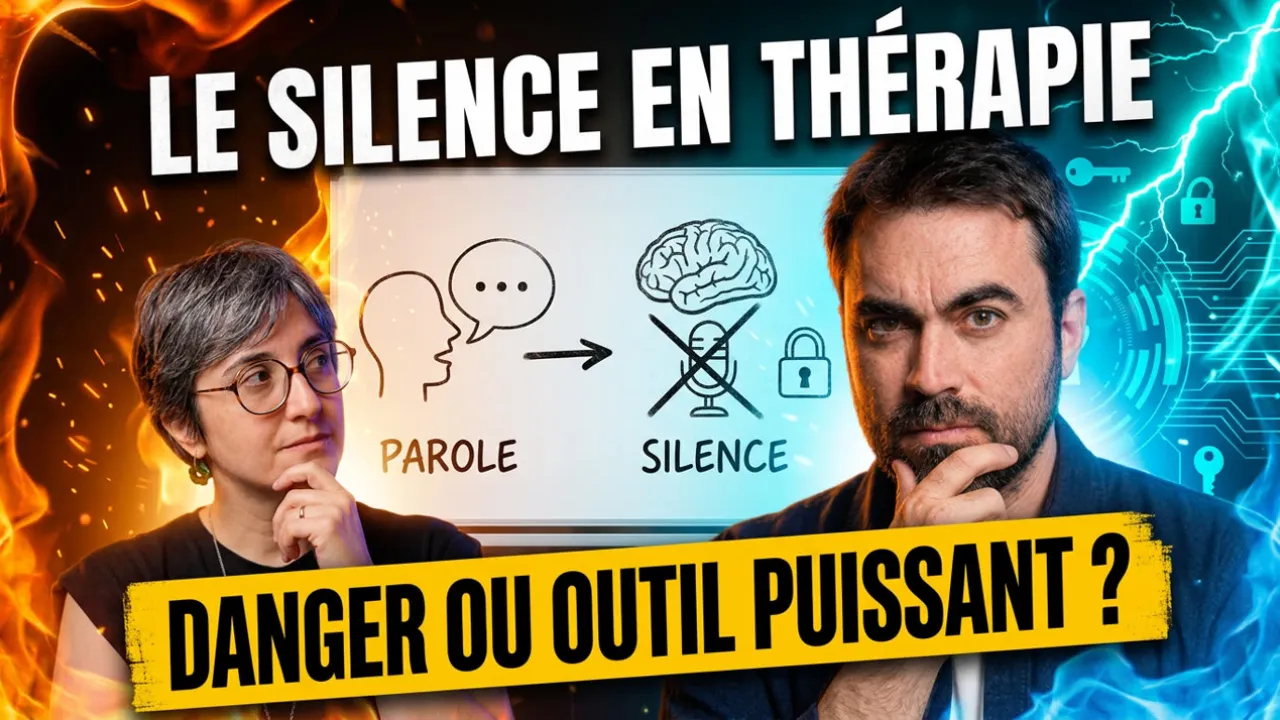
 Silence in therapy: a polysemic presence
From Heidegger to Palo Alto, silence is not an absence but a message. Defensive, strategic, reflective or shared: its forms, its functions and its risks.
 Article
 Crisis: a catalyst of transformation in human systems
A crisis is not a malfunction to correct but an effort by the system not to founder. From the Denver Project to Falicov: a typology and what it asks of the practitioner.
 Article
 First Psychological Aid for Families During War: Integrating the Narrative Approach With Emotionally Focused Therapy (EFT)
Three or four meetings for families living under the threat of war: telling their story before a witness, then repairing the attachment cycle disrupted by fear.
Comments 0
Log in to join the discussion. Log in