Red Sistémica · Crisis and resilience
Argentina 2001-2003. Stress, trauma and resilience
Which events of the crisis that opened in December 2001 did Argentines experience as the most destabilising, and what behaviours did they put to work in order to hold on? Ruth Casabianca and Hugo Hirsch present the preliminary conclusions of a piece of research carried out in Santa Fe among the middle class, at the crossing point of the concepts of stress, trauma and resilience.
“The distinction between stress and trauma is valid when it comes to putting professional therapeutic procedures to work, but not when we focus on the subjects’ own capacities for recovery.”
Ruth Casabianca and Hugo Hirsch
Abstract of the original
This work offers the preliminary conclusions of a piece of research carried out to explore the impact that the crisis triggered in December 2001 had on certain sectors of the population. Drawing on the concepts of stress, trauma and resilience, it examines which events were perceived as the most significantly destabilising, and which adaptive behaviours were described as the most frequent and the most effective.
The data seem to support the conclusions of earlier research carried out in other contexts, as regards the personal characteristics and the interpersonal ways of acting that are most effective in facing lasting misfortunes.
Introduction
In this presentation we shall examine some of the effects of the violence unleashed by the institutional crisis during the years 2001-2002, as they are described by some of those who underwent it. And also what they say about the way they sought to mitigate them. In short: the damage and its palliatives, as described by the victims-protagonists. We shall not speak here of the causes of that violence, nor of the professional methods that make it possible to resolve it or to relieve its effects.
In recent years, and most particularly from December 2001 onwards, there occurred in the country a series of events unprecedented in our history, which had a wide echo not only among our population but also in the world press.
Among these striking events, which acted as social stressors, let us mention: the continuous rise in unemployment and poverty, what has been called the financial “corralito”, the fall of a constitutional president and the succession of several presidents within the space of five days, the physical destruction of banks, the cacerolazos and the demonstrations of piqueteros, the public expression of rejection of the ruling class and of the judicial system, the devaluation of the currency and the hyperinflation that followed, physical insecurity and acts of violence against persons and property, the progressive loss of confidence in the public security forces, among others.
From within our profession as psychologists, committed to matters of health — in the most general sense of physical, psychosocial and spiritual well-being —, we could not fail to perceive that the majority of the population, individually or in the groups to which it belongs, seemed to have been affected in its well-being to varying degrees and in different ways.
In our experience in private practice or in public health institutions, we received daily messages that helped us to detect, in a non-systematic way, how far and in what way people felt flouted in their human dignity, in their values and their principles of life, in the quality of their most significant bonds, and in their attitudes towards themselves and towards others.
This perception led us to design a piece of research that we began in our city and among the middle-class population: partly because research requires that certain constants be defined, and partly because we thought a priori that this social class had been particularly affected in its vision of the world. We shall analyse here some of the significant data we gathered during a preliminary stage, carried out with the methodological collaboration of Dr Liliana Tauber, the participation of students on the psychology programme, and the support of our Universidad Católica de Santa Fe.
We started from the conception according to which individuals are always immersed in contexts of meaning and of interaction which influence and transform them, and to which they also react by adapting in different ways, and at different levels of insertion: as persons, in the closest groups such as the couple or the family, in our social networks and in the institutions to which we belong. Each of these levels is connected to the others and interdependent with them; in other words, a change in one of them affects the others and is affected by them.
For the purposes of this research — and in connection with the conception we have just described —, we shall consider the concepts of stress, trauma and resilience, in order to apply them to the analysis and the understanding of the phenomena observed.
Our objectives
Our objectives were the following:
- to detect to what extent the population had undergone the impact of the events that took place between 2001 and 2003;
- to determine which of these events had been perceived by the respondents as intense social stressors;
- to determine what the negative or stressful effects were that they had perceived at the different levels, individual and group;
- to determine what the adaptive or resilient behaviours were that they had put to work in order to reduce or relieve the perceived damage.
Working methodology
The methodology involved several stages.
1. The construction of the survey questionnaire
A first pilot survey was constructed with open questions, and was administered to fifty subjects from Santa Fe and the Federal Capital. On the basis of the answers obtained, the categories of the definitive survey were elaborated by agreement among the researchers.
These agreements led to formalising, depending on the question, between twelve and thirty-three categories.
The questionnaire consists mostly of closed alternatives with scale items (Cohen and Manion, 1990) and of a few open questions. The answers were quantified from 1 to 6 for the following categories: “very slightly intense”, “slightly intense”, “intense”, “fairly intense”, “very intense”, “no opinion”.
2. The sampling plan
It comprises three stages of quantitative data processing.
1st stage: stratification of the neighbourhoods of the city of Santa Fe. To this end, we gathered information from the census and from the permanent household survey of the city of Santa Fe, whose source was the “Programa de Información sobre Municipios” of INDEC, in minimal observation units (census fractions and districts).
The PRINEM database provided us, by census district, with information on the following variables:
- number of industrial, commercial and service premises;
- number of occupied private dwellings;
- number of collective dwellings;
- number of unoccupied dwellings;
- total population;
- number of people attending an educational establishment;
- number of people who have never attended an educational establishment;
- number of people no longer attending, but having attended, an educational establishment;
- number of households in a situation of overcrowding;
- number of households without toilets.
Each neighbourhood was identified with its corresponding fractions and districts, which made it possible to obtain, for each of them, a quantification in terms of the variables indicated. Finally we grouped the neighbourhoods by means of a cluster analysis — a statistical method of grouping observation units according to their proximity in terms of distance. This made it possible to construct strata of neighbourhoods, approximately classified as belonging to the “upper class”, the “middle class” or the “working class”. We thus selected the neighbourhoods whose characteristics were those of the “middle class”.
2nd stage: delimitation of each of the neighbourhoods selected at the previous stage. At this stage it was a matter of delimiting each neighbourhood retained, by identifying its boundaries and its streets.
3rd stage: drawing lots for the block in the neighbourhoods retained at the first stage. The blocks of each neighbourhood were numbered so as to make it possible to draw lots for them. Simple random sampling was carried out to select each of the blocks.
A classification and a selection also bore on the age and the sex that the respondents had to have. The ages were distributed as follows: from 18 to under 30, from 30 to under 40, from 40 to under 50, from 50 to under 60, and 60 or over. Each interviewer had to select, in each household, the person who would answer the survey, in order to gather the opinions of people of different ages and sexes.
The preliminary sample analysed for the present work is of fifty subjects.
Stress, trauma and resilience
[The journal interrupts the text here, then takes it up again further on.]
The scientific literature developed over the last fifteen years does not insist on the differentiation between stress and trauma when the focus of the analysis is resilience. This distinction is valid when it comes to putting professional therapeutic procedures to work, but not when we focus on the subjects’ own capacities for recovery…
Notes from the original
(*) The complete article was published in no. 79 of Perspectivas Sistémicas.
Who are the authors
Ruth Casabianca holds a licentiate in psychology. She directs the psychology programme of the Universidad Católica de Santa Fe. She is a visiting lecturer at postgraduate level at the Universidad Nacional del Litoral, the Universidad de Buenos Aires and the Universidad del Aconcagua.
Hugo Hirsch holds a licentiate in psychology. He teaches at the Universidad de Buenos Aires, is a visiting lecturer at the Universidad Adventista del Plata, and has been a postgraduate lecturer at the Universidad de Belgrano.
Liliana Tauber is a professor of mathematics and holds a doctorate in education. She teaches at the Universidad Católica de Santa Fe and at the Universidad Nacional del Litoral.
An extract
Red Sistémica publishes online only a fragment of this article: the full text appeared in no. 79 of Perspectivas Sistémicas. Our translation covers the whole of the fragment put online, and nothing more; the results of the research and their discussion are not accessible to us. Read the original fragment in Spanish.
References
Bell, Carl (2002) : « Cultivating resilience ». Artículo publicado en Gift from Within, en asociación con Amazon.com.
Casabianca, Ruth ; García, Adela (1998) : « Familias a cargo de un solo padre. Terapia y resiliencia ». Investigación presentada al XI Congreso de la International Family Therapy Association. Düsseldorf.
Cohen, L. y Manion, L. (1990). Métodos de investigación educativa. Madrid : La Muralla.
Henderson Grotberg, Edith (2002) : « Nuevas tendencias en resiliencia », en Melillo, A. ; Suárez Ojeda, E. : Resiliencia. Paidós. Bs. As.
Lewis Herman, Judith (1992) : Trauma and Recovery. The aftermath of violence — from domestic abuse to political terror. Basic Books. New York.
López Rosetti, Daniel (2000) : Estrés : cómo entenderlo y vencerlo. Lumen. Bs. As.
Ravazzola, Cristina (2002) : « Resiliencias familiares », en Melillo, A. ; Suárez Ojeda, E. : Resiliencia. Paidós. Bs. As.
Reivich, Karen ; Shatté, Andrew (2002) : The Resilience Factor. Broadway Books. New York.
Siebert, Al (2001) : « How to Develop Survivor Resiliency ». The Resiliency Center. Chicago.
Spera, Stefanie ; Lanto, Sandra (1997) : Beat Stress with Strength. Park Avenue. New York.
Walsh, Froma (1982) : Normal Family Process. Guilford Press. New York.
This article is an English translation of “Argentina 2001-2003: Stress, trauma y resiliencia”, published by Red Sistémica (first published in Perspectivas Sistémicas, n° 79, décembre 2003 – février 2004). Translated and republished with the journal’s permission.
Read the original articleHow to cite this article
Casabianca, R., & Hirsch, H. (2022). Argentina 2001-2003. Stress, trauma and resilience (Complexe Systémique, Trans.). Complexe Systémique. https://app.complexe-systemique.com/en_GB/articles/argentina-2001-2003-stress-trauma-and-resilience (Original work published in 2003 in Perspectivas Sistémicas, n° 79, décembre 2003 – février 2004; republished in 2022 by Red Sistémica, https://redsistemica.ar/2022/07/15/argentina-2001-2003-stress-trauma-y-resiliencia/)
To go further
- Psychological intervention in mass crisis. The terrorist attack on the Jewish community of Buenos Aires (part 1)The other great Argentine collective crisis, and what psychologists learned there about intervention.
- Systemic therapy of resilience. Opening paths, from suffering to well-beingThe clinical side of the concept that this research puts to the test of the field.
- On resilience. The thought of Boris CyrulnikWhere the notion of resilience comes from, and what it changes in the way lasting misfortunes are seen.
Related training courses
 Symposium
Digital technology, AI and mental health
Conference in Lyon, 11 December 2026: digital technology, artificial intelligence and mental health. Six talks, replay for participants. In French.
 Short course
The suicidal crisis in adolescents and young adults
Training: assessing and supporting the suicidal crisis in adolescents and young adults. Clinical landmarks and systemic tools. In French.
Related articles
 Article
 The AFFIRM Model for Navigating Challenges in Continuously-Interfaith and Divergent-Interfaith Marriages
Thirty happy interfaith couples describe how they navigate their religious differences: five processes, from respecting each other’s choices to religious intimacy, gathered in the AFFIRM model.
 Article
 Toxic, narcissistic, borderline: what therapy speak does to your relationships
Narcissistic, borderline, toxic: therapy speak has left the consulting room. Julien Besse shows how these labels close the debate and relieve us of our own part.
 Article
 First Psychological Aid for Families During War: Integrating the Narrative Approach With Emotionally Focused Therapy (EFT)
Three or four meetings for families living under the threat of war: telling their story before a witness, then repairing the attachment cycle disrupted by fear.
 Article
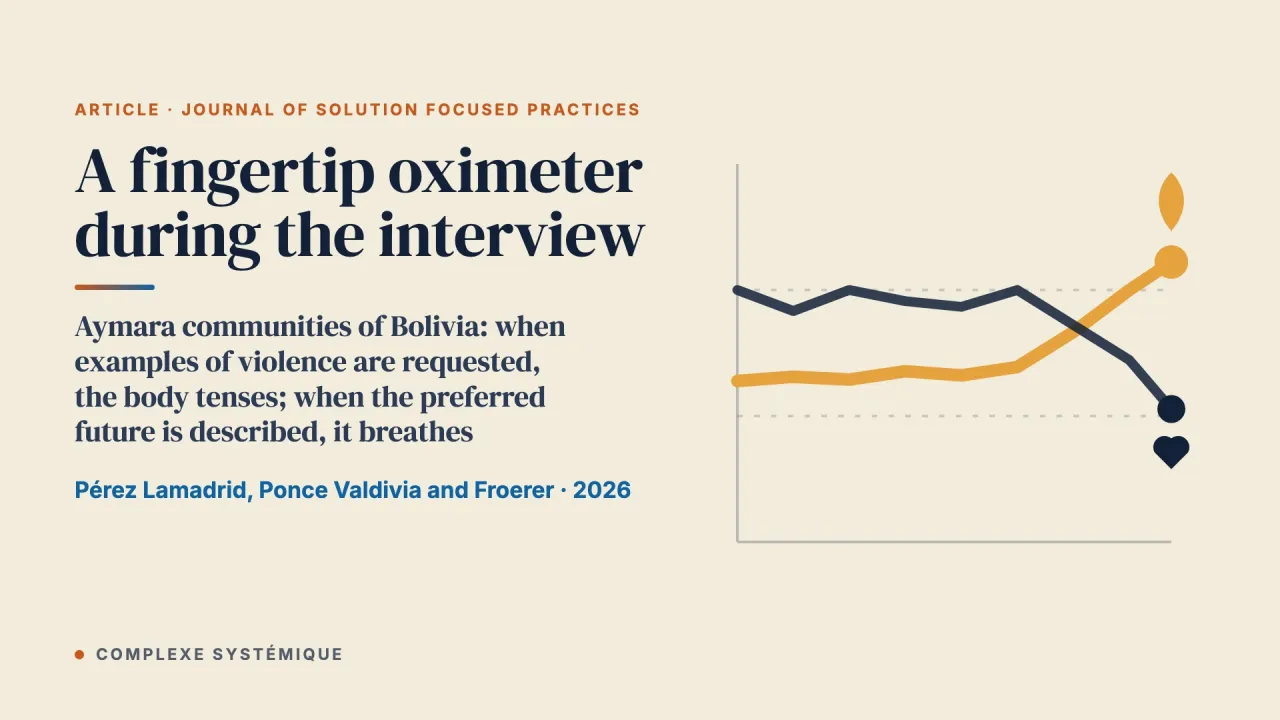
 Oxygenation and Heart Rate in Solution-Focused and Problem-Focused Interviews With Rural and Indigenous Aymara Communities (Viacha and Laja) Regarding Intersectional Violence
A fingertip oximeter on 19 Aymara people of the Altiplano: the problem-focused interview tenses when examples of violence are requested; the solution-focused one oxygenates and slows the heart.
Comments 0
Log in to join the discussion. Log in