Red Sistémica · Crisis intervention
Psychological intervention in mass crisis. The terrorist attack on the Jewish community of Buenos Aires (part 1)
The aim of this article is to contribute to the work of all those who carry out a professional task — therapeutic, educational and community-based — by setting out guiding principles, intervention strategies, models and techniques that are effective in the individual, family and, as has been said, community psychological handling of a human crisis as terrible and outrageous as the one experienced by the Jewish community and by the whole Argentine people barely a few months ago.
“The guiding principle, fundamental and vital, that orients every kind of intervention in a crisis situation is that of building, developing and maintaining the cognitive, emotional and behavioural continuity of the people involved in and affected by the event.”
Jacinto Inbar
Editor’s note
Ten years after the terrible attack, still not clarified by the national authorities, as a reminder addressed to society, as testimony for the new generations and as a tribute to the victims and their families, we are publishing this excellent article, written at the time by an Argentine-Israeli colleague and friend, Jacinto Inbar.
The integration of different paradigms — the cognitive-behavioural and the systemic —, grounded in the experience of mass disasters such as those that occurred in Israel, Colombia and Mexico, may help the reader to discover and adopt the elements likely to serve their work of psychotherapeutic assistance. At the same time, mental health professionals who recognise themselves in other schools or other approaches will find in it contributions and working methodologies known for their very high effectiveness in the treatment of post-traumatic stress following massive community crises: acts of terrorism, natural or man-made disasters.
A three-axis model
The preventive, psychoeducational and interventional model adopted by the author in emergencies, massive crises or community disasters could be pictured as a cube, at the base of which the various chronological stages would be identified:
1
Pre-warning
The stage during which no concrete information is available about the possibility that the event may occur, but during which psychoeducational, security and other programmes can be designed.
2
Warning
The stage during which information is available, generally valid and reliable, about the probability that the event may occur. If it is a natural disaster, such as a tornado in Florida, this stage is fundamental for raising awareness and for the concrete preparation of the population. In the case of acts of terrorism, despite the understandable limits of forecasting, the security and intelligence services of the various countries have shown that they are able to gather and exchange information in order to thwart the attack, or to reduce the damage when time or data were lacking for more effective action.
3
Impact
The stage during which the event takes place (explosion, earthquake, etc.). This is the moment to apply all the programmes worked on over the years. The security, assistance and support forces, along with educational and community actors, in accordance with their role — defined, accepted and exercised —, put their knowledge, their capacities, their plans and so on into practice.
4
Post-impact
The stage during which the various institutions (community, educational, health, security, etc.) implement programmes of rehabilitation, recovery, coping, education and treatment. But also preventive plans intended to avoid the possible occurrence of another event, since there is by then an awareness, a legitimacy, a sensitivity, a motivation and a readiness on the part of those who take decisions, of community leaders, of parents and so on.
In a certain sense, this article is written “backwards”: it will neither detail nor analyse the preliminary stages (which nevertheless have a real and fundamental importance in prevention, education and coping), since the community — in the broadest sense of the term — already finds itself several months on from the attack carried out in July; we shall therefore concentrate on the post-impact stage.
To continue with the illustration of the model, on the vertical axis of the cube we describe the different target groups to which the various programmes are addressed at the different stages mentioned above. Individuals are thus identified: for example those directly affected (the injured, survivors, the bereaved, members of the rescue team, people who helped with the identification of the bodies) and those who are indirectly affected (those in whom the event may bring past experiences back to life, the survivors of an earlier natural disaster and, to be distinguished from them, those who lived through indescribable experiences during the Holocaust).
Other target groups are the family (affected directly or indirectly, or understood as a target population when psychoeducational programmes are concerned), the community (the one directly affected, but also, on the preventive and educational level, all the communities where similar events may occur) and organisations (community institutions, schools, clubs, emergency, security and health services, etc.).
The other axis of the cube refers to the wide range of possible interventions. One can thus picture dozens of small cubes describing specific interventions, intended for clearly identified target groups, at a given stage. For instance, at the pre-warning stage, working with organisations — let us say a school —, one can design and implement psychoeducational programmes aimed at developing the coping capacities and skills of the pupils, the teaching team and the administrative staff. A forthcoming article will propose, describe, develop and analyse the various possible interventions, most of them highly effective, that have been implemented and applied in different countries, including Israel.
Interventions at the post-impact stage
This part of the article deals with the various interventions (not only psychotherapeutic ones) that can or must be applied immediately after the event — here, the explosion — and with those that are designed and implemented with the people affected directly or indirectly (survivors, the injured, the bereaved, rescue teams, as mentioned above) as well as with community, educational, rescue and health institutions.
The guiding principles of post-impact intervention
Several guiding principles of intervention in a crisis situation are accepted and explained by those who have accumulated experience in the treatment of acute stress reactions in different fields: the military field (Salomón y otros, 1986; Oren e Inbar, 1991) and that of natural disasters (Inbar, 1992).
1
Proximity
As close as possible, from a physical point of view, to the place of the event.
2
Immediacy
As soon as possible after the appearance of the symptoms; and, for certain types of reaction, even before it occurs.
3
Expectancy
The expectation of a return, as quickly as possible, to the role or the function that were the person’s own before the event.
The basis of these principles rests empirically on research of recognised scientific rigour. Applying them lowers the probability that a feeling of guilt, a self-definition as incompetent or needy, or a stigmatisation will develop, and raises the probability of a rapid and effective recovery.
Proximity
According to the principle of proximity, most interventions must be applied in a place physically close to the area where the event occurred, here the place where the act of terrorism was carried out. As we shall see below, it would be desirable for certain cognitive and behavioural interventions to be conducted, despite their “apparent cruelty”, in the ruins of the building of the Jewish community of Buenos Aires (AMIA); at the right moment, of course, with the appropriate target groups and with clearly defined therapeutic intervention objectives. We must stress that the principles and proposals discussed hold for all the people affected by or concerned with the event, whatever their community and social belonging and origin.
Immediacy
Applying the principle of immediacy leads us to intervene as soon as possible. With the people directly affected, the injured and the survivors, and with those who took an active part from the moment of impact (members of the rescue team, people in charge of identifying the bodies, adolescents who took part in clearing the rubble, doctors, police officers, firefighters, rabbis and others), different models or different forms of psychological debriefing (1) can be applied.
The objectives of this crisis intervention, whose stages and phases will be developed in due course, are the following: to allow the expression of the experiences and emotions felt during the event; to lower the stress arising from psychological threats, expectations, demands, predictions and cognitive distortions; to increase cognitive organisation by gathering alternative explanations of the event; to activate the resources internal (capacity for coping) and external to the individual or the group (seeking and mobilising support, solidarity and cohesion); to lower the feeling of abnormality or marginality (by increasing the normativity and the legitimacy of the symptoms experienced); and finally, to prepare for certain experiences, such as the appearance of possible symptoms and reactions, and to identify the possibilities of psychological assistance, should it prove necessary (Dyregrov, 1989; Hodgkinson y Stewart, 1988, 1991).
Psychological debriefing, as a psychotherapeutic intervention, is used in our experience at different moments. First, immediately after the event, as has just been set out; a second time, after two or three months, in an attempt to identify certain dysfunctional thoughts, attitudes or reactions that had not appeared during the first intervention; and finally, after a year, as follow-up or evaluation of the treatments applied, in order to look for the persistence of symptomatology, in particular post-traumatic stress disorders (Inbar, 1992).
Expectancy
The principle of expectancy refers to the importance of developing and inducing the expectation of a return, as quickly as possible, to the role or the function held before the event. This principle is expressed by the therapist verbally and through their conduct. The people affected are encouraged to return to their earlier activities, to daily routine, and to foster the development of a psychological construct that we, specialists in mass disasters, call hopefulness.
Continuity
What has just been said leads us to a further guiding principle, fundamental and vital, that orients every kind of intervention in situations of crisis, emergency and mass disaster. It is the principle of building, developing and maintaining the cognitive, emotional and behavioural continuity of the people involved in and affected by the event.
Concretely, the counsellor, the therapist or the mental health worker stimulates the creation, the strengthening and the preservation of the thoughts, beliefs, attitudes, predictions, attributions and explanations (cognitive domain), of the affects and feelings (emotional domain) and of the behaviours, roles and tasks (behavioural domain) that were functional or adaptive before the event.
Namely: the immediate return to the institution targeted by terrorism, active involvement in rescue tasks (for example by clearing rubble), participation in specific activities (recovering the books of the destroyed library, support given to other people affected), or any kind of activity that makes it possible to develop or maintain the sense of perceived self-sufficiency, the self-image and the feeling of behavioural and cognitive control that may be assumed to have been significantly damaged.
Key takeaway
Proximity, immediacy and expectancy are not technical recipes: they aim to prevent the affected person from defining themselves as incompetent or needy, and from being stigmatised. The thread that links them is continuity: sustaining what, before the event, was functional in the person’s thoughts, affects and conduct, rather than organising a rupture of their life around the trauma. This is what one finds again, in an entirely different context, among the clinicians who have worked with the victims of persecutory violence.
Developing hardiness (2) among the people affected by the attack
The present article will be continued in the next issue. There we shall also develop models of approach and outreach (“reaching out”), and include individual, group and family therapeutic approaches to post-traumatic stress disorders following acts of terrorism and mass disasters. There we shall analyse crisis intervention strategies within the school network, as well as a cognitive model for grief counselling and therapy.
Notes from the original
(1) The term used in English is “psychological debriefing”; the rendering into Spanish, perhaps a provisional one, is the author’s.
(2) Other possible renderings of the term in the original language: “firmness”, “mettle” or “temperance”, “strength of spirit”, etc.
(*) This article was published in issue no. 34 of Perspectivas Sistémicas, November-December 1994. Other works by the author have appeared in Perspectivas Sistémicas no. 2 and no. 28.
Who is Jacinto Inbar
Dr Jacinto Inbar is a clinical and organisational psychologist. He is an expert in crisis and mass-disaster intervention. He teaches at the Hebrew University of Jerusalem, in Israel. He can also be read on this site: Integrating cognitive hypnotherapy into the treatment of couples.
This article is an English translation of “Estrategias de intervención psicológica en situaciones de crisis masivas. El atentado terrorista en la Comunidad Judía de Buenos Aires (1° parte)”, published by Red Sistémica (first published in Perspectivas Sistémicas, n° 34, novembre-décembre 1994). Translated and republished with the journal’s permission.
Read the original articleHow to cite this article
Inbar, J. (2022). Psychological intervention in mass crisis. The terrorist attack on the Jewish community of Buenos Aires (part 1) (Complexe Systémique, Trans.). Complexe Systémique. https://app.complexe-systemique.com/en_GB/articles/psychological-intervention-in-mass-crisis-the-terrorist-attack-on-the-jewish-community-of-buenos-aires-part-1 (Original work published in 1994 in Perspectivas Sistémicas, n° 34, novembre-décembre 1994; republished in 2022 by Red Sistémica, https://redsistemica.ar/2022/06/24/estrategias-de-intervencion-psicologica-en-situaciones-de-crisis-masivas-el-atentado-terrorista-en-la-comunidad-judia-de-buenos-aires-1-parte/)
To go further
- Psychological intervention in mass crisis. The terrorist attack on the Jewish community of Buenos Aires (part 2)The sequel: hardiness, community outreach strategies and the stages of psychological debriefing.
- Persecutory violence in the Basque CountryAnother terrorism, slower and more insidious, and its effects on victims and their families.
- Integrating cognitive hypnotherapy into the treatment of couples. Interview with Jacinto InbarThe same author, nearly thirty years later, on the cognitive side of his clinical work.
Related training courses
 Short course
The suicidal crisis in adolescents and young adults
Training: assessing and supporting the suicidal crisis in adolescents and young adults. Clinical landmarks and systemic tools. In French.
Related articles
 Article
 Relearning couplehood after exile and violence
At the Maison d’Ella, Ivy Daure receives exiled women who have survived violence. Her work: relearning relationship so as not to form a couple by the same grammar again.
 Article
 First Psychological Aid for Families During War: Integrating the Narrative Approach With Emotionally Focused Therapy (EFT)
Three or four meetings for families living under the threat of war: telling their story before a witness, then repairing the attachment cycle disrupted by fear.
 Article
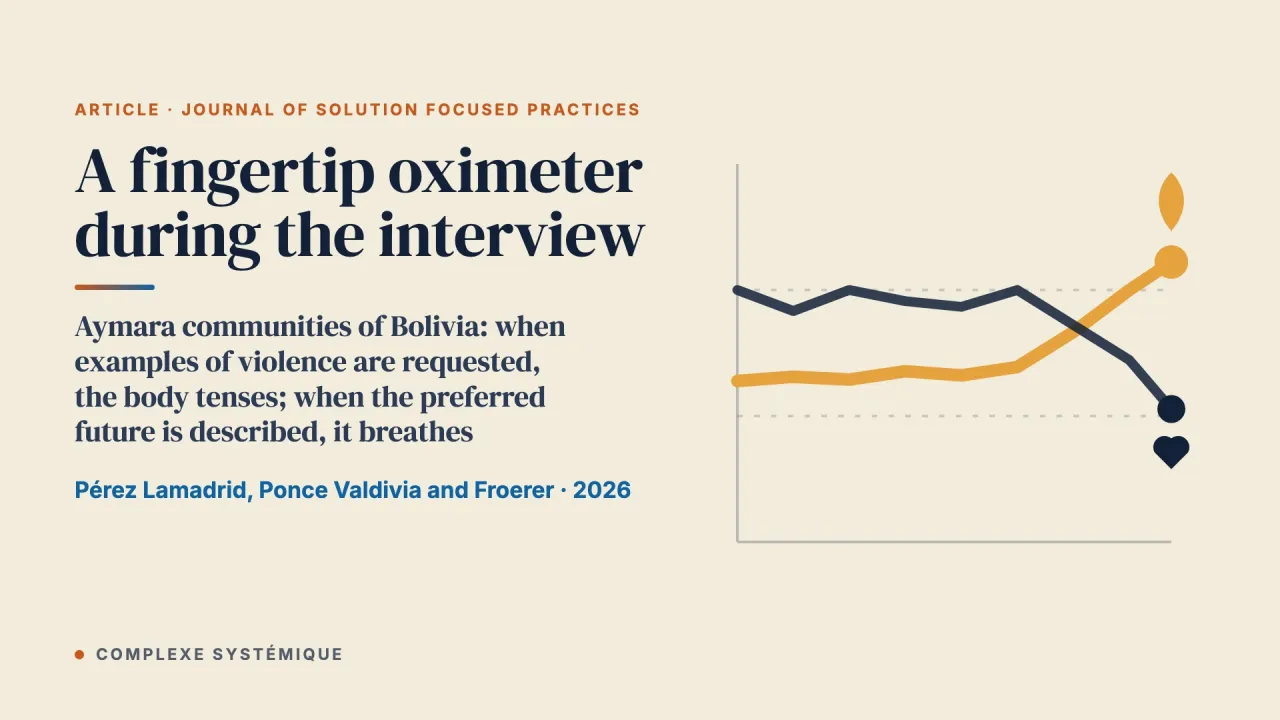
 Oxygenation and Heart Rate in Solution-Focused and Problem-Focused Interviews With Rural and Indigenous Aymara Communities (Viacha and Laja) Regarding Intersectional Violence
A fingertip oximeter on 19 Aymara people of the Altiplano: the problem-focused interview tenses when examples of violence are requested; the solution-focused one oxygenates and slows the heart.
 Article
 Psychological trauma: what to do in the first 24 to 48 hours — Stéphanie Khalfa
Early intervention does not begin with a detailed account. Stéphanie Khalfa presents the nine-step MOSAIC emergency protocol: body, co-regulation and connection.
Comments 0
Log in to join the discussion. Log in