Child & Family Social Work · Social work
Disrupting the Child Welfare Participation Paradigm: A Contextual, Relational, Embedded and Pragmatic Approach
Why does the participation of children and parents so often remain wishful thinking in child welfare? A British and Italian team of five academics combines reflexive action research with a literature review. Its proposal: to think of participation as a mindset informed by psychoanalysis, and as a communication skill inspired by the Palo Alto pragmatics.
This is a reformatted republication of Disrupting the Child Welfare Participation Paradigm: A Contextual, Relational, Embedded and Pragmatic Approach, by Jeri L. Damman, Teresa Bertotti, Diletta Mauri, Gillian Ruch and Karen Winter, published in Child & Family Social Work (Wiley) (2026), doi: 10.1111/cfs.70254, under a CC BY 4.0 licence. Prepared by Complexe Systémique in September 2026: the authors’ text is unchanged; the layout has been adapted for reading online, which constitutes a modification of the work under the terms of the licence. This edition was made neither by the authors nor by the publisher, who are not responsible for its content or for any errors. The original version prevails.
We are persuaded that participation should not be conceived as a discrete ‘task’ to be completed.
Jeri L. Damman, Teresa Bertotti, Diletta Mauri, Gillian Ruch and Karen Winter
Abstract
Child and parent participation is fundamental to effective child welfare practice. Legislative imperatives assert the right to participate, but in a child welfare context, participation is complex and risks becoming rhetorical. This paper, based on a conceptual synthesis built from second person action research and a narrative review, explores child and parent participation from a UNCRC rights-based perspective, adopting a critical reflexive approach to explore challenges and begin to disrupt entrenched and dichotomized child–parent participation practices. Our synthesis positions context and relationships as central to meaningful participation in child welfare, embeds participatory acts in the everyday mindsets and practices of professionals and positions participation as a skilled communication process. Psychoanalytic concepts and the Pragmatics of Human Communication are introduced as generative conceptual frames, offering an innovative reconceptualization of participation that is more inclusive, contextual, relational, embedded and pragmatic. We conclude with a call for participatory research involving children and parents that might offer new insights and mobilize practitioners into more attuned and epistemically and socially just participatory practices.
1 Introduction
The participation rights of children and parents involved in the child welfare system are a well-established principle and both the United Nations Convention on the Rights of the Child (UNCRC; UN 1989) and the Human Rights Act 1998 underpin social work law, policy and practice nationally and internationally (Abela et al. 2024). Despite this legal mandate, implementing these participation rights in a child welfare context, particularly in child protection matters, remains complicated and challenging for professionals due to individual, interpersonal and system level factors (Henze-Pedersen and Bengtsson 2024). Part of the complexity, across child welfare systems internationally, comes from the child welfare context itself where responsibilities are broad and include investigating potential/actual child abuse and neglect, assessing risk, negotiating and agreeing support arrangements and reviewing progress. This work is often premised on legally mandated power differences between professionals and families, both with and without court involvement, depending on the structure of the child protection system, which differs across countries. In these circumstances, child welfare professionals are called to contribute to one of the most challenging decisions in modern democracies, balancing child protection needs and parents' rights (Berrick et al. 2022). Furthermore, complexity arises from the separation of children's rights from parents' rights and the need for professionals to navigate this in their participatory relationships, especially where parental abuse or neglect concerns exist.
Recent developments in participation have attempted to address this complex child welfare context, but despite these developments, research continues to highlight chronic challenges to implementing child welfare participatory practices (Kennan et al. 2018; McCafferty and Mercado Garcia 2024; Toros 2021a, 2021b), reflecting a state of ‘stuckness’ in participation practice that is reductionist, siloed and decontextualized. In response to this state of affairs, this study aims to deconstruct current participatory practice challenges to inform a new direction of travel for rights-based participatory practice and research in child welfare.
Guided by a novel reflexive second person action research approach and narrative literature review (Bourhis 2017; Coghlan and Brydon-Miller 2014), our critical synthesis employs a reflexive lens to explore rights-based child and parent participation in child welfare and the contextual and relational considerations to achieving meaningful participation. In the following sections, we begin by situating our exploration of child and parent participation in its legal context, followed by a review of the evidence base relating to the current opportunities and challenges associated with child welfare participation. Our analysis and discussion reveal the affective and communicative elements of participation, and we draw on psychoanalytic ideas and the Pragmatics of Human Communication (PHC) (Watzlawick et al. 1971) as two generative conceptual frames. These frames, firstly, position context and relationships as central to meaningful child welfare participation, secondly, embed participatory acts in the everyday mindsets and practices of professionals, and thirdly, configure participation as a skilled communication process that calls on well-honed levels of emotional literacy combined with an attention to the pragmatic aspects of communication. Our analysis intends to offer an innovative reconceptualization of participation that is more inclusive, contextual, relational, embedded and pragmatic. Finally, we conclude with a call for further participatory research that might offer new insights and mobilize practitioners to embed more epistemically and socially just and attuned participatory practices.
1.1 Legislative Imperatives for Rights-Based Participatory Practices
The UNCRC (UN 1989) is an international legal instrument increasingly being incorporated into domestic law in some countries with many others embedding its principles in aspects of policy and legislation, particularly in relation to children's participation rights in decision-making (see Kilkelly et al. 2021 for a comparative review). Indeed, most professionals working with children are aware of children's right to participation as defined in article 12. However, there is less awareness of the emphasis the UNCRC places on the child's wider context and within this the attention it also pays to the needs, rights, responsibilities and voice of parents.
Indeed, there is a notable tendency to decontextualize the article 12 participation right from the other UNCRC rights; meaning it is treated as standalone and unconnected to other rights. The absence of nuanced considerations regarding the implementation of this right has contributed to child welfare practice that has increasingly siloed participation practice and research into parents' rights versus children's rights (Nissen and Ravn 2024) by separating children's participation from its wider context, especially child–parent relationships and the broader cultural context of these relationships (Keddell 2023; Wilson 2025). This, in turn, has led to insufficient attention being paid to the contextual, contingent and conditional aspects of participation as a rights-implementation process, which relies on collaborative, reciprocal, responsive and reflexive relationships between adults (professionals, parents and carers) and children. The UNCRC recognizes these aspects as outlined further below.
1.2 Rights-Based Participation and the Contextual, Contingent and Conditional Nature of Rights
The UNCRC describes family as ‘the fundamental group of society and the natural environment for the growth and well-being of all its members and particularly children’ (UN 1989, 1). It recognizes the importance of parents, who are described as having ‘primary responsibility’ for their child's development, “to secure, within their abilities and financial capacities” (UN 1989, 8), the conditions necessary for this development. The UNCRC recognizes the challenges parents face in meeting their responsibilities and duties and, therefore, outlines their rights to receive services, support and assistance (see articles 18 and 27).
In drawing attention to the central role played by parents (and other adults) in creating opportunities for children and supporting them to exercise their rights, the contextual nature of children's participation rights is obvious. The Lundy model (2007), which has been adopted worldwide, underscores these contextual aspects to children's participation rights and the fact that adults (professionals and parents) play a central role. The model draws attention to the fact that it is not enough for children to have voice (express a view); they require space (created by adults) to express their views, an audience (adults who listen), and they require influence (adults acting on/taking into account children's views and providing feedback on its influence). It is notable, therefore, that the UNCRC recognizes the central role played by parents in promoting their child's rights and development, as well as parents' right to assistance and support in their parenting roles, and their right to be actively involved in shaping the nature of those services (Winter et al. 2024). It is also notable that the UNCRC (UN 1989) recognizes that not all adults may be enabling and, therefore, stresses numerous times both their rights and the responsibilities as parents and where their rights are restricted due to harm and risk to children.
Parent's participation rights are further supported by international and domestic human rights, equalities and child protection legislation and policies. Article 8, Human Rights Act, 1998 asserts an individual's right to private and family life, which includes a parent's right to be involved in decisions about their child provided this aligns with the child's best interests. Importantly, parent participation is further enshrined in the Equality Act 2010, which requires accessible communication (e.g., disability and language barriers) and protects parents from discrimination in safeguarding processes based on race, disability, age, sex and other protected characteristics.
As noted, in child welfare contexts where continuums of need and risk exist, the participation rights of parents can be limited in varying ways due to evidence of child abuse or neglect. Parents may continue to participate fully in decision-making, may be precluded from decision-making but still participate through general expressions of wishes/views or may be prevented from participating in more severe cases of abuse or neglect where clear and immediate risk to the child exists.
The contextual, contingent nature of participation rights highlighted here evidences the interwoven nature of child and parent participation rights, calling into question the established child–parent dichotomy currently pervading research, policy and practice. This dichotomized lens means that debates on child and parent participation rights are separated out, neglecting the necessary contextual and relational focus (Wilson 2025) and inhibiting the advancement of more meaningful participation opportunities, potentially reducing child welfare participation to rhetoric. We hypothesize that the insufficient attention given to the contextual characteristics of child welfare contributes to the current state of ‘stuckness’ that we perceive in participation practice.
This conceptual synthesis aims to address this situation by offering a new direction of travel for rights-based child and parent participatory practice and research in child welfare through a deconstruction of the factors that contribute to the current decontextualized, reductionist and siloed approach. The following research questions informed this exploration: (1) What insights does existing research provide for professional participatory practices with children and parents in child welfare? (2) How do individual, interpersonal and structural contexts impact child and parent participation in child welfare? (3) How can theory inform more contextualized and holistic child and parent participatory practices in child welfare?
2 Methods
This critical synthesis was inspired by the authors' joint sense of frustration at what we perceived to be a lack of collective progress and innovation in the everyday participatory practices in child welfare with children and parents, especially where child protection concerns exist. As academics with expertise in child participation, parent participation and professional practice in child welfare, we recognized, within this critique, our own contribution to preserving this stuck position and a reluctance, due to the complexity of child–parent participation, to immerse ourselves in the well-worn participatory terrain to reveal and inspire new ways of thinking.
Our critical synthesis to address our research questions was developed using novel reflexive Second-Person Action Research and narrative literature review methods. Second-Person Action Research is a form of inquiry undertaken by two or more people, which focuses on a shared concern, where the researchers are positioned as both the researcher and subject (Coghlan and Brydon-Miller 2014). This collaborative approach involves bringing together diverse perspectives to formulate research questions, engaging in a process of collecting and analysing information, and taking action related to the conclusions reached.
Our methods were underpinned by our collective identity as five white female academics working in UK and European universities who were committed to exercising our curiosity and reflexivity as both a methodological approach and as an end goal. Despite our existing collective knowledge, we have endeavoured to avoid positioning ourselves as ‘having the answers’ or as presenting a final ‘solution’ to achieving meaningful participation. Rather our aim was to explore existing participation agendas as an initial step to charting a new course with children, parents and professionals that re-envisages participatory practice in everyday child welfare work.
The team adopted a slow and sustained critical reflexive approach throughout the project. This approach recognized our own sensitive, deeply held and at times conflicting positions and perspectives as child-, parent- and professional-focused participation researchers and the need for us, as a group, to deconstruct our own individual siloed understandings and biased conceptions of participation. Our evolving shared understanding of our unique positionalities guided our sensitive and critical navigation of the values, beliefs, assumptions and norms underpinning participation in a child welfare context and informed our analysis of the current stuckness in participatory practice.
Over a 20-month period between September 2023 and May 2025, our second person action research approach involved us meeting as a team to explore our research questions. Sessions included in person and online, 1- and multiday critical reflective sessions and meetings. Early in our process, we recognized that the notion of ‘participation’ in child welfare was disseminated in many places and discussed in many ways, without clear or consistent connections, which we referred to as the ‘rabbit holes of participation.’ Meetings incorporated a range of activities to explore this further, including in-depth dialogue, reflective free writing exercises (Elbow 1989), debates on child–parent participation sensitivities, reflective conversations about the experiences of children, parents and professionals in participatory spaces, and the theorization of future child welfare participation approaches. During this work, we recognized that meaningful participation needed to consider the emotional aspects of inviting in, and deeply listening to, the difficult life experiences of children and parents, as well as the context in which the relationship and listening develops. This was the basis for both our continued dialogue about our diverse sensitivities and grounded our associated narrative review. Individual and collective writing were used as instruments for collecting, analysing and critiquing emergent ideas related to child welfare participation and for identifying potential ways forward.
A narrative review (Bourhis 2017) was conducted concurrently with the reflexive action research sessions. As our starting position recognized current participatory practices as problematic, we sought to explore the contextual factors that contribute to (and describe) the current state of affairs. Separate searches (child, parent and professional) were conducted between June 2024 and March 2025 using databases and search engines including PsycINFO, MEDLINE, SSCI and Google Scholar, along with a further snowballing technique. Search terms included keywords relevant to each stakeholder group (child, parent or professional), child welfare (child welfare and child protection) and their participation experience (e.g., participation, involvement, experience and views). The inclusion criteria included empirical research published in the research team's first language (English and Italian) between 2005 and 2025 and that addressed the qualitative experiences of at least one of the three key stakeholders (child, parent and professional), providing their perspectives and understandings of child welfare participation in everyday practice. Our intention was to better understand the contextual factors that helped or hindered participation practices, and we selected studies that explored these issues in depth or offered a new contribution to this understanding. The volume of literature varied across stakeholder groups with relatively limited research on parent's experiences of participation (rather than their child welfare experience more broadly) and a substantial body of work on children's participation. As the latter already included a prevalence of research reviews on children's participation experience, we limited our focus to scoping, systematic and umbrella reviews for this stakeholder group.
Selected literature for each stakeholder group was analysed separately to identify relevant contextual factors. This analysis involved three members of the research team undertaking a close reading of the sources to iteratively categorize relevant factors for each stakeholder group. To maintain consistency across stakeholder groups, these factors were then organized across the micro (emotional, relational context), meso (organizational context) and macro (socio-cultural context) levels. Through this narrative review and our iterative, reflexive action research we were able to collectively develop a novel theoretically informed approach to participation in child welfare, which is explored below.
3 Literature Review: Child, Parent and Professional Perspectives on Participation
Current understandings of child welfare participation have been informed by theoretical participatory models (Allcock 2018), most of which address children's participation, with some relevance for parent participation. These models depict various hierarchical and nonhierarchical levels of child participation in decision-making (Hart 1992; Treseder 1997) or depict rights-based elements to participation in a more situated way (Cuevas-Parra 2023; Gresdahl et al. 2025; Henze-Pedersen and Bengtsson 2024; Lundy 2007; Shier 2001). Power, or the extent to which an individual's participation influences a decision or outcome, is embedded in participation. Some of these models address power explicitly, with more meaningful participation represented in examples of professional-child power sharing practices, while others are more implicit, with meaningful participation represented in rights-based practice.
Primary research on child welfare participation in everyday social work practice is generally qualitative, small in scale and primarily focused on children's participation. From our review of literature, outlined below, there are notable gaps. First, there are few studies which integrate the shared experiences, perspectives and understandings of children, parents and professionals. Second, most studies generally address the individual experiences of children, parents and professionals, with less attention paid to their perceived meaning of participation. Third, there are notable knowledge gaps involving minoritized groups and young children (Kelly et al. 2016; Winter 2009, 2012, 2014). The research knowledge base and gaps are further explored below.
3.1 Participation Perspectives: Children
Several scoping, systematic and umbrella reviews provide a comprehensive account of children's experiences and perspectives of participatory practices (Jørgensen et al. 2024; McCafferty and Mercado Garcia 2024; McTavish et al. 2022; Toros 2021b; Toros et al. 2018; Toros and Falch-Eriksen 2024). At the micro level, studies highlight children's perceptions of an overall lack of participation represented by insufficient involvement and access to information. Children place importance on effective communication and dialogue, highlighting their need to be heard, their unique contribution and the negative consequences of being not seen or heard. For example, a review of 12 studies by Toros (2021b) found that, despite some individual accounts of good participation, children generally felt excluded with little or no opportunity to participate in plans and significant decisions about their lives. Children also perceived a finality to professional decisions with little scope for reconsideration. These findings are consistent with other reviews, which also highlight children's lack of awareness of their participation rights, of essential information about processes and outcomes directly impacting their lives, and lack of adapted information to promote their understanding (Jørgensen et al. 2024; Toros et al. 2018; Toros and Falch-Eriksen 2024). An umbrella review of 14 systematic reviews further identified children's negative emotions, such as fear associated with their experience of investigation and removal, as a potential barrier to participation (McCafferty and Mercado Garcia 2024).
Studies also consistently highlight the centrality of positive relationships for meaningful and effective participation (Jørgensen et al. 2024; McTavish et al. 2022). Jørgensen et al. (2024), for example, reviewed 25 studies and identified the relational factors necessary for participation. These included partnership working through mutual exchange and dialogue, time and space to build relationships with children focused on listening, and ‘power-sensitive’ relational practices that position the child as the primary focus. McTavish et al. (2022) in their meta-synthesis of qualitative research capturing the views of 376 children across 25 studies found a range of relational attributes children perceived as important, including appreciation, availability, connection, confidentiality, honesty, fairness and inclusivity.
The micro level facilitators and barriers are closely aligned to those at a meso-level. Child welfare assessment and decision-making processes are not easily understood by children, with professional expertise often prioritized (Toros and Falch-Eriksen 2024). This adult-dominant approach extends to professional interactions, with children perceiving professionals as being more accessible to, and spending more time with, parents and, therefore, potentially prioritizing parents' views, needs or rights over their own (Toros and Falch-Eriksen 2024). Information sharing processes, including their purpose, timing, method of delivery and developmental appropriateness, were also perceived by children as problematic resulting in a general lack of information (Toros et al. 2018). These findings are consistent with other reviews highlighting organizational context as a factor in limiting the effective implementation of child participation policies (Jørgensen et al. 2024; McCafferty and Mercado Garcia 2024). Jørgensen et al. (2024) in their review identify the need for more ‘relational space’ focused on effective listening practices and active dialogue to offer children a greater sense of control in their life and child welfare service experiences.
At the macro level, children's perspectives reflect prevailing societal attitudes and beliefs related to children and childhood. An umbrella review of systematic reviews of child participation research (McCafferty and Mercado Garcia 2024) concluded that children's voices were not taken seriously, particularly in the context of child maltreatment. This is further reflected in reviews indicating even greater barriers for young children with the privileging of parental voices (Toros and Falch-Eriksen 2024). Conversely, antidiscriminatory practices that seek inclusion and a reduction in the age and role-related power imbalances create opportunities for meaningful participation (Jørgensen et al. 2024; McTavish et al. 2022).
3.2 Participation Perspectives: Parents
Research on parents' experiences of participation (i.e., parents being given power, opportunity and information to meaningfully take part in plans and decisions affecting themselves and, in most circumstances, their children) is more limited compared to children's participation. Instead, parent participation, engagement and involvement are terms used, often interchangeably, to address parents' experience of child welfare service interactions more broadly.
At the micro level, studies on parents' experiences of participation also identify the importance of relationships as a basis for effective participatory practices. Parents are often in crisis at the point of their child welfare involvement (Salverson and Arney 2013). Prior life experiences, perceptions of a traumatic initial child welfare encounter and subsequent child welfare process can be accompanied by intense negative emotion such as fear, grief, sadness, anxiety and anger (Antonopoulou et al. 2024; Goddard et al. 2023; Lalayants and Saitadze 2025), which can restrict parents' opportunity and capacity to participate in child welfare processes and decisions, particularly for parents from marginalized groups (Rousson et al. 2025; Tembo 2020, 2022). Parents may have difficulty in understanding concerns (Syrstad and Slettebø 2020), processing the level and complexity of information required or meeting the many competing child welfare demands (Dir et al. 2025). Parents may also display avoidant behaviours or resort to unhealthy coping strategies such as substance misuse (Dir et al. 2025; Goddard et al. 2023), further limiting participation opportunities.
Despite favourable child welfare outcomes, parents may still report negative experiences of professional behaviours and attitudes that inhibit their full participation and are perceived as authoritarian, punitive, judgemental and deficit-based (Ghaffar et al. 2012; Lines et al. 2025; Saar-Heiman et al. 2024; Toros et al. 2025). Parents perceive professional engagement, listening and relational skills as key to promoting participation (Healy et al. 2011; Lehtme and Toros 2020; Lines et al. 2025), as well as professionals who use their power as a mechanism for support rather than control (Davies et al. 2023). Parents identify the importance of collaborative relationships and spaces with professionals but also highlight the need for these to include their children where possible (Juul and Husby 2020) and advocates when required (Damman et al. 2025; Davies et al. 2023).
At a meso level, parent participation is inhibited by the competing demands placed on parents and the perceived complexity and power of the child welfare system. Parent participation is restricted when parents have limited understanding of how to navigate child protection processes or what is expected in a professionally dominant environment (Damman et al. 2025; Lalayants and Merkel-Holguin 2025). In formal meetings or spaces, parents can feel marginalized and uninformed about the implications of decisions made (Gibbons and Connolly 2020). The inherent power imbalance can also mean that parents feel unable to put forward an alternative explanation for their family's difficulties (Smithson and Gibson 2017) or to disagree when their consent is sought (Storhaug et al. 2023) in the interest of being perceived as compliant and cooperative (Gibbons and Connolly 2020).
At a macro level, societal expectations of parenting, defined within a specific cultural context (Okpokiri 2021; Tahir and Cobigo 2025), can hinder participation among parents who do not prescribe to or fail to achieve these standards. Societal perceptions of poor parenting, or evidence of inadequate or harmful parental care, can contribute to high levels of shame along with social disapproval and stigma (Burrow et al. 2024; Tembo 2022). This shaming is played out through both child protection processes and professional encounters (Gibson 2020). Furthermore, shame can be internalized, contributing to disenfranchisement (Otterlei and Engebretsen 2021), thereby limiting opportunities for meaningful participation.
3.3 Participation Perspectives: Professionals
Consistent with child and parent perspectives, and at the micro level, the quality of relationships between professionals and families is crucial for participation (Toros et al. 2018; Williams and Parry 2023), with self-efficacy, trust and confidence being key factors for effective engagement (Alfandari 2017; Gladstone et al. 2012; Vis et al. 2012; Woodman et al. 2023). Professionals often perceive communication as a significant barrier, citing a lack of appropriate language and tools, which underscores the need for specialized training (Diaz et al. 2019; Taylor et al. 2016; Toros et al. 2018; Vis et al. 2012; Woodman et al. 2023), an aspect frequently underprioritized in formal child welfare training and organizations (Kosher and Katz 2025).
Another concern is the need to avoid further harm to children, which interacts with how risk perceptions influence professional decision-making (Moreno et al. 2025). Whilst professionals prioritize creating safe environments, this can risk evolving into protectionism (Henze-Pedersen 2026; Vis et al. 2012) and support for participation is often limited when children's safety is perceived to be at risk (Van Bijleveld et al. 2015), reflecting a professional prioritization of needs over rights (Kosher and Ben-Arieh 2020; Toros et al. 2015). More broadly, professional participation increases with a child's age (Berrick et al. 2015; Kosher and Ben-Arieh 2020; Lätsch et al. 2023; Pölkki et al. 2012; Toros 2021a), yet certain groups such as fathers (Maxwell et al. 2012), young people from poor families (Lätsch et al. 2023), young children and disabled children (Franklin and Goff 2018; Taylor et al. 2016) often have fewer participation opportunities.
At the meso level, organizational culture and service structures can impact the professional approach to child and parent participation. Heavy child welfare workloads (Pölkki et al. 2012; Strömpl and Luhamaa 2020; Taylor et al. 2016; Vis et al. 2012; Williams and Parry 2023; Woodman et al. 2023), service fragmentation (Vis et al. 2012), prescriptive rather than participatory intervention procedures and unfriendly environments for families (Henze-Pedersen 2026; Sanders and Mace 2006) delimit professionals' ability to foster engagement.
Child welfare professionals often feel constrained in their roles, particularly when their ability to influence processes is limited (Healy and Darlington 2009; Kosher and Ben-Arieh 2020; Vis et al. 2012). Van Bijleveld et al. (2014) found that managers who view their role as merely executing judicial orders see little opportunity for collaborative problem-solving with children. Critical phases, such as assessment, are particularly constrained by an emphasis on investigative roles (Kosher and Katz 2025). Power dynamics further limit the redistribution of influence, especially to parents (Darlington et al. 2010; Saar-Heiman 2023).
Socio-cultural factors also shape the professional approach to participation. Misunderstanding of children's rights, viewing participation as tokenistic or consensus gathering and cultural perceptions of childhood as vulnerability all reduce meaningful engagement (Diaz et al. 2019; Kosher and Ben-Arieh 2020; Raineri et al. 2021; Sanders and Mace 2006; Shemmings 2000; Strömpl and Luhamaa 2020; Van Bijleveld et al. 2014).
Overall, our review of literature highlights that a siloed approach to participation in child welfare practice continues to prevail, with most studies focusing on one stakeholder group (child, parent and professional) and few studies integrating the experiences of those involved. Within the largely siloed research literature, it is apparent, however, that across the perspectives of children, parents and professionals, meaningful participation emerges as a fundamentally relational, communicative and emotional process rather than simply a procedural mechanism for involvement in decision-making. All three stakeholder groups identify trusting relationships, respectful dialogue and opportunities for meaningful exchange as fundamental to effective participation. Conversely, participation becomes problematic when communication is insufficient, inaccessible or dominated by professional authority, with children and parents left feeling unheard, marginalized or unable to influence decisions about their lives. The literature also highlights the powerful emotional context within which participation occurs. Children experience uncertainty, exclusion and fear. Parents share these feelings, in addition to navigating anxiety, grief, shame and stigma. Professionals experience similar emotions as they balance concerns about risk, safety and responsibility. These emotional realities shape both individuals' capacity to participate and the participatory space. Together, findings suggest that participation cannot be understood independently of the relationships, communication practices and power dynamics (Enroos and Pösö 2023; Fargion and Mauri 2025) through which it is enacted, and greater attention to these interconnected dimensions is required to advance meaningful participation.
This review also suggests that although participatory guidelines and methods for professionals already exist, their implementation falls short and repeated calls for organizational reform, enhanced guidance and professional training have largely failed to shift practice. This is likely due to tensions inherent in legalistic, bureaucratic, risk-centric and judicial contexts (Diaz et al. 2019; Healy et al. 2012; Moreno et al. 2025; Ney et al. 2013), suggesting a new approach to advancing participatory practice is needed.
3.4 Child Welfare Participation as a Psychosocial and Communicative Process
The analysis presented here draws on insights generated through the second-person action research and the narrative literature review. Whilst the literature review provides an important contextual and conceptual foundation, our interpretation of findings is equally informed by the collaborative, reflexive knowledge development in our action research approach.
Together, these methods facilitate a deeper understanding of the entrenched, dichotomous and disconnected nature of rights-based participatory discourses and everyday practice, and potential opportunities for greater integration and coherence.
To advance meaningful child welfare practice, we propose the use of two conceptual frameworks, which originate from different traditions and are not frequently used in the analysis of participatory processes. The first derives from a psychodynamic and psychoanalytic approach, which considers the relational dynamics discussed and recognizes the trauma associated with the child welfare service context. The second refers to a pragmatic approach and considers the effects of communication on people's behaviour. These two frameworks, though usually treated separately, may, when connected, strengthen engagement and begin to address the obstacles identified in research to date. We believe that combining these two approaches allows, on the one hand, full recognition of the profound encounter with pain and trauma inherent in child welfare work and, on the other hand, transcends the psycho-emotional dimension alone, placing relationships within the broader contexts that shape and give meaning to them.
Together, this conceptual framing allows us to grasp that participation is contextual and closely anchored to people's intentions. It underlines the importance of placing the relationship between the child, parent and social worker within the broader, interdependent context in which the subjects live and act. For the child welfare professional, this is within the context of multiple mandates. For the parent, it is in reflecting on their own difficulties and desires both in the relationship with the child and in relation to the context. For the child, it is in their relationships with other significant people in their lives, as well as in their relationship with the child welfare professional. It is within this interplay of understanding that the trust necessary to implement participatory processes develops.
The following sections present these two conceptual frameworks that offer strategies to address the participation challenges identified. The first framework focuses on the development of a psycho-social sensibility in participatory practice, which is the development of a mindset that positions participation as an unequivocal and integral component of the fabric of child welfare practice. The second framework, the PHC model (Watzlawick et al. 1971), is applied to suggest ways of translating this mindset into a skillset. We argue that the two interpretive frameworks proposed here make it possible to develop and sustain effective communication and participation processes that take into account people's specific circumstances without limiting the focus solely to the relationship between individuals and child welfare professionals.
4 Addressing Participation Inhibition in the Mindset: A Psycho-Social Frame
As noted above, it is essential to recognize the varied and complex personal, interpersonal and social experiences that bring children and parents to the attention of child welfare systems. For most families, this encompasses a more complex configuration than the familiar and established binaries of perpetrator-victim or need-risk (Luu et al. 2025). In particular, as part of rights-based participatory practice, child welfare professionals require the capacity to comprehend and bear complex lived experiences that affect children, parents and professionals, including their affective conscious and unconscious dimensions. For all involved, the emotional pain evoked by children being placed at risk is difficult to bear. It is, therefore, entirely understandable that defensive responses, which contribute to the emergence of polarized positions, are adopted to manage the distress, which are likely reflected in our review of the literature. In such an emotive context, promoting participation practices requires sensitive and attuned professional conduct.
In order to bring our conceptual ideas alive we consider, for example, how a social worker might ensure their own anxiety about a child's wellbeing and safety does not inhibit the right of the child or the parent to participate in the child welfare process. Findings from the talking and listening to children (TLC) research (Winter et al. 2017) highlight such risks. In one instance, a social worker describes how she approaches a visit to a 5-year-old boy where a child welfare investigation is underway, mindful of not causing distress and keeping her visit really brief:
But I think I'm also conscious that I don't want to ask them too sort of heavy specific questions … let me have a conversation with him, but as I said, I don't want it to be too formal with him. It'll be a really brief visit, I would imagine, with Danny (Ruch 2026, 10).
Another instance illustrated how a social worker visiting a 5-year-old girl was managing her own anxiety about causing further harm:
Yes, I found it like it was a, it was …, yeah, it was a good visit, you know, I don't think I've left her with any sort of trauma or distress. (Ruch 2026, 10)
Comments like this provide examples of the defensive responses of professionals working in child welfare spaces. When explicitly asked, social workers can consciously articulate the rationale behind their behaviours. In the moment, however, it is more likely that their actions, whilst ostensibly protecting the child from further distress, actually unconsciously restrict the child's opportunity to express their wishes and feelings. Similarly, the fearful or angry feelings elicited in parents by child welfare investigations can incline professionals to adopt unconsciously constraining behaviours that prohibit parents' opportunities to fully express their views. These observations reflect themes identified in the literature review, where professionals' defensive responses were similarly found to constrain the expression of children's and parents' views.
Reflecting on the needs of children in foster care, Briggs (2012, 6) suggests child welfare professionals need to focus on the ‘beneath-the-surface phenomena,’ which aid understanding of ‘the child's emotional life and how to respond to his or her needs for secure and consistent relationships.’ The depth of insight that comes with psychoanalytic understanding of children's development affords opportunity to engage with and bear the pain associated with a child's circumstances. This perspective is pivotal to understanding participation and the current shortcomings in participatory discourses. Children known to child welfare services due to substantiated child protection concerns, by definition, have experienced adverse childhood experiences and a degree of trauma. These are typically due to action or inaction by adults (often a parent or other caregiver), leading to the likelihood of children displaying ambivalent and fragmented relationships with other adults they encounter:
So many children in care suffer the trauma of abuse, neglect and then separation from their parents. Traumatized children are therefore likely to be emotionally and mentally [affected] by their experiences, often without someone to help them with the consequent pain and confusion. Because trauma invariably fragments … these children are likely to communicate only fragments of their experiences and feelings. These communications are likely to be complex, muddled unconscious and often only observable through practitioners examining and reflecting on their [own] experiences and feelings of working with the child (Briggs 2012, xxvi)
In parallel with the children's position are the emotional sensitivities associated with parents, especially when involvement is involuntary and where many will have their own experiences of adversity or trauma as children or adults (Suomi et al. 2023). Addressing parents' inevitable feelings of fear, anger or shame from being scrutinized by child welfare professionals and their defended responses is a challenging but necessary prerequisite to promoting meaningful participation and requires specific professional knowledge and enhanced skills.
To address these complex challenges, child welfare professionals are required to create relational and participatory spaces with parents and children, whether independently or shared, that recognize and respond to the mix of thoughts, emotions and influences shaping the views of children and parents. Building on findings from the literature review, an understanding of psychodynamic behaviours and the role of the unconscious in the face of unbearable pain and anxiety has the potential to help professionals provide empathic support and create meaningful and effective reflective, relational spaces. In practice this means offering parents support to recognize and acknowledge their own and their children's feelings and circumstances. In so doing, the centrality of parents as both participatory right holders and essential allies in the promotion of children's right to participation is, wherever possible, fully recognized and enacted.
As a consequence of these complex dynamics, emotional responses can also influence how power is used by professionals and responded to by children and parents, as evidenced in our literature review. Child welfare professional power, beyond professional competencies, comes from their legally and socially mandated role, which can be perceived as having both positive and negative aspects. Child welfare professionals can use their power positively to facilitate meaningful participation and alliances to address presenting problems. In other circumstances, managing uncomfortable emotions associated with pain, anxiety and uncertainty may produce insecurity and defended responses from child welfare professionals, resulting in a problematic use of power. In these instances, professional power can be exerted to reinforce control, potentially disrupting the delicate balance of a participatory space. Conversely, this can generate emotional responses in children or parents that aim to resist through challenge or submit through compliance, further diminishing meaningful participation opportunities.
Addressing these complexities requires child welfare professionals to move beyond rational and verbal forms of interaction and to develop skills and awareness to observe more than act, and importantly, to listen more than talk, to make sense of child and parent's responses and behaviours that might appear to be, on the surface, paradoxical (Ruch et al. 2020). More nuanced and diverse approaches are needed that enable nonverbal actions to inform participatory practices. Psychoanalytically informed methods, such as infant and child observation, work discussion groups and mentalization can provide vital containing spaces, where such skills can be honed (Adamo and Rustin 2014; Fonagy et al. 2018; Rustin and Bradley 2008).
Extending the conditions for participatory practice more broadly to the meso level, Briggs (2012) argues that child welfare organizations require the resilience to bear the pain children, and we assert, parents and families, experience as a result of abuse, neglect and separation. Our literature review provides some examples of this lack of resilience, which Briggs argues, will adversely impact on professionals' capacity to bear the pain. Furthermore, Briggs reinforces the significance for children of their context, ‘…. to help traumatized children, practitioners needed to widen their thinking from the child to the emotional-social context in which the child is placed’ (Briggs 2012, xxvii). This context reflects the children's relationship with their family, community and the child welfare system. Adopting this wider perspective on participation helps overcome what can be perceived as an oppositional child–parent participation stance that unhelpfully compartmentalizes child or parent participation processes and outputs creating siloed participation, as highlighted in the literature reviewed. A wider perspective recognizes the inherent relationship that exists and asserts both children and parents as deserving of attention and consideration.
In arguing for this contextual approach to participation, which recognizes the respective positions of the child, parent and child welfare professional, we are persuaded that participation should not be conceived as a discrete ‘task’ to be completed. Rather, it needs to be conceptualized as a mindset that positions participation as an unequivocal and integral component of the fabric of child welfare practice, a fabric where people act and communicate according to their understanding of the context, including their purpose and intentions within it. How this mindset translates into a skillset that is enacted in everyday practice is where the second conceptual framework comes into play and where reflections on the communication process are at the centre.
5 Addressing Participation Inhibition in the Skills Base: A PHC Conceptual Frame
Whilst the case for a psycho-social sensibility in participatory practice has been clearly stated what remains unclear is how this psycho-socially informed mindset might be enacted in the participation space or indeed what this space might be like. This section addresses this gap and explores how principles from the PHC model (Watzlawick et al. 1971) offer a theoretical frame to better respond to the obstacles encountered in enhancing child and parent rights-based participation. It draws on the tradition of the Palo Alto School, which, although originating from psychological studies and having analysed how mental illness can develop as a result of confusing communication, has had a strong impact on the development of the study of communicative dynamics and the quality of human communication. The PHC makes it possible to show that the context in which the communicative exchange takes place is not neutral but, on the contrary, has a strong and powerful influence both on the communicative intentions of the speaker and on the listener's understanding and response. It allows us to grasp how the invitation to participation cannot disregard the context in which it takes place and the meanings that people attribute to it. In other words, it allows people to be recognized as sentient and agentic subjects, who reflect and act consistently with their own strategies and their understanding of the context in which they find themselves. Therefore, we argue that the psycho-social help to reveal the chronic, invisible barriers to implementing the participatory rights of children and parents, and the PHC generative frame offers a practice-based approach to address these barriers for meaningful participatory practice. We contend that together these two conceptual approaches offer an integrated, intellectually rigorous and practically relevant novel practice framework for the enhancement of participatory practices.
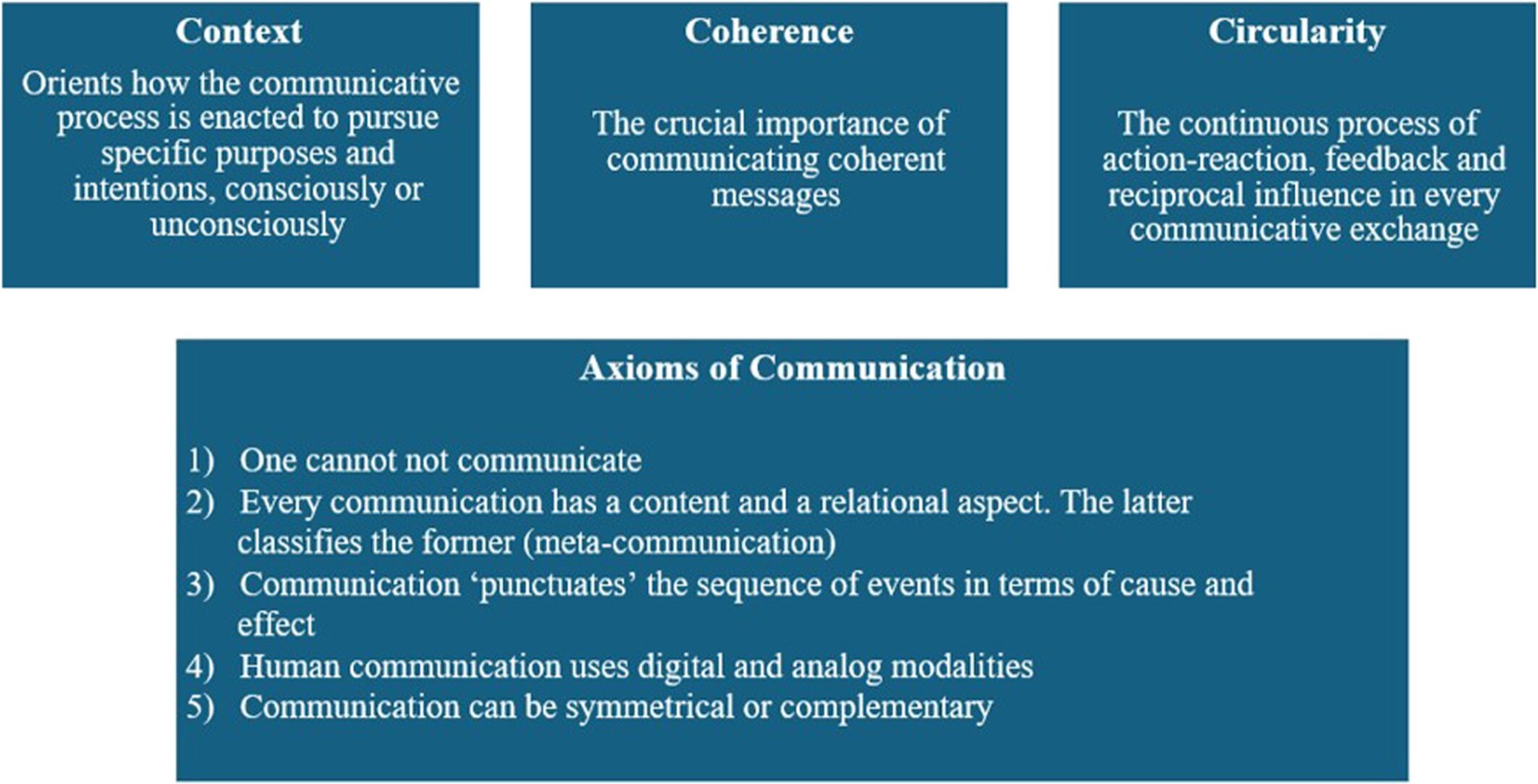
Rather than approaching participation in an abstract way, this frame recognizes communication and dialogue as crucial mechanisms and considers the pragmatic aspects that underpin meaningful participation. These are centred around the notion that every communicative process unfolds within a specific context, among ‘thinking and acting’ individuals, who pursue their own goals and act consistently on their understanding of the context. Drawing on the PHC's three core concepts of (i) context, (ii) coherence of messages and (iii) circularity, we illustrate how professionals can respond more effectively to the child welfare participation obstacles and ambiguities highlighted in our literature review.
PHC comprises five axioms of communication (Figure 1) that describe the communication process and focus on the interplay between verbal and nonverbal communication during an interaction. In brief, the following five axioms assert that: (i) one cannot not communicate; (ii) every communication has content and a relational aspect; (iii) communication ‘punctuates’ the sequence of events in terms of cause and effect; (iv) human communication uses digital and analogue modalities (varied, including nonverbal); (v) communication exchanges are either symmetrical or complementary (parties at the same or different levels respectively). These axioms explain misunderstandings and conflicts, including those discussed in our literature review, with good and effective communicative exchanges achieved when all elements (verbal and nonverbal, relations and contents) are coherent. These elements—content and relations—can lead to meaningful communication (mutual understanding) depending on the communicants' interpretation of the context in which the communication takes place. In this sense, context is a ‘matrix of meaning.’
5.1 Context in Communication
A PHC approach requires consideration to the integral context in which communication occurs and the meanings individuals consciously or unconsciously attribute to it. This contextual understanding orients how the communicative process is enacted to pursue specific purposes and intentions. In a child welfare context, relationships are unequal, characterized by purposeful power differences and statutory functions influencing the relational expectations and communication of people involved, as evidenced in our literature review. When compared to parents involved on a voluntary basis, parents whose engagement is mandatory are more likely to expect to be scrutinized and assessed and, therefore, concerned how their words/action might be used or interpreted. These two contrasting contexts highlight how any professional claim to be seeking a participatory relationship will be experienced very differently. For example, the professional who communicates to an involuntary parent in a child protection context ‘I am here to help you,’ ‘Trust me,’ may not appear congruent with the context and the different relational positions. Drawing on the findings of the TLC project, one social worker demonstrated her ability to exercise an empathic yet authoritative position that sensitively and honestly confronted the realities of a parent's situation:
Because the first visit she was very anxious and she sat and cried. She goes, ‘I don't want you to take him off me.’ And I was kind of saying, ‘You know Kathryn, we do do that when we need to, but I'm not coming out to do that today. What I'm out to do is to help you.’ (Ruch 2026, 9)
5.2 Coherence of Messages in Communication
Context closely connects to the importance of communicating coherent messages, drawing on the systemic ‘double bind’ concept, developed by Bateson et al. (1956) in relation to family communication patterns in mental health. In general, a double bind occurs when an individual is placed in a situation where they receive two or more conflicting messages, with one message negating the other. This creates a paradox where any response the individual chooses leads to confusion, anxiety and often a sense of powerlessness. A typical paradox in the child welfare context is the invitation for a parent to participate in an initial investigation by sharing their perspective on family difficulties to assess risk and need. A parent's decision to disclose or deny, for example, a substance misuse problem, could equally result in a negative outcome of either child removal (a disclosure) or preventing access to necessary supports (a denial). Therefore, if not correctly explained, the communication could be experienced as misleading and distressing.
For children, a message's coherence may be reflected in how a child-professional relationship is influenced by how a child perceives their parent's position or the consequences their words might have in the wider context. A familiar scenario is the child who expresses their wish to remain with their parents, despite evidence of risk to their safety. In these circumstances, further explanations are required for the professional to recognize the double bind and establish the basis for the child's wishes, for their understanding of the context and the coherence and the reliability of the message.
5.3 Circularity in Communication
Circularity is the continuous process of action-reaction and feedback in every communicative exchange. Interpersonal communication is never one-way but involves interaction and requires ‘anticipated feedback’ to take place. Viewed through the lens of circularity, communication can be understood as a dynamic process in which communicants react to each other with each emitting and receiving information in turn and, when receiving information, choosing to accept, refuse or disqualify the communication. For example, when a professional invites a child to participate, the child receives and processes this request based on their understanding of participation and the current context, then responds according to this interpretation. Through this circular exchange, communication can develop positively in a relationship of mutual understanding or can contribute to a new (and more equal) relationship, thus creating the space to make participatory practice more credible. However, in involuntary conflictual contexts, it can also develop negatively through misunderstandings.
The unequal relationships in child welfare services, underpinned by purposeful power, present a particularly challenging context for communicants as receiver and emitter as noted in our literature review. These challenges highlight the fundamental need for awareness and transparency in the power imbalance, with careful encoding and decoding to deliver and receive communication as intended to achieve reciprocal understanding. Therefore, meaningful participation does not come easily but reflects real challenge and effort as positions and understandings are worked through and resolved. In practice, this requires the assurance of clarity in both the object and purpose of participation, the careful tailoring of bespoke content for the intended receiver, a continuous process of checking for understanding and adapting communication as needed (and seeking the same approach when assuming the position of receiver). In summary, the PHC shows how participation practices in child welfare should be considered as a circular, relational process that develops through mutual influences, within a context endowed with meanings that can be different among communicants and needs to be considered and aligned for good and effective communication.
6 Moving Forward: Contextual, Relational, Embedded and Pragmatic Participation
In drawing our ideas together and reflecting on the implications for social work practice, we are proposing an initial approach that does not seek to ignore or negate the progress that has been made over many years across the different participatory arenas. Rather, we are arriving at the beginning of a broader, collective endeavour to better understand and shape participatory practices in child welfare—one that respectfully disrupts, complements and sensitively adds nuance to current approaches and practices. These ambitions are in response to our realization that, firstly, there is an entrenched disconnect between theoretical developments and child welfare practice realities, resulting in inhibited and siloed participatory practices as evidenced in the literature, secondly, a rights-based approach requires greater attention to an individual's agency and context and thirdly, the most recent innovations in participation trend towards the system and policy levels, with less attention paid to participation at the direct practice level. Building on our preceding sections, below we outline the key characteristics of a rights-based participation mindset that is contextual, relational, embedded and pragmatic, together with their implications for practice.
6.1 The Contextual Dimension
The contextual dimension of rights-based participation speaks to values in its inclusive stance, which seeks to hold the participatory rights and responsibilities of children, parents and professionals in a holistic framework. This configuration is in response to the limitations of the prevailing dichotomized approaches, which underestimate the importance of wider individual, familial, cultural and societal contexts and recognize their fluidity and the need for participatory spaces and outcomes to be informed by a process of continuous awareness of contextual influences. This also responds to the oversimplification of what is an unavoidably complex and charged professional space. By recognizing contextual factors and acknowledging their inevitable complexity, professionals are supported to hold in mind the participatory rights of both the child and the parent.
6.2 The Relational and Embedded Dimensions
Current research highlights the importance of, and need for, participation to be more relational and more sustainable. Children and parents need to feel participation is happening as an integral part of the relationship they have with a child welfare professional and not experience it as a discreet task on a professional checklist. For professionals, participation should not be experienced as an extra demand in an already time pressured environment but rather recognized as an embedded aspect of everyday practice. That said, the intensity of the emotional dynamics in child welfare contexts, and the pressure this can create, must not be underestimated. Child welfare professionals, for example, can express insecurity about TLC and balancing children's agency with their need for protection. In relation to parents, entrenched notions of the ‘bad’ parent can generate worries among professionals who fear that inviting a parent's perspective will result in unsafe practice when current child welfare concerns are not straightforward. These feelings are understandable. A psycho-social mindset plays an important role in mitigating the emotional barriers that might encourage a reductionist ‘checklist’ approach to relational participation rights and thereby impede it being embedded in everyday practice and sustained over time.
6.3 The Pragmatic Dimension
The pragmatic dimension shifts the nature of engagement from ‘a model’ of participation to an embedded practice approach or, more precisely, a pragmatic mindset, which values lived experience and seeks to deeply understand what is going on for families in their relations with child welfare systems. PHC centres and demystifies participation and its associated concepts help identify, in concrete and tangible terms, how to recognize communication barriers and their relevant context and how to overcome these barriers to promote meaningful participation through finely tuned, effective communication. This more pragmatic lens encourages a participatory mindset to be applied as part of professionals' everyday encounters and communications with children and parents.
Taken together, these dimensions suggest that meaningful rights-based participation is less dependent on the implementation of specific participation models and more dependent on practitioners' capacity to work contextually, relationally and reflexively within the complexities of everyday child welfare practice.
7 Conclusions
Child and parent participation is a fundamental right that underpins effective child welfare practices. Despite wide consensus on the importance of participation and over three decades' worth of models to inform its application in child welfare, meaningful participation remains elusive. This paper, informed by our deliberative reflexive critical inquiry, asserts that a more contextual, relational, embedded and pragmatic participatory approach is needed that disrupts the current siloed and surface approaches and that draws attention to the emotional and communicative elements of participatory practice.
This paper should be considered in light of certain limitations. Our novel second person action research approach and narrative review was designed to provide a broad, interpretive and critical synthesis of literature across stakeholder groups rather than an exhaustive systematic assessment of the evidence base. Consequently, the ideas presented here should be viewed as a conceptual contribution intended to stimulate debate, research and practice development, rather than as a definitive roadmap for implementation.
The complexity of participation in a child welfare context, as explored here, suggests an innovative reconceptualization on its own may be insufficient to shift practice. Future participatory research is needed to shift the current state of play, offer new insights and chart a new course by testing contextual, relational, embedded and pragmatic participatory approaches. For example, more research is needed on communication processes as participatory spaces involving child welfare professionals, children and parents and how these can be strengthened. Participatory research is also needed on effective communication processes that promote both children's and parents' participation across population subgroups and a spectrum of safeguarding concerns to ensure equity in participatory opportunities and methods. Findings from future research could also inform social work education and training for professionals to develop a comprehensive and accurate understanding of child and parent participation rights and how these are implemented in practice using a well-developed mindset and skillset. This future direction can mobilize steps forward into more attuned professional practice and more epistemically and socially just participatory spaces.
Complexe Systémique: key points
For systemic practice, the interest of this paper is to bring Palo Alto back where it is no longer expected: into the child welfare office. The team shows that participation fails less for lack of laws or models than because it is thought of in silos, children’s rights versus parents’ rights, whereas it is played out in a relational context charged with fear, shame and power. The double bind is described precisely: inviting a parent to speak frankly about substance use exposes them to losing their child if they speak, or losing support if they stay silent. As long as this paradox is not named, “participation” remains an injunction. Two levers are proposed: a psychoanalytically informed attention to professionals’ own defences, and a pragmatic reading of messages (context, coherence, circularity). The limit is clear: this is a conceptual essay, with no new data and no direct voices of children or parents, and the participatory research it calls for remains to be done. Read alongside our guided reading of Pragmatics of Human Communication, and the article on working systemically with parents whose children are placed in care.
Notes from the original
Conflicts of interest. The authors declare no conflicts of interest.
References
Abela, A., C. Devaney, B. H. Kojan, T. Kotzeva, J. Arsic, and S. Wilson. 2024. “The Meaningful Participation of Children in Matters That Affect Them: Child Participation in the Context of Child Protection Across Five European Countries.” Children and Youth Services Review 157: 107746. https://doi.org/10.1016/j.childyouth.2024.107746.
Adamo, S. M., and M. Rustin. 2014. Young Child Observation: A Development in the Theory and Method of Infant Observation. Karnac.
Alfandari, R. 2017. “Evaluation of a National Reform in the Israeli Child Protection Practice Designed to Improve Children's Participation in Decision-Making.” Child & Family Social Work 22: 54–62. https://doi.org/10.1111/cfs.12292.
Allcock, A. 2018. Frameworks for Child Participation in Social Care. Outlines. https://www.iriss.org.uk/resources/esss-outlines/frameworks-child-participation-social-care.
Antonopoulou, V., M. Killian, and D. Forrester. 2024. “Measuring Levels of Family Stress and Engagement in Child Protection Social Work: An Explorative Analysis of Parental Stress and Social Worker Practice Skills.” Journal of Children's Services 19, no. 2: 123–134.
Bateson, G., D. D. Jackson, J. Haley, and J. Weakland. 1956. “Toward a Theory of Schizophrenia.” Behavioral Science 1, no. 3: 251–264. https://doi.org/10.1002/bs.3830010307.
Berrick, J. D., S. Peckover, T. Pösö, and M. Skivenes. 2015. “The Formalized Framework for Decision-Making in Child Protection Care Orders: A Cross-Country Analysis.” Journal of European Social Policy 25, no. 4: 366–378. https://doi.org/10.1177/0958928715594540.
Berrick, J. D., M. Skivenes, and J. N. Roscoe. 2022. “Children's Rights and Parents' Rights: Popular Attitudes About When We Privilege One Over the Other.” International Journal of Social Welfare 31: 449–462. https://doi.org/10.1111/ijsw.12523.
Bourhis, J. 2017. “Narrative Literature Review.” In The Sage Encyclopedia of Communication Research Methods, vol. 4, 1076–1077. SAGE Publications, Inc. https://doi.org/10.4135/9781483381411.n370.
Briggs, S. 2012. “Observation, Containment, Countertransference: The Contribution of Psychoanalytic Thinking to Contemporary Relationship-Based Social Work Practice.” In Waiting to Be Found: Papers on Children in Care, 271–286. Karnac.
Burrow, S., L. Wood, C. Fisher, R. Usher, R. Gayde, and M. O’Donnell. 2024. “Parents’ Experiences of Perinatal Child Protection Processes: A Systematic Review and Thematic Synthesis Informed by a Socio-Ecological Approach.” Children and Youth Services Review 166: 107960.
Coghlan, D., and M. Brydon-Miller. 2014. “Second Person Action Research.” In The SAGE Encyclopedia of Action Research, Vol. 2, 699–700. SAGE Publications Ltd. https://doi.org/10.4135/9781446294406.n309.
Cuevas-Parra, P. 2023. “Multi-Dimensional Lens to Article 12 of the UNCRC: A Model to Enhance Children's Participation.” Children's Geographies 21, no. 3: 363–377. https://doi.org/10.1080/14733285.2022.2071598.
Damman, J. L., Y. Saar-Heiman, M. Lalayants, and A. Gupta. 2025. “What Makes Peer Support Supportive? A Scoping Review of Multidimensional Parent Advocacy Support in Child Welfare.” Children and Youth Services Review 169: 108133.
Darlington, Y., K. Healy, and J. A. Feeney. 2010. “Challenges in Implementing Participatory Practice in Child Protection: A Contingency Approach.” Children and Youth Services Review 32, no. 7: 1020–1027. https://doi.org/10.1016/j.childyouth.2010.04.002.
Davies, K., N. Ross, J. Cocks, and W. Foote. 2023. “Family Inclusion in Child Protection: Knowledge, Power and Resistance.” Children and Youth Services Review 147: 106860.
Diaz, C., H. Pert, and N. P. Thomas. 2019. “Independent Reviewing Officers' and Social Workers' Perceptions of Children's Participation in Children in Care Reviews.” Journal of Children's Services 14, no. 3: 162–173.
Dir, A. L., B. L. Batch, and M. C. Aalsma. 2025. “Understanding Parents' Experience Navigating Substance Use Treatment and the Child Welfare System.” Journal of Substance Use and Addiction Treatment 172: 209672.
Elbow, P. 1989. “Toward a Phenomenology of Freewriting.” Journal of Basic Writing 8, no. 2: 42–71.
Enroos, R., and T. Pösö. 2023. “Family Relatedness: A Challenge for Making Decisions in Child Welfare.” Families, Relationships and Societies 12, no. 2: 272–287.
Fargion, S., and D. Mauri. 2025. “Children Involved in Child Protection: Hostile Attitudes as a Form of Agency.” Social Sciences 14, no. 8: 449.
Fonagy, P., G. Gergely, and E. L. Jurist. 2018. Affect Regulation, Mentalization and the Development of the Self. Routledge.
Franklin, A., and S. Goff. 2018. “Listening and Facilitating All Forms of Communication: Disabled Children and Young People in Residential Care in England.” Child Care in Practice 25, no. 1: 99–111. https://doi.org/10.1080/13575279.2018.1521370.
Ghaffar, W., M. Manby, and T. Race. 2012. “Exploring the Experiences of Parents and Carers Whose Children Have Been Subject to Child Protection Plans.” British Journal of Social Work 42, no. 5: 887–905. https://doi.org/10.1093/bjsw/bcr132.
Gibbons, M., and N. Connolly. 2020. “‘Just Shut Up and Let Them Talk’: Participation, Power and the Parent Voice in the Child Protection System.” Social Work and Social Sciences Review 22, no. 1: 26–41.
Gibson, M. 2020. “The Shame and Shaming of Parents in the Child Protection Process: Findings From a Case Study of an English Child Protection Service.” Families, Relationships and Societies 9, no. 2: 217–233.
Gladstone, J., G. Dumbrill, B. Leslie, A. Koster, M. Young, and A. Ismaila. 2012. “Looking at Engagement and Outcome From the Perspectives of Child Protection Workers and Parents.” Children and Youth Services Review 34, no. 1: 112–118.
Goddard, K., J. Montague, and J. Elander. 2023. “Parental Involvement in Child Protection Services and Parenting Experience as Alcohol and Other Drug Use: An Interpretative Phenomenological Analysis.” British Journal of Social Work 53, no. 6: 3034–3054.
Gresdahl, M., A. S. Storhaug, and H. Fauske. 2025. “Balancing Child Participation and Protection in Emergency Cases: Ensuring the Child's Best Interests.” Children and Youth Services Review 172: 108259.
Hart, R. 1992. Children's Participation: From Tokenism to Citizenship. UNICEF Innocenti Essays.
Healy, K., and Y. Darlington. 2009. “Service User Participation in Diverse Child Protection Contexts: Principles for Practice.” Child & Family Social Work 14, no. 4: 420–430.
Healy, K., Y. Darlington, and J. A. Feeney. 2011. “Parents' Participation in Child Protection Practice: Toward Respect and Inclusion.” Families in Society 92, no. 3: 282–288.
Healy, K., Y. Darlington, and J. Yellowlees. 2012. “Family Participation in Child Protection Practice: An Observational Study of Family Group Meetings.” Child & Family Social Work 17: 1–12.
Henze-Pedersen, S. 2026. “Listening to Children, Holding Parents Accountable: Social Workers’ Perspectives on Children and Parents in Child Welfare Services.” British Journal of Social Work 56, no. 3: 926–943.
Henze-Pedersen, S., and T. T. Bengtsson. 2024. “Developing a Model for Child Participation in Child Welfare Services.” Child & Family Social Work 29, no. 4: 1086–1095. https://doi.org/10.1111/cfs.13150.
Jørgensen, T., S. Seim, and B. M. Njøs. 2024. “How Children and Young People Understand and Experience Individual Participation in Social Services for Children and Young People: A Synthesis of Qualitative Studies.” European Journal of Social Work 27, no. 3: 546–559.
Juul, R., and I. S. D. Husby. 2020. “Collaboration and Conversations With Children in Child Welfare Services —Parents' Viewpoint.” Child & Family Social Work 25, no. S1: 9–17. https://doi.org/10.1111/cfs.12707.
Keddell, E. 2023. “Recognising the Embedded Child in Child Protection: Children's Participation, Inequalities and Cultural Capital.” Children and Youth Services Review 147: 106815.
Kelly, B., J. Dixon, and M. Incarnato. 2016. “Peer Research With Young People Leaving Care: Reflections From Research in England, Northern Ireland and Argentina.” In Young People Transitioning From Out-Of-Home Care: International Research, Policy and Practice, edited by P. Mendes and P. Snow, 221–240. Springer.
Kennan, D., B. Brady, and C. Forkan. 2018. “Supporting Children's Participation in Decision-Making: A Systematic Literature Review Exploring the Effectiveness of Participatory Processes.” British Journal of Social Work 48, no. 7: 1985–2002.
Kilkelly, U., L. Lundy, and B. Bryne. 2021. Incorporating the UN Convention on the Rights of the Child Into National Law. Intersentia.
Kosher, H., and A. Ben-Arieh. 2020. “Social Workers' Perceptions of Children's Right to Participation.” Child & Family Social Work 25, no. 2: 294–303.
Kosher, H., and C. Katz. 2025. “Risk or Opportunity? Child Protection Workers' Perceptions of Children's Participation in the Protection System.” Child Abuse & Neglect 162: 107110.
Lalayants, M., and L. Merkel-Holguin. 2025. “Navigating the Child Welfare System: The Role of Enhanced Parent Advocacy Supports in Child Protection.” Journal of Public Child Welfare 19, no. 2: 297–319.
Lalayants, M., and I. Saitadze. 2025. “Separation and Psychosocial Challenges of Parents With Children in Foster Care.” Children and Youth Services Review 171: 108180.
Lätsch, D., J. Quehenberger, R. Portmann, and A. Jud. 2023. “Children's Participation in the Child Protection System: Are Young People From Poor Families Less Likely to Be Heard?” Children and Youth Services Review 145: 106762.
Lehtme, R., and K. Toros. 2020. “Parental Engagement in Child Protection Assessment Practice: Voices From Parents.” Children and Youth Services Review 113: 104968.
Lines, L. E., T. A. Kakyo, J. Anderson, N. Sivertsen, and S. Hunter. 2025. “Parents' Experiences of Accessing Support for Adversities That Impact Their Parenting: A Systematic Review of Qualitative Evidence.” Health & Social Care in the Community 2025, no. 1: 5537011. https://doi.org/10.1155/hsc/5537011.
Lundy, L. 2007. “‘Voice’ Is Not Enough: Conceptualising Article 12 of the United Nations Convention on the Rights of the Child.” British Educational Research Journal 33, no. 6: 927–942.
Luu, B., A. C. Wright, S. Schurer, et al. 2025. “Understanding Families With Multiple, Complex, and Unmet Service Needs in the Child Protection System Through the Lens of Linked Administrative Data in New South Wales, Australia.” Child Protection and Practice 6: 100224.
Maxwell, N., J. Scourfield, B. Featherstone, S. Holland, and R. Tolman. 2012. “Engaging Fathers in Child Welfare Services: A Narrative Review of Recent Research Evidence.” Child & Family Social Work 17, no. 2: 160–169.
McCafferty, P., and E. Mercado Garcia. 2024. “Children's Participation in Child Welfare: A Systematic Review of Systematic Reviews.” British Journal of Social Work 54, no. 3: 1092–1108.
McTavish, J. R., C. McKee, and H. L. MacMillan. 2022. “Foster Children's Perspectives on Participation in Child Welfare Processes: A Meta-Synthesis of Qualitative Studies.” PLoS ONE 17, no. 10: e0275784.
Moreno, E., R. Thorpe, and A. Wheeler. 2025. “Managing Risk and Child Participation in Out-Of-Home Care: Practitioner Perspectives.” Australian Social Work 78, no. 4: 471–484.
Ney, T., J. A. Stoltz, and M. Maloney. 2013. “Voice, Power and Discourse: Experiences of Participants in Family Group Conferences in the Context of Child Protection.” Journal of Social Work 13, no. 2: 184–202. https://doi.org/10.1177/1468017311410514.
Nissen, M. A., and M. K. Ravn. 2024. “Going Beyond Dichotomous Political Discourses About Children's Participation and Voice: Unfolding the Complexities of Children's Needs in and Around Supervised Contact in Denmark.” European Journal of Social Work 28, no. 4: 730–742.
Okpokiri, C. 2021. “Parenting in Fear: Child Welfare Micro Strategies of Nigerian Parents in Britain.” British Journal of Social Work 51, no. 2: 427–444.
Otterlei, M. T., and E. Engebretsen. 2021. “Parents at War: A Positioning Analysis of How Parents Negotiate Their Loss After Experiencing Child Removal by the State.” Qualitative Social Work 21, no. 4: 765–782. https://doi.org/10.1177/14733250211048546.
Pölkki, P., R. Vornanen, M. Pursiainen, and M. Riikonen. 2012. “Children's Participation in Child-Protection Processes as Experienced by Foster Children and Social Workers.” Child Care in Practice 18, no. 2: 107–125.
Raineri, M. L., F. Corradini, V. Calcaterra, and E. Cabiati. 2021. “Compliance o reciprocità? Come gli operatori sociali concepiscono la partecipazione.” In Tra partecipazione e controllo. Contributi di ricerca sul coinvolgimento di bambini e famiglie nei servizi di tutela minorile, edited by V. Calcaterra and M. L. Raineri, 17–54. Erickson.
Rousson, A. N., S. Merelas, E. A. Tajima, L. Orlando, J. J. Lund, and S. Barkan. 2025. “At the Mercy of Our System”: Structural and Programmatic Changes for Supporting Parents With Children in Out-of-Home Care.” Children and Youth Services Review 175: 1–10.
Ruch, G. 2026. Listening and Talking to Children [Presentation]. CAFCASS Together Champions, Professional Development Event.
Ruch, G., K. Winter, F. Morrison, M. Hadfield, S. Hallett, and V. Cree. 2020. “From Communication to Co-operation: Reconceptualizing Social Workers' Engagement With Children.” Child & Family Social Work 25: 430–438. https://doi.org/10.1111/cfs.12699.
M. Rustin, and J. Bradley, eds. 2008. Work Discussion. Learning From reflective practice in work and families. Tavistock Clinic Series. Karnac.
Saar-Heiman, Y. 2023. “Power With and Power Over: Social Workers' Reflections on Their Use of Power When Talking With Parents About Child Welfare Concerns.” Children and Youth Services Review 145: 106776.
Saar-Heiman, Y., J. L. Damman, M. Lalayants, and A. Gupta. 2024. “Parent Peer Advocacy, Mentoring, and Support in Child Protection: A Scoping Review of Programs and Services.” Psychosocial Intervention 33, no. 2: 73–88.
Salverson, M., and F. Arney. 2013. “Understanding the Journey of Parents Whose Children Are in Out-Of-Home Care.” In Working With Vulnerable Families: A Partnership Approach, edited by F. Arney and D. Scott, 2nd ed., 213–235. Cambridge University Press.
Sanders, R., and S. Mace. 2006. “Agency Policy and the Participation of Children and Young People in the Child Protection Process.” Child Abuse Review: Journal of the British Association for the Study and Prevention of Child Abuse and Neglect 15, no. 2: 89–109.
Shemmings, D. 2000. “Professionals' Attitudes to Children's Participation in Decision-Making: Dichotomous Accounts and Doctrinal Contests.” Child & Family Social Work 5, no. 3: 235–243.
Shier, H. 2001. “Pathways to Participation: Openings, Opportunities and Obligations: A New Model for Enhancing Children's Participation in Decision-Making in Line With Article 12.1 of the United Nations Convention on the Rights of the Child.” Children and Society 15, no. 2: 107–117.
Smithson, R., and M. Gibson. 2017. “Less Than Human: A Qualitative Study Into the Experience of Parents Involved in the Child Protection System.” Child & Family Social Work 22, no. 2: 565–574.
Storhaug, A. S., M. K. Fylkesnes, E. Langsrud, and Ø. Christiansen. 2023. “Parents' and Child Welfare Workers' Understandings of Consent to Emergency Placements.” Nordic Social Work Research 15, no. 1: 29–40. https://doi.org/10.1080/2156857X.2023.2193823.
Strömpl, J., and K. Luhamaa. 2020. “Child Participation in Child Welfare Removals Through the Looking Glass: Estonian Children's and Professionals' Perspectives Compared.” Children and Youth Services Review 118: 105421.
Suomi, A., A. Bolton, and D. Pasalich. 2023. “The Prevalence of Post-Traumatic Stress Disorder in Birth Parents in Child Protection Services: Systematic Review and Meta-Analysis.” Trauma, Violence & Abuse 24, no. 2: 1032–1046.
Syrstad, E., and T. Slettebø. 2020. “To Understand the Incomprehensible: A Qualitative Study of Parents' Challenges After Child Removal and Their Experiences With Support Services.” Child & Family Social Work 25, no. 1: 100–107.
Tahir, M., and V. Cobigo. 2025. “They Helped me Stand on my Own Two Feet”: Canadian Parents With Intellectual Disabilities in Child Protection.” Journal of Intellectual Disabilities 29, no. 2: 349–370.
Taylor, J., K. Stalker, and A. Stewart. 2016. “Disabled Children and the Child Protection System: A Cause for Concern.” Child Abuse Review 25, no. 1: 60–73.
Tembo, M. J. 2020. “Navigating Emotions in Child Welfare: Immigrant Parents' Experiences and Perceptions of Involvement With Child Welfare Services in Norway.” International Social Work 65, no. 2: 254–267. https://doi.org/10.1177/0020872819897770.
Tembo, M. J. 2022. “Navigating Emotions in Child Welfare: Immigrant Parents' Experiences and Perceptions of Involvement With Child Welfare Services in Norway.” International Social Work 65, no. 2: 254–267. https://doi.org/10.1177/0020872821994276.
Toros, K. 2021a. “Children's Participation in Decision-Making From Child Welfare Workers' Perspectives: A Systematic Review.” Research on Social Work Practice 31, no. 4: 367–374. https://doi.org/10.1177/1049731520984844.
Toros, K. 2021b. “A Systematic Review of Children's Participation in Child Protection Decision-Making: Tokenistic Presence or Not?” Children & Society 35, no. 3: 395–411. https://doi.org/10.1111/chso.12418.
Toros, K., D. M. DiNitto, and A. Tiko. 2018. “Family Engagement in the Child Welfare System: A Scoping Review.” Children and Youth Services Review 88: 598–607. https://doi.org/10.1016/j.childyouth.2018.03.011.
Toros, K., and A. Falch-Eriksen. 2024. “I Got to Say Two or Three Lines”—A Systematic Review of Children's Participation in Child Protective Services.” Child Abuse & Neglect 150: 106934. https://doi.org/10.1016/j.chiabu.2023.106934.
Toros, K., A. Falch-Eriksen, and O. Lysa. 2025. “Parents' Voices on Parental Engagement in Child Protective Services.” Journal of Children's Services 20, no. 2: 47–62.
Toros, K., M. C. LaSala, and M. Medar. 2015. “Assessment of Children in Need in a Post-Soviet Context: Reflections of Child Protective Workers in Estonia.” Journal of Family Social Work 18, no. 4: 267–287. https://doi.org/10.1080/10522158.2015.1039110.
Treseder, P. 1997. Empowering Children and Young People: Promoting Involvement in Decision-Making. Save the Children.
United Nations. 1989. Convention on the Rights of the Child. United Nations. https://www.ohchr.org/en/instruments-mechanisms/instruments/convention-rights-child.
van Bijleveld, G. G., C. W. Dedding, and J. F. Bunders-Aelen. 2014. “Seeing Eye to Eye or Not? Young People's and Child Protection Workers' Perspectives on Children's Participation Within the Dutch Child Protection and Welfare Services.” Children and Youth Services Review 47: 253–259. https://doi.org/10.1016/j.childyouth.2014.09.022.
van Bijleveld, G. G., C. W. M. Dedding, and J. F. G. Bunders-Aelen. 2015. “Children’s and Young People’s Participation Within Child Welfare and Child Protection Services: A State-of-the-Art Review.” Child and Family Social Work 20, no. 2: 129–138. https://doi.org/10.1111/cfs.12082.
Vis, S. A., A. Holtan, and N. Thomas. 2012. “Obstacles for Child Participation in Care and Protection Cases—Why Norwegian Social Workers Find It Difficult.” Child Abuse Review 21: 7–23. https://doi.org/10.1002/car.1155.
Watzlawick, P., J. H. Beavin, and D. D. Jackson. 1971. Pragmatics of Human Communication: A Study of Interactional Patterns, Pathologies, and Paradoxes. W. W. Norton & Company.
Williams, T. L., and S. L. Parry. 2023. “The Voice of the Child in Social Work Practice: A Phenomenological Analysis of Practitioner Interpretation and Experience.” Children and Youth Services Review 148: 106905.
Wilson, S. 2025. “Rethinking Participation: Exploring Children's Power Relations and Emotions in Child Protection Services.” British Journal of Social Work 55: 3280–3297. https://doi.org/10.1093/bjsw/bcaf168.
Winter, K. 2009. “Relationships Matter: The Problems and Prospects for Social Workers' Relationships With Young Children in Care.” Child & Family Social Work 14, no. 4: 450–460. https://doi.org/10.1111/j.1365-2206.2009.00628.x.
Winter, K. 2012. “Ascertaining the Perspectives of Young Children in Care: Case Studies in the Use of Reality Boxes.” Children & Society 26, no. 5: 368–380. https://doi.org/10.1111/j.1099-0860.2010.00335.x.
Winter, K. 2014. “Understanding and Supporting Young Children's Transitions Into State Care: Schlossberg's Transition Framework and Child-Centred Practice.” British Journal of Social Work 44, no. 2: 401–417.
Winter, K., P. Connolly, S. Millen, and D. Sweet. 2024. “The UNCRC and Family Support: A Case Study of the Early Intervention Support Service.” Child Care in Practice 30, no. 4: 502–516.
Winter, K., V. Cree, S. Hallett, et al. 2017. “Exploring Communication Between Social Workers, Children and Young People.” British Journal of Social Work 47, no. 5: 1427–1444.
Woodman, E., S. Roche, and M. McArthur. 2023. “Children's Participation in Child Protection—How Do Practitioners Understand Children's Participation in Practice?” Child & Family Social Work 28, no. 1: 125–135.
Reformatted republication of Disrupting the Child Welfare Participation Paradigm: A Contextual, Relational, Embedded and Pragmatic Approach, by Jeri L. Damman, Teresa Bertotti, Diletta Mauri, Gillian Ruch and Karen Winter, Child & Family Social Work, advance online publication (2026), doi: 10.1111/cfs.70254, under a CC BY 4.0 licence. Edition and layout: Complexe Systémique, September 2026 — the work has been modified under the terms of the licence. Neither the authors nor the publisher are responsible for this edition; the original version prevails.
This is the original article “Disrupting the Child Welfare Participation Paradigm: A Contextual, Relational, Embedded and Pragmatic Approach”, published in Child & Family Social Work (2026) under a CC BY 4.0 licence. Republished by Complexe Systémique: the author’s text is unchanged; only the presentation has been adapted for reading online, as set out at the head of this page.
Read the original articleHow to cite this article
Damman, J. L., Bertotti, T., Mauri, D., Ruch, G., et Winter, K. (2026). Disrupting the Child Welfare Participation Paradigm: A Contextual, Relational, Embedded and Pragmatic Approach. Complexe Systémique. https://app.complexe-systemique.com/en_GB/articles/disrupting-the-child-welfare-participation-paradigm (Original work published in 2026 in Child & Family Social Work, Early View (2026); republished in 2026 by Child & Family Social Work, https://onlinelibrary.wiley.com/doi/full/10.1111/cfs.70254)
To go further
- Pragmatics of human communication: a guided readingThe pragmatics of communication.
- « Il ne suffit pas de faire ou de dire ce qu’il faut » : travailler de façon systémique avec des parents dont les enfants sont placésParents of children in care.
- « Je peux le dire ? » Participation et positionnement des enfants dans une atmosphère de secret en thérapie familialeChildren’s participation.
Related articles
 Article
 Toxic, narcissistic, borderline: what therapy speak does to your relationships
Narcissistic, borderline, toxic: therapy speak has left the consulting room. Julien Besse shows how these labels close the debate and relieve us of our own part.
 Article
 Making Sense of Parental Resistance in Involuntary Child Welfare Relationships: Child Welfare Workers' Perspectives
Eleven Norwegian child welfare workers make sense of parental resistance: learned fear, exclusion and services with no time for the relationship.
 Article
 “I Self‐Protect to Avoid Child Protection”: Transgender Parents' Fears of Help‐Seeking and Social Service Systems
108 trans parents in the United States describe their fear of being reported to child protective services, and how it leads them to forgo help and care.
 Article
 “The Liminal Father”: A qualitative study exploring men's experiences of paternal imprisonment
Six men recall growing up with an imprisoned father: a “liminal” father, neither present nor absent, pain held at a distance, lasting stigma and the need to grow up fast.