Psychology and Psychotherapy: Theory, Research and Practice · Family
A qualitative, multi‐perspective study on causal beliefs about adolescent depression
Thirty-four Dutch adolescents with clinical depression, their mothers and their fathers each say what they think caused the depression, then what they believe the young person thinks. At group level the explanations look alike: character, social relationships, school, stress. Within each family they overlap little, and parents underestimate how much their child understands about their own depression.
This is a reformatted republication of A qualitative, multi‐perspective study on causal beliefs about adolescent depression, by Wilma G. M. Wentholt, Loes H. C. Janssen, Lisanne A. E. M. van Houtum, Mirjam C. M. Wever, Marieke S. Tollenaar, Lenneke R. A. Alink and Bernet M. Elzinga, published in Psychology and Psychotherapy: Theory, Research and Practice (Wiley) (2024), doi: 10.1111/papt.12528, under a CC BY 4.0 licence. Prepared by Complexe Systémique in September 2026: the authors’ text is unchanged; the layout has been adapted for reading online, which constitutes a modification of the work under the terms of the licence. Tables are presented as lists (Table 1, flattened in the source, has been regrouped by adolescents, mothers and fathers); end-of-article statements are grouped in the notes; the data availability statement and the online supplementary material (Tables S1–S2, Figures S1–S2) are not reproduced. This edition was made neither by the authors nor by the publisher, who are not responsible for its content or for any errors. The original version prevails.
The aim thereby does not have to be that the adolescent and their parent(s) hold the same perspective, but rather that they understand each other's perspective and communicate about this.
Wilma G. M. Wentholt, Loes H. C. Janssen, Lisanne A. E. M. van Houtum, Mirjam C. M. Wever, Marieke S. Tollenaar, Lenneke R. A. Alink and Bernet M. Elzinga
Abstract
Objectives. The current study aimed to examine: (1.1) causal beliefs about adolescent depression in a sample of adolescents with a clinical depression and their mothers and fathers; (1.2) within-family overlap of causal beliefs; (2.1) mothers' and fathers' reflected causal beliefs about their child's perspective; (2.2) the accuracy of mothers' and fathers' reflected causal beliefs as related to their child's causal beliefs.
Design. Qualitative study using a within-family approach.
Methods. Adolescents with a current clinical depression (MDD/dysthymia; N = 34) and their parents (N = 34 mothers, N = 26 fathers) were independently interviewed about their causal beliefs about the adolescents' depression. Parents were additionally interviewed about their perception of their child's causal beliefs (i.e., reflected causal beliefs).
Results. The causal beliefs most frequently mentioned by adolescents, mothers and fathers are: characteristics of the child, social factors, school and various stressful experiences. Parent–child overlap was relatively low, specifically for the themes of bewilderment, cumulative effect and stressful life events, whereas overlap was relatively high for themes of social factors, school and stressful experiences outside of the family. Parents were relatively accurate in their reflected causal beliefs, but tended to underestimate their child's insights into possible causes of their depression. Accuracy of parents' reflected causal beliefs was particularly low for the theme cumulative effect and high for social factors.
Conclusions. The various causal beliefs of adolescents and their parents could be used in therapeutic setting. Future research could examine whether (guided) conversations may promote alignment within families and treatment efficacy.
Practitioner Points
- Each adolescent with depression has their own personal set of causal beliefs, and these can substantially differ from the perspective of their own parents. It is of value to ask the adolescent as well as both parents about their (reflected) causal beliefs, to understand the factors at play and the alignment within the family.
- Many of the causal beliefs concerned stressful experiences (in various domains) and nearly a quarter of the adolescents mentioned feeling overwhelmed by the build-up of (negative) life experiences. Adolescents may greatly benefit from support in processing these experiences in a therapeutic setting, and there may be a meaningful opportunity to involve parents in supporting the adolescent beyond the therapeutic setting in daily life.
- Asking about causal beliefs in a structured manner can provide additional insights about these beliefs. We would recommend practitioners to start with an open question on the topic, next use an overview of known risk factors, and ask about factors that are specifically perceived to cause and maintain the depression.
BACKGROUND
The adolescent years are characterized by many physical, psychological, cognitive, emotional and social changes (e.g., Sawyer et al., 2012). These provide great opportunities (e.g., emotional development; Sawyer et al., 2012), but also vulnerabilities, as reflected in the strong rise of depressive disorders during this period (e.g., Kessler et al., 2005). A variety of depressive disorders are described in the Diagnostic and Statistical Manual of Mental Disorders (DSM-V), in which ‘the common feature of these disorders is the presence of sad, empty, or irritable mood, accompanied by somatic and cognitive changes that significantly affect the individual's capacity to function’ (American Psychiatric Association [APA], 2013, p. 155). The developing adolescent tries to find their place in the (social) world around them and to establish their identity and autonomous functioning (McCurdy et al., 2020; Smetana, 2010). When depressive disorders occur during this developmental phase, this can have a long-term impact via negative effects on several life areas (e.g. disruptions in social, academic and family domain; Clayborne et al., 2019) and a major risk of recurrence later in life (Curry et al., 2011).
Epidemiological studies show that various biological (e.g., genetics, neural structures, neurochemicals, immune system), cognitive (e.g., cognitive schemas and style, pessimism, ruminative style, information processing) and social factors (e.g., life events, family dynamics, relationship issues, low social support) form a risk for depression (Dobson & Dozois, 2011). Factors appearing from qualitative studies on adolescents' beliefs about the causes of their own clinical depression are largely in line with these known risk factors (Bear et al., 2021; Midgley et al., 2017; Viduani et al., 2021; Wisdom & Agnor, 2007; Wisdom & Green, 2004). Adolescents hold diverse causal beliefs about their own depression, which can be roughly grouped in three main categories. The largest category is ‘psychosocial adversities’, such as maltreatment, peer group rejection/bullying and family issues, poverty and illness (Bear et al., 2021; Midgley et al., 2017; Viduani et al., 2021; Wisdom & Green, 2004). Secondly, personality factors (Bear et al., 2021; Midgley et al., 2017; Wisdom & Green, 2004) and thirdly, intergenerational vulnerability (Bear et al., 2021; Midgley et al., 2017; Wisdom & Agnor, 2007) are frequently mentioned. In the context of intergenerational vulnerability, some participants focus on genetic explanations (Bear et al., 2021; Midgley et al., 2017), whereas others mention social explanations (family interactions, coping, negative events) (Wisdom & Agnor, 2007). In addition to these three main categories, pressures of being an adolescent (Wisdom & Green, 2004) and a hormonal imbalance (Midgley et al., 2017) are sometimes mentioned. Finally, two overarching themes appear. On the one hand, adolescents mention a gradual build-up/cumulative effect of stressors (Bear et al., 2021; Wisdom & Green, 2004), while others struggle to grasp any possible causes (i.e., bewilderment; Bear et al., 2021; Midgley et al., 2017). Adolescents often mention multiple beliefs and thereby provide a multi-dimensional explanation (Bear et al., 2021; Midgley et al., 2017).
Following Bronfenbrenner's ecological approach to human development, children develop in close bi-directional interaction with several systems surrounding them, of which the family system is one of the systems closest to the child (Bronfenbrenner, 1977). Even though adolescents strive for autonomy (McCurdy et al., 2020), their parents are primary caregivers and remain important in the adolescent's daily life and long-term development (e.g., Meeus, 2016). Subsequently, systematically reviewed research shows that an integrative involvement of parents in the treatment of adolescent depression is beneficial to treatment effects and family dynamics (e.g., lowered conflict) (Dardas et al., 2018). Further, one quantitative study shows that causal beliefs of care providers (spouses and other family members) play a role in treatment adherence of adult patients, with lower adherence in case of attributions of the depression to cognitive or attitudinal problems (Sher et al., 2005). This suggests that parental causal beliefs may also play a role in the treatment of adolescent depression. To the best of our knowledge, there are no qualitative studies that included causal beliefs of parents about the clinical depression of their own adolescent child, nor on their insights into their child's causal beliefs. It is thus unknown to what extent parents share similar causal beliefs to their child or have very different views on the causes of their child's depression.
Shared causal beliefs and/or parents' accurate understanding of their child's causal beliefs may add to the support that adolescents perceive from their parents, whereas disagreements on the topic can be a source of tension and conflict. Low levels of support and high levels of conflict subsequently have been found to relate to and even predict adolescent depression (Restifo & Bögels, 2009). Currently, there is no research in which the parent–child overlap in causal beliefs and parents' accuracy of their reflected causal beliefs about their child's perspective has been examined, the current study aims to do so in light of the possible clinical relevance.
It is specifically of value to qualitatively examine causal beliefs about adolescent clinical depression, in addition to quantitative research. People with a lived/current experience of depression have personal insights into their own disorder, which might give input for therapy as well as research. Psychological treatment of depression is in general effective, but effect sizes are small (Cuijpers et al., 2009) and effects of different types of individual psychological treatments appear comparable (Cuijpers et al., 2011). Although specifically for adolescent depression, an integrative involvement of parents seems to be beneficial for treatment efficacy (Dardas et al., 2018). There may be value in including insights of the adolescent patient as well as their parent(s) in research and clinical practice; personal causal beliefs have been found to impact treatment preference, adherence and outcome (Hagmayer & Engelmann, 2014). One study included in the review by Hagmayer and Engelmann (2014), for example, showed that interpersonal therapy was more efficient than cognitive behavioural therapy for people holding interpersonal conflict as a causal belief of their depression (Carter et al., 2011). Including the patient's own perspective could thus benefit research on treatment efficacy. Before attending to research on benefits of involving causal beliefs in treatment, there is a need for qualitative research on causal beliefs of adolescents as well as their parents.
Current study
With the current qualitative study, we aim to provide new insights into causal beliefs about adolescent depression from a multi-perspective family approach in a sample of adolescents with a clinical depression and their mothers as well as fathers. More specifically, we aim to examine: (1.1) the adolescents' and their mothers' and fathers' causal beliefs about the adolescents' depression; (1.2) to what extent the adolescents' and their mothers' and fathers' causal beliefs are overlapping within families; (2.1) the mothers' and fathers' assumptions of their child's causal beliefs (i.e., reflected causal beliefs); (2.2) and to what extent mothers and fathers are accurate in their reflected causal beliefs.
METHODS
Participants
This study is part of the Dutch two-generation, multi-method project ‘Relations and Emotions in Parent-Adolescent Interaction research’ (RE-PAIR) of Leiden University. The overall aim of the RE-PAIR study is to examine the bidirectional relation between parent–child interactions and adolescent depression by comparing families with an adolescent without psychopathology to families with an adolescent with a current Major Depressive Disorder (MDD) or dysthymia (from now on referred to as ‘adolescents with depression’). In the current study we only included families with an adolescent with depression.
Families were recruited through mental health-care facilities in the area of Leiden and through advertisements. Mental health-care professionals informed eligible families about the study and brought the researchers into contact with interested families. Families were informed and screened (i.e., brief check of in- and exclusion criteria) by phone and an appointment was scheduled to diagnostically interview the adolescents using the Kiddie-Schedule for Affective Disorders and Schizophrenia – Present and Lifetime (K-SADS-PL; Reichart et al., 2000). If all in- and exclusion criteria were met, subsequent study parts (see procedure) were scheduled. Inclusion criteria for adolescents were: primary diagnosis of MDD or dysthymia (checked using the K-SADS-PL), aged between 11 and 17 years at time of inclusion, living and participating with at least one primary caregiver and attending (or completed) high school or higher education. Adolescents and their parent(s) were required to have a sufficient command of the Dutch language. If applicable to the family situations, the two primary caregivers were invited to partake in the study. If there were more than two caregivers involved in the adolescent's life, the two with the most frequent contact with the adolescent were selected by the family and researcher. All families in which two parents participated concerned a mother and a father. Families were excluded if the adolescent was starting antidepressant treatment (stable doses were allowed), if safety could not be ensured because of suicidal tendencies (suicidal ideation was no exclusion criterion) or severe auto-mutilation and in case of a current comorbid diagnosis of intellectual disability, psychosis, eating disorders, substance use disorders, or autism spectrum disorders. These comorbid disorders were exclusion criteria because of the impact on cognitive and behavioural functioning in social interactions, which is relevant given the focus on parent–child interactions in the broader project. A total of 70 families that deemed eligible for the study were contacted, of which 34 families were included and participated in the current study.
A total of 35 families with an adolescent with depression (N = 35) and their parents (N = 62) participated in RE-PAIR between July 2018 and February 2022. Of these 35, one family (with n = 2 parents) was initially recruited as a healthy control family, but during the K-SADS-PL interview it became apparent that the adolescent had a current MDD. Qualitative interview data relevant for the current study was therefore not available for this family. This resulted in a total sample of 34 families with an adolescent with depression (N = 34, 79.4% female) and their mothers (N = 34, 97.1% biological mothers) and fathers (N = 26, 92.3% biological fathers). The majority of the adolescents had a primary diagnosis of MDD (n = 27) and seven had a primary diagnosis of dysthymia. Demographic characteristics of the sample are presented in Table 1. All adolescents had sought professional help, but we observed great variation in the type of professional (e.g., social worker at school up to licensed psychologist) and the type and frequency of sessions (ranging from currently waitlisted to (bi-)weekly sessions up to one-and-a-half-year) (Table 1). None of the families had received parenting interventions or family-based treatment in the context of the adolescents' depression.
Table 1 — Demographic characteristics of participants.
Values: M (SD)/% (n); range in brackets.
Adolescents (N = 34)
- Age at the research day. 15.67 (1.51) [12.65–18.09].
- Biological sex, female. 79.4 (27).
- Education. Lower vocational education (Dutch: VMBO): 17.6 (6); Higher vocational education (Dutch: HAVO): 17.6 (6); Pre-university education (Dutch: VWO): 35.3 (12); Secondary vocational education (Dutch: MBO): 14.7 (5); Higher professional education (Dutch: HBO): 5.9 (2); Other: 8.8 (3).
- Ethnicity, white European. 64.7 (22).
- Parents divorced/separated. 47.1 (16).
- Depression symptomatology (PHQ-9). 20.06 (4.75) [9.00–27.00].
- Current comorbid psychopathology (K-SADS-PL). Anxiety disorder(s): 44.1 (15); Other disorder(s) (i.e., ADHD, OCD, CD): 8.8 (3); Anxiety and other disorder(s): 11.8 (4); No comorbid disorders: 34.3 (12).
- Professional help/treatment. Never, but currently waitlisted or started intake: 41.2 (14); Past, sessions with licensed therapist: 26.5 (9); Currently, sessions with licensed therapist: 32.4 (11).
- Stressful life events (LES). Stressful loss: 0.29 (0.46) [0.00–1.00]; Stressful health threats: 0.85 (1.35) [0.00–6.00]; Stressful relational or situational challenges: 2.29 (1.71) [0.00–6.00].
- Childhood Trauma Questionnaire (CTQ-SF). Emotional abuse: 8.71 (3.70) [5.00–18.00]; Emotional neglect: 11.06 (3.32) [500–19.00]; Total score: 35.38 (7.41) [24.00–56.00].
Mothers (N = 34)
- Age. 47.90 (4.89) [36.51–54.95].
- Education. High school: 29.4 (10); Secondary vocational education (Dutch: MBO): 17.6 (6); Higher professional education or university (Dutch: HBO, WO): 52.9 (18).
- Ethnicity, white European. 79.4 (27).
- Depression symptomatology (PHQ-9). 5.74 (5.47) [0.00–26.00].
- Indication of psychological disorders (MINI). Current psychological disorder(s): 38.2 (13); Current MDD/dysthymia: 20.6 (7); Past psychological disorder(s): 55.9 (19); Past MDD/dysthymia: 38.2 (13).
Fathers (N = 26)
- Age. 53.16 (5.09) [42.28–64.64].
- Education. High school: 11.5 (3); Secondary vocational education (Dutch: MBO): 26.9 (7); Higher professional education or university (Dutch: HBO, WO): 61.5 (16).
- Ethnicity, white European. 76.9 (20).
- Depression symptomatology (PHQ-9). 4.08 (4.56) [0.00–21.00].
- Indication of psychological disorders (MINI). Current psychological disorders: 26.9 (7); Current MDD/dysthymia: 3.8 (1); Past psychological disorders: 34.6 (9); Past MDD/dysthymia: 26.9 (7).
Note: PHQ-9, LES, K-SADS, CTQ-SF and MINI are described in the Supplementary Materials section. Comorbid anxiety disorder(s) include PTSD. Comorbid disorders excludes ‘probable’ disorders and disorders in (partial) remission. Total score CTQ-SF is excluding the minimalization items. Abbreviations: ADHD, attention deficit hyperactivity disorder; CD, conduct disorder; MDD, major depressive disorder; OCD, obsessive compulsive disorder.
Procedure and measures
Participation in the RE-PAIR study consisted of four parts: online questionnaires, one research day at the laboratory, 14 consecutive days of Ecological Momentary Assessment and an fMRI scan session. All travel expenses were compensated. Adolescents received a monetary compensation of 15–35 euros and parents of 73–103 euros, depending on the study parts they participated in. In the current study we only used data of the qualitative interview during the research day and online questionnaires. Data from the other parts of the study are presented elsewhere (Janssen et al., 2020, 2021, 2023, 2024; van Houtum, van Schie et al., 2023; van Houtum, Wever, et al., 2023; van Houtum et al., 2021, 2022; Veenman et al., 2024; Wever, van Houtum, Janssen, Spruit, et al., 2022; Wever, van Houtum, Janssen, Wentholt, et al., 2022; Wever et al., 2021, 2023, 2024).
Semi-structured qualitative interviews were conducted and audiotaped by trained researchers (PhD candidates) and research assistants (undergraduate students in Clinical Psychology and Child and Adolescent Psychology) at the end of the research day in a private, quiet space with each family member separately. The interview contained questions on multiple topics, among which causal beliefs about the adolescents' depression. To assess these causal beliefs, we started by asking an open question: ‘What are, in your view, possible causes of your (child's) depressive symptoms?’ (from now on referred to as ‘Unprompted causal beliefs’). Next, we handed the participants an overview of scientifically-based risk factors of adolescent depression based on the work of Hansson et al. (2010) (overview presented in Table S1) and asked them: ‘Previous scientific studies have identified several possible causes. When looking at this overview, do you see any factors that might have played a causal role in your (child's) depressive symptoms?’ (from now on referred to as ‘Prompted causal beliefs’). Lastly, we asked parents: ‘What do you think your child sees as possible causes?’ (from now on referred to as ‘Reflected causal beliefs’). Audio-recordings of the full interviews were transcribed using Amberscript software (Amberscript, 2022), anonymized and manually checked and corrected by independent research assistants.
The RE-PAIR study was approved in May 2018 by the Medical Ethical Committee of the Leiden University Medical Centre (NL62502.058.17) and conducted in accordance with the declaration of Helsinki and the Dutch Medical Research Involving Human Subjects Act (WMO). Participants signed informed consent and both parents with legal custody signed additional informed consent in case their child was younger than 16 years.
Qualitative analyses
We used the software ATLAS.ti (ATLAS.ti Scientific Software Development GmbH, 2022) and followed the method of grounded theory for thematically analysing qualitative data (i.e., open, axial and selective coding) with an iterative approach (Boeije, 2010). Three undergraduate students coded three interviews, developed an initial coding tree (open and axial coding) and discussed the themes with the lead coders (WW and BE). Four interviews were coded using the coding tree to gain more information about relevant themes. Themes were discussed with the lead coders and the coding tree was revised. Next, six undergraduate students were introduced to this coding tree and coded all 94 interviews twice; in two rounds of iterative coding in which students never coded multiple interviews of the same family. Unclarities and considerations were reported and discussed with the lead coders. Information from the students' coding and the intervision meetings was used to revise the coding tree. Lastly, one undergraduate student was introduced to the system, coded three practice interviews and the coding of nine interviews (double-coded by WW) was discussed in-depth with the first author (WW). The student coded the remaining 85 interviews (total of 94 interviews minus nine double-coded interviews), reported unclarities and discussed consensus with the lead coders. The final coding tree and additional coding rules can be found in the Supplementary Results section.
Within-family overlap and the parental accuracy of reflected causal beliefs
Per mother–child and father–child dyad we computed two scores: a within-family overlap score of causal beliefs and an accuracy score of the parents' reflected causal beliefs as related to their own child's causal beliefs. The within-family overlap scores were based on the unprompted part of the interview to gain insight into participants' idiosyncratic beliefs. Parents were asked about their reflected causal beliefs after having seen the prompted overview in the context of their own causal beliefs. Therefore, accuracy scores were based on the parents' reflected causal beliefs as related to the total (unprompted and prompted part of the interview) of their own child's causal beliefs.
The within-family overlap and parental accuracy scores were computed separately, but in a similar manner. Each main theme that was mentioned only by the adolescent or the parent within the dyad was assigned zero points and each main theme that was mentioned by the adolescent as well as the parent within the dyad was assigned one point. Main themes that were not mentioned by the adolescent nor the parent were not included in the overlap and accuracy score. The sum of these scores per main theme was divided by the total number of mentioned main themes (by adolescent and/or parent). The within-family overlap score ranged from no overlap in causal beliefs (with a mean score of zero) to full overlap for each mentioned theme (mean score of one). The within-family accuracy score ranged from completely inaccurate parental reflected causal beliefs (with a mean score of zero) to completely accurate parental reflected causal beliefs (with a mean score of one). Further, per main theme we visualized within-family overlap and accuracy in area-proportional Venn diagrams using an online application (https://eulerr.co/) based on the eulerr R package (version 6.1.1) (Larsson, 2021).
RESULTS
Based on the thematic analysis, we identified 12 broad themes with a total of 39 underlying subthemes (Table S2). A brief description and frequencies of all (sub)themes can be found in Table S2 and the Supplementary Results. Table S1 presents the themes relating to the prompted part of the interview. Descriptive statistics of the interview duration, number of (reflected) (sub)themes and within-family overlap and accuracy scores are presented in Table 2. We assigned a second, randomized number to each family to ensure anonymity in quoting fragments.
Table 2 — Descriptive statistics of qualitative interviews.
Values: M (SD) [range].
- Duration full interview in minutes. Adolescents (N = 34): 13 (5) [5–33]; Mothers (N = 34): 27 (12) [10–62]; Fathers (N = 26): 27 (12) [8–57].
- Causal beliefs, unprompted number of themes. Adolescents (N = 34): 2.65 (1.50) [1.00–7.00]; Mothers (N = 34): 3.82 (1.29) [2.00–8.00]; Fathers (N = 26): 3.31 (1.76) [1.00–7.00].
- Causal beliefs, total number of themes. Adolescents (N = 34): 3.68 (1.68) [1.00–9.00]; Mothers (N = 34): 5.29 (1.75) [2.00–10.00]; Fathers (N = 26): 5.23 (1.70) [1.00–9.00].
- Causal beliefs, unprompted number of subthemes. Adolescents (N = 34): 3.44 (2.12) [1.00–9.00]; Mothers (N = 34): 5.30 (1.85) [2.00–11.00]; Fathers (N = 26): 4.54 (2.77) [1.00–10.00].
- Causal beliefs, total number of subthemes. Adolescents (N = 34): 5.27 (2.70) [2.00–14.00]; Mothers (N = 34): 8.70 (3.28) [4.00–16.00]; Fathers (N = 26): 7.85 (3.33) [1.00–14.00].
- Total number of themes reflected causal beliefsa. Mothers (N = 34): 2.42 (1.36) [1.00–6.00]; Fathers (N = 26): 1.78 (1.04) [0.00–4.00].
- Total number of subthemes reflected causal beliefsa. Mothers (N = 34): 2.97 (2.02) [1.00–8.00]; Fathers (N = 26): 2.00 (1.17) [0.00–4.00].
- Overlap score child–parent dyads. Mothers (N = 34): 0.31 (0.19) [0.00–0.80]; Fathers (N = 26): 0.22 (0.25) [0.00–1.00].
- Accuracy score parents' reflected causal beliefsa. Mothers (N = 34): 0.34 (0.23) [0.00–1.00]; Fathers (N = 26): 0.23 (0.20) [0.00–0.67].
Note: Themes with only one subtheme (i.e., ‘Bewilderment’, ‘Cumulative effect’, ‘Lack of perceived understanding/support’) were included in the number of main themes as well as subthemes. Unprompted = causal beliefs unprompted part of the interview; Total = total of causal beliefs throughout unprompted and prompted parts of the interview; reflected causal beliefs = mothers' and fathers' assumptions about their child's causal beliefs. Overlap scores are based on unprompted part of the interview, accuracy scores are based on the adolescents' total interview (unprompted plus prompted). a Reflected causal beliefs missing data for n = 3 mothers and n = 3 fathers. For this part n = 31 mothers and n = 23 fathers, out of n = 33 families.
Adolescents', mothers' and fathers' unprompted causal beliefs (Aim 1.1)
Given the large number of themes, we will focus on the top five of causal beliefs across family members (Table 3), including the themes ‘Social’, ‘Characteristics of the child’, ‘Stress within family context’, ‘Stressful life event’, ‘School’, ‘Intergenerational’, ‘School’ and ‘Puberty’. The top five of unprompted causal beliefs of adolescents, mothers and fathers was relatively similar regarding the themes ‘Social’, ‘Characteristics of the child’ and stressful experiences (Table 3). ‘Social’ (top theme adolescents) and ‘Characteristics of the child’ (top theme parents) were overall the most frequently mentioned themes of causal beliefs (Supplementary Results) across adolescents and parents. The theme ‘Social’ consisted of statements about negative interpersonal experiences ranging in intensity from social experiences in daily life as ‘my friendships feel a bit, uhm, unbalanced […] As if I do understand what's on my friends' mind but they don't understand me’ (#100, girl) to severe experiences like ‘well, uhm, I basically was bullied by my trainer for a full year. They knew how to turn things around, make it seem like it was my fault’ (#156, girl). The theme ‘Characteristics of the child’ consisted of statements about characteristics that are related to the child('s personality) and are present across contexts; ranging from specific statements like ‘he has always been sensitive, which might make him more susceptible to having a hard time […]He worries about things beyond his age’ (#184, mother of a boy) to more general statements like ‘it is simply something in her character’ (#29, father of a girl).
Table 3 — Top five causal beliefs per type of family member.
Themes ranked 1 to 5 (%).
- Adolescents (N = 34), unprompted. 1. Social (41.2); 2. Stressful life event (38.2); 3. Characteristics child (35.3); 4. School (35.3); 5. Stress family context (32.3).
- Adolescents (N = 34), total. 1. Social (52.9); 2. Stressful life event (52.9); 3. Stress family context (50.0); 4. Characteristics child (50.0); 5. School (47.1).
- Mothers (N = 34), unprompted. 1. Characteristics child (85.3); 2. Stress family context (50.0); 3. Social (47.1); 4. Puberty (41.2); 5. School (35.3).
- Mothers (N = 34), total. 1. Characteristics child (91.2); 2. Social (67.6); 3. School (64.7); 4. Stress family context (61.8); 5. Intergenerational (58.8).
- Mothers, reflecteda. 1. Characteristics child (45.2); 2. Social (41.9); 3. Stress family context (32.3); 4. Stressful life event (25.8); 5. School and Bewilderment (both 22.7).
- Fathers (N = 26), unprompted. 1. Characteristics child (57.7); 2. Intergenerational (42.3); 3. Stress family context (38.5); 4. Social (34.6); 5. Use of media (30.8).
- Fathers (N = 26), total. 1. Characteristics child (76.9); 2. Social (76.9); 3. Intergenerational (69.2); 4. Stress family context (65.4); 5. Stressful life event (57.7).
- Fathers, reflecteda. 1. Characteristics child (30.4); 2. Social (26.1); 3. Stress family context (26.1); 4. Stressful life event (21.7); 5. Bewilderment (21.7).
Note: Unprompted = causal beliefs unprompted part of the interview; Total = total of causal beliefs throughout unprompted and prompted parts of the interview; Reflected = mothers' and fathers' assumptions about their child's causal beliefs. a Reflected causal beliefs missing data for n = 3 mothers and n = 3 fathers. For this part n = 31 mothers and n = 23 fathers, out of n = 33 families.
A third important causal belief for adolescents, mothers and fathers were stressful life experiences. The theme ‘Stress within family context’ (top five of adolescents, mothers and fathers) consisted of statements about (often chronic) stressful experiences in the family context, for example, ‘mostly because of my parents' divorce and the difficult situation with my father’ (#177, girl) and ‘she grew up in a family with a lot of fights, uhm I think you could define it as psychological domestic violence. And uhm, well, at some point it happened daily and she blew the whistle about that, she couldn't take it anymore’ (#45, mother of a girl). Participants further mentioned acute, specific ‘Stressful life events’ (top five adolescents) like: ‘she saw her father being handcuffed and taken away by the police’ (#83, mother of a girl) and ‘I saw my grandmother dying in her home, she had a heart attack. I was there from start to end, she fell on the floor and my mom was panicking’ (#20, girl).
The theme ‘School’ was also frequently mentioned by adolescents (top five), mothers (top five) and fathers (top six). This theme included statements about a pressure to perform at school and other stressors in the school setting, for example, ‘I was already not doing so well at school and I was not feeling good. And then all the teachers and my mom were breathing down my neck. It all got too much and I just didn't care anymore’ (#72, girl).
The theme ‘Intergenerational’ was frequently mentioned by mothers and fathers (top two) and included explicit statements about recognizing certain characteristics (i.e., varying from vague statements to specifically clinical depression) from family members and/or assigning these to genetic inheritance. Adolescents rarely mentioned the theme ‘Intergenerational’ without being prompted, whereas nearly half of them mentioned it after being prompted ‘I think it's also a genetic thing and people are led by example’ (#95, father of a girl).
The theme ‘Use of media’ was in the top five of fathers' unprompted causal beliefs, but not in those of mothers and adolescents. This theme included statements about the negative effects of use of media, like: ‘if you spend a lot of time on Instagram and see fun stuff of others, that can really cloud her view’ (#58, father of a girl). The theme ‘Puberty’ on the other hand, was in the top five of mothers' unprompted causal beliefs, but not in those of fathers and adolescents. This theme included statements about puberty and the accompanying turbulence, for example, ‘first of all I think her age and hormonal fluctuations and stuff’ (#54, mother of a girl).
Within-family overlap (Aim 1.2)
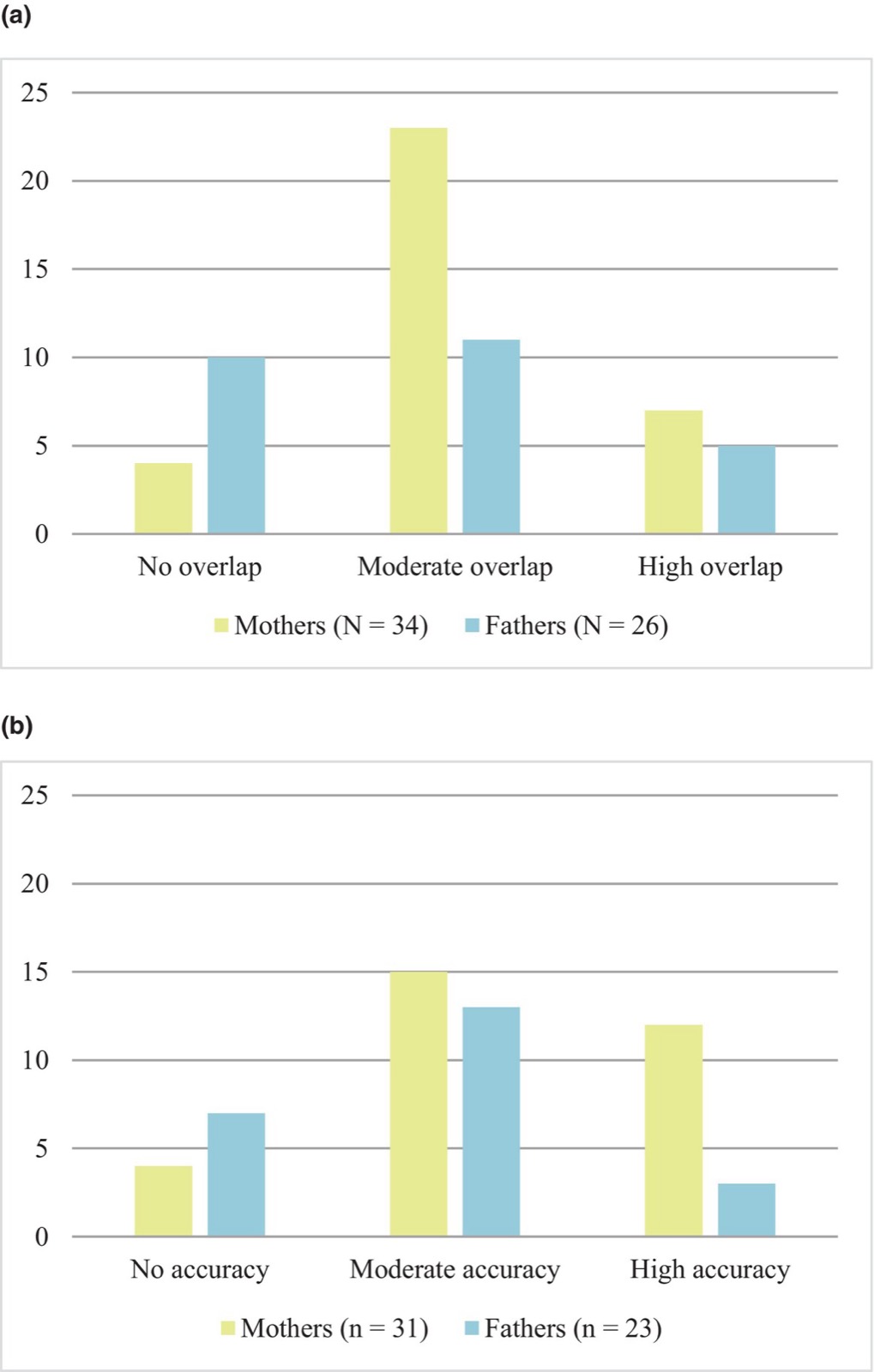
To visually present the distribution of overlap scores (Figure 1a), we categorized parents as having no overlap, moderate overlap (overlap score of 0.01–0.49) and high overlap (overlap score of 0.50 or higher) in causal beliefs with their own child. Fathers on average had a lower overlap score than mothers (Table 2), more often showed no overlap at all and less often moderate overlap with their child (Figure 1a).
We visualized within-family overlap for the themes of causal beliefs in Venn diagrams (top five themes presented in Figure 2; all themes presented in Figure S1). Examination of these Venn diagrams provided insights into patterns of overlap, which we organized from low to high overlap in the current section. The overarching themes ‘Bewilderment’ and ‘Cumulative effect’ were themes with the lowest parent–child overlap (Figure S1). ‘Bewilderment’ indicates the participant did not understand the cause of the depression and ‘Cumulative effect’ indicates the participant explicitly mentioned a cumulation of multiple factors was the cause of the depression. These were important themes to adolescents, but were less often mentioned by their parents. One girl, for example, mentioned ‘it was a build-up of small things […] those became more and more and that resulted in a lot of stress and it [depressive symptoms] worsened’ (#156), while neither of her parents explicitly mentioned this ‘Cumulative effect’. Families in which (both) parent(s) had no overlap with their child (n = 3) always concerned adolescents who only mentioned a sense of ‘Bewilderment’ ‘I really don't know’ (#1, girl), while their parent(s) mentioned multiple causal beliefs, but no ‘Bewilderment’. Parent–child overlap was also relatively low for ‘Stressful life event’, especially when adolescents mentioned events outside of the family context, like: ‘my girlfriend and I broke up and uhm, there was a robbery at work’ (#53, mentioned by a boy, but not his mother). While cases of parent–child overlap more often concerned events within the family context, such as the death of a grandparent.
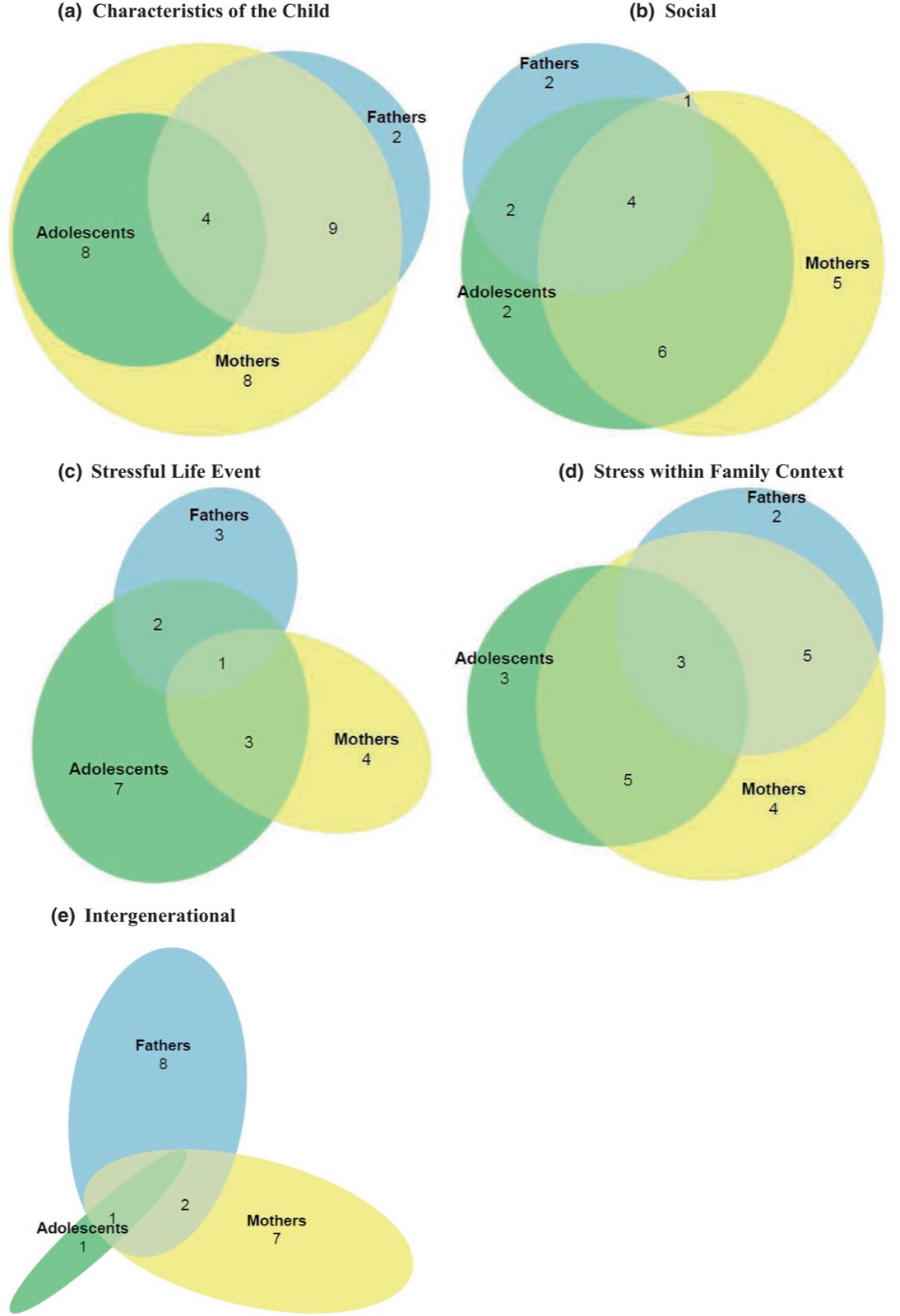
We noticed relative high parent–child overlap for ‘Social’, ‘School’ and ‘Stress outside family context’; and relative high mother–child (but low father–child) overlap of ‘Characteristics of the child’ and ‘Stress within family context’ (Figure 2; Figure S1). Family members often overlapped in mentioning ‘[I/she] didn't really have any friends’ (#131, mentioned by a girl and her mother, but not father) and ‘social isolation [due to the COVID-19 pandemic]’ (#120, mentioned by a girl, her mother and father) as causal beliefs.
Thematic causal beliefs parents attribute to their child's perspective (Aim 2.1)
Data of parents' reflected causal beliefs of their child's perspective was missing for some parents (n = 3 mothers, n = 3 fathers), resulting in a sample size of 31 mothers and 23 fathers from 33 families. Given the large number of themes, we will focus on the top five of reflected causal beliefs across family members (Table 3), including the themes ‘Social’, ‘Characteristics of the child’, ‘Stress within family context’, ‘Stressful life event’, ‘School’, ‘School’ and ‘Bewilderment’. The top five of reflected causal beliefs (Table 3) was nearly identical for mothers and fathers and the themes also appeared in the (total) top five of adolescent. Parents' top theme of reflected causal beliefs was ‘Characteristics of the child’, they, for example, mentioned: ‘Maybe her self-esteem, I think she knows or feels that she finds it very important what others say about her’ (#102, father of a girl) or ‘she really thinks she misses a chemical in her brain’ (#191, mother of a girl). ‘Social’ and ‘Stress within family’ were the second and third most important themes of parents' reflected causal beliefs. For example, one father of a girl mentioned ‘I think she'll mention being rejected by others, having few friends’ (#89) and one mother of a girl mentioned ‘and uhm, I think [child] will mention she misses her family [who live abroad] a lot’ (#102). Fourth, parents mentioned ‘Stressful life events’ as a reflected causal beliefs. For example, both parents of a girl mentioned ‘she will mention […] assault-like situations’ (#120) and both parents of a boy mentioned ‘he will mention what happened with his friend [suicide]’ (#138). Fifth, parents mentioned ‘School’ as a reflected causal belief. One father, for example, mentioned ‘hmm yeah, maybe school problems’ (#102, girl). And lastly, ‘Bewilderment’ appeared in the top five themes of parents' reflected causal beliefs. One mother, for example, mentioned ‘[child] recently said there's no reason for her to be depressed, so she doesn't know why’ (#112, girl). This theme did not appear in the adolescents' (total) top five, but was still frequently mentioned by them (26.5%; Table S2).
Within-family accuracy (Aim 2.2)
Categorized accuracy scores are visually presented in Figure 1b. Parents mentioned reflected main themes less frequently and had a lower average of reflected themes (in number) than the frequency by which the themes were mentioned by adolescents as their own (total) causal beliefs (Table 2). Fathers on average had a lower accuracy score than mothers (Table 2), were somewhat more often fully inaccurate and less often highly accurate (Figure 1b). We visualized within-family accuracy for the themes of reflected causal beliefs in Venn diagrams (Figure S2). Examination of these Venn diagrams provided insights into patterns of accuracy, which we organized from low to high accuracy in the current section. Families in which (both) parent(s) were fully inaccurate in their reflected causal beliefs concerned families in which parent(s) mentioned their child would struggle to mention causal beliefs (‘Bewilderment’; two families), did not mention anything about their child's causal beliefs, but elaborated on their own perspective (one family), or mentioned completely different themes than their child did (three families). Further, none of the parents accurately assumed their child to mention a ‘Cumulative effect’ as a causal belief, while this theme was explicitly mentioned by nearly a quarter of the adolescents. One girl, for example, mentioned ‘well uhm it's because my home situation changed […] it went downhill from there […] It's an accumulation of the past, elementary school, people close to me who let me down and abandoned me and stuff and the change in my home situation. A combination of these things’ (#89), while neither of her parents explicitly mentioned this cumulative effect when asked about their daughter's causal beliefs. Parents' accuracy of reflected causal beliefs was also low for ‘Intergenerational’. However, it should be kept in mind that only two adolescents mentioned this theme spontaneously and most adolescents mentioned this theme only after being prompted with the overview.
Multiple themes showed moderate accuracy of parents' reflected causal beliefs. The themes ‘Bewilderment’ and ‘Characteristics of the child’ were mentioned by approximately as many adolescents (as causal beliefs) as parents (as reflected causal beliefs). However, at a within-family level mothers and fathers were approximately as often inaccurate as accurate in their reflection of the themes, except for mothers reflection of ‘Characteristics of the child’ (accurate more often than inaccurate). The themes ‘Stress within family context’, ‘School’ and ‘Stressful life event’ were underestimated by parents, with substantially fewer parents mentioning these themes as reflected causal beliefs, than adolescents mentioning them as causal beliefs. However, parents who did mention the themes were relatively often accurate that their child had mentioned this. Fathers were notably accurate in holding ‘Stress outside family context’ as a reflected causal belief.
Parents were particularly accurate in their reflected causal beliefs of the themes ‘Social’ and ‘Use of media’. The theme ‘Use of media’ was an important causal belief to fathers in their own perspective, but none of the mothers and fathers held this as a reflected causal belief when asked about their child's perspective and the theme was indeed mentioned by none of the adolescents. ‘Social’ was an important theme to adolescents (n = 18) and for the majority of them (n = 13), one or both parents accurately mentioned this as a reflected causal belief.
Explorative, clinically relevant results
Three observations should be mentioned that are relevant in the clinical context. First, the overview of known risk factors helped adolescents formulate their causal beliefs. This is reflected in the sharp increase of ‘Intergenerational’ from the unprompted to prompted part of the interview (Table S2). Further, three adolescents only mentioned a sense of ‘Bewilderment’ at the unprompted part of the interview, but no specific causal beliefs. All three of them mentioned one (namely ‘Intergenerational’) or more causal beliefs when presented with the overview. Second, participants mentioned some themes specifically in the context of maintaining or worsening factors rather than direct causes of the depression. This was the case for the themes ‘Characteristics of the child’, ‘Stress outside family context’, ‘Stressful life event’ and ‘School’. For example: ‘I can't name any causes, only things that are of influence. Like a lack of sleep, stress […] and fights and weird things that happen, it worsens it. And failing or things that go badly, it can trigger it. I start to feel bad about myself and get in a depressed mood’ (#25, boy) and ‘she got horribly behind at school, the pressure increased […] I think that, uhm, caused like a disconnection. I don't think that's the cause per se, but it really didn't help her’ (#191, father of a girl). And third, we observed that families with particularly high accuracy scores (total n = 7, of which n = 4 one-parent families), often concerned families with an adolescent who currently received treatment (n = 5, of which n = 4 one-parent families). Parents in these families were relatively accurate to indicate ‘Stress within family context’ and ‘Stressful life event’.
DISCUSSION
The current study aimed to qualitatively examine causal beliefs about adolescent depression in adolescents with a clinical depression and their mothers and fathers from a within-family perspective. The first key finding is that the top themes of personality and various social and stressful experiences were similar across adolescents and their parents and consistent with previous qualitative studies among adolescents (Bear et al., 2021; Midgley et al., 2017; Viduani et al., 2021; Wisdom & Green, 2004). A second, more remarkable finding is that when looking at the causal beliefs within families, overlap in beliefs of adolescents and their own parent(s) was relatively low. So, within one family the adolescent could have viewed the depression as a result of personality characteristics and stressful events whereas the mother may have seen it as a result of puberty and school factors. And thirdly, parents were moderately accurate in formulating their own child's causal beliefs, but they did tend to underestimate their child's causal beliefs, in a sense that the adolescent mentioned more themes (e.g., school, social experiences, intergenerational and personality traits) than their parent would expect (e.g., school and social experiences). We found a large variety of causal beliefs about adolescent depression, ranging from stressful experiences to the turbulence of puberty. This variety aligns with previous qualitative work (Bear et al., 2021; Midgley et al., 2017; Viduani et al., 2021; Wisdom & Green, 2004) and the abundant number of risk factors appearing from epidemiological research (e.g., Dobson & Dozois, 2011). The three main categories (psychosocial adversities, personality factors, intergenerational vulnerability) in previous qualitative studies on the perspectives of adolescents, are hereby extended to the perspectives of their parents; in the context of parents' own beliefs about the cause(s) of their child's depression, as well as in the context of beliefs they thought that their child holds.
Psychosocial adversities were a main causal belief of participants in the current study as well as previous work (Bear et al., 2021; Midgley et al., 2017; Viduani et al., 2021; Wisdom & Green, 2004). The themes of stress within and outside the family context, stressful life events and social factors could be grouped into one broad, generic category of psychosocial adversities. Nearly all adolescents mentioned one or multiple of these adversities and a quarter of them mentioned feeling overwhelmed by the build-up of (negative) life experiences. The current study adds two important themes to this list of stressors: School and constraints due to the COVID-19 pandemic. One could argue whether the term adversity is fitting with regard to school, but clearly it is a stressor to adolescents, which is recognized by their parents in the current study. School was experienced as problematic by many participants, either in general terms or specifically in terms of (pressured) performance. Adolescents in the Netherlands experience increased pressure and stress at school over time (De Looze et al., 2020). The generalizability to other nations should be made with caution, as a somewhat older cross-national study indicates that perceptions of school pressure barely changed between 1994 and 2010 (Klinger et al., 2015). Regardless of the increase over time, meta-analytic research shows that pressure at school relates to increased depression (symptoms and clinical levels), with some evidence for a directional effect of depressive symptoms following academic pressure (reviewed by Steare et al., 2023). On the other hand, concentration problems and an impact of symptoms on functioning in, among others, the academic area are considered when diagnosing a clinical depression (APA, 2013). Academic stress and depressive symptoms are thus likely to bi-directionally influence each other and this stress is an important factor to consider in researching and treating adolescent depression.
Constraints due to the COVID-19 pandemic were coded as a stressor outside the family and can be considered a psychosocial adversity. From the first Dutch lockdown onwards (March 2020), 22 families participated and constraints due to COVID-19 were mentioned as a causal belief by 27.3% of adolescents, 31.8% of the mothers and 22.2% of the fathers of these families (Table S2). The theme thereby did not appear in the top five causal beliefs and it was often mentioned as a worsening factor rather than a direct cause. Meta-analytic research shows a moderately stable increase in depressive symptoms from pre to during the COVID-19 pandemic (Ludwig-Walz et al., 2022; Madigan et al., 2023), but low certainty of evidence for clinically relevant depression rates (Ludwig-Walz et al., 2022). Insights from our qualitative work combined with existing meta-analyses, suggest that constraints due to the pandemic are not (perceived as) a main cause of adolescent clinical depression. On the other hand, the effects of these constraints cannot be ignored as there is clear evidence for its (perceived) worsening effects on depressive symptoms.
The current study replicates the second broad category of personality factors that was previously found (Bear et al., 2021; Midgley et al., 2017; Wisdom & Green, 2004) with a variety of subthemes. The third broad category of intergenerational vulnerability (Bear et al., 2021; Midgley et al., 2017; Wisdom & Agnor, 2007) was partially replicated. This category was an important theme to parents in the current study, but only two of the adolescents mentioned it spontaneously. This number substantially increased after presenting adolescents with the overview of known risk factors. The majority of participants mentioned familial factors and genetic heritability simultaneously, thereby partially holding a biological explanation. Two interesting conclusions can be made. Parents, but not adolescents, in the current study hold intergenerational vulnerability as an important idiosyncratic causal belief to the adolescent's depression. Further, using an overview of prompts seems valuable in interviewing adolescents. This is in line with a study on paediatric diabetes, in which a list of prompts helped adolescents to ask questions and participate more during medical visits (Pembroke et al., 2022). Adolescents (as well as adults) may struggle to formulate their input on certain topics. Some symptoms of a clinical depression may have made this even more difficult in the current sample (e.g., lack of motivation and concentration, low self-esteem). We recommend the use of an overview to prompt adolescents (and parents) during an interview.
Lastly, the current study adds the theme of media use to the list of causal beliefs from a family perspective. This was an important causal belief of fathers, but not adolescents and mothers, in the current study. Previous qualitative work on adolescents' causal beliefs is thereby replicated, in the sense that adolescents did not mention the theme. (Social) media is increasingly available in current society and adolescent media use cross-sectionally relates to adolescent depressive symptoms (meta-analysis by Ivie et al., 2020), but directional effects remain unclear. Further, adolescent media use has been found to relate to increased parent–child conflict (e.g., Yang & Zhang, 2021). Media use was an important topic to fathers, but not adolescents and mothers in the current study, indicating their different views on the topic. Whereas (reflected) casual beliefs of adolescents, mothers and fathers were generally similar on a group level, there were substantial discrepancies within families. There was relatively low overlap in causal beliefs between adolescents and their parents. Further, parents were moderately accurate in formulating their own child's causal beliefs, but they did tend to underestimate their child's causal beliefs, in a sense that the adolescent mentioned more themes than their parent(s) would expect. Overlap and accuracy were particularly low for overarching themes, parent–child overlap was relatively high for social and school factors, whereas parental accuracy was relatively high for social factors only. Thus, parents and adolescents largely shared causal beliefs about stressors or experiences of a chronic nature outside of the family context, affecting the adolescents' daily life. These factors may have been more evident, with parents being aware of their child's social and school experiences and of the emotional impact of these experiences on their child. For social experiences, parents were even accurately aware of their child's insights into the topic. It seems that this topic is particularly discussed within families and/or noticed by parents.
Two additional noteworthy observations were made. First, some participants spontaneously described themes (e.g., constraints due to COVID-19) and symptoms of the depression (e.g., negative self-views, insomnia, dysregulated academic functioning) as factors maintaining or worsening the depression, rather than perceiving them as causes preceding the depression. This perspective fits the network modelling approach, in which the interest lies in how symptoms influence each other rather than examining causes preceding the depression (Fried et al., 2017; van Borkulo et al., 2015). Second, families with parents with particular accurate reflected causal beliefs (i.e., accuracy score ≥ .50) often concerned adolescents who currently received treatment of a licensed psychologist. Parents in these families were relatively accurate to indicate stress in the family context or stressful life events. This was not found for overlap scores. The current study concerns a cross-sectional design and it is unclear whether high accuracy preceded or followed the start of treatment. On the one hand, therapy may promote parents' understanding of their child's perspective on these stressful experiences. On the other hand, parents were possibly more aware of the impact of these stressful experiences as perceived by their child and promote the start of therapy.
Strengths and limitations
The major strength of this study is its pioneering focus on qualitatively reporting causal beliefs about adolescent depression from the perspective of adolescents with a clinical depression as well as their mothers and fathers. It is also the first qualitative study on parents' reflected causal beliefs and on within-family overlap of causal beliefs and accuracy of parents' reflected causal beliefs, thereby substantially adding new insights to previous research.
The results should be interpreted in light of two important sample characteristics. All included adolescents had sought treatment and approximately half of them had received at least some treatment in the past or present. Causal beliefs may have been influenced by the (application process for) treatment. Second, adolescents were excluded in case of specific current comorbidity (see Methods). Results can therefore not simply be generalized to families with an adolescent with depression prior to help-seeking and/or with previous listed current comorbidity. Lastly, the descriptive methodology for within-family overlap and accuracy should be kept in mind; no conclusions can be made about the causes nor consequences of these levels of overlap and accuracy.
Clinical implications and future directions
Results of the current study can be translated into three main clinical implications. First, it is of value to (independently) inquire about perspectives on causal beliefs of adolescents as well as both of their parents. Some main, comparable themes appear on a group level, but the current study importantly highlights the variety in experiences of adolescents with a clinical depression and their parents. Further, there was considerable variation between families in the level of parent–child overlap and accuracy of parental reflected causal beliefs. Practically, it is of value to ask the adolescent as well as both parents about their (reflected) causal beliefs to provide a completer view on factors that are at play and on the alignment within families. The aim thereby does not have to be that the adolescent and their parent(s) hold the same perspective, but rather that they understand each other's perspective and communicate about this. Future research could examine the effects of talking about causal beliefs in therapy. Actively asking about and involving the adolescent's causal beliefs in treatment (e.g., using shared decision making) may address their personal concerns and benefit treatment satisfaction and efficacy. Additionally, future research could test whether (family) interventions can promote alignment in (reflected) causal beliefs of adolescents and their parents, test whether adolescents experience this alignment as supportive and whether increased alignment would benefit adolescent and/or parent wellbeing.
Second, many of the causal beliefs concerned stressful experiences (although in various forms) and nearly a quarter of the adolescents spontaneously mentioned feeling overwhelmed by a build-up of (negative) life experiences. Adolescents may greatly benefit from support in processing (negative) life experiences in a therapeutic setting and strengthen their emotion regulation skills. Further, there may be a meaningful opportunity to promote parental understanding of their child's experiences of stressors and involve parents in supporting the adolescent in daily life. Nearly all parents (except for one family) mentioned multiple themes as reflected causal beliefs and they may (implicitly) already know the build-up effect of such experiences is difficult to their child; future research could examine whether adolescents would benefit from explicitly talking about this topic in therapeutic and/or family setting.
Third, the use of an overview of known risk factors (Table S1) can help adolescents (and parents) formulate their causal beliefs. To start, one should ask an open question about the topic, to avoid influencing the adolescent's idiosyncratic beliefs and input. As a next step it is valuable to present the overview. Adolescents may initially struggle formulating their thoughts and may be better able to do so when presented with an overview. Additionally, the current study shows that some adolescents and parents spontaneously differentiate between causal and maintaining or worsening factors. Asking about causal and maintaining factors in a structured manner, may provide additional insights to family members as well as clinicians.
CONCLUSION
To conclude, this within-family qualitative study on causal beliefs about adolescent depression highlights three key messages. First, there is a large variety in causal beliefs of adolescents with a clinical depression and their parents. Some comparable main themes appear on a group level, but there are substantial variations per family and per person within that family. In scientific research it is thus important to distinguish these levels. (Guided) conversations within families about each member's perspective may help them to better understand and support each other. Second, many of the themes concerned a form of stressful experiences. Specific themes within these stressful experiences align with previous research, although the theme of stress specifically in the school setting is added in the current study. Third, parents in the current sample tended to underestimate their child's causal beliefs; adolescents mentioned themes more often than their own parent(s) would expect. This was mainly the case for stressful experiences, intergenerational and cumulative effect. Future studies could investigate whether involving causal beliefs in the treatment of adolescent depression would benefit treatment outcomes; and whether (parenting) interventions may increase alignment of parents' reflected causal beliefs and increase the level of support as perceived by the adolescent.
Complexe Systémique: key points
What the study brings to light is less the content of the explanations than how they are distributed within the family. At group level, adolescents, mothers and fathers tell roughly the same story: character, social relationships, school, stress. Within each family, the accounts overlap little, and parents mainly underestimate what their child perceives of the build-up of difficulties, or their bewilderment at not knowing. Fathers put screens forward, which adolescents never mention. For systemic practice the interest is twofold. Asking each member separately about their causal hypotheses, then about those they attribute to the others, opens a space for metacommunication in which the aim is mutual understanding rather than agreement. And the spontaneous distinction between causes and maintaining factors echoes a circular rather than linear reading of the symptom. The limits are clear: cross-sectional design, Dutch families already seeking care, purely descriptive overlap scores. Read alongside the Norwegian study of family illness beliefs, and the meta-analysis of family involvement in psychotherapy for depression in children and adolescents.
Notes from the original
Author contributions. Wilma G. M. Wentholt: Conceptualization; investigation; writing – original draft; methodology; formal analysis; visualization; project administration. Loes H. C. Janssen: Conceptualization; writing – review and editing; investigation. Lisanne A. E. M. van Houtum: Conceptualization; investigation; writing – review and editing. Mirjam C. M. Wever: Conceptualization; investigation; writing – review and editing. Marieke S. Tollenaar: Conceptualization; writing – review and editing. Lenneke R. A. Alink: Writing – review and editing. Bernet M. Elzinga: Conceptualization; writing – review and editing; funding acquisition; methodology; supervision.
Acknowledgements. Many thanks to all participating families, collaborating practitioners and assisting students. A special thanks to Annelot van Geffen, Willemijn Cobben, Veerle Bastiaansen and Elif Uyanik for their assistance in (the coordination of) the coding of the interviews. The study is supported by a personal research grant awarded to Bernet Elzinga by the Netherlands Organization for Scientific Research (NWO-VICI; Unravelling the Impact of Emotional Maltreatment on the Developing Brain, 453-15-006).
Conflict of interest statement. The authors have declared that they have no competing or potential conflicts of interest.
References
Amberscript. (2022). Amberscript [Online software]. https://www.amberscript.com/
American Psychiatric Association [APA]. (2013). Depressive disorders. In Diagnostic and statistical manual for mental disorders (DSM-V) ( 5th ed., p. 155). American Psychiatric Association.
ATLAS.ti Scientific Software Development GmbH. (2022). ATLAS.TI Windows [Computer software]. https://atlasti.com
Bear, H. A., Krause, K. R., Edbrooke-Childs, J., & Wolpert, M. (2021). Understanding the illness representations of young people with anxiety and depression: A qualitative study. Psychology and Psychotherapy: Theory, Research and Practice, 94(4), 1036–1058. https://doi.org/10.1111/papt.12345
Boeije, H. R. (2010). Doing qualitative analysis. In Analysis in qualitative research. SAGE Publishing.
Bronfenbrenner, U. (1977). Toward an experimental ecology of human development. American Psychologist, 32(7), 513–531.
Carter, J. D., Luty, S. E., McKenzie, J. M., Mulder, R. T., Frampton, C. M., & Joyce, P. R. (2011). Patient predictors of response to cognitive behaviour therapy and interpersonal psychotherapy in a randomised clinical trial for depression. Journal of Affective Disorders, 128(3), 252–261. https://doi.org/10.1016/j.jad.2010.07.002
Clayborne, Z. M., Varin, M., & Colman, I. (2019). Systematic review and meta-analysis: Adolescent depression and long-term psychosocial outcomes. Journal of the American Academy of Child & Adolescent Psychiatry, 58(1), 72–79. https://doi.org/10.1016/j.jaac.2018.07.896
Cuijpers, P., Andersson, G., Donker, T., & van Straten, A. (2011). Psychological treatment of depression: Results of a series of meta-analyses. Nordic Journal of Psychiatry, 65(6), 354–364. https://doi.org/10.3109/08039488.2011.596570
Cuijpers, P., Van Straten, A., Van Schaik, A., & Andersson, G. (2009). Psychological treatment of depression in primary care: A meta-analysis. British Journal of General Practice, 59(559), e51–e60. https://doi.org/10.3399/bjgp09X395139
Curry, J., Silva, S., Rohde, P., Ginsburg, G., Kratochvil, C., Simons, A., Kirchner, J., May, D., Kennard, B., Mayes, T., Feeny, N., Albano, A. M., Lavanier, S., Reinecke, M., Jacobs, R., Becker-Weidman, E., Weller, E., Emslie, G., Walkup, J., … March, J. (2011). Recovery and recurrence following treatment for Adolescent major depression. Archives of General Psychiatry, 68(3), 263–269. https://doi.org/10.1001/archgenpsychiatry.2010.150
Dardas, L. A., van de Water, B., & Simmons, L. A. (2018). Parental involvement in adolescent depression interventions: A systematic review of randomized clinical trials. International Journal of Mental Health Nursing, 27(2), 555–570. https://doi.org/10.1111/inm.12429
De Looze, M. E., Cosma, A. P., Vollebergh, W. A. M., Duinhof, E. L., de Roos, S. A., van Dorsselaer, S., van Bon-Martens, M. J. H., Vonk, R., & Stevens, G. W. J. M. (2020). Trends over time in Adolescent emotional wellbeing in The Netherlands, 2005-2017: Links with perceived schoolwork pressure, parent-Adolescent communication and bullying victimization. Journal of Youth and Adolescence, 49(10), 2124–2135. https://doi.org/10.1007/s10964-020-01280-4
Dobson, K. S., & Dozois, D. J. A. (2011). Risk factors in depression. Elsevier.
Fried, E. I., van Borkulo, C. D., Cramer, A. O. J., Boschloo, L., Schoevers, R. A., & Borsboom, D. (2017). Mental disorders as networks of problems: A review of recent insights. Social Psychiatry and Psychiatric Epidemiology, 52(1), 1–10. https://doi.org/10.1007/s00127-016-1319-z
Hagmayer, Y., & Engelmann, N. (2014). Causal beliefs about depression in different cultural groups—What do cognitive psychological theories of causal learning and reasoning predict? Frontiers in Psychology, 5, 1303. https://doi.org/10.3389/fpsyg.2014.01303
Hansson, M., Chotai, J., & Bodlund, O. (2010). Patients' beliefs about the cause of their depression. Journal of Affective Disorders, 124(1), 54–59. https://doi.org/10.1016/j.jad.2009.10.032
Ivie, E. J., Pettitt, A., Moses, L. J., & Allen, N. B. (2020). A meta-analysis of the association between adolescent social media use and depressive symptoms. Journal of Affective Disorders, 275, 165–174. https://doi.org/10.1016/j.jad.2020.06.014
Janssen, L. H. C., Kullber, M.-. L. J., Verkuil, B., van Zwieten, N., Wever, M. C. M., van Houtum, L. A. E. M., Wentholt, W. G. M., & Elzinga, B. M. (2020). Does the COVID-19 pandemic impact parents' and adolescents' well-being? An EMA-study on daily affect and parenting. PLoS One, 15(10), e0240962. https://doi.org/10.1731/journal.pone.0240962
Janssen, L. H. C., Verkuil, B., van Houtum, L. A. E. M., Wever, M. C. M., & Elzinga, B. M. (2021). Perceptions of parenting in daily life: Adolescent-parent differences and associations with adolescent affect. Journal of Youth and Adolescence, 50(12), 2427–2443. https://doi.org/10.1007/s10964-021-01489-x
Janssen, L. H. C., Sloan, C. J., Verkuil, B., Van Houtum, L. A. E. M., Wever, M., & Wever, C. M., Fosco, G. M., & Elzinga, B. M. (2023). Adolescents’ and parents’ affect in relation to discrepant perceptions of parental warmth in daily life. Journal of Research on Adolescence, 33(4), 1320–1334. https://doi.org/10.1111/jora.12879
Janssen, L. H. C., Verkuil, B., Nedderhoff, A., van Houtum, L. A. E. M., Wever, M. C. M., & Elzinga, B. M. (2024). Tracking real-time proximity in daily life: A new tool to examine social interactions. Behavior Research Methods. https://doi.org/10.3758/s13428-024-02432-1
Kessler, R. C., Berglund, P., Demler, O., Jin, R., Merikangas, K. R., & Walters, E. E. (2005). Lifetime prevalence and age-of-onset distributions of DSM-IV disorders in the National Comorbidity Survey Replication. Archives of General Psychiatry, 62(6), 593–602. https://doi.org/10.1001/archpsyc.62.6.593
Klinger, D. A., Freeman, J. G., Bilz, L., Liiv, K., Ramelow, D., Sebok, S. S., Samdal, O., Dür, W., & Rasmussen, M. (2015). Cross-national trends in perceived school pressure by gender and age from 1994 to 2010. European Journal of Public Health, 25, 51–56. https://doi.org/10.1093/eurpub/ckv027
Larsson, J. (2021). Eulerr: Area-proportional Euler and Venn diagrams with Elipses. R package version 6.1.1. https://CRAN.R-project.org/package=eulerr
Ludwig-Walz, H., Dannheim, I., Pfadenhauer, L. M., Fegert, J. M., & Bujard, M. (2022). Increase of depression among children and adolescents after the onset of the COVID-19 pandemic in Europe: A systematic review and meta-analysis. Child and Adolescent Psychiatry and Mental Health, 16(1), 109. https://doi.org/10.1186/s13034-022-00546-y
Madigan, S., Racine, N., Vaillancourt, T., Korczak, D. J., Hewitt, J. M. A., Pador, P., Park, J. L., McArthur, B. A., Holy, C., & Neville, R. D. (2023). Changes in depression and anxiety among children and adolescents from before to during the COVID-19 pandemic: A systematic review and meta-analysis. JAMA Pediatrics, 177(6), 567–581. https://doi.org/10.1001/jamapediatrics.2023.0846
McCurdy, A. L., Williams, K. N., Lee, G. Y., Benito-Gomez, M., & Fletcher, A. C. (2020). Measurement of parental autonomy support: A review of theoretical concerns and developmental considerations. Journal of Family Theory & Review, 12(3), 382–397. https://doi.org/10.1111/jftr.12389
Meeus, W. (2016). Adolescent psychosocial development: A review of longitudinal models and research. Developmental Psychology, 52(12), 1969–1993. https://doi.org/10.1037/dev0000243
Midgley, N., Parkinson, S., Holmes, J., Stapley, E., Eatough, V., & Target, M. (2017). “Did I bring it on myself?” An exploratory study of the beliefs that adolescents referred to mental health services have about the causes of their depression. European Child & Adolescent Psychiatry, 26(1), 25–34. https://doi.org/10.1007/s00787-016-0868-8
Pembroke, S., Cody, D., Roche, E. F., Sleath, B., Hilliard, C., Brenner, M., & Coyne, I. (2022). Encouraging adolescents' participation during paediatric diabetes clinic visits: Design and development of a question prompt list intervention. Diabetes Research and Clinical Practice, 190, 109985. https://doi.org/10.1016/j.diabres.2022.109985
Reichart, C. G., Wals, M., & Hillegers, M. (2000). Vertaling K-SADS. HC Rümke Groep.
Restifo, K., & Bögels, S. (2009). Family processes in the development of youth depression: Translating the evidence to treatment. Clinical Psychology Review, 29(4), 294–316. https://doi.org/10.1016/j.cpr.2009.02.005
Sawyer, S. M., Afifi, R. A., Bearinger, L. H., Blakemore, S.-J., Dick, B., Ezeh, A. C., & Patton, G. C. (2012). Adolescence: A foundation for future health. The Lancet, 379(9826), 1630–1640. https://doi.org/10.1016/S0140-6736(12)60072-5
Sher, I., McGinn, L., Sirey, J. A., & Meyers, B. (2005). Effects of caregivers' perceived stigma and causal beliefs on patients' adherence to antidepressant treatment. Psychiatric Services, 56(5), 564–569. https://doi.org/10.1176/appi.ps.56.5.564
Smetana, J. G. (2010). Adolescents, families, and social development: How teens construct their worlds. John Wiley & Sons.
Steare, T., Gutiérrez Muñoz, C., Sullivan, A., & Lewis, G. (2023). The association between academic pressure and adolescent mental health problems: A systematic review. Journal of Affective Disorders, 339, 302–317. https://doi.org/10.1016/j.jad.2023.07.028
van Borkulo, C., Boschloo, L., Borsboom, D., Penninx, B. W. J. H., Waldorp, L. J., & Schoevers, R. A. (2015). Association of Symptom Network Structure with the course of depression. JAMA Psychiatry, 72(12), 1219–1226. https://doi.org/10.1001/jamapsychiatry.2015.2079
van Houtum, L. A. E. M., Wever, M. C. M., Janssen, L. H. C., van Schie, C. C., Will, G.-. J., Tollenaar, M. S., & Elzinga, B. M. (2021). Vicarious praise and pain: Parental neural responses to social feedback about their adolescent child. Social Cognitive and Affective Neuroscience, 16(4), 406–417. https://doi.org/10.1093/scan/nsab004
van Houtum, L. A. E. M., Wever, M. C. M., van Schie, C. C., Janssen, L. H. C., Wentholt, W. G. M., Tollenaar, M. S., Will, G.-. J., & Elzinga, B. M. (2023). Sticky criticism? Affective and neural responses to parental criticism and praise in adolescents with depression. Psychological Medicine, 1-10. https://doi.org/10.1017/S0033291723002131
van Houtum, L. A. E. M., van Schie, C. C., Wever, M. C. M., Janssen, L. H. C., Wentholt, W. G. M., Tailby, C., Grenyer, B. F. S., Will, G.-. J., Tollenaar, M. S., & Elzinga, B. M. (2023). Aberrant neural network activation during reliving of autobiographical memories in adolescent depression. Cortex, 168, 14–26. https://doi.org/10.1016/j.cortex.2023.06.021
van Houtum, L. A. E. M., Will, G.-. J., Wever, M. C. M., Janssen, L. H. C., van Schie, C. C., Tollenaar, M. S., & Elzinga, B. M. (2022). Adolescents’ affective and neural responses to parental praise and criticism. Developmental Cognitive Neuroscience, 54, 101099. https://doi.org/10.1016/j.dcn.2022.101099
Veenman, M., Janssen, L. H. C., van Houtum, L. A. E. M., Wever, M. C. M., Verkuil, B., Epskamp, S., Fried, E. I., & Elzinga, B. M. (2024). A network study of family affect systems in daily life. Multivariate Behavioral Research, 59(2), 371–405. https://doi.org/10.1080/00273171.2023.2283632
Viduani, A., Benetti, S., Martini, T., Buchweitz, C., Ottman, K., Wahid, S. S., Fisher, H. L., Mondelli, V., Kohrt, B. A., & Kieling, C. (2021). Social isolation as a core feature of adolescent depression: A qualitative study in Porto Alegre, Brazil. International Journal of Qualitative Studies on Health and Well-Being, 16, 1978374. https://doi.org/10.1080/17482631.2021.1978374
Wever, M. C. M., van Houtum, L. A. E. M., Janssen, L. H. C., Spruit, I. M., Tollenaar, M. S., & aan het Rot, M., & Elzinga, B. M. (2022). Eyes on you: Ensuring empathic accuracy or signalling empathy? International Journal of Psychology, 57(6), 743–752. https://doi.org/10.1002/ijop.12862
Wever, M. C. M., van Houtum, L. A. E. M., Janssen, L. H. C., Wentholt, W. G. M., Spruit, I. M., Tollenaar, M. S., Will, G.-. J., & Elzinga, B. M. (2022). Neural and affective responses to prolonged eye contact with one's own adolescent child and unfamiliar others. NeuroImage, 260, 119463. https://doi.org/10.1016/j.neuroimage.2022.119463
Wever, M. C. M., van Houtum, L. A. E. M., Janssen, L. H. C., Will, G.-. J., Tollenaar, M. S., & Elzinga, B. M. (2021). Neural signatures of parental empathic responses to imagined suffering of their adolescent child. NeuroImage, 232, 117886. https://doi.org/10.1016/j.neuroimage.2021.117886
Wever, M. C. M., van Houtum, L. A. E. M., Janssen, L. H. C., Wentholt, W. G. M., Spruit, I. M., Tollenaar, M. S., Will, G.-. J., & Elzinga, B. M. (2023). Looking into troubled waters: Childhood emotional maltreatment modulates neural responses to prolonged gazing into one's own, but not others’, eyes. Cognitive, Affective, & Behavioral Neuroscience, 23(6), 1598–1609. https://doi.org/10.3758/s13415-023-01135-y
Wever, M. C. M., Will, G.-. J., van Houtum, L. A. E. M., Janssen, L. H. C., Wentholt, W. G. M., Spruit, I. M., Tollenaar, M. S., & Elzinga, B. M. (2024). Neural and affective responses to prolonged eye contact with parents in depressed and nondepressed adolescents. Cognitive, Affective, & Behavioral Neuroscience. https://doi.org/10.3758/s13415-024-01169-w
Wisdom, J. P., & Agnor, C. (2007). Family heritage and depression guides: Family and peer views influence adolescent attitudes about depression. Journal of Adolescence, 30(2), 333–346. https://doi.org/10.1016/j.adolescence.2006.04.001
Wisdom, J. P., & Green, C. A. (2004). “Being in a funk”: Teens' efforts to understand their depressive experiences. Qualitative Health Research, 14(9), 1227–1238. https://doi.org/10.1177/1049732304268657
Yang, X., & Zhang, L. (2021). Reducing parent-adolescent conflicts about mobile phone use: The role of parenting styles. Mobile Media & Communication, 9(3), 563–583. https://doi.org/10.1177/2050157920986190
Reformatted republication of A qualitative, multi‐perspective study on causal beliefs about adolescent depression, by Wilma G. M. Wentholt, Loes H. C. Janssen, Lisanne A. E. M. van Houtum, Mirjam C. M. Wever, Marieke S. Tollenaar, Lenneke R. A. Alink and Bernet M. Elzinga, Psychology and Psychotherapy: Theory, Research and Practice, vol. 97, no 3, p. 477-497 (2024), doi: 10.1111/papt.12528, under a CC BY 4.0 licence. Edition and layout: Complexe Systémique, September 2026 — the work has been modified under the terms of the licence (tables presented as lists). Neither the authors nor the publisher are responsible for this edition; the original version prevails.
This is the original article “A qualitative, multi‐perspective study on causal beliefs about adolescent depression”, published in Psychology and Psychotherapy: Theory, Research and Practice (2024) under a CC BY 4.0 licence. Republished by Complexe Systémique: the author’s text is unchanged; only the presentation has been adapted for reading online, as set out at the head of this page.
Read the original articleHow to cite this article
Wentholt, W. G. M., Janssen, L. H. C., van Houtum, L. A. E. M., Wever, M. C. M., Tollenaar, M. S., Alink, L. R. A., et Elzinga, B. M. (2024). A qualitative, multi‐perspective study on causal beliefs about adolescent depression. Complexe Systémique. https://app.complexe-systemique.com/en_GB/articles/a-qualitative-multi-perspective-study-on-causal-beliefs-about-adolescent-depression (Original work published in 2024 in Psychology and Psychotherapy: Theory, Research and Practice, 97(3), 477-497 (2024); republished in 2024 by Psychology and Psychotherapy: Theory, Research and Practice, https://bpspsychub.onlinelibrary.wiley.com/doi/10.1111/papt.12528)
To go further
- Les *croyances familiales sur la maladie* : regards de familles vivant avec la maladie mentaleFamily illness beliefs.
- L’*implication de la famille* dans la psychothérapie de la dépression chez l’enfant et l’adolescent : revue systématique et méta-analyseInvolving the family in psychotherapy for depression.
- Le cheminement de la *résilience familiale* du point de vue de parents d’adolescents souffrant de dépression : une analyse phénoménologique interprétativeFamily resilience in adolescent depression.
Related training courses
 Symposium
État des Lieux: a psychological approach to spaces
Replay of the “État des Lieux” conference (Paris, 16 October 2026): Ivy Daure, Maurizio Frisina, Viola Sallay and Gilbert Pregno on places as a clinical resource. In French.
 Short course
The suicidal crisis in adolescents and young adults
Training: assessing and supporting the suicidal crisis in adolescents and young adults. Clinical landmarks and systemic tools. In French.
 Symposium
The Abnormal Normals and the Normal Abnormals
Conference replay: six clinicians explore normality — diagnoses, norms, adolescents, therapists. Immediate, lifetime access. Talks in French.
Related articles
 Scientific
Family group conference provision across the lifespan of child welfare intervention: A mixed-method realist-informed evaluation comparing three stages of welfare concern
Early help, child protection or children in care: among 155 UK families, experiences and outcomes of family group conferences vary very little by stage.
 Scientific
The Role of Parental Expressed Emotion and Loss-Specific Parental Responses in Children’s Loss-Related Outcomes Following Traumatic Loss: A Mixed-Methods Observational Study
After a road-traffic bereavement, parental criticism goes with the child's depression, positive appraisals of the loss with better well-being.
 Scientific
Parenting after critical illness: a biopsychosocial review of post-intensive care syndrome, family systems, and child outcomes
After post-intensive care syndrome, parenting falters, the co-parent is worn down and children help in silence. A biopsychosocial review proposes how to spot them.
 Scientific
Understanding the Impact of Family-Focused Youth Care: Examining Outcomes, Effective Elements and Tipping Points as Experienced by Parents and Youth
After family-focused youth care, the child and the family are doing better, the parents much less so. Alliance, content, organization and tipping points as families see them.