Child & Family Social Work · Social work
Be(com)ing Family: A Systematic Review of Stakeholders' Perspectives on Family in Family Foster Care
When a child enters a foster family, who is family? A review of 18 studies asks foster carers, parents, children of foster carers and social workers: blood, law, love, choice, and, in kinship care, a thin line between devotion and duty.
This is a reformatted republication of Be(com)ing Family: A Systematic Review of Stakeholders' Perspectives on Family in Family Foster Care, by Lara Wulleman, Hans Grietens, Ilse Noens and Nicole Vliegen, published in Child & Family Social Work (Wiley) (2026), doi: 10.1111/cfs.13258, under a CC BY 4.0 licence. Prepared by Complexe Systémique in September 2026: the authors’ text is unchanged; the layout has been adapted for reading online, which constitutes a modification of the work under the terms of the licence. Tables are presented as lists. This edition was made neither by the authors nor by the publisher, who are not responsible for its content or for any errors. The original version prevails.
Stakeholders in the FC system are not merely passive actors. They influence how families are defined and challenge practices.
Lara Wulleman, Hans Grietens, Ilse Noens and Nicole Vliegen
Abstract
When a child enters a foster family, it weaves an intricate web that profoundly changes the relationships and bonds of all involved, making it difficult to define ‘family’ using predefined criteria. Despite the far-reaching impact on all involved, no previous study has systematically reviewed and qualitatively analysed how parents, foster carers, children of foster carers and foster care workers in kith, kinship or nonkinship care understand family. This study examines the characteristics of studies examining stakeholders' family understandings, how stakeholders define family and whom they consider family. Following PRISMA guidelines, 18 studies were included and analysed using a reflexive thematic analysis. Results show a plurality of family meanings, encompassing perceptions of family in the context of care and support, biological and legal dimensions of family, emotional and relational aspects of family and family as a site of stability and transition. These meanings also involve intricate aspects, such as the thin line between devotion and duty in kith and kinship caregiving. Who stakeholders considered family could be categorized as ‘blood relatives as ‘natural’ family members’, ‘legally bounded family membership’, ‘chosen family’, ‘differing views on who is family’ and ‘reconciling all family perspectives in the foster care system’. Implications for research, practice and policymaking are discussed.
1 Introduction
The placement of a child in a foster family marks a critical juncture in family relationships. In kinship1 and kith2 care, this event reshapes existing relationships, whereas in nonkinship care,3 new relationships emerge, and existing ones are altered. These changes lead to a tangled web of relationships that makes it difficult to define family using predefined criteria.
In a recent review, Ie, Ursin, and Mariño (2021) examined the family understandings of (former) foster children in both kinship and nonkinship care. They identified four understandings of family: (1) family as biological relatedness, (2) family as associated with positive emotions, (3) family as doing and (4) family as a choice. Additionally, foster children expressed a sense of belonging to either kinship family members, nonkinship family members or a combination of both. A review and meta-analysis by Wulleman et al. (2023) revealed a growing interest among researchers in exploring the family perspectives of foster children in nonkinship care, particularly in the last 5 years. This study highlights the multifaceted meanings of family among foster children in nonkinship care, encompassing biological relatedness, doing family; family as a dynamic and evolving entity and/or family as a weird concept in which foster children felt an erosion of the term because of their family histories. Furthermore, who they considered family could be categorized as belonging to one family (either their birth or foster family), belonging to two families (birth and foster family), belonging to multiple family systems (e.g., including friends and people they met in residential care) or experiencing no sense of family.
The family perspectives of other key stakeholders in foster care (FC), such as parents,4 foster carers, children of foster carers5 and FC workers, remain less explored. Investigating their viewpoints is essential for a holistic analysis of family and family relationships within FC. In addition, it can provide comprehensive insights that can inform research, policy and practice to improve the lives of all involved in the FC system. Therefore, our research was guided by the following research questions:
- What are the characteristics of studies examining family understandings of parents, foster carers, children of foster carers, or FC workers6 in terms of their year of publication, geographic origin, and target populations?
- How do these stakeholders understand family?
- Who do these stakeholders consider family?
2 Methods
The systematic literature search was conducted according to the Preferred Reporting Items for Systematic Reviews and Meta-Analyses 2020 (PRISMA) statement (Page et al. 2021).
2.1 Data Search
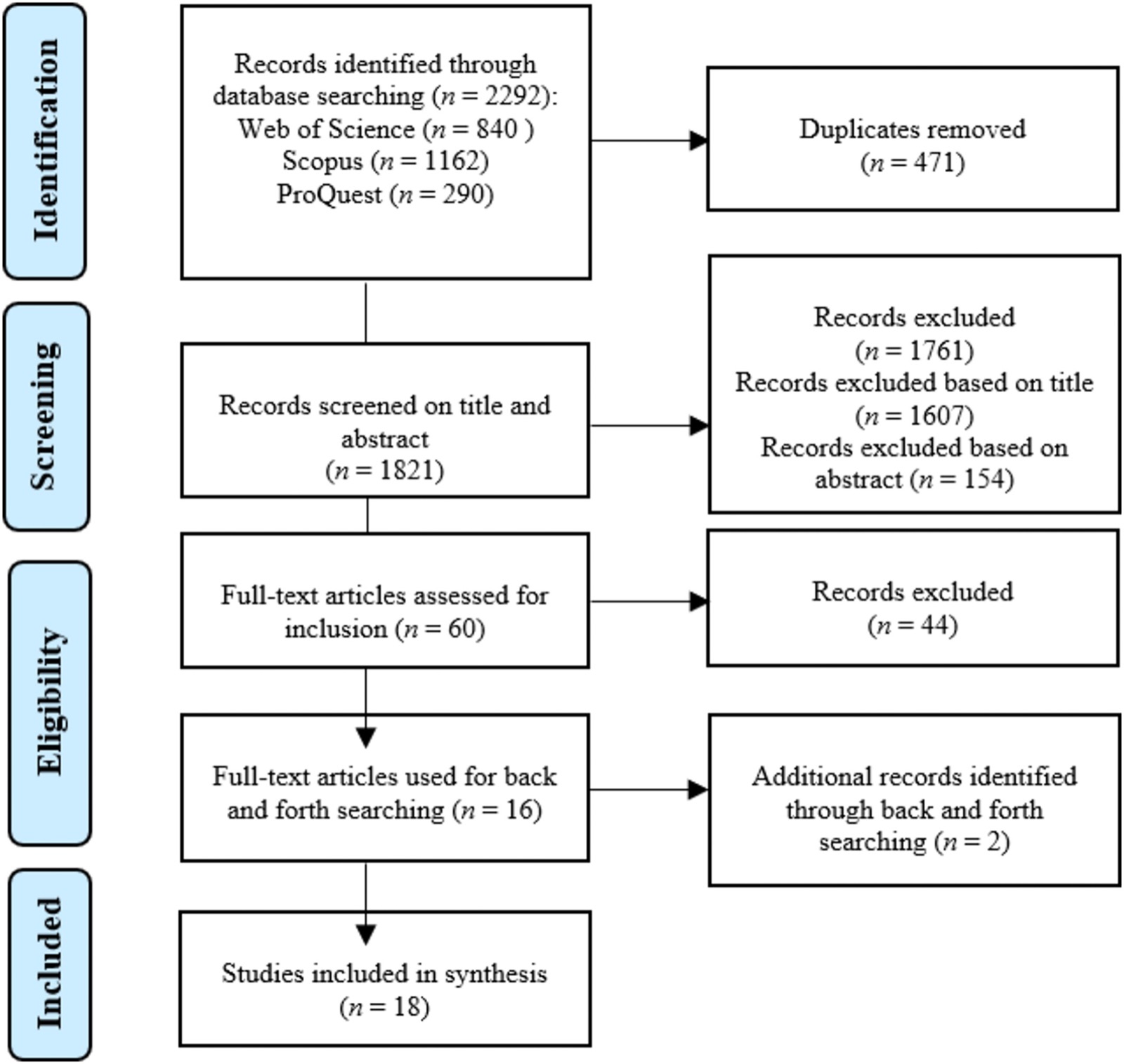
In June 2022, the Web of Science, Scopus and ProQuest databases were preliminarily searched to select relevant keywords. Once the keywords were determined, a review protocol was created and registered with the Prospective Register of Systematic Reviews (CRD42022344825). The main search was conducted in July 2022 and repeated in November 2024 to ensure the article reflects the most recent developments, using the keywords listed in Table 1. There were no geographic or temporal restrictions; however, the search was limited to studies in English. The combined search yielded 2292 hits, which were reduced to 1821 after duplicates were removed. See Figure 1 for a detailed overview of the selection process.
Table 1 — Key search terms.
- Context: Foster care OR Foster famil* OR Kin* care OR Fostering OR Traditional foster OR Network foster OR Non-kin* care OR Alternative care OR Substitute care OR Looked after child* OR Out-of-home OR Out of home OR Child welfare OR Child protection OR Social work*; Topic: Family relationship* OR Concept* of famil* OR Family concept* OR (Perception* NEAR/6 famil*) OR (Construct* AND famil*) OR Psychological famil* OR Family identit* OR Famil* of choice OR Fictive kin* OR Chosen famil* OR Meaning* of famil* OR (Belong* NEAR/6 famil*) OR View* of family OR Perspective* of family; Exclusion: NOT = Health OR Nurs*
2.2 Inclusion Criteria
Titles and abstracts were screened by the first author using these inclusion criteria: (1) empirical articles; (2) published in peer-reviewed journals; (3) that addressed how parents, foster carers, children of foster carers or FC workers involved in kinship, kith or nonkinship care define family and/or whom they consider family; and (4) available in full text. This resulted in 66 articles. Full-text review led to the exclusion of 50 articles because, for example, they examined social networks or belonging rather than ‘family’ or ‘family belonging’, targeted foster adoptive parents, or focused exclusively on social workers working in other fields. Three articles were retained after a joint discussion with a co-author (HG). In addition to the remaining 16 articles, two articles were found through backward and forward snowballing.7 This resulted in a total of 18 articles included in this study. In the following sections, we refer to these articles by their assigned number, which can be found in Table 2.
Table 2 — Included articles.
- 1; Title: Genealogy's Desire: Practices of Kinship Amongst Lesbian and Gay Foster-Carers and Adopters; Author: Hicks; Year: 2006; Country: UK; Objectives: Discuss the practices of kinship developed by lesbians and gay men who foster or adopt children; Type of placement: Nonkinship care; Quality assessment scorea: 7/10b
- 2; Title: Family types and social integration in kinship care; Author: Holtan; Year: 2008; Country: Norway; Objectives: Address the complexity of relationships in kinship care and explore the social integration of foster children; Type of placement: Kinship care; Quality assessment scorea: 9/10b
- 3; Title: Support in Kith and Kin Care: The Experience of Carers; Author: O'Neill; Year: 2011; Country: Australia; Objectives: Explore carers' experience of kin and kith care and to gain an understanding of the support need of these carers; Type of placement: Kith and kinship care; Quality assessment scorea: 8/10b
- 4; Title: Against the odds: Foster carers' perceptions of family, commitment and belonging in successful placements; Author: Oke et al.; Year: 2013; Country: UK; Objectives: Explore experiences and perceptions relating to family, belonging and commitment of foster carers; Type of placement: Nonkinship care; Quality assessment scorea: 7/10b
- 5; Title: How Do Social Workers Define the Concept of Family?; Author: Gavriel-Fried et al.; Year: 2014; Country: Israel; Objectives: Examine how social workers define the concept of family, and how personal values, socio-demographic variables and personal acquaintance with non-traditional types of families affect these definitions; Type of placement: —; Quality assessment scorea: 8/8c
- 6; Title: ‘It's a Family Responsibility’: Family and Cultural Connection for Aboriginal Children in Kinship Care; Author: Kiraly et al.; Year: 2015; Country: Australia; Objectives: Explore to what extent Indigenous children in kinship care are able to maintain family relationships and connection to their culture, what helps to support family relationships and connection to culture for Indigenous children in kinship care and what the barriers are to family and cultural connection for Indigenous children in kinship care; Type of placement: Kith and kinship care; Quality assessment scorea: 8/8c 10/10b
- 7; Title: Out of time: theorizing family in social work practices; Author: Morris et al.; Year: 2017; Country: UK; Objectives: Explore social workers' conceptions of family; Type of placement: —; Quality assessment scorea: 7/10b
- 8; Title: Developing and Maintaining Foster Family Identity Through Foster Parents' Identity Work; Author: Miller-Ott; Year: 2017; Country: USA; Objectives: Understand the communicative strategies that foster parents use to create family identity; Type of placement: Nonkinship care; Quality assessment scorea: 7/10b
- 9; Title: Constructing Family from a Social Work Perspective in Child Welfare: A Juggling Act at Best; Author: Johner & Durst; Year: 2017; Country: Canada; Objectives: Explore the construction of ‘family’ and decision-making process about family life in the prairie region of Canada in professional social work practice; Type of placement: —; Quality assessment scorea: 8/10b
- 10; Title: Families beyond boundaries: Conceptualizing kinship in gay and lesbian adoption and fostering; Author: Wood; Year: 2018; Country: UK; Objectives: Explore why participants chose to adopt or foster and the conditions by which kinship is conceived of and negotiated within the parameters of adoption or fostering; Type of placement: Nonkinship care; Quality assessment scorea: 7/10b
- 11; Title: Conceptualisations of Family and Social Work Family Practice in Chile, Mexico and Norway; Author: Studsrod et al.; Year: 2018; Country: Chile, Mexico and Norway; Objectives: Examine how social workers' conceptualizations of family, ‘family members’ and state responsibilities, impact on social work practice; Type of placement: —; Quality assessment scorea: 6/10b
- 12; Title: Talking Back to ‘Family’, ‘Family troubles’, and ‘the Looked-after Child’; Author: Welch; Year: 2018; Country: UK; Objectives: Explore three key categorizations that come together around the alternative care of looked-after children: family, family troubles and the looked-after child; Type of placement: Kinship care; Quality assessment scorea: 8/10b
- 13; Title: What is a family? Constructions of family and parenting after a custody transfer from parents to foster parents; Author: Wissö et al.; Year: 2019; Country: Sweden; Objectives: Explore how parenting and family is constructed by custodians and young people with experience of custody transfer; Type of placement: Nonkinship care; Quality assessment scorea: 8/10b
- 14; Title: Family conceptions and social workers' professional judgment in Chilean social child services; Author: Reyes-Quilodran et al.; Year: 2021; Country: Chile; Objectives: Identify social workers' conceptions of the family and explore the presence of variables that might influence practitioners' concepts of family; Type of placement: —; Quality assessment scorea: 7/8c 8/10b
- 15; Title: Doing foster family with young refugees: Negotiations of belonging and being at home; Author: Mörgen & Rieker; Year: 2022; Country: Switzerland; Objectives: Investigate how young refugees and their foster parents develop and negotiate feelings of belonging and to what extent meanings ascribed to ‘at home’ and ‘family’ may be challenged; Type of placement: Nonkinship care; Quality assessment scorea: 7/10b
- 16; Title: Rethinking “the family” in foster care in Italy: The perspective of children in care and of foster parents' children; Author: Sità & Mortari; Year: 2022; Country: Italy; Objectives: Explore the overlapping experiences between foster children and children of parents who foster in terms of family construction and belonging; Type of placement: Nonkinship care; Quality assessment scorea: 7/10c
- 17; Title: How do kinship and foster caregivers differ in their conceptualization of family connectedness?; Author: Hassall et al.; Year: 2023; Country: Australia; Objectives: Compare kinship and foster caregivers' family connectedness conceptualizations; Type of placement: Kinship care; Quality assessment scorea: 8/10b
- 18; Title: An Exploratory Typology for Understanding Family-Relationship Issues in Kinship-Care Placements; Author: Dorval et al.; Year: 2024; Country: Canada; Objectives: Explore family relationship dynamics in kinship-care placements; Type of placement: Kinship care; Quality assessment scorea: 8/10b
a Qualitative studies were scored with a total of 10 points, quantitative studies were scored with a total of 8 points and mixed-method studies (articles 6 and 14) had two final assessment scores. b The Joanna Briggs checklist for Qualitative Research was used, with scores of 1–3 indicating high risk, 4–6 moderate risk and 7–8 low risk of bias. c The Joanna Briggs checklist for Analytical Cross-Sectional Studies was used, with scores below 4 indicating high risk, 5–7 moderate risk and 8–10 low risk of bias.
2.3 Quality Assessment
The 18 studies were assessed for methodological quality using the Joanna Briggs Institute critical appraisal tools, that is, the checklist for Qualitative Research (all except three) (Joanna Briggs Institute 2020b) and the checklist for Analytical Cross-Sectional Studies (5, 6, 14) (Joanna Briggs Institute 2020a). Three reviewers (LW, JW and FB8) assessed the quality of 50% of the articles individually, and disagreements were resolved by team consensus. Because of the high level of agreement, the remaining articles were assessed by the first author. All criteria were answered either yes, no or unclear. For each study, the total number of criteria answered ‘yes’ was used as the final assessment score (see Table 2). No studies were excluded, as studies were rated as either low or moderate risk of bias.
2.4 Data Abstraction
For each article, we extracted the following information in an Excel spreadsheet: title, author(s), year of publication, country, objectives, study population, sample size and study design. We analysed the characteristics of the studies in terms of year of publication, country, study population and study design (RQ1). To examine RQ2 and RQ3, we extracted all results related to how participants define family and who they consider family from each study into a Word document. To analyse these data, we conducted a reflexive thematic analysis (Braun and Clarke 2019, 2021; Terry and Hayfield 2021). First, the document was (re)read to become familiar with the data, and ideas were noted in the margins. Based on these ideas, we inductively assigned codes that were later categorized into themes and subthemes. This was a back-and-forth process of rereading data and changing and adjusting codes, themes and subthemes, resulting in a coding tree and table in which themes and subthemes were clearly defined (see Table 3). We verified accuracy through an iterative dialogue with the data by answering the following questions: (1) Does the content of the coding tree reflect the most relevant data from each study concerning our research questions? (2) What similarities and differences in (sub)themes can be identified within and across stakeholders?
Table 3 — Overview of themes, subthemes and descriptions.
Meaning of family
- Family as custodians of culture and care. Unconditional care and support: Family as those who offer unconditional care to its members; family as a support system. Care between devotion and duty: Family responsibilities, family duties and obligations towards other family members. Passing down social and cultural values: Family as a passage of intergenerational values, culture and traditions. Multifaceted family roles and ambiguity: Simultaneously fulfilling multiple family roles and identities and role ambiguity.
- Biological and legal dimensions. Biological ties: Family as an inherent extension of biology, encompassing blood ties and physical resemblance, referred to as ‘real’ family. Legal ties: Family as legal ties and the certainty they offer. Family as private versus public: Family as a private matter versus being part of a public foster care system.
- Unconditional love and belonging. Family as attachment, love and a sense of belonging.
- Family as a site of stability and transition. Family is forever versus temporary care: Family as relationships that are forever against the backdrop of the goal of temporary care in foster care. Shifting family priorities: The initial focus in kinship and kith care on assisting the parents shifts over time to prioritize the needs of the child.
Who is considered family
- Blood ties. Blood relationships as ‘natural’ family relationships.
- Legal ties. Family members as those who are legally.
- Chosen family. Those who are not related by blood or legal processes e.g. friends.
- Differing views on who is family. Discrepancies about who counts as family, both between family members and with outsiders.
- Co-constructing family in the foster care system. The act of reconciliation between who foster care workers see as family, who the client sees as family and who the system reckons as family.
This study was conducted by four white, middle-class researchers, three of whom identify as women and one as a man. None of us has first-hand experience as a foster child. One author is a kinship carer, whereas another has indirect experience of out-of-home care through the placement of a family member. We acknowledge that our social identities, lived experiences and understanding of the literature likely influenced the research process from the formulation of the research questions to the interpretation of the results.
3 Results
First, we look at the characteristics of the 18 included studies in terms of year, country, target group, and methodology (RQ1). Then we discuss how these stakeholders understand family (RQ2) and who they consider family (RQ3).
3.1 Study Characteristics
After an initial study in 2006 (1) and a following one in 2008 (2), four articles were published between 2011 and 2015 (3–6). In the last 5 years, research interest has increased and 12 studies were published between 2017 and 2024 (7–18). Ten studies were conducted in Europe, with the remaining studies taking place in Australia, Asia, Canada, North America, and South America. Study 11 utilized intercontinental data collected from Chile, Mexico, and Norway (see Table 2).
There was wide variation in the extent to which specific target groups were included in the studies. (Former) foster carers were included in 11 studies, five of which involved kith and kinship carers (2, 3, 6, 12, 17) and seven of which encompassed nonkinship carers (1, 4, 8, 10, 13, 15, 17). Social workers participated in seven studies (1, 5, 6, 7, 9, 11, 14). Parents were represented in only three studies (2, 7, 18), and children of foster carers in one study (16). All studies combined included approximately 1135 participants, 715 social workers, 340 foster carers (185 nonkinship carers, 95 kinship carers and 60 kith carers9), 45 children of foster carers and 35 parents.
All except three studies used solely qualitative methods. Especially qualitative interviews, either exclusively or partially, were used to capture the meaning of family for participants (1, 2, 3, 4, 7, 8, 10, 12, 13, 14, 15, 16, 18); Study 14 also used semi-structured interviews, but in a quantitative design. Other methods included focus groups (6, 7, 9, 11, 14), vignettes (7, 9, 11), surveys (5, 6, 14) and family charts (2).
3.2 How Stakeholders Define Family
Based on our analysis of each articles' results section, we identified and categorized stakeholders meanings of family into ‘perceptions of family in the context of care and support’, ‘biological and legal dimensions of family’, ‘emotional and relational aspects of family’ and ‘family as a dynamic and fluid concept’. However, stakeholders' understandings were often a combination of elements within and between themes.
3.2.1 Perceptions of Family in the Context of Care and Support
3.2.1.1 Family as a Source of Unconditional Care and Support
Stakeholders portrayed family as a collective where members actively look out for one another (8), support, help or advise each other (1, 7, 8, 9, 10, 11, 13, 17), overcome challenges together (4), are committed to each other (1, 4, 6, 8, 10, 17), recognize the importance of the unit (6, 12, 15), invest in the group (8) and treat everyone equally (8, 10, 13, 15). In addition, family provides a place to live or a home (1, 2, 4, 5, 8, 13, 15), as well as financial resources such as money and gifts (8, 10):
I've always been there for my children (…). Obviously, if they need help (…), I'll help. (Kinship carer) (2, p. 1029)
Nonkinship carers referred to family as a ‘lifeline’ (Study 1, p. 770). Echoing this sentiment, a social worker said, ‘Well I see family as a support system that goes well beyond the confines of family of origin’ (Social worker, 9, p. 21).
3.2.1.1.1 Care Between Devotion and Duty
When support is a kind of ‘obvious’ family characteristic, belonging to a family goes hand in hand with responsibilities, family duties, and obligations towards other family members (2, 3, 6, 7, 10, 12). In the studies focusing on kith and kinship care, caring for the foster child was often based on these family responsibilities and duties (2, 3, 6, 12), as reflected in referring to it as an ‘automatic response’ (3, p. 92) and quotes such as ‘that's family, that's what you do’ (Kinship carer, 3, p. 93), ‘there was no choice, family is family and I love these kids’ (Kinship carer, 3, p. 92) and ‘even though they're not blood related, as in the sense of a white man, they're my brother and sisters and I have to take care of them’ (Kith carer, 6, p. 27). Despite the challenges, these caregivers spoke about a sense of fulfilment, pride and joy of caring for family members (2, 3, 17):
If you just relax into it and not feel cross, there's something about the continuity of generations and life that seems sort of right … the experience has been enormously enriching … the relationship [with granddaughter] is a very beautiful thing. (Kinship carer) (2, p. 92)
In addition, parents of children placed in kinship care were allowed to ‘retain their symbolic parenthood’ (2, p. 1029):
I can ring home to my mother at 11 in the evening, just to chat (…) How's it going? Has Linda been good today? You see? I could not have done that with a foster mother. (Birth mother) (2, p. 1029)
However, in cases of kinship and kith care, some foster carers found themselves grappling with the high cost of family responsibilities, such as losing their social life or not being able to devote enough time and attention to other family members:
I do not regret having him (grandson), but I regret the situation and there's days I actually hate my daughter … this is not what I had envisaged for myself … my life's come to a standstill. We took it on, we were altruistic about it at the beginning … and then all of a sudden it all started sinking in … well there goes my social life, my ability to be able to pack up and go when I needed to. (Kinship carer) (3, p. 92)
My other two little granddaughters never see us now – we have lost that bond. (Kinship carer) (3, p. 94)
In this light, the use of the term ‘altruism’ in the first quote is interesting. It seems to reflect a voluntary decision to care for the child. Nevertheless, their stories show the fine line between devotion and duty, which is also reflected in the fact that some kinship and kith carers felt unable to refuse to care for the child:
[A grandmother talking about her fear of her daughter getting pregnant again] I will not go near that child, I will not visit her in hospital … because as soon as I do, I know what will happen - and I cannot do it again. (Kinship carer) (3, p. 92)
So even if a Grandma did not feel she was fit enough or strong enough to take on care, she would never say ‘No’. So [it's] cultural. Culture is a huge, huge issue. Or in terms of family … there usually is another half a dozen people living in the house … they are not going to tell their family that they are not welcome there. (Sue, social worker) (6, p. 29)
Grandparents, especially grandmothers expressed profound feelings of shame and self-blame about their children's inability to care for their grandchildren, ‘Do I ask myself if I could have been a better mother? Yes. Do I ask myself where I went wrong? Yes’ (Kinship carer, 3, p. 92). They also sometimes harboured resentment towards relatives who chose to remain unaware of the children's situation. Moreover, they were often the ones who had reported the parents to child protection services or confronted them in court during custody hearings (3). Interestingly, a kinship carer, although discussing the difficult relationship with her sister, indirectly referred to her sister as the mother of her foster child Mia:
Her mother pits Mia against us, and when Mia comes home all hell lets loose. (Kinship carer) (2, 1030)
Some parents recognized the challenging impact of kinship care on their family relationships (2, 3, 7). In Study 18, Nicholas shared that he often mediated tensions between his family and in-laws after his son was placed with his family rather than theirs.
3.2.1.2 The Role of Family in Social and Cultural Development
Stakeholders saw the socialization of children as a family responsibility, described as education and discipline (4, 8), with participants talking about preparing children to become ‘decent’ members of society:
Almost all of the children are used to eating with one utensil … hold it in their hand in a grip and shovel food … so we have taught children how to set tables, we have taught them the right use of cutting … just normal table manners just like we teach our own kids we would teach them. (Lynn, nonkinship carer) (8, p. 214)
In addition, stakeholders emphasized families' pivotal role in transmitting culture (13, 17), beliefs (6, 16), traditions (8, 17), rituals (7), heritage (6, 17) and identity (1, 6, 8, 16) from one generation to the next. For example, kinship care is seen as a way to maintain family unity and revitalize Aboriginal customs (Kinship carer) (3, p. 94). Rose, an FC worker, stressed the importance of children retaining their identity and connection to their community, regardless of their caregiver (6, p. 27).
3.2.1.3 Multifaceted Roles and Ambiguity
In Study 4, nonkinship carers detailed their experiences of concurrently adopting the roles of foster carer, parent, and advocate, illustrating the complexity of their responsibilities. Similarly, kinship carers recounted their efforts in balancing numerous roles while renegotiating their relationships with the children under their care (2, 3), with parents (2), with other children they had (3) and with extended family members (3). This balancing act was described as follows:
The whole family dynamics, it's a constant juggling of everybody … you are an auntie, a mother, a carer. (Kinship carer) (3, p. 93)
I'm only 10 years older than she is … I've got my own family now and I'm mother and sister in one. It's really hard – [my husband] and I get really cross when we think about my mum who abandoned us all – and also my sisters and brothers who have left it all to me. (Kinship carer) (3, p. 94)
Furthermore, parents grappled with uncertainty about their roles in their children's lives, navigating challenges in defining and maintaining meaningful connections. One birth mother described how her child asked if she could join them at a nursery. Although she could not go alone, the caregiver allowed her to accompany them. At the nursery, the birth mother felt uncertain about her role, believing that certain activities were more appropriate for the caregiver to handle (12). Another birth mother was unsure how to sign her letters to her children, whether to sign ‘mum’ or her first name (12).
3.2.2 Biological and Legal Dimensions of Family
3.2.2.1 An Innate Biological Connection
Stakeholders described family as an intrinsic biological connection, creating an innate and enduring link among individuals (12). They often referred to these relationships as ‘factually family’ or ‘real family’ (12, 15), underscoring the perceived naturalness of these bonds (4, 15). Moreover, physical resemblances were pointed out as a tangible indicator of these biological connections:
These two definitely-definitely look alike. In the eyes in these two, but you can tell that they are definitely the family, like. (…). (Birth mother) (12, p. 205)
Interestingly, even when stakeholders felt a lack of connection with their relatives, they still sometimes referred to them as ‘real’ family:
I do not have much to do with my real family, the last time I saw them, em, they were offering me drugs. (Birth mother) (12, p. 206)
3.2.2.2 Legal Assurance of Family Ties
Stakeholders commonly mentioned biological and legal ties together (2, 3, 6, 7, 11, 12, 13, 14, 15), indicating that this dual connection is ‘the common’ interpretation of family: ‘My concept of a family is people who are related by blood or ties of marriage so usually related’ (Social worker, 7, p. 55). However, the lack of legal ties was often a source of uncertainty. A kith carer stressed the critical need for legal security, saying, ‘That was my first priority … get them legally so that nobody can ever take them off me’ (Kith carer, 3, p. 96). Social workers acknowledged the importance of legal agreements with parents, legal categories of parental care (e.g., the need for parental responsibility to be clearly defined by a court) and, in some cases, the transfer of parental responsibility, as key elements in establishing permanence (7).
3.2.2.3 The Profound Impact of the State on Family Life in FC
Although stakeholders talked about family as a private group of people, this understanding was challenged by their involvement in FC (3, 6, 7, 10, 12). Some kinship carers felt exposed to and controlled by rather than supported by, the professional gaze of FC services:
(…) Do I resent being visited by departmental staff and having our family placed under a microscope? Yes. (Kinship carer) (3, p. 92)
… I was so aware that, you know, I have got to respond correctly … I have got this social worker and therapist watching how I deal with [the problem]. (Kinship carer) (12, p. 209)
In Study 7, a key phrase from parents was that both they and their children struggled to ‘manage everything’ because they were faced with changing social workers, appointments for treatment or therapy, meetings, and home visits, and were tired of finding ways to cope with the amount and extent of professional interference in the family:
I'd have just ignored them and go and stand in the kitchen and wait until they'd gone … I mean … in one week I'd have [lists several people scheduled to visit the parent at home] it went on and on really. I mean how many people is that coming round! … Every time I got rid of one I'd think, that's one less. (Birth parent) (7, p. 58)
3.2.3 Emotional and Relational Aspects of Family
Stakeholders talked about family as a nurturing environment where members care for and love each other (4, 6, 7, 8, 10, 15, 17). They spoke of people ‘feeling like family’ and mentioned these relationships were characterized by a sense of family (9), attachment (4, 7, 8, 17), an affectionate bond (16), trust (2, 4, 8), unconditional love (4, 6, 7, 13), a sense of belonging (4, 7, 15, 16, 17), acceptance (4), warmth (13), intimacy (15), emotional security (4, 17) or an emotional closeness (15, 17):
We love them unconditionally. I think that is the thing is not it? (…). (Yvonne, nonkinship carer) (4, p. 14)
When we are looking for family and when we are involved in families, we look to who they feel is their family when we are looking for supports for them. (Social worker) (9, p. 21)
3.2.4 Family as a Site of Stability and Transition
3.2.4.1 Family Is Forever Versus Temporary Care
Stakeholders talked about family being dynamic (7, 8, 9, 10, 11, 12, 13, 15, 16, 17), yet unconditional (4, 8, 10, 17), stable (8, 13, 15) and forever (8, 10, 13, 15, 17). Study 15 elaborated on the shift in family dynamics within the Meier family when their nonkinship foster child, Tarik, became an adult. As Tarik matured, the foster mother ceased her caregiving roles (e.g., cooking, cleaning), causing the family dynamic to shift to one resembling that of roommates. This transition led to tensions within the foster mother, who viewed Tarik as her child ‘somewhat’ and felt a continual obligation to care for him while grappling with the foster father's view that the caregiving role should end once Tarik reached adulthood:
For him, because he really lives in our family, he almost became our child somewhat [Mr. Meier: Well, yours.], well, my child then, yes indeed, so that I noticed that I had opened this, so boundaries [Mr. Meier clears his throat] were difficult to uphold for me, well, I found it very … pretty fast, it broke my heart, I shared his grief. (Ms. Meier, nonkinship carer) (15, p. 226)
The tension between the foreverness of family and the temporary nature of FC as such was evident in Study 13, where foster carers struggled with the fear of not knowing if and when the child would leave their home: ‘What if social services will take her away, what will we do?’ (Karlsson, nonkinship carer) (13, p. 14). In addition, nonkinship carers in Study 4 expressed concerns about fostering attachment with the children in their care, as these relationships may only be temporary. They were also concerned about the emotional impact on themselves and the children should a separation occur. It is noteworthy that some social workers and nonkinship carers used the term ‘permanency’ instead of ‘forever’, or used it interchangeably:
(…) Permanency, definitely permanency of some kind. She needs to know she's going to be with someone forever. No more moves (…). (Social worker) (7, p. 55)
(…) And start to kind of help them build that sense of permanency and trust in the fact that family is supposed to mean the person comes back, that they do not just leave you. (Nonkinship carer) (8, p. 214)
This interchangeable use of permanency and forever is notable because the goal of permanency is to prevent frequent moves or disruptions, thereby creating a stable and continuous environment for the child. This does not necessarily imply a lifelong commitment like ‘forever’ does. However, nonkinship carers believed these relationships would last beyond the FC period, as reflected in their future projections (4, 15):
My foster children related to my mother as nanny/she was nanny to all of my kids. They all still call her nanny. Becky's children would be my grandchildren. (Diana, nonkinship carer) (4, p. 14)
3.2.4.2 Shifting Family Priorities From one Generation to the Next
In cases of kinship and kith care, the initial focus was typically on assisting the parents, but this shifted over time to prioritize the child's well-being. Foster carers then had to reassess and redefine their relationships with both the child and the parents. For instance, one grandparent mentioned their initial priority was helping their child, but gradually shifted focus to their grandchild (2). This required renegotiating and redefining relationships, moving from ‘my grandchild’ to ‘my child.’ Another foster father expressed:
(…) The time passed into years; we were, of course, as fond of her as if she'd been our own child. (…) We've never had any desire to have an extra child, you see (…). We thought the situation was very hopeless for Kristin [the mother]. We wanted to help, to be there when there was a need for it … But then Kristin comes and says she wants to have the child, (…) then it was the child's needs we thought of first and foremost, and then I said (…): It's too late. (Kinship carer) (2, p. 1031)
3.3 Who Stakeholders Consider Family
Based on our analysis of each article's results section, we analysed who stakeholders considered family and identified the following themes: ‘blood relatives as ‘natural’ family members’, ‘legally bounded family membership’, ‘chosen family’, ‘varied views on who (can) belong to the foster family’ and ‘reconciling all family perspectives in the FC system’.
3.3.1 Blood Relatives as ‘Natural’ Family Members
In all target groups, individuals acknowledged blood relatives as family, with kinship carers and parents placing the greatest emphasis on biological relationships. In Study 12, one kinship carer stated that living with a biological parent was the most natural option while living with extended family (i.e., relatives outside the nuclear family) was the next preferred option. Kinship carers strongly opposed nonkinship FC, stating, ‘I will not let strangers bring up my grandchildren’ (6, p. 26). Conversely, foster carers in same-sex relationships challenged the notion of biological superiority in discussions with FC workers (1, 3, 4, 9, 10, 11). For example, Ethan reacted to claims of their social workers about racial matching:
I was challenging her on this and asking her why and she said, naively in my view: ‘when you walk out of the door with your children you do not want people to assume straight away that they are adopted’. I looked at my partner and looked at her and said ‘everybody will make that assumption about our kids!’ (Ethan, nonkinship carer) (10, p. 160)
3.3.2 Legally Bounded Family Membership
Who was considered a family member was also dependent on who legally was family. For example, the Meiers in Study 15 demonstrated a ‘membership with reservations’ approach, influenced by the asylum status of their foster son. This legal context contributed to Mr. Meier viewing FC as temporary, thereby perceiving his foster child more as a guest than a permanent family member.
3.3.3 Chosen Family
With chosen family, we refer to persons who are not related by blood or legal processes and are considered family members by stakeholders, such as foster children, which many stakeholders reckoned as family (e.g., 2, 3, 4, 13 and 17):
I do see them as my kids and social workers sometimes pull a bit of a face when I say ‘my kids’ but they are. (Yvonne, nonkinship carer) (4, p. 14)
I used to say: ‘she's my foster sister’ and people asked: what does that mean? And I had to explain everything. Anyway now I say: ‘she's my sister’ and that's it, because in the end, this is the truth! (Ester, daughter of foster carers) (16, p. 7)
Furthermore, lesbian and gay foster carers often included friends, families of origin and support systems formed around fostering or parenting (e.g., other foster carers they met) in their family systems (1, 10). Rosie, a nonkinship carer, suggested that this understanding may be because gay and lesbian foster carers have more experience with creating families of choice and networking
I think we are more experienced networkers if you know what I mean, because we have to sort of go outside immediate family or work colleagues, and stuff like that and we have to sort or find our own sort of community of friends. (Rosie, nonkinship carer) (10, p. 159)
However, the authors of Studies 1 and 10 emphasized that the concept of chosen family is not exclusive to same-sex parenting, as heterosexual families also adopt this principle.
3.3.4 Differing Views on who Is Family
Stakeholders' definitions of family appeared highly individualistic, often differing from their immediate (15) or extended family networks (9, 13, 16). For instance, in Study 15, a foster mother referred to their foster child as ‘almost’ her child, whereas the foster father saw the child more as a guest. Foster carers also emphasized the importance of their friends and relatives recognizing foster children as integral family members (10, 13):
My parents treat our children equally, but my husband's family only give presents to our biological children. It makes me so upset but I do not know how to tell them. (Turesson, custodian) (13, p. 14)
This recognition by friends and family could also serve as validation of the foster child's status as a ‘real’ family member. In Study 15, Mr. and Ms. Keller expressed that their foster child is ‘truly a family member’, citing instances where friends implicitly included him in family gatherings and activities.
Additionally, stakeholders faced challenges from outsiders regarding their family definitions. In Study 16, Francesca, a child of nonkinship carers, recounted being corrected by her teacher for referring to a foster brother as her sibling
We had a kid for a long time, he was here for 6 years, and I considered him my brother. I had a bad experience with my elementary school teacher who, when I introduced myself saying ‘I have two brothers, a mom and a dad, two goldfishes,’ would correct me in front of the whole class saying: ‘You have ONE brother.’ I was quite upset because he was a brother to me, and in the end, I thought maybe my teacher was a bit dumb. (Francesca, daughter of foster carers) (16, p. 8)
3.3.5 Reconciling all Family Perspectives in the FC System
Although social workers stated that their conception of family often did not coincide with that of their clients (9), they indicated their understanding of family had broadened over the years. They reported that they now focused more on sources of support in a child's broader familial and informal networks, such as neighbours, teachers and friends, and worked more with support networks and ecomaps (1, 11). However, social workers indicated that they lacked the time and resources to do so (7, 11). Moreover, they had to adhere to national child protection laws, on which the questions of ‘who are the recipients of services’ and ‘who to include in a case’ are based (11). As a result, social workers had to engage in what they called an ongoing co-constructive communicative process about the concept of family between themselves, the families they engaged with, the resources they had and FC legislation.
4 Discussion
This systematic review aimed to (1) provide an overview of the characteristics of studies examining family understandings of stakeholders in FC, (2) examine how these stakeholders define family and (3) whom they consider family.
Although the last 5 years have seen a surge in research into stakeholders' perceptions of family, this work has predominantly centred on the perspectives of social workers and foster carers. This leaves a notable gap in our understanding of the views of parents and children of foster carers, a trend that aligns with historical patterns in the literature (Kapp and Vela 2004; Schofield et al. 2011; Serbinski and Shlonsky 2014). Consequently, our results primarily reflect how foster carers and social workers understand family.
4.1 What Is Family?
Stakeholders presented multifaceted views of family, covering the themes: perceptions of family in the context of care and support, biological and legal dimensions of family, emotional and relational aspects of family and family as a site of stability and transition. These perspectives align partly with those of (former) foster children on family, as discussed by Ie, Ursin, and Mariño (2021) and Wulleman et al. (2023). However, no stakeholders in this study expressed an erosion of the term ‘family’.
Stakeholders' views on family varied. Kinship carers and parents emphasized biological and legal ties more than nonkinship carers, kith carers and children of foster carers. Their understanding of family rooted in biology was intertwined with heteronormativity and bionormativity. Furthermore, kinship carers brought family duties more to the fore compared with other stakeholders, which is not surprising given that the care of their foster child, and therefore much of their daily family life, was often based on these responsibilities or duties. When discussing the fine line between devotion and duty, it is also important to note that family roles and responsibilities are gendered. In kinship care, women, particularly grandmothers, predominantly assume primary caregiving roles, whereas grandfathers and uncles are generally seen as secondary or backup support (3). This gendered distribution of caregiving responsibilities mirrors societal norms that idealize women as naturally caring and nurturing and willing to prioritize their families' needs over their own (Goode, Callender, and Lister 1998; Malos 1995). Elson (2017) observes that despite the age of these references ‘women continue to have greater responsibility than men for unpaid care and domestic work in families and communities’ (p. 53). In discussing the profound impact of the state on family life in FC, we note that professional interference in the family was particularly challenging for parents and kinship carers. This may be because nonkinship carers made a conscious choice to incorporate public services into their family life, whereas others viewed it more as a consequence of their family responsibilities or duties.
In ‘family is forever versus temporary care’, stakeholders' traditional view of family bonds as lifelong commitments contrasts sharply with the short-term nature of FC. The term ‘permanency’ emerges as a bridge in this uncertain landscape, aiming to reconcile the desire for lasting bonds with the impermanence of FC. Our findings emphasize that permanency encompasses more than legal and residential aspects (Brodzinsky and Smith 2019). Permanency was also achieved through the expectation that relationships would continue after FC (relational permanency) and the continuity of cultural identity, seen in the symbolic characterization of family (cultural permanency).
4.2 Who Is Family?
Who stakeholders considered family categorized into ‘blood relatives as ‘natural’ family members’, ‘legally bounded family membership’, ‘chosen family’, ‘differing views on who is family’ and ‘reconciling all family perspectives in the FC system’. Again, these perspectives align partly with those of (former) foster children on family, as discussed by Ie, Ursin, and Mariño (2021) and Wulleman et al. (2023). However, unlike some foster children, no stakeholders in this study reported a complete absence of family belonging. One possible reason for this difference may be the composition of the stakeholder sample. Most stakeholders in this study were foster carers (both kinship and nonkinship), whereas biological parents and children of foster carers were underrepresented. Foster carers, by virtue of their caregiving role, are generally committed to fostering a sense of continuity and belonging for children in their care. This caregiving perspective may make them less likely to experience or express an erosion of the family concept. In contrast, foster children often experience family as fragmented because of frequent transitions, complex family histories and varying family attachments. This can lead them to perceive family in a more ambiguous or eroded way.
The term ‘chosen families’ or ‘families of choice’ originated in studies of gay and lesbian kinship (Kendrick 2013), addressing the need for meaningful relationships when biological family members rejected or disowned queer individuals because of their sexuality (Weston 1997, 2005). Studies show that foster children may consider friends, teachers, people they met in residential care and so forth, as family (e.g., Thomas, Jackl, and Crowley 2017; Wissö, Johansson, and Höjer 2019). Additionally, nonkinship or kith carers and children of foster carers and foster children viewing each other as family can also be categorized as chosen family.
Foster carers stressed the importance of their friends and family recognizing foster children as integral family members. This mirrors foster children's emphasis on being accepted as family by both their foster family (Biehal 2014) and extended foster family members (Hedin, Höjer, and Brunnberg 2011; Schofield 2002), highlighting the performative aspect of family described by Finch (2007) as ‘family display’. Sakar, Mr. and Mrs. Keller's foster son, being invited to family gatherings and activities by their friends and family not only served as proof that he was ‘truly a family member’ but also authenticated his membership (‘truly’).
Stakeholders being ‘corrected’ on who they considered family by family members and outsiders illustrates the nuanced nature of family identification in FC, where personal feelings and societal constructs intertwine. Yuval-Davis (2006, 2011) distinguishes between ‘feelings of belonging’ and ‘politics of belonging’. Although feelings of belonging refer to emotional attachment and a sense of home, the politics of belonging refer to the sociofunctional factors (i.e., the roles that family members fulfil and how these roles are recognized in society) and structures that construct belonging, the discourse of who belongs and who does not. Other scholars, including Lähdesmäki (2020) and Thissen (2015), have expanded on this by emphasizing that the social and the political intervene in all aspects of a person's social and personal life and that, therefore, the feelings and politics of belonging are intricately interconnected. Our findings align with this interconnectedness, recognizing the influence of the sociofunctional definition of family and the importance of how child welfare systems understand family, from placement options (e.g., nonkinship care, residential care and adoption) to who may be involved, on stakeholders' family understandings. Social workers described this as an ongoing co-constructive communicative process about the concept of family between themselves, the families they engaged with, the resources they had and FC legislation. Although scholars have highlighted the interconnectedness of feelings and politics of belonging, they have often done so in a top-down approach (e.g., Thissen 2015), whereas this review highlights the importance of recognizing bottom-up influence. Stakeholders in the FC system are not merely passive actors. They influence how families are defined and challenge practices (e.g., by challenging heteronormativity), which in turn can change the legislation to which they are subject.
5 Strengths and Limitations
This is the first study to systematically review stakeholders' perceptions of family within kin, kith and nonkinship care. Nonetheless, this study has limitations. Studies may have gone undetected because of database selection, search strategy, and keywords, or exclusive focus on English-language literature. Further, our findings are mainly informed by social workers and foster carers' perspectives. Because of insufficient information, it was impossible to differentiate results based on the length of placement. Additionally, although the articles reviewed cover diverse cultural backgrounds, we could not compare cultural variations in family conceptualization and FC systems because of inconsistent reporting across studies.
6 Implications
Our findings underscore the need for policies and practices within FC to adopt an inclusive and expansive understanding of the concept of family. All stakeholders—foster children, parents, foster carers and the children of foster carers—must be actively involved in defining ‘family’ and determining who is considered part of it. Interventions such as ‘Family Finding’ (Campbell and Borgeson 2016; Pale Blue. Inc n.d.) offer a valuable framework for engaging these stakeholders. To maximize the effectiveness of these interventions, they must focus not only on identifying family members but also on providing continuous support. This support should extend beyond facilitating kinship or kith placements for children and ensure relational permanency both during and after FC. For FC workers to collaborate effectively with these identified family members, policies must prioritize this broader view of family, ensuring that adequate time and resources are allocated to these efforts.
Our research also reveals important complexities within kinship care arrangements, which are often promoted as a means to preserve family connections. Although the intention is to strengthen familial ties, our findings show that kinship care can, in some instances, complicate and strain the relationships it aims to preserve. This highlights the need for continuous, critical reflection on the benefits and challenges of kinship care, especially as the number of such placements continues to rise. To effectively support the growing number of kinship placements, services must be specifically tailored to address the unique needs of these arrangements. For instance, there should be a more in-depth examination of the extent to which family members feel they have genuine choice when deciding whether to accept a placement.
Additionally, research on how parents and children of foster carers perceive family relationships is notably underexplored, especially when compared with other groups within FC research. This observation aligns with broader trends in the literature, where these groups are often marginalized (Kapp and Vela 2004; Serbinski 2014; Serbinski and Shlonsky 2014). We have an ethical obligation to ensure their voices are included in academic discussions. Future research should prioritize a multistakeholder approach that examines family relationships from all perspectives, capturing the full range of dynamics within FC systems. Furthermore, socioeconomic status and cultural background play a crucial role in shaping family perceptions and should be explored more deeply. Understanding how these factors influence family dynamics within diverse FC systems is essential for providing more nuanced and effective support to children and families in care.
Complexe Systémique: key points
For systemic practice, the question “who is family?” is anything but theoretical: it decides who is invited, who appears on the genogram, who has a say. This review shows that the answer varies with the position one occupies, that blood and law dominate among parents and in kinship care, and that chosen families, notably among gay and lesbian foster carers, widen the boundaries. Two contributions deserve attention: the thin line between devotion and duty in kinship care, which weighs above all on grandmothers and can be read as a question of loyalty, and the idea of a relational and cultural permanency that goes beyond legal status alone. The definition of family emerges as a co-construction between families, teams and laws. The scope remains limited: the perspective of social workers and foster carers dominates (715 professionals against 35 parents and 45 children of foster carers), the studies are heterogeneous and English-language only, and foster children themselves are out of scope. Read alongside the article on working systemically with parents whose children are placed, and the article on invisible loyalties.
Notes from the original
1 Placement of children with relatives.
2 Placement of children with persons from the child's or parents' social network.
3 Placement of children with unrelated individuals who have chosen to become foster carers.
4 Biological parents of a child in foster care.
5 Biological children of foster carers.
6 Professionals engaged in assessing, placing, supervising and supporting foster care placements, such as social workers and case managers.
7 Back snowballing involves reviewing the references of articles, whereas forward snowballing checks which later articles have cited them.
8 Julie Wolfs and Fien Bossuyt contributed as second and third reviewers as part of their master's thesis.
9 Individuals from the child's or parents' social network who provide care but are not related by blood or legal ties.
Disclosure. ChatGPT-4 was used as an aid to refine the linguistic presentation of the content without altering the original research findings or scientific contributions of the work. After using this tool, we thoroughly reviewed and edited the content to ensure accuracy, coherence and adherence to academic standards. We take full responsibility for the content of this work.
Conflicts of interest. The authors declare no conflicts of interest.
References
Biehal, N. 2014. “A Sense of Belonging: Meanings of Family and Home in Long-Term Foster Care.” British Journal of Social Work 44, no. 4: 955–971. https://doi.org/10.1093/bjsw/bcs177.
Braun, V., and V. Clarke. 2019. “Reflecting on Reflexive Thematic Analysis.” Qualitative Research in Sport, Exercise and Health 11, no. 4: 4. https://doi.org/10.1080/2159676X.2019.1628806.
Braun, V., and V. Clarke. 2021. “One Size Fits All? What Counts as Quality Practice in (Reflexive) Thematic Analysis?” Qualitative Research in Psychology 18, no. 3: 328–352. https://doi.org/10.1080/14780887.2020.1769238.
Brodzinsky, D., and S. L. Smith. 2019. “Commentary: Understanding Research, Policy, and Practice Issues in Adoption Instability.” Research on Social Work Practice 29, no. 2: 185–194. https://doi.org/10.1177/1049731518782647.
Campbell, K. A., and J. Borgeson 2016. A Call for Radical Change in Child Protection Practice: Unleashing the Restorative Power of Relationship by Authentically Engaging the Extended Family, Community and Tribe. National Institute for Permanent Family Connectedness. https://www.familypermanency.org/s/A-Call-for-Radical-Change-in-Child-Protection-Practice-1.pdf.
Dorval, A., S. Hélie, and M.-A. Poirier. 2024. “An Exploratory Typology for Understanding Family-Relationship Issues in Kinship-Care Placements.” Societies 14, no. 3: 41. https://doi.org/10.3390/soc14030041.
Elson, D. 2017. “Recognize, Reduce, and Redistribute Unpaid Care Work: How to Close the Gender Gap.” New Labor Forum 26, no. 2: 52–61. https://doi.org/10.1177/1095796017700135.
Finch, J. 2007. “Displaying Families.” Sociology 41, no. 1: 65–81. https://doi.org/10.1177/0038038507072284.
Gavriel-Fried, B., G. Shilo, and O. Cohen. 2014. “How Do Social Workers Define the Concept of Family?” British Journal of Social Work 44, no. 4: 992–1010. https://doi.org/10.1093/bjsw/bcs176.
Goode, J., C. Callender, and R. Lister. 1998. Purse or Wallet?: Gender Inequalities and Income Distribution Within Families on Benefits. London: Policy Studies Institute.
Hassall, A., A. Olsen, S. Bourke, and D. S. Pasalich. 2023. “How Do Kinship and Foster Caregivers Differ in Their Conceptualization of Family Connectedness?” Child Abuse & Neglect 145: 106391. https://doi.org/10.1016/j.chiabu.2023.106391.
Hedin, L., I. Höjer, and E. Brunnberg. 2011. “Settling Into a New Home as a Teenager: About Establishing Social Bonds in Different Types of Foster Families in Sweden.” Children and Youth Services Review 33, no. 11: 2282–2289. https://doi.org/10.1016/j.childyouth.2011.07.016.
Hicks, S. 2006. “Genealogy's Desire: Practices of Kinship Amongst Lesbian and Gay Foster-Carers and Adopters.” British Journal of Social Work 36, no. 5: 761–776. https://doi.org/10.1093/bjsw/bch405.
Holtan, A. 2008. “Family Types and Social Integration in Kinship Foster Care.” Children and Youth Services Review 30, no. 9: 1022–1036. https://doi.org/10.1016/j.childyouth.2008.01.002.
Ie, J., M. Ursin, and M. V. Mariño. 2021. “Foster Children's Views of Family: A Systematic Review and Qualitative Synthesis.” Children and Youth Services Review 132: 106337. https://doi.org/10.1016/j.childyouth.2021.106337.
Joanna Briggs Institute. 2020a. Checklist for Analytical Cross Sectional Studies. https://jbi.global/critical-appraisal-tools.
Joanna Briggs Institute. 2020b. Checklist for Qualitative Research. https://jbi.global/sites/default/files/2020-08/Checklist_for_Qualitative_Research.pdf.
Johner, R., and D. Durst. 2017. “Constructing Family From a Social Work Perspective in Child Welfare: A Juggling Act at Best.” Journal of Comparative Social Work 12, no. 1: 4–37. https://doi.org/10.31265/jcsw.v12i1.145.
Kapp, S. A., and R. H. Vela. 2004. “The Unheard Client: Assessing the Satisfaction of Parents of Children in Foster Care.” Child & Family Social Work 9, no. 2: 197–206. https://doi.org/10.1111/j.1365-2206.2004.00323.x.
Kendrick, A. 2013. “Relations, Relationships and Relatedness: Residential Child Care and the Family Metaphor.” Child & Family Social Work 18, no. 1: 77–86. https://doi.org/10.1111/cfs.12040.
Kiraly, M., J. James, and C. Humphreys. 2015. “It's a Family Responsibility”: Family and Cultural Connection for Aboriginal Children in Kinship Care.” Children Australia 40, no. 1: 23–32. https://doi.org/10.1017/cha.2014.36.
Lähdesmäki, T. 2020. “Politics of Belonging in Brussels' European Quarter.” International Journal of Heritage Studies 26, no. 10: 979–997. https://doi.org/10.1080/13527258.2019.1663237.
Malos, E. M. 1995. The Politics of Housework (Revised ed.). Cheltenham: New Clarion Press.
Miller-Ott, A. 2017. “Developing and Maintaining Foster Family Identity Through Foster Parents' Identity Work.” Journal of Family Communication 17, no. 3: 208–222. https://doi.org/10.1080/15267431.2017.1293061.
Mörgen, R., and P. Rieker. 2022. “Doing Foster Family With Young Refugees: Negotiations of Belonging and Being at Home.” Children & Society 36, no. 2: 220–233. https://doi.org/10.1111/chso.12460.
Morris, K., S. White, P. Doherty, and L. Warwick. 2017. “Out of Time: Theorizing Family in Social Work Practice.” Child & Family Social Work 22: 51–60. https://doi.org/10.1111/cfs.12257.
Oke, N., H. Rostill-Brookes, and M. Larkin. 2013. “Against the Odds: Foster Carers' Perceptions of Family, Commitment and Belonging in Successful Placements.” Clinical Child Psychology and Psychiatry 18, no. 1: 7–24. https://doi.org/10.1177/1359104511426398.
O'Neill, C. 2011. “Support in Kith and Kin Care: The Experience of Carers.” Children Australia 36, no. 2: 88–99. https://doi.org/10.1375/jcas.36.2.88.
Page, M. J., D. Moher, P. M. Bossuyt, et al. 2021. “PRISMA 2020 Explanation and Elaboration: Updated Guidance and Exemplars for Reporting Systematic Reviews.” BMJ 372: n160. https://doi.org/10.1136/bmj.n160.
Pale Blue. Inc. (n.d.). Family Finding. Retrieved April 3, 2024. https://www.familyfinding.org/.
Reyes-Quilodran, C., C. Muñoz-Guzman, and L. Guerra-Aburto. 2021. “Family Conceptions and Social Workers' Professional Judgment in Chilean Social Child Services.” Social Work Education 40, no. 8: 1064–1080. https://doi.org/10.1080/02615479.2020.1781077.
Schofield, G. 2002. “The Signicance of a Secure Base: A Psychosocial Model of Long-Term Foster Care.” Child & Family Social Work 7, no. 4: 259–272. https://doi.org/10.1046/j.1365-2206.2002.00254.x.
Schofield, G., B. Moldestad, I. Höjer, et al. 2011. “Managing Loss and a Threatened Identity: Experiences of Parents of Children Growing Up in Foster Care, the Perspectives of Their Social Workers and Implications for Practice.” British Journal of Social Work 41, no. 1: 74–92. https://doi.org/10.1093/bjsw/bcq073.
Serbinski, S. 2014. “Growing Up in Families That Foster: Exploring the Emotions of Young Adult Sons and Daughters of Foster Parents” University of Toronto, Canada Published doctoral dissertation. https://tspace.library.utoronto.ca/handle/1807/68241..
Serbinski, S., and A. Shlonsky. 2014. “Is It That We Are Afraid to ask? A Scoping Review About Sons and Daughters of Foster Parents.” Children and Youth Services Review 36: 101–114. https://doi.org/10.1016/j.childyouth.2013.10.023.
Sità, C., and L. Mortari. 2022. “Rethinking “the Family” in Foster Care in Italy: The Perspective of Children in Care and of Foster parents' Children.” Global Studies of Childhood 13: 358–371. https://doi.org/10.1177/20436106221099037.
Studsrød, I., I. T. Ellingsen, C. M. Guzmán, and S. E. M. Espinoza. 2018. “Conceptualisations of Family and Social Work Family Practice in Chile, Mexico and Norway.” Social Policy and Society 17, no. 4: 637–649. https://doi.org/10.1017/S1474746418000234.
Terry, G., and N. Hayfield. 2021. Essentials of Thematic Analysis. American Psychological Association. https://doi.org/10.1037/0000238-000.
Thissen, L. 2015. “Because Here We Live in the Netherlands”: Languagecultural Politics of Belonging in a Supermarket.” Applied Linguistics Review 6, no. 2: 195–216. https://doi.org/10.1515/applirev-2015-0010.
Thomas, L. J., J. A. Jackl, and J. L. Crowley. 2017. “Family?. Not Just Blood”: Discursive Constructions of “Family” in Adult, Former Foster Children's Narratives.” Journal of Family Communication 17, no. 3: 238–253. https://doi.org/10.1080/15267431.2017.1310728.
Welch, V. 2018. “Talking Back to “Family”, “Family Troubles”, and “the Looked-after Child”.” Sociological Research Online 23, no. 1: 197–218. https://doi.org/10.1177/1360780417749439.
Weston, K. 1997. Families We Choose: Lesbians, Gays, Kinship (Revised ed.). New York, NY: Columbia University Press.
Weston, K. 2005. “Families in Queer States: The Rule of Law and the Politics of Recognition.” Radical History Review 2005, no. 93: 122–141.
Wissö, T., H. Johansson, and I. Höjer. 2019. “What Is a Family? Constructions of Family and Parenting After a Custody Transfer From Birth Parents to Foster Parents.” Child & Family Social Work 24, no. 1: 9–16. https://doi.org/10.1111/cfs.12475.
Wood, K. 2018. “Families Beyond Boundaries: Conceptualising Kinship in Gay and Lesbian Adoption and Fostering.” Child & Family Social Work 23, no. 2: 155–162. https://doi.org/10.1111/cfs.12394.
Wulleman, L., H. Grietens, I. Noens, and N. Vliegen. 2023. “(Re)defining Family: A Systematic Review and Meta-Synthesis of Foster Children's Views of Family in Non-Kinship Foster Care.” Children and Youth Services Review 155: 107184. https://doi.org/10.1016/j.childyouth.2023.107184.
Yuval-Davis, N. 2006. “Belonging and the Politics of Belonging.” Patterns of Prejudice 40, no. 3: 197–214. https://doi.org/10.1080/00313220600769331.
Yuval-Davis, N. 2011. The Politics of Belonging: Intersectional Contestations. https://doi.org/10.4135/9781446251041.
Reformatted republication of Be(com)ing Family: A Systematic Review of Stakeholders' Perspectives on Family in Family Foster Care, by Lara Wulleman, Hans Grietens, Ilse Noens and Nicole Vliegen, Child & Family Social Work, vol. 31, no 1 (2026), doi: 10.1111/cfs.13258, under a CC BY 4.0 licence. Edition and layout: Complexe Systémique, September 2026 — the work has been modified under the terms of the licence. Neither the authors nor the publisher are responsible for this edition; the original version prevails.
This is the original article “Be(com)ing Family: A Systematic Review of Stakeholders' Perspectives on Family in Family Foster Care”, published in Child & Family Social Work (2026) under a CC BY 4.0 licence. Republished by Complexe Systémique: the author’s text is unchanged; only the presentation has been adapted for reading online, as set out at the head of this page.
Read the original articleHow to cite this article
Wulleman, L., Grietens, H., Noens, I., et Vliegen, N. (2026). Be(com)ing Family: A Systematic Review of Stakeholders' Perspectives on Family in Family Foster Care. Complexe Systémique. https://app.complexe-systemique.com/en_GB/articles/becoming-family-a-systematic-review-of-stakeholders-perspectives-on-family (Original work published in 2025 in Child & Family Social Work, 31(1), 607-620 (2026); republished in 2026 by Child & Family Social Work, https://onlinelibrary.wiley.com/doi/full/10.1111/cfs.13258)
To go further
- « Il ne suffit pas de faire ou de dire ce qu’il faut » : travailler de façon systémique avec des parents dont les enfants sont placésWorking systemically with parents of children in care.
- What are invisible loyalties?Invisible loyalties.
- Redéfinir la grand-parentalité face à l’autisme : une étude qualitative du vécu émotionnel et du rôle des grands-parentsThe role of grandparents.
Related training courses
 Symposium
État des Lieux: a psychological approach to spaces
Replay of the “État des Lieux” conference (Paris, 16 October 2026): Ivy Daure, Maurizio Frisina, Viola Sallay and Gilbert Pregno on places as a clinical resource. In French.
Related articles
 Scientific
Family group conference provision across the lifespan of child welfare intervention: A mixed-method realist-informed evaluation comparing three stages of welfare concern
Early help, child protection or children in care: among 155 UK families, experiences and outcomes of family group conferences vary very little by stage.
 Scientific
“One Can Have All Sorts of Good Intentions but Sometimes in Everyday Life, It Turns Out Differently”: Change Agreements in Couples' Everyday Lives
Six Danish couples followed after an online couple program: their change agreements become guilt-inducing contracts, shared understanding or revealers of inequality.
 Scientific
How can we BeST? meet the needs of adoptive families? Relevant findings from a major Randomised Controlled Trial of infants in foster care in the UK
The BeST? trial (488 infants in care in the UK) reread for adoption: holistic, ongoing assessment of children and a move to dual registration.
 Scientific
The Role of Parental Expressed Emotion and Loss-Specific Parental Responses in Children’s Loss-Related Outcomes Following Traumatic Loss: A Mixed-Methods Observational Study
After a road-traffic bereavement, parental criticism goes with the child's depression, positive appraisals of the loss with better well-being.