AI-assisted translation
This version was translated from Spanish by Complexe Systémique with the help of artificial intelligence. In case of doubt, the original version prevails.
Red Sistémica · Interview
Community interventions. Interview with Celia Falicov
Celia Falicov is one of those figures in family therapy whom nobody can ignore. Anyone who teaches therapy has inevitably referred to her book Family Transitions and to her work, and it is this work that recently brought her to us. She gave several seminars in Spain, and Mosaico could not miss the opportunity to interview the therapist from the La Jolla Marital and Family Institute in San Diego (California).
“Instead of one family, we have two, and that can be a more positive than negative element of life, since complexity offers more alternatives.”
Celia Falicov
Editorial note
This interview was conducted by Javier Bou for Mosaico, the journal of the Spanish Federation of Family Therapy (FEATF), on the occasion of the seminars given by Celia Falicov in Spain, and then published in no. 54 of Perspectivas Sistémicas (December 1998-February 1999).
A “Robin Hood” practice
Perhaps you could begin by situating your work for us.
For twelve years, I worked at the Palomides research institute in Chicago, and it was there that I began to see children and adolescents with their families, working in the Black and Latino neighbourhood of Chicago. I did a great deal of intervention on the specific problems of a poor ecological context, with families that have been labelled “multi-problem”, where the identified patient is frequently a child with behavioural disorders or problems linked to social stress. When I emigrated to San Diego, a very different context, marked by strong segregation between races and social classes, my activity turned towards a private practice that I would describe as Robin Hood style, in the sense that I see many rich people whom I charge large sums, and a significant number of people who pay me very little, or sometimes do not pay me at all. So much for clinical activity; as for teaching, I teach in two different places: the University of California at San Diego and the University of San Diego, a private Catholic university. We will talk later about some of my work in the community.
Multicultural work in a border city
From your work in a border city of the United States, with a different culture that is also your own, tell us about the particularities or characteristics of multicultural work.
Multicultural work in San Diego, a border city, has particular characteristics: the coexistence of cultures there is perhaps a little stronger, because there are no separate spaces such as neighbourhoods. Very often, living in a border city means that the two cultures coexist within a single family, not only because the husband belongs to one culture and the wife to another, but also because within the family, even sharing the same ethnicity and/or the same social class, there are different psychologies as to closeness to Anglo-Saxon models or to Hispanic models. My work is often a work of uniting cultures within a single family, to facilitate the possibility of a harmonious coexistence.
Yes, because that is the message of your course: biculturalism, the possibility of making the two cultures compatible.
Yes, and of alternating from one culture to the other, according to the context that best serves the family.
In our country, and in Europe in general, we are witnessing a great influx of immigrants from economically less developed countries, especially from Africa, which creates situations of marginalisation, uprooting and exploitation. How do you approach work with this type of problem from the public services?
No, I am not in a public service, but that is not by choice. The United States is going through a period not only of economic crisis and weak support for social programmes, but also of an anti-immigration current. The United States has known different eras of openness to immigration or rejection of it, through laws that protect neither the illegal nor the legal immigrant. Some voluntary programmes in which I work do more prevention than treatment. One of the most acute national problems for the Latino population in the United States is the failure of the education system, because it is through education that the children of immigrants can build a better future for themselves. Some programmes, such as the one I run, are tutoring schemes for children of immigrants who are not succeeding at school, because of problems of bilingualism or of a poorly acquired acculturation, or because the families have not been able to take care of their children emotionally. Moreover, they have not been formally equipped either in a way that would give them the education needed to communicate adequately and thus integrate into the system. So, in this volunteer programme, each of those who take part commits to strengthening, over a relatively short period of time, the possibilities and resources of a family, by adopting it informally, by becoming a bridge, a link with the dominant society, by teaching it how to manage the relationships it forms with institutions and by helping the children of these families to succeed.
You are no doubt familiar with the experiences that Mony Elkaïm, Pluymaekers and so many other renowned systemic family therapists are developing in various countries around work with social networks, and in particular with marginalised people and immigrants. Tell us about experiences from your own environment.
Well, we form a total network, in the sense that the families who are in the programme also constitute a network. Once a month, we all meet, mentors and families. The families begin to get to know each other because in reality, those of us who meet work by school district; the families therefore go to the same school, live nearby and know each other, they know the other families who also have children in this same programme. What we have observed is that they are very proud to take part in the programme. Part of our commitment also consists in talking to them once a week, asking them how they are, whether they need anything, or simply greeting them. It is a truly new programme.
Sometimes, mothers, grateful that their children have new possibilities, ask for the same thing for themselves. We try to make it possible for the women to get to know each other and to help each other with childcare, so that they can go to English classes. The men, because of their activity outside the home, start speaking English more quickly and adapt more.
Key takeaway
The tutoring programme described by Falicov does not treat, it prevents: each mentor informally “adopts” an immigrant family for a short time, serves as a bridge with the institutions of the dominant society, and the families themselves, brought together by school district, end up forming a network of mutual support.
Models of migration and cultural change
Throughout the seminar, you spoke to us about themes such as models of migration, cultural change and the therapeutic focus adopted in each of them. I think that if you said a word about them, it would be of great interest to our readers.
I believe that one of the new things in acculturation theory is the idea that the modern or postmodern emigrant, today’s emigrant, is different from that of the first decades of this century, in the sense that the emigrant of the past often had to cut off relations with their country of origin completely, and that part of their cultural, emotional and adaptive success consisted in adapting completely to the host culture. Some of the new theories are more complex, in the sense that they are not linear and do not require a stripping away of the values of origin, but rather a movement towards an integration or a hybrid mixture, where the cultures of origin are not lost, but are not preserved in their intact forms either, without the new culture being acquired totally, but also partially. This requires a much more experiential, more living model, and a much greater curiosity on the part of the therapist about each family’s personal decisions on which elements to integrate from the new culture and which to preserve from their culture of origin.
The emigrant of the past
Cuts off completely from their country of origin; their success is measured by their total adaptation to the host culture. Linear model.
Today’s emigrant
Hybrid integration: nothing is lost or preserved intact, the new culture is acquired partially. The therapist takes an interest in each family’s own choices.
Single-parent and stepfamilies
You are a supervisor of the American Association for Marriage and Family Therapy. In the United States, you have a long background of work with single-parent, separated and stepfamilies. In our country, on the other hand, these are relatively recent phenomena. What suggestions would you make to therapists and experts working on this theme?
I believe there are some useful elements on the systemic transformations through which families change their number of members, similar to the inevitable developmental family transitions. But they also have certain interesting stages to observe. One of those that has become apparent to me over the years is a rule that cannot be passed on to the family: the transformation that consists in going from a nuclear family to a single-parent family or to a stepfamily, which is a binuclear family, takes about three years or more. Some families believe that once they are out of the conflicts of separation and reconstituted, everything will go well; but it may happen that the step-parents think that the children are going to start treating them as parents, obeying them or making them feel loved, and that is neither easy nor quick.
Another very important element is to change a deficiency model that we have had for many years, in the sense that we had a normative position according to which the intact family or family of origin is the correct family, and divorce, the single-parent family or the stepfamily mean a failure of the family of origin. We forget the possibility that more complex systems, such as stepfamilies, may also be systems endowed with more resources. A good reframing in this regard is to make it clear that instead of one family we have two, and that this can be a more positive than negative element of life, since complexity offers more alternatives.
Key takeaway
Two clinical landmarks for stepfamilies: the transition from a nuclear family to a binuclear family takes three years or more, and the “deficiency model” (the intact family as the norm, reconstitution as failure) is worth reframing: two families means more resources and more alternatives.
Associations, schools and prospects for family therapy
The associative movement of “systemic practitioners” in Spain fortunately follows unitary paths, embodied essentially in our federation. Tell us about the state of affairs in the United States.
We have a long history, of thirty years, with two types of association. One is the Academy of Family Therapy, and the other is called the Association for Marriage and Family Therapy. There is a very important difference between the two, although both have contributed to the development of family therapy in certain directions. AFTA (American Family Therapy Academy), relatively small for the size of the United States, has the characteristic that its members are all teachers of therapy. To join, you must have at least five years of teaching, as well as three letters of recommendation from other AFTA members. It is fundamentally a society of academic nourishment, of exchange, where people come to find out about the latest developments, to listen to their colleagues on what they are thinking at that moment. It must have some 300 members.
The other is a professional protection association, much more complex in terms of organisation, whose annual meeting has always gathered thousands of participants. Among its members, there are family counsellors and supervisors; to be a supervisor, you have to meet certain criteria, and it is a status renewable every five years, I believe. In this first application, you are questioned about your way of thinking on the theoretical level, about your position, etc., and you have to learn the ethical standards.
How do you see the prospects for the different models or approaches in family therapy?
I think there has been a stripping away, a softening of the schools which, in the end, formed a kind of whole divided between several sectors that had placed the emphasis on different currents – for example describing more what was happening in the family of origin, or what was happening within the family, in a more experiential therapy – and each formed a different school, each with a particular slice of the systemic; but that has disappeared, because all contribute to a better understanding of the relational.
My impression is that, in recent times, new schools and new fashions have emerged, perhaps necessary in order to do something that the purely relational could not do, such as working at the individual level, as well as the interest in the social, an aspect that had been less well attended to. I think that many of the narrative currents have introduced more of the individual cognitive, as well as the modern dimension and power relations, and have concerned themselves less with narrative effectiveness at the emotional level. The existence of different models within family therapy, isomorphic with the existence of multiple cultures in families, enriches the panorama.
To finish, tell us how you experienced this journey across the “bull’s hide” and the contact with the professionals of the FEATF (Spanish Federation of Family Therapy).
I love coming to Spain, people are extremely kind, warm… I feel very well received, very well treated, and that, psychologically, is very important for everyone who gives presentations, both in their own country and abroad: in the first case because that is where one lives, and abroad because of the isomorphism of the relational, at the level of the family as of the environment: being well received makes one think better. So I feel that there is here an openness to learning, a tolerance of ideas and little critical confrontation, which is naturally sometimes necessary. But whenever someone adds something, it is important that they add it in a harmonious, collaborative way.
For our part, we want to thank you for your collaboration and for giving us this time. You know that we will always be open to welcoming you.
This interview is an English translation of “Intervenciones comunitarias. Entrevista a Celia Falicov”, published by Red Sistémica (first published in Perspectivas Sistémicas, n° 54, décembre 1998-février 1999 (entretien réalisé pour la revue Mosaico, FEATF)). Translated and republished with the journal’s permission.
Read the original articleHow to cite this article
Bou, J. (2022). Community interventions. Interview with Celia Falicov (Complexe Systémique, Trans.). Complexe Systémique. https://app.complexe-systemique.com/en_GB/articles/community-interventions-interview-with-celia-falicov (Original work published in 1998 in Perspectivas Sistémicas, n° 54, décembre 1998-février 1999 (entretien réalisé pour la revue Mosaico, FEATF); republished in 2022 by Red Sistémica, https://redsistemica.ar/2022/06/28/multiculturalidad-y-maltrato-infantil-la-terapia-familiar-aplicada-a-la-multiculturalidad-entrevista-a-celia-falicov-y-marco-vannotti/)
To go further
- Mobility and migration: rethinking the systemic approach in a globalized worldThe hybrid acculturation models mentioned by Falicov, reread in the age of globalisation.
- Stepmother, stepfather, finding one's place: easing family relationships — Ivy DaureThe three years (or more) of transition to a stepfamily, seen from the step-parents’ side.
- Mony Elkaïm, a pioneer of the systemic approachThe pioneer of network work with marginalised populations, cited by Javier Bou.
Related training courses
 Symposium
État des Lieux: a psychological approach to spaces
Replay of the “État des Lieux” conference (Paris, 16 October 2026): Ivy Daure, Maurizio Frisina, Viola Sallay and Gilbert Pregno on places as a clinical resource. In French.
 Certifying course
Training in Systemic Therapy and Interventions – Cycle 1
Certifying training cycle in systemic therapy and interventions – year 1. Courses, supervision and practice, aligned with EFTA/SFTF. In French.
 Certifying course
Training in Systemic Therapy and Interventions – Cycle 2
Certifying training cycle in systemic therapy and interventions – year 2. Clinical complexity, supervision and practice. EFTA/SFTF aligned. In French.
 Certifying course
Training in Systemic Therapy and Interventions – Cycle 3
Certifying training cycle in systemic therapy and interventions – year 3. In-depth intervention, supervision and practice. EFTA/SFTF aligned. In French.
Related articles
 Blog
Blog Adult parentification: when being useful becomes a condition for being loved
Why is it sometimes so hard to hand over? Julien Besse explores parentification and parentalisation, acknowledgement and the place we take in our adult relationships.
 Scientific
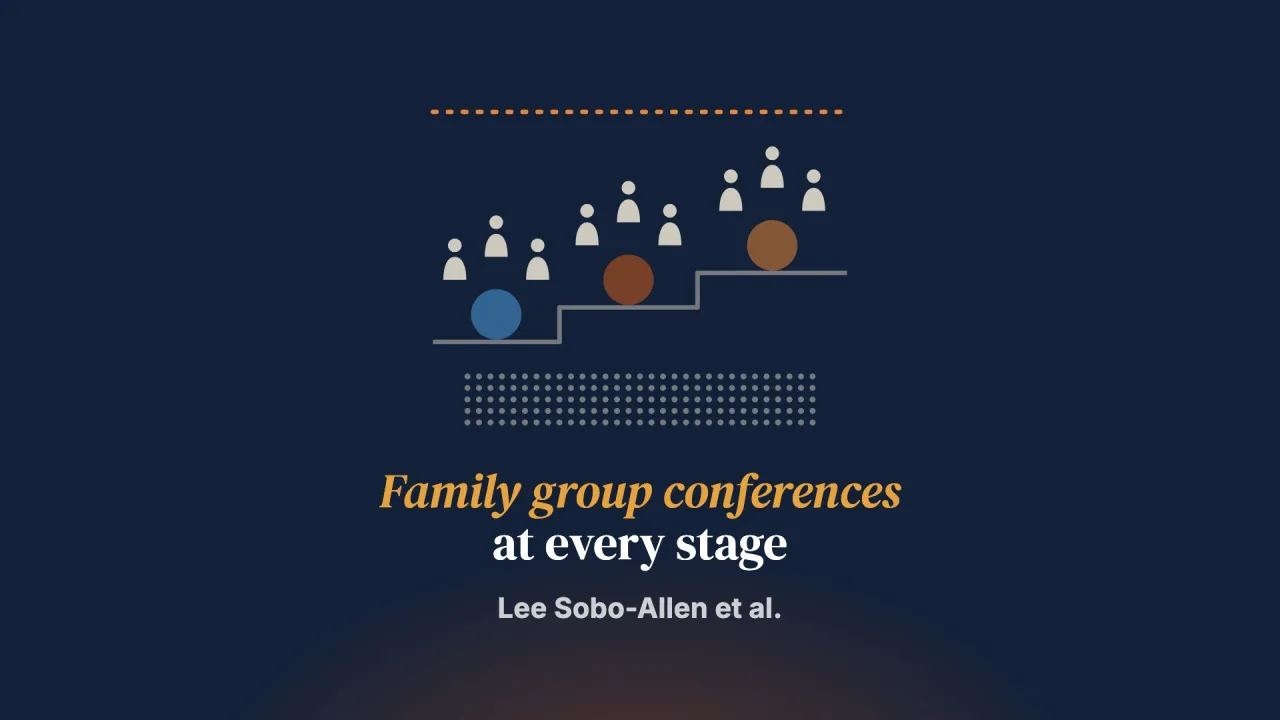
 Family group conference provision across the lifespan of child welfare intervention: A mixed-method realist-informed evaluation comparing three stages of welfare concern
Early help, child protection or children in care: among 155 UK families, experiences and outcomes of family group conferences vary very little by stage.
 Scientific
 Transitioning to the Business of a Session in Collaborative-Dialogic Meetings: A Conversation Analysis
How do Open Dialogue therapists move to the business of a session? The open question creates silences and family negotiation: a conversation analysis of ten sessions.
 Scientific
 Implementing Family Group Decision-Making within statutory child protection social work in Scotland: Challenges and opportunities
Family group decision-making offered automatically in Scottish child protection: families find a voice, social workers doubt the plans, and everyone wants it offered earlier.
Comments 0
Log in to join the discussion. Log in