Conflict Resolution Quarterly · Family mediation
“Efforts to Surface the Unspoken”: A Mixed Methods Study of a Risk-Informed Check-In in Norwegian Family Mediation
In Norway, mediation is mandatory for separating parents, and the risk of violence often slips past the telephone intake. Jan Stokkebekk’s team tested, in seven offices, a five-minute individual conversation, two questions on discomfort and unsafety, before the first joint session. Risk categorization shifts in one case in three, and it is the gap between the two parents’ answers that best signals hidden danger.
This is a reformatted republication of “Efforts to Surface the Unspoken”: A Mixed Methods Study of a Risk-Informed Check-In in Norwegian Family Mediation, by Jan Stokkebekk, Trine Eikrem and Kristoffer Whittaker, published in Conflict Resolution Quarterly (Wiley) (2026), doi: 10.1002/crq.70043, under a CC BY 4.0 licence. Prepared by Complexe Systémique in September 2026: the authors’ text is unchanged; the layout has been adapted for reading online, which constitutes a modification of the work under the terms of the licence. Tables are presented as lists. This edition was made neither by the authors nor by the publisher, who are not responsible for its content or for any errors. The original version prevails.
The mixed methods findings converge on a single conclusion: the protocol functions not as a classification instrument but as a relational opening that can reach risk intake procedures miss.
Jan Stokkebekk, Trine Eikrem and Kristoffer Whittaker
Abstract
In family mediation, emotional discomfort and perceived unsafety may signal deeper relational risks, including postseparation violence. Standard intake procedures in Norwegian family mediation depend on disclosure to a nonclinical administrator before any therapeutic relationship exists, and research documents systematic under-reporting at this stage. This study evaluates a brief, individually administered check-in protocol developed through the risk-informed mediation (RIM) project, a practice-oriented research collaboration between mediators and researchers in which mediators ask two experiential questions at the start of the first session. Using an embedded mixed methods design, we combined statistical analysis of 322 cases from seven Norwegian family counseling offices with qualitative findings from a mediator focus group at one embedded site. Each office contributed data from both a mediation-as-usual (MAU) period and a RIM period, allowing comparison of risk categorization across the two conditions. Chi-square tests revealed statistically significant shifts at four of seven offices. Within the RIM period, 9.5% of cases were re-categorized upward and 23.2% downward following the check-in. Dyadic asymmetry, defined as divergent responses between parents, predicted upward re-categorization with an odds ratio of 3.88, rising to 7.21 in low-risk dyads. Mediators described the check-in as a relational opening that revealed concerns parents had not raised before; unchanged assessments were not inert but confirmed a safe starting point. The mixed methods findings converge on a single conclusion: the protocol functions not as a classification instrument but as a relational opening that can reach risk intake procedures miss. Effects vary across offices, and the findings surface three structural dilemmas—how broad the inquiry should reach, how a mediator who has learned that one parent fears violence can act on that knowledge within a role that offers no formal protective mechanism beyond reporting duties, and how much interpretive competence the protocol requires of those who use it.
1 Prologue
“Sometimes I wonder,” one mediator said during a seminar break, “if what they call discomfort is actually fear.” The other nodded. “Yes. And when someone says they feel unsafe, I always ask myself: Is this emotional tension, or are we missing signs of violence?”
2 Introduction
The exchange in the prologue, where two mediators asked whether what parents describe as discomfort might in fact be fear, illustrates a recurring challenge in family mediation. Everyday terms such as discomfort and feeling unsafe can refer to very different conditions. They may describe ordinary unease, for example the stress of visiting a public office or speaking about private matters, but they can also signal serious relational risk, including coercive control or postseparation violence. Any intervention must therefore be sensitive to this range. It should avoid conflating mild unease with intimate partner violence, yet it cannot depend on explicit disclosure before risk is taken seriously. The challenge, then, is to create conditions under which these distinctions can be heard.
In family mediation, the most serious risk at that end of the range is postseparation violence. National survey data from Norway indicate that about 8%–10% of women and 2%–3% of men report severe physical partner violence (Thoresen and Hjemdal 2014). Risk often increases around separation, and violence that persists or escalates after a relationship has ended has well-documented consequences for health and quality of life (Seeberg and Bossy 2024). In family mediation, violence is recorded as a theme in roughly 13% of cases between 2019 and 2023, although these figures are based on mediators' recall at case closure and likely underestimate true prevalence (Barne-, ungdoms- og familiedirektoratet [Norwegian Directorate for Children, Youth and Family Affairs] 2024).
2.1 The Norwegian Mediation Context
The institutional context in Norway shapes how these concerns are handled. Mediation is mandatory for all separating parents with children under 16, regardless of whether any dispute is present (Children Act, section 51; Tjersland et al. 2015). This differs from most countries, where mandatory mediation applies only when parents seek access to the courts. In Norway, parents must attend mediation both at the time of separation and before initiating legal proceedings concerning custody, residence, or contact. The model therefore serves a preventive function at the population level, aiming to limit conflict and promote cooperative parenting.
As a result, the mediation population is more heterogeneous than in most international studies, including parents who separate amicably as well as those in active conflict, including where relational risk or violence may be present but less visible. Mediation is offered primarily within family counseling centers, which also provide couple therapy, family therapy, and courses addressing relational difficulties. The service is statutory and free of charge.
Because family mediation is a universal service, it must accommodate situations ranging from cooperative low-conflict cases to cases involving serious relational risk. The system relies on early differentiation so that time, competence, and safety measures can be directed where they are most needed. Cases are classified using an eight-item scored intake tool administered by a nonclinical office administrator (Dittman et al. 2021). Cases are classified as A (low conflict), B (moderate conflict), C (high conflict), or C! (high conflict with risk). C and C! cases require two mediators by regulation (Molden et al. 2019). Where power imbalance is so severe that joint mediation is not viable, parents may be granted separate mediation, a legally defined protective measure distinct from shuttle mediation: parents attend on entirely different days and neither is informed of the other's schedule. This must be decided before the formal mediation invitation is issued. Under the Children Act (§§ 51–52) and the Marriage Act (§ 26), the mediator's purpose is to assist parents in reaching an agreement on parental responsibility, residence, and contact that serves the child's best interests; the mediator facilitates this process but has no authority to determine its outcome. The intake tool was designed primarily as a resource allocation mechanism, not as a clinical screening tool for hidden risk (Eikrem et al. 2023).
Norwegian family mediation covers two principal case types. Separation and divorce cases are opened when parents with children under 16 separate or divorce, as mandatory attendance is required by law. Parental dispute cases are opened when already-separated parents return to the service over ongoing disagreements about residence, contact, or parental responsibility. Although separation cases frequently involve parental dispute, the two types differ in legal basis, the relational stage at which they arise, and, as this study shows, in how risk is re-categorized following the check-in.
2.2 A Structural Gap at Intake
The intake tool functions as intended for its allocative purpose, but its design produces a structural limitation: it depends entirely on what parents choose to disclose in a telephone call conducted by a nonclinical administrator before any clinical relationship has been established. Data protection regulations mean that individual disclosures made during the intake call cannot be passed to the mediator who will conduct the session; only the aggregate category can be shared. The source behind the category is not accessible to the clinician. Under-reporting is well documented: Dittman et al. (2021) found that one third of parents understated their difficulties at the telephone intake compared with an anonymous electronic questionnaire, and that of the parents who reported violence or substance misuse in the questionnaire, only 15% had disclosed this at intake.
2.3 Approaches to Risk Identification
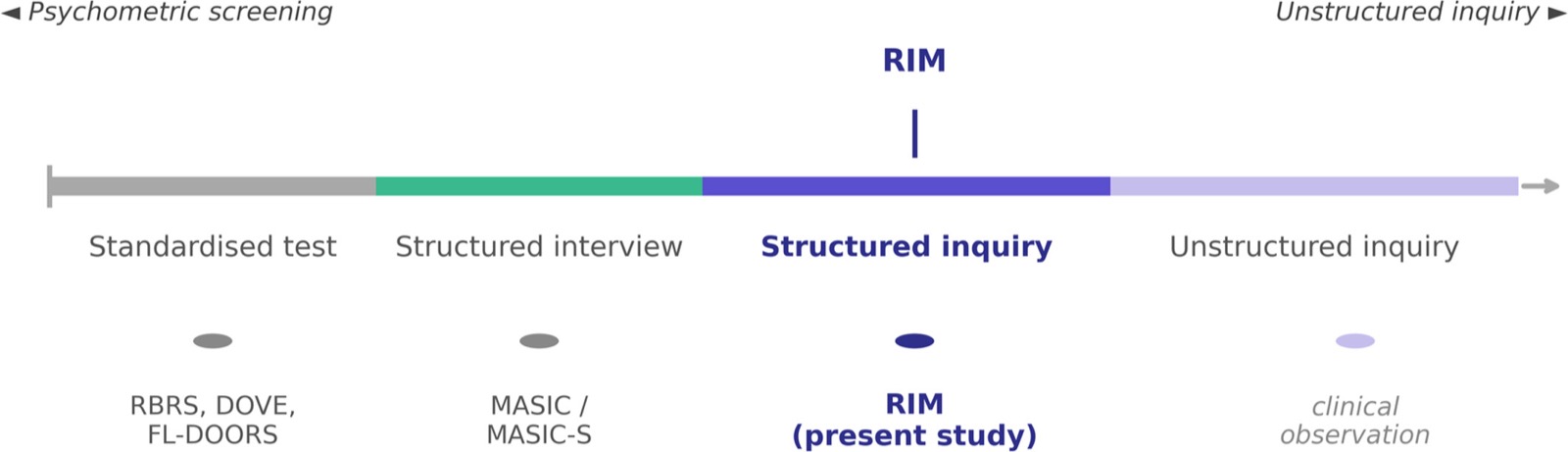
Internationally, efforts to address this structural condition have produced a range of instruments, positioned along a continuum from psychometric screening to risk-informed inquiry (Figure 1). Spangaro et al. (2009) distinguish routine screening, defined as the systematic application of a standardized test to identify individuals at sufficient risk, from routine inquiry, which draws on clinical judgment rather than test logic. At the screening end, instruments such as the RBRS (Beck et al. 2013), DOVE (Ellis and Stuckless 2006), and FL-DOORS (Booth et al. 2023) are thorough, validated, and behaviorally precise. Their limitation is structural: all are administered before any clinical relationship exists, and depend on a parent's willingness to disclose to an unknown administrator. Closer to the inquiry end, the Mediator's MASIC (Rossi et al. 2022, 2024) places assessment within a confidential clinical interview conducted by the mediator, identifying IPV in 94% of cases where it was reported, compared to 38% with a general, broad-question screen (Rossi et al. 2024). Its limitation is practical: MASIC has been found too time-consuming for routine use under ordinary workload conditions (Rossi et al. 2024). None of the existing instruments address the gap between intake and the first joint session: the moment when a clinical relationship has just been established and disclosure is most possible, but the joint conversation has not yet begun.
2.4 The RIM Check-In
The RIM check-in was developed through a bottom-up collaboration between practitioners and researchers at two family counseling offices in Oslo before expanding to a formal pilot study. The check-in occupies that position on the continuum: the start of the first mediation session, after a clinical relationship has been established but before the joint conversation begins. Each parent is invited to a brief individual conversation while the other waits outside. The mediator asks two questions, scored 0–10: “On a scale from 0 to 10, how uncomfortable is it for you to be in the same room as your ex-partner?” and “On a scale from 0 to 10, how safe do you feel about speaking freely and being in the same room as your ex-partner?” Scores above 5 on either question prompt a follow-up: “What makes you feel uncomfortable or unsafe?” The questions were chosen precisely because they target the two experiential dimensions introduced at the opening of this article: ubehag (discomfort in the mediation situation) and utrygghet (felt unsafety with the other parent). The 5-min format reflects the constraints of mandatory mediation: brief enough to be routine, open enough to bring out what a joint session would suppress. Each parent gives their account independently, before either has heard the other's version. The mediator's responsibility is to pursue what emerges. Spangaro et al. (2011) identify three conditions for disclosure: a direct question, a trusted person asking, and a sense of choice. Intake-based tools satisfy only the first; RIM addresses all three. Because separate mediation must be decided before the formal invitation is issued, risk identified through the check-in cannot trigger a switch to separate mediation, but can inform how the mediator conducts the session and activate statutory reporting duties. Recent legislative changes in Norway have made this gap more pressing.
2.5 Legislative Context
The new Children Act (Stortinget [Norwegian Parliament] 2025a, Prop. 117 L, 2024–2025) establishes shared daily decision-making authority as the default for separating parents regardless of cooperation capacity, prompting concern from several organizations that this assumes cooperation even in cases with histories of violence or coercive control (Barneombudet [Norwegian Children's Ombudsman] 2025; Stine Sofies Foundation et al. 2025; Norsk Psykologforening [Norwegian Psychological Association] 2024). A parallel set of parliamentary recommendations adopted alongside the new Children Act establishes that children who are exposed to, or witness, violence perpetrated by a parent should, as a general principle, not have contact with that parent (Stortinget [Norwegian Parliament] 2025b, Recommendation No. 526 L, 2024–2025).
These resolutions strengthen children's protection but do not extend equivalent provisions to adult parties where histories of violence or coercive control are present. Postseparation conflict spans a wide continuum from temporary disagreements to entrenched hostility (Smyth and Moloney 2019), and terms such as high conflict may conceal significant differences between mutual disagreement and coercive control. The capacity to distinguish between conflict and coercion is therefore central to safe mediation practice.
2.6 Present Study
This article reports findings from an embedded mixed methods study of the risk-informed mediation (RIM) protocol conducted across seven family counseling offices between November 2024 and February 2025. The study was guided by a practice-oriented research approach (Castonguay and Muran 2015), integrating systematic data collection with routine clinical mediation practice.
The study had two primary aims. First, it examined whether the brief check-in protocol was associated with changes in mediators' risk categorization across participating offices. Second, it explored how mediators experienced, interpreted, and integrated the protocol into their day-to-day work. A central analytical focus concerned the clinical significance of dyadic asymmetry—that is, divergent responses between parents to the check-in questions—as a potential predictor of re-categorization. This focus rests on the assumption that asymmetric reporting within a parental dyad may reveal clinically meaningful differences in exposure to insecurity or risk that are not readily identifiable in joint mediation contexts, with direct implications for how risk is identified and addressed in practice. A third question—whether divergent responses between parents predict upward re-categorization, and what that asymmetry reveals about how risk is distributed within a dyad—was identified as a secondary aim following initial data examination.
Four research questions guided the study:
- To what extent was the check-in protocol associated with changes in risk assessments across the participating offices?
- How did mediators experience and understand the protocol in day-to-day practice?
- In what ways did the qualitative material help explain observed quantitative patterns?
- Do divergent responses between parents predict re-categorization, and if so, what does dyadic asymmetry reveal about how risk may be distributed within a parental dyad?
3 Methods
3.1 Design
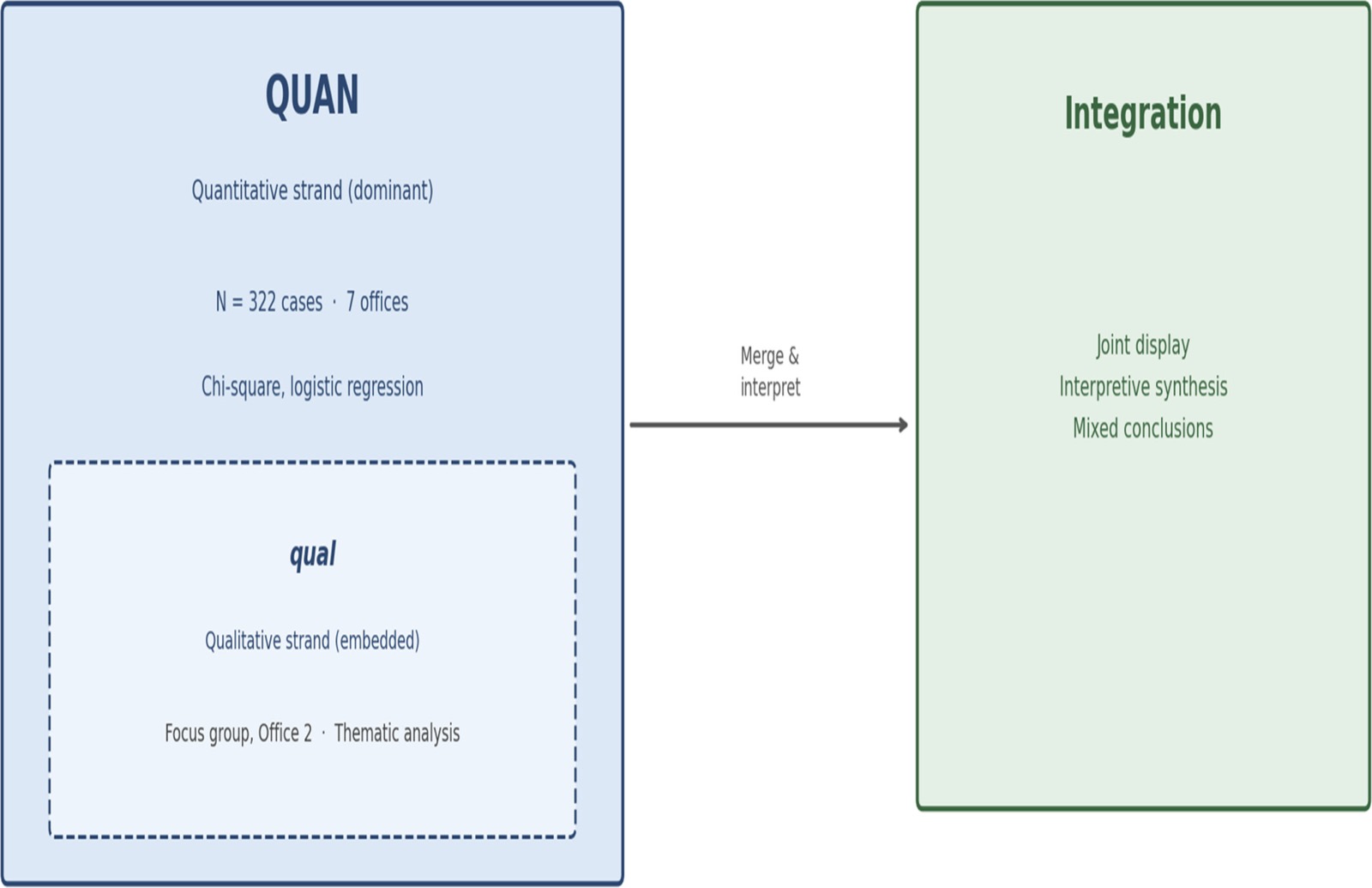
The study employed an embedded mixed methods design with a dominant quantitative strand (Creswell and Clark 2017; see Figure 2). Qualitative data from one selected site were integrated within the quantitative strand at the interpretation stage, where findings from Office 2 contextualize patterns observed across all seven offices.
3.2 Participants
Quantitative data were collected from 322 mediation cases across seven Norwegian family counseling offices between November 2024 and February 2025. Cases granted separate mediation at intake were excluded. Offices represented geographic and demographic diversity. Mediators were primarily social workers with family therapy backgrounds or licensed psychologists. One office (Office 2) contributed both quantitative data (n = 66) and participated in a qualitative focus group interview with six mediators.
Under both MAU and RIM, mediators exercise ongoing clinical judgment about risk throughout the mediation process, including decisions about co-mediators, session structure, and whether to hold individual or joint conversations. The formal outcome variable differs between the two periods. In the MAU period, the outcome is the mediator's clinical risk assessment recorded at case closure, as part of routine administrative practice. In the RIM period, the outcome is the mediator's clinical risk categorisation recorded via a brief research questionnaire completed immediately after the check-in at the start of the first mediation session. In both periods, this clinical categorisation is compared with intake category derived from the eight-item intake tool.
3.3 Data Collection
3.3.1 MAU Intake Procedures and Categorization
Before implementation of the RIM protocol, all cases were categorized using a standard phone-based intake procedure administered by a nonclinical office administrator. The tool comprises eight scored questions covering legal basis for mediation, disagreements about residence and contact, co-parenting conflict, duration of difficulties, trust in the other parent as caregiver, prior court proceedings, and problems related to substance use or violence (Dittman et al. 2021).1 Responses are aggregated into a total score that classifies cases as A, B, C, or C!. The tool was developed from practitioner experience rather than psychometric validation (Dittman et al. 2021).
3.3.2 RIM Check-In Protocol and Implementation
During the first mediation session in the RIM period, each parent was invited to a brief individual check-in using the two structured questions described in Section 1. Scores above 5 prompted a follow-up about the source of discomfort or unsafety. Responses were noted as working notes and not included in the official case file. The conversation typically lasted 5 min per parent. The mediator's revised risk assessment was made immediately after the check-in with both parents, before the joint session commenced. The intake categorization is performed by an office administrator before any clinical relationship exists; the RIM check-in is conducted by the mediator, a trained clinician, within the first session. These are qualitatively different assessment processes carried out by different roles.
3.4 Analytical Strategy: Re-Categorization of Risk as Outcome
We compared mediators' revised risk assessments after the check-in with initial intake categorization, grouping changes as Lower Risk, Unchanged, or Higher Risk. An important structural asymmetry bears on interpretation: in the MAU period the outcome variable is the mediator's assessment at case closure, while in the RIM period it is the mediator's assessment immediately after the check-in at the start of the first session. This limits direct comparison and is acknowledged as a limitation. A further interpretive constraint concerns the B category specifically. When both parents respond at intake and their scores differ, the higher score determines the assigned category. When only one parent responds, any score in the A range is automatically upgraded to B as a precautionary measure (Dittman et al. 2021). The higher-score rule applies to the intake categorization under both MAU and RIM, as intake procedures are identical in both periods. The mediator's subsequent clinical reassessment—at case closure under MAU, and after the check-in under RIM—is a clinical judgment not governed by this algorithmic rule. B-category cases therefore cannot be treated as a uniform group: they may reflect genuine intermediate conflict, dyadic disagreement, or incomplete intake data from a single respondent. A supplementary analysis was therefore conducted restricting the comparison to B-category and above cases (B+). A-category cases more closely resemble family consultation than mediation in the conventional sense (Wing 2009), and including them risks diluting effects that are relevant only to cases where conflict or risk is present at intake.
3.5 Quantitative Analysis
Quantitative data were analyzed using IBM SPSS (version 29.0.2.0). Chi-square tests assessed distributional change after the check-in. Transition matrices, frequency distributions, and cross-tabulations were constructed to identify re-categorization patterns. Effect sizes (Cramér's V) were calculated where relevant. Dyadic analyses examined whether asymmetric responses between parents predicted upward re-categorization.
3.6 Qualitative Analysis
Qualitative data from Office 2 were analyzed using reflexive thematic analysis (Braun and Clarke 2006, 2019, 2024). The focus group was conducted via Microsoft Teams, recorded, and transcribed. The second author led the interview; the first and third authors participated as observers. A follow-up reflection session was also transcribed and included in the analysis. Integration occurred within-site at Office 2, where quantitative and qualitative data were interpreted side-by-side, and interpretively at the regional level, where findings from Office 2 contextualized broader patterns across all seven offices. Joint displays enabled identification of convergent and divergent findings (Creswell and Clark 2017).
3.7 Ethical Considerations
The study was conducted within the statutory Norwegian family counseling service (Bufetat) and was approved by the Data Protection Officer at Bufetat prior to data collection. Under Norwegian research governance, studies conducted as part of routine service development within a statutory body—and which do not involve direct collection of sensitive data from clients—are assessed by the institutional data protection officer rather than a Regional Ethics Committee (REK). This constitutes the appropriate oversight mechanism under applicable Norwegian regulations. The quantitative data were drawn from administrative records generated in the course of normal service operation; no client data were collected as primary research data. Mediators who participated in the focus group interviews were informed about the study's purpose and that their contributions, including direct quotations, might be used in publications; participation was voluntary throughout. All data were anonymized, and data security procedures were followed. The protocol was designed to minimize distress, and mediators received training to respond appropriately to any disclosures.
3.8 Researcher Reflexivity
All three researchers are active in the Norwegian mediation field, positioning them as insider-researchers with access to and accountability within practice. Reflexivity, as used here, refers to an ongoing process in which practitioners and researchers examine their own assumptions, values, and reactions in relation to those they work with (Rothman 2014). Two levels are relevant here. At the practice level, this means attending to how the mediator's own positioning and reactions shape the clinical encounter (Stokkebekk 2024). At the researcher level, it involves critical scrutiny of how embeddedness in the field, prior commitment to the intervention, and insider positioning shape interpretation and reporting. Reflexivity operated at both levels (Braun and Clarke 2019; Whittaker et al. 2023), grounded in critical realism and moderate social constructionism.
4 Findings
4.1 Quantitative Findings
4.1.1 Comparison of MAU and RIM
To evaluate the impact of the RIM protocol, we compared risk re-categorizations across seven offices during the MAU and RIM periods described in Section 2.
Table 1 presents re-categorization by office. Clear shifts are visible particularly at Offices 3, 4, and 7, with bidirectional movement suggesting the protocol revealed both underestimated and overestimated risk.
Table 1 — Risk re-categorization by office: MAU vs. RIM (percentages and counts).
- Office: 1; Lower risk (MAU): 8.5% (13); Lower risk (RIM): 15.5% (18); Unchanged (MAU): 81.0% (124); Unchanged (RIM): 77.6% (90); Higher risk (MAU): 10.5% (16); Higher risk (RIM): 6.9% (8)
- Office: 2; Lower risk (MAU): 6.9% (36); Lower risk (RIM): 21.2% (14); Unchanged (MAU): 77.1% (400); Unchanged (RIM): 66.7% (44); Higher risk (MAU): 16.0% (83); Higher risk (RIM): 12.1% (8)
- Office: 3; Lower risk (MAU): 5.8% (14); Lower risk (RIM): 22.5% (32); Unchanged (MAU): 80.4% (193); Unchanged (RIM): 66.2% (94); Higher risk (MAU): 13.8% (33); Higher risk (RIM): 11.3% (16)
- Office: 4; Lower risk (MAU): 5.3% (8); Lower risk (RIM): 15.9% (14); Unchanged (MAU): 80.8% (122); Unchanged (RIM): 79.5% (70); Higher risk (MAU): 13.9% (21); Higher risk (RIM): 4.5% (4)
- Office: 5; Lower risk (MAU): 16.5% (36); Lower risk (RIM): 22.5% (18); Unchanged (MAU): 68.8% (150); Unchanged (RIM): 67.5% (54); Higher risk (MAU): 14.7% (32); Higher risk (RIM): 10.0% (8)
- Office: 6; Lower risk (MAU): 8.2% (5); Lower risk (RIM): 40.0% (4); Unchanged (MAU): 83.6% (51); Unchanged (RIM): 60.0% (6); Higher risk (MAU): 8.2% (5); Higher risk (RIM): 0.0% (0)
- Office: 7; Lower risk (MAU): 10.7% (19); Lower risk (RIM): 33.8% (48); Unchanged (MAU): 70.1% (124); Unchanged (RIM): 53.5% (76); Higher risk (MAU): 19.2% (34); Higher risk (RIM): 12.7% (18)
Note: Percentages may not sum to 100 due to rounding. Lower risk, unchanged, and higher risk refer to the direction of change between the intake category and the mediators subsequent clinical assessment, recorded at case closure under MAU and immediately after check-in under RIM. Abbreviations: MAU, standard mediation period (baseline); RIM, risk-informed mediation period (intervention).
Table 2 summarizes the statistical tests. Chi-square tests revealed significant differences at Offices 2 (χ2 = 15.361, p = 0.001), 3 (χ2 = 23.496, p < 0.001), 4 (χ2 = 11.470, p = 0.003), and 7 (χ2 = 25.462, p < 0.001). Office 6 showed a nominally significant result (χ2 = 8.271, p = 0.016) but is excluded from the count given its very small RIM sample (N = 10). The protocol influenced mediators' risk assessments in a measurable way, though with variation across offices.
Table 2 — Statistical results by office.
- Office: 1; χ 2: 3.859; p: 0.145; Cramér's V: 0.120; Sig.: —
- Office: 2; χ 2: 15.361; p: 0.001; Cramér's V: 0.162; Sig.: Yes
- Office: 3; χ 2: 23.496; p: < 0.001; Cramér's V: 0.248; Sig.: Yes
- Office: 4; χ 2: 11.470; p: 0.003; Cramér's V: 0.219; Sig.: Yes
- Office: 5; χ 2: 2.126; p: 0.345; Cramér's V: 0.084; Sig.: —
- Office: 6; χ 2: 8.271; p: 0.016; Cramér's V: 0.341; Sig.: —a
- Office: 7; χ 2: 25.462; p: < 0.001; Cramér's V: 0.283; Sig.: Yes
a Office 6 excluded from significance count due to small RIM sample (N = 10).
Effect sizes (Cramér's V) ranged from small (Office 1: V = 0.120; Office 2: V = 0.162) to moderate (Offices 3–4: V = 0.248, 0.219) to strongest at Offices 6 and 7 (V = 0.341, 0.283), suggesting that local implementation context moderates impact. Having established that the protocol had a measurable effect at four offices, we turn to the distribution of re-categorizations across the full sample.
4.1.2 Risk Re-Categorization Patterns Within the RIM Period
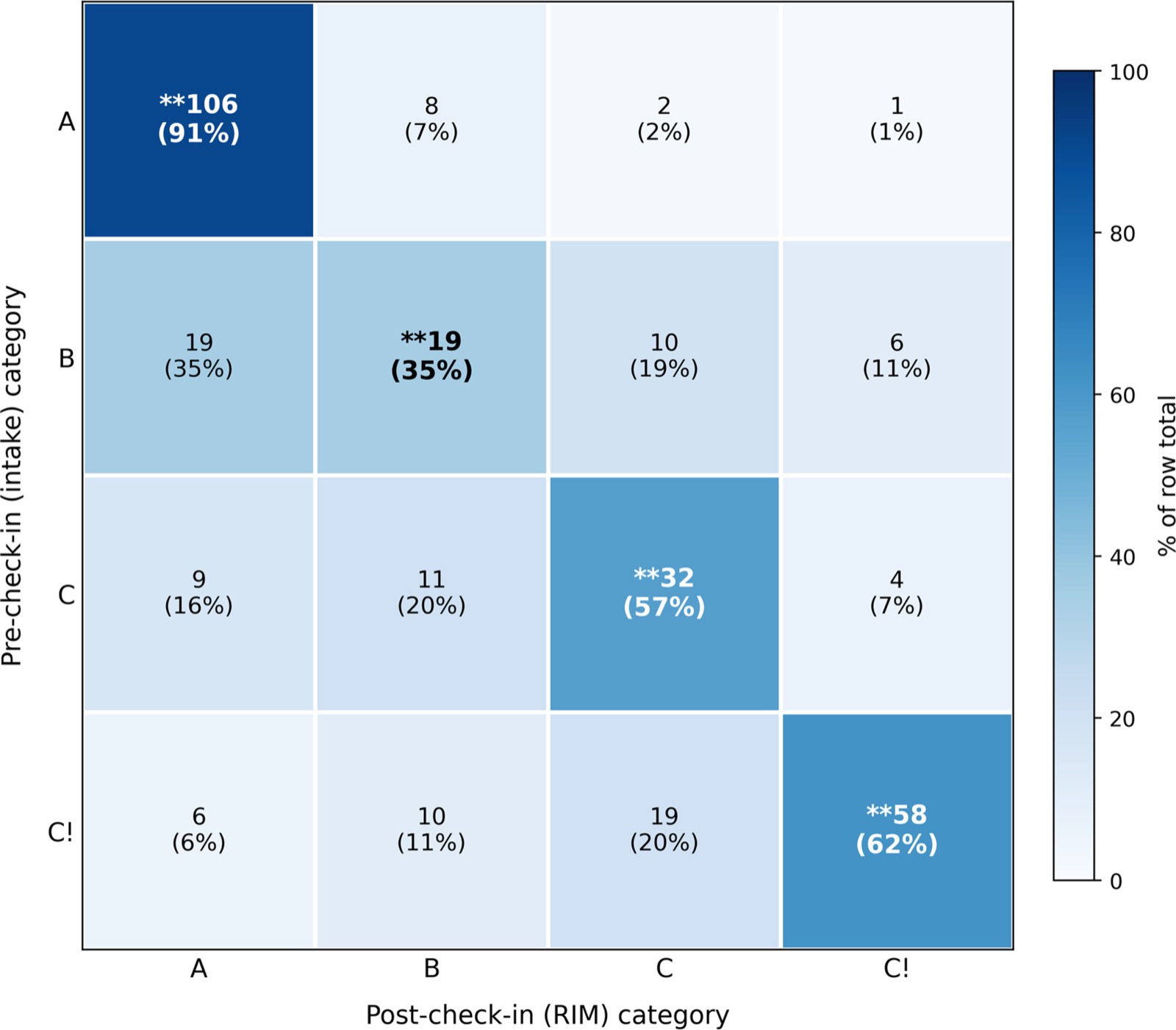
We then examined the distribution of re-categorizations within the RIM period. Out of 322 mediation cases, 67.3% (n = 217) assessments remained unchanged following the check-in, 23.2% (n = 74) were re-categorized as lower risk, and 9.5% (n = 31) as higher risk. A chi-square test confirmed a statistically significant overall shift (χ2(2) = 9.96, p = 0.0069; Cramér's V = 0.161), with estimated power of 1.0.
Figure 3 presents a transition matrix for all 322 mediation cases, illustrating how cases moved between intake and post-check-in risk categories. Rows represent the initial risk category at intake (A, B, C, C!), columns represent the post-check-in category, diagonal values (e.g., A → A) indicate unchanged assessments, and off-diagonal values reflect re-categorization, either upward or downward. Six cases initially assessed as high-risk (C!) were reclassified as low-risk (A), suggesting either overestimation during intake or underreporting at check-in. Only one case was re-categorized from A to C!, indicating that the protocol did not produce extreme upward shifts from low to high risk.
4.1.3 Re-Categorization by Mediation Type: B+ Cases
A supplementary analysis restricted to B-category and above cases (B+, n = 202 in the RIM period) examined whether re-categorization patterns differed by mediation type. Among separation and divorce B+ cases, 49.5% were re-categorized downward following the check-in, compared with 26.8% among parental dispute B+ cases, a statistically significant difference (χ2 = 11.9, p = 0.003). Upward re-categorization was comparable across types (separation and divorce: 11.0%; parental dispute: 9.3%). When parental dispute B+ cases were compared directly with the MAU B+ reference population (n = 967), no significant difference was found (χ2 = 0.7, p = 0.695), indicating that the parental dispute recategorization profile closely matched clinical judgment without the structured check-in. The same comparison for separation and divorce B+ cases yielded a highly significant difference (χ2 = 37.8, p < 0.001). These patterns suggest that the aggregate RIM effect is driven primarily by separation and divorce cases. Beyond mediation type, a second question concerns what it is about individual dyads that predicts upward re-categorization.
4.1.4 Dyadic Asymmetry as a Predictor of Risk Re-Categorization
To explore relational dynamics underlying risk assessment, we examined whether dyadic asymmetry, defined as divergent responses between parents on either of the two check-in questions, predicted upward re-categorization following the RIM protocol. In a simple logistic regression model (Table 3), dyadic asymmetry significantly predicted increased risk categorization (B = 0.987, SE = 0.407, z = 2.426, p = 0.015), with an odds ratio of 2.68. A multivariate model yielded a stronger effect (B = 1.356, SE = 0.387, z = 3.50, p < 0.001; OR = 3.88), indicating that dyads with asymmetrical disclosures were nearly four times more likely to be reclassified upward.
Table 3 — Logistic regression: asymmetry as predictor of upward re-categorization.
- Model: Simple model; B: 0.987; SE: 0.407; z: 2.426; p: 0.015; OR: 2.68; 95% CI: [1.21–5.93]
- Model: Multivariate model; B: 1.356; SE: 0.387; z: 3.50; p: < 0.001; OR: 3.88; 95% CI: [1.82–8.30]
Note: Logistic regression with upward risk re-categorization as outcome (0 = no, 1 = yes).
Tables 3 and 4 present two components of the same dyadic analysis and are numbered accordingly. A stratified analysis (Table 4) grouped dyads into low (0–1), medium (2–3), and high (4+) risk categories based on a composite of 10 risk indicators. Asymmetry had a significant effect only in low-risk dyads (OR = 7.21, p < 0.001), highlighting the check-in's role in revealing hidden concerns when initial risk appears low. When individual risk indicators (e.g., fear of ex-partner, insecurity in the mediation setting, nonviolent insecurity) were tested separately in multivariate models, none reached statistical significance. It is the discrepancy between parents, not any single risk factor, that prompts concern.
Table 4 — Stratified logistic regression by RIM check-in risk level.
- Risk group: Low (0–1); n (dyads): 142; OR: 7.21; 95% CI: [2.89–18.0]; p: < 0.001
- Risk group: Medium (2–3); n (dyads): 104; OR: 1.43; 95% CI: [0.57–3.59]; p: 0.446
- Risk group: High (4+); n (dyads): 76; OR: 1.12; 95% CI: [0.38–3.28]; p: 0.836
Note: Logistic regression stratified by composite risk level based on 10 risk indicators from the RIM check-in. Abbreviation: OR, odds ratio.
4.1.5 Gendered Patterns in Risk Reporting
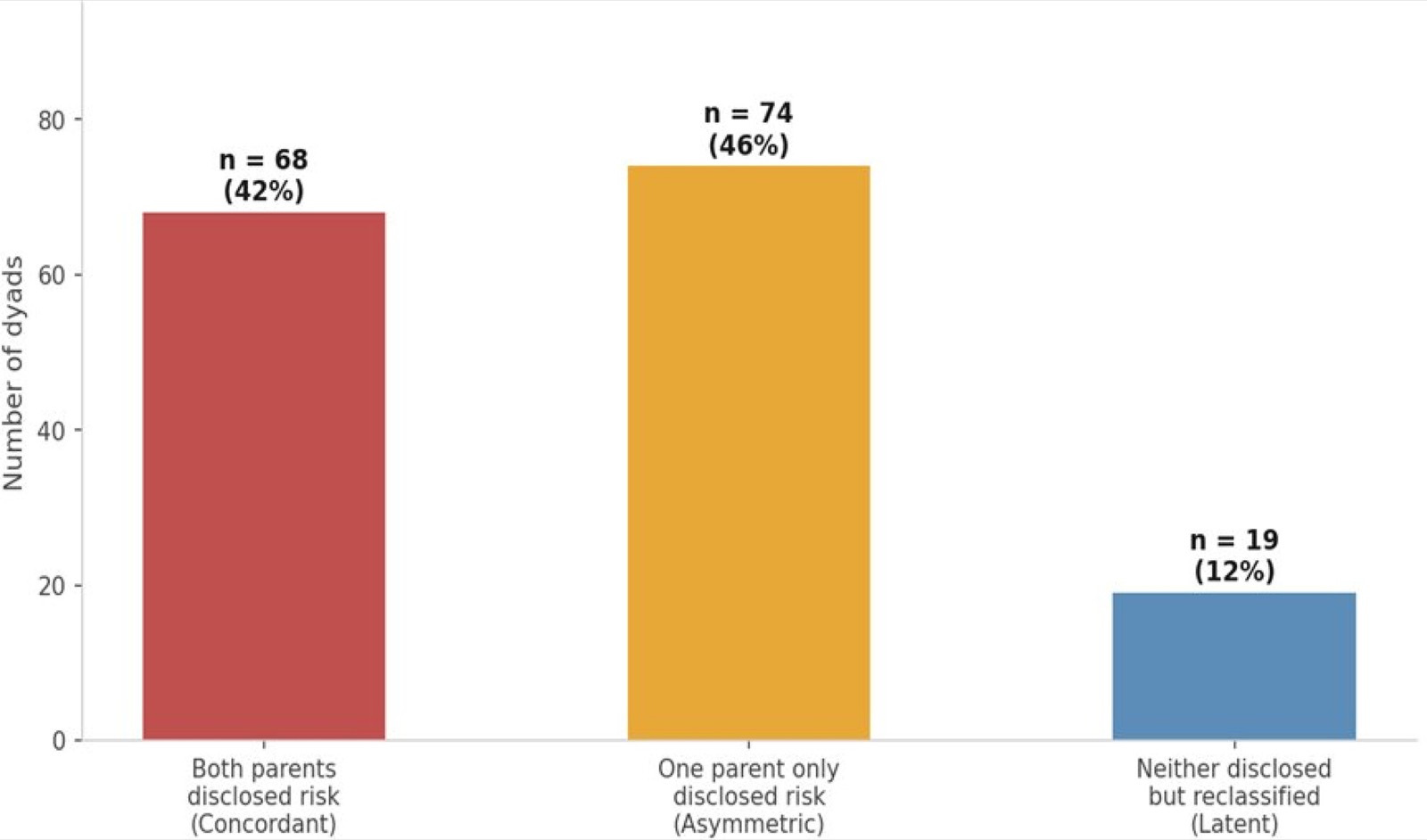
To explore how discomfort and insecurity were reported within dyads, we analyzed risk indicators at the dyadic level. Among the 93 dyads in which at least one parent reported risk, three configurations were identified: both parents reported at least one risk factor; only the mother reported risk; only the father reported risk.
Figure 4 illustrates the distribution of symmetric and asymmetric disclosure across each risk indicator, distinguishing cases where both parents, neither parent, or only one parent disclosed that indicator. Discomfort indicators were more frequently reported symmetrically, suggesting shared emotional unease. Unsafety indicators, including partner violence, threats, and substance use, were predominantly reported asymmetrically, pointing to divergent experiences within the same dyad. Among asymmetric cases, mothers more frequently disclosed prior partner violence and care-related mistrust; fathers more often expressed nonviolent insecurity and concerns about the ex-partner's mental health.
The overall proportion reporting at least one risk indicator was similar across genders (19.8% of mothers and 21.8% of fathers), suggesting that both parents report risk at comparable rates but with qualitatively different content. The quantitative strand establishes what the check-in changes; the qualitative strand, drawn from Office 2, addresses how mediators experienced and made sense of those changes.
4.2 Qualitative Findings
Three themes were developed from focus group interviews at Office 2, exploring how the check-in shaped the mediator role. The first, A Door-Opener to the Unspoken, describes how mediators experienced the check-in as creating a moment in which parents could name concerns that intake procedures had not reached, characterized by emotional depth and a sense of individual recognition. The second, Holding Space Without Taking Over, captures the tension between that emotional depth and the nontherapeutic frame of mediation. The third, Balancing Structure and Sensitivity, reflects mediators' practical negotiations between standardized procedure and professional discretion, including challenges with terminology and interpreters. A forthcoming article will present qualitative material from all three focus group interviews.
The three themes reflect the three quantitative patterns. The 9.5% of cases re-categorized upward corresponds to what mediators described in Theme 1, A Door-Opener to the Unspoken: something was revealed that the intake procedure had not reached. The 67.3% of unchanged assessments maps to Theme 2, Holding Space Without Taking Over: the check-in confirmed a safe starting point rather than revealing new concern. The 23.2% of cases re-categorized downward maps to what mediators described as Balancing Structure and Sensitivity: the check-in sometimes confirmed that an intake category reflected precautionary scoring under conditions of uncertainty rather than confirmed risk, and direct conversation with a clinician reduced rather than amplified concern. Together, the quantitative and qualitative strands suggest that the protocol's significance lies not only in the cases it reclassifies, but in the relational conditions it creates: a structured moment in which each parent's account is formed independently, before either has heard the other's version.
5 Discussion
The central finding of this study is that a brief, individually administered risk check-in can reveal concerns that standard intake procedures do not reach, not primarily by reclassifying cases, but by creating a relational moment in which parents can say what they could not, or would not, say in a telephone interview or a joint session. The check-in was, in the mediators' experience, a relational intervention grafted onto an administrative procedure.
5.1 Recalibration or Concealment? Interpreting Downward Re-Categorization
The predominance of downward movement from the intake category to the mediator's post-check-in assessment in the RIM period requires interpretation. Downward movement can reflect four processes: overestimation at intake, where the scoring rule inflates estimates for unsure responses (Dittman et al. 2021); clarification of genuine ambiguity; suppression in the face-to-face encounter; or a containing effect of service contact, where entry into a clinical encounter may itself reduce experienced unsafety. Spangaro et al. (2009) argue that screening itself constitutes an intervention: being asked directly may alter how a parent understands their own situation, which supports the interpretation that unchanged categories are not passive outcomes.
Two structural features of the intake tool help explain the predominance of downward movement. The scoring rule treats an unsure response to the violence and substance use question as equivalent to confirmed risk. A parallel mechanism at B automatically upgrades A-range scores when only one parent has responded (Dittman et al. 2021). Both rules err on the side of caution but produce inflated baselines. The downward pattern is consistent with the protocol confirming genuine low-risk levels that precautionary intake scoring had obscured, particularly in separation and divorce cases where single-respondent upgrades are more common.
At the same time, underreporting at telephone intake is well documented (Dittman et al. 2021), and a structured check-in with a trusted clinician may reveal what the telephone interview did not. The present data cannot separate correction of inflated intake scores from genuine disclosure of suppressed risk, but both processes would produce the pattern of predominantly downward re-categorization observed. The first interpretation—overestimation at intake through the precautionary scoring rules—and the second—clarification of genuine ambiguity—both suggest the protocol is functioning as intended by correcting inflated baselines. The fourth—the containing effect of service contact—is also consistent with intended functioning. The third interpretation—suppression in the face-to-face encounter—cannot be resolved by the present data, as suppression would produce the same observable pattern as correction. Whether the check-in reveals or conceals depends partly on what it asks, and that is the first of three structural dilemmas the findings bring into view.
5.2 Dilemma 1: Scope, Not Too Narrow and Not Too Broad
The check-in protocol faces a scope dilemma that has no clean resolution. If it asks only two broad experiential questions, it identifies that something is present without identifying what, leaving the mediator with signal but not substance. If it extends to behaviorally specific questions about violence, threats, and the child's situation, it risks exceeding the relational conditions that make disclosure possible in the first place, and moves the mediator toward a clinical assessment role the mediation mandate does not support. The RIM check-in asks two questions and follows up when scores exceed five. It does not ask about violence, substance misuse, or the child. What it does is open a space in which parents can raise any of those things, and the qualitative findings show that they do: disclosures covered fear of the other parent's behavior, worry about the child's situation, and parenting capacity, with mothers more likely to raise prior violence and fathers more likely to raise nonviolent insecurity. The FL-DOORS rests on a similar premise: that broad, nondirective questions can yield disclosures that targeted questions suppress (Booth et al. 2023). The cost of this approach is diagnostic imprecision. The protocol signals that something is present without identifying what it is or who is responsible. Jaffe et al. (2008) argue that screening must go further, differentiating the potency, pattern, and primary perpetrator of violence. RIM does not make that differentiation. It creates the opening; further clinical assessment must follow. This scope reflects the purpose of mediation. Katz (2007) draws the contrast with therapy: feelings are acknowledged but not worked through, and the goal is agreement rather than psychological change. Where violence is a factor, therapy involves safety planning and ongoing assessment of whether it is responsible to continue (Snellingen et al. 2024). Risk identification in mediation is not oriented toward such intervention: its purpose is to establish whether safe and equal participation is possible (Wing 2009). What RIM does not address is the information that enters the first session before the check-in begins: the intake category whose source the mediator cannot know.
5.3 Dilemma 2: Neutrality, Asymmetry, and the Child's Best Interests
The neutrality dilemma begins before the first session. When parents arrive, the mediator already holds a risk category derived from a telephone interview conducted by an administrative staff member. A case classified as C! signals that something serious has been reported, but carries no indication of who reported it or whether the other parent is aware. Data protection law means individual disclosures cannot be passed on: the aggregate category can be shared with the mediator; the source behind it cannot. This asymmetry is an unintended structural consequence of applying data protection rules to an administrative intake process not designed with this information flow in mind: the individual disclosure is classified as sensitive personal data and cannot be passed beyond the administrative function that received it, including to the clinician who will subsequently work with the family. The mediator therefore enters the joint session knowing that risk is present without knowing its shape, its direction, or whether both parents are aware that it has been named.
The check-in enters this gap. It does not resolve the information problem, but it gives it a shape. By speaking with each parent individually, the mediator now knows not only that risk is present but something of whose experience it reflects. The findings show this matters clinically: no individual risk indicator predicted upward re-categorization on its own, but dyadic asymmetry did, with an odds ratio of 3.88, rising to 7.21 in low-risk dyads. This finding extends the screening literature, which has predominantly modelled risk as an individual property (Beck et al. 2013; Booth et al. 2023; Jaffe et al. 2008). Where Jaffe et al. (2001) argued that risk remains invisible unless someone asks, the present finding suggests it also remains invisible unless both parents are asked separately and their responses compared. The check-in also opens a limited action space. Where concern is disclosed, the mediator can adjust how the joint session is introduced, consider whether further individual conversations are needed later in the process, or activate statutory reporting duties if the threshold is met. The protocol does not prescribe these responses, but it creates the conditions under which they become possible.
But acting on what has been disclosed is not straightforward. Mediation rests on an assumption of procedural equality, but Wing (2009) argues that reliance on neutrality and self-determination masks how mediation can reproduce structural inequality between parties. Where one parent is afraid of the other's reaction, the precondition for genuine dialogue is not met, regardless of how evenly the mediator distributes speaking time. The individual check-in ensures that each parent's account is formed independently, before either has heard the other's version.
The mediator who has conducted the check-in now holds asymmetric information: one parent may have disclosed fear or prior violence while the other has not. The mediator must lead a joint session from a position formally defined as neutral, while knowing the two parents do not enter the room on equal terms, using information without breaching confidentiality, shaping the session without exposing the disclosing parent, and holding an ethical obligation toward the child that neither question addresses directly. The check-in asks about each parent's discomfort and unsafety, but not what the child experiences in the household where the fear originates (Eikrem and Andenæs 2025). Mediators have a statutory duty under the Family Counseling Act (section 10) to act when there is reason to believe a child is at risk, yet the protocol that reveals that risk provides no structured pathway for acting on it within the first session. The asymmetry revealed by the check-in extends beyond the dyad: it is also an asymmetry between what is known and what can be done. The principles of neutrality, power-balancing, and the child's best interests are simultaneously in play in every mediation, and the check-in brings all three into conflict at once.
The check-in thus creates both a dilemma and a resource: it gives the mediator something to work with that the intake procedure did not, while placing the mediator in a position that the mediation mandate cannot fully support. How well the mediator can hold that position depends both on the conditions under which the protocol is practiced and on the individual mediator's level of skill, confidence, and experience with the questions in use, which is the third dilemma.
5.4 Dilemma 3: Intensity, Not Too Demanding and Not Too Minimal
A protocol that is too demanding exceeds the conditions of everyday practice and is abandoned; one that is too minimal produces no recalibration and adds nothing to what mediators already do. The office-level variation in this study maps directly onto that tension. Four of the seven offices showed significant shifts in risk categorization, while three did not. Office 7, which took part in the prepilot, showed the strongest effect and had the highest number of RIM cases relative to office size, suggesting that accumulated practice with the protocol amplifies its impact. The absence of a significant effect at some offices may reflect a different dynamic: offices where mediators already identify risk consistently at intake may show little movement with RIM precisely because the protocol adds less to what good practice already captures. A further source of variation is the type composition of each office's caseload. Because the re-categorization effect is concentrated in separation and divorce B+ cases, offices with a higher proportion of parental dispute cases would be expected to show smaller aggregate effects, irrespective of implementation quality. This structural factor is not controlled for in the office-level analysis and should be considered in future comparative work. Screening tools are routinely abandoned when they exceed the conditions of everyday practice (Clemants and Gross 2007; Rossi et al. 2024; Sixsmith and Blakey 2025). RIM addresses this through brevity, but brevity does not eliminate interpretive demand. The prepilot at Office 7 documented a recurrent challenge: mediators found it difficult to distinguish between ubehag (discomfort) and utrygghet (unsafety), the two constructs that anchor the protocol. Discomfort with the mediation situation and fear of the other parent can present similarly, and hearing that difference, and responding to it clinically rather than procedurally, requires practice with the questions in use (Eikrem et al. 2023). This may explain why the strongest effect was observed at the office that had spent a full year developing the protocol iteratively: not simply because mediators used the check-in, but because they had learned to use it. This is consistent with Lee et al. (2021) 10-year retrospective on universal risk screening in an Australian mediation and counseling organisation, which similarly found that practitioner familiarity with screening process accumulated over time and influenced quality of risk identification.
This variation is also bound up with how RIM was developed. The protocol emerged from a bottom-up collaboration between mediators and researchers rather than psychometric item testing. A more formally validated tool might offer greater diagnostic precision, but the practice-oriented approach offers something different: tools that practitioners recognize as their own. The cost is reduced precision; the gain is actual use, and it is this tension between precision and feasibility that the three dilemmas, taken together, name.
What holds the three dilemmas together is a structural feature of the check-in that none of them resolves: speaking with each parent individually makes visible what joint sessions suppress. Mothers and fathers disclosed risk at comparable rates but with qualitatively different content, and the gap between their accounts, the dyadic asymmetry, was the only consistent predictor of upward re-categorization. The check-in does not eliminate that inequality; it names it. Office 2 allows the two strands of evidence to be read together directly, and the joint display below shows concretely what that looks like in practice.
5.4.1 Mixed Methods Integration
Table 5 presents a joint display integrating quantitative and qualitative findings from Office 2, where both strands were collected. All quantitative figures refer to Office 2 cases (n = 66).
Table 5 — Joint display integrating quantitative and qualitative findings from Office 2.
- Quantitative findings (Office 2): 12% of cases re-categorized higher risk; Qualitative themes: A door-opener to the unspoken; Interpretation: Mediators described the check-in as creating a moment in which parents could name concerns they had not raised before, particularly around fear of the other parent and the child’s situation
- Quantitative findings (Office 2): 21% of cases re-categorized lower risk; Qualitative themes: Balancing structure and sensitivity; Interpretation: Mediators noted that the check-in sometimes revealed that an intake category was based on uncertainty rather than confirmed risk, and that direct conversation reduced rather than amplified concern
- Quantitative findings (Office 2): 67% of cases remained unchanged; Qualitative themes: Holding space without taking over; Interpretation: Mediators reported that unchanged categories were not inert: the check-in confirmed a safe starting point and shaped how the joint session was introduced
Note: All quantitative figures are from Office 2 (n = 66). Qualitative themes are drawn from focus group data at the same site.
Taken together, the two strands support a conclusion neither could reach alone: the check-in functions not as a classification instrument but as a relational opening. The 67% of unchanged cases were not passive: mediators described confirmation of a safe starting point as itself clinically meaningful.
6 Limitations
The design is naturalistic, with no control over confounding factors and no systematic assessment of implementation fidelity. The intake tool against which RIM is compared has not been psychometrically validated, and observed recategorization reflects the combined effect of RIM and the properties of that tool, which cannot be disentangled. The dataset does not record whether one or both parents responded at intake, limiting interpretation of B-category patterns specifically. The MAU and RIM periods reflect different assessment logics and time points, which limits direct comparison. Generalisability is bounded by the Norwegian context of mandatory, universal mediation, which differs structurally from jurisdictions where mediation is sought only in disputed cases. Interview order was not standardized, separation initiation was not recorded, and mediator-level variation was not controlled for. The RIM check-in is administered once, at the start of the first session; the number of sessions per family varies by category, and a single assessment point cannot capture how disclosure readiness and perceived risk may shift across a longer mediation trajectory.
7 Conclusion and Implications
This study evaluated a brief risk-informed check-in in Norwegian family mediation. Effects vary across offices and the protocol's scope is constrained by existing regulations. This article reports the first phase of a three-part practice-oriented research program. The protocol is already being scaled to additional offices, and the present findings are feeding directly into that development work. These implications rest on the central pattern: the check-in opened a space for disclosure rather than classifying risk, dyadic asymmetry was the only consistent predictor of upward re-categorisation, and mediators described it as a door-opener whose unchanged outcomes confirmed a safe starting point.
The findings indicate that RIM primarily enables inquiry. It opens a space for disclosure rather than directly classifying risk. It is positioned as a supplement to existing intake procedures, not a replacement for them, and the two are complementary rather than one compensating for the other. Risk-informed inquiry reflects a clinical orientation that holds attention to relational risk alongside the`mediator's broader responsibilities, navigating the child's best interests, neutrality and power balance (Stokkebekk 2024). Screening and risk-informed inquiry may serve overlapping but distinct disclosure motivations. Some parents disclose more readily at a distance, where anonymity lowers the threshold; others disclose only once a clinical relationship and a sense of trust have been established. These are competing accounts of what supports disclosure, and the present study does not test them directly.
Within RIM, the two experiential questions function as a primer rather than a complete assessment. They lower the threshold for disclosure, establish the legitimacy of the topic, and create the relational conditions in which parents can articulate concerns at the check-in. A structured extension, summarized in Table 6, would follow a different logic. Where the experiential questions ask how the parent feels, behaviorally specific questions ask what has happened. Rossi et al. (2022, 2024) demonstrate that this distinction matters clinically: general distress questions and behavior-specific questions tap different dimensions of risk and complement rather than substitute for each other. An extended protocol would therefore preserve Q1 and Q2 as the relational entry point and add behaviorally specific questions conditionally, only when scores above 5 signal that something is present. The three domains where under-reporting is most common in the Norwegian intake data are fear of the other parent's reaction, threats and violence, and concern for the child's situation. Whether they can be administered within 5 min without disrupting relational quality is an empirical question the development project is positioned to address. Extending the protocol raises practical questions about follow-up and system readiness: where violence is identified, the service system must be equipped to respond.
Table 6 — Proposed extended RIM check-in protocol: five-question structure.
- Q: 1; Dimension: Discomfort in the mediation situation (ubehag); Format: 0–10 scale; if above 5, open follow-up; Rationale: Broad experiential entry point; normalizes the conversation; score above 5 triggers follow-up and informs whether Q3–5 are administered
- Q: 2; Dimension: Unsafety in speaking freely and being in the same room as the other parent (utrygghet); Format: 0–10 scale; if above 5, open follow-up; Rationale: Narrows from general situational discomfort to felt unsafety with the other parent; score above 5 triggers follow-up; together with Q1 determines whether Q3–5 are administered
- Q: 3; Dimension: Fear of the other parent's reaction after today's session; Format: 0–10 scale or Yes/No + open follow-up; Rationale: Bridges the in-session experience and postseparation risk; taps coercive control and fear of consequences outside the mediation room (Rossi et al. 2024)
- Q: 4; Dimension: Experience of partner violence or threats from the other parent; Format: Yes/No + open follow-up; Rationale: Behaviorally specific; increases identification of IPV that experiential questions may not detect (Dittman et al. 2021; Rossi et al. 2022)
- Q: 5; Dimension: Serious concern for the child's safety or care situation with the other parent; Format: Yes/No + open follow-up; Rationale: Targets the child's situation directly; activates statutory reporting duty (Family Counseling Act, s. 10)
Note: Questions 1 and 2 constitute the current RIM protocol. Questions 3–5 represent a proposed extension. Q1 and Q2 are experiential questions that lower the threshold for disclosure; scores above 5 on either question trigger the open follow-up and determine whether Q3–5 are administered. The behaviorally specific questions are conditional on the experiential layer, not routine for all parents.
Several aspects of the present findings extend beyond what the project can directly address. RIM is not a screening instrument and cannot be evaluated as one; it is an inquiry tool that opens a clinical conversation. As the Limitations note, the Norwegian intake instrument has not been psychometrically validated, and the present findings should be read in that context. Returning to the screening-inquiry continuum in Figure 1, the findings suggest that the intake and the inquiry functions may need to be considered together. RIM adds the inquiry functions the system has lacked. It does not address the screening function. A second and third article will address cross-case qualitative synthesis and full mixed methods integration.
The dilemmas of scope, neutrality, and intensity set out in the discussion are not failures of the protocol. They are structural features of the mediator role that the check-in makes visible precisely because it works.
8 Epilogue
Discomfort and unsafety are not simply emotional states. They are signals with relational, legal, and ethical implications. The RIM protocol offers a structured way for practitioners to hear those signals, but acting on them requires institutional conditions that tools alone cannot provide. Better mediation practice begins with a willingness to ask the difficult question and to take the answer seriously.
Complexe Systémique: key points
The interest of this Norwegian study is to shift the screening question: instead of one more questionnaire, a simple relational gesture, seeing each parent alone for five minutes before the joint session and asking how uncomfortable or unsafe it feels to be in the same room as the other. The most telling result for a systemic reading is that risk shows up in the relationship rather than in the individual: no single indicator predicts re-categorization, but the gap between the two accounts does, especially when everything seemed calm. Mothers more often speak of past violence, fathers of a different kind of insecurity. The article also has the merit of naming what the tool lays bare: a mediator who now knows something they can neither share nor address, between neutrality, power balance and the best interests of a child whose voice nobody gathers directly. The limits are real: a naturalistic design, an unvalidated intake tool, effects that vary widely from one office to another. Read alongside the study on the place of the child in the Norwegian family protection service, and the study on couple therapists’ decisions when violence becomes the issue.
Notes from the original
1 The eight questions, with response options and scores, are as follows. (1) Legal basis for mediation: Marriage Act (0 points); cohabiting at separation (0 points); Children Act (100 points); Children Act—returned from court (0 points). (2) Disagreements about residence, contact and parental responsibility: Yes (50 points); Sometimes (25 points); No (0 points). (3) Co-parenting conflict at present: Yes (50 points); Sometimes (25 points); No (0 points). (4) Duration of difficulties: Under 6 months (0 points); Over 6 months (50 points). (5) Trust in the other parent as caregiver: Yes (0 points); Somewhat (25 points); No (50 points). (6) Prior court proceedings regarding child arrangements: Yes (100 points); No (0 points). (7) Problems related to substance use or violence: Yes (1000 points); Unsure (500 points); No (0 points). (8) If yes—is the problem acknowledged and taken into account in planning residence and contact?: Acknowledged and addressed (−500 points); Acknowledged but not addressed (0 points); Not acknowledged (0 points). Category thresholds: ≥ 500 points = C! (risk case); ≥200 points = C; ≥ 75 points = B; < 75 points = A. The disproportionate weight at item 7 is a deliberate design feature, not a scaling error: because items 1–6 yield a combined maximum of 400 points, the 1000-point value ensures that any confirmed disclosure of violence or substance use automatically exceeds the C! threshold regardless of all other responses. An “unsure” response (500 points) reaches the C! threshold by itself, reflecting the tool's intentionally oversensitive design as a resource allocation instrument whose purpose is to capture possible risk rather than to confirm it (Dittman et al. 2021).
Acknowledgments. The authors are grateful to Gøril Westborg Smiseth, leader of Homansbyen Counselling Office, and Kirsti Dybvik, leader of Christiania Family Counselling Office, for the collaboration through which the RIM check-in protocol and practice were developed during the pre-pilot phase. We also thank the mediators and leaders of the seven offices who participated in the pilot study reported here. We are particularly grateful to Lena Holm Berndtsson, Head of Department at Bufetat Region East, for her tireless commitment to the Norwegian Family Counselling Service and for her support of this work. Former Director Mari Trommald deserves special acknowledgement for her conviction that research and professional development by and for those working in the service are both a precondition for good practice and a hallmark of good governance.
Funding. The authors have nothing to report.
Ethics statement. The study was approved by the Data Protection Officer at Bufetat as part of routine professional and service development. Under Norwegian research governance, studies conducted within statutory services without direct collection of sensitive client data are assessed by the institutional data protection officer; this constitutes the appropriate oversight mechanism under applicable Norwegian regulations. Mediators who participated in the focus group were informed about the study's purpose and that their contributions, including direct quotations, might be used in publications; participation was voluntary throughout.
Consent. The authors have nothing to report.
Conflicts of interest. The authors declare no conflicts of interest.
References
Barne-, ungdoms- og familiedirektoratet [Norwegian Directorate for Children, Youth and Family Affairs]. 2024. “Statistikk og Analyse: Familievernet [Statistics and Analysis: Family Counselling Services].” https://www.bufdir.no/statistikk-og-analyse/lss/hovedmal-3/.
Barneombudet [Norwegian Children's Ombudsman]. 2025. Høringsuttalelse: Forslag Til ny barnelov [Consultation response: Proposal for new Children Act]. Barneombudet. https://www.barneombudet.no/.
Beck, C. J. A., J. M. Menke, and A. J. Figueredo. 2013. “Validation of a Measure of Intimate Partner Abuse (Relationship Behavior Rating Scale-Revised) Using Item Response Theory Analysis.” Journal of Divorce & Remarriage 54, no. 1: 58–77. https://doi.org/10.1080/10502556.2012.743830.
Booth, A. T., B. J. Wright, H. Pearce, C. Ralfs, and J. E. McIntosh. 2023. “The Family Law Detection of Overall Risk Screen (FL-DOORS): Utility as a Repeated Measure for Assessing Change in Family Violence Risk Over Time.” Family Court Review 61, no. 2: 359–371. https://doi.org/10.1111/fcre.12714.
Braun, V., and V. Clarke. 2006. “Using Thematic Analysis in Psychology.” Qualitative Research in Psychology 3, no. 2: 77–101. https://doi.org/10.1191/1478088706qp063oa.
Braun, V., and V. Clarke. 2019. “Reflecting on Reflexive Thematic Analysis.” Qualitative Research in Sport, Exercise and Health 11, no. 4: 589–597. https://doi.org/10.1080/2159676x.2019.1628806.
Braun, V., and V. Clarke. 2024. “Reporting Guidelines for Qualitative Research: A Values-Based Approach.” Qualitative Research in Psychology 22: 1–40. https://doi.org/10.1080/14780887.2024.2382244.
Castonguay, L. G., and J. C. Muran. 2015. “Fostering Collaboration Between Researchers and Clinicians Through Building Practice-Oriented Research: An Introduction.” Psychotherapy Research 25, no. 1: 1–5. https://doi.org/10.1080/10503307.2014.966348.
Clemants, E., and A. Gross. 2007. “Why Aren't We Screening? A Survey Examining Domestic Violence Screening Procedures and Training Protocol in Community Mediation Centers.” Conflict Resolution Quarterly 24, no. 4: 413–431. https://doi.org/10.1002/crq.182.
Creswell, J. W., and V. L. P. Clark. 2017. Designing and Conducting Mixed Methods Research. 3rd ed. SAGE Publications.
Dittman, S., L. Larsen, and T. Holt. 2021. “Foreldre Underrapporterer om Konflikter og Utfordringer i Forkant av Mekling [Parents Underreport Conflict and Difficulties Prior to Mediation].” Tidsskrift for Norsk Psykologforening 58, no. 9: 766–775. https://doi.org/10.52734/3WfR437s.
Eikrem, T., and A. Andenæs. 2025. “Doing Divorce—Children's Agency and Meaning Making When Experiencing Divorce.” Child & Family Social Work. https://doi.org/10.1111/cfs.13282.
Eikrem, T., I. Huglen, G. Hægland, T. Nordvik, and J. Stokkebekk. 2023. Risikoinformert Mekling: Sluttrapport Fra Pre-Piloten Ved Homansbyen og Christiania Familievernkontor [Risk-Informed Mediation: Final Report From the Pre-Pilot at Homansbyen and Christiania Family Counselling Offices]. Barne-, Ungdoms- og Familieetaten, Spisskompetansemiljøet for Vold og Høykonflikt.
Ellis, D., and N. Stuckless. 2006. “Domestic Violence, DOVE, and Divorce Mediation.” Family Court Review 44, no. 4: 658–671. https://doi.org/10.1111/j.1744-1617.2006.00117.x.
Jaffe, P. G., J. R. Johnston, C. V. Crooks, and N. Bala. 2008. “Custody Disputes Involving Allegations of Domestic Violence: Toward a Differentiated Approach to Parenting Plans.” Family Court Review 46, no. 3: 500–522. https://doi.org/10.1111/j.1744-1617.2008.00216.x.
Jaffe, P. G., S. E. Poisson, and A. Cunningham. 2001. “ Domestic Violence and High-Conflict Divorce: Developing a New Generation of Research for Children.” In Domestic Violence in the Lives of Children: The Future of Research, Intervention, and Social Policy, edited by S. A. Graham-Bermann and J. L. Edleson, 189–202. American Psychological Association.
Katz, E. 2007. “A Family Therapy Perspective on Mediation.” Family Process 46, no. 1: 93–107. https://doi.org/10.1111/j.1545-5300.2006.00194.x.
Lee, J., C. Ralfs, A. Booth, and J. E. McIntosh. 2021. “Practicing Best Practice: A 10-Year Retrospective on Universal Risk Screening in a Mediation and Counseling Organization.” Family Court Review 59, no. 4: 697–709. https://doi.org/10.1111/fcre.12603.
Molden, T. H., G. Ulset, and M. Røe. 2019. Kvalitet i Familievernet: Ansattes Vurderinger av Betingelser for et Faglig Godt Tjenestetilbud [Quality in Family Counselling Services: Staff Assessments of Conditions for High-Quality Practice] [ISBN 978-82-7570-589-9]. NOVA.
Norsk Psykologforening [Norwegian Psychological Association]. 2024. “Høringssvar: Forslag Til ny barnelov [Consultation response: Proposal for New Children Act].” https://www.psykologforeningen.no/.
Rossi, F. S., A. G. Applegate, C. J. Beck, C. Timko, and A. Holtzworth-Munroe. 2022. “Screening for Intimate Partner Violence in Family Mediation: An Examination of Multiple Methodological Approaches Using Item Response Theory.” Assessment 29, no. 8: 1641–1657. https://doi.org/10.1177/10731911211022843.
Rossi, F. S., A. G. Applegate, C. Tomlinson, and A. Holtzworth-Munroe. 2024. “Intimate Partner Violence Screening for Separating or Divorcing Parents: An Introduction to the Mediator's Assessment of Safety Issues and Concerns-Short (MASIC-S).” Family Court Review 62, no. 1: 15–30. https://doi.org/10.1111/fcre.12762.
Rothman, J. 2014. “The Reflexive Mediator.” Negotiation Journal 30, no. 4: 441–453. https://doi.org/10.1111/nejo.12070.
Seeberg, M. L., and D. Bossy. 2024. «Dråpe for Dråpe, Stein for Stein»: Familievernets Voldsarbeid i Endring [“Drop by Drop, Stone by Stone”: Changes in Family Counselling Services' Work on Violence] [Report]. NOVA/OsloMet.
Sixsmith, A., and R. Blakey. 2025. “Family Mediation and Domestic Abuse: Lessons From Australia.” Journal of Social Welfare and Family Law 47, no. 2–3: 213–235. https://doi.org/10.1080/09649069.2025.2530883.
Smyth, B. M., and L. J. Moloney. 2019. “Post-Separation Parenting Disputes and the Many Faces of High Conflict: Theory and Research.” Australian and New Zealand Journal of Family Therapy 40, no. 1: 74–84. https://doi.org/10.1002/anzf.1346.
Snellingen, J. F., P. E. Carlin, and A. Vetere. 2024. “Is It Safe Enough? An IPA Study of How Couple Therapists Make Sense of Their Decision to Either Stop or Continue With Couple Therapy When Violence Becomes the Issue.” Behavioural Sciences 14, no. 1: 37. https://doi.org/10.3390/bs14010037.
Spangaro, J., A. B. Zwi, and R. Poulos. 2009. “The Elusive Search for Definitive Evidence on Routine Screening for Intimate Partner Violence.” Trauma Violence Abuse 10, no. 1: 55–68. https://doi.org/10.1177/1524838008327261.
Spangaro, J. M., A. B. Zwi, and R. G. Poulos. 2011. ““Persist. Persist”: A Qualitative Study of Women's Decisions to Disclose and Their Perceptions of the Impact of Routine Screening for Intimate Partner Violence.” Psychology of Violence 1, no. 2: 150–162. https://doi.org/10.1037/a0023136.
Stine Sofies Stiftelse, N. K. V. T. S. Redd Barna, and Krisesentersekretariatet. 2025. “Brev Til Stortinget: Bekymring for ny Barnelov [Letter to Parliament: Concerns About New Children Act].” https://stinesofiesstiftelse.no/.
Stokkebekk, J. 2024. “ Meklingstriangelet: Et Meklerverktøy for å Bidra til Økt Refleksivitet i Møte Med Foreldrekonflikter og Motstridende Idealer i Skilsmissemekling [The Mediation Triangle: A Tool to Support Reflexivity in Work With Parental Conflict].” In Konflikt: Forståelse og Håndtering i Møte Med Familier [Conflict: Understanding and Management When Working With Families], edited by E. Syrstad and A. K. Flacké, 1st ed., 157–179. Fagbokforlaget.
Stortinget [Norwegian Parliament]. 2025a. “Prop. 117 L (2024–2025). Lov om Foreldreansvar og Samvær (Barnelova) [Act on Parental Responsibility and Contact (Children Act)].” https://www.stortinget.no/.
Stortinget [Norwegian Parliament]. 2025b. “Innst. 526 L (2024–2025). Innstilling Fra Familie- og Kulturkomiteen om lov om Foreldreansvar og Samvær (Barnelova) [Recommendation from the Standing Committee on Family and Cultural Affairs on the Act on Parental Responsibility and Contact (Children Act)].” https://www.stortinget.no/no/Saker-og-publikasjoner/Publikasjoner/Innstillinger/Stortinget/2024-2025/inns-202425-526l/.
S. Thoresen, and O. K. Hjemdal, eds. 2014. Vold og voldtekt i Norge: En nasjonal forekomststudie av vold i et livsløpsperspektiv [Violence and Rape in Norway: A National Prevalence Study of Violence in a Life Course Perspective] (Rapport 1/2014). Nasjonalt kunnskapssenter om vold og traumatisk stress.
Tjersland, O., W. Gulbrandsen, and H. Haavind. 2015. “Mandatory Mediation Outside the Court: A Process and Effect Study.” Conflict Resolution Quarterly 33, no. 1: 19–34. https://doi.org/10.1002/crq.21129.
Whittaker, K., J. Stokkebekk, L. Loras, and T. Tilden. 2023. “Researching What We Practice: The Paradigm of Systemic Family Research: Part 2.” Family Process 62, no. 3: 961–975. https://doi.org/10.1111/famp.12921.
Wing, L. 2009. “Mediation and Inequality Reconsidered: Bringing the Discussion to the Table.” Conflict Resolution Quarterly 26, no. 4: 383–406. https://doi.org/10.1002/crq.240.
Reformatted republication of “Efforts to Surface the Unspoken”: A Mixed Methods Study of a Risk-Informed Check-In in Norwegian Family Mediation, by Jan Stokkebekk, Trine Eikrem and Kristoffer Whittaker, Conflict Resolution Quarterly, advance online publication (2026), doi: 10.1002/crq.70043, under a CC BY 4.0 licence. Edition and layout: Complexe Systémique, September 2026 — the work has been modified under the terms of the licence (tables presented as lists). Neither the authors nor the publisher are responsible for this edition; the original version prevails.
This is the original article ““Efforts to Surface the Unspoken”: A Mixed Methods Study of a Risk-Informed Check-In in Norwegian Family Mediation”, published in Conflict Resolution Quarterly (2026) under a CC BY 4.0 licence. Republished by Complexe Systémique: the author’s text is unchanged; only the presentation has been adapted for reading online, as set out at the head of this page.
Read the original articleHow to cite this article
Stokkebekk, J., Eikrem, T., et Whittaker, K. (2026). “Efforts to Surface the Unspoken”: A Mixed Methods Study of a Risk-Informed Check-In in Norwegian Family Mediation. Complexe Systémique. https://app.complexe-systemique.com/en_GB/articles/efforts-to-surface-the-unspoken-a-mixed-methods-study-of-a-risk-informed-check (Original work published in 2026 in Conflict Resolution Quarterly (2026), publication en ligne anticipée; republished in 2026 by Conflict Resolution Quarterly, https://onlinelibrary.wiley.com/doi/full/10.1002/crq.70043)
To go further
- Où est l’enfant dans les services de thérapie familiale après des violences familiales ? Une étude du service norvégien de protection de la familleThe child in the Norwegian service.
- Est-ce suffisamment sûr ? Une étude IPA sur la manière dont les thérapeutes de couple donnent sens à leur décision d’arrêter ou de poursuivre la thérapie de couple quand la violence devient l’enjeuWhen violence becomes the issue.
- « L’autre qui dérange et moi » : récits parallèles de parents séparés en conflit prolongéTwo accounts of one separation.
Related articles
 Scientific
“One Can Have All Sorts of Good Intentions but Sometimes in Everyday Life, It Turns Out Differently”: Change Agreements in Couples' Everyday Lives
Six Danish couples followed after an online couple program: their change agreements become guilt-inducing contracts, shared understanding or revealers of inequality.
 Scientific
How can we BeST? meet the needs of adoptive families? Relevant findings from a major Randomised Controlled Trial of infants in foster care in the UK
The BeST? trial (488 infants in care in the UK) reread for adoption: holistic, ongoing assessment of children and a move to dual registration.
 Scientific
Internal Family Systems Therapy as Part of the ‘Family of Systemic Therapies’: A Critical Exploration of Systemic Practice in the Intra-Personal Domain
Does IFS belong to the family of systemic therapies? A critical exploration, grounded in a family court vignette, of systemic work with “parts”.
 Scientific
The Role of Parental Expressed Emotion and Loss-Specific Parental Responses in Children’s Loss-Related Outcomes Following Traumatic Loss: A Mixed-Methods Observational Study
After a road-traffic bereavement, parental criticism goes with the child's depression, positive appraisals of the loss with better well-being.