AI-assisted translation
This version was translated from Portuguese by Complexe Systémique with the help of artificial intelligence. In case of doubt, the original version prevails.
Revista Brasileira de Terapia Familiar · Couple
From the child to the couple: redefinition as the matrix of change
When a child becomes the symptom, it is often the parental couple speaking through the child. Drawing on her specialization training at the Federal University of Rio Grande do Sul and on a clinical vignette, Giórgia Reis Saldanha revisits Andolfi, Haley and McGoldrick to show how redefining the problem shifts therapy from the “identified patient” to the couple, without attacking the scapegoat function too early.
Unofficial English translation. This article is a translation of Do Filho ao Casal: A Redefinição como Matriz da Mudança, by Giórgia Reis Saldanha, published in the Revista Brasileira de Terapia Familiar (ABRATEF), vol. 7, no. 1 (2018), doi: 10.60114/rbtf.v7i1.55, under a CC BY 4.0 licence. Translated by Complexe Systémique in November 2026 with the help of artificial intelligence: the original Brazilian Portuguese text has been translated into English and reformatted, which constitutes a modification of the work under the terms of the licence. Paragraphs and headings are those of the journal; the author’s biographical note, printed as a footnote on the first page, is included in the presentation; the Brazilian saying in the last part is kept in Portuguese, followed by a translation; passages quoted from Brazilian editions are translated from the Portuguese; a few obvious typographical errors have been corrected silently. The abstract is the author’s own English version. This translation was made neither by the authors nor by the journal, who are not responsible for its content or for any errors. The original version prevails.
No child can play the role of resolving the conflicts between the parents.
Giórgia Reis Saldanha
Abstract
This study aims to present the problematic of the conjugal conflicts that are denounced by the symptomatic behavior of a scapegoat – the small child, having as a guideline element the notion of redefinition of the therapeutic system for recognizing it as a promising strategy for changes. Through a bibliographical review, this paper discussed three sections that contemplate the couple’s constitution: the complex “toothbrushes encounter”; the scapegoat: the symptom that denounces a marital problem; and the redefinition as the matrix of change: the encounter with the couple. In fact, the role of the family therapist and the family will be presented, and together redefine the therapeutic system with a view to the resignification of the problems that block the family group development. It is understood that this comprehension is favorable to broaden the view of the members of the therapeutic system, promoting a more widespread, sensitive and effective practice.
Keywords: systemic therapy; identified patient; redefinition.
Introduction
The redefinition of the problem for which therapy was requested is the touchstone on which all therapeutic progress rests. It is the most creative aspect of therapy, and the one that allows the family to become the protagonist of its own change.
(Maurizio Andolfi)
This paper arises from the wish to problematize the many cases of marital conflict seen in clinical practice that are denounced by the symptomatic behaviour of a scapegoat – here the child –, taking as its guiding thread the notion of redefinition of the therapeutic system, which I recognize as a promising strategy for change, as well as my theoretical and practical experience as a student and systemic therapist in the specialization programme in Clinical Practice, with an emphasis on Systemic Couple and Family Therapy, at the Psychological Care Clinic of the Federal University of Rio Grande do Sul.
Throughout my time on the programme, there were recurring cases of parents whose words were marked by ideas such as: my child is not well, or my child has a problem and we don’t know what to do any more. Seeking psychological treatment for children has thus become very common today. Yet, most of the time, the symptom shown by the little ones is linked – directly – to their family’s dysfunctional mode of interaction. Marital conflict, for example, the central theme of this paper, is considered one of the main reasons why a child presents aggressive behaviour, learning difficulties, isolation, among other signs that reveal the suffering of the whole family unit.
Andolfi et al. (1989) point out that the family, through its request for therapy, will try to impose its own costume, describing it in detail and inviting the therapist to share its own frame of reference. The family – here the couple – will try to impose its own rules with the intention of drawing the therapist into its game. Consequently, forming a therapeutic system requires continuous redefinition or restructuring on the therapist’s part. However, this will only be possible if the therapist manages to change the meaning attributed to the symptomatic behaviour of the identified patient – the child. The therapist’s main objective is therefore to make clear that the presented symptom is directly linked to the level of the relationship, doing so in such a way that it becomes clear to everyone that the symptom works to maintain the family’s homeostasis and, often, to keep a bigger problem in the marital unit from coming to the surface.
The marital relationship has been identified as a major factor in families’ quality of life, particularly regarding the relationships that fathers and mothers have with their children. Marital adjustment, forms of communication and the conflict-resolution strategies used by the couple influence the development of patterns of childcare and the quality of the relationships between subsystems (Braz et al., 2005).
In this context, over the course of my clinical experience in the specialization programme, I came to see that forming a couple is one of the most complex phases of the life cycle, since the construction of conjugality runs head-on into the patterns that each partner brings from their history with their family of origin. The force of the transgenerational legacy of two families influences, directly or indirectly, the construction of a new system. The couple is the axis on which the functioning of the whole family unit depends, and relational balance is necessary for the family to have a healthy rhythm. Instead of balance, however, some families show tensions, rigidity or enmeshed bonds that prevent the system from moving, and it is in these families that the symptomatic child usually appears.
Mindful of cultural variability in definitions of the couple, and not much given to theorizations that make the capacity for understanding barren, I would like to make clear the perspective on the marital unit that I take as the starting point of this study. I am speaking of the relationship between a man and a woman with young children, with a view that overlays the structure of the life cycle and transgenerational conflicts at the points of transition from one stage to another in the family’s developmental process.
In view of the above, this paper is organized as follows. The first section, Couple Formation: The Complex Meeting of the Toothbrushes, is organized so as to present some of the problems of marriage, such as the difficulty of building a marital unit differentiated from the families of origin, and the consequences for the emergence of new functions. The second section, Scapegoat: The Symptom that Denounces a Marital Problem, deals with the most extreme expression of a dysfunctional family interaction through an identified patient, and aims to highlight the power linked to the function of a ‘scapegoat’. The third section, Redefinition as the Matrix of Change: The Encounter with the Couple, concerns the strategy that deconstructs the individual-centred problem and reaches the treatment of the marital subsystem through the resignification of the symptom. The fourth section offers the Final Considerations on the paper.
Couple formation: the complex “meeting of the toothbrushes”
The family life cycle is circular and repetitive, so we can tell a family’s story starting from any moment. We will begin with the formation of a new couple because, as Monica McGoldrick has said, “becoming a couple is one of the most complex and difficult tasks of the family life cycle” (p. 184, 2011).
The place of marriage in the life cycle has changed drastically over time. Overlaid on this global emotional backdrop are the changing role of women, personal development, intolerance of crises, the high divorce rate, the increasing mobility of our culture, among other factors that invite us to redefine, from time to time, the meaning of a union. Today, many people feel that marriage restricts individual freedom. Willi (1995) notes that “personal development is a highly valued cultural and therapeutic goal [...], but marriage, by definition, is not a free union; it is a commitment. It does not fit the modern image of personal fulfilment” (p. 38). Nevertheless, the aim of this section is to highlight the idea held by some young adults who see union with another person as the only way to gain autonomy, at the moment when they move away from the gaze of their parents or guardians. In reality, what happens to these people is a false idea of independence and only an apparent distancing from the relationship with the family of origin.
In the current context of social change, the living together of two complex individual systems requires negotiation. Marriage demands that two people rethink together a great many questions they had previously idealized for themselves in individual terms, and also that they reassess the expectations about the future that were predefined by their families of origin. According to McGoldrick (2011),
The couple must make decisions about holidays, and about how to use space, time and money. There are also decisions about which family traditions and rituals will be kept and which the partners will develop on their own. These decisions can no longer be made on a purely individual basis. The couple will also have to renegotiate relationships with parents, siblings, friends, extended family and colleagues in view of the new marriage (p. 185).
When two people decide to live together, each must be willing to reorient their individual purposes; only then can they form a healthy couple, with unity and diversity at the same time. Each has aspects in common with the other, and each is different from the other. “Difference is an inevitable consequence of human life, and we need to learn to welcome it as a gift, not as a call to war” (Satir, 1995, p. 36).
I often criticize the popular saying that idealizes the meeting of the two halves of an orange. On the contrary, I defend the idea that a couple should be formed by two whole oranges. In other words, a person will only enjoy a good relationship with someone else when they are ready to live alone. On this subject, Carter and McGoldrick (1995) add that, for individuals to be able to join with another and establish an intimate relationship between their I, the you and the we, it is essential that their identity already be formed, so that they can reconcile it with another person’s identity. The ideal scenario, therefore, is one in which the partners become independent of their family roots – even before the union with another person – while maintaining close and affectionate ties with them. Marriage will then serve for everyone to share and celebrate the change of status, not only of the new couple, but of all the members of the family.
There are different patterns of couple relationship, but they are not mutually exclusive and tend to overlap. What lies behind any marriage is the existence of two individuals who lack something. What they need can only be found in the other. Clinical experience has revealed the recurring complaint – not made explicit – that the partner does not fulfil the needs that the parents did not meet. I consider that this process can be traced back to an incomplete differentiation from the family of origin. In this vein, Satir (1995) stresses that “one of the therapeutic goals is to complete the separation from the parents and to build a truly new relationship, grounded in two individuals and not in reciprocal projections” (p. 36).
A couple relationship is not merely the sum of two personalities. It is more than that. It is the meeting of two distinct social units, of two families that shape each partner’s beliefs and expectations and influence, directly or indirectly, the relational pattern of the new system. Thus, one of the basic precepts for maintaining and sustaining a good relationship is adequate differentiation from the families of origin and the individuation of the new couple. Yet it is common to see couples who cannot build a marital identity and who, although physically separated from their families, maintain an emotional over-involvement, enmeshed bonds and the diffuse boundaries typical of such systems.
According to Willi (1995), for a relationship to be functional, it is important that the rules be neither completely rigid nor modifiable by one of the two members without consulting the other. This is not an easy task, since few couples manage to share out functions equally or to negotiate the rules that are part of the marriage contract. This means that union with another person requires a series of adjustments between the spouses until they manage to build a shared, complementary world, sharing situations and ideas, negotiating tasks, changing roles and taking on new functions.
Considering the current context of massive social change, which, for example, moves women out of the role of housewife and brings them into the labour market as active participants, I would underline another arena that becomes problematic for a poorly adjusted marital unit: the arrival of the first child. At a time of extreme transformations and challenges to relationships, when the domestic structure is increasingly unusual, Bradt (2011) states with certainty that “there is no stage that brings about more profound change or that represents a greater challenge for the nuclear and extended family than the addition of a new child to the family system” (p. 206).
Space for fatherhood and motherhood can be hard to create. A child may be born into an environment that has no place for them, or where there is a void between the partners that the child will have to fill, or else, at the other extreme, among adults who are over-involved in the parental sphere. Any of these paths facilitates the emergence of family problems that the child will denounce while growing up, the subject of the next chapter.
Scapegoat: the symptom that denounces
The expression scapegoat originated in an annual ritual of the Jewish tradition, called the Day of Atonement (Yom Kippur, in Hebrew). In the biblical tradition, the priests laid all the sins of Israel on the goat. Then the people also placed their wrongs on the animal, which was soon abandoned to the elements in the desert, in order to free the people from the evils they had committed, and also so that punishments and curses would fall far from the faithful.
In the social setting we live in, we can easily cite the role played by various scapegoats, such as, for example, disabled people, homosexuals, the poor, communists, among other groups considered weaker. Creating scapegoats is very common among human beings, whether in social relations or even in personal interactions.
In Psychology with a Systemic approach, the term, also called the identified patient, is used to characterize an individual who expresses, through symptomatic behaviour, a suffering that belongs to all the members of a family system. In therapy, in cases where the child is pointed out as the bearer of the problem, Andolfi, Angelo, Menghi and Nicolò-Corigliano (1989) remind us that:
In general, the family’s wishes are based on the psychiatric logic of delegating the illness to the individual. Although this concept of mental illness frightens the family, it also gives it security: the illness of one individual member explains the difficulties of the whole family, which has to bear its effects, while the other members do not need to feel directly implicated (p. 94).
The family is an open system in constant change. Each change considerably shakes its functioning and requires a process of adaptation. Some families are more flexible in the face of transformations, others more rigid, and any change in relationships is perceived as a threat to each member’s interactional scheme. Andolfi et al. (1989) point out that one reaction to the spectre of change, which is perceived as traumatic for the whole system, is to select one member of the family to convey the stress through the expression of symptoms. The symptomatic behaviour of the identified member works as a homeostatic regulator; that is, it serves to maintain balance and to focus all the tension on that member at times when the stability of the group seems to be in danger.
Some couples carry with them the old idea that children do not perceive the family problems going on around them. It is on the basis of this belief that many of them do not shield their children’s eyes and ears, and engage in serious arguments and even physical aggression in front of the little ones. However, beyond seeing and hearing, children feel and are affected by the tense climate of the environment they live in. They are sensitive to the point of responding to the stimuli of love and discord, of quarrels and disunity. As a consequence, symptoms appear in the children; that is, they fall ill, become aggressive and anxious, do poorly at school, among other signs that denounce a bigger problem the couple cannot deal with. But, unfortunately, most parents do not realize that their children’s suffering reflects a dysfunctional marital relationship, and they add the child’s situation as one more problem to be solved, one in which they do not see themselves as directly implicated.
The transition to fatherhood and motherhood is one of the main challenges for young contemporary couples. This stage changes the balance between work, friends and extended family. The arrival of a child can have different meanings in a couple’s life. For some, this moment is carefully planned – which does not prevent difficulties from being born as well. For others, it represents an indirect demand from society and/or their families of origin. And there is a third case: a child may be wanted to give meaning to the couple, in an attempt to overcome some problems in the marital relationship. Although the last is considered a very frequent attempt, the results, most of the time, are not those hoped for. No child can play the role of resolving the conflicts between the parents and, inevitably, while growing up, the child will suffer the consequences of having failed in the mission assigned to them.
When the symptomatic child appears, the parents, eager to solve the ‘new’ problem, seek professional help for the child. My clinical experience with couples with young children at the UFRGS Psychological Care Clinic showed, in several cases, that parents bring to therapy their own definition of the problem, as well as their own expectations about the outcome, in which they do not see themselves as responsible. Such was the case, for example, of a 10-year-old boy who was presented by his parents as an extremely aggressive, defiant child doing poorly at school. The mother, a housewife diagnosed with depression, immersed in the boy’s issues, complained that the father did not take part in their son’s upbringing; in her words, her husband did not have a firm hand [sic]. The father, a construction foreman, defended himself by saying that the family was going through financial difficulties, that he spent most of his time at work and that, when he got home, if he felt like it, he liked to play with his son. The boy, head down, silently followed his parents’ words, as for a few moments they set aside the complaint about the little one’s symptomatic behaviour and spent the time trading insults. The mother, authoritarian and controlling, reminded everyone that they were there because of their son, and said repeatedly that there was no point in talking about their relationship because her husband was not going to change. So, for several weeks, the father did not attend the sessions, and only came back after numerous attempts on my part to contact him.
The family system makes its request: help us change our child without interfering in our relationships. As a result, the identified patient is frequently taken to therapy, and since this child is the sick one, there is no room for questions about the parents’ concern and care. However, we know that the absolute centrality of the patient’s pathology fills the family’s world, blocking the emergence of any other problem, most often a marital one. On this point, Andolfi et al. (1989) warn that a therapy that “rests on this basis is inevitably ineffective and encourages passivity. It provides stereotyped answers which, in general, are quickly turned into diagnostic labels” (p. 92).
The enormous importance of the scapegoat function explains the difficulty of broadening the symptom so as to involve all the family relationships. That is why, before bringing the tensions of the marital unit to the surface, the therapist must communicate with the family through the same channel its members use to communicate with one another: the identified patient. Andolfi et al. (1989) stress that “if we begin our therapeutic work by attacking the function of the identified patient, we will be acting on the very mechanisms that led the patient to become a scapegoat” (p. 57). This means confronting, prematurely, the poverty of the couple’s interactions. So, to move beyond the function of the identified patient and reach the family’s network of functions, the therapist must proceed calmly, since the parents’ move to deny personal issues and marital conflicts also says a great deal about the mental health of the family system (Andolfi, Angelo, Menghi & Nicolò-Corigliano, 1989).
In the eyes of systemic therapy, the identified patient has enormous power over the family. In the therapeutic system this is no different. Thus, through the identified patient, the therapist should try from the very first session to involve the family in the process. “Each member must feel motivated to come back, to commit to something that concerns them deeply and personally” (Andolfi et al., 1989, p. 62). Along this path, the therapist works to shift the centrality away from the identified patient and takes the place of director in the family therapy. If the therapist succeeds, the family’s original functional rigidity gradually gives way to greater elasticity in the assignment of individual and subsystem functions. The initial, highly stabilized family structure is little by little replaced by a new organization, which is unstable and provisional (Andolfi & Angelo, 1981).
At the moment the therapist takes command of the therapeutic system – a role previously held by the scapegoat –, the therapist must change the stereotyped wishes the family brings to therapy. In the book Terapia Familiar, Maurizio Andolfi says that the therapist needs to redefine the therapeutic relationship no longer as an intervention centred on a “sick” individual, but in such a way that the family becomes responsible for solving its interaction problems, as these become clearer with the professional’s help (Andolfi, 1996). Therapy can be transformative until the relationship between therapist and identified patient is redefined.
Redefinition as the matrix of change: the encounter with the couple
One of the tenets of Systemic Therapy that guides my work as a therapist is the idea that the problem presented by families is constructed in relationships. In the same way, I consider deconstruction important. “To broaden the problem is to redefine it, to deconstruct the idea that it lies in the individual. If it lies in relationships, by changing them, the problem is deconstructed” (Oliveira, Flôres & Cunha, n.d.).
In clinical practice it is common to receive families who lay in the therapist’s lap the responsibility for solving the problem of one specific member. If we adopt the systemic approach, we must explore the interpersonal context of the identified patient – the child – as a means of resignifying the symptomatic behaviour whose function is to denounce a marital problem. Andolfi (1989, 1996), in more than one work, defends the idea that the therapist must, fundamentally, bring about a redefinition of the therapeutic relationship, so that the family system takes charge of its interaction problems as these become clearer with the professional’s help. The therapist needs to acquire a new form of power, based on the capacity to engage actively with the contradictions, roles and social stereotypes that act so strongly on the family and on the therapeutic system.
The main intention of people who seek psychotherapy is to relieve the state of suffering that led to the request for intervention. However, the complaint takes on a different meaning depending on the perspective from which we consider it. If the therapist’s view of the suffering points to a wider disturbance, which affects and is in turn affected by other factors, we will move towards finding the interactive meaning of the dysfunctional behaviour and its implications in the context in which it appeared. In this sense, the symptom shown by the identified patient will no longer be perceived as an individual problem; once redefined, it will serve as an incentive for the growth of a group that shares a common history.
The redefinition proposed in this study leads to questioning a popular saying that has long been crystallized in our society. Many have heard or said that em briga de marido e mulher não se mete a colher (“you don’t put your spoon into a fight between husband and wife”). I understand that popular sayings seem to carry an irrefutable wisdom, but this is not always so. Opposites do not usually attract for long, and marriage is not a structure armoured against questioning. If parents could easily admit their marital difficulties, their children would not need, in most cases, to express the conflict through dysfunctional behaviour. The clinical example of the 10-year-old boy cited in the previous chapter is a typical case of marital conflicts denounced through symptoms in a weaker member. Over the course of the sessions with the family, it became increasingly clear that the marital difficulties made effective care of the child impossible. Thus, once the parents were encouraged to face the problems of a marital relationship that was unsatisfactory for both, the boy stopped being part of the therapeutic system and quickly achieved better results at school. It is therefore possible to resolve difficult situations by freeing the individual from the role of scapegoat and the family from the role of culprit, allowing the couple to discover their own capacities for change in favour of a healthy family relationship.
Andolfi (1996, p. 95) says that “if we hope to achieve satisfactory results in therapy, a viable context is essential. However, a satisfactory context is rarely created without a process of redefinition”. In families where the child has the function of stabilizing a marital dyad, there will essentially be, in systemic family therapy, a change of direction from the parents-and-child unit to the couple. The therapist takes the child’s place; the question then becomes how the therapist can withdraw without the couple becoming destabilized and without bringing the child back in (Haley, 1978). Thus are born systemic couple therapy and the search for autonomy in managing marital conflicts.
Final considerations
Living alongside people so diverse, with such a wealth of cultural expression, has made my view of the world far more pluralistic. In clinical practice, the guiding thread of my work is the idea that what happens in an individual who is part of a family does not stem only from conditions internal to that person, but also from an intense exchange with the wider context in which the person lives. The individual not only receives the impact of this environment but also acts on it, influencing it and being influenced by it (Minuchin, 1982). It is from this multifaceted approach that systemic family work seeks, in response to the family’s motivations, to provide a therapeutic space that can be used as a kind of sounding board for conflicts, expectations and interpersonal tensions that had not been recognized until then, or that had remained hidden behind the pathology of one of the family’s members.
As this study proposed, we began the discussion with the formation of a couple. Based on the idea that the human being is a relational being, we know, generally speaking, that men and women seek, over the course of their lives, a companion with whom to experience some kind of union, legitimizing not only the meeting of two individuals but also the meeting of two families. Together and apart, they take on the dialectical – and challenging – process of belonging and differentiation. Each partner must separate from their family of origin – while maintaining the affectionate bonds – in order to form their own marital identity. The more separate they are, the more they will be together, increasing their individuality and intimacy and making possible new ways of functioning and new expectations in this relationship.
Nevertheless, it is common for the elements that run through the construction of the marital unit to be difficult to work through. We have seen that, in families with young children, the couple’s dysfunctional relationship directly affects the child’s emotional development. As a refuge from their own issues, the parents delegate to the child the role of the sick one – the scapegoat –, and the child is frequently taken to therapy. On the basis of the idea that the child’s symptom comes with dysfunctions in other areas of relationships, therapeutic work will naturally seek to broaden the interactive meaning of the problem; that is, the therapist will shift attention from individual behaviour to the observation of family interactions.
Redefining the problem is the main focus of therapeutic progress. It means changing the conceptual and emotional framework in which a situation is experienced, and placing it in another frame, in order to change the family’s perception of the individual symptom and thereby gain full access to the family system. Thus, like Menghi (1977), cited in Andolfi et al. (1989), I reaffirm the idea that we can no longer see the patient as the personification of fragility, nor can we believe that certain functions performed by the patient and by the members of the family have any chance of evolving in a situation of protection. The problem, if there is one, lies in not confusing functions with the individuals who perform them. It is therefore our duty to attack the former (functions) while supporting the latter (the patient), scrupulously avoiding doing the opposite.
Complexe Systémique: key points
Drawn from a specialization thesis, this paper has the clarity of a well-taught synthesis: it links the difficulty of differentiating from the families of origin, the arrival of the first child and the emergence of a symptomatic child, then shows, with Andolfi, that redefining the problem is the condition for moving from the “identified patient” to the couple. The vignette of the 10-year-old boy nicely illustrates the delicate moment when the marital conflict is approached without attacking the scapegoat function too early, and Haley’s idea that the therapist takes the child’s place, then must be able to withdraw without the child being drawn back in, remains a useful compass. Two reservations, however. The reading sometimes slides towards linear causality (marital conflict “produces” the symptom) and towards blaming the parents, especially the mother, which circularity invites us to qualify. And the couple is explicitly defined as heterosexual with young children: a frame worth widening. Read alongside the analysis of the relational reframe in attachment-based family therapy, and Juan Luis Linares’s paper on conjugality and parentality.
Notes from the original
1 Article based on the final monograph of the specialization programme, supervised by Mara Lúcia Rossato.
References
Andolfi, M., Angelo, C. (1981). The Therapist as Director of the Family Drama. Journal of Marital and Family Therapy.
Andolfi, M., Angelo, C., Menghi, P. & Nicolò-Corigliano, A. M. (1989). Por trás da máscara familiar: um novo enfoque em terapia da família. Porto Alegre: Artes Médicas.
Andolfi, M. (1996). A terapia familiar: Um enfoque interacional. Campinas: Editorial Psy.
Bradt, J. O. (2011). Tornando-se pais: famílias com filhos pequenos. In M. McGoldrick & B. Carter, Mudanças no ciclo de vida familiar. (2a.ed.) Porto Alegre: Artmed.
Braz, M. P. et al. (2005). Relações conjugais e parentais: Uma comparação entre famílias de classes sociais baixa e média. Psicologia: Reflexão e Crítica. Disponível em: <http://www.scielo.br/pdf/prc/v18n2/27465.pdf>. Acesso no dia 15 de dezembro de 2017.
Carter, B., & McGoldrick, M. (1995). De la familia al individuo: la diferenciación del sí mismo en el sistema familiar. Buenos Aires: Ed. Paidos Iberica.
Haley, J. (1978). Marriage therapy as a triangle. Problem-solving therapy. San Francisco: Jossey-Bass, Inc. Publishers.
McGoldrick, M., Carter, B. (2011). As mudanças no ciclo de vida familiar (2a.ed.). Porto Alegre: Artmed.
Minuchin, S. (1982). Famílias: funcionamento e tratamento. Porto Alegre: Ed. Artes Médicas.
Oliveira, I. L., Flôres, L. R. & Cunha, G. [s.d.]. O Processo Terapêutico na Clínica de Terapia Familiar Sistêmica. Revista de Psicologia. Disponível em: <http://blog.newtonpaiva.br/psicologia/wp-content/uploads/2012/08/pdf-e2-26.pdf>. Acesso em 18 de dezembro de 2018.
Satir, V. (1995). A mudança no casal. In M. Andolfi et al. (org), Casal em Crise. São Paulo: Summus.
Willi, J. (1995). A construção diádica da realidade. In M. Andolfi et al. (org), Casal em Crise. São Paulo: Summus.
Unofficial English translation of Do Filho ao Casal: A Redefinição como Matriz da Mudança, by Giórgia Reis Saldanha, Revista Brasileira de Terapia Familiar, vol. 7, no. 1 (2018), doi: 10.60114/rbtf.v7i1.55, under a CC BY 4.0 licence. Translation (with the help of artificial intelligence) and layout: Complexe Systémique, November 2026 — the work has been modified under the terms of the licence. Neither the authors nor the journal are responsible for this translation; the original version prevails.
Unofficial English translation of “Do Filho ao Casal: A Redefinição como Matriz da Mudança”, published in Revista Brasileira de Terapia Familiar (2018) under a CC BY 4.0 licence. Made by Complexe Systémique with the help of artificial intelligence, it does not come from the authors or the journal, who are not responsible for its content; the original version prevails.
Read the original articleHow to cite this article
Saldanha, G. R. (2018). From the child to the couple: redefinition as the matrix of change (Complexe Systémique, Trans.). Complexe Systémique. https://app.complexe-systemique.com/en_GB/articles/from-the-child-to-the-couple-redefinition-as-the-matrix-of-change (Original work published in 2018 in Revista Brasileira de Terapia Familiar, v. 7, n. 1 (2018); republished in 2018 by Revista Brasileira de Terapia Familiar, https://revbrasterapiafamiliar.abratef.org.br/revista/article/view/55)
To go further
- Anatomy of the Relational Reframe in Attachment‐Based Family TherapyThe relational reframe in a first session.
- The couple, at the crossroads of conjugality and parentalityConjugality, parentality and triangulation.
- The Rome school of family therapy: understanding the symptom differentlyThe symptom according to the Rome School.
Related training courses
 Short course
Extramarital affairs in couple therapy: from crisis to forgiveness
One-day online training with Julien Besse: reading the crisis triggered by an extramarital affair, positioning oneself as a couple therapist, rebuilding trust and working on forgiveness up to the repair ritual. Delivered in French.
 Symposium
État des Lieux: a psychological approach to spaces
Replay of the “État des Lieux” conference (Paris, 16 October 2026): Ivy Daure, Maurizio Frisina, Viola Sallay and Gilbert Pregno on places as a clinical resource. In French.
 Certifying course
Training in Systemic Therapy and Interventions – Cycle 1
Certifying training cycle in systemic therapy and interventions – year 1. Courses, supervision and practice, aligned with EFTA/SFTF. In French.
 Certifying course
Training in Systemic Therapy and Interventions – Cycle 2
Certifying training cycle in systemic therapy and interventions – year 2. Clinical complexity, supervision and practice. EFTA/SFTF aligned. In French.
Related articles
 Blog
Capp® groups give parents a place to think together
How does a reflective parenting group work? Jalila Kormachi and Yara Doumit describe how parents revisit a difficult moment and choose what to try next.
 Blog
Challenging in therapy: What a patient taught me
A couples therapy session led me to reflect on confrontation, authenticity and resonance: how to address difficult behaviour without invalidating the person.
 Blog
Adult parentification: when being useful becomes a condition for being loved
Why is it sometimes so hard to hand over? Julien Besse explores parentification and parentalisation, acknowledgement and the place we take in our adult relationships.
 Scientific
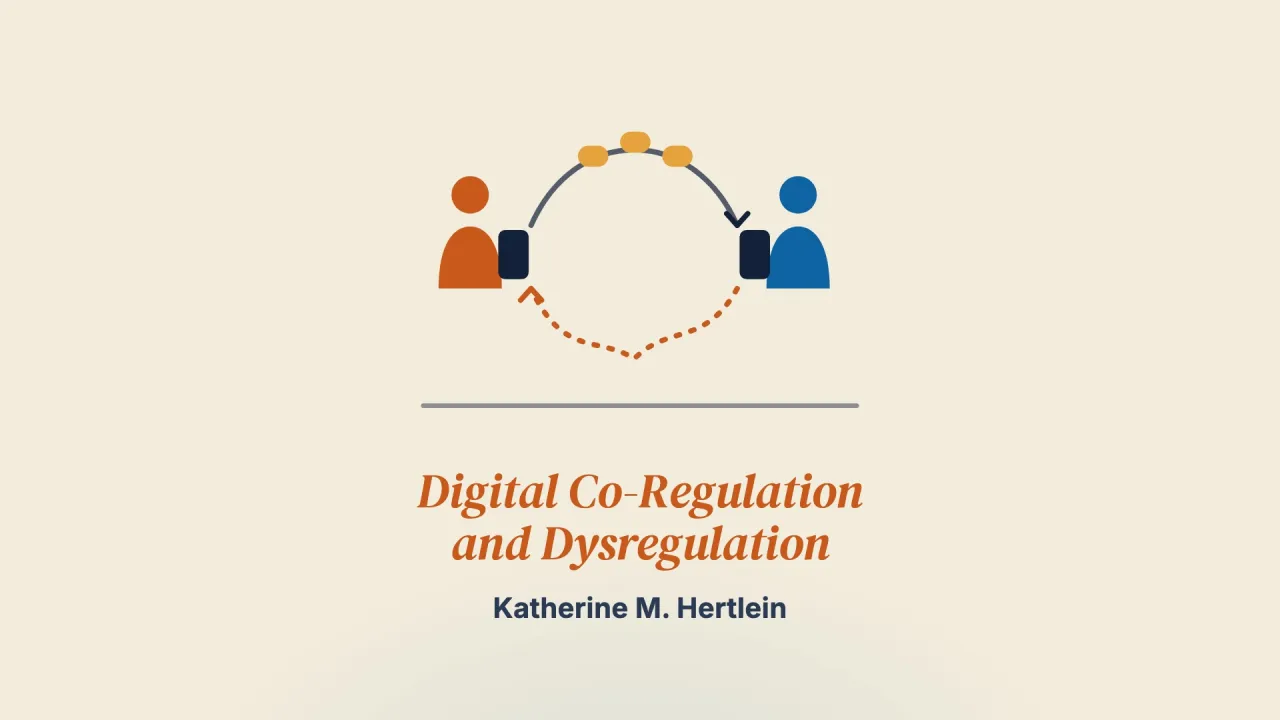
Digital Co-Regulation and Dysregulation in Romantic Relationships: A Systemic Model of Technology-Mediated Emotional Processes
Checking, chasing, blocking: 31 interviews show how the phone regulates or dysregulates a couple’s anxiety, with a systemic model of the loop.
Comments 0
Log in to join the discussion. Log in