Child & Youth Care Forum · Family therapy
Individual-Level Outcomes and Change Patterns of an Integrative Inpatient Treatment Program for Traumatized Families: A Quasi-Experimental Multiple-Case Study
In the Netherlands, the KINGS programme admits families marked by trauma, for whom outpatient care has failed, to an on-site treatment setting for six to ten weeks, and treats parents’ trauma, children’s trauma and their relationship together. Lysbert T. Zeinstra’s team followed 15 families every week before, during and after their stay: trauma symptoms mostly decrease, but trajectories remain highly diverse.
This is a reformatted republication of Individual-Level Outcomes and Change Patterns of an Integrative Inpatient Treatment Program for Traumatized Families: A Quasi-Experimental Multiple-Case Study, by Lysbert T. Zeinstra, Jana Knot-Dickscheit, Anne-Marie N. Huyghen and Annemiek T. Harder, published in Child & Youth Care Forum (Springer) (2026), doi: 10.1007/s10566-026-09946-z, under a CC BY 4.0 licence. Prepared by Complexe Systémique in September 2026: the authors’ text is unchanged; the layout has been adapted for reading online, which constitutes a modification of the work under the terms of the licence. Tables are presented as lists; end-of-article statements are grouped in the notes. This edition was made neither by the authors nor by the publisher, who are not responsible for its content or for any errors. The original version prevails.
Change is facilitated when trauma symptoms in parents and children are addressed not as separate problems, but in relation to parenting and the parent-child relationship within the family system.
Lysbert T. Zeinstra, Jana Knot-Dickscheit, Anne-Marie N. Huyghen and Annemiek T. Harder
Abstract
Background. Children growing up in families experiencing complex and multiple problems face an increased risk of interpersonal trauma and adverse developmental outcomes. Parental trauma, emotion regulation difficulties, and strained parent-child relationships may limit the feasibility and response to outpatient trauma-focused interventions. To address these barriers, the Dutch KINGS program integrates trauma treatment for parents and children with work on family interactions and parenting in an inpatient setting that provides safety and structure.
Objective. We examined outcome trajectories and change patterns before, during, and after KINGS across child and parental trauma symptoms, child emotional and behavioral problems, parental feelings and responses toward the child, and the parent-child relationship.
Method. We conducted a quasi-experimental multiple-case time-series study with non-concurrent, staggered intervention onset. The analytic sample included 15 families (n = 15 parents; n = 18 children) who completed weekly assessments across baseline (≥ 5 weeks), intervention, and 8-week follow-up. We used visual analyses, Simulation Modeling Analysis (SMA), and Nonoverlap of All Pairs (NAP) to evaluate changes and temporal patterns.
Results. For each outcome, except the parent-child relationship, at least half of the participants showed moderate-to-strong improvement during KINGS. Change patterns varied (e.g., gradual gains or brief early worsening followed by improvement), and most gains were maintained or enhanced during follow-up. Improvements were most consistent for child and parental trauma symptoms.
Conclusions. Integrative, inpatient trauma-focused family treatment was associated with improvements in families for whom outpatient care proved insufficient. Larger comparative studies with extended follow-up are needed to strengthen causal inference and assess generalizability.
Keywords: Trauma, Family treatment, PTSD, Parent-child relationship, Emotion regulation, Multiple-case design
Introduction
Families experiencing complex and multiple problems (FECMP; Van Assen et al., 2020) face severe, chronic, and intertwined problems across multiple areas of life. These include problems related to psychosocial functioning (e.g., child or parental psychopathology), parenting, and socioeconomic factors (e.g., financial and housing problems) (Bodden & Deković, 2016; Ghesquière, 1993; Tausendfreund et al., 2016; Zeinstra et al., 2024, in press). Compared to the general population, children and parents in FECMP are more frequently exposed to traumatic experiences (Bunting et al., 2017; Deković & Bodden, 2019), which increases the risk of developing Posttraumatic Stress Disorder (PTSD). PTSD is characterized by intrusive thoughts, avoidance behaviors, negative changes in cognition and mood, and heightened arousal following exposure to actual or threatened death, serious injury, or sexual violence (American Psychiatric Association, 2013).
In FECMP, trauma exposure is frequently interpersonal (e.g., domestic violence, abuse, and neglect) (Bunting et al., 2017; Zeinstra et al., 2024). Chronic interpersonal trauma exposure that begins early in life can lead not only to PTSD symptoms but also to attachment problems, behavioral problems, emotion regulation difficulties, and lowered self-esteem (D’Andrea et al., 2012; Spinazzola et al., 2021). In addition, children’s trauma exposure is often linked to their parents’ earlier trauma exposure (Bosquet Enlow et al., 2014; Lünnemann et al., 2019; Narayan et al., 2021). Research shows that parents with a history of childhood trauma are more likely to have children who are also exposed to traumatic experiences (Lehrner & Yehuda, 2018; Lê-Scherban et al., 2018; Schickedanz et al., 2018). Unaddressed PTSD symptoms and disrupted family functioning can perpetuate maladaptive patterns across generations. Specifically, parental PTSD has been associated with reduced sensitivity and responsiveness in parenting (Greene et al., 2020; Van Ee et al., 2012, 2016), more hostile interactions with their children (Christie et al., 2019), and increased distress and behavioral problems in those children (Lambert et al., 2014; Van Ee et al., 2012). Without effective treatment, these patterns tend to persist, contributing to long-term personal suffering, substantial mental-health and medical service use and costs, and an increased risk of out-of-home placement (Mevissen et al., 2020; Pannebakker et al., 2018).
Several evidence-based trauma-focused treatments are available to address trauma and related symptoms, including Eye Movement Desensitization and Reprocessing (EMDR; Shapiro, 2018), Prolonged Exposure (PE; Foa et al., 2007), and Trauma-Focused Cognitive Behavioral Therapy (TF-CBT; Cohen & Mannarino, 2015). However, standard outpatient delivery of these interventions may not adequately address the complex needs of trauma-impacted FECMP. In practice, these treatments are often not implemented when the home environment is considered unsafe (Steketee & Doelman, 2022). When implemented, dropout and limited treatment response remain significant concerns, particularly for children from families with low socioeconomic status or a history of maltreatment (Burback et al., 2024; DeLorenzi et al., 2016; Eslinger et al., 2022; Van der Hoeven et al., 2022). Non-response to treatment increases the risk of long-term functional impairment and relapse, while therapists may experience feelings of uncertainty and failure (Semmlinger et al., 2024).
From a trauma- and systems-theoretical perspective (Kleber et al., 1992; Von Bertalanffy, 1969), several mechanisms help explain why standard outpatient trauma treatments may be infeasible or insufficient for trauma-impacted FECMP: (i) the transactional nature of parent-child processes, (ii) the prerequisite of safety and containment for trauma processing, and (iii) the pervasive avoidance and dysregulation that hinder engagement.
First, many treatment programs address children or parents (i.e., adults) separately, without accounting for the reciprocal effects of trauma within the parent-child relationship (Fictorie et al., 2022; Figley & Kiser, 2013; Mooren et al., 2023; Stolper et al., 2022). Parents play an important role in their children’s recovery from trauma by providing emotional support, facilitating positive experiences, and acting as co-therapists (Shapiro et al., 2017). However, their own trauma can undermine this capacity (Mevissen et al., 2020). The high levels of parenting stress they face in managing their child’s sometimes extreme behaviors (e.g., aggressive outbursts and severe emotional dysregulation) can further strain the parent-child relationship and hinder recovery for both the child and parent (Bodden & Deković, 2016; Mevissen et al., 2020). Second, completing or even initiating outpatient treatment may be hampered by the accumulation of stressors common in FECMP, such as unsafe home environments, financial problems, transportation barriers, and limited social support (Bodden & Deković, 2016; Mevissen et al., 2020). Finally, co-occurring PTSD, emotional dysregulation, and interpersonal difficulties in both parents and children can produce extreme avoidance, behavioral dysregulation, and other challenges that complicate treatment (Wesselmann & Shapiro, 2013). As a result of these symptoms, families may appear unmotivated, making therapeutic engagement more difficult (Struik et al., 2017).
Taken together, these constraints point to the need for an integrated, whole-family treatment format delivered in a safe, containing context that reduces practical barriers and enables concurrent work on trauma processing, emotional regulation, parenting, and the parent-child relationship (Mooren et al., 2023; Van der Hoeven et al., 2023). To address this need, a Dutch child and adolescent psychiatric treatment center developed a program called KINGS (i.e., Kind IN Gezond Systeem, a Dutch acronym for Child IN Healthy System). KINGS is an intensive, inpatient, trauma-focused treatment program for trauma-impacted FECMP that addresses both child and parental trauma within the family system. The program is based on the assumption that breaking the cycle of intergenerational trauma and adversity is essential to support families in achieving long-term positive outcomes and preventing out-of-home placement of children (Ploeg & Wanders-Mulder, 2019). KINGS integrates evidence-based trauma treatments, such as EMDR and Imaginal Exposure, with interventions that target symptom-related challenges and treatment barriers (e.g., disruptive or avoidant child behavior, emotion regulation problems, and parent-child relationship difficulties), such as motivational interviewing, body-oriented therapy, video feedback, and modeling (Ploeg & Wanders-Mulder, 2019; Ploeg et al., 2026). In this way, KINGS is intended not only to reduce trauma symptoms, but also to strengthen parents’ regulatory capacity and emotional availability, so that trauma processing can take place within safer and more supportive parent-child interactions (Meijer, 2026; Mevissen et al., 2020; Shapiro et al., 2017). The goal of KINGS is to improve family functioning by reducing trauma symptoms in both children and parents, reducing emotional and behavioral problems in children, and improving parenting skills and positive parent-child interactions.
While clinical impressions suggest that KINGS is associated with reduced trauma symptoms and improved family functioning (Ploeg & Wanders-Mulder, 2019), a rigorous empirical evaluation of the program outcomes is still lacking. This evidence gap mirrors the broader observation that, despite growing international interest in integrated, family-centered treatment approaches, robust outcome evaluations – particularly for trauma-focused and inpatient programs – remain scarce (Barth et al., 2023; Falkov et al., 2016; Foster et al., 2016; Stolper et al., 2022). Accordingly, it remains unclear whether and by what change processes participation in an inpatient, trauma-focused, whole-family model is associated with change in individual symptoms and relational functioning.
Beyond this evidence gap, methodological concerns have been raised about PTSD trials, particularly the frequent reliance on group-level effect sizes, which may mask important individual- and family-level variations in treatment outcomes, including cases of non-response or symptom worsening (Semmlinger et al., 2024; Varker et al., 2021). The Single-Case Experimental Design (SCED) methodology offers a suitable approach to capture individual trajectories. SCEDs allow a case-by-case examination of change, which is well-suited to the heterogeneous nature of FECMP, including the KINGS target population (Ploeg & Wanders-Mulder, 2019; Zeinstra et al., 2024). Unlike traditional group designs, SCEDs enable a detailed analysis of individual response patterns (e.g., magnitude and timing of change), capturing clinically meaningful shifts that may be obscured in aggregate data (Borckardt et al., 2008; Jarrett, 2013; Tanious & Onghena, 2019). When implemented with full experimental control, SCEDs provide a robust basis for causal inference (Kratochwill et al., 2010). In applied settings where full control is not feasible, quasi-experimental adaptations can strengthen causal plausibility through systematic replication within and across cases (Kazdin, 2021). Thus, the single-case research design framework is a promising approach for evaluating interventions such as KINGS, in which individual variability is expected and clinically meaningful.
To our knowledge, this pre-registered study1 is the first to systematically evaluate an inpatient, integrated, trauma-focused treatment program for FECMP using a quasi-experimental, multiple-case, time-series design. The purpose of this study was twofold. First, we aimed to examine the individual-level outcomes of KINGS across trauma symptoms in children and parents, emotional and behavioral problems in children, positive parental feelings and responses toward the child, and parent-child relationships. Second, we aimed to explore patterns of change over time, from a ≥ 5-week baseline period prior to the intervention through the inpatient intervention phase and into the first 8 weeks post-intervention (i.e., follow-up). Based on intervention theory (Ploeg & Wanders-Mulder, 2019; Ploeg et al., 2026), we expected to observe (i) reductions in trauma symptoms in children and parents, (ii) reductions in children’s emotional and behavioral problems, (iii) improvements in positive parental feelings and responses, and (iv) improvements in the parent-child relationship during KINGS. We further expected that these improvements would be maintained across the 8-week follow-up period. We had no a priori hypotheses regarding specific patterns of change, as this examination was exploratory.
Beyond addressing an important empirical gap, the present study also contributes to the theoretical understanding of integrated trauma-focused care for FECMP. More specifically, it examines whether an inpatient whole-family model is associated with change in the individual and relational domains that trauma theory (Kleber et al., 1992) and systems theory (Von Bertalanffy, 1969) identify as central to persistent family difficulties. In this way, the study builds on earlier publications on KINGS that have focused on the target population (Zeinstra et al., 2024; Zeinstra et al., in press) and the content and structure of daily practice (Zeinstra et al., 2025), by providing a systematic empirical evaluation of change patterns in the domains the program is designed to target. These insights may inform the further development of trauma care pathways for FECMP, particularly when outpatient treatment is insufficient or unfeasible.
Method
Study Design
This study is part of a larger longitudinal evaluation of the KINGS treatment program and was approved by the Ethics Review Board of Erasmus University Rotterdam. We used a quasi-experimental multiple-case time-series design (Kazdin, 2021). This design shares key features with a multiple-baseline single-case experimental design (SCED; Kazdin, 2021; Kratochwill et al., 2010), including repeated weekly measurement and staggered intervention onset across cases, but baseline lengths were non-randomized, non-concurrent, and determined by clinical scheduling.
Ethically, we considered it inappropriate to randomize families to different baseline lengths or delay access to treatment to obtain concurrent or stable baselines, given the severity and complexity of symptomatology and extensive prior treatment histories of participating families, as shown in previous research (Zeinstra et al., 2024, in press). Instead, the baseline length and treatment start followed clinical scheduling, resulting in a non-concurrent, naturalistic baseline phase across participants. Methodologically, the design retained repeated observations and staggered intervention onset, which help reduce threats to internal validity such as maturation, regression to the mean, and historical events, but it does not permit definitive causal inference. Our approach aligns with Kazdin’s (2021) position that in applied clinical settings where full experimental control is not feasible, rigorously structured quasi-single-case designs can help explore patterns of change associated with program participation.
The study consisted of three distinct phases (A-B-A’). Phase A was a naturalistic baseline period lasting a minimum of 5 weeks and a maximum of 13 weeks. Phase B comprised the full duration of the KINGS program and lasted 6–10 weeks. Phase A’ represents the 8-week follow-up. Throughout all three phases, the participating parents and children completed a brief questionnaire measuring the outcome variables once per week.
Setting and Intervention
The KINGS program is delivered at two inpatient sites of a child and adolescent psychiatry organization in the northern and central Netherlands. Families reside in separate family housing units during admission. Site A comprises small family houses situated on a green, campus-like terrain (capacity: 5–6 families). Site B is a residential house in a regular neighborhood (capacity: 2 families). Families are typically referred by primary care physicians, social services, or child protective services, followed by an orientation meeting with clinicians to assess suitability and prepare the family for admission. The target population consists of families experiencing complex and multiple problems with trauma exposure in parents and/or children for whom outpatient care has been insufficient or infeasible (Zeinstra et al., 2024).
The typical admission lasts 6–8 weeks (range in the present study: 6–10). Throughout admission, families reside on-site in the dedicated housing units. This residential setup is standard for participation in KINGS and is intended to provide a safe and containing therapeutic environment, physically and emotionally, where parents and children can focus on treatment and practice skills consistently in daily routines. Practical arrangements (e.g., school participation, contacts with external professionals, and – where applicable – parents’ work obligations) are coordinated on a case-by-case basis. External professionals already involved with the family (such as referrers, social workers, or child-protection case managers) are encouraged to stay involved during admission, including by attending weekly evaluation meetings, to ensure continuity of care after discharge.
During their stay, families receive 24/7 support from family support workers trained in cognitive-behavioral techniques and trauma-informed care, characterized by opportunities for choice, collaboration, empowerment, attention to trauma triggers, and understanding (emotional and behavioral) problems in the context of trauma histories (Gardiner et al., 2017). Support is tailored to the family’s needs and their personal goals. Therapy sessions and family meetings with therapists are held in a central on-site building. The treatment program consists of three phases, each lasting 1–3 weeks on average. Parents and children progress through the same phases, with parents one phase ahead of their children, reflecting the program theory that parents first need sufficient stabilization and progress in their own trauma treatment to support their children’s treatment from a more regulated and emotionally available state (Ploeg & Wanders-Mulder, 2019).
Phase 1 focuses on establishing a safe and predictable foundation for treatment. This includes creating a physically and emotionally safe environment, building a trusting therapeutic alliance with both parents and children, and supporting families in developing structured and healthy daily routines. Psychoeducation on trauma and attachment is provided, and clinicians use motivational interviewing (MI) (Miller & Rollnick, 2013). Children participate in the Motivation, Adaptive Skills and Trauma Resolution (MASTR) protocol (Greenwald, 2009). Parents engage in body-oriented work (trauma-sensitive mindfulness, yoga, compassion training; Emerson, 2015; Gilbert, 2005; Treleaven, 2018). Video feedback (Balldin et al., 2016; Wels, 2001) is combined with applied behavior analysis (ABA) (Cooper et al., 2019) to enhance the understanding of family dynamics and parental sensitivity. Phase 2 centers on intensive trauma processing: parents receive daily EMDR (Shapiro, 2018) and Imaginal Exposure (IE) (Foa et al., 2007) from EMDR Europe-certified therapists. As parents near completion, the children begin trauma therapy, with the parents providing co-regulatory support. Phase 3 emphasizes the generalization of skills and relapse prevention. Parents learn to apply new or reinforce existing parenting strategies and continue supporting their children’s ongoing treatment. A relapse prevention plan is developed for use in the home environment after discharge, outlining anticipated challenges and strategies to maintain treatment gains. For a more detailed description of program theory and care provision, see Ploeg and Wanders-Mulder (2019), Ploeg et al. (2026), and Zeinstra et al. (2025).
Participants and Procedure
Participants were recruited from the two inpatient sites described in the subsection Setting and Intervention between January 2022 and October 2023, when time constraints required the closure of recruitment. We aimed to recruit at least nine parents and nine children to permit systematic replication across cases (Delsing & van Yperen, 2017).
During program intake, clinicians introduced the study to families and asked for permission for the principal researcher (first author) to contact them by phone and email. The first author then contacted the families to provide verbal and written information about the broader longitudinal evaluation and the present optional multiple-case module, verify eligibility, and answer questions. Families who wished to participate received an in-person home visit from the first author to obtain written informed consent from both parents and children aged ≥ 12 years. Participation was voluntary and did not affect access to care.
The inclusion criteria were as follows: (a) sufficient Dutch language proficiency and (b) the participating parent had an email address or telephone number and access to a smartphone or tablet with an internet connection. Children aged ≥ 8 years were eligible to complete self-reports, while younger children were represented by parent reports. No exclusion criteria were applied to the study.
Nineteen families consented to participate in this study. Following consent, the first author enrolled the participants and managed all study communications. The weekly questionnaire was distributed via a digital link sent to parents’ smartphones every Friday, with completion requested during the weekend. If no response was recorded by Monday, a reminder was sent. The sample characteristics and pretreatment scores of the final analytic sample are presented in Table 1 (see Sect. “Participant Flow and Analytic Sample” for participant flow).
Table 1 — Participants’ background and pre-treatment variables
Role and age (years); phase length in weeks (baseline, treatment, follow-up); pre-treatment totals1 on the CRIES and SDQ (child/parent report), PSQ, FQ and PTSD-SR. The footnote marker 2 on some baseline lengths is not explained in the source.
- Family 1, ID 1 (Mother, 35 years). Phase length (weeks): baseline 6, treatment 6, follow-up 8; CRIES (child/parent): –; SDQ (child/parent): –; PSQ: –; FQ: –; PTSD-SR: Missing.
- Family 1, ID 2 (Daughter, 10 years). Phase length (weeks): baseline 6, treatment 6, follow-up 8; CRIES (child/parent): 31*/47*; SDQ (child/parent): Missing/23*; PSQ: 69*; FQ: 113*; PTSD-SR: –.
- Family 1, ID 3 (Son, 7 years). Phase length (weeks): baseline 6, treatment 6, follow-up 8; CRIES (child/parent): –; SDQ (child/parent): –/Missing; PSQ: –; FQ: –; PTSD-SR: –.
- Family 2, ID 4 (Mother, 43 years). Phase length (weeks): baseline 12, treatment 8, follow-up 8; CRIES (child/parent): –; SDQ (child/parent): –; PSQ: –; FQ: –; PTSD-SR: 19*.
- Family 2, ID 5 (Daughter, 3 years). Phase length (weeks): baseline 12, treatment 8, follow-up 8; CRIES (child/parent): –; SDQ (child/parent): –/25*; PSQ: 76*; FQ: –; PTSD-SR: –.
- Family 3, ID 6 (Mother, 46 years). Phase length (weeks): baseline 12, treatment 8, follow-up 8; CRIES (child/parent): –; SDQ (child/parent): –; PSQ: –; FQ: –; PTSD-SR: 22*.
- Family 3, ID 7 (Son, 8 years). Phase length (weeks): baseline 12, treatment 8, follow-up 8; CRIES (child/parent): –/37*; SDQ (child/parent): –/24*; PSQ: 109*; FQ: 88*; PTSD-SR: –.
- Family 4, ID 8 (Mother, 41 years). Phase length (weeks): baseline 8, treatment 6, follow-up 8; CRIES (child/parent): –; SDQ (child/parent): –; PSQ: –; FQ: –; PTSD-SR: 35*.
- Family 4, ID 9 (Daughter, 8 years). Phase length (weeks): baseline 8, treatment 6, follow-up 8; CRIES (child/parent): 38*/26; SDQ (child/parent): –/19*; PSQ: 113*; FQ: 97*; PTSD-SR: –.
- Family 5, ID 10 (Mother, 33 years). Phase length (weeks): baseline 8, treatment 9, follow-up 0; CRIES (child/parent): –; SDQ (child/parent): –; PSQ: –; FQ: –; PTSD-SR: 18*.
- Family 5, ID 11 (Daughter, 5 years). Phase length (weeks): baseline 8, treatment 9, follow-up 0; CRIES (child/parent): –; SDQ (child/parent): –/21*; PSQ: 65*; FQ: 82; PTSD-SR: –.
- Family 6, ID 12 (Mother, 32 years). Phase length (weeks): baseline 8, treatment 8, follow-up 8; CRIES (child/parent): –; SDQ (child/parent): –; PSQ: –; FQ: –; PTSD-SR: 31*.
- Family 6, ID 13 (Son, 5 years). Phase length (weeks): baseline 8, treatment 8, follow-up 8; CRIES (child/parent): –; SDQ (child/parent): –/22*; PSQ: 93*; FQ: 105*; PTSD-SR: –.
- Family 7, ID 14 (Mother, 36 years). Phase length (weeks): baseline 12, treatment 10, follow-up 8; CRIES (child/parent): –; SDQ (child/parent): –; PSQ: –; FQ: –; PTSD-SR: 26*.
- Family 7, ID 15 (Daughter, 12 years). Phase length (weeks): baseline 12, treatment 10, follow-up 8; CRIES (child/parent): 47*/53*; SDQ (child/parent): 18*/28*; PSQ: 83*; FQ: 74; PTSD-SR: –.
- Family 7, ID 16 (Daughter, 5 years). Phase length (weeks): baseline 12, treatment 10, follow-up 8; CRIES (child/parent): –; SDQ (child/parent): –/3; PSQ: –; FQ: –; PTSD-SR: –.
- Family 8, ID 17 (Mother, 38 years). Phase length (weeks): baseline 32, treatment 6, follow-up 8; CRIES (child/parent): –; SDQ (child/parent): –; PSQ: –; FQ: –; PTSD-SR: 31*.
- Family 8, ID 18 (Daughter, 7 years). Phase length (weeks): baseline 32, treatment 6, follow-up 8; CRIES (child/parent): –; SDQ (child/parent): –/21*; PSQ: 90*; FQ: 81; PTSD-SR: –.
- Family 9, ID 19 (Mother, 32 years). Phase length (weeks): baseline 6, treatment 7, follow-up 8; CRIES (child/parent): –; SDQ (child/parent): –; PSQ: –; FQ: –; PTSD-SR: 25*.
- Family 9, ID 20 (Son, 12 years). Phase length (weeks): baseline 6, treatment 7, follow-up 8; CRIES (child/parent): 35*/25; SDQ (child/parent): 12/19*; PSQ: 64*; FQ: 82; PTSD-SR: –.
- Family 9, ID 21 (Son, 9 years). Phase length (weeks): baseline 6, treatment 7, follow-up 8; CRIES (child/parent): 60*/37*; SDQ (child/parent): –/12*; PSQ: –; FQ: –; PTSD-SR: –.
- Family 10, ID 22 (Mother, 30 years). Phase length (weeks): baseline 6, treatment 7, follow-up 8; CRIES (child/parent): –; SDQ (child/parent): –; PSQ: –; FQ: –; PTSD-SR: 36*.
- Family 10, ID 23 (Son, 6 years). Phase length (weeks): baseline 6, treatment 7, follow-up 2; CRIES (child/parent): –; SDQ (child/parent): –/30*; PSQ: 96*; FQ: 81; PTSD-SR: –.
- Family 11, ID 24 (Mother, 42 years). Phase length (weeks): baseline 6, treatment 9, follow-up 8; CRIES (child/parent): –; SDQ (child/parent): –; PSQ: –; FQ: –; PTSD-SR: 15*.
- Family 11, ID 25 (Son, 11 years). Phase length (weeks): baseline 6, treatment 9, follow-up 8; CRIES (child/parent): Missing/24; SDQ (child/parent): 14/27*; PSQ: 86*; FQ: Missing; PTSD-SR: –.
- Family 11, ID 26 (Daughter, 9 years). Phase length (weeks): baseline 6, treatment 9, follow-up 8; CRIES (child/parent): 47*/17; SDQ (child/parent): –/Missing; PSQ: –; FQ: –; PTSD-SR: –.
- Family 12, ID 27 (Mother, 51 years). Phase length (weeks): baseline 6, treatment 11, follow-up 8; CRIES (child/parent): –; SDQ (child/parent): –; PSQ: –; FQ: –; PTSD-SR: 15*.
- Family 12, ID 28 (Daughter, 17 years). Phase length (weeks): baseline 32, treatment 11, follow-up 8; CRIES (child/parent): Missing/52*; SDQ (child/parent): Missing/28*; PSQ: 81*; FQ: 129*; PTSD-SR: –.
- Family 13, ID 29 (Mother, 43 years). Phase length (weeks): baseline 7, treatment 8, follow-up 8; CRIES (child/parent): –; SDQ (child/parent): –; PSQ: –; FQ: –; PTSD-SR: 22*.
- Family 13, ID 30 (Son, 8 years). Phase length (weeks): baseline 7, treatment 8, follow-up 8; CRIES (child/parent): 37*/45*; SDQ (child/parent): –/24*; PSQ: 78*; FQ: 94*; PTSD-SR: –.
- Family 14, ID 31 (Mother, 45 years). Phase length (weeks): baseline 13, treatment 8, follow-up 8; CRIES (child/parent): 19/24; SDQ (child/parent): 12/19*; PSQ: –; FQ: –; PTSD-SR: 11.
- Family 14, ID 32 (Daughter, 11 years). Phase length (weeks): baseline 13, treatment 8, follow-up 8; CRIES (child/parent): –; SDQ (child/parent): –; PSQ: 81*; FQ: 133*; PTSD-SR: –.
- Family 15, ID 33 (Mother, 45 years). Phase length (weeks): baseline 32, treatment 9, follow-up 8; CRIES (child/parent): –; SDQ (child/parent): –; PSQ: –; FQ: –; PTSD-SR: 32*.
1 These five questionnaires measure baseline functioning on child trauma symptoms (CRIES; child and parent report), child emotional and behavioral problems (SDQ; child and parent report), parental trauma symptoms (PTSD-SR), parenting stress (PSQ), and family functioning (FQ). Scores in the clinical range are indicated with *. Cells left blank (-) are either not applicable due to the perspective of the respondent (child vs. parent) or because the child’s age is below the minimum required for the questionnaire
Measures
For all measures, we shortened validated self-report scales to keep participants motivated while still capturing different concepts. The selection of core items was based on (i) theoretical considerations (e.g., one item per sub-construct measured in the original scale), (ii) expected sensitivity to short-term change, (iii) best alignment with program goals, and (iv) expert opinion from KINGS professionals on (i), (ii), and (iii). To increase sensitivity to change, we reworded items to refer to the past week and converted the original Likert response scales to a 0–10 slider scale (0 = never; 10 = always). Participants were asked to indicate how often each item applied to them in the past week. This type of brief repeated measurement is common in single-case experimental and intensive longitudinal research, where dense within-person data are prioritized while respondent burden is kept manageable (Bülow et al., 2025; Krasny-Pacini & Evans, 2018). Given the shortened, adapted weekly format, reliability and comparability with the original full scales are likely to be reduced. Moreover, these weekly item sets were not intended as full psychometric scales, but as brief indices of change over time within participants; they do not permit strong conclusions about diagnostic status, categorical remission (e.g., PTSD remission), or clinically significant change in the sense of the original full instruments. Accordingly, we interpret scores as weekly indices and emphasize within-person change across phases, with systematic replication across cases, rather than norm-referenced interpretations or between-person comparisons.
Parental trauma symptoms were measured using one item each from the four subscales of the Posttraumatic Stress Disorder Symptoms Scale, Self-Report version (PTSD-SR; Engelhard et al., 2007; Foa et al., 1993), measuring symptoms of intrusion, avoidance, hyperarousal, and negative cognitions. The PTSD-SR has shown satisfactory internal consistency, high test-retest reliability, and good concurrent validity in its full form (Foa et al., 1993). In the present study, we selected four items to capture how often in the past week parents experienced painful thoughts or images about the traumatic event (intrusion), tried not to think about it (avoidance), were alert or vigilant (hyperarousal), and felt guilty about it (negative cognitions).
Child trauma symptoms were measured in parents and children (aged 8 years and older) using one item each from the three subscales of the Children’s Revised Impact of Event Scale (CRIES-13; Perrin et al., 2005; Verlinden, Van Laar et al., 2014; Verlinden, Van Meijel et al., 2014), assessing symptoms of intrusion, avoidance, and hyperarousal. The CRIES-13 has demonstrated good reliability and validity, including in Dutch samples (Perrin et al., 2005; Verlinden, Van Laar et al., 2014; Verlinden, Van Meijel et al., 2014). For the present study, we selected three items to capture how often in the past week the child thought about the (most profound) traumatic event without wanting to (intrusion), tried not to think about it (avoidance), and was easily irritated (hyperarousal). These items were completed by children aged 8 years and older as self-report and by parents as parent-report for each child in the family aged 8 years or older.
Child emotional and behavioral problems were measured by parent report for children aged 4 years and older and by self-report for children aged 11 years and older using two items from the emotional symptoms subscale and two items from the conduct problems subscale of the Strengths and Difficulties Questionnaire (SDQ; Goodman, 1997; Van Widenfelt et al., 2003). The Dutch SDQ has acceptable internal consistency and sufficient concurrent validity (Van Widenfelt et al., 2003; Theunissen et al., 2016, 2019). In the present study, we selected four items to capture how often in the past week the child got very angry and lost his/her temper and usually did what adults asked (conduct problems), and was unhappy, depressed or tearful, and worried (emotional symptoms).
Positive parental feelings and responses toward the child were measured in parents using two items from the ‘problems in parenting’ subscale and two items from the ‘problems in parent-child relationship’ subscale of the Parenting Stress Questionnaire (PSQ; Vermulst et al., 2015). The PSQ has shown good reliability and validity in its full form (Vermulst et al., 2015). In the present study, we selected four items to capture how often in the past week parents felt happy with the child and felt calm when the child was with them, as well as how often they felt that the child listened to them and that they were able to calm the child when the child was angry. Parents completed these items for the child with whom they experienced the greatest parenting challenges at the beginning of the baseline period. Accordingly, these parent-reported data reflect a focal child within the family and should not be interpreted as representing all children in the family.
The parent-child relationship was measured in parents using three items from the responsiveness subscale and two items from the communication subscale of the Family Questionnaire (FQ; Van der Ploeg & Scholte, 2008). The FQ has shown good internal consistency in its full form (Van der Ploeg & Scholte, 2008). For children (≥ 8 years), we used five items from the Parent-Child Interaction Questionnaire-Revised (PACHIQ-R; Lange et al., 2002) that corresponded most closely to the selected FQ items. The PACHIQ-R has shown good internal consistency in its full form (Lange et al., 2002). Because parent and child reports were based on different instruments, we treated them as two related but separate indicators of the broader parent-child relationship, rather than as identical or directly interchangeable measures. Parents again completed the items for the child with whom they experienced the greatest parenting challenges, whereas children completed the items for the parent who was most present in their daily lives. For parents, the selected items assessed how often in the past week they had hugged or patted the child, given advice when the child was struggling with something, and complimented the child (responsiveness), as well as how often they found it difficult to understand the child and argued with the child (communication). Children were asked how often in the past week their parent comforted them when they were sad about something, how often they asked their parent for advice when they had a problem, how often their parent was proud of them, and how often their parent did not understand them very well and argued with them.
For each variable, we calculated sum scores per participant per time point. We reverse-coded positively worded items for symptom-related outcomes (child and parental trauma symptoms and child emotional and behavioral problems) so that higher scores reflected more symptoms or problems. Conversely, we reverse-coded negatively worded items for positively framed outcomes (positive parental feelings and responses toward the child and the parent-child relationship) so that higher scores reflected better functioning.
Analysis
We followed a pre-registered analytical plan to test our hypotheses. To address the first research question (RQ1), we examined within-person changes in outcomes across phases using visual analysis of within-phase trends and stability and statistical indices of between-phase level change (Simulation Modeling Analysis [SMA] and Nonoverlap of All Pairs [NAP]). To address the second research question (RQ2), we used SMA slope analyses to identify which predefined change patterns best fit each participant’s data. We analyzed each outcome separately by participant, informant (parent or child), and phase contrast; no multivariable models were estimated.
In all analyses, the intervention phase refers to the entire KINGS period, without distinguishing between the specific treatment phases described in Sect. “Setting and Intervention”. To assess the impact of baseline length, we repeated the analyses using each participant’s full baseline (range: 5–13 weeks) and a fixed window of the last five baseline observations prior to intervention onset. Because the results were comparable, we retained the full baseline data. We coded non-response weeks as missing. We did not impute missing data and instead used the available observations for each participant, phase, and informant.
Within-Phase Visual Analysis
We graphed weekly scores for each outcome and participant to assess trends and stability, following Lane and Gast (2014). We quantified within-phase trends using the split-middle procedure. We defined therapeutic trends as decreasing trend lines for problem-related outcomes (trauma symptoms and emotional and behavioral problems) and increasing trend lines for positive functioning (positive parental feelings and responses and the parent-child relationship). We defined phase stability as ≥ 80% of data points falling within ± 25% of the median (stability envelope).
Between-Phase Changes in Level
We examined level changes (baseline–intervention, intervention–follow-up, baseline–follow-up) using SMA (version 8.3.3), a bootstrapping approach that accounts for autocorrelation and is suitable for time series with < 30 observations per phase (Borckardt et al., 2008). We calculated Pearson correlations for each outcome by participant and phase contrast to assess mean-level changes. To control for Type I error due to multiple comparisons, we applied a Bonferroni correction, with significance set at p ≤ 0.017 when all three phase contrasts were tested and at p < 0.05 when only one contrast was tested (e.g., baseline–intervention, owing to incomplete follow-up data).
In addition, we used NAP (Parker & Vannest, 2009) to quantify nonoverlap between phases (baseline–intervention, intervention–follow-up, baseline–follow-up). The NAP value represents the proportion of comparisons in which the later-phase data improved relative to the earlier-phase data. Values between 0 and 0.65 indicate weak improvement, 0.66–0.92 indicate moderate improvement, and 0.93–1.00 indicate strong improvement (Parker & Vannest, 2009).
Slope of Symptom Change
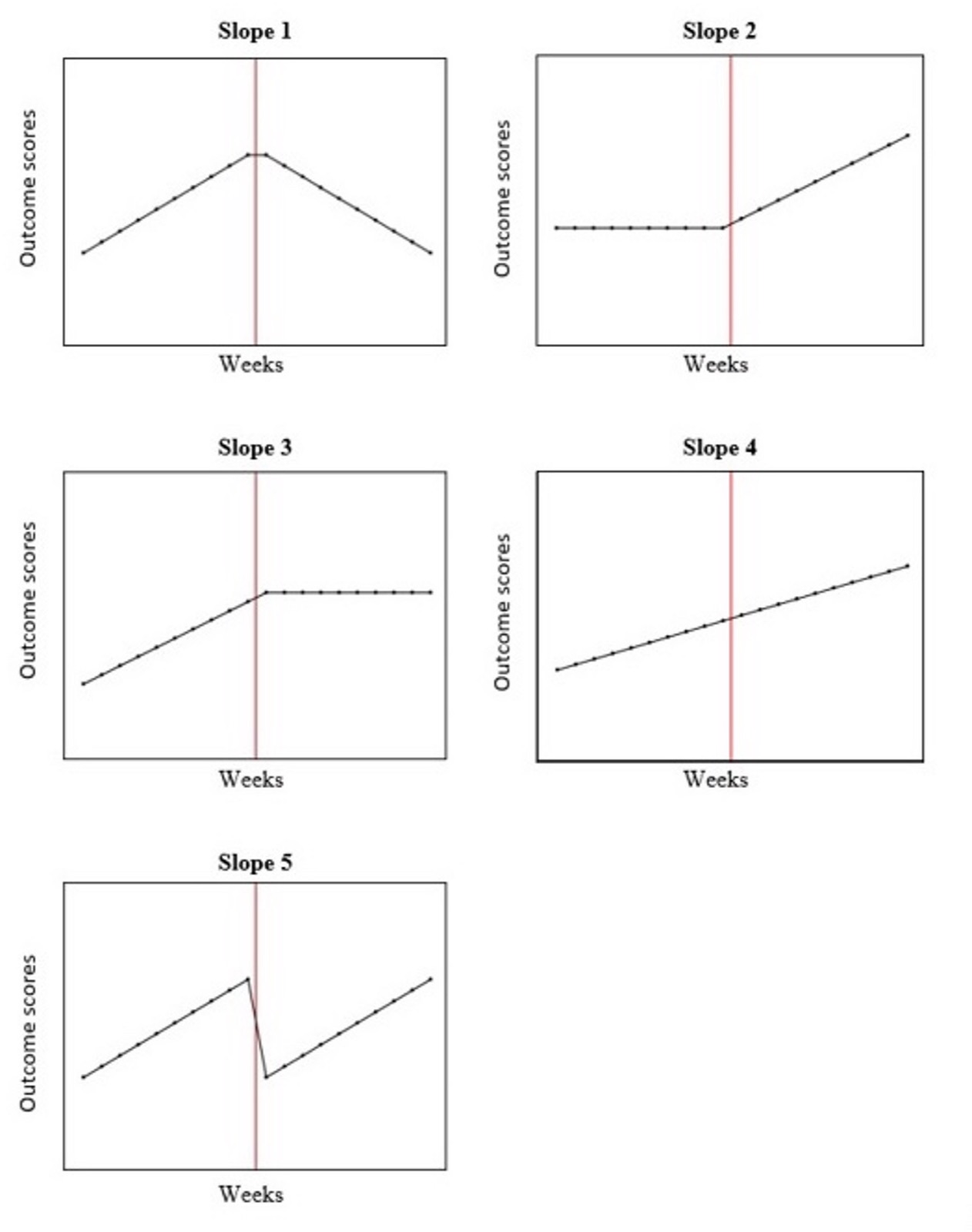
We used SMA to determine which predefined slope model best fit the data by correlating observed data streams with standard slope models. The model with the highest correlation is considered the best fit (Delsing & van Yperen, 2017). We examined five standard slope models (Fig. 1). To evaluate significance, we used 5,000 simulated data streams matched to the original data in length and autocorrelation (Jarrett, 2013). We applied the same Bonferroni correction as for level changes.
Results
Participant Flow and Analytic Sample
During the inclusion window (January 2022–October 2023), 19 families (21 parents and 24 children) enrolled in the present study, representing 23% of all families admitted to KINGS during that period. Of the 24 children, nine provided self-reports. Consistent with Simulation Modeling Analysis (SMA) prerequisites for short time series (Borckardt et al., 2008), participants with fewer than five completed measurements spanning any two phases (baseline–intervention, intervention–follow-up, or baseline–follow-up) were excluded from the analysis. The predominant reason for not meeting this threshold was an earlier-than-planned treatment start, resulting in a baseline shorter than five weeks, often combined with missing data later in the trajectory. In total, exclusions comprised four families (six parents; four children with self-reports; two children with parent-report only).
The final analytic sample comprised 15 families, with one parent per family (all mothers; age 30–51 years) and 18 children (age 3–17 years; 10 girls, 8 boys). This sample size meets the recommended thresholds for demonstrating replication across cases in single-case designs (Delsing & van Yperen, 2017; Kazdin, 2021). The overrepresentation of mothers reflects the KINGS population, which largely consists of single-parent families in which mothers are the primary caregivers (Zeinstra et al., 2024, in press). Eight children were < 8 years old and were therefore represented by parent reports only. Among the 10 children aged ≥ 8 years and thus eligible for self-reporting, five (from four families; two were siblings) provided self-reports. The remaining five did not provide self-reports due to mild intellectual disabilities interfering with reliable self-report (n = 2) or to avoid overburdening at the parents’ request (n = 3). The 15 families received KINGS between April 2022 and December 2023. Table 1 presents the participants’ background characteristics and pretreatment scores.
Individual-Level Changes in Outcomes
Across outcomes, visual analysis indicated that during baseline, most families showed either therapeutic trends (53.4%) or stability (29.3%). During the intervention, therapeutic trends were predominant (76.2%). During follow-up, most participants showed stabilization (48.1% stability) or further improvement (32.5%), although some participants (19.5%) deteriorated. Table 2 summarizes the within-phase therapeutic trends and between-phase improvements across outcomes based on visual analysis and statistical indices (NAP, SMA). Detailed case-level results are provided in Appendix Tables 3, 4, 5, 6, 7, 8, and Appendix C.
Table 2 — Summary of within-phase therapeutic trends (visual analysis) and between-phase improvements (NAP, SMA) across outcomes
- Parental trauma symptoms. Within-phase therapeutic trendsa: Baseline: 5/10; Intervention: 15/15; Follow-up: 7/14. Between-phase level changesb, NAP ≥ 0.66 then SMA sig.: baseline–intervention 6/10 and 1/10; intervention–follow-up 9/14 and 2/14; baseline–follow-up 8/9 and 5/9.
- Child trauma symptoms, parent report. Within-phase therapeutic trendsa: Baseline: 4/8; Intervention: 8/11; Follow-up: 3/11. Between-phase level changesb, NAP ≥ 0.66 then SMA sig.: baseline–intervention 4/8 and 1/8; intervention–follow-up 7/11 and 3/11; baseline–follow-up 6/8 and 6/8.
- Child trauma symptoms, child report. Within-phase therapeutic trendsa: Baseline: 3/4; Intervention: 4/5; Follow-up: 4/5. Between-phase level changesb, NAP ≥ 0.66 then SMA sig.: baseline–intervention 0/4 and 0/4; intervention–follow-up 3/5 and 1/5; baseline–follow-up 3/4 and 1/4.
- Child emotional/behavioral problems, parent report. Within-phase therapeutic trendsa: Baseline: 7/12; Intervention: 14/18; Follow-up: 6/16. Between-phase level changesb, NAP ≥ 0.66 then SMA sig.: baseline–intervention 6/12 and 0/12; intervention–follow-up 8/16 and 1/16; baseline–follow-up 8/10 and 1/10.
- Child emotional/behavioral problems, child report. Within-phase therapeutic trendsa: Baseline: 1/2; Intervention: 2/3; Follow-up: 0/3. Between-phase level changesb, NAP ≥ 0.66 then SMA sig.: baseline–intervention 1/2 and 1/2; intervention–follow-up 0/3 and 0/3; baseline–follow-up 1/2 and 1/2.
- Parental feelings/responses. Within-phase therapeutic trendsa: Baseline: 2/8; Intervention: 9/14; Follow-up: 1/12. Between-phase level changesb, NAP ≥ 0.66 then SMA sig.: baseline–intervention 5/9 and 0/9; intervention–follow-up 6/12 and 0/12; baseline–follow-up 5/7 and 2/7.
- Parent-child relationship, parent report. Within-phase therapeutic trendsa: Baseline: 6/9; Intervention: 9/13; Follow-up: 5/11. Between-phase level changesb, NAP ≥ 0.66 then SMA sig.: baseline–intervention 4/9 and 0/9; intervention–follow-up 7/11 and 0/11; baseline–follow-up 7/7 and 1/7.
- Parent-child relationship, child report. Within-phase therapeutic trendsa: Baseline: 3/4; Intervention: 2/5; Follow-up: 0/5. Between-phase level changesb, NAP ≥ 0.66 then SMA sig.: baseline–intervention 1/4 and 0/4; intervention–follow-up 1/5 and 0/5; baseline–follow-up 1/4 and 0/7.
Numbers are presented as n/total.
a Therapeutic trend = visual analysis showing symptom reduction/improvement within a phase
b NAP ≥ 0.66 = Moderate-to-strong improvement; Significant (SMA) = Simulation Modeling Analysis, p < 0.05 for single comparisons, p < 0.017 for three comparisons (Bonferroni correction).
For parental trauma symptoms, the baseline data showed a mixture of stability and therapeutic trends. Therapeutic trends were observed in all parents during the intervention. During follow-up, half of the parents continued to show therapeutic trends, while the remainder reported either stability or deterioration. NAP analyses indicated moderate-to-strong improvements in most cases across all phase contrasts, with several statistically significant reductions, particularly from baseline to follow-up.
For child trauma symptoms, both parent and child reports showed some therapeutic trends during baseline, and the majority indicated improvement during the intervention. During follow-up, parents’ reports more often suggested stabilization, whereas children’s self-reports more often indicated improvement. The NAP results supported moderate-to-strong improvements across phases, with the SMA confirming significant reductions primarily in parent reports, particularly from baseline to follow-up.
For child emotional and behavioral problems, parent reports during baseline reflected both therapeutic trends and deterioration, whereas child reports showed stability or improvement. During the intervention, most children showed therapeutic trends according to both the parents and the children. The follow-up findings were heterogeneous, including improvements, stabilization, and deterioration. The NAP results indicated moderate-to-strong improvements in at least half of the participants across phases, except for child-reported problems when comparing follow-up to intervention, although the SMA identified only a few statistically significant reductions.
For positive parental feelings and responses, most baseline reports indicated stability. During the intervention, therapeutic trends were observed in the majority of parents, and during follow-up, most parents reported stabilization. The NAP confirmed moderate-to-strong improvements across phases, whereas the SMA identified significance only in isolated cases.
For the parent-child relationship, some therapeutic trends were already present during baseline. Parent reports most often indicated therapeutic trends during the intervention, which either continued or stabilized at follow-up. Child reports were more variable, with stabilization and deterioration being more frequent than improvement. The NAP findings indicated moderate-to-strong improvements in all parents when comparing follow-up to baseline, but few significant improvements emerged from SMA.
Taken together, the intervention phase was characterized by therapeutic changes across most domains, particularly in parental trauma symptoms. Baseline phases showed mixed patterns, with therapeutic trends alongside stability and some deterioration. During follow-up, many participants showed stabilization or continued gains, while heterogeneity across domains and discrepancies between the parent and child reports remained evident.
Change Patterns
To address the second research question, we identified the best-fitting predefined change pattern (slope model; see Fig. 1) for each participant and contrast using the SMA (highest correlation = best fit). Figure 2 shows the distribution of the best-fitting models across participants for each phase contrast2. The direction (therapeutic vs. contra-therapeutic) was defined relative to the outcome valence (symptom reduction or increase in positive outcomes). Model 1 was treated as a mixed pattern, as the direction (therapeutic vs. contra-therapeutic) depended on the outcome and phase (e.g., symptom reduction during intervention but symptom increase during follow-up, or vice versa for positive outcomes). See Appendices B and C for case-level details.
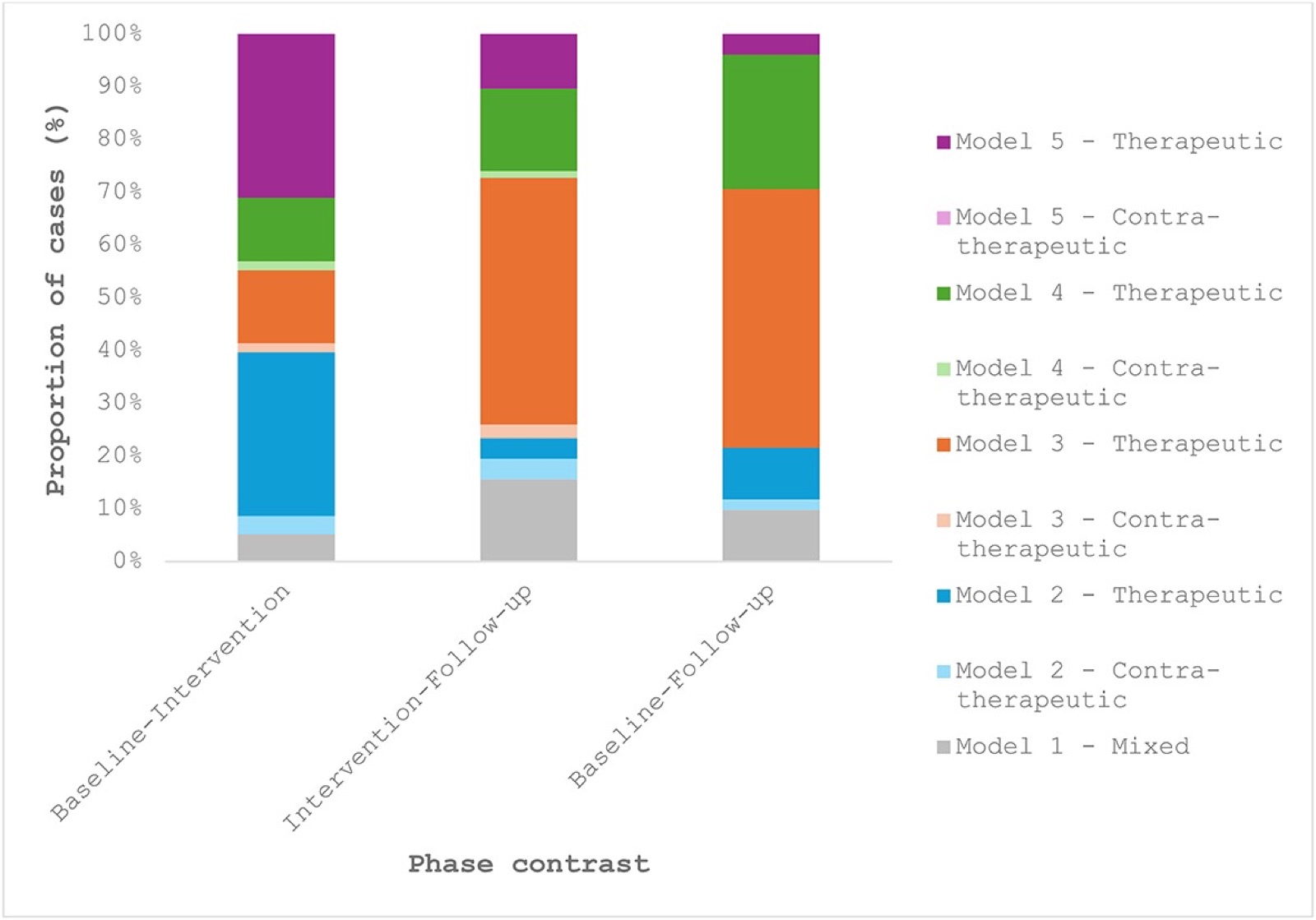
From baseline to the intervention, two models predominated: Model 2 (stable baseline followed by improvement during the intervention) and Model 5 (improvement during the baseline, a short deterioration at the intervention onset, and subsequent gradual improvement). Both reflect therapeutic trajectories in the context of symptom reduction (parental and child trauma symptoms and emotional and behavioral problems) and improvements in parental feelings and the parent-child relationship. The relative contribution of these two models varied across outcomes: Model 2 was most common for parental trauma symptoms, parental feelings, and the parent-child relationship, whereas Model 5 more often characterized children’s outcomes.
From intervention to follow-up, the dominant pattern across domains was Model 3, reflecting improvement during the intervention, which stabilized during follow-up. This model was especially frequent for parental and child trauma symptoms, as well as parental feelings. For child emotional and behavioral problems, more heterogeneity emerged, with some cases following Model 1 (deterioration during follow-up) and others following Model 4 (continued improvement). For the parent-child relationship, parents more often reported patterns consistent with Models 3 and 4, whereas children’s reports showed greater variability and included stabilization or deterioration in the relationship.
Taken together, the change pattern analyses suggest that families most often followed Model 2 or Model 5 when moving from baseline to intervention, both consistent with therapeutic change, while stabilization of gains (Model 3) predominated during follow-up. Nonetheless, outcome-specific heterogeneity was evident, particularly in children’s emotional and behavioral problems and in child-reported perceptions of the parent-child relationship, where contra-therapeutic or mixed trajectories were more common.
Discussion
This quasi-experimental multiple-case time-series study of the KINGS inpatient family treatment program for trauma-impacted families experiencing complex and multiple problems (FECMP) found moderate-to-strong within-person improvements during the program. Improvements were most evident in child and parental trauma symptoms, and gains were generally maintained or enhanced 8 weeks post-discharge. At the same time, a non-trivial minority showed mixed or contra-therapeutic trajectories, particularly during follow-up, indicating that some families may require more intensive or more prolonged support following KINGS.
To our knowledge, this is the first quasi-experimental multiple-case study to evaluate such an integrated, trauma-focused inpatient program for FECMP. Engaging and treating such families in standard outpatient settings is often challenging due to barriers such as avoidance, emotional and behavioral dysregulation, and strained parent-child relationships (Mevissen et al., 2020; Mooren et al., 2023; Shapiro et al., 2017). The KINGS program is designed to address these barriers directly by involving both parents and children and by targeting trauma, regulation, and family interactions simultaneously. The observed improvements are therefore particularly notable given these known challenges. Below, we elaborate on the observed changes across domains and phases.
Regarding the first research aim (i.e., the level of change), most participants showed the expected trend of improvement across key outcomes during the KINGS program. Reductions in parental trauma symptoms were most pronounced, while child trauma symptoms and emotional and behavioral problems also improved, although there was more variability across participants and less frequent statistical significance. Positive parental feelings and the parent-child relationship showed more modest gains. Improvements in the parent-child relationship were clearer in parent than in child reports. Overall, the intervention phase was characterized by therapeutic change across most domains, but the magnitude of improvement differed between the outcomes.
During follow-up, most families either maintained or extended their gains. Parents generally continued to report reductions in trauma symptoms, and most children showed further improvements in trauma symptoms and emotional and behavioral problems based on information from at least one informant. Parents also described stabilization or additional gains in positive feelings and the parent-child relationship. Children’s perspectives were more heterogeneous, with some indicating stability and others deterioration. This discrepancy may reflect stricter parenting boundaries set by parents after returning home, which children may perceive negatively, at least initially. In addition, the transition to everyday responsibilities, such as school and work, likely reduces the time parents and children spend together compared to the continued contact during KINGS. Future research should explore these dynamics to better understand how family-focused interventions affect children’s perceptions of their relationships with their parents, including in the longer term.
The improvements in child and parent trauma symptoms observed in this study are consistent with findings on intensive trauma-focused interventions for adults and adolescents with complex PTSD, which report significant and rapid reductions in PTSD symptom severity and low dropout rates (Hendriks et al., 2017; Oprel et al., 2021; Van Woudenberg et al., 2018). Similarly, studies on integrated, family-oriented approaches (Mevissen et al., 2020; Stolper et al., 2024; Van der Hoeven et al., 2023; Wesselmann et al., 2018) suggest that combining trauma-focused treatment with interventions targeting attachment, regulation, and parenting stress is associated with improvements in children’s functioning and family dynamics. Overall, these findings suggest that integrated models may be associated with reductions in trauma symptoms and related emotional, behavioral, and family dynamic problems in FECMP.
Although mechanisms underlying change were not directly tested in this study, the pattern of findings can be interpreted in light of the trauma- and systems-theoretical rationale (Kleber et al., 1992; Von Bertalanffy, 1969) underlying KINGS. More specifically, the observed improvements are consistent with the idea that change is facilitated when trauma symptoms in parents and children are addressed not as separate problems, but in relation to parenting and the parent-child relationship within the family system. From this perspective, the simultaneous focus on parental and child trauma, parenting, and relational functioning may help reduce mutually reinforcing patterns of stress, dysregulation, and strained parent-child interactions (Mevissen et al., 2020; Mooren et al., 2023; Shapiro et al., 2017). In addition, the inpatient context may have supported change by offering a safe and containing environment, while temporarily reducing contextual stressors and avoidance that can interfere with outpatient trauma treatment. The combination of trauma processing with ongoing support and repeated practice in daily family interactions (Barth et al., 2023; Zeinstra et al., 2025) may further have helped families not only process traumatic experiences, but also respond differently to distress and tension in everyday family life. Finally, reductions in parental trauma symptoms may have contributed to a more supportive family environment, thereby creating more favorable conditions for children’s recovery and for more positive parent-child interactions. These interpretations remain hypothetical, but they help situate the present findings within the program theory underlying KINGS.
Several notable observations emerged from this study. First, early improvements were evident during the baseline phase (i.e., prior to KINGS) for most outcomes, with the exception of parental feelings and responses. More than half of the participants showed progress during this phase. Some families improved in multiple domains, while others showed gains in only one or a few. This baseline effect may reflect an anticipatory or expectancy (i.e., placebo) effect, possibly driven by hope linked to the imminent start of the intervention. Hope may have played a role in these early improvements, as it has been linked to greater self-esteem, better quality of life, less despair and pessimism, and stronger beliefs in one’s ability to overcome challenges (Hayes et al., 2017; Kavak & Yilmaz, 2018). For parents, this hope may stem from finally receiving the type of support that they find helpful but that has often been lacking in previous interventions, namely systemic support addressing the whole family and underlying problems such as unaddressed trauma symptoms (Visscher et al., 2022). In addition, weekly self-report assessments may have influenced participants’ perceptions by increasing self-awareness, which could have promoted a more balanced view of functioning and reduced perceived symptom severity (Chen et al., 2017).
Second, we observed continued improvements during the follow-up period. These gains may reflect the reinforcement of therapeutic progress in the home environment, where families can recognize and reinforce positive changes in previously challenging areas (e.g., reduced avoidance and improved emotion regulation). The transition from the inpatient setting to the home reintroduces new stressors (e.g., work, school, and social demands) that may interfere with the application of learned skills in the home environment (Preyde et al., 2019; Thunnissen et al., 2000). Therefore, the continued progress observed in our study is encouraging. However, further research is needed to explore how these improvements are maintained and develop over time.
Third, two out of three children who did not receive direct trauma treatment during KINGS due to prioritizing stabilization amid unstable family dynamics and high parental distress nonetheless demonstrated strong and significant reductions in trauma symptoms at the follow-up. Although this finding is based on a very small subsample and must be interpreted with caution, it raises the possibility that improvements in parental trauma symptoms and family dynamics contribute to a more supportive environment, indirectly alleviating children’s trauma-related distress (Ploeg & Wanders-Mulder, 2019). Prior research has shown that parental trauma symptoms can maintain or exacerbate trauma symptoms in children (Landolt et al., 2012; Williamson et al., 2017), suggesting that parental recovery may help facilitate the recovery of children. In line with this, Liu et al. (2024) found that trauma-informed parenting programs significantly improve parenting practices and parental mental health. Although their meta-analysis did not directly assess child outcomes, these findings point to enhanced parental functioning as a pathway toward more supportive developmental contexts for traumatized children. Future research should examine whether and how such environmental shifts are associated with child symptom reduction and further explore the extent to which integrated, family-focused interventions can help foster these shifts and contribute to breaking cycles of trauma-related relational and regulatory patterns across generations.
Finally, in one family, an out-of-home placement was decided by the referring child welfare services two weeks after discharge. This child (ID23) entered KINGS with the highest parent-reported emotional and behavioral problems in the sample and showed gradual deterioration during admission (worsening problems, declining parent-child relationship, and no improvement in parental feelings/responses). As a single case, it illustrates the potential breadth of trajectories in a heterogeneous clinical population and underscores the need to clarify whether the referral is perceived as a “last resort” before admission and to make success criteria and decision thresholds explicit. If such parameters remain implicit, treatment engagement and parents’ sense of psychological safety to participate fully could be affected (Gabriel et al., 2017). It also highlights the importance of monitoring co-occurring risk signals (escalating child problems, deteriorating parent-child relationships, and absent gains in parental responsiveness) to inform safety planning and aftercare. Although this case contrasts with the majority of families who showed moderate-to-strong improvements in at least three outcomes, variation in response was evident. Identifying predictors of divergent trajectories remains an important task for future research to support the personalization of care (Ng & Weisz, 2016).
Regarding the second research aim (i.e., patterns of change), the results showed positive change in the desired direction for most families across all outcome measures, typically showing either a gradual improvement or an initial setback at the start of the program, followed by improvement. This initial setback may reflect the challenges that families face in adjusting to new dynamics within the inpatient setting. This pattern is consistent with insights from dynamic systems theory (Granic & Patterson, 2006), which suggests that during the process of system adaptation (e.g., families adjusting to intervention), there may be a temporary increase in distress as existing patterns of behavior are disrupted before stable, positive changes are realized. During the follow-up period, most outcomes either stabilized or continued to improve, with the latter trend particularly evident in children’s emotional and behavioral problems and parents’ perceptions of the parent-child relationship. Beyond these general trends, our findings also point to important heterogeneity in patterns of change, a topic recognized as important for understanding individual treatment responses (Barlow & Nock, 2009).
Strengths and Limitations
A notable strength of this study is that it was conducted in a naturalistic inpatient treatment setting that reflects everyday practice with a clinical sample of families experiencing interrelated problems across multiple domains of life (child development, parenting, family dynamics, and contextual factors). These families are often excluded from research because of the heterogeneity and comorbidity of their problems and because of concerns among researchers and professionals about overburdening families already under considerable stress. While much of the existing research on families with multiple problems tends to focus on specific problems or perspectives, our study considered the views of both parents and children and examined multiple domains (individual symptoms and parent-child relationships). Such a comprehensive approach is necessary to understand the complexity of these families’ experiences and how treatment can effectively address their diverse needs (Bodden & Deković, 2016).
Our study had some methodological limitations. First, the quasi-experimental single-case design used variable baseline lengths that were neither randomized nor concurrent. This limited experimental control and reduced the strength of causal inference compared to fully randomized multiple-baseline designs. In addition, several participants showed unstable data and therapeutic trends at baseline. Although extending the baseline phase to achieve stability is a recommended approach in such cases (Lane & Gast, 2014), it was not feasible for this population, given the urgent need for treatment. Moreover, given the combination of externalizing and internalizing problems and difficult family dynamics, stable baseline data may be unrealistic in this population (Van der Hoeven et al., 2023). These baseline instabilities limit the certainty with which positive outcomes can be attributed to the intervention, as it cannot be ruled out that some improvements may have occurred independently. Therefore, we interpret the findings as indicative of outcome patterns emerging in the context of program participation.
Nevertheless, the sequential implementation of the intervention across families with varying baseline lengths reduced the likelihood that improvements were merely due to maturation or external factors. In that sense, the design represents a pragmatic and methodologically sound middle ground between anecdotal case studies and fully randomized controlled trials (Kazdin, 2021). This is particularly relevant given the ethical and practical constraints of researching high-need families in complex real-world clinical settings. Clear and unambiguous answers regarding causality may not always be attainable in such dynamic environments (Boulton et al., 2015; Stolper et al., 2024). In addition, although Bonferroni corrections were applied within sets of comparisons, the overall number of tests means that some residual risk of Type I error remains. We therefore interpret the findings primarily on the basis of convergence across visual analysis, NAP, and SMA rather than isolated significant findings.
Second, because no validated instruments with an appropriate weekly time frame were available for our constructs, we constructed a brief questionnaire by selecting core items from validated scales. This practice, common in single-case experimental and intensive longitudinal research, enabled weekly assessments with dense within-person observations while minimizing the burden and mitigating non-response (Bülow et al., 2025; Krasny-Pacini & Evans, 2018). However, using abbreviated item sets may have reduced the reliability and validity of our measures. Because these weekly measures were constructed as brief indices of change rather than full psychometric scales, conventional internal consistency estimates were not considered the most informative indicator of measurement quality in the present study. Instead, we relied primarily on the documented psychometric support of the source instruments, transparent item selection, and cautious interpretation of the resulting scores as weekly indices of within-person change. At the same time, the psychometric support for the original instruments does not automatically generalize to the shortened weekly versions used here. The present findings should therefore not be interpreted as evidence of remission, diagnostic change, or clinically significant improvement in the sense of the original full measures.
In addition, parent- and child-reported parent-child relationship outcomes were based on related but non-identical instruments, which limits the extent to which these perspectives can be interpreted as directly comparable. Reliance on self-reports also introduces potential response biases: social desirability may have led to under-reporting of socially sensitive experiences (e.g., conflict, harsh interactions), and positivity-related cognitive biases may have inflated perceived improvement in positively framed outcomes (e.g., parental feelings, perceived relationship quality) (Gower et al., 2022; Visschers et al., 2017). Future evaluations could strengthen conclusions by triangulating self-reports with clinician-rated measures, administrative indicators (e.g., documented incidents), and ecological momentary assessments, and by explicitly assessing inter-rater agreement.
Third, the analytic sample consisted of families who voluntarily enrolled in the present multiple-case study and provided at least five observations across at least two phases of the study. This inclusion procedure may have introduced selection or non-response bias, which may limit generalizability, because participating families may differ from non-participants. Because families who declined participation did not provide study data, potential selection effects could not be formally examined. The present findings may reflect families who were sufficiently engaged, available, and able to complete frequent assessments before, during, and after a demanding treatment trajectory. The extent to which these patterns generalize to the broader KINGS population therefore remains uncertain. In addition, because all reporting parents in the analytic sample were mothers, the findings may not generalize to fathers or other caregivers. This limitation should be interpreted in light of the KINGS population, which largely consists of single-parent families in which mothers are the primary caregivers (Zeinstra et al., 2024, in press).
At the weekly level, within-participant nonresponse primarily shortened phase lengths rather than clustering at particular symptom levels. The main analytic consequence is reduced sensitivity (i.e., fewer observed comparisons and lower power in SMA/NAP), likely resulting in more conservative significance tests and more frequent “unstable” classifications, although non-response related to symptom fluctuations cannot be ruled out. As the present study was designed to characterize within-case rather than population-level changes, generalizability should be examined further in the broader longitudinal evaluation.
Clinical Implications
This study suggests that KINGS may be a promising approach for trauma-impacted families experiencing complex and multiple problems (FECMP) for whom prior treatment attempts have been unsuccessful and other options are limited. Our findings indicate positive changes in child and parental trauma symptoms, child emotional and behavioral problems, parental feelings and responses toward the child, and the parent-child relationship during and after participation in KINGS. Although the quasi-experimental single-case design does not permit definitive causal inference, its structured design and systematic replications strengthen the plausibility that these changes are meaningfully related to program participation.
Taken together, the results underscore the potential value of integrated, trauma-focused “whole-family” treatment as an approach that may help parents interrupt intergenerational trauma-related patterns, foster healthier parent-child relationships, and support better developmental outcomes for their children. While the inpatient format requires families to temporarily leave their homes, routines, and social environments, it may simultaneously remove barriers that often complicate outpatient treatment (e.g., unsafe home environment, transportation, limited social support; Bodden & Deković, 2016; Mevissen et al., 2020). This combination of respite from daily stressors and a structured therapeutic context may help sustain engagement and enable concurrent work on trauma processing, regulation, parenting, and parent-child interactions.
This evaluation provides a foundation for larger comparative studies with extended follow-up. The 8-week post-discharge period in the present study was relatively short given the chronic and complex difficulties of the families included. Longer-term trajectories, including possible relapse or re-escalation of problems, therefore remain unknown. Future research should therefore examine durability and generalizability across settings and subgroups, and include economic evaluation that weighs the additional logistical and financial resources against potential gains (e.g., improved engagement, symptom reduction, lower relapse, or reduced risk of out-of-home placement).
Appendices
Appendix A
(See Table 3)
Table 3 — Results of the within-phase visual analysis per case per variable between phases A, B, and A’
For each measure: trend direction, then stability, in Phase A (baseline), B (intervention) and A’ (follow-up). “Even” = no upward or downward trend.
- Family 1, ID 1 (Mother, 35 years). Parental trauma symptoms: A even, unstable; B therapeutic, unstable; A’ therapeutic, unstable.
- Family 1, ID 2 (Daughter, 11 years). Child trauma symptoms (C): A therapeutic, unstable; B therapeutic, unstable; A’ therapeutic, unstable. Child trauma symptoms (P): A therapeutic, stable; B therapeutic, unstable; A’ even, stable. Emo-Beh. Problems (C): A even, stable; B therapeutic, unstable; A’ even, unstable. Emo-Beh. Problems (P): A contra-therapeutic, stable; B therapeutic, stable; A’ contra-therapeutic, unstable. Pos. Parental feelings/response: A even, stable; B therapeutic, stable; A’ contra-therapeutic, stable. Parent-child relationship (C): A even, stable; B even, stable; A’ even, stable. Parent-child relationship (P): A even, stable; B therapeutic, stable; A’ even, stable.
- Family 1, ID 3 (Son, 7 years). Emo-Beh. Problems (P): A contra-therapeutic, stable; B contra-therapeutic, stable; A’ therapeutic, unstable.
- Family 2, ID 4 (Mother, 43 years). Parental trauma symptoms: A N/A, N/A; B therapeutic, unstable; A’ even, stable.
- Family 2, ID 5 (Daughter, 3 years). Emo-Beh. Problems (P): A N/A, N/A; B therapeutic, stable; A’ contra-therapeutic, stable. Pos. Parental feelings/response: A N/A, N/A; B contra-therapeutic, stable; A’ even, stable.
- Family 3, ID 6 (Mother, 46 years). Parental trauma symptoms: A N/A, N/A; B therapeutic, unstable; A’ therapeutic, stable.
- Family 3, ID 7 (Son, 8 years). Child trauma symptoms (P): A N/A, N/A; B even, stable; A’ therapeutic, stable. Emo-Beh. Problems (P): A N/A, N/A; B therapeutic, stable; A’ even, stable. Pos. Parental feelings/response: A N/A, N/A; B therapeutic, stable; A’ even, stable. Parent-child relationship (P): A N/A, N/A; B even, stable; A’ even, stable.
- Family 4, ID 8 (Mother, 41 years). Parental trauma symptoms: A contra-therapeutic, unstable; B therapeutic, stable; A’ therapeutic, stable.
- Family 4, ID 9 (Daughter, 8 years). Child trauma symptoms (C): A therapeutic, unstable; B therapeutic, unstable; A’ therapeutic, unstable. Child trauma symptoms (P): A therapeutic, unstable; B therapeutic, stable; A’ even, stable. Emo-Beh. Problems (P): A therapeutic, unstable; B therapeutic, unstable; A’ therapeutic, stable. Pos. Parental feelings/response: A even, stable; B therapeutic, stable; A’ even, stable. Parent-child relationship (C): A therapeutic, stable; B therapeutic, stable; A’ contra-therapeutic, stable. Parent-child relationship (P): A therapeutic, stable; B therapeutic, stable; A’ therapeutic, stable.
- Family 5, ID 10 (Mother, 33 years). Parental trauma symptoms: A therapeutic, unstable; B therapeutic, unstable; A’ N/A, N/A.
- Family 5, ID 11 (Daughter, 5 years). Emo-Beh. Problems (P): A therapeutic, unstable; B therapeutic, unstable; A’ N/A, N/A. Pos. Parental feelings/response: A therapeutic, stable; B contra-therapeutic, stable; A’ N/A, N/A. Parent-child relationship (P): A therapeutic, stable; B therapeutic, stable; A’ N/A, N/A.
- Family 6, ID 12 (Mother, 32 years). Parental trauma symptoms: A even, stable; B therapeutic, unstable; A’ contra-therapeutic, stable.
- Family 6, ID 13 (Son, 5 years). Emo-Beh. Problems (P): A therapeutic, stable; B contra-therapeutic, unstable; A’ contra-therapeutic, unstable. Pos. Parental feelings/response: A contra-therapeutic, stable; B therapeutic, unstable; A’ even, stable. Parent-child relationship (P): A even, stable; B therapeutic, stable; A’ therapeutic, stable.
- Family 7, ID 14 (Mother, 36 years). Parental trauma symptoms: A N/A, N/A; B therapeutic, unstable; A’ even, stable.
- Family 7, ID 15 (Daughter, 12 years). Child trauma symptoms (C): A N/A, N/A; B therapeutic, unstable; A’ contra-therapeutic, unstable. Child trauma symptoms (P): A N/A, N/A; B therapeutic, unstable; A’ even, stable. Emo-Beh. Problems (C): A N/A, N/A; B even, stable; A’ even, stable. Emo-Beh. Problems (P): A N/A, N/A; B therapeutic, unstable; A’ therapeutic, stable. Pos. Parental feelings/response: A N/A, N/A; B even, stable; A’ therapeutic, stable. Parent-child relationship (C): A N/A, N/A; B therapeutic, unstable; A’ contra-therapeutic, unstable. Parent-child relationship (P): A N/A, N/A; B therapeutic, stable; A’ even, stable.
- Family 7, ID 16 (Daughter, 5 years). Emo-Beh. Problems (P): A N/A, N/A; B even, unstable; A’ even, unstable.
- Family 8, ID 17 (Mother, 38 years). Parental trauma symptoms: A N/A, N/A; B therapeutic, unstable; A’ even, stable.
- Family 8, ID 18 (Daughter, 7 years). Emo-Beh. Problems (P): A N/A, N/A; B contra-therapeutic, stable; A’ therapeutic, unstable. Pos. Parental feelings/response: A N/A, N/A; B contra-therapeutic, stable; A’ even, stable. Parent-child relationship (P): A N/A, N/A; B even, stable; A’ even, stable.
- Family 9, ID 19 (Mother, 32 years). Parental trauma symptoms: A therapeutic, unstable; B therapeutic, unstable; A’ even, stable.
- Family 9, ID 20 (Son, 12 years). Child trauma symptoms (C): A therapeutic, unstable; B therapeutic, unstable; A’ therapeutic, unstable. Child trauma symptoms (P): A contra-therapeutic, unstable; B therapeutic, unstable; A’ even, unstable. Emo-Beh. Problems (C): A therapeutic, unstable; B therapeutic, unstable; A’ contra-therapeutic, unstable. Emo-Beh. Problems (P): A therapeutic, unstable; B therapeutic, unstable; A’ contra-therapeutic, unstable. Pos. Parental feelings/response: A therapeutic, stable; B therapeutic, stable; A’ contra-therapeutic, stable. Parent-child relationship (C): A therapeutic, stable; B contra-therapeutic, stable; A’ even, stable. Parent-child relationship (P): A therapeutic, stable; B even, stable; A’ even, stable.
- Family 9, ID 21 (Son, 9 years). Child trauma symptoms (C): A even, stable; B even, stable; A’ therapeutic, unstable. Child trauma symptoms (P): A even, unstable; B therapeutic, unstable; A’ even, stable. Emo-Beh. Problems (P): A even, unstable; B therapeutic, unstable; A’ even, unstable. Parent-child relationship (C): A therapeutic, stable; B even, stable; A’ even, stable.
- Family 10, ID 22 (Mother, 30 years). Parental trauma symptoms: A therapeutic, unstable; B therapeutic, stable; A’ contra-therapeutic, stable.
- Family 10, ID 23 (Son, 6 years). Emo-Beh. Problems (P): A contra-therapeutic, unstable; B therapeutic, unstable; A’ N/A, N/A. Pos. Parental feelings/response: A even, unstable; B therapeutic, stable; A’ N/A, N/A. Parent-child relationship (P): A therapeutic, stable; B even, stable; A’ N/A, N/A.
- Family 11, ID 24 (Mother, 42 years). Parental trauma symptoms: A even, stable; B therapeutic, unstable; A’ even, stable.
- Family 11, ID 25 (Son, 11 years). Child trauma symptoms (P): A therapeutic, stable; B therapeutic, stable; A’ therapeutic, stable. Emo-Beh. Problems (P): A therapeutic, stable; B therapeutic, unstable; A’ even, stable. Pos. Parental feelings/response: A contra-therapeutic, unstable; B therapeutic, unstable; A’ even, unstable. Parent-child relationship (P): A contra-therapeutic, stable; B therapeutic, unstable; A’ even, unstable.
- Family 11, ID 26 (Daughter, 9 years). Child trauma symptoms (P): A even, unstable; B therapeutic, unstable; A’ contra-therapeutic, unstable. Emo-Beh. Problems (P): A contra-therapeutic, stable; B therapeutic, unstable; A’ even, unstable.
- Family 12, ID 27 (Mother, 51 years). Parental trauma symptoms: A therapeutic, unstable; B therapeutic, unstable; A’ therapeutic, unstable.
- Family 12, ID 28 (Daughter, 17 years). Child trauma symptoms (P): A N/A, N/A; B contra-therapeutic, unstable; A’ therapeutic, stable. Emo-Beh. Problems (P): A N/A, N/A; B therapeutic, unstable; A’ therapeutic, stable. Pos. Parental feelings/response: A N/A, N/A; B therapeutic, stable; A’ even, stable. Parent-child relationship (P): A N/A, N/A; B therapeutic, stable; A’ therapeutic, stable.
- Family 13, ID 29 (Mother, 43 years). Parental trauma symptoms: A therapeutic, stable; B therapeutic, unstable; A’ contra-therapeutic, unstable.
- Family 13, ID 30 (Son, 8 years). Child trauma symptoms (P): A even, stable; B even, stable; A’ even, stable. Emo-Beh. Problems (P): A therapeutic, stable; B therapeutic, unstable; A’ contra-therapeutic, unstable. Pos. Parental feelings/response: A even, stable; B therapeutic, stable; A’ even, stable. Parent-child relationship (P): A therapeutic, stable; B therapeutic, stable; A’ therapeutic, stable.
- Family 14, ID 31 (Mother, 45 years). Parental trauma symptoms: A contra-therapeutic, unstable; B therapeutic, unstable; A’ therapeutic, unstable.
- Family 14, ID 32 (Daughter, 11 years). Child trauma symptoms (P): A therapeutic, unstable; B therapeutic, unstable; A’ even, unstable. Emo-Beh. Problems (P): A therapeutic, unstable; B therapeutic, unstable; A’ therapeutic, unstable. Pos. Parental feelings/response: A even, stable; B therapeutic, stable; A’ even, stable. Parent-child relationship (P): A therapeutic, stable; B therapeutic, stable; A’ therapeutic, stable.
- Family 15, ID 33 (Mother, 45 years). Parental trauma symptoms: A N/A, N/A; B therapeutic, unstable; A’ therapeutic, stable.
F = family number; ID = identification number; C = Child-report; P = Parent-report; N/A = not available. A therapeutic direction indicates a decrease in problem behavior (trauma symptoms; emotional and behavioral problems) or increase in family functioning (parental feelings and response toward the child; parent-child relationship). A contra-therapeutic direction indicates an increase in problem behavior (idem) or decrease in family functioning (idem).
Appendix B
(See Tables 4, 5, 6, 7, 8)
Table 4 — NAP and pearson correlations for level and slope changes in parental trauma symptoms
- Family 1, ID 1. Baseline–intervention: NAP 0.633, L -0.139, S -0.386 (2); intervention–follow-up: NAP 0.538, L -0.055, S -0.806* (5); baseline–follow-up: NAP 0.479, L -0.172, S -0.737* (5).
- Family 2, ID 4. Baseline–intervention: N/A; intervention–follow-up: NAP 0.652, L -0.224, S -0.608* (5); baseline–follow-up: N/A.
- Family 3, ID 6. Baseline–intervention: N/A; intervention–follow-up: NAP 0.852, L -0.638*, S -0.810** (3); baseline–follow-up: N/A.
- Family 4, ID 8. Baseline–intervention: NAP 0.829, L -0.596, S -0.697 (2); intervention–follow-up: NAP 1.00, L -0.881*, S -0.943** (3); baseline–follow-up: NAP 1.00, L -0.918**, S -0.816* (4).
- Family 5, ID 10. Baseline–intervention: NAP 0.806, L -0.582*, S -0.639* (2); intervention–follow-up: N/A; baseline–follow-up: N/A.
- Family 6, ID 12. Baseline–intervention: NAP 0.641, L -0.303, S -0.730* (5); intervention–follow-up: NAP 0.867, L -0.670, S -0.944** (3); baseline–follow-up: NAP 1.00, L -0.945**, S -0.824 (3).
- Family 7, ID 14. Baseline–intervention: N/A; intervention–follow-up: NAP 0.701, L -0.528, S -0.888** (3); baseline–follow-up: N/A.
- Family 8, ID 17. Baseline–intervention: N/A; intervention–follow-up: NAP 0.762, L -0.525, S -0.843** (3); baseline–follow-up: N/A.
- Family 9, ID 19. Baseline–intervention: NAP 0.881, L -0.700, S -0.848* (4); intervention–follow-up: NAP 0.643, L -0.359, S -0.690* (3); baseline–follow-up: NAP 1.00, L -0.941**, S -0.890* (3).
- Family 10, ID 22. Baseline–intervention: NAP 0.806, L -0.514, S -0.774 (4); intervention–follow-up: NAP 0.573, L -0.139, S -0.630 (1); baseline–follow-up: NAP 0.885, L -0.636, S -0.755 (3).
- Family 11, ID 24. Baseline–intervention: NAP 0.988, L -0.848, S -0.940* (2); intervention–follow-up: NAP 0.804, L -0.557, S -0.880** (3); baseline–follow-up: NAP 1.00, L -0.974**, S -0.887 (4).
- Family 12, ID 27. Baseline–intervention: NAP 0.700, L -0.342, S -0.665 (5); intervention–follow-up: NAP 0.900, L -0.578, S -0.843* (3); baseline–follow-up: NAP 0.958, L -0.734, S -0.758 (4).
- Family 13, ID 29. Baseline–intervention: NAP 0.622, L -0.307, S -0.703* (5); intervention–follow-up: NAP 0.884, L -0.609, S -0.821* (3); baseline–follow-up: NAP 0.991, L -0.845*, S -0.770 (3).
- Family 14, ID 31. Baseline–intervention: NAP 0.550, L -0.052, S + 0.411 (1); intervention–follow-up: NAP 0.446, L -0.120, S -0.670* (5); baseline–follow-up: NAP 0.660, L -0.241, S -0.351 (2).
- Family 15, ID 33. Baseline–intervention: N/A; intervention–follow-up: NAP 0.703, L -0.365, S -0.551 (4); baseline–follow-up: N/A.
NAP score: Weak (improvement) = 0–0.65; Moderate = 0.66–0.92 (bold); Strong = 0.93–1.00 (bold italic). L = level change; S = slope change (numbers in parentheses indicate the best-fitting slope). N/A = not available.
*p < 0.05, **p < 0.01 for single comparisons; *p ≤ 0.017, ** p ≤ 0.003 for three comparisons (Bonferroni correction).
Table 5 — NAP and pearson correlations for level and slope changes in child trauma symptoms
- Family 1, ID 2 (C). Baseline–intervention: NAP 0.611, L -0.026, S -0.761*(5); intervention–follow-up: NAP 0.646, L -0.394, S -0.736* (3); baseline–follow-up: NAP 0.906, L -0.594, S -0.789* (3).
- Family 1, ID 2 (P). Baseline–intervention: NAP 0.667, L -0.431, S -0.733 (2); intervention–follow-up: NAP 0.825, L -0.636, S -0.888* (3); baseline–follow-up: NAP 1.00, L -0.868*, S -0.827 (3).
- Family 3, ID 7 (P). Baseline–intervention: N/A; intervention–follow-up: NAP 1.00, L -0.935*, S -0.890* (4); baseline–follow-up: N/A.
- Family 4, ID 9 (C). Baseline–intervention: NAP 0.514, L -0.112, S -0.627 (5); intervention–follow-up: NAP 0.800, L -0.591, S -0.743* (3); baseline–follow-up: NAP 0.911, L -0.736, S -0.810* (4).
- Family 4, ID 9 (P). Baseline–intervention: NAP 0.642, L -0.301, S -0.429 (3); intervention–follow-up: NAP 0.975, L -0.848*, S -0.792* (3); baseline–follow-up: NAP 0.982, L -0.848*, S -0.792* (3).
- Family 7, ID 15 (C). Baseline–intervention: N/A; intervention–follow-up: NAP 0.618, L -0.156, S -0.408 (1); baseline–follow-up: N/A.
- Family 7, ID 15 (P). Baseline–intervention: N/A; intervention–follow-up: NAP 0.986, L -0.866*, S -0.900* (3); baseline–follow-up: N/A.
- Family 9, ID 20 (C). Baseline–intervention: NAP 0.583, L -0.083, S -0.138 (3); intervention–follow-up: NAP 0.902, L -0.780*, S -0.746 (4); baseline–follow-up: NAP 0.979, L -0.845*, S -0.847* (4).
- Family 9, ID 20 (P). Baseline–intervention: NAP 0.809, L -0.550, S -0.702 (2); intervention–follow-up: NAP 0.634, L -0.313, S -0.545 (3); baseline–follow-up: NAP 0.958, L -0.778*, S -0.663 (4).
- Family 9, ID 21 (C). Baseline–intervention: NAP 0.083, L + 0.735, S + 0.801* (3); intervention–follow-up: NAP 0.750, L -0.451, S -0.634 (2); baseline–follow-up: NAP 0.489, L -0.206, S + 0.507 (1).
- Family 9, ID 21 (P). Baseline–intervention: NAP 0.488, L -0.111, S -0.656 (5); intervention–follow-up: NAP 0.652, L -0.541, S -0.848 (3); baseline–follow-up: NAP 1.00, L -0.903**, S -0.765 (4).
- Family 11, ID 25 (P). Baseline–intervention: NAP 0.774, L -0.179, S -0.301 (3); intervention–follow-up: NAP 0.848, L -0.614, S -0.754* (3); baseline–follow-up: NAP 0.990, L -0.822*, S -0.860** (3).
- Family 11, ID 26 (P). Baseline–intervention: NAP 0.464, L + 0.030, S -0.511 (5); intervention–follow-up: NAP 0.366, L + 0.265, S -0.837* (1); baseline–follow-up: NAP 0.354, L + 0.251, S -0.644 (1).
- Family 12, ID 28 (P). Baseline–intervention: N/A; intervention–follow-up: NAP 0.669, L -0.439, S -0.447 (4); baseline–follow-up: N/A.
- Family 13, ID 30 (P). Baseline–intervention: NAP 0.929, L -0.761*, S -0.671 (2); intervention–follow-up: NAP 0.839, L -0.461, S -0.404 (3); baseline–follow-up: NAP 0.988, L -0.620*, S -0.521 (3).
- Family 14, ID 32 (P). Baseline–intervention: NAP 0.363, L + 0.247, S -0.415 (5); intervention–follow-up: NAP 0.652, L -0.229, S -0.524 (5); baseline–follow-up: NAP 0.484, L + 0.021, S -0.334 (5).
NAP score: Weak (improvement) = 0–0.65; Moderate = 0.66–0.92 (bold); Strong = 0.93–1.00 (bold italic). C = child-report; P = parent-report. L = level change; S = slope change (numbers in parentheses indicate the best-fitting slope). N/A = not available
*p < 0.05, **p < 0.01 for single comparisons; *p ≤ 0.017, ** p ≤ 0.003 for three comparisons (Bonferroni correction)
Table 6 — NAP and pearson correlations for level and slope changes in child emotional and behavioral problems
- Family 1, ID 2 (C). Baseline–intervention: NAP 1.00, L -0.890*, S -0.900* (4); intervention–follow-up: NAP 0.260, L + 0.428, S + 0.394 (2); baseline–follow-up: NAP 0.975, L -0.779*, S -0.744 (3).
- Family 1, ID 2 (P). Baseline–intervention: NAP 0.900, L -0.718, S -0.780 (2); intervention–follow-up: NAP 0.513, L -0.050, S -0.626 (1); baseline–follow-up: NAP 0.927, L -0.752, S -0.691 (3).
- Family 1, ID 3 (P). Baseline–intervention: NAP 1.00, L -0.875, S -0.671 (3); intervention–follow-up: NAP 0.225, L 0.453, S + 0.605 (3); baseline–follow-up: NAP 0.917, L -0.710, S -0.787 (2).
- Family 2, ID 5 (P). Baseline–intervention: N/A; intervention–follow-up: NAP 0.883, L -0.647, S -0.689 (4); baseline–follow-up: N/A.
- Family 3, ID 7 (P). Baseline–intervention: N/A; intervention–follow-up: NAP 1.00, L -0.914*, S -0.905* (4); baseline–follow-up: N/A.
- Family 4, ID 9 (P). Baseline–intervention: NAP 0.357, L + 0.325, S -0.290 (5); intervention–follow-up: NAP 0.863, L -0.599, S -0.494 (3); baseline–follow-up: NAP 0.768, L -0.512, S -0.567 (3).
- Family 5, ID 11 (P). Baseline–intervention: NAP 0.868, L -0.613, S -0.856** (4); intervention–follow-up: N/A; baseline–follow-up: N/A.
- Family 6, ID 13 (P). Baseline–intervention: NAP 0.172, L + 0.486, S + 0.395 (2); intervention–follow-up: NAP 0.848, L -0.617, S -0.478 (3); baseline–follow-up: NAP 0.705, L -0.418, S -0.432 (3).
- Family 7, ID 15 (C). Baseline–intervention: N/A; intervention–follow-up: NAP 0.146, L + 0.599, S + 0.606 (2); baseline–follow-up: N/A.
- Family 7, ID 15 (P). Baseline–intervention: N/A; intervention–follow-up: NAP 0.778, L -0.500, S -0.787* (3); baseline–follow-up: N/A.
- Family 7, ID 16 (P). Baseline–intervention: N/A; intervention–follow-up: NAP 0.411, L + 0.125, S -0.489 (5); baseline–follow-up: N/A.
- Family 8, ID 18 (P). Baseline–intervention: N/A; intervention–follow-up: NAP 0.850, L -0.611, S -0.644 (2); baseline–follow-up: N/A.
- Family 9, ID 20 (C). Baseline–intervention: NAP 0.536, L -0.109, S -0.337 (5); intervention–follow-up: NAP 0.563, L -0.214, S -0.276 (1); baseline–follow-up: NAP 0.615, L -0.321, S -0.493 (3).
- Family 9, ID 20 (P). Baseline–intervention: NAP 0.679, L -0.378, S -0.698* (5); intervention–follow-up: NAP 0.509, L -0.143, S -0.519 (3); baseline–follow-up: NAP 0.700, L -0.459, S -0.751* (3).
- Family 9, ID 21 (P). Baseline–intervention: NAP 0.619, L -0.232, S -0.630 (5); intervention–follow-up: NAP 0.679, L -0.357, S -0.666 (3); baseline–follow-up: NAP 0.844, L -0.600, S -0.545 (3).
- Family 10, ID 23 (P). Baseline–intervention: NAP 0.111, L + 0.673*, S + 0.591* (4); intervention–follow-up: N/A; baseline–follow-up: N/A.
- Family 11, ID 25 (P). Baseline–intervention: NAP 0.833, L -0.536, S -0.690* (4); intervention–follow-up: NAP 0.607, L -0.150, S -0.357 (3); baseline–follow-up: NAP 0.938, L -0.689*, S -0.771* (3).
- Family 11, ID 26 (P). Baseline–intervention: NAP 0.786, L -0.445, S -0.808* (2); intervention–follow-up: NAP 0.188, L + 0.550, S -0.605 (1); baseline–follow-up: NAP 0.302, L + 0.324, S + 0.518* (2).
- Family 12, ID 28 (P). Baseline–intervention: N/A; intervention–follow-up: NAP 0.700, L -0.357, S -0.552 (4); baseline–follow-up: N/A.
- Family 13, ID 30 (P). Baseline–intervention: NAP 0.514, L -0.220, S -0.734* (5); intervention–follow-up: NAP 0.625, L -0.139, S -0.707 (1); baseline–follow-up: NAP 0.750, L -0.398, S -0.529 (1).
- Family 14, ID 32 (P). Baseline–intervention: NAP 0.548, L -0.152, S -0.360 (2); intervention–follow-up: NAP 0.589, L -0.186, S -0.676* (5); baseline–follow-up: NAP 0.646, L -0.327, S -0.479 (2).
NAP score: Weak (improvement) = 0–0.65; Moderate = 0.66–0.92 (bold); Strong = 0.93–1.00 (bold italic). C = child-report; P = parent-report. L = level change; S = slope change (numbers in parentheses indicate the best-fitting slope). N/A = not available
*p < 0.05, **p < 0.01 for single comparisons; *p ≤ 0.017, ** p ≤ 0.003 for three comparisons (Bonferroni correction)
Table 7 — NAP and Pearson correlations for level and slope changes in parental feelings and responses
- Family 1, ID 2. Baseline–intervention: NAP 0.833, L + 0.508, S + 0.636 (2); intervention–follow-up: NAP 0.325, L -0.271, S + 0.622 (1); baseline–follow-up: NAP 0.614, L + 0.210, S + 0.362 (1).
- Family 2, ID 5. Baseline–intervention: N/A; intervention–follow-up: NAP 0.634, L + 0.248, S -0.479 (1); baseline–follow-up: N/A.
- Family 3, ID 7. Baseline–intervention: N/A; intervention–follow-up: NAP 0.945, L + 0.734, S + 0.889** (4); baseline–follow-up: N/A.
- Family 4, ID 9. Baseline–intervention: NAP 0.714, L + 0.332, S + 0.540 (2); intervention–follow-up: NAP 0.650, L + 0.160, S + 0.301 (3); baseline–follow-up: NAP 0.759, L + 0.382, S + 0.417 (4).
- Family 5, ID 11. Baseline–intervention: NAP 0.597, L + 0.240, S + 0.426 (3); intervention–follow-up: N/A; baseline–follow-up: N/A.
- Family 6, ID 13. Baseline–intervention: NAP 0.492, L + 0.153, S -0.680* (1); intervention–follow-up: NAP 0.875, L + 0.597, S + 0.839* (3); baseline–follow-up: NAP 1.00, L + 0.885*, S + 0.720 (2).
- Family 7, ID 15. Baseline–intervention: N/A; intervention–follow-up: NAP 0.479, L -0.059, S -0.082 (4); baseline–follow-up: N/A.
- Family 8, ID 18. Baseline–intervention: N/A; intervention–follow-up: NAP 0.875, L + 0.615, S + 0.607 (2); baseline–follow-up: N/A.
- Family 9, ID 20. Baseline–intervention: NAP 0.536, L -0.069, S + 0.653 (5); intervention–follow-up: NAP 0.473, L + 0.224, S + 0.524 (3); baseline–follow-up: NAP 0.500, L + 0.186, S + 0.505 (3).
- Family 10, ID 23. Baseline–intervention: NAP 0.570, L + 0.106, S + 0.452 (5); intervention–follow-up: N/A; baseline–follow-up: N/A.
- Family 11, ID 25. Baseline–intervention: NAP 0.810, L + 0.500, S + 0.717 (2); intervention–follow-up: NAP 0.491, L + 0.179, S + 0.589 (3); baseline–follow-up: NAP 0.844, L + 0.681, S + 0.533 (4).
- Family 12, ID 28. Baseline–intervention: N/A; intervention–follow-up: NAP 0.688, L + 0.423, S + 0.750 (3); baseline–follow-up: N/A.
- Family 13, ID 30. Baseline–intervention: NAP 0.729, L + 0.435, S + 0.732 (2); intervention–follow-up: NAP 0.875, L + 0.636, S + 0.808** (3); baseline–follow-up: NAP 0.988, L + 0.849**, S + 0.676 (3).
- Family 14, ID 32. Baseline–intervention: NAP 0.738, L + 0.416, S + 0.531 (4); intervention–follow-up: NAP 0.420, L -0.145, S + 0.267 (5); baseline–follow-up: NAP 0.672, L + 0.334, S + 0.453 (4).
NAP score: Weak (improvement) = 0–0.65; Moderate = 0.66–0.92 (bold); Strong = 0.93–1.00 (bold italic). L = level change; S = slope change (numbers in parentheses indicate the best-fitting slope). N/A = not available
*p < 0.05, **p < 0.01 for single comparisons; *p ≤ 0.017, ** p ≤ 0.003 for three comparisons (Bonferroni correction)
Table 8 — NAP and Pearson correlations for level and slope changes in the parent-child relationship
- Family 1, ID 2 (C). Baseline–intervention: NAP 0.958, L + 0.422, S + 0.648 (3); intervention–follow-up: NAP 0.438, L -0.246, S -0.215 (2); baseline–follow-up: NAP 0.833, L + 0.340, S + 0.561 (3).
- Family 1, ID 2 (P). Baseline–intervention: NAP 0.783, L + 0.517, S + 0.652 (2); intervention–follow-up: NAP 0.775, L + 0.519, S + 0.659 (3); baseline–follow-up: NAP 0.948, L + 0.759, S + 0.583 (4).
- Family 3, ID 7 (P). Baseline–intervention: N/A; intervention–follow-up: NAP 0.953, L + 0.673, S + 0.819** (4); baseline–follow-up: N/A.
- Family 4, ID 9 (C). Baseline–intervention: NAP 0.257, L -0.398, S + 0.799* (5); intervention–follow-up: NAP 0.863, L + 0.635, S + 0.672 (3); baseline–follow-up: NAP 0.518, L + 0.144, S + 0.567 (1).
- Family 4, ID 9 (P). Baseline–intervention: NAP 0.414, L -0.179, S + 0.770* (5); intervention–follow-up: NAP 0.750, L + 0.484, S + 0.650 (3); baseline–follow-up: NAP 0.661, L + 0.343, S + 0.570 (3).
- Family 5, ID 11 (P). Baseline–intervention: NAP 0.722, L + 0.253, S + 0.438* (4); intervention–follow-up: N/A; baseline–follow-up: N/A.
- Family 6, ID 13 (P). Baseline–intervention: NAP 0.984, L + 0.642, S + 0.787* (2); intervention–follow-up: NAP 0.741, L + 0.390, S + 0.610 (4); baseline–follow-up: NAP 0.955, L + 0.804*, S + 0.835* (4).
- Family 7, ID 15 (C). Baseline–intervention: N/A; intervention–follow-up: NAP 0.528, L -0.048, S + 0.433 (1); baseline–follow-up: N/A.
- Family 7, ID 15 (P). Baseline–intervention: N/A; intervention–follow-up: NAP 0.652, L + 0.257, S + 0.513 (3); baseline–follow-up: N/A.
- Family 8, ID 18 (P). Baseline–intervention: N/A; intervention–follow-up: NAP 0.750, L + 0.447, S + 0.521 (4); baseline–follow-up: N/A.
- Family 9, ID 20 (C). Baseline–intervention: NAP 0.381, L -0.284, S -0.392 (2); intervention–follow-up: NAP 0.321, L -0.270, S -0.390 (3); baseline–follow-up: NAP 0.219, L -0.593, S -0.428 (3).
- Family 9, ID 20 (P). Baseline–intervention: NAP 0.642, L + 0.384, S + 0.687* (3); intervention–follow-up: NAP 0.598, L + 0.333, S + 0.359 (3); baseline–follow-up: NAP 0.719, L + 0.489, S + 0.768** (3).
- Family 9, ID 21 (C). Baseline–intervention: NAP 0.607, L + 0.294, S + 0.578* (3); intervention–follow-up: NAP 0.464, L + 0.029, S + 0.366 (1); baseline–follow-up: NAP 0.583, L + 0.273, S + 0.573 (3).
- Family 10, ID 23 (P). Baseline–intervention: NAP 0.417, L -0.273, S + 0.587* (1); intervention–follow-up: N/A; baseline–follow-up: N/A.
- Family 11, ID 25 (P). Baseline–intervention: NAP 0.833, L + 0.527, S + 0.818 (2); intervention–follow-up: NAP 0.455, L + 0.028, S + 0.649 (1); baseline–follow-up: NAP 0.875, L + 0.618, S + 0.414 (3).
- Family 12, ID 28 (P). Baseline–intervention: N/A; intervention–follow-up: NAP 0.713, L + 0.356, S + 0.479 (3); baseline–follow-up: N/A.
- Family 13, ID 30 (P). Baseline–intervention: NAP 0.443, L -0.053, S + 0.684* (5); intervention–follow-up: NAP 0.884, L + 0.664, S + 0.801* (4); baseline–follow-up: NAP 0.938, L + 0.725, S + 0.817* (4).
- Family 14, ID 32 (P). Baseline–intervention: NAP 0.548, L + 0.116, S + 0.369 (2); intervention–follow-up: NAP 0.607, L + 0.164, S + 0.816** (5); baseline–follow-up: NAP 0.682, L + 0.284, S + 0.480 (2).
NAP score: Weak (improvement) = 0–0.65; Moderate = 0.66–0.92 (bold); Strong = 0.93–1.00 (bold italic). C = child-report; P = parent-report. L = level change; S = slope change (numbers in parentheses indicate the best-fitting slope). N/A = not available
*p < 0.05, **p < 0.01 for single comparisons; *p ≤ 0.017, ** p ≤ 0.003 for three comparisons (Bonferroni correction)
Appendix C
Graphs of the outcome measures per participant3
Parental Trauma Symptoms
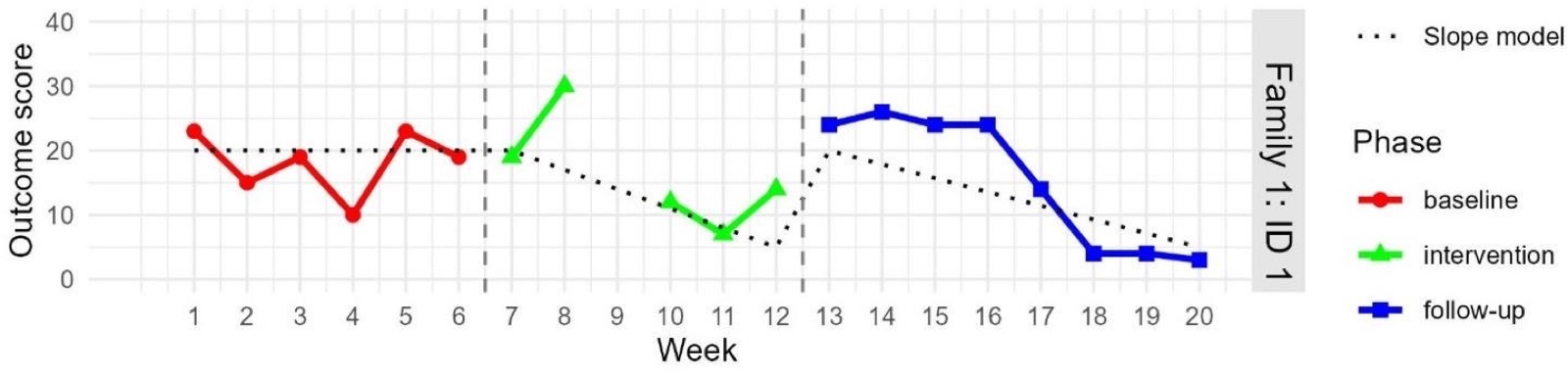
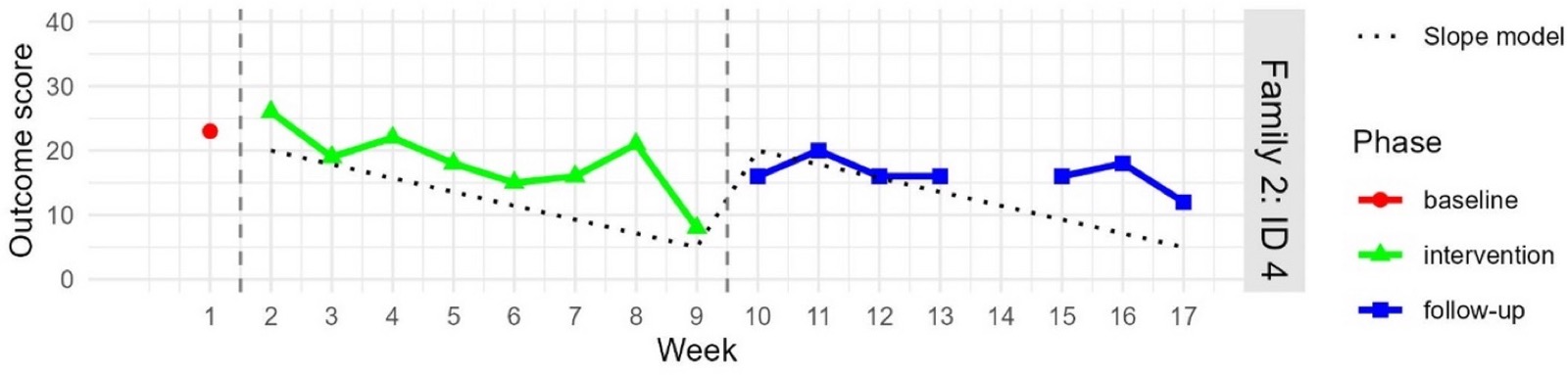
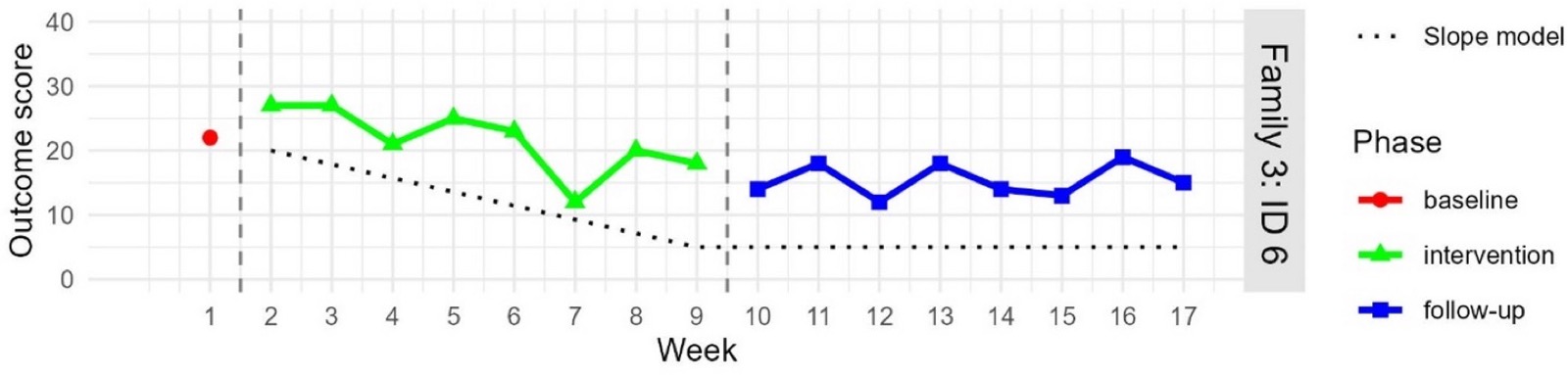
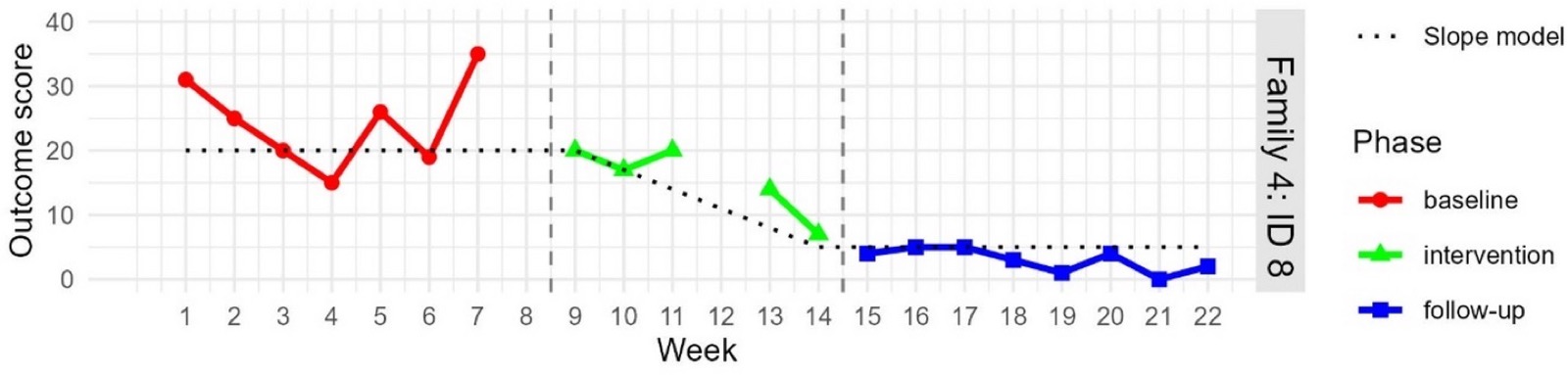
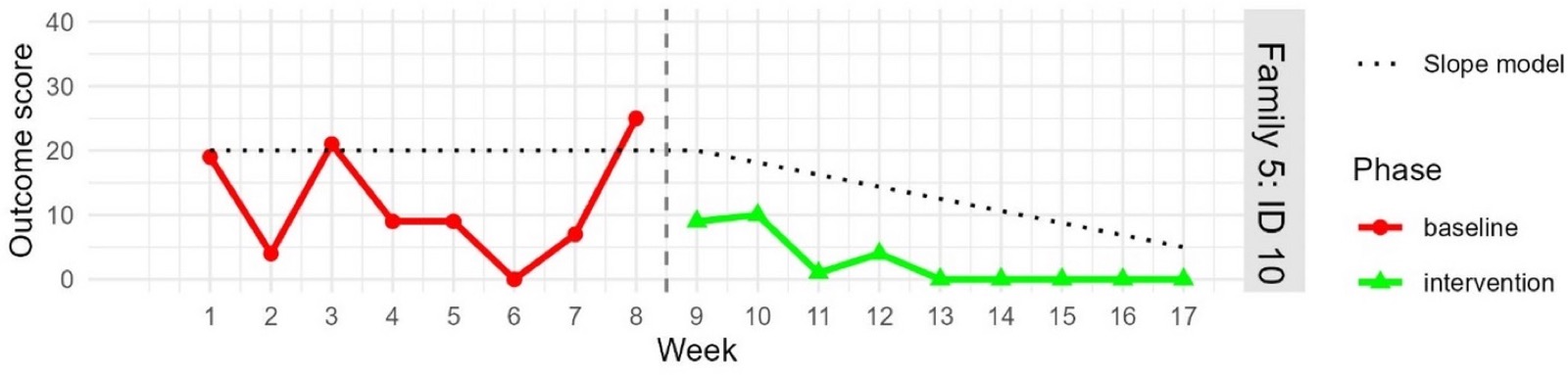
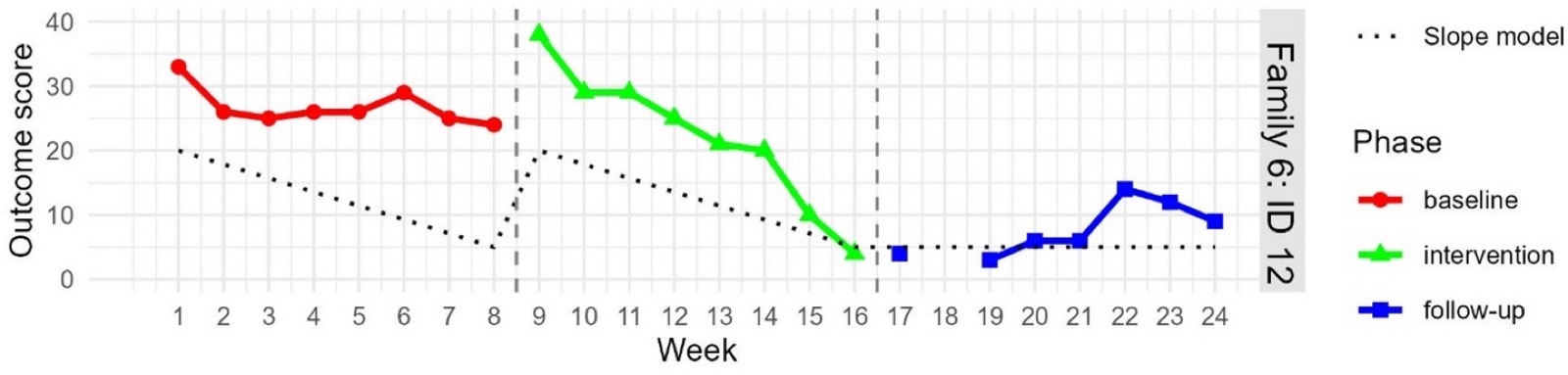
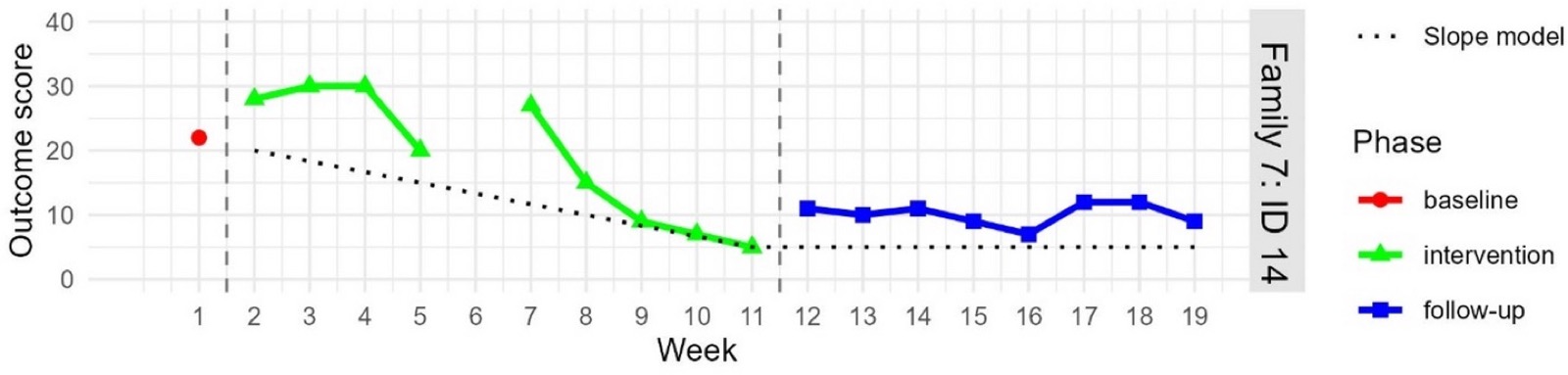
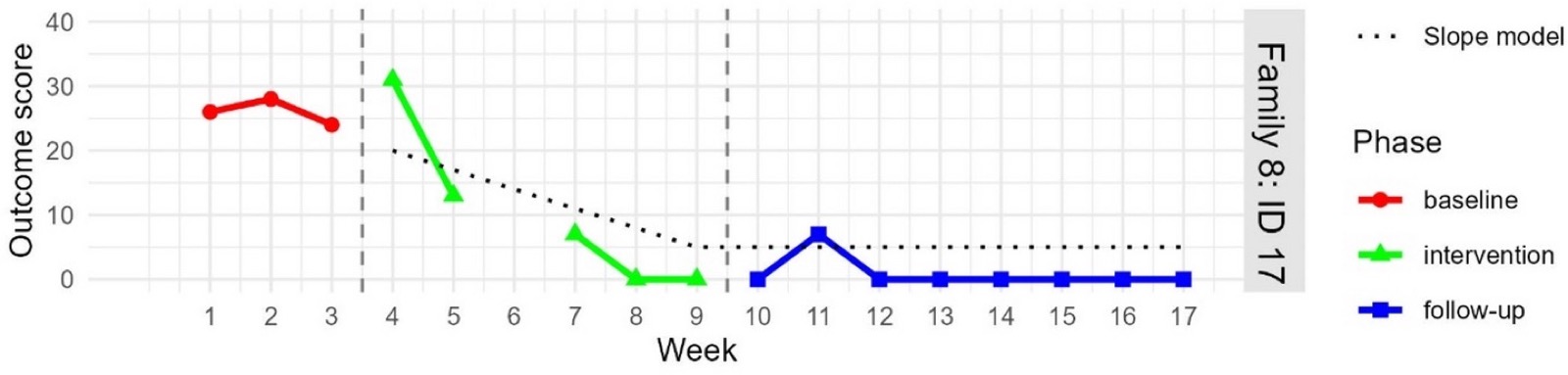
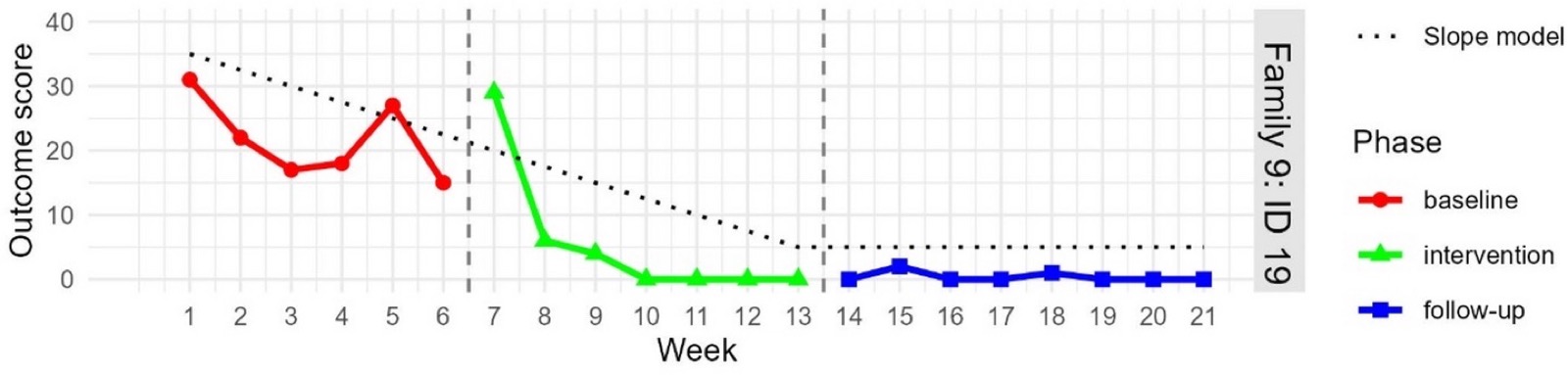
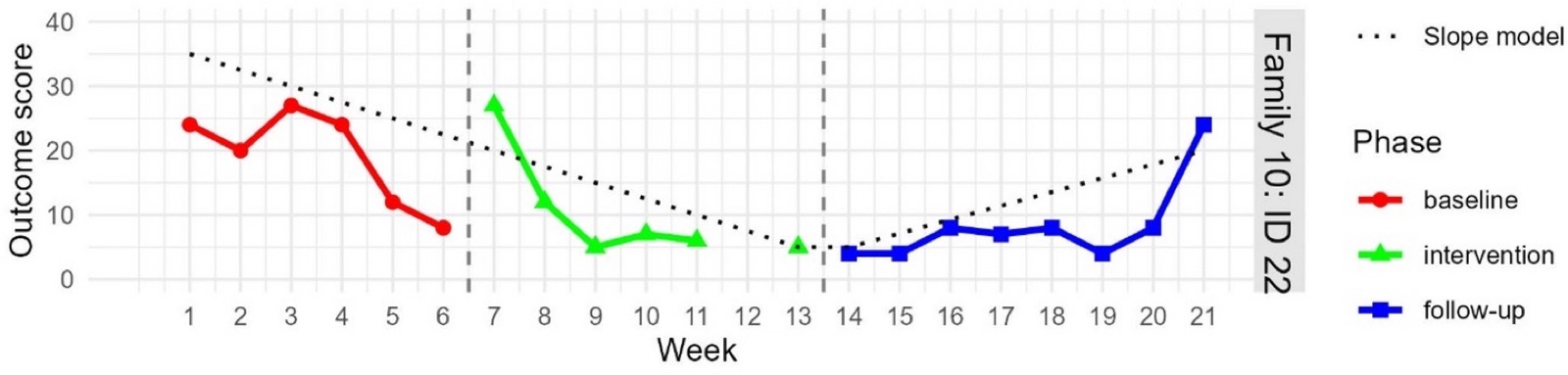
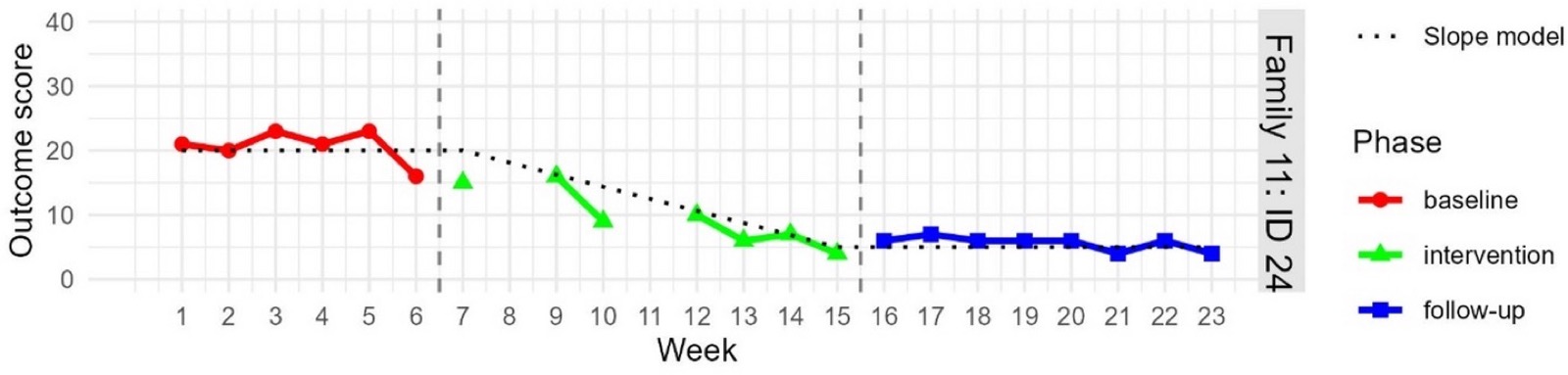
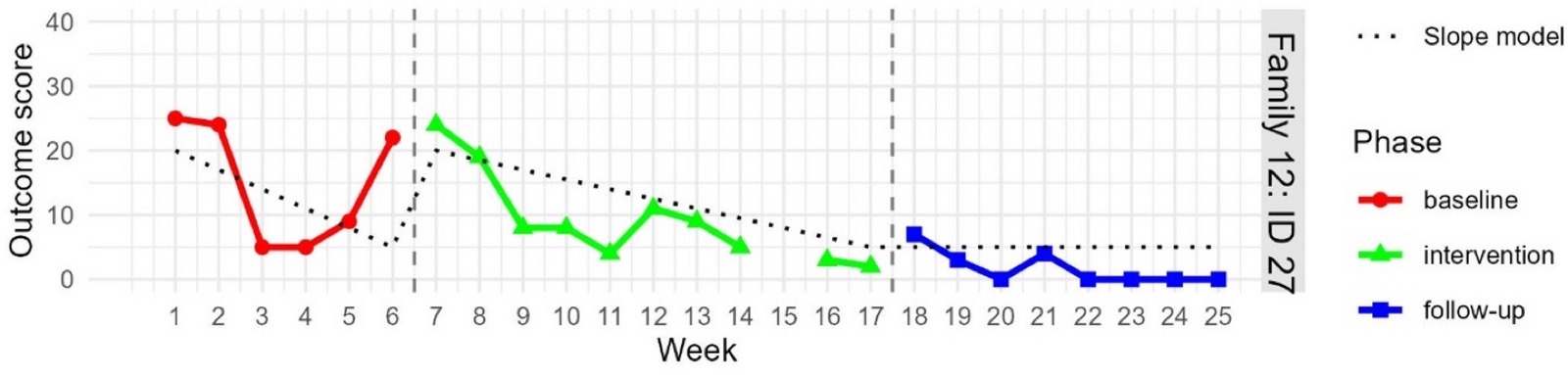
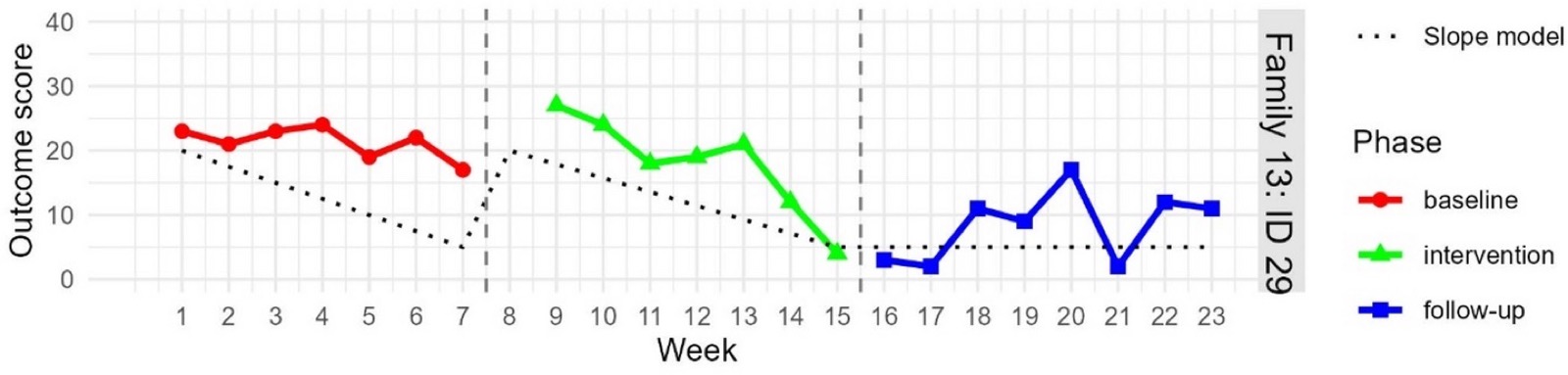
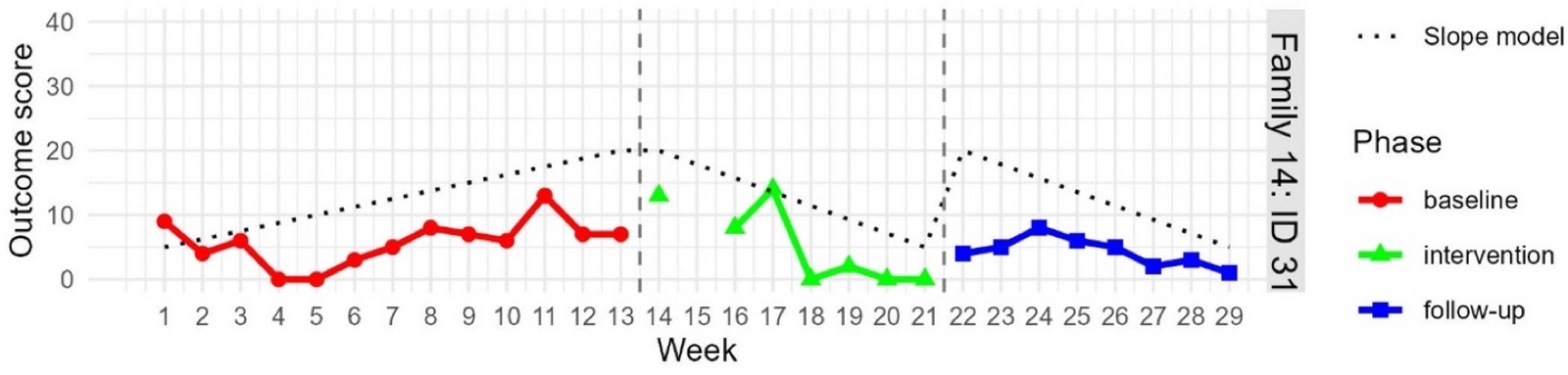
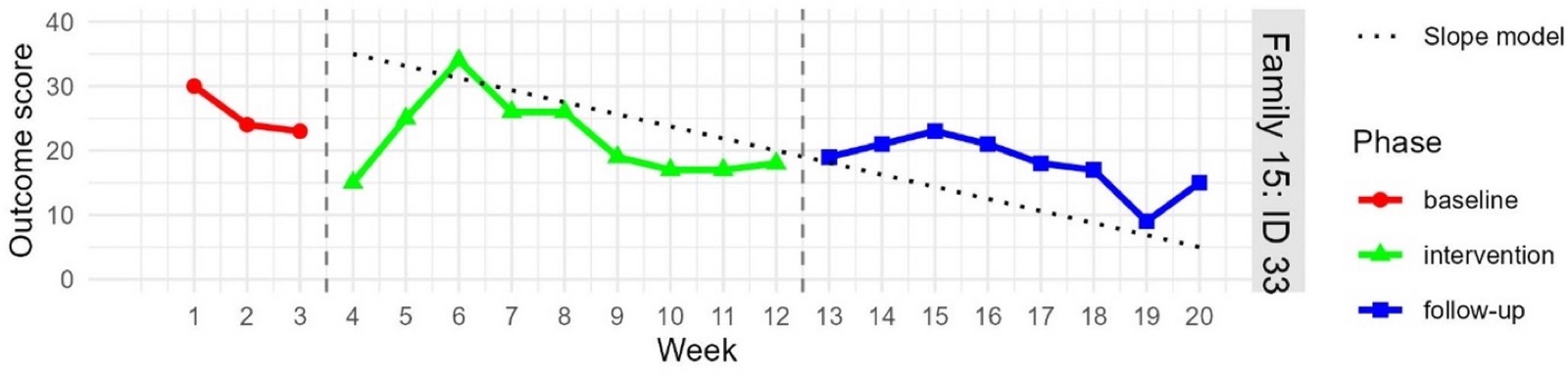
Child Trauma Symptoms
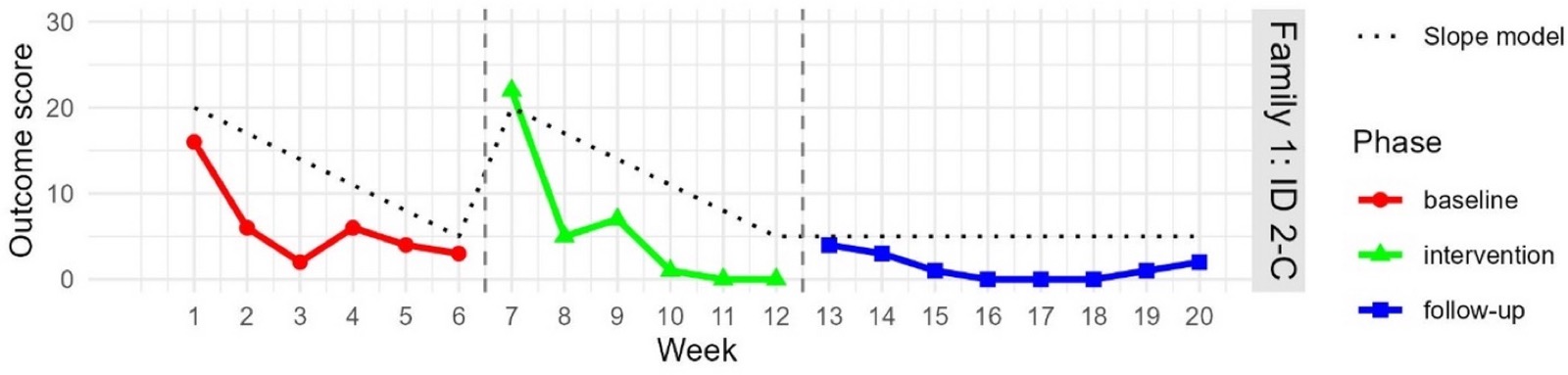
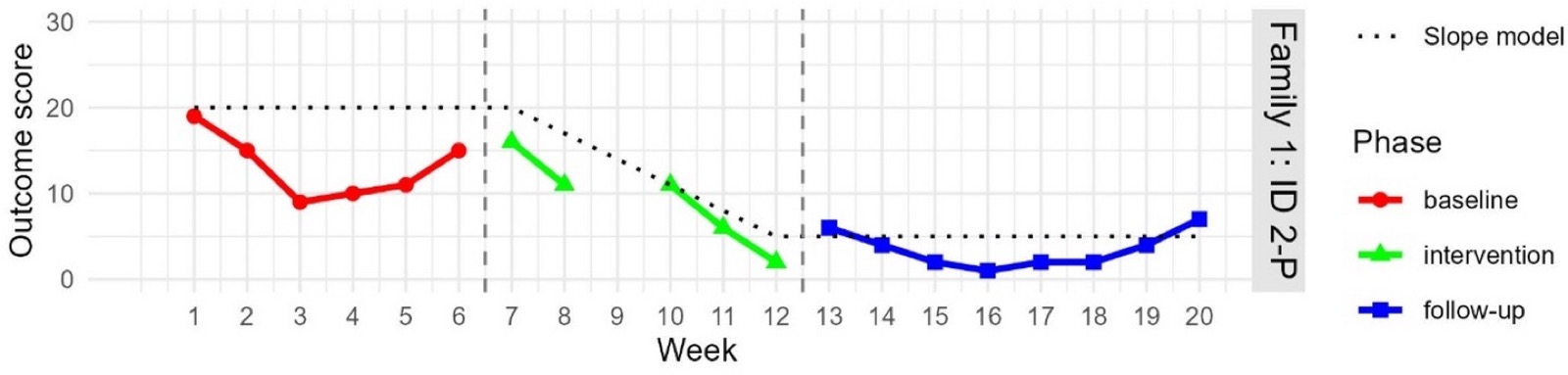
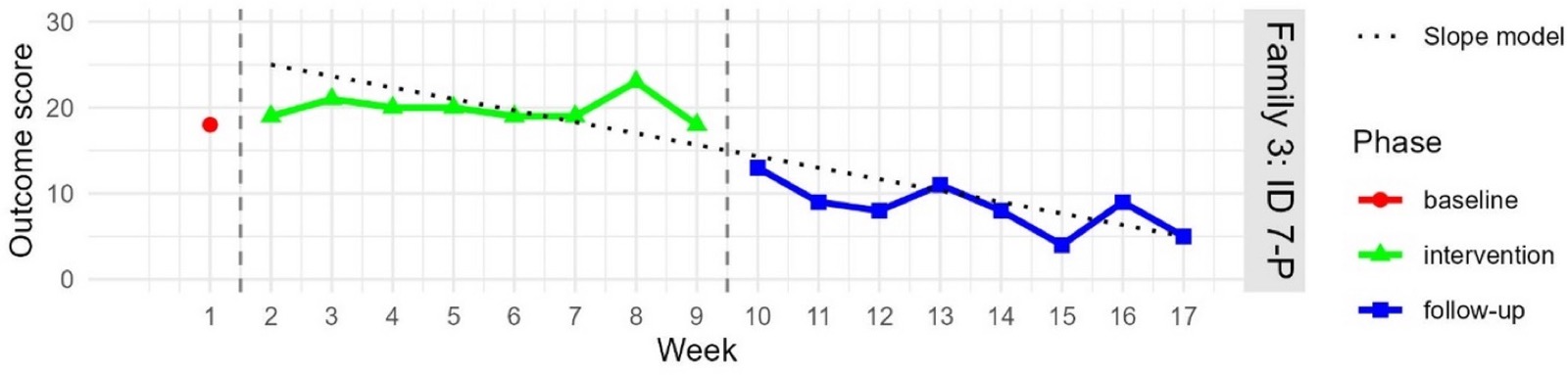
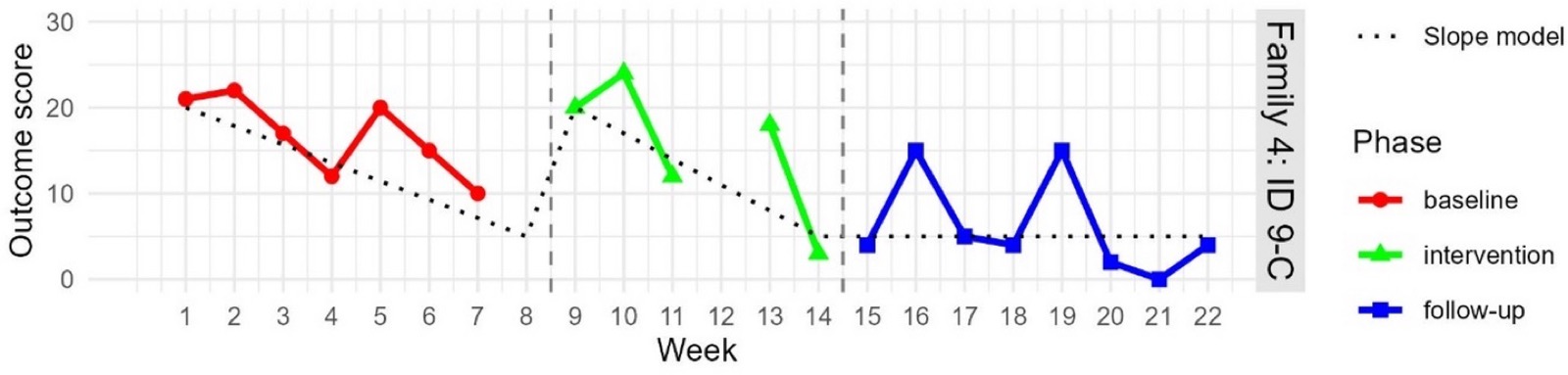
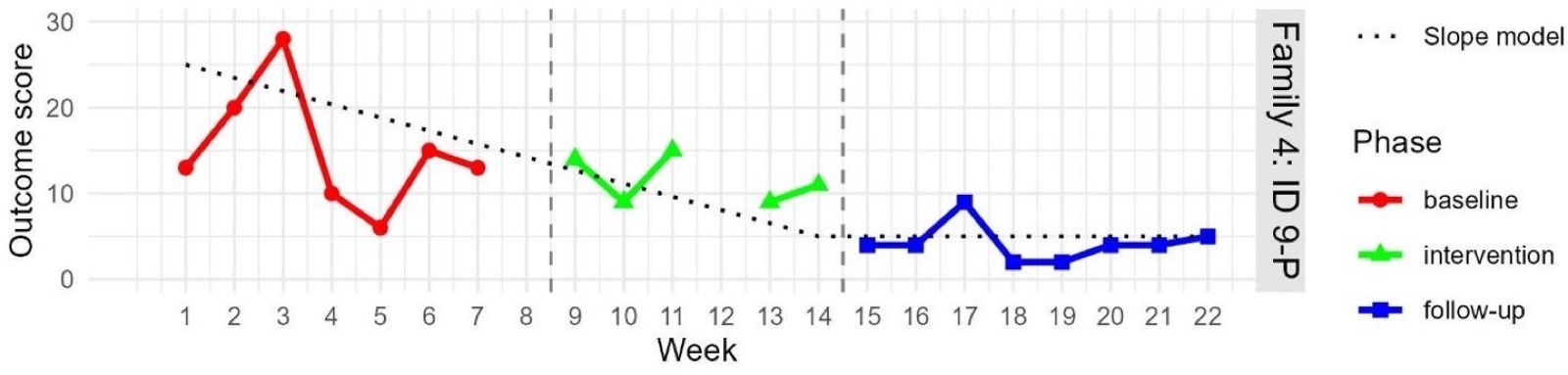
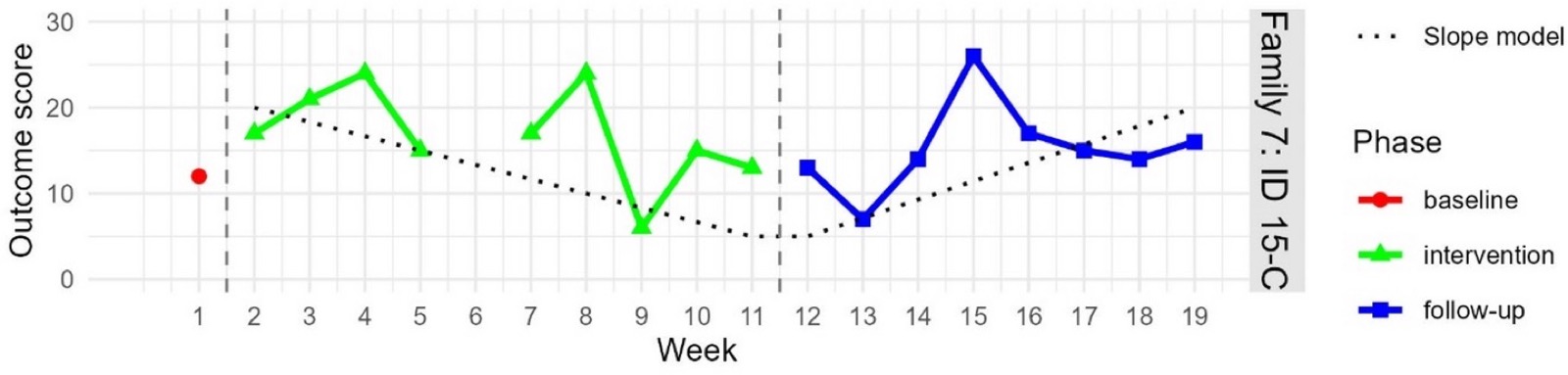
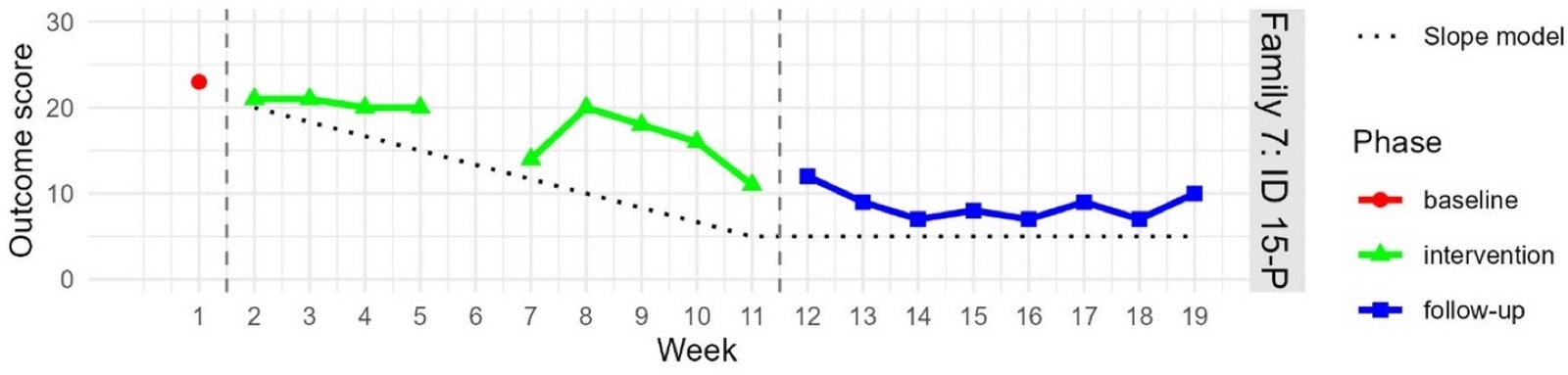
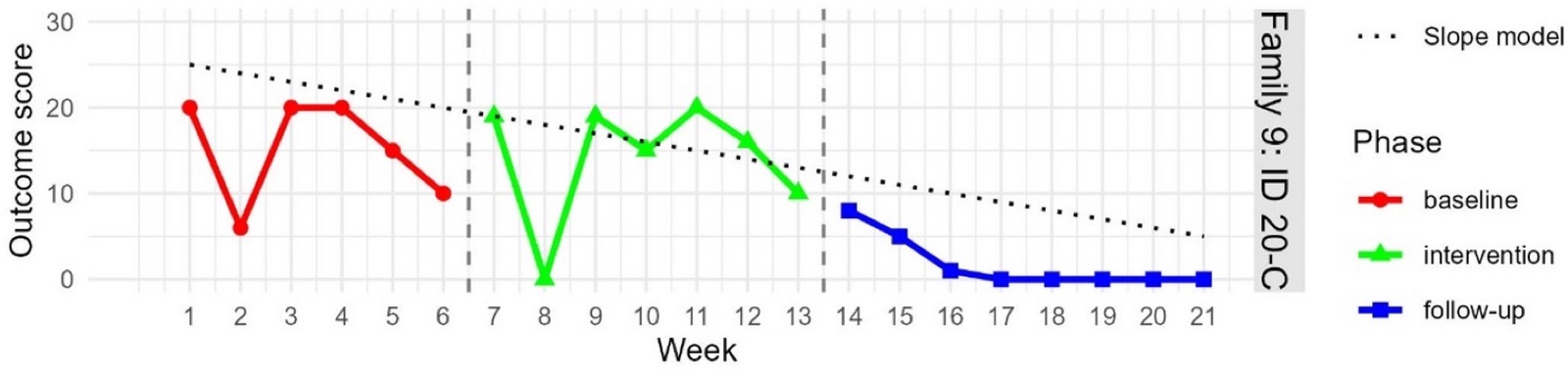
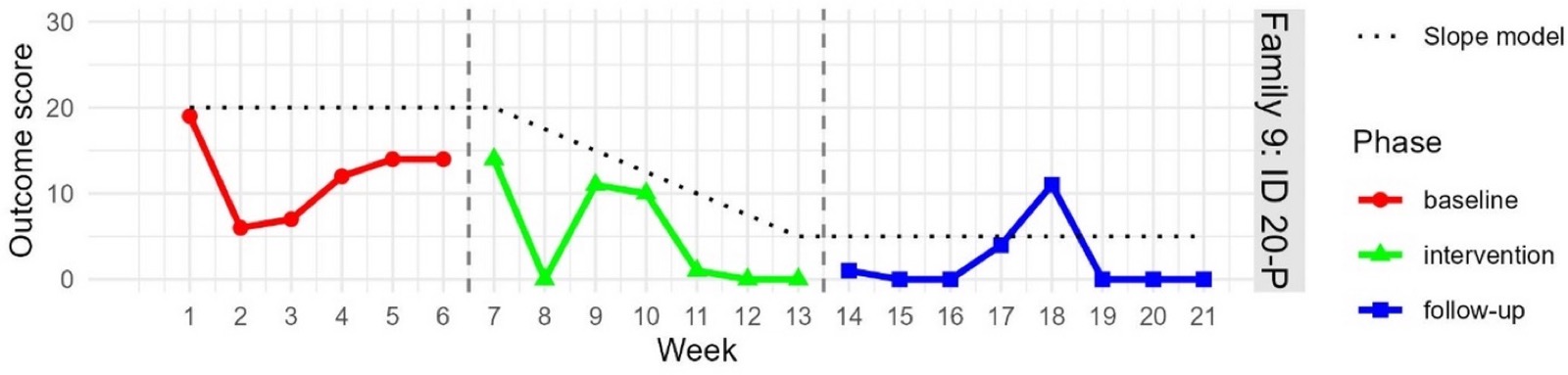
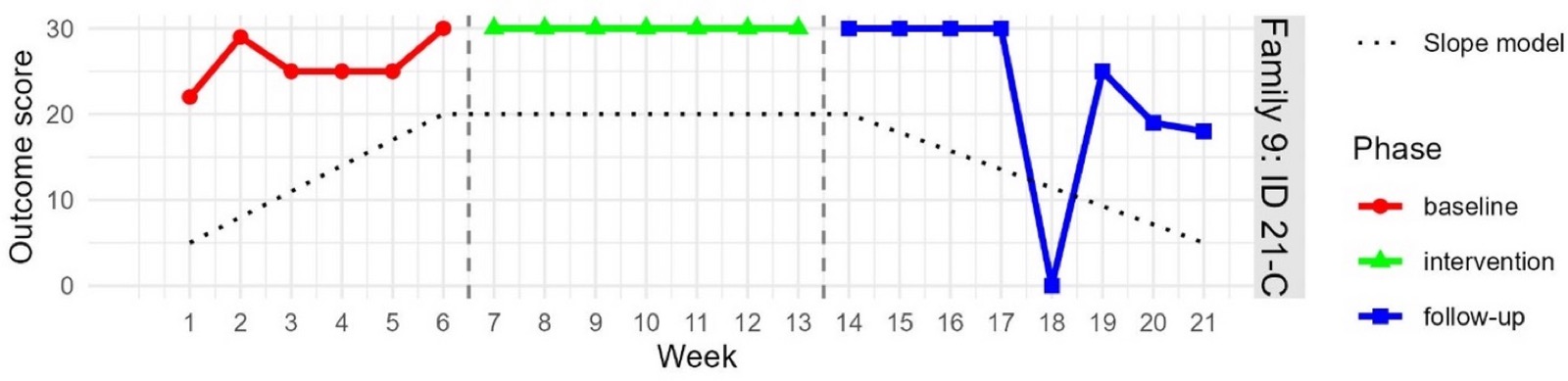
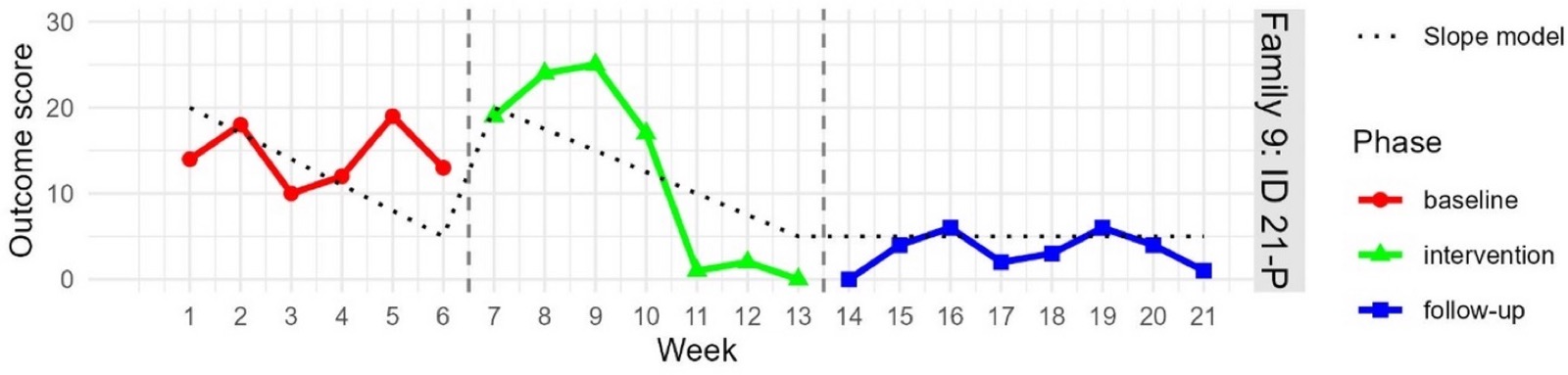
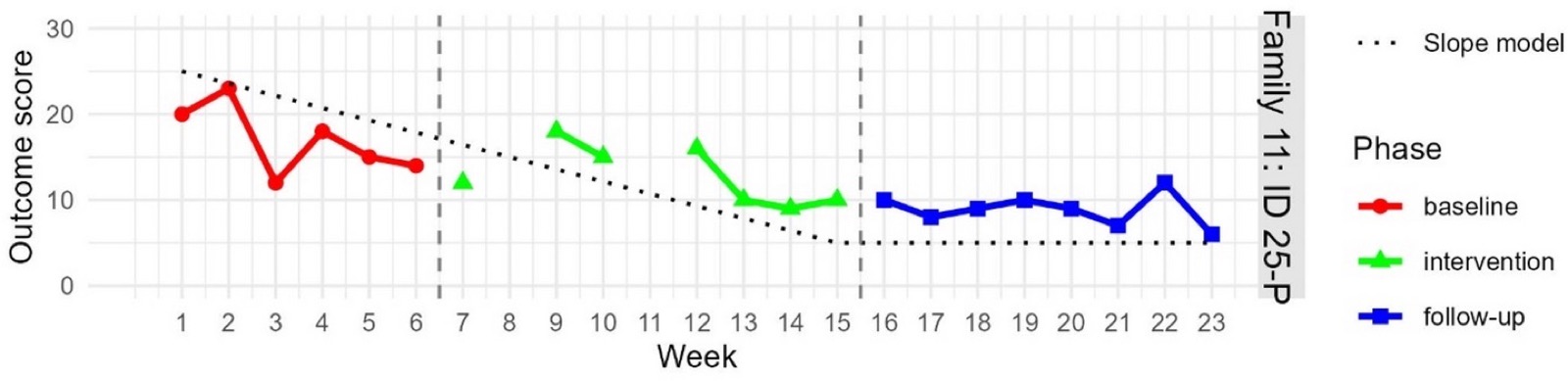
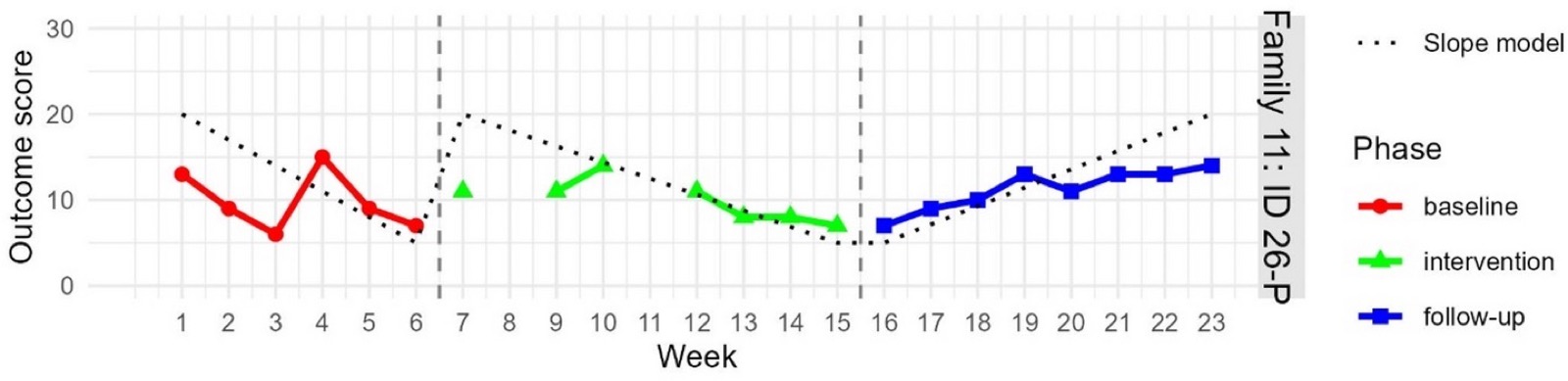
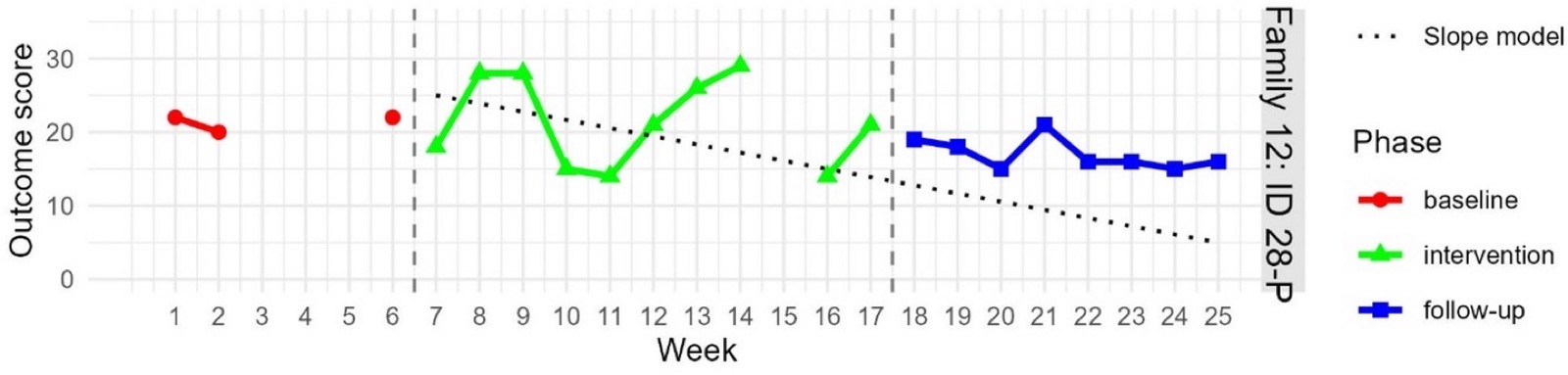
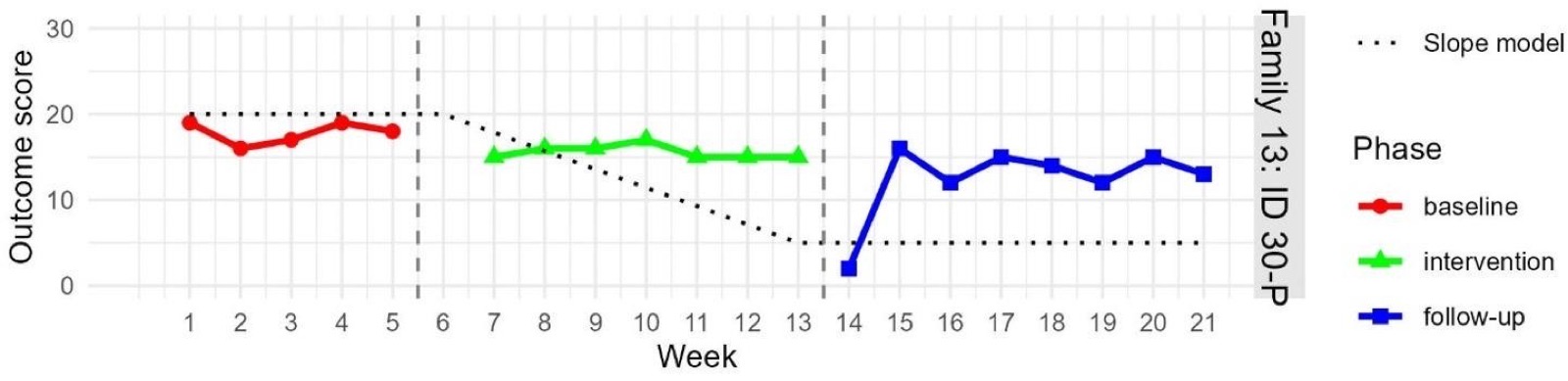
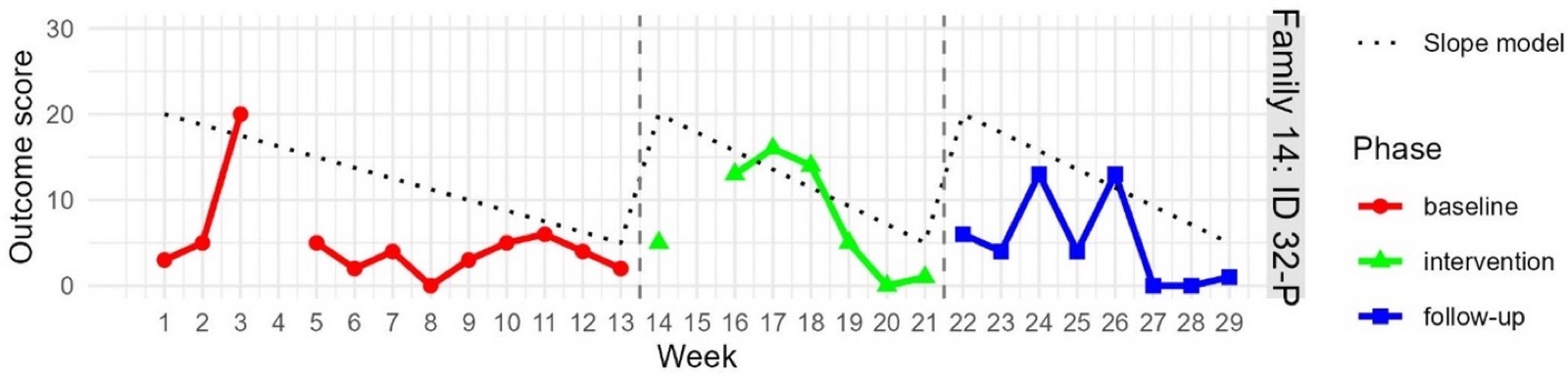
Child Emotional and Behavioral Problems
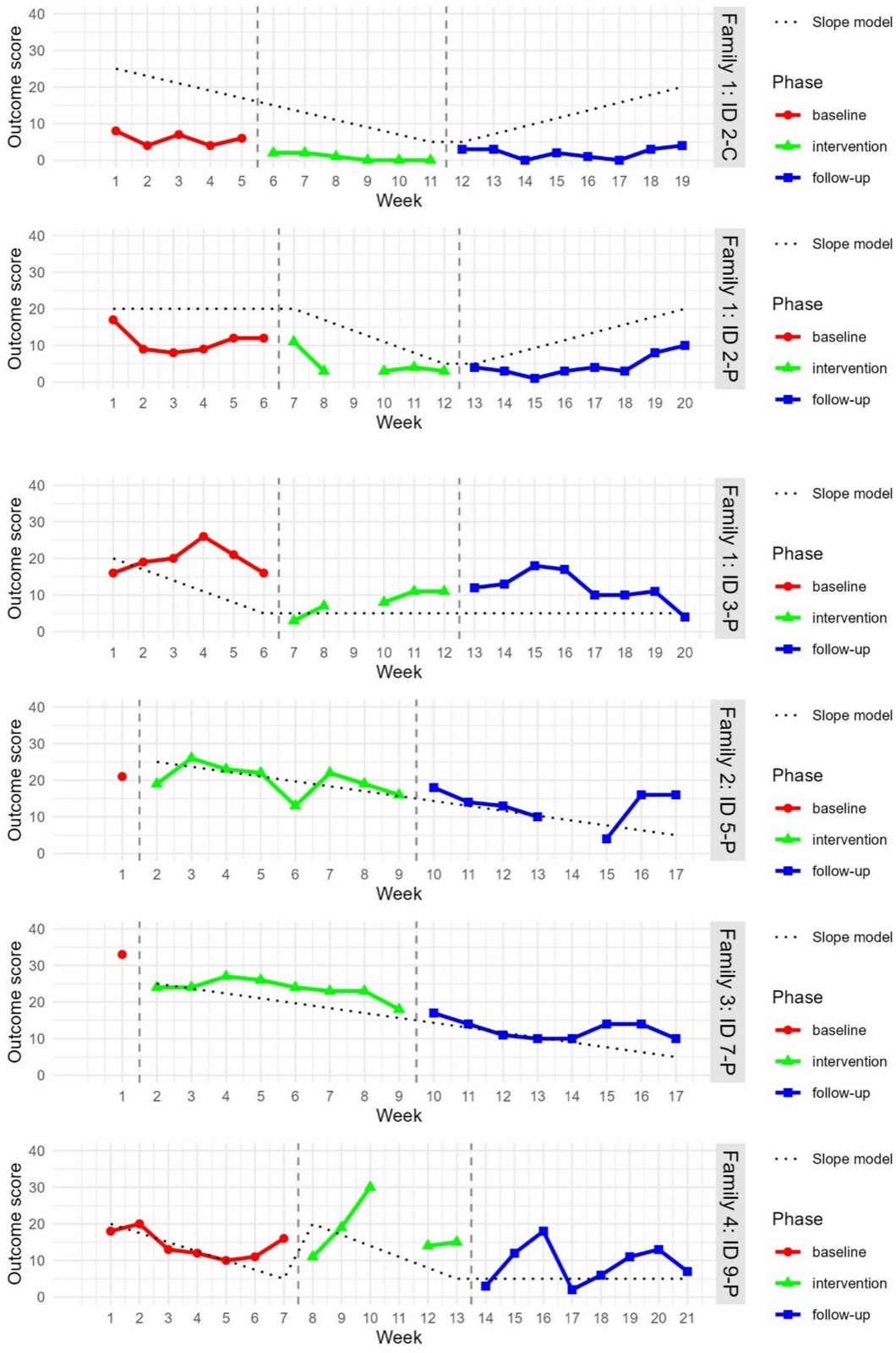
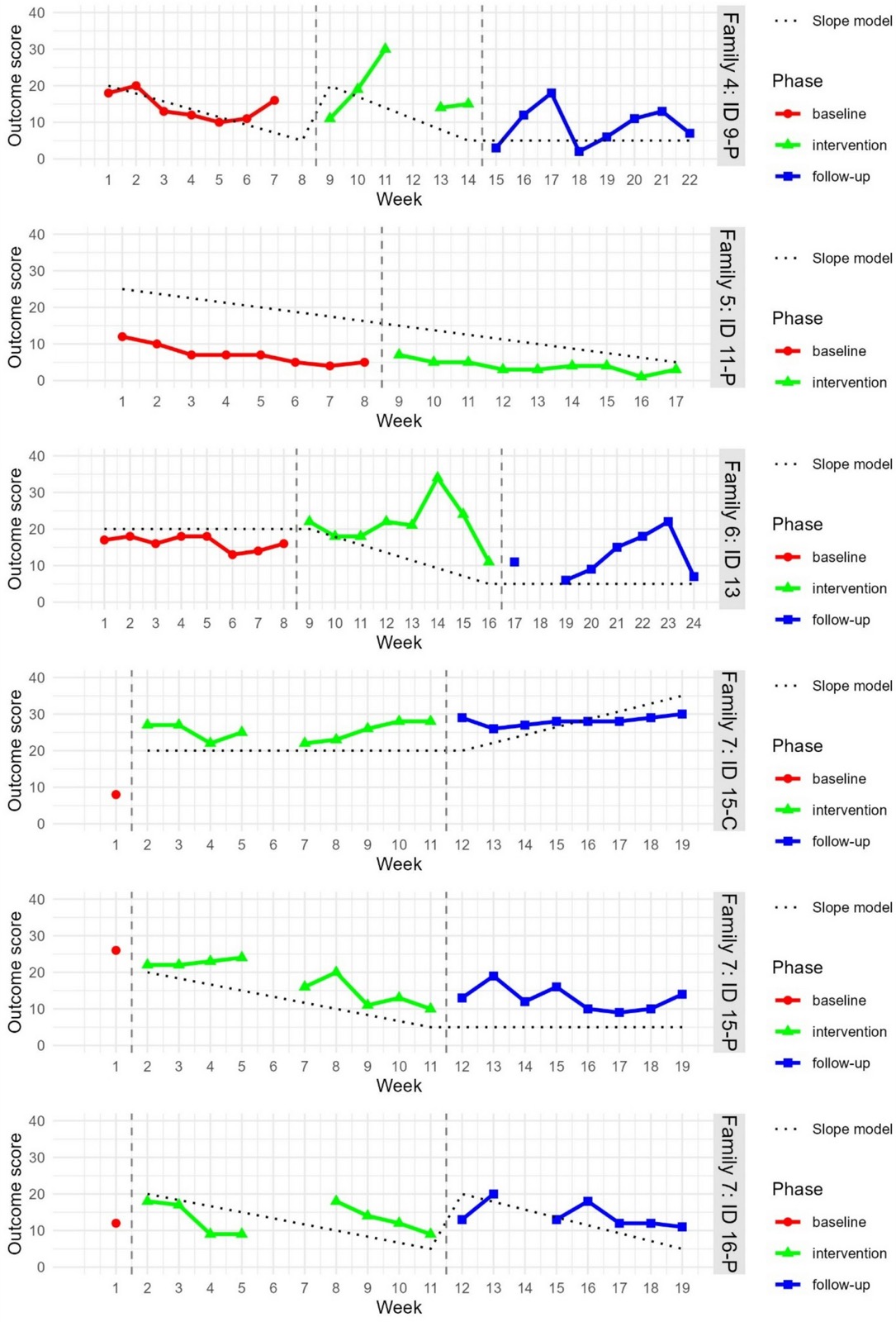
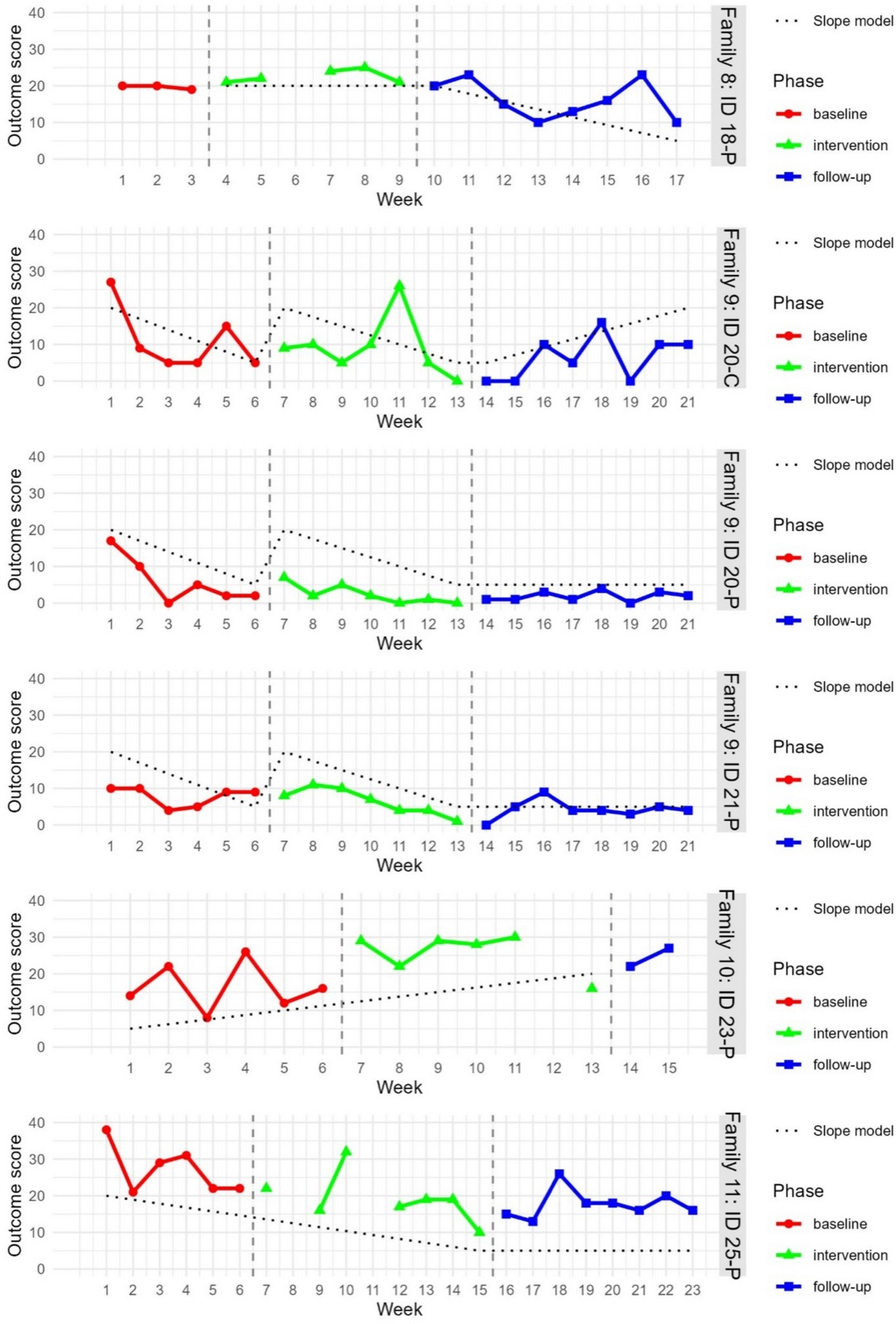
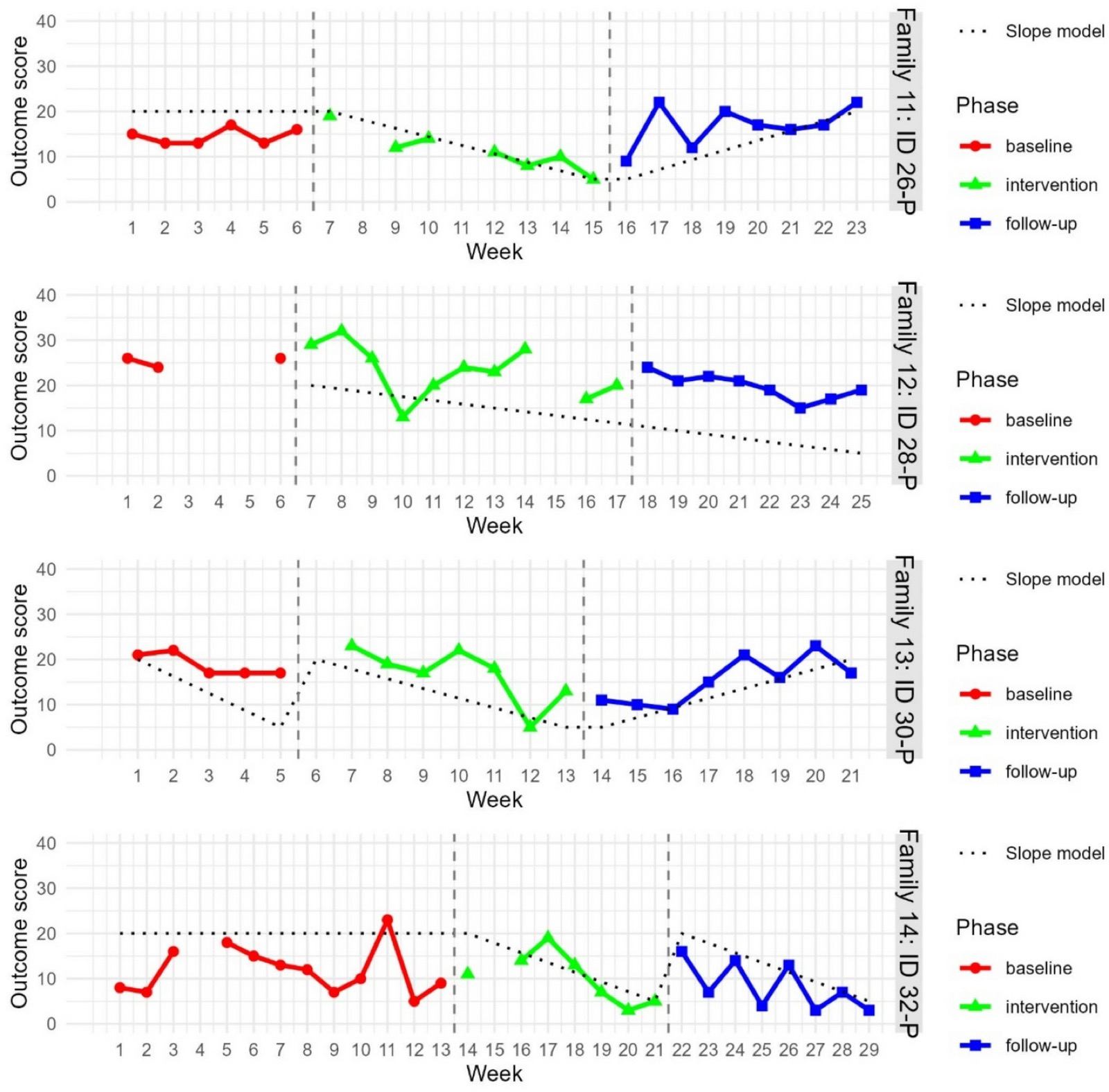
Positive Parental Feelings and Responses Toward the Child
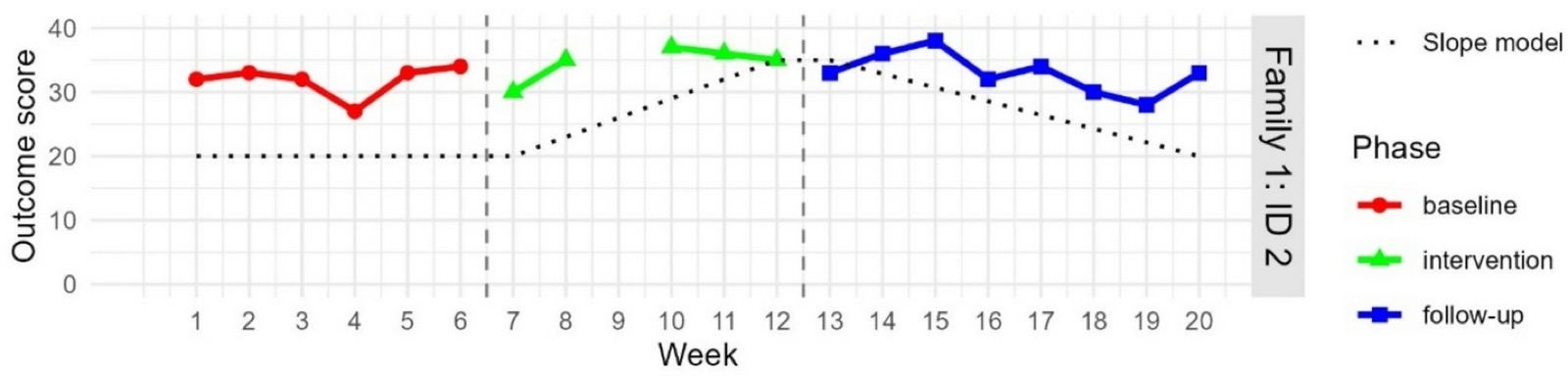
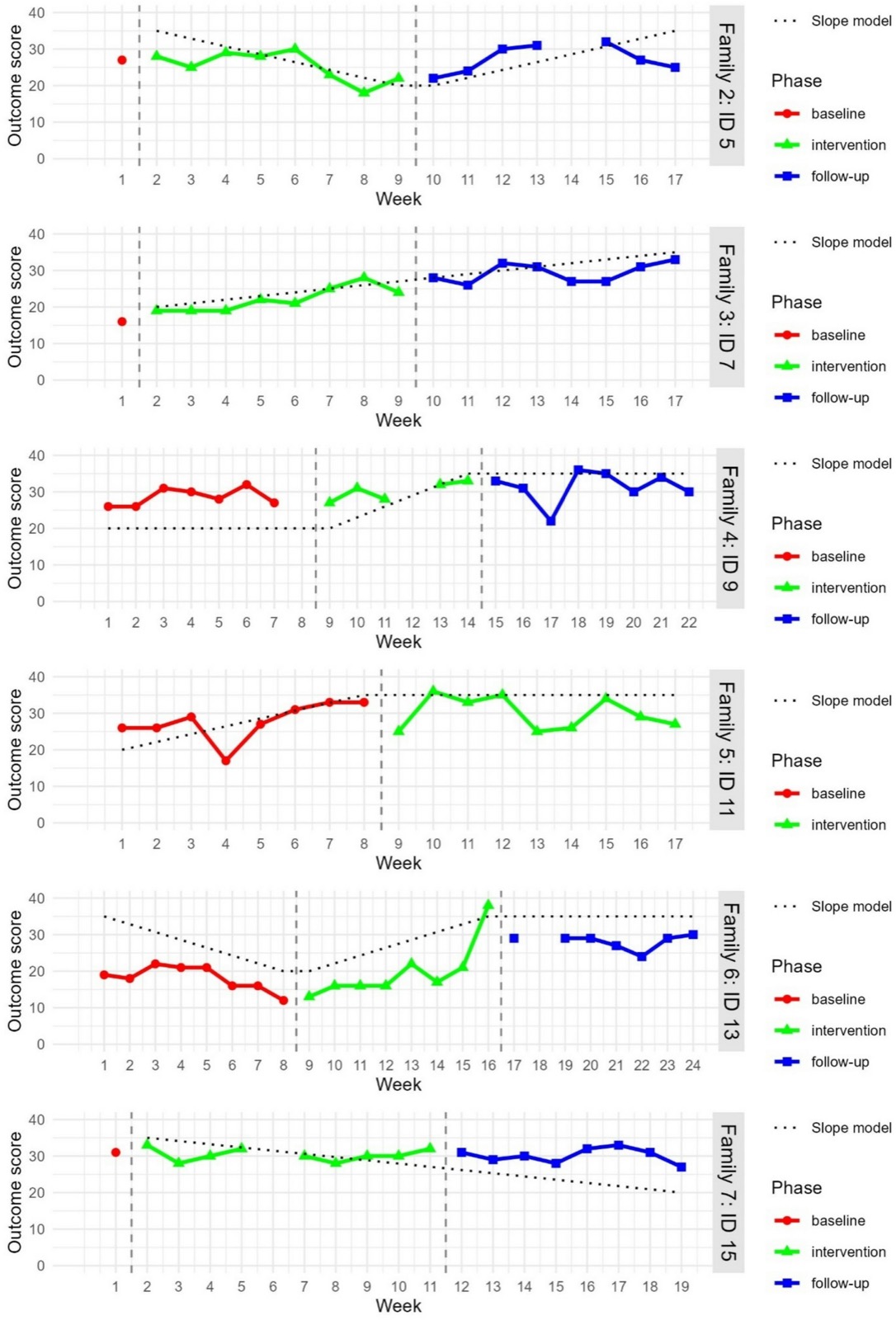
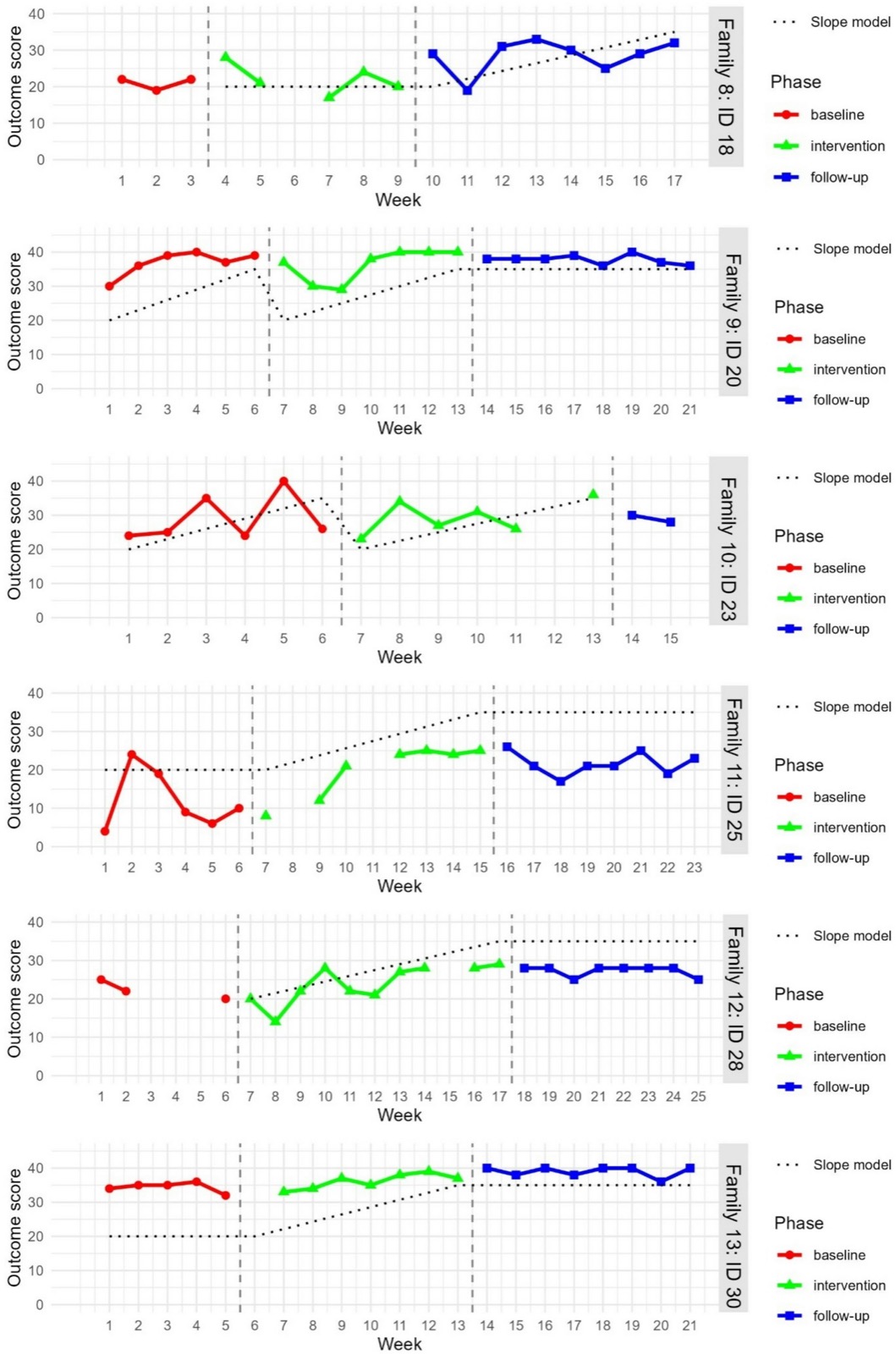
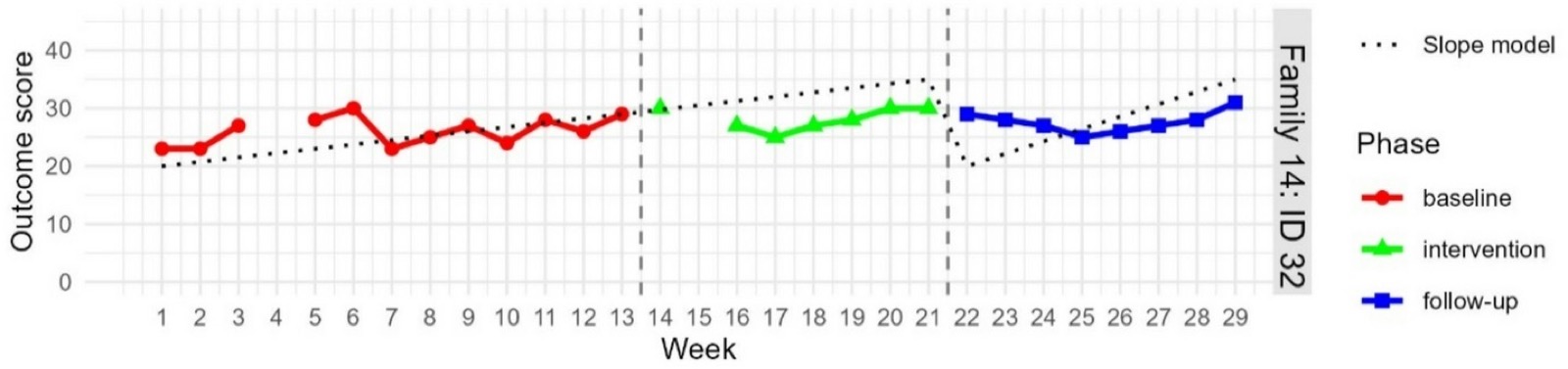
Parent-Child Relationship
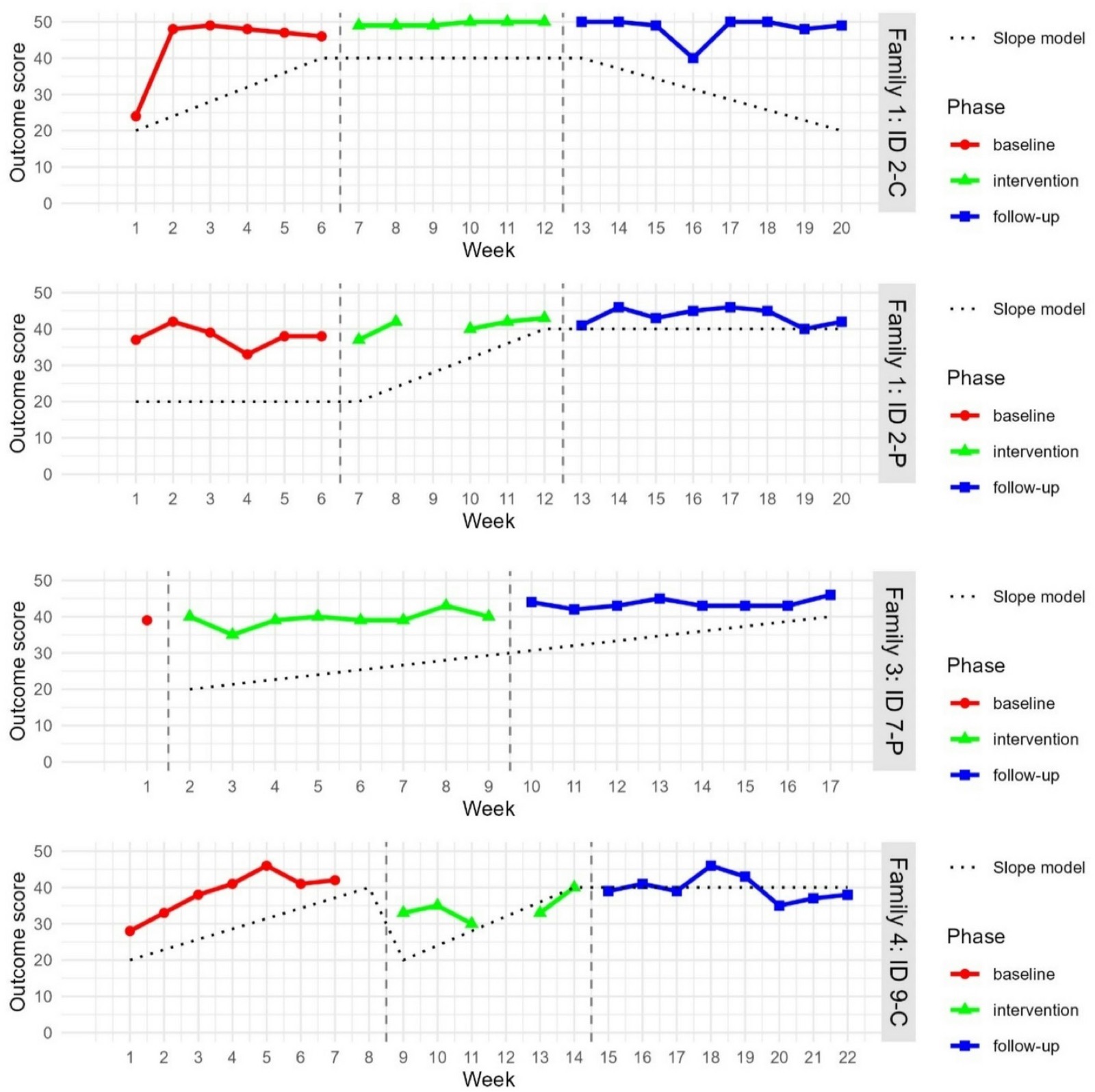
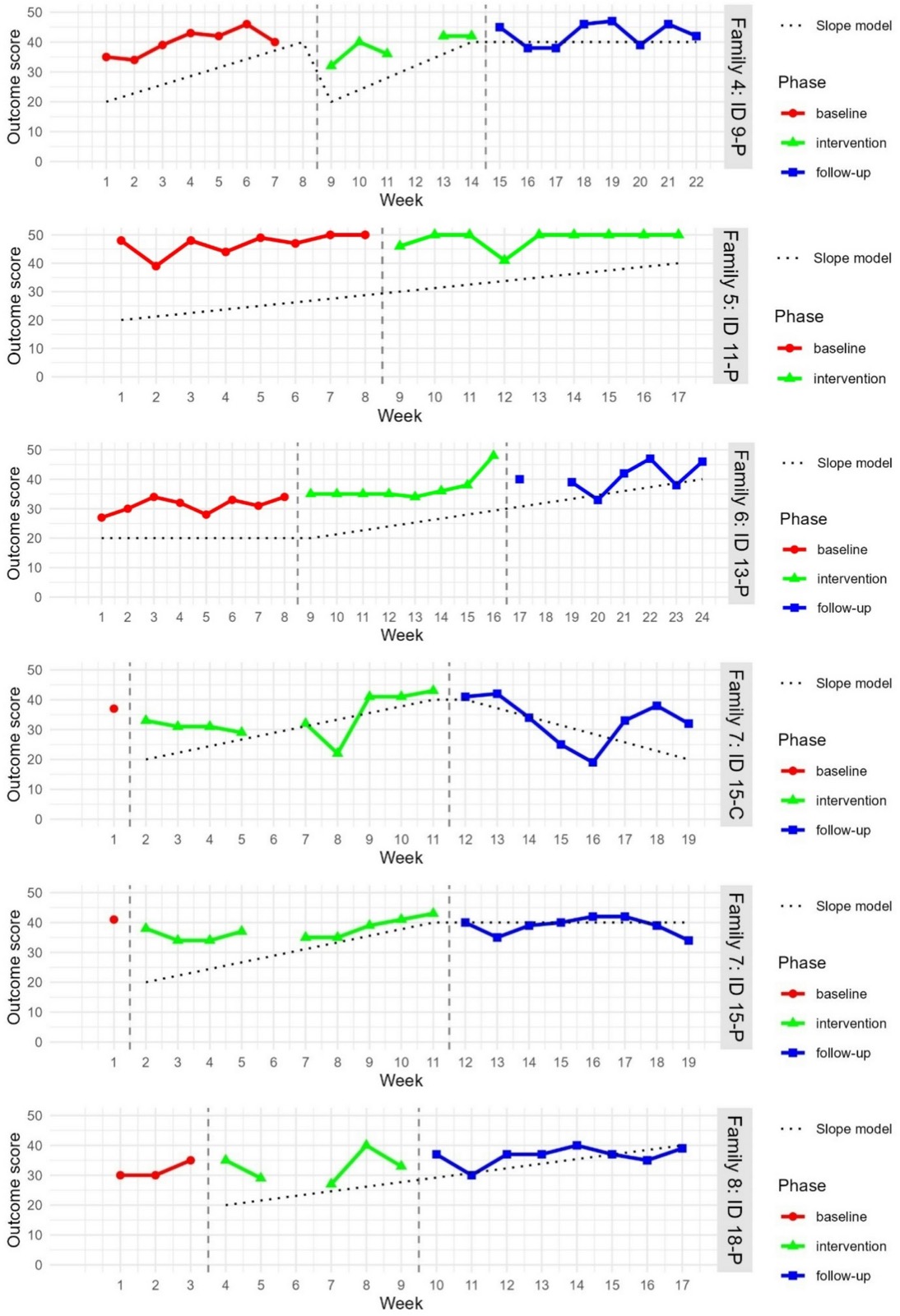
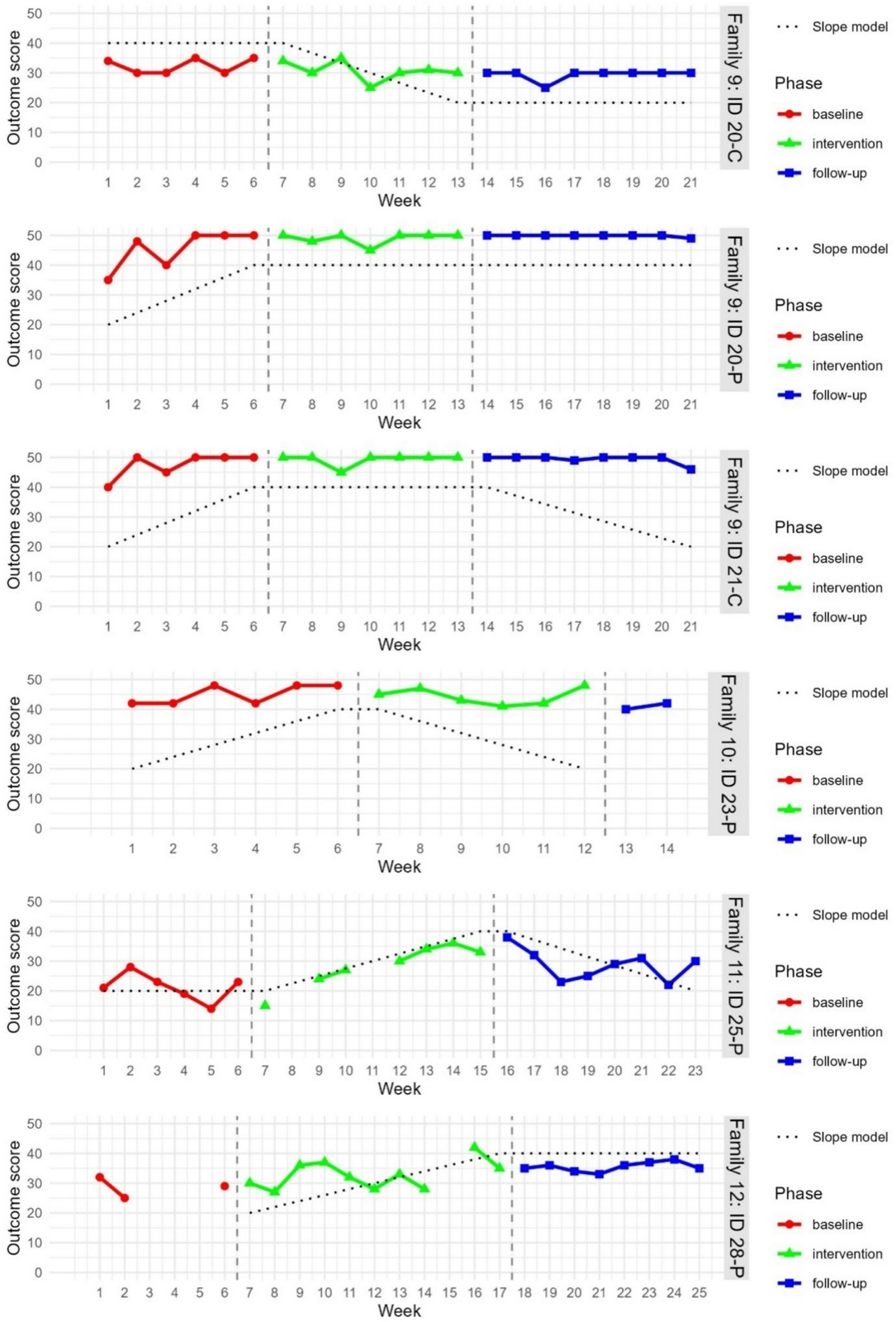
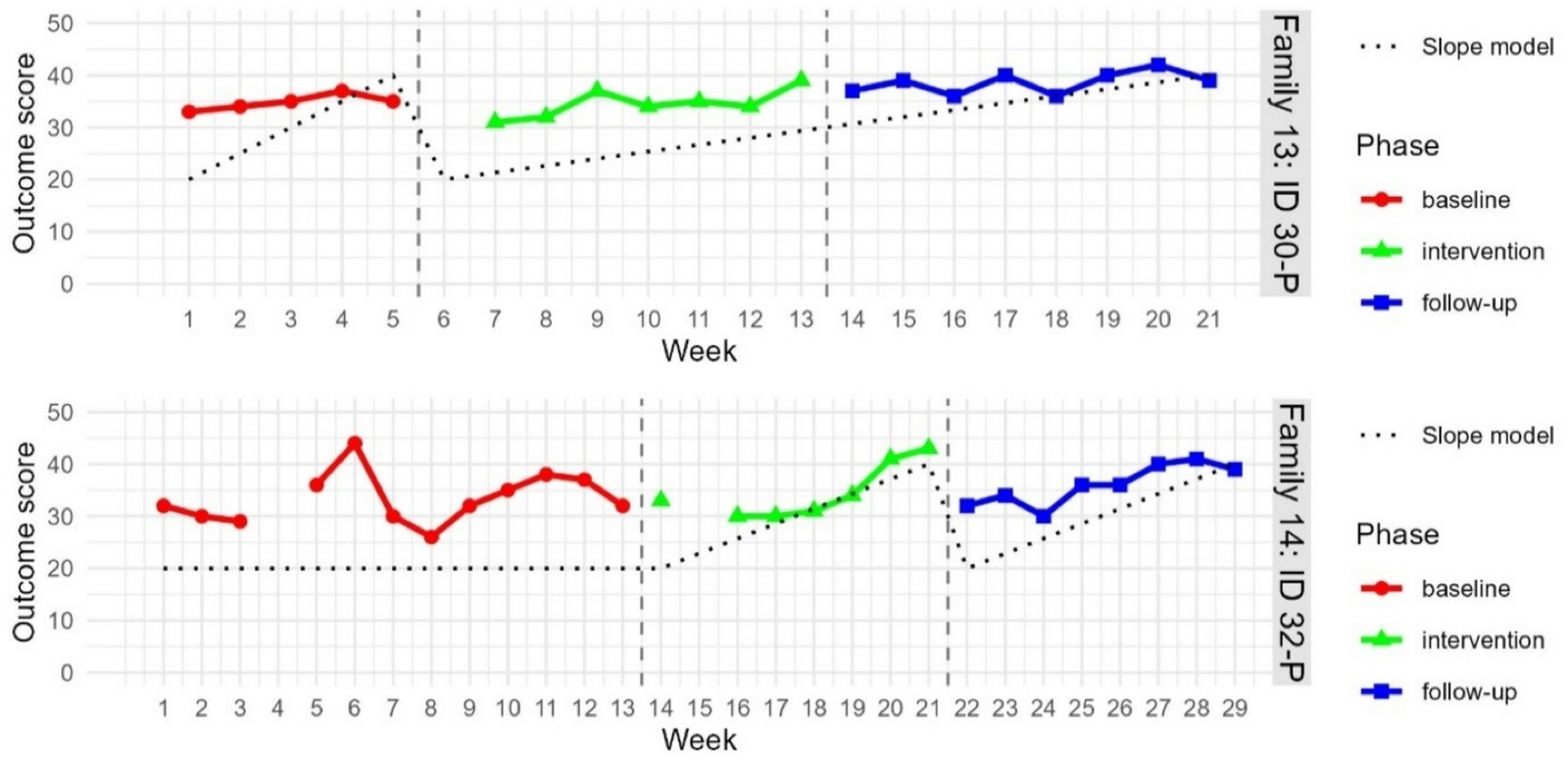
Complexe Systémique: key points
For systemic practice, the interest of KINGS lies in its organisational wager: rather than treating the child and then the parent, or the reverse, the programme brings the whole family on site and deliberately staggers treatments, with the parent one phase ahead so as to become, once better regulated, a support for the child’s therapy. Individual curves mostly move in the right direction, especially for trauma symptoms, and two children who were not treated directly improve as their mother improves: a concrete argument for a circular reading of family trauma. The reading must nonetheless remain cautious. Progress often begins before admission, the measures are single items completed weekly, all parent respondents are mothers and follow-up stops at eight weeks. Children’s view of the relationship is also more mixed than that of parents, and one discharge was followed by a placement: what such an admission represents, “last resort” or not, deserves to be talked through with the family from the moment of referral. Read alongside the study on effective elements of care for families with multiple problems, and the article on family-based intensive trauma treatment after family violence.
Notes from the original
1 For pre-registered hypotheses and analytical approach see https://osf.io/uc63z.
2 In Fig. 2, for completeness, models were also derived for baseline to follow-up, but we do not emphasize this contrast in interpretation because it inherently spans the intervention phase.
3 Note: In each figure, the dotted black line represents the standard slope model (out of five predefined patterns) that showed the highest correlation with the participant’s observed data in Simulation Modeling Analysis (SMA). It serves as a visual aid to interpret the most plausible change pattern and does not represent a fitted trend line. In rare cases where the SMA yielded conflicting slope patterns within the same phase (i.e., different best-fitting slopes for adjacent phase comparisons), we prioritized the comparison with the strongest correlation coefficient to determine the visual trend representation. This approach ensures consistency and avoids multiple conflicting trends within a single phase. The detailed SMA results per participant are shown in Tables 4, 5, 6, 7, 8.
Acknowledgements. This work is part of a larger project, “KINGS: Effectiveness of an innovative treatment program for traumatized children and parents in multiple problem situations”, funded by the Stichting tot Steun VCVGZ [grant number 263]. The authors wish to express their gratitude to Dr. Tim Tausendfreund, ZHAW Zurich University of Applied Sciences, for his valuable feedback and critical insights during the first author’s research visit to Switzerland.
Conflict of interest. The authors declare no competing interests relevant to the content of this study.
Ethical Approval. This study is part of a larger, comprehensive evaluation of the effectiveness of the KINGS treatment program, a longitudinal research project conducted by the same research team. This project was approved by the Ethics Review Board of the University of Rotterdam (20–064).
Consent to Participate. Informed consent was obtained from parents and children over 12 years of age.
References
American Psychiatric Association. (2013). Diagnostic and statistical manual of mental disorders (5th ed.). American Psychiatric Association.
Balldin, S., Fisher, P. A., & Wirtberg, I. (2016). Video feedback intervention with children: A systematic review. Research on Social Work Practice, 28(6), 682–695. https://doi.org/10.1177/1049731516671809
Barlow, D. H., & Nock, M. K. (2009). Why can’t we be more idiographic in our research? Perspectives on Psychological Science, 4, 19–21. https://doi.org/10.1111/j.1745-6924.2009.01088.x
Barth, R. P., Zeinstra, L. T., Lee, B. R., & Harder, A. T. (2023). Shared family care: Out-of- Home care programs for serving parents and children together. Residential Treatment For Children & Youth, 41(1), 24–46. https://doi.org/10.1080/0886571x.2023.2202889
Bülow, A., Janssen, L. H. C., Dietvorst, E., Bij de Vaate, N. A. J. D., Hillegers, M., Valkenburg, P. M., & Keijsers, L. (2025). From burden to enjoyment: A user-centered approach to engage adolescents in intensive longitudinal research. Journal of Adolescence, 97(4), 886–900. https://doi.org/10.1002/jad.12478
Bodden, D. H. M., & Deković, M. (2016). Multiproblem families referred to youth mental health: What’s in a name? Family Process, 55(1), 31–47. https://doi.org/10.1111/famp.12144
Borckardt, J. J., Nash, M. R., Murphy, M. D., Moore, M., Shaw, D., & O’Neil, P. (2008). Clinical practice as natural laboratory for psychotherapy research: A guide to case- based time-series analysis. American Psychologist, 63(2), 77–95. https://doi.org/10.1037/0003-066X.63.2.77
Bosquet Enlow, M., Egeland, B., Carlson, E., Blood, E., & Wright, R. J. (2014). Mother- Infant attachment and the intergenerational transmission of posttraumatic stress disorder. Development and Psychopathology, 26(1), 41–65. https://doi.org/10.1017/S0954579413000515
Boulton, J. G., Allen, P. M., & Bowman, C. (2015). Embracing complexity: Strategic perspectives for an age of turbulence. Oxford University Press. https://doi.org/10.1093/acprof:oso/9780199565252.001.0001
Bunting, L., Webb, M. A., & Shannon, R. (2017). Looking again at troubled families: Parents’ perspectives on multiple adversities. Child & Family Social Work, 22, 31–40. https://doi.org/10.1111/cfs.12232
Burback, L., Brémault-Phillips, S., Nijdam, M. J., McFarlane, A., & Vermetten, E. (2024). Treatment of posttraumatic stress disorder: A state-of-the-art review. Current Neuropharmacology, 22(4), 557–635. https://doi.org/10.2174/1570159x21666230428091433
Chen, J. A., Fearey, E., & Smith, R. E. (2017). That which is measured improves: A theoretical and empirical review of self-monitoring in self-management and adaptive behavior change. Journal of Behavior Therapy and Mental Health, 1(4), 19–38. https://doi.org/10.14302/issn.2474-9273.jbtm-16-1180
Christie, H., Hamilton-Giachritsis, C., Alves-Costa, F., Tomlinson, M., & Halligan, S. L. (2019). The impact of parental posttraumatic stress disorder on parenting: A systematic review. European Journal of Psychotraumatology. https://doi.org/10.1080/20008198.2018.1550345
Cohen, J. A., & Mannarino, A. P. (2015). Trauma-focused cognitive behavior therapy for traumatized children and families. Child and Adolescent Psychiatric Clinics of North America, 24(3), 557–570. https://doi.org/10.1016/j.chc.2015.02.005
Cooper, J. O., Heron, T. E., & Heward, W. L. (2019). Applied behavior analysis (3rd ed.). Pearson.
D’Andrea, W., Ford, J., Stolbach, B., Spinazzola, J., & van der Kolk, B. A. (2012). Understanding interpersonal trauma in children: Why we need a developmentally appropriate trauma diagnosis. The American Journal of Orthopsychiatry, 82(2), 187–200. https://doi.org/10.1111/j.1939-0025.2012.01154.x
Deković, M., & Bodden, D. H. M. (2019). Gezinnen met meervoudige en complexe problemen: Kenmerken en verschillende typen [Families with multiple and complex problems: Characteristics and different types]. In J. Knot-Dickscheit & E. J. Knorth (Eds.), Gezinnen met meervoudige en complexe problemen. Theorie en praktijk [Families with multiple and complex problems. Theory and practice].Lemniscaat.
DeLorenzi, L., Daire, A. P., & Bloom, Z. D. (2016). Predicting treatment attrition for child sexual abuse victims: The role of child trauma and co-occurring caregiver intimate partner violence. Counseling Outcome Research and Evaluation, 7(1), 40–52. https://doi.org/10.1177/2150137816632850
Delsing, M., & van Yperen, T. (2017). Wat werkt voor wie? De kracht van N = 1-onderzoek [What works for whom? The power of N=1 research]. In T. van Yperen (Ed.), Zicht op effectiviteit: Handboek voor resultaatgerichte ontwikkeling van interventies in de jeugdsector[Looking at effectiveness: A handbook for results-oriented design of interventionsin the youth sector] (pp. 331–356). Lemniscaat.
Emerson, D. (2015). Trauma-sensitive yoga in therapy: Bringing the body into treatment. W. W. Norton.
Engelhard, I. M., Arntz, A., & van den Hout, M. A. (2007). Low specificity of symptoms on the post-traumatic stress disorder (PTSD) symptom scale: A comparison of individuals with PTSD, individuals with other anxiety disorders and individuals without psychopathology. British Journal of Clinical Psychology, 46(4), 449–456. https://doi.org/10.1348/014466507x206883
Eslinger, J., Sprang, G., & Jodts, J. (2022). Keeping children and youth in trauma treatment: Examination of an alliance building dropout management program. Clinical Child Psychology and Psychiatry, 28(2), 721–733. https://doi.org/10.1177/1359104522111184
Falkov, A., Goodyear, M., Hosman, C. M. H., Biebel, K., Skogøy, B. E., Kowalenko, N., Wolf, T., & Re, E. (2016). A systems approach to enhance global efforts to implement family-focused mental health interventions. Child & Youth Services, 37(2), 175–193. https://doi.org/10.1080/0145935x.2016.1104104
Fictorie, V., Jonkman, C., Visser, M., Vandenbosch, M., Steketee, M., & Schuengel, C. (2022). Effectiveness of a high-intensive trauma-focused, family-based therapy for youth exposed to family violence: Study protocol for a randomized controlled trial. Trials. https://doi.org/10.1186/s13063-021-05981-4
Figley, C. R., & Kiser, L. J. (2013). Helping traumatized families (2nd ed.). Routledge/Taylor & Francis Group.
Foa, E. B., Hembree, E., & Rothbaum, B. (2007). Prolonged exposure therapy for PTSD: Therapist guide: Emotional processing of traumatic experiences. Oxford University Press. https://doi.org/10.1093/med:psych/9780195308501.001.0001
Foa, E. B., Riggs, D. S., Dancu, C. V., & Rothbaum, B. O. (1993). Reliability and validity of a brief instrument for assessing post-traumatic stress disorder. Journal of Traumatic Stress, 6(4), 459–473. https://doi.org/10.1007/bf00974317
Foster, K., Maybery, D., Reupert, A., Gladstone, B., Grant, A., Ruud, T., Falkov, A., & Kowalenko, N. (2016). Family-focused practice in mental health care: An integrative review. Child & Youth Services, 37(2), 129–155. https://doi.org/10.1080/0145935x.2016.1104048
Gabriel, T., Keller, S., Bombach, C., Stohler, R., & Ibrahimi, B. (2017). Wirkungsanalyse von mutter-kind-angeboten im kanton Zürich [Impact analysis of mother-child services in the canton of Zurich]. Zürcher Hochschule für Angewandte Wissenschaften. https://digitalcollection.zhaw.ch/
Gardiner, E., Iarocci, G., & Moretti, M. (2017). Integrative care for adolescents with dual diagnosis: Considering trauma and attachment within an innovative model for clinical practice. Journal of Mental Health Research in Intellectual Disabilities, 10(4), 321–344. https://doi.org/10.1080/19315864.2017.1337835
Ghesquière, P. (1993). Multi-problem gezinnen: Problematische hulpverleningssituaties in perspectief [Multi-problem families: Problematic care situations in perspective]. Garant.
Gilbert, P. (2005). Compassion: Conceptualisations, research and use in psychotherapy. Taylor & Francis.
Goodman, R. (1997). The strengths and difficulties questionnaire: A research note. Journal of Child Psychology and Psychiatry, 38(5), 581–586. https://doi.org/10.1111/j.1469-7610.1997.tb01545.x
Gower, T., Pham, J., Jouriles, E. N., Rosenfield, D., & Bowen, H. J. (2022). Cognitive biases in perceptions of posttraumatic growth: A systematic review and meta- analysis. Clinical Psychology Review, 94, Article 102159. https://doi.org/10.1016/j.cpr.2022.102159
Granic, I., & Patterson, G. R. (2006). Toward a comprehensive model of antisocial development: A dynamic systems approach. Psychological Review, 113(1), 101–131. https://doi.org/10.1037/0033-295X.113.1.101
Greene, C. A., McCarthy, K. J., Estabrook, R., Wakschlag, L. S., & Briggs-Gowan, M. J. (2020). Responsive parenting buffers the impact of maternal PTSD on young children. Parenting, 20(2), 141–165. https://doi.org/10.1080/15295192.2019.1707623
Greenwald, R. (2009). Treating Problem Behaviors: ATrauma-Informed Approach. Routledge/Taylor & Francis Group.
Hayes, L., Herrman, H., Castle, D., & Harvey, C. (2017). Hope, recovery and symptoms: The importance of hope for people living with severe mental illness. Australasian Psychiatry, 25(6), 583–587. https://doi.org/10.1177/1039856217726693
Hendriks, L., Kleine, R. A., Heyvaert, M., Becker, E. S., Hendriks, G. J., & Minnen, A. (2017). Intensive prolonged exposure treatment for adolescent complex posttraumatic stress disorder: A single-trial design. Journal of Child Psychology and Psychiatry, 58(11), 1229–1238. https://doi.org/10.1111/jcpp.12756
Jarrett, M. A. (2013). Treatment of comorbid attention-deficit/hyperactivity disorder and anxiety in children: Processes of change. Psychological Assessment, 25(2), 545–555. https://doi.org/10.1037/a0031749
Kavak, F., & Yilmaz, E. (2018). The effect of hope on the treatment adherence of schizophrenia patients. Annals of Medical Research, 25(3), 416–419. https://doi.org/10.5455/annalsmedres.2018.05.092
Kazdin, A. E. (2021). Single-case research designs: Methods for clinical and applied settings (3rd ed.). Oxford University Press.
Kleber, R. J., Brom, D., & Defares, P. B. (1992). Coping with trauma: Theory, prevention and treatment. Swets & Zeitlinger.
Krasny-Pacini, A., & Evans, J. (2018). Single-case experimental designs to assess intervention effectiveness in rehabilitation: A practical guide. Annals of Physical and Rehabilitation Medicine, 61(3), 164–179. https://doi.org/10.1016/j.rehab.2017.12.002
Kratochwill, T. R., Hitchcock, J., Horner, R. H., Levin, J. R., Odom, S. L., Rindskopf, D. M., & Shadish, W. R. (2010). Single-case designs technical documentation. What Works Clearinghouse. http://ies.ed.gov/ncee/wwc/pdf/wwc_scd.pd
Lambert, J. E., Holzer, J., & Hasbun, A. (2014). Association between parents’ PTSD severity and children’s psychological distress: A meta-analysis. Journal of Traumatic Stress, 27(1), 9–17. https://doi.org/10.1002/jts.21891
Landolt, M. A., Ystrom, E., Sennhauser, F. H., Gnehm, H. E., & Vollrath, M. E. (2012). The mutual prospective influence of child and parental post-traumatic stress symptoms in pediatric patients. Journal of Child Psychology and Psychiatry and Allied Disciplines, 53(7), 767–774. https://doi.org/10.1111/j.1469-7610.2011.02520.x
Lane, J. D., & Gast, D. L. (2014). Visual analysis in single case experimental design studies: Brief review and guidelines. Neuropsychological Rehabilitation, 24(3–4), 445–463. https://doi.org/10.1080/09602011.2013.815636
Lange, A., Evers, A., Jansen, H., & Dolan, C. (2002). PACHIQ-R: The parent-child interaction questionnaire – Revised. Family Process, 41(4), 709–722. https://doi.org/10.1111/j.1545-5300.2002.00709.x
Lehrner, A., & Yehuda, R. (2018). Trauma across generations and paths to adaptation and resilience. Psychological Trauma: Theory Research Practice and Policy, 10(1), 22–29. https://doi.org/10.1037/tra0000302
Liu, A. Y., Gubbels, J., & Orobio de Castro, B. (2024). The effectiveness of trauma-informed parenting programs for traumatized parents and their components: A meta-analytic study. Clinical Child and Family Psychology Review, 27, 1113–1143. https://doi.org/10.1007/s10567-024-00503-5
Lünnemann, M. K. M., V. d. Horst, F. C. P., Prinzie, P., Luijk, M. P. C. M., & Steketee, M. (2019). The intergenerational impact of trauma and family violence on parents and their children. Child Abuse & Neglect, 96, 1–12. https://doi.org/10.1016/j.chiabu.2019.104134
Lê-Scherban, F., Wang, X., Boyle-Steed, K. H., & Pachter, L. M. (2018). Intergenerational associations of parent adverse childhood experiences and child health outcomes. Pediatrics. https://doi.org/10.1542/peds.2017-4274
Meijer, L. (2026). Breaking the chain together: Understanding and supporting parents with PTSD [Doctoral thesis]. Utrecht University.
Mevissen, L., Ooms-Evers, M., Serra, M., de Jongh, A., & Didden, R. (2020). Feasibility and potential effectiveness of an intensive trauma-focused treatment programme for families with PTSD and mild intellectual disability. European Journal of Psychotraumatology, 11(1), 1–11. https://doi.org/10.1080/20008198.2020.1777809
Miller, W. R., & Rollnick, S. (2013). Motivational interviewing: Helping people change (3rd ed.). Guilford Press.
Mooren, T., Van Ee, E., Hein, I., & Bala, J. (2023). Combatting intergenerational effects of psychotrauma with multifamily therapy. Frontiers in Psychiatry, 13, 1–9. https://doi.org/10.3389/fpsyt.2022.867305
Narayan, A. J., Lieberman, A. F., & Masten, A. S. (2021). Intergenerational transmission and prevention of adverse childhood experiences (ACEs). Clinical Psychology Review, 85, 1–11. https://doi.org/10.1016/j.cpr.2021.101997
Ng, M. Y., & Weisz, J. R. (2016). Annual research review: Building a science of personalized intervention for youth mental health. Journal of Child Psychology and Psychiatry, 57(3), 216–236. https://doi.org/10.1111/jcpp.12470
Oprel, D. A. C., Hoeboer, C. M., Schoorl, M., de Kleine, R. A., Cloitre, M., Wigard, I. G., van Minnen, A., & van der Does, W. (2021). Effect of prolonged exposure, intensified prolonged exposure and stair prolonged exposure in patients with PTSD related to childhood abuse: A randomized controlled trial. European Journal of Psychotraumatology, 12(1), 1–13. https://doi.org/10.1080/20008198.2020.1851511
Pannebakker, N. M., Kocken, P. L., Theunissen, M. H. C., van Mourik, K., Crone, M. R., Numans, M. E., & Reijneveld, S. A. (2018). Services use by children and parents in multiproblem families. Children and Youth Services Review, 84, 222–228. https://doi.org/10.1016/j.childyouth.2017.12.003
Parker, R. I., & Vannest, K. J. (2009). An improved effect size for single case research: Non overlap of all pairs (NAP). Behavior Therapy, 40, 357–367. https://doi.org/10.1016/j.beth.2008.10.006
Perrin, S., Meiser-Stedman, R., & Smith, P. (2005). The children’s revised impact of event scale (CRIES): Validity as a screening instrument for PTSD. Behavioural and Cognitive Psychotherapy, 33(4), 487–498. https://doi.org/10.1017/S1352465805002419
Ploeg, C., Scholts, H., Zeinstra, L., & Wanders, F. (2026) EMDR in an inpatient setting: KINGS (Kid in Good System). In R. Beer & C. De Roos (Eds.), Handbook of EMDR children and adolescents.Oxford University Press.
Ploeg, C., & Wanders-Mulder, E. H. (2019). Kind IN Gezond Systeem (KINGS): Een trauma- georiënteerde behandeling voor gezinnen met meervoudige en complexe problemen [Child IN Healthy System (KINGS): A trauma-oriented treatment program for families with multiple and complex problems]. In J. Knot-Dickscheit & E. J. Knorth (Eds.), Gezinnen met meervoudige en complexe problemen. Theorie en praktijk [Families with multiple and complex problems. Theory and practice] (pp. 439–452). Lemniscaat.
Preyde, M., MacLeod, K., Bartlett, D., Ogilvie, S., Frensch, K., Walraven, K., & Ashbourne, G. (2019). Youth transition after discharge from residential mental health treatment centers: Multiple perspectives over one year. Residential Treatment for Children & Youth, 37(1), 65–89. https://doi.org/10.1080/0886571x.2019.1597664
Schickedanz, A., Halfon, N., Sastry, N., & Chung, P. J. (2018). Parents’ adverse childhood experiences and their children’s behavioral health problems. Pediatrics. https://doi.org/10.1542/peds.2018-0023
Semmlinger, V., Leithner, C., Klöck, L. M., Ranftl, L., Ehring, T., Schreckenbach, M., & Tamam, L. (2024). Prevalence and predictors of nonresponse to psychological treatment for PTSD: A meta-analysis. Depression and Anxiety, 2024(1), 1–12. https://doi.org/10.1155/2024/9899034
Shapiro, F. (2018). Eye movement desensitization and reprocessing (EMDR) therapy: Basic principles, protocols, and procedures (3rd ed.). The Guilford Press.
Shapiro, F., Wesselmann, D., & Mevissen, L. (2017). Eye movement desensitization and reprocessing therapy (EMDR). In M. A. Landolt, M. Cloitre, & U. Schnyder (Eds.), Evidence-based treatments for trauma-related disorders in children and adolescents (pp. 273–298). Springer.
Spinazzola, J., van der Kolk, B., & Ford, J. D. (2021). Developmental trauma disorder: A legacy of attachment trauma in victimized children. Journal of Traumatic Stress, 34(4), 711–720. https://doi.org/10.1002/jts.22697
Steketee, M., & Doelman, E. (2022). Hoe bescherm je kinderen als het thuis onveilig is? [How can we protect children when home is unsafe?]. Verwey-Jonker Instituut. https://www.verwey-jonker.nl/publicatie/aanpak-kindermishandeling/
Stolper, H., Imandt, L., van Doesum, K., & Steketee, M. (2024). Improvements in the quality of the parent-child relationship following treatment with an integrated family approach. Frontiers in Psychiatry, 15, 1–13. https://doi.org/10.3389/fpsyt.2024.1377100
Stolper, H., van Doesum, K., & Steketee, M. (2022). Integrated family approach in mental health care by professionals from adult and child mental health services: A qualitative study. Frontiers in Psychiatry, 13, 1–14. https://doi.org/10.3389/fpsyt.2022.781556
Struik, A., Ensink, J. B. M., & Lindauer, R. J. L. (2017). I won’t do EMDR! The use of the Sleeping Dogs method to overcome children’s resistance to EMDR therapy. Journal of EMDR Practice and Research, 11(4), 166–180. https://doi.org/10.1891/1933-3196.11.4.166
Tanious, R., & Onghena, P. (2019). Randomized single-case experimental designs in healthcare research: What, why, and how? Healthcare, 7(4), 1–19. https://doi.org/10.3390/healthcare7040143
Tausendfreund, T., Knot-Dickscheit, J., Schulze, G. C., Knorth, E. J., & Grietens, H. (2016). Families in multi-problem situations: Backgrounds, characteristics, and care services. Child & Youth Services, 37(1), 4–22. https://doi.org/10.1080/0145935X.2015.1052133
Theunissen, M., De Wolff, M., Vugteveen, J., Timmerman, M., & De Bildt, A. (2019). Handleiding voor het gebruik van de Strengths and Difficulties Questionnaire bij adolescenten (12–17 jaar) binnen de Jeugdgezondheidszorg [Manual for the use of the Strengths and Difficulties Questionnaire in adolescents (12–17 years) within Youth Health Care]. TNO.
Theunissen, M. H. C., De Wolff, M., Van Grieken, A., & Mieloo, C. (2016). Handleiding voor het gebruik van de SDQ binnen de Jeugdgezondheidszorg [Manual for the use of the SDQ within Youth Health Care]. TNO.
Thunnissen, M., Duivenvoorden, H., & Trijsburg, R. W. (2000). Hoe verder? Ervaringen van patiënten na kortdurende klinische psychotherapie [How to proceed? Patient experiences after short-term inpatient psychotherapy]. Tijdschrift Voor Psychotherapie, 26(4), 96–102. https://doi.org/10.1007/bf03061923
Treleaven, D. A. (2018). Trauma-sensitive mindfulness: Practices for safe and transformative healing. W. W. Norton.
Van Assen, A., Knot-Dickscheit, J., Post, W., & Grietens, H. (2020). Home-visiting interventionsfor families with complex and multiple problems: A systematic review andmeta-analysis of out-of-home placement and child outcomes. Children and Youth Services Review, 114, 1–14. https://doi.org/10.1016/j.childyouth.2020.104994
Van der Hoeven, M. L., Assink, M., Stams, G.-J., Daams, J. G., Lindauer, R. J. L., & Hein, I. M. (2022). Victims of child abuse dropping out of trauma-focused treatment: A meta-analysis of risk factors. Journal of Child & Adolescent Trauma, 16(2), 269–283. https://doi.org/10.1007/s40653-022-00500-2
Van der Hoeven, M. L., Plukaard, S. C., Schlattmann, N. E., Lindauer, R. J., & Hein, I. M. (2023). An integrative treatment model of EMDR and family therapy for children with severe symptomatology after child abuse and neglect: A SCED study. Children and Youth Services Review, 152, 1–12. https://doi.org/10.1016/j.childyouth.2023.107064
Van der Ploeg, J. D., & Scholte, E. M. (2008). Gezinsvragenlijst GVL [Family Questionnaire]. Bohn Stafleu van Loghum.
Van Ee, E., Kleber, R. J., & Jongmans, M. J. (2016). Relational patterns between caregivers with PTSD and their nonexposed children: A review. Trauma Violence & Abuse, 17(2), 186–203. https://doi.org/10.1177/1524838015584355
Van Ee, E., Kleber, R., Mooren, T. T. M., Van Woudenberg, C., Voorendonk, E. M., Bongaerts, H., Zoet, H. A., Verhagen, M., Lee, C. W., van Minnen, A., & De Jongh, A. (2012). War trauma lingers on… associations between maternal PTSD, parent-child interaction and child development. Infant Mental Health Journal, 33(5), 459–468. https://doi.org/10.1002/imhj.21324
Van Widenfelt, B. M., Goedhart, A. W., Treffers, P. D. A., & Goodman, R. (2003). Dutch version of the Strengths and Difficulties Questionnaire (SDQ). European Child & Adolescent Psychiatry, 12(6), 281–289. https://doi.org/10.1007/s00787-003-0341-3
Van Woudenberg, C., Voorendonk, E. M., Bongaerts, H., Zoet, H. A., Verhagen, M., Lee, C. W., van Minnen, A., & De Jongh, A. (2018). Effectiveness of an intensive treatment programme combining prolonged exposure and eye movement desensitization and reprocessing for severe post-traumatic stress disorder. European Journal of Psychotraumatology. https://doi.org/10.1080/20008198.2018.1487225
Varker, T., Jones, K. A., Arjmand, H. A., Hinton, M., Hiles, S. A., Freijah, I., Forbes, D., Kartal, D., Phelps, A., Bryant, R. A., McFarlane, A., Hopwood, M., O’Donnell, M., Verlinden, E., Van Meijel, E. P. M., Opmeer, B. C., Beer, R., de Roos, C., Bicanic, I. A. E., … Lindauer, R. J. L. (2021). Dropout from guideline-recommended psychological treatments for posttraumatic stress disorder: A systematic review and meta-analysis. Journal of Affective Disorders Reports, 4, 1–9. https://doi.org/10.1016/j.jadr.2021.100093
Verlinden, E., Van Laar, Y. L., van Meijel, E. P. M., Opmeer, B. C., Beer, R., de Roos, C., Bicanic, I. A. E., Lamers-Winkelman, F., Olff, M., Boer, F., & Lindauer, R. J. L. (2014a). A parental tool to screen for posttraumatic stress in children: First psychometric results. Journal of Traumatic Stress, 27(4), 492–495. https://doi.org/10.1002/jts.21929
Verlinden, E., Van Meijel, E. P. M., Opmeer, B. C., Beer, R., de Roos, C., Bicanic, I. A. E., Lamers-Winkelman, F., Olff, M., Boer, F., & Lindauer, R. J. L. (2014b). Characteristics of the Children’s Revised Impact of Event Scale in a clinically referred Dutch sample. Journal of Traumatic Stress, 27(3), 338–344. https://doi.org/10.1002/jts.21910
Vermulst, A. A., Kroes, G., De Meyer, R. E., Nguyen, L., & Veerman, J. W. (2015). Parenting stress questionnaire. Praktikon.
Visscher, L., Jansen, D. E. M. C., Scholte, R. H. J., van Yperen, T. A., Evenboer, K. E., & Reijneveld, S. A. (2022). Elements of care that matter: Perspectives of families with multiple problems. Children and Youth Services Review, 138, 1–11. https://doi.org/10.1016/j.childyouth.2022.106495
Visschers, J., Jaspaert, E., & Vervaeke, G. (2017). Social desirability in intimate partner violence and relationship satisfaction reports: An exploratory analysis. Journal of Interpersonal Violence, 32(9), 1401–1420. https://doi.org/10.1177/0886260515588922
Von Bertalanffy, L. (1969). General system theory: Foundations, development, applications. George Braziller.
Wels, P. M. A. (2001). Helpen met beelden. Video in de hulpverlening aan gezinnen [Helping with a camera. The use of video for family intervention]. Bohn Stafleu van Loghum.
Wesselmann, D., Armstrong, S., Schweitzer, C., Davidson, M., & Potter, A. (2018). An integrative EMDR and family therapy model for treating attachment trauma in children: A case series. Journal of EMDR Practice and Research, 12(4), 196–207. https://doi.org/10.1891/1933-3196.12.4.196
Wesselmann, D., & Shapiro, F. (2013). Eye movement desensitization and reprocessing. In J. Ford & C. Courtois (Eds.), Treating complex traumatic stress disorders in children and adolescents (pp. 213–224). Guilford Press.
Williamson, V., Creswell, C., Fearon, P., Hiller, R. M., Walker, J., & Halligan, S. L. (2017). The role of parenting behaviors in childhood post-traumatic stress disorder: A meta- analytic review. Clinical Psychology Review, 53, 1–13. https://doi.org/10.1016/j.cpr.2017.01.005
Zeinstra, L., Huyghen, A. M., Harder, A., Post, W., Wanders-Mulder, F., & Knot-Dickscheit, J. (2024). De klinische en traumageoriënteerde gezinsbehandeling KINGS: Een dossierstudie naar gezinskenmerken [KINGS inpatient and trauma-informed family treatment: A case-file study of family characteristics]. Jeugd in Ontwikkeling. https://doi.org/10.54447/JiO.1812
Zeinstra, L. T., Huyghen, A. M. N., Harder, A. T., Post, W. J., Wanders, F., & Knot-Dickscheit, J. (in press). A cumulative and strengths-based approach to the characteristics of families with complex and multiple problems: A case-file study. Child & Family Social Work
Zeinstra, L. T., Visscher, L., Huyghen, A. M. N., Harder, A. T., Wanders, F., & Knot-Dickscheit, J. (2025). Unraveling trauma-focused residential treatment for families experiencing complex and multiple problems: Practitioner-reported practice and program elements. Residential Treatment for Children & Youth. https://doi.org/10.1080/0886571X.2025.254088
Reformatted republication of Individual-Level Outcomes and Change Patterns of an Integrative Inpatient Treatment Program for Traumatized Families: A Quasi-Experimental Multiple-Case Study, by Lysbert T. Zeinstra, Jana Knot-Dickscheit, Anne-Marie N. Huyghen and Annemiek T. Harder, Child & Youth Care Forum, advance online publication (2026), doi: 10.1007/s10566-026-09946-z, under a CC BY 4.0 licence. Edition and layout: Complexe Systémique, September 2026 — the work has been modified under the terms of the licence (tables presented as lists). Neither the authors nor the publisher are responsible for this edition; the original version prevails.
This is the original article “Individual-Level Outcomes and Change Patterns of an Integrative Inpatient Treatment Program for Traumatized Families: A Quasi-Experimental Multiple-Case Study”, published in Child & Youth Care Forum (2026) under a CC BY 4.0 licence. Republished by Complexe Systémique: the author’s text is unchanged; only the presentation has been adapted for reading online, as set out at the head of this page.
Read the original articleHow to cite this article
Zeinstra, L. T., Knot-Dickscheit, J., Huyghen, A.-M. N., et Harder, A. T. (2026). Individual-Level Outcomes and Change Patterns of an Integrative Inpatient Treatment Program for Traumatized Families: A Quasi-Experimental Multiple-Case Study. Complexe Systémique. https://app.complexe-systemique.com/en_GB/articles/individual-level-outcomes-and-change-patterns-of-an-integrative-inpatient-treatment (Original work published in 2026 in Child & Youth Care Forum, OnlineFirst (2026); republished in 2026 by Child & Youth Care Forum, https://link.springer.com/article/10.1007/s10566-026-09946-z)
To go further
- Toward tailored care for families with multiple problems: A quasi-experimental study on effective elements of careFamilies with multiple problems.
- Le traitement intensif du trauma fondé sur la famille pour les jeunes présentant un stress post-traumatique après des violences familiales : ce que disent les jeunes des résultats, des composantes clés, des obstacles et des leviersAnother intensive trauma treatment.
- Thérapie familiale et EMDR après maltraitance et négligence envers l’enfant : effets modérateurs du style d’attachement de l’enfant et des symptômes de TSPT sur les résultats du traitementEMDR and family therapy.
Related training courses
 Symposium
État des Lieux: a psychological approach to spaces
Replay of the “État des Lieux” conference (Paris, 16 October 2026): Ivy Daure, Maurizio Frisina, Viola Sallay and Gilbert Pregno on places as a clinical resource. In French.
 Certifying course
Training in Systemic Therapy and Interventions – Cycle 1
Certifying training cycle in systemic therapy and interventions – year 1. Courses, supervision and practice, aligned with EFTA/SFTF. In French.
 Certifying course
Training in Systemic Therapy and Interventions – Cycle 2
Certifying training cycle in systemic therapy and interventions – year 2. Clinical complexity, supervision and practice. EFTA/SFTF aligned. In French.
 Certifying course
Training in Systemic Therapy and Interventions – Cycle 3
Certifying training cycle in systemic therapy and interventions – year 3. In-depth intervention, supervision and practice. EFTA/SFTF aligned. In French.
Related articles
 Blog
Adult parentification: when being useful becomes a condition for being loved
Why is it sometimes so hard to hand over? Julien Besse explores parentification and parentalisation, acknowledgement and the place we take in our adult relationships.
 Scientific
Family group conference provision across the lifespan of child welfare intervention: A mixed-method realist-informed evaluation comparing three stages of welfare concern
Early help, child protection or children in care: among 155 UK families, experiences and outcomes of family group conferences vary very little by stage.
 Scientific
Transitioning to the Business of a Session in Collaborative-Dialogic Meetings: A Conversation Analysis
How do Open Dialogue therapists move to the business of a session? The open question creates silences and family negotiation: a conversation analysis of ten sessions.
 Scientific
“One Can Have All Sorts of Good Intentions but Sometimes in Everyday Life, It Turns Out Differently”: Change Agreements in Couples' Everyday Lives
Six Danish couples followed after an online couple program: their change agreements become guilt-inducing contracts, shared understanding or revealers of inequality.