Journal of Family Theory & Review · Family
Intergenerational Trauma in Refugee Families: A Scoping Review of Contextual and Systemic Perspectives
How does research understand the transmission of trauma from one generation to the next in families who have fled war and persecution? Zamzam Dini and Kadija Mussa screened 18 recent studies: shifting definitions, theory that is often absent or implicit, and families reduced to the mother–child dyad, with no fathers, no siblings and no children who have grown into adults.
This is a reformatted republication of Intergenerational Trauma in Refugee Families: A Scoping Review of Contextual and Systemic Perspectives, by Zamzam Dini and Kadija Mussa, published in Journal of Family Theory & Review (Wiley) (2026), doi: 10.1111/jftr.70013, under a CC BY 4.0 licence. Prepared by Complexe Systémique in September 2026: the authors’ text is unchanged; the layout has been adapted for reading online, which constitutes a modification of the work under the terms of the licence. Tables are presented as lists. This edition was made neither by the authors nor by the publisher, who are not responsible for its content or for any errors. The original version prevails.
Only approaches incorporating systemic and relational perspectives provide the nuance necessary to capture the refugee family experience fully.
Zamzam Dini and Kadija Mussa
Abstract
This scoping review analyzed 18 current research articles to identify how scholars conceptualize and use theory to understand trauma transmission in refugee family systems. Analysis of theory and results across this body of literature resulted in several significant findings. First, there is inconsistency in how researchers define and operationalize trauma. As a result, evidence of trauma transmission and pathways is also inconsistent. Second, although these articles aim to understand trauma in refugee families, the only family constellations represented are mother–child dyads, leaving out fathers and families with multiple children. Future research should overcome these limitations by integrating systemic perspectives, relational measures, and interdisciplinary approaches. Using innovative methodologies and culturally grounded theories will enable researchers to produce more inclusive and impactful studies on this critical topic.
1 Introduction
Refugees who flee war, violence, and persecution experience both preemigration trauma and postmigration stress (Hecker et al. 2017; Porter and Haslam 2005; Steel et al. 2017). In this article, we first define traumatic experiences as responses to life-threatening events that are experienced directly or indirectly (Muir 2006). According to the Diagnostic and Statistical Manual of Mental Disorders (DSM-5, American Psychiatric Association 2013), a traumatic event involves exposure to actual or threatened death, serious injury, or sexual violence, either directly, as a witness, or through indirect learning that it occurred to a close associate. This scoping review focuses on events that meet the DSM-5 criteria as trauma-inducing. Not all high-stress or adverse events, such as migration-related loss or economic hardship, qualify as traumatic unless they involve actual or perceived threat to life or bodily integrity. Trauma responses can be neurobiological in nature, including hyper- or hypoarousal, cortisol dysregulation, or insomnia (Yehuda et al. 2015). Trauma responses can also impact interpersonal functioning, including attachment ruptures, emotional dysregulation, and declining emotional intelligence (Bombay et al. 2014; Kellermann 2001; Sangalang and Vang 2017). Within the context of refugee experiences, individuals may suffer from torture, war trauma, sexual violence, starvation, and/or family separation, possibly activating multiple forms of trauma responses (Bombay et al. 2014; Kellermann 2001; Sangalang and Vang 2017).
Refugees are individuals and families forced to migrate due to a reasonable fear of threats to life, property, or freedom (United Nations High Commissioner for Refugees [UNHCR] 2016). Theoretical frameworks are critical for evaluating research design, notably whether studies account for trauma conceptualizations and cultural contexts in refugee families. Intergenerational trauma describes how trauma experienced by one generation manifests in subsequent generations, even without direct exposure (Yehuda and Giller 1994). This foundational understanding of trauma and its intergenerational effects provides a basis for exploring specific types of trauma, such as preemigration trauma, which is particularly relevant in the context of refugee experiences.
Preemigration trauma and stress refers to the psychological and physical impacts that can potentially be caused by experiences such as torture, political and religious persecution, and imprisonment. Postmigration stress includes the challenges of adapting to a new environment, including navigating unfamiliar systems and addressing resource shortages (Hecker et al. 2017; Perera et al. 2013; Porter and Haslam 2005). Refugees are often lumped into a single category and their experiences are homogenized, with their stories blended into the larger immigrant context. However, even though all refugees are immigrants, not all immigrants are refugees. This distinction is critical for understanding the unique traumas and resettlement challenges that refugees face, which differ significantly from those of other immigrant groups.
For refugees, preemigration trauma caused by experiences in their home countries, such as political persecution, imprisonment, or violence, impacts their psychological well-being, disrupts family dynamics, and hinders their ability to access employment, education, and social support systems in their host country. Postmigration stress also impacts the adjustment of refugee families, stemming from the barriers they face in resettlement, such as limited education transferability, language differences, lack of financial resources, and lack of employment opportunities (Halcón et al. 2004; O'Donnell et al. 2020; Weine et al. 2011). These economic, linguistic, and systemic barriers exacerbate the stress of transitioning into a new environment, creating compounding challenges for refugees.
Steel et al. (2017) illustrated the extent to which refugees experience the effects of preemigration trauma and postmigration stress, which are distinct from the experiences of general immigrants. Unlike immigrants who often migrate voluntarily for better opportunities, refugees frequently endure severe trauma, such as persecution, war, or forced displacement, before migration and face compounded stressors, such as navigating resettlement systems and coping with the psychological aftermath of their experiences in their host countries. They found that 89% of the 420 refugee participants in their study reported experiencing at least one traumatic event before migration, 47% reported clinically significant posttraumatic stress disorder (PTSD), and 20% reported clinically significant depressive symptoms. These findings highlight the pervasive impact of trauma on refugees' mental health and underscore the importance of studying its intergenerational effects.
Other studies have similarly documented high rates of trauma exposure and posttraumatic stress symptoms among refugee populations. For example, Fazel et al. (2005) conducted a systematic review of mental health studies with refugee children and found elevated rates of PTSD, depression, and anxiety across multiple resettlement contexts. Similarly, Silove et al. (2017) highlighted that prolonged exposure to persecution, displacement, and resettlement stressors increases the risk for trauma-related disorders in forcibly displaced individuals. A meta-analysis by Bogic et al. (2015) demonstrated that war-affected refugees experience long-term mental health consequences, with PTSD rates remaining high even 20 years after displacement. These studies reinforce the pervasive psychological impact of both preemigration trauma and postmigration stress among displaced families.
1.1 Contextualizing the Refugee Experience
Globally, the scale of displacement continues to rise, further contextualizing the lived experiences of refugee families. According to the UNHCR (2022), more than 103 million individuals are forcibly displaced worldwide, including 32.5 million refugees, 53.2 million internally displaced persons, and 5.4 million asylum seekers. Among these populations, limited access to employment, education, health care, and legal protections exacerbates vulnerabilities and contributes to ongoing psychological distress. These structural factors highlight that the refugee experience is shaped not only by individual trauma histories but also by systemic barriers to stability and well-being across diverse global contexts.
A common perception is that refugees' lives improve significantly once they resettle in a host country. Although it may be true that they have escaped immediate dangers from war and persecution or the dire conditions in refugee camps, this perspective often overlooks the ongoing challenges refugees face after resettlement. This simplification undermines the complexities of the refugee experience and the long-term stressors they endure. These include adjusting to new financial, educational, and employment systems; navigating cultural adaptation (Lincoln et al. 2016); and processing the trauma of their experiences during migration and resettlement (Jorgenson and Nilsson 2021; Medford 2019; Sirin et al. 2019; Tummala-Narra et al. 2019; Wilmsen 2019). Categorizing these challenges into financial, cultural, and emotional domains can better contextualize their struggles (Jorgenson and Nilsson 2021; Medford 2019; Sirin et al. 2019; Tummala-Narra et al. 2019; Wilmsen 2019). There are indications that refugee families' stress and trauma do not stop once they resettle in their host country but intensify due to the continued exposure to postmigration stresses coupled with unresolved premigration trauma. Bentley et al. (2019) found that the length of time required to resettle in the United States was directly linked to higher levels of psychological distress. Psychological distress peaked at 7 years postmigration before plateauing at approximately 15 years. In contrast, Javanbakht et al. (2018) identified that PTSD and anxiety symptoms increased in Syrian refugee children 2 years after they arrived in the United States. Together, these findings reveal that both the duration of resettlement processes and postmigration stress significantly exacerbate mental health challenges. Furthermore, the research underscores that postmigration stress has an impact on entire families. Parents facing preemigration trauma combined with postmigration stress often struggle to provide attentive care (Phipps and Degges-White 2014). A study of refugees in Denmark by Dalgaard et al. (2016) revealed that children with trauma-affected parents were less well-adjusted than their Danish peers. These observations emphasize the need for family-focused interventions to address systemic and individual challenges for refugee families holistically.
1.2 Intergenerational Transmission of Trauma
Intergenerational transmission of trauma describes the process by which the psychological and physiological effects of trauma are passed from caregivers to their children, often manifesting in relational disturbances, mental health challenges, and disruptions to family functioning. This phenomenon has been documented across a range of populations exposed to chronic and collective trauma, including descendants of enslaved African Americans, Indigenous communities impacted by colonization, and families affected by systemic racism and community violence. Trauma experienced by one generation—such as forced displacement, racialized violence, or cultural genocide—can lead to unresolved posttraumatic stress symptoms in caregivers, including emotional numbing, avoidance, or hyperarousal (Bombay et al. 2014; Comas-Díaz et al. 2019). These symptoms often interfere with caregivers' emotional availability and parenting practices, creating conditions in which children may develop internalizing or externalizing symptoms and experience insecure attachment or disconnection from cultural identity (Gee et al. 2019; Sotero 2006).
Recent research has shown that trauma exposure and its sequelae among historically marginalized populations are linked to mental health disparities in subsequent generations. For instance, studies among African American families have found that the legacies of slavery, segregation, and ongoing structural racism contribute to heightened stress, racial socialization demands, and vulnerability to anxiety and depressive symptoms in youth (Bryant et al. 2022). Similarly, Indigenous communities have reported associations between historical trauma—such as boarding school experiences—and youth outcomes including substance use, suicidality, and disrupted family cohesion (Kirmayer et al. 2014). These effects are often exacerbated when trauma is unaddressed within families or communities, leaving younger generations to interpret silence, distress, or overprotection without context. Additional research has shown that refugee families resettled after war and persecution similarly experience relational disruptions, including attachment insecurity and maladaptive emotion regulation among children (Sangalang and Vang 2017).
The body of research on trauma acknowledges the intergenerational transmission of trauma from parents to children; early studies on this topic primarily focused on children of Holocaust survivors. The phenomenon of intergenerational trauma was first noted when Rakoff (1966) observed behavioral concerns among three second-generation offspring of Holocaust survivors, sparking a new field of research. Follow-up studies confirmed intergenerational patterns of trauma in the family systems of Holocaust survivors (Sigal and Weinfeld 1989; Solkoff 1992; van IJzendoorn et al. 2003; Yehuda and Giller 1994). These studies established that the psychological effects of trauma experienced by parents could influence their children, even in the absence of direct exposure to the traumatic events. For example, children of Holocaust survivors often exhibited symptoms such as anxiety, depression, or difficulties in interpersonal relationships, which researchers linked to their parents' unresolved trauma. These foundational studies established the presence of intergenerational trauma and provided a theoretical basis for exploring similar patterns in other populations.
Although studies with Holocaust victims shed important light on the phenomenon of the intergenerational transmission of trauma in families, research into the intergenerational transmission of trauma in other populations, particularly immigrant and refugee families, has only recently begun to emerge. Parental trauma can affect children's mental health and adjustment, yet less is known about how cultural, migratory, and systemic factors influence the transmission of trauma in refugee families. For instance, studies have documented how mothers' mental health symptoms impact their children's psychological well-being (Dalgaard et al. 2016; East et al. 2018; Javanbakht et al. 2018; Steel et al. 2017), but little is known about the specific mechanisms through which these effects are transmitted in the context of displacement and resettlement. This body of research has largely neglected children who arrived as adolescents (1.5-generation refugees) and those born in host countries (second-generation refugees). Clarity on how the timing of migration, cultural adaptation, and systemic barriers uniquely shape trauma transmission across these generations is lacking.
This lack leaves an important gap in our understanding of how refugee parents' trauma influences the lives of their children, especially adult children who belong to the 1.5 and second generations in refugee families. Addressing this gap is critical for several reasons. First, understanding these processes can help identify intervention points to support refugee families more effectively. Second, a deeper examination of intergenerational trauma in refugees can inform culturally sensitive practices, ensuring that services account for the unique experiences of displaced families. Finally, this work has broader implications for mental health and social policy, as it highlights the interplay between individual, familial, and systemic factors in shaping the well-being of refugee families over time.
To address the aforementioned literature gaps, this scoping review aims to understand how intergenerational transmission of trauma is being conceptualized when researching refugee family systems. A comprehensive search of the literature using the Preferred Reporting Items for Systematic Reviews and Meta-Analyses (PRISMA) guidelines (Page et al. 2021) was conducted. The purpose of this review is to reach a better understanding of how to study the intergenerational transmission of trauma in refugee families. This review seeks to enhance understanding of the theoretical frameworks and methodologies used to study intergenerational trauma in refugee families and to identify critical areas for future research, including culturally sensitive approaches to trauma.
2 Search and Methodology
This scoping review adhered to the PRISMA guidelines (Page et al. 2021) to ensure transparency and reproducibility throughout the selection and reporting processes. PRISMA was chosen over other frameworks, such as Arksey and O'Malley's (2005) methodology, due to its systematic structure for identifying, screening, and including studies, which aligns with the goals of this review. PRISMA's explicit inclusion and exclusion criteria provided a structured approach to refine the dataset and ensure comprehensiveness.
2.1 Research Question and Aim
The guiding research question for this review is as follows: How is the intergenerational transmission of trauma conceptualized, and what theories are used to understand this phenomenon in refugee family systems? The aim of this review is to identify theoretical frameworks and methodological approaches used in the literature and assess their cultural sensitivity, breadth, and depth in conceptualizing trauma transmission in refugee families.
2.2 Search Strategy
A comprehensive search was conducted using three major databases: PsychInfo, Medline, and Sociological Abstracts. These databases were selected for their relevance to family systems, trauma, and refugee issues. The expanded search terms aimed to encompass a wider range of studies while keeping a focus on the research question. The search terms were as follows: (Refugee OR “forced migrant”) AND (“intergenerational trauma” OR “transmission of trauma” OR “parental trauma”) AND (family* OR “family systems” OR “child*”) AND (“transgenerational patterns” OR “intergenerational relations” OR “intergenerational patterns”). Reference lists of identified studies were manually reviewed to find additional relevant articles.
2.3 Inclusion Criteria
Studies were included if they met the following criteria (a) were empirical studies published in peer-reviewed journals, (b) focused on trauma, (c) included a generational trauma component in which only refugee parents directly experienced trauma, (d) examined refugee families resettled in a host country (not refugee camps), and (e) were published in English between 2014 and 2024. The 10-year cutoff was chosen to ensure the review captures contemporary research and reflects current theoretical and methodological advancements. Given that the intergenerational transmission of trauma in refugee families is a relatively new area of focus, this timeframe allows for a balance between comprehensiveness and relevance.
2.4 Exclusion Criteria
Studies were excluded if they (a) were not empirical studies (e.g., books, dissertations, reviews, or case studies), (b) did not focus on trauma, (c) lacked a generational component (i.e., did not explore beyond the individual level), (d) examined participants resettled in refugee camps rather than host countries, (e) focused solely on Holocaust survivors or World War II refugees, or (f) were not focused on refugee populations.
2.5 Screening and Selection Process
Across the three databases, 528 articles were initially identified. After applying the exclusion criteria, articles were removed if they (a) were published before 2014 (n = 146); (b) were nonarticles (e.g., books, dissertations, reviews; n = 25); (c) were nonempirical studies (n = 18); (d) lacked a trauma focus (n = 40); (e) lacked a generational component (n = 5); (f) focused on participants in refugee camps (n = 81); (g) focused solely on Holocaust survivors or World War II refugees (n = 3); or (h) were duplicate entries across databases (n = 120). This left 90 articles for abstract review. Additional exclusions were made for feasibility trials (n = 4), case studies (n = 3), and studies focused on World War II refugees (n = 1). Finally, one article was identified through a manual review of reference sections, resulting in 18 articles included in the review.
2.6 Data Extraction and Analysis
The final sample of 18 peer-reviewed studies was subjected to a thematic analysis following Braun and Clarke's (2006, 2012) six-phase approach. This method was selected for its flexibility and rigor in identifying, analyzing, and reporting patterns of meaning across qualitative data, particularly in interdisciplinary fields where theoretical frameworks vary. Thematic analysis provided a structured yet adaptable framework for systematically examining how intergenerational trauma has been conceptualized, measured, and theorized across diverse contexts. After familiarization with the studies, initial codes were generated inductively based on recurrent content related to trauma transmission, theoretical positioning, cultural assumptions, and relational outcomes. These codes were then reviewed and organized into higher order themes that captured broader patterns of meaning across the literature.
Four key themes were identified: (a) conceptualizations of intergenerational trauma; (b) pathways and mechanisms of trauma transmission; (c) empirical evidence of psychological, physiological, or relational transmission; and (d) theoretical orientation and application. To gain a better understanding of the role of theory in shaping the findings, studies were further categorized based on the explicitness of theoretical use—overt (clearly articulated framework), covert (theoretical influence without formal acknowledgment), or absent (no identifiable theoretical grounding). This typology enabled a nuanced evaluation of how theory informed, or failed to inform, researchers' interpretations of trauma-related outcomes. Thematic clustering also revealed a notable lack of culturally grounded and systemic frameworks, pointing to a critical gap in how trauma is studied outside Eurocentric and individualistic paradigms. Overall, the application of thematic analysis served not only to synthesize the existing literature but also to identify conceptual areas for future research that have been overlooked. See Figure 1 for the PRISMA flow chart.
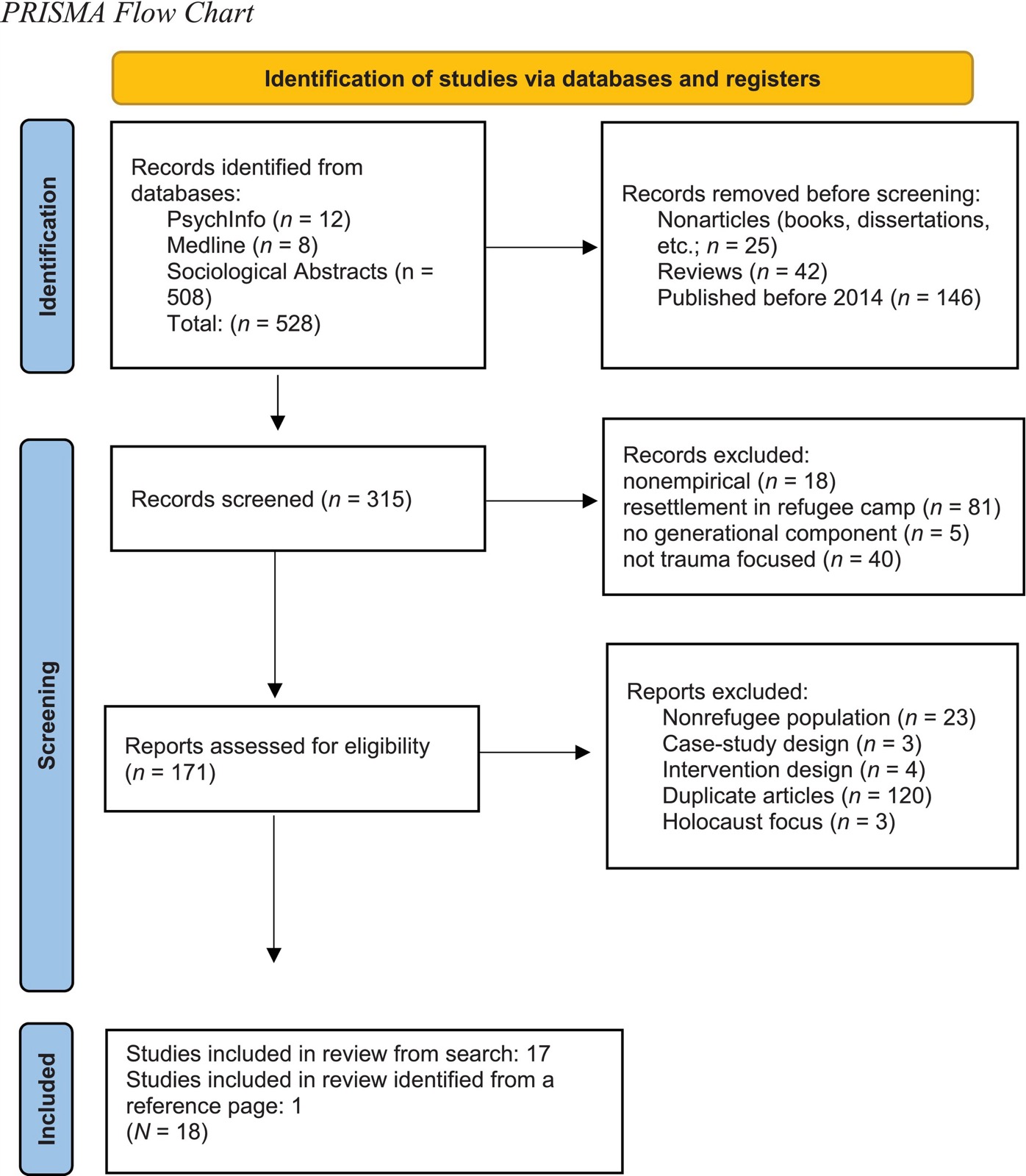
3 Collating, Summarizing, and Reporting the Results
Characteristics of the included studies are provided in Table 1. The results of this scoping review summarize and report on three distinct approaches researchers have employed to conceptualize and examine the intergenerational transmission of trauma in refugee families. These approaches were identified and categorized based on how studies framed their research questions, methodologies, and interpretations of trauma transmission. The first approach focused on trauma transmission pathways, exploring mechanisms such as harsh parenting styles, family communication patterns, or attachment processes through which trauma is transmitted across generations. The second approach emphasized evidence or outcomes of trauma transmission, assessing the psychological, emotional, or behavioral impacts on children, such as emotion regulation difficulties or internalizing and externalizing behaviors. The third approach integrated both pathways and evidence, examining not only the mechanisms of transmission but also their measurable outcomes within refugee family systems. This organizational structure provides a clear framework for presenting and interpreting the findings, emphasizing the diversity in conceptualizations and methodologies across the reviewed studies.
Table 1 — Study characteristics.
- Authors, date: Beiser and Hou (2016); Analysis of trauma: Outcomes; Unit of trauma analysis: Children's emotional problems and aggressive behavior; Use of theory: None; Theory: NA; Research design: Secondary Quantitative Data analysis; Participants: New Canadian Children & Youth Study; refugee youth aged 11 to 13 years; Journal: Journal of Nervous & Mental Disease
- Authors, date: Browne et al. (2017); Analysis of trauma: Pathway; Unit of trauma analysis: Parenting status (single, two-parent, etc.); Use of theory: None; Theory: NA; Research design: Secondary Quantitative Data analysis; Participants: Longitudinal Survey of Immigrants to Canada; adults; Journal: PLoS One
- Authors, date: Bryant et al. (2021); Analysis of trauma: Pathway and outcomes; Unit of trauma analysis: Family separation; Use of theory: Implicit; Theory: Family separation; Research design: Secondary Quantitative Data analysis; Participants: Building a New Life in Australia; adults and children of adult respondents; Journal: Australian & New Zealand Journal of Psychiatry
- Authors, date: Dalgaard et al. (2016); Analysis of trauma: Pathway and outcomes; Unit of trauma analysis: Communication and attachment styles, PTSD symptoms; Use of theory: Explicit; Theory: Attachment theory; Research design: Mixed methods; Participants: 30 refugee families with 30 children; Journal: Attachment & Human Development
- Authors, date: Dikyurt (2023); Analysis of trauma: Pathway; Unit of trauma analysis: Communication style; Use of theory: Implicit; Theory: Family communication; Research design: Mixed methods: semi-structured interviews & archival research; Participants: Bosnian American Individuals; Journal: Journal of Aggression, Conflict, and Peace Research
- Authors, date: East et al. (2018); Analysis of trauma: Outcomes; Unit of trauma analysis: Attachment style; parent and child symptoms; Use of theory: Explicit; Theory: Attachment theory; Research design: Mixed methods; Participants: Somali refugee women and their children; Journal: Journal of Immigrant and Minority Health
- Authors, date: Elsayed et al. (2019); Analysis of trauma: Outcomes; Unit of trauma analysis: Child emotion regulation; Use of theory: None; Theory: NA; Research design: Quantitative; Participants: Syrian newcomer children and their mothers; Journal: Child Psychiatry & Human Development
- Authors, date: Féron (2024); Analysis of trauma: Pathway; Unit of trauma analysis: Conflict memories; Use of theory: Implicit; Theory: Memory transmission; Research design: Semistructured interviews; Participants: Second-generation Rwandan individuals; Journal: Ethnic and Racial Studies
- Authors, date: Hoffman et al. (2020); Analysis of trauma: Outcomes; Unit of trauma analysis: Child adjustment; Use of theory: No use; Research design: Mixed methods; Participants: Karen refugee individuals; Journal: Journal of Immigrant and Minority Health
- Authors, date: Jeyasundaram et al. (2020); Analysis of trauma: Pathway; Unit of trauma analysis: Communication style; Use of theory: Explicit; Theory: Critical framework; Research design: Qualitative; Participants: Vietnamese refugees; Journal: Canadian Journal of Occupational Therapy
- Authors, date: Kizilhan et al. (2022); Analysis of trauma: Pathway and outcomes; Unit of trauma analysis: Communication style and PTSD symptoms; Use of theory: Implicit; Theory: Communication styles (Braga et al. 2012); Research design: Mixed methods; Participants: Three generations of Kurdish refugees; Journal: International Journal of Environmental Research and Public Health
- Authors, date: Lembcke et al. (2020); Analysis of trauma: Pathway and outcomes; Unit of trauma analysis: Cortisol levels and parental affection; Use of theory: None; Theory: NA; Research design: Mixed methods; Participants: Mother–child dyads; Journal: Psychoneuroendocrinology
- Authors, date: McCleary et al. (2020); Analysis of trauma: Pathway; Unit of trauma analysis: Communication style; Use of theory: Implicit; Theory: Family communication; Research design: Qualitative focus group interviews; Participants: Somali, Oromo, Burmese, and Karen refugees; Journal: Sociology compass
- Authors, date: Meschke and Juang (2014); Analysis of trauma: Pathway; Unit of trauma analysis: Communication style; Use of theory: Explicit; Theory: Acculturative Stress Theory; Research design: Qualitative; Participants: Hmong American individuals; Journal: Ethnicity and health
- Authors, date: Miller et al. (2018); Analysis of trauma: Pathway; Unit of trauma analysis: Family separation; Use of theory: Implicit; Theory: Family separation; Research design: Mixed methods; Participants: Afghani/Persian, Iraqi/Syrian, and African (Great Lakes region) individuals; Journal: American Journal of Orthopsychiatry
- Authors, date: Muruthi and Lewis (2017); Analysis of trauma: Pathway; Unit of trauma analysis: Intergenerational relationships; Use of theory: Explicit; Theory: Intergenerational ambivalence framework; Research design: Qualitative; Participants: Cambodian refugee individuals; Journal: Journal of Intergenerational Relationships
- Authors, date: Sangalang et al. (2017); Analysis of trauma: Pathway and outcomes; Unit of trauma analysis: Family cohesion, parental warmth and involvement; Use of theory: None; Research design: Longitudinal; Participants: Southeast Asian refugee mothers and their children; Journal: Social Science & Medicine
- Authors, date: Speidel et al. (2021); Analysis of trauma: Outcomes; Unit of trauma analysis: Family, child, and parent adversity; Use of theory: Explicit; Theory: Family systems theory; Research design: Mixed methods; Participants: Syrian refugee mothers and their children; Journal: International Journal of Environmental Research and Public Health
Abbreviations: NA = not applicable, PTSD = posttraumatic stress disorder.
3.1 Trauma Transmission Pathways
Eight articles under review fell into this category. Some articles used a behavioral perspective to understand the trauma transmission pathway—for example, communication (McCleary et al. 2020; Meschke and Juang 2014) or warm and harsh parenting styles (Bryant et al. 2021). Notably, other studies looked at broader levels of experiences such as family separation (Miller et al. 2018) and cultural, familial, and sociohistorical transmissions of trauma (Jeyasundaram et al. 2020). Browne et al. (2017) used parenting status (divorced, two-parent, etc.) as a way to assess the trauma transmission pathway. Dikyurt (2023) used insight-based or reflective self-identification of the transmission of trauma within the lives of adult children of Bosnian refugees. Féron (2024) examined the transmission of conflict memories in a Rwandan diaspora. These articles are in the pathway category because they focused not on the adult children's symptomology but asked participants to reflect on their parental relationship growing up to identify the influence of trauma in their upbringing.
3.2 Trauma Transmission Evidence
Five articles emphasized trauma symptomology and focused on trauma transmission evidence. These articles looked at anger and sadness regulation in children (Elsayed et al. 2019), children's emotional problems and aggressive behavior (Beiser and Hou 2016), children's internalizing and externalizing behaviors and social–emotional capacities (Speidel et al. 2021), and child adjustment (East et al. 2018; Hoffman et al. 2020). Although the outcomes focused on child experiences, these articles also considered specific parental experiences such as maternal torture exposure (Hoffman et al. 2020), parental premigratory life stressors and postmigratory daily hassles (Beiser and Hou 2016; Elsayed et al. 2019), and mother's mental health (Beiser and Hou 2016; East et al. 2018) as variables. Speidel et al. (2021) also looked at broader levels of experiences, such as parental and familial adversity occurrences.
3.3 Dual Outcome and Pathways Trauma Transmission Approach
The remaining five articles examined trauma transmission pathways in conjunction with evidence or outcomes of trauma transmission. Sangalang et al. (2017) assessed parental warmth and involvement as the trauma pathway. They assessed children's depressive symptoms, antisocial behavior, delinquent behavior, and school problems as trauma transmission evidence or outcomes. Bryant et al. (2021) looked at prolonged grief disorder (PGD) and warm and harsh parenting styles as trauma pathways while assessing children's behavioral, emotional, and social problems as evidence of trauma transmission. Lembcke et al. (2020) were the only articles incorporating a biological perspective of trauma transmission, measuring mother–child dyad hair cortisol levels as outcomes while looking at maternal affectionate parenting as a trauma transmission pathway. Dalgaard et al. (2016) used attachment and communication style as forms of trauma transmission pathways to explain trauma transmission outcomes such as child adjustment and mental health. Kizilhan et al. (2021) used communication style as an assessment of trauma transmission while using PTSD criterion to measure trauma transmission evidence in three generations of Alevi Kurdish families.
4 Overview and Critique of Theory
Using Knapp's (2009) definition of critical theorizing, the use of theory in the identified articles was assessed not only by the explicit mention of theory but, if it was mentioned, by how the researchers used theory. Knapp explained that critical theorizing looks at covert and overt use of theoretical assumptions integrated throughout the conceptualization, methodology, and analysis as well as how the assumptions in the theoretical groundings overlap with or relate to other ways of understanding or hypothesizing the studied phenomenon.
4.1 Trauma Transmission Pathways
4.1.1 Overt and Explicit Use of Theory
Three studies used theory in an overt and explicit manner. Two studies, Muruthi and Lewis (2017) and Jeyasundaram et al. (2020) used an adapted intergenerational ambivalence theoretical framework and a critical perspective framework, respectively, to understand how trauma affects values, habits, or traditions versus actual experiences, attitudes, or concerns (Muruthi and Lewis 2017) and the occupational lives of second-generation refugees (Jeyasundaram et al. 2020). Meschke and Juang (2014) argued that parental acculturative stress leads to a communication breakdown based on language differences (i.e., stressed parents speak to their children exclusively in their native language even if their adolescent children are uncomfortable in that language). These articles gathered data using individual semistructured interviews and analyzed their data using narrative inquiry (Jeyasundaram et al. 2020; Muruthi and Lewis 2017) or open-ended interviews and thematic analysis (Meschke and Juang 2014). All three studies used participants' experiences to confirm or deny trauma transmission in their family system. The use of theory was explicit and integrated throughout their conceptual understanding of trauma and their interpretation of the results. This meant that theoretical understandings like acculturative stress, for example, were addressed in the discussion section as how the participants shared experiences overlapping with the acculturative stress phenomenon.
4.1.2 Covert and Implicit Use of Theory
Four articles implicitly used theory to understand trauma transmission pathways in refugee family systems (Dikyurt 2023; Féron 2024; McCleary et al. 2020; Miller et al. 2018). The explicit theory was not identified. However, assumptions from the literature were referenced, such as differing family communication styles (Dikyurt 2023; McCleary et al. 2020), the transmission of conflict memories (Féron 2024), and the negative impact of family separation (Miller et al. 2018).
4.1.3 No Use of Theory
One article in the trauma transmission pathways category did not use theory. There was no indication of Browne et al. (2017) using theory implicitly or explicitly. As mentioned earlier, they used parenting status (e.g., divorced, two-parent household) to assess the trauma transmission pathway. The hypothesis was that single-parent households would have more difficulty than two-parent households in parenting capacity and other factors (Browne et al. 2017). This study was the only article that factored parental distress into their data analysis but did not measure any child outcomes directly, which is a limitation. The authors attempted to assess parental stress by focusing on parenting status and emotional outcomes. However, parenting is only within the context of the child, and ignoring child outcomes without a qualitative design limits the ability to accurately capture parental stress. Parenting status was used as a categorical variable to group parents, but no theoretical grounding was integrated.
4.2 Trauma Transmission Evidence and Outcomes
4.2.1 Covert or Implicit Use of Theory
The two articles in this category used family systems theory (Speidel et al. 2021) and attachment theory (East et al. 2018). East et al. (2018) used attachment theory to conceptualize attachment style as trauma transmission evidence, not a transmission pathway, focusing solely on PTSD symptomology. Initially, an attachment was conceptualized as the emotional connection between a caregiver and a child by using observational data from the child (Bowlby 1969), and East et al. (2018) conducted a storytelling assessment without looking at parent–child interactions. In this case, theory was used implicitly or covertly, reducing the tenets and assumptions of the theory. They modified attachment theory in their conceptual model to focus on detached or withdrawal behaviors, two characteristics of avoidant attachment style, to measure mothers' emotional connection with their children.
Guided by family systems theory, Speidel et al. (2021) divided participants into different subsystems (parent–child, parent subsystem, family system) when examining adverse experiences. This systems perspective meant they could examine child, parent, and family adversities individually and interconnectedly. Using a family systems approach allowed Speidel et al. (2021) to look at levels of adversity across systems due to a need for greater consistency in refugee research on the risk and protective factors of adversity on refugee families. Systemically, however, Speidel et al. (2021) focused only on trauma transmission outcomes or evidence such as trauma symptoms, emotion regulation, and optimism. Although the use of theory here was explicit, the theory needed to be integrated throughout the work.
Speidel et al. (2021) argued that family adversity, not just parent and child adversities, was a separate factor in the intergenerational transmission of trauma, aligning with family systems theory assumptions that one individual impacts the entire family system and vice versa (Atzaba-Poria et al. 2004). The theory was used to argue for a relational or systemic lens when studying refugee families, which is a strength of this study. Discussion of the theory was only present within the introduction to argue the aforementioned point; however, it was mentioned again at the end to provide minimal interpretation of findings using a relational perspective.
4.2.2 No Use of Theory
The next three articles understood trauma transmission using evidence from symptomology and did not use any theory. These articles looked at anger and sadness regulation in children (Elsayed et al. 2019), children's emotional problems and aggressive behavior (Beiser and Hou 2016), and child adjustment (Hoffman et al. 2020). Because of the focus on symptomology, self- and parent-report measures were used to assess behavioral symptoms in parents, offspring, or both to understand the intergenerational transmission of trauma in these family systems. There were no studies that used theory explicitly, integrating its tenets throughout the study; instead, trauma transmission evidence alone was considered.
4.3 Dual Outcome and Pathway Trauma Transmission Approach
4.3.1 Overt and Explicit Use of Theory
One article in the trauma transmission pathway and evidence category made explicit use of theory. Dalgaard et al. (2016) used a combination of communication and attachment theory to examine how intrafamily communication affected by language deficits resulted in insecure attachment in children of parents with trauma exposure. Dalgaard and colleagues described the pathway as a psychodynamic process of transmitting displaced emotions. The authors used communication and attachment styles as a way both to conceptualize and to understand the families' behaviors, but also as a form of assessment in the interpretation of their results, integrating theory throughout the study. In addition, Dalgaard and colleagues cited a study (Sagi-Schwartz 2008) that conducted cross-sectional research on daughters of Holocaust survivors and a control group, finding that the children of the Holocaust survivors had fewer secure attachments overall. Attachment theory is a theoretical framework used not only in research but also in clinical practice. The findings in the cited study point to the assumption that fewer secure attachments equal unhealthy relationships. However, there could be many reasons why someone might have few secure attachment figures, and this narrative might not offer the most holistic understanding of attachment.
4.3.2 Covert and Implicit Use of Theory
Two articles from the trauma transmission pathway and evidence category used theory implicitly. Kizilhan et al. (2021) and Bryant et al. (2021) both incorporated theoretical assumptions implicitly into their studies. Bryant and colleagues identified family separation as a phenomenon and used that as a measure to assess a trauma transmission pathway, cross-referencing that with general mental health symptoms. Kizilhan and colleagues used the communication styles identified by Braga et al. (2012) from a grounded theory study of refugees to assess trauma transmission pathways. They then assessed mental health symptoms using PTSD criterion–based assessments.
4.3.3 No Use of Theory
The final two studies applied both trauma transmission pathways and evidence/outcomes to understand intergenerational transmission of trauma but did not incorporate any use of theory, either overtly or covertly. Sangalang and Vang (2017) developed their own measures of family cohesion, parental warmth, and parental involvement instead of grounding their variables in a theory per se. Lembcke et al. (2020) were the only articles to incorporate a biological perspective of trauma transmission, measuring mother–child dyad hair cortisol levels as outcomes while looking at maternal affectionate parenting as a trauma transmission pathway. There was also no explicit or implicit use of theory grounded in the study throughout, including the discussion and interpretation of results. See Table 2 for a visual representation of the article groupings.
Table 2 — Study groupings based on approach and use of theory.
- Trauma transmission pathways; Explicit use of theory: Jeyasundaram et al. (2020); Meschke and Juang (2014); Muruthi and Lewis (2017); Implicit use of theory: Dikyurt (2023); Féron (2024); McCleary et al. (2020); Miller et al. (2018); No use of theory: Browne et al. (2017)
- Trauma transmission evidence; Explicit use of theory: None; Implicit use of theory: East et al. (2018); Speidel et al. (2021); No use of theory: Beiser and Hou (2016); Elsayed et al. (2019); Hoffman et al. (2020)
- Trauma transmission pathways and evidence; Explicit use of theory: Dalgaard et al. (2016); Implicit use of theory: Bryant et al. (2021); Kizilhan et al. (2022); No use of theory: Lembcke et al. (2020); Sangalang et al. (2017)
5 The Importance of Using Theory
Of the 18 articles reviewed, more than half (n = 12) did not explicitly identify or thoroughly integrate a theoretical framework when interpreting a trauma transmission pathway or the outcome or evidence of trauma transmission. This is especially concerning, given earlier discussions regarding the inability to determine a single operational definition for the transmission of trauma pathways and a single conceptualization regarding evidence of identified pathways.
The lack of transparency regarding assumptions underlying the transmission of trauma in refugee families creates challenges in assessing the cultural appropriateness of research. Although a lack of theoretical grounding is problematic across all populations, it is particularly critical in refugee research due to the unique and culturally specific experiences of this population. Refugees often come from diverse cultural contexts with distinct family structures, parenting practices, and ways of processing trauma, which may differ significantly from the Western, individualistic frameworks commonly employed in research. Without explicit theories that consider these cultural nuances, there is a risk of misinterpreting or oversimplifying trauma transmission pathways and outcomes, potentially leading to conclusions that are neither relevant nor applicable to refugee families. Transparent use of theory allows researchers to critique and adapt assumptions to ensure they align with the lived experiences and cultural contexts of the populations being studied. In refugee research, this transparency is essential for capturing the complexity of intergenerational trauma in ways that are culturally sensitive and meaningful (Henrich et al. 2010). For the articles that focused on trauma transmission outcomes, focusing solely on symptoms mirrors the medical model of assessment where one focuses on problems on an individual basis. This mindset is not systemic in nature and might lead to deficit-based representations of communities.
Notably, six of the reviewed articles that appeared to lack explicit theorizing employed quantitative designs to examine trauma symptomology in parents and patterns of trauma in children (Beiser and Hou 2016; Browne et al. 2017; Elsayed et al. 2019; Hoffman et al. 2020; Lembcke et al. 2020; Sangalang et al. 2017). These studies tended to follow a consistent structure: (a) identifying trauma symptoms in parents, (b) examining parental behaviors such as warmth or harsh parenting, and (c) measuring child outcomes such as emotional regulation or adjustment. A potential reason for this focus on symptomology may be that five of these studies were published in psychiatry journals and one in a public health journal, fields that often prioritize clinical symptom assessment. However, it is important to recognize that conducting relational, empirical research with refugee populations presents significant challenges, and the lack of explicit theorizing does not necessarily mean theories were absent from the conceptualization or interpretation of findings. Although reliance on clinical symptomology may risk oversimplifying the complex relational experiences of trauma, it is also possible that researchers used theoretical frameworks implicitly to guide their work, even if this was not formally articulated in the publications. This is less of a critique and more of a call to action to increase our intentionality around the use of theory in refugee and family studies.
6 Strengths and Key Highlights From the Findings
Regarding the limitations of this review, we acknowledge the importance of the findings from these studies and their contributions to the field of family science and refugee studies. This will not be an exhaustive discussion, and we encourage others to review the articles individually to capture the depth and breadth of the research findings. Jeyasundaram et al. (2020) used a critical framework to understand the occupational experiences of refugees. They explained that using a critical occupational perspective allowed them to posit that meanings associated with an occupation are fleeting, dependent on social factors, and evolve in response to sociopolitical changes (Jeyasundaram et al. 2020). This article provides us with a strong example of how different fields of research attempt to understand the transmission of intergenerational trauma within their respective worldviews. The authors used a critical lens to challenge assumptions within their discipline and highlight how the occupations of second-generation refugees are influenced by the contexts in which they are situated (Jeyasundaram et al. 2020). Using a critical perspective, they explored how intergenerational trauma manifests in the occupational lives of second-generation refugees while taking into account sociopolitical forces at play.
There is a consensus within the articles in this review that maternal or parental preemigration trauma is associated with negative child outcomes (Beiser and Hou 2016; Bryant et al. 2021; Dalgaard et al. 2016; East et al. 2018; Hoffman et al. 2020; Lembcke et al. 2020; Sangalang et al. 2017). When an ecological and systems lens is applied, Speidel et al. (2021) found that familial premigratory adversity is associated with child internalizing and externalizing symptoms more than child or parental adversity alone. Sangalang et al. (2017) explained that school problems became more apparent when teachers reported negative behaviors to parents, amplifying familial stress rooted in underlying maternal trauma and therefore injecting more stress into the family system. Lembcke et al. (2020), who focused on maternal affection, and Bryant et al. (2021), who looked at harsh and warm parenting, both found that lower warm parenting and maternal affection were significantly associated with higher parental trauma. Lembcke and colleagues explained that if the parent had lower levels of PGD, warm parenting was associated with positive mental health for children; however, if there were higher levels of parental PGD, this was associated with increased anxiety in children, probably due to anxious or overprotective parenting.
Another important consensus across the studies that considered racism and discrimination experienced by refugee children was that there was a clear and significant association between perceived discrimination and negative mental health outcomes not influenced by trauma experienced by children or parents (Beiser and Hou 2016; East et al. 2018; Jeyasundaram et al. 2020). Beiser and Hou (2016) explained that refugee youth were able to distinguish between race-based discrimination and refugee-based discrimination and that both had statistically significant influences on aggressive behavior and emotional problems. Beiser and Hou's analysis was unique in that it compared refugee youth and immigrant youth from the same source country and found that refugee youth had higher levels of aggressive behavior and emotional problems. This sampling method is a way to understand between-group differences while maintaining cultural significance. The refugee experience is nuanced and complex, further highlighting the complexities of these studies in their attempt to understand the lived experiences of their participants.
7 Critique of Trauma Conceptualizations
7.1 PTSD as the Sole Indicator of Trauma
The concern about so many studies using PTSD as the only form of measurement for trauma is that many refugees may suffer from traumatic stress but their symptoms do not meet the clinical cutoff or criteria for PTSD. Traumatic stress refers to the emotional, psychological, and physiological responses that arise from experiencing or witnessing events perceived as threatening, overwhelming, or harmful to a person's sense of safety, identity, or well-being (American Psychiatric Association 2013). Culturally sensitive understandings of traumatic stress recognize that individuals' experiences, expressions, and healing processes are shaped by their cultural backgrounds, historical contexts, social identities, and systemic factors such as racism, displacement, and collective trauma (Bryant-Davis 2005). Traumatic stress may manifest differently across cultures and communities, and effective support requires acknowledging the diverse ways trauma is experienced, narrated, and addressed within each cultural context.
Several studies in this body of literature attended to that difference. For example, Hoffman et al. (2020) used three measures—a PTSD scale and the General War Trauma and Torture Scale that included traumatic events not captured by the five-item PTSD scale. Additionally, they used the Physical Health Questionnaire, which measured physiological response to trauma, which other studies often overlook. Speidel et al. (2021) and Elsayed et al. (2019) used the Traumatic Stress Questionnaire to assess exposure to stressors. To measure postmigration stress, some studies used measures such as the Social Adjustment Rating Scale (Elsayed et al. 2019; Speidel et al. 2021), a brief daily hassles measure (Elsayed et al. 2019) administered to both mothers and children, and a 10-item scale of current life event stressors (Bryant et al. 2021) administered to the parent alone. Miller et al. (2018) used a broader measure, the World Health Organization Quality of Life Scale—Brief, to examine overall life quality or measures specific to the conceptualization of trauma. Bryant et al. (2021) used the PGD measures specific to their study. With such measures, we can see that PTSD does not have to be the default and only form of trauma assessment. There is evidence for its efficacy in research and clinical practice; however, there should always be more room for culturally sensitive assessments of trauma expression. A complete list of all the assessments used by studies included in this review is provided in Table 3.
Table 3 — Complete list of assessments and measures used in the 18 articles in this scoping review.
- Stress and Trauma Measures. Harvard Trauma Questionnaire: Bryant et al. (2021); Dalgaard et al. (2016); East et al. (2018); Lembcke et al. (2020); Miller et al. (2018). Hopkins Symptoms Checklist: Dalgaard et al. (2016); East et al. (2018); Miller et al. (2018). Traumatic Stress Questionnaire: Elsayed et al. (2019); Speidel et al. (2021). Mental Health Screening for MDD and PTSD; General War Trauma and Torture Scale: Hoffman et al. (2020). PTSD-8; Prolonged Grief Disorder; 10-item scale of current life events and stress: Bryant et al. (2021). PTSD Symptoms Checklist—Civilian Version; World Health Organization Quality of Life Scale-Brief: Miller et al. (2018). Hair cortisol concentration: Lembcke et al. (2020). Emotional problems (yes/no): Browne et al. (2017). Social Readjustment Rating Scale for both mother and child; five items from brief daily hassles measures for adults and youth: Elsayed et al. (2019). Posttraumatic Diagnostic Scale: Kizilhan et al. (2022).
- Parenting Measures. Family cohesion, parental warmth, parental involvement: Sangalang et al. (2017). Harsh Parenting Scale of the Early Childhood Longitudinal Study of Children; Warm Parenting Scale Child Rearing Questionnaire: Bryant et al. (2021). Maternal affection using observational measure Parenting Interactions with Children Checklist of Observations Linked to Outcomes: Lembcke et al. (2020). Parenting Status (four categories): Browne et al. (2017).
- Parental Assessment of Children. Strengths and Difficulties Questionnaire maternal assessment of youth: Dalgaard et al. (2016); Hoffman et al. (2020); Speidel et al. (2021). Emotion Regulation Coping subscales of the Children's Emotion Management Scales; Child Routines Inventory—5: Elsayed et al. (2019). Parent–child communication; Conflict Behavior Questionnaire: Sangalang et al. (2017). Holistic Student Assessment (social emotional capacities): Speidel et al. (2021).
- Child Assessments. Children's Depression Inventory—2; Perceived Racism Scale—Children; Multicultural Peer Victimization scale; Harvard–Uppsala Trauma Questionnaire for Children semistructured interview: East et al. (2018). Child Behavior Checklist—Preschool PTSD (in Arabic): Lembcke et al. (2020). Depressive symptoms, antisocial behavior, delinquent behavior, school problems: Sangalang et al. (2017). Emotional Problems subscale from the Ontario Child Health Survey, Aggressive Behavior six-item scale, Perceived Discrimination, Preflight Trauma, Traumas of Passage: Beiser and Hou (2016). Traumatic Stress Questionnaire (four items for children): Elsayed et al. (2019); Speidel et al. (2021). Attachment and Traumatization Story Task: Dalgaard et al. (2016). Strengths and Difficulties Questionnaire (SDQ): Bryant et al. (2021).
- Other Assessments (Adult). Family and personal human and social capital (depressive symptoms, parental education, parental linguistic fluency, social competence, instrumental competence); social receptivity (poverty, poor quality of neighborhood, feel welcomed at school): Beiser and Hou (2016). Physical Health Questionnaire: Hoffman et al. (2020).
Note: Dalgaard et al. (2016) explicitly indicated the use of attachment theory in their work. Abbreviations: MDD = major depressive disorder, PTSD = posttraumatic stress disorder.
7.2 Lack of Attention to Somatic Symptoms of Trauma
Lembcke et al. (2020), which measured stress via hair cortisol concentration, was the only medically framed study. Using biological measures to examine physiological responses to trauma can be an important component in understanding stress. Many things can affect hair samples (frequency of hair washing, hair length, etc.); however, Lembcke et al. (2020) identified this as a limitation. Thus, it is recommended that more than one biological measure be used, such as MRI scans, blood tests, finger pulse amplitudes, and heart rate (Kanahara et al. 2022; Kiecolt-Glaser et al. 2003; Wrocklage et al. 2017).
7.3 Culturally Incompatible Measures
Bryant et al. (2021) used warm and harsh parenting styles derived from the Early Childhood Longitudinal Study of Children, a national Canadian dataset (Zubrick et al. 2014), with the Harsh Parenting Scale developed by Paterson and Sanson (1999) and the Warm Parenting Scale from the Child Rearing Questionnaire developed by the U.S. Department of Education (2001) to assess parenting in their study. These parenting scales were developed more than 20 years ago and need to be culturally adapted. Emotional expressions like affection and warmth are influenced by culture; therefore, to assess a culturally specific expression as a universal parenting style does not seem ethical, nor is it an accurate representation of families that do not adhere to culturally specific emotional expressions. A significant limitation in Browne et al.'s (2017) study was their use of four categories of parental status—single parent, two-parent household, divorced nonparent, and nondivorced nonparent—to compare differences in parental stress. No other measures provided information about these parents, reducing the research to a single structural dimension that missed substantial complexity in the participants' premigration experiences and postmigration lives.
7.4 Focus on the Individual
One critique of the use of individual measures is that they fail to assess the relational nature of a transmission pathway. Studies that use individual measures from parents and children obscure the relational transmission pathway and fail to measure certain qualities of the relationship, such as communication, trust, security, and parenting style, that are important to highlight. Individual measures can be effective if used with relational measures that look at family dynamics. It is vital to consider both the trauma transmission pathway and the contextual factors that might be influencing a given perceived phenomenon. Most refugee families are transnational in nature, meaning that all members of a given family may not be physically together, therefore making studies that look at complete family systems difficult to design. The critique here is the intentional exclusion of other children in the family system who are accessible and focusing on only one or the eldest child. Féron (2024) excelled in engaging individuals but nonetheless used a systemic approach. The study therefore conceptualized a single generation of a diaspora as one unit and assessed the transmission of conflict memories without taking certain nuances or differences into consideration.
8 Discussion
One of the most significant findings from this review is the lack of a consistent operational definition for the intergenerational transmission of trauma across the identified studies. This inconsistency underscores the need for greater standardization while reflecting the phenomenon's complexity. Many studies rely on researcher-dependent definitions shaped by specific paradigmatic and cultural lenses, resulting in a fragmented understanding of trauma transmission. This variability challenges efforts to synthesize findings, evaluate methodologies, and develop cohesive frameworks that capture the nuanced realities of trauma transmission in refugee families. Addressing this gap is critical for fostering a shared language and culturally responsive approaches in future research. Incorporating insights from global mental health scholarship could strengthen efforts to conceptualize trauma transmission across diverse contexts, ensuring that frameworks are both culturally sensitive and methodologically rigorous. Although uniform assumptions across individuals, dyads, or families are neither possible nor desirable given the deeply personal nature of trauma responses, advancing this field requires greater consistency in defining and operationalizing key constructs. Global mental health literature provides valuable models for balancing the need for standardized approaches with attention to local cultural and contextual variations. This review identifies several key considerations for researchers studying traumatized families and intergenerational trauma transmission. The following discussion addresses these considerations, draws implications from existing studies, and offers recommendations for strengthening future research in a globally informed, culturally grounded manner.
8.1 Implications and Recommendations for Future Directions
The most critical finding from this review is the importance of grounding research on the intergenerational transmission of trauma in sound theory and conceptual clarity. Although trauma conceptualization must remain flexible to account for diverse etiologies and individualized human responses, flexibility should not come at the expense of theoretical rigor. Researchers must articulate clear theoretical frameworks and rationale for their chosen conceptualizations to ensure relevance and methodological strength. When the focus is on trauma transmission in refugee families, it is crucial to employ systemic, family-based theories to avoid privileging individual perspectives and instead adopt a holistic, relational, and interdependent systems view. Thorough integration of theory throughout the research process—not merely in framing but also in methodology and interpretation—is essential.
This review identified three broad approaches to interpreting trauma transmission (pathways, evidence, or both). Of these, only approaches incorporating systemic and relational perspectives provide the nuance necessary to capture the refugee family experience fully. Complementing this, recent systemic reviews of family-based interventions with refugee populations provide key insight into how trauma transmission might be interrupted through multigenerational, relational, and culturally responsive approaches (Bunn et al. 2022; Mak and Wieling 2022; Slobodin and de Jong 2015). These reviews consistently support the use of parenting groups, multifamily group interventions, and home-visiting models in improving child outcomes, family cohesion, and mental health literacy. However, they caution that the field lacks theoretical clarity and rigorous implementation models, echoing this review's call for systemic, family-level frameworks that account for sociocultural and historical dimensions of trauma (Bunn et al. 2022; Mak and Wieling 2022; Slobodin and de Jong 2015).
Future research must move beyond symptom-focused models to contextualize trauma within broader sociocultural, historical, and geopolitical realities. Drawing from global mental health frameworks can further strengthen this work because they address the intersection of culture, structural violence, and resilience in diverse refugee populations. Incorporating models such as Good and Hinton's (2015) multiaxial analysis, which considers dimensions such as ethnopsychology, public trauma representations, spirituality, and resilience, would provide a more comprehensive and globally informed approach to understanding trauma transmission across generations. Another example is the cultural-clinical psychology framework (Ryder et al. 2011). This framework encourages an integrated understanding of mental health by examining how cultural systems influence symptom expression, diagnosis, and treatment effectiveness globally. In addition to these ontological dimensions, it is equally important to consider the systemic and temporal contexts that shape refugee experiences of trauma over time.
8.2 Existential Trauma, Legal Limbo, and the Limits of Current Theory
In addition to the gaps identified in the conceptualization of trauma pathways and outcomes, it is important to consider the trauma associated with existential limbo, prolonged asylum processes, and legal uncertainty among refugees and asylum seekers. Prolonged waits for legal status, restrictions on employment, and ambiguous belonging to either the country of origin or the host country create chronic and relational forms of trauma that are not easily captured by event-based models of trauma transmission (Hartonen et al. 2022). Research with refugee populations in long-term encampment contexts highlights that dependency is not a result of cultural dispositions but of systemic barriers that erode self-esteem, agency, and relational functioning (Abdi 2005). Conceptualizing trauma narrowly as exposure to life-threatening events overlooks the cumulative impact of forced immobility, legal invisibility, and political exclusion. Without frameworks that address these enduring and systemic experiences, there is a risk of continuing to produce deficit-based models that fail to capture the lived realities of displaced families. Expanding constructs such as ambiguous loss (Boss 1999) or developing new culturally grounded theories that account for temporal and existential uncertainty are essential for advancing trauma transmission research in refugee family systems.
Another significant limitation in the reviewed literature is the predominant focus on mother–child dyadic experiences. Despite the relational nature of trauma transmission, studies largely ignored father–child relationships and dynamics among multiple children in the family system. Many studies focused on a single child and the mother, even when data from other family members were available. Only one study (Lembcke et al. 2020) included observational family dynamics and relationship measures. It was also surprising that no father–child dyads were involved in these studies. Even when both parents were present in the family system, researchers only interviewed the mother while providing no theoretical justification or pragmatic reason for this. Another critique of this literature is that studies appear to focus almost exclusively on the transmission of trauma from parents to young children. The only time adult children were participants was when they were interviewed individually; however, when parents were involved, older and adult children were invisible in the research. Children's inability to articulate their internal experience creates a hyperfocus on their behaviors and does not provide a complete or accurate picture of the impact of trauma. Including young adults who could describe their experiences would add essential insights to the research base. Addressing this gap is essential for a more complete understanding of intergenerational trauma in refugee families.
Communication within trauma-exposed refugee families emerged as a critical factor in either perpetuating or breaking the cycle of trauma transmission. Family communication influences attachment styles and can bridge generational gaps caused by acculturation differences. This review emphasizes the role of therapy in facilitating family communication and helping families disclose parental trauma and family legacies in meaningful ways. Additionally, future research should examine whether communication patterns persist across multiple generations, particularly among second-generation refugees and their children.
A final finding highlights the importance of incorporating biological measures into studies on intergenerational trauma. Although only one study (Lembcke et al. 2020) employed a biological measure (hair cortisol concentration), its findings underscore how trauma impacts children as they grow and mature. As such measures become more accessible and affordable, researchers should integrate behavioral and biological assessments to provide a more comprehensive understanding of trauma transmission. Interdisciplinary studies involving public health, social work, family science, and medicine would enable creative approaches to explore the multifaceted nature of trauma in refugee families.
9 Conclusion, Implications, and Future Recommendations
The intergenerational transmission of trauma is a complex and significant phenomenon influencing refugee families across diverse communities. This review analyzed 18 studies that employed varied conceptualizations and definitions of trauma transmission. Findings suggest that maternal mental health strongly correlates with adverse child outcomes, while family communication plays a pivotal role in either perpetuating or disrupting trauma transmission cycles. Generational strains due to acculturation differences also affect family cohesion, creating individual and familial differences in experiences.
Key limitations in the existing literature include the lack of perspectives from diverse family constellations outside the mother–child dyad, limited theoretical grounding, and a reliance on self-reported data. Furthermore, most studies failed to address the relational nature of trauma transmission or explore its broader systemic impacts. Only two studies examined racism or discrimination as specific stressors, a surprising oversight given the predominance of People of Color in refugee populations and the dual discrimination they face based on racial and immigrant identities.
Future research should address these limitations by incorporating systemic perspectives, relational measures, and interdisciplinary approaches. Attention to cultural sensitivity, diverse family dynamics, and the inclusion of fathers and adolescent or adult children will provide a more comprehensive understanding of intergenerational trauma in refugee families. Researchers can contribute to more inclusive and impactful studies on this important topic by employing innovative methodologies and culturally grounded theories. The field of family science is well suited to address family systems and broader ecological contextual factors when looking at refugee families. This scoping review has identified a need for more refugee family research emerging from family science as a discipline.
Complexe Systémique: key points
This review does family clinicians a valuable service: it shows that what is called “intergenerational transmission of trauma” covers very different objects from one study to the next, from hair cortisol to communication styles, and that the theory that should connect these objects usually remains silent. The most telling finding is systemic: almost every study looks at a mother and a child, never a father, rarely siblings, and almost never children who have grown into adults, even though they could describe what was passed on to them. For practice, three leads stand out: to see family communication as the place where the cycle is perpetuated or broken, not to reduce trauma to a diagnosis of posttraumatic stress disorder alone, and to take into account legal limbo and existential uncertainty, which the notion of ambiguous loss helps to illuminate. The review has its limits: three databases, English-language articles only, and a classification of studies that is sometimes debatable in its details. Read alongside the article on intergenerational trauma and relational bridging among East African refugees, and the article on migration, ambiguous loss and rituals.
Notes from the original
Conflicts of interest. The authors declare no conflicts of interest.
References
Abdi, A. M. 2005. “In Limbo: Dependency, Insecurity, and Identity Amongst Somali Refugees in Dadaab Camps.” Refuge 22, no. 2: 6–14. https://doi.org/10.25071/1920-7336.21328.
American Psychiatric Association. 2013. Diagnostic and Statistical Manual of Mental Disorders. 5th ed. American Psychiatric Publishing.
Arksey, H., and L. O'Malley. 2005. “Scoping Studies: Towards a Methodological Framework.” International Journal of Social Research Methodology 8, no. 1: 19–32. https://doi.org/10.1080/1364557032000119616.
Atzaba-Poria, N., A. Pike, and K. Deater-Deckard. 2004. “Do Risk Factors for Problem Behaviour Act in a Cumulative Manner? An Examination of Ethnic Minority and Majority Children Through an Ecological Perspective.” Journal of Child Psychology and Psychiatry 45, no. 4: 707–718.
Beiser, M., and F. Hou. 2016. “Mental Health Effects of Premigration Trauma and Postmigration Discrimination on Refugee Youth in Canada.” Journal of Nervous and Mental Disease 204, no. 6: 464–470. https://doi.org/10.1097/NMD.0000000000000516.
Bentley, J. A., M. L. Dolezal, and M. K. Alsubaie. 2019. “Does Duration of Residency in the United States Influence Psychological Symptoms and Postmigration Stressors Among Refugees? Potential Implications of Populism for Refugee Mental Health.” International Perspectives in Psychology 8, no. 3: 161–176. https://doi.org/10.1037/ipp0000109.
Bogic, M., A. Njoku, and S. Priebe. 2015. “Long-Term Mental Health of War-Refugees: A Systematic Literature Review.” BMC International Health and Human Rights 15, no. 1: 29. https://doi.org/10.1186/s12914-015-0064-9.
Bombay, A., K. Matheson, and H. Anisman. 2014. “The Intergenerational Effects of Indian Residential Schools: Implications for the Concept of Historical Trauma.” Transcultural Psychiatry 51, no. 3: 320–338. https://doi.org/10.1177/1363461513503380.
Boss, P. 1999. Ambiguous Loss: Learning to Live With Unresolved Grief. Harvard University Press.
Bowlby, J. 1969. Attachment and Loss, Vol. 1: Attachment. Basic Books.
Braga, L. L., M. F. Mello, and J. P. Fiks. 2012. “Transgenerational Transmission of Trauma and Resilience: A Qualitative Study With Brazilian Offspring of Holocaust Survivors.” BMC Psychiatry 12, no. 1: 134. https://doi.org/10.1186/1471-244X-12-134.
Braun, V., and V. Clarke. 2006. “Using Thematic Analysis in Psychology.” Qualitative Research in Psychology 3, no. 2: 77–101. https://doi.org/10.1191/1478088706qp063oa.
Braun, V., and V. Clarke. 2012. “Thematic Analysis.” In APA Handbook of Research Methods in Psychology: Vol. 2. Research Designs: Quantitative, Qualitative, Neuropsychological, and Biological, edited by H. Cooper, 57–71. American Psychological Association. https://doi.org/10.1037/13620-004.
Browne, D. T., A. Kumar, S. Puente-Duran, K. Georgiades, G. Leckie, and J. Jenkins. 2017. “Emotional Problems Among Recent Immigrants and Parenting Status: Findings From a National Longitudinal Study of Immigrants in Canada.” PLoS One 12, no. 4: e0175023. https://doi.org/10.1371/journal.pone.0175023.
Bryant, C. M., C. S. Henry, and J. A. Richeson. 2022. “The Intergenerational Transmission of Trauma and Mental Health Disparities Among African American Families.” Journal of Family Theory & Review 14, no. 1: 54–71. https://doi.org/10.1111/jftr.12450.
Bryant, R. A., B. Edwards, M. Creamer, et al. 2021. “Prolonged Grief in Refugees, Parenting Behaviour and Children's Mental Health.” Australian and New Zealand Journal of Psychiatry 55, no. 9: 863–873. https://doi.org/10.1177/0004867420967420.
Bryant-Davis, T. 2005. “Coping Strategies of African American Adult Survivors of Childhood Violence.” Professional Psychology: Research and Practice 36, no. 4: 409–414. https://doi.org/10.1037/0735-7028.36.4.409.
Bunn, M., N. Zolman, C. P. Smith, et al. 2022. “Family-Based Mental Health Interventions for Refugees Across the Migration Continuum: A Systematic Review.” SSM - Mental Health 2: 100153. https://doi.org/10.1016/j.ssmmh.2022.100153.
Comas-Díaz, L., G. N. Hall, and H. A. Neville. 2019. “Racial Trauma: Theory, Research, and Healing.” American Psychologist 74, no. 1: 1–16. https://doi.org/10.1037/amp0000442.
Dalgaard, N. T., B. K. Todd, S. I. F. Daniel, and E. Montgomery. 2016. “The Transmission of Trauma in Refugee Families: Associations Between Intra-Family Trauma Communication Style, Children's Attachment Security and Psychosocial Adjustment.” Attachment & Human Development 18, no. 1: 69–89. https://doi.org/10.1080/14616734.2015.1113305.
Dikyurt, A. E. 2023. “Bosnian Americans: Transmission of Trauma Between Generations.” Journal of Aggression, Conflict and Peace Research 15, no. 4: 301–311. https://doi.org/10.1108/JACPR-08-2022-0736.
East, P. L., S. Gahagan, and W. K. Al-Delaimy. 2018. “The Impact of Refugee Mothers' Trauma, Posttraumatic Stress, and Depression on Their Children's Adjustment.” Journal of Immigrant and Minority Health 20, no. 2: 271–282. https://doi.org/10.1007/s10903-017-0624-2.
Elsayed, D., J.-H. Song, E. Myatt, T. Colasante, and T. Malti. 2019. “Anger and Sadness Regulation in Refugee Children: The Roles of Pre- and Post-Migratory Factors.” Child Psychiatry & Human Development 50, no. 5: 846–855. https://doi.org/10.1007/s10578-019-00887-4.
Fazel, M., J. Wheeler, and J. Danesh. 2005. “Prevalence of Serious Mental Disorder in 7000 Refugees Resettled in Western Countries: A Systematic Review.” Lancet 365, no. 9467: 1309–1314. https://doi.org/10.1016/S0140-6736(05)61027-6.
Féron, É. 2024. “Memories of Violence in the Rwandan Diaspora: Intergenerational Transmission and Conflict Transportation.” Ethnic and Racial Studies 47, no. 2: 274–296. https://doi.org/10.1080/01419870.2023.2261285.
Gee, G. C., A. Hing, S. Mohammed, D. C. Tabor, and D. R. Williams. 2019. “Racism and the Life Course: Taking Time Seriously.” American Journal of Public Health 109, no. Suppl. 1: S43–S47. https://doi.org/10.2105/AJPH.2018.304766.
Good, B., and D. E. Hinton. 2015. Culture and PTSD: Trauma in Global and Historical Perspective. University of Pennsylvania Press. https://doi.org/10.9783/9780812291469.
Halcón, L. L., C. L. Robertson, K. Savik, et al. 2004. “Trauma and Coping in Somali and Oromo Refugee Youth.” Journal of Adolescent Health 35, no. 1: 17–25. https://doi.org/10.1016/j.jadohealth.2003.08.005.
Hartonen, V. R., P. Väisänen, L. Karlsson, and S. Pöllänen. 2022. “A Stage of Limbo: A Meta-Synthesis of Refugees' Liminality.” Applied Psychology 71, no. 3: 1132–1167. https://doi.org/10.1111/apps.12349.
Hecker, T., H. E. Ainamani, K. Hermenau, E. Haefele, and T. Elbert. 2017. “Exploring the Potential Distinction Between Continuous Traumatic Stress and Posttraumatic Stress in an East African Refugee Sample.” Clinical Psychological Science 5, no. 6: 964–973. https://doi.org/10.1177/2167702617717023.
Henrich, J., S. J. Heine, and A. Norenzayan. 2010. “The Weirdest People in the World?” Behavioral and Brain Sciences 33, no. 2–3: 61–83. https://doi.org/10.1017/S0140525X0999152X.
Hoffman, S. J., M. M. Vukovich, A. H. Gewirtz, J. A. Fulkerson, C. L. Robertson, and J. E. Gaugler. 2020. “Mechanisms Explaining the Relationship Between Maternal Torture Exposure and Youth Adjustment in Resettled Refugees: A Pilot Examination of Generational Trauma Through Moderated Mediation.” Journal of Immigrant and Minority Health 22, no. 6: 1232–1239. https://doi.org/10.1007/s10903-020-01052-z.
Javanbakht, A., D. Rosenberg, L. Haddad, and C. L. Arfken. 2018. “Mental Health in Syrian Refugee Children Resettling in the United States: War Trauma, Migration, and the Role of Parental Stress.” Journal of the American Academy of Child & Adolescent Psychiatry 57, no. 3: 209–211.e2. https://doi.org/10.1016/j.jaac.2018.01.013.
Jeyasundaram, J., L. Y. D. Cao, and B. Trentham. 2020. “Experiences of Intergenerational Trauma in Second-Generation Refugees: Healing Through Occupation.” Canadian Journal of Occupational Therapy 87, no. 5: 412–422. https://doi.org/10.1177/0008417420968684.
Jorgenson, K. C., and J. E. Nilsson. 2021. “The Relationship Among Trauma, Acculturation, and Mental Health Symptoms in Somali Refugees.” Counseling Psychologist 49, no. 2: 196–232. https://doi.org/10.1177/0011000020968548.
Kanahara, N., H. Yamanaka, Y. Shiko, Y. Kawasaki, and M. Iyo. 2022. “The Effects of Cumulative Antipsychotic Dose on Brain Structures in Patients With Schizophrenia: Observational Study of Multiple CT Scans Over a Long-Term Clinical Course.” Psychiatry Research: Neuroimaging 319: 111422. https://doi.org/10.1016/j.pscychresns.2021.111422.
Kellermann, N. P. 2001. “Transmission of Holocaust Trauma—An Integrative View.” Psychiatry: Interpersonal and Biological Processes 64, no. 3: 256–267. https://doi.org/10.1521/psyc.64.3.256.18464.
Kiecolt-Glaser, J. K., C. Bane, R. Glaser, and W. B. Malarkey. 2003. “Love, Marriage, and Divorce: Newlyweds' Stress Hormones Foreshadow Relationship Changes.” Journal of Consulting and Clinical Psychology 71, no. 1: 176–188. https://doi.org/10.1037/0022-006X.71.1.176.
Kirmayer, L. J., J. P. Gone, and J. Moses. 2014. “Rethinking Historical Trauma.” Transcultural Psychiatry 51, no. 3: 299–319. https://doi.org/10.1177/1363461514536358.
Kizilhan, J. I., M. Noll-Hussong, and T. Wenzel. 2021. “Transgenerational Transmission of Trauma Across Three Generations of Alevi Kurds.” International Journal of Environmental Research and Public Health 19, no. 1: 81. https://doi.org/10.3390/ijerph19010081.
Knapp, S. J. 2009. “Critical Theorizing: Enhancing Theoretical Rigor in Family Research.” Journal of Family Theory & Review 1, no. 3: 133–145. https://doi.org/10.1111/j.1756-2589.2009.00018.x.
Kizilhan, J. I., M. Noll-Hussong, and T. Wenzel. 2022. “Transgenerational Transmission of Trauma across Three Generations of Alevi Kurds.” International Journal of Environmental Research and Public Health 19, no. 1: 81. https://doi.org/10.3390/ijerph19010081.
Lembcke, H., T. Buchmüller, and B. Leyendecker. 2020. “Refugee Mother–Child Dyads' Hair Cortisol, Post-Traumatic Stress, and Affectionate Parenting.” Psychoneuroendocrinology 111: 104470. https://doi.org/10.1016/j.psyneuen.2019.104470.
Lincoln, A. K., V. Lazarevic, M. T. White, and B. H. Ellis. 2016. “The Impact of Acculturation Style and Acculturative Hassles on the Mental Health of Somali Adolescent Refugees.” Journal of Immigrant and Minority Health 18, no. 4: 771–778. https://doi.org/10.1007/s10903-015-0232-y.
Mak, C., and E. Wieling. 2022. “A Systematic Review of Evidence-Based Family Interventions for Trauma-Affected Refugees.” International Journal of Environmental Research and Public Health 19, no. 15: 9361. https://doi.org/10.3390/ijerph19159361.
McCleary, J. S., P. J. Shannon, E. Wieling, and E. Becher. 2020. “Exploring Intergenerational Communication and Stress in Refugee Families.” Child & Family Social Work 25, no. 2: 364–372. https://doi.org/10.1111/cfs.12692.
Medford, M. M. 2019. “Racialization and Black Multiplicity: Generative Paradigms for Understanding Black Immigrants.” Sociology Compass 13, no. 7: e12717. https://doi.org/10.1111/soc4.12717.
Meschke, L. L., and L. P. Juang. 2014. “Obstacles to Parent–Adolescent Communication in Hmong American Families: Exploring Pathways to Adolescent Mental Health Promotion.” Ethnicity & Health 19, no. 2: 144–159. https://doi.org/10.1080/13557858.2013.814765.
Miller, A., J. M. Hess, D. Bybee, and J. R. Goodkind. 2018. “Understanding the Mental Health Consequences of Family Separation for Refugees: Implications for Policy and Practice.” American Journal of Orthopsychiatry 88, no. 1: 26–37. https://doi.org/10.1037/ort0000272.
Muir, W. 2006. “Trauma: Physiology, Pathophysiology, and Clinical Implications.” Journal of Veterinary Emergency and Critical Care 16, no. 4: 253–263. https://doi.org/10.1111/j.1476-4431.2006.00185.x.
Muruthi, J. R., and D. C. Lewis. 2017. “Cambodian Refugee Families: Impacts of Immigration-Related Stressors on Intergenerational Relationships.” Journal of Intergenerational Relationships 15, no. 2: 125–142. https://doi.org/10.1080/15350770.2017.1294418.
O'Donnell, A. W., J. Stuart, and K. J. O'Donnell. 2020. “The Long-Term Financial and Psychological Resettlement Outcomes of Pre-Migration Trauma and Post-Settlement Difficulties in Resettled Refugees.” Social Science & Medicine 262: 113246. https://doi.org/10.1016/j.socscimed.2020.113246.
Page, M. J., J. E. McKenzie, P. M. Bossuyt, et al. 2021. “Updating Guidance for Reporting Systematic Reviews: Development of the PRISMA 2020 Statement.” Journal of Clinical Epidemiology 134: 103–112. https://doi.org/10.1016/j.jclinepi.2021.02.003.
Paterson, G., and A. Sanson. 1999. “The Association of Behavioural Adjustment to Temperament, Parenting and Family Characteristics Among 5-Year-Old Children.” Social Development 8, no. 3: 293–309.
Perera, S., M. Gavian, P. Frazier, et al. 2013. “A Longitudinal Study of Demographic Factors Associated With Stressors and Symptoms in African Refugees.” American Journal of Orthopsychiatry 83, no. 4: 472–482. https://doi.org/10.1111/ajop.12047.
Phipps, R. M., and S. Degges-White. 2014. “A New Look at Transgenerational Trauma Transmission: Second-Generation Latino Immigrant Youth.” Journal of Multicultural Counseling and Development 42, no. 3: 174–187. https://doi.org/10.1002/j.2161-1912.2014.00053.x.
Porter, M., and N. Haslam. 2005. “Predisplacement and Postdisplacement Factors Associated With Mental Health of Refugees and Internally Displaced Persons: A Meta-Analysis.” JAMA 294, no. 5: 602–612. https://doi.org/10.1001/jama.294.5.602.
Rakoff, V. M. 1966. “Long Term Effects of the Concentration Camp Experience.” Viewpoints 1: 17–22.
Ryder, A. G., L. M. Ban, and Y. E. Chentsova-Dutton. 2011. “Towards a Cultural–Clinical Psychology.” Social and Personality Psychology Compass 5, no. 12: 960–975. https://doi.org/10.1111/j.1751-9004.2011.00401.x.
Sagi-Schwartz, A. 2008. “The Well-Being of Children Living in Chronic War Zones: The Palestinian–Israeli Case.” International Journal of Behavioral Development 32, no. 4: 322–336. https://doi.org/10.1177/0165025408090974.
Sangalang, C. C., J. Jager, and T. W. Harachi. 2017. “Effects of Maternal Traumatic Distress on Family Functioning and Child Mental Health: An Examination of Southeast Asian Refugee Families in the U.S.” Social Science & Medicine 184: 178–186. https://doi.org/10.1016/j.socscimed.2017.04.032.
Sangalang, C. C., and C. Vang. 2017. “Intergenerational Trauma in Refugee Families: A Systematic Review.” Journal of Immigrant and Minority Health 19, no. 3: 745–754. https://doi.org/10.1007/s10903-016-0499-7.
Sigal, J. J., and M. Weinfeld. 1989. Trauma and Rebirth: Intergenerational Effects of the Holocaust. Praeger Publishers.
Silove, D., P. Ventevogel, and S. Rees. 2017. “The Contemporary Refugee Crisis: An Overview of Mental Health Challenges.” World Psychiatry 16, no. 2: 130–139. https://doi.org/10.1002/wps.20438.
Sirin, S. R., E. Sin, C. Clingain, and L. Rogers-Sirin. 2019. “Acculturative Stress and Mental Health.” Pediatric Clinics of North America 66, no. 3: 641–653. https://doi.org/10.1016/j.pcl.2019.02.010.
Slobodin, O., and J. T. V. M. de Jong. 2015. “Family Interventions in Traumatized Immigrants and Refugees: A Systematic Review.” Transcultural Psychiatry 52, no. 6: 723–742. https://doi.org/10.1177/1363461515588855.
Solkoff, N. 1992. “Children of Survivors of the Nazi Holocaust: A Critical Review of the Literature.” American Journal of Orthopsychiatry 62, no. 3: 342–358.
Sotero, M. 2006. “A Conceptual Model of Historical Trauma: Implications for Public Health Practice and Research.” Journal of Health Disparities Research and Practice 1, no. 1: 93–108. https://digitalscholarship.unlv.edu/jhdrp/vol1/iss1/6.
Speidel, R., E. Galarneau, D. Elsayed, et al. 2021. “Refugee Children's Social–Emotional Capacities: Links to Mental Health Upon Resettlement and Buffering Effects on Pre-Migratory Adversity.” International Journal of Environmental Research and Public Health 18, no. 22: 12180. https://doi.org/10.3390/ijerph182212180.
Steel, J. L., A. C. Dunlavy, C. E. Harding, and T. Theorell. 2017. “The Psychological Consequences of Pre-Emigration Trauma and Post-Migration Stress in Refugees and Immigrants From Africa.” Journal of Immigrant and Minority Health 19, no. 3: 523–532. https://doi.org/10.1007/s10903-016-0478-z.
Tummala-Narra, P., A. Deshpande, and J. Kaur. 2019. “South Asian Adolescents' Experiences of Acculturative Stress and Coping.” American Journal of Orthopsychiatry 86, no. 2: 194–211. https://doi.org/10.1037/ort0000147.
U.S. Department of Education. 2001. “US Childhood Longitudinal Study, Birth Cohort.” https://nces.ed.gov/ecls/Birth.asp.
United Nations High Commissioner for Refugees. 2016. “Global Trends: Forced Displacement in 2016.” https://www.unhcr.org/statistics/unhcrstats/5943e8a34/global-trends-forced-displacement-2016.html.
United Nations High Commissioner for Refugees. 2022. “Global Trends: Forced Displacement in 2022.” UNHCR.
van IJzendoorn, M. H., M. J. Bakermans-Kranenburg, and A. Sagi-Schwartz. 2003. “Are Children of Holocaust Survivors Less Well-Adapted? A Meta-Analytic Investigation of Secondary Traumatization.” Journal of Traumatic Stress 16, no. 5: 459–469. https://doi.org/10.1023/A:1025706427300.
Weine, S. M., Y. Hoffman, N. Ware, et al. 2011. “Secondary Migration and Relocation Among African Refugee Families in the United States.” Family Process 50, no. 1: 27–46. https://doi.org/10.1111/j.1545-5300.2010.01344.x.
Wilmsen, B. 2019. “Family Separation and the Impacts on Refugee Settlement in Australia.” Australian Journal of Social Issues 48, no. 2: 241–262. https://doi.org/10.1002/j.1839-4655.2013.tb00280.x.
Wrocklage, K. M., L. A. Averill, J. Cobb Scott, et al. 2017. “Cortical Thickness Reduction in Combat Exposed U.S. Veterans With and Without PTSD.” European Neuropsychopharmacology 27, no. 5: 515–525. https://doi.org/10.1016/j.euroneuro.2017.02.010.
Yehuda, R., N. P. Daskalakis, A. Lehrner, et al. 2015. “Influences of Maternal and Paternal PTSD on Epigenetic Regulation of the Glucocorticoid Receptor Gene in Holocaust Survivor Offspring.” American Journal of Psychiatry 171, no. 8: 872–880. https://doi.org/10.1176/appi.ajp.2014.13121571.
Yehuda, R., and E. Giller. 1994. “Comments on the Lack of Integration Between the Holocaust and PTSD Literatures.” PTSD Research Quarterly 5, no. 4: 5–7.
Zubrick, S. R., C. C. Shepherd, P. Dudgeon, et al. 2014. “Social Determinants of Social and Emotional Well-Being.” In Working Together: Aboriginal and Torres Strait Islander Mental Health and Wellbeing Principles and Practice, edited by P. Dugeon, H. Milroy, and R. Walker, 2nd ed., 93–112. Kids Research Institute Australia.
Reformatted republication of Intergenerational Trauma in Refugee Families: A Scoping Review of Contextual and Systemic Perspectives, by Zamzam Dini and Kadija Mussa, Journal of Family Theory & Review, vol. 18, no 1 (2026), doi: 10.1111/jftr.70013, under a CC BY 4.0 licence. Edition and layout: Complexe Systémique, September 2026 — the work has been modified under the terms of the licence (tables presented as lists). Neither the authors nor the publisher are responsible for this edition; the original version prevails.
This is the original article “Intergenerational Trauma in Refugee Families: A Scoping Review of Contextual and Systemic Perspectives”, published in Journal of Family Theory & Review (2026) under a CC BY 4.0 licence. Republished by Complexe Systémique: the author’s text is unchanged; only the presentation has been adapted for reading online, as set out at the head of this page.
Read the original articleHow to cite this article
Dini, Z., et Mussa, K. (2026). Intergenerational Trauma in Refugee Families: A Scoping Review of Contextual and Systemic Perspectives. Complexe Systémique. https://app.complexe-systemique.com/en_GB/articles/intergenerational-trauma-in-refugee-families-a-scoping-review-of-contextual-and-systemic (Original work published in 2025 in Journal of Family Theory & Review, 18(1), 192-208 (2026); republished in 2026 by Journal of Family Theory & Review, https://onlinelibrary.wiley.com/doi/full/10.1111/jftr.70013)
To go further
- « Assez d’être à bout » : trauma intergénérationnel et pont relationnel chez les personnes réfugiées est-africaines de la génération 1.5The 1.5 generation speaks.
- Migration, ambiguous loss and ritualsThe ambiguous loss of exile.
- Utiliser l’entretien d’exploration de l’attachement adulte (AEAI) pour rompre le cycle du trauma intergénérationnel : illustrations tirées d’un programme de réunification familialeBreaking the cycle of trauma.
Related training courses
 Certifying course
Training in Systemic Therapy and Interventions – Cycle 1
Certifying training cycle in systemic therapy and interventions – year 1. Courses, supervision and practice, aligned with EFTA/SFTF. In French.
 Certifying course
Training in Systemic Therapy and Interventions – Cycle 2
Certifying training cycle in systemic therapy and interventions – year 2. Clinical complexity, supervision and practice. EFTA/SFTF aligned. In French.
 Certifying course
Training in Systemic Therapy and Interventions – Cycle 3
Certifying training cycle in systemic therapy and interventions – year 3. In-depth intervention, supervision and practice. EFTA/SFTF aligned. In French.
 Certifying course
Training in Systemic Therapy and Interventions – Cycle 4
Certifying training cycle in systemic therapy and interventions – year 4. Clinical integration, supervision and certification. EFTA/SFTF. In French.
Related articles
 Article
 “Tired of Being Tired”: Intergenerational Trauma and Relational Bridging Among 1.5‐Generation East African Refugees
Sixteen Somali, Oromo and Ethiopian refugees who arrived as children describe their role as bridges between generations, between inherited silences and burdened resilience.
 Article
 Silent Witnesses, Protective Bonds: Sibling Memories and Shielding Behaviors in Households Affected by Intimate Partner Violence
Fourteen sibling pairs recount how they protected one another during violence between their parents: a “sibling shield”, divergent memories, a long silence.
 Article
 Family Systems and Cultural Adaptation in Psychosocial Cancer Interventions for Latinx Families: A Critical Review
Nine family-based psychosocial cancer interventions under scrutiny: few measure the family as a system, and the culture of Latinx families is almost absent.
 Article
 Redefining Grandparenting in Autism: A Qualitative Study of Emotional Experience and Role of Grandparents
Ten grandparents of autistic children describe grief, anger and hope, and a reinvented role: scaffolding, supporting their child, training, asking for help.