AI-assisted translation
This version was translated from Portuguese by Complexe Systémique with the help of artificial intelligence. In case of doubt, the original version prevails.
Revista Brasileira de Terapia Familiar · Couples
Love in Marriage Throughout the Times
Reserve-love within marriage, passion-love outside it, then courtly and romantic love: Maria Luiza Puglisi Munhoz traces how the Christian West, and then modernity, have thought about love between spouses. From the sacramentalization of the sexual act to the emancipation of women, she shows how the romantic ideal, having become the marital norm, comes into tension with individuality. Finally, she draws on Maturana and Morin to think of conjugal love as something that is built, cultivated and regenerated.
Unofficial English translation. This article is a translation of O Amor Através dos Tempos nas Uniões Conjugais, by Maria Luiza Puglisi Munhoz, published in the Revista Brasileira de Terapia Familiar (ABRATEF), vol. 2, no. 1 (2010), doi: 10.60114/rbtf.v2i1.116, under a CC BY 4.0 licence. Translated by Complexe Systémique in November 2026 with the help of artificial intelligence: the original Brazilian Portuguese text has been translated into English and reformatted, which constitutes a modification of the work under the terms of the licence. The text was established from the journal’s scanned PDF; paragraphs and headings are those of the journal; the author’s biographical note, printed as a footnote on the first page, is included in the presentation; quotations from works first published in French (Ariès, Rougemont, Morin) or English (Giddens, Macfarlane, Cancian, Ryan), as well as those from Arendt and the Bible, are translated from the article’s Portuguese, not taken from the original texts; the author capitalizes “Love” throughout, and the translation keeps this; a few typographical errors have been corrected silently. The abstract is the author’s own English version. This translation was made neither by the authors nor by the journal, who are not responsible for its content or for any errors. The original version prevails.
A hug is only a true hug when both people are standing firmly on their own two legs.
Maria Luiza Puglisi Munhoz
Abstract
This research proposal is to draw an historical line about the different conceptions of love inside the marriage. The relationship between man and woman based on love has been the fundamental reason of marriage, but it suffers transformations due to the different meanings attributed to it in different historical moments and cultural grounds. It’s hard to define it because of a variety of feelings that comes along with it, with the predominance of the paradoxical meaning between pleasure and suffering. Searching the mythology course of love since the beginning of Christianity we arrive at the post modernity, with Maturana considering the loveless as the origin of human suffering. We analyse the experience of love in the context of the of present relations complexity, as conceived by Morin. The theoretical conclusion is that the theme of love is endless, because it’s an inseparable theme on human existence.
Keywords: love conceptions; marriage; complex thought.
“Love makes communicate and unites what would otherwise never meet; communication makes us love what would otherwise never be known…”
Edgar Morin
Introduction
Love can be defined in many ways and described in different forms and guises. It can be regarded as an emotion, a feeling, a single attitude or a set of behaviours. It can also be seen as an individual orientation, or as a bond between two or more people. Mutual or one-way, satisfying or frustrating. It can be directed towards a child, an adult, a social or ethnic group, God, one’s country or nature. It is a magical and mysterious subject, which challenges not only philosophy, psychology and religion, but also each of us in our personal demands, shaped by the meanings imposed by different societies over the course of human history (Montoro, 2010).
Many philosophers and thinkers have stated that human beings cannot be thought of individually, apart from their social and emotional ties. Indeed, the Loving relationship between a man and a woman has been considered the first and main reason for coming together and for maintaining a relationship. Personal interest in marital choices became the focus of countless controversies, widely found in prose and verse, which highlight the influence of the moral values and social impositions of each era.
These controversies originate in the obligations imposed by Christian morality, which appropriated Stoic principles on matrimonial relations. The theologians of the Church proclaimed, with the force of a commandment, that a man should love his wife as if she were his own body, while at the same time assimilating the values of asceticism and contemplation into couples’ relationships, not allowing them to experience the pleasures of the Loving act unless it was directed towards procreation. With the sacramentalization of the sexual act, the sign of the bodily union between God and the Church, which balanced the evil of copulation against the good of procreative coitus, true conjugal Love came to be the love that submits to the discipline of continence (Vainfas, 1986).
Paul the Apostle sums up the thinking of the time: “Husbands must love their wives as their own bodies (…) as Christ does his Church, without spot, without wrinkle, or any such blemish, but holy and immaculate” (Eph. 5:25, 27).
Conjugal Love as the mirror of divine Love is expressed in the popular, secular and religious literature of the late sixteenth and early seventeenth centuries as a tender, loyal, deep and pious feeling, in which the union of body and soul of the two spouses endures, united as if they were one, living in harmony and in the fear of God. Love in marriage was accepted without any doubt as the remedy for concupiscence, but it was reticent about desire and a secret as to its expression; it could not be declared and had to be sublimated, out of distrust of pleasure (Vainfas, 1986). Modesty and reserve were owed by the wife. She was not allowed to show desire for sexual pleasure without being considered shameless, because of the religious morality that imposed on women the role of bulwark upholding marital purity. On the husband was imposed the duty of knowing his wife’s needs and satisfying her desires. Happiness would thus be attained, as Arendt says of Saint Augustine: “…happiness is attained only when the beloved becomes a permanent element, inherent in our very being” (1996, p. 19). For this saint, only such true Love could be eternal.
Reserve-Love, Passion-Love and Courtly Love in marital relationships
Ariès (1985) analyses the silence that has always surrounded certain domains of human life. For him, conjugal Love was one of the domains silenced within marriage, and on the basis of this analysis he recognizes and denounces the two existences of Love: Reserve-Love, within marriage, which authorized Passion-Love, outside marriage.
As regards the Reserve-Love of which Ariès (1985) speaks: “…husbands were invited to love their wives, and wives were invited to be devoted and submissive to them” (p. 158). Owing to the differences between the spouses, and to the complementarity between husband and wife, they would become one body, not only through the penetration of the sexes but through mutual trust, reciprocal attachment and identification with each other. Such a Love, an appropriation, expected to be lasting and enduring, did not come all at once; it did not need to pre-exist the marriage, but it was expected to be built through the experience of the union. To this end, care was taken to prevent personal interests, considered less important, from disturbing the affinities between the spouses. This conception was widely accepted in the era of negotiated marriages, arranged according to family alliances and property, perpetuating values and teachings through descent.
Passion-Love, for its part, was based on Love at first sight, under the yoke of Eros’s arrow, characterized by being sudden and unpredictable like a deadly dart; an eroticized Love, with a feverish beginning, a flowering and an end (Ariès, 1985). Expelled from marriage, it was recognized in illicit, forbidden unions, because it contained, amalgamated in its make-up, a kind of magic, something unknown that drove lovers to seek out challenges, in contrast to the insipidity and monotony of legitimate bonds, where Love loses its appeal because there are no obstacles between husband and wife. As Rougemont (1988) says: “… obstacles must be recreated in order to be able to desire once more and to exalt that desire to the level of an intense passion” (p. 199).
Giddens (1992), deepening his studies of the questions of intimacy in couples, refers to passionate Love as a connection between Love and sexual attachment. It was called amour passion because it was considered disruptive of personal relationships and of social order and duties, and therefore dangerous: “…it uproots the individual from worldly activities and generates a propensity for radical options and sacrifices” (p. 48).
In the premodern period of European societies, and in Brazil as heir to Portuguese models, most marriages were founded on economic circumstances and not on sexual attraction. There are accounts of peasant life in France and Germany (seventeenth century) in which kisses, caresses and other affectionate expressions characteristic of passionate Love were not common in relationships between spouses. Only in aristocratic circles were such licences permitted, circles in which respectable women were freed from the demands of reproduction and routine work. Men’s opportunities to become involved in extramarital Love affairs, however, were frequent and numerous.
As moral values evolved, societies tended to bring the two forms of Love closer together, seeking a middle ground between the normative characteristics of conjugal Love and the creative, imaginative sources of passionate Love. From this fusion Courtly Love would emerge, deeply rooted in popular culture and conceived by poets and historians as the Loves brought together and idealized. This form of Love would be given priority and would make the union of body, mind and spirit between man and woman the prevailing emotional relationship.
For Macfarlane (1990), Shakespeare’s sonnets and plays, at the end of the sixteenth century, show the relationships of body and soul present in marital unions:
… are women not considered weak only because their nature is pure? And are they not necessary only because man cannot live without their company? When we are helpless, they comfort us; when melancholy, they cheer us; they have the power to deliver us from the gates of hell. When we are exasperated, their musical tongues drive away evil spirits; when we are bewitched, their Love disarms the tormenting demons; and when we are swallowed up in the abyss of licentiousness, they help us escape the infernal furnace (p. 169).
Malthus, living at the end of the eighteenth century, states that marriage is owed above all to Love and to the conjugal relationship, which, once entered into, should be the most important thing in a person’s life, as: “…a sensitive plant that requires great delicacy to live, rises to the essential prerequisite of marriage, which will have no hope of happiness without true affection on one side and the return of that affection on the other” (Macfarlane, 1990, pp. 186–187).
This sense of Love resembles the conception attributed to Plato (1972), in which it is defined as an impulse directed towards a person of the opposite sex, or of the same sex, an affective compound made of desire and of lack of the object of desire, characterized by nostalgia for the lost ideal object: suffering arising from loss or absence and, on the other hand, great joy in the presence of that object. This conception shows the constant presence of the paradox between desire, pleasure and satisfaction and, conversely, lack and suffering.
This conception of Love would also prevail in the High Middle Ages and still during the sixteenth to eighteenth centuries, when the great cultural revolution that began in the Renaissance took place in Europe.
In the High Middle Ages, this contemplative Love is characteristic of Courtly Love, of chivalric culture, in which devotion to God was replaced by a Lady, for whom one sighed at the impossibility of possessing her, renouncing carnal relations. One of its striking expressions is “unsatisfied desire”, also common in Christian mysticism.
This lay love, which values women, brings about a change in the vocabulary of Love, which becomes richer and more worldly. The term Courtly Love implies the relationship of Passion-Love with suffering and brings about the secularization of the object of love, replacing the figure of God with a human creature. By making the Lady, the Mistress, the object of Love, the figure of woman was given greater value, influencing literature, which as a result brought about an incredible enrichment of the sentimental vocabulary.
With the scientific revolution of the sixteenth century, the materialist philosophy of the seventeenth and eighteenth centuries and the philosophical Romanticism of the nineteenth century, great changes took place. According to mechanistic rules, the more complex must be explained by its simplest parts. As a result, the position that love occupied among the human passions was reversed; it left the top of the idealized and fanciful hierarchy and was gradually replaced by desire in love relationships, and later by pleasure. This is when the amalgamation of Courtly Love and Passion-Love can be recognized, giving rise to Romantic Love.
As Macedo confirms: “In Courtly Love, with its code of love and its judgements in the courts or tribunals of love, we find the seed of the idealization that constitutes Romantic Love” (2010, p. 114).
The ideals of Romantic Love
Considering that the question of love, including Romantic, sexual Love, must have been an object of fantasy and thought since the dawn of human evolution, it is at the historical moment when Romantic Love begins to make its presence felt, incorporating the elements of Passion-Love, that it will directly influence marital relationships. It makes affectionate and loving behaviour, previously kept secret within marriage, become public: an essential condition for its existence and for the community’s recognition of the behaviours considered lawful between spouses.
The roots of these changes can be found in the new conceptions of love and marriage. The complex of ideas associated with Romantic Love linked love with freedom for the first time, both being considered desirable in couples’ unions. Yet the destiny of the individual in personal relationships had always been tied to a wider cosmic order, in which the emergence of Love was closely related to the moral values of Christendom. One had to devote oneself to God in order, through him, to become part of a mystical unity in relations between man and woman.
The ideals of Romantic Love, resulting from the resonance of these conceptions, mixed with elements of Passion-Love that yearn for freedom, fit directly into the emerging ties between freedom and self-knowledge, self-realization, removing the spiritual and religious mediation present in these forms of Love. Romantic Love was the compromise found to link Passion-Love and Reserve-Love, becoming, from then until today, the ideal of conjugal love. In this way, Passion-Love, characteristic of the life of sweethearts and lovers, gradually changes, broadening its possibilities and becoming Romantic Love, with its element of sublimated Love, more properly suited to the reality of married people. The virtues and qualities of character of the spouses will prevail over sexual ardour.
Sexuality became detached from romance from the nineteenth century onwards, and from the demands of reproduction from the eighteenth century, owing to the strict limitation of family size; significant changes occur in what is sexually expected of marriage, by women as well as by men. Women replace sex with Love; in order to love and be loved, they expect to receive and give sexual pleasure; men, giving priority to the satisfaction of sexual appetite as a characteristic of their masculinity, also want to receive Love, despite appearances to the contrary.
Romantic Love, while distinguishing itself from Passion-Love, although retaining traces of it, tends to keep the element of sublime Love predominant over sexual ardour. Giddens (1992) regards immediate attraction as part of Romantic Love, duly separated from the sexual and erotic compulsions of passionate Love.
The first glance of “love at first sight”, as a total, all-embracing communicative attitude, an intuitive grasping of the other’s qualities, and qualifies it as a process of attraction to someone who can make the life of this other person “complete” (1992, p. 51).
Romantic Love is essentially feminine, a result of the division of tasks proposed in unions. Yet from its origins this Love raises the question of intimacy in the search for complementarity. As Giddens (1992) says, “The other, whoever they may be, fills a void that the individual does not even necessarily recognize (…) and this void has directly to do with self-identity: in a certain sense, the fragmented individual becomes whole” (p. 56). This quotation matches what is observed today in proposed unions that seek completeness through the other, often compromising the relationship through the loss of one’s own individuality in the hope of achieving conjugality.
Troya Paz (1989) puts forward another conception of Romantic Love: “…a revolutionary act, a break from the world of others, creating for the romantic couple a bond that makes them feel as though they were the only ones” (p. 6). Falling in love is a meta-feeling, above ordinary facts, which implies an overflowing of the sense of time, of self-image, of the image of the other and of the worldview. The author believes that the romantic couple carves out reality in its own way, establishing norms, codes and customs that are experienced as new constructions aspiring to an intense and unique eroticism in the complementarity of the beloved’s body with one’s own, as a source of desire and of curiosity for renewed discoveries. Each member keeps the certainty of having created a new being, a bond that arises from the relationship and belongs to both, though distinct from themselves and existing in its own right, a bond that has always existed, expressed in artistic productions across different eras and cultures. Such bonds are generally revealed as passionate love, linked to tragedies and sufferings that move in an orbit different from that of marriage. It is not a distinct phenomenon, since this romantic couple is expected to go on to form a family through an explicit and/or implicit contract, revealing what unites them, why they met, and what they stay and will stay together for. Their thoughts and feelings about the contract they have made become the testimony and repository of the permanence of life together.
The novel as the sublimation of Love
Romance does not come to an end, but is taken up in novels as a newly discovered narrative form (nineteenth century), giving a reflexive character to sublime Love. For Stone (1982), modernity is inseparable from the ascendancy of reason, in which an understanding of physical and social processes replaces the arbitrary rules of mysticism and dogma. Since reason leaves no room for emotion and expels it from its domains, emotion becomes part of everyday activities, seeking ecstasy in romantic stories.
These narratives show the contradictions and ambiguities of romantic ideals, such as adventure, freedom and a spirit of defiance against norms, alongside security, reliability and completeness in the quest for self-realization. As Moreira Leite (1964/1969) points out, these are stories in which the heroine discovers, after courtships with other men, that her true hero, brilliant and adventurous, stands out for his exotic traits. Defying convention, he is a man of integrity, solid, who becomes a rich and reliable husband. The great writer José de Alencar, a representative of Romantic literature in Brazil (mid-nineteenth century), highlights the double existence of Love, expressed in a juxtaposition of independent traits brought together in a single character. In Senhora, the novel ends with the reconciliation of the useful and the affective, while in Lucíola, because of the antagonism of the ideas, they cannot be reconciled and the heroine dies.
For Giddens (1992), women were the most affected and, in turn, the greatest propagators of Romantic Love. Through fantasy they fulfilled their repressed desires, especially in the Victorian period, when rules and customs oppressed them. This is borne out by the growing wave of romantic stories, written above all by women novelists, from the early nineteenth century to the present day, indicating that the avid consumption of novels has in no way been a testimony to women’s passivity but, on the contrary, opens up as a space for the ecstasy that the world has denied them.
In present-day relationships, the outcome of seemingly insoluble conflicts, the sublimated character of Romantic Love persists, insofar as it becomes subordinated to motherhood. The idealization of the woman-mother creates a situation in which the woman, in her role as mother, will be the central figure in the marriage, the guiding axis of family relationships, the “queen of the home”, as Macedo (1981) observes. For a great many women, becoming a mother is still the most important event of their lives. In such cases, Romantic Love, the Passionate Love of the marital couple, is very commonly replaced by Duty-Love, directed towards the well-being of the family, especially the children, and which must last for ever. The results have often been disastrous, forcing couples to live years of unhappiness because of the fragile connection between marriage and Love, with demands that it continue indefinitely.
The displacement of conjugal Love
Children become the centre of the family’s concerns, causing the family’s centre to shift “…from patriarchal authority to maternal affection” (May Ryan, 1981, p. 102). As a result, the control exercised by women over the upbringing of children, who become fewer and more vulnerable, increases. The woman idealized as mother, part of the modern construction of motherhood, becomes associated with femininity. These are qualities long ingrained in the female personality, making her the specialist of the heart, with sway over her husband’s inclinations; while he governs her by law, she governs him by persuasion. As Cancian (1987) notes, drawing on an article on marriage published in 1839, “the man exercises dominion over the person and conduct of his wife”. In return, “…the empire of woman is an empire of softness… her commands are caresses, her threats are tears” (p. 21).
Looking back over the whole path travelled by the changes in cultural conceptions of Love in marriage under the influence of romantic ideals, what we see as a result is greater freedom of choice for the couple, which makes choices considerably harder and more complex. Considering the circularity that exists among all these aspects, what we perceive is a gradual but significantly present change in the complexity of the problem, while at the same time the reflections of ideals geared towards individualization, of all the struggles in defence of individual freedoms, emerge more clearly, with the signs of their influences and consequences.
Following these struggles and transformations, it becomes ever more evident that, with the new condition of women, shared life as it traditionally took place, with the woman following in the man’s footsteps and serving him, has little chance of continuing. Therefore, more than ever, respect for differences must be the keynote of the marital relationship, at least for those who wish to preserve it. This points to the conflict that arises in marriage today: by strengthening respect for individuality, obstacles are created to the conjugality that belongs to the everyday life of a couple. These factors once again expose the points of friction in questions of freedom of choice that conflict with cultural conditioning, the product of traditional values that make the question of marital choices, and in direct interdependence marital relationships, ever more complex.
Individuality and conjugality lived with Love
In my work with couples who find it difficult to live the conjugality of intimate and affective relationships freely, while respecting their individualities, I use the following metaphor: “A hug is only a true hug when both people are standing firmly on their own two legs; otherwise it will be a ‘prop’, a ‘walking stick’, or some other way of expressing personal needs, but never a true hug”.
With this quotation, I am questioning any form of Love that proposes a fused bond, such as passionate Love, or Romantic Love in its traditional mould, which has long been recognized as the necessary basis of marriage. As I have observed, marriage is resistant to this form of Love, because it contains a quality of enchantment, of idealization, which is in itself highly possessive, requiring those who love each other to be together all the time available. It is undoubtedly a demand that cannot be reconciled with the real needs of the new roles of married life, such as the usual duties and obligations of everyday life; incompatible with the development of an autonomous individual, able to be well on their own, and only then able to share their ideals, their intimacy and their life plans with someone, in a full and satisfying exchange (Munhoz, 2001).
Conjugal Love is therefore, in my view, an affective tie that is created and cultivated, the fruit of a relationship between two people, a bond, as described by Troya (1989), separate from each of them individually but belonging to both spouses, and which is not autonomous because it does not subsist on its own. To stay alive and lasting, it must be built, tended and nourished like a seed that needs water, food and attention to become a plant, grow and stay alive.
Gikovate (1984) argues that, nowadays, libertarian desires prevail over romantic ones, because the latter are characterized as a possessive Love, a dual bond of fusion that prevents people from following their path towards independence, in search of a shared self-sufficiency. Gikovate uses the expression the Prince Charming complex, paraphrasing Colette Dowling’s Cinderella complex, in order to explain the age-old agreement established between man and woman. This agreement is defined as a bilateral phenomenon, a view I agree with and share in my clinical observations of couples. Men tend to present themselves to women as heroes; and this is because women have grown used to waiting for men to come and wake them from their sleeping beauty dreams with the kiss that will bring them to light; from then on, they revolve around him, “pampering” him and receiving encouragement and protection from him.
Love after the sociocultural movements
At the beginning of the century, the cinema, with Charles Chaplin’s films and their sublimated Loves, and later the Hollywood films of the 1940s and the stories of M. Delly, emphasized romantic fantasies in Loving relationships, becoming forerunners of today’s representations of affection. More recently, around 1950, the French existentialist movement brought about a revolution in customs, leading people to think of sexuality as increasingly detached from marriage and linked to the love relationship. People who loved each other no longer needed to marry in order to have sexual relations. The hippie revolution, with the rise of rock and roll and its message of Peace and Love, preached the search for emotion and affection in relationships, shown through looseness and bodily expression, present in clothing, postures and communication, and in expressions of tenderness with greater physical closeness, which would come to resonate in the narratives of today’s novels and soap operas.
These soap operas have exposed the present movement, in which Loving longings are confined to people’s subjectivity, without a clear idea of how to fulfil them, persistently trying to find the path that will not make them incompatible with personal freedom. And because these quests are often excessively idealized in the name of Love, they lose sight of everyday life and of the obstacles to be shared, faced and overcome together.
From the facts described, one can note the systemic circular movement of relationships between partners: subject to the multifactorial influences of morality, religion and beliefs at the time of the sociocultural, scientific and technological movements, especially the advent of the pill, which occurred between the middle and the end of the twentieth century, couples continue to live through a process of significant transformation. Women, with female emancipation, experience sexual drive freed from the obligation to marry and will no longer need to instrumentalize their sexuality in marriage, since they can live it freely and rewardingly outside it. And having become personally fulfilled, they will not need to use the marital union as a springboard to acquire status or to fulfil their frustrated ambitions. From then on, these women’s aim will be to find in male company far more the pleasure of sharing, of companionship and friendship, in a search for completeness and for equal rights and duties, than to maintain a submissive position in exchange for support and protection.
Love in postmodernity
Following on from the profound transformations affecting family relationships, with marked changes in marital relationships, there is evidence of the demoralization of the sacredness of marriage and of a reduction in biological reproduction. In this context, marriage and the family are characterized by a deepening of individualism, which encourages the instability of intimate relationships, favouring individual aspirations and the constant reformulation of plans. It is the acceptance of heterogeneity, discontinuity and the ephemerality of relationships. These phenomena can be observed in alternative forms of union, as well as in the different family configurations of today. By challenging the division between public and private space, women have won their rights as citizens: they have gained the right to decide about their fertility; as owners of and responsible for their own bodies and for the work they do, and with the autonomy that this position guarantees, they can decide what is best for themselves. As a result, intimate and sexual relationships are being redefined, in search of adjustments that meet present-day needs. Yet within these transformations there remains an attempt to reconcile the ideals of Romantic Love, seeking to maintain relationships of intimacy based on Love, mutual trust and fidelity between spouses, as values proper to modernity, characteristic of the bourgeois nuclear family (Vaitsman, 1994).
To gain a better understanding of these historical movements, I draw on the revolutionary, new-paradigm theories of Humberto Maturana (2004), a natural heir to Bateson in the study of human behaviour, when he says that our actions result from our choices, subordinated to our desires and preferences as they emerge from the intertwining of our biology and our culture. For him, the history of humanity follows a course determined by the emotions; human beings are endowed not only with reason but also with emotions, and the human emotional dimension has the same weight and value as the rational, and contributes to the construction of the world in the same way and in the same proportion. He argues confidently that it is possible to rescue human beings from the domain of pain and suffering, which is cultural in origin, by using instruments such as language, reflection and Lovingness, because he believes that 90% of human suffering originates in lovelessness (Mathis, 2010).
Along the same line of thought, Morin (1997) agrees with Maturana in abandoning the traditional idea of rational man – homo sapiens – characteristic of modernism, and broadens this conception to that of homo sapiens-demens. According to him, the quality of sapiens attributes reason and wisdom to the human being. However, being homo sapiens implies being equally demens, that is, manifesting a convulsive outward affectivity, with passions, rages, shouting, abrupt changes of mood, a permanent source of delusions. Between homo sapiens and homo demens, as between wisdom and madness, there is no clear boundary. In love, besides being inseparable, wisdom and madness interpenetrate each other.
Morin situates his discussion of Love within the new-paradigm view of humankind and of science. The author sums up this view in the metaphor of the fabric when he defines complexity etymologically. Complexity – complexus – woven together. This metaphor leads us to look at Love understood in the full breadth of its dimensions. It is in itself a paradox that makes us perceive its bipolarity. On the one hand, an ardent spiritual Love that fears being degraded by carnal contact and, on the other, an intense animality. This bipolarity can imprison the individual between sublime Love and base desire, and yet the dialogue between these two instances can come about in the fullness of the encounter of body and soul (Salazar, 2010).
For Morin, Love, like everything that is alive, is subject to the principle of degradation. But living beings live on their own disintegration, combating it through regeneration. Love can only be lived by being ceaselessly reborn; he says: “Love implies the permanent regeneration of nascent Love” (1997, p. 24).
Love makes us discover the truth of the other; the authenticity of Love lies not only in projecting our truth onto the other and seeing the other solely through our own eyes, but rather in opening a facilitating space that allows us to be contaminated by the truth of the other. In this view, the tragedy of Love arises from the failure to understand oneself and the other, but its beauty lies in the interpenetration of the other’s truth within oneself and in finding one’s own truth through the other. Union in separation and separation in union is, according to Morin, what will characterize Love, not only maternal Love but also Love between partners. By seeking to understand his definitions of Love from his perspective of complexity, we can grasp the dialogic of Love, of wisdom and of madness arising from sapiens demens, which makes Love a paradox that includes the dance of opposites, but goes beyond opposites and contradictions and gives meaning to Love under the paradigm of complexity.
Complexity is defined by Morin (1991) as the opposite of disjunction, fragmentation and exclusion, which belong to the Cartesian paradigm, or paradigm of simplicity. Complexity includes rather than separates; it enters into dialogue with opposites, allowing a dance between them, going beyond the contradictions that the simplifying gaze does not accept. From this conception, Love is the apex of the union between madness and wisdom, containing within itself the fundamental contradiction, the co-presence of madness and wisdom. That is why, in postmodernity, we understand the feeling of Love as accompanied by an enormous variety of other feelings, among which we can mention joy, sadness, anxiety, euphoria, restlessness, despair and hope, with the idea of paradox, inseparably, predominating: pleasure and suffering.
Indeed, discussions about Love have not run dry, for many, many years now. Love has been debated throughout human history by philosophers, biologists, sociologists, psychologists and many other scholars, all with valuable contributions. Morin (2001), however, situates his discussion of Love within the new-paradigm view of humankind and of science, a view summed up in the metaphor of complexity – that which is woven together. This metaphor brings us to an understanding of Love in the full breadth of its dimensions, placing us before the contradictions of life, from which we cannot escape as long as we are alive.
What matters is to know that our life is the fruit of our choices; that we cannot control events and therefore need to be attentive in order to deal with the unpredictable; and that our well-being and supposed happiness depend on our capacity to love. Quoting Macedo, I return to the teachings of Saint Augustine:
Just as Love is built, so too is the happiness that derives from it. I would like to change an old adage that says: Happiness is where we put it, and we never put it where we are! I would say: happiness is where we put it; the problem is putting it where we are! To that end, we must not lose the capacity to dream and to want to be happy (Macedo, 2010, p. 119).
In conclusion, we can state with confidence that we have the possibility of loving, since Love is one of the core themes of human existence. The importance of having access to it is indisputable if a human being is to develop well, becoming a being who grows, learns and is at ease with themselves, with others and with the world around them.
Complexe Systémique: key points
This historical essay, built mainly on secondary sources (Ariès, Giddens, Macfarlane), sketches a Western and Christian genealogy of conjugal love, conceived almost exclusively for the man–woman couple. Its clinical value lies less in its chronology than in a few landmarks that are useful in sessions. First, each partner arrives with an inherited model of love: reserve-love that is built over time, passion-love that feeds on obstacles, romantic love that promises completeness, duty-love centred on the children. Identifying these models, and the gaps between them, sheds light on many complaints. Second, the metaphor of the hug between two people standing on their own legs offers a simple image for working on the tension between individuality and conjugality without setting one against the other. Finally, the idea, taken from Troya and Morin, of a bond that belongs to both partners but exists only if it is tended and regenerated shifts the question from “who is right” to how the relationship is cared for. Read alongside Omar Biscotti’s metaphor of dependence in couples, and Irene Loyácono’s reflection on the instability of the conjugal bond.
References
Arendt, H. (1996). Condição humana. Rio de Janeiro: Forense Universitária.
Ariés, P. (1978). História social da criança e da família, Rio de Janeiro. Zahar, Título original: L'enfant et la vie familiale sous l'ancien regime, Paris: Edit. du Seuil, 1973.
Bíblia Sagrada (1965). Rio de Janeiro: Barsa.
Cancian, F. (1839/1987). Love in America. Cambridge: Cambridge University Press.
Giddens, A. (1993). A Transformação da Intimidade. São Paulo: Unesp Editora.
Gikovate, F. (1984). O Amor nos anos 80. São Paulo: Ed. Associados.
Macedo, R. M. S. (1981). A mulher na família. Trabalho Apresentado no XV Congresso de Neurologia, Psiquiatria e Higiene Mental - novembro de 1981.
Macedo, R. M. S. (2010). Ocaso da vida, ocaso do amor? In G. M. C. F. Montoro e M. L. P. Munhoz Desafio do amor: questão de sobrevivência. São Paulo: Roca.
Macfarlane, A. (1990). História do casamento e do amor: Inglaterra 1300/1840. Tradução Paulo Neves. São Paulo: Companhia das Letras.
Mathis, R. C. S. de, (2010). O emocionar matrístico na construção do mundo: um espaço de amor na obra de Humberto Maturana. In G. M. C. F. Montoro e M. L. P. Munhoz Desafio do amor: questão de sobrevivência. São Paulo: Roca.
Maturana, H. & Verden-Zöller, G. (2004). Amar e brincar – Fundamentos esquecidos do humano. São Paulo: Palas Athenas.
May Ryan (1981). The Cradle of the Middle Class. Cambridge: Cambridge University Press.
Montoro, G. M. C. F. (2010). O desafio do amor: uma questão de saúde pública. In G. M. C. F. Montoro e M. L. P. Munhoz, Desafio do amor: questão de sobrevivência. São Paulo: Roca.
Moreira Leite, D. (1964/1969). O amor romântico e outros temas. São Paulo: Pontez.
Morin, E. (1997). Amor poesia sabedoria. Rio de Janeiro: Bertrand Brasil.
Morin, E. (1991). Introdução ao pensamento complexo. Lisboa: Instituto Piaget.
Morin, E. (2001). O método IV: as ideias. Porto Alegre: Sulina.
Munhoz, M. L. P. (2001). Casamento; ruptura ou continuidade dos modelos familiares? São Paulo: Expressão & Arte Editora.
Platão (1972). O banquete. São Paulo: Abril Cultural, (Os pensadores).
Rougemont, D. (1988). O amor e o ocidente. Rio de Janeiro: Editora Guanabara. Título original: L'Amour et l'Occident. Paris: Editions du Seuil, 1973.
Salazar, M. C. A. (2010). O amor sob o paradigma da complexidade: a visão do amor segundo Edgar Morin. São Paulo: Roca. In G. M. C. F. Montoro e M. L. P. Munhoz Desafio do amor: questão de sobrevivência. São Paulo: Roca.
Stone, L. (1982). The family, sex and marriage in England, 1500 – 1800. London: Harmondsworth.
Troya, E. P. (1989). Acerca de la pareja romántica. Seminário apresentado no II Curso Internacional Familias y Sistemas, en Instituto Latinoamericano de Estudios de la Familia, México.
Vainfas, R. (1986). Casamento, amor e desejo no Ocidente cristão. São Paulo: Ática.
Vaitsman, J. (1994). Flexíveis e plurais: identidade, casamento e famílias em circunstâncias pós-modernas. Rio de Janeiro: Rocco.
Unofficial English translation of O Amor Através dos Tempos nas Uniões Conjugais, by Maria Luiza Puglisi Munhoz, Revista Brasileira de Terapia Familiar, vol. 2, no. 1 (2010), doi: 10.60114/rbtf.v2i1.116, under a CC BY 4.0 licence. Translation (with the help of artificial intelligence) and layout: Complexe Systémique, November 2026 — the work has been modified under the terms of the licence. Neither the authors nor the journal are responsible for this translation; the original version prevails.
Unofficial English translation of “O Amor Através dos Tempos nas Uniões Conjugais”, published in Revista Brasileira de Terapia Familiar (2010) under a CC BY 4.0 licence. Made by Complexe Systémique with the help of artificial intelligence, it does not come from the authors or the journal, who are not responsible for its content; the original version prevails.
Read the original articleHow to cite this article
Munhoz, M. L. P. (2010). Love in Marriage Throughout the Times (Complexe Systémique, Trans.). Complexe Systémique. https://app.complexe-systemique.com/en_GB/articles/love-in-marriage-throughout-the-times (Original work published in 2010 in Revista Brasileira de Terapia Familiar, v. 2, n. 1 (2010); republished in 2010 by Revista Brasileira de Terapia Familiar, https://revbrasterapiafamiliar.abratef.org.br/revista/article/view/116)
To go further
- Dependence / independence in couples: a metaphorThe illusion of fusion in couples.
- The instability of the conjugal bondMoving beyond “make me happy”.
- Love, unlove and psychopathologyLove and lovelessness in psychotherapy.
Related training courses
 Short course
Extramarital affairs in couple therapy: from crisis to forgiveness
One-day online training with Julien Besse: reading the crisis triggered by an extramarital affair, positioning oneself as a couple therapist, rebuilding trust and working on forgiveness up to the repair ritual. Delivered in French.
 Webinar
Extramarital affairs: what does the therapist do when the couple explodes?
Replay of the free webinar of 5 November 2026: how to position yourself as a systemic therapist in the crisis of the extramarital affair. Revelation, secrecy, multipartiality.
 Webinar
The three loves
Replay of the free webinar with Dr Robert Neuburger of 1 October 2026: the three loves, attachment and ways of loving. Held in French.
 Short course
The new arenas of couple therapy: work, money, tasks and co-existence
Online training: working with conjugal tensions around work, money, mental load and household tasks. Systemic reading and tools. In French.
Related articles
 Scientific
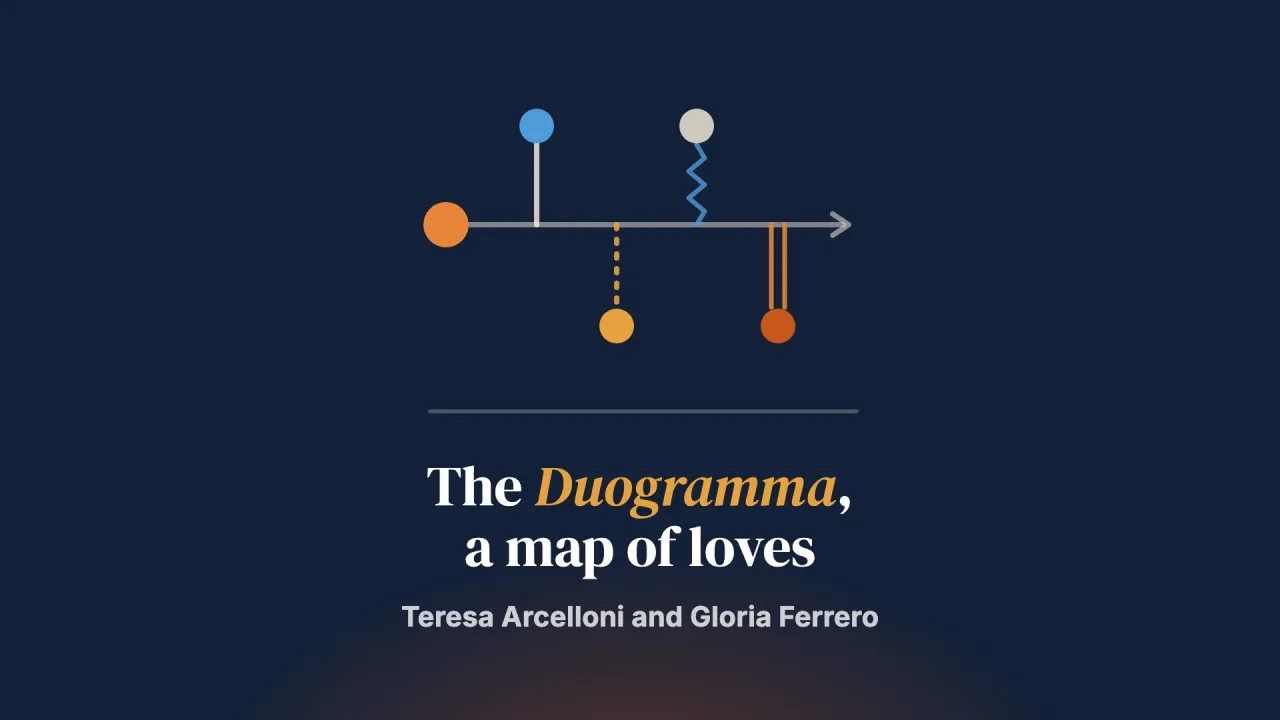
The Duogramma®: An innovative methodology for psychotherapy
A map of the couple relationships lived, desired or rejected since childhood: the Duogramma®, its graphic rules and its use in individual therapy.
 Blog
Adult ADHD: when forgetting turns into a misunderstanding
Forgetting, compensating, tension in the couple: a systemic look at adult ADHD, to understand what is at stake and to look for more fitting forms of support.
 Scientific
Sickle Cell Disease and Young Couples: Understanding the Influence of Shared and Individual Meaning on Couples’ Experience of Illness
Nine young adult couples facing sickle cell disease: how each partner makes sense of the illness, and how the couple moves from caregiving to equality from one crisis to the next.
 Scientific
Digital Co-Regulation and Dysregulation in Romantic Relationships: A Systemic Model of Technology-Mediated Emotional Processes
Checking, chasing, blocking: 31 interviews show how the phone regulates or dysregulates a couple’s anxiety, with a systemic model of the loop.
Comments 0
Log in to join the discussion. Log in