Psychology and Psychotherapy: Theory, Research and Practice · Family
Mother and clinician experiences of a trial of a video feedback parent–infant intervention for mothers experiencing difficulties consistent with ‘personality disorder’: A qualitative interview study
In London, mothers whose enduring difficulties in managing emotions and relationships are consistent with ‘personality disorder’ received six video feedback sessions at home with their baby. Forty-four interviews with mothers, clinicians and a researcher describe the fear of being filmed and judged, and what eases it: a non-judgemental, child-focused gaze that freezes the frame on moments of connection.
This is a reformatted republication of Mother and clinician experiences of a trial of a video feedback parent–infant intervention for mothers experiencing difficulties consistent with ‘personality disorder’: A qualitative interview study, by Kirsten Barnicot, Jennie Parker, Sarah Kalwarowsky, Eloise Stevens, Jane Iles, Paul Ramchandani and Mike Crawford, published in Psychology and Psychotherapy: Theory, Research and Practice (Wiley) (2023), doi: 10.1111/papt.12453, under a CC BY 4.0 licence. Prepared by Complexe Systémique in September 2026: the authors’ text is unchanged; the layout has been adapted for reading online, which constitutes a modification of the work under the terms of the licence. Tables are presented as lists; end-of-article statements are grouped in the notes; the data availability statement and the online supporting information are not reproduced. This edition was made neither by the authors nor by the publisher, who are not responsible for its content or for any errors. The original version prevails.
Some mothers – particularly those with current or previous social services involvement – expressed that this positive feedback on their parenting stood in stark contrast to the negative feedback they were used to receiving from professionals.
Kirsten Barnicot, Jennie Parker, Sarah Kalwarowsky, Eloise Stevens, Jane Iles, Paul Ramchandani and Mike Crawford
Abstract
Objectives. We explored mothers' and clinicians' experiences of a video feedback intervention adapted for perinatal ‘personality disorder’ (VIPP-PMH) and the acceptability of a randomised controlled trial (RCT) examining its effectiveness.
Design. In-depth qualitative interviews with participants from a two-phase feasibility study of the VIPP-PMH intervention. Participants were mothers experiencing enduring difficulties in managing emotions and relationships, consistent with a ‘personality disorder’, and their 6- to 36-month-old children.
Methods. Forty-four qualitative interviews were conducted, including all nine mothers receiving VIPP-PMH during the pilot phase, 25 of the 34 mothers participating in the RCT (14 allocated to the VIPP-PMH arm and 9 from the control arm), 11 of the 12 clinicians delivering VIPP-PMH and one researcher. Interview data were thematically analysed.
Results. Mothers described feeling motivated to take part in the research and understood the need for randomisation. Research visits were largely experienced positively, with some suggestions for improvement in questionnaire timing and accessibility. Almost all mothers initially felt anxious about being filmed, but reported positive experiences of the intervention, particularly valuing its non-judgemental, positive and child-focussed nature, their supportive relationship with the therapist and the insights they gained on their child.
Conclusions. The findings indicate the likely feasibility and acceptability of undertaking a future definitive RCT of the VIPP-PMH intervention in this population. In designing a future trial, a positive and non-judgemental therapeutic relationship will be important to allay mothers' anxieties about being filmed, and careful consideration should be given to the timing and accessibility of questionnaires used.
Practitioner points
- When delivering video feedback interventions to mothers experiencing perinatal mental health difficulties such as ‘personality disorder’, it is important to allay mothers' anxieties about being filmed by emphasising the non-judgemental and child-focussed natured of the intervention.
- Feedback on mother–child interaction should be predominantly positive, helping mothers to build on the strengths in their relationship with their child.
- Feedback on children's communicative and play behaviour may help mothers to identify, understand and respond sensitively to their children's cues.
- The acceptability and feasibility of delivering video feedback interventions in perinatal mental health populations can be supported by protected time for clinicians to prepare and deliver sessions, agreement on mutually acceptable boundaries for appointment rescheduling, home-based delivery and encouraging mothers to respond naturally to their child's cues as much as possible.
BACKGROUND
Parents who meet diagnostic criteria for a ‘personality disorder’ experience enduring difficulties in managing emotions and relationships. Given the growing consensus that this diagnostic label can often be unhelpful, whilst an alternative conceptualisation has not been agreed (Consensus Statement Group, 2018; Hartley et al., 2022), we will place this terminology in quotes. This group of parents – particularly those experiencing difficulties consistent with ‘borderline personality disorder’ – are more likely than others to lack confidence in parenting, to experience parenting stress (Bartsch et al., 2016; Dunn et al., 2020; Zalewski et al., 2015) and to experience difficulties in understanding and responding appropriately to their child's communication (‘parental sensitivity’, Ainsworth et al., 1974; Petfield et al., 2015, Steele et al., 2019). Their children are more likely to experience difficulties in forming a secure parent–child attachment and are at increased risk of developing emotional, behavioural and mental health difficulties (Petfield et al., 2015). Consequently, interventions focussed on improving the parent–infant relationship for parents experiencing difficulties consistent with ‘personality disorder’ have been highlighted as a priority in United Kingdom health policy (Department of Health, 2012; National Health Service, 2019; UK Parliament et al., 2013).
This group of parents have often themselves experienced relational and attachment trauma (Porter et al., 2020; Zanarini et al., 1997). New parenthood can potentially be a turning point, with parents highly motivated to develop positive relationships with their own children (Bartsch et al., 2016; Dunn et al., 2020). The perinatal period from birth to toddlerhood is also an important window for interventions to support positive child development, with neurogenesis in critical brain regions peaking at age three (Shonkoff & Philips, 2000; Siegel, 2015).
There have been a number of promising interventions developed for mothers experiencing difficulties consistent with ‘borderline personality disorder’ including the ‘parenting skills for mothers with borderline personality disorder’ group intervention (Renneberg & Rosenbach, 2016; Rosenbach et al., 2020) and mother–infant dialectical behaviour therapy (Sved Williams et al., 2021). However, these have not yet been tested in a randomised controlled trial (RCT). We have recently completed a feasibility RCT of the video feedback intervention for positive parenting (VIPP, Juffer et al., 2015), adapted for parents experiencing difficulties consistent with perinatal ‘personality disorder’ (VIPP-PMH), and their 6- to 36-month-old children (Barnicot et al., 2022). This is, to our knowledge, the first published RCT of a perinatal parent–infant intervention in this population. Uptake and completion rates indicated high levels of intervention feasibility and acceptability, whilst outcome data showed potential positive effects on parental sensitivity in parent–child interaction (Barnicot et al., 2022). Understanding parents' and clinicians' experiences of the trial and intervention is vital for informing further improvements in acceptability and feasibility.
We conducted a thematic analysis of qualitative interviews with participating parents and clinicians. Our aims were:
- To understand how parents and clinicians experienced taking part in the intervention and in the trial;
- To synthesise their feedback to determine the feasibility and acceptability of the intervention and trial design and inform further optimisation.
Design
Qualitative interviews were completed with a subsample of participants and clinicians from the BOOST trial – a two-phase feasibility study in which VIPP-PMH was piloted and modified (Phase 1) and then evaluated using a pilot two-arm parallel RCT (Phase 2). Interviews were analysed using reflexive thematic analysis, drawing on an interpretivist approach by considering the role of the researcher and researcher-participant dynamics in creating and interpreting the interview data (Braun & Clarke, 2019; Ormston et al., 2014).
Ethics statement
The study was approved by the UK NHS Health Research Authority and granted a favourable opinion by the London – Camden and Kings Cross NHS Research Ethics Committee in June 2017.
Inclusion and exclusion criteria
Inclusion and exclusion criteria for participation in the trial are shown in Table 1. All participating mothers, all clinicians delivering VIPP-PMH or recruiting to the trial and researchers involved in the trial were invited to participate in interviews.
Table 1 — Inclusion and exclusion criteria.
- Inclusion criteria: Men and women who:
- Were experiencing enduring difficulties in managing emotions and relationships consistent with DSM-V personality disorder as assessed using the SCID-PD Personality Disorder Interview
- Were a mother or father with parental responsibility for a biological or adopted child aged 6–36 months old at the point of randomisation, with unsupervised contact outside of a contact centre with that child for at least 24 h per 7-day period
- Were capable of giving informed consent
- Were aged 16–65 years old
- Were using secondary care mental health services in a participating Trust at the point of study entry
- Families where a sibling or co-parent had participated in the study
- Families in which the eligible child had a clinical diagnosis of a learning difficulty, developmental disorder, or sensory impairment.
- Families in which the eligible parent had English language or learning difficulties that are sufficiently severe to prevent them completing study measures even with assistance.
- Families in which the eligible parent was participating in another type of parent–infant psychotherapy.
Intervention
Six 90-minute sessions of the Video-feedback Intervention to promote Positive Parenting with Sensitive Discipline (Juffer et al., 2015), adapted for perinatal mental health (VIPP-PMH). Clinicians videoed parent–child interactions and subsequently replayed the videos for the parent, offering feedback on the child's interactive and play behaviour, highlighting the child's attachment behaviours and reinforcing parents' sensitive responses to their child. If the child was aged between 6 and 10 months at intervention initiation, modified developmentally appropriate filming tasks were used and intervention content around sensitive discipline was omitted (VIPP Training and Research Centre, 2015). The intervention was adapted for parents experiencing ‘personality disorder’ by adding material on managing self-critical feelings and anxieties about being judged (Barnicot et al., 2022). Clinicians delivering the intervention attended a 5-day accredited training in the adapted VIPP-SD programme and received accredited supervision prior to each delivered session.
Control condition
Participants in the control condition did not receive VIPP-PMH. Both intervention and control participants accessed care as usual from mental health, primary care and/or social services and received information booklets about early child development and parenting (Department of Education, 2013; National Society for the Prevention of Cruelty to Children, 2013a, 2013b).
Study setting
Participants were recruited from community perinatal mental health and personality disorder services in four NHS Trusts in London, United Kingdom.
Qualitative interviews
Mothers were interviewed by JP, a researcher with lived experience of a ‘personality disorder’ diagnosis, whilst clinician interviews were carried out by KB with input from SK. Participants were interviewed over the phone, excepting five clinician interviews occurring in person. Interviews were guided by a semi-structured topic guide, including some predetermined questions, but open-ended and flexible to allow for researcher probing and exploration of additional topics. Based on the research questions and guidance on key domains to explore in qualitative research within feasibility trials (O'Cathain et al., 2015), parents were asked about their expectations and experiences of the intervention, its relevance to their needs and to their child, what they found helpful or less helpful, any experiences of feeling judged or self-critical and potential changes that could be made to improve their overall experience. Participants in the control group were also interviewed about their feelings regarding receiving care as usual in the context of an RCT, and all participants were asked how they felt about being randomised and how they experienced the research visits. Clinicians were asked about their experiences of referring participants to the research and of delivering the intervention. The topic guides are available in the Appendix S1. Interviews ranged from 10 to 60 min duration, averaging 27 min and were audio-taped for subsequent transcription.
Qualitative analysis
KB and JP co-led a reflexive thematic analysis of interview data (Braun & Clarke, 2006, 2019), using a single coding framework to analyse maternal, clinician and researcher accounts. Data collection and analysis occurred concurrently so that early analysis could inform conduct of subsequent interviews (Corbin & Strauss, 2008). Based on the research questions and guidance on key domains to explore in qualitative research within feasibility trials (O'Cathain et al., 2015), participants' feedback was deductively analysed under three Domains: Taking Part in the Research, Experiences of the Control Condition and Experiences of VIPP-PMH. Following line-by-line coding of all data in MAXQDA software (Version 12, VERBI Software, 2015), themes and sub-themes were inductively created to capture the in-depth data on experiences of VIPP-PMH. The data within the first two domains were less rich; consequently, an analytic narrative without themes or sub-themes was created to capture this.
Reflexivity
The analytical team engaged in reflexive dialogue throughout the research (Olmos-Vega et al., 2022). We considered the possible benefits of KB's established relationship with the clinicians she interviewed in encouraging greater openness in disclosing their experiences, in contrast to JP's lack of prior relationship with the mothers she interviewed. Conversely, we reflected that the clinicians may have felt less able to criticise study or intervention procedures given KB's role in designing these, whereas the mothers may have been encouraged by JP's independence from other research team members and disclosure of relevant lived experience to share any negative experiences. We reflected that participants' accounts were interpreted through the lens of KB's positive and negative personal experiences of delivering VIPP-PMH, whilst JP interpreted participants' accounts through the lens of her own positive and negative experiences of receiving mental health services. This led each analyst to privilege different aspects of participants' accounts, enabling collaborative insights that may not have been otherwise accessible (Gillard et al., 2012).
RESULTS
Sample characteristics
Forty-four interviews were conducted, comprising all nine mothers receiving VIPP-PMH during the pilot phase, 14 of the 20 mothers allocated to the VIPP-PMH arm and nine of the14 mothers allocated to the control arm during the RCT phase, 11of the 12 clinicians delivering VIPP-PMH or referring mothers to the study, and one researcher.
Eleven mothers did not take part in feedback interviews; one explicitly declined, and the remainder did not respond to researcher contact attempts. Characteristics of interviewed and non-interviewed mothers (see Table 2) were broadly similar to the full RCT sample (Barnicot et al., 2022). The most commonly recorded primary diagnoses were depressive disorders, whilst just over a third had a recorded primary diagnosis of emotionally unstable (borderline) personality disorder on their medical records. Seventy-eight percent of interviewed participants exceeded the diagnostic threshold for borderline ‘personality disorder’ according to a SCID-PD diagnostic interview, with the remainder meeting diagnostic criteria for avoidant, obsessive–compulsive and/ or paranoid ‘personality disorders’. Nearly three quarters of the sample had a history of physical and/or sexual trauma, most commonly beginning in childhood. Mothers not taking part in an interview were less likely to meet diagnostic criteria for ‘borderline personality disorder’ and more likely to meet criteria for ‘paranoid personality disorder’, and more likely to have discontinued VIPP-PMH early or been allocated to the control arm, than participating mothers.
Table 2 — Characteristics of interviewed versus non-interviewed participants.
- Allocated to VIPP (pilot or RCT); Interviewed (N = 32), N (%) or Mean (SD): 23 (72%); Not interviewed (N = 11), N (%) or Mean (SD): 6 (55%)
- VIPP without SD; Interviewed (N = 32), N (%) or Mean (SD): 14 (44%); Not interviewed (N = 11), N (%) or Mean (SD): 5 (45%)
- VIPP-SD; Interviewed (N = 32), N (%) or Mean (SD): 9 (28%); Not interviewed (N = 11), N (%) or Mean (SD): 1 (9%)
- Completed all 6 VIPP sessions; Interviewed (N = 32), N (%) or Mean (SD): 18 (56%); Not interviewed (N = 11), N (%) or Mean (SD): 2 (18%)
- Completed <6 VIPP sessions; Interviewed (N = 32), N (%) or Mean (SD): 5 (16%); Not interviewed (N = 11), N (%) or Mean (SD): 4 (36%)
- Allocated to usual care alone (RCT); Interviewed (N = 32), N (%) or Mean (SD): 9 (28%); Not interviewed (N = 11), N (%) or Mean (SD): 5 (45%)
- Maternal ethnicity
- Black British; Interviewed (N = 32), N (%) or Mean (SD): 4 (12.5%); Not interviewed (N = 11), N (%) or Mean (SD): 0 (0%)
- Black Other; Interviewed (N = 32), N (%) or Mean (SD): 1 (3%); Not interviewed (N = 11), N (%) or Mean (SD): 0 (0%)
- Mixed; Interviewed (N = 32), N (%) or Mean (SD): 4 (12.5%); Not interviewed (N = 11), N (%) or Mean (SD): 1 (9%)
- South Asian British; Interviewed (N = 32), N (%) or Mean (SD): 1 (3%); Not interviewed (N = 11), N (%) or Mean (SD): 2 (18%)
- South Asian Other; Interviewed (N = 32), N (%) or Mean (SD): 2 (6%); Not interviewed (N = 11), N (%) or Mean (SD): 1 (9%)
- White British; Interviewed (N = 32), N (%) or Mean (SD): 11 (34%); Not interviewed (N = 11), N (%) or Mean (SD): 4 (36%)
- White Other; Interviewed (N = 32), N (%) or Mean (SD): 7 (22%); Not interviewed (N = 11), N (%) or Mean (SD): 2 (18%)
- Other; Interviewed (N = 32), N (%) or Mean (SD): 2 (6%); Not interviewed (N = 11), N (%) or Mean (SD): 1 (9%)
- Maternal employment status
- Full or part-time employed (maternity leave); Interviewed (N = 32), N (%) or Mean (SD): 5 (16%); Not interviewed (N = 11), N (%) or Mean (SD): 0 (0%)
- Full or part-time employed (returned to work); Interviewed (N = 32), N (%) or Mean (SD): 9 (28%); Not interviewed (N = 11), N (%) or Mean (SD): 4 (36%)
- Unemployed; Interviewed (N = 32), N (%) or Mean (SD): 18 (56%); Not interviewed (N = 11), N (%) or Mean (SD): 7 (64%)
- Relationship status
- In an unmarried relationship; Interviewed (N = 32), N (%) or Mean (SD): 7 (22%); Not interviewed (N = 11), N (%) or Mean (SD): 3 (27%)
- Married; Interviewed (N = 32), N (%) or Mean (SD): 13 (41%); Not interviewed (N = 11), N (%) or Mean (SD): 2 (18%)
- Single; Interviewed (N = 32), N (%) or Mean (SD): 12 (67%); Not interviewed (N = 11), N (%) or Mean (SD): 6 (55%)
- Number of children
- 1; Interviewed (N = 32), N (%) or Mean (SD): 13 (41%); Not interviewed (N = 11), N (%) or Mean (SD): 4 (36%)
- 2; Interviewed (N = 32), N (%) or Mean (SD): 10 (31%); Not interviewed (N = 11), N (%) or Mean (SD): 3 (27%)
- ≥3; Interviewed (N = 32), N (%) or Mean (SD): 9 (28%); Not interviewed (N = 11), N (%) or Mean (SD): 4 (36%)
- Age of target child (months)
- 6–10 months; Interviewed (N = 32), N (%) or Mean (SD): 20 (62.5%); Not interviewed (N = 11), N (%) or Mean (SD): 8 (73%)
- 11–36 months; Interviewed (N = 32), N (%) or Mean (SD): 12 (37.5%); Not interviewed (N = 11), N (%) or Mean (SD): 3 (27%)
- Children's social services involvement
- Current; Interviewed (N = 32), N (%) or Mean (SD): 9 (28%); Not interviewed (N = 11), N (%) or Mean (SD): 2 (18%)
- Past only; Interviewed (N = 32), N (%) or Mean (SD): 6 (19%); Not interviewed (N = 11), N (%) or Mean (SD): 3 (27%)
- Never; Interviewed (N = 32), N (%) or Mean (SD): 17 (53%); Not interviewed (N = 11), N (%) or Mean (SD): 6 (55%)
- Maternal primary recorded ICD-10 diagnosis
- Adjustment disorder/Other reactions to severe stress; Interviewed (N = 32), N (%) or Mean (SD): 4 (12.5%); Not interviewed (N = 11), N (%) or Mean (SD): 0 (0%)
- Anxiety disorder; Interviewed (N = 32), N (%) or Mean (SD): 0 (0%); Not interviewed (N = 11), N (%) or Mean (SD): 1 (9%)
- Bipolar affective disorder; Interviewed (N = 32), N (%) or Mean (SD): 2 (6%); Not interviewed (N = 11), N (%) or Mean (SD): 0 (0%)
- Eating disorder; Interviewed (N = 32), N (%) or Mean (SD): 1 (3%); Not interviewed (N = 11), N (%) or Mean (SD): 0 (0%)
- Emotionally unstable personality disorder; Interviewed (N = 32), N (%) or Mean (SD): 12 (37.5%); Not interviewed (N = 11), N (%) or Mean (SD): 5 (45%)
- Major depressive or recurrent depressive disorder/episode; Interviewed (N = 32), N (%) or Mean (SD): 10 (31%); Not interviewed (N = 11), N (%) or Mean (SD): 4 (36%)
- Other mental and behaviour disorders associated with the Puerperium; Interviewed (N = 32), N (%) or Mean (SD): 1 (3%); Not interviewed (N = 11), N (%) or Mean (SD): 0 (0%)
- Post-traumatic stress disorder; Interviewed (N = 32), N (%) or Mean (SD): 0 (0%); Not interviewed (N = 11), N (%) or Mean (SD): 1 (9%)
- No diagnosis recorded; Interviewed (N = 32), N (%) or Mean (SD): 2 (6%); Not interviewed (N = 11), N (%) or Mean (SD): 0 (0%)
- Maternal SCID-PD primary classificationa
- Avoidant; Interviewed (N = 32), N (%) or Mean (SD): 4 (12.5%); Not interviewed (N = 11), N (%) or Mean (SD): 1 (9%)
- Borderline; Interviewed (N = 32), N (%) or Mean (SD): 25 (78%); Not interviewed (N = 11), N (%) or Mean (SD): 7 (64%)
- Obsessive compulsive; Interviewed (N = 32), N (%) or Mean (SD): 2 (6%); Not interviewed (N = 11), N (%) or Mean (SD): 1 (9%)
- Paranoid; Interviewed (N = 32), N (%) or Mean (SD): 1 (3%); Not interviewed (N = 11), N (%) or Mean (SD): 2 (18%)
- Maternal history of sexual and/or physical violence trauma (THQ)b
- Any age; Interviewed (N = 32), N (%) or Mean (SD): 24 (75%); Not interviewed (N = 11), N (%) or Mean (SD): 9 (82%)
- In childhood; Interviewed (N = 32), N (%) or Mean (SD): 14 (44%); Not interviewed (N = 11), N (%) or Mean (SD): 7 (64%)
- Had previously attended the emergency department for psychiatric reasons; Interviewed (N = 32), N (%) or Mean (SD): 15 (47%); Not interviewed (N = 11), N (%) or Mean (SD): 4 (36%)
- Had previously self-harmed; Interviewed (N = 32), N (%) or Mean (SD): 24 (75%); Not interviewed (N = 11), N (%) or Mean (SD): 9 (82%)
- Edinburgh Post-natal Depression scale (EPDS)c; Interviewed (N = 32), N (%) or Mean (SD): 13.91 (6.85); Not interviewed (N = 11), N (%) or Mean (SD): 13.45 (8.65)
- Personality disorder severity (SAS-PD)d; Interviewed (N = 32), N (%) or Mean (SD): 9.27 (3.58); Not interviewed (N = 11), N (%) or Mean (SD): 13.89 (4.57)
- Complex PTSD symptomse; Interviewed (N = 32), N (%) or Mean (SD): 32.34 (11.52); Not interviewed (N = 11), N (%) or Mean (SD): 33.09 (16.89)
a SCID-PD, self-report questionnaire and semi-structured interview, carried out by a trained researcher, First et al., 2015. b THQ, Trauma History Questionnaire, Hooper et al., 2011. c Edinburgh Postnatal Depression Scale, Cox et al., 1987. d SAS-PD, Standardised Assessment of Severity of Personality Disorder, Olajide et al., 2017. e Complex PTSD scale, Cloitre et al., 2018.
Domain 1: Taking part in the research
Feedback from 32 mothers, nine clinicians and one researcher contributed to this Domain. Exemplar quotes are given in Table 3. Some mothers initially felt unsure about taking part, feeling unclear about what the research involved and/or anxious about the prospect of being filmed. They were worried about being judged as lacking in parenting skills, felt self-conscious about watching themselves on video and were concerned about who might access the videos. One mother wondered whether participation implied a problem with her parenting. Clear explanations, and trust in the reassurances given by clinicians and researchers, helped to address these concerns. Mothers were motivated to participate by wanting to gain insight, learning and benefits for their parenting, their child and their relationship with their child, and/or to help others. Clinicians and researchers felt that recruitment was hindered by mothers disengaging from the clinical service and/or being discharged before the child reached the minimum recruitment age of 6 months.
Table 3 — Examples quotes for experiences of taking part in the research and the control condition.
- Domain 1. Taking part in the research.: Challenges
- Recruitment hindered by mothers disengaging or being discharged · “If they didn't engage with the service that made recruitment really difficult because there was no way of going back and asking them….because we run a small service and you're only taking on women after six months postnatal as new referrals, but we're working with the ones who were already under us up to a year, so probably we may have missed some of the women who could have benefitted from your service” [Clinician 1] “The biggest problem with recruitment was that Perinatal mental health services aren't taking on people with six-month olds, they're taking pregnant people. So recruitment would have to be staggered forward.” [Researcher 1]
- Feeling initially unclear about what the research involved · “Even though it was explained, I still kind of wasn't sure what I had to actually do…what they needed. But only until like the sessions started did I know what they wanted, because obviously there was film each session, see how [Child] would respond”. [P105] “The woman I was seeing, I think it was the psychiatrist at perinatal mental health, she suggested it. She was pretty vague on what it was to be fair, but at the same time I trusted that she was putting me forward for something that would be beneficial to me.” [P108] “I think you're in a difficult position because you could send out a load of leaflets and a load of information on it and as a new mother, you're not going to get time to read it, or have the brain power to absorb it. And then you can have someone come to your house and ask you, but if the baby's screaming or kicking off or this and that, you are not able to fully concentrate and understand, and maybe even feel like you can ask a question.” [P304]
- Feeling anxious about being filmed and/or judged · “I didn't really want to be filmed …I don't really know who's going to be watching and what they're going to do with it, how long they're going to keep it….. I thought should I do it or not?” [P217] “I was just worried maybe that I might do something, likes if [Child] was having a fit or something… I wouldn't know what to do and then they might judge me on that. But it wasn't like that.” [P218]. “It was kind of at a point of feeling very, very vulnerable anyway, having obviously been fairly very early stages of having him and post-natal depression and whatever else. You know, it's not the easiest time to then start to think about watching yourself back and seeing how you are – good or not good, or whatever as a parent. But, yeah, so nervous I would say; a bit unsure as to what I was going to find.” [P308]. “I was worried that they would tell me that I didn't have a good relationship with my daughter and that she didn't bond with me properly.” [P501]. “I did have one or two mums who didn't want to be filmed…I was trying to explain it, ‘Hardly anyone would see it and that it was just a group of researchers and it's all confidential, like we wouldn't post it anywhere or anything’ and that was just a no-no” [Researcher 1].
- Finding the questionnaires difficult · “Maybe if they were electronic and then you could just fill them out and send them back? Maybe that would have been easier, because then I could have done it when the kids were asleep and actually took the time to focus on it, not just quickly get it done, quickly get it done – I felt like I was kind of rushing them.” [P104] “I think because of [C]'s age, some of the questions didn't apply to her but that was fine and we talked about that in the moment.” [P108]. “I asked [R] if I could fill the questionnaire later, and I send it back by post, because that questionnaire was a bit hard for me because I had to think about the past, and it was difficult questions.” [P216]. “[C] was a bit younger back then, and then she wasn't so happy about me being busy and then she wasn't letting me answer the questions; she kept grabbing the pen or she kept grabbing the papers, because she was getting upset because we were busy for so long. So, maybe if it would be a bit shorter or maybe if they could split it into two different sessions or visits” [P217]. “…Some of the questions, the way you had to answer is not that good because some of the questions are like – the question says no when the answer is yes, so it's confusing.” [P302]. “You think well I don't really want to put down that I felt suicidal or had really low thoughts because it seems a bit – so I suppose there's a little bit of pressure, self-imposed, from there being people there while you are filling in the form” [P303]. “The only thing is there were some questions and it was ‘not at all’ or ‘sometimes’ was like the same one…..I would want to put ‘not at all’, but it would make me feel like I was saying ‘sometimes’ because you only had that choice to link them two together.” [P307]. “There's the one, I think probably more than one, mum who weren't great at reading or great at reading in English. And for them the questionnaires put them off…that was more mums who couldn't read very well than I've ever had in any other study.” [Researcher 1].
- Domain 1. Taking part in the research.: Helpful factors
- Recruitment helped by good communication between research and clinical teams · “He was a really good link between the teams and the mums…. he did a lot of really good liaising between us, both in terms of ‘I don't think she can do this right now’, or ‘she really, really wants to do this but there's some stuff going on in her life’” [Researcher 1]. “It wasn't too onerous for us. I think once we got into the swing of it, it was an easy enough thing to identity; you know, you guys coming in and going through the lists made it a lot easier.” [Clinician 2]
- Clear explanations about what the study involved · “When I spoke to [R1] again, it just…made more sense; she went into more detail.…it made me want to do it more when it was explained properly” [P110] “[R] was very good in explaining only herself and the team would watch it and she assured me that nobody else would watch it … and that I would receive all the videos.” [P203] “[R1] was very good at talking through what was going to be happening. So, yeah, I felt a lot better having talked to her.” [P308]
- Feeling motivated by potential benefits for self and child · “Because I had some children removed…. I just want the best for my little one so any help that I could get really.” [P106] “Anything that I can get to do more as a parent and as a person, and any sort of resources and skills I can pick up are going to be beneficial for me and for my child.” [P108]. “I kind of just thought that I was struggling with the baby a bit, and I was just trying to take any help available to help me bond with him, to help me understand him a bit more.” [P110] “Back then I was in quite a dark place….It was just a case of anything to help. I was struggling bonding with [C] and I was just desperate, I just wanted someone to come along and fix me.” [P304]. “People find it interesting and something that can be beneficial potentially for their baby.” [Clinician 3] “Really selling the point of them being able to pick up on, detect the baby's cues, and respond to it, I think that's quite a motivator for them because naturally most people want to be a better mum or be the best that they can be.”[Clinician 4]
- Feeling motivated by wanting to help others · “Knowing how hard it sometimes is to get participants for a study I was happy to participate from that perspective too.” [P108] “When I got more information it sounded really interesting, and at the time I just thought if it benefits me that's great, but if it doesn't at least, because it's a research thing, at least it will benefit somebody.” [P205] “To be honest I'm just one of those people believes that if I can do something now to help somebody else with their child potentially then yeah, I want to be involved in this.” [P214] “I think a lot of people were motivated by altruism, just wanting to help and wanting to contribute” [Clinician 5]
- Positive relationship with the researcher · “They were lovely and answered all my questions and were the right mix of friendly and engaging. [P108]. “I did it with [R] and she was such a nice warm person that it was actually good to talk to somebody about some difficulties that I have had in the past, because some of the questions bring up your past….[R] was very down to earth, nice, and she seemed interested, not judgemental, not neglecting, not dismissive.”[P203]. “She had a really great sense of humour; she told me I didn't have to do it, this is a voluntary thing…and she just made me so relaxed, it was like, ‘well let's just do it’”. [P115]. “[R1] was really nice, she was really friendly and really good with [C] as well, because when I did the last questionnaire [C] was still in that playful mood and she was playing with her so I could answer the questions. She was very easy to talk to and she reassured me and made me feel very relaxed. I also felt like I could be open and honest with her and if there were a few things I didn't quite get I just asked her about it.”[P307].
- Researcher support with the questionnaires · “She was absolutely great…..It was always relaxed, she was like ‘you can take a break’ and then go and do some questionnaires and then took a break, did some filming and then she was always like ‘I can read the questions to you if you want’…..So she was always just reassuring which was really nice to have there and it was just [C] was also quite attached to me at that time but she was able to entertain [C] as well. It was a much more relaxing environment and [R] herself was quite a relaxing person.” [P101] “She gave me as much time as I needed and she just waited for me to finish, so there wasn't no rush….There were just some long words where I didn't understand but [R] explained it to me.” [P106] “I struggle with reading black and white. So I was like ‘It's going to take me forever to do it’ and she was like, ‘that's okay’, she read out the questions to me…. She was like, ‘okay, if you can't, well I'll help you’ [P110]. “I remember she said ‘If you find it is too much we can do some now and some another day’, but I felt it was okay. I felt it was fine.” [P301] “You certainly couldn't, for some of the mums in the study, post them the questionnaires and just get them to do it, you had to sit there and read it, which is fine… making sure there is an availability for them to always have the choice to either ‘I'll come to your house or I'll phone you and do the questionnaires’” [Researcher 1]
- Domain 1. Taking part in the research.: Domain 2. Experiences of the control condition
- Preference for VIPP · “I really wanted the person to come round. I'm not so good at reading things – the information pack.” [P206] “I felt like I wanted the other one, the video one, not the paper one… because they would give more feedback and if it's written on paper I don't get to ask questions or anything.” [P302] I was a bit disappointed actually!.... I would have secretly liked to have done more of the other stuff to be honest.” [P307]
- Understanding the rationale for randomisation · “I know how these things work so that's fair enough, it's not going to be a scientific study if it's not a randomised control trial.” [P303] “I get it's completely at random, so you can't…also if you knew they were picking you'd feel like ‘did I do something wrong’ as well.” [P307].
- The information booklets · “The information pack, when I finally got around to reading it, it was informative and things and it was easy to read but I'm better at learning when people show me how to do it. [P206]. “At that time my baby was quite young, so I didn't even have time to do anything! Let alone sit down and read through the booklet and stuff.” [P209]. “As time has gone through certain things – it definitely did help because the way that they wrote it is from the baby's point of view, from the baby's perspective, so ‘Oh when I'm doing this it means this or that’ so I thought it was pretty cool to be honest.” [P214] “I haven't had time. And also, you know I have some concentration problems, and I am not really a good reader as well.” [P216]
Mothers' feedback on the study questionnaires is summarised in Table 4. A number of mothers expressed difficulties with completing the measures, including their length and content, and the upsetting nature of some of the questions. Support from the researchers, and having the option to complete questionnaires in their own time before or after the research visit, was described as helpful. A number of mothers expressed their appreciation for their positive relationship with the researchers, valuing their kindness, empathy and flexibility in scheduling visits and working around the child's needs.
Table 4 — Participant feedback on the questionnaires.
- Measure: All measures; Participant feedback: Too long overall. Support from the researcher and opportunity to complete questionnaires in their own time helped
- Measure: Brief Infant Toddler Socio-Emotional Assessment (BITSEA); Participant feedback: Participants of children aged under 12 months found it difficult to apply all questions to their child's stage of development
- Measure: Child behaviour checklist age 1.5–5; Participant feedback: Participants found this questionnaire too long and overlapping with the BITSEA. Participants of children aged under 12 months found it difficult to apply all questions to their child's stage of development
- Measure: Clinical outcomes in routine evaluation; Participant feedback: No positive or negative feedback given
- Measure: Edinburgh post-natal depression scale; Participant feedback: No positive or negative feedback given
- Measure: Infant-toddler symptom checklist; Participant feedback: Some participants found the conflation of “Never or sometimes” as a single response option made the questionnaire difficult to answer
- Measure: International trauma questionnaire; Participant feedback: No positive or negative feedback given.
- Measure: Parental sense of competence scale; Participant feedback: Some participants found some questions on this measure were long-winded and confusingly worded
- Measure: Parental stress scale; Participant feedback: No positive or negative feedback given
- Measure: The standardised assessment of severity of personality disorder; Participant feedback: No positive or negative feedback given
- Measure: The structured clinical interview for DSM-5 personality disorders; Participant feedback: Some participants were confused by double negative questions. One participant found this upsetting to complete but also said she felt this questionnaire described what she was going through better than any others
- Measure: Trauma history questionnaire; Participant feedback: Some participants found this upsetting to complete. Support from the researcher was helpful
Domain 2. Experiences of randomisation and the control condition
Feedback from 32 mothers, two clinicians and one researcher contributed to this domain. Exemplar quotes are given in Table 3. A majority of mothers in the RCT phase expressed a preference for receiving VIPP-PMH because it provided an opportunity to interact with a clinician and ask questions. Whilst they found some aspects of the information booklets helpful, such as the information about child development, overall they reported difficulties finding time to sit down and read them. Allocation to the control condition was therefore a disappointment for the majority. However, most mothers understood the rationale for randomisation.
Domain 3. Experiences of VIPP-PMH
Twenty-three mothers received VIPP-PMH. Their experiences were conceptualised into themes and sub-themes, with the first theme representing benefits of VIPP-PMH for parent–child interaction, and the remaining themes representing challenges and helpful factors, as depicted in Figure 1. Where mothers and clinicians gave similar accounts of mothers' experiences, illustrative quotes from mothers rather than clinicians have been prioritised. Illustrative quotes from clinicians are provided where clinicians described divergent perspectives specific to their own experiences; further illustrative quotes from clinicians for each sub-theme are available in the Appendix S1.
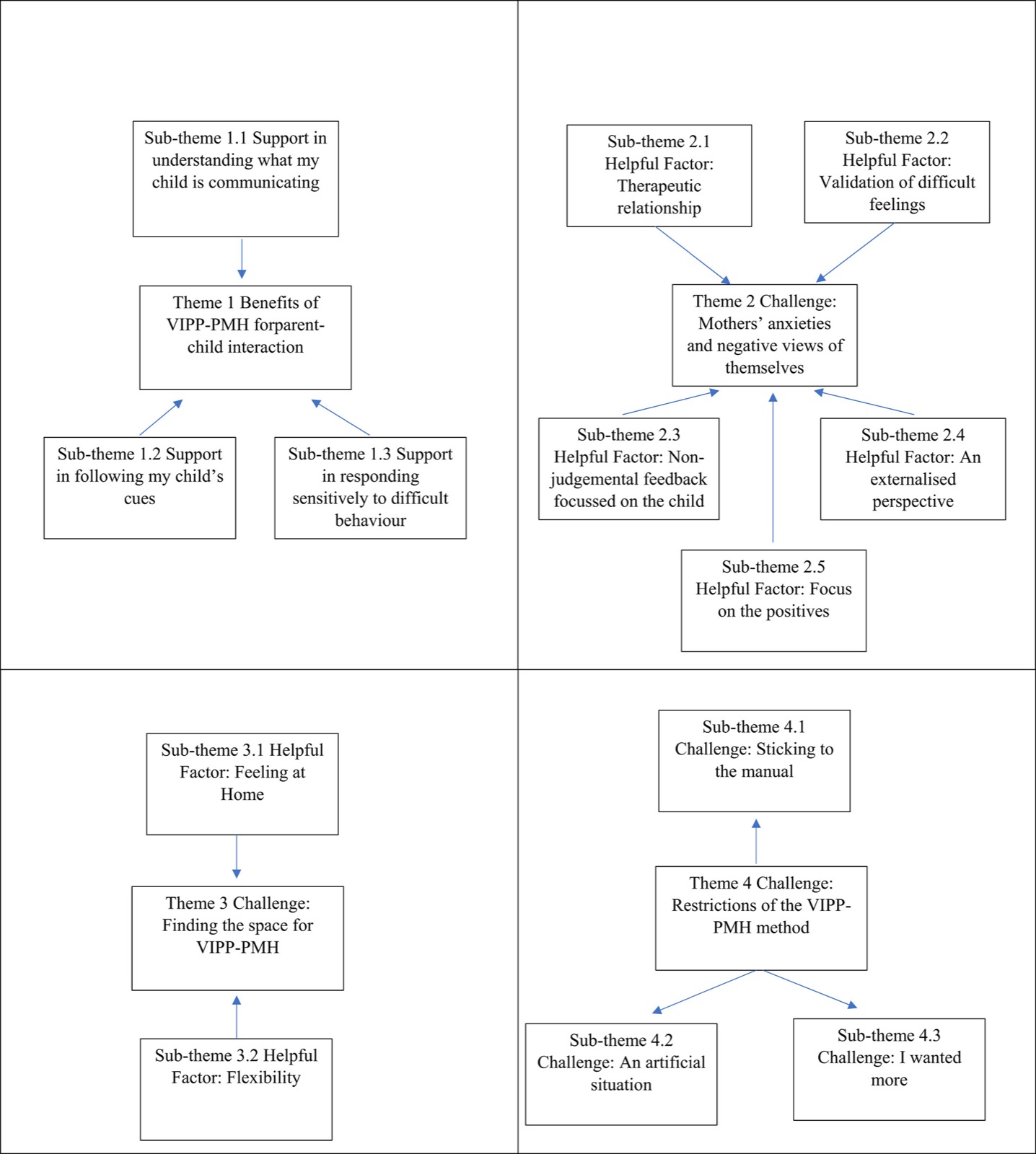
Theme 1: Benefits of VIPP-PMH for parent–child interaction
Feedback from 22 mothers and 11 clinicians contributed to this theme. The main target of the VIPP-PMH intervention is increasing maternal sensitivity and reducing intrusive behaviour. Accordingly, clinicians outlined that the intervention felt particularly appropriate for mothers in whom they observed difficulties in parent–child interaction, such as struggling to notice what their child was communicating, interpreting their child's frustration negatively as bad behaviour rather than being able to empathise with it and finding it hard to let their child lead the play or set the pace of the interaction. Clinicians also noted that some mothers were already demonstrating consistently high levels of sensitivity and non-intrusiveness, making it more challenging for clinicians to see the benefit of the intervention:
[She] was already very sensitive and I felt that she didn't really need to hear what I was saying… That was harder because I felt like I wasn't making a difference. (Clinician 5)
However, even mothers described by clinicians as highly sensitive did recount benefitting from VIPP-PMH, through having their sensitive interactional behaviour reinforced and encouraged. The following sub-themes encapsulate the benefits of VIPP-PMH for parent–child interaction that mothers and clinicians observed.
Sub-theme 1.1 support in understanding what my child is communicating
This sub-theme is supported by quotes from 20 mothers and 7 clinicians, who concurred that the video feedback elements of the intervention had helped mothers to better understand their child's cues and communication, and the way they experienced the world around them.
It was nice having her break down the videos for me and say like, ‘Look, at this point she was doing this, she indicated this to you’ - it helps you pick up on certain indications that you kind of overlook… [My child's] cues like when she would look at me or glance at me in a certain way it's like she wants my attention, she wants my interaction. (P104)
Through this process, mothers described an increased awareness of how much their children enjoyed even the simplest of play interactions with them, and the importance of building in time for connection with their child each day.
Some mothers also described gaining a more nuanced and positive understanding of their child's behaviour that they had previously interpreted negatively. For instance, understanding that their child's independent exploratory behaviour did not mean that they did not need or want their mother.
[My child] is a very confident little lady and could be easily mistaken for the fact that she doesn't need you, which is very much how I was… Actually little things in her behaviours, where she checks in or the way that she reacts back to you, it's showing that “Yeah okay mummy I can do this for myself but I still need you”. (P304)
For one mother, her increased connection and communication with her child was an important part of her strong desire to break the cycle of abuse and poor parental relationships that she herself had experienced.
I went through some trauma and I didn't feel I could go to my parents and talk openly… [VIPP-PMH] made such a huge difference into you understanding yourself as a parent, the child, and improving that relationship … so the child feels confident they want to talk to you. This to me is priceless. (P301)
Sub-theme 1.2 support in following my child's cues
This sub-theme is supported by quotes from 13 mothers and 7 clinicians, who explained how the intervention had helped mothers to step back in the interaction and follow their child's cues, letting their child lead the play, and slowing down the interaction to follow their child's pace.
I feel like now I can understand his cues… Like for instance, eating; before I'd just force it like, “Hurry up, come on, just eat,” and then now I just take a step back and when he does certain things like shakes his head I know he's not ready yet and so I just hold back. (P110)
Sub-theme 1.3 helpful factor: Support in responding sensitively to difficult behaviour
Eleven mothers received VIPP-PMH with the sensitive discipline component. Of these, the majority described learning helpful strategies for understanding and managing their child's difficult behaviour such as tantrums, including empathy, explanations, consistency and staying calm.
She was just explaining how kids at this age don't really understand rules specifically, but that just repeating things to them and with time they will understand it… it really helped to manage [my child]'s tantrums. (P501)
Theme 2 challenge: Mothers' anxieties and negative views of themselves
Twenty-six mothers and 11 clinicians reflected that mothers experienced anxieties about being videoed for a range of reasons, including feeling self-conscious, worrying about their physical appearance, feeling self-critical and negative about themselves as parents and worrying about others judging them. These anxieties sometimes stemmed from previous negative interactions with services around their parenting, particularly where child protection services had been involved.
I felt like maybe it's like the police, they're going to police you! You know, police your parenting… I think you feel exposed…I've had my children removed from my care while I was very, very ill, so sometimes you do feel like… it's hard. (P403)
Underlying these anxieties was sometimes a pervasive negative view of themselves as parents; a conviction that they were not good enough and that this would be revealed in the video footage.
I was convinced that I was really bad for my child and not doing very well as a mum… they'll see what a rubbish mum I am, they're going to think I'm very neglectful. (P205)
The following sub-themes represent factors that helped to address this challenge.
Sub-theme 2.1 helpful factor: Therapeutic relationship
All 23 interviewed mothers, and 5 clinicians, explained the importance of the warm, supportive and trusting therapeutic relationships mothers developed with the intervention clinician. This helped them relax and overcome anxieties about taking part.
The filming I weren't too sure about… that for me was a bit nerve-wracking. But then it weren't too bad, like when [the clinician] came to do it she made me feel really comfortable and I liked that… she was a very warm welcoming person. (P104)
However, both clinicians and mothers shared that getting to know each other and building trust took time.
I didn't feel like we had a really good relationship at the beginning, but that definitely grew. By the end I felt like we had quite a good connection and we were able to have really good discussions about different parts of the programme. (Clinician 6)
Sub-theme 2.2 helpful factor: Validation of difficult feelings
Nine mothers and 8 clinicians discussed appreciating the opportunity to debrief with the clinician at the end of each session, explaining that this helped mothers feel cared for and validated.
I think the fact that we had time to talk before and after each session was really good. Because for someone who has anxiety, it's really important to feel like I could actually express any concerns I had, and to also feel validated. (P208)
However, some clinicians found mothers did not share difficult feelings with them, and a few mothers explained that they had sometimes found it difficult to open up to the clinician or to put their feelings into words.
Sub-theme 2.3 helpful factor: Non-judgemental feedback focussed on the child
Eighteen mothers and 6 clinicians talked about the importance of not feeling judged by the clinician delivering VIPP-PMH, supported by consistent reassurance from the clinician that they were not there to judge.
I found the filming quite difficult because I felt like I was almost on show… I found that quite regularly she would reassure me that actually it wasn't being judged – it was a learning curve for everyone. (P208)
Mothers and clinicians explained that the focus on understanding the child, rather than on mothers' behaviour, helped to alleviate their anxieties about being judged.
[The clinician] never criticised me. She'd always say, ‘Oh no, this isn't about criticising you as a parent, this is about us learning about the communication of [my child]’… She sold me on it, I said “Yeah, this is great!” I never took it personally. (P403)
Sub-theme 2.4 helpful factor: An externalised perspective
Thirteen mothers and 6 clinicians spoke about the power of seeing mothers' interaction with their child externalised on the video recording. This ‘externalisation’ allowed mothers to notice aspects that had been difficult to see when caught up in the interaction. For some, this acted as a powerful counterforce to the negative beliefs they held about themselves.
All of those sorts of really extreme thoughts were going through my head and then the following session [the clinician] was pausing the video and she said, ‘Look how happy you both are when you look at each other’. I hadn't even realised - but there it was on film and I couldn't deny that it was there … I really realised that things are never really as dark as I was thinking they were. (P205)
Sub-theme 2.5 helpful factor: Focus on the positives
Sixteen mothers and 6 clinicians praised the focus of the intervention on highlighting the positive aspects of mothers' interaction with their child. For some, this was around helping them see evidence of the bond their child had with them, supported by ‘freeze-framing’ moments of connection between parent and child — a look, a smile, laughter or touch — when playing back the videos.
She would always freeze the video and say “Look you can see the amount of eye contact and the amount of love that she has in her eyes just looking at you for that one moment and it's just, that's a really special bond”. (P101)
For others this was around highlighting and praising what they were doing well as parents. Some mothers – particularly those with current or previous social services involvement – expressed that this positive feedback on their parenting stood in stark contrast to the negative feedback they were used to receiving from professionals.
It's the first time I've had someone actively saying how good something was about the way I did something… having someone saying that you are doing something well when you're feeling like you're failing at it all can only help. (P308)
A number of mothers and clinicians linked this directly to mothers feeling more confident in themselves as parents and in their relationship with their child.
It gave me confidence to feel like ‘Okay, I'm getting this right, I am a good enough parent, I am a good enough mummy’… I felt really quite empowered after. (P403)
Theme 3 challenge: Finding the space for VIPP-PMH
Twenty-three mothers and 10 clinicians contributed to this theme. Some mothers faced challenges in engaging with the VIPP-PMH sessions. Clinicians explained that frequent cancellations and missed appointments were frustrating and made it harder for mothers to retain the intervention messages due to long gaps between sessions.
I would say the most difficult was the consistency of being able to see them because she would either cancel literally in the last minute or just not be there when you turned up. (Clinician 6)
Mothers' accounts of why they sometimes struggled to attend sessions helped to give another perspective. It could feel really difficult to juggle sessions with the various medical and social stressors they and their families were facing. Sometimes their low mood left them feeling unable to face coming to the session and it could be hard to find the headspace to fully engage with it.
[My child] was in and out of hospital, my husband was in and out of hospital, I was in and out of hospital, we were going through a house purchase, I was interviewing for a new job, and then on top of that I wanted to chuck myself under a train… My head was so taken up with other things that I couldn't really fully embrace what was going on in these sessions. (P304)
These challenges were exacerbated in the sole study site that, due to clinical necessity, conducted the intervention in the clinic. Mothers described difficulties in overcoming anxieties about leaving the house, getting to the clinic regularly by public transport and fitting this in with baby's nap and feeding times. They also described the clinical space as inconducive to natural interaction with their child.
[Sometimes I was] feeling low or feeling like I just can't face the world today, or I can't just deal with having to travel today. I think that's the times that a home session would have been really good because…then I wouldn't have to worry. (P101)
Sub-theme 3.1 helpful factor: Feeling at home
Eighteen mothers who received VIPP-PMH in their homes described feeling relaxed, comfortable and more able to interact naturally with their child.
It was just much easier. I probably wouldn't have been able to maintain doing it had we had to travel somewhere… I know how to play with my daughter in our house, so from that point of view it was much more natural than if we'd been somewhere else. (P306)
Sub-theme 3.2 helpful factor: Flexibility
Ten mothers expressed appreciation for clinicians' patience and flexibility in rearranging sessions, or in one case even allowing a break in intervention delivery during a mental health crisis.
The flexibility when I needed it was really helpful for me, because I wasn't really in the right place to work on anything. (P306)
Mothers and clinicians alike explained that frequent reminders about upcoming sessions were needed, particularly when mothers' lives felt chaotic and they were struggling to keep on top of things. Conversely, some clinicians felt under pressure to terminate the intervention prematurely, as frequent cancellations led to other service -users waiting longer to be seen.
I was feeling some pressure from the rest of the team not to offer more appointments, in terms of my clinical availability. So it was hard for me to persist in giving appointments that were not utilised. (Clinician 3)
Theme 4 challenge: Restrictions of the VIPP-PMH method
Sub-theme 4.1 challenge: Sticking to the manual
All of the interviewed clinicians expressed the challenge of learning and adhering to the manualised intervention method. Clinicians initially felt anxious about getting the method right and not making mistakes, but described the training and supervision process as very helpful in overcoming this. The time needed to prepare the video feedback was initially challenging but became quicker with practice. Clinicians also referenced other challenges inherent to the manualised approach, including feeling inauthentic whilst reading out scripted messages and the repetitive nature of some of these, and a feeling that the manual limited their capacity to tailor the intervention to individual mother–child dyads. Clinicians had to adjust to aspects of VIPP-PMH that were different to their usual ways of working, such as feeding back on the interaction indirectly from the child's perspective rather than giving direct pointers about maternal behaviour, and avoiding in-depth discussion of topics that fell outside of the intervention remit.
Because it's a manually scripted intervention it did feel a little bit rigid at times and I found that very difficult to stick with, because I'm kind of quite an experienced clinician. (Clinician 7)
Conversely, very few mothers expressed difficulties with these aspects, with some indicating that they found the repetition of themes helpful and the feedback genuine and tailored to their situation.
Sub-theme 4.2 challenge: An artificial situation
A related challenge, expressed by 15 mothers and 3 clinicians, was that being filmed undertaking pre-determined tasks did not always reflect mothers' natural interactions with their children. They felt that their own and their child's behaviour was affected by the presence of the camera, with mothers feeling a pressure to do the activities ‘correctly’. One mother expressed that sometimes this made it harder to be sensitive in her interactions with her child as she felt she needed to stick to the task even if her child was unhappy.
It's really hard to even think of your child and think “Actually no, he doesn't want to do it, so let's stop”, because you're kind of being told what to do and it's just not really knowing what to do for the best at that moment. (P308)
Sub-theme 4.3 challenge: I wanted more
Nine mothers described wanting more information, written guidance or direct feedback on their parenting than VIPP-PMH in its current format had offered them. Five clinicians also felt that mothers could benefit from more direct parenting tips, reinforced by earlier introduction of written materials to keep.
Because new mums can be quite scatter-brained, having follow-up notes after each session might help … so I remember and make sure that I put it in practice. (P201)
Specific areas in which mothers wanted more guidance included the impact of their mental health on parenting, child development and how to change the way they felt about their child. A few mothers whose children had been too young to receive the sensitive discipline intervention component wanted more help with strategies for managing challenging behaviour and boundary setting.
DISCUSSION
This is, to our knowledge, the first evaluation of a parent–infant intervention for parents experiencing difficulties consistent with ‘personality disorder’. Additionally, qualitative accounts of parents' experiences of VIPP are rare, with only two other published qualitative evaluations to our knowledge (Iles et al., 2017; Lawrence et al., 2013).
Trial feasibility and acceptability
The findings indicate feasibility and acceptability of the trial procedures. Whilst some mothers were initially hesitant about being filmed, they were motivated to take part by their desire to help their child, the parent–child relationship and other mothers. Whilst most expressed a preference to receive VIPP-PMH over the control condition, they largely understood the need for randomisation. This corresponds well with the high consent rates for the trial that we have reported elsewhere (Barnicot et al., 2022). The research visits were largely experienced positively, corresponding well with the high post-intervention follow-up rate reported elsewhere (Barnicot et al., 2022). In a future trial, researchers should limit the number of questionnaires used and continue to support participants emotionally and practically in completing the questionnaires. Where possible, alternatives should be found for measures reported by our participants to have unclear wording or response options, or to be developmentally inappropriate for younger children. To facilitate trial recruitment and expand the population of parents able to benefit from VIPP-PMH, future trials should consider extending inclusion to mothers with babies aged younger than 6 months.
Intervention feasibility and acceptability
Almost all mothers reported positive experiences of the intervention, indicating its feasibility and acceptability. Mothers particularly valued their supportive relationship with the therapist, the insights they gained on their child and the non-judgemental, positive and child-focussed nature of the intervention. This corresponds with a large body of evidence showing that VIPP trials are feasible and acceptable in other populations, including mothers with bulimia nervosa, insecure attachment or low sensitivity and children with behavioural problems (Juffer et al., 2017; O'Farrelly et al., 2021). Mothers described gaining a new perspective on their interaction with their child, which helped them to better understand their child's communication and to follow their cues. Many developed an increased confidence in their parenting abilities. These findings triangulate well with quantitative data from the trial showing a medium-sized increase in parenting self-efficacy from pre- to post-intervention in the intervention condition (dRM, pooled = 0.45) and a pre-post increase in the percentage of mothers in the intervention condition rated as sensitive in blinded observer ratings of parent–child interaction (from 35% to 53%; Barnicot et al., 2022). Whilst some mothers did experience challenges during the intervention such as struggling to find the time and headspace to engage with it, and grappling with their negative self-perception and fears of being judged, the clinicians were largely able to work with mothers to overcome these difficulties. Mothers and clinicians described valuing the emphasis of the VIPP intervention on highlighting positive aspects of parent–child interaction and celebrating parents' strengths (Juffer et al., 2015). Our adaptations for this population, whereby the non-judgemental and child-focussed nature of the intervention was emphasised, and mothers were given an opportunity to discuss any difficult thoughts or feelings with the clinician, were also positively received.
Overall, these qualitative findings, in tandem with the quantitative findings reported elsewhere (Barnicot et al., 2022), suggest that VIPP-PMH is an acceptable and feasible intervention and shows strong potential for supporting positive parent–infant interaction, for this population of parents experiencing difficulties consistent with ‘personality disorder’, and their young children. Nearly 80% of interviewees met diagnostic criteria for ‘borderline personality disorder’, supporting the acceptability and feasibility of the intervention in this population specifically. A fully-powered definitive trial is required to establish the effectiveness of the intervention in supporting key drivers of positive parenting and child socioemotional health, including parental sensitivity, parental non-intrusiveness and infant attachment security (Fearon et al., 2010; Kok et al., 2013; van Ijzendoorn et al., 1999).
Clinician reports of high pre-intervention levels of sensitivity and non-intrusiveness in some mothers align with findings reported elsewhere that 41% of the sample demonstrated high pre-intervention levels of observer-rated sensitivity in parent–child interaction (Barnicot et al., 2022). Whilst clinicians expressed that it was harder to see the relevance of the intervention for these mothers, mothers still felt the positive feedback they received was valuable in building their self-confidence and in strengthening the relationship against future challenges. Similarly, the observer-rated sensitivity data indicated that VIPP-PMH may help to reinforce continued high levels of sensitivity over time, in contrast to declining sensitivity seen over time in the control group (Barnicot et al., 2022).
In a future trial, it will be important for clinicians delivering the intervention to be supported by their service in having protected time to prepare and deliver VIPP sessions and in agreeing mutually acceptable boundaries with mothers on appointment rescheduling. Mothers could be supported to feel more natural interacting on camera with their child through clinicians emphasising that the suggested activities are simply a starting point for filming, and that if the child does not enjoy the activity they can deal with it how they usually would, either by carrying on or deciding to stop and do something else instead. Wherever possible, the intervention should be carried out in mothers' homes and supported throughout by written summaries of parenting tips.
Strengths and limitations
We were able to interview most mothers receiving the intervention (79%) and control condition (64%), including both mothers who completed and those who discontinued the intervention, across a diverse sample of mothers representing different ethnic groups and social circumstances (employment status, marital status and household make-up). Collaborative and reflexive data interpretation by a VIPP-PMH practitioner/researcher, and a lived experience researcher, helped to keep the analysis relevant to the concerns of people experiencing mental health difficulties and may have enabled richer analytical insights (Gillard et al., 2012).
Our analysis generated novel findings, which are likely to be transferable to understanding what makes VIPP an acceptable and helpful intervention across different populations of mothers and infants. We were able to derive useful implications for improving feasibility and acceptability in future trials of VIPP-PMH. However, since we could not reach over a third of control condition participants, and just under half of participants who did not complete all 6 offered VIPP-PMH sessions, we may have missed important additional insights on trial acceptability and feasibility.
CONCLUSION
Our findings indicate the likely feasibility and acceptability of a future definitive RCT of VIPP-PMH for mothers experiencing difficulties consistent with ‘personality disorder’. Clinicians delivering VIPP-PMH can allay mothers' anxieties about being filmed by emphasising the non-judgemental and child-focussed natured of the intervention.
Careful consideration should be given to the age range of babies included, the volume and accessibility of questionnaires used and the utility of any additional interventions offered to control participants.
Open research badges
This article has earned a Preregistered Research Designs badge for having a preregistered research design, available at https://www.isrctn.com/ISRCTN10052006.
Complexe Systémique: key points
What stands out is the reversal the camera brings about. For mothers who have often been under the gaze of child protection services, being filmed first means being watched; the intervention turns this device of exposure into a device of recognition. Three levers contribute: a trusting relationship built over time, feedback that speaks about the child rather than the mother, and freeze-frames on moments of connection, which provide evidence that self-criticism finds hard to contest. Systemic practitioners will recognise a familiar movement: externalising, shifting attention to the relationship, positive connotation. The study also shows the price of the frame: a manual experienced clinicians found rigid, an artificial filmed situation, sessions hard to keep when life overflows. The limits lie in the position of the interviewers, one of whom designed the intervention, and in the mothers who could not be reached, often those who had dropped out. Read alongside the results of the VIPP-PMH trial, and the article on mothers with a borderline personality diagnosis.
Notes from the original
Author contributions. Kirsten Barnicot: Conceptualization; data curation; formal analysis; funding acquisition; investigation; methodology; project administration; supervision; writing – original draft. Jennie Parker: Conceptualization; data curation; formal analysis; funding acquisition; investigation; methodology; writing – review and editing. Sarah Kalwarowsky: Data curation; investigation; project administration; writing – review and editing. Eloise Stevens: Project administration; supervision; writing – review and editing. Jane Iles: Conceptualization; funding acquisition; methodology; project administration; supervision; writing – review and editing. Paul Ramchandani: Conceptualization; funding acquisition; methodology; writing – review and editing. Mike Crawford: Conceptualization; funding acquisition; methodology; project administration; supervision; writing – review and editing.
Acknowledgements. The research was funded by a National Institute for Health Research Research for Patient Benefit grant (PB-PG-0815-20023) to KB, JI, JP, PR and MC. The views expressed are those of the author(s) and not necessarily those of the NIHR or the Department of Health and Social Care. With enormous thanks to the mothers, children and clinicians who took part, and particular thanks to Maddalena Miele, Ola Ajala, Sushma Sundaresh and Tara Lawn for supporting recruitment and trial implementation, and Ainoa Mateu, Alba Ancochea Vilaplana, Emily Hodgson, Emily Pearson, Laura O'Hanlon, Leonie Lee-Carbon, Naomi Clarke, Natalie Loibner, Rachel Stevens and Vicky Kavadi-Roach for delivering some of the intervention sessions.
Conflict of interest statement. All authors declare no conflict of interest.
References
Ainsworth , M. D. S., Bell , S. M., & Stayton , D. ( 1974 ). Infant-mother attachment and social development . In M. P. Richards (Ed.), The introduction of the child into a social world (pp. 99 – 135 ). Cambridge University Press .
Barnicot, K., Welsh, M., Kalwarowsky, S., Stevens, E., Iles, J., Parker, J., Miele, M., Lawn, T., O’Hanlon, L., Sundaresh, S., Ajala, O., Bassett, P., Jones, C., Ramchandani, P., & Crawford, M. (2022). Video feedback parent-infant intervention for mothers experiencing enduring difficulties in managing emotions and relationships: A randomised controlled feasibility trial. British Journal of Clinical Psychology, 61, 1188–1210. https://doi.org/10.1111/bjc.12388
Bartsch , D. R., Roberts , R. M., Davies , M., & Proeve , M. ( 2016 ). Understanding the experience of parents with a diagnosis of borderline personality disorder . Australian Psychologist , 51 , 472 – 480 . https://doi.org/10.1111/ap.12174
Braun , V., & Clarke , V. ( 2006 ). Using thematic analysis in psychology . Qualitative Research in Psychology , 3 ( 2 ), 77 – 101 . https://doi.org/10.1191/1478088706qp063oa
Braun , V., & Clarke , V. ( 2019 ). Reflecting on reflexive thematic analysis . Qualitative Research in Sport, Exercise and Health , 11 ( 4 ), 589 – 597 . https://doi.org/10.1080/2159676X.2019.1628806
Cloitre , M., Shevlin , M., Brewin , C. R., Bisson , J. I., Roberts , N. P., Maercker , A., Karatzias , T., & Hyland , P. ( 2018 ). The international trauma questionnaire: Development of a self-report measure of ICD-11 PTSD and complex PTSD . Acta Psychiatrica Scandinavica , 138 ( 6 ), 536 – 546 .
Consensus Statement Group. ( 2018 ). Shining lights in dark corners of people's lives: The consensus statement for people with complex mental health difficulties who are diagnosed with a personality disorder . Anna Freud National Centre for Children and Families; Barnet, Endfield & Haringey Mental Health Trust; the British Association of Social Workers; the British Psychological Society, Centre for Mental Health, Mind, Royal College of General Practitioners, Royal College of Nursing . https://www.mind.org.uk/media-a/4353/consensus-statement-final.pdf
Cox , J. L., Holden , J. M., & Sagovsky , R. ( 1987 ). Detection of postnatal depression: Development of the 10-item Edinburgh postnatal depression scale . British Journal of Psychiatry , 150 , 782 – 786 .
Department of Education. ( 2013 ). What to expect, when?https://www.foundationyears.org.uk/wp-content/uploads/2019/01/What-to-Expect-When-2018.pdf
Department of Health, United Kingdom. ( 2012 ). Annual report of the chief medical officer. Our children deserve better: prevention pays . https://www.gov.uk/government/publications/chief-medical-officers-annual-report-2012-our-children-deserve-better-prevention-pays
Dunn , A., Cartwright-Hatton , S., Startup , H., & Papamichail , A. ( 2020 ). The parenting experience of those with borderline personality disorder traits: Practitioner and parent perspectives . Frontiers in Psychology , 11 , 1913 . https://doi.org/10.3389/fpsyg.2020.01913
Fearon , R. P., Bakermans-Kranenburg , M. J., vanIjzendoorn , M. H., Lapsley , A. M., & Roisman , G. I. ( 2010 ). The signifance of insecure attachment and disorganization in the development of children's externalizing behavior: A meta-analytic study . Child Development , 81 ( 2 ), 435 – 456 .
First , M. B., Williams , J. B. W., Karg , R. S., & Spitzer , R. L. ( 2015 ). User's guide for the SCID-5-PD (structured clinical interview for DSM-5 personality disorder) . American Psychiatric Association .
Gillard , S., Simons , L., Turner , K., Lucock , M., & Edwards , C. ( 2012 ). Patient and public involvement in the coproduction of knowledge: Reflection on the analysis of qualitative data in a mental health study . Qualitative Health Research , 22 ( 8 ), 1126 – 1137 .
Hartley , S., Baker , C., Birtwhistle , M., Burgess , J. L., Chatburn , E., Cobbaert , L., Howley , M., Huggett , C., MacKenzie-Nash , C., Newton , A., Parry , S., Smith , J., Taylor , C. D. J., Taylor , P. J., & Timoclea , R. ( 2022 ). Commentary: Bringing together lived experience, clinical and research expertise – A commentary on the may 2022 debate (should CAMH professionals be diagnosing personality disorder in adolescence?) . Child and Adolescent Mental Health , 27 , 246 – 249 . https://doi.org/10.1111/camh.12586
Hooper , L., Stockton , P., Krupnick , J., & Green , B. ( 2011 ). Development, use, and psychometric properties of the trauma history questionnaire . Journal of Loss and Trauma , 16 , 258 – 283 .
Iles , J. E., Rosan , C., Wilkinson , E., & Ramchandani , P. G. ( 2017 ). Adapting and developing a video-feedback intervention for co-parents of infants at risk of externalising behaviour problems (VIPP-Co): A feasibility study . Clinical Child Psychology and Psychiatry , 22 ( 3 ), 483 – 499 .
Juffer , F., Bakermans-Kranenburg , M. J., & Van IJzendoorn , M. H. ( 2015 ). Manual VIPP-SD. Video-feedback intervention to promote positive parenting and sensitive discipline (VIPP-SD) . Version 3.0. Centre for Child and Family Studies, Leiden University .
Juffer , F., Bakermans-Kranenburg , M. J., & Van IJzendoorn , M. H. ( 2017 ). Video-feedback intervention to promote positive parenting and sensitive discipline (VIPP-SD): Development and meta-analytical evidence of its effectiveness . In H. Steele & M. Steele (Eds.), Handbook of attachment-based interventions (pp. 1 – 26 ). Guilford Press .
Kok , R., Linting , M., Bakermans-Kranenburg , M. J., van IJzendoorn , M. H., Jaddoe , V. W. V., Hofman , A., Verhulst , F. C., & Tiemeier , H. ( 2013 ). Maternal sensitivity and internalizing problems: Evidence from two longitudinal studies in early childhood . Child Psychiatry and Human Development , 44 , 751 – 765 .
Lawrence , P. J., Davies , B., & Ramchandani , P. G. ( 2013 ). Using video feedback to improve early father–infant interaction: A pilot study . Clinical Child Psychology and Psychiatry , 18 ( 1 ), 61 – 71 .
National Health Service. ( 2019 ). The NHS Long Term Plan, 2019 . https://www.longtermplan.nhs.uk/wp-content/uploads/2019/08/nhs-long-term-plan-version-1.2.pdf
National Society for the Prevention of Cruelty to Children. ( 2013a ). All babies count – Support for parents . https://library.nspcc.org.uk/HeritageScripts/Hapi.dll/filetransfer/2012AllBabiesCountSupportForParents.pdf?filename=AA58F75CEDE68892A73FB681FE246B8371684F102152F0AA780A14959D3BCE5767137B3B2A935011CBAEC3068664FF681AA6D2524E357BAB96C006752CCD756759AD77BD1E389823A55CFAAE74B2EE64F46C611AD1724BE1AC500B025490CCB1CD8D9D26B00674E723A731951BB13FBE2976B014838E6BBB09AEFD51A7436D31D539BFFA7F87C9EB8BBB12390834EA899F5100E669EE69E8C9A72BF9DD19A811F00520F174FB496157437F432A2D0BC5846DB081C4&DataSetName=LIVEDATA
National Society for the Prevention of Cruelty to Children. ( 2013b ). Positive Parenting . https://learning.nspcc.org.uk/media/1195/positive-parenting.pdf
O'Cathain , A., Hoddinott , P., Lewin , S., et al. ( 2015 ). Maximising the impact of qualitative research in feasibility studies for randomised controlled trials: Guidance for researchers . Pilot and Feasibility Studies , 1 , 32 . https://doi.org/10.1186/s40814-015-0026-y
O'Farrelly , C., Watt , H., Babalis , D., et al. ( 2021 ). A brief home-based parenting intervention to reduce behavior problems in young children: A pragmatic randomized clinical trial . JAMA Pediatrics , 175 ( 6 ), 567 – 576 . https://doi.org/10.1001/jamapediatrics.2020.6834
Olajide , K., Munjiza , J., Moran , P., O'Connell , L., Newton-Howes , G., Bassett , P., Gbolagade , A., Ng , N., Tyrer , P., Mulder , R., & Crawford , M. ( 2017 ). Development and psychometric properties of the standardized assessment of severity of personality disorder (SASPD) . Journal of Personality Disorders , 32 , 44 – 56 .
Olmos-Vega , F. M., Stalmeijer , R. E., Varpio , L., & Kahlke , R. ( 2022 ). A practical guide to reflexivity in qualitative research: AMEE guide No. 149, medical teacher . Medical Teacher . https://doi.org/10.1080/0142159X.2022.2057287
Ormston , R., Spencer , L., Barnard , M., & Snape , D. ( 2014 ). The foundations of qualitative research . In J. Ritchie , J. Lewis , C. Nicholls , & R. Ormston (Eds.), Qualitative research practice: A guide for social science students and researchers (pp. 1 – 25 ). Sage .
Petfield , L., Startup , H., Droscher , H., & Cartwright-Hatton , S. ( 2015 ). Parenting in mothers with borderline personality disorder and impact on child outcomes . Evidence-Based Mental Health , 18 ( 3 ), 67 – 75 . https://doi.org/10.1136/eb-2015-102163
Porter , C., Palmier-Claus , J., Branitsky , A., Mansell , W., Warwick , H., & Varese , F. ( 2020 ). Childhood adversity and borderline personality disorder: A meta-analysis . Acta Psychiatrica Scandinavica , 141 ( 1 ), 6 – 20 .
Renneberg , B., & Rosenbach , C. ( 2016 ). “There is not much help for mothers like me”: Parenting skills for mothers with borderline personality disorder – A newly developed group training program . Borderline Personality Disorder and Emotion Dysregulation , 3 , 16 . https://doi.org/10.1186/s40479-016-0050-4
Rosenbach , C., Buck-Horstkotte , S., & Renneberg , B. ( 2020 ). Parenting skills for mothers with BPD - A group training . http://refubium.fu-berlin.de
Shonkoff , J. P., & Philips , D. A. ( 2000 ). Committee on integrating the science of early childhood development. From neurons to neighbourhoods: The science of early childhood development . U.S.A. National Academies Press .
Siegel , D. J. ( 2015 ). The developing mind, second edition: How relationships and the brain interact to shape who we are . The Guilford Press .
Steele , K. R., Townsend , M. L., & Grenyer , B. F. S. ( 2019 ). Parenting and personality disorder: An overview and meta-synthesis of systematic reviews . PLoS One , 14 ( 10 ), e0223038 .
Sved Williams , A., Osborn , A., Yelland , C., & Hollamby , S. ( 2021 ). Changing intergenerational patterns of emotional dysregulation in families with perinatal borderline personality disorder . Archives of Women's Mental Health , 24 , 641 – 648 . https://doi.org/10.1007/s00737-021-01119-2
United Kingdom Parliament , Leadstom , A., Field , F., Burstow , P., & Lucas , C. ( 2013 ). The 1001 critical days: The importance of the conception to age two period . Cross-Party Manifesto. http://www.1001criticaldays.co.uk/the_manifesto.php
vanIjzendoorn , M. H., Schuengel , C., & Bakermans-Kranenburg , M. J. ( 1999 ). Disorganized attachment in early childhood: Meta-analysis of precursors, concomitants, and sequelae . Development and Psychopathology , 11 ( 2 ), 225 – 249 .
VERBI Software. ( 2015 ). MAXQDA version 12 [computer software] . Berlin, Germany: VERBI Software. https://www.maxqda.com
VIPP Training and Research Centre. ( 2015 ). Table of videos to be recorded for VIPP (for infants 6–12 months) . Centre for Child and Family Studies, Leiden University .
Zalewski , M., Stepp , S. D., Whalen , D. J., & Scott , L. N. ( 2015 ). A qualitative assessment of the parenting challenges and treatment needs of mothers with borderline personality disorder . Journal of Psychotherapy Integration , 25 ( 2 ), 71 – 89 .
Zanarini , M. C., Williams , A. A., Lewis , R. E., Reich , R. B., Vera , S. C., Marino , M. F., Levin , A., Yong , L., & Frankenburg , F. R. ( 1997 ). Reported pathological childhood experiences associated with the development of borderline personality disorder . The American Journal of Psychiatry , 154 ( 8 ), 1101 – 1106 . https://doi.org/10.1176/ajp.154.8.1101
Reformatted republication of Mother and clinician experiences of a trial of a video feedback parent–infant intervention for mothers experiencing difficulties consistent with ‘personality disorder’: A qualitative interview study, by Kirsten Barnicot, Jennie Parker, Sarah Kalwarowsky, Eloise Stevens, Jane Iles, Paul Ramchandani and Mike Crawford, Psychology and Psychotherapy: Theory, Research and Practice, vol. 96, no 2, p. 480-503 (2023), doi: 10.1111/papt.12453, under a CC BY 4.0 licence. Edition and layout: Complexe Systémique, September 2026 — the work has been modified under the terms of the licence (tables presented as lists). Neither the authors nor the publisher are responsible for this edition; the original version prevails.
This is the original article “Mother and clinician experiences of a trial of a video feedback parent–infant intervention for mothers experiencing difficulties consistent with ‘personality disorder’: A qualitative interview study”, published in Psychology and Psychotherapy: Theory, Research and Practice (2023) under a CC BY 4.0 licence. Republished by Complexe Systémique: the author’s text is unchanged; only the presentation has been adapted for reading online, as set out at the head of this page.
Read the original articleHow to cite this article
Barnicot, K., Parker, J., Kalwarowsky, S., Stevens, E., Iles, J., Ramchandani, P., et Crawford, M. (2023). Mother and clinician experiences of a trial of a video feedback parent–infant intervention for mothers experiencing difficulties consistent with ‘personality disorder’: A qualitative interview study. Complexe Systémique. https://app.complexe-systemique.com/en_GB/articles/mother-and-clinician-experiences-of-a-trial-of-a-video-feedback-parent-infant-intervention (Original work published in 2023 in Psychology and Psychotherapy: Theory, Research and Practice, 96(2), 480-503 (2023); republished in 2023 by Psychology and Psychotherapy: Theory, Research and Practice, https://bpspsychub.onlinelibrary.wiley.com/doi/10.1111/papt.12453)
To go further
- Une intervention parent-nourrisson par *vidéo-feedback* pour des mères ayant des difficultés durables à gérer émotions et relations : un essai contrôlé randomisé de faisabilitéThe trial results.
- Traverser la *parentalité* : l’expérience de mères ayant reçu un diagnostic de personnalité borderlineBeing a mother with this diagnosis.
- Apprendre à *mentaliser* : l’expérience du changement chez des parents vulnérables pendant la guidance vidéo en santé mentale du nourrissonVideo guidance.
Related articles
 Article
 Family group conference provision across the lifespan of child welfare intervention: A mixed-method realist-informed evaluation comparing three stages of welfare concern
Early help, child protection or children in care: among 155 UK families, experiences and outcomes of family group conferences vary very little by stage.
 Article
 “One Can Have All Sorts of Good Intentions but Sometimes in Everyday Life, It Turns Out Differently”: Change Agreements in Couples' Everyday Lives
Six Danish couples followed after an online couple program: their change agreements become guilt-inducing contracts, shared understanding or revealers of inequality.
 Article
 How can we BeST? meet the needs of adoptive families? Relevant findings from a major Randomised Controlled Trial of infants in foster care in the UK
The BeST? trial (488 infants in care in the UK) reread for adoption: holistic, ongoing assessment of children and a move to dual registration.
 Article
 The Role of Parental Expressed Emotion and Loss-Specific Parental Responses in Children’s Loss-Related Outcomes Following Traumatic Loss: A Mixed-Methods Observational Study
After a road-traffic bereavement, parental criticism goes with the child's depression, positive appraisals of the loss with better well-being.