AI-assisted translation
This version was translated from Italian by Complexe Systémique with the help of artificial intelligence. In case of doubt, the original version prevails.
Connessioni · Addiction
Psychiatric diagnosis and systemic hypothesis. What possibilities for change for the family?
A public therapeutic community in the Veneto, which takes in people with alcohol or drug problems, some with a dual diagnosis, surveyed patients and family members on admission, on the forty-fifth day and after six months of treatment. Alessandro Mantovani and Alessia Marconato track how “diagnostic conviction” and family functioning, measured with the SCORE-15, evolve. Patients redefine their problem in more relational terms, while family members mainly see family functioning improve: two entry points into change, which the systemic hypothesis invites us to connect.
Unofficial English translation. This article is a translation of Diagnosi psichiatrica e ipotesi sistemica. Quali possibilità di cambiamento per la famiglia?, by Alessandro Mantovani and Alessia Marconato, published in Connessioni (Centro Milanese di Terapia della Famiglia), new series, no. 4 (2018), under a CC BY 4.0 licence. Translated by Complexe Systémique in November 2026 with the help of artificial intelligence: the original Italian text has been translated into English and reformatted, which constitutes a modification of the work under the terms of the licence. The paragraphs and subheadings are those of the journal; the authors’ positions, given at the head of the article, are moved to the byline; the graphs, in Italian, have no captions in the journal: their captions are taken from the text; graph 6, cited in the text, does not appear in the journal, nor does the appendix mentioned; quotations are translated from the Italian; the instrument’s name is standardized as “SCORE-15”; a few typographical errors have been silently corrected. This translation was made neither by the authors nor by the journal, who are not responsible for its content or for any errors. The original version prevails.
Unlike a diagnosis, a hypothesis is neither totalizing nor timeless.
Alessandro Mantovani, Alessia Marconato
Introduction
For systemic therapists, the main thing in a process of care is not the diagnosis but a good hypothesis, one able to connect all the relational factors that have built up the designation of the patient, that is, one able to make sense for everyone connected with the problem.
In addiction problems, the hypothesis is generally built on two levels of complexity: the first consists of the addiction behaviour (that is, the dependence itself: alcohol use, psychoactive substances and pathological gambling) and its effects on the system; the second concerns the relational context of the system and its effects on the addiction behaviour.
Amid such complexity, the diagnosis very often becomes the first step in naming the problems: the family itself is the first to make a self-diagnosis. Next, the care system confirms or disconfirms the family’s diagnoses through processes of labelling or categorization that help to stabilize the designation. At this point the consequences for the process of care are already set, and they usually act by making the situation chronic and increasing the inflexibility of family functioning.
In this article we set out to examine the effects of systemic-relational therapeutic intervention on diagnostic conviction and on family functioning, among both family members and patients with alcohol- or drug-related problems and dual diagnosis.
Diagnosis and the systemic perspective
In our view, diagnosis can be seen as a “common language” used by professionals as:
- a way of bringing a set of behaviours together into a recognizable picture;
- a method for explaining the causes of a set of behaviours;
- a norm for establishing the premises of therapy.
For these reasons, diagnosing can have some advantages, since it allows the problem to be defined, professionals to talk to one another and specific pathways to be set out. On the other hand, there can be negative aspects: attaching a label to the person, and making the doctor or therapist too sure of themselves, with the possible consequence of reducing interest in the patient.
The concept of diagnosis has changed over time in the systemic approach. In the 1970s, with the shift from the psychoanalytic to the systemic model, it was accompanied by the term “transaction”: “family with anorexic transaction”, “family with schizophrenic transaction” (Selvini Palazzoli M. et al., 1975). This emphasized that the symptom was an integral part of a specific family pattern. It was also due to the concepts of first-order cybernetics: what mattered was understanding how the family moved and how it functioned through a process of circular causality. With the introduction of second-order cybernetics, and hence of the observer’s influence, the concept of diagnosis was replaced by that of hypothesis: a hypothesis that is co-constructed with the family. Unlike a diagnosis, a hypothesis is neither totalizing nor timeless (Boscolo, Cecchin, 1988); interest shifts from what the diagnosis is to how it came to be constructed. In the process of co-constructing the hypothesis, all members of the family are connected and thus take an active part in rereading their own history and building new meanings. According to the systemic model, the symptom is communication, the expression of a distress that involves the whole family of which the individual is part. The person who shows distress becomes the “identified patient”, the bearer of the rigidity of the system and of its habitual relational patterns. In the systemic approach, the idea is that the symptom is closely related to the position the patient occupies in the system they belong to and to the function they perform within the family (Boscolo et al., 1983; Peruzzi, 1999; Selvini, 2013).
Clearly, if one wished to name an essential reference parameter that systemic therapists have in mind when setting out to form a hypothesis, it would be the concept of “context”, understood as “the social and relational place in which the patient’s symptom appears, in which it takes shape and acquires meaning” (Bateson, 1977). It is by reconstructing the context that the therapist brings out the relational valences of the symptomatic behaviour, explores its function within the balances of the system of reference, and recovers its meanings in the light of the implications it takes on within a network of interpersonal relationships. Yet defining the context, in the light of current developments in systemic psychotherapy, today means identifying and integrating a series of levels that make diagnosing, like doing therapy, complex operations.
Boscolo and Bertrando (1996) highlight the possibility of different ways of “making a diagnosis” by describing three models. The medical model, in which the diagnosis is made first from subjective symptoms, then from the history and physical examination, and is followed by therapy; the biopsychosocial model, which considers the interaction between biological, psychological and social aspects; and the third approach, pursued above all by systemic therapists, which focuses on the problem and on existential suffering without resting on an unquestioned idea or an idea of pathology. Boscolo and Bertrando argue for the “importance of transcending dichotomies and respecting the plurality of points of view”. The concept of diagnosis thus takes on the value of a process in motion, constantly changing, modifiable through the therapeutic process, which is characterized by the therapist’s inquiry. This concept takes up the thinking of Selvini Palazzoli et al. (1980): “diagnosis begins the moment one comes into contact with the client and never ends. The way in which one discerns the situation modifies the situation.”
Peruzzi (1999) writes that a systemic diagnosis, in addition to the diagnostic assessment (content level), should take into account all the different assessments of the individual, without neglecting the assessment of the wider social context (relationship level). Peruzzi also introduces the concept of compatibility, which consists “in re-creating an integration among the multiplicity of assessments actually involved in a situation – the system created by the problem. Ideally, the goal of a therapy could be identified precisely with increasing or modifying the degree of compatibility between the assessments the patient makes of themselves and their behaviour on the one hand, and the assessments made of them and their behaviour, on the other, by the people who make up their social network”. The various professionals who find themselves working together, but with different premises, will have to discuss the two different levels by applying the concept of compatibility, integrating their points of view without excluding any of them. The activity of diagnosing therefore brings out what might be called side effects, as the words of Heinz von Foerster (1987) remind us: “a description says more about the observer than about the observed”, or as Boscolo and Cecchin (1988) wrote: “diagnoses made by different practitioners say more about the practitioner than about the client”.
Pietro Barbetta (2003), on diagnosing, writes: “The activity defined as psychodiagnostics, however, makes things damnably complicated. Psychodiagnostics is in fact a field of expertise that provides a judgement on human conduct in relation to a semantic distinction of the normal/pathological kind, which at least partly overlaps with the semantics of moral judgement.” Barbetta thus highlights the importance of analysing context and cultural history for diagnostic discourse, underlining the relationship between society, cultural and historical circumstances, and mental health.
Systemic-relational intervention and diagnostic conviction: the study
The present study was undertaken with the aim of recording and capturing the effects of a systemic-relational intervention on diagnostic convictions and on family functioning, in groups of families following a residential community programme at the Public Therapeutic Community of Ulss 2, Asolo district (Veneto Region). We think it important to summarize briefly the cornerstones of the work done in this facility. It is based on the systemic-relational approach and on the social-ecological approach (Hudolin method), which observes the family and the person, not only the patient and their pathology. Compared with earlier theories of alcoholism treatment, this approach brings about a change of perspective, regarding “alcohol dependence” as a multifactorial, psycho-physical-social problem that involves the whole family and the person’s other life systems (community, society). The fundamental concepts of this approach are essentially three:
- the idea that “moderate drinking” cannot be defined;
- the concept of alcoholism as a lifestyle;
- ecological thinking.
Another central aspect of the facility is the multifamily Community. According to Canevaro and Bonifazi (2011), multifamily groups are a therapeutic tool for two main reasons: they allow the widest therapeutic range of action in a face-to-face situation between therapist and patients, and they are a psychosocial tool that saves the institution time, energy and money. Canevaro and Bonifazi define multifamily groups as “a meeting of groups of people united by family ties (of blood or of alliance) and bound to a symptomatic member, explicitly or implicitly intent on establishing a social network that provides cohesion and mutual support”. They go on: “while one works with one family, the others take part emotionally, sometimes very intensely, with the possibility of feeling less anxiety than if they were at the centre of attention; thus many families learn even if they do not speak, incorporating the experiences of others; it is learning by imitation”. According to Laqueur (1972), one of the main therapeutic goals of multifamily groups is to eliminate or alter family enmeshment.
Crucial in multifamily therapy is the concept of mentalization, defined by Allen et al. (2010) as the “mental process by which an individual implicitly and explicitly interprets their own actions and those of others as meaningful on the basis of intentional mental states, such as personal desires, needs, emotions, beliefs and reasons”. According to these authors, four fundamental aspects can be identified:
- the metacognitive phenomenon, that is, the capacity to regard oneself and others as beings endowed with a mind;
- the second aspect concerns the meaning given to one’s own actions and to those of others;
- intention and the capacity to have desires, aspirations, plans;
- the process and the capacity of the mind to perform mental actions that can develop at different levels.
Instruments
The study was carried out by administering a questionnaire made up essentially of three parts: the first collects demographic information, the second explores diagnostic rigidity, and the third consists of the first section of the SCORE-15 (in the Appendix). The questionnaire is basically the same for patients and family members; it differs only in the first section, where patients are asked whether they take medication and family members are asked about their role. In addition, the demographic part collects information on housing, occupation, the services the person is referred to and how many years they have been in the care of the services. In the second part, diagnostic conviction is explored through a Likert scale, broken down into the following items:
- the definition of the problem;
- the explanation of the problem, that is, the reasons believed to lie at the origin of the difficulty;
- the effect generated by the problem, that is, the perceived and observed consequences;
- the change seen in the course of the therapeutic programme.
The SCORE-15 (Stratton et al., 2014), included in the third and final section of the questionnaire, is an instrument for measuring therapeutic change and assesses family functioning during the programme. It is a self-report questionnaire, made up of forty items in its original version and reduced to fifteen items in the recent version, which uses a five-point Likert scale. Scoring yields a total score and a score for each of the following scales: adaptability, overinvolvement and communication disturbances.
Participants
The total sample consists of 60 people and is divided into two separate groups:
- The first consists of 30 people, 11 patients and 19 family members, following the therapeutic programme in one of the two sections of the community, the “Alcohol” section or the “Dual Diagnosis” section. This sample was given the same questionnaire on admission (T0) and on the forty-fifth day of residential treatment (T1). These two different moments (T0 and T1) were chosen in order to check the variables explored in the second section of the questionnaire and to have a snapshot of the therapeutic process. The forty-fifth day of treatment was selected as T1 because, in the “Alcohol” section, it generally coincides with the end of the programme and discharge, while in the “Dual Diagnosis” section it corresponds to a phase in which the families have already introduced themselves (through a letter written to each member) to the multifamily Community, have already had family sessions with the therapist and have begun reconstructing their three-generational history.
- The second sample consists of 30 people, 14 patients and 16 family members. What the whole of the second sample has in common is having begun therapeutic treatment at least six months earlier (T2). Of these 14 patients, at the time the questionnaire was administered, 6 were following the programme in the “Dual Diagnosis” section and 9 had completed residential treatment and were attending a Territorial Alcohol Club.
The 30 people who were given the questionnaire at T0 and T1 are the same. Initially the T0 sample comprised 36 people, 6 more than the final sample (3 patients and 3 family members); it was not possible to give them the questionnaire at T1 because they dropped out of treatment before the forty-fifth day. These 3 patients had two specific characteristics in common: they lived alone and, besides the Alcohol and Tobacco Service (SerAT) or the Addiction Service (SerD), they were also followed by psychiatry.
The sample given the questionnaire six months after the start of treatment (T2) is completely different from the T0 and T1 sample. In all there are 30 people: 5 patients were in treatment at the time of administration, 9 had completed community treatment, were being followed as outpatients by the services and were attending a Territorial Alcohol Club (CAT).
The demographic characteristics of the two samples are briefly summarized below, according to the main findings:
- age group: in the first sample the predominant age group of patients and family members is 31 to 40; the second sample is characterized by a predominant age group between 51 and 60, among both patients and family members;
- role of family members: in the first sample the most frequent figure is the mother, while the second sample shows an increase in the presence of children;
- housing: in the first sample, patients live mainly with their family of procreation (46%), while in the second sample 29% live with their partner and 29% in other housing arrangements (homeless or in a group home);
- employment status: work activity shows no great differences between the two samples; most patients are unemployed while most family members have an occupation;
- support administrator: a legal protection measure that appears in the second sample and is not present in the first. This may be because, during treatment, the procedure for this measure is started for some patients.
Results
Diagnostic conviction at T0 and T1
Below we analyse the diagnostic conviction of patients and family members on admission (T0) and on the forty-fifth day of treatment (T1) at the Therapeutic Community (TC).
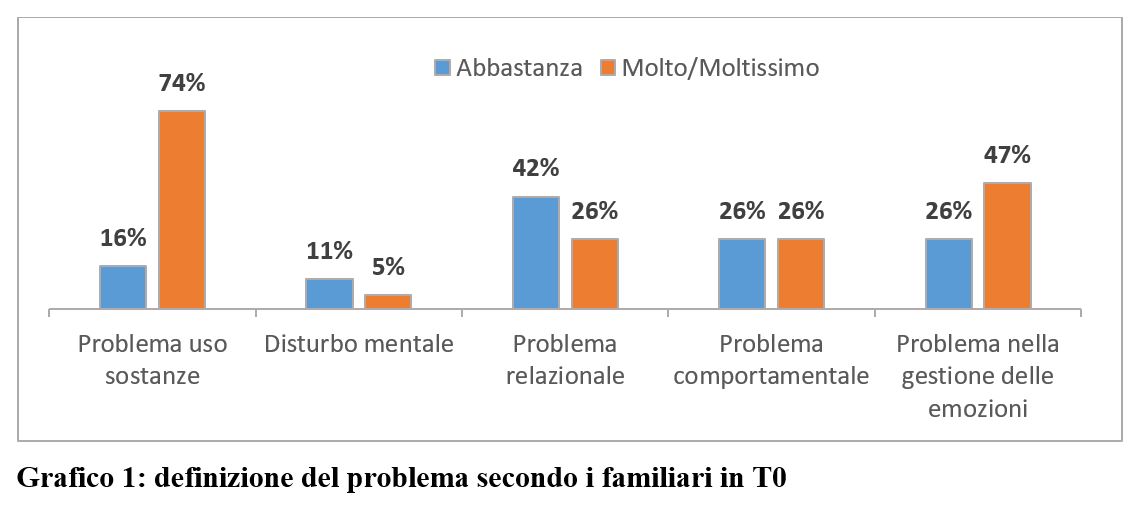
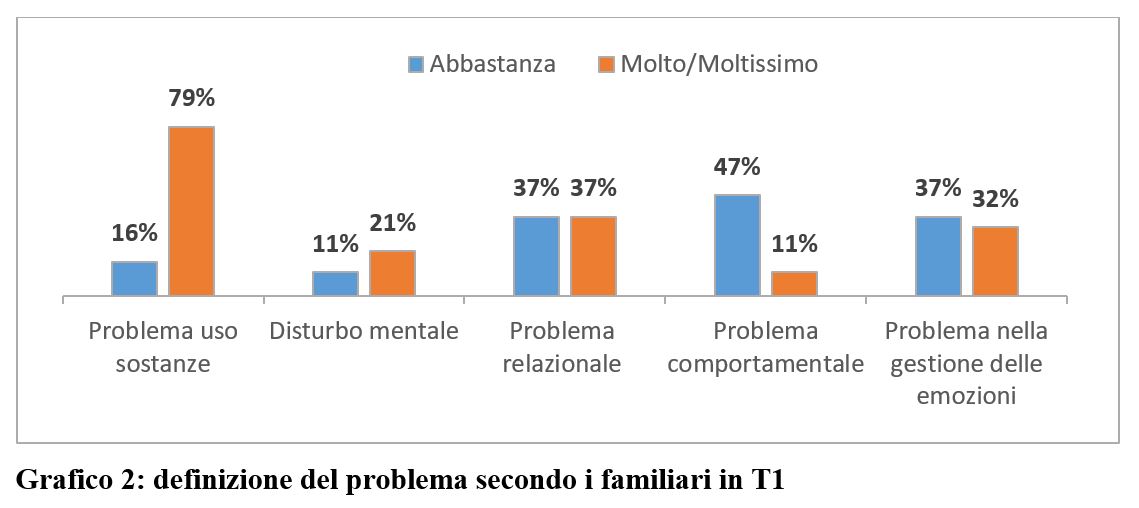
The definition patients give of their problem at T0 and T1: no clear definition of the problem emerges. 36% describe it mainly as a problem linked to substance use and a difficulty in managing emotions, both on admission to the TC and after forty-five days. By contrast, for family members at T0 (graph 1) there is a clear definition of the problem: 74% describe it as a problem linked to substance use and 47% as a difficulty in managing emotions. Family members at T1 (graph 2) also describe it mainly as a problem linked to substance use (79%). In both subgroups and at both times, the categories most often chosen are the same, but among family members there is a decided and shared predominance.
As with the definition of the problem, so too with its explanation, that is, the meaning given to it, patients at T0 show greater indeterminacy. At T1, by contrast, patients mainly explain their problem with the categories relational difficulties (45%), family problems (36%) and character problems (36%). For family members at T0 the predominant explanation is past traumas (53%), followed by recent events and stress (42%); at T1, for family members too, the problem is explained by relational difficulties (53%) and past traumas in equal measure (53%).
As for the effects of the problem, for patients on admission (T0) they are family and work-related (absences, warning letters, job loss), 36% in both cases. After forty-five days of treatment, too, the main effects of the problem are those on the family (45%). For family members at T0 the effects of the problem are psychological (58%) and family-related (58%), and at T1 too the perceived effects of the problem are psychological and family-related, both at 47%.
The changes most often found in the sample after forty-five days (T1) are family (64%), relational (55%) and psychological (55%). For family members at T1, all the categories representing changes (physical, psychological, relational, family, work) show a sharp increase, except the one concerning work.
Diagnostic conviction at T2
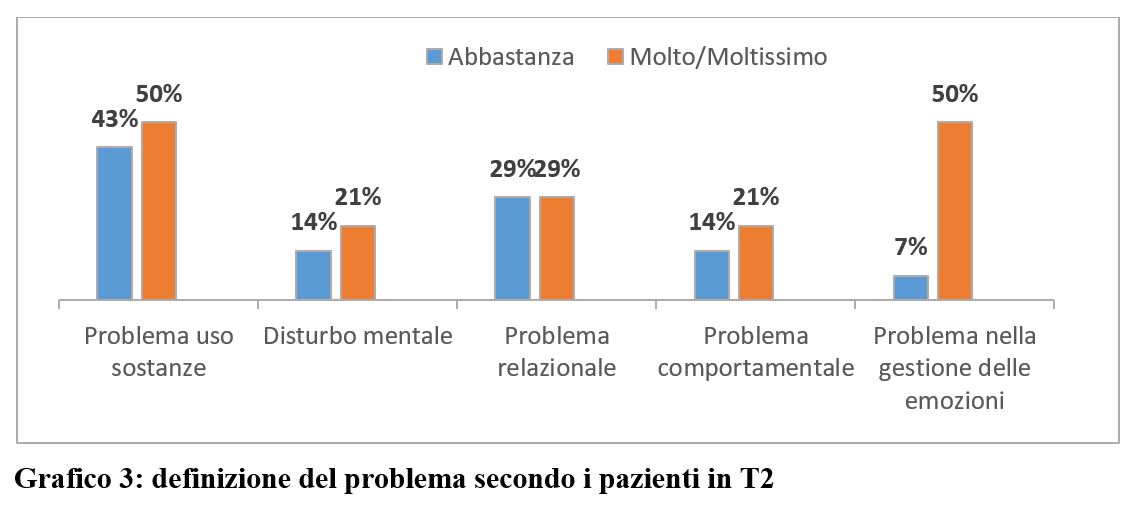
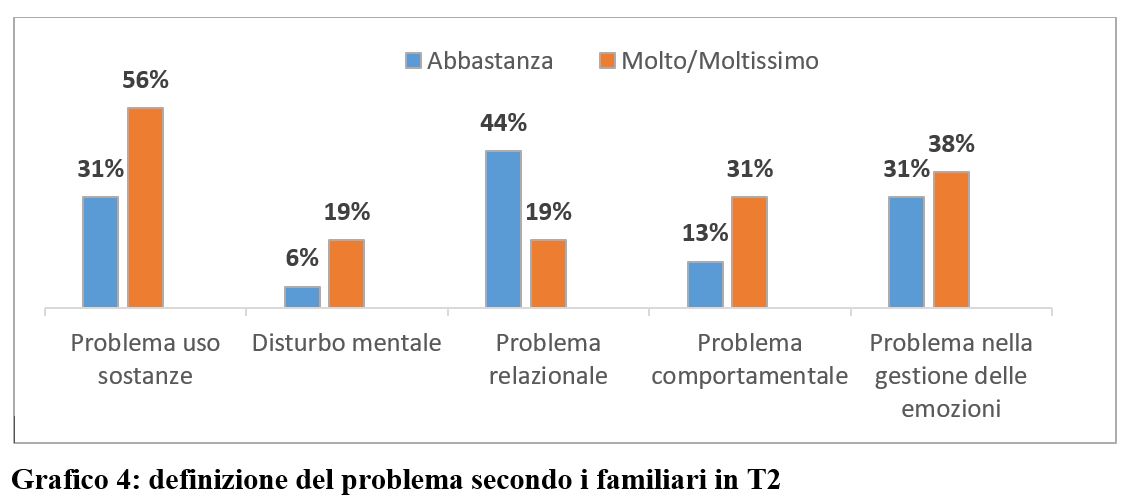
This section analyses the diagnostic conviction of patients and family members six months after the start of treatment (T2) at the Therapeutic Community. Graph 3 shows the definition patients give of their problem: 50% describe it as a problem linked to substance use and as a difficulty in managing emotions; 29% outline it as a relational problem. 56% of family members (graph 4) describe it as a problem linked to substance use and 38% as a difficulty in managing emotions. In both subgroups, patients and family members, the categories chosen most often are the same.
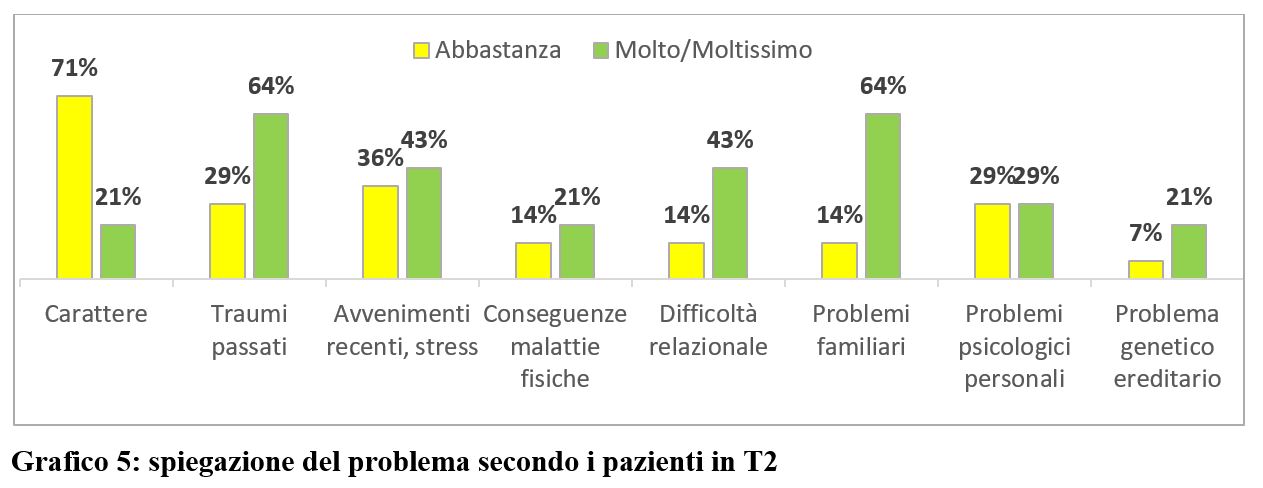
The next two graphs show the explanations of the problem for patients (graph 5) and for family members (graph 6). Patients’ explanations are past traumas and family problems, at 64% in both categories. For family members the main explanation is past traumas (50%), followed by relational difficulties (44%) and family problems (37.5%).
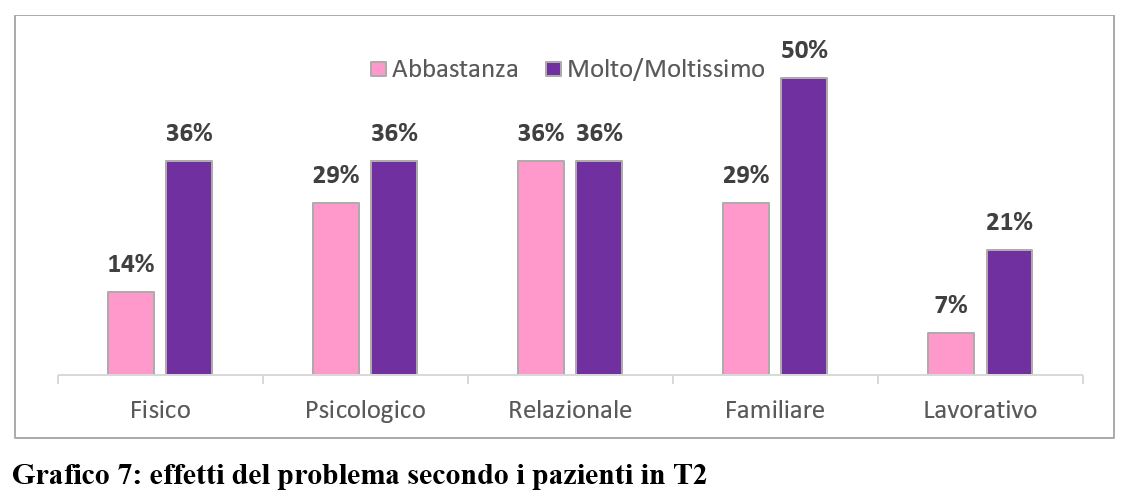
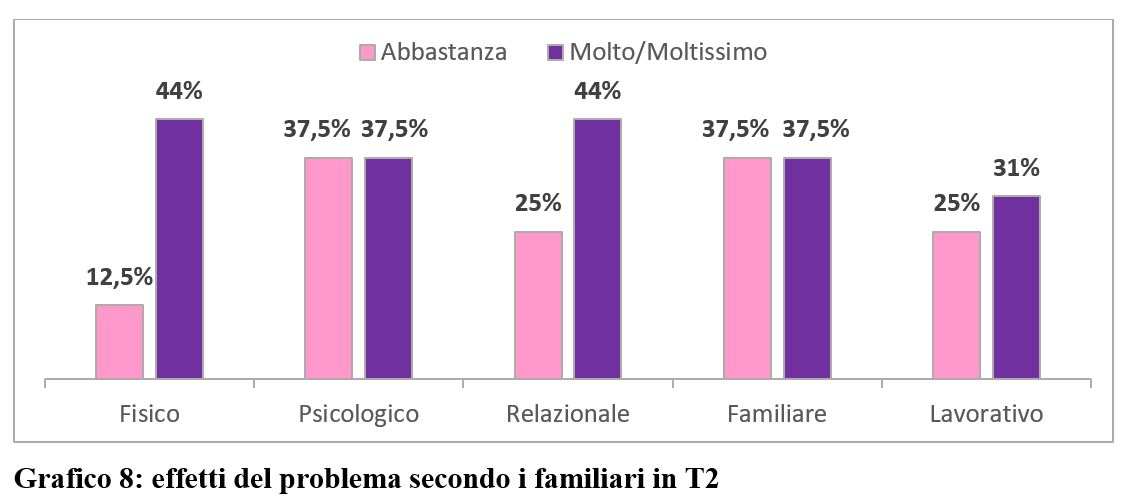
Graphs 7 and 8 describe the effects of the problem, first for patients and then for family members. The predominant effects for the first subgroup are family-related (50%). The categories physical, psychological and relational problems are also regarded by patients as important effects; in all these categories the figure is 36%. For family members there are high percentages for each effect: 44% report a physical and relational effect, 37.5% a psychological and family effect.
The changes that patients mainly report six months after admission are psychological (79%), family (79%) and physical (64%). For family members the most evident effect is on the family (50%).
Below are the main differences found between the two samples at the three points considered with regard to diagnostic conviction.
- With regard to the question “How do I define my problem”, comparing answers at the three times considered shows a change in how the problem is stated. For patients there is no variation in the definition of the problem, which is confirmed as a substance use problem, but there is an increase in defining it as a difficulty in managing emotions, hence a more “internal” description. Among family members there are no great changes, apart from a decrease in defining the problem as substance use.
- With regard to “What explanation do I give of my problem”, patients show a sharp increase in the following categories (listed in order of greatest change): recent events and stress, relational difficulties, past traumas and family problems. As with the definition, for the explanation too, no great shifts are seen among family members.
- In relation to “What kind of effect has the problem had on me”, patients show slight increases in all categories except work. Among family members there is a decrease in the psychological and family categories.
- With regard to the question “Following the therapeutic programme, what change have I seen in myself”, patients show a large increase in all categories, especially the psychological and relational items. For family members the main increase is seen at T1, decreasing at T2; the increase in family change nonetheless remains fairly constant.
In conclusion, the data show an intensification over time of diagnostic conviction in a relational and family direction, among both patients and family members; it should be stressed that this growth occurs mainly among patients.
Family functioning
Below we analyse the final results of the SCORE-15 in the first sample at the two times (T0 and T1). Graph 9 describes the final score of the questionnaire given to the families and shows the changes for each patient, each family member and each family between the two administrations.
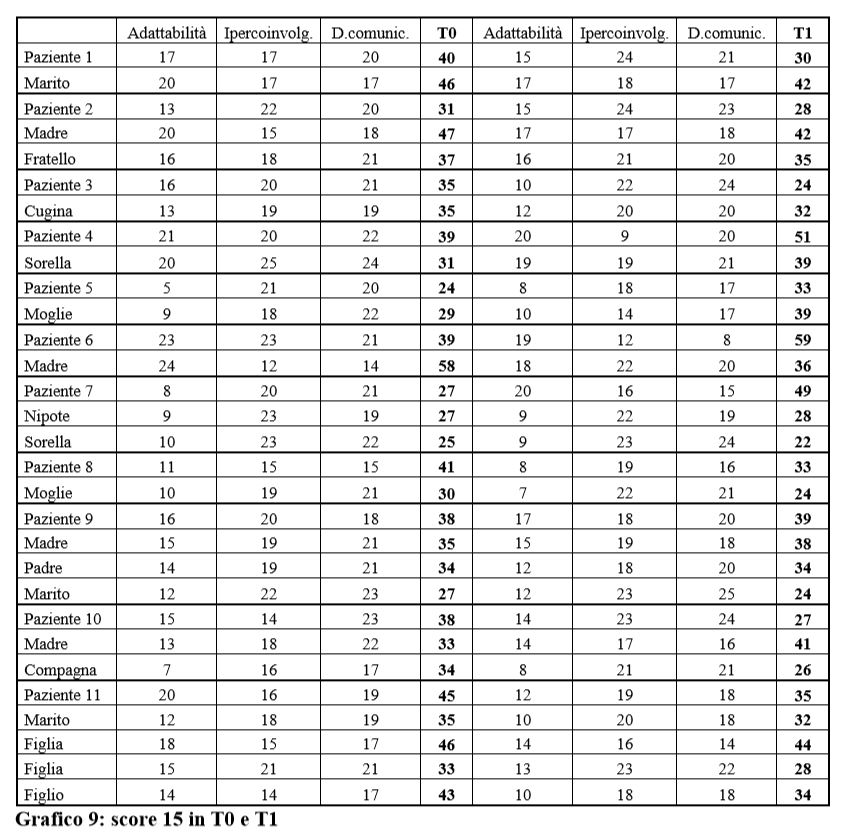
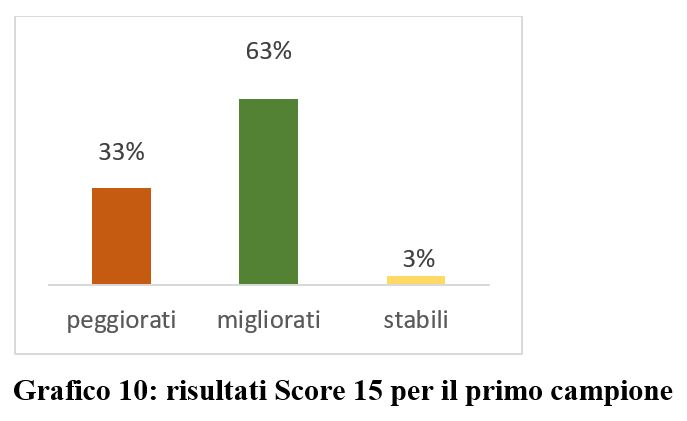
Graph 10 shows the SCORE-15 results for the first sample, in which 63% improved, 33% worsened and 3% remained stable. Specifically, among patients 55% improved and 45% worsened forty-five days after the start of treatment. Among family members, 68% improved, 26% worsened and 5% remained stable.
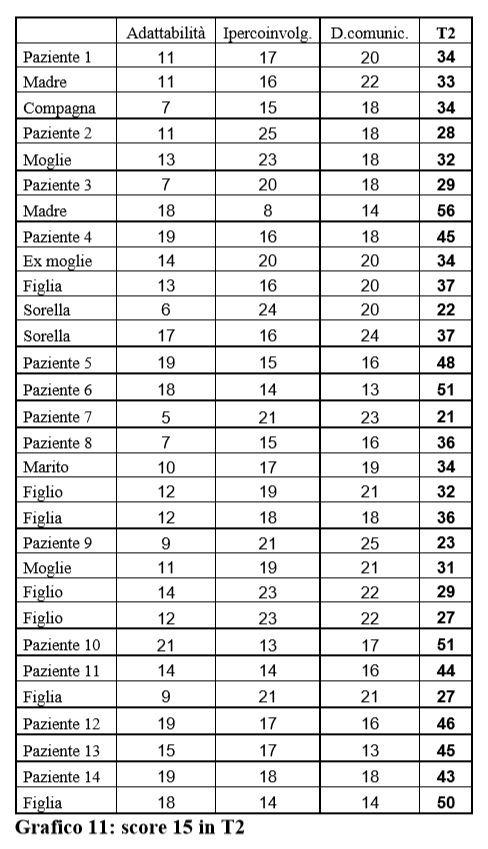
As for the administration of the SCORE-15 in the second sample at T2 (graph 11), unlike the first sample, no comparison with a second time point can be made.
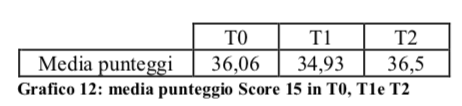
Averaging all the scores across the three times (graph 12) reveals no significant changes.
Conclusions
From the analysis of the data collected, the following conclusions can be drawn:
- with regard to diagnostic conviction, there is a change in the form of an increase in a relational and family direction, mainly among patients;
- with regard to family functioning, there is an improvement, above all among family members.
It thus appears that the two “variables” explored are not correlated with each other if we consider only the “individual patient” subsample: as we have seen, the patient’s perception of the diagnosis improves without bringing an improvement in their perception of family functioning.
We can see the correlation between the two “variables” if we examine the two subsamples, “patients” and “family members”, in relation to each other. At this point we could put forward two possible hypotheses. The first: the improvement in the patient’s perception of the diagnosis allows family members to improve their perception of family functioning. The second: family members’ perception of improved relationships leads to a change in the patients’ diagnostic perception.
We can also better understand the results obtained through the map of the “systemic quadrilateral” of Mosconi et al. (2013), a useful tool for building the hypothesis. This scheme is based on four interconnected logical levels: the problem as lived, intrapsychic conflict, communicative incongruence and relational conflict. Specifically, the model explores the following dimensions: individual/relational; phenomenological-descriptive/generative. This gives four descriptive levels: individual phenomenological (the narrative of the problem), individual generative (individual functioning), relational phenomenological (the system’s communication patterns) and relational generative (the history and evolution of the system).
Reading the data through the systemic quadrilateral, it can be said that patients show greater change in the individual and intrapersonal area, while family members enter the process of change through the corner of the relational dimension. Patients show a change at the individual phenomenological level (narrative of the problem) and the individual generative level (individual functioning). In family members the levels that change most are relational phenomenological (the system’s communication patterns) and relational generative (the history and evolution of the system).
In the light of these results, it becomes important for therapeutic work to connect the improvement in the patient’s diagnostic perception with the improvement in family functioning among family members, in order to analyse this change and widen its recognition by both patients and family members, so as to generate curiosity about “how come” the family system developed a problem of this kind. In this way the whole family unit has the opportunity to re-narrate, in a shared way, the story of what happened. The work of building the systemic hypothesis thus becomes fundamental, particularly because it makes it possible to reconnect the difficulties brought by the patient with the position they occupy within the system and the function they have come to perform in it.
Complexe Systémique: key points
The study remains exploratory: two small samples, the second made up of different people from the first, no comparison group, descriptive percentages without statistical testing, and “correlations” inferred rather than measured; the figures given in the journal do not always add up. Its clinical interest lies in its question: what happens to the diagnosis when a family enters a systemic programme? Patients move from a “substance” problem to a more internal and relational reading, while family members keep their definition but see family functioning improve. The two subsystems thus change through different corners of Mosconi’s quadrilateral, and it is the work of hypothesizing that can connect these two movements in session, for instance by asking each party what they notice about the other’s change. One detail deserves attention from care teams: the three patients who left the programme before the forty-fifth day had in common that they lived alone and were also under psychiatric care, as if the multifamily setting held on less well to the most isolated people. Read alongside Maurizio Coletti on the relational foundations of drug addiction treatment, and the meta-analysis of multiple family therapy.
References
Allen J. G., Fonagy P., Bateman A. W. (2010), La mentalizzazione nella pratica clinica, Milano, Raffaello Cortina.
Barbetta P. (2003), Le radici culturali della diagnosi, Roma, Meltemi.
Bateson G. (1977), Verso un’ecologia della mente, Milano, Adelphi.
Boscolo L., Bertrando P. (1996), Terapia sistemica individuale, Milano, Raffaello Cortina.
Boscolo L., Cecchin G. (1988), “Il problema della diagnosi in ottica sistemica”, Rivista Psicobiettivo, 3, 19-30.
Boscolo L., Caillé P., Cecchin G., Hoffman L., Keeney B. P., Malagoli Togliatti M., Selvini Palazzoli M., Telfener U. (1983), La terapia sistemica. Nuove tendenze in terapia della famiglia, Roma, Astrolabio.
Bruni F. (2012),“Notiziario della Società Italiana di Psicologia e Psicoterapia Relazionale”, Prato.
Canevaro A., Bonifazi S. (2011), Il gruppo multifamiliare. Un approccio esperienziale, Roma, Armando Editore.
Heinz von Foerster (1987), Sistemi che osservano, Roma, Astrolabio.
Laqueur H. P. (1972), Mechanism of Change in Multiple Family Therapy, in Segar C. J., Kaplan H. S. (eds.), Progress in group and Family therapy, New York, Brunnel/Mazel.
Mosconi A., Tirelli M., Neglia V. (2013), “Il quadrilatero sistemico: una storia per narrare altre storie. Il caso di una supervisione sistemica in un Day Hospital Territoriale”, Terapia Familiare, 101, 67 – 93.
Peruzzi P. (1999), “Diagnosi e terapia sistemica”, Connessioni, 5, 57-66.
Selvini Palazzoli M., Boscolo L., Cecchin G., Prata G. (1975), Paradosso e controparadosso.Un nuovo modello nella terapia della famiglia a transazione schizofrenica,Milano, Feltrinelli.
Selvini Palazzoli M., Boscolo L., Cecchin G., Prata G. (1980), “Ipotizzazione, circolarità e neutralità. Tre direttive per la conduzione della seduta”, Terapia familiare, 7, 7-19.
Selvini M. (2013), “Dodici dimensioni per orientare la diagnosi sistemica”, Aggiornamento all’articolo di Terapia Familiaredel 2007, 84, 9-29.
Stratton P., Lask J., Bland J., Nowotny E., Evans C., Singh R., Janes E., Peppiatt A. (2014), “Validation of the SCORE-15 Index of Family Functioning and Change in detecting therapeutic improvement early in therapy”, Journal of Family Therapy, 36, 3-19.
Unofficial English translation of Diagnosi psichiatrica e ipotesi sistemica. Quali possibilità di cambiamento per la famiglia?, by Alessandro Mantovani and Alessia Marconato, Connessioni, new series, no. 4 (2018), under a CC BY 4.0 licence. Translation (with the help of artificial intelligence) and layout: Complexe Systémique, November 2026 — the work has been modified under the terms of the licence (graphs in Italian, captions taken from the text). Neither the authors nor the journal are responsible for this translation; the original version prevails.
Unofficial English translation of “Diagnosi psichiatrica e ipotesi sistemica. Quali possibilità di cambiamento per la famiglia?”, published in Connessioni (2018) under a CC BY 4.0 licence. Made by Complexe Systémique with the help of artificial intelligence, it does not come from the authors or the journal, who are not responsible for its content; the original version prevails.
Read the original articleHow to cite this article
Mantovani, A., et Marconato, A. (2018). Psychiatric diagnosis and systemic hypothesis. What possibilities for change for the family? (Complexe Systémique, Trans.). Complexe Systémique. https://app.complexe-systemique.com/en_GB/articles/psychiatric-diagnosis-and-systemic-hypothesis-what-possibilities-for-change-for-the-family (Original work published in 2018 in Connessioni, nuova serie, n. 4 (2018); republished in 2018 by Connessioni, https://connessioni.cmtf.it/diagnosi-psichiatrica-e-ipotesi-sistemica-quali-possibilita-di-cambiamento-per-la-famiglia/)
To go further
- Theory and epistemology of the relational treatment of drug addictionColetti on the relational treatment of drug addiction.
- The effect of multiple family therapy on mental health problems and family functioning: A systematic review and meta-analysisWhat research shows on multiple family therapy.
- Challenges in addiction-affected families: a systematic review of qualitative studiesWhat addiction puts families through.
Related training courses
 Symposium
État des Lieux: a psychological approach to spaces
Replay of the “État des Lieux” conference (Paris, 16 October 2026): Ivy Daure, Maurizio Frisina, Viola Sallay and Gilbert Pregno on places as a clinical resource. In French.
 Certifying course
Training in Systemic Therapy and Interventions – Cycle 1
Certifying training cycle in systemic therapy and interventions – year 1. Courses, supervision and practice, aligned with EFTA/SFTF. In French.
 Certifying course
Training in Systemic Therapy and Interventions – Cycle 2
Certifying training cycle in systemic therapy and interventions – year 2. Clinical complexity, supervision and practice. EFTA/SFTF aligned. In French.
 Certifying course
Training in Systemic Therapy and Interventions – Cycle 3
Certifying training cycle in systemic therapy and interventions – year 3. In-depth intervention, supervision and practice. EFTA/SFTF aligned. In French.
Related articles
 Blog
Adult parentification: when being useful becomes a condition for being loved
Why is it sometimes so hard to hand over? Julien Besse explores parentification and parentalisation, acknowledgement and the place we take in our adult relationships.
 Scientific
Transitioning to the Business of a Session in Collaborative-Dialogic Meetings: A Conversation Analysis
How do Open Dialogue therapists move to the business of a session? The open question creates silences and family negotiation: a conversation analysis of ten sessions.
 Scientific
“One Can Have All Sorts of Good Intentions but Sometimes in Everyday Life, It Turns Out Differently”: Change Agreements in Couples' Everyday Lives
Six Danish couples followed after an online couple program: their change agreements become guilt-inducing contracts, shared understanding or revealers of inequality.
 Scientific
The AFFIRM Model for Navigating Challenges in Continuously-Interfaith and Divergent-Interfaith Marriages
Thirty happy interfaith couples describe how they navigate their religious differences: five processes, from respecting each other’s choices to religious intimacy, gathered in the AFFIRM model.
Comments 0
Log in to join the discussion. Log in