Journal of Solution Focused Practices · Empirical research
Solution-Focused Brief Therapy-Enhanced Fatherhood Curriculum Pilot Study: A Comparison of Delivery Methods in Response to the COVID-19 Pandemic
A fathering centre in Colorado Springs, fifteen weeks of group, men often sent by the court or social services. Johnny Kim and his team wanted to test one simple thing: does the usual curriculum, enriched with solution-focused questions, do better than the usual curriculum? The pandemic upended the plan. Groups had to move online, and the study ended up comparing three things: the standard programme in person, the enhanced programme begun in the room and finished remotely, and the enhanced programme entirely online. Unexpected result: the online version does as well as the in-person one, and it is the hybrid group, disrupted midway, that does worse. The authors hide none of the limits, non-equivalent groups, effects impossible to disentangle. A useful paper for anyone running parent groups, and for anyone who wants to know what research honestly calls a pilot study.
This is the original article Solution-Focused Brief Therapy-Enhanced Fatherhood Curriculum Pilot Study: A Comparison of Delivery Methods in Response to the COVID-19 Pandemic, by Johnny Kim, In Young Park, Jennifer Bellamy, Susan Burt, Gary Grambort, Sarah Locklear and Ken Sanders, published in Journal of Solution Focused Practices (2022), doi: 10.59874/001c.75000, under a CC BY 4.0 licence. Republished by Complexe Systémique: the authors’ text is unchanged; only the presentation has been adapted for reading online, the five tables being rendered as cards, their figures re-read on the rendered pages. Boxes and notes labelled “Complexe Systémique” are ours, not the authors’.
Many fatherhood programs provide curriculum-based peer groups, but the evidence for their effectiveness is limited and prior studies highlight challenges in recruiting and retaining participants. This pilot study aimed to test the effectiveness of a standard fatherhood curriculum enhanced with Solution Focused Brief Therapy (SFBT) using a quasi-experimental design. Study outcomes included father involvement and parenting skills measured immediately post-intervention. A sample of 92 fathers (M age = 35.2) participating in a fatherhood program were recruited to participate in the study. Due to COVID-19, the treatment groups were moved to an online format. Independent samples and paired samples t-test were used to detect group differences and Hedges’s g effect sizes were also calculated to examine magnitude of treatment effects. Although the SFBT-enhanced peer group curriculum did not outperform the comparison curriculum, the online version of the SFBT-enhanced curriculum was found to be equivalent to the in-person curriculum. These novel findings suggest that online fatherhood groups may be similarly as effective as in-person groups, which may increase opportunities for access and participation in fatherhood programs.
Keywords: Solution-focused brief therapy, fatherhood, father involvement, randomized control treatment, online intervention
Introduction
Fathers’ and their roles as parents are an important target for intervention to improve child and family well-being. In recent decades, studies have established clear and consistent linkages between positive fathering and child well-being including economic (Black et al., 2003; Newland, 2015), behavioral (Amato & Gilbreth, 1999; McMunn et al., 2017), and cognitive (Roggman et al., 2004; Rollè et al., 2019; Tamis-Lemonda et al., 2004) indicators across diverse populations, including young, unmarried, racially and ethnically diverse, and low-income fathers. Providing parenting supports through fatherhood programming represents an opportunity to bolster the well-being of children and families across a variety of domains. However, fatherhood program recruitment and retention are an ongoing challenge. An important “next step” in the field is to identify strategies and interventions that improve fathers’ engagement in programs and improve their fathering attitudes and involvement in rearing their children. Thus, this pilot study was designed to test the effectiveness of a standard fatherhood curriculum enhanced with Solution Focused Brief Therapy (SFBT) in improving father involvement, parenting skills, and solution-building using a quasi-experimental design.
There remains a great need for the development of innovative and evidence-supported approaches to serving fathers and their families, especially those in underserved subgroups that have needs and challenges that likely require more targeted services and supports. For example, a group of fathers with unique needs, but little research to guide practice, is fathers who are making the transition from jail or prison back to their communities and families. These fathers face significant barriers to employment and have often been separated from their families for months or even years, making employment and re-establishment of family relationships particularly difficult (Dallaire, 2007; Murray & Farrington, 2008). Another subgroup in need of more effective, targeted services is fathers with a history of violence. The risk to children and families, including child maltreatment and domestic violence (e.g., Kitzmann et al., 2003), makes participation in traditional fatherhood programming difficult, particularly for those who are court ordered not to have contact with their families. Taken together, these underserved groups represent a large portion of fathers in need of responsible fatherhood services.
There is no gold standard evidence-based responsible fatherhood program, however many fatherhood programs use peer group curricula as an important piece of their service array. However, few curricula have been subjected to rigorous effectiveness studies- particularly those designed to support low-income fathers. Furthermore, few efforts have been made to develop an approach to father engagement in key services such as peer groups that has been informed by behavioral research or theory. Discrete strategies to increase engagement of fathers in services generally have been identified in the field, including offering incentives, bringing services to fathers where they are at (e.g., at school, home, work), and providing transportation, among other approaches (Heinrichs, 2006; Sandstrom et al., 2015). These strategies are anecdotally helpful, however, there is little rigorous research to establish the efficacy of any of these strategies individually or in concert.
One promising approach to improve family involvement that is informed by behavioral research and theory is SFBT. SFBT is an evidence-based therapy model that was developed to provide a more strengths-based alternative approach to traditional problem-focused services. The more positive, solution-building approach of SFBT makes it particularly well-suited to work with low-income fathers served by fatherhood programs, many of whom are court ordered (Kim et al., 2021). SFBT also works well for a diverse group of families and family relationships (i.e., married, unmarried, nonresidential) and for those who may be discouraged from attending services that tend to focus on the negative behaviors of fathers (Kim, 2014). SFBT originates from family systems theory and family therapy and works by providing strategies by which individuals and families shift the way they perceive their problems, focus on their desired goals, and explore ways that they have been successful in achieving their goals in the past (De Jong & Berg, 2008). One of the key elements in the SFBT approach is to collaboratively help clients identify solutions to their problems and let the client be the expert in identifying what the problems are and how to best resolve them (Kim, 2008). Thus, there is a greater emphasis on solution-building with clients that involves asking different questions that lead to different, more positive, effects (Jordan & Turns, 2016).
SFBT can also be an effective intervention for a variety of mental health and well-being outcomes with mandated or service-resistant clients by creating a more collaborative approach to addressing client needs (Kim & Franklin, 2015). Several systematic reviews and meta-analysis studies have shown SFBT to have small to medium, positive treatment effects for internalizing problem behaviors, externalizing problem behaviors, and family-related problems (Gingerich et al., 2012; Gingerich & Peterson, 2013; Kim, 2008). More recently, a randomized controlled trial with families involved in the child welfare system found SFBT to be effective in helping parents with substance abuse related problems, trauma, child well-being, and family well-being (Kim et al., 2018; 2019). Participants in the study all had children placed in out-of-home care with a case plan goal of reunification as well as alcohol or drug abuse by a parent. Study results showed positive treatment effects for the SFBT group using solution-building techniques that amplified client strengths and helped parents describe a preferred future where the problem is gone (Kim et al., 2018; 2019).
Objectives of the Study
Given the benefits of positive father involvement, the need for improved engagement of fathers in fatherhood programming, and the promising research supporting the potential for SFBT to improve father involvement and solution-building, this study was designed to evaluate the effectiveness of a SFBT-enhanced peer group curriculum for fathers to enhance solution-building, father involvement in families, and improve father’s parenting skills. Participating fathers were recruited from a community-based social service agency (Center on Fathering, CoF) that offers various curriculum and programs for fathers to help strengthen families. The study’s research questions and hypotheses are as follows:
- Does the SFBT-enhanced peer group curriculum improve fathers’ capacity to identify solutions and exceptions to problems as well as hope for the future (e.g., solution-building skills) as compared to the standard CoF fatherhood curriculum alone?
- Does the SFBT-enhanced peer group curriculum result in improved fathers’ involvement in families as compared to the standard CoF fatherhood curriculum alone?
- Does the SFBT-enhanced peer group curriculum result in improved parenting skills and knowledge among fathers as compared to the standard CoF fatherhood curriculum alone?
Methods
Design of the Study
To answer the research questions, this pilot study used time-lagged quasi-experimental (QED) pre-test post-test design whereby two groups of fathers participating in a group fatherhood curriculum at one social service agency were sequentially enrolled in the study. The first group of fathers recruited into the study served as the comparison group and received services as usual [standard Center on Fathering (CoF) fatherhood curriculum]. Fathers in the comparison group were recruited and enrolled between August 2018 through December 2018. Then, the staff of the social service agency were trained in the SFBT-enhanced fatherhood curriculum. Following training, the treatment group of fathers was recruited from February 2020 through November 2020. This study design enabled the establishment of preliminary trends on outcomes within a short period, minimizing contamination across study conditions, and maximizing empirical opportunities to examine feasibility and fidelity of the program (Guterman et al., 2018).
Sample
The CoF is a fatherhood program that serves Colorado Springs metro region and is a part of El Paso County Department of Human Services (DHS). The CoF works with families who have court involvement or are working with the DHS as well as families who want to improve how they parent their child. Inclusion criteria for participation included fathers who: (a) enrolled in the fatherhood programs at the CoF, (b) aged 18 years or older, and (c) consented to participate in the study.
Fathers were recruited into the research study using the CoF’s normal recruitment and interaction process by CoF staff. All fathers who entered services for the fatherhood curriculum during the study enrollment period were offered the opportunities to participate in the research study. If they agreed to participate, the agency intake clinician provided information about the study to participating fathers and reviewed consent forms with them. Participants were offered $25 gift cards for completing pretest measures and $30 gift cards for completing posttest measures. University of Denver IRB approval was obtained prior to data collection.
Procedures
All clinicians and clinical directors delivering the fatherhood curriculum were employees of the CoF and were either a bachelor’s or master’s level clinician with no previous training in SFBT. Participating fathers completed pretest measures on the first day of the fatherhood curriculum and posttest measures during the last course. After data were collected from the comparison group, CoF clinicians were trained in SFBT over 2 full days by the lead author who is an expert in SFBT. The lead author and CoF clinicians also worked on integrating SFBT techniques into the standard fatherhood curriculum to design the SFBT-enhanced peer group curriculum. Once the SFBT-enhanced peer group curriculum was finalized, recruitment and data collection for the treatment group began for the SFBT-enhanced peer group curriculum. Curricula were offered throughout the year on a staggered basis so that fathers did not have to wait any longer than a few weeks to start a group.
Standard CoF Fatherhood Curriculum
The CoF provides a standard skills-based, 15-week responsible fatherhood delivered curriculum. The group meets weekly for 90 minutes and has an average class size of 15 fathers. The CoF currently runs between 6-8 fatherhood curriculum per year, serving approximately 90 fathers annually. The standard CoF Fatherhood curriculum addresses the father-child relationship and parenting skills to improve the family relationship and father involvement. Some of the major topics covered in the curriculum include the importance of fathers’ roles, family communication, anger management, child development, child-parent attachment, play, discipline, and self-esteem. The standard curriculum can be provided to fathers of any age or family situation (e.g., unmarried or married fathers who are or are not living with their children).
The standard CoF fatherhood curriculum employs an evidence-informed curriculum that has been continually developed over the last 20 years by Ken Sanders, previous program manager of CoF. When CoF first began providing this curriculum in the mid-1990s, one of the only well-disseminated curricula that had been used with both young, low-income, and single mothers and fathers was the MELD curriculum. A seven-site study of the MELD curriculum demonstrated improvements in attitudes and beliefs of participants on measures related to parenting and nurturing children, including more appropriate expectations about children’s abilities, increased empathy, and reduced value of corporal punishment (Treichel, 1995). The CoF fatherhood curriculum enhanced the MELD curriculum using local research evidence including focus group data, evaluation data and continuous feedback from staff and participants. These evidence-supported improvements included interactive activities, updates and examples using technology, and more strengths-based content. The curriculum has been evaluated internally using pre-post data, and demonstrated improvements in parenting skills, attitudes, and behaviors.
SFBT-Enhanced Peer Group Curriculum
SFBT strategies have been used with difficult-to-serve populations to address family functioning (Kim et al., 2018). SFBT is an evidence-based intervention that builds on clients’ resources and motivations to shift away from problem-talk to focus more on what they want and explore ways they have been successful in achieving their goals in the past. Goals are important to the change process and are created cooperatively with participants (Kim & Franklin, 2015). The clinicians use various solution-building questioning techniques like exception questions, scaling questions, relationship questions, miracle question, compliments, first formal task (do more of what is already working) and goal setting (DeJong & Berg, 2008). These SFBT techniques help clients define what they want in the future and lead them in a process of visualization, imagination, and planning specific steps to desired goal. More details about the specifics of SFBT and how it differs from other evidence-supported interventions can be found in the SFBTA Treatment manual (Bavelas et al., 2013).
Researchers collaborated with the CoF for 6 months to develop this new SFBT fatherhood curriculum. None of the weekly topics or core content changed from the Standard CoF fatherhood curriculum except for adapting more solution-building questions into the way clinicians facilitate the class discussions and interactive activities. In the beginning, CoF clinicians received intensive 2-day SFBT training to learn the theoretical model’s approach as well as specific SFBT techniques used to help clients identify solutions and preferred future. CoF clinicians were taught how to use SFBT techniques to help fathers identify solutions to their problems and provide details about what their preferred futures look like when the fathers are at their best. Next, the research and CoF team went through each of the 15-week curriculum and identified ways to integrate SFBT techniques into the class discussion, class reflection activities, and interactive activities. These solution-building skills were integrated into the curriculum to support their efforts to enhance engagement. Finally, each clinician was able to conduct an entire SFBT fatherhood curriculum to practice new SFBT skills as well as the new discussion and interactive activities. The lead author who led the SFBT training met monthly for one hour with the CoF clinicians to provide further training, consultation, and revisions. Additional information about the SFBT-Enhanced Fathering Curriculum and copies can be requested by contacting the El Paso County Department of Human Services Center on Fathering.
COVID-19 Modifications
The COVID-19 pandemic emerged at the beginning of the treatment phase of the study, which required the CoF to stop all services. The first two SFBT-enhanced treatment groups had met in-person before the CoF stopped the classes due to state public health orders to prevent the COVID-19 virus from spreading. The groups had met for almost half of the 15-week sessions before switching to online remote classes to finish out the class. The first SFBT-enhanced treatment group completed 8 of 15 sessions in-person and the second completed 6 of 15 sessions in-person. The CoF paused the classes for one week so that they could find a way to continue safely providing the classes. During this pause, the CoF decided to provide weekly SFBT fatherhood curriculum remotely using Webex video conferencing.
Due to the COVID-19 pandemic interrupting the start of the treatment group curriculum, two different types of SFBT-enhanced fatherhood curricula were provided to treatment group participants: (a) two hybrid groups (n=22) that were delivered initially in-person and ended online and (b) and five (n=20) online groups. All online group meetings were provided by Webex video conference platform. The five online SFBT-enhanced fatherhood groups did conduct the first and last class in-person using social distancing practices in a large parking lot so that the fathers could complete hard copies of the intake and assessment forms. Otherwise, the rest of the classes were conducted online. The groups were offered throughout the year on a staggered basis so that fathers did not have to wait any longer than a few weeks to start.
Outcome Measures
Measures for this study included those that address each of the three research questions. Two of the measures, (i.e., solution-building skills and father involvement) were collected at posttest for all of the comparison, hybrid, and online groups. One measure (i.e., parenting attitudes) that assessed father’s parenting attitudes was collected at the pre-and post-test periods.
Fathers’ solution-building skills, one of the key constructs of SFBT, was measured using the Solution-Building Inventory (SBI; Smock et al., 2010). The SBI measure consists of 14 items that assessed participant’s capacity to identify solutions and exceptions to problems as well as hope for the future (e.g., “I am able to generate solutions”, “I have the ability to focus on what I want to occur in my life”). Participants used a 5-point Likert scale to rate their level of agreement (1=Strongly disagree to 5=Strongly agree). A mean score of SBI was computed so that a higher score indicates higher solution-building skills. The measure showed high reliability in our sample, showing α = .93 for the comparison groups, α = .90 for the hybrid groups, and α = .87 for the online groups.
Father involvement was assessed by using the 11 items of the Fatherhood Research and Practice Network Father Engagement Scale (FRPN; Dyer et al., 2015). FRPN measures one’s capacity for involvement in childrearing and cognitive activities with items (e.g., “How often have you fed or given a bottle to (child)?”) rated on a 5-point frequency scale that ranges from 1 = never, 2 = 1 to 2 days per month, 3= 3 to 4 days per month, 4=2 to 3 days per week, 5= everyday or almost everyday. For this study, the responses were averaged so that higher scores indicate greater involvement of fathers in families. The measure has been found to have a strong internal consistency (α = .89) and good convergent, discriminant, and criterion validity (Bavolek & Keene, 2010). The measure also showed strong reliability for our sample (α = .96 for the comparison group, α = .93 for the hybrid group, and α = .96 for the online group).
Parenting attitudes was measured by using the Adult Adolescent Parenting Inventory- version 2 (AAPI-2), which consists of 40 items that assess knowledge about parenting and child rearing attitudes (Conners et al., 2006). The measure consists of five constructs, including: (a) expectations of children, (b) parental empathy towards children’s needs, (c) use of corporal punishment, (d) parent-child family roles, and (e) children’s power and independence (Conners et al.). Each item is measured based on a 5-point Likert scale, which has a range of 1=Strongly disagree to 5 = Strongly agree. For this study, the mean score was used so that higher score indicates more positive parenting attitudes. The measure has been shown to have adequate psychometric properties in a culturally diverse samples of parents, showing high reliability coefficients ranging from α = .80 to .89 (Lawson et al., 2015; Park, 2011). The measure also showed strong reliability for our study samples (α = .81 for the comparison group; α = .76 for the hybrid group; and α = .78 for the online group).
Power Analysis
An a priori power analysis for power = 0.80 with a two-tailed α = .05 for a repeated measures model showed that 198 participants are necessary for the small effect size (η2 = 0.01); 34 total participants are required when the effect size is medium (η2 = 0.06); and 16 total participants are required when the effect size is large (η2 = 0.14; Kim et al., 2018).
Data Analysis
Univariate and bivariate analyses were conducted to answer the present study’s research questions. Descriptive analyses frequency distributions, means, and standard deviations were conducted. Bivariate analyses included chi-square tests and independent samples t-tests to test for statistically significant differences between comparison and treatment groups (e.g., the standard CoF curriculum vs. SFBT-enhanced peer group curriculum) on father demographic variables. The differences in father’s involvement and solution-building skills between the comparison and the treatment groups were calculated using independent samples t-test. Statistical significance was defined as a probability p < .05. To assess the amount of change in parenting attitudes after 10 months from the baseline, we used paired sample t-tests between pre- and post-test in each treatment group.
Given the pilot nature of this study and the reduced power given the relatively small number of participants, effect sizes are particularly useful in assessing whether the intervention provides evidence promising effects warranting future studies. The magnitudes of effect sizes observed on three fathering outcome variables were estimated using Hedges’s g with a small sample bias correction to yield the most conservative effect size estimates. Effect sizes were interpreted using Cohen’s (1988) guidelines (i.e., 0.2 = a small effect; 0.5 = a medium effect; 0.8 = a large effect). 95% confidence intervals were calculated to examine the significance of each effect size (Shadish & Haddock, 1994). Data were analyzed using Stata 14.0.
Results
Descriptive Characteristics
Descriptive statistics for the variables are provided in Table 1. The mean age of participant fathers was 36.0 (SD = 9.0) in the comparison group, 34.6 (SD = 7.0) in the hybrid group, and 33.6 (SD = 9.0) in the online group. The majority of the participants in all three groups were White, single or never married, fully employed, and had a degree of higher than college. The Pearson Chi-square and independent samples t-tests results revealed no statistically significant differences in demographic characteristics between the comparison and the treatment groups, except for financial assistance and criminal justice involvement.
Table 1. Study Sample Characteristics (n = 92)
Three groups: comparison, standard CoF (n = 50); treatment SFBT hybrid (n = 22); treatment SFBT online (n = 20). N (or M) and % (or SD), then p.
Age (M, SD): 36.0 (9.0) / 34.6 (7.0) / 33.6 (9.0); p = .27.
Race/Ethnicity: White 37 (74.0%) / 15 (68.2%) / 13 (65.0%); Black 6 (12.0%) / 3 (13.6%) / 3 (15.0%); Alaska native 1 (2.0%) / 0 / 0; Asian/Pacific Islander 1 (2.0%) / 0 / 0; Latino/Hispanic 4 (8.0%) / 4 (18.2%) / 3 (15.0%); p = .51.
Marital status: Married 10 (20.0%) / 2 (9.1%) / 5 (25.0%); Separated 10 (20.0%) / 7 (31.8%) / 4 (20.0%); Divorced 8 (16.0%) / 6 (27.3%) / 5 (25.0%); Single/Never married 19 (38.0%) / 7 (31.8%) / 5 (25.0%); p = .62.
Educational attainment: Less than high school 21 (42.0%) / 11 (50.0%) / 7 (35.0%); Higher than college 27 (54.0%) / 11 (50.0%) / 12 (60.0%); p = .66.
Full Employment: 34 (68.0%) / 15 (68.2%) / 16 (80.0%); p = .64. Financial assistance: 18 (36.0%) / 5 (22.7%) / 4 (20.0%); p = .00. Criminal justice involvement: 32 (64.0%) / 10 (45.5%) / 5 (25.0%); p = .01.
Inferential Statistics
Differences in Solution Building and Father Involvement by Treatment Group. The results for independent samples t-test between comparison and hybrid groups are presented in Table 2. There was a significant difference in solution-building skills between the comparison and hybrid groups (t(64) = 2.22*, p <.05), with comparison group showing higher mean scores (M = 61.1, SD = 6.6) compared to the hybrid group (M = 57.1, SD = 7.5). The effect size for this difference in solution-building skills was medium (Hedges’s g = -0.58, [CI: -1.10, -0.07]); Shadish & Haddock, 1994). Similarly, the difference in father’s involvement in caregiving activities between two groups was significant (t(67) = 2.08*, p < .05), with the comparison group (M = 57.1, SD = 7.5) showing a higher father involvement than the hybrid group (M = 57.1, SD = 7.5). The Hedges’s g for father involvement in caregiving activities indicated the medium effect size (Hedges’s g = -0.54; [CI: -1.05, -0.03]). There was no significant difference in father involvement in cognitive activities between two groups (t(68) = 1.54, p = .06), although the comparison group (M = 10.1, SD = 2.6) attained slightly higher scores than the hybrid group (M = 9.0, SD = 2.8).
Table 2. Independent T-Test between Comparison and Hybrid group (n = 72)
For each variable: Comparison (n = 50) M (SD); Hybrid (n = 22) M (SD); t; p; Hedges’s g [95% CI].
Solution-building skills: 61.1 (6.6); 57.1 (7.5); 2.22*; <.05; -0.58 [-1.10, -.07].
Father involvement in caregiving activities: 18.4 (5.5); 15.3 (5.9); 2.08*; <.05; -0.54 [-1.05, -.03].
Father involvement in cognitive activities: 10.1 (2.6); 9.0 (2.8); 1.59; .06; -0.41 [-.92, .09].
Note. SD = Standard Deviation; CI = Confidence Intervals; *p < 0.05. Complexe Systémique: in the authors’ text, the comparison group’s caregiving involvement mean is given as “M = 57.1, SD = 7.5”, identical to the hybrid group’s; Table 2 gives 18.4 (5.5) versus 15.3 (5.9). We reproduce both as printed.
Between Comparison and Online Group. The results of the independent t-test for father’s solution-building skills between the comparison and online group are presented in Table 3. There was no significant difference in father’s solution-building skills (t(61) = 1.29, p = .21), despite the online group (M = 63.2, SD = 5.6) attaining higher solution-building skills score than the comparison group (M = 61.1, SD = 6.6). Also, there were no significant differences in father’s involvement in both caregiving [t(63) = -1.23, p = .23] and cognitive activities [t(64) = -1.98, p = .06] between these two groups. None of the between-group effect sizes were statistically significant based on the 95% CI.
Table 3. Independent T-Test between Comparison and Online Treatment Group (n = 42)
For each variable: Comparison (n = 50) M (SD); Online (n = 20) M (SD); t; p; Hedges’s g [95% CI].
Solution-building skills: 61.1 (6.6); 63.2 (5.6); 1.29; .21; 0.13 [-.39, .65].
Father involvement in caregiving activities: 18.4 (5.5); 16.4 (5.6); -1.23; .23; -0.35 [-.87, .17].
Father involvement in cognitive activities: 10.1 (2.6); 8.4 (3.2); -1.98; .06; -0.61 [-1.14, .08].
Note. S.D. = Standard Deviation; CI = Confidence Intervals; *p < 0.05.
Between Hybrid and Online Groups. The results for testing differences in solution-building skills between hybrid and online groups is presented in table 4. There was a significant difference in solution-building skills between hybrid and online group (t(63) = -1.23, p = <.01), showing that the online group has a higher score in solution-building skills (M = 63.2, SD = 5.6) compared to the hybrid group (M = 57.1, SD = 7.5). There were no significant differences in father’s involvement in caregiving and cognitive activities between the two groups. The effect size for the solution-building skills was 0.90, thereby indicating a large effect size between hybrid and online group (Hedges’s g = 0.90, [CI: 0.25, 1.58]).
Table 4. Independent T-Test between Hybrid and Online Group
For each variable: Hybrid (n = 22) M (SD); Online (n = 20) M (SD); t; p; Hedges’s g [95% CI].
Solution-building skills: 57.1 (7.5); 63.2 (5.6); 2.94*; < .01; .90 [.25, 1.58].
Father involvement in caregiving activities: 15.3 (5.9); 16.4 (5.6); 0.60; .55; .19 [-.43, .82].
Father involvement in cognitive activities: 9.0 (2.8); 8.4 (3.2); -0.60; .55; -.19 [-.83, .43].
Note. S.D. = Standard Deviation; CI = Confidence Intervals; *p < 0.05. Complexe Systémique: the authors’ text gives t(63) = -1.23 for this comparison, Table 4 gives t = 2.94*; we reproduce both as printed.
Pretest and Posttest Differences
The paired sample t-test results for parenting attitudes across three groups are presented in Table 5. In the comparison group, there was a significant improvement in fathers’ parenting attitudes from pretest scores (M = 31.7, SD = 6.5) to posttest scores (M = 34.3, SD = 7.1; t(47) = -2.71*, p < .05). There was no significant increase in the parenting attitudes between pretest (M = 31.9, SD = 4.1) and posttest (M = 33.7, SD = 6.0) in the hybrid group (t(15) = -1.34, p = .20). Also, the results from the pretest (M =31.5, SD = 4.5) and post-test (M = 35.1, SD = 6.5) indicated that the online group improved in parenting attitudes (t(19)= -2.85*, p <.05). For the comparison group, the within group effect sizes were 0.37, illustrating small treatment effects (Hedges’s g = 0.37, [CI: .30, .46]). The SFBT hybrid group also had a within-group effect size illustrating small treatment effects (Hedges’s g = 0.32, [CI: .15, 51]). For the SFBT online group, the within group effect sizes indicated medium treatment effect (Hedges’s g = 0.61, [CI: .38, .89]). Parenting attitudes in all three groups showed a 95% confidence interval that did not contain zero, indicating that the participants improved significantly from pretest to posttest on their parenting skills. None of the between-group effect sizes were statistically significant based on the 95% CI.
Table 5. Paired Sample T-test of Parenting Attitudes, and Effect Size Results
Comparison group (a): pretest 31.7 (6.5); posttest 34.25 (7.1); within-group effect size 0.37 [.30, .46].
SFBT hybrid group (b): pretest 31.9 (4.1); posttest 33.69 (6.0); within-group effect size 0.32 [.15, .51].
SFBT online group (c): pretest 31.5 (4.5); posttest 35.05 (6.5); within-group effect size 0.61 [.38, .89].
Between-group effect sizes (95% CI): a-b 0.22 [-.27, .73]; b-c -0.37 [-.99, .23]; a-c -0.11 [-.63, .40].
Note. S.D. = Standard Deviation; CI = confidence intervals.
Discussion
This study was designed to explore the effectiveness of the SFBT-enhanced fatherhood curriculum to improve solution-building skills, father involvement in families, and parenting skills and knowledge. The quasi-experimental design was interrupted by the COVID-19 pandemic and the format of the intervention had to be adjusted for delivery online. Despite the challenges of COVID-19 restrictions, the community agency was able to pivot to an online SFBT treatment modality which had never been done before and allowed the research team to examine whether this SFBT-enhanced curriculum could be done online. This unanticipated change allowed the research team to test a fatherhood curriculum that was delivered in the standard in-person format, a hybrid- curriculum that met in-person and online using SFBT-enhanced curriculum, and an online SFBT-enhanced curriculum.
Despite the interruption to the study, we note some intriguing findings. Overall, all three groups showed improvements from pretest to posttest on the AAPI measure, which suggests the fatherhood curriculum used at the CoF helps fathers improve their parenting attitudes. These improvements in parenting skills and knowledge were also seen in the group of fathers that received the SFBT-enhanced curriculum through the hybrid and online version. Results from the paired sample t-tests for AAPI measure also showed statistically significant results for all three groups, indicating significant improvements from pretest to posttest on parenting attitudes.
Additionally, participants in the comparison group showed higher scores in solution-building skills and father involvement in caregiving activities compared to those in the hybrid group. As there was a higher percentage of married and socioeconomically advantaged fathers in the comparison group than in the hybrid group (e.g., married fathers: 20.0 vs. 9.1% Table 1), some of the differences in these fathering scores may be attributable to the larger proportion of married fathers in the comparison group. Indeed, there is some evidence to suggest that any effect of interventions on parenting skills and knowledge may differ depending upon the socio-economic status (SES) of fathers (e.g., Winter et al., 2012). Another factor that confounds the comparison of results is that the hybrid group was intended to be delivered in-person using the SFBT-enhanced curriculum but had to make an abrupt, and unplanned change to the curriculum structure and content delivery- which may have reduced its effectiveness. Furthermore, the country was experiencing a major public health and economic crisis that could most certainly have had an impact on the hybrid group participants that affected the study outcomes.
Similarly, the online group outperformed the hybrid group in solution-building skills and father’s involvement in caregiving activities outcomes. The comparison of father involvement outcomes between the two SFBT enhanced curriculum treatment groups (i.e., hybrid vs. online) indicated a trend in which fathers showed better scores for the online group than did their counterparts in the hybrid group at posttest. There were no significant differences between the comparison and online groups on the solution-building skills and father involvement, and this unplanned finding suggests that responsible fatherhood groups could be successfully delivered in a fully online format. To our knowledge this is the first study to demonstrate equivalent outcomes between in-person and online fatherhood support groups.
Finally, the COVID-19 pandemic allowed us to learn some of the challenges and opportunities around incorporating technology to deliver a group fatherhood curriculum. For example, some of the logistical challenges involved ensuring class participants had access to a personal computer, tablet, or mobile smartphone as well as access to stable internet services. Relatedly, challenges were encountered around gathering participant email addresses to send video conference log-in information as well as explaining how to access and use video conferencing services. While the content of the curriculum did not change, staff had to create electronic class materials and assist participants with electronic versions of the assignment materials. Staff found collecting required weekly homework was a little more challenging for the online curriculum compared to when curriculum is delivered in-person. Also, not being able to see body language or facial expressions for those who did not have video options made class discussions more challenging when group curriculum was facilitated online.
However, there were some opportunities gained when delivering the online SFBT-enhanced curriculum that was learned from this study. Some of these included easier access to the fatherhood curriculum for those participants who had limited transportation as well as convenience of not having to travel to the agency site. Offering online curriculum made it easier for fathers who were leaving work or living in another part of town to join virtually and still participate. Online curriculum also made it more convenient to attend programs for some fathers who were caring for their children. The CoF also found their hybrid group had a low attrition rate given the COVID-19 pandemic challenges, which was similar to their in-person groups. Most importantly, the community agency was able to develop an online version of their standard fatherhood curriculum that they can implement as part of a more robust course offering to future participants.
Despite meaningful findings of this study, several limitations are worth noting. The primary limitation of our research is that the design of the study was quasi-experimental, and that the design was interrupted by the COVID-19 pandemic. Therefore, it was not feasible to test the originally planned in-person SFBT-enhanced curriculum as originally planned. Also, the comparison and treatment groups differed non-randomly at baseline on a few demographic and socioeconomic (SES)-related variables (i.e., financial assistance and criminal justice involvement), which might have impacted the program effectiveness. Previous studies indicate that low SES parent groups show higher parenting outcome scores (e.g., parenting skills, knowledge) following intervention as compared to their high SES counterparts (Gardner et al., 2010; Mackenzie et al., 2004), as they tend to be more open to program content. While it is possible that the comparison group in our study benefited from the intervention more than the treatment group in some way, it is unclear from the current study if this was the case. A more rigorous test of the intervention using a randomized control trial design or a larger quasi-experimental design with more equivalent groups is needed to clarify these relationships. There were also comparatively fewer participants in both modified treatment groups (hybrid and online) compared to the comparison group which can diminish statistical power. Furthermore, we cannot disentangle the effects of the SFBT-enhancement from the online format or the impact of the pandemic. It is possible that the standard CoF fatherhood curriculum would not have been as effective without the SFBT enhancement online, for example. Future research is needed to isolate the effects of SFBT enhancement and online delivery. Also, two outcomes of interest (solution-building skills and father involvement) were measured only once after the curriculum was provided, thereby limiting our ability to examine any significant changes from pretest to posttest. Future research should work to reduce the risk of attrition bias and increase generalizability by assessing these measures before and after the fathering group classes. Finally, this study only assessed the intervention effects immediately after completion of curriculum, making it difficult to reach conclusions for the long-term effects of CoF fatherhood programs and SFBT treatment on fathering outcomes.
Conclusions
Despite the limitations, this pilot study offers some important insights into the potential for responsible fatherhood programming to be provided online to improve access, and yet achieve similar effects on outcomes. Participation through in-person responsible fatherhood groups can be a challenge because of work schedules, family responsibilities, or lack of transportation. The findings of our study provide preliminary support of online SFBT-enhanced fathering curriculum that offers clinicians and program administrators options in program delivery modes. For example, providing online classes and courses that make use of digital content and apps can be beneficial in increasing client access to programs through digital platforms and technologies during this COVID pandemic (Halpin & Collier, 2014) and beyond. Findings from our study show incorporating SFBT techniques into the CoF standard fatherhood curriculum and delivering it online may also yield benefits for participants around solution-building skills, parent engagement, and parenting skills however more research is needed to further confirm this approach.
The authors declare that there are no conflicts of interest. Funding was provided by the University of Denver Professional Research Opportunities for Faculty (PROF) grant.
Complexe Systémique: what to take away
What the study set out to prove, it does not prove: the enhanced curriculum does no better than the standard one. What it discovers by accident is more useful: a fathers’ group held entirely online gets the same results as one held in a room, and it is the group interrupted midway that suffers. A systemic lesson as much as a methodological one: the frame matters more than the technique, and a stable frame, even remote, beats a broken one. The authors list their limits without varnish, non-equivalent groups, effects impossible to disentangle, single measurements; we have flagged in place two inconsistencies between text and tables. Read with the new fatherhood as seen by family therapy, and with the Bolivian study on family protection workers, another pre-post pilot with the same caveats.
References
Amato, P., & Gilbreth, J. (1999). Nonresident fathers and children’s wellbeing. A meta-analysis. Journal of Marriage and the Family, 61, 557-573.
Bavelas, J., De Jong, P., Franklin, C., Froerer, A., Gingerick, W., Kim, J.,…Trepper, T. S. (2013). Solution focused therapy treatment manual for working with individuals (2nd version). Solution Focused Brief Therapy Association. http://www.sfbta.org/PDFs/researchDownloads/fileDownloader.asp?fname=SFBT_Revised_Treatment_Manual_2013.pdf
Bavolek, S. J., & Keene, R. G. (2001). Adult-adolescent parenting inventory AAPI-2: Administration and development handbook. Family Development Resources, Inc.
Black, M. M., Dubowitz, H., & Starr, Jr, R. H. (2003). African American fathers in low income, urban families: Development, behavior, and home environment of their three-year-old children. Child Development, 70(4), 967-978. https://doi.org/10.1111/1467-8624.00070
Conners, N. A., Whiteside-Mansell, L., Deere, D., Ledet, T., & Edwards, M. C. (2006). Measuring the potential for child maltreatment: The reliability and validity of the Adult adolescent parenting inventory—2. Child Abuse & Neglect, 30(1), 39-53. https://doi.org/10.1016/j.chiabu.2005.08.011
Dallaire, D. H. (2007). Incarcerated mothers and fathers: A comparison of risks for children and families. Family Relations, 56(5), 440-453. https://doi.org/10.1111/j.17413729.2007.00472.x
De Jong, P. & Berg, I. K. (2008). Interviewing for solutions (3rd ed.). Brooks Cole/Cengage Learning.
Gardner, F., Hutchings, J., Bywater, T., & Whitaker, C. (2010). Who benefits and how does it work? Moderators and mediators of outcome in an effectiveness trial of a parenting intervention. Journal of Clinical Child and Adolescent Psychology, 39(4), 568–580. https://doi.org/10.1080/15374416.2010.486315
Gingerich, W. J., Kim, J. S., Geert, J. J., Stams, J. M., & Macdonald, A. J. (2012). Solution-focused brief therapy outcome research. In C. Franklin, T. Trepper, W. J. Gingerich & E. McCollum (Eds.). Solution-focused brief therapy: A handbook of evidence-based practice (pp. 95–11). Oxford University Press.
Gingerich, W. J., & Peterson, L. T. (2013). Effectiveness of solution-focused brief therapy: A systematic qualitative review of controlled outcome studies. Research on Social Work Practice, 23, 266-283. https://doi.org/10.1177/1049731512470859
Guterman, N. B., Bellamy, J., & Banman, A. (2018). Promoting father involvement in early home visiting services for vulnerable families: Findings from a pilot study of “Dads matter”. Child Abuse & Neglect, 76, 261–272. https://doi.org/10.1016/j.chiabu.2017.10.017
Halpin, J., & Collier, L. (2014). The curriculum of the future: How digital content is changing education. The Center for Digital Education.
Heinrichs, N. (2006). The effects of two different incentives on recruitment rates of families into a prevention program. Journal of Primary Prevention, 27(4), 345-365. https://doi.org/10.1111/j.1741-3729.2007.00472.x
Jordan, S., & Turns, B. (2016). Utilizing solution-focused brief therapy with families living with autism spectrum disorder. Journal of Family Psychotherapy, 27(3), 155-170. https://doi.org/10.1080/08975353.2016.1199766
Kim, J. S. (2008). Examining the effectiveness of solution-focused brief therapy: A meta-analysis. Research on Social Work Practice, 18, 107-116. https://doi.org/10.1177/1049731507307807
Kim, J. S. (2014). Solution-focused brief therapy: A multicultural approach. Sage Publications.
Kim, J. S., Akin, B., & Brook, J. (2019). Solution-focused brief therapy to improve child well-being and family functioning outcomes with substance using parents in the child welfare system. Developmental Child Welfare, 1(2), 124-142. https://doi.org/10.1177/2516103219829479
Kim, J. S., Brook, J., & Akin, B. A. (2018). Solution-focused brief therapy with substance-using individuals: A randomized controlled trial study. Research on Social Work Practice, 28, 452-462. https://doi.org/10.1177/1049731516650517
Kim, J. S., Brook, J., & Akin, B. (2021). Randomized controlled trial study of solution-focused brief therapy for substance using parents involved in the child welfare system. Journal of Society for Social Work and Research.
Kim, J. S., & Franklin, C. (2015). Understanding emotional change in solution-focused brief therapy: Facilitating positive emotions. Best Practices in Mental Health, 11(1), 25-41.
Kitzmann, K. M., Gaylord, N. K., Holt, A. R., & Kenny, E. D. (2003). Child witnesses to domestic violence: A meta-analytic review. Journal of Consulting and Clinical Psychology, 71(2), 339-352. https://doi.org/10.1037/0022-006x.71.2.339
Lawson, K. M., Crouter, A. C., & McHale, S. M. (2015). Links between family gender socialization experiences in childhood and gendered occupational attainment in young adulthood. Journal of Vocational Behavior, 90, 26-35. https://doi.org/10.1016/j.jvb.2015.07.003
MacKenzie, E. P., Fite, P. J., & Bates, J. E. (2004). Predicting outcome in behavioral parent training: Expected and unexpected results. Child & Family Behavior Therapy, 26(2), 37–53. http://dx.doi.org/10.1300/J019v26n02_03
McMunn, A., Martin, P., Kelly, Y., & Sacker, A. (2017). Fathers’ involvement: Correlates and consequences for child socioemotional behavior in the United Kingdom. Journal of Family Issues, 38(8), 1109-1131. https://doi.org/10.1177/0192513X15622415
Murray, J., & Farrington, D. P. (2008). The effects of parental imprisonment on children. In M. Tonry (Ed.), Crime and justice: A review of research (Vol. 37, pp. 133-206). University of Chicago Press.
Newland, L. A. (2015). Family well-being, parenting, and child well-being: Pathways to healthy adjustment. Clinical Psychologist, 19(1), 3-14. https://doi.org/10.1111/cp.12059
Park, K. H. (2011). The influence of perceived parenting attitudes and self-differentiations on the core self-evaluations in the employees. Korean Journal of Psychology: General, 30(1), 243-264.
Roggman, L. A., Boyce, L. K., Cook, G. A., Christiansen, K., & Jones, D., (2004). Playing with daddy: Social toy play, early head start, and developmental outcomes. Fathering, 2(1), 83-108. https://doi.org/10.3149/fth.0201.83
Rollè, L., Gullotta, G., Trombetta, T., Curti, L., Gerino, E., Brustia, P., & Caldarera, A. M. (2019). Father involvement and cognitive development in early and middle childhood: A systematic review. Frontiers in Psychology, 10, 2405. https://doi.org/10.3389/fpsyg.2019.02405
Sandstrom, H., Gearing. M., Elizabeth Peters, H., Heller, C., Healy, O., & Pratt, E. (2015, November). Approaches to father engagement and fathers’ experiences in home visiting programs (Report). Urban Institute, Washington, DC: OPRE Report 2015-103.
Shadish, W. R., & Haddock, C. K. (1994). Combining estimates of effect size. In H. Cooper & L. V. Hedges (Eds.), The handbook of research synthesis (pp. 261–281). Russell Sage Foundation.
Smock, S. A., McCollum, E. E., & Stevenson, M. L. (2010). The development of the solution building inventory. Journal of Marital and Family Therapy, 36(4), 499-510. https://doi.org/10.1111/j.1752-0606.2010.00197.x
Tamis-Lemonda, C. S., Shannon, J. D., Cabrera, N. J., & Lamb, M. E. (2004). Fathers and mothers at play with their 2- and 3-year-olds: Contributions to language and cognitive development. Child Development, 75(6), 1806-1820. https://doi.org/10.1111/j.1467-8624.2004.00818.x
Treichel, C. J. (1995). The MELD for Young Moms Program: A National Study of Demographics and Program Outcomes. MELD: ERIC Document No. ED396847. https://files.eric.ed.gov/fulltext/ED396847.pdf
Winter, L., Morawska, A., & Sanders, M. (2012). The knowledge of effective parenting scale (KEPS): A tool for public health approaches to universal parenting programs. The Journal of Primary Prevention, 33(2-3), 85-97. https://doi.org/10.1007/s10935-012-0268-x
Contacts
Johnny Kim: johnny.kim@du.edu · In Young Park: inyoung.park@du.edu · Jennifer Bellamy: jennifer.bellamy@du.edu · Susan Burt: susanburt@elpasoco.com · Gary Grambort: arygrambort@elpasoco.com · Sarah Locklear: Sarah@consciousevolutioncounseling.com · Ken Sanders: krsanders@comcast.net
Original article Solution-Focused Brief Therapy-Enhanced Fatherhood Curriculum Pilot Study: A Comparison of Delivery Methods in Response to the COVID-19 Pandemic, by Johnny Kim, In Young Park, Jennifer Bellamy, Susan Burt, Gary Grambort, Sarah Locklear and Ken Sanders, published in Journal of Solution Focused Practices, vol. 6, no. 1 (2022), article 5, pp. 38-51, doi: 10.59874/001c.75000, under a CC BY 4.0 licence. Republished by Complexe Systémique, September 2026, with the presentation adapted for online reading and the tables rendered as cards; the authors’ text is unchanged.
This is the original article “Solution-Focused Brief Therapy-Enhanced Fatherhood Curriculum Pilot Study: A Comparison of Delivery Methods in Response to the COVID-19 Pandemic”, published in Journal of Solution Focused Practices (2022) under a CC BY 4.0 licence. Republished by Complexe Systémique: the author’s text is unchanged; only the presentation has been adapted for reading online, as set out at the head of this page.
Read the original articleHow to cite this article
Kim, J., Park, I. Y., Bellamy, J., Burt, S., Grambort, G., Locklear, S., & Sanders, K. (2022). Solution-Focused Brief Therapy-Enhanced Fatherhood Curriculum Pilot Study: A Comparison of Delivery Methods in Response to the COVID-19 Pandemic. Complexe Systémique. https://app.complexe-systemique.com/en_GB/articles/solution-focused-brief-therapy-enhanced-fatherhood-curriculum-pilot-study-a-comparison-of-delivery-methods-in-response-to-the-covid-19-pandemic (Original work published in 2022 in Journal of Solution Focused Practices, vol. 6, n° 1 (2022), article 5, p. 38-51; republished in 2022 by Journal of Solution Focused Practices, https://journalsfp.org/article/75000)
To go further
- Contexts and circumstances of the new fatherhood. In search of the paternal instinct: implications for family therapyFatherhood as seen by family therapy, without a questionnaire.
- Solution Focused Brief Therapy and Vicarious Resilience in Bolivian Protective Family Services WorkersAnother pre-post pilot study, same caveats, another continent.
- Co-designing a Whole-school Solution Focused Programme With Students, Staff, and Parents and Carers to Improve Communication and WellbeingAnother solution-focused group programme, this time at school.
Related training courses
 Webinar
Extramarital affairs: what does the therapist do when the couple explodes?
Free webinar: how to position yourself as a systemic therapist in the crisis of the extramarital affair. Revelation, secrecy, multipartiality.
 Webinar
The three loves
Free live webinar with Dr Robert Neuburger, 1 October 2026, 6 pm (Paris): the three loves, attachment and ways of loving. Held in French.
 Short course
The suicidal crisis in adolescents and young adults
Training: assessing and supporting the suicidal crisis in adolescents and young adults. Clinical landmarks and systemic tools. In French.
 Short course
Training in the Strategic Resolutive Method
Training in the Strategic Resolutive Method: analysing how problems persist and building strategies for change. Online, delivered in French.
Related articles
 Article
 The AFFIRM Model for Navigating Challenges in Continuously-Interfaith and Divergent-Interfaith Marriages
Thirty happy interfaith couples describe how they navigate their religious differences: five processes, from respecting each other’s choices to religious intimacy, gathered in the AFFIRM model.
 Article
 What if the shortest path to change ran through a joyful detour?
Humour in therapy is not a gimmick but a clinical skill: it loosens the loops, reframes without wounding and reopens the field of possibilities. With its ethical safeguards and a concrete toolbox.
 Article
 First Psychological Aid for Families During War: Integrating the Narrative Approach With Emotionally Focused Therapy (EFT)
Three or four meetings for families living under the threat of war: telling their story before a witness, then repairing the attachment cycle disrupted by fear.
 Article
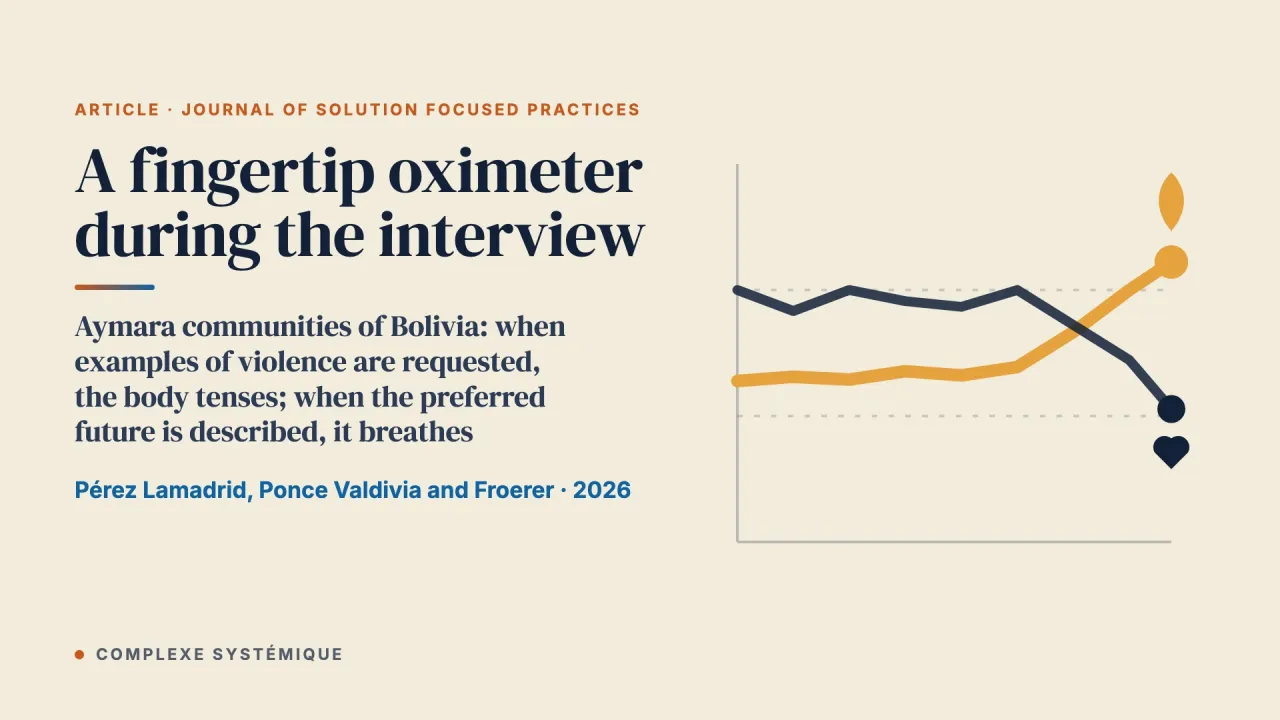
 Oxygenation and Heart Rate in Solution-Focused and Problem-Focused Interviews With Rural and Indigenous Aymara Communities (Viacha and Laja) Regarding Intersectional Violence
A fingertip oximeter on 19 Aymara people of the Altiplano: the problem-focused interview tenses when examples of violence are requested; the solution-focused one oxygenates and slows the heart.