The British Journal of Social Work · Family group conferences
Specifying the practice model for Family and Group Conferencing for adults: Reporting on a Delphi consultation
What is a Family and Group Conference when the person at the centre is an adult, in mental health or social care? A Delphi consultation in Britain with three panels, one of them made up of people with lived experience of conferences, produced thirty-two shared statements on delivery, ingredients for success and potential outcomes. One question remains open: can a network be convened around a carer when the person cared for does not take part?
This is a reformatted republication of Specifying the practice model for Family and Group Conferencing for adults: Reporting on a Delphi consultation, by Jerry Tew, Hayrunisa Pelge and Sharanya Mahesh, published in The British Journal of Social Work (Oxford University Press) (2026), doi: 10.1093/bjsw/bcag034, under a CC BY 4.0 licence. Prepared by Complexe Systémique in September 2026: the authors’ text is unchanged; the layout has been adapted for reading online, which constitutes a modification of the work under the terms of the licence. Tables are presented as lists; end-of-article statements are grouped in the notes. This edition was made neither by the authors nor by the publisher, who are not responsible for its content or for any errors. The original version prevails.
This may reflect that FGC is fundamentally a democratic way of working, which engenders a substantial alignment of view and experience between those who provide and use FGC services.
Jerry Tew, Hayrunisa Pelge and Sharanya Mahesh
Abstract
From its origins in services for children and families, Family and Group Conferencing (FGC) is being developed in adult social care and mental health contexts. It offers an inclusive process whereby a person and their chosen supporters can devise their own plans in consultation with relevant professionals. Ways of working have evolved significantly, reflecting the different social and legal and contexts of work with adults. Building upon an earlier scoping of the field, a Delphi consultation was employed to consolidate our understanding of ‘how the model should be delivered’, ‘ingredients for success’, and ‘potential positive outcomes’. Three panels of experts were recruited to take part in the consultation, including those with lived experience. Consensus was achieved in relation to thirty-two statements, which provide a basis for fidelity criteria that can be used in future evaluations and trials, and in the development of standards and guidance for FGC practice with adults—both in the UK and internationally. Consensus was not achieved as to whether and how this approach could be offered for an informal carer in circumstances where the person receiving care did not wish or was unable to participate.
Background
Family and Group Conferencing (FGC) for adults is emerging internationally as an approach that has been offered in social care and mental health services (Fisher et al. 2018; de Jong et al. 2018) with potentially wider applicability in other health contexts. It offers an inclusive and co-productive process whereby a person and their chosen supporters can devise their own support or recovery plans in consultation with relevant professionals. It thereby fits well within broader developments of relational and strength-based practice (Miller and Mahesh 2025) and shared decision-making in health contexts (Ramon 2021).
Current FGC practice with adults has evolved out of practice with children and families, and generally comprises the following stages:
- preparatory conversations in which an independent coordinator meets separately with potential participants to help them to establish what they each want out of the process
- a conference which usually comprises information sharing and discussion with any professionals involved (Part 1), followed by ‘Private Time’ in which the individual and family/network members share ideas and decide on their proposed plan (Part 2). The coordinator and relevant professionals may rejoin at the end to help finalize and agree the plan (Part 3).
- subsequent review meeting(s) to check how the plan is working and adapt it if appropriate (Metze et al. 2015).
The practice model has been adapted around the different social, legal, and service contexts of work with adults. Key differences that shape the process are that the individual for whom the process has been convened (the ‘central person’) is an adult with rights to self-determination, and the other participants (‘network members’) are the significant others that the person has chosen to invite. These could be family members, but they could also be friends, neighbours, or others within their social networks (de Jong et al. 2018)—hence our use of the more inclusive term Family and Group Conferencing (FGC). Typically, FGCs for adults are not offered in scenarios where the alternative might be enforced statutory intervention, unlike the ‘edge of care’ scenarios that may be common in children and families contexts. This can make possible a process with significantly different power and relational dynamics, both within the ‘lifeworld’ of informal support and between this lifeworld and professional systems (see Hayes and Houston 2007).
In England, the FGC practice model for children and families has been overseen by the Family Rights Group—so there is some practical clarity as to what is or is not an FGC. However, FGC practice with adults has moved into more uncharted territory. A recent systematic review of family group decision-making interventions in adult healthcare (Hillebregt et al. 2019) found a range of approaches internationally, not all of which might be seen as adhering to the core principles of FGC—hence the potential value of undertaking a Delphi consultation.
A Delphi approach was used to explore with panels of experts whether consensus could be reached as to the defining features of the practice model for adults. Such an approach has become more widely used in health research (Diamond et al. 2014) and more recently in social care (Metzelthin et al. 2022; Haworth et al. 2023). The Delphi consultation formed the final stage of a wider research project on FGC funded by the National Institute for Health and Care Research. It provided an opportunity to test out and consolidate findings from a realist synthesis of the international literature, together with survey and interview data, that had been undertaken in an earlier phase of the research project. This had offered a preliminary characterization of the adult FGC model as practised, and its underpinning programme theory (Mahesh et al. 2025; Tew et al. 2025).
We were interested not only in gaining clarity as to the features of the practice model as it is emerging, but also what were seen as the core ingredients for success and the range of potential outcomes that may be achieved. Such clarity would be helpful as a basis for fidelity criteria—so that future trials or evaluations could be founded on a clear and broadly accepted definition of the practice model for FGC for adults. It was also intended that agreed statements could be utilized to develop professional standards and guidance—which could be particularly important if FGC is rolled out more widely across social care and health services.
Methods and process
The aim of a Delphi consultation is to build on the knowledge and experience of panel(s) of people who are, from various perspectives, experts in relation to the subject of the research—with opportunities for each participant to learn from and reflect on the perceptions and understandings of the other participants. A Delphi exercise lends itself to being conducted online (Khodyakov et al. 2011), and we used the Qualtrics platform for data security and ease of use. By ensuring that particular individuals do not have undue influence on the consultation, an online Delphi can build on ‘the anonymity of participating experts who are invited to assess and comment on different statements’ (Beiderbeck et al. 2021).
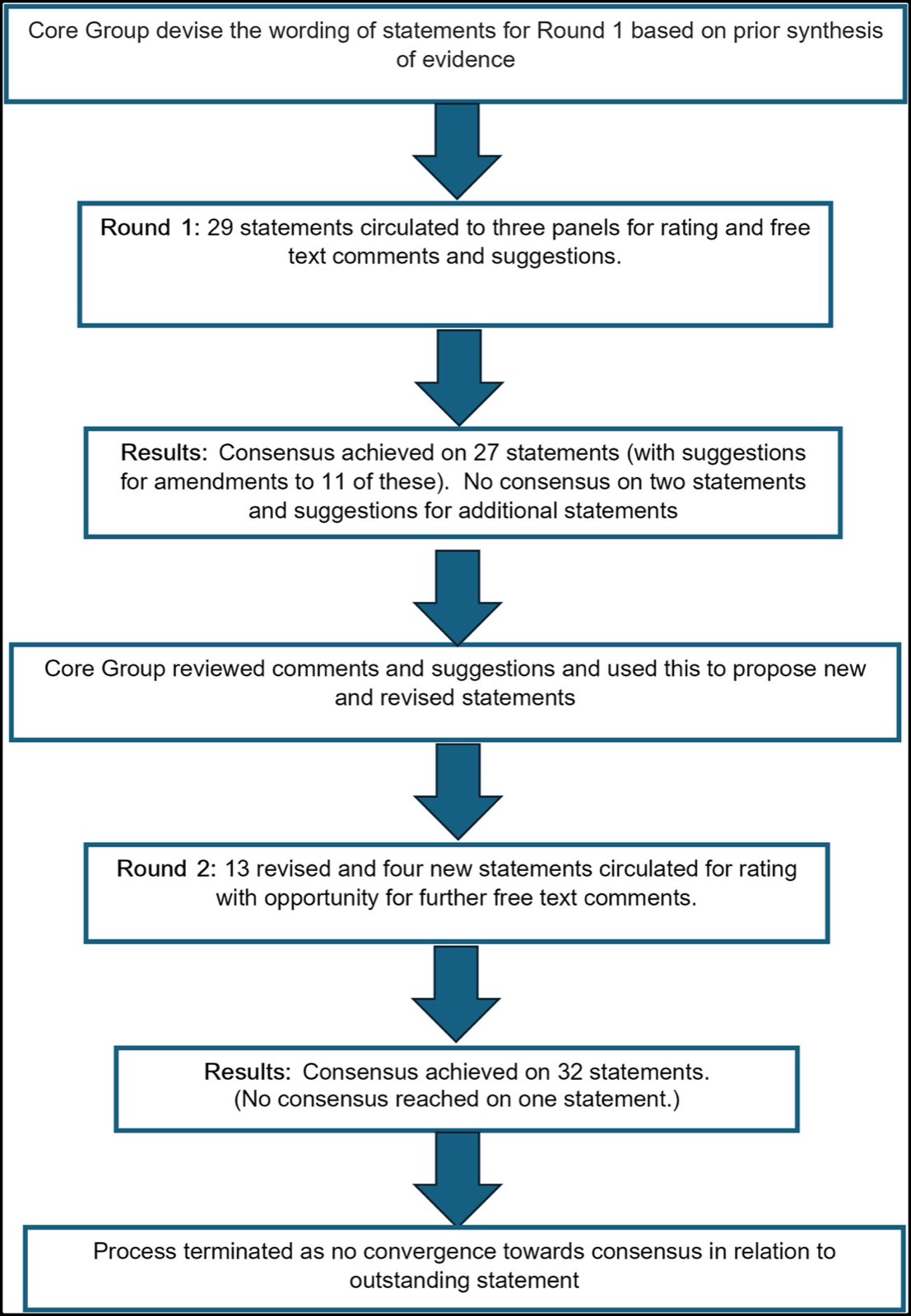
A Delphi is an iterative process that comprises successive rounds of consultation in relation to a proposed set of statements (see Fig. 1) and is designed so as to enable participants to move towards a consensus view where this is achievable. (However, from a research perspective, informed disagreement on a particular point may also be valuable as an outcome, as this may highlight an as-yet-unresolved area of debate within the field of practice.) Given the time constraints on potential participants, we chose a 2 + 1 design, in which two rounds would be undertaken with the possibility of continuing to a third round only if panels were moving closer to consensus, although the threshold requirement had not yet been reached.
For the results from a Delphi process to have validity, it is important that it is inclusive of relevant backgrounds and perspectives (Haworth et al. 2023). In constructing our expert panels, we identified three categories of people whose expertise would be particularly valuable: people with lived experience of FGC in an adult social care or mental health context—either as a central person or as a network member (LE panel); practitioners with direct experience of convening FGCs (FP panel); and other stakeholders (OS) with a particular knowledge and interest in FGCs for adults—for example, commissioners, referring social workers, or researchers.
In each round, panel members were invited to rate their level of agreement or disagreement with each proposed statement using a 5-point Likert scale (from −2 = ‘strongly disagree’ to +2 = ‘strongly agree’). Although similar studies have utilized a 9-point scale, we were concerned that this could be less reliable, as individual panellists might have a different sense of what a score of, say, ‘7’ might mean to them, whereas the terms ‘agree’ or ‘strongly agree’ have a more straightforward face-value meaning, which is likely to lead to more consistency between panellists. There is some variation across Delphi studies as to where the threshold is set for consensus to be determined—with a systematic review indicating a median agreement score of 75 percent or above (Diamond et al. 2014). Taking a slightly more cautious approach in the knowledge that the outputs from this consensus exercise would need to have credibility across the practice sector, we set, as a criterion for consensus, that a minimum of 80 percent of all panel members either agreed or strongly agreed with a particular statement (i.e. a rating of +1 or +2 on the Likert scale). In addition, in line with the principle that FGC is a democratic practice, we set a further criterion for consensus: not only did a statement have to achieve a minimum of 80 percent agreement overall, but it also had to pass the same threshold with the LE panel.
Too few participants can lead to the concern that panel(s) are not sufficiently representative of the potential diversity of views and experiences. Too many participants can make the process unwieldy, with participants not having the time or ‘headspace’ to fully engage with the comments and judgements made by other participants. Following Khodyakov et al. (2011), we determined that involving around thirty to forty participants overall would be optimal in terms of balancing these two considerations—with a desirable minimum of ten for each panel.
A purposive sample of panel members was recruited via a Research and Practice Network for FGC with adults (which was hosted by a voluntary organization, Community Catalysts and connected with all FGC services for adults across Great Britain), and via other contacts made during the earlier stages of the research process. Organizations were asked to extend invitations to practitioners and to individuals and network members who had used FGC services. Through this process, we were able to include participants from England, Scotland, and Wales, and from services that had not been involved in the field research strand of the overall research. We were pleased that there was minimal attrition between Rounds 1 and 2 (see Table 1).
Table 1 — Participant numbers per Delphi round and per panel.
- Panel: LE; Round 1: 10; Round 2: 10
- Panel: FP; Round 1: 10; Round 2: 9
- Panel: OS; Round 1: 17; Round 2: 15
- Panel: Total; Round 1: 37; Round 2: 34
We established a Core Group to oversee the process, comprising two members of the research team with lived experience of services (one with direct experience of participating in an FGC), two with practice experience in relation to FGCs for adults, and two academic researchers (one with a practice background in social work). Ethical approval was obtained from the University of Birmingham Humanities and Social Sciences Ethics Committee (ERN_2866-Jul2024).
The first stage of the process was for the Core Group to formulate the wording of a set of statements that would then be circulated for rating and comment in Round 1 (see Figure 1). Drawing upon our earlier research findings (see Mahesh et al. 2025; Tew et al. 2025), 29 statements were proposed which addressed three topic areas: ‘How the practice model of FGC should be delivered’, ‘Ingredients for success’ and ‘Potential positive outcomes.’ These statements were then piloted with individuals who were not going to be panellists, but who had lived experience or practice backgrounds. The feedback received indicated that (1) the wording of the statements was clear and comprehensible, and (2) the exercise was engaging and doable within a timeframe of around thirty to forty-five minutes, corresponding to what is generally seen as acceptable for an online Delphi exercise (Donohoe et al. 2012).
As well as giving a rating score for each statement, panellists were invited to provide free text comments and/or suggestions for amendment—and to propose additional statements to address other aspects of practice where they considered clarification would be helpful. Particularly where panels have different areas of expertise, the process of ‘learning across’ between panels may be seen as a valuable part of the Delphi process (Hawarth et al. 2023). Therefore, in setting the scene for deliberation in Round 2, panellists were asked to consider anonymized feedback from Round 1 from each of the three panels, both in terms of ratings and free text comments. Where feedback indicated that a statement might be improved (even if the consensus threshold had already been met), or that an additional statement might be helpful, the Core Group devised new or revised statements for consideration in Round 2. Where a revised version of a statement achieved a higher level of consensus, this was adopted. If it failed to do so, the original version stood (if the criteria for consensus had been met in Round 1).
We would have proceeded to a third round if there were statement(s) where the panels were moving closer to consensus, but this had not quite been reached. In the event, this criterion was not met the process was terminated after Round 2.
Results
How the model should be delivered
As may be seen in Table 2, the set of statements that were agreed provide a detailed specification of how FGC should be delivered in an adult social care or health context. The high level of initial consensus achieved in Round 1 may partly reflect the thoroughness of the preparatory work that had been undertaken as part of the wider research project (Mahesh et al. 2025; Tew et al. 2025).
Table 2 — Statements with consensus agreement—how the model should be delivered.
- 1. Central to the model is the independence of the coordinator who has responsibility for facilitating the process, not for what should go into the Plan. They should not normally have any other role in relation to the central person and their network (such as social worker or service provider) but can enable the implementation and review of the Plan. Highest agreement score achieved in: Round 1. Level of agreement (%): LE Panel 100; All 100.
- 2. Training for coordinators should be for a minimum of ten days and should include training on FGC values and principles, communication and facilitation skills, cultural competence, and specialized knowledge of adult protection issues and community resources; andopportunities for shadowing and co-working with experienced coordinators. They should also be shadowed while they undertake their first Conferences. Highest agreement score achieved in: Round 2. Level of agreement (%): LE Panel 90; All 94.
- 3. Guides in different formats should be created to give out to the central person and network members. These should break down the different stages of the FGC process (including preparation), so that everyone involved is aware of what it will be like and what will happen. Highest agreement score achieved in: Round 2 (New statement). Level of agreement (%): LE Panel 90; All 97.
- 4. The process and format should be informal and flexible so as to best fit with people’s social and cultural preferences, support needs, or other factors—as long as all participants will have a voice. Highest agreement score achieved in: Round 1. Level of agreement (%): LE Panel 100; All 94.
- 5. Where the central person may have limited mental capacity or other vulnerabilities that may affect their participation, they should be offered an advocate, or an alternative mechanism whereby their views and preferences can be represented (e.g. by preparing a statement or personal plan in advance). Highest agreement score achieved in: Round 1. Level of agreement (%): LE Panel 100; All 97.
- 6. During the preparation phase, the coordinator should connect with the central person and each network member to explore their concerns, aspirations and preferred options—and how to include the widest relevant network. Highest agreement score achieved in: Round 1. Level of agreement (%): LE Panel 100; All 100.
- 7. During the preparation phase, the coordinator should also connect with the referrer and relevant practitioners to clarify what they would wish to bring to the discussion. Highest agreement score achieved in: Round 1. Level of agreement (%): LE Panel 100; All 95.
- 8. On the basis of what people have said, a working document should be drawn up and shared with all participants ahead of the Conference. This should be written from the perspective of the central person (but may also need to reflect the perspectives of other participants where these may differ). The central person’s voice may be reflected through the utilization of ‘I’ statements, or by them taking responsibility for writing the document. Highest agreement score achieved in: Round 1. Level of agreement (%): LE Panel 80; All 84.
- 9. There should be a discussion with the central person and their network as to where they would be most comfortable in hosting their FGC. They should be offered the choice of a neutral venue for the Conference, such as a library or community facility. However, they may elect to hold the Conference wherever feels most comfortable to them—including the place where they live. Highest agreement score achieved in: Round 2. Level of agreement (%): LE Panel 90; All 97.
- 10. Online and hybrid options for the conference can also be offered—particularly as a way of including people who may be geographically dispersed. Where possible, professionals should be encouraged to participate in person. Highest agreement score achieved in: Round 1. Level of agreement (%): LE Panel 100; All 100.
- 11. In setting the tone for the Conference, it should start in a way that brings people together on an informal basis and breaks down power hierarchies—such as the sharing of food. Highest agreement score achieved in: Round 1. Level of agreement (%): LE Panel 90; All 97.
- 12. The discussion with practitioners in the Conference should be facilitated so that all participants are able to learn with and from each other, with a particular focus around what matters to the central person. Highest agreement score achieved in: Round 1. Level of agreement (%): LE Panel 100; All 95.
- 13. Central to the model is Private Time in which the central person and network members (and any advocate) work up their preferred Plan. In some instances, the central person and network members may invite the coordinator into the room to assist at particular points with their decision-making process. Highest agreement score achieved in: Round 2. Level of agreement (%): LE Panel 90; All 91.
- 14. The Conference needs to be as long as it takes for participants to fully understand the issues and consider responses. Alternatively, discussions may be better split over more than one shorter meeting. Highest agreement score achieved in: Round 2 (New statement). Level of agreement (%): LE Panel 80; All 88.
- 15. Where appropriate, there should be an opportunity for an extended discussion with practitioners at the start of the Conference around safeguarding concerns or what may be feasible to include in the Plan. They may also be invited to rejoin the Conference at the end of Private Time to finalize proposals for service input (and how this should be coordinated), or to discuss whether safeguarding concerns are being sufficiently addressed. Highest agreement score achieved in: Round 2. Level of agreement (%): LE Panel 90; All 88.
- 16. When a person does not have any network other than paid workers, or where the primary issue is one that needs to be resolved with practitioners and services, it may be useful to convene a Network Meeting that is facilitated by a coordinator. However, this should not be called an FGC. Highest agreement score achieved in: Round 2 (New statement). Level of agreement (%): LE Panel 90; All 82.
- 17. It is essential that coordinators are able to offer follow-through to support the implementation of the Plan, and to convene one or more conversations with the central person and network members to review how the Plan is working and address any additional issues that may have arisen. Highest agreement score achieved in: Round 1. Level of agreement (%): LE Panel 90; All 92.
- NC. Where the central person is unable or unwilling to participate in the process, an FGC can be held for their main carer, addressing the issues that they may be experiencing Highest agreement score achieved in: Round 1, consensus not achieved. Level of agreement (%): LE Panel 70; All 70.
Even where consensus was achieved in Round 1, without any suggested amendments, there could be some interesting nuances in the free-text comments. For example, in relation to how the independence of coordinators should be understood (Statement 1), one member of the LE panel appreciated how their coordinator had offered additional support in relation to seeing through the implementation of the plan:
My coordinator was an advocate for me and where appropriate and necessary to help achieve my FGC goals, my coordinator did get in contact with my other care providers to get answers and encourage action on my behalf.
However, within a wider context in which social care and community resources may be affected by cutbacks, other FP and OS panellists expressed concern that FGC coordinators may get sucked in, not just to offer follow-through and review(s) with the central person and network members (as set out in Statement 17), but also to become de facto care coordinators or support workers.
Similarly, there were differences in emphasis in relation to Statement 4, which proposed flexibility of format and process to take account of both cultural preferences and support or access needs. Supporting this statement, one OS panellist argued that FGCs ‘have moved away from a one-size-fits-all approach’ so as to accommodate the preferences and expectations of people from different cultural and ethnic groups that are taking up FGC services. While another OS panellist suggested that some people ‘may find a more structured process and format easier to access and less threatening’, an LE panellist commented that flexibility in format had been ‘very important to me as someone who is neurodivergent’.
Where suggestions for improvement were offered, these could involve adding new clauses to the original wording. In some instances, this additional detail resulted in a higher level of consensus in Round 2 (e.g. in the more detailed specification of training for FGC coordinators in Statement 2), but, in other instances, panels overall preferred the (perhaps simpler) wording of the original statement. There was a more substantive difference of view with regard to Statement 13, which sought to specify how the FGC coordinator might assist in Private Time if requested to do so. The initial wording offered the possibility that the central person and network members might, under certain circumstances, invite the coordinator to stay in the room and to assist with their decision-making process. While 90 percent of both the LE and FP panels agreed or strongly agreed with this statement—seeing this fall-back position as pragmatic and potentially useful—there were concerns among the OS panel that this might constitute a potential dilution of the principle of Private Time. As well as stressing that the ‘golden standard’ of FGC should be ‘to let the family begin this process without anyone in the room with them’, their comments suggested a more circumscribed flexibility in which co-ordinators might be invited into the room for short periods to assist (e.g. perhaps outlining resources or options), but in a way that did not risk ‘developing a dependence’. The revised wording that was proposed in Round 2 received stronger support overall (Table 2, Statement 13), with an LE panellist seeing this as still offering them the back-up they might need:
I think the FGC coordinator’s input is really important. Sometimes as a family you are so deeply and emotionally connected that you often don’t see the obvious and practical solutions/options available to you.
Somewhat more contentious was the question as to how and when relevant practitioners should be invited to join the decision-making process. Unlike in FGCs for children, the purpose of the Conference may include negotiating with practitioners around what they could offer as part of the overall Plan. The initial wording of Statement 15 therefore offered the possibility that practitioners could be invited ‘to rejoin the Conference if it is helpful’, but that ‘practitioners who may be in a position to use statutory powers or determine eligibility for services would not normally be allowed to stay for the main part of the Conference’. This wording raised concerns for all three panels with only 70 percent agreement across the board—but with somewhat different concerns being raised.
One LE panellist was concerned that excluding professionals with statutory powers could be counter-productive as they could have the most relevant knowledge and understanding of options available (e.g. in relation to safeguarding), and it could be valuable to use the Conference to ‘foster a sense of collaboration between the family and the professionals’. A contrary view was expressed by an FGC practitioner who stated that professional involvement in any substantive part of the plan-making discussion ‘would undermine the fundamental purpose of the FGC process, which is to empower individuals and networks to develop their own plans and solutions’.
Such positions were hard to reconcile, so it was decided by the Core Group to propose a revised wording of the statement, which delineated a more circumscribed opportunity for discussion with professionals, but nevertheless recognized the value of their presence, not just for information-sharing in Part 1 of the Conference (before Private Time), but also in Part 3 to finalize proposals. As one FGC practitioner commented:
Part 3 of the FGC meeting… is a vital part of the negotiation phase of the meeting. If professionals are not there, it makes the FGC less empowering and takes the focus and power back to professionals.
However, the Core Group also recognized that, in some circumstances, a facilitated dialogue with professionals might be what the central person and their network identified that they needed (e.g. to better coordinate service input or where all their day-to-day support might be from paid support workers)—and hence that it may be helpful to offer an alternative format of a facilitated Network Meeting with professionals—the basis of the new Statement 16. A member of the OS panel proposed that this ‘should have the same principles as FGC, with the person being at the centre and reducing hierarchies’. However, to avoid any dilution of the FGC model itself, such a meeting should not be called an FGC. Both Statements 15 and 16 achieved consensus in Round 2, with the highest level of agreement coming from the LE panel, who perhaps recognized, more acutely than others, how difficult it can be to negotiate plans with professional systems, and to have a forum in which their voices can be heard.
Two new statements were developed based on panellists’ suggestions and these achieved consensus in Round 2. There was recognition across all groups that, particularly because adults’ FGCs could be very different from more conventional (and professionally dominated) approaches to decision-making, people tended to be unfamiliar with what it might entail—hence the importance of providing information in easily accessible forms beforehand (Statement 3). This should put over ‘the empowering process of FGC’ while not ‘over-professionalising the core concept’ (OS panellist).
LE panellists saw it as important to specify that a Conference should be allowed to take ‘as long as it takes’ (Statement 14), with one commenting ‘I like that there’s no “time limit”—that takes pressure off the central person’, and another reflecting on their experience of how this was important for them:
I think you absolutely need to have that one all-important meeting regardless of how long it takes.
However, it was also recognized that one long meeting might not be suitable for everyone, as people could lose focus or simply become exhausted—so the option of splitting the discussion into shorter meetings, perhaps focused around particular issues, could be a helpful alternative.
Consensus was not reached as to whether, and in what circumstances, an FGC could be convened to address the issues experienced by a person’s main carer when the central person would not be taking part in the Conference–either out of choice or for reasons relating to their mental capacity (Statement NC). Although a majority within each panel expressed support for the possibility of convening an FGC for the main carer, this did not reach the level required for consensus. The most marked split was within the FP panel, with 60 percent strongly agreeing and 20 percent strongly disagreeing, but there was also a similar split within the LE panel. One LE panellist highlighted, although ‘it must be done with caution’, that ‘in some cases it will be vital that the main carer is heard and gets the support the FGC can provide in the absence of the central person’. However, another saw this as potentially threatening the rights and interests of the central person:
By shifting the focus to the carer, the central person’s autonomy and voice could be overlooked, particularly if the FGC centres more on the carer’s concerns than the individual’s well-being. This shift could disempower the central person and lead to decisions that may not prioritise their rights and dignity.
The Core Group sought to reflect this concern for Round 2 by inserting a caveat to clarify that an FGC for a carer should not make ‘any decisions relating to the support arrangements for the central person’. One FGC practitioner supported this revised statement:
I think offering an FGC to the carer is beneficial even if the cared-for person does not attend. To me it’s not about coercing the cared-for person into something they don’t want. Instead, I see it as the carer is the person at the centre of this kind of FGC. The issues that can be put to network and agencies would be around how the carer can be supported to achieve their desired outcome. Or how they could be supported with potential challenges.
However, the opportunity to reflect on the concerns expressed by some panellists in Round 1 would seem to have led others to reconsider their positions, and the overall level of agreement for the revised statement fell, with doubts expressed as to how this could work without, at least indirectly, impacting on the interests of the central person. As one member of the OS panel put it:
I don’t see how this will work in practice as options would have to be so restricted to have no impact on the central person.
A view expressed by a number of panellists was that alternative support should be available to carers, but not necessarily under the umbrella of an FGC. As FGC practice with adults develops and evolves, it will be interesting to see what comes to be regarded as best practice in terms of how to organize network support around a main carer without compromising the rights or interests of the central person.
Ingredients for success
Whereas questions as to what exactly should constitute the FGC practice model for adults elicited some interesting differences in view from our panellists, questions around how it works elicited a more consistent level of agreement from the outset (see Table 3). The statements that were proposed in Round 1 were drawn from the preliminary programme theory that had been developed in an earlier phase of the research project (Tew et al. 2025). The only suggestion for improvement was the substitution of the phrase ‘quality of life’ for ‘best life possible’ in Statement 21.
Table 3 — Statements with consensus agreement—ingredients for success.
- 18. Co-ordinators are trained and supported to stay with uncertainty and give space for the central person and their network to find their own solutions. Highest agreement score achieved in: Round 1. Level of agreement (%): LE Panel 80; All 92.
- 19. Co-ordinators should be willing and able to ‘go the extra mile’ in supporting participants to engage in the process where participants may be fearful, ashamed or embarrassed, or may initially lack self-confidence or motivation or skills to be effectively heard. Highest agreement score achieved in: Round 1. Level of agreement (%): LE Panel 100; All 100.
- 20. The professional system must be willing and able to give power to the central person and their network to make their own decisions, and participants must believe that they can (and will be allowed to) take charge of their situation. Highest agreement score achieved in: Round 1. Level of agreement (%): LE Panel 90; All 87.
- 21. Practitioners are willing to join the process with open minds and learn with the central person and their network as to what may be current challenges and what would enable them to have the best quality of life. Highest agreement score achieved in: Round 2. Level of agreement (%): LE Panel 100; All 98.
- 22. Space is given for the central person and network members to be recognized for who they are, what matters to them, and how they may be able to contribute towards a successful outcome. Highest agreement score achieved in: Round 1. Level of agreement (%): LE Panel 100; All 100.
- 23. Restorative culture—no blaming, but space to acknowledge any feelings of hurt or shame as part of a process of strengthening or rebuilding relationships. Highest agreement score achieved in: Round 1. Level of agreement (%): LE Panel 100; All 100.
- 24. It is important for everyone involved to be given the time and space to talk freely within the conference—and to be given the opportunity to make sense of things in their own way and to be creative in relation to finding solutions. Highest agreement score achieved in: Round 2 (New statement). Level of agreement (%): LE Panel 100; All 97.
Although this is not something that has surfaced explicitly in the children and families FGC literature, there was consensus that encouraging participants (including professionals) to stay with uncertainty, rather than jumping to solutions or judgements, was crucial in giving space to the central person and their network to reach their own understanding of the issues and propose their own solutions (Statement 18). Members of the OS panel commented that although this ‘can be uncomfortable for all involved, especially if there is disagreement between parties’, this can be a crucial ingredient for success, as ‘uncertainty makes room for curious questions and thinking outside the box’.
Rather than ‘doing to’ people, FGC was seen as offering the possibility of very different power relationships:
The model’s process enables empowerment. The usual process of a service-led meeting is reversed… The central person invites professionals to attend rather than the other way round. The venue and time is chosen by the central person and their family/network. The symbolism of this is significant. Along with Private Time, the process delivers empowerment. The model also has at its core a focus on the strengths and abilities of the central person and the family/network as opposed to a deficit traditional model. (OS panellist)
In research on FGCs for children (Mitchell 2021), participants had identified how being recognized for who they were—rather than being defined by the potentially negative or limiting perceptions of others—was central to their feeling confident and able to develop and deliver their own plans. This was echoed in relation to FGCs for adults (Statement 22), with a member of the OS panel stressing the frustration and damage that can be caused if professionals have failed to offer such recognition in the past:
The FGC process can take some of the heat and hurt that people carry, especially when issues have not been addressed and people feel that they have not been listened to or their role and knowledge respected.
It was seen that FGCs could provide an opportunity for restoration where relationships had become fraught or distanced—either with professionals (as reflected in the above quote) or between network members (Statement 23):
I feel it is very important to allow people to express how they are feeling and given space to restore broken and/or fragmented relationships. A safe non-judgemental space needs to be created. (LE panellist)
While it was seen as aspirational that practitioners should be willing to join the process with open minds and learn with the central person and their network (Statement 21), it was recognized that not all practitioners may engage with the process seriously or may resist the temptation to take over (see de Jong et al. 2018). As one LE panellist reflected:
One of the social workers in our FGC was great and the other really clearly didn’t know what was going on and didn’t want to be there.
On the basis of suggestions from Round 1, a new statement (Statement 24) was drafted which highlighted the need for people to have the time and space to ‘talk freely’ and, most importantly, to have the opportunity ‘to make sense of things in their own way’. This achieved consensus support in Round 2.
Potential positive outcomes
We used the Delphi consultation as a means to review and validate our emerging understanding of what may be seen as potential positive outcomes from FGCs for adults. There was strong support for the contention that FGCs can achieve a range of outcomes over and above enabling people to make and implement their plans (Statement 25)—and consensus support was achieved for the broader range of outcome statements set out in Table 4.
Table 4 — Statements with consensus agreement—potential positive outcomes.
- 25. A plan is made and implemented that builds on the preferences, aspirations, and capabilities of the central person and their network. Highest agreement score achieved in: Round 1. Level of agreement (%): LE Panel 100; All 100.
- 26. The central person has enhanced wellbeing (capability to live a meaningful, valued life with stronger connections with family, friends, and wider community). Highest agreement score achieved in: Round 1. Level of agreement (%): LE Panel 100; All 100.
- 27. People with caring responsibilities have enhanced wellbeing (less sense of isolation and more support in their caring role, and enhanced capability to live meaningful, valued lives with stronger connections with the people that matter to them). Highest agreement score achieved in: Round 2. Level of agreement (%): LE Panel 80; All 92.
- 28. The central person feels empowered by being closer to and better understood by the people that matter to them. Highest agreement score achieved in: Round 1. Level of agreement (%): LE Panel 100; All 100.
- 29. Larger and/or better functioning relational network—with better communication, sharing of caring responsibilities and opportunities for reciprocity. Highest agreement score achieved in: Round 1. Level of agreement (%): LE Panel 90; All 97.
- 30. Improved communication and trust between the central person, network members, and practitioners/care services. Highest agreement score achieved in: Round 1. Level of agreement (%): LE Panel 90; All 95.
- 31. More effective safety net around the central person offering better protection and a balanced approach to risk-taking. Highest agreement score achieved in: Round 1. Level of agreement (%): LE Panel 100; All 98.
- 32. More effective or better-tailored use of social care and health resources. The central person and network to have a better understanding of what resources may be available to them. Highest agreement score achieved in: Round 2. Level of agreement (%): LE Panel 100; All 100.
All panels agreed that both the central person and those with caring responsibilities could experience enhanced well-being as a result of the FGC process (Statements 26 and 27). However, in some of the feedback, it was recognized that enhancing well-being could depend, not just on a successful Conference, but also on actually being able to access the identified community or social care resources that could be important to them—particularly within a context of service pressures. Reflecting these concerns, there was consensus support for adding a clause to Statement 32 to the effect that people should have a ‘better understanding of what resources may be available to them’.
The sociological concept of ‘relational agency’ had been developed in the characterization of programme theory for FGC (Burkitt 2016; Tew et al. 2025). This describes how people, and particularly those with vulnerabilities and support needs, may not always be in a position to exercise agency as an autonomous individual, but can have more influence and ability to act if they have people around them who already have an appreciation of their needs, wants, and preferences. This underpins the wording of Statement 28, which achieved unanimous agreement, with one member of the OS panel commenting that ‘it is important not to under-estimate the importance of feeling closer to and better understood, even for people with significant capacity issues’.
There was consensus that potential positive outcomes could include a larger and/or better functioning relational network (Statement 29) and improved communication and trust between the central person, network members, and practitioners (Statement 30). While the former was seen as more realistic—‘Between the central person and their network- absolutely!’ (LE panellist), the latter was seen by some as aspirational at best—‘Would be brilliant—not our experience’ (another LE panellist). Again, the main cause of this was seen to be services being cut or over-stretched, but there could also be an issue of underlying attitude and orientation—the degree to which practitioners were actually invested in following through with the agenda that had been set out by the central person and their network.
Limitations
The value of a Delphi exercise depends on the recruitment of experts from across the field of interest, so that the results are not unduly influenced by sub-groups with particular experiences or sectional interests. This could be a concern when the overall number of participants is relatively small, as in this study. In constructing our purposive sample, we were mindful of this and sought to ensure that participants were included from across all FGC services currently operating (and not just those that had been sites for the field research), In many instances, we relied on service managers to cascade information to practitioners, agency colleagues, and people who had used their services, so this may have introduced an element of bias in terms of the pool of potential participants. Given this, those recruited to the lived experience panel may have tended to have had broadly favourable experiences of FGC services—and hence may not have been representative of all users of FGC services. Similarly, there could have been a bias towards those who felt more able and confident. This is acknowledged as a limitation.
Some studies have adopted a modified Delphi approach in which there is a structured forum for discussion among participants between each round (see, e.g. Haworth et al. 2023). It is possible that, had we adopted this approach, we might have been able to achieve consensus on how or whether an FGC can be offered to support an informal carer.
Conclusion
A Delphi approach proved successful in refining and agreeing a set of statements that provide a comprehensive specification of the FGC practice model for adults—what it is, what makes it work well, and what it may achieve. It was interesting to note the degree to which there was commonality of perspective between the lived experience, FGC practitioner, and OS panels in relation to the statements that were reviewed. Where there was difference, this was more often within rather than between panels. This may reflect that FGC is fundamentally a democratic way of working, which engenders a substantial alignment of view and experience between those who provide and use FGC services.
A strength of the Delphi process was that it facilitated reflection on the potentially contentious issue as to how social work and other practitioners could be involved in discussions while also preserving the principle of dedicated Private Time. Out of this emerged consensus support for a clarification that there could be two different sorts of meeting—an FGC in which discussions with practitioners could feed into a Plan that is made in Private Time, and a Network Meeting which would be a facilitated discussion with practitioners to resolve issues relating to service support.
The only outstanding question on which consensus was not reached relates to whether or how FGCs could be offered to address issues faced by an informal carer, when the person receiving the care is unable or unwilling to participate - for example, due to having more advanced dementia. This issue may need to be revisited at a point in the future when there is more experience as to whether and how this may be done in ways that are respectful of the rights and interests of the person receiving care.
This exercise is of particular significance as, up until now, there has been no detailed specification of FGC practice with adults. Although reflecting expert opinion in Britain, it is hoped that the results of this exercise may be of use internationally in providing a basis for fidelity criteria that could be used to define the parameters of the practice model in future research. It is intended that the agreed statements will be used in standards and guidance that can be adopted for FGCs for adults in Britain—and work on this is currently in progress. As FGC practice with adults extends over the coming years, it may be possible to conduct a similar consultation on a larger scale, perhaps with international representation, to confirm or update how the practice model may be defined.
Complexe Systémique: key points
For a systemic reader, the value of this text is that it makes explicit what makes an FGC for adults, and therefore what sets it apart from an ordinary case meeting. Three features stand out: an independent coordinator with no other role in relation to the person; a Private Time in which the central person and their network work out their plan on their own; a network chosen by the person, reaching beyond the family. The statements on ‘ingredients’ speak the language of systemic practice: staying with uncertainty rather than rushing to solutions, recognising people for who they are, making room for repairing relationships, thinking of agency as relational. The most fertile point is the disagreement: convening a network around a carer without the person cared for risks talking about them in their absence, and the question remains open. The limits are those of a modest-sized British Delphi, recruited through the services themselves, probably with fairly satisfied users. Read alongside the first part of the characterisation of the model, and the article on family group conferences as a shared decision-making strategy in mental health.
Notes from the original
Acknowledgements. The authors would like to acknowledge the contribution of the members of the Core Group: Kar-Man Au, Vicky Nicholls, Lyndsey Taylor, and Miranda McGill.
Conflicts of interest. None declared.
Funding. The research was funded by the National Institute of Health and Care Research (NIHR) grant number 135127.
References
Beiderbeck D. et al. (2021) ‘Preparing, Conducting, and Analyzing Delphi Surveys: Cross-disciplinary Practices, New Directions, and Advancements’, MethodsX, 8: 101401. 10.1016/j.mex.2021.101401
Burkitt I. (2016) ‘Relational Agency: Relational Sociology, Agency and Interaction’, European Journal of Social Theory, 19: 322–39. https://doi.org/10.1177/1368431015591426
Diamond I. et al. (2014) ‘Defining consensus: A Systematic Review Recommends Methodologic Criteria for Reporting of Delphi Studies’, Journal of Clinical Epidemiology, 67: 401–9. https://doi.org/10.1016/j.jclinepi.2013.12.002
Donohoe H., Stellefson M., Tennant B. (2012) ‘Advantages and Limitations of the E-Delphi Technique: Implications for Health Education Researchers’, American Journal of Health Education, 43: 38–46. https://doi.org/10.1080/19325037.2012.10599216
Fisher T., Mooney B., Papworth A. (2018) ‘FGCs and Adult Social Care’, in Edwards D. Parkinson K. (eds) Family Group Conferences in Social Work. Bristol: Policy Press.
Hayes D., Houston S. (2007) ‘Lifeworld’, ‘System’ and Family Group Conferences: Habermas’s Contribution to Discourse in Child Protection’, British Journal of Social Work, 37: 987–1006. https://doi.org/10.1093/bjsw/bcl055
Haworth S., Montgomery P., Schaub J. (2023) ‘A Delphi Study to Develop Items for a New Tool for Measuring Child Neglect for Use by Multi-Agency Practitioners in the UK’, Social Sciences, 12: 239. 10.3390/socsci12040239
Hillebregt C. et al. (2019) ‘Family Group Decision-making Interventions in Adult Healthcare and Welfare: a Systematic Literature Review of its Key Elements and Effectiveness’, BMJ Open, 9: e026768. https://bmjopen.bmj.com/content/9/4/e026768 https://doi.org/10.1136/bmjopen-2018-026768
de Jong G., Schout G., Abma T. (2018) ‘Understanding the Process of Family Group Conferencing in Public Mental Health Care’, The British Journal of Social Work, 48: 353–70. https://doi.org/10.1093/bjsw/bcx037
Khodyakov D. et al. (2011) ‘Conducting Online Expert Panels: A Feasibility and Experimental Replicability Study’, BMC Medical Research Methodology, 11: 174. https://doi.org/10.1186/1471-2288-11-174
Mahesh S. et al. (2025) ‘What is Family and Group Conferencing for Adults? Part 1: Characterising the Model and Methods of Enquiry’, NIHR Open Research, 5: 20. https://doi.org/10.3310/nihropenres
Metze R., Abma T., Kwekkeboom M. (2015) ‘Family Group Conferencing: A Theoretical Underpinning’, Health Care Analysis: Journal of Health Philosophy and Policy, 23: 165–80. https://doi.org/10.1007/s10728-013-0263-2
Metzelthin S. et al. (2022) ‘Development of an Internationally Accepted Definition of Reablement: a Delphi Study’, Ageing and Society, 42: 703–18. https://doi.org/10.1017/S0144686X20000999
Miller R., Mahesh S. (eds) (2025) Strengths-Based Practice in Adults Social Work and Social Care. London: Routledge. https://doi.org/10.4324/9781003424383
Mitchell M. (2021) ‘The Value of Recognition Theory to Family Group Conferencing and Childcare and Protection’, The British Journal of Social Work, 51: 2191–209. https://doi.org/10.1093/bjsw/bcaa207
Ramon S. (2021) ‘Family Group Conferences as a Shared Decision-Making Strategy in Adults Mental Health Work’, Frontiers in Psychiatry, 12: 663288. 10.3389/fpsyt.2021.663288
Tew J. et al. (2025) ‘What is Family and Group Conferencing for Adults? Part 2: Developing Programme Theory’, NIHR Open Research, 5: 34. https://doi.org/10.3310/nihropenres
Reformatted republication of Specifying the practice model for Family and Group Conferencing for adults: Reporting on a Delphi consultation, by Jerry Tew, Hayrunisa Pelge and Sharanya Mahesh, The British Journal of Social Work, advance online publication (2026), doi: 10.1093/bjsw/bcag034, under a CC BY 4.0 licence. Edition and layout: Complexe Systémique, September 2026 — the work has been modified under the terms of the licence (tables presented as lists). Neither the authors nor the publisher are responsible for this edition; the original version prevails.
This is the original article “Specifying the practice model for Family and Group Conferencing for adults: Reporting on a Delphi consultation”, published in The British Journal of Social Work (2026) under a CC BY 4.0 licence. Republished by Complexe Systémique: the author’s text is unchanged; only the presentation has been adapted for reading online, as set out at the head of this page.
Read the original articleHow to cite this article
Tew, J., Pelge, H., et Mahesh, S. (2026). Specifying the practice model for Family and Group Conferencing for adults: Reporting on a Delphi consultation. Complexe Systémique. https://app.complexe-systemique.com/en_GB/articles/specifying-the-practice-model-for-family-and-group-conferencing-for-adults (Original work published in 2026 in The British Journal of Social Work, publication en ligne anticipée, bcag034 (2026); republished in 2026 by The British Journal of Social Work, https://academic.oup.com/bjsw/advance-article/doi/10.1093/bjsw/bcag034/8666313)
To go further
- Qu’est-ce que la *conférence familiale et de groupe* pour adultes ? Partie 1 : caractériser le modèle et les méthodes d’enquêteCharacterising the model.
- Qu’est-ce que la conférence familiale et de groupe pour adultes ? Partie 2 : élaborer la *théorie du programme*Programme theory.
- Les *conférences familiales* comme stratégie de décision partagée dans le travail de santé mentale auprès des adultesShared decision-making in mental health.
Related training courses
 Symposium
Digital technology, AI and mental health
Conference in Lyon, 11 December 2026: digital technology, artificial intelligence and mental health. Six talks, replay for participants. In French.
 Short course
The suicidal crisis in adolescents and young adults
Training: assessing and supporting the suicidal crisis in adolescents and young adults. Clinical landmarks and systemic tools. In French.
Related articles
 Article
 Family group conference provision across the lifespan of child welfare intervention: A mixed-method realist-informed evaluation comparing three stages of welfare concern
Early help, child protection or children in care: among 155 UK families, experiences and outcomes of family group conferences vary very little by stage.
 Article
 How can we BeST? meet the needs of adoptive families? Relevant findings from a major Randomised Controlled Trial of infants in foster care in the UK
The BeST? trial (488 infants in care in the UK) reread for adoption: holistic, ongoing assessment of children and a move to dual registration.
 Article
 Implementing Family Group Decision-Making within statutory child protection social work in Scotland: Challenges and opportunities
Family group decision-making offered automatically in Scottish child protection: families find a voice, social workers doubt the plans, and everyone wants it offered earlier.
 Article
 Parenting after critical illness: a biopsychosocial review of post-intensive care syndrome, family systems, and child outcomes
After post-intensive care syndrome, parenting falters, the co-parent is worn down and children help in silence. A biopsychosocial review proposes how to spot them.