AI-assisted translation
This version was translated from Portuguese by Complexe Systémique with the help of artificial intelligence. In case of doubt, the original version prevails.
Revista Brasileira de Terapia Familiar · Couples
The couple we build and the partners who inhabit us
Why do we fall in love with an image rather than a person? Psychologist and Jungian analyst Suely Engelhard follows development from birth to adulthood to show how the anima and the animus, these “invisible partners,” are projected onto the other in passion. A couple only becomes a true “we” by withdrawing these projections and renewing its pacts, including those that were never spoken. In clinical work, she combines the crossed genogram and the sand tray to make visible the loyalties and triangulations that stand in the way.
Unofficial English translation. This article is a translation of O Casal que Formamos e os Parceiros que nos Habitam, by Suely Engelhard, published in the Revista Brasileira de Terapia Familiar (ABRATEF), vol. 9, no. 1 (2020), doi: 10.60114/rbtf.v9i1.30, under a CC BY 4.0 licence. Translated by Complexe Systémique in November 2026 with the help of artificial intelligence: the original Brazilian Portuguese text has been translated into English and reformatted, which constitutes a modification of the work under the terms of the licence. Paragraphs and headings are those of the journal; the author’s biographical note, printed as a footnote on the first page, is included in the presentation; the quotations from Jung, Sanford, Johnson, Di Yorio, Galiás and Berdyaev are translated from the article’s Portuguese, not taken from the original texts; the lyrics of the Chico Buarque song quoted by the author are not reproduced, out of respect for copyright, but summarized in an editor’s note; a bracketed gloss explains the reference to Casal 20; a few typographical errors, notably in the names of Lynn Hoffman and James Hillman, have been corrected silently. The abstract is the author’s own English version. This translation was made neither by the authors nor by the journal, who are not responsible for its content or for any errors. The original version prevails.
Building the “we” requires sacrifice; it requires giving up childish desires, the idealization of the other, the immature idea that the other will complete me.
Suely Engelhard
Abstract
On while working with couples in distress, it´s fundamental for the therapist to be able to make them realize what happens to them for being undifferentiated and unconscious of their internal invisible partners. For unconsciousness, seeking to frame the partner on this projection, there are loyalties and triangulations which prevent the criation of a clear and unfused communication, a true partnership with the life partner. The use of combined techniques of Family Therapy and Analitycal Pshychology, by Carl G Jung, is na excellent resource for the therapeutic system to favor the projrct “us” (the couple) to become more fluid and better able to deal with the components in a mmetrical way, building a path of individuation and differenciacion for them.
Keywords: invisible partners; archetypes/archetipical images; conjugality; differenciation/ individuation; therapeutic system.
Birth and parenthood
When we are born from the mother’s womb into the womb of the family, we are definitively inserted into the world and into humanity, with its archetypes (primordial images), its stories and its traditions. And it is this insertion into the collective that, paradoxically, shapes the structuring of the individual personality. The interaction of accumulated relational experiences, which establish a dialogue between past and present toward the future, defines the individual, who in turn defines existential reality, along a two-way path that spirals upward, the individual forming one of the links that make up the human species. Since the human personality is understood as an energetic phenomenon, it is in constant transformation and always seeks the potential energy needed to adapt to its life history.
At the beginning of conception, the human being is governed by two primordial forces, which activate the environment in which one is conceived and born through the parenting exercised by the parents, who formed the former couple and now begin a family. These forces are called the parental archetypes, the primordial types of the Great Mother and the Father, which appear in the form of the parental imago, in their positive and negative aspects, and are the first rulers of human development. The son or daughter receives the parents’ care while at the same time granting them, in that caring, the role of parents, establishing a deeply intimate relational contact with them; through this affective exchange the child’s sexual identity, among other aspects of the personality, is structured and strengthened. “It is as if the child had not yet been entirely born, but were still immersed in the atmosphere of the parents” (Jung, 1984, 347 § 756).
When the child is cared for and assisted by the energetic force of the Mother Goddess, through the activation of this force by parenting, when care and affection, protection and nourishment are given, a feeling of union arises that promotes and sustains well-being, prevents frustration and raises self-esteem. On its terrible side, this primordial force brings about abandonment and deprivation, helplessness and malnutrition, for, just as it takes care of life, it also takes care of death.
The Father, for his part, is the god who brings order, with very serious laws that fascinate and that separate opposites; he teaches what is allowed and what is not; he builds up the experience of three-dimensionality, teaching what is in front, behind, above and below; he stimulates abstract reasoning, all the signs that show equality and those that differentiate facts, and the mastery of time through learning to tell the hours on the clock. His terrible and negative aspect emerges when justice is disrespected and disobedience to complementarity occurs. Then his wrath is expressed through the violence of an eye for an eye, a tooth for a tooth...
These archetypal forces will go on structuring the human child’s psyche for many years, helping the child to face and overcome conflicts, disappointments and intense joys, all indispensable to socialization, and the Father God prepares the way for the experience of adolescence to be received as a gift.
Even while the little being is initially under the rule of these primeval energies, there are two further, extremely important archetypes, the animus and the anima, which carry great meaning and build, through archetypal images, a relational bridge between the personal and the impersonal, between the conscious and the unconscious, and which bring, in a compensatory way, aspects of the masculine and the feminine that each gender contains within itself and that need to be contacted for its development to proceed without major difficulties.
It is in human nature for the unconscious to long, objectively, to merge with the conscious in the quest to form an indivisible and creative personality: the union of opposites, male and female, within the individual personality is included in this idea. Biologically, this is a real fact. Every body contains the hormones of the gender opposite to the one that orients it. Why, since we are not separated into mind and body, should it be any different with our psyche?
These archetypes bring their symbolic expression to consciousness and compensate for the properties of the personality we display. It is on the hidden recesses of what one receives at one’s origins, on what the family of origin and the extended family carry of significance, on the individual’s history and relational interaction, on how this system thinks, feels and acts, that the therapist’s gaze must rest in order to understand that person.
Adolescence
In adolescence, the primary triangle formed with the parents will undergo a series of opposing energetic forces, for there is an endogamous libido (energy), which pulls the adolescent into the family circle, and an exogamous libido (energy), which pushes the adolescent out of it. The system is unsettled, since a new order will have to be reached. And here yet another archetypal force becomes present: the Hero, who drives the young human forward, giving courage in the face of the ups and downs of the experiences to be faced, of the folly and the overflowing joy that this period demands. The parents, in turn, will also have to make room, heroically, for their child’s development to take place. They will have to learn to be parents of adolescents while revisiting, on another level, this stage they have already gone through.
“Psychic birth, and with it the conscious differentiation from the parents, occurs only at puberty, with the eruption of sexuality. [...] Hence the name given to this phase: the ‘difficult years’ of adolescence” (Jung, 1984, 347 § 756).
To all this are added the experiences each person has in life through the collective image that man has of woman and woman has of man. These archetypal images in essence intervene actively in us as a stranger, sometimes helpful, sometimes troublesome and sometimes even destructive.
This contrasexual element is generally so elusive that it seems to be outside us, in the other, but in truth it is a reflection of our own projected psyche, absorbed in fertile soil or mirrored on a 360° screen.
By recognizing projections and using them as a mirror, we take important steps toward self-knowledge. The invisible partners are right there, in these psychic images projected onto the other, in these lived affective relationships, which can occur from the earliest age.
Sanford (1987) states that, because of the numinous force of this projection, the individual undergoes a magnetic effect of attraction or repulsion toward whoever carries it. At first, when falling in love, there seems to be perfect complementarity. Everything fits together perfectly; there is a losing of oneself in the other. Intense, passionate feelings and emotional experiences, whose theme is the idealization of the other, are the basis of this relational interaction.
According to Iraci Galiás, an analyst of the SBPA/IAAP, these new Gods that guide this phase of development—the anima in men and the animus in women—have Alterity as their main value, “with exchange, symmetry and the dialectic of opposites” (Galiás, 1988, p. 158), which are not learned through teaching but through seeking and discovering them. Here, the real value and importance of the other are perceived and taken into account. In this lived dynamism, the individual attains the capacity to recognize in oneself and in the other the emotions that are less conscious, darker, and manages to relate to them dialectically. To sin at this stage of development, all it takes is an attitude of betrayal, of disregard for oneself and, consequently, for the other, failing to remain coherent and closing oneself off to whatever is not the same as oneself.
Alterity (Byington, 1983, p. 24) creatively enables a being to preserve its identity, quality and lived condition and, at the same time, to be able to open up to the other, to what is different, and to sustain this polarization by living it in harmony with the unity that the individual constitutes.
Young adulthood and adulthood
When passion is experienced, it is the first sign that the animic force (in the imagistic form of the archetype of the anima in men and of the animus in women) has been projected onto the other, who becomes the loved, desired object. The fascination is so great because it occurs within the relationship, a two-way street, never from one person alone to the other. For this compulsive attitude to impose itself and be lived without awareness, there has to be reciprocity. At that moment there is total surrender, and the lovers, driven by amorous unconsciousness, become fused; they need each other to live and to keep their balance. This attitude of complementarity sustains the relationship for a while, but not for long if there is no transformation.
In the reality test of human relationships, the relationship of being in love is doomed to failure, since the individual happens to fall in love with the stranger within and thus falls in love with oneself through the image of the unconscious contrasexual partner projected onto the other. Once these first times of darkness have passed, of passion without awareness, of the desire that the other be what I long for to satisfy me, the enchantment begins to fade and each partner starts to realize that the other is not simply their desire, nor the dream or ideal in their head. The other is a person, with ideas and dreams of their own and also with dark, unconscious and unresolved issues in their identity and relational development.
If this unconscious passion does not dissolve, one dies of passion; that is, one remains a prisoner of one’s own unconsciousness, and the person who was initially the recipient of the amorous projection is quickly transformed from goddess into witch, from prince into ogre. And, as Vanda Di Yorio (1996, p. 22/3) says, “From fascination at the moment of choosing a spouse to mortal hatred at later moments, those involved in this relationship are always equally responsible for how the drama unfolds. We end up being betrayed by what dwells in us.”
The experience of falling in love opens the individual to matters of the heart in a marvelous way, expanding the personality and bringing the sexes together in relationship. But real love only begins when one comes to know the other as the person they truly are. Popular wisdom says that, to know someone, you have to eat a sack of salt together. This takes time and relational constancy, maturing and realistic expectations of the other, which then leads the couple to establish a symmetrical partnership.
In the couple dyad, since there is no adversary, since there is no one to be defeated, there is room for the projection to dissolve, and then either both win or no one wins. In this relationship there is no happiness, nor any exultation, when the other makes a mistake: the goal, in this place, is not to make mistakes. In the game of frescobol (Brazilian beach paddleball), we have a perfect metaphor for the couple’s relationship of symmetry: managing to keep the ball in play as long as possible is what distinguishes a good partnership.
The intimacy of the relationship between two people exposes, very clearly, what each has become up to the moment of this encounter. Yet, in many respects, each projects onto the other dark and denied aspects of themselves, since the ego finds it very hard to accept its deficiencies, problems, sufferings and fears, just as it often ennobles itself with false values and, instead of accepting its own dull shine, glitters with fool’s gold, usually out of loyalty to its origins. What seems to be one’s absolute truth becomes palpable, and revelations occur as in dreams, which, being a symbolic expression of what is present in the unconscious, when they bring, for instance, the image of a sexual relationship, generally represent, beyond their objective content, the tendency of some unconscious part of the individual to reach consciousness and unite intimately with the personality.
The experience of the encounter and of the alchemy of love between self-other is transformed as rituals of renewal take place. Many of these stem from the symbolic experiences of two-person love relationships that one has lived alongside and received as a model in one’s family and cultural matrices and in the historical moment in which one lives. In every family there is a common space in which the narratives of its members are negotiated and shared, and in this experience there also occurs the manifestation of what happens interpsychically, a sharing of unconsciouses. According to Lynn Hoffman (in Seixas, 2004), a family therapist of the Milan group, the personal unconscious is in constant interaction with the other unconsciouses: familial, cultural, social.
It is then that the energy of Eros, of life, can be lived as human love, love for what the other really is, and so the creative interaction of opposites takes place. Accepting the differences and peculiarities of oneself and of the other brings the couple closer, enriches the shared experience, and the capacity to love matures. In this intimacy with the object of passion, little by little, the idealization dissolves and that object can be lovingly contained, ceasing to be the stranger. It thus comes to be accepted as the partner of a shared life, with its qualities and imperfections.
Conjugality
The most complex issue of conjugality, this affective bond resulting from the union of two adults, is that it is more than just that. Beyond the individuality of two subjects, with their histories and social positions, their projects and their personal desires, through conjugality the couple relationship can become a path of differentiation, of individuation, for its members, because it responds to a communication that takes place in a common co-unconscious space natural to human beings. However, this same conjugal identity, or relational space, created by the two individuals may at times be disturbed by the action of autonomous emotional complexes and intergenerational triangulations, generating conflict and adverse reactions, which impairs communication and creates incongruities.
As Jung (1983) once remarked, there is no monotheism of consciousness. Our personality is not consciousness alone; it is made up of a multitude of smaller, partial personalities with which we dialogue and interact.
Therefore, says Sanford (1987), “Every relationship is a mixture of areas in which people meet and areas in which they do not meet, because they are two different people.” The pattern I carry, woven by my personal and family history, is different from the one the other brings, with varied tones, nuances and shades. As a nuclear couple forming a family, it is up to this system to create its own line and pattern, its emotional climate, resulting from the negotiation of its shared affects and behaviors, letting go of certain rules and legacies stemming from its origins.
It is in the process of differentiation of the self, of constantly pushing away the projections and narratives that are made about the self and/or that it makes about itself, that the possibility arises of becoming aware of what we call the project of the other. Seen in this way, the other will not be an idea inscribed in my head, nor that which I desire, nor an extension of my utopias or a double of me. The other is a living, real being, as I am. Jung always drew attention to the fact that the man–woman relationship occurs between real individuals and that this relationship builds a multifaceted third: the couple, or the “we.”
When we are in a true relationship, Hillman (2013) asserts, the anima (or the animus) has to drop out: here it is the human being who relates, because if the relationship remains determined by these forces, which are internal and not external, it will turn into an archetypal pantomime performed by human actors. Building the “we” requires sacrifice; it requires giving up childish desires, the idealization of the other, the immature idea that the other will complete me... The childish other half of the orange... The perfect Casal 20 [the Brazilian title of the television series Hart to Hart]...
It is important not to forget that we live in a rigid patriarchal society that predetermines the behavior of men and women according to its criteria and, in particular, their roles in the couple relationship. This prejudiced bind stifles both members of the dyad, especially when the patriarchal dynamic proves oppressive and repressive.
Families are embedded in this system. Within them, values and beliefs, the negotiation of affective experiences and the accepted individual behavior of their members are the ingredients that allow the psychological maturity of the human personality to evolve, a maturity whose construction depends on how much and how love is being lived and felt. Seemingly such a simple formula, were it not that the simplest things are, at bottom, the most complex to achieve.
The family, with its stories, missions and loyalties, inscribes itself deeply in the way its members act, love and desire, and it affects and is affected by the cultural moment and space in which it lives. Each person’s position in the love relationship is linked, today, to patriarchal primacy, as well as to their age and sex and to their position among their siblings in their family of origin.
In my opinion, analyzing the characteristics of the contemporary world, I see it as made up of conditions that work against the project of a shared life. According to Jung (1979), most maladjusted, failed and unhappy marriages are due to the lack of education of adult individuals, who live completely ignorant of the main things in life. A man has to know that a woman’s anger does not stem only from possession by her animus, for the feminine is quite capable of knowing its anger as well as its heroic capacity.
Whenever we move away from our inner world, from our invisible partners, the more they grow in size for being ignored. If we turn toward them, if we face them and take them into account, a psychological evolution takes place and projections are withdrawn from the other, bringing forth, for each person, the human being in itself. “[...] only the union of these two principles (masculine and feminine) constitutes a complete human being” (Berdyaev in Sanford, 1987, p. 148).
Empathy and the ability to bear frustration are the paths and the means of access for the couple to establish a fruitful and valuable relationship, allowing both personalities to multiply creatively in the experience of this encounter. One then recognizes that one is not married to auntie or to granny, nor to my great-uncle or my older brother, nor to mom and dad. One recognizes oneself as married to a human being who has characteristics resembling theirs, since the inner image, which is part of that being’s affective and cognitive experience and development, is modeled on what activated it, and since that human being is a unique being, with their own systems of ideas and fantasies. Only when one is able to value the other in themselves does the other that exists in each person’s inner world dissolve.
In men, there appears greater respect for the world of the heart, for relationships, for the search for meaning in existence and in sharing life, working seriously on their feelings and expectations. With this, their outbursts of bad temper, their sexual fantasies and their insatiable dissatisfaction become recognized as the result of animic possession. The more tyrannical, misogynistic and brutish a man is, seeing woman only as a sexual object, the more he is identified with and guided by his unconscious feminine side. Believing himself superior, he is in truth a puppet of his invisible partner, manipulated by the strings of his unconsciousness. Such a man has his capacity for discernment clouded, his critical sense fogged and obscured, his creativity inhibited. In this situation, his arguing is irritable and disproportionate, and his sadness may lead him to drink or to use other drugs to numb himself.
In women, there is a broadening of the journey toward spirituality, with an understanding of this spirituality as linked to bodily sensations. Symbolically, a woman understands with her whole body, in order to comprehend and take part in the wider world, with goals and aspirations beyond the family world, and she ends up realizing that her devastating opinions and criticisms, her cold and destructive reflections, have as their background the force of her invisible partner, her inner animus, while she is alienated from her own nature and identified with the animic masculine. According to Sanford (1987), when a woman feels offended without just cause and becomes indignant and aggressive, a martyred woman, animic domination is present.
In today’s world, the idea of the disposable, of the sensation of pleasure and of living well without effort as the focus and first goal of life, neither conditions nor equips individuals with the resilience to face difficulties and frustrations when they arise: whether in work relationships, in friendships, in family relationships or, above all, in love relationships.
When people decide to live together, explicit vows are made and some others are left unspoken. These invisible promises, these silent pacts, when broken, are responsible for the couple’s crisis and for most failures in marriage. This is what Jung calls the lack of education of the adult.
Differentiation/Individuation
In the process of differentiation/individuation and in the development of the “we” project, it is essential that the vows made in marriage, explicit or not, be renewed. The symbolic experience of the ritual of renewing these agreements allows several remarriages to take place, starting from the couple’s first experience and reaching the present conjugal life, toward transformation. This means going in search of the meaning of existence, since nothing is achieved where there is no meaning in life.
To regard marriage as a path of salvation is to be able to take it as a path to self-knowledge. Understanding the conjugal self (a concept introduced by Byington (2003)), the sum of the couple’s psychic contents encompassing the conscious and unconscious functions that energize the relationship, greatly helps analysts in their work.
When the couple is in crisis and suffering, this requires them to redefine their roles, both in relation to their families of origin and in renewing their conjugal pacts, so as to allow this couple—atrophied, dismantled or inflated by daily life—creative transformations that consent to the exclusion of the man/woman polarity of sexual identity for the sake of a true encounter, in which the I/YOU survives within the WE, each member keeping their uniqueness and contributing, in proportion, to strengthening the couple project.
According to Byington (2003), it is in the dynamism of alterity that this happens. Each self answers for its personal needs, and both take care of the relationship through a great deal of dialogue and joint work. They tend to the individual and couple polarities with rigorous analysis, affection, appreciation, tenderness and creative flexibility. This capacity can only come about in the outer world once this inner dialogue has already been lived by individuals with themselves, since our psyche is formed by countless autonomous personalities, facets of our own soul, which need to be recognized and integrated. It is in this relationship of the self with its unconscious aspects that the opportunity for creativity arises, for the permanent invisible partners become allies insofar as they have not been denied but accepted and welcomed consciously. It is the seriousness with which the inner world is welcomed and respected that makes possible the stability of human consciousness, its maturing and a good mediation with life’s challenges.
Although the past conditions us, says Jung (1979), the same is true of the future, which has long been present in each of us and slowly emerges from within as a consequence of lived actions and relationships, for the unconscious has as its goal to separate and to unite, to make its way into consciousness, to gain light.
Each person’s identity is built from family consciousness, from the universe of educational, affective and cultural values that are passed on. Each family member contributes and responds within this system as a whole, generating an atmosphere or emotional field in which relationships are founded. No one becomes human, that is, exists and develops specifically human faculties, in isolation, without contact with other human beings and without living the most diverse possibilities of emotional exchange.
Human archetypes, according to Neumann (1995), are the expression of relationships among human beings, and their archetypal field expresses the fact that humanity is a psychosocial unity.
Beyond the desires, fears, longings and apprehensions of consciousness, there is a spontaneous production of the unconscious whose purpose is to integrate everything that belongs to an individual life, “whether the subject agrees or not, whether he becomes aware of what is happening or not” (Jung, 1979, 102 § 745). According to Jung, whenever an emotional element becomes conscious, an opposite value of equal energy content is constellated in the unconscious—this is the dialectic of the process of forming psychic identity. Therefore the conjugal persona is extremely necessary for the couple, facing society, to perform its social role, taking care not to become identified with it and end up as a mere performer in a theater of living. When that happens, conjugality falls ill and the couple project comes to a standstill.
We cannot forget that we are governed by unconscious rules and mottos, in a complex and autonomous way, which give shape to hidden mandates stored in the family unconscious. Marriage should be valued as a path of salvation, not of well-being, for it is this possibility that will give solid support to conjugality. Within families, it is the conflictual experiences of the here and now, and those that often unconsciously transcend generations, that drive each person’s principle of individuation to become a process, as Jung (1962, 411 § 644) puts it so well: “The well-being of the individual requires that he, who in childhood was no more than a mere particle revolving around a system of rotation, should, once an adult, become the center of a new system.”
“As a rule, the factor that acts psychically with great intensity on the child is the life that the parents or ancestors did not live (for this is the atavistic psychological phenomenon of original sin)” (Jung, 1981, 47 § 87). It is therefore urgent for these inter- and transgenerational issues to be perceived and valued by the therapeutic system, for this is how the knots that appear in that dyad’s life path, and that create uncomfortable tensions for its development, can be undone.
Individuation, for Jung, is the expression of inner growth and development, which is strengthened and broadened through the symbolic reading of the individual’s development within their family matrix.
Every father, then, has in every respect ample opportunity to spoil a good deal in his daughter’s innermost being, which must then be dealt with by the educator, by the husband and by the physician in the case of neurosis. The reason is that “what was spoiled by the father” can only be restored by another father, and “what was spoiled by the mother” can only be repaired by another mother. The disastrous repetition of the family pattern could be described as psychological original sin or as the curse of the Atreidae that works through the generations. (Jung, 1985, 176 § 226).
A transformation that did not occur in earlier generations, or an issue that remained unresolved, frozen, will be put forward again by the family unconscious until an individual appears who has the tools and resources needed to carry out and undergo the transformation, often by repeating the very act that caused the issue, but with a new and differentiated emotional attitude. Only in this way are old values preserved, to which recognition and acceptance of their opposites will be added, in shared loving agreement and permanent dialogue, in a round dance of creativity and life.
The integration of these symbols, according to Jung (1988, 42 § 451):
[...] consists in an individual act of realization, understanding and moral evaluation. It is an extremely difficult task that demands a high degree of ethical responsibility. Only from a few individuals can the capacity for such an achievement be expected, and these are by no means the political leaders but the moral leaders of humanity. The preservation and development of civilization depend on these singular men...
It is through Eros, the force and vigor of life, which goes far beyond mere sexuality and lies at the essence of all human creativity, of all love between two people, that existence comes about, and Eros sustains human beings so that they can bear the experiences of sacrifice that life demands.
It is Eros that makes us abandon the love that was childishly deified by animic projection, distinguishing and sustaining the everyday love of relationships with real men and women. A much simpler love, and far less ardent and mysterious, compared with the one we live when we are caught by the projection of our invisible partners onto the other.
For the love bond to mature, the couple will have to endure dealing with the frustrations that follow the withdrawal of idealized projections and work constantly so that libidinal energy is directed toward the affective relationship and toward all the positive agreements they may reinvent along their path through life.
With the sacrifice of old values, old points of view and old sets of moral/social norms and precepts, transformation takes place, a new synthesis becomes real and the couple matures, between the two of them and with the world around them. Imprisonment in passion impoverishes and mistreats; one remains limited and limiting in relation to the demands that life makes. By fleeing suffering, a requirement that anyone who is to be transformed and matured must go through, unhappiness is doubled. A high price is paid, there is no transformation, no new family nucleus is created, and life cycles that produce nothing are endlessly repeated. One only moves beyond the cycle of illusions, where many stop and waste their lifetime, harming their own choice of love, when one accepts the sacrifice of living.
Robert Johnson (1987, p. 215) sums up this idea clearly:
The physical world is true and real; the inner world is also true and real, and it is when we confuse them, when we fail to live the inner world as symbol, when we try to locate it in flesh-and-blood people, that this illusory world is created. The illusory world is a projected world, which thus distorts both the inner and the outer, so that we cannot see either of them as it is.
Chico Buarque, singer, composer, writer and playwright, brings up this question in the lines of the song “Porque era ela, porque era eu” (“Because it was her, because it was me”), which he wrote for the Brazilian film A Máquina (2005), directed by João Falcão:
[The author quotes here, in full, the lines of the song “Porque era ela, porque era eu” by Chico Buarque, which are not reproduced out of respect for copyright. In them, the speaker says he cannot explain the couple he formed with her: neither of them had fine words, but she led him along, and the two went on dazed, laughing and crying for no reason; today, remembering her, he understands that the encounter happened because they were exactly those two people. — Editor’s note.]
Conclusion
When governed by the low differentiation of the family self and by the mottos and rules of its origins, the self hardly manages to achieve psychic and relational maturity, because the other will not be recognized as a subject but as an object for the use/projection of my immature ideas and desires. Inevitably, the other sustains this projection by having an infantilized and poorly differentiated self, feeding the relationship back and creating what we call emotional codependency, in which contamination, reaching the point of emotional fusion, places the individual and the couple project in neurotic, confused situations with a great drain of emotional energy. It is precisely when the symptom appears in the relational sphere and ceases to be an intra- and interpsychic phenomenon that the best access is gained to the shadow material that needs to reach consciousness.
When this does not happen, we will have a self and a “we” possessed by a charge of unconscious energy, independent of their will or control. As if they had a life of their own, because of their very intense energetic charge, these forces dominate the self and the “we,” controlling and disturbing them, generating discomfort and tension along the path to be traveled, and this “[...] path indicated by the complexes is more like a rough and winding shortcut, which often gets lost in a dense wood and, many times, instead of leading us to the heart of the unconscious, passes it by” (Jung, 1984, 49 § 210).
In this situation, the couple’s alchemy is impaired, because its participants are foreigners, strangers to the dyad, and as a result disputes over relational boundaries grow and invisible loyalties become rigid and imperative. Power issues flare up as the couple relationship fragments, imploding the unity that ought to be taking shape. Rigid interconnected triangles with a high degree of internal tension become evident. Everyone suffers and no one benefits from this affective darkness, in which a rigid complementarity sets in with polarized pairs. If there is no change in these interactions beyond the homeostatic maintenance of the system, the symptom will settle in through one of the members of the couple, in one or more children or in the couple itself, and may become chronic.
The therapist will have to work, within the therapeutic system, on several vectors that condemn these systems to chronicity. They are: enmeshment or split, overprotection or emotional abandonment, rigidity or excessive indulgence, a low level of conflict resolution, avoidance, or a very high one, assent and approval, and the existing intra- and intersystem triangulations.
Assessing the whole family in person and, if this is not possible, using the genogram with the technique developed by Moisés Groisman, the crossed genogram, in which complicating influences become visible, is a good therapeutic path. By combining it with the building of scenes in the sand tray, we can see relational symbols presenting themselves to be recognized and worked through and, in this way, reach emotional differentiation and affective integration.
With these techniques, the disposition of the therapeutic system, the attitude of forming an alliance with each member of the system and the promotion of a more productive interaction, the aim is for the system to begin to remove complex structural themes that overlap in an excessive expenditure of psychic-relational energy. With a focus on making the system more flexible, the therapist considers which problematic interactions and paralyzed dyads will need to be hydrated so that reactive and defensive arguments can be deconstructed and start flowing with respectful lovingness, sustaining the differences that are to be considered and welcomed.
When the experience of the inner and outer relational spheres gradually defines itself reciprocally, in an ascending helical form inscribed in the process of dialogue between past and present toward the future, we can attribute a more positive and optimizing meaning to certain certainties through which we define ourselves, in exchange with the historical and cultural moment in which one is embedded.
And as we have seen, these definitions may often be based on an identification of the self with an autonomous complex energy, an unconscious complex that encapsulates egoic identity. Thus, individuals must always seek to become aware of their qualities and limitations, since marriage only exists and takes shape as a path of salvation when it involves two adults who will strive to build a lasting marriage despite their differences and mutual disappointments, constantly seeking to adapt to the relational transformations required of them.
Starting from knowing how to hold an honest dialogue with one’s inner world, creative dialogue with the other becomes possible, with greater intimacy and fewer emotional distortions. Since it always makes pains and defenses more evident, the conflict lived in the relationship between two people gives the couple dyad, together, the conditions to discover new paths to overcome them, making the love relationship full of absolutely spontaneous creativity.
Complexe Systémique: key points
This article offers a rare bridge between analytical psychology and family therapy: Jung’s “invisible partners” meet invisible loyalties, triangulation and differentiation of self. Its most useful idea for sessions is probably that of silent pacts: what each partner never said when making a commitment weighs as much as the vows spoken aloud, and a crisis can become the occasion for successive “remarriages” within the same couple. The text should nonetheless be read with some distance. It rests on a man/woman polarity and on portraits of men and women “possessed” by their inner partner that reproduce gender stereotypes, even as the author denounces patriarchy; same-sex couples are absent. Marriage becomes a “path of salvation,” a formula that does not suit every situation, particularly where there is violence. Finally, the crossed genogram and the sand tray are only mentioned: how to use them remains to be described. One question remains fruitful in sessions: who really inhabits the relationship, the real person or mom, dad, an aunt? Read alongside the interview with Paul Gibney on integrating systemic and Jungian perspectives, and Irene Loyácono’s reflection on the instability of the conjugal bond.
References
Buarque, C. (2006). Porque era ela, porque era eu. In Carioca (2006). Recuperado em 26 fevereiro, 2020, de https://m.letras.mus.br
Byington, C. A. B. (2003). A construção amorosa do saber. São Paulo: Religare.
D’Angelo Seixas, M. R. (2004). O co-inconsciente e a palavra criadora no sociodrama familiar. In M. A. F. Vitale (Org.). Laços Amorosos: terapia de casal e psicodrama. São Paulo: Ágora.
Di Yorio, V. L. (1996). Amor conjugal e terapia de casal: uma abordagem arquetípica. São Paulo: Summus.
Hillman, J. (2013). O sonho e o mundo das trevas. Petrópolis: Vozes.
Johnson, R. A. (1987). We: a chave da psicologia do amor romântico. São Paulo: Mercuryo.
Jung, C. G. (1962). Símbolos de Transformación (OC V). Buenos Aires: Paidós.
Jung, C. G. (1979). Resposta a Jó (OC XI/4). Petrópolis: Vozes.
Jung, C. G. (1981). O desenvolvimento da personalidade OC XVII Petrópolis: Vozes.
Jung, C. G. (1983). A natureza da psique (OC VIII 2). Petrópolis: Vozes.
Jung, C. G. (1984). A dinâmica do Inconsciente (OCVIII/2). Petrópolis: Vozes.
Jung, C. G. (1985). Mysterium Coniunctionis (OCXIV/1). Petrópolis: Vozes.
Jung, C. G. (1988). Aspectos do Drama Contemporâneo (OC X/ 2). Petrópolis: Vozes.
Jung, C. G. et al. (1964). O homem e seus símbolos. Rio de Janeiro: Nova Fronteira.
Pessoa, M. S. C. (2017). Os sonhos na terapia junguiana de casais: um modelo de análise. Curitiba: Appris.
Neumann, E. (1995). A Criança. São Paulo: Cultrix.
Neumann, E. (2000). O medo do feminino São Paulo: Paulus. (Amor e Psique)
Sanford, J. A. (1987). Os parceiros invisíveis. São Paulo: Paulus. (Amor e Psique)
Unofficial English translation of O Casal que Formamos e os Parceiros que nos Habitam, by Suely Engelhard, Revista Brasileira de Terapia Familiar, vol. 9, no. 1 (2020), doi: 10.60114/rbtf.v9i1.30, under a CC BY 4.0 licence. Translation (with the help of artificial intelligence) and layout: Complexe Systémique, November 2026 — the work has been modified under the terms of the licence (song lyrics not reproduced). Neither the authors nor the journal are responsible for this translation; the original version prevails.
Unofficial English translation of “O Casal que Formamos e os Parceiros que nos Habitam”, published in Revista Brasileira de Terapia Familiar (2020) under a CC BY 4.0 licence. Made by Complexe Systémique with the help of artificial intelligence, it does not come from the authors or the journal, who are not responsible for its content; the original version prevails.
Read the original articleHow to cite this article
Engelhard, S. (2020). The couple we build and the partners who inhabit us (Complexe Systémique, Trans.). Complexe Systémique. https://app.complexe-systemique.com/en_GB/articles/the-couple-we-build-and-the-partners-who-inhabit-us (Original work published in 2020 in Revista Brasileira de Terapia Familiar, v. 9, n. 1 (2020); republished in 2020 by Revista Brasileira de Terapia Familiar, https://revbrasterapiafamiliar.abratef.org.br/revista/article/view/30)
To go further
- The Second Practice of Psychotherapy: Integrating Systemic and Jungian Perspectives—An Interview with Dr Paul GibneyJung and systemic thinking.
- What are invisible loyalties?The loyalties that weigh on the couple.
- The couple's life cycle: a clinical compass for navigating marital crisesCrisis as a passage.
Related training courses
 Short course
Extramarital affairs in couple therapy: from crisis to forgiveness
One-day online training with Julien Besse: reading the crisis triggered by an extramarital affair, positioning oneself as a couple therapist, rebuilding trust and working on forgiveness up to the repair ritual. Delivered in French.
 Symposium
État des Lieux: a psychological approach to spaces
Replay of the “État des Lieux” conference (Paris, 16 October 2026): Ivy Daure, Maurizio Frisina, Viola Sallay and Gilbert Pregno on places as a clinical resource. In French.
 Webinar
Extramarital affairs: what does the therapist do when the couple explodes?
Replay of the free webinar of 5 November 2026: how to position yourself as a systemic therapist in the crisis of the extramarital affair. Revelation, secrecy, multipartiality.
 Webinar
The three loves
Replay of the free webinar with Dr Robert Neuburger of 1 October 2026: the three loves, attachment and ways of loving. Held in French.
Related articles
 Scientific
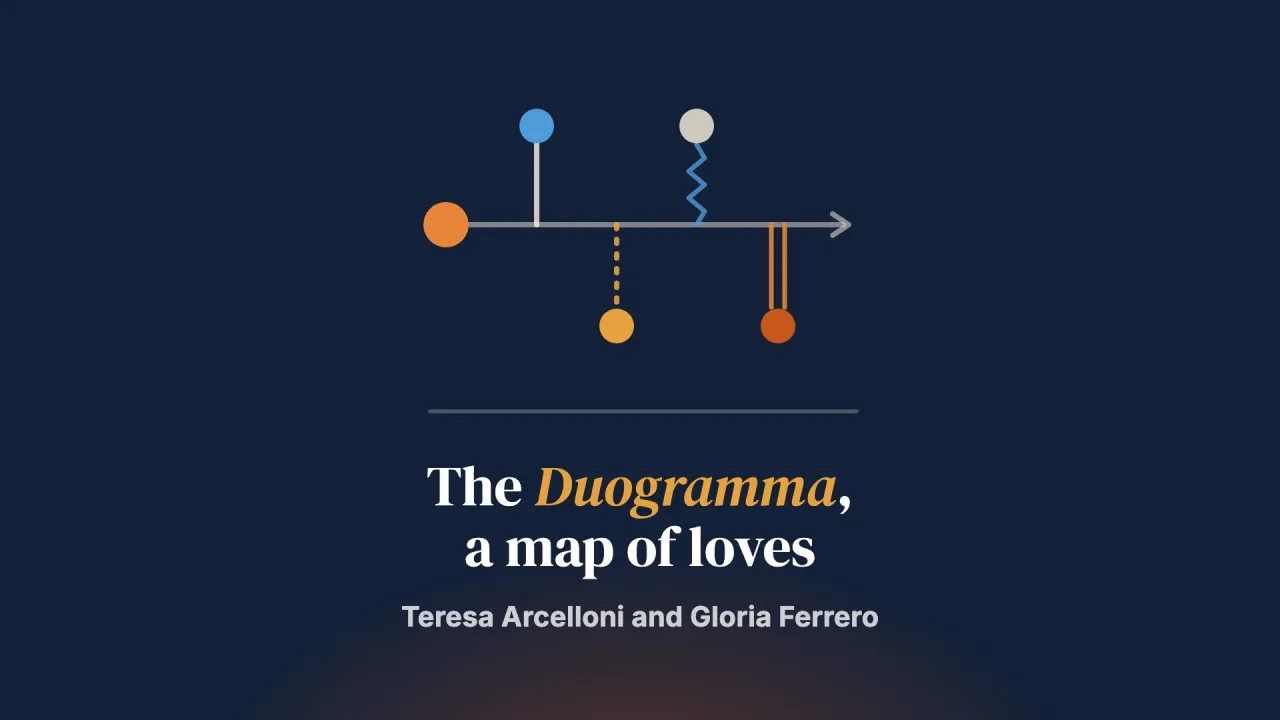
The Duogramma®: An innovative methodology for psychotherapy
A map of the couple relationships lived, desired or rejected since childhood: the Duogramma®, its graphic rules and its use in individual therapy.
 Blog
Challenging in therapy: What a patient taught me
A couples therapy session led me to reflect on confrontation, authenticity and resonance: how to address difficult behaviour without invalidating the person.
 Blog
Adult ADHD: when forgetting turns into a misunderstanding
Forgetting, compensating, tension in the couple: a systemic look at adult ADHD, to understand what is at stake and to look for more fitting forms of support.
 Scientific
Sickle Cell Disease and Young Couples: Understanding the Influence of Shared and Individual Meaning on Couples’ Experience of Illness
Nine young adult couples facing sickle cell disease: how each partner makes sense of the illness, and how the couple moves from caregiving to equality from one crisis to the next.
Comments 0
Log in to join the discussion. Log in