Journal of Family Therapy · Family therapy
The ‘four selves’ framework for facilitating personal and professional development (PPD) in qualifying-level systemic psychotherapy training
Systemic training has stopped requiring personal therapy, in favour of personal and professional development groups. But what should happen in those groups? In Belfast, Ursula McKeown suggests thinking of each trainee as inhabited by four ‘selves’, personal, professional, employee and student, which overlap and jostle against a sociopolitical backdrop. Four trainees describe what the framework changed for them.
This is a reformatted republication of The ‘four selves’ framework for facilitating personal and professional development (PPD) in qualifying-level systemic psychotherapy training, by Ursula McKeown, Stephen Coulter and Suzanne Mooney, published in Journal of Family Therapy (Wiley) (2024), doi: 10.1111/1467-6427.12465, under a CC BY 4.0 licence. Prepared by Complexe Systémique in September 2026: the authors’ text is unchanged; the layout has been adapted for reading online, which constitutes a modification of the work under the terms of the licence. This edition was made neither by the authors nor by the publisher, who are not responsible for its content or for any errors. The original version prevails.
One must also be mindful that PPD is neither supervision nor personal therapy.
Ursula McKeown, Stephen Coulter and Suzanne Mooney
Abstract
Personal and Professional Development (PPD) has been long considered a central component of counselling and psychotherapy training. Key literature in respect of PPD approaches for psychotherapy training is reviewed, and the scant literature specifically relating to systemic psychotherapy noted. The ‘Four Selves’ PPD Framework, developed in Northern Ireland by the lead author as part of qualifying-level Systemic Psychotherapy training, is presented, including its diagrammatic representation, constituent elements and an illustrative example. This is followed by guidance from the PPD tutor (lead author) based on her experience of utilising the Framework to facilitate tailored PPD sessions across the two-year clinical Masters programme aimed at enhancing trainee self-reflexivity, supplemented by feedback on the ‘model-in-practice’ from a recent cohort of students. The article concludes by encouraging readers to consider the applicability of The ‘Four Selves’ PPD Framework to their own psychotherapy training contexts.
Practitioner points
- PPD is an essential component of effective and ethical psychotherapy training, aimed at enhancing student self-reflexivity and awareness of bias.
- There is little guidance in the literature or from professional bodies [including Association for Family Therapy (AFT) UK] regarding how training providers should facilitate PPD or appropriate content.
- The ‘Four Selves Framework’ can provide a flexible framework for PPD activity for qualifying level training courses in systemic psychotherapy.
- The ‘Four Selves Framework’ may be adaptable to other modalities and levels of training.
INTRODUCTION
To the lay person, it may not be obvious that personal development and professional development should be inextricably linked. Professional development is generally defined as centring on skills and knowledge related specifically to the professional task, including developing or updating skills and knowledge, formal training courses and learning from practice experience (Wilkins, 1997). Personal development, on the contrary, has been defined as, ‘the conscious pursuit of personal growth by expanding self-awareness and knowledge and improving personal skills’ (Thum, 2012; UKCPD, 2022), with the aim of being able to ‘enlist a rich variety of personal attributes freely and with discrimination in such a way as to bring a creative energy to the whole of life’ (Wilkins, 1997, p. 12). There are some occupations in which professional development can proceed with minimal personal development, where contact with vulnerable populations is not required and concomitantly personal development can take place in multiple domains of life unconnected to the workplace. However, in the fields of counselling and psychotherapy, personal and professional development are understood to be intersecting, mutually beneficial activities, essential to effective and ethical practice. Meakin (2021, pp. 51–52) comments:
As therapists, we take ourselves into our work; we are the tools of our trade. A therapist's human being is integral with and influential on their human doing and human relating with clients … It is important I am aware of influences on my way of working and being with people in order to be as effective as possible with clients. It is important I am reflexive and relationally responsive, to notice when I am less effective and attend to this.
Traditionally, from its inception, the psychotherapy field has included a requirement for trainees to engage in personal therapy. There is a broad consensus on the usefulness of personal therapy in promoting better therapeutic practice (Moe & Thimm, 2021; Orlinsky et al., 2001; Von Haenisch, 2011) via increasing a number of valued therapist qualities/competencies, including learning about one's emotional blind spots; one's impact on other people; and to recognise and work with one's limitations and biases (Oteiza, 2010). There is a minority acknowledgement in the literature that personal therapy can also have negative effects for some trainees (Ellis & Crombie, 2004; Rizq & Target, 2008) and that it has potential to ‘undermine the necessarily unique idiosyncrasies of practitioner development’ (House, 2007, p. 427). In addition, Von Haenisch (2011) argues that the tradition of mandatory personal therapy whilst training has continued in many psychotherapeutic modalities, despite the lack of strong empirical evidence for its effectiveness. Over time, the ubiquity of the requirement for personal therapy for psychotherapy trainees has lessened as alternative methods to promote personal and professional development have emerged (Bennett-Levy, 2019). More recent modalities such as cognitive behavioural therapies and systemic psychotherapy do not include personal therapy as a formal requirement during training (AFT, 2015; BACP, 2022). With the more techno-rational approach of the former and the central emphasis on the network of relationships in the latter, these modalities looked to other more theoretically congruent ways of promoting PPD, with systemic psychotherapy opting for small experiential group work (Spencer, 2006). Thus, over time, the ubiquity of the requirement for personal therapy for psychotherapy trainees has lessened as alternative methods to promote personal and professional development emerged. All methods emphasise developing greater self-reflexivity, which Pote et al. (1999, p. 110) define as follows:
Self–reflexivity focuses especially on the effect of the therapy process on the therapist and the way that it is a source of (resource for) change in the family. In order to use self-reflexivity it will be necessary for the therapist to be alert to their own constructions, functioning, and prejudices so that they can use their ‘self’ effectively with the family.
There are now a wide range of alternatives to personal therapy as a method for PPD in psychotherapy training. These include personal development groups (Orlinsky et al., 2001; Payne, 2007; Spencer, 2006), with the aim of developing the trainees' self-awareness, and the Circumplex Model of Personal Professional Development (Sheikh et al., 2007), a multi-dimensional model congruent with Kolb's (1984) model for experiential learning, which is argued to facilitate the systematic development of reflective practice among trainees. Two approaches are of particular note, person of the therapist training (POTT) (Aponte & Winter, 2000), due to its relatively long history, wide application in academic, clinical and supervision contexts and emergent evidence base (Kissil & Niño, 2017), and ‘personal and professional consultation with trainee families’ (Woodcock & Rivett, 2007), which is the only PPD practice (we could identify) specifically applied within a qualifying level systemic psychotherapy training course.
POTT has its origins in the 1980s and is a process through which ‘trainees become more aware of their own flaws and vulnerabilities, and learn how to use them purposefully and intentionally in their clinical work’ (Kissil & Niño, 2018, p. 319). POTT centres around the lifelong unresolvable struggles we all grapple with, and the hurts, disappointments and losses that are at their core, known as ‘signature themes’ (Aponte et al., 2009; Aponte & Kissil, 2014).
In ‘personal and professional consultation with trainee families’, students are encouraged to attend three ‘therapeutic consultations’ with their own families with a recognised systemic practitioner during the second year of their training to consider issues pertinent to their development as therapists. This process aims ‘to deepen the trainees’ understanding of ‘self’ and to provide an opportunity for trainees to experience and reflect on the person of the therapist from within an experience akin to family therapy’ (Woodcock & Rivett, 2007, p. 352). Student evaluation was mixed, with only a minority saying that this process was more beneficial than the course's standard PPD groups, yet all went on to recommend it for other trainees (Woodcock & Rivett, 2007, p. 353).
Despite this divergence regarding mandated personal therapy, there remains a strong consensus in the literature regarding the term ‘personal and professional development’ (PPD) and its importance in psychotherapeutic trainings. However, there is much less agreement as to what PPD actually denotes, resulting in a lack of clear guidance for educational faculties. The literature describes a wide range of interrelated concepts (Oteiza, 2010), with course organisers largely left to determine the nature of PPD activities, albeit approved during the accrediting process by the relevant professional body. For example, the Association of Family Therapy and Systemic Practice in the UK (AFT) Training Standards for qualification level systemic psychotherapy training states that twenty-five of the 180 direct taught hours are expected to be specifically dedicated to PPD, which should encompass, ‘… exploration of the contribution of “self” (both personal and professional) to direct work with clients and other aspects of professional work… [and] should be addressed in all domains of the course but particularly in the supervision group and personal and professional development groups’ (AFT, 2015, p. 12). However, only two of the twenty-five Learning Outcomes (LO) identified as essential for competent, independent practice, which students are expected to demonstrate by course end, are directly associated with PPD. These are:
LO 14: An ability to understand and manage personal connection with the work and reflect on changes that could be made.
LO 22: An ability to take an active role in the development of personal learning and be able to identify areas of personal strength as well as areas for future professional development. This will include reflexive abilities about self and self in relationship.
Given the limited guidance from AFT on what should be encompassed within facilitated small group PPD forums, it is the purpose of this article to report on a PPD framework specifically developed by the first author to address this deficit in her work, with several cohorts of trainees undertaking qualification level training (MSc Systemic Psychotherapy) at Queen's University Belfast. This ‘Four Selves’ framework accords with Hess's (1980) standards for an effective model, which states that any model ‘should be represented in some form of pictorial or diagrammatic display; should present methods that are applicable to the phenomena at hand; should have a broad scope; and should specify assumptions or functions based on an underlying theory’ (p. 11). The PPD framework was first publically presented to an inaugural joint Association for Family Therapy (AFT, UK professional body) and the Family Therapy Network of Ireland (FTAI) conference in May 2022, where it was well received.
Towards a systemic understanding of ‘self’ and ‘selves’
Central to the topic of considering the pursuit of PPD within systemic psychotherapy training is a relational understanding of the notion of the ‘self’. In Western cultures the concept of ‘self’ is most frequently taken to refer to an individual's personal experience as an autonomous human being who is separate from others, and which is experienced with continuity through time (Augusto & Kimberly, 1995). Systemic theorists such as Fishbane (2001, p. 274) note, however, that this ‘traditional narrative of the separate self’ is not shared by all cultures, with many understanding ‘self’ as a collective and relational construct. Nevertheless, in Western cultures the conceptualisation of the ‘separate self’ with its inherent emphasis on the individual traits of ‘autonomy, independence, separation, power, and competition’ (Fishbane, 2001 p. 274) is identified as the dominant narrative within the discipline of Psychology, greatly influencing the shaping of norms for many social roles and experiences, including mental health and illness. However, from the later decades of the twentieth century, alternative social constructionist understandings of ‘the self’ have arisen within social psychology and systemic and narrative theory. For example, infants are now seen as maturing from dependence to interdependence (rather than independence or autonomy) (Stern, 1985) and identity, rather than being located within the individual mind, is understood to develop within the relational context (Anderson & Goolishian, 1992). In this way, individual consciousness is conceptualised as ‘arising in the context of a person experiencing herself as an object of collective representation and collective reflection and discourse’ (Burns & EngDhal, 1998, p. 166) where multiple ‘selves’ or identities can co-exist, being brought forth within specific contexts (Kang & Bodenhausen, 2015). Such discourses note how an individual's sense of self is strongly influenced by their intergenerational history and narratives as well as the intersection (Crenshaw, 2017) of socio-political constructs and discourses such as culture, gender, race, social class, sexual orientation, etc. Furthermore, social psychologists and linguists argue that when we meet and communicate with another, our identities inter-mingle. Thus, we influence each other's self-descriptions – developing what is known as ‘we-dentities’ (Larina et al., 2017). Such theoretical nuances led systemic theorists to emphasise the importance of dialogue and the collective, with a shift away from individual personal therapy as a mandatory training component, towards embedding PPD within a small group experiential context as a means of enhancing trainee self-reflexivity. We use this construct of the ‘four selves’ mindful of its potential for ‘fixedness’ or reification if the process of its co-construction within current socio-political narratives is forgotten. The framework has shown a good degree of utility and flexibility in helping trainees expand their understanding of a socially and contextually located self of the therapist.
THE ‘FOUR SELVES’ FRAMEWORK FOR PERSONAL AND PROFESSIONAL DEVELOPMENT
Framework development
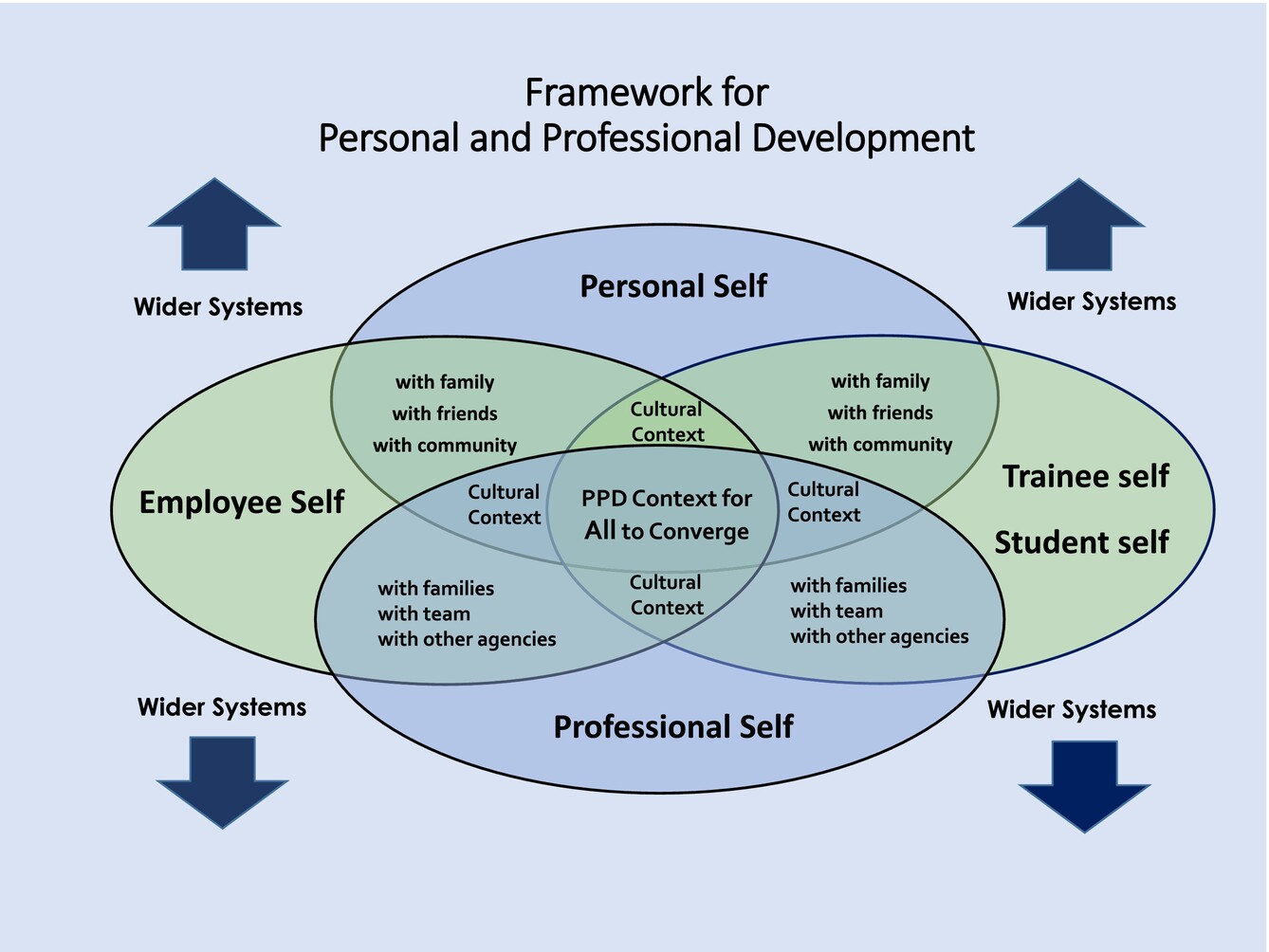
The ‘Four Selves’ framework was initially developed to help guide the process of facilitating the AFT-mandated 25-h small experiential group PPD input for systemic psychotherapy trainees undertaking qualifying-level systemic psychotherapy training at Queen's University, Belfast. At Queen's, this mandatory training component is structured via ten 2.5-h sessions over two academic years. To date, the framework has been recursively developed with three cohorts of trainees. The framework conceptualises the trainee simultaneously inhabiting ‘four selves’ with particular resonance for their systemic psychotherapeutic training, all of which need attended to, to varying degrees at different points in their development. The ‘Four Selves’ framework was formulated by the first author, drawing primarily on her direct practice of promoting trainee PPD at different levels of systemic training, but also informed by her extensive practice experience of over 30 years as a social worker, systemic psychotherapist and registered systemic supervisor (Figure 1).
Framework overview
Diagrammatically, the ‘Four Selves’ framework’ is presented as having four elliptically shaped intersecting ‘selves'. These represent three pre-existing identities which trainees bring to their psychotherapeutic training – the personal self, the professional self, and the employee self – and the fourth newly (re)-acquired identity of the student self. When engaging in systemic psychotherapy training and (re-)embracing a student self with its multi-dimensional elements (academic theory, practice skills, live supervised clinical training and PPD), the pre-existing ‘selves' all have potential to come into urgent and sharp relief at different stages during the course. The framework seeks to help trainees appreciate the distinct and intersecting nature of these aspects of their emerging systemic identity, situating and legitimising differential contributions to their professional development and exploring any constraining dominant discourses. The central intersection where the ‘four selves' overlap provides the opportunity for all aspects of the ‘four selves' to be attended to in facilitated PPD sessions. The surrounding space in the diagram represents the wider systemic context in which the training and trainee is situated, including the socio-economic environment and broader socio-political and policy context. This space invites consideration of the intersectionality of multiple aspects of diversity and promotes a ‘third’ order perspective. As McDowell et al. (2019, p. 12) state:
Taking a third-order perspective means taking a metaview of systems of systems to map relationships between society, ourselves, and families. This requires us to attune to sociocultural experience and adopt perspectives that include frameworks for understanding societal context and power.
As such, the framework invites and facilitates consideration of issues of diversity and inequality within the therapeutic process.
The ‘four selves’ framework PPD process and content
Each facilitated small group experiential PPD session has an identified theme and is supported by associated academic articles. The selected themes arise from the clinical experience of the teaching team, co-constructed with consecutive cohorts of trainees, as those that are often central in therapeutic dialogue with families. Thus, PPD discussions have a recursive isomorphic relationship with clinical practice. The ten broad topics chosen for consideration in PPD group sessions through this process are: identity; communication; positioning; change; loss; personal cultural genogram; self of the therapist; working in a clinical team; family resilience; and spontaneity and creativity.
These ten core themes are not exclusive, nor are they meant to be reductionist. We have found they have worked well to date but that is not to say they are immutable, as they can be reviewed and adapted over time. While these themes are intended to provide a ‘shape’ to each session, the focus is unapologetically on what is present or emerges for the trainees (and indeed facilitator) at that moment and how this can be usefully named and brought forward for discussion in the group. It is important to acknowledge that there have been PPD sessions when pressing issues arise for trainees and any planned structure is abandoned to work with what has ‘turned up’ that day. This flexibility has been factored into the framework with each aspect of the ‘four selves’ able to expand or contract in accordance with the needs of the group in any given session. Thus, the themes are held ‘lightly’ with the framework offering a fluidity that is congruent with therapeutic practice.
During these often emotive PPD discussions, the ‘four selves’ come in and out of focus/relief and are explicitly attended to in ways that seek to develop trainee self-awareness and capacity for self-reflexivity in their therapeutic work. Trainees are invited to ease into the conversation with an initial exploration about their personal relationship to the theme and associated theory. Thus, they connect with their ‘personal selves’ and experiences from earliest days in their family of origin, tracking their personal journey to date. Conversation is then invited from the position of the other selves as professionals, employees and as trainees. Exercises individually, in pairs, and whole group (usually six to nine trainees) supportively expand the conversation that emerges, with the intention of maximising the potential learning. In the evolving dialogue and interactions, previously held views, beliefs or taken-for-granted assumptions are opened for discussion in ways that seek to help trainees become more self-aware, making space for new learning and differential responses and enhanced understanding, including the impact of privilege and disadvantage on lived relational experience. These co-constructed, collaborative and experiential conversations present an alchemy for potential change, which is invitational in its offering. Each of the four ‘selves’ is now elaborated.
The ‘personal self’
The ‘personal self’ is at the heart of the ‘Four Selves’ framework for PPD. While the other three ‘selves’ (described in detail below) represent different elements of professional development, it is only when these intersecting aspects of trainees' professional identity are considered in the context of their ‘personal self’, that is, their own multi-layered experiences of their current family, family of origin, friends and community, that one can posit that PPD is occurring. Aponte and Carlsen (2009, p. 395) state, ‘personally, all therapists use themselves within the relationship with clients to establish trust with clients, develop empathy for them and implement their interventions. All therapy is a marriage of the technical with the personal’. Thus there is a need to create a safe space for systemic psychotherapy trainees, whose primary focus is arguably on family and significant other relationships, to begin to attend to the way they have constructed their understanding of their own lives and experiences, and how aspects of the personal can permeate into the therapeutic relationship and practice – bringing explicit attention to the ‘marriage’ or interaction of the personal with ‘the technical’. Jensen (2016, p. 46) summarises this process as follows: ‘when working with PPD processes, we should be reflecting on both what therapists learn and bring home from working as a therapist and on what we bring into therapy from our personal and private experience in our own lives.’ The ‘personal self’ therefore requires students to reflect on how they ‘have done life to now’ with particular attention to how they ‘do’ relationships, their sense of ‘self’ or personal identity in the world, and the various elements that informs their thinking and actions, such as personal knowledge, lived experience, beliefs, values, personality traits, attitudes, societal discourses and family of origin issues.
To achieve this marriage of the technical and the personal, Kaslow and Schulman (1987) advised family therapists to ‘go home’ by exploring their own genograms. ‘Going home’ to self is therefore the starting point for students at the beginning of each PPD session, when they are invited to bring attention to their embodied sense of self, what is coming with them into the group at this particular moment in time. From this position, they are invited to expand their personal relationship to the thematic topic for discussion.
Thus, irrespective of the topic for discussion, there is always a clear emphasis on the ‘personal self’ and their relationship with how they have been informed and influenced by their lived experiences, both past and present, with consideration of their relational interactions with others and their wider socio-political context.
The ‘professional self’
The ‘professional self’ stands in direct contrast to the ‘personal self’. This co-existing identity attends to the body of professional knowledge, skills, techniques and ‘expertise’ that has been developed to date along the student's professional trajectory combined with their professional habitus (Bourdieu, 1984), that is, the way they have been trained to perceive and react to the world. It is noteworthy that in qualifying-level systemic psychotherapy training in the UK, all trainees will already have an AFT-approved ‘prior professional qualification’ (PPQ) (or equivalent) as a mandatory course entrance requirement. Approved PPQs include social work, mental health nursing, clinical/educational/counselling psychology, psychiatry, qualified arts therapists, occupational therapists, speech and language therapists and counselling (AFT, 2015). As a result, students already have established ways of understanding the problems in clients' lives and normative discipline and agency-specific interventions or ways of responding. There is significant overlap here with the ‘employee self’ (as we shall see), but the ‘professional self’ is primary among this pair of ‘selves’ in that it persists beyond any particular role or organisational context, and is likely to contribute to the core identity of the individual professional, albeit to varying degrees.
As a student once again, new professional learning/knowledge and what has been previously ‘known’ starts to be re-experienced, as a different (enhanced) ‘professional self’ emerges to incorporate a new professional identity as a systemic psychotherapist. New space must now be opened (Freedman & Combs, 1995) to create an opportunity for a new professional identity to become embedded, involving a new way of making sense of the world, often moving from an individually focused perspective to a primarily systemic (relational and interactional) way of understanding human behaviour (Vetere & Dallos, 2018). Student conceptualisation of professional ethics is also broadened and the ramifications of incorporating this alongside their core professions' codes of conduct and ethical frameworks has to be processed. Within systemic training, there is a clear theoretical shift in thinking and practice away from the individual towards the family/relational system (Coulter et al., 2020) and a requirement for an enhanced capacity for self and relational reflexivity as important additional features in understanding of the therapeutic process (Burnham, 2005; Pote et al., 1999; Rober, 2011). For many students this is ‘new’ professional territory, with old professional identities having to accommodate the new emerging identity as a systemic psychotherapist.
The ‘employee self’
The ‘employee self’ represents the part of student identity that has to connect their learning and development during the course to their particular agency context and role. Students in part-time systemic psychotherapy training in the UK not only hold a range of primary professional qualifications (noted above), but they are also simultaneously employed in different clinical contexts and roles in statutory, voluntary and community sector organisations or in private practice (such as fostering and adoption services, child, adolescent and adult mental health contexts, acute inpatient or residential settings, community counselling organisations). As an essential element of all levels of systemic training, students are required to apply and reflect upon newly acquired systemic learning in their agency context and role. Over the course of the 2-year MSc qualifying-level training, students explore and experiment with how a systemic orientation might ‘fit’ and add value to their employment context. Each student's ‘agency context’ has its own ethos and historical and cultural norms, with differential levels of support provided for students to incorporate their new skills. While some employers may be au fait with the systemic approach, for others it may be the first time they have promoted such training for their staff. Even when the employer has supported the student both financially and in terms of time and easement of work duties, consideration may not have been given to how to support their new emerging professional identity and skills. It can therefore be a challenge for the ‘employee self’ to process their systemic learning and work out the ‘fit’ within their current employment context as well as changes to relationships with their immediate and wider service colleagues, senior managers and other agencies.
The student can also feel conflicted in this employment context, as former practice norms may no longer ‘fit’ with their emerging professional identity. Themes of loyalty, commitment, fitting in, speaking out, conflict and making room for change can come to the fore. The student can feel they are in a place of ‘shifting sands’ as they search for some ‘solid ground’ where they can begin to incorporate their new learning into their current work context and role. While some are successful in integrating systemic concepts into their current work settings, adjustment difficulties may lead others to seek more congruent alternative employment during or following course completion.
The ‘student self’
Unlike the pre-existing selves explored above (personal, professional and employee), the ‘student self’ is a newly adopted identity associated with programme entry and participation. The student returning to the academic setting is introduced to theoretical concepts, techniques and skills, initially from a place of cognition. As an essential element of systemic psychotherapeutic training, students experience the application of theory into practice in ‘live supervised training clinics’ where, in small training groups, they work directly with families as lead therapist or members of the reflecting team under the supervision of an experienced systemic psychotherapist. It is in this clinical learning environment where previously held professional competences, honed by many years' experience, are challenged in the company of their peers and supervisor. Students are conscious of wanting to provide a ‘good’ service to the families they are working with, made more challenging when practicing in a new setting with a different client group and presenting issues other than those they may be used to. This live supervised clinical training experience is a robust learning environment, akin to the apprenticeship experience where students ‘learn their trade’ and become competent systemic psychotherapists. This can be daunting, perhaps particularly for highly experienced practitioners. It is here that the ‘old’ knowledge, skills and techniques must make room for ‘new’ knowledge, skills and techniques to emerge. Students also experience a new relational learning context as they form into teams within the supervised clinical placement, with each trainee taking the lead therapist role with some families and ‘reflecting team’ role (Andersen, 1987) with others. There can be ‘performance issues’ as their practice is under constant observation by fellow students, as well as their training clinic supervisor, who is both contributing to and assessing their development as trainee psychotherapists. They must also produce written assignments to meet university academic requirements. This return to education as mature learners can bring tensions and stressors for many in submitting written work for appraisal. These vulnerabilities can be acknowledged and explored in the context of PPD as part of the many learning challenges. One student described the impact of this process of putting themselves ‘under the microscope’ whereby they are observed and observe themselves and their peers: ‘we are always questioning what we do, how we do it and why we are doing what we are doing’. Together in the PPD group, students are invited to share their struggles of putting new knowledge and skills into practice.
An example of this process in action: Theme – ‘Self of the Therapist’
Students were asked to bring to the session an object to represent their adolescence. Chosen objects were placed on the floor and the group was invited to notice their item among the others, and to begin to observe their own embodied experience and visceral reactions, to think about their choices and consider their observations of others. A 5-min mindfulness exercise was then offered to allow trainees to ground themselves and connect again with the narratives from that time in their lives. This allows trainees to explicitly draw on the ‘personal self’ of the framework and open into a discussion of their relationship with their chosen object with the group, opening space for similarity and difference. For some, the impact of living and growing up in Northern Ireland from a religious and political cultural perspective (connecting with third order socio-cultural attunement) was an important influence and backdrop to their ‘story’. The emerging discussions captured told and untold, secret stories or unedited versions that resonated. Attention was drawn to narratives of resilience, resourcefulness and strengths that helped shape the ‘adult me’ and how these influence their professional, employee and student ‘selves’, capturing the pertinent learning for their various practice contexts. The session concluded with a facilitated self-care exercise.
USING THE FRAMEWORK – THE FACILITATOR'S PERSPECTIVE
Facilitated PPD forums are ultimately intended to enhance the development of students' systemic knowledge, skills and techniques. To do so, it is essential to provide a space in which thinking, feeling and reflection can take place across all the contexts. As PPD facilitator, the many contexts of the ‘four selves’ model has meant orienting myself (as well as the students) to remain open and curious to any previous or currently held positions in relation to self and others. The importance of ‘feedback’ in continuously calibrating and recalibrating the purpose and process of the session has contributed collectively to the development of the PPD forum. As Radovanovic (1993, p. 255) articulates:
‘The only reliable instrument we have are our own lenses, through which we explain the world’ and ‘lenses are developed, created and organised by our past history, tradition, training and the experience of living in continuous conversations with other people’.
There is an important established distinction between supervision and personal therapy (Milne, 2007), and one must also be mindful that PPD is neither supervision nor personal therapy. It does, however, centrally contribute to addressing AFT Learning Outcome 14, ‘An ability to understand and manage personal connection with the work and reflect on changes that could be made’. This facilitator has found that having the framework visually present for each session invites students to begin to explore each component of the ‘four selves’ with consideration to their strengths and vulnerabilities as a means of assisting students ‘…turn personal vulnerabilities into clinical assets’ (Aponte & Carlsen, 2009, p. 397).
The task of the PPD facilitator is to maximise the learning experience for each student. Clapper (2010) reminds us that the creation of a secure environment is critical to the learning experience. The co-creation of ground rules and clear expectations of the group processes addresses this matter at the outset. Griffith and Griffith (1994:73) note how hierarchies of power can silence people; therefore, the ‘power differentials’ between students and facilitator, and indeed any emerging within the student peer group relationships, need to be explicitly addressed. It is emphasised that the PPD sessions are not an assessed part of the course and that the PPD facilitator is not involved in marking students' work.
At the initial point of each PPD session, students are invited to spend the first few minutes getting in tune with their personal embodied sense of self – the ‘going home’ process mentioned above – ‘tuning in’ to their own thoughts and feelings to create space to be fully present with each other in the group. Initial attention is given to whatever is foreground for them at that particular moment and discussion of whatever needs to be ‘let go of’ to engage fully with the PPD process. This goes some way to clearing space for the ‘selves’ to be explored in relation to any given theme.
Vygotsky's zone of proximal development theory (Vygosky, 1987) encourages the promotion of learning that is outside of a person's comfort zone but not too far away from what is already known. This theory has guided the facilitator's approach with the requirement to remain flexible and adaptable throughout. For example, during one PPD session some students had dilemmas they were facing in a work context, separate to the topic of the session, that were preoccupying their thoughts. In agreement with the group, the planned topic for that day was suspended to allow the imminent issues to be processed, with clear links made regarding practice development and linking back to the identified theme when possible. In this way, small group PPD process seeks to mirror therapist-family moments in therapy where the therapist attends to the family feedback and together address what is most germane at that time.
EXPERIENCING THE FRAMEWORK – THE STUDENTS' PERSPECTIVE
The third student cohort at QUB to experience the ‘Four Selves’ PPD framework for systemic psychotherapy training were asked for feedback towards the end of the second/final year of their training. All students (n = 4) gave permission for their views to be reported in publications including use of anonymised quotations. The students were asked to reflect upon a single question: ‘How do you believe the ‘four selves' PPD framework has impacted, shaped or influenced your personal and professional learning?’ Their responses were audio-taped, transcribed and subject to thematic analysis. Three main themes emerged: the significance of facilitated PPD groups as a safe space where relational risk-taking could occur to help integrate and accelerate course learning; the usefulness of the ‘four selves' framework for promoting self-awareness and self-reflexivity; and the significance of PPD for highlighting personal and professional resonances. These emergent themes are now described and illustrated with direct quotations from the trainees. Crosscutting all themes was an overt appreciation for how the convenor facilitated the PPD sessions. This common response was well articulated by one student who stated: ‘[The facilitator] held that space and held us and used that space so effectively for us.’
PPD groups as a safe space for relational ‘risk taking’ to integrate course learning
All students noted the significance of PPD sessions being a safe, contained and containing space where they felt their emotional experience could be ‘held’, with a strong sense of this being vital to their survival through the course and capacity to rise to the learning challenges. Student 2 opined, ‘our learning with the four of us together in a safe space [in PPD sessions] has enriched my experience on this journey … without the sessions I don't know how I would have been able to get to the point where I am today.’ This safe, facilitated context allowed risks to be taken, enabling students to make greater personal connection with each other. This was noted by student 4, who stated: ‘I think we had to be brave in a way and had to take the risk… we didn't know each other before starting this process. But we did open up to each other.’ This PPD process also appeared to help students integrate different elements of the programme (e.g. links made between lectures and training clinics), which one student reported could ‘feel quite separate’. It was clear from student responses that the ‘four selves’ PPD sessions were experienced as quite different from other PPD experiences in prior academic and professional trainings. This was most eloquently expressed by student 1, who commented:
I'm shocked to realise that this is the only professional learning experience where all those aspects of myself have been held and attended to in a meaningful way. That surprises me… we are all from a social work type background and this is not our first postgraduate learning.
PPD groups promoting self-awareness and self-reflexivity
The structure of the ‘four selves’ PPD framework clearly resonated with student reports of how they were able to use it to develop their thinking about the multiple roles and positons they inhabit:
I can remember at the beginning I didn't see my student and trainee self as distinct things, I clubbed them together. Through PPD I realised, I was more comfortable with my trainee self in [the training] clinic…I didn't see my academic self… this made me realise how one is influencing the other (student 3).
Perhaps crucially, the students also commented on how the process had helped them to think differently and enhanced the quality and speed of their learning, particularly their capacity for self-awareness and self-reflexivity. As student 2 put it:
…when I was locating myself [from a different position] you could think about things very differently and in a new way. [This process] has brought me much further on than would have happened if it was just about the skills or academic [knowledge] or just the clinic. It has developed my learning exponentially.
PPD groups facilitating personal and professional resonances
As a professional clinical training programme, the end purpose is to provide a better service to clients. As such, it was encouraging to hear that students could see how the PPD process may be similar to those that clients go through in therapy, making them more aware of the different aspects of clients' identities, and how these influence their lives. This was articulated by student 1 when she stated:
I always found the PPD [process] isomorphic. I always think in terms of what is happening for us might be what is happening for families… when we are in sessions, … I always think of all these different parts of the person's identity.
The integration of all elements of the course learning through the ‘four selves’ PPD framework was also reported as impactful for students' wider personal and family lives. This integration of personal and professional learning is included in a positive overall summary statement made by student 3:
For me, PPD probably tied all aspects of the training and life outside the training together …. I think this is the first time in my entire career that all parts of me have really been thought about in one space. We have all been nurtured in being able to do that.
CONCLUSIONS
The importance of PPD for ethical and effective psychotherapy training is affirmed. A distinction is made between modalities that require trainees to engage in mandated personal therapy and newer modalities that employ methods more congruent with their underlying theoretical orientations. Systemic psychotherapy is one such modality. In line with its ‘person-in-relationship’ orientation, much of the mandatory PPD required at qualifying-level training takes place in facilitated small experiential groups. As we have seen, there is little guidance provided by the governing body in the UK or in the wider systemic literature on what the content of PPD groups should be or how they should be conducted/facilitated.
The presentation of the ‘Four Selves’ framework for PPD presented in this article, developed with MSc Systemic Psychotherapy trainees at Queen's University Belfast, seeks to address this gap. Whilst not wishing to be prescriptive, it offers one way of ‘doing’ PPD that seems to be effective for promoting a safe space for trainees to integrate and accelerate course learning, developing greater self-awareness and self-reflexivity and attuning to arising personal and professional resonances whilst adopting a ‘third order’ approach to attend to structural issues of power and inequality. It is argued that the ‘Four Selves’ framework is broad enough and flexible enough to be easily adapted to other training contexts while maintaining its conceptual integrity.
Complexe Systémique: key points
The merit of this framework is that it names a blind spot in systemic training: the ‘employee self’. People rarely train in a vacuum. Each week they return to an institution that funded the training without always welcoming systemic thinking, and loyalty to the employer can clash with the new professional identity, to the point that some trainees change jobs. The design is consistent with the theory it teaches: the PPD group works like a family in session, with a theme held ‘lightly’ and dropped when the day’s urgency demands it, a no-assessment rule and an opening ritual, ‘going home’. The evaluation, however, remains very thin: four people from a single cohort, questioned at the end of the course by the team that trained them, with a facilitator who is also the framework’s author. The ‘third-order’ perspective on power and inequality is asserted more than equipped. For training teams, the framework mainly offers a simple grid for spotting which ‘self’ is under strain at a given moment. Read alongside the article on working with the person of the therapist, and the article on the genogram workshop.
Notes from the original
Conflict of interest statement. The authors do not have any conflict of interest in relation to this manuscript.
References
AFT. (2015) Training standards and course accreditation, 4th edition revised (blue book). Warrington: Association of Family Therapy and Systemic Practice in the UK.
Andersen, T. (1987) The reflecting team: dialogue and meta-dialogue in clinical work. Family Process, 26(4), 415–428.
Anderson, H. & Goolishian, H. (1992) The client is the expert: a not-knowing approach to therapy. In: S. McNamee & K.J. Gergen (Eds.) Therapy as social construction. London: Sage, pp. 25–39.
Aponte, H. & Kissil, K. (2014) ’If I can grapple with this I can truly be of use in the therapy room’: using the therapist's own emotional struggles to facilitate effective therapy. Journal of Marital and Family Therapy, 40(2), 152–164. Available from: https://doi.org/10.1111/jmft.12011
Aponte, H. & Winter, J. (2000) The person and practice of the therapist: treatment and training. In: M. Baldwin (Ed.) The use of self in therapy. New York: Haworth Press.
Aponte, H.J. & Carlsen, J.C. (2009) An instrument for person-of the-the-therapist supervision. Journal of Marital and Family Therapy, 35(4), 395–405.
Aponte, H.J., Powell, F.D., Brooks, S., Watson, M.F., Litzke, C., Lawless, J. et al. (2009) Training the person of the therapist in an academic setting. Journal of Marital and Family Therapy, 35, 381–394. Available from: https://doi.org/10.1111/j.1752-0606.2009.00123.x
Augusto, B. & Kimberly, G. (1995) The development of identity. A critical analysis from the perspective of the self as subject. Developmental Review, 15(4), 404–433.
BACP. (2022) Minimum Training Standards. Available from: https://babcp.com/Portals/0/Files/About/Minimum%20Training%20Standards%201222.pdf?ver=2022-12-15-155902-380 [Accessed 28th July 2023].
Bennett-Levy, J. (2019) Why therapists should walk the talk: the theoretical and empirical case for personal practice in therapist training and professional development. Journal of Behavior Therapy and Experimental Psychiatry, 62, 133–145.
Bourdieu, P. (1984) Distinction: a social critique of the judgement of taste. London: Routledge.
Burnham, J. (2005) ‘Relational reflexivity: a tool for socially constructing therapeutic relationships’ chapter 1. In: C. Flaskas, A. Perlez & B. Mason (Eds.) The space between: experience, context, and process in the therapeutic relationship. London: Karnac, pp. 1–17.
Burns, T.R. & EngDhal, E. (1998) The social construction of consciousness. Part 2: individual selves, self-awareness, and reflectivity. Journal of Consciousness Studies, 5(2), 166–184.
Clapper, T. (2010) Creating the safe learning environment. PAILAL, 3, 1–6.
Coulter, S., Houston, S., Mooney, S., Devaney, J. & Davidson, G. (2020) Attaining theoretical coherence within relationship-based practice in child and family social work: the systemic perspective. British Journal of Social Work, 50(4), 1219–1237. Available from: https://doi.org/10.1093/bjsw/bcz110
Crenshaw, K.W. (2017) On intersectionality: essential writings. New York: The New Press.
Ellis, D. & Crombie, J. (2004) It's not always good to talk. The Psychologist, 17, 630–631.
Fishbane, M. (2001) Relational narratives of the self. Family Process, 40(3), 273–291.
Freedman, J. & Combs, G. (1995) Narrative therapy: the social construction of preferred realities. New York: WW Norton & Company.
Griffith, J.L. & Griffith, M.E. (1994) The body speaks. Therapeutic dialogues for mind-body problems. New York: Basic Books.
Hess, A.K. (1980) Psychotherapy supervision: theory, research and practice. New York: John Wiley & Sons.
House, R. (2007) The be-coming of a therapist: experiential learning, self-education and the personal/professional nexus. British Journal of Guidance and Counselling, 35(4), 427–440.
Jensen, P. (2016) (Chapter 3) ‘mind the map’. In: A. Vertere & P. Stratton (Eds.) Interacting selves. Systemic solution for personal and professional development in counselling and psychotherapy. London and New York: Routledge.
Kang, S.K. & Bodenhausen, G.V. (2015) Multiple identities in social perception and interaction: challenges and opportunities. Annual Review of Psychology, 66, 547–574.
Kaslow, F.W. & Schulman, N. (1987) The family life of psychotherapists: clinical implications. Journal of Psychotherapy and the Family, 3, 79–96.
Kissil, K. & Niño, A. (2017) Does the person-of-the-therapist training (POTT) promote self-care? Personal gains of MFT trainees Following POTT: a retrospective thematic analysis. Journal of Marital and Family Therapy, 43(3), 526–536.
Kissil, K. & Niño, A. (2018) The person-of-the-therapist Training's state of affairs: evaluating research and implementation of the model. Journal of Family Psychotherapy, 29(4), 318–335. Available from: https://doi.org/10.1080/08975353.2018.1477383
Kolb, D.A. (1984) Experiential learning: experience as the source of learning and development. Englewood Cliffs, N.J: Prentice-Hall.
Larina, T.V., Ozyumenko, V.I. & Kurteš, S. (2017) I-identity vs we-identity in language and discourse: Anglo-Slavonic perspectives. Lodz Papers in Pragmatics, 13(1), 109–128.
McDowell, T., Knudson-Martin, C. & Maria Bermudez, J.M. (2019) Third-order thinking in family therapy: addressing social justice across family therapy practice. Family Process, 58, 9–22. Available from: https://doi.org/10.1111/famp.12383
Meakin, B. (2021) “Patchwork of practice” as autoethnography for personal and professional development. Murmurations: Journal of Transformative Systemic Practice, 3(2), 51–67.
Milne, D.L. (2007) An empirical definition of clinical supervision. British Journal of Clinical Psychology, 46, 437–447.
Moe, F.D. & Thimm, J. (2021) Personal therapy and the personal therapist. Nordic Psychology, 73(1), 3–28. Available from: https://doi.org/10.1080/19012276.2020.1762713
Orlinsky, D.E., Botermans, J.F. & Rønnestad, M.H. (2001) Towards an empirically grounded model of psychotherapy training: four thousand therapists rate influences on their development. Australian Psychologist, 36(2), 139–148. Available from: https://doi.org/10.1080/00050060108259646
Oteiza, V. (2010) Therapists' experiences of personal therapy: a descriptive phenomenological study. Counselling and Psychotherapy Research, 10(3), 222–228.
Payne, H. (2007) Personal development groups in the training of counsellors and therapists: a review of the research. European Journal of Psychotherapy & Counselling, 2(1), 55068.
Pote, H., Stratton, P., Cottrell, D., Boston, P., Shapiro, D. & Hanks, H. (1999) Systemic family therapy manual. Leeds: Family Therapy research Centre, University of Leeds.
Radovanovic, D.M. (1993) Knowing systemic rules: from staged of disorder to second order towards positive delinquency – a true story. Human Systems, 4, 235–258.
Rizq, R. & Target, M. (2008) The power of being seen: an interpretative phenomenological analysis of how experienced counselling psychologists describe the meaning and significance of personal therapy in clinical practice. British Journal of Guidance and Counselling, 36(2), 131–153.
Rober, P. (2011) The therapist's experiencing in family therapy practice. Journal of Family Therapy, 33(3), 233–255.
Sheikh, A.I., Milne, D.L., Bryony, V. & MacGregor, B.V. (2007) A model of personal professional development in the systematic training of clinical psychologists. Clinical Psychology & Psychotherapy, 14, 278–287.
Spencer, L. (2006) Tutor's stories of personal development training – attempting to maximise the learning potential. Counselling and Psychotherapy Research, 6(2), 108–114.
Stern, D.N. (1985) The interpersonal world of the infant: a view from psychoanalysis and developmental psychology. New York: Basic Books.
Thum, M. (2012) What is Personal Development? Available from: https://www.myrkothum.com/what-is-personal-development/ [Accessed 31st October 2022].
United Kingdom College for Personal Development (UKCPD). (2022) What is Personal Development? Available from: https://ukcpd.co.uk/personal-development/what-is-personal-development/ [Accessed 31st October 2022].
Vetere, A. & Dallos, R. (2018) Working systemically with families: formulation, intervention and evaluation. https://doi.org/10.4324/9780429485244
Von Haenisch, C. (2011) How did compulsory personal therapy during counselling training influence personal and professional development? Counselling and Psychotherapy Research, 11(2), 148–155.
Vygosky, L.S. (1987) Mind in society. In: M. Cole (Ed.) The development of higher psychological processes. London: Harvard University Press.
Wilkins, P. (1997) Personal and professional development in counsellors. London: Sage.
Woodcock, J. & Rivett, M. (2007) Bringing the self into family therapy training: personal and professional consultations with trainee families. Journal of Family Therapy, 29(4), 351–354. Available from: https://doi.org/10.1111/j.1467-6427.2007.00400.x
Reformatted republication of The ‘four selves’ framework for facilitating personal and professional development (PPD) in qualifying-level systemic psychotherapy training, by Ursula McKeown, Stephen Coulter and Suzanne Mooney, Journal of Family Therapy, vol. 46, no 3 (2024), doi: 10.1111/1467-6427.12465, under a CC BY 4.0 licence. Edition and layout: Complexe Systémique, September 2026 — the work has been modified under the terms of the licence. Neither the authors nor the publisher are responsible for this edition; the original version prevails.
This is the original article “The ‘four selves’ framework for facilitating personal and professional development (PPD) in qualifying-level systemic psychotherapy training”, published in Journal of Family Therapy (2024) under a CC BY 4.0 licence. Republished by Complexe Systémique: the author’s text is unchanged; only the presentation has been adapted for reading online, as set out at the head of this page.
Read the original articleHow to cite this article
McKeown, U., Coulter, S., et Mooney, S. (2024). The ‘four selves’ framework for facilitating personal and professional development (PPD) in qualifying-level systemic psychotherapy training. Complexe Systémique. https://app.complexe-systemique.com/en_GB/articles/the-four-selves-framework-for-facilitating-personal-and-professional-development-ppd (Original work published in 2024 in Journal of Family Therapy, 46(3), 306-321 (2024); republished in 2024 by Journal of Family Therapy, https://onlinelibrary.wiley.com/doi/full/10.1111/1467-6427.12465)
To go further
- Working with the person of the therapistWorkshops devoted to the person of the therapist.
- Who am I and where do I come from? The genogram workshopThe genogram as group work.
- Supervision in systemic therapyWhat supervision does, and what PPD does not.
Related training courses
 Certifying course
Training in Systemic Therapy and Interventions – Cycle 1
Certifying training cycle in systemic therapy and interventions – year 1. Courses, supervision and practice, aligned with EFTA/SFTF. In French.
 Certifying course
Training in Systemic Therapy and Interventions – Cycle 2
Certifying training cycle in systemic therapy and interventions – year 2. Clinical complexity, supervision and practice. EFTA/SFTF aligned. In French.
 Certifying course
Training in Systemic Therapy and Interventions – Cycle 3
Certifying training cycle in systemic therapy and interventions – year 3. In-depth intervention, supervision and practice. EFTA/SFTF aligned. In French.
 Certifying course
Training in Systemic Therapy and Interventions – Cycle 4
Certifying training cycle in systemic therapy and interventions – year 4. Clinical integration, supervision and certification. EFTA/SFTF. In French.
Related articles
 Article
 The AFFIRM Model for Navigating Challenges in Continuously-Interfaith and Divergent-Interfaith Marriages
Thirty happy interfaith couples describe how they navigate their religious differences: five processes, from respecting each other’s choices to religious intimacy, gathered in the AFFIRM model.
 Article
 Are You Qualified, ChatGPT? Examining Clinical Skills and Competencies of ChatGPT in Delivering Systemic Interventions
A GPT trained in systemic interventions, blind-rated by twelve clinical supervisors: a rushed, dominating novice, whom the client nonetheless loved.
 Article
 “I Want to Make Sure I'm Doing What It Takes”: Parental Role Changes Following Separation
Seventeen mothers and fathers describe how they redefine their parental role right after separation: revisiting the past, facing uncertainty, adjusting or feeling stuck.
 Article
 Disrupting the Child Welfare Participation Paradigm: A Contextual, Relational, Embedded and Pragmatic Approach
Why does participation remain rhetorical in child welfare? A synthesis combines psychoanalysis and Palo Alto pragmatics to rethink it in context.