AI-assisted translation
This version was translated from Portuguese by Complexe Systémique with the help of artificial intelligence. In case of doubt, the original version prevails.
Revista Brasileira de Terapia Familiar · Couples
The grieving process in couple life and infidelity
What if infidelity were sometimes the symptom of a grief that has never been put into words? Drawing on a literature review of dysfunctional grief, the impact of losing a child on the couple, and marital communication, a group of therapists from the Associação Paranaense de Terapia Familiar puts forward two hypotheses linking grief and infidelity. An invitation to explore the history of losses in the system when couples seek help after an affair.
Unofficial English translation. This article is a translation of Processo de luto na vida do casal e a infidelidade, by Ana Beatriz Pedriali Guimarães, Désirée Pereira Jorge Bettega, Giovanna Beatriz Kalva Medina, Ronit Mazer Sauerman and Zenilda Barbosa Castelo Branco, published in the Revista Brasileira de Terapia Familiar (ABRATEF), vol. 12, no. e0624 (2024), doi: 10.60114/rbtf.v12i1.136, under a CC BY 4.0 licence. Translated by Complexe Systémique in November 2026 with the help of artificial intelligence: the original Brazilian Portuguese text has been translated into English and reformatted, which constitutes a modification of the work under the terms of the licence. Paragraphs and headings are those of the journal; the two diagrams of the original are reproduced as figures; end-of-article statements are grouped in the notes. The reference Bilardi et al. (2018), which deals with the treatment of landfill leachate, clearly does not match the point being made; it is kept as the journal gives it. The abstract is the authors’ own English version. This translation was made neither by the authors nor by the journal, who are not responsible for its content or for any errors. The original version prevails.
Communication is a factor that facilitates the grieving process.
Ana Beatriz Pedriali Guimarães, Désirée Pereira Jorge Bettega, Giovanna Beatriz Kalva Medina, Ronit Mazer Sauerman, Zenilda Barbosa Castelo Branco
Abstract
This research explores the relationship between marital infidelity and dysfunctional grief in couples and highlights the lack of literature on the subject proposing two hypotheses. The first one suggests that pre-existing marital dissatisfaction intensifies distancing and compromises communication, creating opportunities for infidelity. The second hypothesis considers grief as a stressor that disrupts the system, tests the couple’s communication, and generates dissatisfaction, fostering situations of infidelity. The research emphasizes the importance of functional communication in the grieving process and concludes that dysfunctional grief can contribute to the emergence of relational problems, including infidelity.
Keywords: Bereavement; Infidelity; Losts; Marital Communication.
Introduction
The impact of death on a system often does not appear directly related to the reactions of sadness or grief over the loss itself. Instead, it operates in a camouflaged way, and the family does not associate dysfunctional family events with the movement of grief. However aversive facing death and sadness may be, their force ends up finding a form of expression. This unacknowledged and unprocessed sadness turns into strong and harmful reactions in other relationships, such as distancing, marital breakdown and extramarital relationships (Walsh, 2005).
Can infidelity emerge as a survival strategy in a situation of family loss? The complexity of affective relationships, like the impact of predictable crises, such as changes in the life cycle, and unpredictable ones, such as losses, the death of children and others, is overcome or not depending on the couple’s prior resources. In some cases both partners experience the pain of the loss, and being emotionally available to the other is not always possible, which creates a distance that opens up room for feelings of isolation and loneliness that can drive the search for comfort outside the relationship.
Walsh (2005) proposes a better understanding of family processes in the face of loss, grounded in the systemic perspective. The legacies of a loss can be expressed in patterns of interaction, mutually influencing the survivors.
For this reason, when assessing a couple who bring up the issue of infidelity, it is important to explore the deaths and losses that have occurred in the system, even in other generations, in order to understand the meaning and context of the current symptom. A loss modifies the family structure and entails multiple losses: the loss of the person, the loss of roles and relationships, the loss of the family unit and the loss of hopes and dreams (Bowen, 1991; Walsh & McGoldrick, 1998). Likewise, therapists who receive a couple facing grief over the loss of a family member should pay attention to the communication and emotional availability of both partners, in order to prevent a possible scenario for infidelity. Broadening the therapeutic lens so that it remains attentive to the losses and to the grief work of the system can be of great value in working with couples who seek help.
Accordingly, the main aim of this article was to relate the phenomenon of marital infidelity to processes of dysfunctional grief in couples. The literature addressing these topics is very limited, hence the need, by studying the two topics separately, to look for points of convergence and explanatory hypotheses for the relationship between them.
Beyond the need for more scientific literature seeking to understand the relationship between grief and infidelity, this article aims to serve as a tool for couple therapists who encounter marital infidelity and grief. To this end, a bibliographic search was carried out in the Scientific Electronic Library Online (SciELO), Medline and PubMed databases for articles published from 2017 to 2022, using the following keywords in Portuguese and English: luto (grieve, bereavement), conjugalidade (couple relationship), casal (couple), perda gestacional (pregnancy loss) and infidelidade (infidelity). In addition to articles, books and theses without a defined date were considered.
Discussion
The relationship between dysfunctional grief and infidelity is not raised explicitly either by clients in the consulting room or in the literature. To investigate the relationship between these topics, it is necessary to explore in depth the history of losses and of possible dysfunctional grief, and its repercussions on marital communication and on infidelity. A brief review of the literature on these topics follows, in order to relate them to each other.
Dysfunctional grief
Mourning rituals are influenced by culture and society. Some cultures include the subject of death in their daily routine, not seeing it as taboo, while others deny or minimize mourning rituals. Contemporary, technological and modern society is increasingly distancing itself from this process, making adaptation more difficult (Walsh, 2005).
The process of working through grief after the loss of a loved one, although it may be extremely painful, is natural and necessary. Death affects all members of the family, each of whom must deal with the loss of the person and of the role that person played in the family system (Carter & McGoldrick, 1995). Acute or functional grief is therefore a normal and expected reaction to loss, and it improves over time. The grieving process takes on average two years to work through and varies from person to person. How one family member reacts to a loss will have consequences for the other members and for relationships that can only be assessed by looking at the system as a whole, and its effects may be immediate or long-term. The tasks to be carried out in working through grief include acknowledging the reality of the loss, sharing and contextualizing the experience, reorganizing the family system and reinvesting in new relationships and life projects (McGoldrick & Walsh, 1998 apud Coelho, 2012, p. 169; Paris et al., 2016).
So-called dysfunctional grief, however, is prolonged. It interferes with normal activities and is accompanied by self-destructive thoughts and behaviours, generating intense, persistent, distressing and disabling suffering. It shows itself as a difficulty in breaking off a relationship that was significant throughout life. Dysfunctional grief appears when the time needed to work through the loss extends indefinitely or when behaviours related to the loss do not move towards reorganization (Coelho, 2012; Paris et al., 2016).
Among the studies analysed, childlessness and the experience of multiple losses emerged as aspects that tend to have negative repercussions on the couple relationship and on the experience of family grief (Kagami et al., 2012; Kiełek-Rataj et al., 2020; Price, 2008; Sugiura-Ogasawara et al., 2013). The literature suggests that when there is prior preparation for the death of a family member, through honest and open discussion of the prognosis, there is a lower incidence of dysfunctional grief after the death. This factor is considered protective, and an intervention that can reduce dysfunctional grief after death (Mason et al., 2020).
Approximately 10 to 15% of people who experience the death of a loved one will develop dysfunctional grief, amounting to tens of millions of people affected worldwide, as reported by Mason et al. (2020). The study by Paris et al. (2016), which assessed Brazilian and Canadian women who had experienced stillbirth, showed that marital dissatisfaction was associated with higher rates of dysfunctional grief. Morelli and Scorsolini-Comin (2016), for their part, interviewed five couples who had lost a child for different reasons (car accident, illness and miscarriage) and found that the child’s death aroused both rejection of the partner and greater intimacy. Better adaptation was observed in couples who helped each other, which highlights the couple relationship as an important resource in coping with death.
The impact of grief on the couple relationship
McGoldrick and Walsh (1998) report that the loss of a child can be devastating for the couple, leaving the relationship vulnerable and at risk of greater deterioration in marital satisfaction over time. Guilt is one of the feelings voiced by parents, especially by mothers, who may feel negligent in their role as caregivers. The trauma of suffering a loss and unacknowledged grief in a marital system can hinder working through the loss in a functional way, and couples may experience reduced sexual satisfaction, avoidance of sexual intimacy, decreased desire (Franche, 2001; Serrano & Lima, 2006), increased emotional distance (Hutti et al., 2015) and a higher risk of separation (Shreffler et al., 2012).
The loss of a child, at any point along the way, from pregnancy to adulthood, is an event that shakes the marital structure. Hiefner (2020) states that 15 to 20% of pregnancies end in pregnancy loss, and that many couples will experience this loss, some more than once.
Differences between men and women in their reactions to grief can increase marital tension even in couples who previously had a stable relationship. After the death of a child, men remain more internally bereaved and use avoidance strategies; they may take refuge in work, or turn to alcohol or to an extramarital affair. They feel uncomfortable with women’s expression of sadness, may fear losing control of their own feelings and become angry with their wives. Women, on the other hand, tend to express grief more openly, seeking social support; they may resent their partners’ emotional unavailability and thus experience a double loss: the loss lived through grief and the loss of the partner, who has withdrawn (Walsh & McGoldrick, 1998).
Corroborating the literature on grief in the marital relationship, Côté-Arsenault and Denney-Koelsch (2018) report that parents who experience perinatal losses1 have higher divorce rates than those who have not gone through this grief.
There are two likely scenarios among couples who go through this loss. In the first, women have partners who are only weakly bonded to the baby and who give them little support in their grief. These women tend to express their suffering more, and seeing their partner not express it in the same way generates frustration. They also report experiencing what is known as disenfranchised grief, that is, grief that is not socially legitimized, as they are pressured to resume their lives quickly after the loss; they show greater difficulty in their coping strategies and feel alone and isolated.
In the second scenario, by contrast, couples express their pain to each other, comfort and support each other and share decisions, developing greater closeness and intimacy through the experience. This difference in how men and women express grief shows how strongly each was bonded to the baby. Prenatal bonding occurs earlier and more strongly in women than in men, because of the physiological changes they experience (Casellato, 2015; Côté-Arsenault & Denney-Koelsch, 2018).
Still in the context of perinatal loss, Silva (2009) points out that, generally speaking, it falls to women to bear the emotional pain, to carry the pain of the man, who cannot express it, and to display all of this intensely. Of the man is required the role of a figure of support and help, of calm, as well as looking after the children and taking on the practical tasks of the funeral ritual. As a result, without realizing it, they do not actively live their own grief (Bilardi et al., 2018). In these cases, this can cause a sense of isolation and avoidance on both sides; one may rebel against the other, not recognizing each one’s style of suffering and demanding of the other ways of coping that are beyond them (Côté-Arsenault & Denney-Koelsch, 2018; Gerber-Epstein et al., 2009). Men may turn to work so as not to have to deal with their wives’ suffering, and this is where the myth arises that they feel the loss of a child less.
It is essential to open up space for communication about the loss, so that it can be discovered how much everyone is suffering, each in their own way, and how much they care about one another. This resource creates important opportunities for the dyad to deal with its pain in a healthy way. Although the experience of pregnancy loss differs between genders (Doka & Martin, 2011), the literature has focused more on women’s reactions and coping strategies than on men’s.
Finnas et al. (2017) examine both the phenomenon of separation after the loss of a child in the perinatal period and the phenomenon of the couple becoming stronger after this event, with increased cohesion and relationship quality and a lower likelihood of separation. The authors report that when the loss of a child is linked to the desire to become pregnant again, the likelihood of separation is reduced.
For Walsh (1995), when a child is lost, working with the couple is essential for building marital resilience and deepening bonds. Both men and women should share the experience of grief, developing empathy and support so as to recover from the loss together.
Shared loss, in which there is commitment, connection, accessibility and responsiveness, increases closeness and strengthens the relationship after a loss. Other coping strategies for the couple are prioritizing time together, mutual support, spirituality and spending time with other people beyond the marital relationship (family and friends) (Côté-Arsenault & Denney-Koelsch, 2018; Hiefner, 2020).
Marital communication in the grieving process
When studying issues involving human relationships, it is necessary to pay attention to communication and its processes. Whenever there is interaction, that is, a message sent and received, there is communication (Watzlawick et al., 2005). In the marital relationship, adults use communication according to the repertoire built up over their lives, influenced by individual characteristics such as personality and genetics, and shaped by the gender taboos inherent in the culture, by formal education and by the family legacies each partner has received.
In expressing themselves within the relationship, the couple establish a marital contract, with implicit and explicit rules for living together, expressing agreements and disagreements about sex, fidelity, money, household chores, relationships with the family of origin and friends, and parental roles when there are children. When communication is functional, there is room for expressing thoughts and feelings without fear and without guilt, without comparisons or contests, because there is a sense of equality and collaboration towards a common goal, the well-being of both in the relationship (Costa & Mosmann, 2020). It is known that many couples have difficulty communicating, as found in the study by Bereza et al. (2005), in which 60% of those interviewed said they had difficulty communicating clearly with their partner.
Communication expresses much more than the content of the words. When the pattern of interaction (communication) is dysfunctional, words can hide resentment and dissatisfaction that, if not properly voiced, build barriers that drive partners apart.
Walsh and McGoldrick (1998) report that acknowledging a loss is made easier by open and clear communication within the system about the facts and circumstances of the death. A family member who feels unable to accept the reality of the death may avoid contact with others or be angry with those who are making progress in the grieving process. A climate of trust, empathy and tolerance of the various emotional reactions is fundamental to the grieving process. Some people may also be unable to express their thoughts about a loss for fear that these will upset the family as a whole.
In families where certain feelings and memories are forbidden by family loyalties or social taboos, blocked communication can contribute to the emergence of symptoms, or feelings may remain hidden and surface in other contexts, disconnected from their origin (Walsh & McGoldrick, 1998).
Hooghe et al. (2018) report that talking about the experience of grief is widely recommended for couples who have lost a child; however, communication patterns vary greatly among such couples. The authors find that both talking and not talking matter for the grieving process, which is seen as a phenomenon that does not exclude verbal communication but goes beyond it, including thoughts, emotions and behaviours. Not talking also serves to seek a bearable distance from one’s own pain and from the partner’s pain, which attune to each other in their relational context.
Research by Dyregrov and Dyregrov (2017) showed that, for some couples, the loss of a child brought a feeling that they had come to know each other at a deeper level, making the relationship special. These couples emphasized the importance of communicating thoughts and feelings. Women initiated conversations more often and expressed a greater need to talk. Deterioration of the relationship was linked to a lack of understanding, communication and care. Communication, respect and understanding emerged as central factors in relationships perceived as positive.
A recent study on the importance of mutual validation through communication in working through grief shows that, for women, greater marital satisfaction is related to the perception that their partners are open to communication. For men, the perception that their wife confirms their own perspective on the loss has a positive impact on individual and marital well-being (Vescovi et al., 2022).
It can be concluded that communication facilitates the grieving process and that, in couples where it fails, grief may be experienced in a dysfunctional way, leading to marital estrangement, conflict, loneliness, infidelity and other related symptoms.
Infidelity and its motivations
When using the term infidelity, one must reflect on what is meant by fidelity. Fidelity, a broad and controversial concept, is tied to the culture, the historical period and the context in which it applies. When two people begin a relationship of any kind, rules of communication and interaction are gradually established, implicitly and explicitly, which dictate how the two people will develop the relationship. This is what we call the relational contract. In Western culture, generally speaking, the relational contract between two partners involves a shared sense of exclusivity and monogamy. Many couples, in addition to abiding by the social rule, also make explicit in this contract what is or is not permitted, and infidelity is the breach of this contract (Perel, 2018; Prado, 2016).
According to Santos and Cerqueira-Santos (2016, p. 86), marital infidelity can be defined as a “violation of expected sexual exclusivity, implicit or explicit” in a relationship, which “would include not only practices of a sexual nature, but also affective involvement and emotional connections”, without the partner’s consent, with efforts made to keep the act secret.
Scheeren and Wagner (2019) carried out a study aimed at identifying characteristics that make it possible to predict marital infidelity. Corroborating the literature, the study showed that the level of dissatisfaction with the marriage is the strongest predictor of infidelity, and that people who consider the possibility of separating from their partner, or who had already faced a crisis and taken a break in the relationship, were four times more likely to be unfaithful. The authors point out that engaging in an act of infidelity exposes the crisis the couple is going through and may hasten its confrontation.
Scheeren and Wagner (2019) also state that, in the face of a crisis, men may resort more to infidelity, while women consider ending the relationship as an attempt to resolve the crisis. The work context is also a predictor of infidelity, as it is one of the settings where people spend the most time, often spending more time with colleagues than with their own spouse, combined with marital dissatisfaction, business trips and lunches where personal matters are shared, among other aspects.
When infidelity is mentioned, it is most commonly associated with sexual involvement with a third person; however, there is a variety of sexual and non-sexual behaviours that can also be considered infidelity (Viegas & Moreira, 2013). According to Gottman and Silver (2014), emotional unavailability and disappointment are factors that, when present in the relationship, increase the risk of the marital contract being broken.
Emotional unavailability occurs when one of the spouses is in a fragile state, needing support, and on turning to their partner does not find that support. When such episodes are repeated, a feeling of loneliness may arise, which feeds the belief that the other cannot be trusted with emotional matters, and this in turn may lead to seeking that emotional support in other relationships (Gottman & Silver, 2014). In a situation of grief over a child, which involves a shared loss in which both are fragile and in need of support, when faced with the partner’s unavailability, the members of the couple may seek that help elsewhere.
Gottman and Silver (2014) describe disappointment as occurring when there is dissatisfaction in the marital relationship, but the couple neither face their relational problems nor talk about their needs, for fear that this may lead to unpleasant conflict. Avoidance and a lack of assertiveness contribute to dysfunctional communication. In other words, the individual suppresses their desires to maintain the stability of the relationship, with the side effect of increasing the distance between the partners. Disappointment arises from frustration with the relationship projected onto the other, combined with dysfunctional communication.
According to the systemic view (Carter & McGoldrick, 1995), all relationships are exposed to predictable and unpredictable stressors. In the face of major changes such as the birth or loss of a child, the death of loved ones, serious or disabling illness in the family, unemployment, bankruptcy and other significant events with an emotional impact, the marital relationship will be affected, leaving both partners vulnerable. In response, each will use the resources and beliefs they know to cope with stress. At this point, dialogue is essential to strengthen the relationship and keep the couple united in facing adversity. If this does not happen, feelings of disappointment, loneliness and lack of trust may emerge. Repeated experiences of emotional disconnection arising from dysfunctional communication create the idea that the other spouse cannot be trusted with one’s vulnerability. While silence is used as a resource to avoid further conflict, it is also used as protection against the fear of being hurt even more (Gottman & Silver, 2014).
Final considerations
Thinking of infidelity as a strategy for coping with grief requires a paradigm shift, mainly because in situations of loss one expects behaviours expressing sadness, anger, denial or other reactions to be more common (Morelli et al., 2013). An act of infidelity linked to unresolved grief is an unusual hypothesis, but it cannot be disregarded, especially by psychotherapists who see cases presenting this concern.
The way the couple experience grief will depend on various factors, such as intergenerational family resources, marital communication, understanding of death and religious orientation, among others (Dyregrov & Dyregrov, 2017; Hooghe et al., 2018; Walsh, 1995).
The first hypothesis about the relationship between grief and infidelity is that the couple was already dissatisfied with the marriage before the grief. The loss thus intensifies the distancing and the difficulty in communication, opening up room for infidelity, as Fig. 1 illustrates.
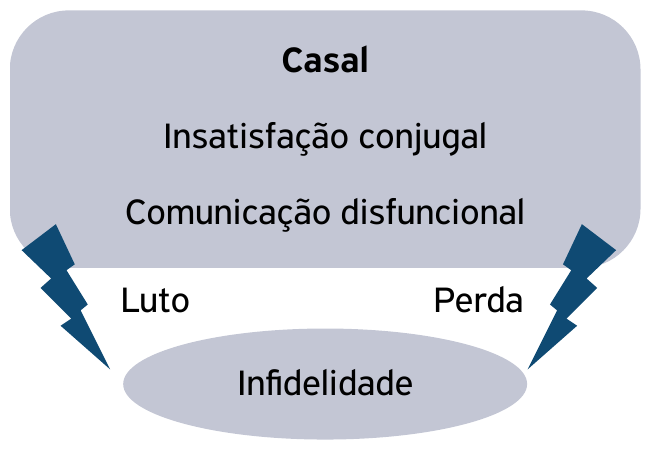
When there is marital dissatisfaction, communication is probably compromised. Adding a context of grief to this recipe further impairs the room for sharing hurts and support, and marital dissatisfaction can only increase. In a systematic literature review by Delalibera et al. (2015), the authors point out that functional families are more resilient in facing difficulties, come together to seek solutions, leave room for the expression of differing feelings, thoughts and opinions and, as a result, tend to experience grief in a less intense and more organized way.
The second hypothesis that this study allows us to put forward is that grief can be considered a stressor for the relationship, disorganizing the system, testing the couple’s communication, generating marital dissatisfaction and opening the way to situations of infidelity, even in relationships that appeared functional before the loss, as can be seen in Fig. 2.
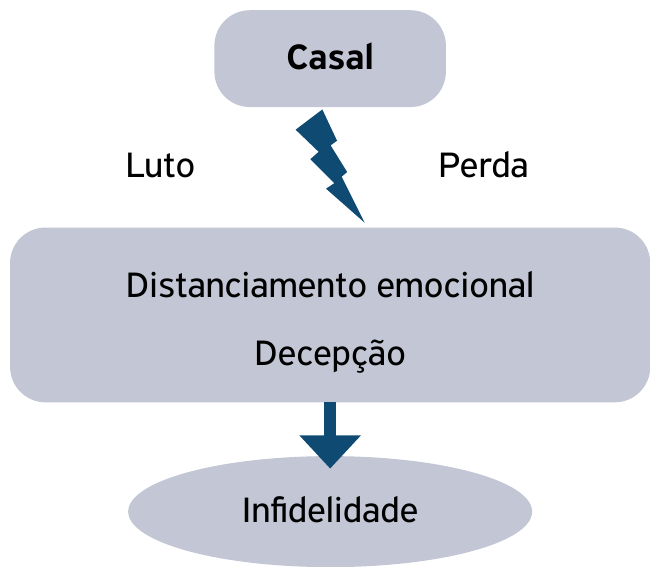
A study by Morelli et al. (2013) also supports the hypothesis of the impact of loss on the marital relationship, reporting an interview with a couple three years after the loss of a child. In this interview, when the couple were asked about their marriage, the wife revealed the distancing and their inability to talk about the loss in the following exchange: “And the marriage? And the marriage? Tell her about the marriage after he passed away, that’s hard, isn’t it? That’s hard, hard, that’s really hard, but, you know? It’s not easy, hard, after that it was” (Morelli et al., 2013, p. 2715).
The same authors further state that grief needs to be lived through by the individual and by the affected group, “since there will be a need for restructuring and for building a new family identity [...], where the expression of feelings is indispensable [...] in order to avoid a crisis within the family” (Morelli et al., 2013, p. 2716).
Dysfunctional grief, in both hypotheses, can make it easier for a third party to enter the relationship, in the sense that it robs the partners of the availability to communicate with and support each other. The members of the couple come to live the relationship with grief and its pain individually, instead of seeking emotional and behavioural resources within the relationship. This can lead to estrangement and to the search for support and satisfaction outside the relationship (Dyregrov & Dyregrov, 2017).
One of the points to be highlighted is the gender difference in the experience of grief. The literature reviewed mentions these differences, which may be seen as causing estrangement and putting the couple at risk of infidelity. When the couple already experiences difficulties in communication and emotional support, loss and grief add to the dysfunction, opening the way to infidelity even further (Bilardi et al., 2018; Côté-Arsenault & Denney-Koelsch, 2018; Franche, 2001; Gerber-Epstein et al., 2009; Serrano & Lima, 2006).
Since this study focuses on just one of the possible symptoms in a context of grief, it is important to stress that infidelity is a complex, multifactorial phenomenon that cannot be fully understood from a perspective of deterministic linear causality. It is known that a dysfunctional experience of grief in the marital relationship can trigger other symptoms, such as addictions, psychiatric disorders, divorce and so on, and the link with infidelity is one more hypothesis for practitioners to consider in such cases.
Complexe Systémique: key points
This article offers a clinical hypothesis rather than a demonstration: infidelity can also be read as the system’s response to a grief that has not been worked through. Its strength lies in a systemic move – looking behind the symptom that brings the couple into therapy for past losses, sometimes from another generation – and in the central place it gives to marital communication, which makes it possible, or impossible, to share pain. The two diagrams offer a simple landmark: grief that aggravates long-standing dissatisfaction, or grief that disorganizes a couple that had been functioning well. The reading nonetheless calls for caution: this is a narrative review without data of its own, focused on the loss of a child and on heterosexual couples, and the differences between men and women are described in rather fixed terms. The article itself recalls that no linear causality can explain an affair. For clinical work, one question is worth keeping in mind: which losses has this couple not yet been able to mourn together? Read alongside family dynamics and the grieving process, and resilience factors in couple healing from infidelity.
Notes from the original
1 Perinatal loss is defined as a loss occurring at any time during pregnancy, during childbirth or up to the child’s first month of life (puerperium) (Laurenti, 1984).
Conflict of interest. Nothing to declare.
Authors’ contributions. Substantial scientific and intellectual contributions to the study: Guimarães ABP, Bettega DPJ, Medina GBK, Sauerman RM, Branco ZBC. Conception and design: Guimarães ABP, Bettega DPJ, Medina GBK, Sauerman RM, Branco ZBC. Data analysis and interpretation: Guimarães ABP, Bettega DPJ, Medina GBK, Sauerman RM, Branco ZBC. Writing of the article: Guimarães ABP, Bettega DPJ, Medina GBK, Sauerman RM, Branco ZBC. Critical revision: Guimarães ABP, Medina GBK. Final approval: Guimarães ABP, Medina GBK.
Data availability statement. Not applicable.
Funding. Not applicable.
Acknowledgements. Not applicable.
References
Bereza, E. A., Martins, J. P., Moresco, L., & Zanoni, S. H. M. S. (2005). A influência da comunicação no relacionamento conjugal. Arquivo Ciências Saúde Unipar, 9(1), 31-36.
Bilardi, S., Calabrò, P. S., Greco, R., & Moraci, N. (2018). Selective removal of heavy metals from landfill leachate by reactive granular filters. Science of the Total Environment, 644, 335-341. https://doi.org/10.1016/j.scitotenv.2018.06.353
Bowen, M. (1991). De la família al individuo: la diferenciación del sí mismo em el sistema familiar. Paidós.
Carter, B., & McGoldrick, M. (1995). As mudanças no ciclo de vida familiar: uma estrutura para a terapia familiar (2ª ed.). Artes Médicas.
Casellato, G. (2015). Luto não-reconhecido: o fracasso da empatia nos tempos modernos. In G. Casellato (Ed.). O resgate da empatia: suporte psicológico ao luto não reconhecido (p. 15-28). Summus.
Coelho, R. M. (2012). Família e luto. In C. M. O. Cerveny (Ed.). Família e… intergeracionalidade, equilíbrio econômico, longevidade, repercussões, intervenções psicossociais, o tempo, filhos cangurus, luto, cultura, terapia familiar, desenvolvimento humano e social, afetividade, negociação (p. 159-175). Casa do Psicólogo.
Costa, C. B., & Mosmann, C. P. (2020). Comunicação conjugal negativa e aberta: modelo interdependente de efeito ator/parceiro no ajustamento conjugal. Ciências Psicológicas, 14(2), e-2283. https://doi.org/10.22235/cp.v14i2.2283
Côté-Arsenault, D., & Denney-Koelsch, E. (2018). “Love Is a Choice”: Couple Responses to Continuing Pregnancy With a Lethal Fetal Diagnosis. Illness, Crisis & Loss, 26(1), 5-22. https://doi.org/10.1177/1054137317740798
Delalibera, M., Presa, J., Coelho, A., Barbosa, A., & Franco, M. H. P. (2015). Family dynamics during the grieving process: a systematic literature review. Ciência & Saúde Coletiva, 20(4), 1119-1134. https://doi.org/10.1590/1413-81232015204.09562014
Doka, K. J., & Martin, T. L. (2011). Grieving beyond gender: Understanding the ways men and women mourn. Routledge.
Dyregrov, A., & Dyregrov, K. (2017). Parents’ perception of their relationship following the loss of a child. Omega, 76(1), 35-52. https://doi.org/10.1177/0030222815590728
Finnas, F., Rostila, M., & Saarela, J. (2017). Divorce and parity progression following the death of a child: A register-based study from Finland. Population Studies, 72(1), 41-51. https://doi.org/10.1080/00324728.2017.1337918
Franche, R. L. (2001). Psychologic and obstetric predictors of couples’ grief during pregnancy after miscarriage or perinatal death. Obstetrics & Gynecology, 97(4), 597-602. https://doi.org/10.1016/s0029-7844(00)01199-6
Gerber-Epstein, P., Leichtentritt, R. D., & Benyamini, Y. (2009). The experience of miscarriage in first pregnancy: The women’s voices. Death Studies, 33(1), 1-29. https://doi.org/10.1080/07481180802494032
Gottman, J., & Silver, N. (2014). O que faz o amor durar. Suma.
Hiefner, A. R. (2020). Dyadic Coping and Couple Resilience After Miscarriage. Family Relations, 70(1), 59-76. https://doi.org/10.1111/fare.12475
Hooghe, A., Rosenblatt, P. C., & Rober, P. (2018). “We hardly ever talk about it”: emotional responsive attunement in couples after a child’s death. Family Process, 57(1), 226-240. https://doi.org/10.1111/famp.12274
Hutti, M. H., Armstrong, D. S., Myers, J. A., & Hall, L. A. (2015). Grief intensity, psychological well‐being, and the intimate partner relationship in the subsequent pregnancy after a perinatal loss. Journal of Obstetric, Gynecologic & Neonatal Nursing, 44(1), 42-50. https://doi.org/10.1111/1552-6909.12539
Kagami, M., Maruyama, T., Koizumi, T., Miyazaki, K., Nishikawa-Uchida, S., Oda, H., Yoshimura, Y. (2012). Psychological adjustment and psychosocial stress among Japanese couples with a history of recurrent pregnancy loss. Human Reproduction, 27(3), 787-794. https://doi.org/10.1093/humrep/der441
Kiełek-Rataj, E., Wendołowska, A., Kalus, A., & Czyżowska, D. (2020). Openness and communication effects on relationship satisfaction in women experiencing infertility or miscarriage: a dyadic approach. International Journal of Environmental Research and Public Health, 17(16), 5721. https://doi.org/10.3390%2Fijerph17165721
Laurenti, (1984). Saúde perinatal. Revista Saúde Pública, 18(4), 267-268. https://doi.org/10.1590/S0034-89101984000400001
Mason, T. M., Tofhagen, C. S., & Buck, H. G. (2020). Complicated Grief: Risk Factors, Protective Factors, and Interventions. Journal of Social Work in End-of-Life & Palliative Care, 16(2), 151-174. https://doi.org/10.1080/15524256.2020.1745726
McGoldrick, M., Walsh, F. (1998). Um tempo para chorar: a morte e o ciclo de vida familiar. In F. Walsh & M. Mcgoldrick (Eds.). Morte na Família: sobrevivendo às perdas (p. 56-75). Artmed.
Morelli, A. B., & Scorsolini-Comin, F. (2016). Repercussões da morte do filho na dinâmica conjugal de casais religiosos. Temas em Psicologia, 24(2), 565-577. https://doi.org/10.9788/TP2016.2-10
Morelli, A. B., Scorsolini-Comin, F., & Santos, M. A. D. (2013). Impacto da morte do filho sobre a conjugalidade dos pais. Ciência & Saúde Coletiva, 18(9), 2711-2720. https://doi.org/10.1590/S1413-81232013000900026
Paris, G. F., Montigny, F. D., & Pelloso, S. M. (2016). Fatores associados ao estado de luto após óbito fetal: estudo comparativo entre brasileiras e canadenses. Revista da Escola de Enfermagem da USP, 50(4), 546-553. https://doi.org/10.1590/S0080-623420160000500002
Perel, E. (2018). Sexo no cativeiro: Como manter a paixão nos relacionamentos. Objetiva.
Prado, L. C. (2016). As múltiplas faces da infidelidade conjugal (2ª Ed.). Arte em Livros.
Price, S. K. (2008). Stepping back to gain perspective: Pregnancy loss history, depression, and parenting capacity in the Early Childhood Longitudinal Study, Birth Cohort (ECLSB). Death Studies, 32(2), 97-122. https://doi.org/10.1080/07481180701801170
Santos, L. R. & Cerqueira-Santos, E. (2016). Infidelidade: uma revisão integrativa de publicações nacionais. Pensando Famílias, 20(2), 85-98.
Scheeren, P., & Wagner, A. (2019). Predizendo a infidelidade conjugal. Psicologia Clínica, 31(2), 387-406. https://doi.org/10.33208/PC1980-5438V0031N02A09
Serrano, F., & Lima, M. L. (2006). Recurrent miscarriage: psychological and relational consequences for couples. Psychology and Psychotherapy, 79(Pt 4), 585-594. https://doi.org/10.1348/147608306x96992
Shreffler, K. M., Wilson, G., Mitchell, K. S., & Schwerdtfeger, K. L. (2012). Considering planning salience in women’s pregnancy intentions. Journal of Family Planning and Reproductive Health Care, 38(3), 204. https://doi.org/10.1136/jfprhc-2011-100280
Silva, D. R. (2009). Famílias e situações de luto. In L. C. Osorio & M. E. P. Valle (Eds.). Manual de Terapia Familiar (p. 376-398). Artmed.
Sugiura-Ogasawara, M., Suzuki, S., Ozaki, Y., Katano, K., Suzumori, N., & Kitaori, T. (2013). Frequency of recurrent spontaneous abortion and its influence on further marital relationship and illness: The Okazaki Cohort Study in Japan. Journal of Obstetrics and Gynaecology Research, 39(1), 126-131. https://doi.org/10.1111/j.1447-0756.2012.01973.x
Vescovi, G., Silva, F. S. D., Levandowski, D. C., & Costa, C. B. D. (2022). Conjugalidade e parentalidade subsequentes à perda gestacional: revisão sistemática. Revista da SPAGESP, 23(1), 159-174. https://doi.org/10.32467/issn.2175-3628v23n1a13
Viegas, T., & Moreira, J. M. (2013). Julgamentos de infidelidade: Um estudo exploratório dos seus determinantes. Estudos de Psicologia, 18(3), 411-418. https://doi.org/10.1590/S1413-294X2013000300001
Walsh, F. (2005). Perda, recuperação e resiliência. In F. Walsh (Ed.). Fortalecendo a Resiliência Familiar (p. 165-196). Roca.
Walsh, F., McGoldrick, M. (1998). A perda e a família: uma perspectiva sistêmica. In F. Walsh & M. McGoldrick (Eds.). Morte na Família: sobrevivendo às perdas (p. 27-55). Artmed.
Watzlawick, P., Beavin, J. H., & Jackson, D. (2005). Pragmática da Comunicação Humana. Cultrix.
Unofficial English translation of Processo de luto na vida do casal e a infidelidade, by Ana Beatriz Pedriali Guimarães, Désirée Pereira Jorge Bettega, Giovanna Beatriz Kalva Medina, Ronit Mazer Sauerman and Zenilda Barbosa Castelo Branco, Revista Brasileira de Terapia Familiar, vol. 12, no. e0624 (2024), doi: 10.60114/rbtf.v12i1.136, under a CC BY 4.0 licence. Translation (with the help of artificial intelligence) and layout: Complexe Systémique, November 2026 — the work has been modified under the terms of the licence. Neither the authors nor the journal are responsible for this translation; the original version prevails.
Unofficial English translation of “Processo de luto na vida do casal e a infidelidade”, published in Revista Brasileira de Terapia Familiar (2024) under a CC BY 4.0 licence. Made by Complexe Systémique with the help of artificial intelligence, it does not come from the authors or the journal, who are not responsible for its content; the original version prevails.
Read the original articleHow to cite this article
Guimarães, A. B. P., Bettega, D. P. J., Medina, G. B. K., Sauerman, R. M., et Branco, Z. B. C. (2024). The grieving process in couple life and infidelity (Complexe Systémique, Trans.). Complexe Systémique. https://app.complexe-systemique.com/en_GB/articles/the-grieving-process-in-couple-life-and-infidelity (Original work published in 2024 in Revista Brasileira de Terapia Familiar, v. 12, n. e0624 (2024); republished in 2024 by Revista Brasileira de Terapia Familiar, https://revbrasterapiafamiliar.abratef.org.br/revista/article/view/136)
To go further
- Family dynamics and the grieving process: A systematic review and narrative synthesisWhat family communication does to grief.
- Impact of Perinatal Death on the Social and Family Context of the ParentsPerinatal death, seen through the whole family.
- Resilience Factors in Couple Healing from Infidelity: A Deductive Qualitative Analysis StudyWhat helps a couple heal after infidelity.
Related training courses
 Short course
Extramarital affairs in couple therapy: from crisis to forgiveness
One-day online training with Julien Besse: reading the crisis triggered by an extramarital affair, positioning oneself as a couple therapist, rebuilding trust and working on forgiveness up to the repair ritual. Delivered in French.
 Symposium
État des Lieux: a psychological approach to spaces
Replay of the “État des Lieux” conference (Paris, 16 October 2026): Ivy Daure, Maurizio Frisina, Viola Sallay and Gilbert Pregno on places as a clinical resource. In French.
 Webinar
Extramarital affairs: what does the therapist do when the couple explodes?
Replay of the free webinar of 5 November 2026: how to position yourself as a systemic therapist in the crisis of the extramarital affair. Revelation, secrecy, multipartiality.
 Webinar
The three loves
Replay of the free webinar with Dr Robert Neuburger of 1 October 2026: the three loves, attachment and ways of loving. Held in French.
Related articles
 Scientific
The Duogramma®: An innovative methodology for psychotherapy
A map of the couple relationships lived, desired or rejected since childhood: the Duogramma®, its graphic rules and its use in individual therapy.
 Blog
Challenging in therapy: What a patient taught me
A couples therapy session led me to reflect on confrontation, authenticity and resonance: how to address difficult behaviour without invalidating the person.
 Blog
Adult ADHD: when forgetting turns into a misunderstanding
Forgetting, compensating, tension in the couple: a systemic look at adult ADHD, to understand what is at stake and to look for more fitting forms of support.
 Scientific
Sickle Cell Disease and Young Couples: Understanding the Influence of Shared and Individual Meaning on Couples’ Experience of Illness
Nine young adult couples facing sickle cell disease: how each partner makes sense of the illness, and how the couple moves from caregiving to equality from one crisis to the next.
Comments 0
Log in to join the discussion. Log in