Child & Family Social Work · Social work
The outsider within: The agentic practices of Family Group Conference coordinators in the context of families with children at risk
In Israel, the Family Group Conference entrusts the family and its network with building a plan to protect a child. Jordan Shaibe and Orna Shemer interviewed almost all the people who coordinate these conferences. Three principles guide their work: leaving the decision to the family, highlighting its abilities and orienting it towards the future, from a singular position, neither fully inside nor fully outside.
This is a reformatted republication of The outsider within: The agentic practices of Family Group Conference coordinators in the context of families with children at risk, by Jordan Shaibe and Orna Shemer, published in Child & Family Social Work (Wiley) (2024), doi: 10.1111/cfs.13114, under a CC BY 4.0 licence. Prepared by Complexe Systémique in September 2026: the authors’ text is unchanged; the layout has been adapted for reading online, which constitutes a modification of the work under the terms of the licence. This edition was made neither by the authors nor by the publisher, who are not responsible for its content or for any errors. The original version prevails.
For most of the coordinators, the purpose they saw in FGC was not necessarily to complete the conference, but to undergo a process with the family that encourages them to take active steps towards a future of their choosing.
Jordan Shaibe and Orna Shemer
Abstract
Family Group Conference (FGC) is a participatory decision-making process for families with children at risk, for whom concerns were recognized by the family, the professionals and/or the community. In its initial stages, FGC is organized, and the families are accompanied, by independent coordinators. The study used a qualitative, action-oriented methodology to explore what practices coordinators use to foster FGC's family-led dynamic. The data collection included 13 semi-structured, in-depth interviews and two research group discussions with coordinators to learn about their perspectives and practices. The study found that these practices were guided by three main principles of action: to affirm the family's control and responsibility, to highlight the family's ability and to orient the family towards the future. The article explores how these practices contribute to the family-led dynamic of FGC and situates them within the context of the welfare system and the positioning of the coordinators as ‘outsiders-within’ to both the family and the welfare services. This study contributes to the body of knowledge on participatory child welfare models and agentic practices and offers implications for policy and implementation of FGC in a manner that recognizes and respects families' agency.
1 INTRODUCTION
The following article shares the findings from a study that examined agentic practices in the context of child welfare and the range of services intended to guarantee children's safety and provide families with the essential assistance to care for their children (Child Welfare Information Gateway, 2018). The study focuses on the Family Group Conference (FGC) model in the context of child protection as it appears in Israel. FGC in child welfare seeks to bolster child safety and diminish the necessity for professional intervention while involving families and children in a participatory manner in the decisions made regarding the children's welfare (Mitchell, 2020). The findings detail the specific actions FGC coordinators take to facilitate families' agency to achieve the model's purpose of a family-led decision-making dynamic (Merkel-Holguin et al., 2020). These practices are explored through the context of the welfare system and the particular position of the coordinator.
2 LITERATURE REVIEW
2.1 FGC in Israel
In Israel, one of the current conventional welfare procedures for the care of families with children at risk involves the Planning, Intervention and Evaluation Committees. In certain circumstances, such as a continuation of concerns for the child following intervention, this decision-making committee is convened with the purpose of determining the risk to which the child is exposed, the family's ability to provide the protection the child requires and the child's future care plan (Alfandari, 2019). Alfandari's (2017) qualitative study found that these formal committees are often characterized by low levels of partnership with parents. This resembles the state of New Zealand's welfare system in the 1980s, which was charged with undervaluing the Māori family and social structure by removing children from their homes and their culture (Ministerial Advisory Committee on a Māori Perspective, 1986).
These criticisms led to the development of the FGC model in New Zealand, which was also adopted in Israel. Although the Israeli government adopted the FGC model in youth justice in 2000 (Rivkin & Shmaia Yadgar, 2007), the uptake in the child protection space FGC occurred more recently. In 2016, the Ministry of Welfare and Social Affairs in partnership with the immigration ministry, the Joint Ashalim organization and the Mosaica organization launched a pilot program based on the FGC model for child protection. The program has been launched in five regions in Israel to examine its place as an alternative to the conventional evaluation committees (Shemer et al., 2022). Thus, in the Israeli model, there is a distribution of responsibilities, with responsibility for identifying concerns and referring families to the model allocated to welfare ministry and responsibility for training and mentoring the coordinators allotted to the Mosaica organization, which specializes in process mediation and restorative justice. The spirit of shared responsibility is to leave the ownership of decision-making with the family, whereas the welfare ministry stays accompanying the family (Shemer et al., 2022).
2.2 The FGC model
In the FGC framework, coordinators are tasked with organizing and mediating the FGC model (Frost et al., 2012). As such, their role is defined by specific characteristics and responsibilities, which come to play in the model's three stages—the preparation, conference and post-conference stages.
Before the conference, in Israel, the social worker provides the coordinator with initial information regarding the family and the concerns for the child. Following this, the coordinator shares with the family with essential information, such as the model's structure and the responsibilities it places on them. During this stage, the family identifies the concerns regarding the child that will be addressed during the conference. Finally, the family is invited to choose which supporters, who are members of the family's social network, they want to include in the FGC process (Connolly, 2006a; Sundell et al., 2001). In the Israeli model, the children are encouraged to take part in selecting and inviting the family supporters (Shemer et al., 2022).
The conference, which is moderated by the coordinator, is divided into three phases. First is the information-sharing stage, during which all the conference members are present, including the family, their supporters, the social worker and other relevant professionals. During this phase, the social worker ensures to disclose all critical information on the concerns that led to the referral and are necessary for the family to proceed in leading the decision-making (American Humane Association, 2010). Following this, all participants share what they view to be both the strengths and the concerns of the family, followed by possible resources and ideas for optional aid to address the specific concerns raised (Connolly & Masson, 2014; Sundell et al., 2001). The second phase of the conference is private deliberation for the family, during which the coordinator and all professionals leave. During this time, the family decides which resources to choose to address the concerns identified (Sampson, 2020; Sundell et al., 2001). Finally, during the agreement phase, the coordinator and social worker return to the room. The family members present their plan to address the concerns, and this plan is discussed until an agreement is reached. The coordinators are responsible in negotiating this discussion. In Israel, every attempt is made to arrive at full agreement of all participants while answering the concerns regarding the children, and the social worker can agree or disagree with the plan in consideration to the risk to the child and the urgency of care (Shemer et al., 2022). During this discussion, the family also decides on an evaluation method for their plan (Connolly, 2006a; Huntsman, 2006; Meijer et al., 2019).
The third stage of the FGC model is the implementation and evaluation stage, during which the family plan is executed, and its effectiveness and success in addressing the concerns raised during the conference are evaluated (Sampson, 2020). In Israel, the social worker is tasked with following up with the family. As such, the coordinators are directed to explain to the family that their role as coordinators finishes at the end of the conference and that continued contact will be with the social worker. In Israel, around 6 weeks following the conference, a second meeting is established with the social worker to ensure the plan has been started. Additionally, unique to the Israeli model, the family is offered a monetary budget as well as the choice of a family companion resource, whose role is to assist the family in the execution of the plan, such as by aiding in contacting government agencies (Shemer et al., 2022).
2.3 The role of the coordinator in FGC
The coordinator is independent to any service agency function related to the family (de Jong et al., 2015; Macgowan & Pennell, 2002). Research found that coordinators believe in the importance of their independent, ‘outsider’ nature, for it enables them to ensure that family decisions are not overridden (Connolly, 2006a; Natland & Malmberg-Heimonen, 2014). Simultaneously, the initial stages of the FGC model are organized by the coordinator, and this formal role that is entrusted to them, thus, also provides them with an ‘insider’ position to the welfare system.
The FGC dynamic poses many challenges to coordinators, including tense relations between the family and the welfare services, resistance from welfare professionals and conflicts between family members. When coordinators were asked how they manage these challenges, they emphasized the importance of discussing with the family about the concerns and resources in a practical manner. Coordinators also stressed the importance of adequately preparing the family for the conference to reduce their anxiety (Connolly, 2006a, 2006b). Moreover, Schout and de Jong (2017) found that coordinators encourage families to speak up and make their voices heard by asking questions and sharing feedback. Finally, in a randomized controlled trial conducted on FGC in England, which found the model to be cost effective and to reduce the likelihood of children going into care as compared with the control group, the coordinator participants described positive outcomes of FGC, including expansion of the family support, and families feeling heard and empowered (Taylor et al., 2023).
In Israel, coordinators receive training from Mosaica in various fields including children at risk, child protection, mediation skills and cultural competence. Coordinators must undergo a practicum program, as well as participate in group and personal mentoring. Finally, recruitment places emphasis on diversity.
Thus, the FGC coordinators are tasked with acknowledging and enhancing the families' control over the decision-making process. The above-noted review highlights how essential the coordinator's role is to the FGC model. Moreover, that “the coordinator should be a gifted citizen with natural abilities to mobilize groups” (Schout & de Jong, 2017, p. 1198) is apparent from the eclectic practices that coordinators implement. The current article proposes the agentic framework to understand what these practices are and how they can assist coordinators in managing the challenges inherent to the FGC dynamic.
2.4 Agency in the context of child welfare
The definition of agency used in this article is the one provided by Amitay and Rahav (2020) as “the belief that one can direct one's life toward desired goals and aspirations despite severe life circumstances and trajectories, encompassing the feeling that one is in control of one's choices and decisions and responsible for their outcomes” (p. 136). Thus, professionals' agentic practices include actions that recognize and uphold people's agency, counter service users' sense of alienation and enhance their sense of ability. Amitay and Rahav (2020) found that these practices have a significant, positive influence in the context of children at risk.
More generally, research on agency has highlighted its importance for well-being (Kahana et al., 2012; Kotan, 2010; Tuason et al., 2021), life satisfaction (Veronese et al., 2019) and positive future thinking (Bryant & Ellard, 2015), as well as its protective, resilience quality in situations of risk (Karam et al., 2021; Okech et al., 2012; Veronese et al., 2018). Thus, the agentic framework is particularly relevant in the context of FGC, in which families with children at risk work together with their social network towards a plan of their own choosing. Furthermore, the strengths-based perspective of FGC, which emphasizes families' power, autonomy, self-reliance and resilience (Bredewold & Tonkens, 2021; Connolly & Masson, 2014; Meijer et al., 2019), is emblematic of the agentic approach.
The review presented here highlights how essential the coordinator's role is to the FGC model, particularly when it is understood from the agentic perspective. Nevertheless, to the best of our knowledge, the topic of the coordinators' practices, and particularly how they implement the FGC family-led and participative model in practice, has gone largely unstudied. This led us to delve beneath the surface of the model, to uncover the guiding principles and practices coordinators use to facilitate the FGC dynamic.
3 METHODOLOGY
To address the need for further research on the practices of FGC coordinators, we used an action-oriented qualitative methodology. This methodology seeks out the actions that participants implement to produce ‘actionable knowledge,’ which is knowledge that easily translates back to actions (Schön, 1984; Schön, 1987; Yang, 2012, p. 262). Because of the lack of literature on coordinators, this methodology was chosen to address the gap in knowledge on the practices of coordinators, and this methodology was found to be effective in revealing significant knowledge on principles of action. Moreover, this study was based on the learning from successes methodology. This is an action-oriented methodology that seeks to uncover the participants' practices by asking them to share their success stories, their perceived costs for success and unresolved issues they experienced. This methodology compiles the participants' practices in order to reveal principles of action (Schechter et al., 2008).
3.1 Research participants and sampling method
The research participants were FGC coordinators that have experience conducting the FGC process. The study was open to all the FGC coordinators active in Israel, which at the time of the data collection included 15 people.
We interviewed 13 coordinators, and two coordinators who did not participate in the interviews joined the research group discussions. The participants were readily available through our contacts with the Mosaica organization. The sample included 10 women and five men with varied occupational backgrounds, as well as participants with experience working with families of different cultural backgrounds.
3.2 Data collection method
The data collection used in-depth, semi-structured interviews that lasted about 1 h each. These interviews were audio-recorded and then transcribed to authentically account for the participants' meanings and stories (Lietz & Zayas, 2010). The interview questions were chosen based on the knowledge gaps regarding coordinators in FGC literature and with reference to the coordinators' tasks throughout the FGC stages as they arise from the literature review and the coordinators' training process. Finally, the questions were selected with the purpose of extracting an action model. These questions asked the participants to describe FGC experiences that they found challenging, as well as ones they found successful, what coping strategies they implemented and which of their actions they perceived as contributing to success. Furthermore, the coordinators were asked to share their understanding of the abstract theories that are the basis of FGC, such as “family-led” and “family's choice,” terms the coordinators often used to describe the FGC process. Lastly, the interviewer asked the participants to share their experiences as though she were in the room with them. In reply, the participants shared stories in a sequence of “I did this, and the family reacted this way, so I did that,” and so forth.
In addition to interviews, we conducted two research group discussions with the coordinators. One was held before the interviewing process to discuss with them the research topic and establish the research and interview questions, and one was held following the data analysis to discuss the research findings, receive feedback and integrate their perspectives further into the data collection (Chiu, 2003; Linhorst, 2002).
3.3 Data analysis
The transcribed interviews and group discussions were analysed using an action-oriented analysis to explore the meanings, commonalities and uniqueness that could be found in the participants' recalled actions (Braun & Clarke, 2012; Carey, 2017). The data analysis method focused specifically on sections in which participants shared storied recollections to discover what practices they used. We analysed these segments as though they had conducted an observation and so identified specific actions as codes and groups of actions based on the same principle as themes (Ngulube, 2015). These action principles describe how the participants implemented their values and guiding principles in practice (Schechter et al., 2008).
We decided to combine bottom-up and top-down analysis. In particular, we used a bottom-up, inductive analysis during which we discovered how the participants' practices and actions come together to tell a cohesive story of agency (Braun & Clark, 2012). Then, once we completed the bottom-up analysis, we used Amitay and Rahav's (2020) definition of agency as a theoretical lens through which to conduct a top-down analysis to identify specifically whether and which of the coordinators' actions were agentic (Braun & Clarke, 2006; Leeming, 2018). This thorough top-down analysis allowed us to verify that indeed the actions the coordinators' described acknowledged, facilitated and bolstered the families' agency.
We found the combined analysis to be the most candid and authentic way to present the data, as the theory of agency elucidated the participants' actions, and their practices in return enhanced and expanded the understanding of agency (Bradbury-Jones et al., 2022; Leeming, 2018; Tai & Ajjawi, 2016).
3.4 Trustworthiness
To maintain reflexivity, we documented in a field diary our experiences and reflected on our position and influence as researchers. In addition, researcher triangulation was achieved through discussions with members of the research team within which the current study was conducted (Koch et al., 2014; Lietz & Zayas, 2010). The thick description collected during the interviews and discussion groups allowed for the participants' practices to be presented as authentically as possible. Finally, following the data analysis, we met with the participants to discuss the findings and check whether they were accurately portrayed in the study (Connelly, 2016; Davies & Dodd, 2002; Lietz & Zayas, 2010).
Although the study is reported in English, the data collection was conducted in Hebrew. To ensure the coordinators' narratives were authentically presented, the data were translated alongside and after the data analysis to ensure the integrity of the participants' voices (Nurjannah et al., 2014). During the translation, we strove to capture the pragmatic meaning of the message the participants conveyed, and the translated quotes, action principles and practices were subsequently translated back to Hebrew, to ensure that the translation was accurate.
3.5 Ethical considerations
The study was approved by the ethics committee of our affiliated university. Prior to the data collection, the participants received an informed consent form. The audio-recordings were transcribed void of identifiable markers and subsequently deleted. The coordinators were assigned pseudonyms to ensure anonymity and security. Moreover, the coordinators were asked at the beginning of the interviews to refrain from sharing identifiable details about the families with whom they worked, and any details mentioned were removed during transcription to protect the privacy of the families (Cary, 2017; Shaw, 2003). Finally, considering the small size of the FGC program in Israel, with only 15 coordinators at the time of the data collection, it was decided not to provide any demographic details regarding the participants, such as age, ethnic background or work experience, to protect the participants' anonymity.
4 FINDINGS
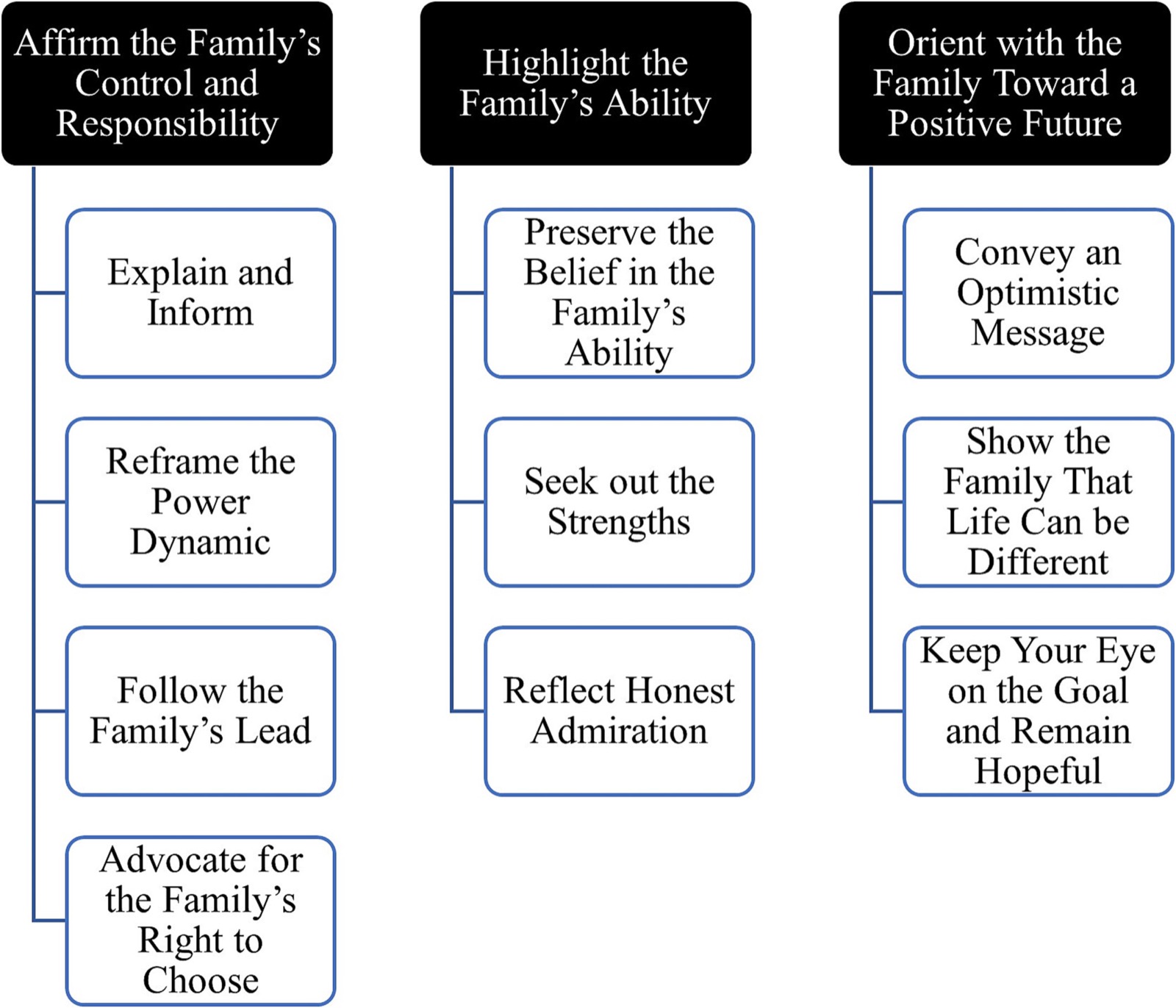
This study asked what practices the participating FGC coordinators used to facilitate the families' agency. We found that the coordinators' actions were guided by three main principles of action, as illustrated by Figure 1. The figure depicts how all the principles and actions were equally important in the coordinators' narratives. Moreover, the coordinators emphasized in the final discussion session that these practices are all interdependent and that they strive to personalize their actions according to the person and situation with whom and in which they are working. Importantly, the practices revealed in this study were perceived by the participants to be successful and effective, and not necessarily coincided with standard FGC guidelines in Israel or internationally.
4.1 Affirm the family's control and responsibility
Throughout the interviews, the participants emphasized the importance of recognizing the families' valid and valuable self-knowledge for making decisions concerning their own lives. Based on this principle, coordinators shared that they took care to explain to the families about the positioning of each family member and professional and about each step the coordinator took. For instance, Odi clarified that he explained, “Why [the process] needs to happen this way. What is special in this process? Where did the process come from and what happens after?” By providing such detailed explanations, Odi and other coordinators took on the responsibility of disclosing any relevant information, while respecting the family's power to choose whether they want to proceed with the FGC model.
Coordinators also strove to reframe the power dynamics between the families and the relevant professionals throughout four different practices. First, coordinators endeavoured to remain aware of their own internalized preconceptions. This reflexivity came up in the open conversation of the interviews, such that when participants used a conceptualization that alluded to unequal power relations, they were often quick to reframe the sentence and re-emphasize the power of the family. For example, Miriam recalled how she explained to a family about the FGC conference by saying:
In the conference there is the part when you sit by yourselves, when you need to do things for the social workers to approve the plan […] No! They do not need, I didn't phrase that sentence right, I always explain it to the family like this: “This is what you want?… Then write that, but explain the concern behind it, why you need it …”
Miriam's initial statement implies a power dynamic with the family in a powerless position and suggests that even while independent from the welfare system, she had taken on an ‘insider’ position with the welfare system and adopted its language. Nevertheless, her effort to rephrase her explanation underscores how Miriam strives to correct this dynamic and return to an outsider position. Moreover, by downplaying the control of the social worker, Miriam's words point to the ever-present tension between the coordinator's desire to facilitate the family's agency and the existing power of the social worker in the context of FGC.
A second practice coordinators used was to emphasize that the family is in charge of making the decisions. This strategy arose especially in cases where families shared feelings of insecurity or helplessness. Coordinators described how they reiterated like a motto that the family is the one who chooses and decides. For example, Tamar described how she repeatedly stated to a mother she worked with that: “We want to find a way that will be good for you and for [your son], you will decide what, but you need to find the way that will be the best, both for you and for your children.”
The third practice to reframe the power dynamic that coordinators shared was to ask for the family's point of view and choice regarding each step of the process. This is one of the strategies that came up the most in the interviews, both in the context of the preparation stage for the conference and in the conference itself, and included where to hold the meetings, what the family's concerns are, which supporters they want to invite to the conference and so on.
Finally, once the family has come to a decision, the importance of listening to and emphasizing the family's choice came up repeatedly in the interviews and the group discussions. In the following quote, Rachel shares how social workers tend to dictate case plans, and she often had to help reframe the family-led decisions by explaining to social workers the importance of listening to the family and their choice, especially when the social workers disagreed with the family.
The social worker was saying: “[The family] has to choose parent counselling, and parent–child treatment centre, and they have to go to …” I told her, “Listen, if you referred them here, and they are here, then they aren't obligated to anything, to anyone, only to themselves. And what they decide? That's what will be. That is it.”
Rachel's passion in advocating for the family's choice is clear from the above quote. It exemplifies what several coordinators described as taking on the family's side. Thus, the coordinators positioned themselves as insiders to the family. Importantly, Rachel ensured not to disagree with the social workers' assessment of what resources would be beneficial for the family and emphasized that it was the social worker's decision that brought the family to FGC. Thus, she is still highlighting the social worker's professional knowledge.
During the discussion group, participants stressed the importance of this practice to ensure the family's control is maintained following the conference and after the FGC process finishes. This practice also influences the nature and ownership of responsibility in the context of child welfare, as it conveys the belief that the social worker's responsibility is to share their expertise but listen to the family's decision, and the family's responsibility is to make decisions that are best for the children.
Thus, the participants expressed the importance of the family's choice and responsibility as a guiding principle in their work and implemented practices that reframed the power dynamic and advocated for the family's decision.
4.2 Highlight the family's ability
During the interviews, the coordinators emphasized the importance they placed on recognizing and believing in the families' inherent capacity and the importance they saw in reflecting this belief to the families. The first practice based on this principle included strengthening their own belief in the family's ability, both by maintaining an objective perspective and by empathizing with the family. This practice was found in the coordinators' stories, particularly when they described concerns for the children that challenged their own belief in the family's ability. Coordinators described how they used self-talk, reflection and consultation with their mentors to understand the family's perspective.
For example, when Gali met with the social worker for the first time, her belief in what she termed the “family's potential” was challenged by the long list of concerns the social worker shared: “She describes to you the family and it looks … like wow! Like, wow, wow.” Despite her doubts, Gali attempted to set them aside and meet the family with no preconceived notions:
But then, you meet the family, meet the mother, meet her partner, with their whole story, and you see that they are humans. First, a mother. And what strengths she had! What survival! What a battle she waged for her children!
Thus, this practice enabled Gali to see beyond the family's casefile and to their humanity, following which she developed a true admiration for them. Moreover, it helped Gali move from a position of an outsider to the family to a position of familiarity and closeness.
Unlike the above story, coordinators sometimes struggled with discovering the family members' strengths, even after the initial meetings, and so they sought individualized methods to uncover them. For example, Natan used WhatsApp text messages to connect with a teenager who was at first reserved and focused on his smartphone during their meetings:
I said, “Tell me, come, come here; show me, what are you doing?” And when I saw what he was doing, I said to myself, “Wow, this boy is a genius!” And all this time everyone saw him as … [sic]. So, I took this, and I told him, “Listen, send me a text message, about what you know to say about some singer.” And then I saw the things he wrote, and it came to him from his own mind! And I told myself, “Wow, this is impossible!”
Natan, like other coordinators, was guided by a core belief that strength can be found in every person. This belief drove him to find a way to communicate with the boy despite the initial difficulty, which eventually transformed his perception of the teenager.
This leads to another significant practice that was found in all the interviews, which was to reflect the honest admiration the coordinators cultivated for the family back to the family, as well as to the family's social network and other relevant professionals. For example, in the above story, Natan shared how he expressed his admiration to the teenager's social network. This is also a practice that came up in the context of the conferences, to encourage the members to speak positively with and about the family. Rachel described the importance she saw in emphasizing the strengths during the conference:
There you really see it happen. You do the strengths' circle, every person says something, and suddenly you [the family] are not there alone facing the welfare system. You are with people who really care about you […] I remember during the conference the mother stood up and said […] “I never thought that I interest, that my family interests, so many people … I was sure I was alone. And when I am here, I understand that I am not alone in this world.”
While sharing this story during the interview, Rachel was brought to tears. Rachel described how she saw this transformation in the mother's perception of the world as the true purpose of FGC.
Thus, highlighting the family's ability was an essential guiding principle in the coordinators' work. To preserve their belief in the family's ability, coordinators strove to remain neutral or empathize with the family's situation. By observing the family and conversing with them, the coordinators endeavoured to identify admirable personality traits, talents, past achievements and positive actions. Finally, once participants sought the family's strengths, they ensured that they shared them with the family and the people around them.
4.3 Orient with the family towards a positive future
The final principle guiding the coordinators' practices was the importance of optimistic future thinking to the family's sense of agency. Coordinators shared how they conveyed a message of hopefulness to the family, by positively framing their conversations, by finding what to be glad for and by searching for a goal together with the family.
For example, Alona describes how a mother shared with her negative expectations for the future. In response, Alona tried to identify with the mother past moments of happiness, what she termed “blossoming”:
I look for that blossoming … I remind her of it. She also told me she wanted to work in [a certain field]. I do not look for that resource for her. When she told me that, I simply told her, “Let's look together, where can you study [that]?” And during the meeting, we found a place, there, near her home. You know, it is something like that, that gives hope.
Thus, Alona grounds her message of optimistic view of the future in realism by finding concrete steps with the mother, by which she can achieve her goals.
The second practice that coordinators described in the interviews was to show the family that they have the power to influence and change their life. One way the coordinators tried to achieve this goal was by providing relevant assistance to the families, particularly when families sought out help. For example, Gali described how the FGC procedure dictates that the FGC budget be reserved for resources for the children. However, when a family she worked with faced an emergency living situation, the budget was diverted to assist the family in paying rent. Coordinators described this practice as transformative, as they believed it “proved” to the families that the relationship they have with professionals can be a positive one, and that by reaching out and asking for assistance they have the power to influence these relationships for the better.
The second practice coordinators used was to seek out opportunities for the family to experience success. For example, Natan described how he discovered that a teenager he worked with wanted to go visit his relatives in a nearby town. In response, Natan said:
No problem! I will teach you how to ride the bus. Let's go to the bus stop. This is the stop where you get off [Natan mimed pointing to a map on a smartphone]. This is the bus number. You travel there now. I'll drive and meet you there.
This quote conveys how coordinators developed close relationships with family members to discover their dreams and goals. Once such goal was found, coordinators then sought how to bring it to life, so that the family could experience the power to positively influence their life even before the end of the FGC process. Moreover, Natan's story conveys the active part coordinators took in supporting the creation of this new reality.
Finally, a practice that came up prominently in the interviews was the importance of the coordinators preserving their own realistic hope for the sake of the families. Coordinators emphasized that genuinely believing in a better future was essential for their optimistic message to the families to be authentic and therefore effective. As such, participants shared actions they witnessed the family taking that helped them believe in an optimistic future. These actions included family members contacting the social services, starting a new job, returning to school and reconnecting with estranged relatives. For example, Tamar described how she knew she achieved her own personal goal as a coordinator, which she saw as the mother making an active change in her life, when on the day of the conference she noticed that:
The mother already arrived before [everyone else], and she moved tables! Now, I saw her hair done up, she was dressed so nicely, and I … I … my jaw dropped! My jaw dropped! She set the table as though fit for royalty! Simply, these are the physical things, that you see.
Tamar's words highlight that, for most of the coordinators, the purpose they saw in FGC was not necessarily to complete the conference, but to undergo a process with the family that encourages them to take active steps towards a future of their choosing. Indeed, some coordinators suggested that for them the FGC process was a successful one if they saw this active transformation, even when the family chose not to proceed to a conference. Tamar, like other coordinators, maintained sight of her purpose and her optimistic belief in the future by seeking observable behavioural changes that indicated to her that the mother was becoming proactive beyond the participation in FGC.
In conclusion, the findings detailed above explored the three principles of action that were found to guide the coordinators' practices in the preparation and conference stages of FGC. These principles included affirming the family's control and responsibility over their own lives, highlighting the family's ability and orienting with the family towards the future. From the findings, it becomes clear that the coordinators implement these practices while shifting their positioning from outsider to insider and back, both in their work with the social workers and the families. The following section explores these findings in relation to existing literature on FGC and agency to determine what they suggest regarding the coordinator's role within the FGC process.
5 DISCUSSION
This article shares the findings from a study that examined agentic practices in the context of the FGC model. The findings detail the specific actions coordinators used to facilitate families' agency and point to the importance of the topic, despite the lack of attention it has received so far in the literature. The following discussion examines how, through these practices, coordinators strove to transform the child welfare decision-making process from one that is often perceived by families to be coercive and alienating, to one that is family-led. This process is situated within the context of the welfare system to ask what complexities exist within these practices and how the unique coordinator figure, characterized by outsider and insider qualities, enables them.
5.1 Making the decision: From an event to a process
The participants' practices affirming the families' choices are emblematic of two essential perceptions: the importance of recognizing the family's self-knowledge and the vitalness of providing the family with the pertinent information regarding the available personal and social resources so that they may make informed decisions. The findings indicate that the coordinators take on responsibility for these principles. These practices can be seen as prerequisites for agency expression, as they aim at facilitating the families' free choice and control over the process by explaining the process, asking for the family's perspective and allowing the family time to make their decisions (Cauce & Gordon, 2012; Stoljar, 2011). Thus, the coordinators actively work to ensure the FGC process is not a coercive one, but one open to the family's decisions.
However, even with initial informed consent, the subsequent welfare process may still limit the families' agency. This is especially true when many families join the FGC process with an internalized sense of powerlessness (Shaibe, 2022) and distrust in the welfare system (Shemer et al., 2022), which can influence their sense of agency (Ferguson & Lavalette, 2004; Hornsby, 2004). To address this, the participating coordinators described transforming the decision-making dynamic from the singular event of the conference to a continuous process taking place throughout the preparation stage, which involves repeated check-ins and encouragement to the family.
This points to a gap between the definition of coordinators' role in literature and guidelines, and how coordinators implement their role in practice. For instance, FGC theory calls for independent coordinators (Macgowan & Pennell, 2002), yet the participants described how they strove to be advocates for the family's right to decide to the social workers. In these dynamics, the limiting structure of the welfare system is revealed, as social workers expressed perceptions regarding what the families are required to do. Perhaps the coordinators' outsider position to the welfare system assisted them in detecting its structure and resisting it. Thus, their neutrality may have helped them in ensuring that the families' decisions were not compromised (Connolly, 2006a). Moreover, it is possible that their perceived lack of obligation to the system allowed them to experience more agency in changing it. Nevertheless, the coordinators are not completely separate from the social and cultural structure of welfare dynamics, and they themselves also had to use reflexivity to set aside their own paternalistic preconceptions.
5.2 The family: Both able and seen
The participating coordinators strove to further transform the welfare decision-making process by addressing the self-perceptions of the family members and the perceptions of their social network and the relevant professionals. The participants described suspending their own judgement, empathizing with the family and seeking out the family members' strengths to cultivate and preserve their belief in the families' ability.
Once the coordinators identified the family's strengths, they described emphasizing the families' strengths both to the families and to their social network. Amitay and Rahav (2020), who studied agentic practices in the context of youth at risk, found that this practice counters alienation. This practice was also found to help coordinators and social workers in developing a positive perception of families referred to FGC (Mitchell, 2020). Finally, positive self-perception, particularly in terms of being able to influence one's life, has been found to influence behaviour and motivation (Contento et al., 2007; Kawano et al., 2021).
Perhaps, as outsiders to the welfare structure, the coordinators managed to take less for granted (Staples, 2001) and were more open to discovering new perspectives about the family, which they could then share with the social workers. Moreover, the coordinators often have little if no preconceptions about the specific family, beyond what the social worker shares with them before their first meeting (Natland & Malmberg-Heimonen, 2014). This study found that as outsiders to the welfare system, coordinators had the space to navigate in informal spaces, such as homes, parks and outings about town. These informal spaces, which are often inaccessible to social workers, are where the coordinators described seeing the families' strengths and gaining an insider perspective to the family. Even so, the findings point to tension in negotiating the insider–outsider position experienced by coordinators, as participants were found to advocate for and take on the family's side or become prejudiced against the family by the social worker's perspective.
5.3 Sense of agency: Looking to the future
The study's coordinators also emphasized the importance of looking to the future to bolster the family's sense of agency. Therefore, they strove to convey a message of optimism and purpose. Research on interventions focusing on positive ‘possible-self’ conceptions have shown that they indeed can have positive influence on people's sense of agency (Grishutina & Kostenko, 2021; Midtgaard et al., 2007).
The coordinators shared how they took active steps towards supporting the family's perception of a positive future by providing relevant assistance to the families in the hope that it would counter the sense of distrust and alienation towards professionals. Similarly, in an effort to enhance the families' belief in their future ability, coordinators sought opportunities for the families to experience successes already during the FGC process. Both actions are agentic practices based on hope that have been found to counter alienation (Amitay & Rahav, 2020).
Indeed, hope and hopelessness are increasingly seen as fundamental for social work and care professionals (Collins, 2015; Flesaker & Larsen, 2012; Krumer-Nevo, 2020). Coordinators in the study described how maintaining their own hope in the future enabled them to offer hope to the families. It is possible that the great sense of control coordinators experience as outsiders to the welfare structure enables them to feel a greater sense of hope themselves and therefore agency (Lipschitz-Elhawi, 2009).
This discussion suggests that the coordinator's characteristics lend an ‘outsider within’ quality to coordinators. The term outsider-within is used in reference to people belonging to traditional positions of power, such as researchers, academics, professionals, while also belonging to marginalized communities. This dynamic enables outsiders-within to be more aware of the power relations between insiders and outsiders (Gold, 2016). When the term is adapted to coordinators, it points to how their unique positioning allows them an insider access to the social workers, but an outsider perspective that is closer to the families. In essence, the coordinators in the study describe how they consciously navigate and move between the inside–outside boundary of the welfare system. This holds significant implications for the coordinator's role regarding how to strike the right balance between the insider and outsider position to the welfare system. It also contributes to social work, in general, by suggesting what practices might be possible through a greater sense of control and flexibility for social workers within their structure.
In conclusion, this study sought FGC coordinators' agentic practices in their work with families with children at risk. Using an action-oriented methodology, the study complied findings that hold meaningful contributions not only to the body of knowledge on FGC and other participative welfare processes but also to professionals and facilitators who implement these models in the field. Through the practices found in this study, enabled by the coordinators' unique outsider-within perspective, the coordinators strove to transform the welfare decision-making process in a meaningful and lasting manner from one of alienation to one that acknowledges and respects families' agency.
5.4 Research limitations
The research had limited sample size, as FGC is still in its infancy in Israel. This also meant the number of coordinators with experience in organizing the program was small. It is important to note that the current study is qualitative in nature, and so does not seek generalizability. Instead, the small sample size allowed closer, more continuous contact between the researchers and the participants, which allowed more in-depth familiarization (Crouch & McKenzie, 2006). However, the small population of coordinators did limit the ability to share contextual information about the participants. Thus, the influence of personal and work experience on the coordinators' perceptions and practices could not be examined.
Finally, most of the stories the participants shared related to their work with mothers. Few coordinators shared stories that involved their work with fathers or direct work with children. This limited the ability to analyse whether different practices are more successful when working with different family members and particularly what practices coordinators use to encourage child participation. Thus, it is recommended for future studies to examine practices specific to children and fathers.
Complexe Systémique: key points
The study sheds light on a link often left in the shadow of participatory schemes: the person who prepares and chairs the Family Group Conference. What coordinators describe closely resembles a systemic stance: explaining each step, asking for the family’s view at every choice, looking for strengths outside the case file, in the informal places of everyday life, and sustaining one’s own hope in order to pass it on. The most fruitful idea is that of a mobile position, outside the social services yet admitted within them, which makes it possible to spot the institution’s constraining structure and loosen it, without thereby escaping its preconceptions. The decision becomes a process rather than an event. The limits should be kept in mind: only fifteen people, no data on their profile, stories selected among successes, almost all centred on mothers, and no voice from families. The drift towards advocating for the family also raises a question of the third party: who holds the place of child protection? Read alongside the article on working systemically with parents whose children are placed in care, and the article on institutional abuse in child protection.
Notes from the original
Acknowledgements. The study was conducted in partial fulfilment of the requirements for the Master's degree (M.A) in The Paul Baerwald School of Social Work and Social Welfare at The Hebrew University of Jerusalem. The research was undertaken as part of a research team in the Nevet Greenhouse of Context-Informed Research and Training at the Hebrew University of Jerusalem and as a continuation of a larger evaluative study of the Israeli FGC pilot program. The authors would like to convey their deep gratitude to the coordinators who shared their knowledge and experiences and to the FGC “Kedem - Olim LaDerech” team, who allowed this research to come to life with their support, advice and facilitation.
Conflict of interest statement. The authors declare that there is no conflict of interest.
References
Alfandari, R. (2017). Partnership with parents in child protection: A systems approach to evaluate reformative developments in Israel. British Journal of Social Work, 47(4), 1061–1077. https://doi.org/10.1093/bjsw/bcw101
Alfandari, R. (2019). Multi-professional work in child protection decision-making: An Israeli case study. Children and Youth Services Review, 98, 51–57. https://doi.org/10.1016/j.childyouth.2018.11.003
American Humane Association. (2010). Guidelines for Family Group Decision Making in child welfare. Developed by American Humane Association and the FGDM Guidelines Committee.
Amitay, G., & Rahav, G. (2020). Being a meaningful presence in the world: Applying successful agentic practices among youth in distress. Preventing School Failure: Alternative Education for Children and Youth, 65(2), 135–145. https://doi.org/10.1080/1045988x.2020.1848777
Bradbury-Jones, C., Herber, O. R., Miller, R., & Taylor, J. (2022). Improving the visibility and description of theory in qualitative research: The QUANTUM typology. SSM-Qualitative Research in Health, 2, 100030. https://doi.org/10.1016/j.ssmqr.2021.100030
Braun, V., & Clarke, V. (2006). Using thematic analysis in psychology. Qualitative Research in Psychology, 3(2), 77–101. https://doi.org/10.1191/1478088706qp063oa
Braun, V., & Clarke, V. (2012). Thematic analysis. In H. Cooper, P. M. Camic, D. L. Long, A. T. Panter, D. Rindskopf, & K. J. Sher (Eds.), APA handbook of research methods in psychology (Vol. 2). Research designs: Quantitative, qualitative, neuropsychological, and biological. (pp. 57–71). American Psychological Association. https://doi.org/10.1037/13620-004
Bredewold, F., & Tonkens, E. (2021). Understanding successes and failures of family group conferencing: An in-depth multiple case study. The British Journal of Social Work, 51(6), 2173–2190. https://doi.org/10.1093/bjsw/bcab062
Bryant, J., & Ellard, J. (2015). Hope as a form of agency in the future thinking of disenfranchised young people. Journal of Youth Studies, 18(4), 485–499. https://doi.org/10.1080/13676261.2014.992310
Carey, M. (2017). Qualitative research skills for social work: Theory and practice. Routledge. https://doi.org/10.4324/9781315245546
Cauce, A. M., & Gordon, E. W. (2012). Toward the measurement of human agency and the disposition to express it. Gordon Commission on the Future of Educational Assessment.
Child Welfare Information Gateway. (2018). What is child welfare? A guide for educators U.S. Department of Health and Human Services, Children's Bureau. https://www.childwelfare.gov/
Chiu, L. F. (2003). Transformational potential of focus group practice in participatory action research. Action Research, 1(2), 165–183. https://doi.org/10.1177/14767503030012006
Collins, S. (2015). Hope and helping in social work. Practice: Social Work in Action, 27(3), 197–213. https://doi.org/10.1080/09503153.2015.1014335
Connelly, L. M. (2016). Trustworthiness in qualitative research. Medsurg Nursing, 25(6), 435–436.
Connolly, M. (2006a). Up front and personal: Confronting dynamics in the family group conference. Family Process, 45(3), 345–357. https://doi.org/10.1111/j.1545-5300.2006.00175.x
Connolly, M. (2006b). Fifteen years of family group conferencing: Coordinators talk about their experiences in Aotearoa New Zealand. British Journal of Social Work, 36(4), 523–540. https://doi.org/10.1093/bjsw/bch273
Connolly, M., & Masson, J. (2014). Private and public voices: Does family group conferencing privilege the voice of children and families in child welfare? Journal of Social Welfare and Family Law, 36(4), 403–414. https://doi.org/10.1080/09649069.2014.967989
Contento, I. R., Koch, P. A., Lee, H., Sauberli, W., & Calabrese-Barton, A. (2007). Enhancing personal agency and competence in eating and moving: Formative evaluation of a middle school curriculum: Choice, control, and change. Journal of Nutrition Education and Behavior, 39(5), S179–S186. https://doi.org/10.1016/j.jneb.2007.02.006
Crouch, M., & McKenzie, H. (2006). The logic of small samples in interview-based qualitative research. Social Science Information, 45(4), 483–499. https://doi.org/10.1177/0539018406069584
Davies, D., & Dodd, J. (2002). Qualitative research and the question of rigor. Qualitative Health Research, 12(2), 279–289. https://doi.org/10.1177/104973202129119793
de Jong, G., Schout, G., Meijer, E., Mulder, C. L., & Abma, T. (2015). Enabling social support and resilience: Outcomes of Family Group Conferencing in public mental health care. European Journal of Social Work, 19(5), 731–748. https://doi.org/10.1080/13691457.2015.1081585
Ferguson, I., & Lavalette, M. (2004). Beyond power discourse: Alienation and social work. British Journal of Social Work, 34(3), 297–312. https://doi.org/10.1093/bjsw/bch039
Flesaker, K., & Larsen, D. (2012). To offer hope you must have hope: Accounts of hope for reintegration counsellors working with women on parole and probation. Qualitative Social Work, 11(1), 61–79. https://doi.org/10.1177/1473325010382325
Frost, N., Abram, F., & Burgess, H. (2012). Family group conferences: Evidence, outcomes and future research. Child & Family Social Work, 19(4), 501–507. https://doi.org/10.1111/cfs.12049
Gold, R. S. (2016). Outsider within. In The Wiley Blackwell encyclopedia of gender and sexuality studies (Vol. 1-4). Wiley-Blackwell. https://doi.org/10.1002/9781118663219.wbegss744
Grishutina, M., & Kostenko, V. (2021). Variety of possible selves: The role of agency and empirical evidence review. (Paper No. WP BRP 126/PSY/2021). National Research University Higher School of Economics. https://doi.org/10.2139/ssrn.3938051
Hornsby, J. (2004). Agency and alienation. In M. De Caro & D. Macarthur (Eds.), Naturalism in question (pp. 173–187). Harvard University Press. https://doi.org/10.2307/j.ctv22jnrf5.12
Huntsman, L. (2006). Family group conferencing in a child welfare context: Literature review. NSW Department of Community Services.
Kahana, E., Kelley-Moore, J., & Kahana, B. (2012). Proactive aging: A longitudinal study of stress, resources, agency, and well-being in late life. Aging & Mental Health, 16(4), 438–451. https://doi.org/10.1080/13607863.2011.644519
Karam, F. J., Barone, D., & Kibler, A. K. (2021). Resisting and negotiating literacy tasks: Agentive practices of two adolescent refugee-background multilingual students. Research in the Teaching of English, 55(4), 369–392. https://doi.org/10.58680/rte202131257
Kawano, M., Takamura, Y., Tachihara, M., Yokota, K., & Yozu, A. (2021). The relationship between motivation for rehabilitation and sense of agency in patients with cerebrovascular disease, and nurse support for patient agency. International Journal of Affective Engineering, 20(3), 143–151, IJAE-D-20-00029. https://doi.org/10.5057/ijae.ijae-d-20-00029
Koch, L. C., Niesz, T., & McCarthy, H. (2014). Understanding and reporting qualitative research: An analytical review and recommendations for submitting authors. Rehabilitation Counseling Bulletin, 57(3), 131–143. https://doi.org/10.1177/0034355213502549
Kotan, M. (2010). Freedom or happiness? Agency and subjective well-being in the capability approach. The Journal of Socio-Economics, 39(3), 369–375. https://doi.org/10.1016/j.socec.2009.11.003
Krumer-Nevo, M. (2020). Radical hope: Poverty-aware practice for social work. Bristol University Press. https://doi.org/10.46692/9781447354925
Leeming, D. (2018). The use of theory in qualitative research. Journal of Human Lactation, 34(4), 668–673. https://doi.org/10.1177/0890334418794666
Lietz, C. A., & Zayas, L. E. (2010). Evaluating qualitative research for social work practitioners. Advances in Social Work, 11(2), 188–202. https://doi.org/10.18060/589
Linhorst, D. M. (2002). A review of the use and potential of focus groups in social work research. Qualitative Social Work, 1(2), 208–228. https://doi.org/10.1177/1473325002001002620
Lipschitz-Elhawi, R. (2009). Ways of enhancing hope among social workers working with adolescents in residential treatment centres. British Journal of Social Work, 39(3), 451–466. https://doi.org/10.1093/bjsw/bcm159
Macgowan, M. J., & Pennell, J. (2002). Building social responsibility through family group conferencing. Social Work with Groups, 24(3–4), 67–87. https://doi.org/10.1300/J009v24n03_06
Meijer, E., Schout, G., & Abma, T. (2019). Family Group Conferencing in coercive psychiatry: On forming partnership between the client, social networks and professionals. Issues in Mental Health Nursing, 40(6), 459–465. https://doi.org/10.1080/01612840.2018.1563254
Merkel-Holguin, L., Schwab-Reese, L., Drury, I., Allan, H., & Hollinshead, D. (2020). Nothing about me without me: Children and young people's experiences with family group conferences. Child & Family Social Work, 25(1), 27–36. https://doi.org/10.1111/cfs.12648
Midtgaard, J., Stelter, R., Rørth, M., & Adamsen, L. (2007). Regaining a sense of agency and shared self-reliance: The experience of advanced disease cancer patients participating in a multidimensional exercise intervention while undergoing chemotherapy–analysis of patient diaries. Scandinavian Journal of Psychology, 48(2), 181–190. https://doi.org/10.1111/j.1467-9450.2007.00562.x
Ministerial Advisory Committee on a Māori Perspective for the Department of Social Welfare. (1986). Puao-te-Ata-tu (Daybreak). Department of Social Welfare.
Mitchell, M. (2020). Reimagining child welfare outcomes: Learning from family group conferencing. Child & Family Social Work, 25(2), 211–220. https://doi.org/10.1111/cfs.12676
Natland, S., & Malmberg-Heimonen, I. (2014). A study of coordinator positionings in family group conferences. Nordic Social Work Research, 4(2), 158–172. https://doi.org/10.1080/2156857x.2013.826142
Ngulube, P. (2015). Qualitative data analysis and interpretation: Systematic search for meaning. In E. R. Mathipa & M. T. Gumbo (Eds.), Addressing research challenges: Making headway for developing researchers (pp. 131–156). Mosala-MASEDI Publishers & Booksellers. https://doi.org/10.13140/RG.2.1.1375.7608
Nurjannah, I., Mills, J., Park, T., & Usher, K. (2014). Conducting a grounded theory study in a language other than English: Procedures for ensuring the integrity of translation. SAGE Open, 4(1), 1–10. https://doi.org/10.1177/2158244014528920
Okech, D., Howard, W. J., & Kim, J. (2012). Efficacy and agency among poor families with and without children. Child & Family Social Work, 18(4), 417–428. https://doi.org/10.1111/j.1365-2206.2012.00861.x
Rivkin, D. & Shmaia Yadgar, S. (2007). Evaluation of Kedem program: Family Group Conferences for youth offenders. Myers-JDC-Brookdale. DM-491-07. [Hebrew].
Sampson, M. (2020). Can the Family Group Conferencing model alleviate tensions between social workers' dual responsibility of child protection and family support? New Vistas, 6(2), 18–23. https://doi.org/10.36828/newvistas.123
Schechter, C., Sykes, I., & Rosenfeld, J. (2008). Learning from success as leverage for school learning: Lessons from a national programme in Israel. International Journal of Leadership Education, 11(3), 301–318. https://doi.org/10.1080/13603120701576274
Schön, D. A. (1984). The reflective practitioner: How professionals think in action. Basic Books.
Schön, D. A. (1987). Educating the reflective practitioner: Toward a new design for teaching and learning in the professions. Jossey-Bass.
Schout, G., & de Jong, G. (2017). Collecting feedback as a tool to reduce care paralysis: Something for family group conferencing coordinators? Child & Family Social Work, 22(3), 1197–1206. https://doi.org/10.1111/cfs.12336
Shaibe, J. (2022). The Perceptions and Agentic Practices of ‘Family Group Conference (FGC)’ Coordinators in Israel (Olim LaDerech - KEDEM Program). [Master's thesis, The Hebrew University of Jerusalem].
Shaw, I. F. (2003). Ethics in qualitative research and evaluation. Journal of Social Work, 3(1), 9–29. https://doi.org/10.1177/1468017303003001002
Shemer, O., Aboud Halabi, Y., Serdtse, Y., & Roer-Strier, D. (2022). Evaluation research report: Concluding the pilot phase of “Olim Laderech-Kedem” (Family Group Conference). Internal Nevet Research Group Report, The Hebrew University of Jerusalem. [Hebrew].
Staples, L. H. (2001). Insider/outsider upsides and downsides. Social Work with Groups, 23(2), 19–35. https://doi.org/10.1300/J009v23n02_03
Stoljar, N. (2011). Informed consent and relational conceptions of autonomy. Journal of Medicine and Philosophy, 36(4), 375–384. https://doi.org/10.1093/jmp/jhr029
Sundell, K., VinnerlIjung, B., & Ryburn, M. (2001). Social workers' attitudes towards family group conferences in Sweden and the United Kingdom. International Journal of Child & Family Welfare, 6(4), 327–336. https://doi.org/10.1046/j.1365-2206.2001.00216.x
Tai, J., & Ajjawi, R. (2016). Undertaking and reporting qualitative research. The Clinical Teacher, 13(3), 175–182. https://doi.org/10.1111/tct.12552
Taylor, S. Blackshaw, E., Lawrence, H., Stern, D., Gilbert, L., & Raghoo, N. (2023). Randomised controlled trial of Family Group Conferencing at pre-proceedings stage. Foundations https://foundations.org.uk/our-work/reports/family-group-conferencing/
Tuason, M. T., Güss, C. D., & Boyd, L. (2021). Thriving during COVID-19: Predictors of psychological well-being and ways of coping. PLoS ONE, 16(3), e0248591. https://doi.org/10.1371/journal.pone.0248591
Veronese, G., Cavazzoni, F., & Antenucci, S. (2018). Narrating hope and resistance: A critical analysis of sources of agency among Palestinian children living under military violence. Child Care Health Development, 44, 863–870. https://doi.org/10.1111/cch.12608
Veronese, G., Pepe, A., Cavazzoni, F., Obaid, H., & Perez, J. (2019). Agency via life satisfaction as a protective factor from cumulative trauma and emotional distress among Bedouin children in Palestine. Frontiers in Psychology, 10, 1674. https://doi.org/10.3389/fpsyg.2019.01674
Yang, K. (2012). Further understanding accountability in public organizations: Actionable knowledge and the structure–agency duality. Administration & Society, 44(3), 255–284. https://doi.org/10.1177/0095399711417699
Reformatted republication of The outsider within: The agentic practices of Family Group Conference coordinators in the context of families with children at risk, by Jordan Shaibe and Orna Shemer, Child & Family Social Work, vol. 29, no 2 (2024), doi: 10.1111/cfs.13114, under a CC BY 4.0 licence. Edition and layout: Complexe Systémique, September 2026 — the work has been modified under the terms of the licence. Neither the authors nor the publisher are responsible for this edition; the original version prevails.
This is the original article “The outsider within: The agentic practices of Family Group Conference coordinators in the context of families with children at risk”, published in Child & Family Social Work (2024) under a CC BY 4.0 licence. Republished by Complexe Systémique: the author’s text is unchanged; only the presentation has been adapted for reading online, as set out at the head of this page.
Read the original articleHow to cite this article
Shaibe, J., et Shemer, O. (2024). The outsider within: The agentic practices of Family Group Conference coordinators in the context of families with children at risk. Complexe Systémique. https://app.complexe-systemique.com/en_GB/articles/the-outsider-within-the-agentic-practices-of-family-group-conference-coordinators (Original work published in 2023 in Child & Family Social Work, 29(2), 560-570 (2024); republished in 2024 by Child & Family Social Work, https://onlinelibrary.wiley.com/doi/full/10.1111/cfs.13114)
To go further
- « Il ne suffit pas de faire ou de dire ce qu’il faut » : travailler de façon systémique avec des parents dont les enfants sont placésParents of children in care.
- Protection or institutional abuse? A crossroads in child protection policiesInstitutional abuse.
- Réputation et responsabilité : une étude qualitative de l’expérience des parents lors des réunions de dialogue ouvert à l’écoleOpen dialogue meetings.
Related articles
 Article
 Family group conference provision across the lifespan of child welfare intervention: A mixed-method realist-informed evaluation comparing three stages of welfare concern
Early help, child protection or children in care: among 155 UK families, experiences and outcomes of family group conferences vary very little by stage.
 Article
 How can we BeST? meet the needs of adoptive families? Relevant findings from a major Randomised Controlled Trial of infants in foster care in the UK
The BeST? trial (488 infants in care in the UK) reread for adoption: holistic, ongoing assessment of children and a move to dual registration.
 Article
 Implementing Family Group Decision-Making within statutory child protection social work in Scotland: Challenges and opportunities
Family group decision-making offered automatically in Scottish child protection: families find a voice, social workers doubt the plans, and everyone wants it offered earlier.
 Article
 Understanding the Impact of Family-Focused Youth Care: Examining Outcomes, Effective Elements and Tipping Points as Experienced by Parents and Youth
After family-focused youth care, the child and the family are doing better, the parents much less so. Alliance, content, organization and tipping points as families see them.