The British Journal of Social Work · Social work
Understanding the Needs of Children Living with Parental Substance Misuse: Perspectives from Children and Practitioners
‘I’m seeing it and I’m only little.’ Seven children aged seven to sixteen, living with a parent who uses alcohol or drugs, use drawings to describe hunger, fear and waiting at the window. Twenty-two front-line practitioners in north-west England complete the picture. Hannah Todman and Hugh McLaughlin read these accounts through Bronfenbrenner’s ecological lens and argue for support for children in their own right, mandatory training and a law that finally obliges local authorities to act.
This is a reformatted republication of Understanding the Needs of Children Living with Parental Substance Misuse: Perspectives from Children and Practitioners, by Hannah Todman and Hugh McLaughlin, published in The British Journal of Social Work (Oxford University Press) (2024), doi: 10.1093/bjsw/bcae079, under a CC BY 4.0 licence. Prepared by Complexe Systémique in September 2026: the authors’ text is unchanged; the layout has been adapted for reading online, which constitutes a modification of the work under the terms of the licence. Children’s drawings are not reproduced; end-of-article statements are grouped in the notes. This edition was made neither by the authors nor by the publisher, who are not responsible for its content or for any errors. The original version prevails.
Children’s needs do not reduce as they grow older, they simply change.
Hannah Todman and Hugh McLaughlin
Abstract
The findings presented here are from a qualitative research study, adopting creative research methods with seven children to provide an in-depth understanding of their lived experience of living with Parental substance misuse (PSM). The children’s data were analysed using interpretive phenomenological analysis. The research also included focus groups with twenty-two professionals which added further understanding to the children’s experiences. Bronfenbrenner’s ecological theory was adopted as a framework to structure the research data from the micro to the macrosystem. Key messages identified the need for children living with PSM to be seen and heard and offered specialist support in their own right. The children experienced multiple risk factors, which were often enduring, and did not reduce as they grew older. This research provided an understanding of the complex needs of children and the risk factors which reach beyond their immediate home environment. This article argues for change, including improved training for front line practitioners, specialist service provision for children not reliant on their parents’ engagement, and for policy change and financial resources for their implementation. It is proposed that this would bridge the gap between research and practice and lead to improved outcomes for children living with PSM.
Introduction
For many children living with parental substance misuse (PSM), life can be fraught with difficulty, fear, danger, unpredictable adult behaviour and absent parenting. Due to parent’s competing needs to obtain substances, pulling them away from their child (Kroll and Taylor, 2009). The impact of PSM can have lifelong negative consequences for a child growing up in a household where their emotional, physical and social developmental needs are not consistently nurtured (Gance-Cleveland et al., 2007). The negative impact of PSM can be further exacerbated by the occurrence of domestic abuse, increasing the immediate risk of harm to a child and emotional distress, often for long periods of time (Velleman and Reuber, 2007; Holland et al., 2014).
The ground-breaking publication of Hidden Harm (ACMD, 2003) and its forty-eight recommendations across a broad range of issues including gaps in research, identifying the needs of children living with parents who misuse drugs, staff training and the need for dedicated service provision, should have been the catalyst for sustained change. Yet twenty-one years on from this publication, children living with PSM continue to be overrepresented in statutory social work practice (Forrester and Harwin, 2006, 2009).
Findings from a cross-sectional profile of 299 children living with PSM referred to children’s social care in the UK, illustrated the complexity of children’s lives due to concerns relating to children’s physical safety, the impact of deprivation and significant mental health difficulties (Roy, 2021). Notably, this research found that 70 per cent of the children living with PSM had been referred to children’s social care previously. This indicates the longevity of support needs for children and their families but also potential problems in early help and statutory services to meet the needs of children living with PSM (Roy, 2021).
Despite the overrepresentation, training for front line practitioners on substance use and PSM is not routine in either pre or post-social work qualification education (Galvani and Forrester, 2011). Significantly, a report by the Children’s Commissioner for England (2018) outlined the difficulty practitioners had in identifying PSM, as children were not coming to the attention of support services early enough. The report questioned whether practitioners, namely children’s social workers, were equipped with the knowledge to adequately assess the needs of children living with PSM and to provide appropriate interventions (Children’s Commissioner, 2018).
This failure to equip practitioners with vital knowledge has been known for over thirty years (Galvani, 2017). Social workers have ‘overwhelmingly’ reported that substance use knowledge and knowledge of PSM is important in their practice, yet their professional education had not prepared them (Galvani et al., 2013, p. 894; Galvani, 2017). This potentially leads to social workers being unable to support families to safely stay together, or to make timely decisions where this is not possible.
Context
The prevailing recorded reasons why children are referred to children’s social care are domestic abuse, parental mental ill health and PSM. Though there remains a ‘sharper focus’ on practice improvement and intervention for children experiencing domestic abuse, neglect and who are at risk of child exploitation (ADCS, 2018, p. 6). This is not surprising, Working Together to Safeguard Children (HM Government, 2018, p. 14) requires practitioners merely to be ‘alert’ to the needs of children living with PSM. Working Together (HM Government, 2018, p. 66) omits any detailed guidance for practitioners as to why children living with PSM maybe at ‘greater risk of harm’ and fails to provide a statutory obligation for local authorities to ensure PSM training is available for practitioners or that services are commissioned to address the needs of children living with PSM (HM Government, 2023).
The 2017 Drugs Strategy outlined the Government’s response to the needs of children affected by PSM on a national level through The Troubled Families Programme. This programme was billed as an initiative which supported local areas to ensure their services took an ‘integrated and coordinated whole family approach’ (Home Office, 2017, p. 12). The 2017 Strategy outlined the need for evidence-based and psychological interventions which ‘should’ be available and ensure that the needs of children and their families affected by drug misuse were ‘appropriately met’ (Home Office, 2017, p. 36). Yet the strategy fell short in providing any clear guidance on how to respond to this recommendation on a practice level.
Working Together (HM Government, 2018, 2023) and the 2017 Drugs Strategy (Home Office, 2017) acknowledged that children living with PSM may be at risk of significant harm. Yet, neither document provided clear guidance for practitioners or a statutory obligation for local authorities to respond to the needs of children living with PSM. It appears that children affected by PSM have fallen between the ‘fracture lines’ between adult and children’s services and the government departments they are responsible to that is, the home office, the Department for Education and the Department for Health (McLaughlin, 2013).
Therefore, the lack of clarity in relation to whose responsibility it is to respond to the needs of these children and the lack of clarity in legislation contributes to a fragmented provision of services. This sentiment is shared by Turning Point, a leading social enterprise designing and delivering health and social care, has highlighted inadequate policy responses, back in 2006 their criticism of policy and provision continues to ring true:
The current lack of a nationally shared direction results in a poor use of resources and a commissioning process that is not given the lever to change. This leads to provision that is inconsistent and uncoordinated with lack of joint working and shared understanding around the needs of children and their parents. (Turning Point, 2006, p. 5)
A consequence of this system is evident in the findings from safeguarding practice reviews (SPRs; formerly serious case reviews). The findings from the 2016 report mirrored preceding reports, PSM was the primary significant factor in almost half (47 per cent) of the 293 SPRs analysed (Sidebotham et al., 2016). However, the figure of 47 per cent does not include the SPRs where PSM co-existed with other significant risk factors, namely domestic abuse and parental mental ill health (Sidebotham et al., 2016). It is therefore likely that the extent to which PSM features in the findings from SPRs could be even higher than reported. The 2016 review outlined key learning points for professionals, including that the focus must not be solely on the needs of the parents at the expense of losing sight of children’s needs (Sidebotham et al., 2016).
Between 2014 and 2017, 278 SPRs were available for analysis, including 165 child fatalities and 113 children who were seriously harmed (Brandon et al., 2020). The report highlighted there were ninety-nine SPRs where alcohol misuse was a significant factor, and ninety-nine SCRs for drug misuse (Brandon et al., 2020). What is not clear from the report is the number of cases where parents used both alcohol and other drugs, or where PSM was identified as a secondary factor.
In the 2020 report (Brandon et al., 2020), the impact of poverty on the lives of families came to the fore in the analysis of the complexity and stresses experienced by families, which led to child neglect, abuse and fatalities:
The links between domestic abuse, substance misuse and poverty are complex and often inter-dependent […]. Substance misuse can result in money needed for food and clothing being diverted to satisfy parental needs. Short-term solutions followed by case closure leaves children at risk. Practitioners need to understand how poverty affects children and, through hearing their voices, seek to safeguard and improve the quality of their lives. (Brandon et al., 2020, p. 59)
Knowledge of substance misuse is not just essential for specialist substance misuse practitioners but for all social workers across both adult and children’s services. In the absence of formal education and training, social workers are left ill-equipped to assess the impact of PSM on children, which may result in missed opportunities for children and families to receive timely interventions to reduce the likelihood of significant harm.
In response to the gaps in research in relation to legislation, policy, practice and the largely absent voices of younger children, the design of this research sought to answer the following research questions (Todman, 2021):
- How do school-age children (aged five to sixteen years) experience living with a parent who misuses substances?
- What do children need in order to promote and strengthen their emotional resilience and enable them, when appropriate to live safely with parents who misuse substances?
- From the perspective of professionals what changes are considered necessary in relation to legislation policy and practice to respond to the needs of these children?
Methodology
This article presents the findings from an empirical qualitative research study, which sought to understand the needs of children living with PSM and the needs of front line practitioners supporting families where PSM is a safeguarding concern. The inclusion of both children living with PSM and of professionals in the research design was purposeful in seeking to understand ‘multidimensional’ factors relating to PSM (Kamenopoulou, 2016, p. 517). The inclusion of professionals was not to validate the lived experience and voices of children, but to consider the wider contextual factors. The research was guided by the principles of hermeneutic phenomenology (Van Manen, 2016) in seeking to understand the unique lived experience of both children living with PSM and of professionals seeking to support children and their families.
The qualitative research study adopted creative interview methods with seven children (aged seven to sixteen years) who at the time of participating in the research were living at home with their parents who continued to misuse substances. The child participants were recruited through a specialist service supporting children and their family affected by PSM. One child participant identified as being gender neutral and as such requested that they were not referred to by their gender. To respect this child’s wishes and to protect their anonymity, none of the children are referred to by their gender (Table 1).
Table 1 — Child participant profiles.
- Child participant: Kit; Child’s age: 7; Parental substance misuse: Mother; Identified substances: Alcohol and unknown substances; Level of safeguarding: Child protection
- Child participant: Charlie; Child’s age: 16; Parental substance misuse: Mother and older sibling; Identified substances: Alcohol and Cannabis; Level of safeguarding: Team around the child
- Child participant: Taylor; Child’s age: 14; Parental substance misuse: Father; Identified substances: Alcohol; Level of safeguarding: Universal services
- Child participant: Rowan; Child’s age: 12; Parental substance misuse: Mother; Identified substances: Alcohol and unknown substances; Level of safeguarding: Child protection
- Child participant: Roux; Child’s age: 8; Parental substance misuse: Mother; Identified substances: Alcohol, crack cocaine, possible multiple substances; Level of safeguarding: Child protection and public law outline
- Child participant: Cody; Child’s age: 11; Parental substance misuse: Mother; Identified substances: Alcohol, crack cocaine, possible multiple substances; Level of safeguarding: Child protection and public law outline
- Child participant: Quinn; Child’s age: 8; Parental substance misuse: Mother and father; Identified substances: Alcohol; Level of safeguarding: Child protection and public law outline
The voices of children are central to this research; to ensure their participation was valued and meaningful, it required an innovative and creative design that empowered children to share their experience (Punch, 2002; Sewell, 2011). The children were invited to draw a picture and talk in response to the semi-structured interview questions. The tools chosen were found to be especially powerful, primary school-aged children were asked, ‘If alcohol/drugs could turn into an animal, what would it look like?’ (Tait and Wosu, 2012). This tool encouraged children to use their imagination, to tell their story through a character, in this case, an animal. As Russo et al. (2006, p. 231) explains:
The imaginary world of young [children] often makes it easy for them to engage in storytelling and to make unconscious connections between their stories and their lives.
The second tool, chosen primarily by secondary school-aged children, was ‘The Tree’ exercise, adapted from Tait and Wosu (2012). This tool invited children to explore their worries and the people and things that help to keep them safe. The branches represent the worry ‘what shakes your branches’, the trunk represents ‘the strong parts of you’, and the roots represent the ‘people and things that keep you safe and secure’ (Tait and Wosu, 2012). The children had the option to use either, both, or none at all. The use of arts-based methods within this research was a conscious decision that stems from social work practice experience of working therapeutically with school-aged children.
The study also explored the experiences of front line practitioners using three focus groups attended by twenty-two practitioners from early intervention services, statutory children’s social work and practitioners in a pastoral role within primary and secondary schools. Focus group participants were recruited from one local authority following an email sent to children’s services and schools, inviting interest in the research (Table 2).
Table 2 — Focus group participants, sample profile
Focus groups: participant’s identification and professional role.
- Focus group 1, professionals from education. PE-1: High School Year 11 Pastoral Lead; PE-2: Primary School Pastoral Lead; PE-3: Primary School Pastoral Manager; PE-4: Primary School Pastoral Manager; PE-5: Primary School Pastoral Lead; PE-6: High School Year 9 Pastoral Manager; PE-7: Primary school Pastoral/Learning Mentor.
- Focus group 2, children’s statutory social workers. PSC-1: Children’s Disability Senior Social Worker; PSC-2: Newly Qualified Social Worker; PSC-3: Senior Social Worker; PSC-4: Newly Qualified Social Worker; PSC-5: Senior Social Worker; PSC-6: Senior Social Worker; PSC-7: Social Care Team Leader.
- Focus group 3, professionals from early intervention services. PEI-1: Family Support Worker; PEI-2: Family Support Worker; PEI-3: Team Around the Family, Support Coordinator; PEI-4: Sex, Relationships and Education Youth Worker; PEI-5: High School Drugs/Youth Worker; PEI-6: Family Support Worker; PEI-7: Youth Justice Service Officer; PEI-8: Parenting Team Practitioner.
The inclusion of focus groups (Braun and Clarke, 2013) was purposeful in considering how policy, practice and contextual factors interact, to allow for a greater depth of understanding. The focus group guide was carefully designed and piloted to stimulate discussion and debate and to allow for the natural flow of conversations in a supportive environment. The focus groups also afforded participants time to reflect on their practice, producing a ‘consciousness-raising effect’ (Braun and Clarke, 2013, p.111) and elicit a ‘richer, deeper and more honest’ discussion, in comparison to an interview with a single participant (Wilkinson and Birmingham, 2003, p. 92).
Ethical considerations
Ethical approval was obtained from Manchester Metropolitan University (Ethos number: 5226) and the local authority where the research was conducted. The sensitive planning and ethical considerations were significant in the design of this research due to the anticipated emotive content and vulnerabilities of the children.
The emotional safety and well-being of child participants remained paramount. This resulted in some children no longer participating because of their emotional health and increased risk of harm as identified by their social worker.
The adult with parental responsibility provided consent for their children to take part following which the children were asked to assent. Though assent cannot stand alone and only consent has any legal standing, it was essential that children’s assent was afforded the same level of respectful consideration. Their inclusion in decision making about their creative interview was a fundamental imperative of this research (Oulton et al., 2016).
After parents had been approached by their children’s specialist social worker from the PSM service and had agreed to be contacted by the researcher, a phone call took place to ensure parents were fully informed of the research’s purpose and the design. Parents were then informed about the creative interviews with their child and that they would remain confidential. A home visit was undertaken where parents had the opportunity to read the information and consent forms and ask the researcher any further questions. A child-friendly version of the information sheet and children’s assent form were shared with the child during the home visit. The children were encouraged to list the snacks they would like to have during the interview and who the researcher could contact if they needed emotional support after the interview. Each creative interview was held at the specialist service where the child was familiar and where their keyworker could be on hand in the event of a child becoming distressed.
Data analysis
The creative interviews with children were digitally recorded and then transcribed verbatim. These data were then analysed following the principles of interpretative phenomenological analysis (IPA). IPA was adopted as it is concerned with the ‘sense of detail’ and a commitment to understanding the perspective of ‘particular people’ (Smith et al., 2012, p. 29). The particular people in this study were children living with PSM and as such both shared themes and children’s unique experiences were included and represented in the findings. For the purpose and parameters of this article, not all twenty-four identified themes are discussed, only those relating to the article’s purpose.
Each focus group was recorded, transcribed verbatim and analysed following a latent and reflexive approach to thematic analysis. This approach is not concerned with the number of times a theme has been identified within the data but rather the focus is on the depth of understanding (Braun and Clarke, 2013). The analysis of focus group data was also inductive by nature, a ‘bottom up’ approach in which the endeavour is to generate an analysis which is driven by the data itself and not shaped by existing theory or interest (Braun and Clark, 2013, p. 175). Due to the richness of data collated, Nvivo software was used to manage the volume of data from both the creative interviews with children and focus groups and to support the identification of themes.
Theoretical framework
In seeking to understand the needs of children living with PSM the research was framed within Bronfenbrenner’s (1977) ecological systems theory. This structure allowed for the consideration of factors beyond a child’s immediate environment. The ecological systems theory does not influence the data itself but provides a framework in which the richness and depth of data can be contextualised. As Bronfenbrenner (1977, p. 514) outlines:
…the understanding of human development demands going beyond the direct observation of behaviour on the part of one or two persons in the same place; it requires examination of multi-person systems of interaction not limited to a single setting and must take into account aspects of the environment beyond the immediate situation containing the subject.
The findings from this research are presented under the four systems of the ecological systems theory; these are a child’s Microsystem (immediate home environment and family relationships), Mesosystem (wider family, social networks and neighbourhood), Exosystem (community resources and service provision) and Macrosystem (wider political systems). It should be noted that the findings could appear in more than one of the systems, due to the complex interactions between a child’s systems.
Findings
The findings report on the original research as presented in the PhD thesis by Todman (2021). The page numbers following the quotes from participants direct the reader to the corresponding pages in the thesis.
Understanding PSM within a child’s microsystem
The children’s reflections coupled with those of the professionals highlighted the harsh and enduring reality of children’s lives. This included the impact of neglect, of children not receiving basic day-to-day care due to PSM and having to be resourceful to meet their own needs.
Well they do worry about food […] say like we haven’t got enough food I’ll go to my nana’s and get fed. (Quinn) (158)
I’ve started a food bank, a clothes bank, a shoe bank. We’ve got children coming in [to school] smelling of urine, and holes in clothes, holes in shoes […] children are coming in […] they haven’t had breakfast, they are deathly thin, it breaks your heart and it’s awful. (Focus Group 1. PE2) (203)
The children’s views illustrated the stark reality of their lives and their vulnerability. Roux shared their experience of PSM through the drawing of an elephant which represented ‘beer’ and a tiger which represented ‘chemicals’. When asked what ‘Greyie’ the elephant was like, Roux whispered ‘scary’ (Todman, 2021).
Roux made a ‘grrrr’ sound to describe how the tiger sounded, before sharing that the tiger was a ‘bully tiger’ that ‘bites’ people.
When he hurts people he puts it into people’s mouth and the people fall asleep […] When they’re sleeping and then they wake up and feel oh I feel dizzeeee and then they fall and go back to sleep. He’s a bully tiger. (Roux) (126)
The use of the word ‘bully’, coupled with the description of the tiger putting something into people’s mouths, suggests Roux had witnessed their mum being forced to take a substance. Roux’s description when referring to ‘people’ could also suggest there were multiple adults in the family home who were using substances (Todman, 2021).
Roux described feeling ‘scared’ when witnessing this incident and profoundly stated:
I’m seeing it and I’m only little. (Roux) (137)
For some children, the sense of danger and feeling scared is not linked to their parent’s behaviour directly but the associated danger of substance misuse.
[…] a person came into my house with a baseball bat, and he had beer in his hand and it was really scary. (Roux) (137)
Witnessing parents being intoxicated undoubtedly caused significant emotional distress for children due to the unpredictable changes in their parents’ behaviour.
[…] cocaine is like anger, it don’t really have a cute side to it, but it has an aggressive and angry side because like when you’re angry you just flip out […] it just all comes out and it’s like fireworks are exploding inside ya and you get really mad. (Cody) (130)
[…] it’s in the eyes, the red eyes and alcohol when it’s bad, you fall over and you bleed. (Quinn) (130)
[Drawing 1 (If alcohol and drugs could turn into an animal, by Roux) — drawing by a participant, not reproduced here.]
Focus group participants also reflected on the impact of ‘erratic’ behaviour when parents are intoxicated and the impact this has on children needing to become independent and mature beyond their years, to meet their own physical and emotional needs.
[…] when she’s sober, she’s a fantastic, an amazing mum, but when she’s drunk, she’s erratic, she’s abusive, forgets to pick them up. […] Already at 13 and 14 they’ve learnt to be independent. (Focus Group 3. PEI8) (201)
For children living with PSM there were times when they did not know whether their parents were safe or not.
[…] a lot of the time the worry is she’ll go out and probably be drinking […] I won’t be able to get hold of her. I don’t know where she is and so I’ll be at home, on my own, not knowing where she is and not knowing if she is coming back, […] that’s when I really worry. (Charlie) (150)
Rowan’s memory of being poorly and needing their mum, highlighted the increased vulnerability of Rowan, not just because of their age, but also due to having been left alone when unwell.
I was left by myself for like 4-5 hours […] I couldn’t ring anyone. I went to my neighbours and asked to use the phone to phone my grandma and she came and picked me up […] I thought she had just gone shopping but she was being a really long time […] it was making me really sad because I was just looking out the window and she wasn’t there. (Rowan) (151)
Rowan recalled memories of their mum drinking alcohol and how this often led to Rowan being in situations where they did not feel safe. Rowan wrote their worry of ‘being safe’ on the top of the tree.
[Drawing 2 (If alcohol and drugs could turn into an animal, by Quinn) — drawing by a participant, not reproduced here.]
The unpredictability and inconsistent care children experience because of PSM were identified across all three focus groups.
The impact substance misuse has on relationships […] whatever drug it is, it’s about a parent’s ability to be the consistent caregiver which is impacted […] substance misuse impacts on that caregiver’s ability to be there for their child. (Focus Group 3. PEI8) (205)
Though children had not identified domestic abuse explicitly, their accounts of hearing ‘bangs’, ‘horrible things’, parents shouting and swearing, and seeing their parents’ injuries suggest children living with PSM are also exposed to domestic abuse (Todman, 2021, p. 136).
I can hear it and it keeps getting in my head, does my head in and so I put my PS4 (Play Station 4) on and put my headphones on, put loud music in my headphones and then all I can hear is my music. (Quinn) (149)
Participants across all focus groups identified domestic abuse as a significant safeguarding concern and inextricably linked to PSM. Participants identified the difficulty in implementing safety plans with children when both parents were misusing substances and domestic abuse was present.
I can think of countless families who I have worked with where a child has been injured because one of the parents has tried to assault the other one under the influence and the child has tried to stop that. (Focus Group 2. PSC7) (208)
The findings relating to a child’s experience of PSM within their Microsystem illustrate the uncertainty, precariousness and danger in their lives. The children’s reflections also highlight how there appears to be little respite from their worries of PSM.
[Drawing 3 (The resilience tree, by Rowan) — drawing by a participant, not reproduced here.]
Understanding the impact of PSM within a child’s mesosystem
Children’s lived experience of growing up with PSM can at best be unpredictable and neglectful and at worst be severe and enduring. The associated risk factors for children living with PSM are not contained to a child’s home environment.
The unpredictability and inconsistent care children experience were identified across all three focus groups.
The impact substance misuse has on relationships […] whatever drug it is, it’s about a parent’s ability to be the consistent caregiver which is impacted […] substance misuse impacts on that caregiver’s ability to be there for their child. (Focus Group 3. PEI8) (204)
Participants emphasised the impact on children living with unpredictable home lives and the need for them to have a place of safety in times of heightened need.
a safe place, whether that’s the wider family, just somewhere where they can go when things have gotten to the point where they are frightened. Because not knowing what state parents might be in, are they hungover, on a come-down, using drugs, under the influence. It can be really unsettling not knowing what state you’re going to find your parent in. (Focus Group 2. PSC1) (226)
Despite the recognised importance of wider family members such as grandparents, participants raised concerns that professionals did not always include family members from outside of the family home in their assessment and care plans for children.
Sometimes it’s just that one trusted adult, whether that’s school, grandma, [key]worker, I think it’s really dangerous if a child is exposed to what they are exposed to and they don’t have one person available for them. (Focus Group 2. PSC1) (227)
Children portrayed a strong message that they needed somebody to talk to, to lessen the negative impact of the reality of living with PSM.
I know I’ve said this loads of times but just talking to people. You know, otherwise you just feel like dead deflated […] like if I couldn’t talk, probably just be upset all the time. (Kit) (190)
[Drawing 4 (Expression of feeling sad and miserable by Kit) — drawing by a participant, not reproduced here.]
Children identified how their school was a safe place and they needed time in their safe place to support positive emotional health.
I think probably support in schools because for me, I think if I didn't have that support it would have affected my education and whole learning. (Charlie) (186)
Participants articulated the need for professionals in schools to understand the complex reality of the lives of children living with PSM. As participants felt schools often took a ‘punitive’ behavioural approach to children. This resulted in children experiencing further negative consequences because of the impact of PSM (Todman, 2021).
Understanding the impact of PSM within a child’s exosystem
Participants shared their reflections of supporting children and the risks to older children seeking comfort and solace outside of their family home.
Participants raised concerns about the child’s wider environment and the potential risk of increased harm linked to children being exploited.
A teenager may not be needing to be fed on a four-hourly basis like a baby might, but the need for love, attention and seeking that elsewhere from people who want to exploit them is certainly a risk for them. (Focus Group 2. PSC7) (211)
Understanding the needs of children living with PSM led to reflections not just about the time needed to gain a child’s trust but of the importance of offering a nurturing response to children.
We need to be given the time to build up relationships with children, so they can trust us and that just doesn’t happen in an 8-week piece of work. (Focus Group 3. PEI6) (224)
The narrative echoed by many focus group participants regarding the provision of support for families was that children should have access to child-focused support. While interventions which were centred on the whole family were valued, participants felt that this approach would often mean the needs of children becoming lost (Todman, 2021).
It’s a child that needs support, separate from parents because, the young person gets lost. (Focus Group 3. PEI4) (231)
Participants highlighted a lack of knowledge and limited access to PSM training, the consequence of this was inconsistent responses from professionals, especially regarding decision-making as to whether a family required statutory or early help services.
I think a lot of us learn on the job, it should really be part of the basics of social work, because they don’t cover it at uni. (Focus Group 2. PSC3) (246)
One participant shared their experience of having been on a drug and alcohol training course and the positive impact this had had on their practice:
I think it should be mandatory for all social workers […] being able to see through the child’s eyes what they’re exposed to […] now I could have a conversation with a parent about their use and do they follow the safety advice from treatment workers. (Focus Group 2. PSC2) (248)
Understanding the impact of PSM within a child’s macrosystem
The impact of austerity measures over the past decade including the closing of community resources such as youth and children’s centres, the disbanding of front-line services, coupled with the changes in the welfare system has meant that children and their families are plunged deeper into poverty (Jones et al., 2019).
Participants shared their frustration with the reduction of community resources and increased waiting times to access services, meaning children who are in most need of support are hit the hardest.
When you cut services, that directly translates into children not meeting their milestones and not having a good life. It’s that simple, you cut services, you cut money, children are not getting fed and are not getting services. (Focus Group 1.PE5) (236)
Participants identified the loss of youth services and the direct impact this had on children vulnerable to exploitation. Youth services/clubs were highlighted as a valued community resource that could often infiltrate and disperse gangs, thus preventing children from being groomed and exploited.
Youth clubs used to be able to get underneath all of that, they could get behind the information, be the early intervention and disrupt a lot of the grooming and exploitation. (Focus Group 2. PSC4) (237)
Participants also raised the issue of early intervention; with continued cuts to front line services (ADCS, 2018) it was becoming increasingly difficult to protect children living with PSM from increased risk of harm and contextual safeguarding concerns.
We’ve all talked today about dealing drugs, teenagers being groomed to deal drugs, it’s happening all the time, it’s just horrible, kids being brought into it from an early age, there is an impact of reduced resources. (Focus Group 2. PSC7) (237)
In their endeavour to respond to the needs of children living with PSM, increased waiting times for services and services no longer existing, left participants with a sense that they had missed opportunities to support families at an earlier stage.
Limitations of the study
A significant limitation to this research has been the absence of diversity. All child participants were white British and thus highlighting gaps in knowledge regarding experiences of global majority of children living with PSM. This was not a purposeful exclusion but a reflection of the local area’s demographics which were less ‘ethnically diverse’, as 92 per cent of the population identify as white, in comparison with the national average of 86 per cent (Visit North West: 2024).
The study was also limited by focusing on a sample of seven children from one local authority who were willing to participate, other children unable or unwilling to participate may have different views. It is also true that these children needed the consent of their parents and it is not known how those children whom their parents did not agree for them to participate would have responded. This sample is not representative of all local authorities and a larger study reflecting the range of local authorities and geographical areas is needed to further develop these insights. However, the use of both individual creative interviews with the children and the three professional focus groups have provided an in-depth exploration of key perspectives which may resonate with others and are deserving of further consideration. The study findings also add further understanding of children’s perspectives and complement the findings of Roy (2021).
Discussion
At the core of this project was the intention to bridge the gap between research and practice, to enable families to stay together where appropriate and enable professionals to make informed and timely decisions when this is not possible. The findings illustrate that the experiences of children living with PSM are complex, risk factors are multiple and at times severe and enduring.
The children’s accounts identify the need for practitioners to understand the impact of unpredictable parental behaviour. The impact of unpredictability on children’s emotional health is well documented in the domestic abuse literature where the term ‘hypervigilance’ is adopted to describe the symptoms children experience when anticipating the next domestic abuse incident. This includes an ‘exaggerated startle’, struggling to fall asleep, thinking about violence and difficulty regulating their emotions (Mertin and Mohr, 2002, p. 153). This research suggests that we need to understand the negative impact of PSM, its perpetuating cycle of uncertainty, hypervigilance and its impact on children’s well-being and development.
The findings identified a potential connection between children living with PSM and contextual safeguarding. Practitioners highlighted the impact of PSM on older children leading to increased vulnerability of exploitation in seeking external comfort in the absence of consistent parental warmth and care. Children’s needs do not reduce as they grow older, they simply change.
The children and focus group participants shared a consistent perspective that children living with PSM need professionals they can trust and that their microsystem support network alone is not enough. They need multiple protective factors to act as a buffer against the negative impact of PSM (Todman and Galvani, 2022). The children expressed their need to have trusted adults, both within their family and community, including school, social workers and specialist services.
Focus group participants expressed concern that support for children living with PSM was predominantly aligned with statutory intervention, crisis intervention and care proceedings. This can be seen in the development of the Family Drug and Alcohol Court (FDAC). A longitudinal study exploring the outcomes of FDAC (Harwin et al., 2018) is both striking and concerning due to the number of parents who had been known to children’s social care for more than ten years. The findings raise significant questions regarding what could have been done earlier to prevent families from coming to the attention of the courts, and how long a child has to endure the associated risk factors of PSM before support is available to them.
Practitioners also highlighted that children living with PSM needed support in their own right, from their experience, a whole family approach meant the voices of children were lost. In response to the findings from this research, a model of practice informed by children for children is proposed. The proposed model of practice is presented in a practice guide published by the British Association of Social Workers (Todman and Galvani, 2022). The principles of this model require practitioner knowledge of the risk and protective factors associated with PSM, to identify and appropriately assess the needs of children where PSM is a safeguarding concern.
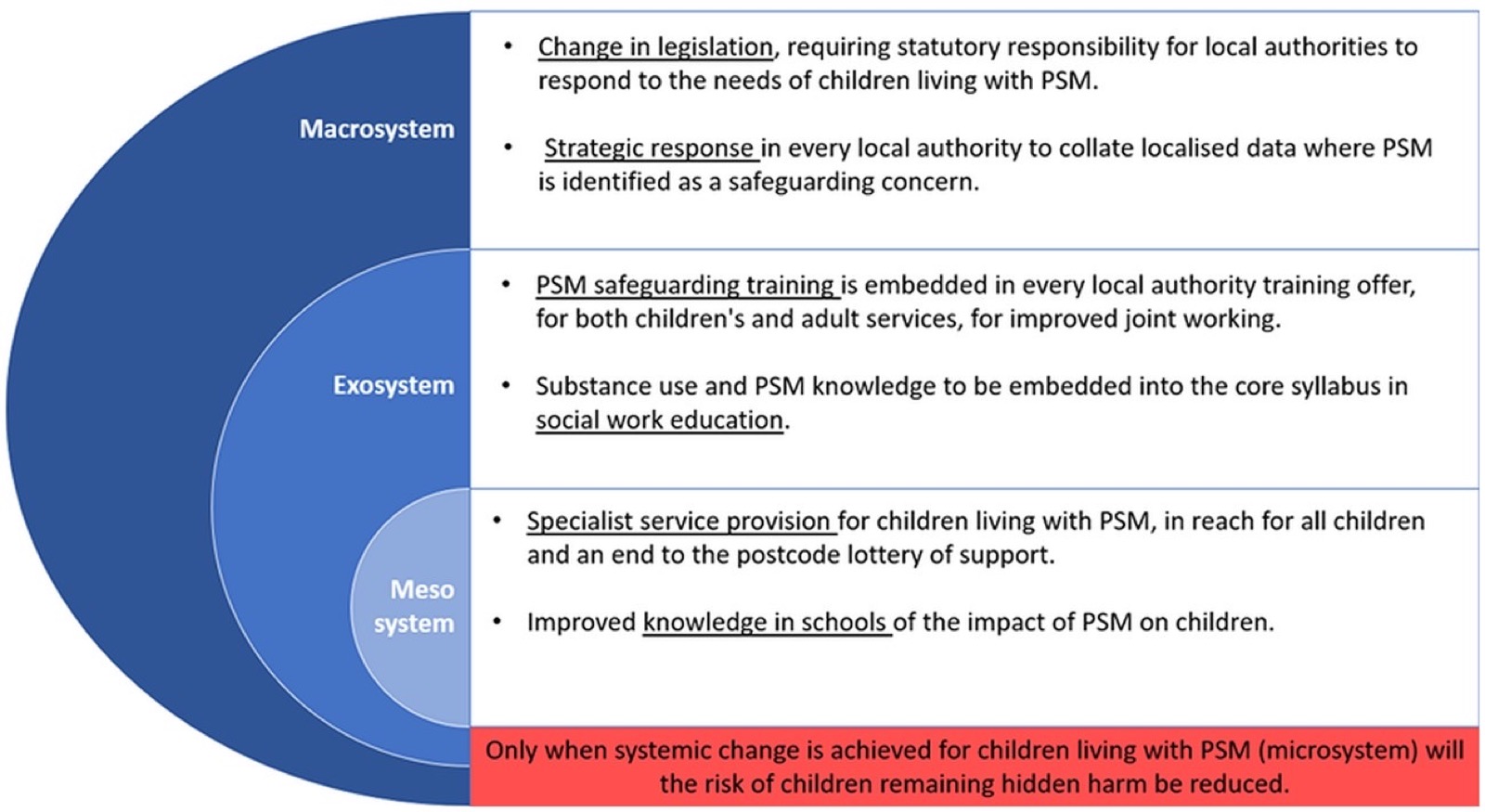
During a time of continued austerity and cuts to vital public services, the lack of legislative protection adds a further layer of systemic failings for children living with PSM. This research advocates changes to respond to the deep-rooted systemic failings, as illustrated below.
[Drawing 5 (The Resilience tree ‘people talking to me’ by Kit) — drawing by a participant, not reproduced here.]
Without appropriate recognition in legislation, changes in policy to ensure all front line practitioners have access to appropriate training and adequate funding for local authorities to commission services, children living with PSM will continue to be failed. Only by addressing the complexity of PSM across multiple systems, which not only interact but overlap, can sustained change be achieved.
Conclusion
The children who participated in this research experienced multiple adversity, precarity and harm. Their reflections illustrated the harsh and enduring reality of their lives, compounded by austerity, financial hardship, homelessness, threats of violence and domestic abuse. The findings suggest that the negative impact of PSM was not indicative of the substance nor the child’s age, as both the youngest and the oldest child participants experienced multiple risks and adversities.
The challenges experienced were compounded by the decade-long impact of austerity measures, which have reduced early intervention services. Resulting in practitioners prioritising the needs of younger children to the detriment of older children. This research has highlighted the impact of PSM on older children with their increased risk of significant harm due to criminal exploitation and/or child sexual exploitation.
The findings identified how a lack of PSM training, both pre- and post-qualification, had impacted practitioners’ ability to effectively identify, assess and respond to the needs of children living with PSM. This will have led to missed opportunities to prevent significant harm and potentially decreasing the number of children being placed in kinship or local authority care.
This research has highlighted the need for systemic change and the value of hearing the voices of children living with PSM. Only by addressing the complexity of PSM across multiple systems, can sustained change be achieved.
Complexe Systémique: key points
This article is valuable because it gives a voice to young children, through drawing and animal metaphors, where research on parental addiction mostly questions adults. Bronfenbrenner’s framework is a reminder that the symptom does not stop at the front door: the grandmother who feeds, the school that protects or punishes, the youth club closed by austerity all belong to the same system. The most debatable point, from a systemic standpoint, is the criticism of the whole-family approach, accused of erasing the child’s voice. It can be read less as a rejection of family work than as a call to create, within that work, a space of the child’s own, with an identifiable trusted adult and a time frame not counted in weeks. The limits are clear: seven white British children, in a single local authority, recruited with their parents’ consent, and findings presented selectively. Read alongside the realist review of family-based interventions for children of substance-abusing parents, and the article on maltreatment and support needs in these families.
Notes from the original
Acknowledgements. The authors would like to thank the Department of Social Care and Social Work, Manchester Metropolitan University and the North-West local authority where the research took place, for understanding why this research was needed. This research would not have been possible without the bravery of the children who participated, and their parents’ trust in the research. This research would also not have been possible without the practitioners who sacrificed their time.
Funding. This research was funded by the Department of Social Care and Social Work, Manchester Metropolitan University.
Conflict of interest statement. None declared.
References
Advisory Council on the Misuse of Drugs. (2003) ‘Hidden Harm Full Report’, available at: https://assets.publishing.service.gov.uk/government/uploads/system/uploads/attachment_data/file/120620/hidden-harm-full.pdf(accessed June 14, 2023).
Association of Directors of Children’s Services (ADCS). (2018) ‘Research Report Safeguarding Pressures Phase 6’, available online at: https://adcs.org.uk/assets/documentation/ADCS_SAFEGUARDING_PRESS URES_PHASE_6_FINAL.pdf (accessed June 14, 2023).
Brandon M., Sidebotham P., Belderson P., Cleaver H., Dickens J., Garstang J., Harris J., Sorensen P., Wate R. (2020) ‘Complexity and Challenge: A Triennial Analysis of SCRs 2014–2017 Final Report March 2020,’ Department for Education, available online at: https://assets.publishing.service.gov.uk/government/uploads/system/uploads/attachment_data/file/869586/TRIENNIAL_SCR_REPORT_2014_to_2017 (accessed June 14, 2023).
Bronfenbrenner U. (1977) ‘Toward an experimental ecology of human development’, American Psychologist, 32(7), pp. 513–31. https://doi.org/10.1037/0003-066X.32.7.513
Bronfenbrenner U. (1979) The Ecology of Human Development: Experiments by Nature and Design, London, Harvard University Press. https://doi.org/10.4159/9780674028845
Braun V., Clarke V. (2013) Successful Qualitative Research: A Practical Guide for Beginners, London, SAGE.
Children’s Commissioner. (2018) “Are they Shouting Because of Me?” Voices of Children Living in Households with Domestic Abuse, Parental Substance Misuse and Mental Health Issues’, Children’s Commissioner for England, available online at: https://www.childrenscommissioner.gov.uk/wp-content/uploads/2018/08/Arethey-shouting-because-of-me.pdf (accessed October 7, 2020).
Forrester D., Harwin J. (2006) ‘Parental substance misuse and child care social work: Findings from the first stage of a study of 100 families’, Child & Family Social Work, 11(4), pp. 325–35.
Forrester D., Harwin J. (2007) ‘Parental substance misuse and child welfare: Outcomes for children two years after referral’, British Journal of Social Work, 38(8), pp. 1518–35. https://doi.org/10.1093/bjsw/bcm051
Galvani S. (2017) ‘Social work and substance use: Ecological perspectives on workforce development’, Drugs: Education, Prevention and Policy, 24(6), pp. 469–76.
Galvani S., Dance C., Hutchinson A. (2013) ‘Substance use training experiences and needs: Findings from a national survey of social care professionals in England’, Social Work Education, 32(7), pp. 888–905. https://doi.org/10.1080/02615479.2012.719493
Galvani S., Forrester D. (2011) How Well Prepared are Newly Qualified Social Workers for Working with Substance Use Issues? Findings from a National Survey in England, England, Taylor & Francis Group.
Gance-Cleaveland B., Mays M., Steffen A. (2007) ‘Association of adolescent physical and emotional health with perceived severity of parential substance abuse’, Journal for Specialists in Paediatric Nursing, 13(1), pp. 15–25.
Harwin J., Ryan M., Broadhurst K. (2018) ‘How does FDAC succeed with parents with substance misuse problems? Exploring relational practices within the English family drug and alcohol court’, Child Abuse Review, 27(4), pp. 266–79. https://doi.org/10.1002/car.v27.4
HM Government. (2018) ‘Working Together to Safeguard Children A Guide to Inter-agency Working to Safeguard and Promote the Welfare of Children’, available online at: https://assets.publishing.service.gov.uk/government/uploads/system/uploads/attachment_data/file/729914/Working_Together_to_Safeguard_Children2018.pdf (accessed June 14, 2023).
HM Government. (2023) ‘Working Together to Safeguard Children A Guide to Multi-agency Working to Help, Protect and Promote Het Welfare of Children’, available online at: https://assets.publishing.service.gov.uk/media/65cb4349a7ded0000c79e4e1/Working_together_to_safeguard_children_2023_-_statutory_guidance.pdf (accessed June 14, 2023).
Holland S., Forrester D., Williams A., Copello A. (2014) ‘Parenting and substance misuse: Understanding accounts and realities in child protection contexts’, British Journal of Social Work, 44(6), pp. 1491–507. https://doi.org/10.1093/bjsw/bcs197
Home Office. (2017) ‘2017 Drugs Strategy’, available online at: https://assets.publishing.service.gov.uk/government/uploads/system/uploads/attachment_data/file/628148/Drug_strategy_2017.PDF (accessed June 14, 2023).
Jones D., Lowe P., West K. (2019) ‘Austerity in a disadvantaged West Midlands neighbourhood: Everyday experiences of families and family support professionals’, Critical Social Policy, 40(3), pp. 389–409. https://doi.org/10.1177/0261018319840923
Kamenopoulou L. (2016) ‘Ecological systems theory: A valuable framework for research on inclusion and special educational needs/disabilities’, Inclusion of Children with Special Educational Needs, 88, 515–27.
Kroll B., Taylor A. (2009) Parental Substance Misuse and Child Welfare, London, Jessica Kingsley Publishers.
McLaughlin H. (2013) ‘Keeping interprofessional practice honest: Fads and critical reflections’, in Littlechild B., Smith R. (eds), A Handbook for Interprofessional Practice in the Human Services Learning to Work Together, Oxon, Routledge.
Mertin P., Mohr P. B. (2002) ‘Incidence and correlates of post trauma symptoms in children from backgrounds of domestic violence’, Violence and Victims, 17(5), pp. 555–67. https://doi.org/10.1891/vivi.17.5.555.33712
Oulton K., Gibson F., Sell D., Williams A., Pratt L., Wray J. (2016) ‘Assent for children's participation in research: Why it matters and making it meaningful: Assent for children's participation in research’, Child: Care, Health and Development, 42(4), pp. 588–97. https://doi.org/10.1111/cch.v42.4
Punch S. (2002) ‘Research with children: The same or different from research with adults’, Childhood, 9(3), pp. 321–41.
Roy J. (2021) ‘Children living with parental substance misuse: A cross-sectional profile of children and families referred to children’s social care’, Child & Family Social Work, 26(1), pp. 122–31. https://doi.org/10.1111/cfs.v26.1
Russo M. F., Vernam J., Wolbert A. (2006) ‘Sandplay and storytelling: Social constructivism and cognitive development in child counselling’, The Arts in Psychotherapy, 33(3), pp. 229–37. https://doi.org/10.1016/j.aip.2006.02.005
Sewell K. (2011) ‘Researching sensitive issues: A critical appraisal of ‘draw and-write’ as a data collection technique in eliciting children's perceptions’, International Journal of Research & Method in Education, 34(2), pp. 175–91. https://doi.org/10.1080/1743727X.2011.578820
Sidebotham P., Brandon M., Sue Bailey S., Belderson P., Dodsworth J., Garstang J., Harrison E., Retzer A., Sorensen P. (2016) ‘Pathways to Harm, Pathways to Protection: A Triennial Analysis of Serious Case Reviews 2011 to 2014 Final Report,’ Department for Education, available online at: https://assets.publishing.service.gov.uk/government/uploads/system/uploads/attachment_data/file/533826/Triennial_Analysis_of_SCRs_2011-2014- Pathways_to_harm_and_protection.pdf (accessed June 14, 2023).
Smith J. A., Larkin M. H., Flowers P. (2012) Interpretative Phenomenological Analysis: Theory, Method and Research, London, SAGE Publications. https://doi.org/10.1037/13620-000
Tait A., Wosu H. (2012) Direct Work with Vulnerable Children Playful Activities and Strategies for Communication, London, Jessica Kingsley Publishers.
Todman H. (2021) Understanding the Needs of Children Living with Parental Substance Misuse: Perspectives of Children and Professionals, Doctoral Thesis (PhD), London, Department of Social Care and Social Work Manchester Metropolitan University, available online at: https://assets.publishing.service.gov.uk/media/65cb4349a7ded0000c79e4e1/Working_together_to_safeguard_children_2023_-_statutory_guidance.pdf (accessed June 14, 2023).
Todman H., Galvani S. (2022) Parental Substance Use: Supporting School Aged Children. A BASW Practice Guide, Birmingham, BASW.
Turning Point. (2006) ‘Bottling it Up: The Effects of Alcohol Misuse on Children, Parents and Families,’ available online at: https://www.drugsandalcohol.ie/6276/1/3499-3720.pdf (accessed June 14, 2023).
Van Manen M. (2016) Researching Lived Experience: Human Science for an Action Sensitive Pedagogy, 2nd ed., New York, NY, Routledge.
Velleman R., Reuber D. (2007) ‘Domestic Violence and Abuse Experienced by Children and Young People living in Families with Alcohol Problems: Results from a Cross-European Study’, ENCARE, available online at: www.drugs.ie/resourcesfiles/ResearchDocs/Europe/Research/2007/Encare_ParentalAlcoholProblems.pdf (accessed June 14, 2023).
Visit North West. (2024) ‘Stockport Population’, available online at: Stockport Population - Demographics, Census Data, Ethnicity, Density (visitnorthwest.com) (accessed May 17, 2024).
Wilkinson D., Birmingham P. (2003) Using Research Instruments: A Guide for Researchers, London, Routledge, Falmer.
Reformatted republication of Understanding the Needs of Children Living with Parental Substance Misuse: Perspectives from Children and Practitioners, by Hannah Todman and Hugh McLaughlin, The British Journal of Social Work, vol. 54, no 7, p. 3073-3095 (2024), doi: 10.1093/bjsw/bcae079, under a CC BY 4.0 licence. Edition and layout: Complexe Systémique, September 2026 — the work has been modified under the terms of the licence. Neither the authors nor the publisher are responsible for this edition; the original version prevails.
This is the original article “Understanding the Needs of Children Living with Parental Substance Misuse: Perspectives from Children and Practitioners”, published in The British Journal of Social Work (2024) under a CC BY 4.0 licence. Republished by Complexe Systémique: the author’s text is unchanged; only the presentation has been adapted for reading online, as set out at the head of this page.
Read the original articleHow to cite this article
Todman, H., et McLaughlin, H. (2024). Understanding the Needs of Children Living with Parental Substance Misuse: Perspectives from Children and Practitioners. Complexe Systémique. https://app.complexe-systemique.com/en_GB/articles/understanding-the-needs-of-children-living-with-parental-substance-misuse (Original work published in 2024 in The British Journal of Social Work, 54(7), 3073-3095 (2024); republished in 2024 by The British Journal of Social Work, https://academic.oup.com/bjsw/article/54/7/3073/7682341)
To go further
- Une revue réaliste des interventions familiales pour les enfants de parents abusant de substancesFamily-based interventions for parental addiction.
- Comprendre la maltraitance et les besoins de soutien dans les familles marquées par l’usage problématique de substances des parentsMaltreatment and support needs.
- « Une meilleure vie de famille » : l’expérience d’une gestion de cas familiale globale face au mésusage parental d’alcoolA whole-family approach, seen from the inside.
Related articles
 Scientific
Family group conference provision across the lifespan of child welfare intervention: A mixed-method realist-informed evaluation comparing three stages of welfare concern
Early help, child protection or children in care: among 155 UK families, experiences and outcomes of family group conferences vary very little by stage.
 Scientific
“One Can Have All Sorts of Good Intentions but Sometimes in Everyday Life, It Turns Out Differently”: Change Agreements in Couples' Everyday Lives
Six Danish couples followed after an online couple program: their change agreements become guilt-inducing contracts, shared understanding or revealers of inequality.
 Scientific
How can we BeST? meet the needs of adoptive families? Relevant findings from a major Randomised Controlled Trial of infants in foster care in the UK
The BeST? trial (488 infants in care in the UK) reread for adoption: holistic, ongoing assessment of children and a move to dual registration.
 Scientific
The Role of Parental Expressed Emotion and Loss-Specific Parental Responses in Children’s Loss-Related Outcomes Following Traumatic Loss: A Mixed-Methods Observational Study
After a road-traffic bereavement, parental criticism goes with the child's depression, positive appraisals of the loss with better well-being.