Counselling and Psychotherapy Research · Family therapy
Who has the Right to Know? Negotiating Epistemic Authority in Constructionist Therapies
What happens when, in session, it is the clients who ask the questions? Ioanna Moraitou and Eleftheria Tseliou analyse, line by line, 19 recorded sessions of post-Milan systemic therapy in Greece. Families ask for an expert’s opinion, therapists answer with a question: the equality that constructionist therapies aim for is accomplished, paradoxically, through the very authority they claim to leave behind.
This is a reformatted republication of Who has the Right to Know? Negotiating Epistemic Authority in Constructionist Therapies, by Ioanna Moraitou and Eleftheria Tseliou, published in Counselling and Psychotherapy Research (Wiley) (2025), doi: 10.1002/capr.70015, under a CC BY 4.0 licence. Prepared by Complexe Systémique in September 2026: the authors’ text is unchanged; the layout has been adapted for reading online, which constitutes a modification of the work under the terms of the licence. The six transcript extracts are reproduced as images; the notation table is presented as a list; the data availability statement is not reproduced. This edition was made neither by the authors nor by the publisher, who are not responsible for its content or for any errors. The original version prevails.
Since equality seems to be accomplished by authority and vice versa, equality and authority seem to be two sides of the same coin.
Ioanna Moraitou and Eleftheria Tseliou
Abstract
Objectives. Constructionist therapies challenged therapists’ authority and advocated the non-hierarchical participation of all members of the therapeutic system in the therapeutic dialogue. However, therapy is institutionally constructed as an asymmetrical process, with the therapist being assigned epistemic authority, that is, the right to know, as compared to clients. Accordingly, clients may evoke therapists’ expertise by asking for advice or straightforward diagnostic assessment. Within such a context, a normative conversational pattern is the therapist being the one formulating questions and the client being the one answering such questions. However, clients may deviate from such a pattern by formulating their own questions to the therapist. The present study's aim was to investigate how participants negotiate epistemic authority, in instances where such deviations occur.
Methods. Drawing from discursive psychology and conversation analysis, we analysed 19 audiotaped therapy sessions, conducted by 3 therapists following the post-Milan systemic approach.
Results. By focusing on a conversational pattern where clients address questions to therapists and therapists respond with questions, analysis illustrates the dilemmatic ways in which therapists and clients challenge and affirm epistemic asymmetry. By addressing a question to the therapist, clients appear to resist asymmetry, while at the same time they invoke therapists’ authority, thus challenging therapists’ adherence to constructionist premises. On the other hand, therapists, by replying with questions, seem to restore the normative order of therapeutic conversation, but also resist such an invoking by not responding from a position of authority.
Conclusion. Our findings highlight the dilemmatic aspects of epistemic authority negotiation in constructionist therapies.
Summary: Implications for practice and policy
- The rhetorical practices identified in our study can inform therapists about the nuanced performance of epistemic authority in the actual therapeutic dialogue.
- Being aware of the dilemmatic aspects of clients' positioning with regard to epistemics, therapists will be able to discern disaffiliative moments that may relate to issues of knowledge and expertise.
- Training programmes in constructionist therapy, and in therapy overall, should engage with the issue of epistemic authority, acknowledging that therapists cannot and should not escape from it, as it can be the means to promote therapeutic change.
- Policies should encourage reflexivity regarding the inevitability of therapists' epistemic authority so that therapists can both acknowledge and reflect on their use of authority.
In this paper, we illustrate how therapists and clients negotiate epistemic asymmetry within naturally occurring therapeutic dialogue in constructionist therapies. With the term constructionist therapies, we refer to approaches mostly developed in the field of systemic family therapy, like post-Milan (e.g., Cecchin et al. 2018) and collaborative approaches (e.g., Anderson 2012). Such approaches share constructionist premises, like the idea that therapy is a co-constructive process, where therapists and clients interact within a conversational space while coordinating their activities (McNamee and Shawver 2004). The therapist is encouraged to abandon the status of authority, and therapy is depicted as a process of mutual influence and transformation (Sutherland 2007). However, therapists are institutionally assigned a higher epistemic status (Stevanovic and Peräkylä 2012, 2014), that is, a higher position with regard to access to knowledge in relation to their clients. Accordingly, clients enter therapy asking for expert advice and solutions to their problems (Silver 1991). The therapeutic practice of posing questions denotes the asymmetry between therapists and clients, as therapists perform their institutional role leading to a reformulation of the original problem by addressing questions to clients (Bartesaghi 2009; Worsøe and Jensen 2020). Simultaneously, the focus on clients' experiences during the therapeutic conversation and therapists' efforts to gain access to these experiences foregrounds the clients' epistemic authority, in that clients are considered experts regarding their own experiences (Ekberg and LeCouteur 2015; Ong et al. 2021; Weiste et al. 2016).
To date, there is limited knowledge about how therapists and clients manage such epistemic asymmetry within the therapeutic context (Ekberg and LeCouteur 2015; Muntigl et al. 2020; Muntigl and Horvath 2014; Ong et al. 2021; Ong et al. 2023; Ong et al. 2024; Smoliak et al. 2022). These studies mostly employ conversational analysis (CA), a qualitative approach allowing for the study of how the social world is constructed in talk (Sacks et al. 1974) and closely affiliated with discursive psychology (DP) (Edwards and Potter 1992), and focus mainly on constructionist therapies. Existing studies of epistemic asymmetry (Muntigl and Horvath 2014; Ong et al. 2024) in the therapeutic dialogue emphasise the need for further study on this matter.
In this paper, we join this line of research by presenting CA and DP informed analyses of transcribed post-Milan therapy sessions, illustrating how therapists and clients negotiate their epistemic authority. First, we elaborate on the notion of epistemic asymmetry in constructionist therapies, and then we focus on the use of questions regarding epistemic asymmetry. We conclude by reporting our discursive analysis, focusing on instances where the clients breach the normative pattern of the therapeutic interaction by formulating their own questions, while therapists answer with a question.
1 Epistemic Asymmetry in Constructionist Therapies
The post-Milan model (Cecchin et al. 2018) and other constructionist models, such as collaborative therapy (Anderson 2012), narrative therapy (White and Epston 1990), and the open dialogue approach (Seikkula 2011), challenged the idea of the therapist's authority and approached therapy as a process of co-construction. Focusing on the client's narrative rather than on the therapist's knowledge, the therapist and the client are considered as conversational partners (Anderson 2012) co-producing knowledge within their local interactional context, that is, the therapeutic dialogue. Accordingly, constructionist therapists relate with clients in a non-directive style, refrain from giving advice (Couture and Sutherland 2006) and from engaging into a monologic, diagnostic discourse (Anderson 2012). On the other hand, such preferences may directly clash with clients who are seeking expert advice and assessment (Silver 1991). In this context, a conflict may arise between the ‘systemic’ and ‘lifeworld’ concerns of therapists and clients, respectively, as the interactional constraints of the therapeutic approach contradict clients' expectations for ‘straightforward’ answers.
Such an interactional setting becomes further complicated by the institutional setting of therapy. Rights and obligations are distributed differently among the participants in therapeutic interaction, as compared to everyday conversations. Therapists' and clients' primary positions attribute to therapists' higher epistemic authority (Ong et al. 2023), given the culturally dominant construction that the therapists have the knowledge and the expertise to ‘cure’ the clients who seek their help. However, as the epistemic stance, that is, the public display of knowledge (Heritage 2012), is not always aligned with the epistemic status, that is, one's position relative to their co-participant(s) in terms of knowledge (Stevanovic and Peräkylä 2014), therapists can diverge from their status by displaying a more symmetrical stance. The constructionist therapeutic context seems to place the therapist in a challenging position as (s)he has to balance between the authority assigned to her/him by therapy's institutional setting and her/his model's dictates to develop a collaborative, non-authoritarian relationship with their client(s) (Anderson 2012).
Simultaneously, given that the positions of authority and the resulting asymmetry are not fixed, clients can resist experts' authority. For example, research (Muntigl et al. 2020) has shown that clients refuse to participate in a particular task by explicitly expressing their reluctance, by keeping silent or by questioning the authenticity of the task. Clients also use their epistemic authority, that is, knowledge derived from their personal experience (Stevanovic and Peräkylä 2012), to resist therapists' suggestions (Ekberg and LeCouteur 2015). By juxtaposing the authority of their personal experience and knowledge, clients emphasise their epistemic primacy, advocating the position of a co-conversant with equal rights.
Overall, in constructionist therapies, therapists and clients need to negotiate epistemic authority given the conflicting demands of their institutionally assigned positions and of the constructionist premises for sharing epistemic expertise, a topic for investigation which has gained limited attention research-wise, as of the time of writing.
2 Epistemic Asymmetry in Constructionist Therapies and Questions in the Therapeutic Dialogue
CA, DP, and constructionist therapies situate the understanding of human behaviour and of mental phenomena within the context of recursive, discursive interaction (Ong et al. 2020; Tseliou and Borcsa 2018). Accordingly, CA and DP bear epistemological and theoretical affinity with such therapies (e.g., Tseliou and Borcsa 2018). CA (Sacks et al. 1974) focuses on studying normative conversational features, like turn-taking, conversational sequences, and adjacency pairs, that is, pairs where when the first part is uttered, a second one is normatively expected, like questions and answers. DP (Edwards and Potter 1992) highlights the performative and argumentative aspects of language in use. DP argues that discourse is inherently dilemmatic, and every time we engage in a conversation, we argue for the veracity of our knowledge claims (Billig 1996).
To date, there is CA and DP research focusing on the study of epistemic asymmetry and authority in psychoanalysis and cognitive therapy (Ekberg and LeCouteur 2015; Etelämäki et al. 2021; Weiste et al. 2016), emotion-focused therapy (e.g., Muntigl et al. 2020; Smoliak et al. 2022), couple and family therapy (Muntigl and Choi 2010), systemic therapy (Watson 2019), collaborative therapy (Smoliak et al. 2018), and the open dialogue approach (Ong et al. 2021; Ong et al. 2024). For example, research (Ong et al. 2021; Ong et al. 2024; Weiste et al. 2016) has shown how therapists downgraded their own knowledge by means of expressions like ‘I'm wondering’ and by grounding their talk in clients' inner experiences or by repeating and incorporating clients' talk. Therapists were also shown (Smoliak et al. 2022) as being co-authors of clients' experiences by means of reporting clients' direct speech and by completing conversation turns, while promoting their own agendas. Clients, on the other hand, were shown as reluctant to follow the therapists' directives and agenda when these were not grounded on prior elicitation of their views (Smoliak et al. 2022) or as invoking their experience to resist unusual questions posed by the therapist (Smoliak et al. 2018). Finally, research focusing on clients' epistemic rights has shown that following an expression of disagreement or withdrawal by the client, the imposition of a therapeutic agenda not associated with the client's perspective led to the creation of a recursive cycle of disaffiliation (Muntigl and Horvath 2014).
It has been argued (Wang 2006) that the study of the unequal distribution of questions can further contribute to the understanding of participants' asymmetry within institutional dialogue. Institutional dialogue is considered as an asymmetrical interaction where the question-answer sequence implies different rights and obligations between the participants (Heritage 2005; Tracy and Robles 2009; Wang 2006). In psychotherapy, questioning is not just about gathering information but further helps therapists to reframe the therapeutic problem according to psychotherapy's institutional requirements. As clients become answerable to therapists and as the presuppositions of the therapeutic process are not accessible to clients, an issue of asymmetry arises concerning the therapist's rights to control the client's contribution (Bartesaghi 2009).
Yet, clients are not passive recipients of therapists' suggestions (Buttny 1996). Dis-preferred response turns, that is, turns which are not normatively expected in adjacency-pair sequences (Sacks et al. 1974), such as silence, questioning, hesitations and repeats, occur when clients express their disagreement with the therapists' articulations in a less obvious way (Pomerantz 1984).
However, to our knowledge, there is no research to date focusing on questions and their relevance for the negotiation of asymmetry between therapists and clients within naturally occurring therapeutic discourse.
3 The Present Study
Acknowledging the limited insights on how equality and collaboration are accomplished in constructionist therapies with regard to questioning, we conducted a CA and DP informed study focusing on the investigation of how clients and therapists negotiate epistemic authority. In this paper, we present an analysis of instances where the institutional order of questions—answers is breached, like when clients instead of therapists pose questions and therapists respond with further questions within naturally occurring constructionist therapeutic dialogue.
4 Method
4.1 Data, Participants, and Setting
We sampled 19 audiotaped individual (6) and family therapy sessions (13), conducted by three therapists following the post-Milan systemic approach. The total duration of the sessions was approximately 16 h. All therapists were women trained in systemic family therapy. The sessions were conducted in two public mental health service settings in Greece.
4.2 Method of Analysis
Sessions were transcribed verbatim following a simplified version of Jefferson's (2004) notation system (see Table 1).
Table 1 — Transcription notation.
- (.) Pause which is noticeable but too short to measure
- (5) Pause timed in tenths of second
- : One or more colons indicate extension of the preceding vowel sound
- [] Overlap of talk
- (()) Double parenthesis indicate clarifying information
- > < Talk between is spoken more quickly than surrounding talk
- word Underline indicates emphasis
- ↑word Shifts into high pitch
- ↓word Shifts into low pitch
- = No distinct pause between the end of one's speech speaker and the start of the next speech
- (.hhh) Exhalation, the number of h indicates the duration of the exhalation
- °word° The word is pronounced in a low voice
Analysis included the following steps. First, the transcripts were read repeatedly to familiarise ourselves with what the text seemed to be accomplishing. Then, all instances where clients posed questions to the therapists were selected (n = 123). From the total sample of instances, those where the therapists respond with a question were selected (n = 14), given our focus on cases where the normative order of questioning-answering is breached. Next, we subjected the selected sequences to DP and CA informed analysis. DP analysis focused on the analysis of the dilemmatic aspects of participants' discursive interactions (Billig 1996), highlighting the contradictory issues and paradoxical situations that participants were faced with. Drawing from CA concepts, like the next-turn proof procedure, that is, evidence of how participants make sense of each other's contributions and the turn-taking organisation of talk (Sacks et al. 1974), we analysed participants' orientation, that is, what they made relevant in their discourse and the recurring conversational patterns.
The analysis below includes the most illustrative extracts, which we translated from Greek to English. In the extracts, we have replaced the names of the clients with pseudonyms to preserve anonymity. The therapists are presented as Τh, and in the cases where there are two therapists, as Th1 and Th2.
4.3 Procedures and Ethics
We followed the code of ethics of the University of Thessaly, Greece1. Following an initial contact with the therapists to provide information about the study, an informed consent form was signed, which addressed issues of confidentiality and participants' rights.
For data sampling, we first contacted local psychotherapeutic associations and institutes. We then asked people in charge to forward to therapists a letter with the study details and a contact form. Of the eight therapists who expressed interest in participating in the study, three decided to proceed with participation, all practising from a post-Milan approach perspective. All participating therapists and clients signed an informed consent form. All therapies had been completed when we were granted access to the sampled audiotapes.
5 Analysis
Our analysis of the conversational pattern where the clients address questions to therapists and therapists respond with questions depicted the dilemmatic ways in which therapists and clients challenged and affirmed epistemic asymmetry. Specifically, we identified the following pattern: clients seemed to challenge the therapists' adherence to constructionist principles for non-hierarchical interaction by seeking therapists' expertise, such as advice and straightforward answers to their questions about assessment. Therapists, on the other hand, seemed to reject clients' assessment and advice-seeking. Clients, in turn, seemed to resist therapists' resistance to offer advice and diagnostic assessment and the therapists' efforts to make them—instead of themselves—provide the answers to their questions.
Overall, therapists and clients seemed to alternate between the position of an equal interlocutor and that of not-knowing, depending on the conversational context. By formulating a question to the therapist and by violating the normative pattern of the therapeutic interaction, the clients seemed to resist the asymmetry, claiming the position of a co-conversant with equal rights. Thus, they either invoked their personal experience, asserting their own epistemic authority, or called on the therapist as an authority to provide an objective answer supporting their argument, resisting therapists' refraining from providing straightforward answers and advice.
Therapists seemed to restore the normative pattern of the therapeutic conversation, asserting their right to control the conversation by answering the clients' questions with questions. By not answering the clients' questions, they also refrained from undertaking a position of expertise/authority, thus rejecting clients' advice-seeking. Furthermore, they seemed to invite the clients to highlight their own perspectives, showing that they acknowledge the epistemic authority that arises from clients' personal experiences, while at times they challenged/questioned the clients' opinions without directly contradicting them.
The sections below illustrate three exemplars of the identified pattern.
5.1 You better tell me
In the following two extracts of the same sequence, the client asks a clarifying question and the therapist formulates a question eliciting the client's subjective view. It comes from a first family therapy session where two female therapists, the mother, the father and the son of the family, Dimitris (D), participated.
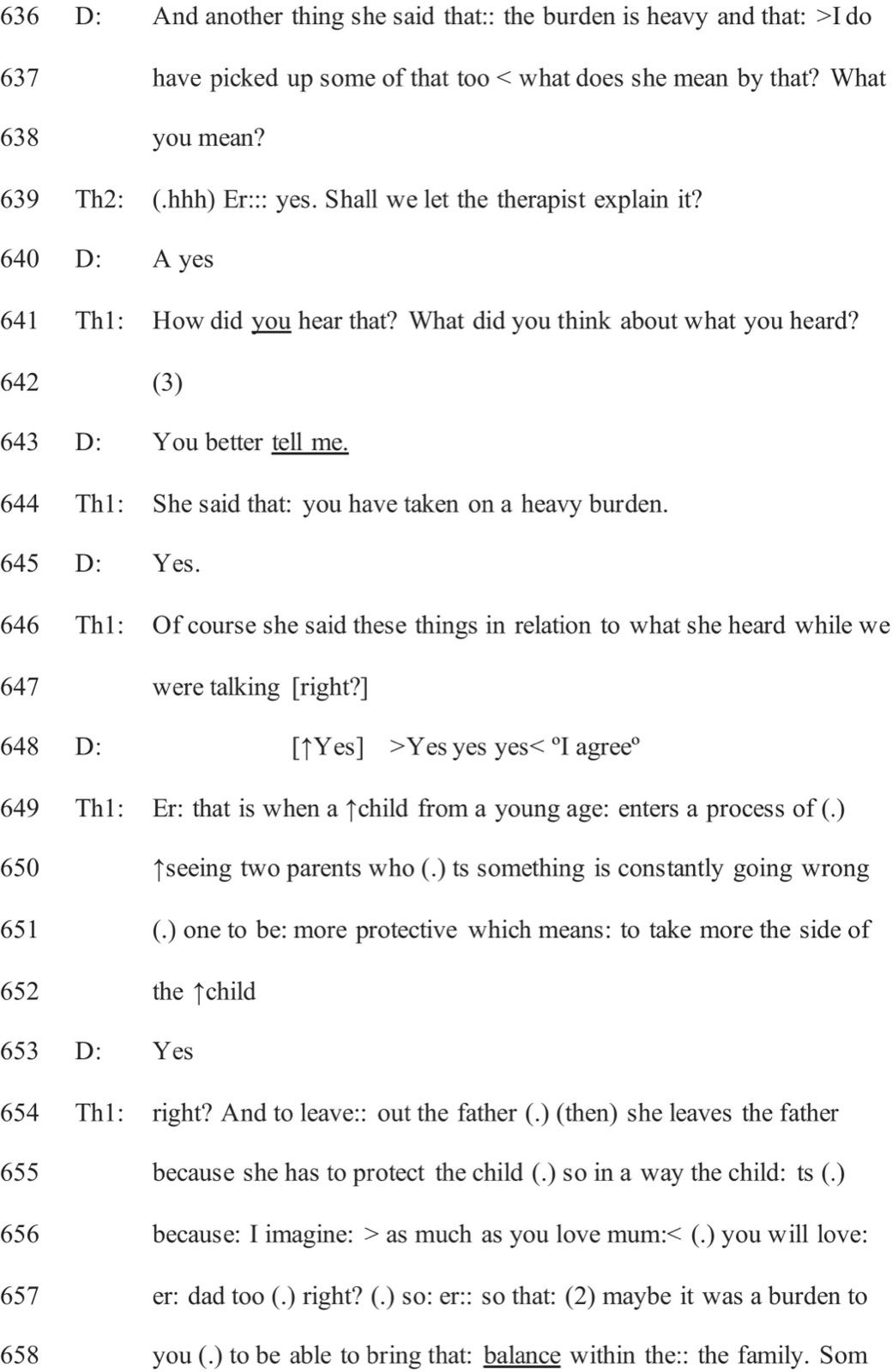
Following a reflecting team discussion between the therapists (538–577), that is, a conversation in the presence of the clients, with the aim of providing feedback to the discussion (Andersen 1987), the sequence begins with a formulation by the therapist who attempts to connect the comments of two family members by making explicit reference to what the mother has previously reported (626–628). At the beginning of extract 1a (636–638), Dimitris asks for clarification on a comment made by the therapist during the reflective discussion. The prolonged exhalation and the hesitation marker, (.hhh) Er::: (639) seem to mitigate the co-therapist's authority (Couture and Sutherland 2006; Strong et al. 2008), while the interrogative sentence and the use of the first-person plural pronoun, ‘Shall we let the therapist explain it?’ (639) construct her as less directive. The reversal of the client's question, ‘How did you…heard?’ (641), shows that the therapist is seeking the client's subjective opinion, while she exerts control over the discussion agenda. The client's use of the imperative and the emphasis on ‘tell me’ (643) show that he does not passively accept the therapist's authority. The therapist using the clients' discourse, ‘Of course…she heard’ (646), as footing, argues that the ideas formulated by her colleague are not based on some preformed knowledge, and through the question mark ‘(right?)’, she invites her interlocutor to consent. Features in the therapist's discourse, like the use of the words ‘imagine:’ (656) and ‘maybe’ (657), hesitancy markers ‘er::’ (657), and the incorrect formulations ‘Som m::(.)’ (658–659), seem to mitigate her claims about Dimitris. The question ‘am I saying that right?’ (659), seemingly addressed to the co-therapist, suggests that the speaker attributes an uncertainty to her description.
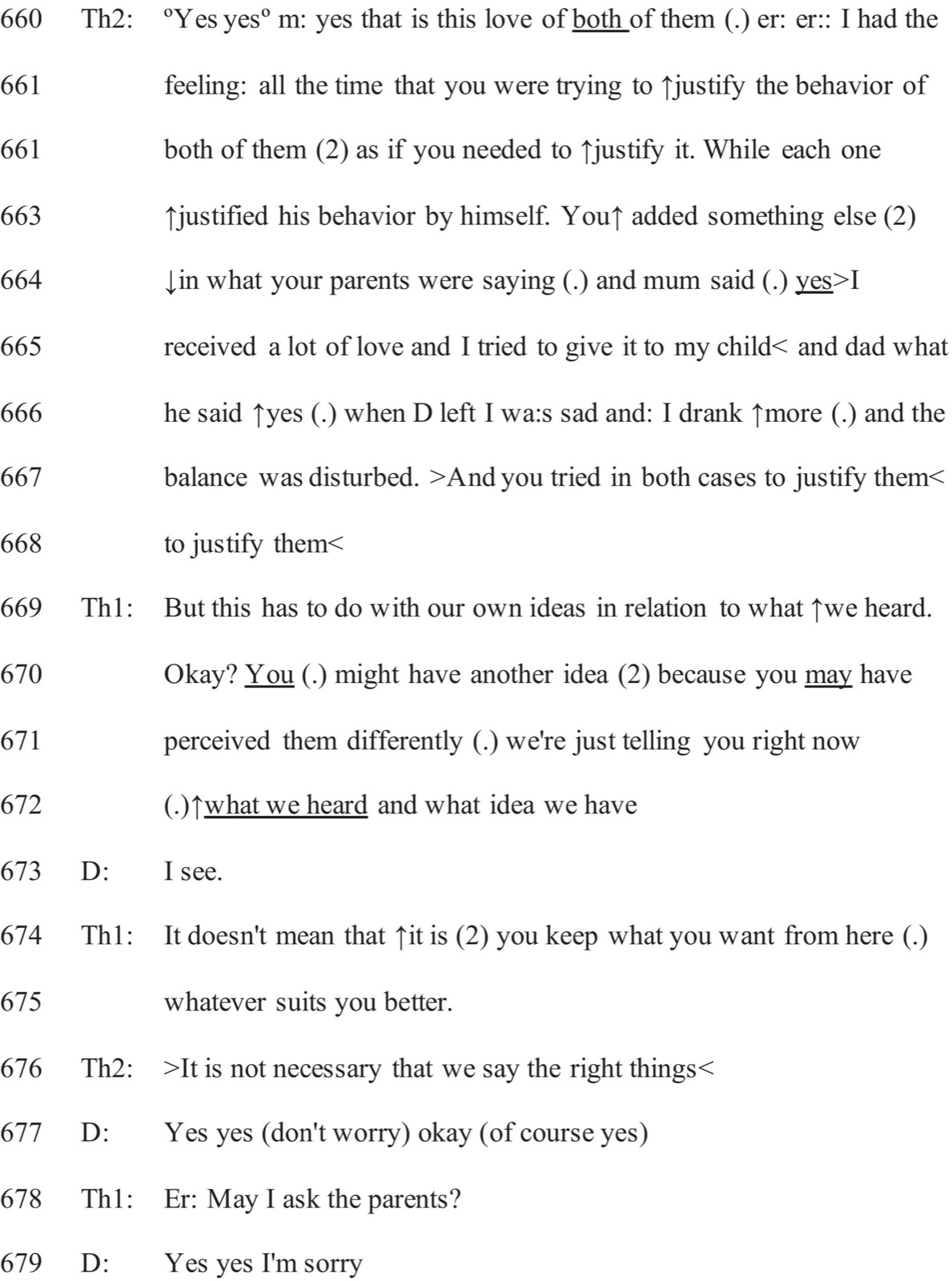
Following therapist 1's question (659, Extract 1a), the co-therapist hesitantly confirms the therapist's account, ‘°Yes yes° m: yes’ (660) and then (660–662) she completes it. By highlighting the common language of the experts, she attributes epistemic authority to their discourse. Simultaneously, she constructs her account as subjective by means of uncertainty markers (‘er: er::’, 660) and the expression ‘I had the feeling’ (660–661). She then seems to ground her description in the client's narrative by stating: ‘You↑ added something else (.)’ (663). The co-therapist further establishes the plausibility of her description without invoking her authority, by means of a number of rhetorical devices; note the use of the footing on the mother's and father's talk, ‘and mum said’ (664), ‘and dad…↑yes’ (665–666) and the vivid description with active voicing (Wooffitt 1992), ‘when D…↑more’ (666). The therapist, in turn, highlights the subjectivity of their perspective, ‘But this…we ↑heard’ (669), but at the same time, through the rhetorical question 'Okay? ‘(670), she invites her interlocutor to accept their description. She then acknowledges the client's right to have his own description, ‘You (.) might…differently’ (670-671). The emphasis on the words ‘Υou’ and ‘may’ and the use of the phrase ‘↑what we heard’ seem to further enhance the idea of subjectivity and authority of personal experience. Although the client seems to agree with the idea of subjectivity, ‘I see’ (673), the therapist continues to defend the client's right to have a different point of view ‘It doesn't…you better’ (674–675). The co-therapist's completion of the therapist's account (676) indicates that this right is not self-evident. The client shows that he accepts the position of a co-conversant with equal rights assigned to him by the therapists (677), constructing such right as indisputable for him (‘of course yes’). As the therapist asks the client's permission to continue the inquiry with his parents (678), the client's apology, ‘I'm sorry’ (679), seems to imply his acknowledgement that he has violated the rules of the therapeutic interaction.
Analysis of this sequence illustrated how the client claims the position of co-conversant but also seems to acknowledge the therapists' epistemic supremacy, by asking a clarifying question and asking for their assessment as experts. Similarly, the therapist was shown to restore the normative pattern of the therapeutic interaction and to acknowledge the client's epistemic authority by answering the client's question with a question. Evidently, the client seems to ask for the therapists' expertise, while the therapists seem to deflect such a request.
5.2 We are of elementary school
In Extract 2, the client attempts to strengthen her argument by asking the therapist for a straightforward assessment, while the therapist answering with a question highlights the importance of subjective experience. The conversation unfolds between the therapist and Christina, who came to therapy to discuss a problem with her grandson. The preceding reflecting team discussion focused mainly on the family members' difficulty in accepting the grandfather's grief over the imminent death of his elderly father.
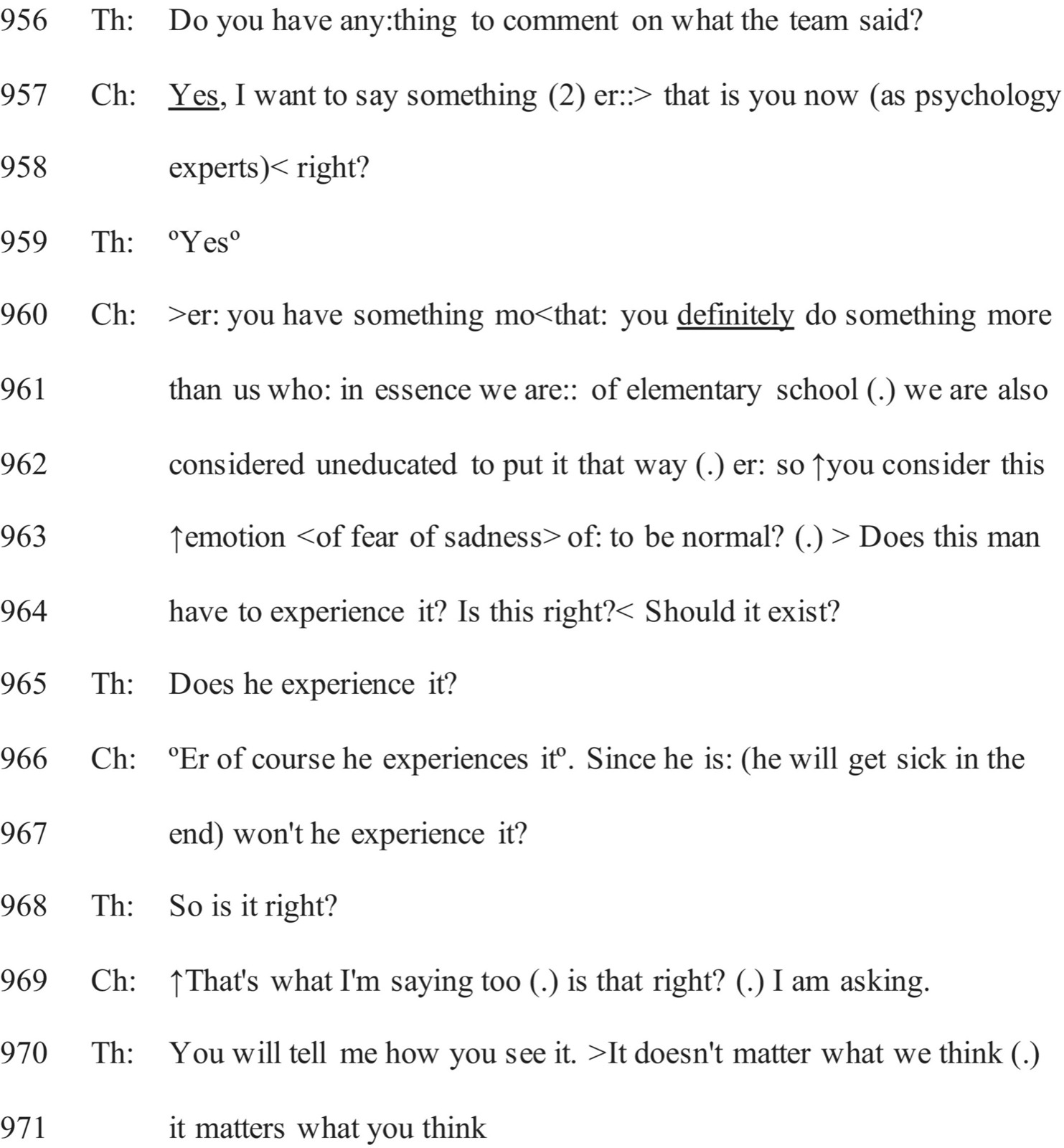
By identifying the part of the conversation where the clients are allowed to intervene (‘Do you…team said?’, 956), the therapist seemingly exercises control over the conducting of the discussion. The openness of the invitation regarding who can comment and the topics that can be commented on allows for constructing therapy as an egalitarian process, open to criticism and objection. Christina taking the floor highlights experts' and non-experts' different epistemic status. Simultaneously, she seems to indirectly criticise what was previously discussed by the reflecting team from the position of a co-conversant with equal rights. Specifically, by invoking the category of the expert (Sacks 1992), ‘er::>…(as psychology experts)<right?' (957–958), she seems to assign authority to the experts. Then, by comparing family members with the therapists, she downplays the position of the first in the therapeutic process: ’e: you have…us‘ (959–960). Similarly, the expressions ’we are:: of elementary school' (960) and ‘we are also considered uneducated’ (960–961) construct the speaker and the rest of the family, as people with a low educational level, but also emphasise the epistemic authority of experts. By highlighting this difference and then by asking questions about the reflection (‘er: so ↑you…exist?’, 961–963), the speaker seems to problematise the views of the therapists, without directly confronting them and without questioning their epistemic authority. Also, by referring to the ‘normal’ (962), the ‘right’ (963) and to ‘Should it exist?’ (963), the speaker seems to acknowledge the therapist's authority to offer an objective assessment while she questions the correctness of what was said during the reflective discussion. The therapist responds to Christina's question with a question (965) and shifts the focus of the discussion from the search for objective truth to her husband's experience, highlighting the client's epistemic authority. Christina initially admits that her husband is experiencing an unpleasant feeling. Later, she questions the way he is handling his health condition (‘he'll get…end’, 966-967). Thus, she seems to defend her point of view without questioning the experts' opinion. When the therapist invites her to assess her husband's reaction (‘So is it right?’, 968), she inverts the question, ‘↑That's what …asking’ (969), again questioning the therapist's authority. By asking ‘is that right?’ and by invoking the right-wrong dichotomy, Christina again reaffirms her search for an objective and scientific assessment of her husband's condition. In contrast to this request, the therapist highlights the importance of her co-conversant's perspective (‘You tell …it’, 970, ‘it matters … think’, 971), while downplaying the experts' knowledge (‘It doesn't …we think’, 970). Thus, she constructs the therapist as somebody who does not possess the absolute truth. Simultaneously, by not responding to the client's question and by being persistent in highlighting her point of view, she seems to impose a certain direction to the therapeutic dialogue.
In sum, analysis of Extract 2 illustrated how the client appears to acknowledge the therapist as an authority figure, while the therapist mitigates her epistemic authority by highlighting the importance of the client's experience, as opposed to expert knowledge, at the same time challenging her co-conversant's description. Like in the case of Extracts 1a–1b, the therapist seems to resist the client's effort to evoke her epistemic expertise by asking for an explicit diagnostic assessment.
5.3 What do you have to say about this?
The following sequence (Extracts 3a, 3b and 3c) comes from a family therapy session where two therapists, the identified patient, Victoria (V), her sister, her mother, Sofia (S), and her father, Harris (H), participate. The co-therapist (Th2) is also Victoria's personal therapist. Prior to this extract, the discussion focused on the mother's excessive care to her children, a behaviour disapproved by her husband and the identified patient. The mother then expresses her concern that Victoria might relapse due to her relationship with a man she does not approve of. The co-therapist intervenes, arguing that when the parents are stressed by the discussion, they recall Victoria's problem and attribute the responsibility for their actions to her.
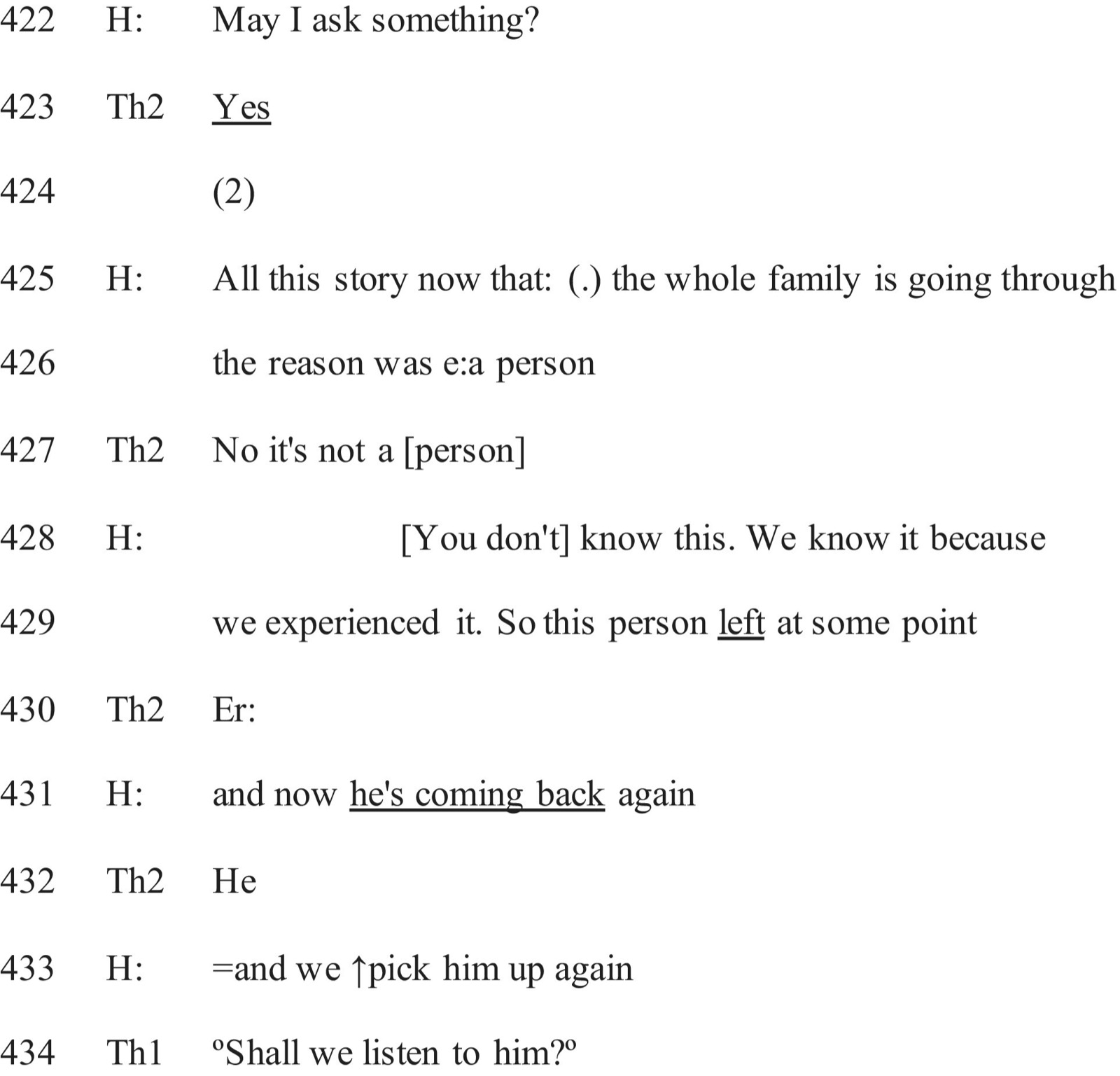
At the beginning of the extract, the father asks for permission to intervene (‘May I ask something?’, 422), showing that he acknowledges the therapist's authority. Then he seems to attribute the problem to Victoria's previous relationship (425–426), like his wife had done earlier. By means of the systematic vagueness (Potter 1996; ‘All this story now’, 425; ‘a person’, 426), and the generalisation of the problem to the family system (‘the whole…through’, 425), he reinforces his construction. When the therapist rejects this claim, ‘No, it's not a [person]’ (427), the father directly intervenes [note the overlapping speech] ’[You]…this' (428), and, in turn, rejects her claim, escalating their confrontation. The expression ‘We know it because we experienced it’ (428–429), strengthens the plausibility of his account, constructing personal experience as something indisputable, while the use of the first plural reinforces family members' alliance. The emphatic pronunciation of the expressions ‘left’ (429) and ‘he's coming back again’ (431), the repetition of the words ‘again’ and the expression ‘=and we…again’ (433), enhance the argument's facticity that reconnecting with the particular person is a repetitive and inappropriate action.
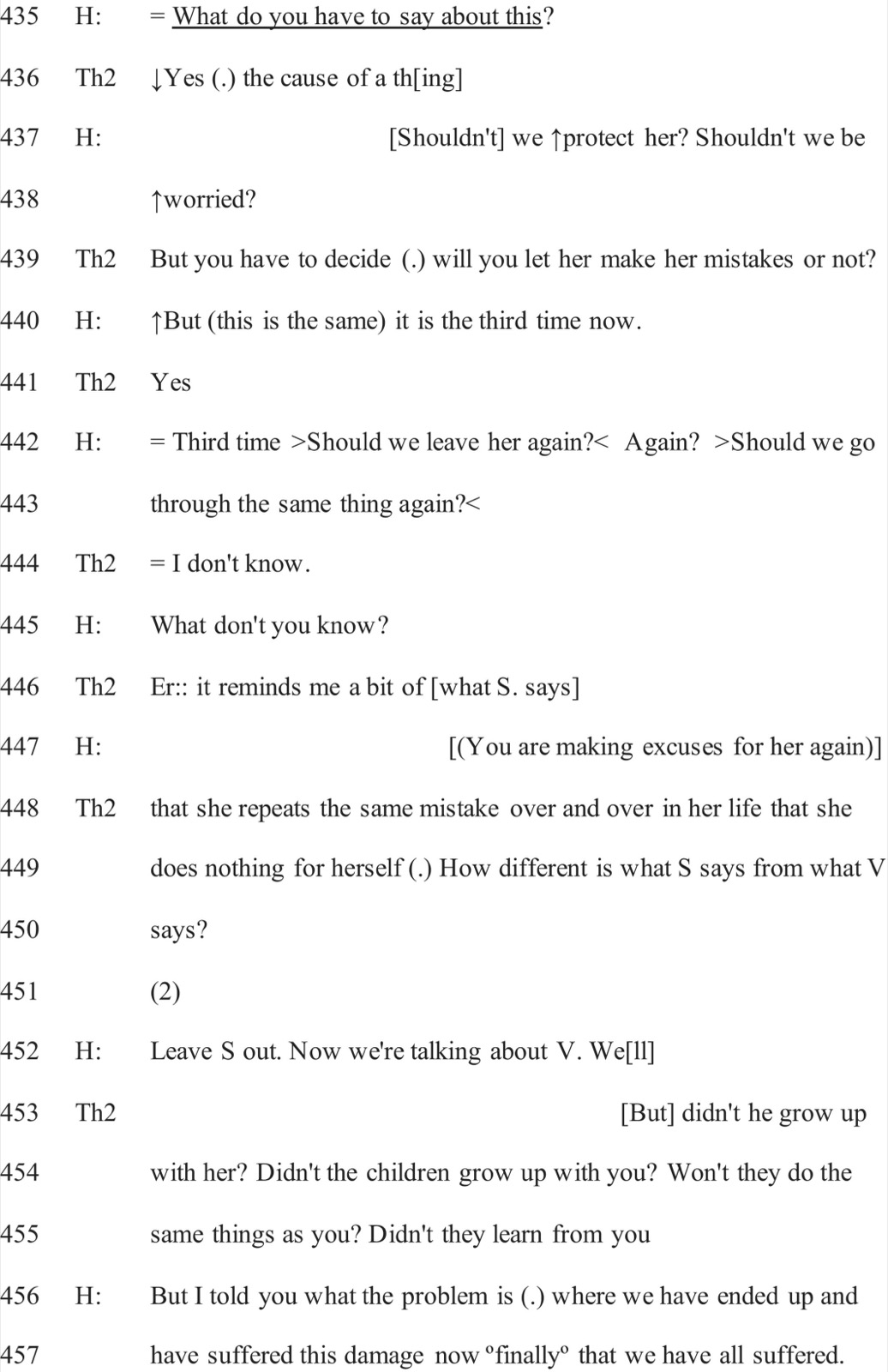
In line 435, the client is emphatically demanding an answer from Th2 as an equal interlocutor, ‘=What do…this?’ Then, he interrupts the therapist and through two interrogative sentences where the verbs ‘↑protect?’ (437) and ‘be ↑worried?’ (438) are uttered in a high pitch tone, he seems to invoke their parental care, constructing their attitude towards their daughter as the only legitimate choice. The therapist indirectly invokes a dominant psychological theory that children learn from their mistakes, while answering the client's question with a question (439). In this way, she seemingly directs her co-conversant towards a specific answer while she upgrades her epistemic status. The father counters the therapist's argument with the counterargument of repeatability (‘↑But [the same]…now’, 440), arguing that there must be a limit to mistakes. He then further reinforces his argumentative line, note the numerical reference '=Third time' (442) and the expressions that highlight the repeatability, ‘again?’ (442), ‘Again?’ (442), ‘the same thing again?<’ (443). The therapist rejects the client's point of view, ‘= I don't know’ (444), without risking coming across as authoritarian, while she simultaneously counters a potential accusation of self-interest in what she is advocating (Potter 1996). With the question ‘What don't you know?’ (445) the father directly challenges her response and her attempt to downgrade her epistemic status. While the therapist (Th2) shifts the conversation to the mother, the father interrupts her, ‘[You are making …again]’ (447), accusing her of being biased in favour of Victoria. Despite the father's interventions towards changing the topic of discussion, the therapist continues her report and then, with four consecutive questions, ‘[But] didn't… from you?’ (453–455), she holds the parents accountable for the daughter's behaviour. In this way, the therapist adopts the position of the expert. Simultaneously, she seems to mitigate the epistemic asymmetry with the interrogative sentences.
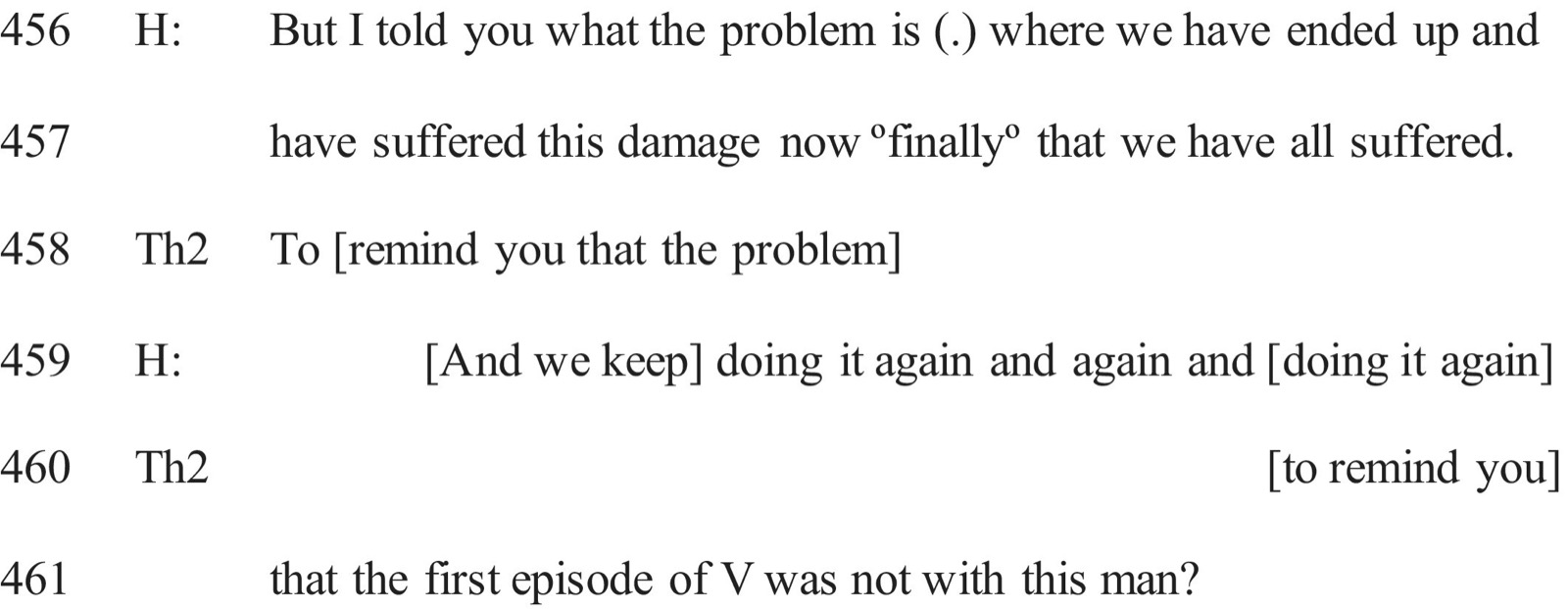
The father rejects the attribution of responsibility by changing the focus of the problem again ‘But…problem is’ (456). By using the first plural (456–457), he enhances his report's credibility, arguing that his narrative is based on others' experiences. While the therapist retries to redefine the focus of the problem, ‘To [remind…problem]’ (458), the father interrupts her (459) and with the repetition of the expression ‘doing it again…again’ (459), he disclaims the responsibility for his family problems, instead attributing the family problems to Victoria's relationship. In response to this confrontation, the therapist's rhetorical construction of remembrance (‘[to remind you]’, 460) constructs her reference as indisputable. Again, the interrogative sentence seems to serve to construct the therapist's report as less authoritarian.
Analysis of Extracts 3a, 3b, 3c illustrated how participants seem to support their argumentation by invoking, each from his/her side, their own epistemic authority, which comes from their personal or professional experience with the identified patient. Once more, the sequence suggests the conflict between the therapists' (collaborative) agenda and the family members' call for straightforward answers/assessment by the expert therapists.
6 Discussion
Our analysis highlights the significance of the rhetorical context for the negotiation of epistemic authority by illustrating the variability and flexibility in therapists' and clients' discursive contributions. Furthermore, it depicts the clash between the constructionist therapists' non-directive interactional agenda and the clients' seeking of direction and straightforward answers.
Specifically, the clients were shown to attribute to therapists either the position of authority or the position of a co-conversant with equal rights by asking questions and by deviating from the normative pattern of institutional (and constructionist) interactional peculiarities. That is, depending on the stakes involved, the clients asked therapists to support their point of view from the position of an expert authority figure to undermine another member's arguments. In our analysis, we identified the invocation of therapists' institutional position and the highlighting of experts' and non-experts' different access to knowledge as rhetorical constructions by which clients seemed to assign power to the therapist. In the case of disagreement, clients took the position of a speaker with equal rights and challenged therapists' statements by emphasising the superiority of their personal experience against ‘sterile’ theoretical, scientific knowledge. Invoking clients' experiences has been identified as a practice disaffiliating clients from therapists' unusual questions (Smoliak et al. 2018). Further, to emphasise personal experience over theoretical knowledge, clients made reference to common sense to validate their argument, claiming the position of an equal co-conversant.
On their side, therapists seemed to restore the normative pattern of the therapeutic interaction by reversing clients' questions and by not answering them. Simultaneously, they seemed to acknowledge the client's epistemic authority while avoiding taking a position of power, providing advice or assessment. When they argued for their account's accuracy, they did not seem to ground their argument in their epistemic authority or their institutional role. Instead, they mainly seemed to employ rhetorical practices of everyday lay discourse, such as the invocation of common sense, rationality and experiential knowledge. By employing such practices, the therapists seemed to attribute a dimension of everyday conversation to the therapeutic interaction, while maintaining its normative, institutionally informed pattern. Therapists used epistemic disclaimers (e.g., I don't know) to reject clients' point of view without risking being labelled as authoritarian (for a different use, see Smoliak et al. 2022).
Our analysis suggests that constructionist therapists do not seem to abandon their epistemic authority. Instead, they seem to guide clients in a co-constructive therapeutic process where all members participate equally, exactly by means of such epistemic authority. Thus, since equality seems to be accomplished by authority and vice versa, equality and authority seem to be two sides of the same coin. Furthermore, our analysis highlights the dilemmatic aspects of the negotiation of epistemic authority (see also Nanouri et al. 2022, focusing on systemic family therapy training). As illustrated elsewhere (Ong et al. 2024), therapists seem to constantly ‘move’ between mitigating their epistemic superiority through repeating and incorporating clients' talk and guiding the conversation in a particular direction.
We acknowledge that sampling data from two therapeutic contexts with therapists following one specific constructionist model are limitations of this study. Furthermore, our own engagement with systemic/constructionist therapies may have contributed a certain interpretative gaze at the sampled sessions. Still, we suggest that the discursive research of questions in constructionist therapies can contribute to the understanding of how therapists and clients negotiate epistemic asymmetry. We consider such knowledge as enhancing constructionist therapists' reflexivity and as fruitfully informing constructionist/postmodern psychotherapeutic theory and practice, with implications for training.
Complexe Systémique: key points
The article takes at its word a promise of post-Milan and collaborative therapies: giving up the expert position. Yet when a family asks “is this normal?”, the therapist who replies “and what do you think?” takes back control of the conversation at the very moment she declines to decide. Not-knowing does not abolish asymmetry, it shifts it. For systemic practice, the lesson is valuable: rather than claiming to step aside, better to acknowledge the authority one exercises, and to notice when a returned question becomes an evasion experienced as a refusal of help, as with the father who retorts “what don’t you know?”. The extracts also show that families know how to handle authority, sometimes summoning expertise against another member, sometimes setting their experience against it. Acknowledged limits: three therapists, a single model, 14 sequences. Read alongside the review of discursive research on power and dialogue, and the conversation analysis of therapist repeats in Open Dialogue.
Notes from the original
1 At the time of conducting this research, there was no institutional ethics review committee.
Acknowledgements. We would like to acknowledge the contribution of Dr. Nikolaos Bozatzis and Prof. Eugenie Georgaca in the wider research project from which the reported study draws. We would also like to thank the anonymous Reviewer for the helpful comments and suggestions for revisions.
Ethics statement. The reported research was conducted according to the code of conduct of the University of Thessaly, Greece.
Consent. All participants gave written informed consent.
Conflicts of interest. The authors declare no conflicts of interest.
References
Andersen, T. 1987. “The Reflecting Team: Dialogue and Meta-Dialogue in Clinical Work.” Family Process 26: 415–428. https://doi.org/10.1111/j.1545-5300.1987.00415.x.
Anderson, H. 2012. “Collaborative Relationships and Dialogic Conversations: Ideas for a Relationally Responsive Practice.” Family Process 51, no. 1: 8–24. https://doi.org/10.1111/j.1545-5300.2012.01385.x.
Bartesaghi, M. 2009. “Conversation and Psychotherapy: How Questioning Reveals Institutional Answers.” Discourse Studies 11, no. 2: 153–177. https://doi.org/10.1177/1461445608100942.
Billig, M. 1996. Arguing and Thinking: A Rhetorical Approach to Social Psychology. Cambridge University Press.
Buttny, R. 1996. “Clients' and Therapist's Joint Construction of the Clients' Problems.” Research on Language and Social Interaction 29, no. 2: 125–153. https://doi.org/10.1207/s15327973rlsi2902_2.
G. Cecchin, G. Lane, and W. A. Ray, eds. 2018. Irreverence: A Strategy for Therapists' Survival. 2nd ed. Routledge.
Couture, S. J., and O. Sutherland. 2006. “Giving Advice on Advice-Giving: A Conversation Analysis of Karl Tomm's Practice.” Journal of Marital and Family Therapy 32, no. 3: 329–344. https://doi.org/10.1111/j.1752-0606.2006.tb01610.x.
Edwards, D., and J. Potter. 1992. Discursive Psychology. Sage.
Ekberg, K., and A. LeCouteur. 2015. “Clients' Resistance to Therapists' Proposals: Managing Epistemic and Deontic Status.” Journal of Pragmatics 90: 12–25. https://doi.org/10.1016/j.pragma.2015.10.004.
Etelämäki, M., L. Voutilainen, and E. Weiste. 2021. “Distributing Agency and Experience in Therapeutic Interaction: Person References in Therapists' Responses to Complaints.” Frontiers in Psychology 12: 585321. https://doi.org/10.3389/fpsyg.2021.585321.
Heritage, J. 2005. “ Conversation Analysis and Institutional Talk.” In Handbook of Language and Social Interaction, edited by K. Fitch and R. Sanders, 103–147. Erlbaum.
Heritage, J. 2012. “Epistemics in Action: Action Formation and Territories of Knowledge.” Research on Language and Social Interaction 45, no. 1: 1–29. https://doi.org/10.1080/08351813.2012.646684.
Jefferson, G. 2004. “ Glossary of Transcript Symbols With an Introduction.” In Conversation Analysis: Studies From the First Generation, edited by G. H. Lerner, 13–31. John Benjamins.
McNamee, S., and L. Shawver. 2004. “ Therapy as Social Construction: Back to Basics and Forward Toward Challenging Issues.” In Furthering Talk: Advances in the Discursive Therapies, edited by T. Strong and D. Paré, 253–270. Kluwer Academic and Plenum Publishers.
Muntigl, P., and K. T. Choi. 2010. “Not Remembering as a Practical Epistemic Resource in Couples Therapy.” Discourse Studies 12, no. 3: 331–356. https://doi.org/10.1177/1461445609358516.
Muntigl, P., and A. O. Horvath. 2014. “The Therapeutic Relationship in Action: How Therapists and Clients Co-Manage Relational Disaffiliation.” Psychotherapy Research 24, no. 3: 327–345. https://doi.org/10.1080/10503307.2013.807525.
Muntigl, P., A. O. Horvath, L. Chubak, and L. Angus. 2020. “Getting to ‘Yes’: Overcoming Client Reluctance to Engage in Chair Work.” Frontiers in Psychology 11: 582856. https://doi.org/10.3389/fpsyg.2020.582856.
Nanouri, K., E. Tseliou, G. Abakoumkin, and N. Bozatzis. 2022. “‘Who Decided This?’: Negotiating Epistemic and Deontic Authority in Systemic Family Therapy Training.” Discourse Studies 24, no. 1: 94–114. https://doi.org/10.1177/14614456211037450.
Ong, B., S. Barnes, and N. Buus. 2020. “Conversation Analysis and Family Therapy: A Critical Review of Methodology.” Family Process 59, no. 2: 460–476. https://doi.org/10.1111/famp.12431.
Ong, B., S. Barnes, and N. Buus. 2021. “Eliciting Stance and Mitigating Therapist Authority in Open Dialogue Meetings.” Journal of Marital and Family Therapy 47, no. 1: 120–135. https://doi.org/10.1111/jmft.12454.
Ong, B., S. Barnes, and N. Buus. 2024. “A Conversation Analysis of Therapist Repeats in Open Dialogue Network Meetings.” Family Process 63: 1–17. https://doi.org/10.1111/famp.12852.
Ong, B., E. Tseliou, T. Strong, and N. Buus. 2023. “Power and Dialogue: A Review of Discursive Research.” Family Process 62: 1391–1407. https://doi.org/10.1111/famp.12881.
Pomerantz, A. 1984. “ Agreeing and Disagreeing With Assessments: Some Features of Preferred/Dis-Preferred Turn Shapes.” In Structures of Social Action: Studies in Conversation Analysis, edited by M. Atkinson and J. Heritage, 57–101. Cambridge University Press.
Potter, J. 1996. Representing Reality: Discourse, Rhetoric and Social Construction. Sage.
Sacks, H. 1992. Lectures on Conversation. Wiley-Blackwell.
Sacks, H., E. A. Schegloff, and G. A. Jefferson. 1974. “A Simplest Systematics for the Organization of Turn-Taking for Conversation.” Language 50, no. 4: 696–735. https://doi.org/10.2307/412243.
Seikkula, J. 2011. “Becoming Dialogical: Psychotherapy or a Way of Life?” Australian and New Zealand Journal of Family Therapy 32, no. 3: 179–193. https://doi.org/10.1375/anft.32.3.179.
Silver, E. 1991. “Should I Give Advice? A Systemic View.” Journal of Family Therapy 13: 295–309. https://doi.org/10.1046/j.1991.00429.x.
Smoliak, O., A. Le Couteur, and C. Quinn-Nilas. 2018. “Issuing and Responding to Unusual Questions: A Conversation Analytic Account of Tom Andersen's Therapeutic Practice.” Journal of Marital and Family Therapy 44, no. 3: 393–408. https://doi.org/10.1111/jmft.12306.
Smoliak, O., C. MacMartin, A. Hepburn, A. Le Couteur, R. Elliott, and C. Quinn-Nilas. 2022. “Authority in Therapeutic Interaction: A Conversation Analytic Study.” Journal of Marital and Family Therapy 48, no. 4: 961–981. https://doi.org/10.1111/jmft.12471.
Stevanovic, M., and A. Peräkylä. 2012. “Deontic Authority in Interaction: The Right to Announce, Propose, and Decide.” Research on Language & Social Interaction 45, no. 3: 297–321. https://doi.org/10.1080/08351813.2012.699260.
Stevanovic, M., and A. Peräkylä. 2014. “Three Orders in the Organization of Human Action: On the Interface Between Knowledge, Power, and Emotion in Interaction and Social Relations.” Language in Society 43, no. 2: 185–207. https://doi.org/10.1017/S0047404514000037.
Strong, T., R. Busch, and S. Couture. 2008. “Conversational Evidence in Therapeutic Dialogue.” Journal of Marital and Family Therapy 34, no. 3: 388–405. https://doi.org/10.1111/j.1752-0606.2008.00079.x.
Sutherland, O. 2007. “Therapist Positioning and Power in Discursive Therapies: A Comparative Analysis.” Contemporary Family Therapy 29, no. 4: 193–209. https://doi.org/10.1007/s10591-007-9050-2.
Tracy, K., and J. Robles. 2009. “Questions, Questioning, and Institutional Practices: An Introduction.” Discourse Studies 11, no. 2: 131–152. https://doi.org/10.1177/1461445608100941.
Tseliou, E., and M. Borcsa. 2018. “Discursive Methodologies for Couple and Family Therapy Research: Editorial to Special Section.” Journal of Marital and Family Therapy 44, no. 3: 375–385. https://doi.org/10.1111/jmft.12308.
Wang, J. 2006. “Questions and the Exercise of Power.” Discourse & Society 17, no. 4: 529–548. https://doi.org/10.1177/0957926506063127.
Watson, R. 2019. “Jointly Created Authority: A Conversation Analysis of How Power Is Managed by Parents and Systemic Psychotherapists in Children's Social Care.” Journal of Family Therapy 41, no. 3: 357–383. https://doi.org/10.1111/1467-6427.12244.
Weiste, E., L. Voutilainen, and A. Peräkylä. 2016. “Epistemic Asymmetries in Psychotherapy Interaction: Therapists' Practices for Displaying Access to Clients' Inner Experiences.” Sociology of Health & Illness 38, no. 4: 645–661. https://doi.org/10.1111/1467-9566.12384.
White, M., and D. Epston. 1990. Narrative Means to Therapeutic Ends. W. W. Norton.
Wooffitt, R. 1992. Telling Tales of the Unexpected: The Organization of Factual Accounts. Harvest Wheatscheaf.
Worsøe, L. B., and T. W. Jensen. 2020. “Questioning Questions in Psychotherapeutic Practice: The Dialogical Dynamics of Change in Therapy Through Clients Questioning Therapists.” Scandinavian Studies in Language 11, no. 1: 279–317. https://doi.org/10.7146/sss.v11i1.121371.
Reformatted republication of Who has the Right to Know? Negotiating Epistemic Authority in Constructionist Therapies, by Ioanna Moraitou and Eleftheria Tseliou, Counselling and Psychotherapy Research, vol. 25, no 2 (2025), doi: 10.1002/capr.70015, under a CC BY 4.0 licence. Edition and layout: Complexe Systémique, September 2026 — the work has been modified under the terms of the licence (transcript extracts reproduced as images; table presented as a list). Neither the authors nor the publisher are responsible for this edition; the original version prevails.
This is the original article “Who has the Right to Know? Negotiating Epistemic Authority in Constructionist Therapies”, published in Counselling and Psychotherapy Research (2025) under a CC BY 4.0 licence. Republished by Complexe Systémique: the author’s text is unchanged; only the presentation has been adapted for reading online, as set out at the head of this page.
Read the original articleHow to cite this article
Moraitou, I., et Tseliou, E. (2025). Who has the Right to Know? Negotiating Epistemic Authority in Constructionist Therapies. Complexe Systémique. https://app.complexe-systemique.com/en_GB/articles/who-has-the-right-to-know-negotiating-epistemic-authority-in-constructionist-therapies (Original work published in 2025 in Counselling and Psychotherapy Research, 25(2), e70015 (2025); republished in 2025 by Counselling and Psychotherapy Research, https://onlinelibrary.wiley.com/doi/10.1002/capr.70015)
To go further
- Power and dialogue: A review of discursive researchPower and dialogue.
- A conversation analysis of therapist repeats in open dialogue network meetingsConversation analysis.
- The Milan school of systemic family therapyThe Milan school.
Related training courses
 Certifying course
Training in Systemic Therapy and Interventions – Cycle 1
Certifying training cycle in systemic therapy and interventions – year 1. Courses, supervision and practice, aligned with EFTA/SFTF. In French.
 Certifying course
Training in Systemic Therapy and Interventions – Cycle 2
Certifying training cycle in systemic therapy and interventions – year 2. Clinical complexity, supervision and practice. EFTA/SFTF aligned. In French.
 Certifying course
Training in Systemic Therapy and Interventions – Cycle 3
Certifying training cycle in systemic therapy and interventions – year 3. In-depth intervention, supervision and practice. EFTA/SFTF aligned. In French.
 Certifying course
Training in Systemic Therapy and Interventions – Cycle 4
Certifying training cycle in systemic therapy and interventions – year 4. Clinical integration, supervision and certification. EFTA/SFTF. In French.
Related articles
 Scientific
Transitioning to the Business of a Session in Collaborative-Dialogic Meetings: A Conversation Analysis
How do Open Dialogue therapists move to the business of a session? The open question creates silences and family negotiation: a conversation analysis of ten sessions.
 Scientific
Internal Family Systems Therapy as Part of the ‘Family of Systemic Therapies’: A Critical Exploration of Systemic Practice in the Intra-Personal Domain
Does IFS belong to the family of systemic therapies? A critical exploration, grounded in a family court vignette, of systemic work with “parts”.
 Scientific
Collaborative Polyphonic Writing as Therapeutic Practice: A Longitudinal Case Study
A patient and her therapist co-write her autobiography: the psychiatric diagnosis becomes one voice among others, coordinated by an “I as a writer”.
 Blog
Toxic, narcissistic, borderline: what therapy speak does to your relationships
Narcissistic, borderline, toxic: therapy speak has left the consulting room. Julien Besse shows how these labels close the debate and relieve us of our own part.