Red Sistémica · Couple therapy
Dependence / independence in couples: a metaphor
The Argentine family therapist Omar Biscotti understands the interplay between dependence and independence in the couple as a relational construction, on an entirely subjective register. The couple constitutes itself as the paradigm of the dependent relationship: each one depends on the other, but — in the best of cases — not in a total and absolute way. What remains to be seen is what happens when one begins to suffer from that dependence. Or from independence.
“… Sing and dance together and be joyous, but let each one of you be alone. Even as the strings of a lute are alone though they quiver with the same music… And stand together yet not too near together, for the pillars of the temple stand apart. And the oak tree and the cypress grow not in each other’s shadow…”
Khalil Gibran
Editor’s note
This text is published by Red Sistémica as a fragment: it breaks off at the author’s words “(to be continued)”. The complete article appeared in no. 81 of Perspectivas Sistémicas (May-June 2004).
The couple, paradigm of the dependent relationship
I understand the interplay between dependence and independence in the couple as a relational construction, on an entirely subjective register.
The couple constitutes itself as the paradigm of the dependent relationship: each one depends on the other, but not in a total and absolute way. At least in the best of cases.
Of course, if “my life depends on you”, the relationship can become tortuous.
In any event, we can ask ourselves the following question: what makes someone feel that way in a relationship, even find a certain enjoyment in it and, more than that, take pleasure in saying so? That is the reproach the bolero sings: not having been taught by the other how one lives without them. But, as the songs also express, one quickly moves on to suffering from it. And that is how a bolero is born. Or a tango.
Total and absolute dependence on the other is present in the period of falling in love and is part of that well-known illusion of being “two but as though we were one”, or “made for each other”, or “two twin souls”, with a claim to being inseparable Siamese twins.
The counterpart of this situation is the wish that the other should feel the same thing for oneself: that one should be everything to them and that they should need nothing other than to be with oneself — if possible, all the time.
This, as happens with all illusions, breaks after a certain time. And the worst of it is that very often it does not break on both sides at once. In other words, there is always someone who is left paying, still wanting to be the whole, while on the other side one is already no more than a part or, in certain tragic cases, one is already nothing at all.
If the couple lasts a little longer than nine and a half weeks (like that famous film with Kim Basinger and Mickey Rourke), we can reach an acceptable degree of mutual dependence, alternating across different terrains.
Dependence: a relational game
The idea I want to convey is that, whenever there is dependence on one side, there is dependence on the other side too. That is why I understand dependence as a relational game. This mutual game guarantees the durability of the couple.
But what happens when one begins to suffer from dependence? Or from independence? (which would amount to suffering from “our” dependence, in so far as we suffer from the other’s independence).
Or else: can someone suffer from their own independence? (that sounds like abandonment, or like loneliness).
Key takeaway
There is no dependent person without dependence on the other side: dependence is a game for two, and it is this mutual game — acceptable, alternating according to the terrain — that makes the couple last. The clinical question is therefore not “who depends on whom?”, but: at what point does this game begin to cause suffering, on one side as much as on the other?
The couple as a jacket
The couple is like a jacket: it has to sit comfortably… (to be continued)
(March 2004)
Notes from the original
(*) The complete article is to be found in no. 81 of the periodical Perspectivas Sistémicas, corresponding to the months of May-June 2004, on sale at newsstands and specialised bookshops in the Federal Capital, or by subscription in the interior of the country and abroad (in the latter case, with an international credit card, by online subscription).
Issues 73 (Fe en el Vínculo) and 80 (Parejas: La Pasión y la Clínica) contain several articles devoted to the theme of the couple.
Who is Omar Biscotti
(**) Dr Biscotti, a family therapist, was president of ASIBA (Asociación Sistémica de Buenos Aires); he is a consultant to Perspectivas Sistémicas and co-director of ISDEBA (Instituto Sistémico de Buenos Aires).
This article is an English translation of “Dependencia/independencia en las parejas: una metáfora”, published by Red Sistémica (first published in Perspectivas Sistémicas, n° 81, mai-juin 2004). Translated and republished with the journal’s permission.
Read the original articleHow to cite this article
Biscotti, O. (2022). Dependence / independence in couples: a metaphor (Complexe Systémique, Trans.). Complexe Systémique. https://app.complexe-systemique.com/en_GB/articles/dependence-independence-in-couples-a-metaphor (Original work published in 2004 in Perspectivas Sistémicas, n° 81, mai-juin 2004; republished in 2022 by Red Sistémica, https://redsistemica.ar/2022/07/19/dependencia-independencia-en-las-parejas-una-metafora/)
To go further
- If you love me, don't love meThe paradox of the loving demand, when depending on the other becomes a contradictory injunction.
- The couple's life cycle: a clinical compass for navigating marital crisesWhat comes after falling in love, stage by stage, when the fusional illusion comes undone.
- The six forms of intimacy in the couple: a systemic and clinical perspectiveHow to be close without being merged: a map of the terrains across which mutual dependence alternates.
Related training courses
 Webinar
Extramarital affairs: what does the therapist do when the couple explodes?
Free webinar: how to position yourself as a systemic therapist in the crisis of the extramarital affair. Revelation, secrecy, multipartiality.
 Webinar
The three loves
Free live webinar with Dr Robert Neuburger, 1 October 2026, 6 pm (Paris): the three loves, attachment and ways of loving. Held in French.
 Certifying course
Training in Systemic Therapy and Interventions – Cycle 1
Certifying training cycle in systemic therapy and interventions – year 1. Courses, supervision and practice, aligned with EFTA/SFTF. In French.
 Certifying course
Training in Systemic Therapy and Interventions – Cycle 2
Certifying training cycle in systemic therapy and interventions – year 2. Clinical complexity, supervision and practice. EFTA/SFTF aligned. In French.
Related articles
 Article
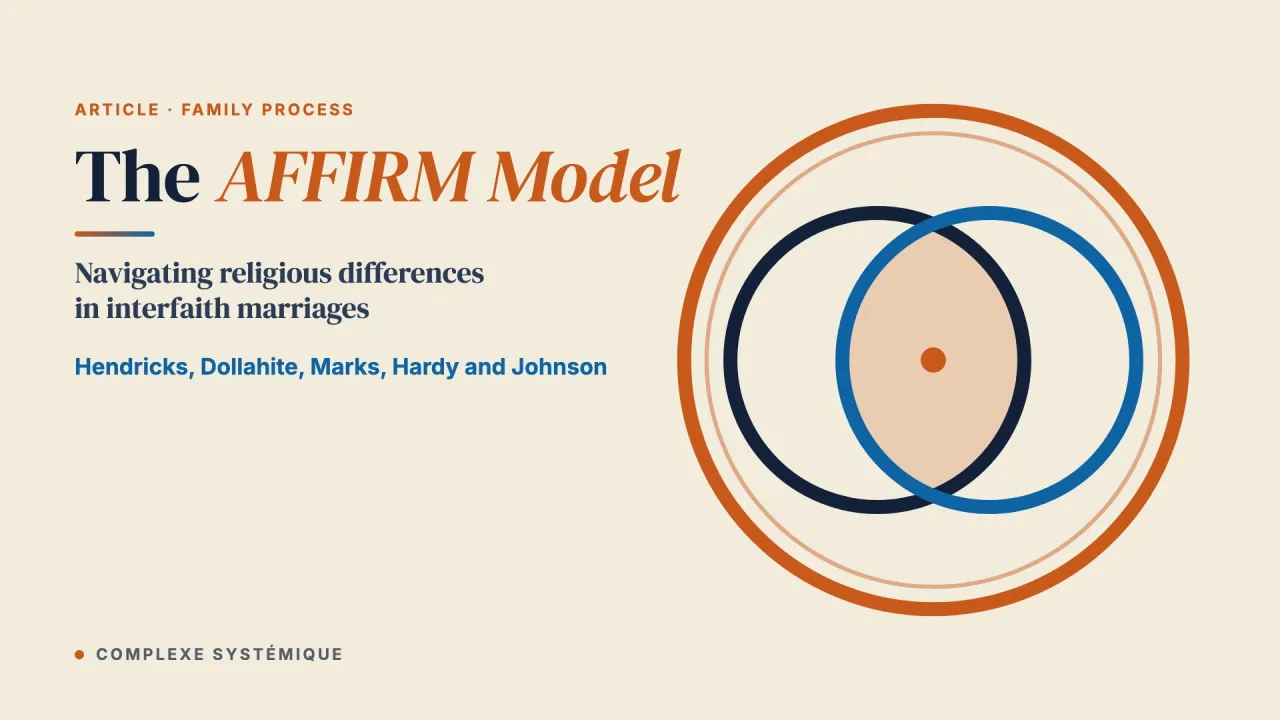
 The AFFIRM Model for Navigating Challenges in Continuously-Interfaith and Divergent-Interfaith Marriages
Thirty happy interfaith couples describe how they navigate their religious differences: five processes, from respecting each other’s choices to religious intimacy, gathered in the AFFIRM model.
 Article
 Toxic, narcissistic, borderline: what therapy speak does to your relationships
Narcissistic, borderline, toxic: therapy speak has left the consulting room. Julien Besse shows how these labels close the debate and relieve us of our own part.
 Article
 Rebuilding trust after infidelity: the 5 behaviours that repair
Infidelity does not doom a couple, but surviving it owes nothing to chance. Five behaviours that restore trust after a betrayal, from a couple therapist’s practice.
 Article
 Being a couple in wartime
Living as a couple under bombardment or in refuge: five vulnerability factors, four protective factors, and concrete implications for professionals.
Comments 0
Log in to join the discussion. Log in