Child and Adolescent Mental Health · Family
A grounded theory of the process of social transition in a family context from the perspective of gender diverse young people and their parents
Changing name, pronouns, clothing: a gender diverse young person’s social transition is never made alone; it involves the whole family. Drawing on interviews with four young people and five parents seen by the former UK Gender Identity Development Service (GIDS), Sophie Razzel’s team describes this passage as a family resilience process, led by the young person and tested by the hostility of relatives, school and sometimes services.
This is a reformatted republication of A grounded theory of the process of social transition in a family context from the perspective of gender diverse young people and their parents, by Sophie Razzel, Simon Levinson and Trish Joscelyne, published in Child and Adolescent Mental Health (Wiley) (2026), doi: 10.1111/camh.70078, under a CC BY 4.0 licence. Prepared by Complexe Systémique in September 2026: the authors’ text is unchanged; the layout has been adapted for reading online, which constitutes a modification of the work under the terms of the licence. Tables are presented as lists; the end-of-article statements are grouped in the notes. This edition was made neither by the authors nor by the publisher, who are not responsible for its content or for any errors. The original version prevails.
The developed theory explained social transition within the family as a young person-led family-resilience process.
Sophie Razzel, Simon Levinson and Trish Joscelyne
Abstract
Background. Some gender diverse young people (GDYP) socially transition—a process of changing from living as the gender that they were assigned at birth to another gender, through social means. Whilst the role of the whole family in the social transitions of GDYP has been indicated, there is a lack of applicable theory and research on the processes of social transition within UK families. The aim of the current study was to address this gap by building a grounded theory of the social transition of young people within the family context.
Methods. We conducted one-to-one, semi-structured interviews with nine participants from four UK families (four GDYP and five parents). All participants were recruited through the UK Gender Identity Development Service (GIDS). Data were analysed using grounded theory methodology.
Results. The developed theory suggests that the social transition of young people within the family context is a young person-led family resilience process, through which families work towards the young person experiencing greater acceptance and belonging. The process consisted of several adaptive subprocesses and was influenced by contextual factors. In managing the challenges of social transition and particularly non-affirming responses, families increased in resourcefulness and developed the understanding and tolerance of their communities.
Conclusion. Further research is needed, particularly in families of different racial backgrounds, and to assess the applicability of the model to families without an affirming parent. Implications are considered within the context of recent changes in UK clinical service provision and developments in educational guidance.
Key Practitioner Message
What is currently known?
- Many gender diverse young people socially transition. The previous evidence base indicates that this may have important implications for well-being and is a family-level process. There was a previous lack of relevant theory and research to explain the ways in which well-being, social transition and the family are connected and the processes of social transition within UK families
What has been shown?
- Social transition within the UK family context appears to be a family resilience process, through which families work towards their young person experiencing greater acceptance and belonging. Exposure to gender minority stressors and the associated challenges of this exposure requires families to adapt through a process of developing family resilience
What is the significance of this for clinical practice?
- Clinical and educational practitioners should attend to the impacts of gender minority stressors when working with gender diverse young people and their families. Assessment and intervention should be routinely offered at the family level. Further research is needed to understand how the processes of social transition occur in families with other characteristics, and to attend to the ways in which changes in services and policies will likely impact social transition and associated well-being
Introduction
There has been a significant increase in gender-diverse children and young people (GDYP) presenting to UK mental health and National Health Service (NHS) gender identity services in recent years (Cass Review, 2024). Whilst the application of a diagnostic framework to this population can be seen as pathologising and contributing to victimising narratives, GDYP do face a significantly increased risk of several negative health outcomes, including increased anxiety, depression and suicidality (American Psychiatric Association, 2022; Horton, 2020; Olson-Kennedy et al., 2016).
A note on language
GDYP is the term used in this study to refer to children and young people (CYP) whose gender identity, role and/or expression differ from that which is culturally expected for them. This may include transgender and/or non-binary young people, as well as those of other gender identities (Mermaids, n.d.; American Psychiatric Association, 2015). The authors do, however, wish to highlight the significant complexities in selecting a term to describe this population, and the importance of self-determination in language choice. The term cisgender is used to describe individuals whose identified gender corresponds with that which they were assigned at birth (American Psychiatric Association, 2015).
UK context
The Cass Review was a recent independent review of gender services for CYP commissioned by NHS England and NHS Improvement (Cass Review, n.d.). The interim report resulted in the closure of the Gender Identity Development Service (GIDS) and service restructuring (Stewart & Palmer, 2024). This, along with the published final report, has received considerable public attention within a pre-existing context of controversy and public debate around the identities of GDYP, which formed part of the context during the time this research was carried out. Additionally, and partly informed by the interim Cass Report, the Department for Education recently published draft non-statutory guidance for schools and colleges on supporting ‘Gender Questioning’ Children (Department for Education, 2023; Department for Education, Badenoch, & Keegan, 2023). Whilst this was published following our data collection, it has relevance to the study implications as it appears to place parameters around social transitioning in schools, and school-based experiences were salient in the social transitions of the young people in the present study.
Social transition and the family
In the United Kingdom and internationally, many GDYP presenting at services have undergone social transition. Social transition may include changing name, pronouns, use of facilities and clothing, but does not include medical transition, although these processes may occur alongside one another (Hall et al., 2024; Cass Review, 2024). It has been suggested that social transition can be associated with a reduction in mental health distress experienced by GDYP, and supporting social transition has been understood as aligned with gender-affirming care (Ehrensaft, Giammattei, Storck, Tishelman, & Keo-Meier, 2018; Hall et al., 2024; Kuvalanka, Weiner, & Mahan, 2014). The wider evidence base exploring associations between social transition and well-being outcomes does, however, appear to be somewhat mixed (Durwood, McLaughlin, & Olson, 2017; Morandini et al., 2023).
Previous research has demonstrated that family responses significantly impact the ability of GDYP to socially transition (Schimmel-Bristow et al., 2018), and family acceptance has been demonstrated to play an important role in GDYPs' psychosocial adjustment (Pariseau et al., 2019). Further highlighting this centrality of family, it has been suggested that social transition should be framed as a ‘family-level’ event (Bull & D'Arrigo-Patrick, 2018). Understanding the family experience of social transition is therefore important.
Previous social transition research has largely been conducted in the United States and Canada, with studies highlighting meaning-making processes and young-person led decision-making (e.g. Bull & D'Arrigo-Patrick, 2018; Olson et al., 2019). Given the current UK context, studies from elsewhere are likely to have only limited applicability, and most previous research has not included the voices of GDYP—a considerable limitation.
Despite the indicated possible role of social transition in the mental health of GDYP and the centrality of the family, there is also a lack of relevant theory to explain the processes by which these are connected. Existing systemic theories may offer some insights. Family resilience theory conceptualises family resilience as the family's capacity to positively respond to challenges through adaptation processes (Walsh, 2016). Catalpa and McGuire (2018) described how, in perpetuating the belief that cisgender identities are the norm, cisnormativity ‘disallows’ the existence of gender diverse people in families. This belief perhaps indicates that a young person's social transition could challenge a family, requiring adaptation that can be understood through family resilience theory.
GDYP are also likely to be exposed to experiences which can be understood as gender minority stressors, including peer victimisation, which is associated with increased mental health difficulties, and reduced school belonging (Hatchel, Valido, De Pedro, Huang, & Espelage, 2019; Hendricks & Testa, 2012; Hunter, Butler, & Cooper, 2021; Meyer, 2003). It seems likely that gender minority stress would also challenge family resilience. Notably, existing models of family resilience have not been grounded in research with GDYP, and there is a risk of further pathologising GDYP when making broader inferences (Horton, 2020; Toomey, 2021).
To address the above gaps in research and theory, we aimed to build a grounded theory of the process of social transition of young people within the UK family context. Four primary questions guided this:
- How is social transition in young people understood by, and negotiated with, family?
- What do young people and parents/carers view as the changes that occurred within the family as a whole as the young person socially transitioned, and how do they understand those now?
- What is seen as helpful or hindering to the social transition of a young person within the family context?
- What influence are racial identities, culture, class and community seen as having on how the family understands and negotiates the social transition of their young person?
Methods
Design
A qualitative, grounded theory design and the methodology of Corbin and Strauss (2015) were chosen, as this inductive approach allowed the voices of the GDYP to be centred in the developing theory and is accommodating of the researchers' critical realist positions. The emphasis of critical realism on giving voice to those often marginalised was also considered particularly appropriate given the minoritised identities of GDYP (Bhaskar, 2008; Hunter et al., 2021; Looker, Vickers, & Kington, 2021).
Ethics
HRA/Health and Care Research Wales approval was granted (REC reference: 21/LO/0854). Informed consent was obtained for all participants aged 16 and over, and assent was obtained, with parental consent, for participants under 16. The ethical guidelines of Vincent (2018) for research with transgender people were also considered throughout, including careful consideration of language, maintaining transparency and ensuring researcher's knowledge of trans history and neglected discourses. Such nuance is important due to the historical exposure of transgender populations to some flawed research practices (Vincent, 2018).
Participants
To allow access to this very specific population, all participants were recruited through the (now former) GIDS. In order to meet the study eligibility requirements, young people had to be aged between 11 and 18 years at the time of participation. Nine participants from four families participated: four GDYP, aged 12–17 (Mean = 15.5 years) and five parents, aged 36–58 years (Mean = 45.2 years). One parent from each family participated, except for Family 1, in which two parents participated. See Table 1 for detailed participant characteristics with pseudonyms. All participants were invited to choose their own pseudonym should they wish to; pseudonyms were therefore either self-selected by the participant or otherwise chosen randomly by researcher SR.
Table 1 — Self-identified participant characteristics (in interview order)
- (Family number) and pseudonym: (1) Zoe; Relationship to GDYP: Mum; Gender identity: Cisgender female; Pronouns: She/her; Age (at time of interview): 36; Ethnicity: White British
- (Family number) and pseudonym: (1) Dan; Relationship to GDYP: Biological father; Gender identity: Straight male; Pronouns: He/him/his; Age (at time of interview): 39; Ethnicity: White British
- (Family number) and pseudonym: (1) Ariana; Relationship to GDYP: Young person; Gender identity: A girl; Pronouns: She/her; Age (at time of interview): 12; Ethnicity: White British
- (Family number) and pseudonym: (2) Ruby; Relationship to GDYP: Young person; Gender identity: A girl, and I will be a woman; Pronouns: She/her; Age (at time of interview): 15; Ethnicity: White British
- (Family number) and pseudonym: (2) Lori; Relationship to GDYP: Mother; Gender identity: There's no male and female, I'm just [Lori] and that's it.; Pronouns: She/her; Age (at time of interview): 49; Ethnicity: White British and human!
- (Family number) and pseudonym: (3) Guitar; Relationship to GDYP: Young person; Gender identity: Very masculine. Always hated feminine things, things to do with girls; Pronouns: He/him; Age (at time of interview): 17; Ethnicity: White
- (Family number) and pseudonym: (3) Sarah; Relationship to GDYP: [Guitar's] mum; Gender identity: Female; Pronouns: She/her; Age (at time of interview): 44; Ethnicity: White British
- (Family number) and pseudonym: (4) Zac; Relationship to GDYP: Young person; Gender identity: Trans male/Trans man/Trans Guy; Pronouns: He/him; Age (at time of interview): 18; Ethnicity: White British
- (Family number) and pseudonym: (4) Elly; Relationship to GDYP: Mother; Gender identity: Woman; Pronouns: She/her; Age (at time of interview): 58; Ethnicity: White British
Service user consultation
Members of a GIDS stakeholder group, including both GDYP and parents/carers of GDYP, reviewed the suitability of the research materials. Feedback was carefully considered, with changes made accordingly.
Procedure
Following a request from the researchers, GIDS clinicians identified families considered suitable from their caseloads and approached participants directly, providing information and requesting they contact the researcher by email if interested. Purposive sampling was used for the initial round of recruitment according to the inclusion criteria. Following initial recruitment, data collection and analysis, theoretical sampling was used to recruit further participants with certain characteristics, allowing the categories to be more fully developed.
All interviews took place individually via video call on a one-to-one basis with the lead researcher. The interviews were audio-recorded and guided by interview schedules with some deviations to support theory development. GDYP and their parents were asked similar questions, but with slightly amended wording to capture their differing roles. Recordings were transcribed verbatim by SR and analysed, beginning with open-coding after the first interview. Constant comparison, axial coding with diagrams, selective coding and diagramming were all applied. Given scale and time constraints, data collection could not be pursued open-endedly and theoretical sufficiency was therefore aimed for, with the intention of achieving conceptual depth (Dey, 1999; Nelson, 2017).
Reflexivity, positionality and quality assurance
Best practice guidelines for conducting qualitative research were used (Yardley, 2000). To support reflection on assumptions, biases and emotional processes, SR completed an audio-recorded bracketing interview, kept a research diary and engaged in supervision throughout. These processes included ongoing reflection on how SR's own identification as Queer and non-binary and without children may have influenced their engagement with the research, as well as their identified inclination to attend more to the GDYPs' views than those of parents. Theoretical memos were also kept, documenting the process of theory development, whilst SR primarily completed the analysis, this was reviewed by all authors. All participants were later invited to review and comment on a report of the research, and three responded, expressing agreement with the model.
Results
Model overview
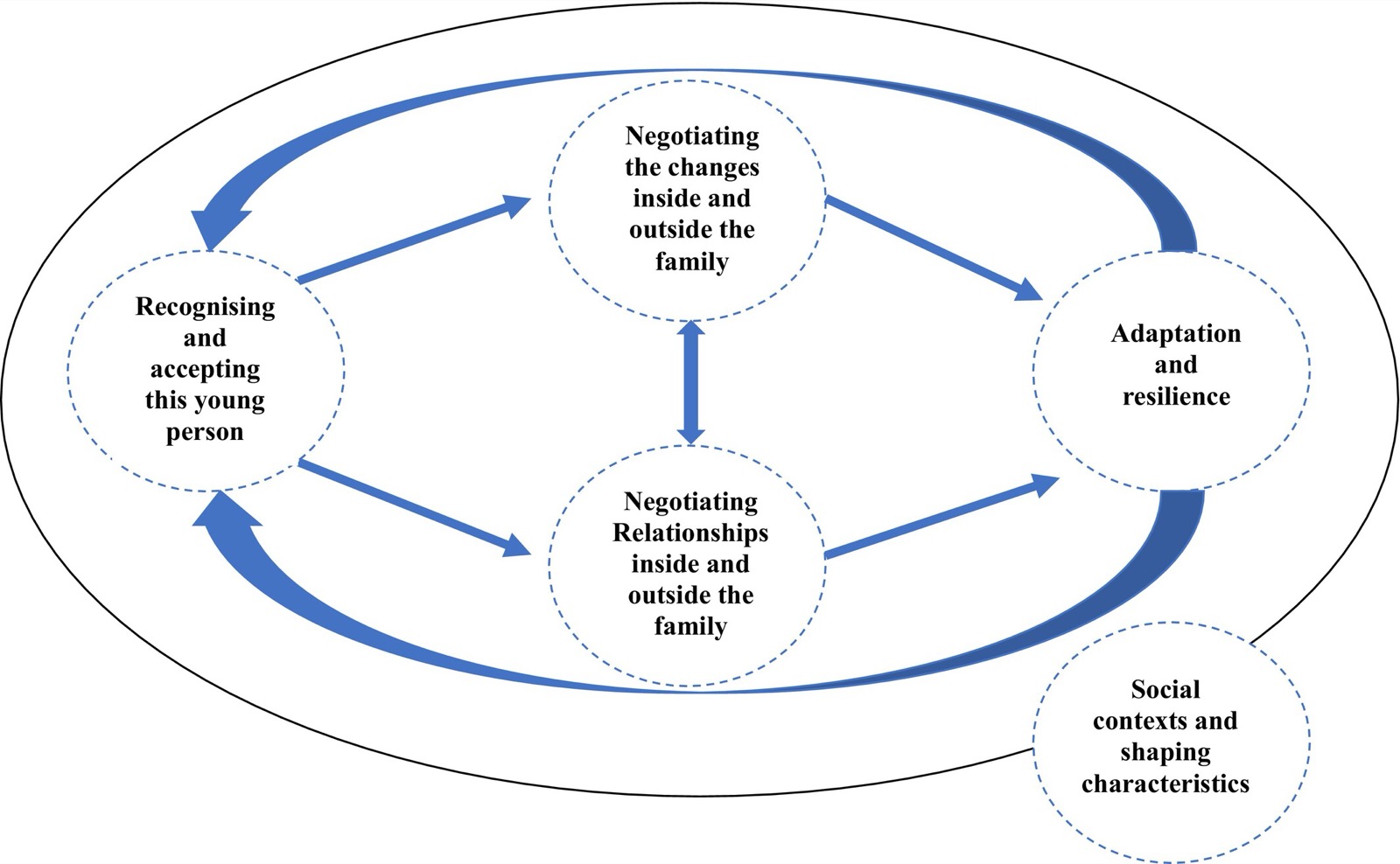
The theory explaining the process of social transition within the family context was described by the overarching category: Working towards a place of acceptance and belonging. This was a young person-led family resilience process, through which families worked through multiple adaptive subprocesses, beginning within the family context before changes outside of the family. Table 2 provides an overview of the organisation of categories. Figure 1 shows the relationship between the categories and the final theoretical model.
Table 2 — Organisation of categories and subcategories
Overarching category: Working towards a place of acceptance and belonging.
- 1. Main category: Recognising and accepting this young person. (1.1) Gender identity is already there; (1.2) Relational recognition; (1.3) Developing understanding; (1.4) Managing disclosure; (1.5) The importance of transition.
- 2. Main category: Negotiating the changes inside and outside the family. (2.1) Anticipating reactions; (2.2) Making requests; (2.3) Non-affirmation; (2.4) Affirmation.
- 3. Main category: Negotiating relationships inside and outside the family. (3.1) Negotiating relational difference; (3.2) Distancing; (3.3) Preserving and increasing connections.
- 4. Main category: Adaptation and resilience. (4.1) The emotional challenge; (4.2) Coping: strengths, skills and strategies; (4.3) Fighting strategies; (4.4) Resourcing: accessing the necessary support; (4.5) Developing self; (4.6) Developing community.
- 5. Main (Contextual) category: Social contexts and shaping characteristics. (No subcategories)
Main category 1: Recognising and accepting this young person
The social transition process began with developing recognition and acceptance of the young person's gender identity.
Subcategory 1.1: Gender identity is already there
All the families understood the young person's gender identity as having long been present, including before recognition: ‘…before I knew what trans was, I think, that was when I was trying to present myself to be more masculine’ (Guitar, young person, age 17).
Subcategory 1.2: Relational recognition
Recognition appeared to develop relationally. For example, Ariana's (young person, age 12) social transition began with dressing up with her cousin: ‘…I used to dress up with her’. Family members' processes of recognition were also interrelated. For example, Zac (young person, age 18) described: ‘…the more I was showing like questioning of it [gender identity] and the more uncertain I was, I feel like that reflected in them [mum] as well’.
Subcategory 1.3: Developing understanding
As different family members developed understanding, they recognised and accepted the young person's gender identity at different times. For example, regarding his initial recognition of his daughter Ariana's gender identity, Dan described how it took him ‘a few months to sort of process everything’.
Subcategory 1.4: Managing disclosure
Whilst the young people's early gravitation towards preferred items, such as toys and clothing typically associated with a different gender, had usually been accepted by the family, the young person also later expressed their wish to make certain changes. Young people appeared to first communicate this to the family member they deemed as most likely to accept their gender identity. In communicating this wish for change, the young person also disclosed their identity. Accounts highlighted the importance of the young person experiencing acceptance from close others regarding their authentic gender identity and expression: ‘I wanted to be sure that we [me and mum] were in agreement, and we were’ (Guitar, young person, age 17).
Subcategory 1.5: The importance of transition
Families came to recognise the importance of supporting social transition, and of the process being child-led. This included Guitar's (young person, age 17) suggested advice for parents:‘… just let them [GDYP] lead’. Social transition was understood as allowing the young people to fully express themselves: ‘…to allow them to kind of flourish and express who they are, without any restriction’ (Dan, Ariana's father), as well as enabling them to experience belonging: ‘it's sort of him finding his place in the world’ (Elly, Zac's mother).
Main category 2: Negotiating the changes inside and outside the family
Beginning within the family and then implementing changes within other contexts, the families negotiated changes of social transition and associated responses.
Subcategory 2.1: Anticipating reactions
Participants usually anticipated others' reactions. For Guitar (young person, age 17), this began with his parents: ‘I think I did have… maybe like a fear that my dad or, and my mum, would sort of just think that, you know, it's a phase, I'm not, I'm not gonna let you do it…’. Contrastingly, anticipation of accepting reactions supported the process for Zac (young person, age 18): ‘I felt like extremely supported and extremely like, I almost could predict how they [mums] would react so it just made it a lot easier’.
Subcategory 2.2: Making requests
Families began working towards acceptance and belonging in other contexts by requesting gender-affirming changes. Families moderated the introduction of changes in efforts to increase the likelihood of acceptance. For example, regarding changes to the school uniform she wore, Ruby (young person, age 15) described: ‘[Mum said] “we won't do the skirt just now because I think it's best if you ask the school or I ask the school’”. Guitar's family also moderated changes as others' reactions to these were anticipated; Guitar's mum, Sarah recalled: ‘… I was aware of, you know, how this (Guitar's gender-affirming changes) might be perceived by other people’.
Subcategory 2.3: Non-affirmation
Non-affirming reactions of others were common across many contexts: ‘[My grandparents] dead name me, misgender me …’ (Zac, young person, age 18). Ruby (young person, age 15) recalled her dad's response to her gender identity and expression: ‘…he was quite, like, mentally abusive to me. Like, he'd be like “No, like stop acting so gay’”. To manage this, Ruby tried to hide her gender expression until, following her parents' separation, she was able to express this more freely. Additionally, Ruby's mother Lori's own increased freedom following the separation informed this. Lori described: ‘… all of a sudden, I was free to be who I was without any restrictions. Why should I then enforce something on my child?’
Ruby's social transition seemed to be defined by experiences of non-acceptance; she recounted many experiences of peers ‘being transphobic’ towards her at school, describing: ‘…transitioning in general you're sort of like being everyone's target’. These reactions appeared to undermine young people's belonging. For example, regarding peers, Ariana (young person, age 12) experienced: ‘…they didn't want to be in the same toilet as me’, and Sarah (Guitar's mum) described how Guitar's ‘…best friend rejected him’.
Difficult experiences with professionals seemed common. Recalling an experience in school, Ariana (young person, aged 12) described: ‘…I got so nervous about it, getting put into girls and boys. And I got put in the boys and I got so sad’. Ruby (young person, age 15) also had difficult experiences with professionals; seemingly responding with concern to her social transition, staff at her school made a referral to social services: ‘… social services got involved and said that mum was brainwashing me into thinking that I was a girl…it felt like a big interrogation’.
Subcategory 2.4: Affirmation
Several parents cited prioritisation of their young person's happiness as related to their accepting response: ‘I just want a happy kid. I don't care what gender she is’ (Zoe, Ariana's mum). Beyond immediate family units, experiences of affirmation were recalled, but less commonly than the non-affirming responses. Ruby's (young person, age 15) reflection on rarer affirming experiences highlighted the contrasting power of affirmation. She became tearful when recalling receiving a gift during the earlier stages of her gender expression that had felt particularly gender-affirming: ‘…I love her for this…. she got me these gorgeous blue pumps. I've still got them upstairs’.
Main category 3: Negotiating relationships inside and outside the family
As the families negotiated the changes of social transition, relationships were negotiated and redefined.
Subcategory 3.1: Negotiating relational difference
Some parents appeared to take on a ‘buffering’ role between young people and other family members, such as Elly (Zac's mother), who described: ‘I've had to um, talk to his dad. Previously when he was young about, ‘please don't put him in really girly dresses’. Different family members’ needs were also negotiated. For example, Sarah (Guitar's mum) described: ‘bearing in mind that I'm a working mum, I have another child… I think sometimes my second child did miss out a little bit’.
Subcategory 3.2: Distancing
Social transitions involved changes in the ways the immediate family unit interacted with extended family and other systems. Elly (Zac's mother) taking on a ‘buffering role’ and advocating for Zac appeared related to an increase in distance in her relationship with Zac's dad. She described: ‘…we (Elly and Zac's dad) don't talk anymore… probably because I've been the bad guy’. In some families, explicit estrangement was considered or used as a means of protecting the young people from non-accepting responses. This occurred in Ariana's family: ‘…We don't speak to my dad's side of the family because they didn't really like me being a girl’ (Ariana, young person, age 12). Ruby's mum, Lori, described how she had been prepared for estrangement: ‘I was quite happy to cut off every single member of my family if it meant… [Lori begins to cry] if it meant that Ruby could be who she was supposed to be.’
Subcategory 3.3: Preserving and increasing connections
All the families experienced increased closeness within some relationships. Zoe (Ariana's mum) reflected: ‘…we're probably closer to be fair than anything because of, I don't know, the fact she is trans that, you know, she has gone through so much and she knows we've got her back’. Maintaining relational closeness was also an important strategy, as exemplified when Guitar (young person, age 17) considered advice he would give to parents/carers of other gender diverse young people: ‘…stay close it will really benefit you and the young person’. Whilst some non-accepting responses led to relational distancing, in other instances, compromises were made to preserve relationships. For Ruby (young person, age 15), this involved negotiating with her brother when he did not accept calling her Ruby. Ruby recalled: ‘…So we came up with [alternative name]’.
Main category 4: Adaptation and resilience
As they adapted to challenges, families developed capabilities and resilience, which equipped them in their continued work through other aspects of social transition.
Subcategory 4.1: The emotional challenge
Zac (young person, age 18) described the emotional family journey: ‘…like immediate family impacted us both, like us all. Like, mentally’; ‘it was that journey we all had to go on’. Participants also experienced mental health impacts related to the many examples of others' challenging responses. Guitar's mum, Sarah, described: ‘where he [Guitar] was kind of having these social responses from people, trying to navigate these pronouns, trying, you know, living this double life not being the authentic him… He tried to hang himself twice’. Regarding social services' involvement, Lori (Ruby's mother) described the: ‘… damage that it had done, to the family unit. And to my mental health as well’.
Subcategory 4.2: Coping: Strengths, skills and strategies
Participants used a range of strategies in managing difficulties. Zoe (Ariana's mum) tried to ‘shield’ and keep Ariana ‘out of the loop’ regarding some difficulties with school, and Ariana's father, Dan's account indicated that open communication within the family was also sometimes an important strategy:‘…if there's an instance at school, we talk about it’.
Cognitive strategies were also used. In managing difficult gender-related experiences with peers, Ariana (young person, age 12) described: ‘I've just got to… let go of it and think “well, they're stupid” and… you know. “Just forget about them’”. This was perhaps a strategy learnt from mum, Zoe, who seemed to support Ariana to maintain a positive outlook, by advising: ‘…it's one person, just ignore them…’. Participants also drew upon past experiences and existing strengths. This included attributes of the young people both supporting and developing through social transition. For example, Ruby (young person, age 15) reflected: ‘I just one day I built up the courage, I was like “Mum I wanna be a girl’”.
Subcategory 4.3: Fighting strategies
Several families experienced a sense of having to ‘fight’ for acceptance of the social transition. Ariana's (young person, age 12) family experienced several requests denied by school staff: ‘…when she went to school, you just felt like… “God what el[se]? What next’” (Zoe, Ariana's mum). Acceptance of Ruby's social transition within secondary school also seemed to have required a significant ‘fight’. Lori (Ruby's mother) described: ‘… she was still forced to use male toilets and male changing rooms’. Lori seemed to use a strategy of ‘picking your battles’, recounting how she advised Ruby to compromise: ‘You're just gonna have to get on with it’.
Subcategory 4.4: Resourcing: Accessing the necessary support
Participants required and worked to source appropriate support. Sarah (Guitar's mum) described support as ‘key’ for parents, and: ‘the most critical thing to have, I think, personally’. The value of support from close friends and other family members was also described by Zoe (Ariana's mum): ‘…having family support is massive…’.
Accounts highlighted the benefits of support from a range of services and professionals, as well as unmet support needs. Schools appeared to hold important potential in supporting the social transitions. For example, regarding her primary school headteacher, Ruby (young person, age 15) reflected: ‘… she was really, really nice and put unisex toilets in, so everyone could go together’. Similarly, Ariana (young person, age 12) described her secondary school as ‘all for equality’, indicating the potential for whole school cultures to be places of acceptance and belonging for GDYP. Despite these positive experiences, significant difficulties and apparent school-based barriers to social transition were salient across accounts. Additionally, Sarah (Guitar's mum) described significant difficulties in accessing child and adolescent mental health service support for Guitar, including when he was experiencing suicidality: ‘… [the psychologist] basically felt that I was giving Guitar adequate enough support at home. So they wouldn't see him’.
Subcategory 4.5: Developing self
Participants reflected on the ways their social transition experiences had shaped them, ascribing positive new meanings. For example, Ariana (young person, age 12) reflected on how coping with others' reactions shaped her: ‘…it's made me who I am’. Similarly, Zac (young person, age 18) described: ‘…my identity is something I hold close to my heart because I had to go a long way to get to where I am…’.
Subcategory 4.6: Developing community
Families also supported the development of their communities, including by educating others. Lori (Ruby's mother) described conversations she has with work colleagues: ‘I always then use that opportunity to educate them (regarding gender diversity)’. Zoe (Ariana's mum) reflected on Ariana's friendship circle: ‘…there's like, doesn't seem to be any prejudice around it. But I think, I don't know whether we've like sort of paved the way a little bit’. Similarly, regarding the challenges negotiated with Ariana's school, Dan (Ariana's dad) reflected, ‘hopefully the kind of the fuss that we kicked up, has put the school in a position now where they can understand…’.
Main (contextual) category 5: Social contexts and shaping characteristics
Social transitions were located within other social contexts. Zac (young person, age 18) described how other shared transitions led to a more serious tone in peer conversations, facilitating his gender identity disclosure: ‘I would say that that transition between schools and lockdown was probably the major push’.
Participants also reflected on how personal and social characteristics shaped social transition, including others' reactions. Zac felt that his parents' experiences of prejudice related to their own gay identities had shaped their understanding of his gender identity: ‘…there was definitely some sort of understanding they would have had’, but he also highlighted the uniqueness of the trans experience. Zac also considered how privilege associated with his white ethnicity likely supported his access to services, reflecting: ‘that just, I guess, opened more doors’; ‘… it puts us more like as a priority…’.
Interaction of categories (Figure 1)
Following the initial stage of ‘recognising and accepting this young person’, the processes of the other main categories were not processed linearly. A double arrow depicts that ‘negotiating the changes of social transition…’ and ‘negotiating relationships…’ co-occurred and were mutually influencing. Arrows from ‘adaptation and resilience’ back to ‘recognising and accepting this young person’ convey that adaptation and resilience developed both as a result of the other aspects of the social transition and supported the social transition to continue and repeat, including in other contexts. As the social transitions occurred across many settings, the overall process typically took place multiple times, beginning with immediate family and then beyond, including within extended family, school, wider communities and public arenas. All aspects of the process were also shaped by contextual factors, represented with the positioning of ‘social contexts and shaping characteristics’ on an outer circle. The circles have a dashed exterior line, representing the permeability of the social transition processes to these contexts and characteristics.
Discussion
The developed theory explained the social transition of GDYP within the UK family context as a family resilience process. Accounts indicated that it was largely due to difficult experiences, which can be conceptualised as gender minority stressors, that this family resilience was required. Echoing previous evidence, gender minority stressor exposure appeared to negatively impact well-being, and frequently occurred in schools (Brecht et al., 2024; Hatchel et al., 2019; Meyer, 2003). Schools did, however, appear to have significant potential to be affirming environments.
A salient strand aligning with other research was the centrality of families in the social transitions and the importance of family acceptance in enabling social transition (Bull & D'Arrigo-Patrick, 2018; Schimmel-Bristow et al., 2018). Participating families clearly viewed social transition as having a key role in well-being, describing many examples of associated positive effects. These impacts echo findings from other recent research, including associations between higher perceived transition progress and lower mental health symptoms (Thoma, C, Ej, S., & Salk, 2023).
Notably, there has been some debate regarding the evidence base for well-being and social transition, with some mixed results (Durwood et al., 2017; Hall et al., 2024; Morandini et al., 2023). However, given the apparent salience of gender minority stress, it seems possible that this may undermine some potential positive impacts of social transition. Exploration of this would be a useful area for future research.
Implications
Given the salience of gender minority stressors, we recommend these are carefully attended to within assessment and treatment offered to GDYP in mental health and gender services. The need for services sensitive to the needs of these young people seems particularly pressing within the recent UK context, as there appears to have been further increased public and media debate regarding the lives and identities of GDYP since the commencement of the Cass Review (Fox, 2024). A focus on gender minority stress may also open up a more systemic understanding of gender dysphoria as related to non-accepting social contexts. This would align with other recent research. For example, Brecht et al. (2024) found that experiencing trans hostility was associated with higher rates of gender dysphoria in transgender adolescents.
Building upon the significance of the family in social transitions, a further recommendation is for assessment and treatment to be consistently offered at the family level. This could perhaps include systemic family therapy interventions around themes of changing family needs due to alterations in relational closeness, supporting families to navigate changes and to bolster family functioning.
Considering the apparent potential for schools to affirm and support social transition, as well as the many experiences of non-affirmation, we recommend school support as another area that needs addressing. Indeed, given the positive experiences of the participants after social transition at school, support for social transition (where desired by GDYP) seems an important area to address for GDYP well-being. The proposed educational guidance on supporting ‘Gender Questioning Children’, however, raises questions over the extent to which this support for transitioning may be possible in the future; UK educational settings will not have a duty to support social transition, and a ‘cautious approach’ is recommended where requests are accommodated (Department for Education, 2023). We therefore recommend that longer-term impacts of this new guidance on the ability to socially-transition and its possible effect on GDYP's well-being is a continuing focus for research.
Whilst we have focused here on the recent UK context, it seems likely that this will have some international generalisability; indeed, the relevance of UK developments to US clinicians has been highlighted (Knopf, 2024).
Limitations
This was an all-white sample, and it is imperative that the voices of people with a range of racial backgrounds are included in theory development. This lack of racial diversity is also particularly limiting given the prominence of gender minority stressors, as minority stressors related to different aspects of identity are considered to intersect (Parent, DeBlaere, & Moradi, 2013; Prendergast & MacPhee, 2018). Additionally, as all the young people had transitioned to a binary gender identity, the extent to which this model applies to GDYP of other gender identities remains unknown. Finally, all findings came from families in which at least one parent was affirming of their GDYPs' identity. The lack of inclusion of less accepting families narrows the generalisability of the presented model significantly; it remains unclear if and how families would engage in a family-resilience process of social transition without the presence of an affirming parental figure. It would be helpful for future research to build upon these areas by examining the experiences of families representing broader characteristics.
Conclusion
The current study addressed a previous lack of research, providing further understanding of the experience of GDYP and their families, and contributing a developed model of social transition within the family context. The developed theory explained social transition within the family as a young person-led family-resilience process. Continuing development in this area is much needed.
Complexe Systémique: key points
For a systemic reading, the study’s contribution is to move social transition from the young person to the family system that welcomes it, negotiates it and also pays its price. The model runs in a loop: recognising, negotiating changes and relationships, adapting, then starting again in each new circle (extended family, school, services). What tests resilience comes less from the transition itself than from the environment’s reactions: misgendering, school refusals, a referral to social services, difficult access to care despite suicide risk. For clinical practice, this invites working at the family level, noticing the parent who acts as a buffer, following the ruptures and rapprochements the transition brings, and treating the school as a possible partner in care. The limits are clear: four white families, all with at least one parent affirming the transition, and young people with binary identities; the model says nothing of families in disagreement. Read alongside the article on trans children and their parents facing transition, and the article on multi-family groups for transgender adolescents.
Notes from the original
Acknowledgements. The authors give a huge thanks to the families who participated for sharing their stories and giving so much. They thank the clinicians of the GIDS for all their help and generous support.
Conflict of interest statement. The authors have declared that they have no competing or potential conflicts of interest.
Funding information. No external financial support was received.
Ethical considerations. Informed consent was obtained for all participants aged 16 and over, and assent was obtained, with parental consent, for participants under 16. HRA/Health and Care Research Wales approval was granted on 10/01/2022 (REC reference: 21/LO/0854). The relevant permissions were obtained for the use and publication of the data presented in Table 1.
References
American Psychiatric Association. (2015). Key terms and concepts in understanding gender diversity and sexual orientation among students: Informational guide [Fact sheet]. Available from: https://www.apa.org/pi/lgbt/programs/safe-supportive/lgbt/key-terms.pdf
American Psychiatric Association. (2022). What is gender dysphoria? Available from: https://www.psychiatry.org/patients-families/gender-dysphoria/what-is-gender-dysphoria
Bhaskar, R. (2008). A realist theory of science. Abingdon, UK: Routledge.
Brecht, A., Bos, S., Ries, L., Hübner, K., Widenka, P.M., Winter, S.M., & Calvano, C. (2024). Analyzing body dissatisfaction and gender dysphoria in the context of minority stress among transgender adolescents. Child and Adolescent Psychiatry and Mental Health, 18, 30.
Bull, B., & D'Arrigo-Patrick, J. (2018). Parent experiences of a child's social transition: Moving beyond the loss narrative. Journal of Feminist Family Therapy, 30, 170–190.
Cass Review. (2024). Independent review of gender identity services for children and young people: Final report. Available from: https://cass.independent-review.uk/wp-content/uploads/2024/04/CassReview_Final.pdf
Cass Review. (n.d.). Terms of reference. Available from: https://cass.independent-review.uk/about-the-review/terms-of-reference/
Catalpa, J.M., & McGuire, J.K. (2018). Family boundary ambiguity among transgender youth. Family Relations: An Interdisciplinary Journal of Applied Family Studies, 67, 88–103.
Corbin, J.M., & Strauss, A. (2015). Basics of qualitative research: Techniques and procedures for developing grounded theory ( 4th edn). Thousand Oaks, CA: SAGE.
Department for Education. (2023). Gender questioning children: Non-statutory guidance for schools and colleges in England, draft for consultation. Available from: https://consult.education.gov.uk/equalities-political-impartiality-anti-bullying-team/gender-questioning-children-proposed-guidance/supporting_documents/Gender%20Questioning%20Children%20%20nonstatutory%20guidance.pdf
Department for Education, Badenoch, K., & Keegan, G. (2023). Parent first approach at the core of new guidance on gender questioning children. [Press release]. Available from: https://www.gov.uk/government/news/parent-first-approach-at-the-core-of-new-guidance-on-gender-questioning-children
Dey, I. (1999). Grounding grounded theory: Guidelines for qualitative inquiry. Bingley, UK: Emerald Group.
Durwood, L., McLaughlin, K.A., & Olson, K.R. (2017). Mental health and self-worth in socially transitioned transgender youth. Journal of the American Academy of Child & Adolescent Psychiatry, 56, 116–123.
Ehrensaft, D., Giammattei, S., Storck, K., Tishelman, A.C., & Keo-Meier, C. (2018). Prepubertal social gender transitions: What we know; what we can learn-a view from a gender affirmative lens. International Journal of Transgenderism, 19, 251–268.
Fox, A. (2024). Doctor who led gender care review says ‘toxicity of debate is exceptional’. The Independent. Available from: https://www.independent.co.uk/news/health/hilary-cass-gender-care-uk-debate-toxicity-b2526126.html
Hall, R., Taylor, J., Hewitt, C.E., Heathcote, C., Jarvis, S.W., Langton, T., & Fraser, L. (2024). Impact of social transition in relation to gender for children and adolescents: A systematic review. Archives of Disease in Childhood, 109, S12–S18. https://doi.org/10.1136/archdischild-2023-326112
Hatchel, T., Valido, A., De Pedro, K.T., Huang, Y., & Espelage, D.L. (2019). Minority stress among transgender adolescents: The role of peer victimization, school belonging, and ethnicity. Journal of Child and Family Studies, 28, 2467–2476.
Hendricks, M.L., & Testa, R.J. (2012). A conceptual framework for clinical work with transgender and gender nonconforming clients: An adaptation of the minority stress model. Professional Psychology: Research and Practice, 43, 460–467.
Horton, C. (2020). Thriving or surviving? Raising our ambition for trans children in primary and secondary schools. Frontiers in Sociology, 5, 1–18.
Hunter, J., Butler, C., & Cooper, K. (2021). Gender minority stress in trans and gender diverse adolescents and young people. Clinical Child Psychology and Psychiatry, 26, 1182–1195.
Knopf, A. (2024). The Cass report, gender identity, and where to go next. The Brown University Child and Adolescent Behavior Letter, 40, 7.
Kuvalanka, K.A., Weiner, J.L., & Mahan, D. (2014). Child, family, and community transformations: Findings from interviews with mothers of transgender girls. Journal of GLBT Family Studies, 10, 354–379.
Looker, B., Vickers, J., & Kington, A. (2021). The case for a critical realist grounded theory research design. In I. Psaroudakis, T. Muller, & A. Salvini (Eds.), Dealing with grounded theory: Discussing, learning, and practice (pp. 139–168). Pisa, Italy: Pisa University Press. Available from: https://livrepository.liverpool.ac.uk/3128865/1/Dealing_With_Grounded_Theory.pdf#page=139
Mermaids. (n.d.). Glossary. Available from: https://mermaidsuk.org.uk/glossary/
Meyer, I.H. (2003). Prejudice, social stress, and mental health in lesbian, gay, and bisexual populations: Conceptual issues and research evidence. Psychological Bulletin, 129, 674–697.
Morandini, J.S., Kelly, A., de Graaf, N.M., Malouf, P., Guerin, E., Dar-Nimrod, I., & Carmichael, P. (2023). Is social gender transition associated with mental health status in children and adolescents with gender dysphoria? Archives of Sexual Behavior, 52, 1045–1060.
Nelson, J. (2017). Using conceptual depth criteria: Addressing the challenge of reaching saturation in qualitative research. Qualitative Research, 17, 554–570.
Olson, K., Blotner, C., Alonso, D., Lewis, K., Edwards, D., & Durwood, L. (2019). Family discussions of early childhood social transitions. Clinical Practice in Pediatric Psychology, 7, 229–240.
Olson-Kennedy, J., Cohen-Kettenis, P.T., Kreukels, B.P.C., Meyer-Bahlburg, H.F.L., Garofalo, R., Meyer, W., & Rosenthal, S.M. (2016). Research priorities for gender nonconforming/transgender youth: Gender identity development and biopsychosocial outcomes. Current Opinion in Endocrinology, Diabetes, and Obesity, 23, 172–179.
Parent, M.C., DeBlaere, C., & Moradi, B. (2013). Approaches to research on intersectionality: Perspectives on gender, LGBT, and racial/ethnic identities. Sex Roles, 68, 639–645.
Pariseau, E.M., Chevalier, L., Long, K.A., Clapham, R., Edwards-Leeper, L., & Tishelman, A.C. (2019). The relationship between family acceptance-rejection and transgender youth psychosocial functioning. Clinical Practice in Pediatric Psychology, 7, 267–277.
Prendergast, S., & MacPhee, D. (2018). Family resilience amid stigma and discrimination: A conceptual model for families headed by same-sex parents. Family Relations: An Interdisciplinary Journal of Applied Family Studies, 67, 26–40.
Schimmel-Bristow, A., Haley, S.G., Crouch, J.M., Evans, Y.N., Ahrens, K.R., McCarty, C.A., & Inwards-Breland, D.J. (2018). Youth and caregiver experiences of gender identity transition: A qualitative study. Psychology of Sexual Orientation and Gender Diversity, 5, 273–281.
Stewart, J., & Palmer, J. (2024). NHS England's response to the final report of the independent review of gender identity services for children and young people. Available from: https://www.england.nhs.uk/long-read/nhs-englands-response-to-the-final-report-of-the-independent-review-of-gender-identity-services-for-children-and-young-people/ [last accessed 27 August 2024].
Thoma, B.C., Jardas, E.J., Choukas-Bradley, S., & Salk, R.H. (2023). Perceived gender transition progress, gender congruence, and mental health symptoms among transgender adolescents. Journal of Adolescent Health, 72, 444–451.
Toomey, R.B. (2021). Advancing research on minority stress and resilience in trans children and adolescents in the 21st century. Child Development Perspectives, 15, 96–102.
Vincent, B.W. (2018). Studying trans: Recommendations for ethical recruitment and collaboration with transgender participants in academic research. Psychology & Sexuality, 9, 102–116.
Walsh, F. (2016). Applying a family resilience framework in training, practice, and research: Mastering the art of the possible. Family Process, 55, 616–632.
Yardley, L. (2000). Dilemmas in qualitative health research. Psychology and Health, 15, 215–228.
Reformatted republication of A grounded theory of the process of social transition in a family context from the perspective of gender diverse young people and their parents, by Sophie Razzel, Simon Levinson and Trish Joscelyne, Child and Adolescent Mental Health, advance online publication (2026), doi: 10.1111/camh.70078, under a CC BY 4.0 licence. Edition and layout: Complexe Systémique, September 2026 — the work has been modified under the terms of the licence (tables presented as lists). Neither the authors nor the publisher are responsible for this edition; the original version prevails.
This is the original article “A grounded theory of the process of social transition in a family context from the perspective of gender diverse young people and their parents”, published in Child and Adolescent Mental Health (2026) under a CC BY 4.0 licence. Republished by Complexe Systémique: the author’s text is unchanged; only the presentation has been adapted for reading online, as set out at the head of this page.
Read the original articleHow to cite this article
Razzel, S., Levinson, S., et Joscelyne, T. (2026). A grounded theory of the process of social transition in a family context from the perspective of gender diverse young people and their parents. Complexe Systémique. https://app.complexe-systemique.com/en_GB/articles/a-grounded-theory-of-the-process-of-social-transition-in-a-family-context (Original work published in 2026 in Child and Adolescent Mental Health, publication en ligne anticipée (2026); republished in 2026 by Child and Adolescent Mental Health, https://acamh.onlinelibrary.wiley.com/doi/10.1111/camh.70078)
To go further
- Enfant qui s’épanouit, *parent en deuil* : une étude qualitative sur des enfants trans et leurs parents face à la transitionParents facing transition.
- Pourquoi des *groupes multifamiliaux* pour les jeunes transgenres et leurs parents ?Multi-family groups.
- « Comment, au nom de Dieu, allons-nous traverser ça ? » : le *soutien parental* aux jeunes transgenresParental support.
Related training courses
 Short course
The suicidal crisis in adolescents and young adults
Training: assessing and supporting the suicidal crisis in adolescents and young adults. Clinical landmarks and systemic tools. In French.
 Symposium
The Abnormal Normals and the Normal Abnormals
Conference replay: six clinicians explore normality — diagnoses, norms, adolescents, therapists. Immediate, lifetime access. Talks in French.
Related articles
 Scientific
Sickle Cell Disease and Young Couples: Understanding the Influence of Shared and Individual Meaning on Couples’ Experience of Illness
Nine young adult couples facing sickle cell disease: how each partner makes sense of the illness, and how the couple moves from caregiving to equality from one crisis to the next.
 Scientific
Family group conference provision across the lifespan of child welfare intervention: A mixed-method realist-informed evaluation comparing three stages of welfare concern
Early help, child protection or children in care: among 155 UK families, experiences and outcomes of family group conferences vary very little by stage.
 Scientific
Decolonizing Supervision: A Critical Race and Queer Theory Framework for Marriage and Family Therapy
Supervision is not neutral: a framework drawing on Critical Race Theory and Queer Theory to name and share power in supervision, with a vignette.
 Scientific
How can we BeST? meet the needs of adoptive families? Relevant findings from a major Randomised Controlled Trial of infants in foster care in the UK
The BeST? trial (488 infants in care in the UK) reread for adoption: holistic, ongoing assessment of children and a move to dual registration.