Psychotherapy · Couples
A Qualitative Meta-Analysis Exploring Client-Reported Outcomes of Couple Therapy
What do couples take from therapy, in their own words? A team at Trinity College Dublin meta-analyzed fifteen qualitative studies and identified twenty-five outcomes, grouped into seven clusters. They include what the usual scales measure, but also what those scales miss: letting go of expectations of the partner, seeing one’s own part in cycles of conflict, or deciding with full clarity to separate.
This is a reformatted republication of A Qualitative Meta-Analysis Exploring Client-Reported Outcomes of Couple Therapy, by Ronan O’Malley, Rebecca Glenny, Simone Poppleton and Ladislav Timulak, published in Psychotherapy (American Psychological Association) (2023), doi: 10.1037/pst0000513, under a CC BY 4.0 licence. Prepared by Complexe Systémique in September 2026: the authors’ text is unchanged; the layout has been adapted for reading online, which constitutes a modification of the work under the terms of the licence. Tables are presented as lists. This edition was made neither by the authors nor by the publisher, who are not responsible for its content or for any errors. The original version prevails.
For instance, for some couples, the clarity on the decision to separate may be a legitimate outcome to work toward.
Ronan O’Malley, Rebecca Glenny, Simone Poppleton and Ladislav Timulak
Abstract
The quantitative reviews of the outcome research on couple therapy show that this type of therapy can produce positive outcomes for couples and improve relationship satisfaction. There is now also a number of qualitative studies in which clients report in their own words on the outcomes of couple therapy. This study aimed to meta-analyze the client-reported outcomes of couple therapy generated in the studies using qualitative methods. A sample of 15 primary studies examining clients’ reported outcomes of couple therapy was identified through an extensive literature search. Relevant qualitative data on the client-reported outcomes were extracted into a single data set. The data was then analyzed using a descriptive–interpretive qualitative meta-analytic approach. Similar outcomes were grouped into metacategories. The metacategories were then organized into several clusters of the client-reported outcomes of couple therapy. The meta-analysis yielded 25 metacategories which were clustered into seven main clusters, (a) seeing things differently; (b) changed behavior within the relationship; (c) improved experience in the relationship; (d) improved communication quality; (e) improvement in relationship functioning; (f) improved individual functioning, and (g) difficult outcomes of therapy. Clients reported numerous constructive (e.g., new understanding of the couple’s interactional functioning, improvement in the conflict management, new positive ways of relating and connecting, letting go of expectations imposed on the partner or changes within the self that may be one’s contribution to the relationship), and some difficult, outcomes of engaging in couple therapy (the clarity on the decision to separate).
Clinical Impact Statement
Question: This study aimed to meta-analyse the client-reported outcomes of couple therapy generated in the studies using qualitative methods. Findings: Clients reported numerous positive outcomes of engaging in couple therapy (e.g., in the area of perception of the partner, in the experienced satisfaction, in communication, in more mutually supportive behavior, but also in the lower individual distress). Meaning: Clients report a significant variety of positive changes that they attribute to couple therapy, which include not only relational changes but also changes in the individual functioning. Next Steps: Given the influence client expectations have on outcomes, it may help to check-in with, clarify and align expectations of individual partners at an early stage of therapy.
Keywords: couple therapy, client experiences, outcomes, qualitative meta-analysis
Couple therapy interventions positively impact upon relationship distress (e.g., M. Friedlander et al., 2021; Snyder & Halford, 2012). Couple therapy approaches have also been designed to target individual psychological issues (e.g., Barbato & D’Avanzo, 2008). Increased relationship satisfaction is a main goal of couple therapy and remains a measure of the outcome of couple therapy often occurring alongside improvements in other specifically targeted issues. Increased relationship satisfaction has been associated with positive improvements in other areas including overall better physical and mental well-being, better financial stability, more beneficial parenting practices, and decreased mortality (Whisman et al., 2022). An older review of 20 meta-analyses of couple therapy effects suggested an average pre–post effect size d = .84 (Shadish & Baldwin, 2003). A newer, model-specific meta-analysis suggested a similar pre–post effect size d = .93 (Spengler et al., 2022), and somewhat smaller pre–post effect size d = .60 was reported in another recent meta-analysis (Rathgeber et al., 2019).
Most of the current outcome research on couple therapy uses the pre–post (follow-up) assessment of couples’ distress using one of the standard instruments. The standard instruments focus on the predetermined outcome domains defined by the experts that constructed the instrument. For instance, a commonly used measure such as Revised Dyadic Adjustment Scale (RDAS; Busby et al., 1995) asks agreements on the issues of religion, finances, sex, career or asks questions about working on a project together or the frequency of quarrelling. Other commonly used measures in the field of couple therapy have a similar focus, such as Marital Satisfaction Inventory (Snyder, 1997) or Couple Satisfaction Index (Funk & Rogge, 2007). Particular theoretical model-specific measures also cover domains that are determined by experts and, given the overall integrative nature of the field of couple therapy, they cover similar areas of couple interaction (Snyder & Balderrama-Durbin, 2022).
Qualitative research, however, also introduces an option of looking at the couple therapy outcomes from the perspective of clients/couples without the predetermined areas of outcomes. As argued by McLeod et al. (2021), the outcomes generated through qualitative methodology can augment knowledge about the therapy outcomes from randomized controlled trials (RCTs). They can, for instance, point to the clients’ agency in constructing what they are taking out of therapy. This can potentially lead to a fresh perspective, complementing the standard outcome research. For instance, in individual therapy, qualitative outcome studies uncovered that some clients may appreciate being more in touch with their vulnerability as a legitimate outcome of psychotherapy (Timulak & Creaner, 2010), an outcome that was not previously conceptualized as relevant by therapeutic theories. We can thus envisage that it can be informative to look at what clients in couple therapy see as the impact/outcome of therapy. The clients’ perspective can sensitize practitioners to what outcomes are valued by clients and thus shape the practitioners understanding of the goals which may be useful to work toward. The clients’ perspective on what outcomes they value in couple therapy can also shape a development of new outcome measures that could perhaps include domains not yet covered (or overemphasized) in the existing outcome measures.
Qualitative psychotherapy research grew significantly over the last 30 years (McLeod et al., 2021). This growth led to the need to be able to synthesize the generated findings through meta-analytic means, and for that purpose, the qualitative meta-analysis (QMA) method was successfully utilized (Timulak & Creaner, 2022). Several meta-analyses focusing on the clients’ experiences of therapy have been conducted in the context of individual therapy (e.g., Levitt et al., 2016). In the context of couple therapy, two QMAs have been conducted that looked at the clients’ experiences of couple therapy (thus not necessarily the outcomes of therapy but rather in session experiences). First of all, Chenail et al. (2012) meta-analyzed findings of 49 qualitative studies on clients’ experiences of couple and family therapy. Their meta-analysis combined couple and family therapy in a way that is difficult for the reader to clearly extract findings pertaining specifically to couple therapy. Furthermore, their meta-analysis included studies focusing on the experiences of therapy, so not explicitly experiences of the outcomes/impacts of therapy. Thus, the presentation of their findings focuses on the expectations pretherapy, in-session experiences of therapy, etc. Only a small portion of their findings including perspective on the impact/outcome of therapy. From the presentation of the findings of the meta-analysis, it is not clear how many of the 49 studies actually contributed to the findings in the area of the outcomes of couple/family therapy and how many were specifically on couple therapy. The outcomes of therapy (couple or family) that were possible to glean from Chenail and colleagues included changes in self-awareness (e.g., recognizing own contribution to the relational problems), in the view of the others (e.g., being more understanding of the other), changes in individual well-being, recognition of differences between the couple/family members (e.g., also being more understanding of those differences), and changes in how the members of the family/couple interacted (e.g., better communicating, having less conflicts). Negative experiences reported by Chenail et al. included clients seeing their therapist as confrontational, biased, slow, lacking connection, not affirming, patronizing, etc. Clients reported that they did not like when the therapists did not manage the sessions well (e.g., did not review homework, did not provide a sense of direction, did not provide equal space to all parties).
Another QMA in the area of couple therapy (Madden & Timulak, 2022) focused solely on the experiences of therapy (so not on the outcomes of couple therapy). The focus of Madden and Timulak’s meta-analysis was on what clients find helpful, difficult but helpful and unhelpful in couple therapy. The authors found 21 qualitative studies that provided relevant findings. Altogether, they distilled 33 metacategories (themes) that captured the clients’ in-session experiences. Only five of those pertained to what we could refer to as in-session outcomes. They included new insights, renewed hope for the relationship, acquiring new communication skills, learning new responses to conflicts and experiences of the renewal of the commitment to the relationship. When considering these findings, the reader needs to be aware that these were in-session experiences that could be conceptualized as in-session outcomes; thus, they were not reported as posttherapy outcomes. In terms of unhelpful experiences, Madden and Timulak’s QMA reported on unsatisfactory relationship with the therapist (e.g., therapist being judgmental), perceptions of the therapist as unskillful (e.g., unable to provide an equal focus between the partners), and perceptions of problems on the clients’ part (e.g., feeling like they are forced by their partner to be in therapy).
These two qualitative meta-analyses showed that there is a reasonable number of qualitative studies investigating the clients’ experiences of couple therapy. A very informal initial search of literature also led us to believe that the field is mature enough to contain enough qualitative studies looking specifically at the outcomes of couple therapy. We thus set out on a formal search of the research and decided to conduct a QMA. The aim of the present study was thus to undertake a qualitative meta-analytic investigation of the client-reported outcomes of couple therapy. In undertaking a qualitative meta-analysis to identify the outcomes that clients report as a result of couple therapy, and synthesizing these, we hoped to complement the existing expert-generated domains of measuring outcomes of couple therapy with those generated by clients, so we could ensure that they do not get overlooked by researchers and clinicians.
Method
Design
This study used a qualitative meta-analysis (QMA) design to conduct a comprehensive secondary analysis of findings from selected primary studies exploring the qualitative outcomes of couple therapy. The method of study was guided by the standards set out by Timulak (2009) and Timulak and Creaner (2022, 2023) as well as recommended reporting standards for QMAs (Levitt et al., 2018). It is described in detail in the following method sections. It is a generic approach to QMA along the lines of other similar descriptions (e.g., Thorne et al., 2004).
Selection of Primary Studies
Searches were undertaken to identify relevant studies that contain data (findings) applicable to the focus of the meta-analysis, outcomes of couple therapy. The following electronic data bases were searched with no date restrictions applied—PsycInfo (from 1812 to 11/05/2022) and PsycArticles (from 1812 to 11/05/2022). To find appropriate studies for the meta-analysis, a structured Boolean search was undertaken, using a combination of keywords and phrases such as (couple therapy OR marriage therapy OR marital therapy OR couple couns* OR marriage couns) AND (outcomes OR outcome OR changes OR effects) AND (qualitative OR mixed method OR grounded theory OR thematic analysis OR content analysis OR case study). Additional relevant studies were identified through manual reference list review of the primary studies identified, through previous meta-analyses and through reference list review of other couple therapy articles of interest. In completing the search, database filters were applied to include results which were peer-reviewed publications and written in English. The overall results of the search were transferred into the reference management software Zotero and saved as one file. Duplicates were removed, leaving the final database for further review.
Inclusion criteria was applied, by the first author, to title and abstract to shortlist the studies compatible with the research question. The inclusion criteria were: written in English; published in a peer-reviewed journal; identified qualitative analysis of the outcomes of couple therapy; reported outcomes from adult clients only (therapist or other observer perspective excluded from data, studies with participants over 18 only); reported outcomes at, or post conclusion of therapy; featured outcomes as a result of couple therapy. A proportion of abstracts (approximately 20% of the full database of 581 abstracts—116 abstracts) were also screened by the second author, a first-year doctoral student on a doctorate in counselling psychology.
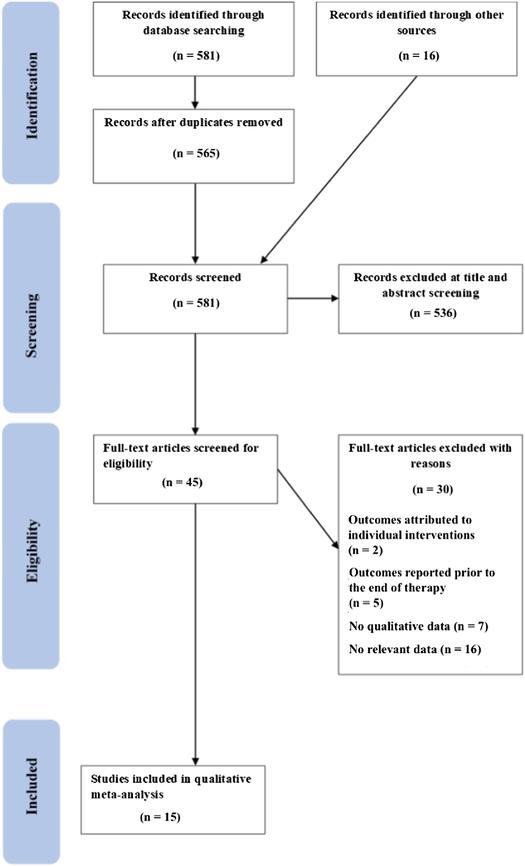
A full-text search of each study on the shortlist was then completed. Studies were excluded based on characteristics of the study which did not align with the research question, including where only quantitative research methods were used, individual or family therapy outcomes were reported, and where outcomes were reported prior to the conclusion of therapy. Further checks were independently completed through full-text screening of a proportion of the shortlisted studies (approximately 15% of shortlisted sample—seven full-text articles) by the fourth author and second author. Any discrepancies were discussed, rechecked, and adjusted accordingly. The final sample analyzed consisted of 15 studies (the selected studies are denoted with an asterisk in the reference list). The process of selection of studies is captured in the Preferred Reporting Items for Systematic Reviews and Meta-Analyses diagram in Figure 1.
> Download Powerpoint slide (.ppt) The downloadable content is an alternative presentation to the accessible web content and may not conform to WCAG 2.1 AA.Figure 1. PRISMA Flow Diagram (See Moher et al., 2009)Note. PRISMA = Preferred Reporting Items for Systematic Reviews and Meta-Analyses.Figure 1. PRISMA Flow Diagram (See Moher et al., 2009)Note. PRISMA = Preferred Reporting Items for Systematic Reviews and Meta-Analyses.
Appraisal of Primary Studies
We used criteria described by Harden et al. (2004) for assessing methodological quality of selected studies. The first author assessed each study on seven criteria: the presence of a theoretical framework/literature review; clarity of study aims; description of context; description of sample/recruitment; a description of data collection and analysis; credibility and trustworthiness of the analyses; and a reference to direct quotes that allow for mediation between the raw data and interpretation. Each feature was given a score of 1 if present, or 0.5 if partially present (see Madden & Timulak, 2022). Each study was rated by another coauthor (interrater agreement using intraclass correlation was .88) and any discrepancies were finalized consensually. All 15 studies met the criteria scoring 4 or above. The average rating was M = 6.17 (SD = 0.88).
Data Preparation and Analysis
After selecting the primary studies to be analyzed, the data relevant for analysis was identified, labelled, extracted, and formatted for analysis by the first author. This process included searching each study for data relevant to the domain of investigation (i.e., what are the outcomes of couple therapy) within all of the results of the primary studies, for example, description of the findings by the primary researchers (e.g., themes or categories identified in the studies) and direct quotes from participants in the studies. Some primary studies conducted interviews during therapy as well as at the conclusion of therapy, only data pertaining to outcomes after the conclusion of therapy was included. Other studies reported on outcomes observed by therapists. Again, only outcomes reported by participant couples were included in the data extraction.
In line with Timulak and Creaner’s (2023) generic descriptive–interpretive qualitative meta-analysis framework, findings from the primary studies, within the domain being investigated, were organized into meaning units (MUs). MUs are the smallest unit of data which can convey meaning and they can vary in length. This could be a category heading from the primary study (e.g., “External [Behaviours]—Interactional change [e.g., reciprocal sensitivity; kindness]”—[Bradford et al., 2016, p. 428]), a sentence or paragraph explaining findings in the study (e.g., “Part of their change of perspective at this point also included the participants reporting seeing strengths in their partners.”—[Handley et al., 2021, p. 164]) or a participant quote which conveys a finding. A participant quote from one of the studies (Ramisch et al., 2013, p. 383) presents a good example of an MU “It helped us stop doing things that were destructive, like being too defensive.” This conveys a clear outcome described by a client that has been attributed to therapy.
The MUs were given a unique code to allow for easy identification of data, cross-referencing, and auditing. In total there were 237 MUs. The average per study was 15.8 (SD = 8.94). The lowest MUs in a study was 4, the highest was 32 MUs. Once all relevant MUs were identified, their content was compared for similarities and clustered together into groups of MUs. Typically, an MU was fed into one group, but as an MU can convey more than one meaning, some MUs were assigned to more than one group. For example, an MU extracted from Greenberg et al. (1988) “the less angry she got and the more open and accepting of me, the easier it was for me to be nice to her” was assigned to the metacategory Acceptance of the Partner/Letting go of Expectations, but it also fit within the metacategory Awareness of the Interactional Cycles in the Relationship as it conveyed meaning in both categories. Each group of MUs was then given a name describing the collective finding conveyed by the MUs. A review of the analysis was completed by the fourth author on the entirety of the dataset extracted from primary studies, as well as the clustering of metacategories. Feedback was provided on clustering of MUs and titles of metacategories, and changes were agreed. A further and final check was completed in line with credibility procedures recommended by Timulak and Creaner (2022, 2023).
The third author, who was also a first-year doctoral student on a doctorate in counselling psychology, was asked to independently assign 40 MUs into 10 metacategories of which the names were provided. Variations were highlighted whereby the third author assigned 37 of the 40 MUs to the same metacategories as the first author, and 3 of the 40 MUs to different categories then originally assigned. These discrepancies were discussed, and 2 of the 3 were added to categories assigned to by the third author as well as remaining in the categories assigned to by the first author. The third discrepancy was found to be a duplicate.
Reflection on Research Team
At the time of the study, the first author was a male doctoral student in a counselling psychology program in Dublin, Ireland, who has completed Level A training in emotion-focused therapy for couples (EFT-C) as well as introductory training to other couple therapy approaches. He is also involved in a further research project exploring the processes and outcomes of transdiagnostic emotion-focused therapy for couples and has an interest in broader outcomes of couple therapy. The second author is a female doctor of counselling psychology student who has training in more than one model of psychotherapy, including EFT. The third author is a female doctor of counselling psychology student, who has training in more than one model of psychotherapy, including EFT and clinical experience in other couple therapy approaches. The fourth author is a male counselling psychologist, researcher, author, and trainer in individual EFT and a qualified practitioner in EFT-C. He has an expertise in qualitative research methods with a specific interest and expertise in qualitative meta-analysis. He provided the mentorship to the first author and oversaw all steps of the meta-analysis. The respective authors took the above-described roles in the project, and all read the final write-up (including the final layout of the metacategories), primarily prepared by the first author with editorial help of the fourth author.
Results
Characteristics of Studies Analyzed
Table 1 — Characteristics of Studies Included in Meta-Analysis
- Authors/study/year: Allen and St George (2001); Therapy model: MFT undefined; Context: Student therapists
Domestic violence
Short term; Sample size: 6; Age range: 18–38; Ethnicity/race: Caucasian; Gender (F/M): 3F, 3M; Sexual orientation: Heterosexual; Location: USA; Data collection method: Semistructured interviews; Follow-up questionnaire (conjoint); Data analysis method: Ethnographic thematic analysis - Authors/study/year: Bird et al. (2007); Therapy model: EFT; Context: Experienced therapist
Naturalistic setting; Sample size: 4; Age range: 26–35; Ethnicity/race: Not stated; Gender (F/M): 2F, 2M; Sexual orientation: Heterosexual, Bisexual; Location: USA; Data collection method: Structured Interview, open-ended questions (Conjoint); Data analysis method: Group hermeneutic/interpretive approach - Authors/study/year: Blow et al. (2009); Therapy model: EFT; Context: Therapist—Advanced D. students
Campus clinic; Sample size: 2; Age range: 46–48; Ethnicity/race: Caucasian; Gender (F/M): 1F, 1M; Sexual orientation: Heterosexual; Location: USA; Data collection method: Unstructured Interview (conjoint); Data analysis method: “Discovery-orientated analysis”? - Authors/study/year: Bradford et al. (2016); Therapy model: Based on SBFT; Context: Trainees and experienced therapists
Two-session relationship check-up; Sample size: 20; Age range: 19–40; Ethnicity/race: Caucasian; Gender (F/M): 10F, 10M; Sexual orientation: Heterosexual; Location: USA; Data collection method: Semi-structured interview (conjoint); Data analysis method: Phenomenological analysis - Authors/study/year: Davis and Piercy (2007); Therapy model: EFT; CBMT; IFSM; Context: Trainees and experienced therapists; Sample size: 8; Age range: 38–77; Ethnicity/race: Caucasian; Gender (F/M): 4F, 4M; Sexual orientation: Heterosexual; Location: USA; Data collection method: Semi-structured interview (interview context not reported); Data analysis method: Grounded theory
- Authors/study/year: Eldridge et al. (2022); Therapy model: TBCT; IBCT; Context: Experienced therapists
Naturalistic setting
Clinical trial; Sample size: 252; Age range: Not Stated; Ethnicity/race: Caucasian; African American; Asian or Pacific Islander; Latinx; native American or Alaskan native; Gender (F/M): 126F, 126M; Sexual orientation: Heterosexual; Location: USA; Data collection method: CES Questionnaire (individual partner questionnaire); Data analysis method: Content analysis - Authors/study/year: Goldman and Greenberg (1992); Therapy model: IST; EFT; Context: Novice therapists
Clinical trial
Campus clinic; Sample size: 22; Age range: 23–57; Ethnicity/race: Caucasian; Gender (F/M): Not stated; Sexual orientation: Not stated; Location: Canada; Data collection method: Structured posttest interview (Conjoint); Data analysis method: Not stated - Authors/study/year: Greenberg et al. (1988); Therapy model: EFT; Context: Clinical trial; Sample size: 37; Age range: 24–50; Ethnicity/race: Not stated; Gender (F/M): Not stated; Sexual orientation: Not stated; Location: Canada; Data collection method: Structured follow-up interview (individual partner interview); Data analysis method: Latent partition analysis
- Authors/study/year: Handley et al. (2021); Therapy model: SBFT; Context: Experienced therapist
Campus clinic; Sample size: 10; Age range: Not Stated; Ethnicity/race: Caucasian; Hispanic; Gender (F/M): 5F, 5M; Sexual orientation: Heterosexual; Location: USA; Data collection method: Unstructured Interview (conjoint); Data analysis method: Grounded theory - Authors/study/year: Helmeke and Sprenkle (2000); Therapy model: EFSA; Context: Trainee therapist
Campus clinic; Sample size: 6; Age range: 26–33; Ethnicity/race: Caucasian; Gender (F/M): 3F, 3M; Sexual orientation: Heterosexual; Location: USA; Data collection method: Posttherapy Interview (conjoint); Data analysis method: Grounded theory - Authors/study/year: Helmeke et al. (2002); Therapy model: EFSA; Context: Trainee therapist
Campus clinic; Sample size: 2; Age range: 26–28; Ethnicity/race: Caucasian; Gender (F/M): 1F, 1M; Sexual orientation: Heterosexual; Location: USA; Data collection method: Posttherapy semistructured interview (Conjoint); Data analysis method: Grounded theory - Authors/study/year: Novak et al. (2019); Therapy model: RE; Context: Naturalistic setting; Sample size: 78; Age range: Not fully stated; Ethnicity/race: Caucasian; African American; Hispanic; Multiracial; Native American; or Alaskan Native; Gender (F/M): 39F, 39M; Sexual orientation: Heterosexual; Location: USA; Data collection method: Semistructured interview (Conjoint); Data analysis method: Grounded theory
- Authors/study/year: Ramisch et al. (2013); Therapy model: EFT; Context: Therapist specialising in ASD
Naturalistic; Sample size: 6; Age range: 29–57; Ethnicity/race: Caucasian; Gender (F/M): 3F, 3M; Sexual orientation: Heterosexual; Location: USA; Data collection method: Semistructured interview (Conjoint); Data analysis method: Descriptive case study - Authors/study/year: Smetana and Bigner (2005); Therapy model: Couple therapy undefined; Context: Campus clinic and community; Sample size: 10; Age range: 21–48; Ethnicity/race: Caucasian; Gender (F/M): 10F; Sexual orientation: Gay; Location: USA; Data collection method: Structured Interview (individual partner interview); Data analysis method: Constant comparative method
- Authors/study/year: Tankha et al. (2020); Therapy model: Novel couple therapy for chronic pain; Context: Novel intervention for chronic pain
Clinical trial
Campus clinic; Sample size: 28; Age range: 44–79; Ethnicity/race: Caucasian, Black, Native American, mixed race; Gender (F/M): 16F, 12M; Sexual orientation: 24 Heterosexual, 4 Gay; Location: USA; Data collection method: Structured interview (conjoint); Data analysis method: Thematic analysis
Note. MFT = marriage and family therapy; EFT = emotionally focused therapy; SBFT = solution-focused brief therapy; IFSM = internal family systems model; CBMT = cognitive behavioural marital therapy; TBCT = traditional behavioural couples therapy; IBCT = integrative behavioral couple therapy; ASD = autism spectrum disorder; BCT = integrative behavioural couples therapy; IST = integrated systemic therapy; EFSA = eclectic family systems approach; RE = relationship education; CES = client evaluation of services. F/M denotes female/male in relation to gender reported by each study.
Though some of the studies analyzed set out to examine the process of couple therapy, all of the studies reported outcomes of couple therapy. In terms of data gathering, five of the studies applied a structured interview, six of the studies used a semistructured interview, three used an unstructured interview, and one study used an evaluation of service written questionnaire. According to the authors of primary studies, data analysis was completed using grounded theory in five studies, thematic analysis in two, and a range of other methods including constant comparative method, content analysis, phenomenological analysis, latent partition analysis, group hermeneutic/interpretive approach, discovery-oriented analysis, and a descriptive case study was used in one study.
The theoretical orientation of the couple therapy undertaken in the studies varied and in some studies was undefined (n = 2). Three studies reported outcomes of couple therapy from a range of named theoretical approaches which included emotionally focused couple therapy, cognitive behavioral therapy, internal family systems model, integrative behavioral couple therapy, traditional behavioral couple therapy, and integrated systemic therapy. A number of studies applied a single couple therapy approach, including emotionally focused couple therapy (n = 4), solution-focused brief therapy (n = 2), eclectic family systems approach (n = 2), relationship education (n = 1), and a novel couple therapy for chronic pain known as the mindful living and relating program (n = 1).
Outcomes of Couple Therapy
Table 2 — Client-Reported Outcomes of Couple Therapy
For each cluster: metacategories, primary studies contributing to each metacategory, and number of contributing studies out of 15.
- Seeing things differently. Awareness of the interactional cycles in the relationship: Allen and St George (2001); Blow et al. (2009); Bradford et al. (2016); Davis and Piercy (2007); Goldman and Greenberg (1992); Helmeke et al. (2002); Novak et al. (2019); Ramisch et al. (2013); Smetana and Bigner (2005); Tankha et al. (2020). 10/15a. A new perspective on the partner: Bird et al. (2007); Bradford et al. (2016); Goldman and Greenberg (1992); Greenberg et al. (1988); Handley et al. (2021); Helmeke and Sprenkle (2000); Helmeke et al. (2002); Ramisch et al. (2013); Smetana and Bigner (2005); Tankha et al. (2020). 10/15. An understanding of working as a unit in the relationship: Allen and St George (2001); Bird et al. (2007); Blow et al. (2009); Davis and Piercy (2007); Goldman and Greenberg (1992); Handley et al. (2021); Helmeke et al. (2002); Ramisch et al. (2013); Smetana and Bigner (2005). 9/15. A new perspective on the self relevant to the relationship: Bird et al. (2007); Davis and Piercy (2007); Greenberg et al. (1988); Handley et al. (2021); Helmeke and Sprenkle (2000); Helmeke et al. (2002); Ramisch et al. (2013); Smetana and Bigner (2005). 9/15. Acceptance of their partner/letting go of expectations: Bird et al. (2007); Bradford et al. (2016); Davis and Piercy (2007); Eldridge et al. (2022); Greenberg et al. (1988); Helmeke and Sprenkle (2000); Helmeke et al. (2002); Tankha et al. (2020). 8/15.
- Changed behavior in the relationship. Change in the interactional cycle: Allen and St George (2001); Bradford et al. (2016); Goldman and Greenberg (1992); Greenberg et al. (1988); Handley et al. (2021); Helmeke et al. (2002); Novak et al. (2019); Ramisch et al. (2013); Smetana and Bigner (2005); Tankha et al. (2020). 11/15. Improvement in managing conflicts in the relationship: Allen and St George (2001); Blow et al. (2009); Bradford et al. (2016); Eldridge et al. (2022); Goldman and Greenberg (1992); Novak et al. (2019); Ramisch et al. (2013); Smetana and Bigner (2005); Tankha et al. (2020). 9/15. Behaving more constructively toward the partner: Bradford et al. (2016); Davis and Piercy (2007); Greenberg et al., (1988); Handley et al. (2021); Ramisch et al. (2013); Smetana and Bigner (2005); Tankha et al. (2020). 7/15. More attentive to their partner: Bradford et al. (2016); Blow et al. (2009); Greenberg et al. (1988); Ramisch et al. (2013); Tankha et al. (2020). 5/15. Open to seeking therapy in future: Bradford et al. (2016); Helmeke et al. (2002). 2/15.
- Improved experience in the relationship. Increased sense of trust in the relationship: Goldman and Greenberg (1992); Ramisch et al. (2013); Smetana and Bigner (2005). 3/15. Increased sense of safety in the relationship: Goldman and Greenberg (1992); Ramisch et al. (2013). 2/15. Increased sense of appreciation in the relationship: Handley et al. (2021); Ramisch et al. (2013). 2/15. Increased sense of enrichment in the relationship: Novak et al. (2019). 1/15.
- Improved communication quality. Improved quality of communication in the relationship: Allen and St George (2001); Bird et al. (2007); Bradford et al. (2016); Eldridge et al. (2022); Goldman and Greenberg (1992); Handley et al. (2021); Helmeke et al. (2002); Novak et al. (2019); Ramisch et al. (2013); Smetana and Bigner (2005); Tankha et al. (2020). 11/15. Better able to express emotions to their partner: Allen and St George (2001); Bird et al. (2007); Blow et al. (2009); Bradford et al. (2016); Eldridge et al. (2022); Goldman and Greenberg (1992); Greenberg et al. (1988); Helmeke et al. (2002); Novak et al. (2019); Ramisch et al. (2013); Tankha et al. (2020). 11/15.
- Improvement in other areas of relationship functioning. Increased focus on ongoing work on the relationship: Bird et al. (2007); Bradford et al. (2016); Greenberg et al. (1988); Handley et al. (2021); Helmeke et al. (2002); Novak et al. (2019); Smetana and Bigner (2005). 7/15. Sense of general improvement (feeling better about the relationship): Blow et al. (2009); Greenberg et al. (1988); Handley et al. (2021); Helmeke et al. (2002); Novak et al. (2019); Tankha et al. (2020). 6/15. Improvement in parenting: Blow et al. (2009); Handley et al. (2021); Helmeke et al. (2002); Ramisch et al. (2013). 4/15. Reduction of tension in the relationship: Blow et al. (2009); Davis and Piercy (2007); Helmeke et al. (2002). 3/15. Relationship endured due to therapy: Bird et al. (2007); Blow et al. (2009); Smetana and Bigner (2005). 3/15.
- Improved individual functioning. Better able to manage own emotions within the relationship: Blow et al. (2009); Handley et al. (2021); Helmeke et al. (2002); Greenberg et al. (1988); Tankha et al. (2020). 5/15. Internalizing therapy as a resource: Bradford et al. (2016); Davis and Piercy (2007); Helmeke et al. (2002). 3/15.
- Difficult outcomes of therapy. Clarified decision to separate: Helmeke et al. (2002); Smetana and Bigner (2005). 2/15. Therapy did not meet expectations: Eldridge et al. (2022). 1/15.
a 10/15 denotes the number of primary studies (n = 10) from the overall sample (n = 15) that contributed to the metacategory.
Cluster 1: Seeing Things Differently
The first of these clusters covers five metacategories that had to do with new awareness or understanding but also realizations that led to a changed relational stance: Awareness of the interactional cycles in the relationship; a new perspective on the partner; an understanding of working as a unit in the relationship; a new perspective on the self, relevant to the relationship; and acceptance of the partner/letting go of expectations.
Awareness of the Interactional Cycles in the Relationship
This metacategory (identified in 10 of the 15 studies) refers to the outcome where couples began to gain an awareness of the cycles of interaction that they participate in. They began to understand how this has contributed to the issues they present with. An example of this from Novak et al. (2019, p. 112) outlined this awareness:We know what we are. We know that’s what it is. So that helped because I didn’t know anything about that before, but then when we start talking, she’ll laugh because now I understand why I do it and why she does it, and it clashes. So that way, that helps me. I mean, I understand why I do it.
A New Perspective on the Partner
This metacategory outlines the change of perspective (more understanding) that participants reported in relation to their partner (identified in 10 of 15 studies analyzed). An example of a quote which illustrates this metacategory is, “If she does get frustrated that I didn’t pick up something instead of thinking, ‘Why is she getting mad at me?’ I just try and look at her perspective more” (Bradford et al., 2016, p. 431).
An Understanding of Working as a Unit in the Relationship
This metacategory refers to the outcome of a new or renewed understanding of working together, as a team, within the relationship and was identified in nine of the 15 studies analyzed. That, while they are individuals, within the relationship, they understand they need to work as a unit. An example of a quote to this effect would be “We’re on the same page, I guess. So, it’s given us a chance to kinda get our thoughts together and realize that we’re working in the same direction” (Handley et al., 2021, p. 164).
A New Perspective on the Self, Relevant to the Relationship
As well as gaining a new perspective on their partner, participants also reported seeing themselves differently as a result of engaging in couple therapy (identified in nine of the 15 studies). Taking this new perspective on themselves appears to have benefited the relationship in a positive way. An example quotation from a participant in this metacategory was from the Davis and Piercy (2007, p. 347) study: “Both of us have been willing to take a good look at who we are and where our insecurities and immaturities brought problems to the marriage.”
Acceptance of the Partner/Letting Go of Expectations
In this metacategory, the outcome was an acceptance of participants of their partner as they are and letting go of the expectations they have for their partner and for the relationship. It was identified in eight of the 15 studies. A quote from one participant in relation to expectations illustrates this change emerging: “I realized that I was being much too hard on [my husband] in my expectations” (Tankha et al., 2020, p. 55).
Cluster 2: Changed Behavior in the Relationship
The second cluster covers five metacategories explicitly referring to changes in behavior: Change in the interactional cycle; improvement in managing conflicts in the relationship; behaving more constructively toward the partner; more attentive to their partner; and open to seeking therapy in future.
Change in the Interactional Cycle
This metacategory was identified in 11 of the 15 studies. This metacategory refers to the change in the interactional cycle between the couple. Couples began to behave differently toward each other. Handley et al. (2021, p.163) highlighted how the changes made by one partner can lead to the change in the other—“I feel more appreciated. I feel more connected, when I don’t feel ignored. Which in turn I think I’m able to meet his needs.”
Improvement in Managing Conflicts in the Relationship
This metacategory (identified in nine of 15 studies) includes instances where participants identified an improvement in the ability to manage conflicts within the relationship. An example quote to illustrate this comes from Eldridge et al. (2022; p. 288): “Learning to discuss a problem and staying levelheaded; learning how not to fight at every disagreement.”
Behaving More Constructively Toward the Partner
In this metacategory, participants reported that they or their partner behaved differently as a result of undertaking couple therapy and that this change was seen as being positive for the relationship (identified in 7 of the 15 studies). This is illustrated in quote from Ramisch et al. (2013, p. 383) “It helped us stop doing things that were destructive, like being too defensive.”
More Attentive to Their Partner
This metacategory was based on findings reported in five of the 15 studies and referred to how participants reported being more attentive to their partner as a result of couple therapy. This is illustrated in Bradford et al. (2016, p. 431) through this quote; “It was more just little things that we could do for each other to demonstrate love.”
Open to Seeking Therapy in Future
This metacategory refers to the outcome for couples where they expressed confidence in therapy as a resource and that they would seek it out again (help seeking behavior), should they need it. This was identified in two of the 15 studies. Helmeke et al. (2002) outlined that one participant gained confidence from her experience of therapy, that her partner could and would return to therapy in the future if they needed to.
Cluster 3: Improved Experience in the Relationship
The third cluster consists of four metacategories that stressed an experiential component of changes due to therapy. It includes categories: Increased sense of trust in the relationship; increased sense of safety in the relationship; increased sense of appreciation in the relationship; and increased sense of enrichment in the relationship.
Increased Sense of Trust in the Relationship
This metacategory refers to an increase in trust within the relationship as an outcome of couple therapy. This was reflected in three of the 15 studies, and the increase in trust had an impact on improvements in communication and in managing conflict. A quote from Ramisch et al. (2013, p. 383) illustrates this outcome—“It kind of helped build our trust back… even though if we were still arguing, you could recognize that we were both trying.”
Increased Sense of Safety in the Relationship
This metacategory refers to an outcome of an increased sense of safety within the relationship and was indicated in two of the 15 studies. Goldman and Greenberg (1992) found that the increased sense of safety was reported by a majority of participants who took part in their study.
Increased Sense of Appreciation in the Relationship
In two of the 15 studies, participants reported an increased sense of appreciation within the relationship. Ramisch et al. (2013, p. 385) found that as a result of that changes that came about through couple therapy, participants reported being “more appreciative of each other as spouses.”
Increased Sense of Enrichment in the Relationship
This metacategory is based on findings from just one out of the 15 studies analyzed; however, it conveys an important qualitative outcome of couple therapy. This outcome is illustrated by a quote from that study (Novak et al., 2019, p. 118), “Yeah, we didn’t know we needed help. But there was room for improvement.”
Cluster 4: Improved Communication Quality
The fourth cluster covers two metacategories, both referring to improvements in communication: Improved quality of communication in the relationship and better able to express emotions to their partner.
Improved Quality of Communication in the Relationship
This metacategory (identified in 11 of the 15 studies) identifies that communication improved or there was a clear appreciation of how important communication is, as a result of undertaking couple therapy. Participants reported that they became better at communicating their needs, for example, one participant concluded, “We are pretty intentional. I think we communicate pretty well about what we want, and what we expect. And I know that’s something I didn’t really do before” (Novak et al., 2019, p. 111).
Better Able to Express Emotions to Their Partner
In 11 of the 15 studies analyzed, events describing this metacategory were noted. Participants described an increased willingness or improved ability to show their feelings to their partner within the relationship. One participant described this in these terms: “was more willing to show my feelings, and to show my vulnerability” (Greenberg et al., 1988, p. 12).
Cluster 5: Improvement in Other Areas of Relationship Functioning
The fifth cluster covers five metacategories where it was harder to find a common thread, so we cluster them as “other areas” of improvement/change. These include metacategories such as increased focus on ongoing work on the relationship; sense of general improvement (feeling better about the relationship); improvement in parenting; reduction of tension in the relationship; and relationship endured due to therapy.
Increased Focus on Ongoing Work on the Relationship
This metacategory highlights the increased focus on the relationship, attending to it, being intentional about it, and prioritizing it. This was identified in seven of the 15 studies analyzed. A quote from Novak et al. (2019, p. 111) illustrates this outcome: “date nights, finally setting aside time … time where we turn our phones off. I think we actually just spend intentional time with one another. So that’s one thing we took away.”
Sense of General Improvement (Feeling Better About the Relationship)
This metacategory was based on six of the 15 studies analyzed and refers to a general, nonspecific improvement in the relationship. The improvements reported varied throughout this metacategory, being more positive, to getting along better to feeling reassured about the things they were doing. A quote that illustrates this general improvement is “I just feel like our marriage is a lot more positive” (Handley et al., 2021, p. 163).
Improvement in Parenting
In this metacategory (identified in four of 15 studies) participants identified an improvement in how they parent their children as a result of couple therapy. This varied from a general sense of improvement to more specific ways the parenting has improved, for example,: “I think we’ve been doing a better job at kind of talking with [child] about his behaviors at school” (Handley et al., 2021, p. 165).
Reduction of Tension in the Relationship
In three of the 15 studies, participants described a reduction of tension within the relationship as an outcome of undertaking couple therapy. This was illustrated through a quote from Davis and Piercy (2007, p. 349): “We’ve noticed a tremendous decrease in the amount of turbulence.”
Relationship Endured Due to Therapy
This metacategory refers to an outcome indicated in three of the 15 studies, where participants indicated that the relationship endured as an outcome of engaging in therapy. That is, that they believed the relationship would not have survived without their therapy experience. This is illustrated in a quote from Bird et al. (2007, p. 11): “Unless we got that experience we wouldn’t be together.”
Cluster 6: Improved Individual Functioning
The sixth cluster contains two metacategories that focus more on the individual partners’ internal processes: Better able to manage own emotions within the relationship and internalizing therapy as a resource.
Better Able to Manage Own Emotions Within the Relationship
This metacategory (identified in five of the 15 studies) refers to how the participants reported an increased ability to manage their emotional responses within the relationship. One client expressed this change in the following terms; “I still deal with frustrations and anxieties and all the problems that I’ve had before, but I seem not to be as overwhelmed by them as I was in the past” (Greenberg et al., 1988, p. 15).
Internalizing Therapy as a Resource
This metacategory illustrates an explicit understanding expressed by participants of how they internalized couple therapy as a resource. This was identified in three of the 15 studies. One client identified that they used, on an ongoing basis, the process they learned in therapy which helped the relationship: “So I was able to internalize the process and employ it on myself just from years of doing it week after week.” (Davis & Piercy, 2007, p. 349).
Cluster 7: Difficult Outcomes of Therapy
The seventh and final cluster covers two metacategories that did not have a positive connotation (although at least in one of those categories could be difficult but potentially constructive): Clarified decision to separate and therapy did not meet expectations.
Clarified Decision to Separate
In two out of the 15 studies, participants reported that therapy had clarified that the relationship issues were irreconcilable at that time and that they should separate. One finding which reflects this clarity came from Helmeke et al.’s (2002) study where the authors describe an example of both partners explaining how therapy helped them conclude that they needed to separate.
Therapy Did Not Meet Expectations
This meta-category refers to some of the only negatively framed client-reported outcomes of couple therapy that were found during this meta-analysis. This metacategory is based on findings from just one out of the 15 studies analyzed; however, it represents an important qualitative outcome of couple therapy. The study that captures these outcomes is by Eldridge et al. (2022, p. 291) and is illustrated through a quote from a participant: “did not get as much insight as I might have liked regarding understanding the causes of our problems.”
Discussion
Based on the findings of 15 primary studies, 25 outcome metacategories were articulated in this meta-analysis. This is a level of differentiation that by far exceeds the outcomes reported in the other two qualitative meta-analyses that at least partly included outcomes of couple therapy. For instance, Madden and Timulak’s (2022) meta-analysis that focused on in-session experiences of couple therapy (so not only experiences of outcome and if outcomes then only in-session outcomes) reported five distinct outcomes, all present in the current meta-analysis (e.g., new insights, improved communication, conflict resolution, and renewed hope for/engagement in the relationship). Madden and Timulak’s meta-analysis can be seen as complementary to our work as it was also conducted recently. Between the two QMAs, the reader can get a sense how clients experience couple therapy and what impact it has. For instance, the clients may experience the therapist as effective and skillful (experience of therapy) and thus commit to therapy, where they can have a sense that they are learning something new (experience of therapy), which further engages them in therapy and leads to the impact after the end of the therapy where they report that they learned new ways of interacting with each other (outcome of therapy). Chenail et al.’s (2012) meta-analysis had a somewhat different focus and only partly overlapped with the focus on outcomes of couple therapy (and even those were mixed with the outcomes of family therapy). The few outcomes reported by Chenail et al. were all found in our meta-analysis, for example, changes in self-awareness, in the view of the others (including recognition of differences), changes in the individual well-being, and in how the couple interacted. Interestingly, of the 15 studies in our meta-analysis, six were also present in Madden and Timulak’s and six in Chenail et al.’s.
Some of the findings of the analysis may have been anticipated, for example, the outcomes of improved communication or improvement in managing conflict are explicit goals of some couple therapy approaches (Gottman & Gottman, 2015; Worrell, 2015). However, others may not be surprising, yet perhaps not often emphasized, such as clarifying a decision to separate as an outcome of couple therapy, or openness to seeking therapy in the future.
Most models of couple therapy assume that presenting issues are linked to relational patterns of behavior of the systems they exist in (Stratton et al., 2015). We could observe several metacategories of outcomes that were linked to the interactional cycles. Developing an awareness of the interactional cycles in the relationship indicates an increased understanding of the cyclical nature of the couple interactions within a relationship. Change in the interactional cycle takes the awareness of problematic cycles a step further into the actual change in interacting. Focus on these interactional cycles is a key mechanism of change of many couples therapies, for example, through behavior change in cognitive-behavior therapy (Baucom et al., 2015; Worrell, 2015), or emotional expression and transformation in emotion-focused therapy (Greenberg & Goldman, 2008; L. S. Greenberg & Johnson, 1988). Indeed, Sprenkle et al. (2009) suggest that the disruption of dysfunctional relational patterns is a common factor in couple therapy; therefore, it is perhaps unsurprising to see the increased awareness of these interactional patterns as an outcome.
The metacategories of a new perspective on the partner and a new perspective on the self, relevant to the relationship suggests that changes in how the participants view themselves, and how they view their partner, contributes to relationship change. It could be observed that the new perspectives that couples gain as an outcome of couple therapy develop in line with the increased awareness of their interactional cycles and their role in perpetuating these. However, some couple therapy models believe that change may begin in any domain and can be multidirectional where behavior change can initiate insight-oriented change or vice versa (Gurman, 2015). Identifying these outcomes of understanding, awareness, and intrapsychic change, in a collective voice, and strongly across qualitative studies, is important. It points to what has been posited as a feature in many couple therapy approaches, that of the importance of a shared understanding of problems in the relationship being built (Sprenkle et al., 2009).
Another intrapsychic change as an outcome of couple therapy was identified with the metacategory of acceptance of the partner/letting go of expectations. Gurman and Burton (2014) highlight this as a common foundation for change whereby improved acceptance of a partner can facilitate change. It indicates that a part of what contributes to relationship distress are the internal expectations that couples place on themselves, their partner, and the relationship. Changing these expectations and accepting the partner, therefore, is a crucial part of reducing relationship distress. This is explicit in some couple therapy approaches (Christensen et al., 2015; Worrell, 2015).
We have already discussed the change in the interactional cycle metacategory, which is further supported by a similar outcome of improvement in managing conflicts in the relationship. Both outcomes were noted widely across the studies. Other changes in behavior within the relationship were also identified, including behaving more constructively toward a artner and being more attentive to their partner. These changes in interpersonal behavior within the relationship are explicitly facilitated in some models of couple therapy (Baucom et al., 2015; Christensen et al., 2015) whereby a commitment and agreement to change the types and frequency of behavior leads to other positive changes in the relationship and overall decrease in relationship distress. In other models, the changes in behavior can come about by partners witnessing each other’s vulnerabilities and underlying hurt and responding to this with care and attention (L. S. Greenberg & Johnson, 1988; Johnson, 2015).
Examples of some individual outcomes from couple therapy were articulated in the meta-analysis within the cluster of improved individual functioning. While they appear to refer to individual changes in relation to the relationship, they indicate changes that may benefit the individual partners in the wider context of their lives. The skills and experiences gained in couple therapy which led to outcomes of better able to manage own emotions within the relationship and internalizing therapy as a resource are likely to translate to improved interactions with others outside of the relationship. Another cluster of perhaps expected outcomes were experiences of increased trust, safety, appreciation, and enrichment within the relationship. While these findings may be somewhat unsurprising, and reflect something of what increased relationship satisfaction means, they are nevertheless important to highlight as they may also guide the more specific domains of outcome measurement for couple therapy in the future.
The analysis also provided some difficult outcomes of therapy, specifically, the metacategory of clarified the decision to separate. Initially, this outcome was seen as potentially negative; however, in at least one of the studies which contributed the separation metacategory (Helmeke et al., 2002), the meaning and tone articulated by participants was that separation, while a difficult outcome of therapy, was the most productive, or at least the clearest action to take. MacIntosh and Butters (2014) suggest that unexpected or perceived negative findings should be qualitatively studied to help interpret the deeper and richer meanings behind them and assist researchers and practitioners in more fully understanding them. While one metacategory from our study found the relationship endured due to therapy, other studies have suggested that termination in relationship can come about through the therapy processes of fully exploring and facing all the issues that have helped to develop and maintain relationship distress (Allen et al., 2012). However, it may be too simple to categorize termination of a relationship, or no improvement in relationship distress, as a negative outcome without examining other outcomes that may have come about for the individuals within the couple. Clarifying the decision to separate as an outcome of couple therapy may actually improve the emotional and psychological well-being of the partners within the couple (MacIntosh & Butters, 2014). Added to this, other outcomes of engaging in couple therapy, such as improved communication and changes in perspective of self and others may assist in future relationships, despite the outcome of a current relationship ending.
The other difficult outcome articulated was in the metacategory of therapy did not meet expectations. Previous studies have found that couples enter therapy with expectations about what the outcomes will be (Friedlander et al., 2019; Tambling & Johnson, 2010; Tambling et al., 2014). One of the expectations expressed by clients in one study (Tambling et al., 2014), was that by undertaking therapy they would resolve the issues that brought them to therapy in the first place. While this may be a reasonable expectation of engaging in therapy, it may place an unrealistic burden on the therapy and the therapist to resolve issues that may be irreconcilable. Taken in the context of the other difficult outcome metacategory from this study, whereby exploring and engaging with all the issues that are maintaining relationship distress may clarify unreconcilable differences, the expectations of couples may actually hinder difficult but potentially positive outcomes of therapy. Exploring expectations of couple therapy, as couples and individuals, and being realistic from the outset of therapy, is an important process and may influence the perception of the potential outcomes following the end of therapy.
Difficult outcomes of couple therapy were reported in only three of the 15 primary studies analyzed. This may be the realistic ratio of more negative to positive outcomes of therapy, but it may also constitute a methodological issue whereby negative or difficult outcomes are not prompted or explicitly sought by researchers. As discussed above, and recommended by previous researchers (Stratton et al., 2015; Timulak & Creaner, 2010), negative or difficult aspects of outcomes of couple therapy should be explicitly sought by future qualitative studies.
Overall, in comparison to widely used standard measures of relational distress that differentiate between clinical and nonclinical relational distress, this qualitative meta-analysis offers several angles how to conceptualize outcomes of couple therapy. For instance, probably the most widely used measure, the Dyadic Adjustment Scale (DAS; Spanier, 1976) and its variants (e.g., RDAS; Busby et al., 1995), measure the couple’s consensus in the areas such as religion, or finances; satisfaction (e.g., frequency of quarrelling or confiding); cohesion (e.g., working on a project together); and affectional expression (including sexual relating). Similarly, the widely used Couple Satisfaction Index (Funk & Rogge, 2007) measures sense of connection, expression of affection, needs satisfaction, fulfilment of relational expectations, and mutual enjoyment. These types of measures do not stress many other aspects such as acceptance of the partner’s difference (essentially letting go of one’s expectations), understanding of own contribution to the problematic interactions, the impact of the quality of relationship on the individual’s well-being (but also, for instance, on parenting, if relevant), and the (re)building of trust and safety in the partner visible in our meta-analysis. Meta-analyses, such as the one presented in this article, may help in revising the existing measures or can lead to a development of new measures, some of which may be focused on specific domains, for instance, clarity on the decision to separate.
Limitations
The sample of participants studied in the meta-analysis, while providing diversity in terms of gender, age, and socioeconomic status, indicated that a majority of studies contained only Caucasian, heterosexual couples. While the study with the largest number of participants (Eldridge et al., 2022) provided some counterbalance, with a variety of ethnicities recorded, the numerical breakdown of these was not provided. All the studies came from North America, suggesting a lack of cultural or contextual diversity across the sample. We would therefore urge the researchers across the globe to contribute with studies that would give a voice to diverse clients to share the impact couple therapy had on their relationships and individual well-being.
Another limitation, inherent in qualitative meta-analyses, is the distance of the meta-analysts from the primary data. The data analyzed here are data that have been analyzed and presented previously by the primary researchers. Data are based on the understanding and interpretation of questions by participants and the primary researchers. That said the meta-analysts read all the relevant findings (e.g., categories/themes, narrative descriptions, quotes) presented in the primary studies afresh and are not constrained by categorizations or conceptualizations present in the primary studies. There is still a risk of context, nuances, and meanings being misread or misinterpreted due to this distance of the meta-analysts from the participants in the primary studies. Where possible the direct data from participants, in the form of direct quotes, was used and the analysis was audited to offer broader perspectives.
The limitations are also embedded in the quality of primary studies. Although we provide some appraisal of them for the reader, there is still an influence of the rigor of the primary studies on our meta-analytic findings. The sample sizes of the primary studies also varied dramatically, which raises a question of small studies having an undue influence on the results of the QMA. We did a small check and divided the studies into two groups, the studies with 10 and more participants (n = 8) and studies with nine and less participants (n = 7). It turned out that both groups of studies contributed to 22 of the 25 metacategories we generated in our meta-analysis. The remaining three metacategories were very small metacategories containing findings from only one or two studies.
Implications for Clinicians
A strong collective voice articulated some common outcomes of couple therapy. It may be of benefit to be able to discuss possible outcomes with couples at the outset of therapy and articulate personalized treatment targets and outcome goals. This may include not only discussing perhaps commonly expected outcomes pertaining to new understanding of the couple’s interactional functioning, or improvement in conflict management or new positive ways of relating and connecting, but also perhaps somewhat less expected outcomes such as letting go of expectations imposed on the partner or changes within the self that may contribute to the relationship. The legitimate outcomes may also include changes in the individual partners’ well-being that goes beyond relational satisfaction. Looking at the more negatively framed outcomes (decision to separate or that therapy did not meet expectations), it may help to check-in with, clarify and align expectations of couples, and of individual partners at an early stage, and perhaps prevent some of these negatively perceived outcomes. Furthermore, it is suggested that clinicians treat perceived negative outcomes with caution and facilitate couples to fully examine the changes that have occurred for themselves as individuals, as well as a couple. Clinicians’ own biases and underlying goals for couples should be reflected upon to ensure they do not interfere with the processes of the couple. For instance, for some couples, the clarity on the decision to separate may be a legitimate outcome to work toward.
Complexe Systémique: key points
What couples say they took from therapy only partly overlaps with what standard scales measure. By pooling fifteen qualitative studies, Ladislav Timulak’s team brings out twenty-five outcomes, many of them systemic in essence: seeing the interactional cycle one is part of, then changing it; discovering oneself as a unit; recognizing one’s own contribution to the problem; giving up trying to change the other. Other outcomes reach beyond the couple: parenting, managing one’s own emotions, therapy internalized as a resource. For clinical practice, two lessons stand out. The first is to talk early about expectations, each partner’s and the couple’s, because an expectation of complete repair can turn what was a clarification into a failure. The second is not to read a separation too quickly as a poor outcome: for some couples, deciding with full knowledge is a legitimate endpoint. The limits are clear: North American studies, mostly with white, heterosexual couples, and very few difficult outcomes actively sought. Read alongside the review of couple therapy in the 2020s, and the article on discernment counseling for mixed-agenda couples.
References
Allen, E. S., Rhoades, G. K., Stanley, S. M., Loew, B., & Markman, H. J. (2012). The effects of marriage education for army couples with a history of infidelity. Journal of Family Psychology, 26(1), 26–35. https://doi.org/10.1037/a0026742
*Allen, J., & St George, S. (2001). What couples say works in domestic violence therapy. The Qualitative Report, 6(3), 1–20. https://doi.org/10.46743/2160-3715/2001.1997
Barbato, A., & D’Avanzo, B. (2008). Efficacy of couple therapy as a treatment for depression: A meta-analysis. Psychiatric Quarterly, 79(2), 121–132. https://doi.org/10.1007/s11126-008-9068-0
Baucom, D. H., Epstein, N. B., Kirby, J. S., & LaTaillade, J. J. (2015). Cognitive-behavioral couple therapy. In A. S. Gurman, J. L. Lebow, & D. K. Snyder (Eds.), Clinical handbook of couple therapy (5th ed., pp. 23–60). Guilford Press.
*Bird, M. H., Butler, M. H., & Fife, S. T. (2007). The process of couple healing following infidelity: A qualitative study. Journal of Couple & Relationship Therapy, 6(4), 1–25. https://doi.org/10.1300/J398v06n04_01
*Blow, A. J., Morrison, N. C., Tamaren, K., Wright, K., Schaafsma, M., & Nadaud, A. (2009). Change processes in couple therapy: An intensive case analysis of one couple using a common factors lens. Journal of Marital and Family Therapy, 35(3), 350–368. https://doi.org/10.1111/j.1752-0606.2009.00122.x
*Bradford, K., Mock, D. J., & Stewart, J. W. (2016). It takes two? An exploration of processes and outcomes in a two-session couple intervention. Journal of Marital and Family Therapy, 42(3), 423–437. https://doi.org/10.1111/jmft.12144
Busby, D. M., Christensen, C., Crane, D. R., & Larson, J. H. (1995). A revision of The Dyadic Adjustment Scale for use with distressed and nondistressed couples: Construct hierarchy and multidimensional scales. Journal of Marital and Family Therapy, 21(3), 289–308. https://doi.org/10.1111/j.1752-0606.1995.tb00163.x
Chenail, R. J., George, S. S., Wulff, D., Duffy, M., Scott, K. W., & Tomm, K. (2012). Clients’ relational conceptions of conjoint couple and family therapy quality: A grounded formal theory. Journal of Marital and Family Therapy, 38(1), 241–264. https://doi.org/10.1111/j.1752-0606.2011.00246.x
Christensen, A., Dimidjian, S., & Martell, C. R. (2015). Integrative behavioral couple therapy. In A. S. Gurman, J. L. Lebow, & D. K. Snyder (Eds.), Clinical handbook of couple therapy (5th ed., pp. 61–95). Guilford Press.
*Davis, S. D., & Piercy, F. P. (2007). What clients of couple therapy model developers and their former students say about change, part II: Model-independent common factors and an integrative framework. Journal of Marital and Family Therapy, 33(3), 344–363. https://doi.org/10.1111/j.1752-0606.2007.00031.x
*Eldridge, K., Mason, J., & Christensen, A. (2022). Client perceptions of the most and least helpful aspects of couple therapy. Journal of Couple & Relationship Therapy, 21(3), 277–303. https://doi.org/10.1080/15332691.2021.1925611
Friedlander, M., Heatherington, L., & Diamond, G. M. (2021) Systemic and conjoint couple and family therapies: Recent advances and future promise. In M. Barkham, W. Lutz, & L. G. Castonguay (Ed.), Bergin and Garfield’s handbook of psychotherapy and behavior change (7th ed., pp. 539–581). John Wiley.
Friedlander, M. L., Muetzelfeld, H., Re, S., Colvin, K. F., Quinn-Nilas, C., & Smoliak, O. (2019). Introducing the expectations and preference scales for couple therapy (EPSCT): Development, psychometric evaluation, and suggested use in practice and research. Family Process, 58(4), 855–872. https://doi.org/10.1111/famp.12446
Funk, J. L., & Rogge, R. D. (2007). Testing the ruler with item response theory: Increasing precision of measurement for relationship satisfaction with the Couples Satisfaction Index. Journal of Family Psychology, 21(4), 572–583. https://doi.org/10.1037/0893-3200.21.4.572
*Goldman, A., & Greenberg, L. (1992). Comparison of integrated systemic and emotionally focused approaches to couples therapy. Journal of Consulting and Clinical Psychology, 60(6), 962–969. https://doi.org/10.1037/0022-006X.60.6.962
Gottman, J. M., & Gottman, J. S. (2015). Gottman couple therapy. In A. S. Gurman, J. L. Lebow, & D. K. Snyder (Eds.), Clinical handbook of couple therapy (5th ed., pp. 129–159). Guilford Press.
Greenberg, L., & Goldman, R. (2008). Emotion-focused couple therapy: The dynamics of emotion, love and power. American Psychological Association. https://doi.org/10.1037/11750-000
*Greenberg, L. S., James, P. S., & Conry, R. F. (1988). Perceived change processes in emotionally focused couple therapy. Journal of Family Psychology, 2(1), 5–23. https://doi.org/10.1037/h0080484
Greenberg, L. S., & Johnson, S. M. (1988). Emotionally focused therapy for couples. Guilford Press.
Gurman, A. S. (2015). The theory and practice of couple therapy. In A. S. Gurman, J. L. Lebow, & D. K. Snyder (Eds.), Clinical handbook of couple therapy (5th ed., pp. 1–18). Guilford Press.
Gurman, A. S., & Burton, M. (2014). Individual therapy for couple problems: Perspectives and pitfalls. Journal of Marital and Family Therapy, 40(4), 470–483. https://doi.org/10.1111/jmft.12061
*Handley, V., Turns, B., Chavez, M., & Jordan, S. (2021). SFBCT for couples raising a child with autism: A grounded theory study. International Journal of Systemic Therapy, 32(2), 153–170. https://doi.org/10.1080/2692398X.2020.1830015
Harden, A., Garcia, J., Oliver, S., Rees, R., Shepherd, J., Brunton, G., & Oakley, A. (2004). Applying systematic review methods to studies of people’s views: An example from public health research. Journal of Epidemiology and Community Health, 58(9), 794–800. https://doi.org/10.1136/jech.2003.014829
*Helmeke, K. B., Bischof, G. H., & Sori, C. E. F. (2002). Dropping out of couple therapy: A qualitative case study. Journal of Couple & Relationship Therapy, 1(2), 51–73. https://doi.org/10.1300/J398v01n02_05
*Helmeke, K. B., & Sprenkle, D. H. (2000). Clients’ perceptions of pivotal moments in couples therapy: A qualitative study of change in therapy. Journal of Marital and Family Therapy, 26(4), 469–483. https://doi.org/10.1111/j.1752-0606.2000.tb00317.x
Johnson, S. M. (2015). Emotionally focused couple therapy. In A. S. Gurman, J. L. Lebow, & D. K. Snyder (Eds.), Clinical handbook of couple therapy (5th ed., pp. 97–128). Guilford Press.
Levitt, H. M., Bamberg, M., Creswell, J. W., Frost, D. M., Josselson, R., & Suárez-Orozco, C. (2018). Journal article reporting standards for qualitative primary, qualitative meta-analytic, and mixed methods research in psychology: The APA Publications and Communications Board task force report. American Psychologist, 73(1), 26–46. https://doi.org/10.1037/amp0000151
Levitt, H. M., Pomerville, A., & Surace, F. I. (2016). A qualitative meta-analysis examining clients’ experiences of psychotherapy: A new agenda. Psychological Bulletin, 142(8), 801–830. https://doi.org/10.1037/bul0000057
MacIntosh, H. B., & Butters, M. (2014). Measuring outcomes in couple therapy: A systematic review and critical discussion. Journal of Couple & Relationship Therapy, 13(1), 44–62. https://doi.org/10.1080/15332691.2013.836050
Madden, L., & Timulak, L. (2022). It takes three to tango: Clients’ experiences of couple therapy-A meta-analysis of qualitative research studies. Counselling Psychology Quarterly. Advance online publication. https://doi.org/10.1080/09515070.2022.2151978
McLeod, J., Stiles, W. B., & Levitt, H. (2021). Qualitative research: Contributions to psychotherapy practice, theory and policy. In M. Barkham, W. Lutz, & L. G. Castonguay (Eds.), Bergin & Garfield’s handbook of psychotherapy and behavior change (7th ed., pp. 351–384). John Wiley.
Moher, D., Liberati, A., Tetzlaff, J., Altman, D. G., & the PRISMA Group. (2009). Preferred reporting items for systematic reviews and meta-analyses: The PRISMA statement. PLOS Medicine, 6(7), Article Articlee1000097. https://doi.org/10.1371/journal.pmed.1000097
*Novak, J. R., Whiting, J. B., Brown, M. D., & Harris, S. M. (2019). The impact of relationship education on the couple relationship: A grounded theory of intentionality and awareness. Journal of Couple & Relationship Therapy, 18(2), 104–125. https://doi.org/10.1080/15332691.2017.1417939
*Ramisch, J., Timm, T., Hock, R., & Topor, J. (2013). Experiences delivering a marital intervention for couples with children with autism spectrum disorder. American Journal of Family Therapy, 41(5), 376–388. https://doi.org/10.1080/01926187.2012.713816
Rathgeber, M., Bürkner, P. C., Schiller, E. M., & Holling, H. (2019). The efficacy of emotionally focused couples therapy and behavioral couples therapy: A meta-analysis. Journal of Marital and Family Therapy, 45(3), 447–463. https://doi.org/10.1111/jmft.12336
Shadish, W. R., & Baldwin, S. A. (2003). Meta-analysis of marriage and family therapy interventions. Journal of Marital and Family Therapy, 29, 547–570. https://doi.org/10.1111/j.1752-0606.2003.tb01694.x
*Smetana, D. J., & Bigner, J. J. (2005). Therapeutic experiences of lesbian couples: An exploratory qualitative analysis. Journal of Couple & Relationship Therapy, 4(1), 23–49. https://doi.org/10.1300/J398v04n01_02
Snyder, D. K. (1997). Marital Satisfaction Inventory, Revised (MSI-R). Western Psychological Services.
Snyder, D. K., & Balderrama-Durbin, C. (2022). Couple assessment. In J. L. Lebow & D. K. Snyder (Eds.), Clinical handbook of couple therapy (6th ed., pp. 22–47). Guilford Press.
Snyder, D. K., & Halford, W. K. (2012). Evidence-based couple therapy: Current status and future directions. Journal of Family Therapy, 34(3), 229–249. https://doi.org/10.1111/j.1467-6427.2012.00599.x
Spanier, G. B. (1976). Measuring dyadic adjustment: New scales for assessing the quality of marriage and similar dyads. Journal of Marriage and the Family, 38(1), 15–28. https://doi.org/10.2307/350547
Spengler, P. M., Lee, N. A., Wiebe, S. A., & Wittenborn, A. K. (2022). A comprehensive meta-analysis on the efficacy of emotionally focused couple therapy. Couple and Family Psychology: Research and Practice. Advance online publication. https://doi.org/10.1037/cfp0000233
Sprenkle, D. H., Davis, S. D., & Lebow, J. (2009). Common factors in couple and family Therapy: The overlooked foundation for effective practice. Guilford Press.
Stratton, P., Silver, E., Nascimento, N., McDonnell, L., Powell, G., & Nowotny, E. (2015). Couple and family therapy outcome research in the previous decade: What does the evidence tell us?Contemporary Family Therapy: An International Journal, 37(1), 1–12. https://doi.org/10.1007/s10591-014-9314-6
Tambling, R. B., & Johnson, L. N. (2010). Client expectations about couple therapy. American Journal of Family Therapy, 38(4), 322–333. https://doi.org/10.1080/01926187.2010.493465
Tambling, R. B., Wong, A. G., & Anderson, S. R. (2014). Expectations about couple therapy: A qualitative investigation. American Journal of Family Therapy, 42(1), 29–41. https://doi.org/10.1080/01926187.2012.747944
*Tankha, H., Caño, A., & Dillaway, H. (2020). “Now I have hope”: Rebuilding relationships affected by chronic pain. American Journal of Family Therapy, 38(1), 51–56. https://doi.org/10.1037/fsh0000472
Thorne, S., Jensen, L., Kearney, M. H., Noblit, G., & Sandelowski, M. (2004). Qualitative metasynthesis: Reflections on methodological orientation and ideological agenda. Qualitative Health Research, 14(10), 1342–1365. https://doi.org/10.1177/1049732304269888
Timulak, L. (2009). Meta-analysis of qualitative studies: A tool for reviewing qualitative research findings in psychotherapy. Psychotherapy Research, 19(4–5), 591–600. https://doi.org/10.1080/10503300802477989
Timulak, L., & Creaner, M. (2010). Qualitative meta-analysis of outcomes of person-centered/experiential therapies. In M. Cooper, J. C. Watson, & D. Holldampf (Eds.), Person-centered and experiential therapies work: A review of the research on counselling, psychotherapy and related practices (pp. 65–90). PCCS Books.
Timulak, L., & Creaner, M. (2022). Meta-analysis in qualitative research: A descriptive- interpretative approach. In U. Flick (Ed.), The SAGE handbook of qualitative research design (pp. 555–570). Sage Publications. https://doi.org/10.4135/9781529770278.n34
Timulak, L., & Creaner, M. (2023). Essential of qualitative meta-analysis. American Psychological Association. https://doi.org/10.1037/0000313-000
Whisman, M. A., Salinger, J. M., & Sbarra, D. A. (2022). Relationship dissolution and psychopathology. Current Opinion in Psychology, 43, 199–204. https://doi.org/10.1016/j.copsyc.2021.07.016
Worrell, M. (2015). Cognitive behavioural couple therapy: Distinctive features. Routledge/Taylor & Francis Group.
Reformatted republication of A Qualitative Meta-Analysis Exploring Client-Reported Outcomes of Couple Therapy, by Ronan O’Malley, Rebecca Glenny, Simone Poppleton and Ladislav Timulak, Psychotherapy, vol. 60, no 4 (2023), doi: 10.1037/pst0000513, under a CC BY 4.0 licence. Edition and layout: Complexe Systémique, September 2026 — the work has been modified under the terms of the licence (tables presented as lists). Neither the authors nor the publisher are responsible for this edition; the original version prevails.
This is the original article “A Qualitative Meta-Analysis Exploring Client-Reported Outcomes of Couple Therapy”, published in Psychotherapy (2023) under a CC BY 4.0 licence. Republished by Complexe Systémique: the author’s text is unchanged; only the presentation has been adapted for reading online, as set out at the head of this page.
Read the original articleHow to cite this article
O’Malley, R., Glenny, R., Poppleton, S., et Timulak, L. (2023). A Qualitative Meta-Analysis Exploring Client-Reported Outcomes of Couple Therapy. Complexe Systémique. https://app.complexe-systemique.com/en_GB/articles/a-qualitative-meta-analysis-exploring-client-reported-outcomes-of-couple-therapy (Original work published in 2023 in Psychotherapy, 60(4), 417-430 (2023); republished in 2023 by Psychotherapy, https://psycnet.apa.org/fulltext/2024-21973-001.html)
To go further
- Couple therapy in the 2020s: Current status and emerging developmentsCouple therapy today.
- Le conseil en discernement pour les couples « à projets divergents »Discernment counseling.
- Le regard des familles sur la thérapie familiale : une revue systématique qualitativeHow families see therapy.
Related training courses
 Symposium
État des Lieux: a psychological approach to spaces
Replay of the “État des Lieux” conference (Paris, 16 October 2026): Ivy Daure, Maurizio Frisina, Viola Sallay and Gilbert Pregno on places as a clinical resource. In French.
 Certifying course
Training in Systemic Therapy and Interventions – Cycle 1
Certifying training cycle in systemic therapy and interventions – year 1. Courses, supervision and practice, aligned with EFTA/SFTF. In French.
 Certifying course
Training in Systemic Therapy and Interventions – Cycle 2
Certifying training cycle in systemic therapy and interventions – year 2. Clinical complexity, supervision and practice. EFTA/SFTF aligned. In French.
 Certifying course
Training in Systemic Therapy and Interventions – Cycle 3
Certifying training cycle in systemic therapy and interventions – year 3. In-depth intervention, supervision and practice. EFTA/SFTF aligned. In French.
Related articles
 Blog
Challenging in therapy: What a patient taught me
A couples therapy session led me to reflect on confrontation, authenticity and resonance: how to address difficult behaviour without invalidating the person.
 Scientific
Digital Co-Regulation and Dysregulation in Romantic Relationships: A Systemic Model of Technology-Mediated Emotional Processes
Checking, chasing, blocking: 31 interviews show how the phone regulates or dysregulates a couple’s anxiety, with a systemic model of the loop.
 Scientific
“One Can Have All Sorts of Good Intentions but Sometimes in Everyday Life, It Turns Out Differently”: Change Agreements in Couples' Everyday Lives
Six Danish couples followed after an online couple program: their change agreements become guilt-inducing contracts, shared understanding or revealers of inequality.
 Scientific
Internal Family Systems Therapy as Part of the ‘Family of Systemic Therapies’: A Critical Exploration of Systemic Practice in the Intra-Personal Domain
Does IFS belong to the family of systemic therapies? A critical exploration, grounded in a family court vignette, of systemic work with “parts”.