Journal of Family Therapy · Family therapy
An Evaluation of Embedded Foundation Training in Systemic Practice Within a Doctorate in Clinical Psychology Programme
Since 2023, England has funded the embedding of accredited systemic training in clinical psychology doctorates. At Royal Holloway, Christopher Loh’s team followed a cohort of 56 trainees through the pilot year. Knowledge grows markedly, especially on the family life cycle; practical confidence, much less. The reasons: ideas experienced as abstract, and a training placed before the placements where they could be practised.
This is a reformatted republication of An Evaluation of Embedded Foundation Training in Systemic Practice Within a Doctorate in Clinical Psychology Programme, by Christopher Loh, Simon Lai, Laura Tierney and Helen Pote, published in Journal of Family Therapy (Wiley) (2026), doi: 10.1111/1467-6427.70031, under a CC BY 4.0 licence. Prepared by Complexe Systémique in September 2026: the authors’ text is unchanged; the layout has been adapted for reading online, which constitutes a modification of the work under the terms of the licence. Tables are presented as lists; the online supporting information is not reproduced. This edition was made neither by the authors nor by the publisher, who are not responsible for its content or for any errors. The original version prevails.
To learn systemic practice as a way of life or the ‘how to do’ is to experience systemic practice.
Christopher Loh, Simon Lai, Laura Tierney and Helen Pote
Abstract
Embedded systemic trainings have recently gained popularity in Doctorate in Clinical Psychology (DClinPsy) programmes due to increased recognition and government funding. However, limited evaluations have been completed to understand both student experience and the effectiveness of the embedded training. As part of piloting the new systemic pathway in the DClinPsy programme at Royal Holloway, University of London (RHUL), we recruited students from our 2023 cohort for the evaluation. We developed the Systemic Competence Survey (SCS) to evaluate the embedded Foundation Training in Systemic Practice (FTSP) quantitatively and qualitatively. The SCS demonstrated that participants improved their self-reported systemic knowledge, especially in applying the family life cycle framework. However, confidence in practical competencies showed minimal growth. Qualitative data highlighted the abstract nature of systemic ideas and a structural misalignment where compulsory FTSP precedes appropriate placement opportunities. This suggests the need to better align the timing of FTSP with practical application to enhance skill acquisition and meet key learning outcomes.
Key Points
- Creating a learning community in the teaching of systemic practice encompasses attention to how emotions unfold from pre- to end-course stage.
- DClinPsy students need to be supported to step into a position to learn a way of learning systemic practice that is different from learning individual focused therapies.
- There is a need to consider structuring the FTSP within DClinPsy programmes to ensure opportunities to practise systemic ideas to enhance student learning.
1 Introduction
For many years many mental health professions have seen the importance of thinking and working systemically to achieve the best outcomes for their clients. Historically, brief training in systemic approaches, methods and techniques (Burnham 1992) has been integrated into a range of courses to ensure that psychological practitioners have some understanding of systemic practice. More recently in the U.K. there has been greater recognition of the importance of systemic practice and government funding has been put towards equipping clinical psychologists with competencies in systemic practice. This is achieved through embedding foundation and intermediate level systemic trainings into DClinPsy programmes. Although there is growing interest in integrating accredited systemic training into DClinPsy programmes, empirical research on its impact remains limited. This paper aims to evaluate the feedback from DClinPsy students who have undertaken FTSP during their first year of pre-registration training. It will consider some of the challenges in embedding systemic training for psychological practitioners in a way that is effective and relationally ethical, ensuring consistency with systemic values and practice.
1.1 Previous Studies on Systemic Training Evaluation
Empirical research on the impact of embedded training in systemic competencies remains limited. There is little systematic investigation into students' perspectives and experiences upon completing such training. To date only two papers (Butler et al. 2024; Evans et al. 2024) have discussed the development of a systemic pathway within DClinPsy programmes. Butler et al. (2024) explored the positive and negative impacts on their DClinPsy student experiences. Though not a full qualitative evaluation, students reported that the training diversified their theoretical foundations and practical approaches to psychological difficulties. Critically, they highlighted several challenges: (1) increased workload within an already intensive doctoral programme; (2) insufficient systemic placement or therapeutic opportunities; (3) the difficulty of shifting from a positivist to a social constructionist mindset; and (4) the complexity of systemic therapy language. Similarly, Evans et al. (2024) noted that systemic training can help students to connect their personal experiences to clinical practice. However, Butler et al. (2024) cautioned that learning about self-reflexivity, which is essential in systemic practice, could be overwhelming for students who are unprepared for deep personal exploration. Notwithstanding the limited evaluation of systemic training within DClinPsy programmes, some studies on related healthcare professions provide useful insights. For instance, a qualitative study on introducing systemic competencies to social work suggests that students prefer hands-on experiential learning, such as role plays and observation, and theory that is grounded in practical examples (Peterson et al. 2016). In addition, family therapy students found self-reflection on therapist identity deeply meaningful despite it provoking feelings of vulnerability (Piercy et al. 2016). A further small-scale longitudinal interpretive phenomenological analysis (IPA) study by Nel (2006), involving six Master's-level family therapy students from different mental health professional backgrounds, revealed that students experienced a process of destruction, construction, and reconstruction of self-identity throughout training. Early in the training, they reported feeling overwhelmed, confused, and de-skilled as they relinquished old certainties to adopt a systemic mindset. However, as training progressed, they gradually regained confidence and integrated systemic knowledge with their existing expertise.
A further set of quantitative studies have also examined the effectiveness of systemic training in meeting learning objectives and in achieving positive outcomes in areas such as systemic knowledge and competence across various healthcare professions, including counsellors, family therapist students and psychiatric nurses (Ma et al. 2018; Navaneetham and Roy 2020; Shah et al. 2000). Across most studies, they found significant improvements in self-reported family therapy knowledge, skills, and attitudes towards systemic therapy, suggesting that systemic training effectively supports professional development.
Taken together, these previous studies provided tentative evidence that DClinPsy students may value an embedded systemic pathway within their programme, particularly when training incorporates practical applications. However, students may face challenges related to professional identity and the demands of the systemic course. Whilst students may develop confidence in facing these challenges as training progresses, additional support may be necessary to help students navigate shifts in their professional identity and pre-existing skills, knowledge, and mindset. From a quantitative perspective, existing research suggests that systemic training is likely to enhance students' knowledge, skills, and attitudes towards systemic practice over time.
1.2 The Context of Clinical Psychology Training in the U.K
Clinical psychologists are scientist practitioners who apply psychological theory and research to alleviate psychological distress and promote psychological well-being. In the U.K. to register as a clinical psychologist with the Health & Care Professions Council (HCPC), one typically needs to attain a three-year DClinPsy degree in the U.K. or an internationally equivalent qualification. The British Psychological Society (BPS 2019) has established accreditation standards for DClinPsy programmes in which graduates are expected to be competent in utilising various models of psychological therapy and evidence-based interventions. Consequently, DClinPsy programmes typically train their students in cognitive behavioural approaches, alongside other complementary psychotherapeutic modalities such as systemic approaches.
2 Systemic Practice in Clinical Psychology
Given the role of clinical psychologists (see BPS 2010), DClinPsy students would have been encouraged to learn aspects of systemic practice even though training in systemic approaches may not be accredited. Embedding formally accredited systemic training within DClinPsy programmes has several advantages:
- It supports students in making an epistemological shift (see Cullin 2014) from individual focused to systemic thinking, which increases their skills to work with diverse populations (see BPS 2017) and a wide range of psychological difficulties across the lifespan (Carr 2024; Carr 2025; Jeffery 2019; Stratton 2016; National Institute for Health and Care Excellence 2007; 2014; 2016; 2017a; 2017b; 2019; 2020; 2022; 2023).
- It expands students' awareness of rooted discrimination within society and clinical psychology (Ahmad et al. 2022; Association of Clinical Psychologists; ACP 2024; BPS 2020; Byrne et al. 2020; Salter et al. 2018) and how equality, diversity, and inclusion (EDI) principles could support service users
- It promotes systemic ideas and equips the psychological workforce with systemic skills to address youth mental health needs outlined in the long-term plan (Health Education England [HEE] 2021).
Following government funding in 2023, an increasing number of DClinPsy programmes have sought accreditation for systemic foundation and intermediate systemic trainings. Recognising the valuable role accreditation plays in ensuring high-quality education and training in systemic practice, they have worked with the professional body such as the Association of Family and Systemic Psychotherapy (AFSP; previously known as the Association for Family Therapy and Systemic Practice, AFT) to ensure embedded courses meet the standards expected across all systemic trainings in the U.K.
2.1 Training in Systemic Practice
In the U.K. AFSP is a membership organisation responsible for accrediting systemic training courses and promoting training standards for family and systemic psychotherapy, as outlined in The Blue Book (see AFSP 2015). This section provides an overview of these training standards.
3 Training in Systemic Practice in RHUL DClinPsy
Since 1997, the DClinPsy programme in Royal Holloway, University of London (RHUL) has been introducing students to the fundamentals of systemic thinking and practice, with systemic models identified as its secondary model after CBT, with teaching staff and students active in systemically informed research and clinical practices, and some students completing specialist systemic placements. Prior to piloting a FTSP, DClinPsy students had 6–7 days of systemic teaching across the whole three-year DClinPsy training. Following the funding from NHS England to DClinPsy Programmes to set up an embedded systemic training across the county, and in addition to the strong, ongoing interest in systemic thinking within the DClinPsy programme in RHUL, the Programme Team saw a great opportunity to pilot an embedded FTSP.
The development of the FTSP curriculum took place over a period of approximately 6 months. This was led by two Systemic Pathway Co-Leads (CL being one of them) who worked closely alongside the DClinPsy Programme Director (HP) and an advisory group which consisted of three experienced systemic psychotherapists. There was also close internal collaboration with the Academic Team, Clinical Tutor Team and BABCP Pathway to ensure that the Systemic Pathway is embedded within the DClinPsy programme rather than running in parallel with other parts of the programme. This initiative has resulted in an increase in systemic teaching from 2 days to 13 days for the students in their first year of training. Following the FTSP in the first year, the students have a further 4 days of systemic teaching in the second year to further consolidate their knowledge. The systemic teaching in the second year is focussed on working in Children and Adolescents Mental Health Services (CAMHS) setting, which fits with their year two placements. After reviewing the aims for the DClinPsy programme as a whole, the RHUL DClinPsy programme decided to pilot an embedded FTSP during the 2023/24 academic year. The structure, aims, and learning outcomes of the training were aligned with The Blue Book (AFSP 2015). A range of teaching methods and approaches that are coherent with systemic practice is employed to accommodate different learning styles and needs.
3.1 Current Study
The present study used a newly developed mixed-methods survey to examine the development of students' knowledge, skills, attitudes, experience, and evaluations of systemic therapy throughout the FTSP embedded within a DClinPsy programme. The specific objectives of the study were to:
- Pilot a new self-reported Systemic Competence Survey (SCS) to examine how DClinPsy students' systemic competencies (as represented through each item) vary across different areas of systemic practice and evolve over time. This SCS is intended to be used as a local evaluative measure at this pilot stage with the possibility of broader application to other DClinPsy programmes.
- Assess DClinPsy students' attitudes, development, and experience of an embedded FTSP in a DClinPsy programme over time
4 Methods
4.1 Participants
Fifty-six DClinPsy students who accepted a place in the DClinPsy programme at RHUL for the 2023/24 academic year (hereafter referred to as participants) were recruited for this study. All 56 participants completed the survey at the pre-course stage. 39 participants completed the survey at the mid-course stage and 46 participants completed it at the end of the course. The demographic composition of the sample closely resembled the national cohort of DClinPsy students for the same academic year, as shown in Table 1.
Table 1 — Demographical distributions in RHUL and national DClinPsy programmes in 2023/24 academic year
- Age group — 20 to 24. RHUL DClinPsy: 30.4%; national DClinPsy: 18.2%.
- Age group — 25 to 29. RHUL DClinPsy: 58.9%; national DClinPsy: 60.6%.
- Age group — 30 to 34. RHUL DClinPsy: 10.7%; national DClinPsy: 14.4%.
- Gender — Female. RHUL DClinPsy: 87.5%; national DClinPsy: 83.7%.
- Gender — Male. RHUL DClinPsy: 12.5%; national DClinPsy: 14.6%.
- Ethnicity — Asian. RHUL DClinPsy: 16.1%; national DClinPsy: 8.9%.
- Ethnicity — Black. RHUL DClinPsy: 1.8%; national DClinPsy: 4.5%.
- Ethnicity — Mixed. RHUL DClinPsy: 8.9%; national DClinPsy: 7.4%.
- Ethnicity — White. RHUL DClinPsy: 71.4%; national DClinPsy: 75.5%.
- Ethnicity — Other. RHUL DClinPsy: 1.8%; national DClinPsy: 2.0%.
- Disability — Able. RHUL DClinPsy: 83.9%; national DClinPsy: 77.5%.
- Disability — Disable. RHUL DClinPsy: 14.3%; national DClinPsy: 19.2%.
4.2 Measures
4.2.1 Systemic Competence Survey
For the purpose of this study, two authors (CL and LT) developed a survey to collect both quantitative and qualitative data at the pre-course stage. The survey items were informed by the module learning outcomes, study aims and the Centre for Outcomes Research and Effectiveness (CORE) (see Pilling et al. 2010). At the mid-course and end-course stages, the qualitative questions were adapted to assess the impact of the systemic training. The quantitative component remained unchanged throughout the stages to ensure consistency in data analysis.
The SCS quantitative data comprised 17 items (see Table 2), with each item designed to assess students' perceived competency in meeting the learning outcomes of the FTSP. Responses were measured on a 5-point Likert scale, ranging from poor (1; no understanding of the area i.e., an area for development) to excellent (5; an expansive, in-depth, and fine-tuned understanding of the area i.e., a key strength). The current sample demonstrated high internal consistency of the measure, with Cronbach's alpha values of 0.917 (pre-course), 0.911 (mid-course), and 0.946 (end-course).
Table 2 — Quantitative items in the systemic competence survey
- 1. My understanding of systemic theories and principles with client-systems
- 2. My knowledge regarding the application of systemic approaches to a range of clinical settings
- 3. My familiarity with current research on family and couple therapy
- 4. My confidence in my ability to critique the application of systemic approaches in light of research
- 5. My ability to consider how inequalities and power differentials impact on my work with client-systems
- 6. My knowledge of AFT code of ethics
- 7. My ability to use ethical decision making in my work with client-systems
- 8. My understanding of the skills required to convene a systemic interview
- 9. My confidence in my ability to establish a good therapeutic relationship with more than one person in the room
- 10. My ability to make a systemic intervention plan
- 11. My ability to construct a genogram to understand family relationships, strengths and vulnerabilities
- 12. My ability to critique the family lifecycle framework
- 13. My knowledge regarding the application of the family lifecycle framework to different family forms
- 14. My ability to identify individual and family strengths
- 15. My ability to work with individual and family strengths
- 16. My ability to consider the impact of my personal family and cultural experience on my practice
- 17. My ability to reflect on my own position within my professional system
The qualitative component included 4 to 8 open-ended questions at different survey stages. These questions were designed to explore participants' evolving attitudes, experiences, and evaluations of the course.
4.3 Procedure
Participants were invited to complete the SCS via Qualtrics, an online survey platform. Data were collected at three time points: (1) at the end of their first systemic lecture on 5th October 2023; (2) at the end of their systemic lecture on 28th November 2023, after they had 30 h of systemic lectures; (3) at the end of the systemic training between December 2024 and January 2025 which coincides with the period when they received feedback on their final assignment of the FTSP.
At the start of each survey, participants were informed about the nature of the study. Anonymity was emphasised to encourage honest responses. Before proceeding, participants were required to electronically sign a consent statement.
4.4 Analysis
4.4.1 Quantitative Analysis
Data analyses were conducted in R statistical environment 4.4.1 (R Core Team 2024) and Microsoft Excel. Descriptive statistics, including mean scores, standard deviations and 95% confidence intervals, were computed for each item across three time points. In addition, qualitative data about students' initial systemic therapy experience were quantified.
4.4.2 Qualitative Analysis
An inductive thematic analysis (Braun and Clarke 2006) was conducted for each time point, supported by NVivo. We provided an estimated number of participants contributing to the themes. We compared the themes across time points to explore longitudinal changes in the perspectives of participants.
5 Results
5.1 Objective 1: How DClinPsy Students' Systemic Competencies Vary Across Different Areas of Systemic Practice and Evolve Over Time
Table 3 and Figure 1 present the descriptive statistics for each competency item across the three time points. Overall, participants' mean scores across all competences increased over time during the course.
Table 3 — Descriptive statistics of mean scores against each item across stages of the course
Mean, SD and 95% CI per item: pre course (N = 56), mid course (N = 38), end course (N = 46).
- Item 1. Pre course: 1.73 (SD 0.75; 95% CI 1.54–1.93); mid course: 2.92 (SD 0.67; 95% CI 2.71–3.14); end course: 3.54 (SD 0.72; 95% CI 3.34–3.75).
- Item 2. Pre course: 1.61 (SD 0.76; 95% CI 1.41–1.80); mid course: 2.63 (SD 0.79; 95% CI 2.38–3.35); end course: 3.35 (SD 0.87; 95% CI 3.10–3.60).
- Item 3. Pre course: 1.09 (SD 0.29; 95% CI 1.01–1.16); mid course: 2.24 (SD 0.93; 95% CI 1.95–3.00); end course: 3.00 (SD 0.87; 95% CI 2.75–3.25).
- Item 4. Pre course: 1.66 (SD 0.96; 95% CI 1.41–1.91); mid course: 2.32 (SD 0.93; 95% CI 2.02–3.26); end course: 3.26 (SD 0.88; 95% CI 3.01–3.52).
- Item 5. Pre course: 2.61 (SD 1.11; 95% CI 2.32–2.90); mid course: 3.63 (SD 0.88; 95% CI 3.35–3.98); end course: 3.98 (SD 0.65; 95% CI 3.79–4.17).
- Item 6. Pre course: 1.23 (SD 0.54; 95% CI 1.09–1.37); mid course: 2.34 (SD 0.94; 95% CI 2.04–3.50); end course: 3.50 (SD 0.94; 95% CI 3.23–3.77).
- Item 7. Pre course: 2.66 (SD 1.13; 95% CI 2.36–2.96); mid course: 3.26 (SD 0.98; 95% CI 2.95–3.98); end course: 3.98 (SD 0.77; 95% CI 3.75–4.20).
- Item 8. Pre course: 1.41 (SD 0.73; 95% CI 1.22–1.60); mid course: 2.76 (SD 0.94; 95% CI 2.46–3.43); end course: 3.43 (SD 0.96; 95% CI 3.16–3.71).
- Item 9. Pre course: 3.05 (SD 1.13; 95% CI 2.76–3.35); mid course: 3.18 (SD 0.90; 95% CI 2.90–4.00); end course: 4.00 (SD 0.73; 95% CI 3.79–4.21).
- Item 10. Pre course: 1.41 (SD 0.71; 95% CI 1.23–1.60); mid course: 2.32 (SD 0.84; 95% CI 2.05–3.15); end course: 3.15 (SD 0.82; 95% CI 2.92–3.39).
- Item 11. Pre course: 1.93 (SD 0.95; 95% CI 1.68–2.18); mid course: 3.71 (SD 0.73; 95% CI 3.48–4.02); end course: 4.02 (SD 0.75; 95% CI 3.81–4.24).
- Item 12. Pre course: 1.20 (SD 0.44; 95% CI 1.08–1.31); mid course: 2.97 (SD 0.68; 95% CI 2.76–3.96); end course: 3.96 (SD 0.70; 95% CI 3.75–4.16).
- Item 13. Pre course: 1.14 (SD 0.40; 95% CI 1.04–1.25); mid course: 3.13 (SD 0.91; 95% CI 2.84–3.74); end course: 3.74 (SD 0.80; 95% CI 3.51–3.97).
- Item 14. Pre course: 2.50 (SD 1.14; 95% CI 2.20–2.80); mid course: 3.74 (SD 0.79; 95% CI 3.48–4.00); end course: 4.00 (SD 0.70; 95% CI 3.80–4.20).
- Item 15. Pre course: 2.39 (SD 1.04; 95% CI 2.12–2.66); mid course: 3.42 (SD 0.68; 95% CI 3.20–3.93); end course: 3.93 (SD 0.71; 95% CI 3.73–4.14).
- Item 16. Pre course: 2.96 (SD 1.11; 95% CI 2.67–3.26); mid course: 3.97 (SD 0.59; 95% CI 3.79–4.13); end course: 4.13 (SD 0.72; 95% CI 3.92–4.34).
- Item 17. Pre course: 3.05 (SD 1.13; 95% CI 2.76–3.35); mid course: 3.71 (SD 0.69; 95% CI 3.49–3.02); end course: 4.02 (SD 0.68; 95% CI 3.82–4.22).
Note: The description of each item is detailed in this table. Abbreviations: 95% CI, 95% confidence interval; SD, standard deviation.
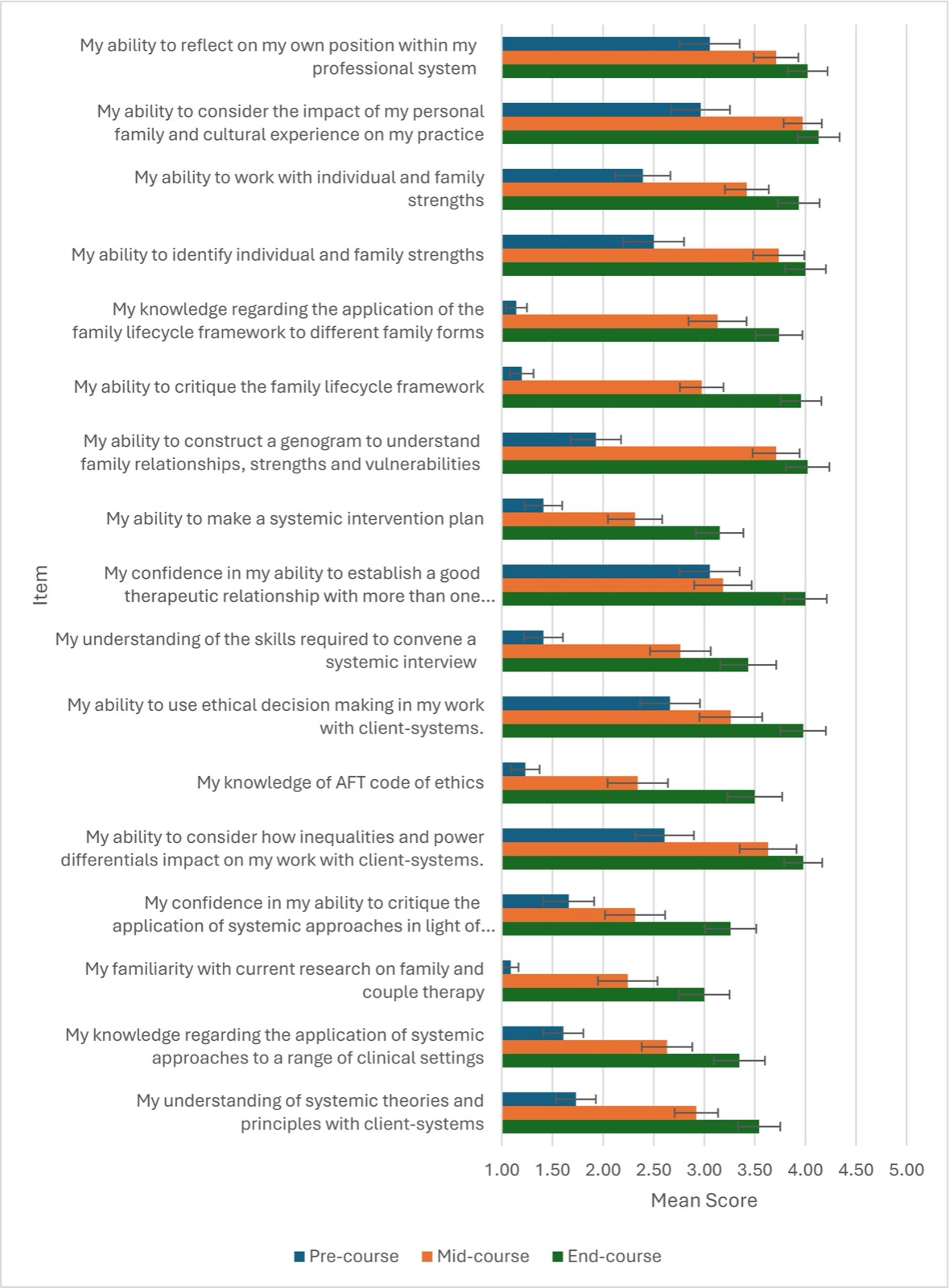
At the beginning of the systemic training, participants rated their competence lowest in Item 3, ‘My familiarity with current research on family and couple therapy’ (Mean = 1.09) and Item 13, ‘My knowledge regarding the application of the family lifecycle framework to different family forms’ (Mean = 1.14). Conversely, they rated their competence highest in Item 9, ‘My confidence in my ability to establish a good therapeutic relationship with more than one person in the room’ (Mean = 3.05) and Item 17, ‘My ability to reflect on my own position within my professional system’ (Mean = 3.05).
At the mid-course stage, the mean scores for most competences increased dramatically, as indicated by the non-overlapping 95% confidence intervals between pre- and mid-course scores. However, two items showed overlapping confidence intervals, suggesting the increases were less significant. They were Item 9, ‘My confidence in my ability to establish a good therapeutic relationship with more than one person in the room’ and Item 11, ‘My ability to construct a genogram to understand family relationships, strengths and vulnerabilities’. Item 3, ‘My familiarity with current research on family and couple therapy’ remained the lowest-rated competence (Mean = 2.24), while Item 16, ‘My ability to consider the impact of my personal family and cultural experience on my practice’ had the highest score (Mean = 3.97). The largest improvement was in Item 13, ‘My knowledge regarding the application of the family lifecycle framework to different family forms’ (Mean increase from 1.14 to 3.13). The smallest improvement was in Item 9, ‘My confidence in my ability to establish a good therapeutic relationship with more than one person in the room’ (Mean increase from 3.05 to 3.18).
At the end-course stage, all mean scores continued to increase, but the rate of improvement slowed compared to the earlier stages. Item 3, ‘My familiarity with current research on family and couple therapy’ remained the lowest-rated competence (Mean = 3.00), while Item 16, ‘My ability to consider the impact of my personal family and cultural experience on my practice’ remained the highest-rated competence (Mean = 4.13). The largest improvement in the final phase was in Item 6, ‘My knowledge of AFT code of ethics’ (Mean increase from 2.34 to 3.50). The smallest improvement was in Item 16, ‘My ability to consider the impact of my personal family and cultural experience on my practice’ (Mean increase from 3.97 to 4.13).
5.1.1 Pre-Existing Systemic Knowledge and/or Experience
At the beginning of the systemic training, 52 participants provided comments on their systemic knowledge and/or experience. Their responses reflected varying levels of familiarity with systemic practice. 10 participants had practical experience applying systemic knowledge in their work with families or using tools such as genograms. 12 participants had observed systemic work, often in clinical settings alongside family therapists or systemic practitioners, though their involvement was primarily observational rather than hands-on. 8 participants had academic knowledge of systemic theory but had not directly applied it in practice. 11 participants had been introduced to basic systemic concepts through previous studies but described their understanding or hands-on experience as limited. 10 participants had no or minimal prior knowledge/experience in systemic practice.
5.1.2 Objective 2: DClinPsy Students' Attitudes, Development and Experience of the Training Over Time
The inductive thematic analysis highlighted the trajectory of participants' focus as they progressed in each stage of their systemic training. At the beginning of the course, most participants expressed their enthusiasm and focused on their expectations of the training. For example, they discussed the values of systemic ideas in psychological practice and viewed the training as a pathway for personal as well as professional growth.
I love [the systemic model]. It makes up for what CBT lacks and facilitates TRUE person-centred care, Participant P02.
I hope to gain more knowledge about systemic theory and become more confident in applying it to practice. I want to learn more about myself and my identity, reflect on this and ultimately develop into a better practitioner, Participant P23.
At the mid-course stage, participants moved their attention particularly to the difficulties and challenges that they encountered during training, although some benefits of the training were discussed. Specifically, they discussed the complexity of systemic concepts and terminology, the lack of opportunities to practise systemic ideas, and the high demanding workload.
I have found it quite abstract and difficult to apply to my work as I am placed in [a Talking Therapies service], Participant M03.
Although the theory has been really interesting I would really like to get better at using specific systemic techniques, as I feel a bit deskilled in this regard when doing role plays, Participant M30.
A lot to take in and I think I had an advantage as I had worked systemically before. but [I] would still say I was confused at times as there was too little time for too much info! Very very interesting though, Participant M04.
Although discussions on the challenges the participants faced continued and repeated at the end of the course, an increasing number of participants also recognised their personal and professional development during the training. For example, they discussed how the training enhanced their self-awareness (e.g., personal identities, family influences, cultural background) and reflective practice and allowed them to bring them into psychological practice.
I have done a lot of self-reflection since starting the training. I feel my ability to reflect has significantly increased, specifically when considering my own social graces and the impact this may have on my practice, Participant E02.
I believe I would like to go on to attain the family therapy training because I have really enjoyed working in this way, working tentatively and considering the different systems and their impacts - families, teams, organisations etc., Participant E33.
Table 4 summarises the main themes under each stage of the training. The supporting information S1 provides more detailed information about the definitions and direct quotations under each theme in each stage.
Table 4 — Themes in each stage of the foundation training in systemic practice
- Pre-course — Positive Attitudes and Value of Systemic Approaches (n = 45). For example, ‘I love it. It makes up for what CBT lacks and facilitates TRUE person-centred care.’
- Pre-course — Desire for Enhanced Skills and Practical Application (n = 40). For example, ‘I hope to gain skills to enable me to work in systemic settings. I am interested in working with young people and their families.’
- Pre-course — Personal Growth and Reflective Practice (n = 20). For example, ‘I want to learn more about myself and my identity, reflect on this and ultimately develop into a better practitioner.’
- Pre-course — Apprehensions about Training Implementation and Comprehension (n = 15). For example, ‘I’m concerned there might not be enough placements next year available if I was to do the second part of it.’
- Mid-course — Struggle with Abstract and Theoretical Concepts (n = 22). For example, ‘I have found it quite abstract and difficult to apply to my work as I am placed in iapt.’
- Mid-course — Need for Practical Application and Demonstration (n = 20). For example, ‘It's very new for me so I have found it very confusing at times to know exactly how to relate the theory to practice but seeing role plays has helped.’
- Mid-course — Overwhelming Volume of Content and Pacing Issues (n = 15). For example, ‘A lot to take in and I think I had an advantage as I had worked systemically before.’
- Mid-course — Positive Impact and Appreciation of a Systemic Perspective (n = 18). For example, ‘I think having a systemic outlook on issues can be really beneficial for patients. It broadens ideas and hypotheses and therefore I can see the benefit.’
- End-course — Enhanced Self-Awareness and Reflective Practice (n = 20). For example, ‘I have become more reflective as a future clinical psychologist and feel more confident about thinking of wider systems involved in client care.’
- End-course — Overwhelming Theoretical Content and Abstract Language (n = 18). For example, ‘It could be quite abstract at times and not always easy to understand the teaching.’
- End-course — Challenges in Practical Application and Integration into Clinical Work (n = 16). For example, ‘It was hard for me to relate the learning to my work during year 1 as I did not have the opportunity to apply what was being taught.’
- End-course — Concerns with Course Structure, Feedback, and Assessment (n = 12). For example, ‘Not knowing when we will receive feedback for work submitted (still waiting for feedback about the last part of the logs that I have put effort into).’
Note: Fifty-five students responded to the pre-course survey. Thirty-eight students responded to the mid-course survey. Forty-five students responded to the end-course survey. n, the estimated number of students contributing to the theme.
6 Discussion
The integration of quantitative and qualitative findings provides a more comprehensive understanding of how DClinPsy students' systemic competencies developed across the training. Taken together, these strands of data suggest that the development of systemic competence involved not only measurable gains in knowledge and skills but also a parallel experiential process in which students negotiated conceptual complexity and gradually integrated systemic perspectives into their professional identities.
6.1 Quantitative Analysis
Approximately 20% of participants started the embedded FTSP with some knowledge of systemic concepts or exposure to systemic practice. Participants' self-reported areas of low competence as knowledge of current systemic research and applications of the family life cycle framework. The results from the SCS indicated an increase in participants' systemic knowledge and skills over the 12 months of the course. As might be expected, the rate of increase was higher at the start of the course. The greatest improvements reported were related to applications of the family life cycle framework to different family forms, but research knowledge remained the lowest self-reported competence area. It was notable that practice competencies such as ‘My confidence in my ability to establish a good therapeutic relationship with more than one person in the room’ though relatively high at the start of training, did not increase as much as knowledge competencies. This is consistent with the conceptual rather than practice focus of the FTSP aims and learning outcomes (see Blue Book AFSP 2025). The patterns of competence improvement may also be related to the placement learning opportunities in family practice, which were limited until the completion of the course. One might argue that the FTSP learning outcomes, which are currently under review, need to more carefully consider the pedagogical challenge of trying to increase systemic conceptual knowledge when systemic practice opportunities are limited (Larner 2014). Thus, the challenge of learning systemic practice in a DClinPsy programme likely stems from both pedagogical and logistical issues.
The study successfully piloted the SCS for self-measurement of competencies in FTSP and demonstrated it has some value in supporting students to map development in their competencies over time. Whilst the SCS has the potential benefit to support students and educators to track development in competencies, it can run the risk of reifying aspects of systemic practice such as the everchanging and moving reflexive, relational, contextual and creative process. Therefore, it is crucial for educators to use the SCS in a flexible, collaborative and reflexive way with students. The highest mean score was at four points on the five-point scale, with participants rarely using the highest-level self-evaluation of their competencies (5, excellent = an expansive, in-depth, and fine-tuned understanding of the area i.e., a key strength). This might be expected for a foundation level course and some competencies such as establishing participants' self-reflexivity over and above their general systemic reflections may be too ambitious for an embedded FTSP where students are learning systemic concepts alongside contrasting models such as CBT. Particularly when FTSP is compulsory on DClinPsy training and there may not be an immediate ‘fit’ between the student's conceptualisation of psychological distress and a systemic understanding of this.
The authors also reflected on the construction of the scale and whether the absolute nature of the anchor points benchmarked against a qualified level of systemic competence was helpful for students or raised expectations that were not consistent with the learning outcomes of the training, as had been the initial aim. Further work on scale anchors and benchmarking may be helpful in improving survey. It may be helpful to determine external validity of the quantitative ratings from the SCS, against arguably more objective measure of systemic competence as measured by supervisor observations (See Systemic Practice Scale, Butler et al. 2018).
6.2 Qualitative Analysis
6.2.1 Emotions and Potentiality at the Departure Point
At the pre-course stage, participants reported positive attitudes towards and a desire to learn systemic approaches due to the potential to enhance their skills and for personal growth. Whilst most participants remained enthusiastic about the prospect of learning a different modality from individual focused therapies, some of them expressed apprehension about how systemic approaches can be integrated with CBT and the training structure to facilitate this learning. Hooks (2003) noted that attending to the emotional feeling in the classroom drives connections and opens space for critical thinking. This seemed to be a useful starting point which, with a well scaffolded learning environment where emotions are consistently attended to throughout the course of training, could lead to both personal and professional growth. As Hooks noted (1994, 8), ‘But excitement about ideas was not sufficient to create an exciting learning process. As a classroom community, our capacity to generate excitement is deeply affected by our interest in one another, in hearing one another's voices, in recognising one another's presence.’ Thus, our feelings about the learning space are generated through joint, collaborative and collective effort. It is crucial to validate students’ initial concerns about learning and create a learning culture of contribution (Mason 2013), for educators to teach and learn with students. As Hooks (2010, 43) noted, by ‘learning and talking together, we break with the notion that our experience of gaining knowledge is private, individualistic and competitive.’ Students need to feel part of a learning community rather than being evaluated although this endeavour can be challenging in the context where they are being assessed.
6.2.2 Pedagogy in Systemic Practice
Feedback at the mid- and end-course stages revealed that participants consistently found that the theoretical content was heavy and the systemic ideas were abstract. It is worth noting that participants reported the positive impact of systemic approaches in their practice although the learning process was challenging. There are several important issues to consider in the teaching of systemic practice within a DClinPsy programme from these reports. Firstly, educators need to be clear with students if they are teaching a set of tools or a way of life. Systemic practice is a unique way of understanding and approaching the dilemmas presented by clients and their families from a relational, contextual and self-reflexive rather than a symptom, problem or diagnostic focused perspective. This means that learning to work systemically is to learn how to work with relational processes including issues of ethics and power that are embedded within these relations. Perhaps, a key tension appears to lie in the heart of the disconnect between students' position to learn about ‘what to do’ and the educators' position to teach the ‘how to do’. For Gilles Deleuze, knowledge is not a static body of facts or information but rather a dynamic, experimental and experiential process (Semetsky 2009). To learn systemic practice as a way of life or the ‘how to do’ is to experience systemic practice. This entails learning about the philosophies and, what Cullin (2014) referred to as, the ‘epistemological shift’, which is likely related to the participants' experience of systemic ideas as being too abstract.
Secondly, it is vital for educators to support students to learn in a way that is coherent to systemic practice. Consistent with the principles of systemic practice, the teaching is more likely to be collaborative, dialogical and experiential with a focus on reflexivity, shared meaning making and multiplicities. The philosophical underpinnings and pedagogical approaches of systemic teaching can pose challenges if these are inconsistent with other dominant models taught on DClinPsy programmes, such as CBT. Educators need to draw on a range of pedagogical approaches such as social justice pedagogy in the teaching of systemic practice to prepare students to work across multiple epistemologies (Hoff and Distelberg 2017) and link systemic thinking to structural issues such as race, culture, gender, sexual orientation and class (Rue and Reynolds 2025). Learning systemic approaches is not simply about learning new approaches, methods and techniques (Burnham 1992) but rather learning a different (and perhaps new) way and context of learning which Bateson (1972) refers to as ‘deutero-learning’. This involves inviting students to a learning space that is experiential and experimental, and be in a position to take relational risks (Mason 2005). As Kolb (1984) noted, experiential learning is not a linear process but rather an iterative and circular process of doing, thinking and reflecting. Learning systemic practice alongside individual focused therapies in the real-world can be complex, messy and unpredictable that requires students to constantly move between ‘reflection-in-action’ (thinking during practice) and ‘reflection-on-action’ (thinking after practice) (Schön 1983) in both clinical and learning contexts. This can be a destabilising and uncomfortable position. It is well-known in the U.K. that the process of getting into a DClinPsy programme is highly competitive. Perhaps for this reason, students who managed to get into the programme may find it more difficult to take relational risks in their learning. Attending to the emotions in the classroom and co-creating a learning community as discussed earlier may address this issue.
6.2.3 Beyond the Psychological and Emotional Conditions
Besides the importance of attending to the psychological and emotional needs of students as discussed above, it is equally pertinent to consider how the course structure can provide a scaffold to support students' learning. Participants reported that concerns about the volume of content, pace of delivery, use of (systemic) language, feedback process, level of assessments, and opportunities to apply systemic ideas in practice. Although it may be challenging to change the volume of content in the teaching due to the requirements set forth by AFSP in the Blue Book (see AFSP 2015), educators could consider when and how the teachings and assessments are placed and delivered within a DClinPsy programme. At RHUL, DClinPsy students are allocated to adult mental health placements which often have fewer opportunities for them to observe or participate in systemic practice. By and large, adult mental health services in the U.K. tend to take an individual focused approach in their care provision which means that systemic psychotherapy posts are limited. However, some adult mental health services do take a systemic approach when they have a fully qualified systemic psychotherapist driving this initiative. Thus, it may be worth to consider implementing the FTSP in the second year of a DClinPsy programme when students are in a child and adolescent mental health placement where there are opportunities to participate in systemic practice. Students will then be able to apply systemic ideas to practice which will enhance their learning to meet the requirement to ‘develop basic practice skills’ (AFSP 2015, 6) of the Blue Book.
7 Limitations
Several limitations should be considered when interpreting the findings of this study. Firstly, due to preserving anonymity, we did not collect socio-demographic information of our participants in each stage of the surveys. It is difficult to determine if our sample was representative of other U.K. DClinPsy programmes owing to biases, that is, the students who did not complete the surveys could share similar backgrounds. Similarly, we did not track participant IDs throughout time points, although our study was longitudinal in design. This precluded the use of appropriate statistical tests for repeated measures for example, repeated measures ANOVA. We therefore were unable to draw statistical conclusions and limited the robustness of our quantitative analyses. In addition, we utilised surveys to collect qualitative data. Although this facilitated efficiency and a high number of qualitative responses when comparing with other data collection methods such as interviews or focus groups, the common pitfalls are that responses are usually brief and rough, with no opportunity for clarification or follow-up questions, which hindered an in-depth analysis of participant experience. Furthermore, there is a risk of confirmation bias among participants as well as the researchers. For example, participants may have rated their competencies lower subconsciously because they may have assumed there was room for improvement in the mid-course stage simply because they knew they were only halfway through their FTSP.
8 Conclusion
This study successfully mapped the development of self-reported systemic competencies among students using the novel Systemic Competence Survey, demonstrating an observable increase in systemic knowledge over the 12-month course, particularly in conceptual areas like the family life cycle framework. Practice-based competencies, however, showed less growth, a finding consistent with the conceptual aims of FTSP and the limited early opportunities for systemic application. Qualitatively, participants reported that the abstract nature of systemic ideas created pedagogical challenges. This was rooted in a disconnect between students' expectations of learning techniques (‘what to do’) and the training's goal of facilitating an epistemological shift towards a relational ‘way of life’ (‘how to do’). Educators are therefore called to adopt experiential and social justice pedagogies to foster deeper learning and a collaborative, risk-taking learning community.
Crucially, the findings highlight that the structural sequencing of a DClinPsy programme may impede the integration of learning, as FTSP precedes common systemic placement opportunities. We recommend that the timing of this FTSP be considered to coincide with child and adolescent placements to better scaffold the application of systemic ideas and meet practice-based learning outcomes. Future research should prioritise external validation of the SCS against objective measures of systemic competence and use more robust statistical methods, such as repeated measures designs, to solidify the observed quantitative trends.
Complexe Systémique: key points
The study’s merit is to look closely at what a systemic training produces when it is inserted into a clinical psychology programme dominated by CBT. Its main finding looks like a paradox: trainees learn concepts, not yet a practice. Knowledge rises quickly, especially on the family life cycle, but confidence in conducting a session with several people barely moves, for lack of families met during the year. The team reads this as a problem of sequencing more than of content, and proposes placing the training alongside child and adolescent mental health placements. The discussion also recalls, with Bateson, that learning systemic practice is a matter of deutero-learning: changing one’s way of learning requires being able to take relational risks, which a highly selective and heavily assessed programme does little to encourage. For those who teach systemic practice, the lesson holds beyond the UK: attend to the group’s emotions and get people practising early. The limits are clear: anonymous, unmatched self-ratings, no statistical test, brief written answers, a single cohort. Read alongside the article on the ‘four selves’ framework in systemic training, and the study on live supervision as experienced in training.
Notes from the original
Ethics statement. This study was performed in line with the principles of the routine course evaluation. Therefore, no ethnics approval was sought. Participants were informed their anonymised data may be used for publications.
Conflicts of interest statement. All authors were employees of the Doctorate in Clinical Psychology programme at Royal Holloway, University of London whilst completing the work.
References
Ahmad, G., S. McManus, C. Cooper, S. L. Hatch, and J. Das-Munshi. 2022. “Prevalence of Common Mental Disorders and Treatment Receipt for People From Ethnic Minority Backgrounds in England: Repeated Cross-Sectional Surveys of the General Population in 2007 and 2014.” British Journal of Psychiatry 221, no. 3: 520–527. https://doi.org/10.1192/bjp.2021.179.
Association of Clinical Psychologists. 2024. Equity, Diversity and Inclusion Context and Strategy for Clinical Psychology. Author. https://acpuk.org.uk/wp-content/uploads/2024/03/EDI-Strategy-Feb-2024.pdf.
Association of Family and Systemic Psychotherapy. 2015. The Blue Book: Training Standards and Course Accreditation. 4th ed. https://www.aft.org.uk/page/informationpolicydocs.
Association of Family and Systemic Psychotherapy. 2025. Accredited Training Courses. https://www.aft.org.uk/general/custom.asp?page=Accreditedtrainingcourses.
Bateson, G. 1972. Steps to an Ecology of Mind: Collected Essays in Anthropology, Psychiatry, Evolution, and Epistemology. University of Chicago Press.
Braun, V., and V. Clarke. 2006. “Using Thematic Analysis in Psychology.” Qualitative Research in Psychology 3, no. 2: 77–101. https://doi.org/10.1191/1478088706qp063oa.
Burnham, J. 1992. “Approach—Method—Technique: Making Distinctions and Creating Connections.” Human Systems: The Journal of Systemic Consultation & Management 3, no. 1: 3–26.
Butler, C., J. Cove, and H. Sherbersky. 2024. “Embedding Systemic Training Into a DClinPsy Programme: The Possibilities and Restraints.” Clinical Psychology Forum 1, no. 372: 16–21. https://doi.org/10.53841/bpscpf.2024.1.372.16.
Butler, C., E. Sheils, J. Lask, T. Joscelyne, H. Pote, and J. Crossley. 2018. “Measuring Competence in Systemic Practice: Development of the ‘Systemic Family Practice—Systemic Competency Scale’ (SPS).” Journal of Family Therapy 42, no. 1: 79–99. https://doi.org/10.1111/1467-6427.12251.
Byrne, B., C. Alexander, O. Khan, J. Nazroo, and W. Shankley. 2020. Ethnicity, Race and Inequality in the UK: State of the Nation. Policy Press. http://library.oapen.org/handle/20.500.12657/22310.
Carr, A. 2024. “Family Therapy and Systemic Interventions for Child-Focused Problems: The Evidence Base.” Journal of Family Therapy 47, no. 1: e12476. https://doi.org/10.1111/1467-6427.12476.
Carr, A. 2025. “Couple Therapy and Systemic Interventions for Adult-Focused Problems: The Evidence Base.” Journal of Family Therapy 47, no. 1: e12481. https://doi.org/10.1111/1467-6427.12481.
Cullin, J. 2014. “On Learning and Teaching Family Therapy.” Australian and New Zealand Journal of Family Therapy 34: 352–369. https://doi.org/10.1002/anzf.1037.
Evans, K., C. Butler, S. Favier, and S. Coles. 2024. “Reflections on Creating Systemic Practitioner Trainings Within DClinPsy Courses: Building Relationships and Learning Across Psychology and Systemic Contexts.” Clinical Psychology Forum 1, no. 375: 113–119. https://doi.org/10.53841/bpscpf.2024.1.375.113.
Health Education England. 2021. Psychological Professions Workforce Plan for England: 2020/21 to 2023/24. https://www.hee.nhs.uk/sites/default/files/documents/Psychological%20Professions%20Workforce%20Plan%20for%20England%20-%20Final.pdf.
Hoff, C., and B. Distelberg. 2017. “Developmental Pedagogy in Marriage and Family Therapy Eduction: Preparing Students to Work Across Epistemologies.” Journal of Family Theory & Review 9, no. 3: 382–390. https://doi.org/10.1111/jftr.12203.
Hooks, B. 1994. Teaching to Transgress: Education as the Practice of Freedom. Routledge. https://doi.org/10.4324/9780203700280.
Hooks, B. 2003. Teaching Community: A Pedagogy of Hope. Routledge. https://doi.org/10.4324/9780203957769.
Hooks, B. 2010. Teaching Critical Thinking: Practical Wisdom. Routledge. https://doi.org/10.4324/9780203869192.
Jeffery, S. 2019. “A Catch-Up on Research and Evidence for Systemic Therapies in Later Life.” Context 165: 33–36. https://cdn.ymaws.com/www.aft.org.uk/resource/resmgr/research/evidence_base/context165-literaturereview.pdf.
Kolb, D. A. 1984. Experiential Learning: Experience as the Source of Learning and Development. Prentice-Hall.
Larner, G. 2014. “Teaching, Training and Supervision in Family Therapy.” Australian and New Zealand Journal of Family Therapy 34, no. 4: 281–282. https://doi.org/10.1002/anzf.1038.
Ma, J. L. C., R. R. Yuan, T. Y. K. Leung, and O. L. Wong. 2018. “Learning Outcome of a Family Therapy Training Course for Psychiatric Nurses in a Chinese Context.” Contemporary Family Therapy 40: 119–127. https://doi.org/10.1007/s10591-017-9422-1.
Mason, B. 2005. “ Relational Risk-Taking and the Therapeutic Relationship.” In The Space Between: Experience, Context and Process in the Therapeutic Relationship, edited by C. Flaskas, B. Mason, and A. Perlesz, 157–170. Routledge. https://doi.org/10.4324/9780429483295.
Mason, B. 2013. “ Towards a Culture of Contribution in Supervisory Practice: Some Thoughts About the Position of the Supervisor.” In Positions and Polarities in Contemporary Systemic Practice: The Legacy of David Campbell, edited by C. Burck, S. Barratt, and E. Kavner, 113–126. Routledge. https://doi.org/10.4324/9780429478413.
National Institute for Health and Care Excellence. 2007. Drug Misuse in Over 16s: Psychosocial Interventions [Clinical Guideline No. 51]. https://www.nice.org.uk/guidance/cg51.
National Institute for Health and Care Excellence. 2014. Alcohol-Use Disorders: Diagnosis, Assessment and Management of Harmful Drinking (High-Risk Drinking) and Alcohol Dependence [Clinical Guideline No. 115]. https://www.nice.org.uk/guidance/cg115.
National Institute for Health and Care Excellence. 2016. Harmful Sexual Behaviour Among Children and Young People [NICE Guideline No. 55]. https://www.nice.org.uk/guidance/ng55.
National Institute for Health and Care Excellence. 2017a. Antisocial Behaviour and Conduct Disorders in Children and Young People: Recognition and Management [Clinical Guideline No. 158]. https://www.nice.org.uk/guidance/cg158.
National Institute for Health and Care Excellence. 2017b. Child Abuse and Neglect [NICE Guideline No. 76]. https://www.nice.org.uk/guidance/ng76.
National Institute for Health and Care Excellence. 2019. Depression in Children and Young People: Identification and Management [NICE Guideline No. 134]. https://www.nice.org.uk/guidance/ng134.
National Institute for Health and Care Excellence. 2020. Eating Disorders: Recognition and Treatment [NICE Guideline No. 69]. https://www.nice.org.uk/guidance/ng69.
National Institute for Health and Care Excellence. 2022. Depression in Adults: Treatment and Management [NICE Guideline No. 222]. https://www.nice.org.uk/guidance/ng222.
National Institute for Health and Care Excellence. 2023. Bipolar Disorder: Assessment and Management [Clinical Guideline No. 185]. https://www.nice.org.uk/guidance/cg185.
Navaneetham, J., and T. Roy. 2020. “Taking Therapy Beyond Clinics—An Evaluation of Family Therapy Training Program With Lay Counselors.” Indian Journal of Social Psychiatry 36, no. 4: 296–302. https://doi.org/10.4103/ijsp.ijsp_22_20.
Nel, P. W. 2006. “Trainee Perspectives on Their Family Therapy Training.” Journal of Family Therapy 28, no. 3: 307–328. https://doi.org/10.1111/j.1467-6427.2006.00354.x.
Peterson, L., E. Jones, and K. Salscheider. 2016. “Social Work Student Learning Experiences of Family Therapy: Improving Competency in Pedagogy Through Qualitative Research.” Australian and New Zealand Journal of Family Therapy 37, no. 3: 301–316. https://doi.org/10.1002/anzf.1157.
Piercy, F. P., R. M. Earl, R. K. Aldrich, et al. 2016. “Most and Least Meaningful Learning Experiences in Marriage and Family Therapy Education.” Journal of Marital and Family Therapy 42, no. 4: 584–598. https://doi.org/10.1111/jmft.12176.
Pilling, S., A. D. Roth, and P. Stratton. 2010. The Competences Required to Deliver Effective Systemic Therapies. Skills for Health. www.ucl.ac.uk/CORE.
R Core Team. 2024. R: A Language and Environment for Statistical Computing. R Foundation for Statistical Computing. https://www.R-project.org/.
Rue, L. D. L., and J. D. Reynolds. 2025. “Social Justice Pedagogy for Master's Level Marriage and Family Therapy Students.” American Journal of Family Therapy 53, no. 1: 100–112. https://doi.org/10.1080/01926187.2024.2336987.
Salter, P. S., G. Adams, and M. J. Perez. 2018. “Racism in the Structure of Everyday Worlds: A Cultural-Psychological Perspective.” Current Directions in Psychological Science 27, no. 3: 150–155. https://doi.org/10.1177/0963721417724239.
Schön, D. A. 1983. The Reflective Practitioner: How Professionals Think in Action. Basic Books.
Semetsky, I. 2009. “Deleuze as a Philosopher of Education: Affective Knowledge/Effective Learning.” European Legacy 14, no. 4: 443–456. https://doi.org/10.1080/10848770902999534.
Shah, A., M. Varghese, G. S. Udaya Kumar, et al. 2000. “Brief Family Therapy Training in India: A Preliminary Evaluation.” Journal of Family Psychotherapy 11, no. 3: 41–53. https://doi.org/10.1300/J085v11n03_04.
Stratton, P. 2016. The Evidence Base of Family Therapy and Systemic Practice. Association for Family Therapy.
The British Psychological Society. 2010. The Core Purpose and Philosophy of the Profession. Division of Clinical Psychology, BPS.
The British Psychological Society. 2017. Practice Guidelines, Third Edition. Author. https://doi.org/10.53841/bpsrep.2017.inf115.
The British Psychological Society. 2019. Standards for the Accreditation of Doctoral Programmes in Clinical Psychology. Author. https://cms.bps.org.uk/sites/default/files/2022-07/Clinical%20Accreditation%20Handbook%202019.pdf.
The British Psychological Society. 2020. Declaration on Equality, Diversity and Inclusion. Author. https://cms.bps.org.uk/sites/default/files/2022-07/Declaration%20on%20equality%2C%20diversity%20and%20inclusion.pdf.
Reformatted republication of An Evaluation of Embedded Foundation Training in Systemic Practice Within a Doctorate in Clinical Psychology Programme, by Christopher Loh, Simon Lai, Laura Tierney and Helen Pote, Journal of Family Therapy, vol. 48, no 2 (2026), doi: 10.1111/1467-6427.70031, under a CC BY 4.0 licence. Edition and layout: Complexe Systémique, September 2026 — the work has been modified under the terms of the licence (tables presented as lists). Neither the authors nor the publisher are responsible for this edition; the original version prevails.
This is the original article “An Evaluation of Embedded Foundation Training in Systemic Practice Within a Doctorate in Clinical Psychology Programme”, published in Journal of Family Therapy (2026) under a CC BY 4.0 licence. Republished by Complexe Systémique: the author’s text is unchanged; only the presentation has been adapted for reading online, as set out at the head of this page.
Read the original articleHow to cite this article
Loh, C., Lai, S., Tierney, L., et Pote, H. (2026). An Evaluation of Embedded Foundation Training in Systemic Practice Within a Doctorate in Clinical Psychology Programme. Complexe Systémique. https://app.complexe-systemique.com/en_GB/articles/an-evaluation-of-embedded-foundation-training-in-systemic-practice-within-a-doctorate (Original work published in 2026 in Journal of Family Therapy, 48(2), e70031 (2026); republished in 2026 by Journal of Family Therapy, https://onlinelibrary.wiley.com/doi/full/10.1111/1467-6427.70031)
To go further
- The ‘four selves’ framework for facilitating personal and professional development (PPD) in qualifying-level systemic psychotherapy trainingThe ‘four selves’ framework.
- “Being part of a community – that has been the good practice”: A qualitative study of family therapy students’ experiences with live supervisionLive supervision in training.
- The journey towards digital systemic competence: Thoughts on training, supervision and competence evaluationDigital systemic competence.
Related training courses
 Certifying course
Training in Systemic Therapy and Interventions – Cycle 1
Certifying training cycle in systemic therapy and interventions – year 1. Courses, supervision and practice, aligned with EFTA/SFTF. In French.
 Certifying course
Training in Systemic Therapy and Interventions – Cycle 2
Certifying training cycle in systemic therapy and interventions – year 2. Clinical complexity, supervision and practice. EFTA/SFTF aligned. In French.
 Certifying course
Training in Systemic Therapy and Interventions – Cycle 3
Certifying training cycle in systemic therapy and interventions – year 3. In-depth intervention, supervision and practice. EFTA/SFTF aligned. In French.
 Certifying course
Training in Systemic Therapy and Interventions – Cycle 4
Certifying training cycle in systemic therapy and interventions – year 4. Clinical integration, supervision and certification. EFTA/SFTF. In French.
Related articles
 Article
 Are You Qualified, ChatGPT? Examining Clinical Skills and Competencies of ChatGPT in Delivering Systemic Interventions
A GPT trained in systemic interventions, blind-rated by twelve clinical supervisors: a rushed, dominating novice, whom the client nonetheless loved.
 Article
 Disrupting the Child Welfare Participation Paradigm: A Contextual, Relational, Embedded and Pragmatic Approach
Why does participation remain rhetorical in child welfare? A synthesis combines psychoanalysis and Palo Alto pragmatics to rethink it in context.
 Article
 Shaping the Therapist, Shaping the Field: A Narrative Review of the Person‐of‐the‐Therapist Training (POTT) Approach
Thirty sources, three periods: the history of Harry J. Aponte’s training, which turns the therapist’s wounds and “signature theme” into a clinical tool.
 Article
 Systems Thinking in Practice (STiP): A Praxeology for Our Times
Checkland moved systemicity from the world to inquiry. Ison and Collins go further: leave the hard/soft dualism behind and put the practitioner back at the centre of praxis.