AI-assisted translation
This version was translated from Italian by Complexe Systémique with the help of artificial intelligence. In case of doubt, the original version prevails.
Connessioni · Systemic clinical practice
Emotions in therapy
Andrea Mosconi and Igino Bozzetto revisit, in dialogue form, the place of emotions in systemic therapy, from the Milan school to second-order cybernetics. Mosconi links them to trauma theory and memory reconsolidation, offers two sets of questions for reading, in session, one’s own emotions and those of the system, and places them at the centre of his Systemic Quadrilateral. The conclusion takes the form of a metaphor: if narratives are the lyrics, emotions are the music.
Unofficial English translation. This article is a translation of Le emozioni in terapia, by Andrea Mosconi and Igino Bozzetto, published in Connessioni (Centro Milanese di Terapia della Famiglia), new series, no. 13 (2023), under a CC BY 4.0 licence. Translated by Complexe Systémique in November 2026 with the help of artificial intelligence: the original Italian text has been translated into English and reformatted, which constitutes a modification of the work under the terms of the licence. The text is a dialogue between the two authors; the paragraphs are those of the journal, without subheadings; Luigi Boscolo’s epigraph, broken into lines in the journal, is set as a block quotation; quotations are translated from the Italian, except Bateson’s, given in his original English wording; titles of works and articles are given as the authors cite them; the caption of Figure 2, missing from the page, reproduces the title printed on the image; a few typographical errors have been silently corrected. This translation was made neither by the authors nor by the journal, who are not responsible for its content or for any errors. The original version prevails.
Emotions are not only inside me; they are activated by the other.
Andrea Mosconi
“The most important change in me as a therapist was the discovery of the power of emotions. I learned it from therapy, in two or three cases in which I came to the idea that insight is not all that important, but that emotions are the royal road to change.”
Luigi Boscolo, personal communication, 2008
This article grew out of a conversation between the two of us on the role of emotions in therapy, initially with the aim of creating teaching material for the students of the specialization school, to help them learn how to construct the hypothesis and how to manualize the therapeutic process. The feedback we received from the students prompted us to put our ideas in order and to extend them to others interested in the subject. We have kept the format of a two-voice dialogue (one might call it a metalogue) because it seemed to us lean and clear.
Bozzetto: The three guidelines, Hypothesizing, Circularity and Neutrality, clearly outlined and described by the Milan team (Selvini Palazzoli, Boscolo, Cecchin and Prata) in their 1980 article, have met different fates over time, even though they were, and still are, closely interwoven. Circularity, understood as the therapist’s ability to rely on the family’s feedback, grounds its current validity in the Batesonian premise of thinking in terms of relationships that produce differences which give information, and its application has remained essentially unchanged: therapists ask questions about the relationships between members and are interested not only in pragmatics but also in semantics and emotional states. Neutrality, the therapist’s privileged relational position, identified to protect the intervention from the risks of taking sides and of sabotage, has undergone profound changes prompted by the encounter with other paradigms. In particular, second-order cybernetics and social constructionism made it possible to focus attention on the observer/therapist, conceived as “curious” (Cecchin, 1987), “multipartial”, as Boscolo described it in a personal communication in 1989, and “non-expert” (Anderson and Goolishian, 1992). Hypothesizing remains a fundamental and irreplaceable principle in the conduct of the session and takes into account all the information that emerges in the interactions: the problem as experienced, the contents and the modes of communication, the types of conflict, both relational and intrapsychic.
The advent of second-order cybernetics also brought permission to open the black box and try to understand what happens within the individual/observer, which made it necessary to pay attention to the emotions of the actors in the therapeutic process as well (therapists and patients).
In 1989 one of the first SIRTS conferences was held at the Palazzo delle Stelline in Milan, entitled “Emozioni, soggetto e sistema” (Emotions, subject and system), at which, for the first time, people courageously allowed themselves to look at what was happening inside the individual. The round table chaired by Valeria Ugazio was attended by Boscolo, Cecchin, Andolfi, Selvini Palazzoli and Vella, who stressed how useful it would be to begin taking into account, in the therapeutic process, the emotions not only of the clients but also of the therapist.
I believe that a very important moment in the evolution of the concept was the shift from the rhetoric of control, according to which emotions disturb knowledge, are pre-social, are/must be regulated by reason/rationality, and are to be interpreted not as causes of future actions but as revealing actions already under way, to emotional self-awareness. Emotions are fundamental tools for knowing the world we are part of; they are social and cultural facts, information about more or less deeply internalized patterns of behaviour (Bateson’s habits) that we activate because we consider them the most appropriate to a largely unconscious, taken-for-granted perception of an environment.
As early as 1976, Bateson, in Verso un’ecologia della mente, stated: “It is the attempt to separate intellect from emotion that is monstrous, and I suggest that it is equally monstrous—and dangerous—to attempt to separate the external mind from the internal. Or to separate mind from body.”
In this regard I found help in some ideas of Laura Fruggeri, set out in her 1992 article entitled Le emozioni del terapeuta nel contesto dell’auto-osservazione della sua attività, in which Fruggeri states that the use of the concept of countertransference in family therapy has developed in two directions: in one, self-observation is seen in terms of control; in the other, emotions are understood as indicators of relational processes.
In the first direction, the therapist relives in the therapy with the family some of the tensions experienced in their own family, activating emotions that may be an obstacle to the proper conduct of the therapy and must therefore be controlled through the analysis of the stories lived in their own family. Seen through this lens, self-observation is understood as a mirror: countertransference is the set of the therapist’s emotional responses in the therapy situation as a reflection of the actions and feelings of the whole family or of one of its members. The therapist, therefore, must observe themselves in order to understand the other, in the role of a neutral and objective scientist who feels no emotions and is a mere receiver of other people’s emotions. At the conference mentioned above, Mara Selvini Palazzoli described a supervision she had given Anna Maria Sorrentino while the latter was engaged in therapy with a family in which the psychotic daughter was triangulated in the parents’ stalemate. On the basis of the view that the therapist is a sender of emotional signals, Selvini Palazzoli had observed that Sorrentino had reacted emotionally to the father’s refined courtship and to the mother’s relational closure, as the daughter had probably done, who had become confused and developed first an anorexic disorder, then a bulimic one and finally a psychotic one.
The second direction indicates that emotions are indicators of relational processes: if we hold that the therapist takes part in the process of interpersonal construction that takes place during therapy, and that emotions are located within the relationship, that is, that they are one with the relationship and indeed constitute the first form of activation within it, then we can think that there is an interdependence between the cognitive, emotional and behavioural systems, so that emotions can be regarded as forms of disposition to action elicited by particular systems of appraisal. Emotions, therefore, have a social nature: they arise from the processes of interaction that a person maintains with the social environment; they are neither a reaction to an external stimulus, nor a reflection of other people’s emotions, nor projections of phantasmatic instances. The therapist’s emotions are indicators of the way in which they take part, through their maps and their systems of belief and meaning, in the construction of the therapeutic relationship.
That said, the questions I would like to put to you, and on which I am curious to hear your position, are essentially these:
- Where does the idea that emotions are indicators of a relationship come from?
- How can we use emotions?
- How can we place them within the therapeutic process?
- How do they relate to the therapist’s process of self-observation?
- How do they fit into the pattern which connects that you have called the Systemic Quadrilateral?
I chose to ask you these questions because, at this stage in the evolution of systemic thinking, you are consolidating an integrative model of intervention, about which I came across a good definition given by Boscolo and Bertrando (1996) in the book Terapia sistemica individuale, where it is stated that the concept of integration in therapy is the ability to draw on a well-tested theoretical model in which one feels at ease and which has given satisfactory results, and to combine it, at particular moments, for example in situations of therapeutic impasse, with other models that can offer a different view of the situation and of the ways of resolving it. I think the effort you are making is fairly well represented by this definition.
Mosconi: I see a small but, in my view, important difference between my concept of integration and what Boscolo and Bertrando state. In my view this definition is not sufficient because, in the conception of what I have called the “integrative systemic model”, there is integration when in a system there is a truly complementary relationship between its component elements. Two types of intervention are truly integrated if they are in a complementary relationship with each other. This means that, within the framework of the type of psychotherapy I practise, I must be able to use new interventions that link up with my model in a complementary way so as to develop one part of it better. A good starting point is to have a unified conception of what generates psychological suffering. Today this is made possible by modern trauma theory, which has unequivocally revealed the brain damage caused by relational traumas. All the theories of mind underlying the various psychotherapies share the hypothesis that we come to feel unwell when we somehow experience traumas, that is, when, as Cecchin used to say, “things go wrong” in the circularity of the mutual need to feel “confirmed”, “seen” by others (Peruzzi, 2005). Relational traumas, therefore, are the source of the destabilization of our Self. For us systemic therapists the traumas par excellence are the double bind and disconfirmations; for Bowlby’s theory they are the various types of insecure attachment; for psychoanalysis it is the failure to resolve the Oedipal conflict. In short, when we come to feel unwell it means that something, precisely, has gone wrong in the relationships between us and the people who matter to us. Psychotherapy is, therefore, always a process of working through the traumas experienced. Neuroscience has now shown that traumatic experiences encoded as episodic memories at the level of the amygdala are no longer indelible and permanent, as was assumed until the end of the last century, but can be worked through, provided that the experience is recalled with its full emotional accompaniment (Ecker et al., 2012). Neuroscience points out that this is the mechanism of brain change in traumatic memories and calls it the Deconsolidation and Reconsolidation of traumatic memories. This allows brain plasticity to start up again. And here, as you see, the role of emotions in psychotherapy forcefully comes to the fore again. If all psychotherapies must deal with “when things go wrong”, and the episodic memories of these events remain unprocessed until they are recalled with their full emotional accompaniment, then a psychotherapy that does not evoke the emotions linked to the most traumatic experiences is not effective. Understanding this step properly requires one more brief explanation. We have said that every problem is the consequence of having lived through traumatic experiences which, as mentioned above, are retained at the level of the amygdala as episodic memories. Now, we must bear in mind that the suffering and the state of alarm induced by such situations may have activated, as a defensive mode, a certain degree of dissociation within the person’s mind. Very often the difficulty of connecting and working through what has emerged in the construction of the systemic hypothesis may stem precisely from this dissociation. This can be observed above all when there are ego-dystonic symptoms, or high levels of anxiety, or severe emotional disorganization in the patient, or again in somatizations; but a certain degree of blindness is always present, and if it were not, the person would probably not have problems. It is therefore important to stress that the client almost always no longer remembers these situations, has not mentalized them or is even afraid to consider them, and so showing them these connections, which they had not foreseen, is an extremely important step. It is a true “broadening of their field of consciousness”, which takes place in what I call the “D” phase of the therapeutic process (Mosconi et al., 1996; Mosconi and Trotta, 2022). So when I conduct a systemic psychotherapy, the first thing I obviously do is co-construct the systemic hypothesis with the client. It must lead us to connect three aspects: 1) the presenting problem; 2) the negative idea of Self and its Prevailing Relational Pattern (PRP) (Mosconi, 2014), which fostered the onset of the problem; 3) “how they learned it”, that is, the function it had in their system and the critical (traumatic) situations that led them to take it on. I then work with the person on that hypothesis; I help them connect the traumatic areas experienced (point 3) with the problem they bring me and recall them, and it is here that the emotional release (deconsolidation) takes place. Focusing on all this then allows the move towards change. Change, as we know, rests on the use of a set of techniques revolving around the question: “What new idea of yourself would you like to have, and what new choices would you like to make, in order to write a story of the future different from that of the past?” Normally this kind of processing is sufficient. If, however, I see that with these systemic conversational techniques it is difficult to activate change, that is when I think of integration with other techniques suited to fostering the recall of these overly dissociated traumatic experiences and emotional release. It is in these cases that, as I said, I add other modalities that give me access to the traumatic material and the related emotions (deconsolidation), bypassing conversational interaction, and that increase the person’s ability to focus on listening to themselves. The techniques I usually integrate are: 1) experiential techniques, because they activate body and mind together; 2) EMDR, because it is a modality that facilitates access to recollections and associated memories; 3) hypnosis, which also bypasses rational control and increases inward focus (Mosconi, 2015). And here we touch on another of the points you asked me about: the connection of all this with the Systemic Quadrilateral (Mosconi et al., 2013). As you know, this construct has at its corners the four levels of human interaction explored from the systemic perspective: 1) Narrative (the problem as experienced); 2) Person (idea of Self, PRP); 3) Communication (communicative incongruities of the system); 4) Relationships (the history that allowed them). Essentially, the action I have described above makes it possible to move from the right side of the Quadrilateral (levels 3 and 4, that is, the relational aspects of communication and relationships) to the left side (level 2, that is, the person and intrapsychic conflict). After that, I reintegrate into the hypothesis the material that has emerged from the experiences lived. This, for me, is integration. Integration as Boscolo and Bertrando read it is based on the principle of multiple hypotheses. General constructivist theory is somewhat different from my own conviction: for me there is the most plausible hypothesis, on which I go ahead in spite of everything; there are not eight thousand hypotheses, one has to find the most plausible one to work on. They, instead, value multiple hypotheses. The idea that one can sometimes use the analytic hypothesis and sometimes the constructivist one does not, in my view, work, and risks creating confusion, since it lacks selection criteria that meet a clinical criterion. Integration must be harmonious and complementary in order to create reflexive and harmonious, not bizarre, circuits between the hypothesis I am working on and the tools I use, and above all it must follow clinical criteria that are as plausible as possible.
Bozzetto: With this premise, which you have now set out more sharply, I would like to discuss with you the reflections you have made over time, and are still making, about emotions, and in particular about their use in the therapeutic process.
Mosconi: You mentioned a number of therapists and some of their ideas on the role of emotions in the therapeutic process. I will start from what Fruggeri (1992) says, still linking up with what has been said. I agree with her: emotions are part of the ongoing interactive process and are created within it. Emotions are not only inside me; they are activated by the other; nor are they in what the other does; they lie in the interaction between my autobiographical memories and the other’s patterns. The other paradigms belong to other models of mind, and therefore of relationship, and thus stand at another logical level. If I say: “What I observe in you is a projection of my unconscious conflicts”, I am not making a wrong reading, but I am making it at a logical level at which my previous learning serves as an internal map with which I interpret the world, so I am making an interpretation centred on my internal functioning and not on the relationship. Likewise, if I say: “What you do in the world is related to your internal working models, which come from traumatic experiences”, again it is not a wrong reading, but it is once more a reading of the Self. In my work on Systemic Identities (Mosconi, 2014), which deals with the various levels of the Self, I clearly state that the level of the Self in relational functioning is meta to all the others, in the sense that it is the highest level of output the mind produces; the level of the idea of myself and of my Internal Working Models (IWM) of cognitivism (Liotti, 1994) lies a little lower, the level of the ego’s defence mechanisms in psychoanalysis (Freud, 1917-1923) lower still, and lower still is the level of the basic mechanisms that organize Narrative. For greater clarity, I summarize these concepts in Figure 1.
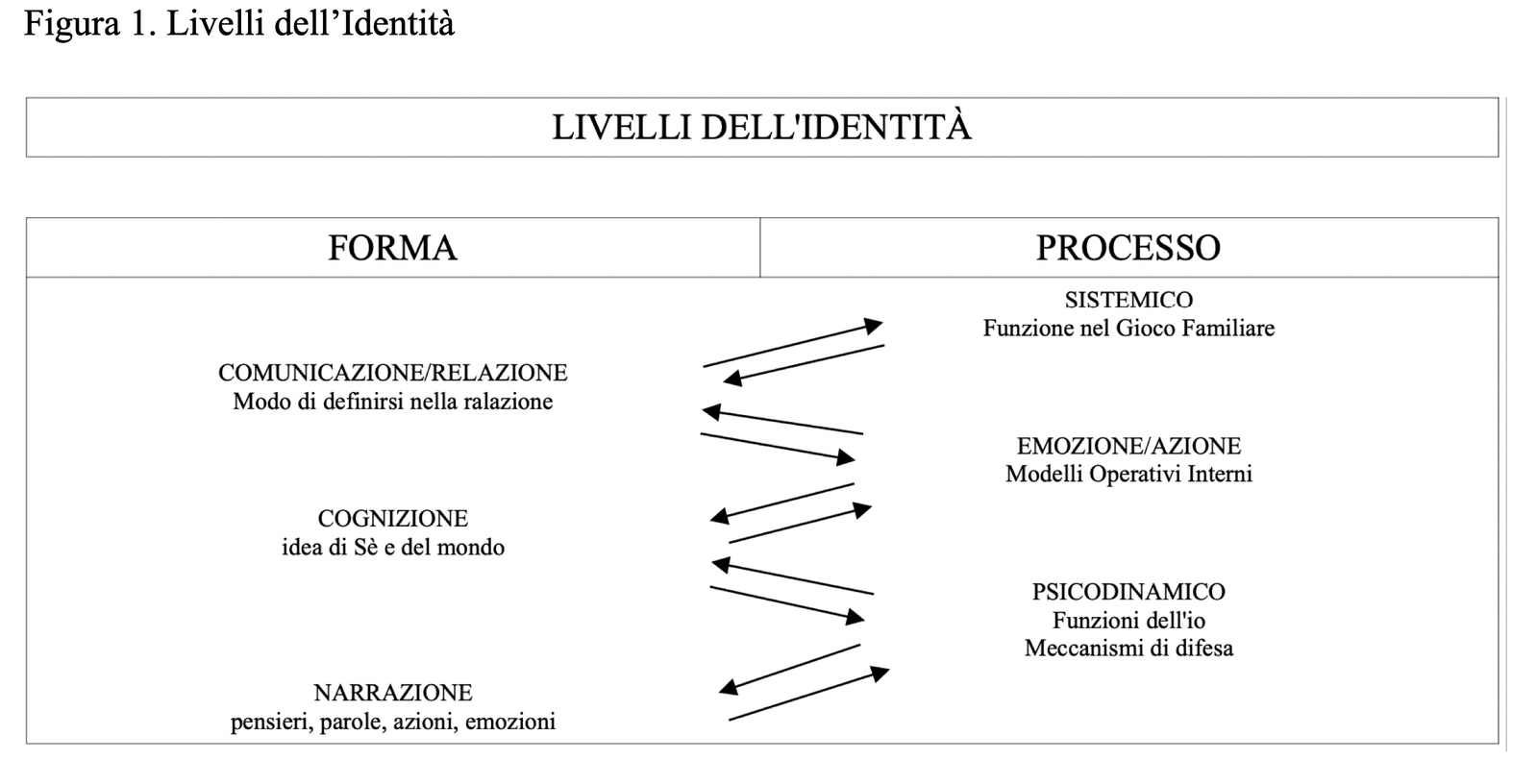
I would like to point out that, as can be seen, “below” does not mean “less valid or important”, nor that the levels contradict one another; they simply stand at different logical levels of description, more or less “meta”. So I would reiterate that, for us systemic therapists, emotions are in general indicators of the ongoing interaction. Thus the therapist’s emotions are activated by the interaction between the therapist and the system in therapy, whether an individual or a family. In fact, we could consider three levels of the emotions activated in therapy: 1) the emotions activated in the therapist by the behaviour of the client(s); 2) the emotions that accompany the behaviour of the client(s) and that signal their way of defining themselves in the situation; 3) the emotions linked to the traumatic experiences being recalled. Take, for example, a situation in which a therapist has to work with two parents and a son who is oppositional, where one parent disqualifies and the other rolls their eyes. At point 1), the therapist will have to deal with the difficulty of being neutral, and if there were similar situations in their own history, this difficulty will be even greater. They must therefore be able to read their own emotions and resonances so as to connect all this to what is happening in the system and maintain their curiosity and equi-proximity. At point 2), however, the clients are showing the therapist the emotions that accompany their current definition of their mutual relationship, and these emotions are therefore informative about it. At point 3), the therapist will have to make the most difficult move, both for themselves and for the clients. They will, that is, have to deconstruct the situation until the traumatic experiences linked to the related emotions that activated the ongoing relational game are recalled. And these, as I said, are not always easy to reach. Emotions in therapy should therefore, in my view, be subjected to a number of questions on the personal side and on the side of the system.
Personal side: 1) by which pattern or behaviour of the system is this emotion I feel activated? 2) which parts of my history are activated by what is happening? 3) what do they make me understand about my history? 4) does what is happening remind me of anything? 5) could it be that someone else in the system is feeling the emotions I feel? 6) could it be that the emotions I feel remind me of experiences that they too have had or are having?
Side of the system (individual/couple/family/etc.): 1) what do what I observe and the emotions I see tell me about how the person defines themselves in relation to others? 2) which pattern of the system’s game do they allow me to hypothesize? 3) which events may have fostered them? 4) which other emotions may underlie them? 5) is it advisable to explore further to bring out the traumatic experiences and the emotions linked to them?
Questions of this kind can allow emotions to be understood and used across the whole field.
Bozzetto: Starting from this shared idea, what can you say about the historical evolution of interest in the subject of emotions in therapy?
Mosconi: Initially they were interpreted according to how they were played out in the system (first-order cybernetics) and as part of patterns that contributed to the ways relationships were defined; they belonged to the domain of non-verbal messages, understood as components of communication that influenced the paraverbal, proxemic, etc., aspects that qualified the relationship. So if I saw that the mother was speaking and the father was nodding off as if he were sleepy or uninterested, it was clear that an emotion of disgust was being activated. If I think of a video Boscolo often showed, in which the father talks about his family of origin and the mother twists her mouth, it is clear that she is feeling an emotion of disgust, which the therapist observes and hypothesizes as a symmetrical relationship between father and mother. The observation of behaviour and emotion is interpreted as part of the ongoing interaction. In that phase the therapist, busy interpreting the system, did not use their own emotions to interpret it, but interpreted emotions as indicators of the ongoing interactive processes. We are now in the next phase, which entails questioning the possibility of understanding the system objectively and asserting that only descriptions of the system can be made. And so one’s own emotions are considered a source of additional, wide-ranging information: for the therapist and for the system, as I said above.
Bozzetto: So you are referring to the theory of the observer introduced by second-order cybernetics. I have always liked the version given by Giuseppe Mantovani (1998), who states that “…constructionism rejects as a positivist residue the idea that the object is a given that pre-exists the social relationship… [In this perspective] there is no immediate access to the object; all experience is bio-culturally mediated.”
Mosconi: I would add that within the theory of the observer, even if my point of observation can probably condition what I see, I must also include what the observer themselves experiences in observing what they see, as I said above. Then the therapist’s emotions too become indicators of the ongoing interactive process. Indeed, in the second of the two schemes concerning the pillars needed for constructing the hypothesis (Mosconi and Tirelli, 1997), I also add emotions as a possible source of information. So the therapist can include their own emotions to generate new questions to ask the client(s), using “self-disclosure” in a therapeutic way: “What you did made me feel… Is there anyone else in the system who felt the same way?” Or: “What you did made me feel… and if I think about it carefully, it is also because I myself went through… When I heard Dad saying… I felt a knot in my stomach, because I saw Dad being aggressive and Mum suffering from it, and I said to myself, who knows… Is there anyone else who saw this?” That is, I add my emotion as a point of entry, linking it to what I think activates it in me, and I give it back to the family as an opportunity to work on the hypothesis. With this example I am telling you two things at once: the first is that I consider my emotions, too, part of the ongoing interaction, and the second is my conviction that those emotions produced in the ongoing interaction must nonetheless be connected to both the aspects mentioned above: on the one hand to the family game in front of me that activates them, and on the other to any parts of my own history that are reactivated. With these premises I can make the intervention more complex by saying: “I saw… and I remembered… so I wondered… But am I feeling this because it resembles a scene I used to see at home, or is there someone else in the system who is experiencing it?” Then the intervention becomes more integrated: I see an emotion as an indicator of something that does not sit right with me, I connect it to the facts that generate it in me and to the facts of my history that resemble them, and I give it back to the system as an integrated whole. I am telling you how, in real time, I can use my emotions in therapy too, if I read them as part of the ongoing interaction and connect them to what activates them in me. I relativize them, that is, to what may have made me sensitive to those patterns in my history, and I give this back. This is why we work with the students’ genograms. In this work the closing question about one’s own family is: “Who are the difficult patients for you, and whom do they resemble in your history?”, because one needs to know who the difficult patients are and to understand why, at least so as to be aware that there are some people who test us more in certain emotional areas and areas of our Self. Neuroscience offers us the theoretical premises that explain everything I am describing to you, because it clearly shows that mirror neurons, which are, among other things, particularly dense in the language area, connect directly to the underlying levels of the thalamus, the part of the nervous system that contains the innate motivational systems and deals with the management of emotions, which in turn will then connect to the whole sympathetic and parasympathetic system, so that we get all the global activations of the body system that we call emotions (Pagani and Carletto, 2019). From a neurophysiological point of view, emotions are global activations of the body system that respond to how the nervous system appraises incoming messages. The first appraisal concerns how dangerous or not dangerous they are for the survival of that living being. If they are appraised as dangerous, the alarm system will be activated, with its “fight-flight-freezing” responses. A baring of teeth or a scream, whether from a dog or from my father, means danger. So the innate motivational system makes me judge as dangerous to my survival those messages from my father or my mother that are particularly aggressive towards my Self. If a person suddenly enters my “vital bubble” in a threatening or unfriendly manner, they are perceived as a danger, and this is because there is a neural system that has been selected in the course of evolution to the point of now being innate (Liotti, 1994). This is what makes me react in this way. In the event there will be a certain number of inputs already pre-interpreted by the system in a certain way, and others that I begin to interpret on the basis of the confirmations and disconfirmations received since birth, and I build up an ever-growing map through the mirror neurons. It is remarkable how close all this is to Bateson’s logical levels of learning. At that point, the emotional schemas activated according to the internal maps I have built up through experience become available for interpreting the incoming input. I will add another important aspect. We know that at the heart of the mechanisms of brain change lies epigenetics: given a chromosomal endowment, depending on the inputs to which cells are subjected, their chromosomes can change and exclude some of the genes, so that the same genetic endowment can produce different modes of functioning. This is how the body’s cells differentiate, producing different tissues: it is not the chromosomal endowment that changes but its gene expression. The nervous system, which from this point of view is no different from all the other tissues, has always been thought of as stable, whereas it is one of the most changeable systems, so that neurons, on the basis of the emotional inputs coming from the innate motivational systems, change according to the quantities of mediators released, thereby changing their epigenetics. This is how patterns of interaction between neurons are created. And why all this? Because the living being has to survive in its environment. Hence cogito ergo computo, I think in order to calculate how to survive, as Morin (1980) said. First of all I must preserve the memory of unpleasant and traumatic stimuli: this is the function of the amygdala. The neuroscientist Marco Pagani has explained the mechanism by which traumatic inputs become fixed. The neural networks of the amygdala that store traumatic episodes remain paralysed in a state of hyperactivation, so that when a stimulus arrives that resembles a traumatic episode stored in this way, a defensive reaction will be triggered. All this in order to escape from danger (Pagani and Carletto, 2019). So we have now come to define the cellular mechanism by which an emotion is activated, and we no longer need so many reasonings of another kind. Fortunately, as I said, we have seen that if the traumatic experience is recalled with its full emotional accompaniment, the brain has the capacity to bring it back to the hippocampus, unlock the synapses of that hyperpolarized neural network and carry out a reassociative operation with other, different neural networks. In this way the neuron’s epigenetics changes. If the new network is a positive emotion, that experience changes its meaning (Ecker et al., 2012). This is what in therapy we call by many different names: redefinition, reframe, restructuring, re-narration; but the mechanism is the deconsolidation and reconsolidation of traumatic memories. In 1996, in the article devoted to the five-stage process of therapeutic conversation (Mosconi et al., 1996), I wrote that the therapeutic intervention, called the “restructuring phase E”, works only if the very data brought by the patient concerning the traumas experienced in the relationships with their system are reorganized by the therapist within a frame of meaning incompatible with the patient’s own. Specifically, in the fourth phase of the therapeutic process (focusing phase “D”) these data are brought to light, and in phase “E” they are reframed so as to produce what is called a “disconfirming cognition”. Only in this way is an effective deconsolidation and reconsolidation of memories produced. If the recall of the traumatic experience is associated with a disconfirming cognition, a therapeutic double bind is created that places the nervous system in an interpretive dilemma in which the patient is allowed to look at the alternatives with the possibility of choosing the most advantageous one, unlike what happens in the double bind that created the trauma, in which the patient was forced to exclude something they felt to be useful for themselves in favour of the other, so as not to create conflict and uncomfortable situations. These concepts have been taken up and set out in still more detail in the recent chapter Manualizing the Therapeutic Process in Systemic Therapy From the Construction of the Hypothesis to the Assessment of Change (Mosconi and Trotta, 2022) in the Handbook of Systemic Approaches to Psychotherapy Manuals (Mariotti et al., 2022).
Bozzetto: You have brought to mind a family I saw a long time ago, who had asked for a consultation for their third-born, an eighteen-year-old son in the midst of a psychotic block. The parents and the two older siblings were busy running a metalworking and engineering company. The father had started building an object in his garage and had achieved rapid success, in which he had involved the whole family and which amounted to a kind of social redemption. The family had been thrown off balance when the third son, after passing his school-leaving examination, had expressed the wish to continue his studies by enrolling in a humanities faculty. The family injunction, “if you really want to study, you will do economics and finance, because you have to stay inside the company”, was in contradiction with the young man’s wish to follow his literary inclinations, and faced with undecidability he had developed a symptom that blocked him. Enabling him to identify who in the extended families represented his inclination towards the humanities, and what role that person had played in the relationships, had allowed him to make sense of what he perceived, and the family to reposition itself towards him.
Mosconi: So emotions in therapy, at this point, are inevitable and are a very important indicator of the meaning of the experiences lived and of the state of the ongoing relationships, but I have to accept them and understand them deeply as connected to what was learned, especially in the worst experiences. In a certain sense this work was already being done with questions about difference: “Excuse me, did this aspect make you think more of this or of that?” In constructing the hypothesis, through questions about difference, we bring into focus the worst component, the one that most made possible a certain kind of learning. If one asks: “Does it seem to you that your parents pay more attention to you and your symptoms, or that they have your brother’s successes more on their minds? Have you managed, with your symptoms, to prevail over your brother?”, am I not perhaps taking him into how much he has had to swallow to bear the fact that his brother was worth more than him, and at the same time restructuring it for him? That is the operation carried out in psychotherapy: restructuring, reconsolidating traumatic memories, recalling them and reconsolidating them by connecting them to another meaning.
Bozzetto: You have just touched on the subject of the therapist’s self-observation, recalling the work that can be done on their family genogram: they are asked to talk about their family, their position within the system and finally the learning contexts in which they learned some things rather than others. Let us suppose, then, that the therapist has experienced a trauma, an event with a strong emotional charge: how can this affect their ability to manage and feel their emotions in relation to a system in treatment?
Mosconi: As I said, this blocks a relational area. When the amygdala is activated by a traumatic situation, the alarm system that is triggered paralyses the brain’s reflective capacity, so that one can only flee (Pagani and Carletto, 2019). If one has lived through a traumatic experience in a given area, one loses the reflective capacity and the fight, flight and freeze reactions are activated. A person who has been traumatized by fire cannot work as a firefighter until they have worked through the trauma and learned strategies for handling themselves well in a fire. It seems clear to me from what I said above that if the core of psychotherapeutic work is recalling the traumatic experiences of our clients with their full emotional accompaniment (deconsolidation), one must be able to stay with clients when they express their suffering and to welcome it, so as then to look for the solution together. All this without haste: it takes time to heal wounds. We therapists, therefore, must be people who, even in the most difficult relationships, can remain calm, activate our curiosity and not lose our reflective capacity because of a paralysed area of our Self. I like to tell students that “we are a bit like social parents” who take care of the wounds that life has inflicted.
Bozzetto: Apart from the work on the family genogram, do other approaches come to mind?
Mosconi: Another powerful tool is the supervision group: if we all have different backgrounds and different resonances, when I engage with the supervision group something arises that in the early days of the school in Milan was called the “orgy of hypotheses”, in which everyone expressed their own, and in this way, on the one hand, many differences and different maps were generated, but on the other there is also the opportunity to ask oneself why I, you, we see it in a certain way. Engaging with the supervision group is therefore a powerful opportunity to see multiple aspects, provided that it entails, at a second stage, a work of comparison and connection, because each person must then say why they see it from that point of view. If one is content with that alone, it is already a step forward compared with thinking “I’m right”, but it is not enough: we are content, that is, to know that reality is different for each of us, and there is no meta-reflection that allows us to see the connections and mentalize them. To bring about change, a process of re-reading and comparison is needed. Another possible tool is the test proposed by Pio Peruzzi (2001): the exercise consisted of watching a video and, using the grid of innate motivational systems, identifying which one is activated when I see certain sequences. Another tool could be to equip oneself with reference schemes and protocols that ensure as complete an analysis as possible of how our therapeutic actions influence the conduct of a session. In the recent work on manualizing the therapeutic process that we mentioned above (Mosconi and Trotta, 2022), we propose several protocols that serve as a guide for covering extensively the founding themes of the Systemic Hypothesis (pillars of the hypothesis), and other protocols for evaluating the interventions made. These tools can serve as a reference against which to compare one’s own actions and thus become aware of the direction in which emotions or prejudices have led us. Using these tools, a therapist can ask: which themes do I tend to explore more, or less? Which interventions do I tend to use most? And why? This approach can become a tool for reading one’s own Self and allows us to carry out a reflexive process on ourselves. I always need something external against which to make a difference and/or another point of view; so my genogram, another therapist, the group, a test or a scale for rating my reactions can all serve to help me in self-observation and self-understanding, both of my emotions and of my premises.
Bozzetto: At the end of this conversation, I think I have understood that, with reference to the Systemic Quadrilateral, emotions should be considered part of individual functioning in response to what happens on the relational side; therefore, in the representation of the Systemic Quadrilateral, they take on a central position precisely because they are activated by the interaction between these two parts.
Mosconi: Certainly, I fully agree. In short: I observe emotions as part of the information I gather on the individual polarities, both at the Individual Phenomenological level, as part of the Narrative, and at the Individual Generative level, as part of the internal processes of the Person (Mosconi et al., 2013). At this level it is extremely important, in my view, to bear in mind what I said above, namely that there are two levels of expression of emotions that we will observe: initially, emotions will be an integral part of the information that the person or people give about their way of defining themselves in the relationship (Prevailing Relational Pattern, PRP), and will combine to generate what we observe in the relational polarities, that is, the ongoing family game. Later, as we deal with the various founding themes of the hypothesis (pillars of the hypothesis) and broaden the field of observation and inference, we will need to have the traumatic situations experienced, especially the worst ones, recounted. Bringing attention back to the individual polarities, we will see the emotions linked to these events appear, and we will have several moments of abreaction which, as we now know, are indispensable for deconsolidating the traumatic memories that have rigidified the reciprocal ways of defining oneself in the relationship, and for being able to redefine them in the ways typical of the systemic hypothesis, that is, by giving them a positive meaning, this time on the side of the relational polarities. If all goes well and the hypothesis is plausible, we will see new emotions appear, again on the side of both the individual and the relational polarities, which should signal well-being or wonder at new understandings, with phrases such as: “Oh, I had never thought of that!” To sum up what I am saying, I summarize it in Figure 2.
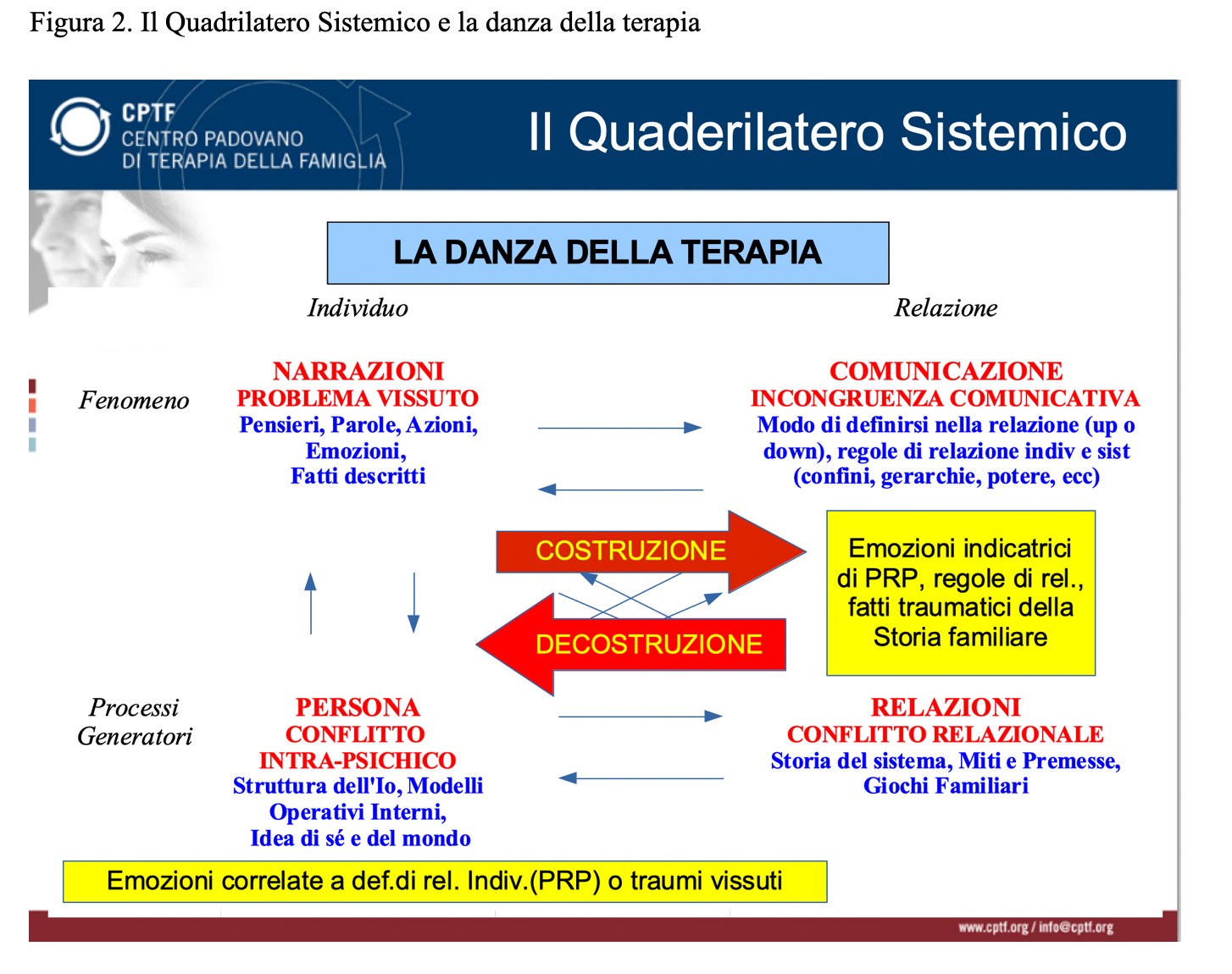
From this figure I would like it to be clear that, in this way, systemic therapy is a continuous dance between the individual and systemic levels. Systemic interactions are deconstructed by exploring, at the individual levels, each person’s narratives, which make it possible to identify the different positions in the system’s game. Then they are connected to compose the systemic hypothesis, and then one goes back to deconstructing by having each person speak about what has been hypothesized, and so on. Throughout this process emotions accompany every individual narrative and every relational exchange, often becoming the most relevant information for understanding people, a true point of entry into how each person positions themselves and into the meaning of the ongoing interaction.
I like to close with a musical metaphor. In every song there are lyrics and music: well, Narratives are the lyrics and Emotions, which I deliberately write here with a capital letter, are the music!
Thank you, Igino, for the opportunity you have given me to reflect on this subject.
Complexe Systémique: key points
This dialogue has the merit of candour. Mosconi embraces an integrative model that settles on “the most plausible hypothesis” rather than the plurality of hypotheses favoured by Boscolo and Bertrando, and he grounds systemic therapy in trauma theory and memory reconsolidation. These neuroscientific supports are put forward with more confidence than the research allows (the thalamus, epigenetics and the amygdala sometimes serve as explanatory shortcuts), and the idea that every problem stems from a trauma is open to debate. The clinical contribution, however, is solid: treating the therapist’s emotions as information about the ongoing interaction rather than as interference to be neutralized; asking oneself, in session, two sets of questions, one about one’s own history and one about the system’s game; giving an emotion back to the family as an open question rather than an interpretation. The training question, “Who are the difficult patients for you, and whom do they resemble in your history?”, transfers directly to supervision. Read alongside resonance according to Mony Elkaïm, and Juan Luis Linares’s proposal on the use of emotions.
References
Anderson, H., & Goolishian, H. (1992), The client is the expert: A not-knowing approach to therapy, in Mc Namee, S., Gergen, K. J. (eds.) Therapy as social construction, London, Sage, pp. 25-39.
Bateson, G. (1972), Steps to an Ecology of Mind. San Francisco, Chandler Publishing Company (trad. it. Verso un’ecologia della mente, Milano, Adelphi, 1978).
Boscolo, L.; Bertrando, P. (1996), Terapia sistemica individuale, Raffaello Cortina Editore, Milano.
Cecchin, G. (1987), Hypothesizing, circularity and neutrality revisited: an invitation to curiosity, Family Process, 26(4): 405–413. https://doi.org/10.1111/j.1545-5300.1987.00405.x
Ecker, B.; Ticic, R.; Hulley, L. (2012), Unlocking the Emotional Brain:Eliminating symptoms at their roots using memory reconsolidation., New York, Routledge, Taylor & Francis, (trad.it, Sbloccare il cervello emotivo: Eliminare i sintomi alla radice utilizzando il riconsolidamento della memoria, Milano, Franco Angeli).
Freud, S. (1917-1923), L’Io e l’Es e altri scritti, in Freud, S. (2000), Opere, Torino,Bollati Boringhieri.
Fruggeri, L. (1992), “Le emozioni del terapista”, Psicobiettivo, 3: 23-24.
Liotti, G. (1994), La dimensione interpersonale della coscienza, Roma, Ed. Nuova Italia Scientifica.
Mantovani, G. (1998), L’elefante invisibile, Firenze, Giunti.
Mariotti, M.; Saba, G.; Stratton, P. (Eds), (2022), Handbook of Systemic Approaches to Psychotherapy Manuals, Switzerland, Springer, pp, 101-122, ISSN 2569-877X, ISSN (electronic) 2569-8796, https://doi.org/10.1007/978-3-030-73640-8.
Morin, E. (1980), La vita della vita, Feltrinelli, Milano.
Mosconi, A. (2014), Identità ed Identità Sistemica in Mosconi, A.; Pezzolo, M.; Racerro G. (eds.), Identità Sistemiche, UltimaBooks.
Mosconi, A. (2015), “Pensando a Luigi: Sviluppi del Milan Approach al Centro Padovano di Terapia della Famiglia’, Connessioni, 25: 51-74.
Mosconi, A.; Castellani, A.; De Maria, L.; Gonzo, M.; Sorgato, R.; Tirelli, M.; Tomas, M.; Zago, E. (1996), “Come costruisci la tua conversazione terapeutica? Breve glossario degli interventi in terapia sistemica e alcune considerazioni sulla possibilità di utilizzo”, Terapia Familiare, 50: 25-41.
Mosconi A.; Tirelli M. (1997), “Dalla scheda telefonica alla cartella dati: uno strumento per il primo approccio e la catamnesi in terapia familiare”, Ecologia della mente, 1:77-101.
Mosconi, A.; Tirelli, M.; Neglia, V. (2013), “Il Quadrilatero Sistemico: Una storia per narrare altre storie: Il caso di una supervisione sistemica in un Day Hospital Territoriale”, Terapia Familiare, 101: 67-92.
Mosconi, A.; Trotta, B., (2022), Manualizing the Therapeutic Process in Systemic Therapy From the Construction of the Hypothesis to the Assessment of Change, in Mariotti, M.; Saba, G.; Stratton, P. (Eds), Handbook of Systemic Approaches to Psychotherapy Manuals, Switzerland, Springer, pp, 101-122, (2022) ISSN 2569-877X, ISSN (electronic) 2569-8796, https://doi.org/10.1007/978-3-030-73640-8.
Pagani, M.; Carletto, S. (eds) (2019), Il cervello che cambia, Milano, Mimesis Edizioni.
Peruzzi P., (2001), “Formazione, lavoro sulla persona del terapeuta e sistemi motivazionali a base innata”, Terapia Familiare, n. 66-67: 83-93.
Peruzzi, P. (2005), “L’ultima lezione di Gianfranco Cecchin”, Connessioni, 16: 23-34.
Unofficial English translation of Le emozioni in terapia, by Andrea Mosconi and Igino Bozzetto, Connessioni, new series, no. 13 (2023), under a CC BY 4.0 licence. Translation (with the help of artificial intelligence) and layout: Complexe Systémique, November 2026 — the work has been modified under the terms of the licence. Neither the authors nor the journal are responsible for this translation; the original version prevails.
Unofficial English translation of “Le emozioni in terapia”, published in Connessioni (2023) under a CC BY 4.0 licence. Made by Complexe Systémique with the help of artificial intelligence, it does not come from the authors or the journal, who are not responsible for its content; the original version prevails.
Read the original articleHow to cite this article
Mosconi, A., et Bozzetto, I. (2023). Emotions in therapy (Complexe Systémique, Trans.). Complexe Systémique. https://app.complexe-systemique.com/en_GB/articles/emotions-in-therapy (Original work published in 2023 in Connessioni, nuova serie, n. 13 (2023); republished in 2023 by Connessioni, https://connessioni.cmtf.it/le-emozioni-in-terapia/)
To go further
- Resonance in systemic therapy: the therapist's emotions as alliesResonance according to Mony Elkaïm.
- The use of emotional intelligence in the construction of therapyLinares on using emotions in session.
- The therapeutic emotion. Interview with Michael MahoneyMahoney on his own emotions in therapy.
Related training courses
 Certifying course
Training in Systemic Therapy and Interventions – Cycle 1
Certifying training cycle in systemic therapy and interventions – year 1. Courses, supervision and practice, aligned with EFTA/SFTF. In French.
 Certifying course
Training in Systemic Therapy and Interventions – Cycle 2
Certifying training cycle in systemic therapy and interventions – year 2. Clinical complexity, supervision and practice. EFTA/SFTF aligned. In French.
 Certifying course
Training in Systemic Therapy and Interventions – Cycle 3
Certifying training cycle in systemic therapy and interventions – year 3. In-depth intervention, supervision and practice. EFTA/SFTF aligned. In French.
 Certifying course
Training in Systemic Therapy and Interventions – Cycle 4
Certifying training cycle in systemic therapy and interventions – year 4. Clinical integration, supervision and certification. EFTA/SFTF. In French.
Related articles
 Scientific
The Duogramma®: An innovative methodology for psychotherapy
A map of the couple relationships lived, desired or rejected since childhood: the Duogramma®, its graphic rules and its use in individual therapy.
 Blog
Challenging in therapy: What a patient taught me
A couples therapy session led me to reflect on confrontation, authenticity and resonance: how to address difficult behaviour without invalidating the person.
 Scientific
Internal Family Systems Therapy as Part of the ‘Family of Systemic Therapies’: A Critical Exploration of Systemic Practice in the Intra-Personal Domain
Does IFS belong to the family of systemic therapies? A critical exploration, grounded in a family court vignette, of systemic work with “parts”.
 Scientific
Collaborative Polyphonic Writing as Therapeutic Practice: A Longitudinal Case Study
A patient and her therapist co-write her autobiography: the psychiatric diagnosis becomes one voice among others, coordinated by an “I as a writer”.
Comments 0
Log in to join the discussion. Log in