Psychology and Psychotherapy: Theory, Research and Practice · Family
Exploring the experiences and responses of siblings living with a brother or sister with obsessive compulsive disorder
Avoiding certain rooms, keeping quiet so as not to trigger a ritual, escaping to school or to one’s bedroom: eight young people from a specialist London clinic describe life with a brother or sister who has OCD. The disorder emerges as a “dangerous dictator” that reorganises the whole household. Depending on the family, it pushes siblings to the periphery, moves them to the centre as substitute parents, or instead unites everyone against a common enemy.
This is a reformatted republication of Exploring the experiences and responses of siblings living with a brother or sister with obsessive compulsive disorder, by Stuart Brownings, Lucy Hale, Laura M. Simonds and Amita Jassi, published in Psychology and Psychotherapy: Theory, Research and Practice (Wiley) (2023), doi: 10.1111/papt.12454, under a CC BY 4.0 licence. Prepared by Complexe Systémique in September 2026: the authors’ text is unchanged; the layout has been adapted for reading online, which constitutes a modification of the work under the terms of the licence. Tables 1 and 2 are presented as lists; end-of-article statements are grouped in the notes; the data availability statement is not reproduced. This edition was made neither by the authors nor by the publisher, who are not responsible for its content or for any errors. The original version prevails.
I just felt like the whole world revolved around OCD and then I just wasn't really part of that.
A sister interviewed by Stuart Brownings, Lucy Hale, Laura M. Simonds and Amita Jassi
Abstract
Objectives. The impact of having a child with diagnosed obsessive–compulsive disorder (OCD) can reportedly cause significant disruption to caregiver routines and negatively affect their mental health. Less is known about the impact to other first-degree relatives such as siblings due to limited research. It should not be assumed that findings in the caregiver literature can simply be applied to siblings. This study, therefore, aimed to explore the experiences and responses of cohabiting siblings of a brother or sister with an OCD diagnosis.
Method. Eight participant siblings were recruited from a UK specialist OCD NHS clinic and interviewed via telephone about their experiences co-habiting with a brother or sister with OCD. Interviews were transcribed and subjected to interpretative phenomenological analysis (IPA).
Results. Two superordinate themes of ‘OCD as a dangerous dictator’ and the ‘unifying/polarising influence of OCD on relationships’ were interpreted from the eight participant experiences. Siblings spoke to OCD creating a dictatorial environment characterised by sibling loss, helplessness and adjustment. This fragile domestic environment seemingly pushed non-anxious siblings to the periphery of the family or conversely centralised their position through parentification.
Conclusions. Many of the sibling experiences of frustration, distress avoidance, helplessness and symptom accommodation are mirrored in the burgeoning caregiver literature. Longitudinal studies are required to track sibling experiences over the course of their siblings OCD journey and expand our knowledge in this area. Counselling services, sibling support groups and inclusion in family assessment, formulation and treatment are possible avenues of exploration for siblings of those with an OCD diagnosis.
Practitioner points
- Results from this exploratory study point to sibling accommodation of their brother or sisters' OCD. This would indicate that siblings should be included in treatment of their family members' OCD in the same way parents are.
- Siblings in this study also indicated high levels of distress and increased isolation from friends and family members as a result of their brothers' or sisters' OCD. It is, therefore, important to ensure clinicians signpost both parents and siblings to external support should they need it when working with the person with OCD.
INTRODUCTION
Obsessive–compulsive disorder (OCD) is characterised by time-consuming, persistent, distressing and interfering intrusive thoughts, images, urges or doubts (obsessions) and repetitive behaviours (compulsions) (DSM-V; American Psychiatric Association, 2013). In the United Kingdom, in children aged 5–15 years, the prevalence of OCD has been reported to be between 0.02% and 0.63% (Heyman et al., 2001).
OCD can lead families to alter their behaviour in a myriad of ways to mitigate distress for the OCD sufferer (Lebowitz et al., 2016). Family accommodation refers to the way in which family members may act to alleviate a relative's symptoms and distress (Kagan et al., 2017). In OCD, this can be in the form of providing reassurance, involvement in behavioural rituals or facilitating avoidance of situations that evoke anxiety. Many families will engage in family accommodation to minimise the impact of OCD on the entire family unit. Studies have found that between 60% and 96% of relatives of adult and child OCD sufferers report accommodating OCD (Allsopp & Verduyn, 1990; Amir et al., 2000; Calvocoressi et al., 1999; Lebowitz et al., 2016; Peris et al., 2008; Shafran et al., 1995; Stewart et al., 2008; Storch et al., 2007).
In addition to high levels of family accommodation of OCD, family functioning can be disrupted as a direct consequence of OCD difficulties (Lochner et al., 2003). Using multiple quality of life measures, Lochner et al. (2003) found adult OCD sufferers (n = 220) reported more impairment in family functioning than those with social phobia or panic disorder. Stewart et al. (2017), also found significant impact to family functioning, particularly with morning and bedtime routines as a result of a child's OCD symptoms. Similarly, Kenyon and Eaton (2015) found poorer family functioning was associated with OCD symptom severity.
Many studies purport to outline the impact and effect of OCD on ‘family members’, yet samples are almost exclusively caregivers or spouses. It is important to consider sibling relationships separately as they are unique in that they are the longest and therefore potentially one of the most influential relationships across an individual's lifespan (Orsmond & Seltzer, 2007). Magliano et al. (1996) included just two co-habiting sibling participants (n = 32) when investigating the emotional impact of living with an adult OCD sufferer. The authors reported moderate to severe levels of burden, compromised social relationships and feelings of depression in most key relatives of OCD sufferers. Cooper (1996) included just six sibling respondents (n = 225) when investigating the effects of OCD on family members. They found increased burden, marital discord, financial problems as well as many other difficulties experienced by family members as a direct result of their relatives' OCD symptoms. Neither of these studies broke down findings by relative type and, therefore, it is unclear whether the reports given by caregivers and spouses would be similar to sibling accounts.
Only two studies have aimed to elucidate the experiences of and effects on siblings of an OCD sufferer. The first investigated sibling family accommodation of anxiety disorders, including OCD, by asking parents of 105 youth–parent dyads to complete a 14-item questionnaire which included just one item asking parents to rate sibling accommodation of the anxiety disorder symptoms (Paediatric Accommodation Scale (PAS); Benito et al., 2015). They found 60.4% of parents endorsed this sibling accommodation item indicating a high prevalence of sibling accommodation within the context of anxiety disorders, albeit based on parent report.
The second study included five sibling dyads, where one sibling had OCD. The OCD sufferers were aged between nine and 13 years (Barrett et al., 2000). Using quantitative measures, they found all siblings accommodated OCD symptoms to some degree. However, the quantitative measures were not able to illuminate the nuances of the sibling's accommodation. Instead, siblings were simply asked to rate the frequency of pre-specified accommodation types (e.g. helping the OCD sufferer avoid triggers). Only one of the five siblings reported feeling distressed from accommodating the OCD sufferers' symptoms. The siblings of OCD sufferers did score higher on a measure of anxiety and depression than siblings of non-OCD sufferers. They also reported feelings of frustration and specific impact on their life such as school lateness due to the OCD sufferer's protracted rituals. These results suggest a negative impact to mental health of siblings with a brother or sister with OCD. However, these quantitative measures do not shed light on how this increased anxiety and low mood manifest in sibling's lives and whether they cause any significant impact.
Taken together, these studies indicate siblings engage in accommodation of OCD and have high levels of distress and frustration. However, our understanding is limited to these two studies, one of which had a limited number of siblings of OCD sufferers with parent perspective only and both studies used quantitative measures. Therefore, further research is needed to explore, in-depth, the first-hand sibling perspective.
The current study explores siblings' experience of living with an OCD sufferer. This is a phenomenological question and therefore can be suitably captured by qualitative methods.
METHOD
Ethical approval was granted by the NRES committee London – London Bridge (Ref: 19/LO/0645).
Recruitment
Throughout this paper, the term ‘sibling’ refers to the sibling of the OCD sufferer. The term ‘OCD sufferer’ refers to the young person with OCD. This study recruited sibling participants who were co-habiting with an OCD sufferer with a primary diagnosis of OCD who had been referred to the South London and Maudsley National Specialist CAMHS OCD, BDD and related disorders team at the Micheal Rutter centre for young people. Some families who are seen in the clinic are offered the opportunity to attend the multi-family groups (MFG). MFG entails a three-day group treatment for OCD as an adjunct to their individual therapy based at the outpatient clinic. The 3 days involve different therapeutic techniques such as group Exposure and Response Prevention (ERP) tasks, fishbowl discussions, sculpts and dedicated sibling discussion focussed on experiences of having a brother or sister with OCD. Fishbowl discussions are a way to organise discussions in larger groups and involve an inner and outer circle of attendees. The inner circle of attendees have a discussion with the outer circle listening to that discussion and taking any notes. Within the MFG, the young people and then parents had time to discuss their viewpoints in the inner circle. Sculpts involve a member of a family physically arranging other family members to show how they experience their relationships relative to one another. Within the MFG, family members were asked to arrange themselves to depict a historic family event where OCD was present. OCD was then purposefully placed in this scene, via another person wearing a mask, to highlight where OCD impacted on family relationships during this event. ERP therapy encourages people to face their OCD fears and let obsessive thoughts occur without neutralising them (OCD UK, 2021). Siblings were recruited from families who had attended one of three MFG that had taken place over an 18-month period (from January 2018 to July 2019) where families included at least one sibling and the family had consented to be contacted for research studies. Suitable sibling participants within this initial pool of MFG families were screened using the inclusion and exclusion criteria below.
A total of 12 siblings were approached and, of these, eight participated. Names have been changed to maintain anonymity. Participant characteristics are detailed in Table 1.
Table 1 — Participant characteristics.
- ID: 1; Age (years): 17; Gender (50% female): Male; Elder or younger participant sibling: Elder
- ID: 2; Age (years): 18; Gender (50% female): Female; Elder or younger participant sibling: Elder
- ID: 3; Age (years): 19; Gender (50% female): Female; Elder or younger participant sibling: Elder
- ID: 4; Age (years): 17; Gender (50% female): Male; Elder or younger participant sibling: Elder
- ID: 5; Age (years): 16; Gender (50% female): Female; Elder or younger participant sibling: Younger
- ID: 6; Age (years): 13; Gender (50% female): Female; Elder or younger participant sibling: Younger
- ID: 7; Age (years): 20; Gender (50% female): Male; Elder or younger participant sibling: Elder
- ID: 8; Age (years): 19; Gender (50% female): Male; Elder or younger participant sibling: Elder
Sample
This study recruited sibling participants who were co-habiting with an OCD sufferer with a primary diagnosis of OCD who had been referred to the National Specialist CAMHS OCD, BDD and related disorders team. Inclusion criteria were being aged 12 years and above, fluent in English and able to give informed verbal assent, consent and/or have parental consent. Potential sibling participants were excluded if they had a current mental health diagnosis. As highlighted in Table 1, all participant siblings were adolescents mostly over the age of 16 years. There was an equal male/female split in sibling participants. Many siblings were older than the OCD sufferer.
No upper age limit was chosen for participants due to not wanting to disregard eligible siblings who satisfied inclusion criteria. The lower age limit of 12 years was implemented due to research suggesting that adolescents aged 12 and above have the four necessary capacities to be decision-making competent when deciding whether to participate in research (Grootens-Wiegers et al., 2017). These capacities are communicating a choice, understanding, reasoning and appreciation.
Procedure
Twelve clinician identified families, who had attended an MFG, were believed to satisfy the above inclusion criteria and provided prior consent to be contacted for research, were approached by researchers to initially outline the study and screen for sibling eligibility. All interested and eligible families were posted relevant information sheets alongside parent, sibling and service user consent/assent forms.
If either the sibling or OCD sufferer within a consenting family were aged under 16 years, researchers sought parental consent and participant assent. For those siblings and OCD sufferers aged 16 years or above, parental consent was not sought. Only one eligible sibling participant was recruited per family.
Once signed consent forms were returned to the recruiting clinic, the lead researcher arranged convenient times for telephone interviews with the sibling. Diagnostic and demographic information for the OCD sufferer was recorded from the clinic's electronic patient records. All participants were interviewed via telephone due to participants living across the United Kingdom, which made face-to-face interviews impractical. The lead author, a male Trainee Clinical Psychologist at the time of the study and with several years' experience of conducting research style interviews, conducted all eight telephone interviews alone with the participant. Interviews were audio recorded. Please see Table 2 for interview schedule questions. On completion of the sibling interview, each sibling participant received a £25 voucher to compensate them for their time.
Table 2 — Interview schedule questions.
- Questions: 1. What is it like living with a sibling who has OCD?; Prompts: If you can remember, it is different to when your sibling did not have OCD? How is it different?
- Questions: 2. How do you cope?
- Questions: 3. How does having a sibling with OCD affect you?; Prompts: Does this impact on your mood, behaviour, day to day functioning?
- Questions: 4. Are there things you do in response to your sibling's OCD? If so, what do you do? OCD; Prompts: Does your sibling ask you to do things that OCD makes it hard for them to do? Do you think doing these things helps your sibling or not? Do you avoid talking about things so you do not trigger your sibling's thoughts or behaviours? Do you make simple decisions when your sibling could not do so because of their OCD? Have you had to stop or reduce doing the things you enjoy because of your sibling's OCD? Do you help your sibling avoid things that make him/her anxious? Do you provide items / things for your sibling's OCD behaviours?
- Questions: 5. How does doing these things make you feel?
- Questions: 6. How has doing these things affected your day-to-day life in a positive or negative way?; Prompts: Explore the positive and negative examples given
- Questions: 7. Do you think they have had an impact on you as a person
Analysis
Interpretative phenomenological analysis (IPA; Smith, 1996) was utilised as it is useful for relatively under studied topics (Smith, 2004) and allows for a richer analytic experience, going beyond description and elaboration of a participant's subjective account (Green et al., 2009). It seeks to understand, through a process of interpretation, how people make sense of their experiences from their idiosyncratic perspective. Furthermore, IPA concerns itself with not only the process of interpretation by the participant but also the researcher (Smith, 1996). Larkin et al. (2008) suggest that IPA ‘explores experience as a reciprocally dynamic interplay between person and the world’ (p. 999).
Interviews were transcribed verbatim and subjected to IPA (Smith, 1996). This involved the analyst reading the first participant transcript several times to familiarise themselves with the data. This transcript was then annotated with descriptive summaries of the account. From these summaries, initial analyst interpretations were noted in the right-hand margin. Initial interpretations were interrogated to make connections between them in order to create preliminary superordinate themes and subordinate themes for this first transcript. Verbatim extracts were highlighted throughout this first transcript to evidence the superordinate and subordinate themes identified. This process was repeated for the remaining seven transcripts. One research supervisor reviewed a small percentage of the transcripts along with the annotations and interpretations made in order to audit the interpreted superordinate and sub-themes, ensuring they were grounded and well represented in the data. All superordinate and sub-themes were then amalgamated into a large set of possible themes from which a final master list of superordinate themes that captured the essence of the entire dataset was formed. This master list was used as the basis to write the below narrative account of participant experience and the analyst's interpretation of it. Verbatim extracts are included to support the analytic account.
RESULTS
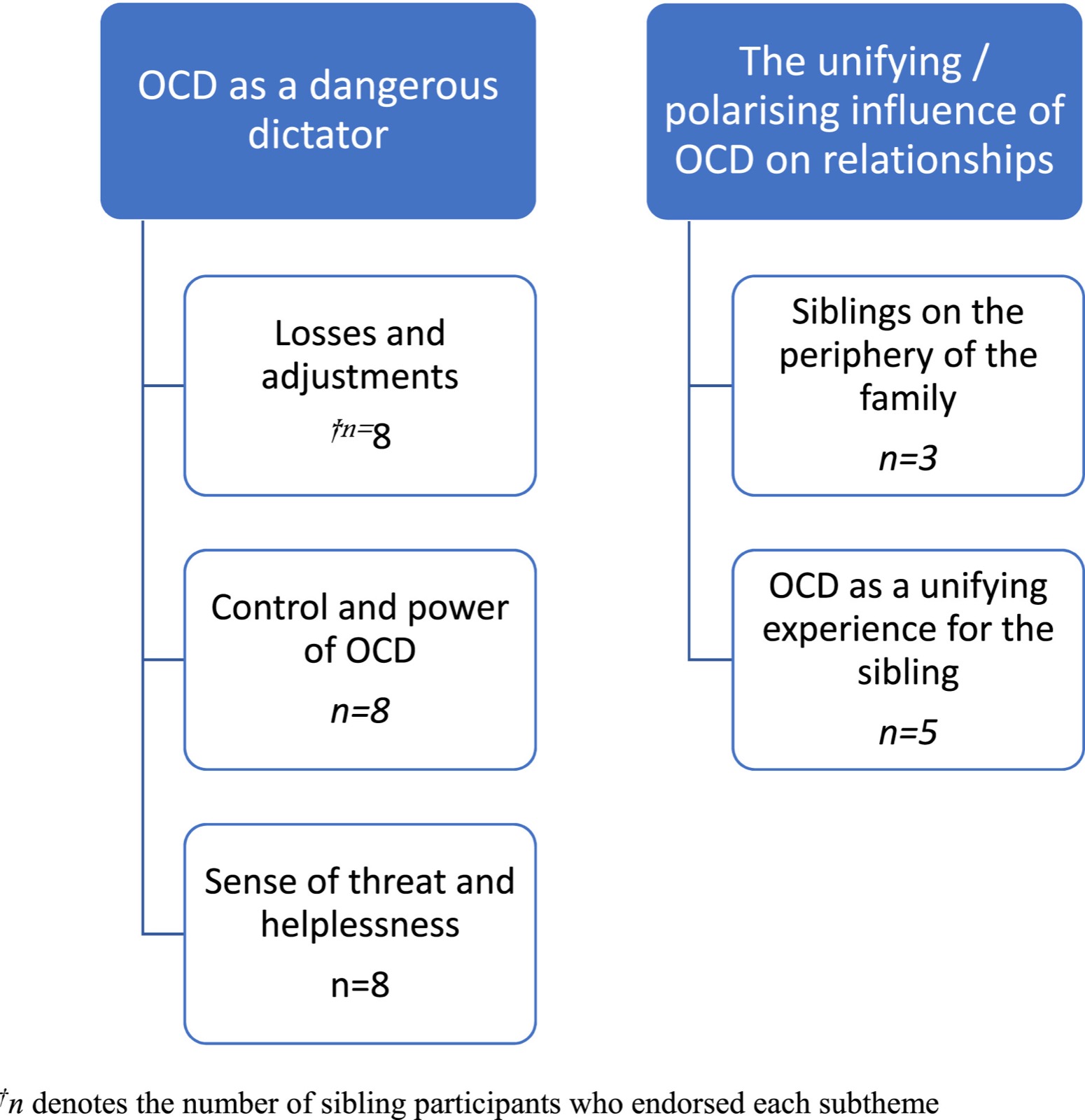
Within this exploratory study, siblings were asked to talk as widely as possible about their experiences of living with an OCD sufferer. All participants gave a rich and varied account of their experiences, which allowed for detailed interpretation and reflection. Each telephone interview with participants lasted between 57 min and 1 h 1 min in total. From participant accounts, two superordinate themes could be interpreted: ‘OCD as a dangerous dictator’ and ‘the unifying/polarising influence of OCD on relationships’. Figure 1 provides an overview of the superordinate and subthemes interpreted from the data and the number of participants who endorsed each sub-theme (Figure 1).
Superordinate theme: ‘OCD as a dangerous dictator’
Participants spoke about OCD creating a dictatorial environment with a tense and fragile atmosphere, particularly in the family home. Helplessness, unwavering OCD control and feelings of loss and adjustment were consistent characteristics of the sibling's domestic milieu. After detailed analysis of participant transcripts, three subthemes were developed that together characterised the ‘OCD as a dangerous dictator’ superordinate theme. These three sibling-related sub-themes were ‘losses and adjustments’, ‘control and power of OCD’ and ‘sense of threat and helplessness’.
Losses and adjustments
All sibling participants spoke of necessary adjustments to their life both inside and outside the home. This included avoidance of rooms within the family home in order not to trigger the OCD sufferer's symptoms, their increased isolation to reduce their own stress levels and increased parental checking on the sibling due to the heightened anxiety OCD caused. The need for siblings to immerse themselves within environments which were free from OCD, such as school or external activities, was seemingly vital for sibling escapism. These environments provided respite and a reprieve from the tense and stressful environment that OCD forced upon everyone in the family home. This was felt to be a necessary and protective adjustment for many siblings. These adjustments did however bring about loss for siblings in terms of limited shared family experiences and an inability to discuss difficulties in order to protect these OCD-free environments. These ideas were interpreted throughout all of the sibling accounts with some example extracts below:
School was great for me as well because it was another environment, I didn't tell anyone at school for quite a while. (Participant 1)
I watched a lot of TV, whereas I've never really been a TV watcher {…} I would always rather be doing something more productive and I felt like I kind of just gave up. I was like, right, I'm just going to do some mindless activities. (Participant 3)
Yeah I think I just needed to just like escape for a few minutes […} Where it may be like school work was a big thing. (Participant 2)
Sibling losses were described in terms of poorer relationships with the OCD sufferer, missed experiences of having friends to stay, ruined family activities or more generally reduced activity and enjoyment. There was understandably some resentment held by siblings towards OCD for these losses and missed opportunities, which for many participants, came at an important stage in their adolescent development. These losses were spoken of in all accounts:
Like me and my sister were getting on really well and it was like a really big weight on me when I kinda like lost her in a way […] sometimes you'd be like out, and you could see that she wasn't like with you and you'd be like I just want to like kind of enjoy this with you (Participant 2)
Yeah, it does like some days, you look at X (OCD sufferer), “oh, that's a nice day,” and then other days you look back and like that day was ruined because of his OCD. (Participant 5)
Control and power of OCD
Siblings spoke of the unyielding and absolute control OCD would exert over the household and its members. Sibling experiences were characterised by significant disruption to family routines and activities. The presence of OCD meant that family activities were repeatedly interrupted, abandoned or extinguished leading to reduced sibling activity when with the family and understandable frustration. OCD was described as a dangerous enemy and captor, not to be confronted even at the expense of the OCD sufferer's wellbeing. Examples of this theme are highlighted in the following extracts:
She (OCD sufferer) was confined to just one room of the house […] it was really difficult. It consumed the lives of my mom and dad. It was difficult to know how best to support X (OCD sufferer). (Participant 8)
Because obviously, we didn't really go many places with X (OCD sufferer) because of all that – the contamination and germs. (Participant 4)
We'd go on family holidays without stress. […] when X's (OCD sufferer) OCD got bad, that sort of went out the window and she wasn't really able to spend any quality time with the four of us for a couple of years really. (Participant 8)
Siblings described a hostage-like environment where it became easier to tow the line dictated by OCD than to push back against the regime it created. Sibling accommodation through avoidance of triggering words or places, providing items for OCD such as cleaning products or food items or providing reassurance was described in all of the participants' experiences. This was, understandably, to reduce the OCD sufferers' already heightened anxiety and provide some respite for all. This is suggested in all accounts with some examples highlighted below:
Quite specific like things or the trigger points for OCD and her like anxiety. So, we had to like keep away from them because we didn't wanna upset her. And while we didn't understand what it was at the time, obviously – we've just done it like naturally. (Participant 7)
Sometimes she (OCD sufferer) says like can you please move this in my room […] Otherwise things will get tense […] and I really don't want to because I know it won't help her. (Participant 6)
Sense of threat and helplessness
Sibling accounts often pointed to OCD as a dangerous and powerful presence as described above. This ensured that its authority over the household was maintained through a very real sense of threat and helplessness on the part of the siblings and other family members. Due to the longstanding nature of the OCD sufferer's difficulties, the sibling's sense of threat became automatically triggered when outside of the family home. Feelings of helplessness were apparent in all sibling accounts. Only when expert advice and intervention was obtained did these very real feelings abate to any degree. This sense of threat and feelings of helplessness are detailed below in examples from participants' accounts:
I've kind of been exposed into it unwillingly and I was like I don't feel comfortable doing this (accommodating) but I know I have to do it. (Participant 5)
I was always like kind of anxious coming home […] cause I didn't know whether like what state X (OCD sufferer) would be in. (Participant 2)
And when I was like stuck in the house, I couldn't really move anywhere else, obviously, had to stay with my family. […] There's still simple things in the house that I couldn't do where I used to. I couldn't play music; I couldn't play x-box because it would make noise and it would disturb X (OCD sufferer). (Participant 7)
Superordinate theme: ‘Unifying/polarising impact of OCD on relationships’
Siblings described a high stress environment created by the powerful dictator OCD. This emotive atmosphere led to strained relationships between family members at times and forced everyone to behave differently. Many of the cognitive (e.g. cognitive escapism and accommodation) and behavioural (accommodation and avoidance) changes described by the sibling participants were designed to protect themselves, the OCD sufferer or other family members. These, often necessary, changes led to siblings either being pushed to the periphery of a weakened family unit as dictated by OCD or centralised their role, often into an additional parental figure. The alternative narrative described by participants was one of the unifying nature of OCD; providing a common goal to strive towards. The pursuit of OCD's extinction by all family members led to a shared experience, which served to tighten the unit and strengthen individual relationships the sibling had within the home. The two sub-themes of ‘Siblings on the periphery of the family’ and ‘OCD as a unifying experience for the sibling’ are discussed below.
Siblings on the periphery of the family
Siblings disclosed a range of behaviours and emotions that led to a distancing from not only the OCD sufferer but also other siblings and their parents. Guilt was an emotion described frequently within sibling accounts. Guilt often stemmed from an unwanted desire to be an additional burden on parental resource; a resource already limited due to the heavy drain of OCD. This led siblings to bury negative emotion to present as ‘well’ or to isolate themselves, often in their bedroom, in order to hide distress from those who cared. Three siblings felt marginalised by the dominance of OCD within the family narrative. Example extracts are detailed below:
I don't know why I didn't tell people, it's just, I kind of felt a sense of guilt erm and like “oh it's not a problem”, I don't want to bring anything else, added problems for her. (Participant 1)
I just feel quite left out because we've been talking about it (OCD) a lot and maybe going to a lot of meetings and yeah, I just felt like the whole world revolved around OCD and then I just wasn't really part of that. (Participant 3)
Sometimes I felt relieved just obviously when I'm sat in the room (bedroom) there was like nothing that could go wrong. (Participant 4)
Sibling fear and anxiety about the future of the family was often discussed. Some participants feared OCD would break the family unit. In some instances, siblings felt this fear was realised. Anxiety arose when siblings pondered what the future might hold for their role within the family and the impact it may have on their relationships if OCD persisted. This in evident in the below accounts:
It went from a nice, lovely family feeling in the house […] it was just awful to be in the house to be fair. Our family lacked structure and it (OCD) destroyed it to be fair. My brother moved out of the house because of it. (Participant 7)
Quite a lot of the time I was really worried about what the future was going to hold for X (OCD sufferer). […} there was definitely a time when I thought “oh my god” not in a bad way, but I'm going to probably have to care for her when I'm an adult. (Participant 3)
OCD as a unifying experience for the family
Although all siblings understandably viewed their experiences living with an OCD sufferer as a significantly challenging time in their lives, some felt that it had a provided a unique shared opportunity for growth as a family. Some siblings described a positive shift in the values they held about their sibling and families, which had led to more time spent with each other and closer relationships. Examples of these experiences are outlined below:
I mean, we lost so much time together […] We (participant and OCD sufferer) kind of wanna spend this much time together because so much time we have to make up for. (Participant 2)
We really, really value and appreciate family time now and family holidays when, because […] there was a time when none of that was possible. (Participant 8)
Five of the sibling participants felt that OCD had led to strengthened relationships with their parents and a stronger family unit due to OCD being a common enemy. Particularly for those families that had seen significant improvements in OCD symptoms in their sibling, it empowered siblings with a real resilience that the family could overcome any challenge. This was evident in the below accounts:
But I think as I […] go forward and we go forward as a family, I think this whole thing would have made us stronger. (Participant 8)
I think it gave us […] the whole family, it brought us closer, something to work on erm, and and like, a reason for us to not be arguing and stuff but to be like all with the same purpose and the same goal. (Participant 1)
DISCUSSION
This study aimed to illuminate the experiences of siblings living with an OCD sufferer. This area has been neglected in favour of research that has focussed almost exclusively on the impact of OCD on co-habiting caregivers and spouses. The two studies that have included siblings have had a small number of them or used parent perspectives and only quantitative measures. This qualitative study is therefore one of very few that explore the impact of OCD on families.
The results in this study indicated all siblings engaged in accommodation of OCD symptoms or participation in rituals, which is in keeping with OCD caregiver/spouse literature (Allsopp & Verduyn, 1990; Amir et al., 2000; Calvocoressi et al., 1999; Lebowitz et al., 2016; Peris et al., 2008; Shafran et al., 1995; Stewart et al., 2008; Storch et al., 2007). Sibling accommodation was often in the form of facilitating avoidance of triggers, hypervigilance to and removal of triggers or providing objects or reassurance for their anxious siblings. Similarly, Storch et al. (2007), using quantitative measures, reported that parent accommodation was often in the form of providing reassurance to their child with OCD or assisting with avoidance of feared objects or situations. Both Kagan et al. (2017) and Caporino et al. (2012) reported that low parental distress tolerance is associated with increased parental accommodation of OCD symptoms. It could therefore be hypothesised that a similar distress avoidance process occurs in both siblings and parents of young people OCD. Sibling's sense of threat and helplessness, as described above, led fearful siblings to accommodate OCD in order to alleviate their own and family members suffering. Alternatively, severe levels of burden (Cooper, 1996; Magliano et al., 1996), compromised social relationships and feelings of depression (Magliano et al., 1996) reported in caregivers, including siblings, could have meant sibling participants had less cognitive resource to tolerate and challenge the OCD sufferer's symptoms and therefore accommodated them out of a felt necessity.
Many of the sibling participants described a disrupted ability to function and spend time with family due to the grip of OCD. This entailed isolating themselves in their bedroom, shortening personal care routines to avoid being late for school/work or triggering OCD and avoiding inviting friends to the house or OCD not allowing them to enter certain rooms in the home. This is in line with reported disruption to functioning in caregivers of OCD in previous studies (Lochner et al., 2003; Stewart et al., 2017). Lochner et al. (2003) report disruption to family life and activities of daily living for parents as a result of having a child with OCD. Similarly, Stewart et al. (2017) described disrupted morning routines for parents due to fear of being late for work. Impact on social relationships has also been highlighted in caregivers of OCD youths by Wu et al. (2018). Wu et al. (2018) reported that caregiver development and social relationships were negatively impacted when the OCD sufferer was experiencing higher OCD-related impairment. These facets, not previously demonstrated in the sibling OCD literature, potentially highlight the important role the education system can play in the siblings' mental health and development. Encouraging after school clubs and understanding the negative impact OCD can have on facets such as sibling tiredness, punctuality, compassion and parental support could be vital in maintaining their health and wellbeing whilst at school.
Disruption to family eating, sleeping and hygiene routines as well as holidays as a result of the controlling nature of OCD were reported by sibling participants in this study. This is corroborated within the paediatric OCD literature (Futh et al., 2012; Stewart et al., 2017). Futh et al. (2012) outlined that parents of OCD sufferers likened the power of OCD to ‘being in the grip of an addiction or being possessed by an inhuman source’. In Stewart et al. (2017), parents reported that the family routines most frequently impacted by OCD were those in the morning and at night. This disruption, alongside the experience of living with the OCD sufferers' severe symptoms, led many siblings to disclose feelings of stress, anxiety, frustration at OCD and sadness for the OCD sufferer. These emotional repercussions are similarly reported in the parent literature by Stewart et al. (2017) who outlined feelings of anxiety, sadness, guilt, anger and frustration in parents as a result of their child's OCD symptoms.
Anxiety and helplessness were key themes for many sibling participants in this study. This was often in the context of negotiating the OCD sufferers' symptoms without causing high levels of distress on a daily basis. These feelings of helplessness are mirrored in the parent literature in OCD (Futh et al., 2012). Through ‘increased understanding of OCD, parents hoped they would be able to learn how to deal with it and feel less helpless’ (Futh et al., 2012, p. 627). This points towards the importance of education for all family members around OCD to reduce felt helplessness and increase siblings' agency for change.
Some sibling participants described OCD as a unifying experience in that it created a common enemy for the family unit to fight against. This process of externalisation was clearly helpful for the siblings and families as it gave form to the significant OCD anxiety and located the problem outside of the family. The Beck Institute (2016) suggest this externalised image of emotion is a crucial facet in childhood CBT as it helps children and young people explain their difficulties via a visual medium. It could be hypothesised that when siblings discussed OCD in this external fashion it gave them permission to ascribe their true feelings to something that had had a significant negative impact on their life as it located the problem outside of the OCD sufferer. Many siblings disclosed an internal battle that fluctuated between frustration directed at the OCD sufferer for the disruption their OCD symptoms caused and empathy that they were held hostage by often incapacitating anxiety. It could be posited that by externalising the OCD, the guilt associated with feeling frustrated at the OCD sufferer was alleviated. Similarly, Friedland (2017) hypotheses that by externalising OCD it allows parents to communicate with their child in a more supportive manner. As hypothesised with sibling experiences, this suggests externalisation alleviates the difficult feelings parents may experience due to their child's OCD, which would otherwise manifest as unhelpful ways of communicating with their child.
Conversely, many sibling accounts spoke to being marginalised from the family by OCD. Sin et al. (2012) suggest that siblings of young people with mental health problems can become increasingly detached from their family and their siblings as a result of feeling resentful towards their ill sibling or blaming themselves for a lack of empathy. Understandable frustration and resentment were facets described by all siblings, especially at stressful moments in their own life such as during exam periods. These periods often diminished their ability to empathise with the OCD sufferer due to increased stress and fatigue. These sibling emotions alongside the protective behaviours they engaged in (isolating in their bedroom and engaging in activities outside of the home) could have contributed to the feelings of being pushed to the periphery of the family.
Several sibling accounts identified reduced parental attention on them as the ‘well’ sibling although many minimised the impact this had. Some siblings suggested it was positive in that it made them more independent and self-motivated to achieve academically. Griffiths and Sin (2013) highlight that there is often decreased attention from parents on the ‘normally’ developing sibling. Marsh (2018) suggests that parental time and energy are finite and this can lead to a lack of parental resource for the well sibling when a brother or sister has a mental health problem. In turn, this may lead well siblings to feel like the forgotten family members (Marsh, 2018). This may have contributed to feelings of marginalisation in sibling reports.
The above findings have possible implications for the long-term mental health of siblings of an OCD sufferer. With regard to assuming a more caregiving role or ‘parentification’ as it referred to in the literature, this is thought to have several negative consequences for siblings including anxiety, depression and psychological distress (Burton, 2007) and shame (Wells & Jones, 2000). Within the present study, siblings spoke to increased anxiety around the uncertainty and fragility of the home environment as well as low mood through isolation in bedrooms, which were regarded as safe from the torment of OCD. Some siblings alluded to feelings of shame in avoiding inviting friends for dinner or to stay due to the prominence of OCD in the household.
Siblings being pushed to the periphery of the family unit by OCD could also be suggested to have a longer-term impact to sibling well-being. Many siblings spoke of OCD dominating the space and attention within the family home leaving little room for their own difficulties or needs. This marginalisation has been suggested by Priebe et al. (2012) to carry an increased risk of mental health problems in those that are marginalised versus those in the general population. Furthermore, reduced caregiver support and perceived marginalisation could increase siblings' vulnerability and lead them to engage in riskier behaviour such as drug taking which could then further escalate the negative impact they experience. With further exploration, assessment of sibling mental health and risk within families that include an OCD sufferer could be vital.
Limitations and suggestions for future research and interventions
This cross-sectional approach provides limited insight into how sibling experiences of co-habiting with an OCD sufferer may change over time, or in relation to changes in their siblings' OCD or other changes. A longitudinal approach to this study would have eradicated the difficulties associated with a cross-sectional design and would expand the fullness of the sibling account provided here, with a focus on change between time points (Calman et al., 2013; Holland et al., 2006). The use of participant diaries between time point interviews could be viable method to bridge this gap in analysis. Mixed methods or quantitative studies could then hone-in on particular facets of the sibling experience, such as accommodation, to explore the generalisability of these responses to OCD in the wider sibling population.
Only recruiting and interviewing siblings who attended MFG sibling days provides one set of data from a relatively homogenous group in that they were in early or late adolescence with the majority older than the OCD sufferer. This may have meant they were more likely to be parentified within the family in a possible attempt to relieve the burden of symptoms on both the OCD sufferer and their parents. Through their discursive, supportive and educational experiences in MFG, participant siblings may have been more able to verbalise their feelings and experiences of co-habiting with OCD, felt more supported through shared experience with other MFG siblings and potentially less blaming of OCD sufferers through experience of externalising OCD during these groups. Interviewing additional groups of siblings from different services would provide greater understanding of the sibling experience in this area. It would also be important, on replication, to recruit sibling participants with current mental health diagnoses. Siblings were excluded from participation in this study if they had current mental health diagnoses. This is a limitation of this study as the impact of living with a brother or sister with OCD is unknown on these potentially more vulnerable young people. This is not only in terms of possible worsening mental health as a result of their siblings' OCD symptoms but also a potential to use observed OCD rituals themselves as a coping mechanism in the possible absence of adaptive coping strategies.
Due to the homogeneity of the participant sample in this study, it would be paramount to recruit siblings and families that are not currently accessing treatment for OCD in ongoing research. This may lead us to different findings in terms of impact of and responses to OCD symptoms from siblings and families alike which would in turn highlight different themes. These themes, in the absence of specialist intervention, would likely not include topics that typically surface during stages of recovery. For example, without learning about externalisation of OCD during treatment, families may not view OCD as a separate entity to their child or sibling and therefore not view OCD as a common enemy to unite against. Anecdotally, families will also often describe OCD as an extremely divisive entity within the family home prior to treatment. This is in stark contrast to many participants in this study describing OCD as a unifying experience for the family. This again is something that may only be possible once families have been able to access tailored and successful interventions for OCD. This limitation only points to the fact that wider research is needed in this area and does not detract from the important findings in this work.
The study findings highlight the significant impact of OCD on siblings which potentially has implications to current interventions although the paucity of research in this area demands a tentative approach in the implications outlined here. NICE (National Institute for Health and Care Excellence) (2005) guidance on interventions for OCD recommends professionals ‘assess the degree to which carers are involved in supporting or carrying out behaviours related to the disorder’. If accommodation was a consistent theme within initial longitudinal qualitative research and subsequent quantitative studies as described above, CBT treatment may need to consider the role of the sibling. This may involve assessment and formulation of sibling accommodation being a potential maintenance factor (Kagan et al., 2017). Siblings may also need to be included within individual CBT for OCD treatment in order to benefit from psychoeducation and support around family responses to OCD. This would also provide a dynamic opportunity for professionals to assess any sibling mental health difficulties as a result of coping with the stressful family environment that OCD creates. Increased sibling anxiety and low mood were both facets disclosed by sibling participants in this study. It would therefore be important to consider mental health consequences and support for the siblings.
A CBT approach focussed on OCD may be limited in addressing difficulties outside of sibling responses to OCD especially when difficulties might be relational between family members or regarding sibling identity shifts. A more systemic model incorporating a narrative therapy approach (McLuckie, 2006) and structural elements (Minuchin, 1974) may be more appropriate to address not only the OCD but also siblings' feelings of helplessness, parentification and possible relational difficulties with other family members during times of severe OCD.
Despite many siblings seeking escapism from OCD, several of them spoke to the benefit of being able to share their difficulties with friends and family. It may be beneficial for siblings to have more readily available support to discuss the losses they experienced as aforementioned and seemingly inherent in having a sibling with OCD. This would allow school and friendship circles to remain ‘OCD free’ and furnish siblings with a previously untapped source of support without the necessity to leave difficult OCD experiences at the door. More widely available NHS or charitable organisation-based sibling groups may also be of benefit to siblings of those with OCD.
CONCLUSIONS
This exploratory study provided some initial insights into how a small group of siblings experienced cohabiting with an OCD sufferer. There is significant overlap between findings in the parent literature and this sibling study. It would appear that family accommodation is apparent in sibling groups alongside disrupted socialising and daily functioning as found with parents of those with OCD. Feelings of helplessness were also a common theme amongst sibling experiences, which again appears to be keenly felt by parents according to the literature.
Novel findings tentatively point to siblings being pushed to the periphery of the family unit especially when OCD is at its most severe. This was seemingly as a result of the demands placed on limited and stretched parental resource. Conversely, some siblings described OCD having a galvanising impact on the family unit, strengthening coping resources and resolve in the face of adversity.
Overall, this exploratory study highlights the importance of considering sibling experience when cohabiting with an OCD sufferer. Accommodation of OCD, a felt sense of helplessness and disrupted routines and socialising were identified by many of the sibling participants. These facets are all widely reported in the adult caregiver literature within OCD. It is clear that further research is paramount in helping us understand more about how siblings are impacted by OCD and the role they may play in helping the family unit challenge OCD.
Complexe Systémique: key points
This small sample (eight young people, a single clinic, families already engaged in multifamily treatment) is enough to bring into view what individual OCD work often leaves out of frame: siblings accommodate the disorder too, and pay a price for it. A useful systemic reading: the symptom reorganises family boundaries, either relegating the “well” sibling to the periphery or parentifying them. Externalising OCD as a common enemy, worked on in multifamily groups through sculpts, appears to be what allows a move from division to alliance, and lets siblings voice anger without blaming their brother or sister. For practice: invite siblings into assessment and formulation, recognise sibling accommodation as a maintaining factor, and offer them a space of their own. Limits: mostly older siblings, without mental health diagnoses, recruited after a programme that precisely teaches externalisation; the “unifying” narrative may be partly its product. Read alongside change patterns during family-based treatment for paediatric OCD, and growing up with a sibling who has depression.
Notes from the original
Author contributions. Stuart Brownings: Data curation, formal analysis, investigation, methodology, project administration, resources, visualization, writing – original draft and writing – review and editing. Lucy Hale: Methodology; supervision; writing – review and editing. Laura M. Simonds: Methodology; supervision; writing – review and editing. Amita Jassi: Conceptualization; methodology; resources; supervision; writing – review and editing.
Acknowledgements. We would like to thank Clinical Psychologist Dr Zoe Kindynis and Assistant Psychologist Kike Thomas-Smith from the recruiting site for your efforts in compiling the list of eligible participants for this study. Thank you to Dr Nan Holmes for your significant support and advice throughout this process. A huge thank you must go to the families and siblings who gave their time and experiences to this study, without which this would not have been possible. Financial support for participant vouchers was provided by the Department of Psychology at the University of Surrey.
Conflict of interest statement. None to declare.
References
Allsopp, M., & Verduyn, C. (1990). Adolescents with obsessive-compulsive disorder: A case note review of consecutive patients referred to a provincial regional adolescent psychiatry unit. Journal of Adolescence, 13(2), 157–169.
American Psychiatric Association. (2013). Diagnostic and statistical manual of mental disorders ( 5th ed.). American Psychiatric Publishing.
Amir, N., Freshman, M., & Foa, E. B. (2000). Family distress and involvement in relatives of obsessive-compulsive disorder patients. Journal of Anxiety Disorders, 14(3), 209–217.
Barrett, P. M., Rasmussen, P. J., & Healy, L. (2000). The effect of obsessive-compulsive disorder on sibling relationships in late childhood and early adolescence: Preliminary findings. Bulletin of the Australian Educational and Developmental Psychologist, 17(2), 82–102.
Benito, K. G., Caporino, N. E., Frank, H. E., Ramanujam, K., Garcua, A., Freeman, J., Kendall, P. C., Geffken, G., & Storch, E. A. (2015). Development of the pediatric accommodation scale: Reliability and validity of clinician and parent-report measures. Journal of Anxiety Disorders, 29, 14–24.
Burton, L. (2007). Childhood adultification in economically disadvantaged families: A conceptual model. Family Relations: An Interdisciplinary Journal of Applied Family Studies, 56, 329–345.
Calman, L., Brunton, L., & Molassiotis, A. (2013). Developing longitudinal qualitative designs: Lessons learned and recommendations for health services research. BMC Medical Research Methodology, 13, 14.
Calvocoressi, L., Mazure, C. M., Kasl, S., Skolnick, J., Fisk, D., Vegso, S. J., Van Noppen, B. L., & Price, L. H. (1999). Family accommodation of obsessive-compulsive symptoms: Instrument development and assessment of family behavior. The Journal of Nervous & Mental Disease, 187(10), 636–642.
Caporino, N. E., Morgan, J., Beckstead, J., Phares, V., Murphy, T. K., & Storch, E. A. (2012). A structural equation analysis of family accommodation in pediatric obsessive-compulsive disorder. Journal of Abnormal Child Psychology, 40, 133–143.
Cooper, M. (1996). Obsessive-compulsive disorder: Effects on family members. American Journal of Orthopsychiatry, 66(2), 296–304.
Friedland, S. (2017). A medical professionals guide to help parents to say ‘go away’ to their child's OCD. Mental Health Matters, 4(6), 42–44.
Futh, A., Simonds, L. M., & Micali, N. (2012). Obsessive-compulsive disorder in children and adolescents: Parental understanding, accommodation, coping and stress. Journal of Anxiety Disorders, 26(5), 624–632.
Green, A. R., Larkin, M., & Sullivan, V. (2009). Oh stuff it! The experience and exploration of diet failure: An exploration using interpretative phenomenological analysis. Journal of Health Psychology, 14(7), 997–1008.
Griffiths, C., & Sin, J. (2013). Rethinking siblings and mental illness. The Psychologist, 26(11), 808–811.
Grootens-Wiegers, P., Hein, I. M., van den Broek, J. M., & de Vries, M. C. (2017). Medical decision-making in children and adolescents: Developmental and neuroscientific aspects. BMC Pediatrics, 17(1), 120.
Heyman, I., Fombonne, E., Simmons, H., Ford, T., Meltzer, H., & Goodman, R. (2001). Prevalence of obsessive-compulsive disorder in the British nationwide survey of child mental health. British Journal of Psychiatry, 179, 324–329.
Holland, J., Thomson, R., & Henderson, S. (2006). Qualitative longitudinal research: A discussion paper. London Southbank University.
Kagan, E. R., Frank, H. E., & Kendall, P. C. (2017). Accommodation in youth with OCD and anxiety. Clinical Psychology: Science and Practice, 24(1), 1–21.
Kenyon, K. M., & Eaton, W. O. (2015). Age at child obsessive compulsive disorder onset and it's relation to gender, symptom severity, and family functioning. Archives of Scientific Psychology, 3, 150–158.
Larkin, M., Watts, S., & Clifton, E. (2008). Giving voice and making sense in interpretative phenomenological analysis. Qualitative Research in Psychology, 3(2), 102–120.
Lebowitz, E. R., Panza, K. E., & Bloch, M. H. (2016). Family accommodation in obsessive- compulsive disorder and anxiety disorders: A five-year update. Expert Review of Neurotherapeutics, 16(1), 45–53.
Lochner, C., Mogotsi, M., du Toit, P. L., Kaminer, D., Niehas, D. J., & Stein, D. J. (2003). Quality of life in anxiety disorders: A comparison of obsessive-compulsive disorder, social anxiety disorder and panic disorder. Psychopathology, 36(5), 255–262.
Magliano, L., Tosini, P., Guarneri, M., Marasco, C., & Catapano, F. (1996). Burden on the families of patients with obsessive-compulsive disorder: A pilot study. European Psychiatry, 11(4), 192–197.
Marsh, D. T. (2018). Siblings: Forgotten family members. https://sutter.networkofcare.org/mh/library/article.aspx?id=444
McLuckie, A. (2006). Narrative family therapy for paediatric obsessive compulsive disorder. Journal of Family Psychotherapy, 16(4), 83–106.
Minuchin, S. (1974). Families and family therapy. Harvard University Press.
NICE (National Institute for Health and Care Excellence). (2005). Obsessive-compulsive disorder and Body Dysmorphic disorder: Treatment. https://www.nice.org.uk/guidance/CG31/chapter/1-Guidance#steps-35-treatment-options-for-people-with-ocd-or-bdd
OCD UK. (2021). What is Exposure and Response Prevention (ERP). https://www.ocduk.org/overcoming-ocd/accessing-ocd-treatment/exposure-response-prevention/#:~:text=Exposure%20and%20Response%20Prevention%2C%20commonly,‘neutralising’%20them%20with%20compulsions
Orsmond, G. I., & Seltzer, M. M. (2007). Sibling of individuals with autism spectrum disorders across the life course. Mental Retardation and Developmental Disabilities Research Reviews, 13, 313–320.
Peris, T. S., Bergman, R. L., Langley, A., Chang, S., McCracken, J. T., & Piacentini, J. (2008). Correlates of accommodation of pediatric obsessive-compulsive disorder: Parent, child, and family characteristics. Journal of the American Academy of Child and Adolescent Psychiatry, 47(10), 1173–1181.
Priebe, S., Matanov, A., Schor, R., Straßmayr, C., Barros, H., Barry, M. M., Díaz-Olalla, J. M., Gabor, E., Greacen, T., Holcnerová, P., Kluge, U., Lorant, V., Moskalewicz, J., Schene, A. H., Macassa, G., & Gaddini, A. (2012). Good practice in mental health care for socially marginalised groups in Europe: A qualitative study of expert views in 14 countries. BMC Public Health, 12, 248.
Shafran, R., Ralph, J., & Tallis, F. (1995). Obsessive-compulsive symptoms and the family. Bulletin of the Menninger Clinic, 59(4), 472–479.
Sin, J., Moone, N., Harris, P., Scully, E., & Wellman, N. (2012). Understanding the experiences and service needs of siblings of individuals with first-episode psychosis: A phenomenological study. Early Intervention in Psychiatry, 6(1), 53–59.
Smith, J. A. (1996). Beyond the divide between cognition and discourse: Using interpretative phenomenological analysis in health psychology. Psychology and Health, 11(2), 261–271.
Smith, J. A. (2004). Reflecting on the development of interpretative phenomenological analysis and its contribution to qualitative research in psychology. Qualitative Research in Psychology, 1(1), 39–54.
Stewart, S. E., Beresin, C., Haddad, S., Egan Stack, D., Fama, J., & Jenike, M. (2008). Predictors of family accommodation in obsessive-compulsive disorder. Annals of Clinical Psychiatry, 20(2), 65–70.
Stewart, S. E., Hu, Y. P., Leung, A., Chan, E., Hezel, D. M., Lin, S. Y., Belschner, L., Walsh, C., Geller, D. A., & Pauls, D. L. (2017). A multisite study of family functioning impairment in pediatric obsessive-compulsive disorder. Journal of the American Academy of Child & Adolescent Psychiatry, 56(3), 241–249.
Storch, E. A., Geffken, G. R., Merlo, L. J., Jacob, M. L., Murphy, T. K., Goodman, W. K., Larson, M. J., Fernandez, M., & Grabill, K. (2007). Family accommodation in paediatric obsessive-compulsive disorder. Journal of Clinical Child and Adolescent Psychology, 36(2), 207–216.
The Beck Institute. (2016). Evil Pink Monsters and externalization in child CBT. https://beckinstitute.org/evil-pink-monsters-use-externalization-child-cbt/
Wells, M., & Jones, R. (2000). Childhood parentification and shame-proneness: A preliminary study. American Journal of Family Therapy, 28, 19–27.
Wu, M. S., Hamblin, R., Nadeau, J., Simmons, J., Smith, A., Wilson, M., Eken, S., Small, B., Phares, V., & Storch, E. (2018). Quality of life and burden in caregivers of youth with obsessive-compulsive disorder presenting for intensive treatment. Comprehensive Psychiatry, 80, 46–56.
Reformatted republication of Exploring the experiences and responses of siblings living with a brother or sister with obsessive compulsive disorder, by Stuart Brownings, Lucy Hale, Laura M. Simonds and Amita Jassi, Psychology and Psychotherapy: Theory, Research and Practice, vol. 96, no 2 (2023), doi: 10.1111/papt.12454, under a CC BY 4.0 licence. Edition and layout: Complexe Systémique, September 2026 — the work has been modified under the terms of the licence (tables presented as lists). Neither the authors nor the publisher are responsible for this edition; the original version prevails.
This is the original article “Exploring the experiences and responses of siblings living with a brother or sister with obsessive compulsive disorder”, published in Psychology and Psychotherapy: Theory, Research and Practice (2023) under a CC BY 4.0 licence. Republished by Complexe Systémique: the author’s text is unchanged; only the presentation has been adapted for reading online, as set out at the head of this page.
Read the original articleHow to cite this article
Brownings, S., Hale, L., Simonds, L. M., et Jassi, A. (2023). Exploring the experiences and responses of siblings living with a brother or sister with obsessive compulsive disorder. Complexe Systémique. https://app.complexe-systemique.com/en_GB/articles/exploring-the-experiences-and-responses-of-siblings-living-with-a-brother-or-sister (Original work published in 2023 in Psychology and Psychotherapy: Theory, Research and Practice, 96(2), 464-479 (2023); republished in 2023 by Psychology and Psychotherapy: Theory, Research and Practice, https://bpspsychub.onlinelibrary.wiley.com/doi/10.1111/papt.12454)
To go further
- Schémas de changement au cours d’un traitement familial du trouble obsessionnel-compulsif pédiatriqueOCD treated as a family.
- Grandir avec un frère ou une sœur en dépression : le point de vue de jeunes adultesSiblings facing mental illness.
- « Comme marcher sur du verre » : l’expérience émotionnelle de la parentification dans l’enfanceWhen the child becomes the parent.
Related training courses
 Short course
The suicidal crisis in adolescents and young adults
Training: assessing and supporting the suicidal crisis in adolescents and young adults. Clinical landmarks and systemic tools. In French.
 Symposium
The Abnormal Normals and the Normal Abnormals
Conference replay: six clinicians explore normality — diagnoses, norms, adolescents, therapists. Immediate, lifetime access. Talks in French.
 Online course
Master the art of narrative therapy: a unique journey with Charlie Crettenand
Immersive online course: discover the narrative approach with Charlie Crettenand. A unique audiovisual journey, lifetime access, exercises. In French, with English subtitles.
Related articles
 Scientific
Family group conference provision across the lifespan of child welfare intervention: A mixed-method realist-informed evaluation comparing three stages of welfare concern
Early help, child protection or children in care: among 155 UK families, experiences and outcomes of family group conferences vary very little by stage.
 Scientific
How can we BeST? meet the needs of adoptive families? Relevant findings from a major Randomised Controlled Trial of infants in foster care in the UK
The BeST? trial (488 infants in care in the UK) reread for adoption: holistic, ongoing assessment of children and a move to dual registration.
 Scientific
Internal Family Systems Therapy as Part of the ‘Family of Systemic Therapies’: A Critical Exploration of Systemic Practice in the Intra-Personal Domain
Does IFS belong to the family of systemic therapies? A critical exploration, grounded in a family court vignette, of systemic work with “parts”.
 Scientific
Implementing Family Group Decision-Making within statutory child protection social work in Scotland: Challenges and opportunities
Family group decision-making offered automatically in Scottish child protection: families find a voice, social workers doubt the plans, and everyone wants it offered earlier.