Clinical Psychology & Psychotherapy · Family therapy
Family Therapy for Kosovar Mothers Who Experienced Conflict-Related Sexual Violence and Their Children in Postwar Times: A Pilot Randomised Waitlist-Controlled Trial
In Kosovo, more than twenty years after the war, mothers who experienced conflict-related sexual violence and live with PTSD took part in ten sessions of family therapy with their child. This first trial conducted in Albanian, at the torture rehabilitation centre in Prishtina, shows improved family functioning according to mothers, but not according to young people, and an unexpected waitlist effect.
This is a reformatted republication of Family Therapy for Kosovar Mothers Who Experienced Conflict-Related Sexual Violence and Their Children in Postwar Times: A Pilot Randomised Waitlist-Controlled Trial, by Christina Seery, Feride Rushiti, Sebahate Pacolli Krasniqi, Selvi Izeti Çarkaxhiu, Vjosa Devaja Xhemaili, Dafina Arifaj Limani, Qëndresa Prapashtica, Vesa Turjaka, Nebahate Zekaj, Mimoza Salihu, Line Hjort, Joanne Ryan, Sara Helene Kaas-Petersen and Shr-Jie Sharlenna Wang, published in Clinical Psychology & Psychotherapy (Wiley) (2024), doi: 10.1002/cpp.3039, under a CC BY 4.0 licence. Prepared by Complexe Systémique in September 2026: the authors’ text is unchanged; the layout has been adapted for reading online, which constitutes a modification of the work under the terms of the licence. Table 1 is presented as a list; the end-of-article declarations are grouped in the notes. This edition was made neither by the authors nor by the publisher, who are not responsible for its content or for any errors. The original version prevails.
Strengthening the relationships within families via family therapy could help protect against the effects of intergenerational war-related trauma.
Christina Seery, Feride Rushiti, Sebahate Pacolli Krasniqi, Selvi Izeti Çarkaxhiu, Vjosa Devaja Xhemaili, Dafina Arifaj Limani, Qëndresa Prapashtica, Vesa Turjaka, Nebahate Zekaj, Mimoza Salihu, Line Hjort, Joanne Ryan, Sara Helene Kaas-Petersen and Shr-Jie Sharlenna Wang
Abstract
Women who have experienced conflict-related sexual violence report significant long-term effects, including posttraumatic stress disorder (PTSD), depression and relationship difficulties. Research has demonstrated that maternal trauma is associated with children's behavioural difficulties and challenges in family functioning, such as impaired communication and harsh parenting. This pilot study is aimed at evaluating the preliminary effectiveness of family therapy for Kosovar mothers who experienced conflict-related sexual violence in 1998–1999 and later developed PTSD and their children in improving family functioning and reducing behavioural difficulties in postwar times. Sixty-four mothers were randomised to an intervention group or a waitlist control group. Data was collected during a screening phase, at baseline before intervention initiation, after the intervention group completed family therapy and once the waitlist control group received the intervention. Generalised linear mixed models were used to analyse group differences in family functioning and children's behaviours over time. At follow-up, mothers in the intervention group reported improved family functioning. However, mothers in the waitlist control group reported significantly fewer behavioural difficulties than mothers in the intervention group before the control group had started family therapy. There was no significant interaction between group condition and time for child-rated family functioning. Overall, this pilot study suggests that family therapy could be effective in reducing the effects of intergenerational trauma related to PTSD and conflict-related sexual violence. Future research should evaluate the long-term effects of family therapy to assess if immediate effects were maintained.
Summary
- Family-based interventions may be supportive in alleviating the intergenerational effects of conflict-related sexual violence.
- A novel family therapy intervention was facilitated for Kosovar mothers who experienced conflict-related sexual violence during the Kosovar war in 1998–1999 and their children.
- Family therapy was associated with improvements in mother-rated but not child-rated family functioning.
- There may have been a waitlist effect as mothers in the waitlist control group rated their children's behavioural difficulties as significantly fewer compared to the baseline before initiating family therapy.
- Findings indicate the preliminary effectiveness of family therapy, although further research is needed to identify supportive interventions for mothers who have experienced conflict-related sexual violence.
1 Introduction
Wartime sexual violence, also known as conflict-related sexual violence, has significant physical and mental health implications for survivors, as well as intergenerational impacts on their children (Stark et al. 2022). There is a great and unfulfilled need to ensure survivors are provided with appropriate interventions, as a study of women in Bosnia who experienced conflict-related sexual violence found that out of the 104 participants, only one woman had received specialist care for her trauma (Anderson et al. 2019). Previous research has demonstrated that in survivors of the war in Northern Kosovo, the level of lifetime exposure to massive violence, familial financial burden and proportion of family members reporting pain and injury related to lifetime violence were intercorrelated (Wang et al. 2010). An RCT of individual CBT for survivors of the war in Kosovo had limited effects (Wang et al. 2017). These findings may suggest the importance of new approaches to rehabilitation in a postwar setting, including ways to address collective emotional pain and trauma in the family, such as utilising family-based interventions or family therapy to reduce the intergenerational effects of PTSD. Additionally, family-based interventions have previously been shown to reduce maternal PTSD and improve parenting skills, stress and child behaviours (Rosenblum et al. 2017; Sullivan et al. 2023).
Mothers' PTSD symptoms can have significant physical impacts, such as a dysregulated stress response system (Fransquet et al. 2022; Hjort et al. 2021), and psychological effects, such as behavioural challenges, on their children. A study of asylum-seeking families in Finland found that children's emotional symptoms, conduct problems and peer problems were associated with parental trauma (Parviainen et al. 2023). Longitudinal data has demonstrated that maternal trauma indirectly affects children's internalising behaviours through negative relationship quality (Fitzgerald, London-Johnson, and Gallus 2020). Additionally, mothers' responsive parenting has been shown to moderate the relationship between mothers' PTSD symptoms and children's stress and disruptive behaviours (Greene et al. 2020). Similarly, family functioning and harsh parenting appear to indirectly affect internalising and externalising difficulties in adolescents with mothers who experienced maltreatment (Bravo et al. 2023). A systemic approach or family therapy could mitigate these intergenerational effects of maternal trauma.
For people who have experienced armed conflict, families can be a significant source of resilience and help one another cope with trauma (de Jong 2020). Family therapy interventions are more or as effective when compared to active control conditions in promoting a range of positive outcomes in children and young people, although there are often methodological concerns associated with trials (Littell et al. 2023; Sheidow, McCart, and Drazdowski 2022). Strengthening the relationships within families via family therapy could help protect against the effects of intergenerational war-related trauma, with some limited evidence suggesting family-based interventions are potentially effective in improving children and caregivers' mental health and family outcomes among refugee families (Bunn et al. 2022). However, there is limited research on the effectiveness of family therapy in postconflict settings (de Jong 2020). A qualitative study with healthcare workers in Bosnia exploring their therapeutic work with women who experienced conflict-related sexual violence highlighted the importance of incorporating family therapy into their practice (Skjelsbaek 2006), although the effectiveness of family therapy for mothers with conflict-related sexual violence is yet to be empirically evaluated.
The present study is aimed at conducting a pilot trial evaluating the preliminary effectiveness of family therapy for Kosovar mothers who experienced conflict-related sexual violence and later developed PTSD and their children. Sexual violence was a prominent feature of the conflict in the Kosovar War, which took place from 1998 to 1999 (Zeidler 2022). While individualised CBT has previously been employed to aid the rehabilitation of Kosovar victims of torture and war (Wang et al. 2017), this is the first time Family Therapy and Systemic Practice was used in the Albanian language and Kosovo for victims of the war. Mothers were randomly allocated to an intervention group to receive 10 sessions of family therapy with their children or a waitlist control group. The present study presents the effects of family therapy on psychological outcomes of family functioning and children's behavioural difficulties as part of a larger research programme exploring whether family therapy can reverse the epigenetic changes in children associated with their mothers' trauma. We hypothesised that mothers and children in the intervention group would have significantly improved scores in children's difficulties and family functioning once they completed family therapy, in comparison to the waitlist control group.
2 Method
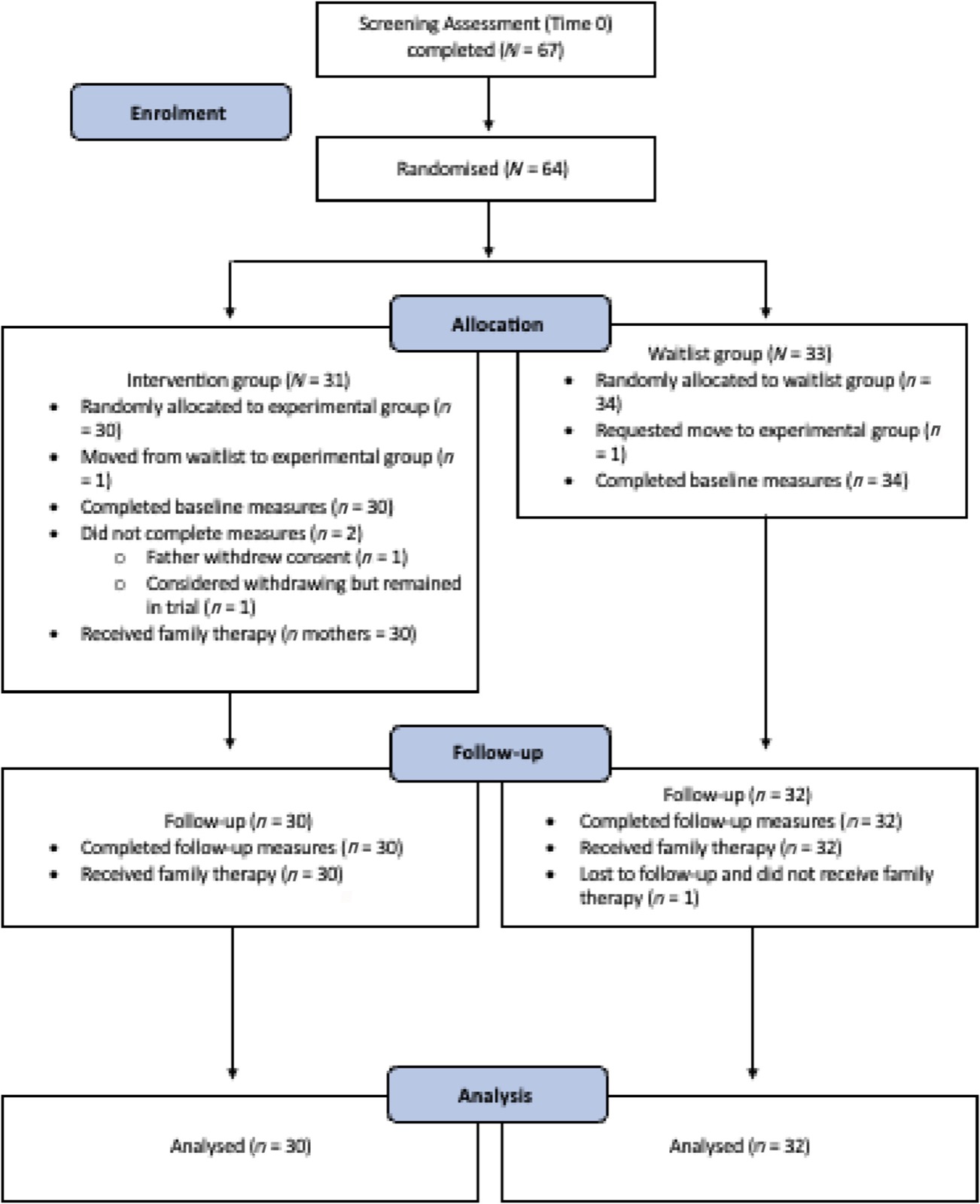
This study used a randomised waitlist-control trial design to compare the effects of family therapy for mothers who all have lifetime PTSD due to experience of conflict-related sexual violence in 1998–1999 and their children (Hjort et al. 2021) on levels of family functioning and difficult behaviours demonstrated by the child. Ethical approval was granted by the commission for the ethical issues within the Kosovo Doctors Chamber, and the study was conducted in line with the Helsinki Declaration. All participants provided informed consent before participating. Figure 1 provides a CONSORT diagram of participant flow through the stages of recruitment, follow-up and analysis.
2.1 Family Therapy
Three pairs of therapists (in which one-half of the pair provided the family therapy while the other observed children's reactions or took notes) in the Kosovo Rehabilitation Center for Torture Victims (KRCT) were trained in family therapy by a certified trainer of the UK Association of Family Therapy and Systemic Practice. The training encompassed modules on the three main schools of systemic theory and practice; application of system theory to observations and family therapy; attachment theory, impact of trauma and domestic violence; narrative theory, communication, change and process of family therapy; the solution focused approach, ethics and the professional role and culture, reflection and adaptation and supervision. The therapists were all women, with an age range of 35–60 (M = 42), with professional backgrounds in psychology, medicine and psychotherapy. Therapists received weekly supervision from the certified trainer.
Treatment fidelity was ensured by presenting detailed descriptions of cases during weekly supervision, in which the supervisor provided feedback on strengths and areas for improvement. When the supervisor was in Kosovo to provide training, supervision was held in person and involved role-playing to practice specific techniques and scenarios, reinforcing the correct application of intervention strategies. Therapists were encouraged to engage in self-reflection during supervision to identify and address any personal biases or deviations from the family therapy protocol. Additionally, a psychologist and a psychotherapist from an external trauma centre in Northern Europe reviewed video recordings of seven family therapy sessions and reported that the family therapists engaged with the families in a sensitive manner, created a safe space to address difficult issues and used family therapy techniques as intended, such as mapping the family dynamic systematically and generating systemic hypotheses to guide the intervention. A total of 23 sessions were recorded to review and ensure treatment fidelity.
The typical goals of family therapy are addressing communication and family problems, improving the home environment's functioning through exploring family dynamics, emphasising the family's strengths and resources and cultivating problem-solving behaviours (Varghese, Kirpekar, and Loganathan 2020). The therapists aimed to sensitively create a safe space for the family to address difficult issues. Family therapy techniques were used, such as systematically mapping the family dynamic and creating systemic hypotheses to guide the intervention. Key topics of family therapy included family structure and roles, communication patterns, rules and boundaries, family history and context, beliefs and values, attachment styles, roles and responsibilities, emotional expression and regulation, power dynamics, family rituals, intergenerational patterns, strengthening the parent–child bond, externalisation techniques and separating challenges from the individual. The topics discussed during the intervention were carefully chosen to resonate with the specific needs and concerns of the mother and child. The use of externalisation and the empty chair technique for family members who were not present were also applied. The intervention aimed to focus on topics that mattered to the mother and child and, therefore, ensure that they felt heard and valued to enhance their engagement.
The majority of families (94%) received 10 sessions of family therapy, while three families received nine sessions and one family participated in three sessions before dropping out of the study. Each session lasted 60 min and was facilitated weekly or very occasionally biweekly.
2.2 Randomization
The 66 children with two pairs of twins were randomly allocated to the intervention group or the waitlist control group by a block randomization procedure using a computerised random number generator of two blocks of size 33, created by a researcher not involved in the trial. Each child was given a unique number, while the twins had the same number. The children in each group were randomly assigned to three pairs of family therapists using a block randomization technique performed by another researcher not involved in the trial.
2.3 Participants
Mothers who were survivors of conflict-related sexual violence attending the KRCT were invited to participate. Criteria for inclusion were Albanian women born in Kosovo and who had lived in Kosovo during the wartime in 1998–1999; mothers who had given birth to at least one child after the war, unrelated to sexual assault; reported at least one experience of sexual violence and met the Diagnostic and Statistical Manual of Mental Disorders (DSM-IV) for PTSD. Participants were excluded if they were not Albanian, experienced cognitive impairments, experienced schizophrenia or major alcoholic or substance abuse, had a blood/injection phone, recently underwent chemotherapy or chemoradiotherapy for cancer or will have such therapy within 6 months of the study commencing. An a priori power analysis was not conducted to determine the sample size. All women who participated in the original epigenetics study (see Hjort et al. 2021 and Fransquet et al. 2022 for further details on recruitment strategy) were invited to participate with the aim of recruiting as many participants as possible.
Of the 117 women participating in the original intergenerational epigenetics study, 64 mothers and their children, including two sets of twins, consented to participate. All mothers were assessed by KRCT clinicians and diagnosed with PTSD according to the DSM-IV, using an Albanian version of the Clinician-Administered PTSD Scale (Turner et al. 2003; Weathers, Keane, and Davidson 2001). Participants were randomly allocated to either an intervention group (n = 30 mothers) or a waitlist control group (n = 32 mothers). Table 1 provides an overview of participants' demographic details and characteristics at the baseline assessments.
Table 1 — Overview of baseline demographic characteristics overall and any differences between intervention and waitlist groups
For each variable: overall; intervention group; waitlist group; pa. M (SD) or n.
- Mother's age, M (SD). 42.58 (4.05); 41.79 (4.34); 43.42 (3.59); p = 0.11.
- Child's age, M (SD). 10.33 (3.81); 10.87 (3.06); 9.82 (4.38); p = 0.27.
- Child at least 12 years old, n. 29; 13; 16; p = 0.60.
- Child's gender, n (p = 0.47). Girl: 28; 15; 16. Boy: 36; 16; 20.
- Mother's occupation, n (p = 0.68). Homemaker: 56; 27; 29. Tailor: 2; 1; 1. Hairdresser: 2; 1; 1. Police officer: 1; 0; 1. Cleaner: 1; 0; 1. Midwife: 1; 1; 0. No data: 1; 1; 0.
- Mother's education, n (p = 0.65). Did not receive education: 3; 1; 2. Preschool: 2; 2; 0. Primary education: 50; 24; 26. Secondary education: 7; 3; 4. Higher education: 2; 1; 1.
- Father participating in family therapy, n (p = 0.33). Yes: 23; 13; 10. No: 41; 18; 23.
- Number of siblings, M (SD). 2 (1.45); 2 (1.37); 2 (1.54); p = 0.94.
- Child's years attending school, M (SD). 6.55 (2.43); 6.37 (2.62); 6.75 (2.23); p = 0.58.
- Child attended elementary school, n (p = 0.60). Yes: 35; 18; 17. No: 29; 13; 16.
- Child left or moved school, n (p = 0.29). Yes: 44; 22; 22. No: 7; 5; 2.
- Family receives social welfare, n (p = 0.12). Yes: 45; 18; 27. No: 10; 7; 3. Unsure: 9; 6; 3.
- Mother received group therapy during trial, n (p = 0.02b). No: 56; 29; 27. Yes: 6; 0; 6.
- Mother received individual therapy during trial, n (p = 0.04b). Yes: 46; 25; 21. No: 16; 4; 12.
- Mothers' baseline SCORE-15, M (SD). 2.51 (0.67); 2.43 (0.59); 2.58 (0.73); p = 0.41.
- Mothers' baseline SDQ difficulties, M (SD). 0.95 (0.31); 0.95 (0.29); 0.97 (0.33); p = 0.74.
- Child's baseline SCORE-15, M (SD). 2.08 (0.45); 2.25 (0.51); 1.94 (0.34); p = 0.06.
a Differences between groups for continuous variables were calculated using independent samples t-tests, and the chi-square test of independence was used for continuous variables. b Significant difference incorporated as a covariate in the analysis.
2.4 Procedure
Data was collected by the KRCT clinician reading the questionnaires aloud, with participants noting their responses. Data was collected from mothers and the youngest child in the family. A screening assessment conducted in February 2021 was used to gather insight into levels of family functioning and behavioural difficulties. Participants were then randomised to an intervention or waitlist group. Participants were aware of which group they were assigned to. One mother requested her family be moved to the intervention condition, which was accommodated.
Before family therapy commenced for the intervention group, all participants completed the baseline questionnaire measures during February and August–October 2021. Demographic details were collected at the screening assessment, and additional questions were asked during the baseline assessment. The intervention group attended family therapy from September 2021 to January 2022, with postintervention data collected in February 2022. The waitlist group attended family therapy from March to June 2022. The follow-up was conducted in August 2022, 7 months after the postintervention time point.
During the trial, regular individual therapy sessions were not offered to the participants unless a mother requested them. Group therapy was offered to some mothers during the waiting period, or in addition to family therapy, once a month. Participants could opt into a maximum of 2–3 individual or group therapy sessions during the trial.
2.5 Measures
2.5.1 Systemic Clinical Outcome and Routine Evaluation-15 (SCORE-15; Stratton et al. 2010)
The SCORE-15 was used as a measure of family functioning. It uses 15 items to assess the participants' perceived family adjustment in terms of the family's communication, strengths and difficulties. Family members 12 years old or older are asked to indicate the extent to which the item reflects their family on a 5-point Likert scale, ranging from describes my family—very well to describes my family—not at all. Low scores indicate fewer perceived difficulties within the family, while higher scores suggest poorer family functioning, such as an increased sense that the family finds it hard to trust or support one another. The SCORE-15 was translated into Albanian for the present study by a certified Family Therapy and Systemic Practice clinician. Cronbach's alpha for mothers' SCORE-15 data was 0.87, 0.85, 0.89 and 0.83 at the screening, baseline, postintervention and follow-up assessments. The intraclass correlation coefficient (ICC) estimate for the mothers' SCORE-15 responses, using screening and baseline assessment data, was 0.85 (CI 95% = 0.79, 0.89), based on an absolute agreement, two-way mixed effects model. The children's data demonstrated similar Cronbach's alpha scores of 0.79, 0.73, 0.81 and 0.83 at the screening, baseline, postintervention and follow-up assessments. The ICC estimate for children's SCORE-15 responses, using screening and baseline assessment data, was 0.62 (CI 95% = 0.21, 0.82), based on an absolute agreement, two-way mixed effects model.
2.5.2 Strengths and Difficulties Questionnaire (SDQ; Goodman 1997)
The SDQ is a measure of psychological adjustment in children, encompassing their internalising and externalising difficulties. The SDQ uses 25 items to measure children's emotional symptoms, conduct problems, hyperactivity/inattention, peer relationship problems and prosocial behaviour. Parents rate the degree to which each item is true about their child using a 3-point Likert scale of not true, somewhat true and certainly true. A total difficulty score is calculated based on all items except those related to prosocial behaviour. Higher scores indicated more difficulties. Mothers answered based on the behaviours of the youngest child in the family. The SDQ has been previously translated into Albanian (Smajlaj et al. 2020). The SDQ total difficulties scores' Cronbach's alpha at the screening, baseline, postintervention and follow-up assessments were 0.80, 0.76, 0.78 and 0.83. The ICC estimate for mothers' total difficulties score, using screening and baseline responses, was 0.72 (CI = 0.54, 0.83), based on an absolute agreement, two-way mixed effects model.
The Albanian SCORE-15 and SDQ demonstrated acceptable internal consistency in the present study (Taber 2018) and good test–retest reliability (Koo and Li 2016).
2.6 Data Analysis
SPSS Version 29 (IBM Corp 2021) was used to clean and analyse the data. Preliminary analyses involved checking the normality distribution of scores, as indicated by skewness and kurtosis, which were within the acceptable ranges (Mishra et al. 2019).
As the SCORE-15 is recommended for use in individuals aged 12 and up (and the children's SCORE-15 for children 8–12; Jewell et al. 2013), we used an independent samples t-test to assess whether the participants younger than 12 who completed the SCORE-15 had significantly different scores from those over 12. As there was a significant difference (t(50) = −2.67, p = 0.010), children younger than 12 were excluded from the analysis of the child-rated SCORE-15 data. The significant difference may be due to children under 12 having reported finding some words in the traditional SCORE-15 unfamiliar (Jewell et al. 2013). Twenty-nine children were included in the final analysis (age range = 12–15, M = 13.55, SD = 1.30), 13 of whom had been randomly assigned to the intervention group.
In terms of missing data, SCORE-15 data were missing for only one mother (1.6%) at the baseline data collection point, and no data was missing for any other time points or the SDQ data. SCORE-15 data were missing for three children (10.3%) at the postintervention time point, and no data were missing at the baseline or follow-up. Little's ‘missing at completely random’ (MCAR) test indicated that children's missing data was MCAR (χ2(3) = 0.09, p = 0.957).
To examine whether family therapy was effective in improving family functioning and behavioural difficulties, generalised linear mixed models (GLMMs) were used as they could account for individual random effects on the repeated measures (Bono, Alarcón, and Blanca 2021). Three separate models were constructed (one each for mother-rated family functioning, mother-rated behavioural difficulties and child-rated family functioning). Each model included the fixed effects of time, intervention condition (intervention or waitlist) and the covariate of the mother's participation in group and individual therapy during the trial. Subjects and random intercepts were included as random effects. The group condition was coded, where ‘0’ represented the waitlist group and ‘1’ represented the intervention group.
As recommended by Bono, Alarcón, and Blanca (2021), the corrected Akaike information criterion (ACC) was used to determine the goodness-of-fit of the models due to the sample size for each model being under 100 people. A null model of only the effects of time on the dependent variable was generated, which was then compared to the fitted model with the group condition (Monsalves et al. 2020). Goodness-of-fit was indicated if the fitted model's ACC was lower than the null model's. We employed an autoregressive covariance matrix for all models. The interactions between time and condition were used to test our hypotheses, and we were specifically interested in whether the intervention group had improved family functioning and behavioural difficulties at postintervention. Effect sizes were calculated according to Feingold's recommendations (Feingold 2009). The ggplot2 package in RStudio Version 2023.12.0+369 was used to create the data visualisations (RStudio Team 2023; Wickham 2016).
3 Results
3.1 Mixed Effects Models
Mothers' participation in group or individual therapy during the trial was included in all models as covariates, with no significant effects observed. For mother-rated family functioning, the fitted model had an improved goodness-of-fit in comparison to the null model (AIC = 344.76). A significant interaction between time and group condition was observed (F(2, 1) = 3.13, p = 0.046, d = 0.51). Figure 2 shows that the intervention group improved in mother-rated family functioning, with lower overall scores after family therapy, indicating reduced family dysfunction.
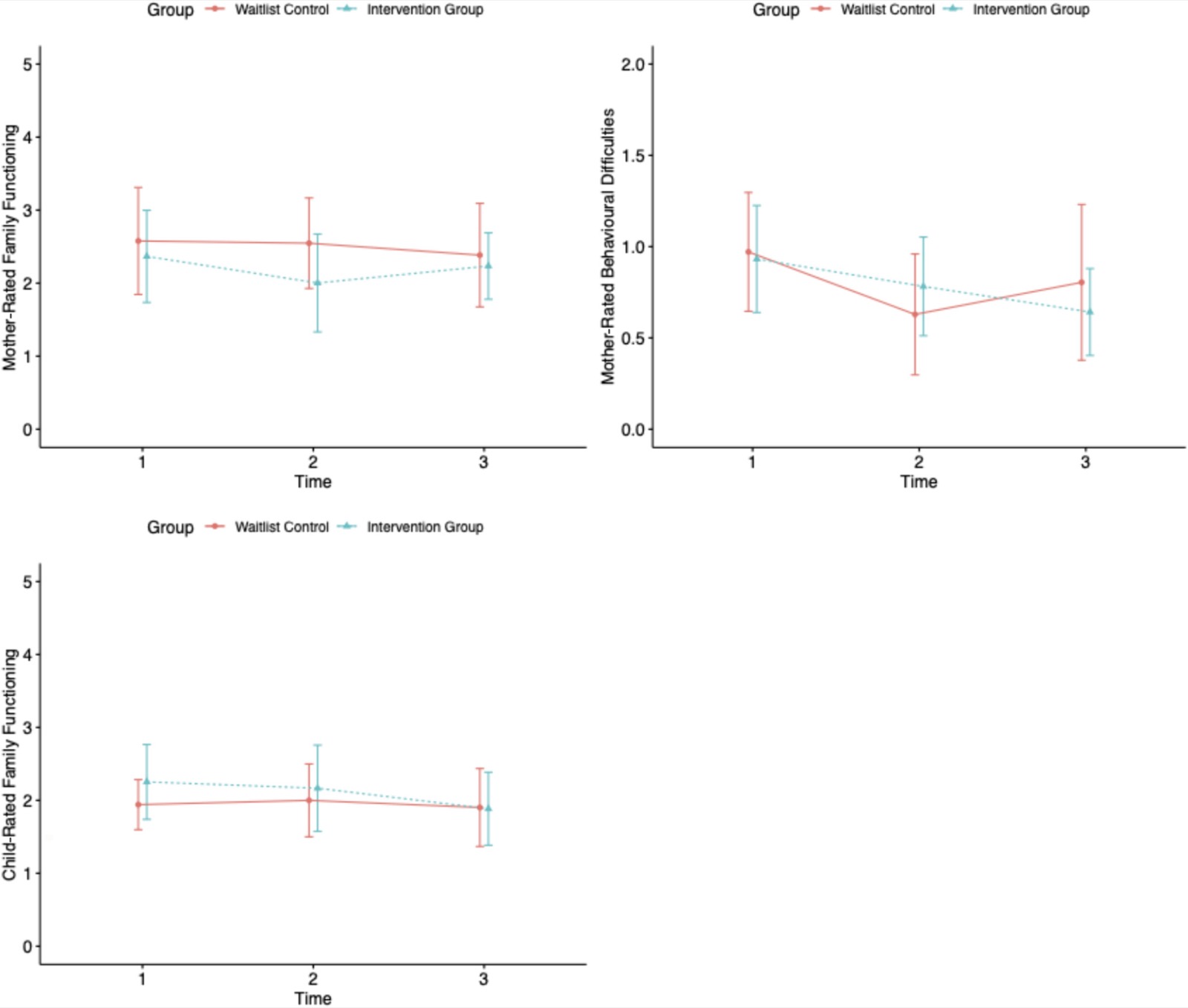
For mother-rated behavioural difficulties, the fitted model had an improved goodness-of-fit compared to the null model (AIC = 123.01). A significant interaction between time and group condition was observed (F(2, 179) = 3.62, p = 0.029, d = 1.05). As demonstrated in Figure 2, the waitlist control group had significantly fewer behavioural difficulties than the intervention group did after the intervention group completed the intervention, although there was no difference once the waitlist control also completed family therapy.
For child-rated family functioning, the fitted model also had an improved goodness-of-fit compared to the null model (AIC = 106.90). No significant interaction between time and group condition was observed (F(2, 76) = 2.28, p = 0.109). There were no significant main effects of time (F(2, 76) = 2.35, p = 0.102) or group condition (F(1, 76) = 1.51, p = 0.102).
Figure 2 provides a visualisation of the dependent variables across time and between conditions.
4 Discussion
This pilot study is aimed at exploring the effectiveness of family therapy for mothers who previously experienced conflict-related sexual violence and had developed lifetime PTSD and their children. There were significant interactions for both mother-rated family functioning and behavioural difficulties. In line with our hypothesis, mothers in the intervention group reported moderately improved family functioning, as suggested by the significant interaction postintervention. Mothers in the waitlist control group reported fewer behavioural difficulties than mothers in the intervention group before initiating family therapy, which contradicted our hypothesis. There was no longer a significant difference between groups once the waitlisted mothers completed family therapy. Finally, there were no differences across time points or between groups for children's ratings of family functioning.
The present study found a significant interaction between intervention condition and time in mother-rated family functioning, with a moderate effect size. These findings are reflective of Hartnett, Carr, and Sexton's (2016) waitlist-controlled trial of functional family therapy, which found a similar moderate improvement in family functioning. Likewise, Godart et al. (2022) conducted a randomised controlled trial of long-term family therapy for adolescents with anorexia nervosa and found moderate effects on family cohesion and adaptability. In comparison, there was no significant effect of family therapy on child-rated family functioning observed. The lack of effects observed may reflect the small sample of young people over 12 that could be included in the analysis, which was likely underpowered. Alternatively, it could reflect a difference in mothers' and children's perceptions of family functioning, as children had slightly better ratings of family functioning at baseline. Discrepancies between mothers and children in perceived family functioning have been previously observed in other samples (Hou, Kim, and Benner 2018; Leung, Shek, and Li 2016; Wen et al. 2023). As mothers who have experienced conflict-related sexual violence can fear that there are negative consequences of their trauma for their children (Rubini et al. 2023), it may be that mothers in the present study were more sensitive and perceived a more impaired family functioning than their children.
Mothers in the waitlist control group reported fewer behavioural difficulties than mothers in the intervention group postintervention, despite not yet having completed family therapy. This may reflect the waitlist-controlled design of the study, as some meta-analyses of RCTs have demonstrated significant but small improvements in waitlist control groups over their waiting times, such as in trials of interventions for social anxiety disorder (Steinert et al. 2017) and panic disorder (Penkova et al. 2018). Høstmælingen et al. (2023) observed that individuals with chronic depression can experience a reduction in symptoms during the waiting period prior to commencing psychotherapy, which they propose may be related to treatment expectations. Additionally, a qualitative evaluation of participants' experiences of being allocated to a waitlist condition for an alcohol reduction intervention found that some participants were motivated to seek support during the waiting period. Other participants in the waitlist condition described changing their behaviours, even without external intervention (Gunnarsson, McCambridge, and Bendtsen 2023). It may be that while they were waiting for family therapy, mothers implemented strategies in the interim to support their child's behavioural challenges. This might explain the interaction between groups found in the present study.
Like Vardanian et al. (2020), who found that functional family therapy was associated with reduced behavioural difficulties, mothers in the intervention group reported improvements in their child's behaviour over time. Family-based interventions for children exposed to conflict have similarly shown improvements in parent-rated behavioural difficulties (Haar et al. 2020; O'Callaghan et al. 2014). Previous research has also demonstrated that posttraumatic growth in Bosnian women who experienced conflict-related sexual violence was associated with greater coping strategies of positive reinterpretation and planning (Anderson et al. 2019). Given that the family system can be a valuable resource for facilitating posttraumatic growth (Berger and Weiss 2009), family therapy could be supportive in increasing mothers' adaptive coping strategies. As a result, it may be a helpful avenue for reducing the negative intergenerational effects of mothers' experiences of conflict-related sexual violence on children's behavioural difficulties. Some participants, mostly adolescent children, reported a sense of shame as a result of participating in the intervention, which was explored and reduced within the intervention. Mothers' shame was also highlighted by their unwillingness to invite their spouses to participate, as it would require disclosing their history of assault. This is understandable given the significant long-term effects of conflict-related sexual violence on survivors (Stark et al. 2022). As the findings of this pilot study suggest the potential benefits of family therapy in improving family functioning and behavioural difficulties in mothers who experienced conflict-related sexual violence and their children, further research could consider the specific therapeutic mechanisms that are associated with improvements, such as reducing the shame experienced by both mothers and children.
The study's findings should be considered in the context of its limitations. We did not record how many family members participated in the family therapy, such as the number of siblings who attended with the mother and child. Similarly, fathers were not explicitly invited to take part in family therapy unless the mother invited them, as some of the women did not want to disclose their experience of conflict-related sexual violence to their partners. It was anticipated that there might be a ripple effect, in which the positive influences of family therapy on the mother–child dyad might extend to the whole family unit. For example, Peltz et al.’s (2015) findings suggested that in addition to reducing depression symptoms, psychotherapy delivered to mothers with depression and their children was associated with improved both the mothers' and fathers' marital relationship satisfaction, suggesting the effects of psychotherapy benefit additional relationships in the family. As the research team was aware not all family members would participate in the intervention, a core target of the intervention was to promote skills and positive changes in the mothers and children participating that might influence the behaviour and well-being of other family members. For example, therapists focused on improving communication skills and emotional regulation in the mother to create a supportive and understanding environment in the home. The therapists regularly received feedback from mothers that fathers and children who were not participating were curious about the therapeutic work. Future research should aim to measure the outcomes of family therapy on siblings or parents who did not participate directly to evaluate the extent of any impacts or ripple effects, such as changes in family cohesion, communication and psychological well-being. Qualitative research with family members who did not participate could also provide further insight into how they perceive or experience the effects of family therapy.
Additionally, one mother who was randomly allocated to the waitlist control group requested to be moved to the experimental group. Given the vulnerability of the women who participated in the research and in an effort to build trust in the research and maintain therapeutic rapport, this request was accommodated. However, this corrupted the randomization process (Vorland et al. 2021). As such, findings should be interpreted cautiously, and further RCTs are necessary to understand the effectiveness of family therapy for this cohort.
Additional measures, particularly concerning mood, psychological well-being and therapeutic mechanisms, alongside the SCORE-15 and SDQ, could have provided further insight into the effectiveness of family therapy for this cohort. For example, family therapy has been shown to reduce suicidal ideation and depressive symptoms (Waraan et al. 2023), and the inclusion of measures of mood could have allowed for the generalisability of findings. Similarly, future research could explore the effectiveness of family therapy in reducing PTSD symptoms in mothers who experienced conflict-related sexual violence, as the present study did not conduct a follow-up clinical interview to assess mothers' PTSD after completing family therapy. Furthermore, additional variables related to familial well-being alongside family functioning would provide valuable insight into the effectiveness of family therapy in this cohort. For example, the relationship between family cohesion and internalising problems in adolescents is associated with shame-proneness (van Eickels, Tsarpalis-Fragkoulidis, and Zemp 2022), which is particularly relevant given the shame experienced by some of the adolescents who participated in the present study. No a priori power analysis was conducted to identify the number of participants necessary to reach statistical power, as the primary target was to recruit as many women as possible from the original study. As such, there was a risk that there were not enough participants to detect differences between groups and across time, as demonstrated by the small sample of children who completed the SCORE-15. The sample size of the participating mothers is reflective of other randomised control trials evaluating family therapy (Godart et al. 2022; Waraan et al. 2023).
Additionally, the SCORE-15 is designed to be completed by individuals aged 12 and over, while the SDQ we employed in the study should be completed by a parent or teacher. A t-test demonstrated significant differences between children aged 11 or younger and 12 or older in SCORE-15 scores, and, therefore, children under 12 were excluded from the analysis. However, the inclusion of the self-report SDQ for 11–16 years old (Goodman, Meltzer, and Bailey 1998) or the children's SCORE for 8–11 years old (Jewell et al. 2013) would have increased the power of the children's data as more children would have been included in the final analysis and provided further understanding of their experiences of family therapy. This is especially important as the degree of agreement between parent and child ratings of SDQ behavioural difficulty scores appears to be influenced by the nature of children's behavioural difficulties, child–parent attachment and parental anger (Hen et al. 2024). As such, children's self-reported behavioural difficulties and socioemotional reactions would have offered valuable insight into the effectiveness of family therapy for this cohort, particularly in the context of the potential waitlist effect demonstrated by mothers randomised to the waitlist control. Additionally, the SCORE-15 is yet to be validated in the Albanian language, and as such, findings should be interpreted with caution. The Albanian translation of the SCORE-15 for this study demonstrated strong internal reliability and good test–retest reliability. However, future research should seek to validate this translation.
A waitlist-controlled design was adopted as it was considered unethical to withhold the intervention option from mothers by employing a control arm with no intervention. This is especially important for participants at risk of mental health distress, as being assigned to a control arm can be met with a sense of disappointment, hopelessness, anger and depression (Naidoo et al. 2020). However, waitlist-controlled designs have been criticised as they are associated with inflated effect sizes (Cunningham, Kypri, and McCambridge 2013; Laws et al. 2022). Given that there appeared to be some effects of the waitlist on mother-rated behavioural difficulties, an active control group may be an appropriate comparison in future research. Additionally, we observed an initial effect of family therapy on mother-rated family functioning and potential improvements in children's behavioural difficulties. However, further research is needed to evaluate the lasting effects of family therapy. One study showed a significant increase in PTSD symptoms between the postintervention and 6-month follow-ups (van Toorenburg et al. 2020), while another demonstrated lasting reductions in PTSD severity 2 years after completing trauma-focused CBT (Bryant et al. 2021). Understanding whether the therapeutic effects are maintained over time will help provide further insight into the effectiveness of family therapy in reducing intergenerational trauma.
Future research could also seek to explore children and mothers' qualitative experiences of family therapy, as similarly done with multifamily therapy for anorexia nervosa (Baudinet et al. 2023) and trauma-informed yoga for women who experienced sexual assault (Nicotera et al. 2022). Qualitative research could provide insight into the acceptability and feasibility of family therapy for women who experienced conflict-related sexual violence. Multifamily therapy may also be supportive in negating the intergenerational effects of trauma (Mooren et al. 2023). As group therapy has demonstrated positive outcomes for survivors of genocidal rape (Varshney et al. 2023), multifamily therapy may have the potential to support mothers who have experienced conflict-related sexual violence.
4.1 Conclusion
This pilot study employed a randomised waitlist-controlled design and aimed at exploring the preliminary effectiveness of family therapy for mothers who experienced conflict-related sexual violence and their children. Mothers in the intervention group had significantly improved family functioning once they completed family therapy, although there was no significant difference in family functioning as reported by children. While there may have been an effect of the waitlist design, there appeared to be an overall influence of time, suggesting that family therapy may also support reductions in children's behavioural difficulties. Overall, family therapy may be a promising avenue for reducing the effects of intergenerational trauma on mothers who experienced conflict-related sexual violence. Future research should evaluate the long-term effects of family therapy for mothers who experienced conflict-related sexual violence and could investigate the effects of family therapy on alternative psychological outcomes, include an active control group as a comparator and explore the qualitative experiences of family therapy.
Complexe Systémique: key points
This pilot trial has the merit of taking family therapy where it is rarely expected: to Kosovar mothers living with the aftermath of wartime sexual violence, in Albanian, in a centre for torture survivors. The systemic reading is explicit: trauma does not stay within one person; it passes into communication, parenting and children’s behaviour. Yet the results call for caution. Only mothers perceive an improvement in family functioning; young people, few in number in the analysis, do not. The waitlist group also improves, randomisation was broken out of humanity, and PTSD was not measured after therapy. The point most useful to clinicians concerns secrecy: many women did not want to invite their partners, so as not to have to disclose what they had endured, and shame also ran through the adolescents. The system that enters the room is thus shaped by what cannot be said. Working with that secret, without forcing disclosure, protecting the mother–child dyad and counting on ripple effects towards those who remain outside: this may be where family therapy finds its place after war. Read alongside the scoping review on intergenerational trauma in refugee families, and the study of children born of sexual violence in post-war Germany.
Notes from the original
Acknowledgements. This manuscript is dedicated to the victims of conflict-related sexual violence and their families who participated in the study. We would like to acknowledge Rainela Xhemollari, Ferdinand Garoff, Petteri Mankila, Ditte Krogh Shapiro and Dr. Mouna Ghanem for their contributions to developing the training curriculum, conducting the training and supervision and implementing the family therapy intervention, as well as evaluating the treatment compliance and integrity. We also thank Professor Robert N. Goodman, Professor Peter Stratton, Professor Carsten Lyng Obel, Professor Gordan Harold, Professor Jens Modvig and Marie Høgh Thøgersen for their constructive feedback and support of this project. This research was funded by the British Embassy in Prishtina, Kosovo.
Disclosure. The sponsor had no role in the study design, data collection and analysis and data interpretation and preparation of the report.
Ethics statement. Ethical approval was granted by the commission for the ethical issues within the Kosovo Doctors Chamber, and the study was conducted in line with the Helsinki Declaration. All participants provided informed consent prior to participation.
Conflicts of interest. The authors declare no conflicts of interest.
References
Anderson, K., A. Delić, I. Komproe, E. Avdibegović, E. van Ee, and H. Glaesmer. 2019. “Predictors of Posttraumatic Growth Among Conflict-Related Sexual Violence Survivors From Bosnia and Herzegovina.” Conflict and Health 13, no. 1: 23. https://doi.org/10.1186/s13031-019-0201-5.
Baudinet, J., I. Eisler, A. Konstantellou, et al. 2023. “Perceived Change Mechanisms in Multi-Family Therapy for Anorexia Nervosa: A Qualitative Follow-Up Study of Adolescent and Parent Experiences.” European Eating Disorders Review 31, no. 6: 822–836. https://doi.org/10.1002/erv.3006.
Berger, R., and T. Weiss. 2009. “The Posttraumatic Growth Model: An Expansion to the Family System.” Traumatology 15, no. 1: 63–74. https://doi.org/10.1177/1534765608323499.
Bono, R., R. Alarcón, and M. J. Blanca. 2021. “Report Quality of Generalized Linear Mixed Models in Psychology: A Systematic Review.” Frontiers in Psychology 12. https://doi.org/10.3389/fpsyg.2021.666182.
Bravo, P., Y. Kim, Y. Xerxa, et al. 2023. “Maternal History of Maltreatment and Offspring's Emotional and Behavioral Problems in Adolescence: Do Family Factors Contribute to the Intergenerational Risk Transmission?” Child Abuse & Neglect 141: 106228. https://doi.org/10.1016/j.chiabu.2023.106228.
Bryant, R. A., L. Kenny, N. Rawson, et al. 2021. “Two-Year Follow-Up of Trauma-Focused Cognitive Behavior Therapy for Posttraumatic Stress Disorder in Emergency Service Personnel: A Randomized Clinical Trial.” Depression and Anxiety 38, no. 11: 1131–1137. https://doi.org/10.1002/da.23214.
Bunn, M., N. Zolman, C. P. Smith, et al. 2022. “Family-Based Mental Health Interventions for Refugees Across the Migration Continuum: A Systematic Review.” SSM - Mental Health 2: 100153. https://doi.org/10.1016/j.ssmmh.2022.100153.
Cunningham, J. A., K. Kypri, and J. McCambridge. 2013. “Exploratory Randomized Controlled Trial Evaluating the Impact of a Waiting List Control Design.” BMC Medical Research Methodology 13, no. 1: 150. https://doi.org/10.1186/1471-2288-13-150.
de Jong, J. T. V. M. 2020. “ Chapter 15—Family Interventions and Armed Conflict.” In Cross-Cultural Family Research and Practice, edited by W. K. Halford and F. Vijver, 437–475. Academic Press. https://doi.org/10.1016/B978-0-12-815493-9.00015-6.
Feingold, A. 2009. “Effect Sizes for Growth-Modeling Analysis for Controlled Clinical Trials in the Same Metric as for Classical Analysis.” Psychological Methods 14, no. 1: 43–53. https://doi.org/10.1037/a0014699.
Fitzgerald, M., A. London-Johnson, and K. L. Gallus. 2020. “Intergenerational Transmission of Trauma and Family Systems Theory: An Empirical Investigation.” Journal of Family Therapy 42, no. 3: 406–424. https://doi.org/10.1111/1467-6427.12303.
Fransquet, P. D., L. Hjort, F. Rushiti, et al. 2022. “DNA Methylation in Blood Cells Is Associated With Cortisol Levels in Offspring of Mothers Who Had Prenatal Post-Traumatic Stress Disorder.” Stress and Health 38, no. 4: 755–766. https://doi.org/10.1002/smi.3131.
Godart, N., G. Dorard, J. Duclos, et al. 2022. “Long-Term Follow-Up of a Randomized Controlled Trial Comparing Systemic Family Therapy (FT-S) Added to Treatment as Usual (TAU) With TAU Alone in Adolescents With Anorexia Nervosa.” Journal of Child Psychology and Psychiatry 63, no. 11: 1368–1380. https://doi.org/10.1111/jcpp.13583.
Goodman, R. 1997. “The Strengths and Difficulties Questionnaire: A Research Note.” Journal of Child Psychology and Psychiatry, and Allied Disciplines 38, no. 5: 581–586. https://doi.org/10.1111/j.1469-7610.1997.tb01545.x.
Goodman, R., H. Meltzer, and V. Bailey. 1998. “The Strengths and Difficulties Questionnaire: A Pilot Study on the Validity of the Self-Report Version.” European Child & Adolescent Psychiatry 7, no. 3: 125–130. https://doi.org/10.1007/s007870050057.
Greene, C. A., K. J. McCarthy, R. Estabrook, L. S. Wakschlag, and M. J. Briggs-Gowan. 2020. “Responsive Parenting Buffers the Impact of Maternal PTSD on Young Children.” Parenting 20, no. 2: 141–165. https://doi.org/10.1080/15295192.2019.1707623.
Gunnarsson, K. U., J. McCambridge, and M. Bendtsen. 2023. “Reactions to Being Allocated to a Waiting List Control Group in a Digital Alcohol Intervention Trial.” Patient Education and Counseling 107: 107572. https://doi.org/10.1016/j.pec.2022.11.014.
Haar, K., A. El-Khani, V. Molgaard, et al. 2020. “Strong Families: A New Family Skills Training Programme for Challenged and Humanitarian Settings: A Single-Arm Intervention Tested in Afghanistan.” BMC Public Health 20, no. 1: 634. https://doi.org/10.1186/s12889-020-08701-w.
Hartnett, D., A. Carr, and T. Sexton. 2016. “The Effectiveness of Functional Family Therapy in Reducing Adolescent Mental Health Risk and Family Adjustment Difficulties in an Irish Context.” Family Process 55, no. 2: 287–304. https://doi.org/10.1111/famp.12195.
Hen, M., V. Shenaar-Golan, S. Atia, and U. Yatzkar. 2024. “Child–Parent Agreement on the SDQ: The Role of Child–Parent Attachment and Parental Feelings.” Journal of Clinical Psychology. https://doi.org/10.1002/jclp.23707.
Hjort, L., F. Rushiti, S.-J. Wang, et al. 2021. “Intergenerational Effects of Maternal Post-Traumatic Stress Disorder on Offspring Epigenetic Patterns and Cortisol Levels.” Epigenomics 13, no. 12: 967–980. https://doi.org/10.2217/epi-2021-0015.
Høstmælingen, A., H. A. Nissen-Lie, B. Wampold, and P. G. Ulvenes. 2023. “Symptom Change During Waitlist for Medicated and Nonmedicated Patients With Chronic Depression.” Psychotherapy and Psychosomatics 92, no. 5: 340–345. https://doi.org/10.1159/000533661.
Hou, Y., S. Y. Kim, and A. D. Benner. 2018. “Parent–Adolescent Discrepancies in Reports of Parenting and Adolescent Outcomes in Mexican Immigrant Families.” Journal of Youth and Adolescence 47, no. 2: 430–444. https://doi.org/10.1007/s10964-017-0717-1.
IBM Corp. 2021. “ IBM SPSS Statistics for Macintosh, Version 28.0 [Computer software].”
Jewell, T., A. Carr, P. Stratton, J. Lask, and I. Eisler. 2013. “Development of a children's Version of the SCORE Index of Family Function and Change.” Family Process 52, no. 4: 673–684. https://doi.org/10.1111/famp.12044.
Koo, T. K., and M. Y. Li. 2016. “A Guideline of Selecting and Reporting Intraclass Correlation Coefficients for Reliability Research.” Journal of Chiropractic Medicine 15, no. 2: 155–163. https://doi.org/10.1016/j.jcm.2016.02.012.
Laws, K. R., L. Pellegrini, J. E. Reid, L. M. Drummond, and N. A. Fineberg. 2022. “The Inflating Impact of Waiting-List Controls on Effect Size Estimates.” Frontiers in Psychiatry 13: 877089. https://doi.org/10.3389/fpsyt.2022.877089.
Leung, J. T. Y., D. T. L. Shek, and L. Li. 2016. “Mother-Child Discrepancy in Perceived Family Functioning and Adolescent Developmental Outcomes in Families Experiencing Economic Disadvantage in Hong Kong.” Journal of Youth and Adolescence 45, no. 10: 2036–2048. https://doi.org/10.1007/s10964-016-0469-3.
Littell, J. H., T. D. Pigott, K. H. Nilsen, J. Roberts, and T. K. Labrum. 2023. “Functional Family Therapy for Families of Youth (Age 11–18) With Behaviour Problems: A Systematic Review and Meta-Analysis.” Campbell Systematic Reviews 19, no. 3: e1324. https://doi.org/10.1002/cl2.1324.
Mishra, P., C. M. Pandey, U. Singh, A. Gupta, C. Sahu, and A. Keshri. 2019. “Descriptive Statistics and Normality Tests for Statistical Data.” Annals of Cardiac Anaesthesia 22, no. 1: 67. https://doi.org/10.4103/aca.ACA_157_18.
Monsalves, M. J., A. S. Bangdiwala, A. Thabane, and S. I. Bangdiwala. 2020. “LEVEL (Logical Explanations & Visualizations of Estimates in Linear Mixed Models): Recommendations for Reporting Multilevel Data and Analyses.” BMC Medical Research Methodology 20, no. 1: 3. https://doi.org/10.1186/s12874-019-0876-8.
Mooren, T., E. van Ee, I. Hein, and J. Bala. 2023. “Combatting Intergenerational Effects of Psychotrauma With Multifamily Therapy.” Frontiers in Psychiatry 13: 867305. https://doi.org/10.3389/fpsyt.2022.867305.
Naidoo, N., V. T. Nguyen, P. Ravaud, et al. 2020. “The Research Burden of Randomized Controlled Trial Participation: A Systematic Thematic Synthesis of Qualitative Evidence.” BMC Medicine 18, no. 1: 6. https://doi.org/10.1186/s12916-019-1476-5.
Nicotera, N., M. M. Connolly, L. Jawdat, and L. Ostrow. 2022. “A Qualitative Study Examining the Lived Experiences of Stress Among Female Sexual Assault Survivors in an 8-Week Trauma-Sensitive Yoga Intervention.” Traumatology 30: 153–163. https://doi.org/10.1037/trm0000411.
O'Callaghan, P., L. Branham, C. Shannon, T. S. Betancourt, M. Dempster, and J. McMullen. 2014. “A Pilot Study of a Family Focused, Psychosocial Intervention With War-Exposed Youth at Risk of Attack and Abduction in North-Eastern Democratic Republic of Congo.” Child Abuse & Neglect 38, no. 7: 1197–1207. https://doi.org/10.1016/j.chiabu.2014.02.004.
Parviainen, H., O. Kiviruusu, R. Lämsä, N. Skogberg, A. E. Castaneda, and P. Santalahti. 2023. “Psychiatric Symptoms and the Association With Parents' Psychiatric Symptoms Among Recently Arrived Asylum-Seeking Children in Finland.” Child Psychiatry & Human Development 54, no. 6: 1699–1709. https://doi.org/10.1007/s10578-022-01371-2.
Peltz, J. S., F. A. Rogosch, R. D. Rogge, D. Cicchetti, and S. L. Toth. 2015. “The Benefits of Child-Parent Psychotherapy to Marital Satisfaction.” Families, Systems & Health 33, no. 4: 372–382. https://doi.org/10.1037/fsh0000149.
Penkova, Z., R. Stark, F. Leichsenring, and C. Steinert. 2018. “The Effects of Waiting for Treatment: A Meta-Analysis of Wait-List Control Groups in Randomized Controlled Trials for Panic Disorder.” Current Psychiatry Reviews 14, no. 2: 60–70. https://doi.org/10.2174/1573400514666180709144931.
Rosenblum, K. L., M. Muzik, D. M. Morelen, et al. 2017. “A Community-Based Randomized Controlled Trial of Mom Power Parenting Intervention for Mothers With Interpersonal Trauma Histories and Their Young Children.” Archives of Women's Mental Health 20, no. 5: 673–686. https://doi.org/10.1007/s00737-017-0734-9.
RStudio Team. 2023. “ RStudio: Integrated Development for R. RStudio (4.3.0) [Computer software].” PBC. http://www.rstudio.com/.
Rubini, E., M. Valente, M. Trentin, G. Facci, L. Ragazzoni, and S. Gino. 2023. “Negative Consequences of Conflict-Related Sexual Violence on Survivors: A Systematic Review of Qualitative Evidence.” International Journal for Equity in Health 22, no. 1: 227. https://doi.org/10.1186/s12939-023-02038-7.
Sheidow, A. J., M. R. McCart, and T. K. Drazdowski. 2022. “Family-Based Treatments for Disruptive Behavior Problems in Children and Adolescents: An Updated Review of Rigorous Studies (2014–April 2020).” Journal of Marital and Family Therapy 48, no. 1: 56–82. https://doi.org/10.1111/jmft.12567.
Skjelsbaek, I. 2006. “Therapeutic Work With Victims of Sexual Violence in War and Postwar: A Discourse Analysis of Bosnian Experiences.” Peace and Conflict. 12: 93–118. https://doi.org/10.1207/s15327949pac1202_1.
Smajlaj, A., G. Musabelliu, A. Lapaj, A. Orgocka, and L. Musabelliu. 2020. “ Strengths and Difficulties Questionnaire – Albanian Version.” https://www.sdqinfo.org/py/sdqinfo/b3.py?language=Albanian.
Stark, L., K. T. Seelinger, R.-M. Ibala, Y. Tovpeko, and D. Mukwege. 2022. “Prevention of Conflict-Related Sexual Violence in Ukraine and Globally.” Lancet 399, no. 10342: 2173–2175. https://doi.org/10.1016/S0140-6736(22)00840-6.
Steinert, C., K. Stadter, R. Stark, and F. Leichsenring. 2017. “The Effects of Waiting for Treatment: A Meta-Analysis of Waitlist Control Groups in Randomized Controlled Trials for Social Anxiety Disorder.” Clinical Psychology & Psychotherapy 24, no. 3: 649–660. https://doi.org/10.1002/cpp.2032.
Stratton, P., J. Bland, E. Janes, and J. Lask. 2010. “Developing an Indicator of Family Function and a Practicable Outcome Measure for Systemic Family and Couple Therapy: The SCORE.” Journal of Family Therapy 32, no. 3: 232–258. https://doi.org/10.1111/j.1467-6427.2010.00507.x.
Sullivan, K. S., K. Ancharski, W. Wortham, et al. 2023. “Feasibility and Preliminary Impact of a Community-Based Intervention for Maternal PTSD and Parenting: Parenting-STAIR Pilot.” Journal of Child and Family Studies 32, no. 2: 481–497. https://doi.org/10.1007/s10826-023-02534-y.
Taber, K. S. 2018. “The Use of Cronbach's Alpha When Developing and Reporting Research Instruments in Science Education.” Research in Science Education 48, no. 6: 1273–1296. https://doi.org/10.1007/s11165-016-9602-2.
Turner, S. W., C. Bowie, G. Dunn, L. Shapo, and W. Yule. 2003. “Mental Health of Kosovan Albanian Refugees in the UK.” British Journal of Psychiatry 182, no. 5: 444–448. https://doi.org/10.1192/bjp.182.5.444.
van Eickels, R. L., A. Tsarpalis-Fragkoulidis, and M. Zemp. 2022. “Family Cohesion, Shame-Proneness, Expressive Suppression, and Adolescent Mental Health—A Path Model Approach.” Frontiers in Psychology 13: 921250. https://doi.org/10.3389/fpsyg.2022.921250.
van Toorenburg, M. M., S. A. Sanches, B. Linders, et al. 2020. “Do Emotion Regulation Difficulties Affect Outcome of Intensive Trauma-Focused Treatment of Patients With Severe PTSD?” European Journal of Psychotraumatology 11, no. 1: 1724417. https://doi.org/10.1080/20008198.2020.1724417.
Vardanian, M. M., C. Scavenius, M. Granski, and A. Chacko. 2020. “An International Examination of the Effectiveness of Functional Family Therapy (FFT) in a Danish Community Sample.” Journal of Marital and Family Therapy 46, no. 2: 289–303. https://doi.org/10.1111/jmft.12405.
Varghese, M., V. Kirpekar, and S. Loganathan. 2020. “Family Interventions: Basic Principles and Techniques.” Indian Journal of Psychiatry 62, no. 8: 192–S200. https://doi.org/10.4103/psychiatry.IndianJPsychiatry_770_19.
Varshney, K., M. G. Chu, P. Shet, J. Hopkins, F. Braga, and P. Ghosh. 2023. “Health and Social Consequences for Survivors of Genocidal Rape: A Systematic Scoping Review.” Journal of Traumatic Stress 36, no. 4: 691–699. https://doi.org/10.1002/jts.22936.
Vorland, C. J., A. W. Brown, J. A. Dawson, et al. 2021. “Errors in the Implementation, Analysis, and Reporting of Randomization Within Obesity and Nutrition Research: A Guide to Their Avoidance.” International Journal of Obesity 45, no. 11: 2335–2346. https://doi.org/10.1038/s41366-021-00909-z.
Wang, S.-J., A. Bytyçi, S. Izeti, et al. 2017. “A Novel Bio-Psycho-Social Approach for Rehabilitation of Traumatized Victims of Torture and War in the Post-Conflict Context: A Pilot Randomized Controlled Trial in Kosovo.” Conflict and Health 10, no. 1: 34. https://doi.org/10.1186/s13031-016-0100-y.
Wang, S.-J., M. Salihu, F. Rushiti, L. Bala, and J. Modvig. 2010. “Survivors of the War in the Northern Kosovo: Violence Exposure, Risk Factors and Public Health Effects of an Ethnic Conflict.” Conflict and Health 4, no. 1: 11. https://doi.org/10.1186/1752-1505-4-11.
Waraan, L., J. Siqveland, K. Hanssen-Bauer, et al. 2023. “Family Therapy for Adolescents With Depression and Suicidal Ideation: A Systematic Review and Meta–Analysis.” Clinical Child Psychology and Psychiatry 28, no. 2: 831–849. https://doi.org/10.1177/13591045221125005.
Weathers, F. W., T. M. Keane, and J. R. T. Davidson. 2001. “Clinician-Administered PTSD Scale: A Review of the First ten Years of Research.” Depression and Anxiety 13, no. 3: 132–156. https://doi.org/10.1002/da.1029.
Wen, W., L. Sim, Y. Hou, S. Chen, and S. Y. Kim. 2023. “Change Patterns of Mother–Adolescent Perceived Parenting and the Corresponding Trajectories in Their Internalizing Symptoms.” Developmental Psychology 59, no. 10: 1906–1920. https://doi.org/10.1037/dev0001620.
Wickham, H. 2016. Ggplot2: Elegant Graphics for Data Analysis ( 2nd ed) (3.3.3). [Computer software]. Springer International Publishing.
Zeidler, K. 2022. “The End of Silencing? Dealing With Sexualized Violence in the Context of the Kosovo Conflict (1998/99–2019).” Comparative Southeast European Studies 70, no. 2: 310–336. https://doi.org/10.1515/soeu-2022-0015.
Reformatted republication of Family Therapy for Kosovar Mothers Who Experienced Conflict-Related Sexual Violence and Their Children in Postwar Times: A Pilot Randomised Waitlist-Controlled Trial, by Christina Seery, Feride Rushiti, Sebahate Pacolli Krasniqi, Selvi Izeti Çarkaxhiu, Vjosa Devaja Xhemaili, Dafina Arifaj Limani, Qëndresa Prapashtica, Vesa Turjaka, Nebahate Zekaj, Mimoza Salihu, Line Hjort, Joanne Ryan, Sara Helene Kaas-Petersen and Shr-Jie Sharlenna Wang, Clinical Psychology & Psychotherapy, vol. 31, no. 4, e3039 (2024), doi: 10.1002/cpp.3039, under a CC BY 4.0 licence. Edition and layout: Complexe Systémique, September 2026 — the work has been modified under the terms of the licence (table presented as a list). Neither the authors nor the publisher are responsible for this edition; the original version prevails.
This is the original article “Family Therapy for Kosovar Mothers Who Experienced Conflict-Related Sexual Violence and Their Children in Postwar Times: A Pilot Randomised Waitlist-Controlled Trial”, published in Clinical Psychology & Psychotherapy (2024) under a CC BY 4.0 licence. Republished by Complexe Systémique: the author’s text is unchanged; only the presentation has been adapted for reading online, as set out at the head of this page.
Read the original articleHow to cite this article
Seery, C., Rushiti, F., Krasniqi, S. P., Çarkaxhiu, S. I., Xhemaili, V. D., Limani, D. A., Prapashtica, Q., Turjaka, V., Zekaj, N., Salihu, M., Hjort, L., Ryan, J., Kaas-Petersen, S. H., et Wang, S.-J. S. (2024). Family Therapy for Kosovar Mothers Who Experienced Conflict-Related Sexual Violence and Their Children in Postwar Times: A Pilot Randomised Waitlist-Controlled Trial. Complexe Systémique. https://app.complexe-systemique.com/en_GB/articles/family-therapy-for-kosovar-mothers-who-experienced-conflict-related-sexual-violence (Original work published in 2024 in Clinical Psychology & Psychotherapy, 31(4), e3039 (2024); republished in 2024 by Clinical Psychology & Psychotherapy, https://onlinelibrary.wiley.com/doi/10.1002/cpp.3039)
To go further
- Le trauma intergénérationnel dans les familles réfugiées : une revue exploratoire des perspectives contextuelles et systémiquesTrauma across generations.
- Représentations de la relation mère-enfant chez les enfants nés de violences sexuelles dans l’Allemagne d’après-guerreChildren born of sexual violence.
- First Psychological Aid for Families During War: Integrating the Narrative Approach With Emotionally Focused Therapy (EFT)Supporting families in wartime.
Related training courses
 Symposium
État des Lieux: a psychological approach to spaces
Replay of the “État des Lieux” conference (Paris, 16 October 2026): Ivy Daure, Maurizio Frisina, Viola Sallay and Gilbert Pregno on places as a clinical resource. In French.
 Certifying course
Training in Systemic Therapy and Interventions – Cycle 1
Certifying training cycle in systemic therapy and interventions – year 1. Courses, supervision and practice, aligned with EFTA/SFTF. In French.
 Certifying course
Training in Systemic Therapy and Interventions – Cycle 2
Certifying training cycle in systemic therapy and interventions – year 2. Clinical complexity, supervision and practice. EFTA/SFTF aligned. In French.
 Certifying course
Training in Systemic Therapy and Interventions – Cycle 3
Certifying training cycle in systemic therapy and interventions – year 3. In-depth intervention, supervision and practice. EFTA/SFTF aligned. In French.
Related articles
 Blog
Adult parentification: when being useful becomes a condition for being loved
Why is it sometimes so hard to hand over? Julien Besse explores parentification and parentalisation, acknowledgement and the place we take in our adult relationships.
 Scientific
Transitioning to the Business of a Session in Collaborative-Dialogic Meetings: A Conversation Analysis
How do Open Dialogue therapists move to the business of a session? The open question creates silences and family negotiation: a conversation analysis of ten sessions.
 Scientific
“One Can Have All Sorts of Good Intentions but Sometimes in Everyday Life, It Turns Out Differently”: Change Agreements in Couples' Everyday Lives
Six Danish couples followed after an online couple program: their change agreements become guilt-inducing contracts, shared understanding or revealers of inequality.
 Scientific
The Role of Parental Expressed Emotion and Loss-Specific Parental Responses in Children’s Loss-Related Outcomes Following Traumatic Loss: A Mixed-Methods Observational Study
After a road-traffic bereavement, parental criticism goes with the child's depression, positive appraisals of the loss with better well-being.