AI-assisted translation
This version was translated from Portuguese by Complexe Systémique with the help of artificial intelligence. In case of doubt, the original version prevails.
Revista Brasileira de Terapia Familiar · Violence
Family therapy in a case of domestic violence: care within the SUS
In a public mental health outpatient clinic in the state of Rio de Janeiro, a psychologist trained in structural family therapy sees Vivian, aged 11, referred for learning difficulties. Behind the school symptom lie the father’s alcoholism and violence, and a maternal history of violence spanning three generations. At the start of the Covid-19 pandemic, remote sessions and the support of services within the SUS, Brazil’s public health system, accompany the mother through to separation.
Unofficial English translation. This article is a translation of Terapia Familiar em Um Caso de Violência Doméstica: Atendimento no SUS, by Marisa Machado Alves dos Santos, published in the Revista Brasileira de Terapia Familiar (ABRATEF), vol. 11, no. 1 (2022), doi: 10.60114/rbtf.v11i1.9, under a CC BY 4.0 licence. Translated by Complexe Systémique in November 2026 with the help of artificial intelligence: the original Brazilian Portuguese text has been translated into English and reformatted, which constitutes a modification of the work under the terms of the licence. Paragraphs and headings are those of the journal; the author’s biographical note, printed as a footnote on the first page, is included in the presentation, and the two following notes have been renumbered accordingly; the genogram (Figure 1) is reproduced as published, with its key in Portuguese; the acronym SUS is explained at its first occurrence; the correspondence address has been omitted; a few obvious typographical errors have been corrected silently. The abstract is the author’s own English version. This translation was made neither by the authors nor by the journal, who are not responsible for its content or for any errors. The original version prevails.
How was the girl to learn if, day and night, she was her mother’s sentinel?
Marisa Machado Alves dos Santos
Abstract
This study aimed to show the clinical experience of a psychologist who performs Family Therapy in a public mental health clinic in a city of Rio de Janeiro state. The experience report highlights the importance of multidisciplinary and intersectoral work carried out in the care network as a strategy to specifically achieve greater resolution in clinical cases. To exemplify the experience, the clinical case of Vivian's family was presented: Brazilian, Afro-descendant, low socioeconomic level, dependent on essential public services and experiencing a domestic violence crisis. Family therapy focused on the mother-child subsystem in order to stimulate the existing resources among the members, aiming at mutual support in the widely adverse context of the beginning of the Sars-Cov-2 pandemic. At a time of family restructuring, the mother chose for the protection of their children, breaking a 17-year relationship ruled by oppression and violence. In the contingency of the Covid-19 pandemic, the therapeutic bond with the psychologist and the articulation with other professionals in the intersectoral network made it possible to provide emergency care to this family through regular sessions, including remote care.
Keywords: family, family therapy, mental health clinic, Unified Health System
Introduction
Brazilian research in the field of public mental health, such as that of Ferreira et al. (2019), Mombelli et al. (2011), Monteiro et al. (2012), Nunes et al. (2019), Shimoguiri and Serralvo (2017) and Tszesmoski et al. (2015), has shown the importance of the family in the care and treatment of children and adolescents within the mental health care network. These studies were carried out by different professionals who make up a multidisciplinary mental health care team, and they share a common finding, above all from the perspective of the practitioners who care for service users: the family needs to be part of the care plan because, in this way, it lives through the process of illness with the patient, who is one of its own, and can be part of the process of improving the patient’s health. Along the same lines, the clinical cases of Ferreira et al. (2019) and Shimoguiri and Serralvo (2017), which used the family approach, achieved positive therapeutic results in the lives of the young service users and their family groups.
Given the role of the family in mental health recovery, its participation also becomes essential in the treatment of children and adolescents, including it in the coordination with the various services involved in intersectoral care. Mombelli et al. (2011) and Tszesmoski et al. (2015), in their samples of public network service users, showed that children with a history of psychological distress had stressful bonds with the family unit and that inadequate family support was negatively related to the presence of stress symptoms. The qualitative study by Monteiro et al. (2012) revealed the lack of assistance to the families of children or adolescents in psychological distress, thus highlighting the importance of including the whole family unit in the therapeutic process.
Carr (2011), in a systematic review, found growth in knowledge in the field of systemic family therapy, covering a range of problems in children, adolescents and adults. Rutter (2000), in turn, stated that rigorous empirical investigations designed to test environmental mediation have shown that negative family factors or neglect carry significant psychopathological risks for the development of children and adolescents.
Systemic family therapy
Systemic family therapy was created in the United States of America in the second half of the twentieth century. In Brazil, it grew in the 1990s and at the beginning of the present twenty-first century. The therapy developed mainly in private institutes that offered training in the main Brazilian state capitals and multiplied the schools of important systemic authors. Recently, this therapy has also become part of the undergraduate and postgraduate curriculum in psychology in higher education institutions in the country.
Minuchin’s (1982) structural family therapy understands the family as an open system in mutual interaction among its members and with the environment. The author cited, Minuchin, is a reference in the Mental Health Notebooks (Ministério da Saúde, 2013) on matters related to the family approach in primary mental health care, and he developed a practice of working with immigrant and poor families dependent on public services (Minuchin et al., 1999).
Minuchin and Nichols (1995) regard family therapy as an approach to treating problems in human relationships that reconciles the family in order to help it work through conflicts at their source and within the sociocultural context to which it belongs. The family unit is thus an open system of relationships made up of the marital (couple) and sibling (children) subsystems. There is also interdependence with other systems, such as the extended family (grandparents, uncles and aunts, nephews and nieces, etc.), the intergenerational system, the social system (friends, neighbors, work, church), the educational system, the health system and others.
Put this way, we can think of the health-illness continuum presented by one family member as a multicausal and multidetermined phenomenon. The individual, as the smallest unit of the family system, is a whole in itself, but also part of the family system. Relationships are organized into repetitive patterns, within a circular process and complementary behaviors. Groisman (2015, p. 20), one of the pioneering Brazilian family therapists, states in his book on family therapy in childhood and adolescence that “the family is a system of forces in which each individual represents a vector, has a function, a power, which interacts with the others to produce the functioning of this system.”
Sanduvette and Reis (2016) state that systemic family therapy is suitable for working with the families of children and adolescents in the public network, and that ongoing training in this field is necessary for multidisciplinary teamwork. The Mental Health Notebooks (Ministério da Saúde, 2013) establish that, for comprehensive mental health care, the family approach is fundamental, as it promotes citizenship, agency and shared responsibility.
All families go through periods of transition; some of these are triggered by the normal developmental cycle, for example when a child is born or when an adolescent leaves home. There are also transitions brought about by unexpected events, such as divorce, unexpected illness, unemployment, public disaster and others. Groisman (2015) adds that the relational perspective, connected to the stage of the family life cycle the individual is going through, enables family therapists to redefine psychiatric diagnoses as behavioral changes or as a marital crisis, depending on the subsystem in focus.
The people in a family have emotional bonds and share their history, beliefs about what they are like as a family, and so on. The counterpart of family affection is family conflict and, one way or another, family members have mechanisms for getting out of a crisis or controlling it. Minuchin et al. (1999), referring to poor families as those facing multiple crises, pointed out that “a recurrent and disturbing fact about these families is that they do not write their own stories. When they enter the institutional network and a file is opened, society does the standardizing” (Minuchin et al., 1999, p. 29). Minuchin et al. also stressed that professionals who work with these poor families must be able to explore family conflict and assess the existing potential for positive change.
In this sense, the aim of this article is not only to report the experience of a psychologist and family therapist working in specialized outpatient psychology care within the Unified Health System (SUS, Brazil’s public health system), but also to give a voice to disadvantaged families who seek help to express their suffering and to have the chance of receiving appropriate therapeutic treatment. To achieve these aims, a clinical case with a systemic family focus will be presented, mentioning the participation of an intersectoral multidisciplinary team and including therapeutic interventions delivered remotely.
Report on the psychologist’s experience as a family therapist: the mental health outpatient clinic
Ordinance (Portaria) No. 224/92 of the Ministry of Health established the Mental Health Outpatient Clinics (ASM, Ambulatórios de Saúde Mental) and defined their operating guidelines (Portaria SAS/MS nº 224, 1992). According to the Ordinance (Portaria SAS/MS nº 224, 1992), care for service users must be provided by a multiprofessional team, mainly through the following modalities: individual and group care, home visits and community activities. The ASM to which the author belongs is called the Municipal Mental Health Center1; it opened in the 1990s, serving mainly children with learning difficulties and psychiatric patients. The municipality’s Mental Health Program is made up of Primary Mental Health Care, the units of the Psychosocial Care Center (for adults), the Child and Adolescent Psychosocial Care Center, the Alcohol and Drugs Psychosocial Care Center, the ASM and the psychiatric emergency service.
The ASM where the present research took place has a multiprofessional team made up of: a psychiatrist, a neuropediatrician, psychologists who see children and adolescents, psychologists who see adults, speech therapists, occupational therapists, social workers and a physiotherapist. This group meets weekly to exchange information and discuss clinical cases. There is also a bimonthly meeting with the other services of the mental health program and a permanent intersectoral mental health forum that meets every four months.
The specialized child care provided by the author takes the form of systemic family therapy; it has been part of the service for almost 20 years and is sustained with the support of the multidisciplinary team. The team recognizes the need for this type of care, especially in difficult cases among the child clientele, such as those involving severe family conflict, children with cognitive disabilities, attention deficit and hyperactivity, child sexual abuse and court-ordered custody.
Referrals to the child psychology service come from various sources in the public network: internally from the Outpatient Clinic and the services of the mental health program, from the pediatric departments of medical units, from the Family Health Strategy units, and also from public schools, the guardianship council (the municipal child protection body) and the Public Prosecutor’s Office. Access to the ASM for the first intake appointment is provided daily by the social work professional of the multidisciplinary team, with the patient subsequently returning monthly.
The systemic family therapy carried out by the author at the ASM is inspired by Minuchin’s (1992) structural model, enriched by her decades of experience as a family therapist in the public service. Being focal in nature, the first sessions (three to four meetings) are decisive for assessing family functioning, as well as for the appropriate referrals and intersectoral exchanges. In these first sessions, in addition to defining the therapeutic goals together with the family, the relational context of the child or adolescent is mapped, organizing therapeutic directives concerning the routine of family life are given, and significant members are called in to take part in the therapy. The necessary referrals may be internal, to the ASM multidisciplinary team (Social Work, Speech Therapy, Neuropediatrics, Occupational Therapy), or external, to other mental health services or to the intersectoral network (education, health, social assistance, or even the justice system).
The clinical case: Vivian’s family2
Vivian, at the time an 11-year-old girl, had been brought by her mother to the Mental Health Center at the age of eight because of learning difficulties (cognitive deficit and inattention) and stuttering, in order to receive psychological care and speech therapy. Figure 1 presents the family genogram of Vivian’s family, a useful instrument for assessment in the initial phase of the family approach. Vivian’s genogram shows, graphically and symbolically, three generations of her family: Vivian and her brothers belong to the current one; the layer above shows her parents’ generation; and the top layer, that of her grandparents.
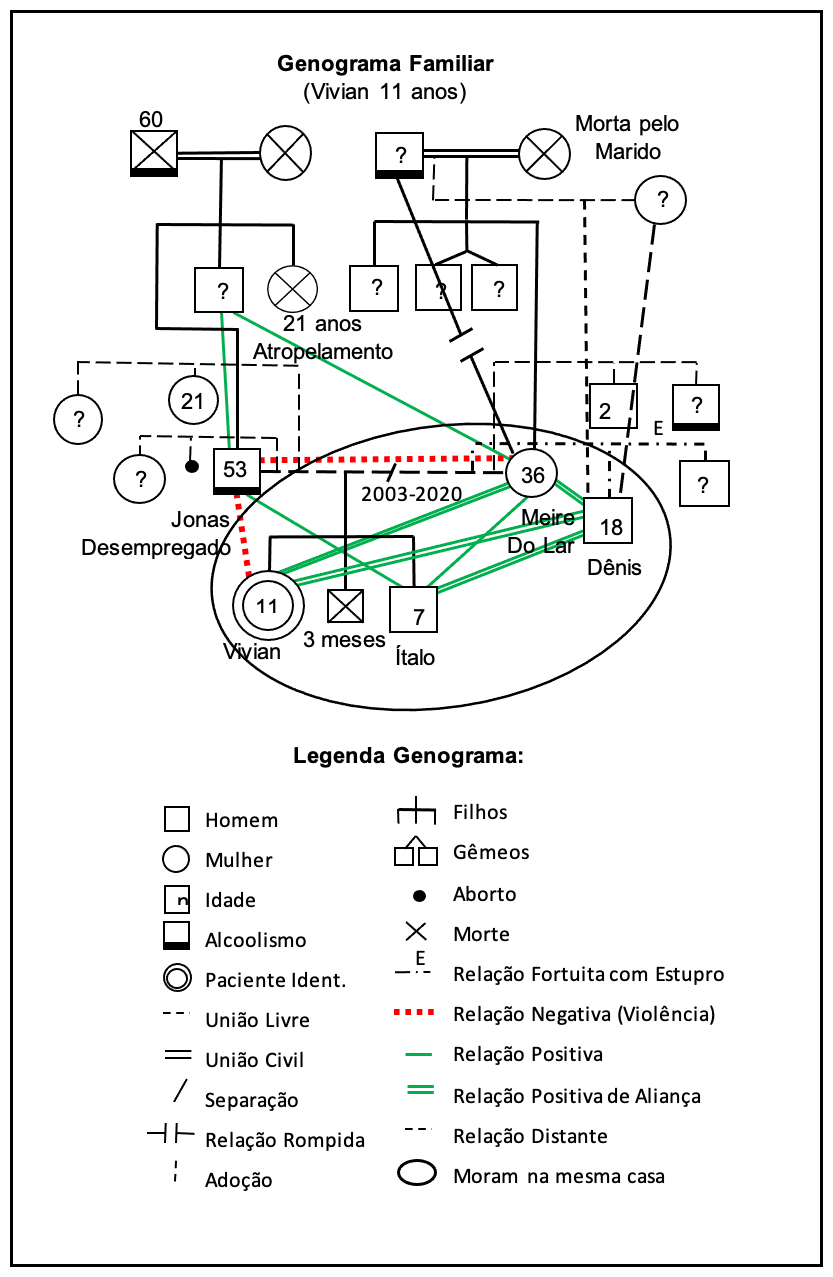
The death of Vivian’s brother was a very traumatic event for the family, as he was only three months old. It is interesting to note that Vivian has no significant bond with the second generation (uncles, aunts and cousins), nor any contact with her grandparents, because three of them have died and only the maternal grandfather, who has broken off relations with Meire, is still alive. Meire, Vivian’s mother, for her part, had three brothers: one older and two twins. The older brother became a pastor but, curiously, his strongest emotional bond is with his brother-in-law, Jonas’s brother. Jonas, Vivian’s father, who was left with after-effects from being run over by a vehicle, also lost a sister (21 years old) who was with him at the time. Both of Vivian’s grandmothers, on her father’s side and her mother’s, had alcoholic husbands, and the paternal grandfather died relatively young, at the age of 60. Note that the ages of many members are not shown because Meire did not know them.
The family dynamics, once shown graphically, reveal how much Jonas’s relationship with Meire and the children was marked by violence. From the very first family therapy sessions, the context of constant marital fights became evident, the mother having already filed several police reports for domestic violence. Meire, the mother, however, showed no motivation for marital separation, as she said she loved Jonas, her husband, very much, and also felt sorry for him. As for the children, Vivian and Ítalo, she did not perceive the vulnerable and risky family situation to which she was exposing the children’s lives and her own. Nevertheless, and generally speaking, Meire’s affectionate relationship with her children is positive, but she is closer to Vivian through identification with her daughter, who is the only girl, as she herself was in her family of origin.
It should be noted that Vivian’s speech therapy offered at the ASM was interrupted because her place was lost due to absences, and contact with the school proved discontinuous, owing to the public school’s lack of interest in exchanges within intersectoral work. After several attempts to include Jonas in the therapeutic process, which achieved only one attendance and a few brief phone calls, the family therapy was not moving forward.
Jonas is HIV-positive (carrier of the HIV virus), with the infection under control, and has physical after-effects from the accident he suffered (his legs are crooked). Aged 53 and without formal employment, he worked odd jobs. He abused alcohol but said he was not dependent. He sought help from Alcoholics Anonymous but was unable to keep up with the program. Meire, aged 36, obese and a homemaker, receives the Continuous Cash Benefit (Benefício de Prestação Continuada) because she has a neurological disease. She also receives Bolsa Família. The family was in regular contact with the Social Assistance Reference Center in their neighborhood and had a bond with the social worker.
A year ago, Dênis, Meire’s 17-year-old son, wanted to come and live with her. He had been raised until the age of seven in a children’s home together with his older brother, Pedro, born of Meire’s first common-law union in her adolescence. At that time, Meire’s stepmother wanted to adopt only Pedro, not Dênis. However, the court decided at the time that the brothers should not be separated, and the couple (the maternal grandfather and his wife) took them both home.
Dênis’s arrival in Meire’s nuclear family substantially improved the restless behavior of the children, Vivian and Ítalo, because an emotional bond formed between them. Dênis has a caring way about him; he plays with Vivian and teaches her schoolwork. He also became her defender against Jonas’s aggressiveness. The girl showed some improvement in her school performance, but she still lived in fear (in one session, for example, she flinched at the noise of the air conditioner in the room, revealing afterwards that it reminded her of her father being violent at home). However, during the school closures due to the Covid-19 pandemic and home schooling, Dênis could not make progress in teaching Vivian and Ítalo because of their cognitive difficulties. The young man was then given guidance on how to handle the children’s learning.
At the start of the social isolation measures to contain the spread of the Covid-19 pandemic, in April 2020, Meire phoned the psychologist/family therapist saying she “couldn’t take” Jonas “any more” and was thinking of separating. During the period of social isolation, the Outpatient Clinic operated on reduced hours, and so Meire and her children received care focused on guidance and protective measures for herself and the children. They were also given guidance on registering to apply for the federal government’s emergency aid.
Driven by interest in the cash aid, Jonas came to one session on his own. He talked a little about himself, said he felt in good shape at 53, and that his relationship with Meire was difficult because she kept no set times for meals at home and did not take care of her own body. Jonas reported that his sexual relations with his wife, even though he was HIV-positive, took place without a condom, but that with “the others” he protected himself. He even admitted that he was jealous of Dênis in relation to Meire and the children, but that the young man had one advantage: “he doesn’t answer back” (to Jonas), that is, he gave no room for drawn-out fights and arguments. It was agreed in this session that Dênis could help him register for the federal government’s emergency aid on his cell phone.
The day after the session, Dênis called to say that he had left home because he had tried to help Jonas register for the aid but had not managed to, and that from then on he would no longer get involved with his mother’s family. Meire was in a very bad way and really wanted to leave home too; she was thinking of renting a house for herself and the children. Vivian, for her part, said on the phone that “there was no way to go on.”
It was a Friday and many primary care professionals were not even in town; the nurses, for example, had been mobilized to fight Covid-19 in the hospitals. Efforts were therefore made to help this family in whatever way possible. Through contact with the Specialized Center for Assistance to Women (CEAM), a body linked to the municipality’s Social Development department, and through the psychologist on duty at the time, remote intersectoral coordination proved productive. The CEAM psychologist contacted Meire and advised her. In the online family therapy session, the following therapeutic directive was given to Meire: the couple should stay in separate “rooms” for a few days (in fact, the place where they lived had only two rooms, besides the kitchen and bathroom). Jonas accepted the arrangement, and it was added that the television should stay with the children, since they were already out of school and stuck indoors.
The following week, a video call session confirmed that the family crisis had calmed down. Everyone spoke on the phone: the couple said they had talked a lot, and Vivian said she was fine. Dênis came back home, saying that he had “grown attached to everyone” in the family, but that for the time being he would keep sleeping at the house of a missionary. Over the next few days, Jonas’s application for emergency aid was to be completed with the help of Dênis and the neighborhood lan house (digital services).
The couple entered the so-called “honeymoon” phase after the fight, a typical situation in abusive relationships involving violence. Meire was closer to Jonas, but this did not stop him from going out to get drunk. In a conversation with the therapist, Jonas said he had “slipped,” the term he used to refer to his compulsion to drink, and admitted that he needed medical help to get treatment and that he would keep the family therapist as a “counselor.”
On May 18, 2020, about a month after these events, Meire phoned the present psychologist, crying and begging for help because she wanted to leave home. The reason: Jonas had got drunk again. He had woken Meire aggressively and, when Vivian intervened asking for calm, he slapped her in the face. This incident gave Meire the strength to actually manage to separate, and so break off the abusive relationship. She was given the necessary support in this session and, that same day, Meire left and managed to rent a house to move into. In the days that followed, Jonas tried, through Vivian, to ask Meire to come back home, but she stood firm in her decision.
The mother and the children began to sleep well, and her calmer emotional state allowed Meire to reveal important facts about her childhood and adolescence. As a child, Meire lived with her three brothers and her parents in a populous state capital. Her father was an alcoholic and violent toward her mother until one day he murdered her while the children were at home. The revelation of this sad family tragedy reawakened fear in Meire. The fear of losing her children to the guardianship council and becoming “front-page news,” and the fear that her daughter would be raped as she had been. Meire once lived in a public children’s home and at the age of 15 went to “live together” with a boyfriend, with whom she had her first child. She stayed with him, also an alcoholic and violent, for three years. She managed to separate, and her son went to a children’s home (Pedro). At 18, she was raped again, which led to her second pregnancy: Dênis was born in the children’s home.
Today, Meire is happy to have found a better house to live in, leaving the one that was close to Jonas’s home. The landlady of the new house is a kind person who spontaneously offers her help. Setting up the new house allowed Meire and the children to dream of a new home.
A brief analysis of the family therapy intervention
Vivian’s family can be considered to be in a vulnerable situation. Families of this kind are not often seen in outpatient care because of their survival needs, since they often have no money for transport to the Outpatient Clinic. It can therefore be observed that, even in a context of lack of material resources, care was valued. Koller et al. (2012) say that the precarious socioeconomic condition of certain families makes their survival more difficult and can trigger risk episodes, such as abandonment, neglect and violence. They add that poor children and their families are exposed to conditions that undermine mental health and that the effects of material deprivation on mental health are cumulative (Koller et al., 2012).
Meire was able to seek help for Vivian’s learning difficulties, although she did not perceive that the child was exposed to risks in the intrafamily violence. This context shows how decisive the tendency to repeat family patterns across generations is. Meire experienced intrafamily violence in her childhood, oppressed also for being a daughter, and saw her mother fall victim to femicide. Likewise, many years later, Vivian in her childhood saw Meire being assaulted.
Vivian’s literacy was on hold also because the child had all her attention and energy turned toward the severe conflict between her parents. How was the girl to learn if, day and night, she was her mother’s sentinel? Trying to defend Meire, as happened several times, Vivian was slapped by her father, until the day her mother decided to put a stop to the situation. Cooper and Vetero (2006) state that domestic violence lowers the IQ of young children, producing stressful effects on their brains. It can therefore be thought, with due allowance, that Vivian’s learning was impaired mainly because of the context of family violence.
Carter and McGoldrick (1995) say that, in general, in families with an alcoholic parent, the eldest child takes on an over-responsible role in order to compensate for the lack of parental functions of the alcoholic father or mother. Although Dênis was not raised in this family, he “adopted” it, with his mother’s support. The young man’s motivation for taking on his mother’s biological family came not only from his wish to live with his mother, but also because Dênis could no longer bear being mistreated by his maternal grandfather’s family.
The inclusion of Dênis in the family unit provoked strong feelings of jealousy in Jonas toward the family he had controlled for years, and this context confronted the couple with the need to work on the dynamics of the relationship. However, that is not what happened. Meire realized that loving Jonas was no longer enough to stay with him. According to Minuchin et al. (1999), the marital subsystem (Meire and Jonas), which was already conflictual and fragile, became worse with the weakening of paternal authority due to Dênis’s involvement in caring for the children. A triangulation was created, marked by Meire’s alliance with the children, specifically with Dênis, and, at the lower vertex, Jonas was left alone.
The sibling subsystem (Vivian, Ítalo and Dênis) was strengthened, but the tension between Dênis and Jonas increased, mainly because Meire could not position herself as a protective mother toward her children. She needed professional and institutional help to protect herself and her children. We saw how the protective therapeutic directive (“asking each member of the couple to stay in separate rooms”) ended up awakening some inner willingness to talk between husband and wife, who then decided to stay in one room and leave the children in the other, which was very important for the family structure in crisis.
Minuchin’s (1982) Structural Theory holds that the subsystems (the couple’s and the children’s) need to be preserved in their functions for the family system to be functional and for relationships between parents and children to flow in affection and in the tasks of each phase of family development. It can also be thought that the tension in the marital relationship was exacerbated by the absence of protective factors: Jonas, besides abusing alcohol, would not agree to take part in family therapy, and Meire did not engage with the psychological care for victims of violence offered by the CEAM. Thus, the couple’s impasse regarding their difficulties, at a time when the family dynamics were being restructured following the inclusion of a new member in the family, resulted in Meire’s overriding need to separate. The external pressure of the quarantine acted as a precipitating factor for the family crisis that was about to erupt.
The wish to take care of her children was Meire’s greatest motivation for changing her life. It is interesting to note that the context of violence had always been the backdrop of this family, yet it was not put forward as the main problem. It took a pandemic with social isolation for Vivian’s family to be flooded by long-standing structural problems that had been relegated to the background, such as Jonas’s alcoholism and violence.
Under pressure, Meire chose life and her love for her children, deciding to end a 17-year relationship. Supported by the family therapist, and also receiving municipal emergency aid and support from the evangelical community, she is managing to move on with her children. The couple’s separation opened a new phase in the family life cycle, breaking with the relational pattern of intergenerational violence and giving the children access to a life of dialogue, respect and affectionate experiences.
Walsh (2016) speaks of the importance of a family resilience perspective. It is important to stop seeing families in difficulty as damaged, as deficient, and to start seeing them as challenged by life’s adversities. This makes all the difference. And as for therapeutic interventions, the author says that they depend more on mobilizing family resources than on the therapist’s techniques. This family resilience paradigm is in line with the SUS concepts of resolutivity and comprehensiveness because, when the family’s internal resources are mobilized and anchored in the external resources available in the care network, the expectation that positive changes will be maintained becomes realistic.
Final considerations
The presentation of the clinical case of Vivian’s family raises a range of theoretical considerations about domestic violence, alcoholism, poverty and low educational attainment, because these are psychosocial factors that interact and intertwine dynamically. The intention was to show the importance of family therapy in specialized psychology care and the collaboration of the bodies of the intersectoral network that come together to form the network of care that many families need.
Family therapy, seen as a strategy for resolutivity in child and adolescent care, brings, among other advantages, a reduction in the number of psychotherapy sessions. Brevity and focal work make it easier for service users to adhere to treatment, as well as to include significant family members in the therapeutic context. The participation of other systems, such as the school and the community, among others, broadens the scope of the problem under analysis, creates alternatives not previously considered in the case in question, and may be useful for other service users and groups in the health network in general.
Family therapy can and should also be applied in the care of the families of service users of the Child and Adolescent Psychosocial Care Center and of the Psychosocial Care Center for adults. Thus, the treatment requests that reach mental health services need to be understood beyond the individual aspects of the identified patient seen as “ill,” taking in a broad context that includes the whole family; this is fundamental for the development of forms of mental health care.
Thus, family therapy as a multidisciplinary field is in line with the psychosocial paradigm advocated by the SUS. It is suggested that further research and studies be carried out both on specialized psychology care at the ASM and on family approach techniques, with systemic family therapy being an effective option.
Complexe Systémique: key points
This clinical account is valuable first for its setting: a public outpatient clinic where family therapy is not a luxury but the condition for reading school difficulties for what they are, the vigilance of a child posted as her mother’s sentinel. The genogram brings out the repetition across three generations (alcoholism, violence, the grandmother’s femicide) and the triangulation created by the arrival of the older half-brother. The directive to separate the couple into two rooms, given remotely on a lockdown Friday, shows what a minimal structural intervention can achieve when it draws on the network (women’s assistance center, social services, emergency aid). One may regret that the father, never really engaged, is described only from the outside, and that safety is treated mainly as a maternal decision: a useful reminder that protecting children exposed to violence cannot rest on the mother alone. Read alongside the study of the transmission of domestic violence in Peruvian families, and the integrated model of the mother–child relationship after intimate partner violence.
Notes from the original
1 Name changed to protect the confidentiality of the health service and its users.
2 All names given have been changed to protect the identity of the family members.
References
Carr, A. (2011). Thematic review of family therapy journal 2010. Journal of Family Therapy, 33(4), 429-447. https://doi.org/10.1111/j.1467-6427.2011.00560.x
Carter, E., & McGoldrick, M. (1995). As mudanças no ciclo de vida familiar: Uma estrutura para a Terapia Familiar (2ª ed.). Artes Médicas.
Cooper, J., & Vetero, A. (2006). Domestic violence and family safety: A systemic approach to working with violence in families. Whurr Publishers Ltd.
Ferreira, T. P. S., Sampaio, J., Oliveira, L. I., & Gomes, F. B. (2019). A família no cuidado em saúde mental: Desafios para a produção de vidas. Saúde Debate, 43(121), 441-449. https://doi.org/10.1590/0103-1104201912112
Groisman, M. (2015). Terapia Familiar breve na infância e na adolescência: sem (100?) remédios, sem (100?) terapia individual. Núcleo Pesquisas.
Koller, S. H., Antoni, C., & Carpena, M. E. F. (2012). Famílias de crianças em situação de vulnerabilidade social. In M. N. Baptista, & M. L. M. Teodoro (Orgs.). Psicologia da família: Teoria, avaliação e intervenções. Artmed.
Ministério da Saúde (2013). Cadernos de atenção básica, 34. Ministério da Saúde. https://bvsms.saude.gov.br/bvs/publicacoes/cadernos_atencao_basica_34_saude_mental.pdf
Minuchin, S. (1982). Famílias: Funcionamento & tratamento. Artes Médicas.
Minuchin, S., & Nichols, M. P. (1995). A cura da família: histórias de esperança e renovação contadas pela terapia familiar. Artes Médicas.
Minuchin, S., Colapinto, J., & Minuchin, P. (1999). Trabalhando com famílias pobres. Artes Médicas.
Mombelli, M. A., Costa, J. B., Marcon, S. S., & Moura, C. B. (2011). Estrutura e suporte familiar como fatores de risco de stress infantil. Estudos de Psicologia, 28(3), 327-335. https://doi.org/10.1590/S0103-166X2011000300004
Monteiro, A. R. M., Rabelo, K. P. S., Teixeira, L. A., Tavares, S. F. V., Silva, R. S. M., & Távora, R. C. O. (2012). Sofrimento psíquico em crianças e adolescentes: A busca pelo tratamento. Escola Anna Nery, 16(3), 523-529. https://doi.org/10.1590/S1414-81452012000300014
Nunes, C. K., Olschowsky, A., Silva, A. B., Kanstorski, L. P., & Coimbra, V. C. C. (2019). Saúde mental infantojuvenil: visão dos profissionais sobre desafios e possibilidades na construção de redes intersetoriais. Revista Gaúcha Enfermagem, 40. https://doi.org/10.1590/1983-1447.2019.20180432
Portaria SAS/MS nº 224, de 29 de janeiro de 1992. https://www.saude.mg.gov.br/images/documentos/Portaria_224.pdf
Rutter, M. (2000). Psychosocial Influences: critiques, findings and research needs. Development and Psychopathology, 12(3), 375-405. https://doi.org/10.1017/s0954579400003072
Sanduvette, V., & Reis, A. O. A. (2016). Modelo de abrangência para a reorganização da saúde mental infantojuvenil em pequenos municípios. In E. Lauridsen-Ribeiro, & O. Y. Tanaka (Orgs.). Atenção em saúde mental para crianças e adolescentes no SUS (2ª ed.). Hucitec.
Shimoguiri, A. F. D. T., & Serralvo, F. S. (2017). A importância da abordagem familiar na atenção psicossocial: Um relato de experiência. Nova perspectiva sistêmica, (57), 69-84. http://pepsic.bvsalud.org/scielo.php?script=sci_abstract&pid=S0104-78412017000100006
Tszesmoski, L. C., Nóbrega, K. B. G., Lima, M. L. L. T., & Facundes, V. L. D. (2015). Construindo a rede de cuidados em saúde mental infantojuvenil: Intervenções no território. Ciência & Saúde Coletiva, 20(2), 363-370. https://doi.org/10.1590/1413-81232015202.05082014
Walsh, F. (2016). Processos normativos da família: Diversidade e complexidade (4ª ed.). Artmed.
Unofficial English translation of Terapia Familiar em Um Caso de Violência Doméstica: Atendimento no SUS, by Marisa Machado Alves dos Santos, Revista Brasileira de Terapia Familiar, vol. 11, no. 1 (2022), doi: 10.60114/rbtf.v11i1.9, under a CC BY 4.0 licence. Translation (with the help of artificial intelligence) and layout: Complexe Systémique, November 2026 — the work has been modified under the terms of the licence. Neither the authors nor the journal are responsible for this translation; the original version prevails.
Unofficial English translation of “Terapia Familiar em Um Caso de Violência Doméstica: Atendimento no SUS”, published in Revista Brasileira de Terapia Familiar (2022) under a CC BY 4.0 licence. Made by Complexe Systémique with the help of artificial intelligence, it does not come from the authors or the journal, who are not responsible for its content; the original version prevails.
Read the original articleHow to cite this article
Santos, M. M. A. dos (2022). Family therapy in a case of domestic violence: care within the SUS (Complexe Systémique, Trans.). Complexe Systémique. https://app.complexe-systemique.com/en_GB/articles/family-therapy-in-a-case-of-domestic-violence-care-within-the-sus (Original work published in 2022 in Revista Brasileira de Terapia Familiar, v. 11, n. 1 (2022); republished in 2022 by Revista Brasileira de Terapia Familiar, https://revbrasterapiafamiliar.abratef.org.br/revista/article/view/9)
To go further
- Intergenerational Transmission of Domestic Violence in Peruvian Families: A Qualitative StudyViolence and alcohol across three generations.
- The Integrated Model: Dynamic Changes in Mother–Child Relationship in the Context of Intimate Partner ViolenceThe mother–child relationship after violence.
- The importance of family therapy. Interview with Salvador MinuchinMinuchin on family therapy.
Related training courses
 Symposium
État des Lieux: a psychological approach to spaces
Replay of the “État des Lieux” conference (Paris, 16 October 2026): Ivy Daure, Maurizio Frisina, Viola Sallay and Gilbert Pregno on places as a clinical resource. In French.
 Symposium
Digital technology, AI and mental health
Conference in Lyon, 11 December 2026: digital technology, artificial intelligence and mental health. Six talks, replay for participants. In French.
 Short course
The suicidal crisis in adolescents and young adults
Training: assessing and supporting the suicidal crisis in adolescents and young adults. Clinical landmarks and systemic tools. In French.
 Certifying course
Training in Systemic Therapy and Interventions – Cycle 1
Certifying training cycle in systemic therapy and interventions – year 1. Courses, supervision and practice, aligned with EFTA/SFTF. In French.
Related articles
 Scientific
The Duogramma®: An innovative methodology for psychotherapy
A map of the couple relationships lived, desired or rejected since childhood: the Duogramma®, its graphic rules and its use in individual therapy.
 Blog
Adult parentification: when being useful becomes a condition for being loved
Why is it sometimes so hard to hand over? Julien Besse explores parentification and parentalisation, acknowledgement and the place we take in our adult relationships.
 Scientific
Transitioning to the Business of a Session in Collaborative-Dialogic Meetings: A Conversation Analysis
How do Open Dialogue therapists move to the business of a session? The open question creates silences and family negotiation: a conversation analysis of ten sessions.
 Scientific
How can we BeST? meet the needs of adoptive families? Relevant findings from a major Randomised Controlled Trial of infants in foster care in the UK
The BeST? trial (488 infants in care in the UK) reread for adoption: holistic, ongoing assessment of children and a move to dual registration.
Comments 0
Log in to join the discussion. Log in