AI-assisted translation
This version was translated from Portuguese by Complexe Systémique with the help of artificial intelligence. In case of doubt, the original version prevails.
Revista Brasileira de Terapia Familiar · Couple
From “till death do us part” to liquid love via Tinder
Why are love bonds made and unmade so quickly today? Bringing together Zygmunt Bauman’s “liquid love”, Jung’s spirit of the age and the concepts of family therapy (rules, triangles, myths, loyalties, delegation), Suely Engelhard shows that the choice of a partner is pulled by invisible threads, and invites couple therapists to widen their lens beyond family history alone.
Unofficial English translation. This article is a translation of Do até que a Morte nos Separe ao Amor Líquido via Tinder, by Suely Engelhard, published in the Revista Brasileira de Terapia Familiar (ABRATEF), vol. 8, no. 1 (2019), doi: 10.60114/rbtf.v8i1.47, under a CC BY 4.0 licence. Translated by Complexe Systémique in November 2026 with the help of artificial intelligence: the original Brazilian Portuguese text has been translated into English and reformatted, which constitutes a modification of the work under the terms of the licence. The text was established from the journal’s PDF, whose text layer is unusable; paragraphs and headings are those of the journal; the author’s biographical note, printed as a footnote on the first page, is included in the presentation; a few typographical errors (the names of Descartes, Krom Paccola, Stierlin and Bertalanffy, “in illo tempore”) have been corrected silently. The abstract is the author’s own English version. This translation was made neither by the authors nor by the journal, who are not responsible for its content or for any errors. The original version prevails.
The “always right” choice of partner is clothed in all these layers of invisible threads that steer and guide it.
Suely Engelhard
Abstract
Brief reflection on how the spirit of the time interferes and updates the emotional relationships between the partners seek driven by the rules, miths and family own slogans.
As the couple relationship and seek cover interconnected triangles that act in choosing "always right" partner, update a comprehensive look on how social changes, the spirit of time influences and makes it happen, participates in this choice and your role in the family.
Keywords: spirit of the time; interconnected triangles;choice of partner; rulles, miths and slogans.
Postmodernity and the current spirit of the age
The present moment in which we live was described by Zygmunt Bauman as a time of liquid emotions, which run through the fingers of anyone who tries to hold on to them. In the human attempt to “have” at the expense of “being”, the idealized aim in life is to collect as many affective, relational experiences as possible, brief and shallow, disposable and discontinuous, since something new must be reached immediately. And so one goes through life, without depth or shrewdness, letting oneself be devoured by time, the ancient Greek god Chronos, father of the second divine generation, who devoured his children for fear of being dethroned and losing his power.
Zygmunt Bauman, Polish sociologist and philosopher, professor of philosophy at the universities of Leeds and Warsaw, says that nowadays relationships between individuals in societies tend to be less frequent and less lasting, and become an accumulation of experiences. The notion of union disappears, and with it insecurity would become a structural part of the postmodern subject. In his books Liquid Love (2004) and Liquid Fear (2006), this is expressed in an excellent reflection on the spirit of the present time, in which the fragility of bonds and the insecurity of relationships lead to the experience of conflicting relationships: ties that are at once tight and loose.
Bauman may be seen as a pessimistic person, which is often the case because, unlike those who strive to extol the virtues of capitalism, he manages to expose, through his critical view of postmodernity, its cruel side, its dark, inhuman and overwhelming aspect, which corrodes and devours today’s human beings when they remain caught in the labyrinthine round of having, acquiring and living to conquer ever more of the current spirit of the age, in which the present is not lived, for the sake of a future we do not even know will come.
This is a concept introduced by Jung (1971) to speak of events that occur in humanity and that reveal an emotional attitude which spreads and branches out through individuals, showing the existence of an invisible field that unifies relationships in their vital course. According to him, no new idea arises out of nothing. It is rather the result of a tangle of rooted aims, to which contemporary human beings, whether or not they are aware of these facts, are bound in an absolutely intimate way.
In the modern world, the idea of a couple who, having chosen each other, would stay together until death did them part matched the forms in which that era tended to live out a relational attitude. Moreover, the lifespan was much shorter than today’s average life expectancy. Even so, some human beings could not adapt to this general tendency. These are beings who find themselves excluded, standing out because they do not follow the social whole, and who are the first to go in search of a creative process that helps them follow their own different existential flow. They continually work “in educating the spirit of the age” (Jung, 1971, OC XV, § 130), in their effort to establish clearly the forms that this historical time needs to find in order to renew itself.
Although they seem to be creating something new, entirely out of their own “desire” and “freedom”, they are in fact being led by what Jung calls “an invisible current” (Jung, 1971, OC XV, § 113). Thus the conscious attitude is influenced by the unconscious, since the latter is common to every human being and aims at becoming conscious. As happens with “a tree in the soil from which it draws its nourishment” (Jung, 1971, OC XV, § 115), it is from the unconscious that the creative impulse springs.
There is in all human beings the innate possibility for ideas to occur, setting limits and categories to creativity. “They appear in formed matter as regulating principles of its formation; only by inference shall we be able to reconstruct the primitive design of the primordial image”. (Jung, 1971, OC XV, § 126)
Humanity, the human macro-family, contains these primordial, mythical images, resulting from “countless typical experiences of a whole genealogy (and thus describing) the average of millions of individual experiences, presenting in this way a picture of psychic life divided and projected into the various forms of the mythological pandemonium. [...] Each of these images contains a little of human psychology and destiny, a little of pain and pleasure repeated countless times in our genealogy, on average also following evolution” (Jung, 1971, OC XV, § 127).
When a mythological experience occurs, there is strong emotional intensity. On such an occasion human beings cease to feel themselves as individuals and come to recognize themselves as components of a species, as members of the great human family; it is as if in them and through them “the voice of all humanity resounded” (Jung, 1971, OC XV, § 128).
The family micro-system
In it we will see these same phenomena that occur in humanity spreading through intergenerational relationships. In the effort to remain loyal to the family rules and to follow them, individuals looking for a relational partner do not perceive that they are being steered by invisible interconnected triangulations, which will only become recognizable when emotion sets them off and makes the relational triangles active.
What are family rules? They are the transactional configurations, not always conscious, that regulate the behaviour of the members of a family, maintained by two systems of bonding:
- one of a general order, which has universal laws governing family organization, and deals with interdependencies or defines hierarchical forms, and
- another of a specific character, which gathers the reciprocal expectations among family members.
Triangles, for their part, are the central building block of the relationship system. Virtually all important relationships between people are overlaid by a third party – a relative, a friend, or even an idea or a memory. Virginia Satir speaks of the primary triangle formed by the parents and the child, and for her this is where the cradle of self-esteem lies (Satir, 1987a). Triangles are dynamic and form in order to release the tension that occurs in a dyad. Many triangles can become chronic detours and thus destroy family relationships.
The concept of trigenerational triangulation, introduced by Murray Bowen (1991), describes triangulation as a natural movement to undo the unpleasant tension that stress causes in relationships. It lowers the tension, but freezes the conflict rather than resolving it. Wherever there is gossip, in a family or in a group, we are facing triangulation. Many forms of triangulation seem so innocent that their destructive power goes unnoticed.
Besides these two phenomena that guide us, we also have family myths, which transcend generations and lead us in subtle ways. Family myths are built in families over countless generations and have the same purpose as the myths that exist and take shape in the different human cultures.
What is myth? What is it for?
In the human macro-family we see that myth is common to all cultures as a primordial way of explaining the reality of being and of being in the world.
According to Alvarenga (2007), Joseph Campbell says that traditional myth fulfils four functions:
- it harmonizes consciousness with its existence through externalization, internalization or correction of something (which Alvarenga calls the religious function);
- it is interpretive, presenting a consistent image of the order of the Universe (according to Alvarenga, the logical function);
- it validates and supports a moral order of society (according to Alvarenga, the ethical function);
- it helps people to understand the unfolding of life with integrity (according to Alvarenga, the structuring function).
Since human beings have no logical understanding of the world, myth is a means of communication, a language that seeks to explain the world and everything that makes it up through its allegories. Myth contains the symbolic dimension, being the antithesis of the factual account, of the chronicle, and it allows the reality of the human psyche to be translated. In myth, the creative, fantastic act deals with and seeks to explain all the themes common to existence.
In all peoples all the primordial realities are present, which reaffirms and grounds Jung’s concept of the collective unconscious. According to him, every being shares fixed structures, called archetypes (primordial types), which, as part of the human psyche, evolved in the same way as our body.
In the most diverse human eras and cultures, myth consists of a set of stories told from generation to generation, which explain how the world was made and how everything happened, giving meaning to a set of ambiguous and at times empty and frightening facts, and translating the understanding of the peoples who created these stories.
Barthes states that myth “is a mode of signification and, this being so, cannot be defined by the object of its message. One must look closely at the way in which it utters it”. (Barthes in Brandão, vol. I, 1986, p. 36).
Junito Brandão used to say in his classes: “When I know the myth, I know the secret of things”.
Within humanity, myth can only be lived in ceremonies that reproduce how everything happened in primordial times, as it occurred at the beginning of time. A living myth is one that does not close on a single solution, but at the end of its telling it is said: they say this and that happened, but there is another version that speaks of other endings, in which this and something else happened. The rite brings about the experience of mythical participation: making what was told in illo tempore happen here and now. The rite thus allows the initiate to live the phenomenon as if for the first time.
The time lived in the rite is sacred time: what is evoked ceases to be past and becomes reality here and now, in the present time, in circular time. This time, the past made present, can integrate transformative experiences into consciousness, because by modifying the past one enters the reversibility of time and symbolically recreates the world. In this way the symbolic understanding of the event is established, reborn as memory.
If this happens in humanity, the same happens in the human micro-family. As Andolfi and Angelo say: a child capable of symbolizing (for example, using puppets to stand in for absent parents) builds his or her own personal “myths”, which are the result of the interaction with those that the environment has transmitted or tries to transmit to the child. [...] Individual myth and family myth are closely interconnected and develop at the same time. (Andolfi and Angelo, 1988, p. 78)
It is through Family Loyalty, a concept formulated by Boszormenyi-Nagy and Spark (1973, in Andolfi and Angelo, 1988), that the threads preserving family existence are cultivated. This loyalty reflects the expectation that, through these “invisible and resistant threads”, the fragments of the relational unit will maintain the family system, based on the recognition of the value acquired by its members.
Alongside this concept we also have the concept of Delegation, extended by Stierlin (1978, in Andolfi and Angelo, 1988), in which the members of a family system would have a more or less conscious notion of carrying functions and expectations to be fulfilled, motivated by their family of origin. Thus individual myth is only apparently individual, since it is in fact influenced by rules, invisible loyalties and delegation, as well as by the family myth. The two myths influence each other, and both influence and are influenced by the myths of the culture concerned, within that historical time.
The family myth is a structure that is built and changes over time, in which elements of reality and fantasy coexist, together constructing a reality suited to meeting certain affective needs of the family system.
“The ‘original’ myth acquires meaning only in the light of what is happening now and of its interweaving with the individual myths of the various members of the family, and of its position within a narrative that precedes them” (Andolfi and Angelo, 1988, p. 82). It therefore needs a before and an after. It is situated in a series of continuous evolutions, in a process of a circular nature, and serves the family according to its reality, attending to its evolution, preservation and transformation. This is why the function of myth is not limited to being merely homeostatic.
While the individual myth speaks of relationships in the here and now – a horizontal cut – the family myth speaks of the trigenerational expression of the system – a longitudinal cut. And both are touched by, and touch, the myths of the culture concerned. And through this interweaving of invisible threads we are guided to create our conception of the family world. And it is there, according to Krom Paccola, M. (1994), that what we call family reality and the individual map appear.
Since all these variables interfere with and act upon individuals in an invisible relational vibrational field, it is worth asking: How are the affective choices of postmodern human beings made? How do therapists broaden their lens, and what of the results obtained?
Imagination is rooted in the body, and it is in the body that we experience the somatic dimension of myth. Keleman (2001) holds that it is from our genetic code (the great human collective) that our basic identity arises, as well as our unique expressive way of responding to life’s challenges. “Myths are scripts of genetic forms in social language”. (Keleman, 2001, p. 26)
To be alive is to be in a body which we must thank and care for every day. I can only love and feel, see and look, hear and tell smells and tastes apart because I have a healthy, living body. According to this author, “the mythic image is inseparable from somatic reality” (Keleman, 2001, p. 25), and it is through it that the body speaks to itself about itself.
Antonio Damásio (1996), in his book Descartes’ Error: Emotion, Reason, and the Human Brain, says that the formula coined by Descartes should be the other way round: I exist, therefore I think. It is the experience of existing that gives us a historical life, with a present, a past and a future still to come. According to Keleman (2001), the perception of our continuity, subjectively as a bodily process, is very similar to dreams and to the poetic states that form myths. “The brain creates linear time and objectifies events”. (Keleman, 2001, p. 27)
The reality created by human beings, the animal symbolicum according to Cassirer, is based on the conjugations of the sensory and the intellectual, expressed in cultural manifestations, so as to attain, by means of them, their much-desired freedom. (Cassirer https://jus.com.br/artigos/37457/introducao-a-filosofia-das-formas-simbolicas-de-ernst-cassirer).
It is a reality of living, mobile organization which, while on the one hand it creates a cosmology, on the other speaks of the different challenges and tasks that confront humans at the different stages of the life cycle. This social order speaks to individuals, places them in the various family roles and enables them to handle and order the great vital experiences such as loyalty, death and birth, sexuality and gender identity.
Our body is a source of knowledge. Bodily experiences lead us to intuit something from within the body, which allows us to conclude that “mythology is structured in the cells” (Keleman, 2001, p. 29), its function being to turn stories into experiences, shaping individuals through our ability to narrate these primary experiences in the form of stories that shape us.
According to Campbell, the economic and social contacts of our life nowadays change so quickly that nothing has stability and everything has to be done alone. The challenge is to “break into this uninterpreted field to discover one’s own mythic interpretation” (Campbell in Keleman, 2001). This is not easy, but it is possible to become aware of it.
If, like the rabbit in Alice in Wonderland, I let myself be contaminated by this “time that flies”, I become subject to the rules and demands of the present whole, with no time to be. One stops really living. Time is stolen from us with our acceptance and connivance. We are swallowed up by it, and what remains is a great existential void and the inability to hold on, in the experience of being, to our affective encounter.
Through this consent, time robs us of affective depth and values. One then comes to accept relational crumbs, which leads to setting off in search of an accumulation of brief love stories, “drugs, sex and rock and roll”. Everything slips through the fingers. Abuses and self-disrespect pile up. On Tinder people hunt for magic solutions and find a vast universe of robotized individuals who, even while seeking to relate, fear that this would bring them imprisonment and tension, since they judge themselves unable to bear it. This ambivalence wears out psychic energy and causes much neurosis and depression.
If we do not seek differentiation and the awareness that the experience of living is only possible if we embody it, the spirit of the age carries us away and we are swept along without reflection, as lived experience and human history liquefy.
The “always right” choice of partner is clothed in all these layers of invisible threads that steer and guide it: the myths of the human macro-family, which reverberate and exchange energy with the myths of the personal micro-family, attuned in turn to individual myths, trigenerational experiences, rules and interconnected triangles, and functional triangulations. The human being is like a puppet, and what can be done to gain a sense of personal self is to seek to know oneself, to differentiate oneself and to know how to interact creatively and consciously with and through these countless invisible threads.
It is up to the family and couple therapist to widen the diagnostic lens when welcoming the couple who come to the consulting room, usually in a state of emotional torment: disfigured, weakened and with no creative energy available. This broadening of focus, beyond the facts narrated, enables the therapist to help the individuals who make up the couple to understand the symbolism that oppresses and compresses them. To reflect beyond their family histories, and to recognize themselves as imprisoned by the demands of the social time in which they live (at present, postmodernity), caught in this constant restlessness in which having, acquiring for no reason, accumulating shallow and fleeting loves override being, bearing the experiences, most often painful, of deepening one’s understanding through the difference the other brings. And, therefore, to understand, resiliently overcome and creatively integrate whatever may be causing tension and emotional combustion.
The couple usually presents as the victim of a great relational abandonment. If the couple in question has children, the parental role comes into play here, and it tends to further stifle the couple’s dialectic and its interactive field. Added to this is the fact that today’s society leads individuals to believe that they can be anything they want to be, with the mind ruling over the whole of the body. And this is a great deception. It is important to recognize the limitation that human beings carry. Eden was lost long ago...
Consumption governed by perverse capitalism and demanded by the present times, in which everything has to be acquired compulsively and quickly discarded, makes these adults prisoners of immediacy, of consumption without awareness, of slavery to work or even of submission to oppressive sport. There is no time for idleness and leisure without abusive expenditure of time, money and vital energy. And it is in this way that affective relationships become fleeting and toxic. For this not to happen, the threads that guide the experience of being must be recognized, reflexively criticized and negotiated.
These constitutional amplifications in therapy help those who are suffering there to aim at a resilient process. This devastated land that reaches us in the consulting room can be fertilized and renewed for the planting of new values and imagistic creations that restore creative energy, since the energy still alive is working to keep the system in action, yet paralysed, circling around the same theme, often across successive generations, discarding love situations that could lead to very productive lives, in the expectation of a magical, fantasized future, to be conquered, that never comes.
We have to reactivate in individuals the perception of their somatic responses, which activates the capacity for imagination and in this way redefines information, and to take them out of a way of living sustained by disembodied and empty images that serve only social and cultural insertion: that people like them, that people value them, and so on, and in which scientific reflections are the one and main driver of their identities. They have to stop being and acting like that type of man or that type of woman, and become intimate with who they really are, not confusing themselves with an image of what they imagine they are. Therefore, to live through images that are rooted in their bodily emotions and that are grounded and deepened in their own self. Only in this way will absorption in these liquid and fleeting experiences be subjected to a critical gaze, and lasting relationships, with all the work they demand, become easier to establish.
As Abraham Maslow pointed out, the great danger lies in living for gains that do not truly represent the individual: survival, security, prestige, social relationships, the development of ego identity (Maslow, in Keleman, 2001, p. 64). This comes very close to narcissism and vanity: the devil’s favourite sin.
It is in the therapeutic process that compassion is activated, the divine power within each person, beyond limiting ego-bound thoughts. One begins to use oneself differently, becoming more understanding, tender and empathetic towards the other to the extent that one becomes so towards oneself. In this resilient way a new form of transcending the relational ephemerality of postmodern times is created. By recognizing the rhythm of their own that organizes them, individuals will have greater clarity about their true identity, and new roles will then be taken on, beginning a new way of being in the world.
According to Von Bertalanffy (2008), we are seeking another basic outlook – the world as organization. This would profoundly alter the categories of our thinking and influence our practical attitudes. We must envisage the biosphere as a whole, with mutual reinforcement or with mutual destructive interdependence. (https://citacoes.in/citacoes/1845133-ludwig-von-bertalanffy)
From this new perspective, the human being comes to be seen differently. A new human being emerges, who is then considered a primarily active system, not only in behaviour but also in relation to knowledge. Previous experiences, attitudes and lived events create their own universe, building a world out of symbolic creation. Creating symbols is the main human activity, and human beings cannot live without promulgating them.
In these symbolic expressions one recognizes the specificity of the culture of a people at a given historical time, and they always deal with unique themes: the worldview, the emergence of life, its development and stages, the deeds of its heroes with their conquests and failures, love choices, ageing and the last great transformation: the final journey, dying.
In the process of being and remaining beyond relational ephemerality, individuals, since they differ from one another – or, more precisely, since it is impossible to be the same as anyone else in one’s individuality – become able to belong to their family universe, to constitute and build within it their own unique singularity, manoeuvring the invisible threads with skill, delicacy and in unexpected ways, ceasing to be replicants of emotions in order to become unique representatives of them.
And then modern liquidity will turn into a solid and lasting coagulation of love relationships, and individuals will mature to bear and overcome the frustrations and variations that life as a couple brings, their bodies perhaps marked in old age by the stormy and gentle winds of falling in love.
Complexe Systémique: key points
This text is an essay rather than a study: it layers the sociology of liquid modernity, Jungian psychology and systemic concepts without any clinical vignette or discussion of sources, some of which are quotations gleaned online. Its view of dating apps is frankly moral, and one could object that the ephemeral is not pathological in itself. Its clinical value lies in the articulation of levels it proposes: the choice of a partner is never merely individual, but responds at once to the myths of the age, to family myths and rules, and to the triangles and delegations handed down from one generation to the next. In practice, therapists can ask a couple what their “always right” choice repeats, which loyalties it honours and which demands of the present (speed, consumption, performance) weigh on their bond, without turning this observation into a verdict. Read alongside the article on the founding myth of the couple, and the article on digital co-regulation in romantic relationships.
References
Andolfi, M. & Angelo, C. (1988) Tempo e mito em psicoterapia familiar Porto Alegre: Artes Médicas.
Alvarenga, M. Z. et cols (2007) Mitologia simbólica São Paulo: Casa do Psicólogo.
Bowen, M. (1991) De la familia al individuo la diferenciación del sí mismo en el sistema familiar. Barcelona: Paidós.
Brandão, J. (1986) Mitologia grega Vol I Petrópolis: Vozes
Cassirer, E. (2011) Introdução à filosofia das formas simbólicas Retirado em 01/07/2019, https://jus.com.br/artigos/37457.
Damásio, A. (1996) O erro de Descartes: emoção, razão e cérebro humano Rio de Janeiro: Companhia das Letras.
Jung, C. G. (1971) O espírito na arte e na ciência OC XV Petrópolis: Vozes.
Keleman, S. (2001) Mito e corpo: uma conversa com Joseph Campbell (3ª ed.) São Paulo: Summus.
Krom, M. (2000) Família e mitos: prevenção e terapia: resgatando histórias São Paulo: Summus.
Krom Paccola, M. (1994) Leitura e diferenciação do mito familiar. Histórias de adolescentes com problemas São Paulo: Summus.
Satir, V. (1987a) The therapist’s story In Baldwin, M e Satir, V (eds) The use of the self in therapy (pg 17-23) Nova York, Haworth Press.
Von Bertalanffy, L. Citações in https://citacoes.in/citacoes/1845133-ludwig-von-bertalanffy. Acessado em 30/06/2019.
Unofficial English translation of Do até que a Morte nos Separe ao Amor Líquido via Tinder, by Suely Engelhard, Revista Brasileira de Terapia Familiar, vol. 8, no. 1 (2019), doi: 10.60114/rbtf.v8i1.47, under a CC BY 4.0 licence. Translation (with the help of artificial intelligence) and layout: Complexe Systémique, November 2026 — the work has been modified under the terms of the licence. Neither the authors nor the journal are responsible for this translation; the original version prevails.
Unofficial English translation of “Do até que a Morte nos Separe ao Amor Líquido via Tinder”, published in Revista Brasileira de Terapia Familiar (2019) under a CC BY 4.0 licence. Made by Complexe Systémique with the help of artificial intelligence, it does not come from the authors or the journal, who are not responsible for its content; the original version prevails.
Read the original articleHow to cite this article
Engelhard, S. (2019). From “till death do us part” to liquid love via Tinder (Complexe Systémique, Trans.). Complexe Systémique. https://app.complexe-systemique.com/en_GB/articles/from-till-death-do-us-part-to-liquid-love-via-tinder (Original work published in 2019 in Revista Brasileira de Terapia Familiar, v. 8, n. 1 (2019); republished in 2019 by Revista Brasileira de Terapia Familiar, https://revbrasterapiafamiliar.abratef.org.br/revista/article/view/47)
To go further
- What to look for in a couple: the founding mythThe founding myth of every couple.
- Digital Co-Regulation and Dysregulation in Romantic Relationships: A Systemic Model of Technology-Mediated Emotional ProcessesWhen screens regulate a couple’s emotions.
- What are invisible loyalties?The powerful thread of family loyalty.
Related training courses
 Short course
Extramarital affairs in couple therapy: from crisis to forgiveness
One-day online training with Julien Besse: reading the crisis triggered by an extramarital affair, positioning oneself as a couple therapist, rebuilding trust and working on forgiveness up to the repair ritual. Delivered in French.
 Symposium
État des Lieux: a psychological approach to spaces
Replay of the “État des Lieux” conference (Paris, 16 October 2026): Ivy Daure, Maurizio Frisina, Viola Sallay and Gilbert Pregno on places as a clinical resource. In French.
 Webinar
Extramarital affairs: what does the therapist do when the couple explodes?
Replay of the free webinar of 5 November 2026: how to position yourself as a systemic therapist in the crisis of the extramarital affair. Revelation, secrecy, multipartiality.
 Webinar
The three loves
Replay of the free webinar with Dr Robert Neuburger of 1 October 2026: the three loves, attachment and ways of loving. Held in French.
Related articles
 Scientific
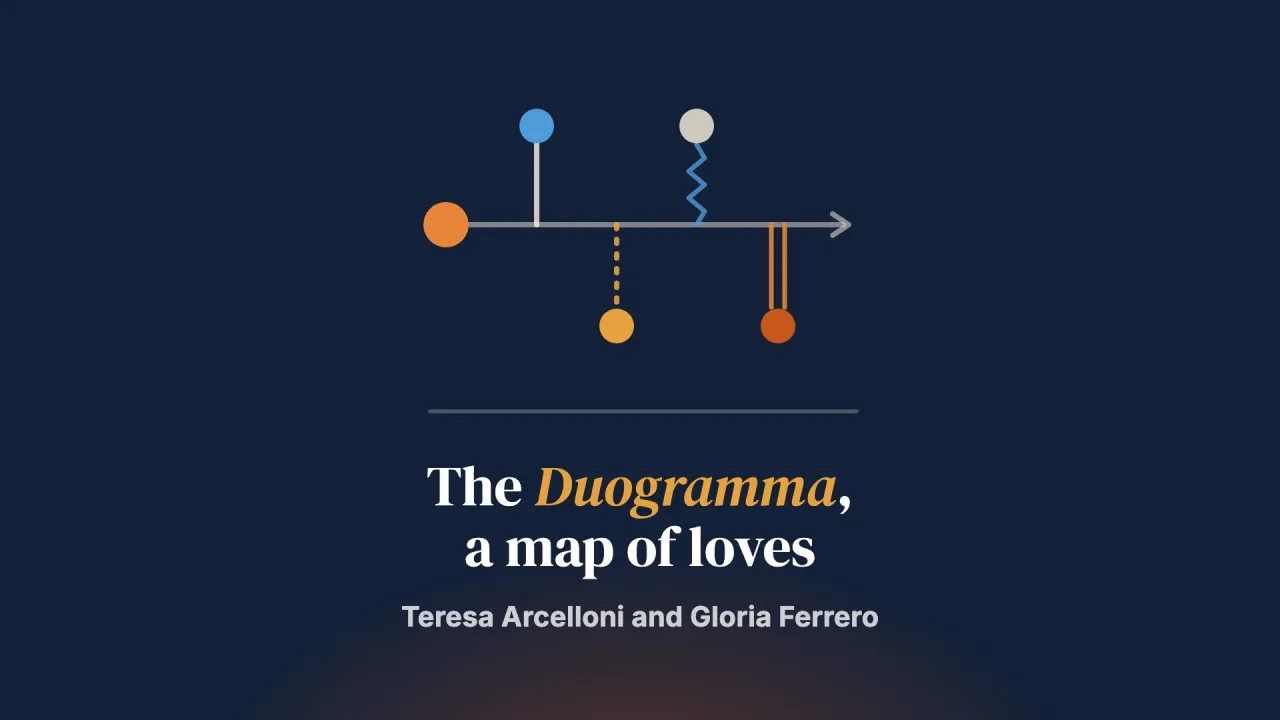
The Duogramma®: An innovative methodology for psychotherapy
A map of the couple relationships lived, desired or rejected since childhood: the Duogramma®, its graphic rules and its use in individual therapy.
 Blog
Challenging in therapy: What a patient taught me
A couples therapy session led me to reflect on confrontation, authenticity and resonance: how to address difficult behaviour without invalidating the person.
 Blog
Adult ADHD: when forgetting turns into a misunderstanding
Forgetting, compensating, tension in the couple: a systemic look at adult ADHD, to understand what is at stake and to look for more fitting forms of support.
 Scientific
Sickle Cell Disease and Young Couples: Understanding the Influence of Shared and Individual Meaning on Couples’ Experience of Illness
Nine young adult couples facing sickle cell disease: how each partner makes sense of the illness, and how the couple moves from caregiving to equality from one crisis to the next.
Comments 0
Log in to join the discussion. Log in