AI-assisted translation
This version was translated from Italian by Complexe Systémique with the help of artificial intelligence. In case of doubt, the original version prevails.
Connessioni · Mythology and clinical practice
How are stories born? An adventurous journey from the seventh level of CMM to the origins of stories
Where do stories come from? Sabrina Piroli starts from Cronen’s CMM model and its six levels of meaning in search of a seventh, supra-cultural level: the developmental tasks shared by the human species, which myths translate into symbols. She then shows how the myth of Zeus and Hera, together with the genogram and a coat of arms, helped a couple on the brink of separation, and sketches a small clinical repertoire of the fifteen major deities of the Greco-Roman pantheon.
Unofficial English translation. This article is a translation of Come nascono le storie? Un viaggio avventuroso dal settimo livello del CMM alle origini delle storie, by Sabrina Piroli, published in Connessioni (Centro Milanese di Terapia della Famiglia), new series, no. 4 (2018), under a CC BY 4.0 licence. Translated by Complexe Systémique in November 2026 with the help of artificial intelligence: the original Italian text has been translated into English and reformatted, which constitutes a modification of the work under the terms of the licence. The paragraphs and subheadings are those of the journal; quotations are translated from the Italian, as the original English wording could not be checked; works written in English are cited under their original English titles, other titles as the author gives them; a few typographical errors (proper names, run-together words) have been silently corrected. This translation was made neither by the authors nor by the journal, who are not responsible for its content or for any errors. The original version prevails.
A myth is therefore a story told and transmitted recursively by the collectivity and by the individual, using the analogical language represented by symbols and archetypes.
Sabrina Piroli
How are stories born? This article tells of the personal journey I undertook to answer this question and of the repercussions it inevitably had on my work. I say inevitably because the journey is certainly no sightseeing trip just outside town: it means stepping out of the perimeter of one’s own certainties, leaving the safe harbour and venturing onto unknown seas, perhaps peopled by sirens and leviathans, and when one returns one has been, in some way and to some degree, transformed by that experience. But no one sets out on an adventure without a good compass, and I have always relied on the systemic compass, thanks to which I have never lost my way: it is precisely this compass that allows me to leave familiar waters to measure myself against the unknown, the distant, the different, and, rather than separating myself from it, to look for connections in order to integrate it. What I offer in this article is the account of my journey towards lands very far from pure systemic thinking. Lands which, however distant, can be explored to gather ideas to feed on, though not without first questioning one’s own prejudices. Lands which, however ancient, can speak to us of very contemporary and even future questions. We might say: eternal ones.
Towards the seventh level of meaning attribution
My journey began many years ago. As for many of us, my first encounter with systemic thinking came through Pragmatics of Human Communication: how reassuring it was to believe that all the questions raised by the infinite combinations of human relationship were contained in that handful of principles! Even then, the most interesting axiom seemed to me to be the one that speaks of the inescapable subjectivity of the communicative act: the punctuation of the sequence of events, the product of our point of view and, consequently, of our history. Of course the pragmatic model, as we know, was meant to draw on the concept of the black box, and that closed, unfathomable box immediately sparked my first questions: I would have liked to know more not only about its contents but even about how it worked, something that in the strategic context was considered blasphemous, to say the least. But at the time, themes such as the construction of meanings and the depth of premises were still far from me. I settled comfortably into first-order cybernetics, but before long I began to feel uncomfortable there, even inadequate as a therapist: strategies, paradoxes and ordeals did not produce the magical effect described in the books inspired by first-order cybernetics. Had I chosen the wrong profession? Doubts gripped me and my insecurities grew. I was not yet able to understand why what seemed a soft bed was in fact so uncomfortable; only some years later, when I encountered the Milan Approach, did I understand that I simply did not want to be a therapist of power but a builder of new meanings, and that these were my premises, impossible to ignore without great discomfort. In those years I learned not only always to keep an open and free gaze on connections and on the new things they give rise to, but also to trust in the capacity to transcend theories in order to work according to a personal vision, one that unites originality and coherence.
Later, thanks to the Milan Approach, I discovered the CMM model, and it took a strong hold on me. The question of punctuation expanded and was redefined before my eyes, leading to the idea that people attribute meanings to their life experiences on the basis of their personal construction of the world. Cronen and his colleagues had dared to open the black box and rummage thoroughly inside it: they immediately became my heroes. Long before, the Great Precursor, Gregory Bateson, had stated that context and meaning are inextricably linked, but Cronen and his group dared to pull no fewer than six contexts, or levels of meaning attribution, out of the black box, ranging from simple content to broad cultural patterns. The latter were described as patterns that pre-exist the individual and on which the individual draws to construct meanings. Things were beginning to get interesting, but the picture was not yet complete: what lay beyond the level of cultures? After all, in their famous 1982 article, comparing their model with that of Palo Alto, the authors themselves state that “there is no finite number of levels of meaning. Previous research has examined an ideal model with at least six levels.” At least six. Was it plausible to think of the existence of (at least) a seventh level of meaning attribution?
In the meantime I put the question of the black box behind me for good: come on, are we men or mice? I became passionate about the narrative approach and read Michael White in one sitting. Here I found further traces leading me towards the origin of stories: the path already opened by the sixth level of the CMM model, the importance of the collective dimension, was becoming ever more evident. The boundary between individual and social narrative was turning from a clearly marked straight line into a fine spiral which, as it grew ever thinner, made it impossible to locate its point of origin. Everything appeared to be part of a recursive and coevolutionary process in which the individual story gives meaning to the collective one, and the collectivity assigns meanings to individual stories, itself becoming a great narrating system with its own powerful voice, the voice of cultures. But if this recursive and coevolutionary process has always existed, in all cultures, is it legitimate to think of some form of supra-cultural, that is, “universal,” matrix? Is that perhaps the seventh level of meaning attribution? To try to answer this last question I held my compass tight and ventured out onto the open sea, far from the safe harbours of systemic thinking.
The origin of stories
I had three questions to answer and a course to hold. The first is that if a seventh, supra-cultural and therefore “universal” level exists, it must also have to do with coordinates shared by all people, so to speak the mother of all stories, the single matrix from which the great cultural stories unfold. The second question I asked myself concerned the ways in which those universal coordinates, which would serve as the foundations of the great cultural stories, are transmitted and elaborated. The third question is what forms these stories have taken and what allows us today to recognize and integrate them.
But let us take things in order. It seems that in all sciences the term constant refers to a quantity (possibly dimensionless) that has a fixed value. So first of all I had to find the constant that would allow me to solve a strange operation: given a human being of any gender, culture and historical period, define the constant that produces a value (result) of a cultural order. What could, for example, I myself, a Bengali child, a South African woman, a North American boy, an old Siberian man, a young Eskimo, an Iranian woman or an Aboriginal newborn have in common, especially if projected into different historical periods? The answer was disarmingly simple: we are all part of the human species and consequently share, albeit on varying timescales, the same story:
- being born in a state of total helplessness and dependence;
- moving from symbiosis with the mother to one’s own individuation;
- building differentiated relationships with the mother and the father, sometimes with brothers and sisters;
- having some form of extended family;
- receiving some form of education, more or less complex;
- discovering sexuality;
- facing the psychological, bodily and social transformations of adolescence;
- becoming individuated as adults and leaving one’s own household to find one’s own place and social role;
- forming bonds, of whatever orientation, sometimes becoming parents, biological or not;
- looking after, educating and caring for significant others, inside and outside the family household;
- facing the psychological, bodily and social transformations of maturity;
- for parents, redefining the relational space when the children, biological or not, leave the household;
- facing the psychological, bodily and social transformations of old age;
- facing illness and death, one’s own and those of others.
In this sense the universal matrix, the mother of all stories, would be nothing other than the story of the developmental tasks (physical, psychological and social) that the human species must face and resolve over the life cycle, from birth to death. And if this is the story that has always repeated itself, we could then define the succession of its stages as a coherent set of species coordinates, that is, as a supra-cultural level of context.
On my research journey I had by now pushed very far from the territories of systemic thinking, landing on the shores of depth psychology: Jung, Hillman, Bolen, and then letting myself be captured by Joseph Campbell’s accounts of mythological orders, described as systems of images that bring to consciousness certain deep meanings of existence. In this sense, myths would have precisely the psychological function of accompanying the individual through life’s developmental tasks, from birth to death (and even beyond, given the large number of myths that deal with the unknowable!). The combinations are infinite but, all things considered, there is a limited number of roles to be played in myths, since they are related to developmental tasks, universal constants within which the uniqueness of each of our human stories unfolds. So, where I had landed, I had found some guiding ideas that could form a bridge between supra-cultural context, broad cultural patterns and biographies: mythological orders. To give an example, I will use the most widespread myth in human history: the hero’s journey, analysed in detail by Joseph Campbell in The Hero with a Thousand Faces. This myth appears recurrently in different cultures and periods (cf. the myths of Gilgamesh, Ulysses, Buddha, Moses, Dionysus) and also forms the basis of many of today’s most famous film narratives, such as the Star Wars or The Lord of the Rings sagas. As the well-known screenwriter Chris Vogler illustrates, in the myth of the hero’s journey, structured in twelve passages (each further divided into several stages), the protagonists begin their adventure as ordinary people living quietly in their everyday world (1) when, often suddenly and against their will, they are drawn into a risky undertaking whose aim is the common good (2). At first they are reluctant and try to ignore or refuse the call (3), but at this point a wise and authoritative figure provides them with teachings and skills (4) that are indispensable for leaving home and beginning the journey, crossing the first threshold to enter the unknown world (5). Stripped of their old securities, they face trials, form alliances and clash with antagonists (6), until they reach the darkest and most threatening place (7), the second threshold, which leads them to the central ordeal, usually a physical, psychological and/or spiritual confrontation with higher forces (8), in order to win the object of the reward (9) and be able to return home. Having passed the ordeal, wounded and weary, they are pursued and attacked again on the road back (10), and here, risking annihilation and death, they cross the third threshold and live through an experience of “resurrection” that will transform them profoundly (11). Finally, grown and changed, they return home bearing a gift or a treasure, a source of benefit for the whole community (12). A supra-cultural myth, then, which retraces the psychological development of the human being, from the innocent condition of childhood to the conquest of one’s own place in the world, passing through the transformative crises of adolescence and the trials of adulthood. A myth that emerges from those species coordinates that are the developmental tasks and that every culture, ancient or contemporary, forges in its own specific way on the basis of its own patterns.
These first suppositions led me to wonder how what I have identified as species coordinates might be transmitted and elaborated. For certain ideas to be transmitted, assimilated and integrated by any population in any era, a universal language is needed, a language based not on number but on analogy: the symbol. Today, in most cases, the symbol is hastily understood above all as a “sign,” as a kind of abstraction, a freely chosen designation linked to the designated object by social convention, such as verbal or mathematical signs, road signs, or the emoticons in WhatsApp messages. Instead, the term should characterize something that, behind its objective and visible meaning, hides another, invisible and far deeper: a flag is nothing but a piece of coloured cloth, but “the right hemisphere does not make this distinction and regards the flag as sacredly identical with what it represents. So ‘Old Glory’ is the United States: if someone tramples on it, there may be a reaction of rage” (G. Bateson). Language explains; the symbol awakens presentiments, sinking its roots into the depths of the soul (J. J. Bachofen); the symbol transforms a phenomenon into an idea, then fixes the idea in an image, keeping that idea active yet at the same time inexpressible in words (J. W. Goethe). A symbol does not translate a content but rather represents its meaning (E. Fromm); it is neither allegory nor sign, but the image of something that transcends consciousness (C. G. Jung). It is also significant that analogous symbols arise in cultures very distant from one another, in time and space, as integral parts of the mythological orders that tell of the origins, the founding principles and the social and psychological development of a people. In other words, certain symbols emerge in the collective narration of the stories of humankind and its cultures, apparently independently of them: how is this possible? To answer, we might begin by drawing on a simple notion from ethology: the innate releasing mechanism described by Konrad Lorenz. If a hawk passes over a group of chicks, or if a simple cardboard silhouette in the shape of a hawk is passed over them, the chicks will run to hide, even if they have never seen a hawk. This suggests that it is not the single chick that reacts to the “predator” stimulus, but rather the species: the response would be collective, not individual. Collective behaviour in response to an image is a good illustration of the concept of the archetype: an archaic or, better, “original” symbol (ἀρχέτυπος, first exemplar), which can provoke emotional or behavioural reactions that make sense in that context. What responds to the symbol/archetype (elements that are often intertwined) is therefore not only the individual but the whole collective dimension of which the individual is a part. A myth is therefore a story told and transmitted recursively by the collectivity and by the individual, using the analogical language represented by symbols and archetypes. This consideration becomes particularly interesting if we consider that we experience the symbol all the time: whenever a certain representation, for no apparent reason, reveals an evocative potential to us, moving us, arousing an emotion, generating a mood, triggering a chain of associations, or simply a start of surprise, dismay or joy, we are at some level resonating with its hidden meanings, with the story of which that image is an integral part, something we grasp not through neocortical consciousness but through the most archaic structures of our brain, located in the limbic system.
Following the thread of my hypotheses, I finally came to the question of how species coordinates are transformed into mythologies representative of specific cultural patterns. Adolf Bastian, a nineteenth-century traveller and anthropologist, coined the term Elementargedanke, or elementary idea, to describe the universal dimension of mythologies. Naturally, he observed that no idea presents itself to the observer in a pure state, but rather in the form in which a particular culture experiences it. For this reason he coined another term: Völkergedanke, or ethnic idea. For example, studying European myths and folklore, we can observe that heroes cross dark forests inhabited by terrible, menacing wolves, whereas in the myths of the Pacific islands danger is represented by deep seas teeming with ravenous sharks. The unknown and danger are represented in different forms, but the wolf and the shark are nothing but expressions of the same primordial fear that the hero must face. It is no coincidence that initiation rites often separate individuals from the social group (the perimeter of securities) to allow them to meet their own limits and resources in contexts unknown (dark) to them, thus showing that they can leave one condition, for example that of boy-son, to take on a new one, that of warrior-husband.
The guiding ideas set out so far therefore led me to consider myths as narratives derived from species coordinates (represented by developmental tasks), translated into cultural ideas and expressed through symbols that resonate as a collective image, activating reactions and behaviours that make sense in that particular context: in other words, every myth validates an age-old experience that has created a model to draw inspiration from.
Myth in the exploration of stories
At this point in my journey into the origin of stories, one important theme remains to be examined: if we accept the idea that mythology stages our path as human beings through its tales dense with archetypes and symbols, we realize that we have access to an almost limitless archive of stories.
One could say that, depending on the specific developmental task to be faced, it is possible to trace in collective memory one or more myths that can illustrate its risks, call up resources and provide inspiration. If this is true, we might ask how useful it is to know those invisible plots that mysteriously weave our life stories. After all, one of the aims of psychotherapy is to enable each person to feel like the active protagonist of their own life narrative: the hero of their own story. All the more so because the encounter with oneself often happens precisely in the wake of a deep existential crisis; it is born of bewilderment, of the collapse of certainties, of the panic that accompanies the failure of a certain life project. When the ship sinks and all is lost, memories can resurface from myth that are capable of transforming that shipwreck into a new trial for the hero.
Of interest to us psychotherapists are the myths that tell of wounded healers. Passing more or less consciously through so-called “madness” is probably one of the most precious experiences a therapist can have. Jung once said that you can accompany someone else only as far as you yourself have come, and no further: that is why the wounded therapist is precisely the one who, knowing suffering, can heal wounds. Aldo Carotenuto states that “regarding that wound, I readily make use of a play on words which, moreover, is entirely legitimate etymologically: it is a ‘ferita’ (wound), and it is a ‘feritoia’ (loophole, an arrow slit), an opening that allows you to keep an eye on your inner world, to scrutinize and investigate the most mysterious and secret part of yourself, the ‘submerged’ part. So it is precisely the healer’s wound that is one of the privileged routes of access to their therapeutic potential, provided that this experience is carefully contextualized within one’s own premises and is the object of self-observation by the therapist themselves” (Carotenuto, 1998).
On the subject of the wounded healer, the Greek myth of Kore-Persephone is especially significant: the goddess, daughter of Demeter and Zeus, is abducted and carried off against her will into the underworld by Hades, lord of the dead. At the beginning of the myth she is just a carefree adolescent, gathering flowers and playing with her friends, before being brutally taken from her mother. But when, after a long time, Hermes reaches the underworld to rescue her, he no longer finds the young girl (κόρη, Kore, the maiden) but a woman (Φερσεφόνη, Persephone, she who brings abundance). Hades, who cannot disobey the will of Zeus, offers her pomegranate seeds so as not to lose her; these magically oblige whoever eats them to return forever to that house. The goddess eats only half of them, then leaves with Hermes to embrace her mother again, knowing full well that from then on and for eternity she would spend part of the year in the world of shadows with Hades and the other in the world of the living with Demeter, becoming a symbol of the eternal cyclical nature of life, with the alternation of its seasons: birth, youth, maturity, death and rebirth. Yet in the myths that followed, when the heroes and heroines of Greek mythology went down to the realm of souls, it was Persephone who received them and guided them through the underworld.
This myth, which like all archetypal stories has extensive polysemic dimensions, illustrates the protagonist’s transformation from unaware maiden to guide of the underworld, through the painful experience of being abducted by a dark force and the resilient exploration of the depths: the wounded healer, thanks to the experience of descending into their own pain and their own madness, becomes able not only to pass through the darkness but also to sense the vital potential hidden in the cycle of death and rebirth. This myth therefore tells of those who, abducted by dark inner forces, develop the capacity not only to move above and below the surface but also to pass on their experience, placing it at the service of others. Perhaps it is also the story of some of us.
The encounter with mythology has thus allowed me to broaden my therapeutic interventions at the individual, couple and group level. Starting from the premise that, as Italians, we are steeped in Greco-Roman culture, I have studied in depth some (there are a great many) of the myths connected with the Olympian deities, figures widely known, and not only to those who have had a classical education: in this sense it is easy to see how widespread Greco-Roman mythology is in literature as well as in cinema and theatre, and in a host of mottoes, proverbs and metaphors. Moreover, thanks to the spread of role-playing games and RPG video games, my work with adolescents and young adults has also been enriched by it.
This material has therefore proved extremely useful for expanding my archive of stories for sessions with clients, whether individuals or couples, as well as for structuring group pathways aimed at personal growth. When I am caring for a story, especially when the same themes have recurred several times over the course of a life, it can happen that calling up great mythical stories opens new developmental meanings, which allow the client to look at their efforts, falls, blocks or repetitions as trials on their own heroic journey towards authenticity, and at their own resources as unique and sacred qualities. It should be stressed that every mythological tale contains an extraordinary number of elements, both positive and negative, belonging as much to the central figure as to the situation depicted and to the many relational intersections present in the narrative: an infinite range of possibilities for constructing new meanings.
Between systemic thinking and mythology: Giacomo and Anna, or the myth of the royal couple
I receive a request for couple counselling from Anna, presented as a last attempt before a separation described as dramatic and almost certain. Giacomo is a 50-year-old businessman; he arrives at the first session well dressed and wearing cologne, displaying self-assurance and showing himself cooperative and well disposed towards the counselling. His wife Anna is a beautiful 38-year-old woman, well groomed and elegant, wearing important but discreet jewellery. It is immediately clear that Anna, behind a façade of icy courtesy and irony, is furious. Married for 12 years, they have two sons aged 9 and 7. Anna asked for the separation after discovering yet another of her husband’s flings: this time Giacomo had supposedly begun a relationship with a woman in her thirties whom they both knew, and to whom, according to Anna, he had given rather expensive gifts. Anna went to a lawyer and threatened separation; Giacomo declared himself innocent but was not believed. Anna describes the rival as an upmarket kept woman, although in reality she works in a bank (Anna implies that she must have got that job the usual way too). During the session Giacomo does not bristle at the insinuations about his marital fidelity, and treats his wife as though he plainly wanted to win her back. At times she seems to soften, but every so often she explodes with words full of anger. We agree on a course of sessions to explore and assess together the state of their union.
We begin exploring the couple’s story, also with the help of the genogram. Both completed secondary school, but while Giacomo devoted himself body and soul to the family business, founded by his paternal grandfather, Anna had some occasional work experience before marrying, and then devoted herself to the marriage. I ask Giacomo to tell me a little more about his personal history, and from his account I form the image of a man who, in his youth, denied himself nothing: parties, women, travel. But meanwhile the family business, founded by his paternal grandfather, demanded more and more of his presence. I ask Giacomo to tell me about this business that absorbs a good part of his time and energy. He tells me that his grandfather was an authoritarian man who tyrannized his children, including Giacomo’s father. When the grandfather fell ill, the father, in agreement with his siblings, took over the reins of the business; shortly afterwards he married a wealthy woman from a good family (Giacomo’s mother) and strengthened the company’s assets. Shortly before turning thirty, Giacomo begins to clash frequently with his father, who asks him ever more insistently to curb his excesses, in other words to start earning the money he spends so carelessly. And so, little by little, Giacomo too, as his father had done before him with the grandfather, takes the reins of the business and finds a way to satisfy his siblings. His life has always revolved around the company and, by his own account, he has never had extramarital relationships, only small, brief infatuations that came to nothing. Anna comes from a well-off family of noble origins; her parents were kind, though very reserved and not very affectionate, observant Catholics who attend their parish and do charitable work. Unlike her sister, a highly regarded architect, and her brother, a doctor, Anna did not pursue her studies with any particular commitment, and she worked without much interest in her sister’s architecture firm. She says that from girlhood her plans were marriage and family. When she tells of meeting Giacomo, her eyes light up. Even then, she says, he was much sought after, so much so that at first she did not want to accept his advances, since besides being rich, handsome and powerful he also had a reputation as a womanizer. But once they began seeing each other, he showed her an unknown side of himself, tender and gentle, which won her over. Anna dwells at some length on the description of their wedding day, an event celebrated with great pomp in the South. Her account gives me the image of a young bride, in love with her husband but also with the role of wife, which projects her into that adult and complex world where she has learned to move with considerable skill.
The couple then talk about the first three years of their marriage before the children arrived, years both describe in very positive terms: great passion, travel, gifts, few bad moods. With the arrival of their first son the relationship inevitably changes and the first crisis sets in. Anna, who has never had many female friends and does not have a deep relationship with her own family, finds herself alone in coping with their first baby. Giacomo, for his part, seems to step up his work, thereby disappointing his young wife’s romantic expectations. The first jealousies arise and Anna becomes suspicious and distrustful. The arrival of their second son makes the climate even worse, and it is now openly conflictual. So Anna “discovers” that Giacomo is skilled at lying: for example, he takes suspicious business trips, has very attractive female colleagues and assistants and sometimes manages to make himself unreachable, yet Anna never manages to find any traces such as text messages, emails or chats. Scenes of jealousy and furious quarrels, during which Anna sometimes leaves, entrusting the children to the nanny (the longest absence was 3 days in a convent of nuns), alternate with reconciliations studded with gifts and trips, the best way, according to Giacomo, to win his wife back. Throughout the account the children appear only tangentially, although Giacomo expresses the wish for a third child, partly because, he says, the business is so important that one day it might need more heads. As for the alleged relationship that triggered Anna’s reaction, it is clear that neither of them really believes it will lead to separation.
Myths about couples are countless but, in my eyes, Giacomo and Anna embody well the myth of Zeus and Hera, the royal couple of Olympus.
The Titan Cronus was the god of time, son of Uranus-sky and Gaia-earth, and his wife was Rhea, also a Titaness, the personification of the forces of nature, goddess of the earth and of all nature. Their children Demeter, Hera, Hestia, Hades and Poseidon were all devoured by Cronus as soon as they were born, because he had learned from his own parents that it was his destiny to be overthrown by one of his children, just as he himself had overthrown his father. But when Zeus was about to be born, Rhea asked Gaia to devise a plan to save him. Rhea gave birth to Zeus in Crete and had a stone wrapped in swaddling clothes delivered to Cronus, who immediately swallowed it thinking it was his newborn son. The mother hid Zeus in a basket placed under a tree, watched over by a family of shepherds. Zeus grew up on the good milk of his nurse, the goat Amalthea; every day the bees distilled the sweetest honey for him, and from Heaven he received ambrosia and nectar, sacred foods that gave him immortality and eternal youth. The Cyclopes forged the thunderbolts with which he trained every day. When he reached adulthood, Zeus (with the help of the goddess Metis) gave Cronus a poison that forced him to disgorge his brothers and sisters. After a battle against the Titans, Zeus divided the world with his elder brothers Poseidon and Hades by drawing lots for the three realms. Zeus, now lord of the gods, was allotted the heavens and the air, Poseidon the seas, and Hades the underworld of souls.
Hera, by contrast, was entrusted to the care of two nature deities, Oceanus and Tethys, elderly adoptive parents of high lineage, but she was brought up by her nurse Macris. In the legends, after overthrowing Cronus and the Titans and becoming lord of the gods, Zeus joined Hera in Crete, where he courted her, at first without success. He then turned himself into a small, shivering cuckoo: unaware, she picked it up and tenderly warmed it at her breast. Zeus immediately resumed his true form and tried to take her by force, but failed. He went on courting her, but she resisted his amorous advances until he promised to marry her. The cult of Hera, as goddess of marriage and married life, was particularly widespread both in mainland Greece and on the islands, and the hieros gamos (ιερογαμία, ἱερὸς γάμος, sacred marriage) with Zeus was the subject of numerous artistic and ritual representations. The honeymoon lasted three hundred years, but when it ended Zeus soon returned to his old habits (he had already had many consorts and many children) and was repeatedly unfaithful to her. Finally, Hera is not remembered as an example of maternal love, since her children always come second to her love for Zeus and are often treated harshly or ignored.
The marriage of Zeus and Hera could be called full of passion, but quarrels often broke out because of Hera’s fierce jealousy and possessiveness, though she was vengeful not so much towards her husband as towards her rivals. Shortly after their return from the honeymoon, after a ferocious quarrel, Hera left Olympus and went back to the island of Euboea to be comforted by her old nurse Macris. But Zeus, wanting to win her back, devised a stratagem: he came down to the mountains of Euboea and spread the rumour of his imminent marriage to a beautiful local nymph. He had a sculptor make a wooden statue of a very beautiful woman, dressed it in sumptuous clothes, had it placed on a chariot and ordered the charioteer to travel the length and breadth of the island, spreading the word that he was taking the new bride to Zeus. On hearing the news, Hera, enraged, stopped the chariot and hurled herself at her rival to tear off her clothes. But when she realized it was a statue, the goddess laughed, forgave Zeus and returned to Olympus to be reunited with him.
The myth of Zeus and Hera thus offers many opportunities to enhance the value of Giacomo and Anna’s story as a couple, and to reflect together on certain critical aspects to be transformed.
Like Zeus, Giacomo comes from a strongly patriarchal family, in which power lies in the hands of men and passes from generation to generation to the strongest son, while women remain subordinate and are brought into the family to strengthen its assets and ensure the continuity of the dynasty. Like the god of the myth, Giacomo is skilled at running his kingdom (a thriving and respected family business), determined but fair with his siblings and business partners, seductive with the beautiful women (secretaries and assistants) he surrounds himself with. The woman he chose to marry, Anna, comes from a good family; she is beautiful but serious, committed to traditional couple values, which see the woman first and foremost as wife and as mother of the children who must ensure a worthy line of descent. Anna, like the goddess of the myth, is a woman of passionate temperament, able to express her positive and negative emotions forcefully, passing even abruptly from tenderness to anger. Like Hera she is as devoted to her husband as she is jealous of him, and she directs her anger mainly at other women, guilty of undermining her precious marital relationship. Moreover, from girlhood she gave up any goals of professional fulfilment, devoting all her energy to the ideal of marriage (the hierogamos of the myth): for Anna everything, children included, is subordinate to her relationship with her consort; she has no social life of her own, and she is happy to be recognized as the wife of Giacomo R., the well-known businessman. A marriage, then, based on a “traditional” couple contract, characterized by clearly defined roles and responsibilities and by complementary dynamics (values fully shared by both, in any case), but marked by intense emotions that give rise to those romantic and passionate aspects which keep the couple in constant emotional tension, periodically revitalizing their union.
I begin by telling them some parts of the myth and immediately notice their interest: they are gratified by the comparison with the most “VIP” couple among the Greco-Roman deities. Both bring their memories of school, literature and film into play in an atmosphere that is, all in all, playful; a shadow crosses Anna’s face, but the threat of separation seems to have been set aside for the moment. As the work on the genogram continues, the stories allow me to bring in the myth from time to time. I also ask them to identify symbols that might represent the spirit of their respective families of origin. Highlighting the patrilineal succession in Giacomo’s genogram and its echoes of the myth (for example, his taking the place of his father, who in his day had dethroned the grandfather, thanks to an alliance with his siblings), he imagines as the symbol of his family history a castle on a round hill, a symbol that evokes power, rising high on a hill, but also the closed, fortified spaces of his family. This is an opportunity to reflect on his difficult relationship with his father: Giacomo, outgoing and dynamic, played the guitar as a boy and would have liked to study music, which his father forbade without discussion. Giacomo recounts the moment he understood that he could not have a plan different from the family’s, that he was called to follow in the footsteps of his grandfather and father, and how he had felt swallowed up by his father, just as happens in the myth when Cronus swallows his children. I take the opportunity to remind Giacomo that it was precisely Zeus who devised the stratagem to break that cycle and create a new dynasty of gods, the gods of Olympus, and he exclaims in surprise, “My children! They must be free!”, while Anna remains silent, nodding.
Working on her own genogram, Anna highlights the nobility of her ancestors and the importance of the marriages that united houses and fortunes. As a symbol she imagines a circle that is half sun and half moon, surrounded by three stars: a symbol that evokes the union of masculine (sun) and feminine (moon), surrounded by stars whose etymology leads back to desire (de-sidere). The genogram allows Anna to observe how she measures herself against her sister and brother, both successful professionals. It emerges that Anna has always felt distant from her parents, who were very old-fashioned and not inclined to show affection. She describes her mother as a pious woman, devoted to parish life, and her father as a strict and authoritative person, though capable of allowing himself some leisure with friends. Anna, unlike her high-flying siblings, sees herself as out of place, so that over time she has developed a certain lack of self-confidence that has led her to give up her own autonomy, lulling herself with the dream of a fairy-tale marriage, the only way to be appreciated by the rest of the family and to leave it with her head held high. Yet once married, her insecurity grows: having become the wife of an important man, she devotes herself entirely to him and to the superficial social life they lead, but without ever truly putting herself on the line. Their respective families of origin seem satisfied and maintain good relations with them. But the fairy tale soon crumbles for Anna: with the arrival of the children she again feels alone and inadequate, sensing at the same time her husband’s “distractions,” and alternating moments of anger with phases of withdrawal. Her greatest fear is of losing Giacomo, of no longer being able to win him back.
At this point I bring in another myth connected with Hera: from time to time, when she wished to rekindle her consort’s passion, the goddess would borrow from Aphrodite her magic girdle, in which her spells of seduction were gathered. I explain that the myth refers to the various feminine dimensions present in every woman, including those of the good wife and the seductive lover. This opens a chapter on the couple’s intimate life, which allows both of them to voice their aspiration to recover a complicity that seemed lost: Giacomo admits to having interpreted as a loss of sexual interest the behaviours of Anna’s that were linked to her doubts about her own capacities as a mother; Anna begins to see her husband’s seductive behaviour as implicit calls directed at her, who over time had cooled a little. I ask them to work out a symbol representing their union, and a coat of arms is created in which, above the castle on top of the hill, shine the sun, the moon and the three stars, which, according to Giacomo, represent the two of them and their children (including the third one he hopes for).
In the following sessions, always keeping the genograms and symbols in view, a comparison between the two mythological figures and the members of the couple brings out the positive and negative sides of the roles they are playing within their union. Giacomo, following in the masculine wake left by the men of his family, reasserts his virile power through his alleged “distractions” and at the same time rekindles in Anna the most intense feelings, precisely that anger and jealousy which, in the end, gratify him deeply. She, for her part, pushes the game with scenes and temporary departures in an attempt to secure for herself the confirmation of a role, of a place of her own, of an importance of her own, in the dynamics of her new family: what she is asking is finally to be seen. Distractions and jealousies are nothing but two sides of the same coin: both remain trapped in rigid traditional roles, pre-arranged by the stories of their respective families. The next step consists in examining some repetitive scripts relating to the roles of wife and husband, using the typifications offered by the myth of Zeus and Hera, and weighing the possibilities of keeping their merits but also of departing, even slightly, from those prestigious but cumbersome models. Gradually, small changes emerge in the couple’s balance: Anna, who has always kept to the margins of the company’s life, begins to take charge, successfully, of its representational events, organizing society functions and fundraising dinners. She then joins an elite association made up mainly of businessmen’s wives, beginning to have a social life of her own and gaining further self-esteem. Giacomo, for his part, expresses the wish to be more present in the family, delegating a series of tasks to his siblings and beginning to spend at least Sundays with his wife and children, at last in purely playful and recreational activities: he even plays the guitar on occasion. With Anna he seems to try out more reassuring and less provocative attitudes, so that she begins to feel more appreciated and can therefore devote part of her energy to herself, feeling a little more secure and less jealous. At the eighth and final session we decide together that they can continue on their own, and I take my leave of them, not without wishing them another three hundred years of honeymoon!
The Pantheon as an archive of stories
This article does not allow for a complete description of the whole development of my work, but I would like to conclude by summarizing in a schematic way some of the myths I use, aware that this will reduce the ideas I share here. I will therefore give only brief examples of how I have applied mythology in my work thanks to the journey I have described, starting from the fifteen principal figures of the Greco-Roman pantheon. Besides, as a therapist trained in the Milan context, I have confidence in the colleagues who have been kind enough to read me this far, and in their ability to go beyond these few lines.
Among the female deities, the figure of Hera (or Juno for the ancient Romans) has proved useful in stories characterized by adherence to the traditional values of marriage, by emotional dependence and by difficulty relating to the feminine. Demeter (or Ceres) in those in which the maternal dimension (not necessarily biological), the tendency to look after others before oneself and the tendency to control the relational environment predominate. We have already spoken of Kore-Persephone (or Proserpina), a complex myth rich in nuance, useful for redefining in a developmental key stories marked by existential crises, capacity for adaptation and resilience, depressive experiences and burnout among care workers, as well as stories founded on “abduction” from the family and sexual initiation as a passage from adolescence to adulthood, while the myth of Artemis (or Diana) proves valuable in stories distinguished by themes linked to personal autonomy, professional competitiveness, symmetrical relationships with the masculine and intense relationships with the feminine, including romantic ones. The myth of Hestia (Vesta) is productive in stories marked by choices that limit emotional and social life in favour of the inner world, such as the decision to enter a religious community or to live in isolation, in austerity and renunciation. Aphrodite (Venus) can be fruitful in stories marked by themes of freedom (including sexual freedom) and creativity, but also by difficulties in maintaining emotional bonds and professional commitments, remaining anchored at superficial levels of relationship. Finally, Athena (Minerva) is an effective myth in stories marked by intense relationships with the father, by difficulty in becoming emotionally involved with men, by the predominance of thought over emotion and therefore of self-control, and by a patriarchal approach to relationships with the feminine.
On the male side, Zeus (or Jupiter) can be a useful myth for examining and reorganizing stories centred on issues of power in the family and professional spheres, on traditional couple values and strongly complementary relationships, while Poseidon (or Neptune) suits stories characterized by difficulty in managing one’s emotions and by violent passions, including abuse alternating with remorse. Hades (or Pluto) is helpful in stories connected with the relationship to the inner world and to everything buried within it, or stories based on a tendency to become emotionally involved with a still immature feminine in order to initiate and shape it, and Apollo is a fruitful myth in stories founded on privileged relationships with the father, on symmetrical relationships with the feminine and on the pursuit of perfection, as well as on intense involvement with one’s own sex. Hermes (Mercury) is indicated for exploring stories connected with flight from responsibility and from lasting bonds, with manipulation and seductiveness, and with conduct on the edge of legality, whereas Ares (or Mars) suits those distinguished by an excessive readiness to “throw oneself into the fray,” acting before thinking, as well as by visceral and intense relationships in which the bodily dimension is primary, both in combat and in the affective sphere. Hephaestus (or Vulcan) connects brilliantly with family or social exclusion caused by differences of various kinds, with resilience and with the capacity to express and fulfil oneself in an original way, particularly in manual activities; finally, Dionysus proves a useful myth for exploring and restructuring stories marked by substance abuse, severe instability, risk behaviours and the search for extreme experiences, including sexual ones, outside social norms.
A provisional conclusion
About ten years ago, within a short time, I lost my partner, my home and my job. A deep crisis followed, which also drove away many friends and colleagues, turning my life into a sort of expanse of scorched earth. I am not ashamed to reveal that I myself needed to seek therapeutic help, which I chose carefully for its distance from systemic thinking, to avoid falling into the trap of “I know perfectly well how it works.” Forced against my will (I was very rigid about coherence between theory and practice) to consider new points of view, I collided with the myth that represented me at that precise moment, but from that violent impact a great deal of precious material emerged. I wondered whether I ought to ignore the possibilities that were being offered to me, perhaps in the name of a certain purism; instead, I chose not only to draw inspiration from them but to give new meaning to my whole journey, integrating that material in the way I have tried to summarize briefly in this article. I confess that the destination is still unknown to me, but since then the taste for research has never left me. After all, Gianfranco Cecchin, in The Cybernetics of Prejudices in the Practice of Psychotherapy, reminds us of “the potential danger a therapist faces if they become excessively fanatical about a specific orientation, because, when this actually happens, they place adherence to the model above the needs of the client.”
Complexe Systémique: key points
This account of a personal path works as clinical testimony rather than as proof. The “seventh level” is not part of Cronen and Pearce’s CMM model: the author freely extends its intuition towards Jungian psychology, and the supports she draws on (archetypes, the innate releasing mechanism, the limbic system) are analogies more than evidence. Reading the couple through types also calls for caution: turning Hera and Zeus into models risks naturalizing gender positions that the couple already experiences as destiny. Yet the interest for practice is real. Here myth works as a reframing: it gives the couple a story larger than their conflict, makes transgenerational repetitions thinkable (Cronus devouring his children, Zeus breaking the cycle) and opens room for play, the chance to depart “even slightly” from prestigious but cumbersome models. Genogram, symbols of the families of origin and then a shared coat of arms form a sequence of floating objects that is easy to transfer. Finally, the conclusion embraces the figure of the wounded healer and recalls, with Cecchin, that no loyalty to a model should come before the person in therapy. Read alongside the interview with Paul Gibney on integrating systemic and Jungian perspectives, and the presentation of the family coat of arms.
References
Bachofen J. J. (1971), Versuch über die Graber- symbolik der Alteri, cit in JACOBI J. (1971), Il Simbolo, http://www.rivistapsicologianalitica.it, n° 4.
Bastian A. (1860),Der Mensch in der Geschichte, Leipzig, Verlag von Otto Wigand.
Bateson G. (1979), Mind and Nature: A Necessary Unit, Dutton, New York, tr. it. Mente e Natura, Milano, Adelphi, 1989.
Byng-Hall J. (1995), Rewriting Family Scripts, New York, Guilford Press, tr. it.Le trame della famiglia. Attaccamento sicuro e cambiamento sistemico, Milano, Raffaello Cortina, 1998.
Bolen J. S. (1984), Goddess in every woman. A new psychology of women, San Francisco, Harper & Row, tr. it. Le dee dentro la donna. Una nuova psicologia femminile, Roma, Astrolabio-Ubaldini, 1991.
Bolen J. S. (1989), Gods in every man. A new psychology of men’s lives and loves, San Francisco, Harper & Row, tr. it. Gli dei dentro l’uomo. Una nuova psicologia dell’uomo, Roma, Astrolabio-Ubaldini, 1991.
Boscolo L., Bertrando P. (1993), I tempi del tempo. Una nuova prospettiva per la consulenza e la terapia sistemica, Torino, Bollati Boringhieri.
Campbell J. (1962-1983), Pathways to bliss. Mitology and Personal Transformation, San Anselmo, CA, Joseph Campbell Foundation, tr. it. Percorsi di felicità. Mitologia e trasformazione personale, Milano,Raffaello Cortina, 2012.
Campbell J. (1949), The Hero with a Thousand Faces, Bollingen Series XVII, New York, Pantheon Books, tr. it. L’eroe dai mille volti, Parma, Guanda, 2000.
Carotenuto A. (1998), Lettera aperta ad un apprendista stregone, Milano, Bompiani Editore.
Cecchin G., Lane G., Ray W. L. (1997), Verità e pregiudizi, Milano, Raffaello Cortina.
Cronen V. E., JOHNSON K. M., Lannamann J. W. (1982), “Paradoxes, Double Binds, and reflexive Loops: An Alternative Theoretical Perspective”, Family Process, 21, pp. 91-112.
Fromm E., Il linguaggio dimenticato, cit. in Jacobi J. (1971), Il Simbolo, http://www.rivistapsicologianalitica.it, n. 4.
Goethe W., Maximen und Reflexionen, n. 1113, cit. in Jacobi J. (1971), Il Simbolo, http://www.rivistapsicologianalitica.it,n° 4.
Hillman J. (1996), The soul’s code: In search of character and calling, New York, Random House, tr. it. Il codice dell’anima. Carattere, vocazione, destino, Milano, Adelphi Edizioni, 1997.
Imber Black E., Roberts J., Whiting R. A. (1988), Rituals in families and family therapy, New York, Norton & Co.
Jacobi J. (1971), Il Simbolo, http://www.rivistapsicologianalitica.it,n. 4.
Jung C. G. (1961), Erinnerungen, Traume, Gedanken von C. G. Jung, New York, Random House, tr. it. Ricordi, sogni, riflessioni, Milano, Rizzoli, 1978.
Jung C. G.(1964),Der Mensch und seine Symbole, Ostfildner, Patmos Verlag, tr. it. L’uomo e i suoi simboli, Milano, TEA, 1991.
Vallino M. (2013), La cintura di Afrodite. La bellezza delle dee e l’anima delle donne, Bari, Progedit.
Vogler C. (1992), The Writer’s Journey: Mythic Structure For Writers, Studio City, CA, Michael Wiese Productions, tr. it. Il viaggio dell’eroe. La struttura del mito ad uso di scrittori di narrativa e di cinema, Roma, Dino Audino, 1999.
Walsh F. (1993), Normal Family Processes, New York, The Guilford Press, tr. it. Ciclo vitale e dinamiche familiari, Milano, Franco Angeli, 1995.
Watzlawick P., Jackson D. D., Beavin J. (1967), Pragmatics of Human Communication, New York, Norton, tr. it. Pragmatica della comunicazione umana, Roma, Astrolabio, 1971.
White M. (1992), La terapia come narrazione. Proposte cliniche, Roma, Astrolabio.
Unofficial English translation of Come nascono le storie? Un viaggio avventuroso dal settimo livello del CMM alle origini delle storie, by Sabrina Piroli, Connessioni, new series, no. 4 (2018), under a CC BY 4.0 licence. Translation (with the help of artificial intelligence) and layout: Complexe Systémique, November 2026 — the work has been modified under the terms of the licence. Neither the authors nor the journal are responsible for this translation; the original version prevails.
Unofficial English translation of “Come nascono le storie? Un viaggio avventuroso dal settimo livello del CMM alle origini delle storie”, published in Connessioni (2018) under a CC BY 4.0 licence. Made by Complexe Systémique with the help of artificial intelligence, it does not come from the authors or the journal, who are not responsible for its content; the original version prevails.
Read the original articleHow to cite this article
Piroli, S. (2018). How are stories born? An adventurous journey from the seventh level of CMM to the origins of stories (Complexe Systémique, Trans.). Complexe Systémique. https://app.complexe-systemique.com/en_GB/articles/how-are-stories-born-an-adventurous-journey-from-the-seventh-level-of-cmm (Original work published in 2018 in Connessioni, nuova serie, n. 4 (2018); republished in 2018 by Connessioni, https://connessioni.cmtf.it/come-nascono-le-storie-un-viaggio-avventuroso-dal-settimo-livello-del-cmm-alle-origini-delle-storie/)
To go further
- The Second Practice of Psychotherapy: Integrating Systemic and Jungian Perspectives—An Interview with Dr Paul GibneySystemic and Jungian psychology.
- Floating objects in systemic therapy: the family coat of armsThe coat of arms as a floating object.
- The use of metaphor in a consultation with a couple facing divorceMetaphor in the face of divorce.
Related training courses
 Short course
Extramarital affairs in couple therapy: from crisis to forgiveness
One-day online training with Julien Besse: reading the crisis triggered by an extramarital affair, positioning oneself as a couple therapist, rebuilding trust and working on forgiveness up to the repair ritual. Delivered in French.
 Symposium
État des Lieux: a psychological approach to spaces
Replay of the “État des Lieux” conference (Paris, 16 October 2026): Ivy Daure, Maurizio Frisina, Viola Sallay and Gilbert Pregno on places as a clinical resource. In French.
 Certifying course
Training in Systemic Therapy and Interventions – Cycle 1
Certifying training cycle in systemic therapy and interventions – year 1. Courses, supervision and practice, aligned with EFTA/SFTF. In French.
 Certifying course
Training in Systemic Therapy and Interventions – Cycle 2
Certifying training cycle in systemic therapy and interventions – year 2. Clinical complexity, supervision and practice. EFTA/SFTF aligned. In French.
Related articles
 Blog
Why do we feel we are behind in our lives?
Checking how old Yalom was when he published his first book reassured me. But in which race? A systemic look at the feeling of being behind, and at what we can change together.
 Scientific
The Duogramma®: An innovative methodology for psychotherapy
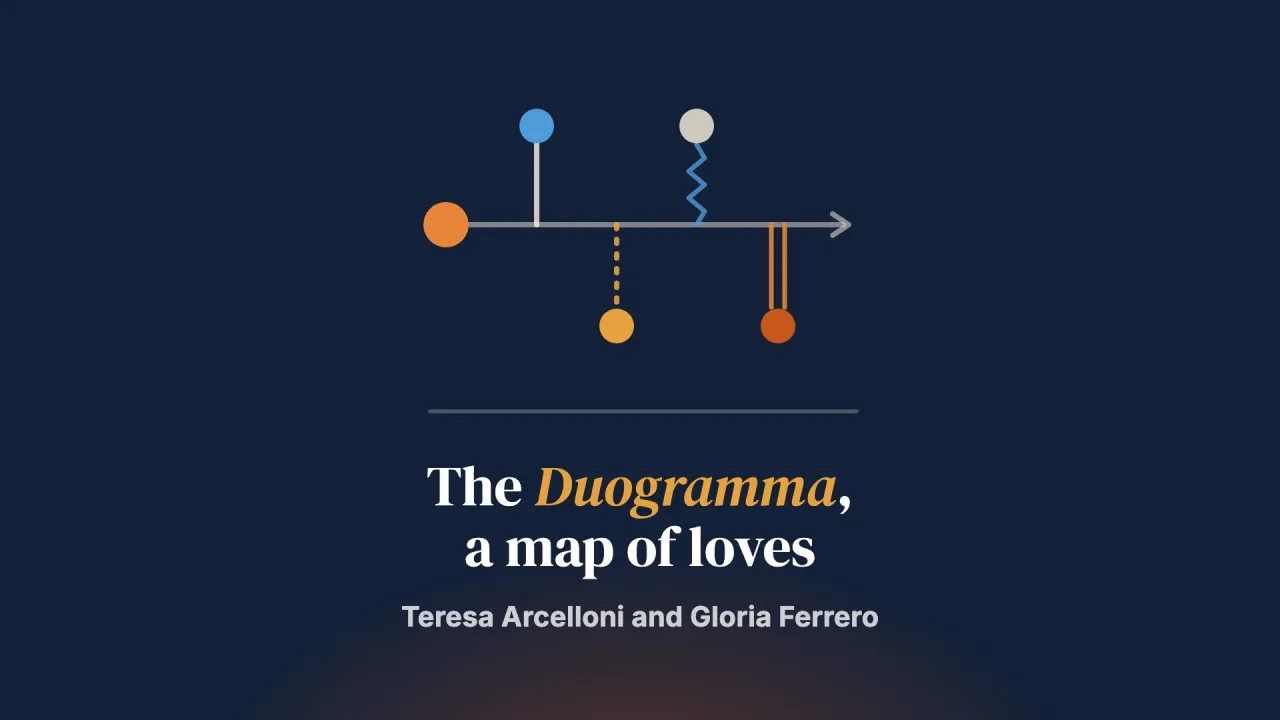
A map of the couple relationships lived, desired or rejected since childhood: the Duogramma®, its graphic rules and its use in individual therapy.
 Blog
Challenging in therapy: What a patient taught me
A couples therapy session led me to reflect on confrontation, authenticity and resonance: how to address difficult behaviour without invalidating the person.
 Scientific
Digital Co-Regulation and Dysregulation in Romantic Relationships: A Systemic Model of Technology-Mediated Emotional Processes
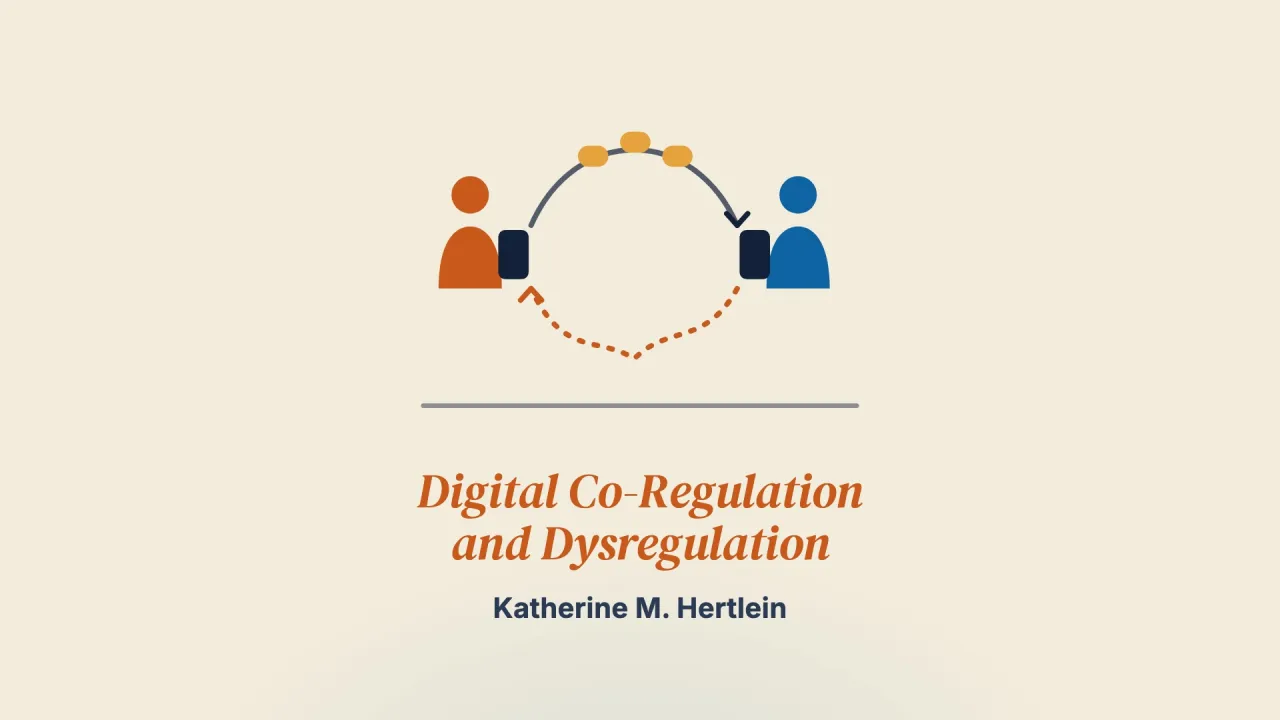
Checking, chasing, blocking: 31 interviews show how the phone regulates or dysregulates a couple’s anxiety, with a systemic model of the loop.
Comments 0
Log in to join the discussion. Log in