British Journal of Learning Disabilities · Narrative therapy
“I'm a man now”: Using Narrative Therapy to support an adult with Down syndrome transition to a new life
After his parents died, Colin, a 36-year-old man with Down syndrome, left the family home for supported living, in the middle of the pandemic. The service asked for work on his “self-confidence”. Alex Lau-Zhu offered nine sessions of Narrative Therapy instead: Tree of Life, outsider witnesses, letters, a definitional ceremony. Staff discover a funny, helpful man full of plans, and conflicts in the house decrease.
This is a reformatted republication of “I'm a man now”: Using Narrative Therapy to support an adult with Down syndrome transition to a new life, by Alex Lau-Zhu and Judith Mann, published in British Journal of Learning Disabilities (Wiley) (2023), doi: 10.1111/bld.12526, under a CC BY 4.0 licence. Prepared by Complexe Systémique in September 2026: the authors’ text is unchanged; the layout has been adapted for reading online, which constitutes a modification of the work under the terms of the licence. The table is presented as a list; the end-of-article declarations are grouped in the notes. This edition was made neither by the authors nor by the publisher, who are not responsible for its content or for any errors. The original version prevails.
Centring Colin's voice meant that he was able to shine a light on his strength-based identity of skills and hopes.
Alex Lau-Zhu and Judith Mann
Abstract
Background. Residential transitions have long been recognised as challenging for people with learning disabilities and can be packed with problem stories. Narrative Therapy practices have the potential to centre the voice of people with learning disabilities; to enable alternative stories to be told; and to shine a light on their own and their support system's resources for change.
Methods. Colin, a 36-year-old man with Down syndrome and a learning disability, met with the first author for nine sessions. Narrative Therapy practices (also drawing on systemic ideas) were used, including the Tree of Life, Outsider Witness Practice, Therapeutic Documentation and Definitional Ceremony. Feedback from Colin and the staff team was gathered through qualitative and quantitative means.
Findings. Colin was keen to share his life stories and explored ideas about his “new life”, wanting to “stay strong” and “stay happy”. Staff noted an improvement in household stress and perceived ability to support Colin. An improvement in quality of life was also demonstrated with a self-report questionnaire.
Conclusions. By acknowledging the power of language, narrative practices offer tools to help people with learning disabilities and their support system in making sense of and navigating important life transitions.
Introduction
This report describes work with Colin, a 36-year-old man with Down syndrome and a learning disability drawing on a range of Narrative Therapy practices (enriched by systemic ideas). Colin attended psychology sessions, which were informed by Narrative Therapy practices (Morgan, 2000; White & Epston, 1990), to support him and the professional system in the transition to supported living and away from his family for the first time. The Tree-of-Life approach was used as a springboard to centre Colin's voice and elevate preferred yet underexplored stories in his “new life”.
I will write from a first-person view in recognition of the importance of self-reflexibility in systemic practice (Rober, 1999), while weaving in reflections on issues of ethics, power, and differences throughout.
1.1 Narrative Therapy
Narrative Therapy is based on the notion that our identities and relationships are shaped by stories that we hold, which in turn depend on available narratives in the wider social, cultural and political contexts (White & Epston, 1990; White, 2007). Certain narratives in society are privileged and thus have power to guide how we make sense of ourselves and the world, whereas other narratives can remain subjugated and silenced, limiting their scope of influence (Foucault, 1975). As everyone's lives are assumed to be multi-storied, a key aim in Narrative Therapy is to access these multiple stories, elevating alternative and preferred narratives for an individual (especially through tellings and re-tellings of these narratives with others). These in turn can open new possibilities for actions and interactions that improve wellbeing. Narrative Therapy is influenced by post-structuralist ideas, which rather than seeing one's identity as fixed or internal, emphasise the dynamic role of language, culture, and broader relationships in continuously shaping it. In practice, this means that a therapist is not considered objective or ‘the expert'; takes seriously that therapeutic conversations can have a powerful effect in (re)shaping identities; and continuously considers the possibility of including others in one's network to support such a process (Thomas et al., 2002). The therapist in Narrative Therapy takes a ‘decentred and influential' posture—the consultee remains the primary author of their life stories through invitations and scaffolding from the therapist (White & Epston, 1990; White, 2007).
Acknowledging the operation of power through narratives is pertinent to people with learning disabilities, whose voices have historically been ignored (Coles & Ellis-Caird, 2019), particularly in a context of entrenched narratives of marginalisation and stigma (Scior & Lynggaard, 2006). It is unsurprising then that the use of narrative practices is common in services for people with learning disabilities in the UK (Kaur et al., 2009), although the evidence base remains relatively small. An emerging body of work showcases the range of ways in which Narrative Therapy practices can help people with learning disabilities, for example, to address challenges with anger and anxiety by honouring stories of strengths and skills (for a review see McParland, 2015).
1.2 The ‘Tree-of-Life' approach
A well-established narrative approach is the ‘Tree of Life’ (Ncube, 2006). This uses the metaphor of a tree (and its parts) to tell the preferred accounts of one's life, which are then shared with others. By giving a clear view of an individual's skills and knowledge and what they give value to, this approach invites them to shed light on their alternative and preferred identities. This approach has been applied to working with children and adults, particularly those who would have traditionally struggled to engage with mainstream talking therapies, for example, asylum seekers (German, 2013), refugees (Schweitzer et al., 2014), African and Caribbean men (Byrne et al., 2011), and Latino families (Méndez & Cole, 2014).
The ‘Tree of Life' is increasingly explored as a therapeutic tool in services for people with learning disabilities as a way to help them make sense of and navigate life challenges. Recent work has described using ‘Tree of Life' groups this way, including a study with four individuals with mild learning disabilities referred for varied difficulties such as mood and behaviour-related issues (Randle-Phillips et al., 2016) and another with six individuals with mild-to-moderate learning disabilities in relation to loss and bereavement (Baum & Shaw, 2015). A recent case study described using the ‘Tree-of-Life' approach (over 10 sessions) with one gentleman with intellectual disabilities also in relation to loss and bereavement and in which two of his carers were invited to witness his tree on the final two sessions (Kubicka & Terry, 2019). Our clinical experience indicates that there are more successful applications of Tree of Life in the learning disability context than are published, which underscore the need for documenting routine use of this approach to help inform the evidence base and promote good practice.
In contrast to other more mainstream therapeutic modalities, a main advantage of the ‘Tree-of-Life' approach is that it focuses on strengths and hopes and is non-pathologizing. Drawing up a tree may also invite creativity and enjoyment, supporting the therapeutic rapport and collaboration especially for individuals—such as those with learning disabilities—who may wish to express themselves through other means beyond words. The inherent use of storytelling also facilitates later sharing with others. A disadvantage (applicable to Narrative Therapy in general) is that it still nevertheless relies on some degree of verbal language to facilitate two-way conversations and thus it is unsuitable for those with minimal or no verbal abilities.
1.3 Transition issues and learning disability
The process of transition for individuals with learning disabilities can be highly complex and challenging (Gauthier-Boudreault et al., 2017). Most researched transitions for this population are related to school (Pallisera et al., 2014; Salt et al., 2019), although other transitions have been increasingly explored, including transitioning from school to post-school life; into older age; changing jobs; and so forth (for recent examples see Strnadová et al., 2021). Residential transitions in particular have long been recognised as posing a major ‘shock' for people with learning disabilities (Coffman & Harris MC, 1980). These entail changes not only in the physical environment but also in new routines, occupations, relationships, and expectations, all of which can lead to stress and require major adjustments (Heller, 1982). Critically, people with learning disabilities often lack control over this process, as it is often initiated by others who become unavailable to support them (Essex et al., 1997). During these transitions, the system's stories may be replete with problems, and the voice of those in transition neglected and ultimately lost.
Residential transitions that involve leaving the parental home unexpectedly (e.g., due to the death of parents) are common in our clinical practice within the learning disability context and often a stimulus for referral. Despite the potential for Narrative Therapy practices to support these transitions, there is a paucity of descriptions of these in the therapeutic literature with people with learning disabilities. In one case study, Hilton (2012) described Sally who recently left her parental home and who was initially referred by the residential home staff for “stealing behaviour”. Through the use of Narrative Therapy, Sally was supported to develop a preferred story about “confidence” and “independent life”, with staff noticing many caring and helpful actions that helped thicken Sally's preferred account of her life. The intervention was appreciated by both Sally and the staff, but quantitative outcomes were not collected.
Transition issues are especially topical given the recent COVID-19 pandemic, where the lives of many people with learning disabilities were dramatically affected by significant disruptions to routine, activities, and social support and contact (Courtenay & Perera, 2020). These issues were all further compounded by the greater risk of infection (Courtenay & Perera, 2020) and comorbidities, including anxiety and loneliness (Lunsky et al., 2022), for people with learning disabilities. Recent reflections about mitigating the impact of COVID-19 for this population have focused on preventing contagion and promoting safety (Taggart et al., 2022) but less so on how to support individuals and their support systems navigate transitions in the context of the disruptions caused by such a pandemic.
1.4 Case description
Colin (pseudonym) is a 36-year-old White British man with a diagnosis of Down syndrome and a learning disability, living in Southeast England. He was referred to a Community Learning Disabilities Service by the manager of his supported living, Jack. In the initial referral, Jack explained that Colin had moved to supported living 2 years ago. Up until his parents' death, Colin had lived in the family home.
Jack described Colin's struggle to settle into supported living and difficulties getting along with his housemate Rachel, who also has a mild learning disability and moved in around the same time. Colin became very upset when Rachel reminded him about no longer living with his own family. Staff found it very challenging to support them living together. Colin became frequently tearful and often talked about wanting to go back home. An intervention for Colin's “self-confidence” was requested.
I met Colin face-to-face for an initial assessment. I was struck by how little he talked about his challenges in supported living. Instead, Colin was keen to tell me about his family. He was eager to talk about the village he used to live in and the things he used to do with his parents. This initial encounter showed me Colin's abilities as a narrator of his life—his skills, strengths, values, hopes and dreams—particularly of stories that may have been lost in this transition.
Method
2.1 Ethics
This case study was part of routine clinical care within an Adult Learning Disabilities Team in the UK National Health Service; therefore formal ethical approval was not required. The authors have abided by the Ethical Principles of Psychologists and Code of Conduct set out by the British Psychological Society and the world principles pertaining to rights and dignity of people set out by the United Nations Convention on the Rights of Persons with Disabilities. The consultee gave written consent for publication. Names, ages, and information on family and professional structures have been changed to preserve confidentiality.
2.2 Case conceptualisation
Colin had moved away from his family for the very first time. ‘Launching' of the children is a key stage in normative models of family life cycles (Carter & McGoldrick, 1988). In Colin's case, this had been “postponed” (Essex et al., 1997) and precipitated by the death of both of his parents within a short span of time, leaving his siblings responsible for planning his care. His sisters were abroad and his older brothers (in their late 50s) had little availability to provide him day-to-day care. The move to supported living may have come as a ‘shock' (Coffman & Harris MC, 1980) for Colin, as he also lost his hometown, his parents, and his day-to-day community life.
The professional system at the supported living house had also been through significant changes—new tenants, new staff, and new management—albeit in the context of the COVID-19 pandemic, which led to three national lockdowns in the span of a year and likely hindered the system's ability to support these changes. Impacts on Colin (and residential staff) included: opportunities for interactions outside of the household were limited; routine and meaningful occupations disrupted; face-to-face visits from family members disallowed; and the mental health and morale of staff and managers undermined.
From a Narrative perspective, I wondered if the prevalent social discourse that sees a learning disability as “tragedy” (Vehmas, 2005) was particularly heightened, given the widespread public fear around the high number of COVID-related deaths for people with learning disabilities. I also wondered if there were unvoiced normative expectations in the system that as an adult in his late 30s, Colin “should” be coping (Gerber, 2011). The referral located the problem in Colin as lacking “self-confidence”, and though this was not his concern, he liked the idea of having a chat with a psychologist. Colin's voice was possibly lost in professional discussions saturated by problem stories during a global pandemic. I was curious about staff's relationship to help (Reder & Fredman, 1996) and whether they would be interested in shining a light on Colin's strengths—and their own expertise—to support him navigate this transition. As a goal, Colin agreed to meet with me initially to share his life stories and what makes him happy. We discussed whether other people could join us later to hear these accounts.
Drawing on systemic ideas about the use of self (Rober, 1999), Colin's transition to a new home resonated with my own predicament about moving abroad away from home for the first time. However, through reflecting on social graces (Burnham, 2018a), I was aware of my privilege in having more control and resources over key life decisions, for example, where to move to and who to live with. I also benefit from dominant discourses about ‘ability' and ‘education' that have given me access to positive meaning, social recognition and ‘well-spoken' language. Acknowledging my own position as a university-educated psychologist, it was important for me to avoid imposing power in our therapeutic conversations (Guilfoyle, 2003) and keeping Colin's voice at the centre. While I connected with the themes of loss, my own experiences of ‘launching' also opened up to new and exciting possibilities as a young adult that otherwise may not have happened had I not moved abroad—therefore I was ‘curious' (Cecchin, 1987) about what these may look like for Colin.
2.3 Content of sessions
Colin and I met nine times over a period of 4 months. Due to COVID-19 restrictions, we met in person while sitting at the garden of his supported living house. I (but not Colin) wore a mask and we sat socially-distanced. Other people were invited throughout the course of our sessions, some in person and others via video call.
Following the ethos of Narrative Therapy of taking a ‘de-centred and influential' posture (White & Epston, 1990; White, 2007), I aimed for each session's content to be fully led by Colin and as informed by reflections shared by his support system. Therefore, key comments provided by Colin and others throughout the sessions were documented within the Methods section to showcase how these progressed and built on those comments. The final feedback by Colin and others about the therapeutic approach as a whole (i.e., by the end of the intervention) was documented within the Results section.
2.3.1 Tree of Life, re-authoring and re-membering
For the first four sessions, Colin and I used the Tree-of-Life approach (Ncube, 2006) to explore Colin's multi-storied life and possible alternative stories to the problem-saturated views described in the referral. From the start, Colin was keen to tell me about where he came from, his parents and his hometown. He also enjoyed drawing, which I thought was well-suited for this approach. I explained the Tree-of-Life metaphor and he was subsequently helped by support workers to complete this in his own time. I invited Colin to tell me the stories in his tree (Table 1) with narrative-informed questions. Rather than following a prescriptive structure (from roots to fruits), I opted to privilege what Colin was most interested in exploring in a given session.
Table 1 — Colin's Tree of Life (Notes).
- Parts of the tree: Roots; Example of guiding questions: Where are you from? What is your family history? Who looked after you? Who taught you things?; Elements from Colin's tree: Live with mum and dad; go to school to learn skills; go to church; horseriding; cooking
- Parts of the tree: Ground; Example of guiding questions: Where do you live and whom with? What do you like doing at home?; Elements from Colin's tree: Living with Rachel and Dan; like drawing; watching football; listening to music; go shopping
- Parts of the tree: Trunk; Example of guiding questions: What are the things you're good at? What talents and special skills do you have? What do you like? What is important to you?; Elements from Colin's tree: Helping out in the office; playing football in the garden; cycling; making people laugh; drawing
- Parts of the tree: Leaves; Example of guiding questions: Who are the most important people in your life?; Elements from Colin's tree: Jack (supported living managers); Melissa, Janet and Ed (support workers); brothers and sisters
- Parts of the tree: Branches; Example of guiding questions: What are your hopes, dreams, wishes and aspirations?; Elements from Colin's tree: Going to trampolining, and to dinosaur park; visit my family; get more DVDs; use the oven
- Parts of the tree: Fruits; Example of guiding questions: What gifts (e.g., kindness and support) have you been given by other people who have been helpful in your life?; Elements from Colin's tree: Be kind; learn skills; to apologise; “be a man”
Colin was particularly energised to talk to me about the things he used to do. We zigzagged between richer descriptions of actions (e.g., “Who taught you these skills?”; “Can you tell me how they taught you?”) and curiosity around meanings (e.g., “Why do you think they taught you these skills?”; “Why would it make them happy to see you use these skills?”), using the re-authoring map (Morgan, 2000; White, 2007) to explore his preferred identity. We engaged in re-membering conversations (Morgan, 2000; White, 2007) to map out Colin's significant relationships from his past life, including with his parents (who had passed away), his siblings, and his teachers, while listening out for ‘continuing bonds' (Klass et al., 1996) within his transition to a new life.
2.3.2 Outsider Witness Practice
An audience bearing witness to the tellings and re-tellings of one's stories is key to promoting the influence of preferred stories over problem stories (White & Epston, 1990). After exploring his tree individually, I suggested to Colin that we invite other people for our next sessions, following the Outsider Witness Practice (Morgan, 2000). I was aware of Jack's management role and thus possibly power in influencing how the professional system would take on some of Colin's ideas, so suggested inviting him in the first instance. Colin was keen to invite his other support workers, two of which were able to attend different sessions (Melissa and Janet). I also invited Judith (part of my team) who worked with narrative and systemic approaches. There were different combinations of witnesses in each session depending on availability.
I was concerned that the professional system, who were the ones making the referral, would have problem-saturated views about Colin's circumstances. To centre Colin's voice, I asked the witnesses to listen to Colin and I have a conversation about his tree; followed by Colin listening to the witnesses comment on what they have heard; and finishing with Colin's comments about what he'd heard from the witnesses (Morgan, 2000). I spoke to the witnesses in preparation and invited them to stay curious and ground their reflections in Colin's language, while abstaining from opinion and advice (Walther & Fox, 2012).
Among comments from the witnesses, Jack was “surprised” to hear that Colin was interested in helping with office work; Janet noted that she had seen Colin and Rachel help each other out and spending time together without fighting, for instance on one occasion they had helped each other with spelling; Melissa commented that Colin had a “sense of humour” and is good at “making people laugh”. Judith was struck by Colin's phrase “I'm a man now”, which gave her “an image of a person determined to figure things out”. Colin said that Jack, Melissa and Janet were “good to me”. I commented to Colin that I got to see a “different side” of him when others joined our sessions, especially his sense of humour when there is a big group of people, as well as his ability to come up with more skills than what we had discussed previously (e.g., knowing how to apologise), which gave me the sense that he really cared about other people. Colin shared that he liked being “cheeky” and he enjoyed that others recognised this in him.
A key feature of working with Colin was the importance of repeated ‘retellings'. For instance, across sessions, Colin would share descriptions of previous episodes where he was “sorting out the envelops” in his dad's office or “cleaning the dishes” in a local community kitchen. Upon hearing some of these stories, Janet was able to share another episode where Colin often took the initiative to “helped with the chores” in his current supported living, for example “sweeping the floor”. For her it meant that it mattered to Colin that he was “helpful to others”, to which Colin nodded and smiled, acknowledging that this account of his values resonated with him. This process illustrates that having other staff acknowledge Colin's stories of his skills and values helped ground his preferred identity by thickening the narrative (Morgan, 2000; White, 2007) with additional details within the landscape of actions (i.e., additional examples of "being helpful") while scaffolding his ability to identify his values within the landscape of meanings (i.e., by hypothesising and naming the underlying value these actions reflected). Repeated ‘re-tellings' therefore were key to move away from an initial story of someone whose “self-confidence” needed fixing at referral, to someone who has many strengths and aspirations as voiced by Colin and witnessed by the staff team.
2.3.3 Therapeutic documentation
Documentation is used as another way to reinforce people's preferred stories and identity descriptions (Morgan, 2000). I wrote four short letters to Colin inviting him to continue to think about our conversations outside of sessions. These included brief summaries and ideas for him to add to his Tree of Life (Table 1), such as the new skills, strengths and commitments that he was able to share with other people (e.g., his “funny” side), and events that contrasted with previous problem stories (e.g., observations of him getting along rather than in conflict with housemate Rachel).
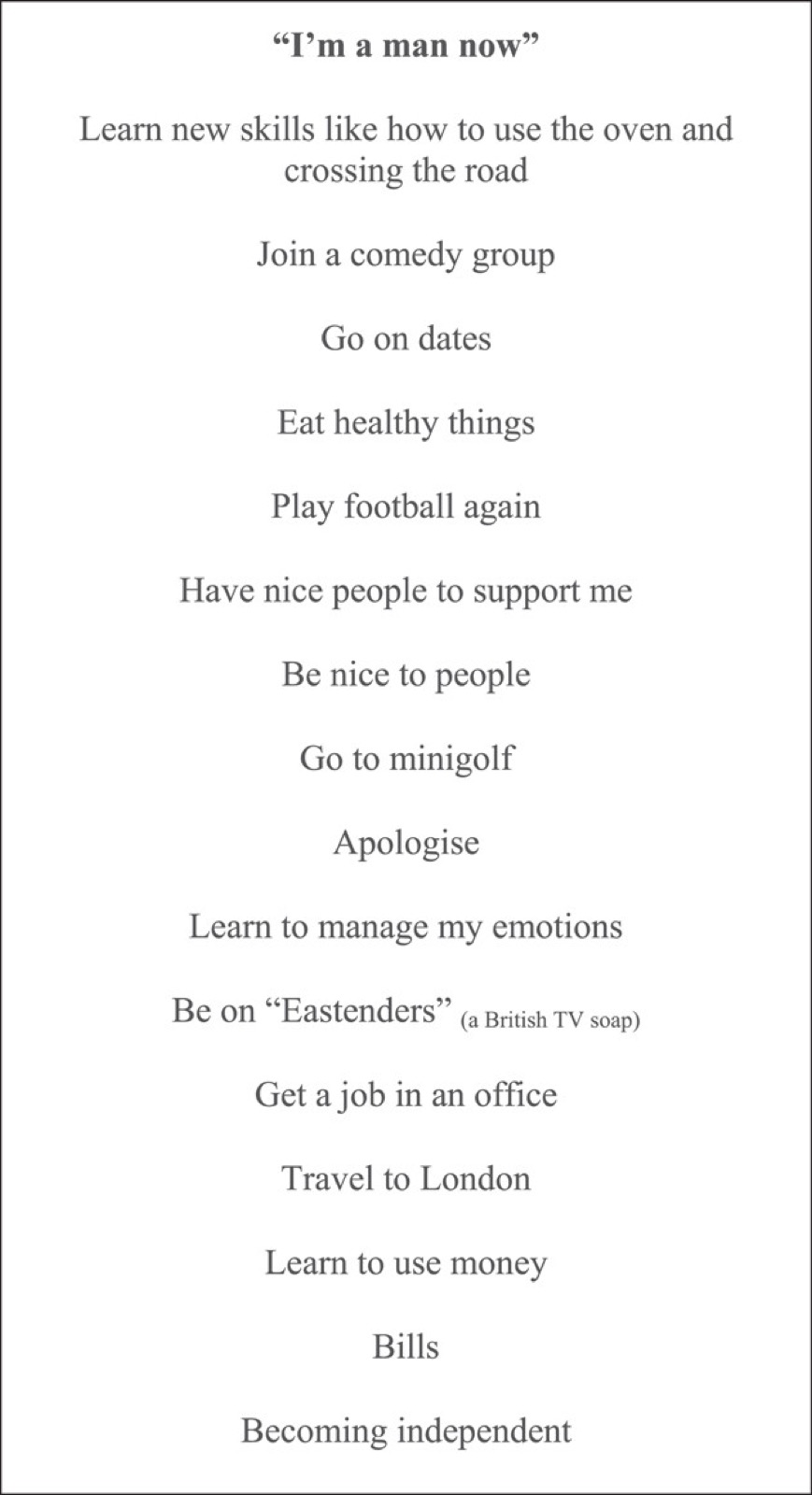
As our conversation with the witnesses (initiated by the Tree of Life) became more focused on Colin's hopes and dreams, I asked whether he would like to consider what it would look like to be “a man now” and live his “new life”—expressions that he used in our conversations. In one letter I started a list based on ideas that I noted and asked if he wanted to expand it (Figure 1).
2.3.4 Definitional ceremony
Rituals can be used to celebrate steps taken to move away from problem stories (Morgan, 2000; White & Epston, 1990). I asked Colin whether he'd like to share his expanded list of hopes and dreams (Figure 1) with his support workers, and Colin said he wanted to invite everyone working with him including staff who had not joined us yet. We followed the same format for witnessing. Colin's initial comments were about wishing to “become independent” and wanting support to learn new skills such as “crossing [the] road”. He also said that he took “things seriously”. Staff first heard what Colin wished for in his “new life”, while we engaged in conversations exploring the effects these would have on him; who he thinks can support him; and why he thought these were important for him.
Among the many reflections, Colin was described as “brave” and “ambitious” and a “deep thinker”. Jack said, “now we know what Colin wants and what we need to do to support him”. Colin liked that staff highlighted his plan to “learn to use money” as this is something that he “really” wanted to do (Figure 1).
2.4 Outcomes
Relational reflexibility (Burnham, 2018b) was used to monitor the sessions' fit to Colin. Ongoing discussions and a final consultation session with the staff team provided feedback on the potential benefits of applying Narrative Therapy practices and the changes observed in supported living. These discussions were supplemented by a quantitative self-report measure of quality of life—the Mini-MANS-Learning Disabilities, or Mini Maslow Assessment of Needs Scales-Learning Disabilities (Raczka et al., 2020)—which was used at the start and end of therapy. This has nine items such as ‘Are you happy with how you spend your time?' and ‘Can you speak up for yourself?'. Answers are provided using a 5-point Likert scale with pictorial and verbal anchors. The score range is 9–45, with lower scores indicating higher quality of life. A recent study showed that this measure has acceptable internal consistency and is deemed acceptable and relatively easy to administer (Raczka et al., 2020).
Results
3.1 Colin's final feedback and quantitative outcome
Throughout the course of therapy, Colin fed-back that he had “liked” the sessions. As we progressed from exploring his past life to ideas about the future, he expressed that it was important for him to “stay strong” and “stay happy” because he now “got a new life”, and that “I'm a man now”. He also commented on several occasions that “people can help me” in response to inviting witnesses and listening to their reflections.
The Mini-MANS-Learning Disabilities showed a drop in score from 17 to 11 from the start to the end of therapy, also indicating an improvement in Colin's overall quality of life.
3.2 Staff's final feedback
The staff team said they experienced a sense of “admiration” for how Colin has engaged in psychology work, and particularly for “seeing Colin focus on the future”. Jack noted that the number of incidents in the supported living house (involving conflict between Colin and Rachel) had decreased both in intensity and frequency (from approximately eight to three times a month). Janet noted that Rachel had started to take an interest in Colin's psychology sessions—for example watching him prepare and rehearse the final presentation of his Tree of Life to the staff team—and perhaps “inspired” to take steps in building her new life in supported living too. Staff overall felt grateful for helping them see Colin's “rich life” and “how to support him moving on”.
Discussion
Narrative Therapy practices (and further drawing on systemic ideas) were applied to support Colin, together with his professional system, transition into his “new life” in supported living. Over the course of nine sessions, the Tree-of-Life approach (Ncube, 2006) was used to invite Colin to thicken the preferred stories of his life (past, present and future) against the backdrop of problem stories of household and staff stress in the context of a global pandemic. We further took inspiration from Narrative Therapy practices of Re-authoring, Re-membering, Outsider Witness Practice, Therapeutic Documentation, and Definition Ceremony (Morgan, 2000; White, 2007). Both qualitative and quantitative indicators suggested improvement in Colin's overall quality of life in supported living, alongside benefits for his relationship with his housemate and for staff's perceived ability to support him moving forward. In line with Colin's initial goal for our sessions, he was able to share his stories as staff now are more aware of his “rich life”.
Overall, this case adds to the emerging published literature on the use of narrative approaches for clinical benefits in individuals with learning disabilities (McParland, 2015). This limited evidence base is somehow striking given the clear relevance of these approaches for addressing pertinent issues of power and marginalisation within the learning disability context and anecdotal evidence that these are routinely used in healthcare services in the UK (Kaur et al., 2009). Specific to issues of residential transition after leaving the parental home unexpectedly, this case study echoes a previous application of Narrative Therapy (Hilton, 2012), where by centring the voice of a woman with learning disability, a preferred account was developed of her giving value to an “independent life” with staff recognising her strengths and aspirations. As we suspect many successful applications of narrative techniques go unpublished due to the time demands of clinical work, we hope this case (with our attempts to carefully describe the development of our sessions and the rationale behind our key decisions) goes one step further to encourage future applications and dissemination of this therapeutic approach.
4.1 A systemic narrative approach
Narrative approaches have often been criticised as taking an individual-based approach focused on discourse and language while perhaps neglecting a truly systemic approach typically involving more than one person in the room (Dallos & Draper, 2010). The Tree-of-Life approach was initially conceived as a community-based project (Ncube, 2006) and an initial adaptation to a learning disability context has involved sharing stories between service users (Randle-Phillips et al., 2016). The application of Tree of Life with Colin was adapted for one individual with learning disability but still informed by the theoretical underpinnings of narrative work, especially the central role of an audience in acknowledging one's preferred stories (Morgan, 2000; White & Epston, 1990; White, 2007). In a learning disability context, I was aware that it would be crucial to somehow involve Colin's system as this would most likely maximise the dissemination of his preferred stories, reduce the influence of problem stories overall, and therefore creating possibilities for new actions and interactions through those that have power to intimately influence his everyday life—in this case his staff team (Baum & Lynggaard, 2006).
This approach was deemed useful not only for Colin and staff, but also possibly for his housemate Rachel, who may have become “inspired” by Colin's journey. Consistent with the ethos of Narrative Therapy, our conversations were led by what Colin was interested in being the narrator of. This meant that the original stimulus of the referral (i.e., the challenging relationship with his housemate Rachel) was not the central focus initially, because he did not bring this up as what he wanted to talk about. Centring Colin's voice meant that he was able to shine a light on his strength-based identity of skills and hopes, which would have provided a safe place to stand when witnesses brought this issue up. Anchored by Colin's preferred identity, staff were also able to spontaneously note unique instances contrary to a problem-saturated account of conflict (i.e., observing that Colin and Rachel had been helping each other out and spending time without arguing), which could have increased their confidence in managing this relationship. There may well be wide-ranging and unintended benefits that will continue to yield as Colin's preferred stories expand through this system and associated networks.
4.2 Self-reflexibility, power and differences
The evidence base for Narrative Therapy with people with learning disabilities remains in its infancy. In the absence of gold-standard protocols in this area, I have learned that a great deal of flexibility and creativity—fully embracing a trial-and-error approach—is likely to be necessary to fully exploit the benefits of Narrative Therapy. Some well-established Narrative Therapy practices appear to be particularly useful for working with people with learning disabilities, including the use of prompts (e.g., Tree of Life) to visually scaffold our conversations and the use of therapeutic documents to help summarise ideas. Nevertheless, prototype questions derived from narrative maps (White, 2007) may need to be distilled and rephrased with much simpler and more concrete language, broken down into several shorter questions, and revisited later if the question is not being understood at a given time. Some stories may need to be repeated several times. The conversations may not always be linear, as previously acknowledged in the application of these practices with people with learning disabilities (Hilton, 2012). In the midst of the ‘messiness', I have found helpful the use of humour and a willingness to stumble. Including my clinical supervisor as an outsider witness in session was useful both for in-vivo observation and post-session supervision to reflect on dilemmas around when to persist with a particular line of questioning and when to abandon it, while keeping Colin's voice at the centre of all conversations.
Adapting therapeutic language in Narrative Therapy is also theoretically motivated as language is thought to be a key mechanism for power's operation (Foucault, 1975). Complex yet unhelpful language in therapy with people with learning disabilities can serve to enhance power differentials between therapists and service users (Guilfoyle, 2003) and thus is another platform for further marginalisation. In this context I have found a ‘not-knowing' stance especially pertinent as a reminder that Colin is the ‘expert' of his own life (Anderson & Goolishian, 1992), and thus the imperative to enable him to tell his own stories. This also applies to the use of the witnesses, and thus careful preparation is required (Walther & Fox, 2012), including careful scaffolding and redirection if the witnesses' comments are infused with well-intentioned opinions and judgements that nevertheless de-centre Colin's voice. Key was to be continuously attentive to what gave value to Colin's life, whichever tangent the conversation went off to. Further guidance in the literature on how to apply the range of Narrative Therapy practices across different learning disability contexts will be welcomed.
4.3 Strengths and limitations
A particular strength of this case is the demonstration of how the Tree-of-Life approach, which is often done in group contexts, can be specifically adapted to support one individual with a learning disability by drawing on additional Narrative Therapy practices (e.g., Outsider Witnesses) and systemic ideas. It also describes a case of using Narrative Therapy on transition issues relatively less discussed in the learning disability literature, including leaving the parental home unexpectedly and recent disruptions by the COVID-19 pandemic. Another important feature is the use of both qualitative and (validated) quantitative outcomes and collected from different stakeholders, highlighting this approach's usefulness as seen by the system.
There were some limitations too. As this is a case study it may not be generalisable, although it adds to recent evidence on the applicability of Narrative Therapy to support residential transitions for people with a learning disability (e.g., Hilton, 2012). The benefits observed may at least be partly explained by the easing of restrictions imposed by the COVID-19 pandemic rather than just the narrative sessions. There was insufficient published information available to calculate reliable changes in the quantitative measure considered (Jacobson & Truax, 1991), so further work may wish to consider additional easy-to-use measures of wellbeing. Witnesses could have also included other people in Colin's system, for example his family, though there were practical (e.g., differences in time zones with those living abroad) and pragmatic constraints (e.g., potential conflicts that may arise between family and staff).
4.4 Future directions
Building on our case study, many other applications of Narrative Therapy practices remain to be explored, which could include adapting the Tree-of-Life approach for individual work with those with moderate levels of disability (as long as they possess verbal skills that allow them to engage in back-and-forth conversations); using Narrative Therapy practices for other forms of transitions within disruptions caused by COVID-19 or similar contexts; including experts by experience such as other people with learning disabilities and/or Down syndrome (who have lived experiences of similar transitions) as outsider witnesses; co-authoring the published work with people with learning disabilities (as in Kubicka & Terry, 2019); and developing guidance for adapting the language and format of various narrative practices within learning disability services to promote research and dissemination of these approaches. As the use of Narrative Therapy widens, its effective, creative and ethical applications will continue to hinge on a deep understanding of the theoretical basis and how its therapeutic stance differs from other more mainstream therapeutic modalities.
Conclusions
By acknowledging the power of language, Narrative Therapy offers tools to help people with learning disabilities and their support system in making sense of and navigating important life transitions. Centring their voices can open up novel opportunities for actions and interactions in line with their preferred stories, which would in turn enhance their wellbeing. This approach also promotes a respect for the ability of people with learning disabilities to be the narrators of their own lives, and as in Colin's words-to take things “seriously”.
Complexe Systémique: key points
The strength of this case report is to show that a referral can be shifted without being ignored. Colin was referred for a lack of “self-confidence” and for arguments with his housemate; therapy starts from what he wants to tell, his family, his village, his skills, and the conflict eases almost as a by-product. The decisive systemic move is the audience: by inviting the manager and staff as outsider witnesses, the narrative therapist circulates the preferred story where Colin's daily life is decided, and staff begin to notice exceptions to the problem on their own. For clinicians, the article offers concrete pointers for adapting narrative maps to learning disability: simple, broken-down, revisited questions, visual prompts, letters. The limits are those of a single case, with no reliable change measure, at a time when the easing of lockdown may have mattered as much as the sessions. Read alongside the article on the Tree of Life in a women's group with fibromyalgia, and the case study on family-systemic conversations around a child with intellectual disability.
Notes from the original
Acknowledgements. We are grateful to Colin (anonymised) and his support system for the opportunity to conduct this piece of work. ALZ was funded by the Oxford Health NHS Foundation Trust for professional doctoral training in clinical psychology.
Conflicts of interest statement. The authors declare no conflicts of interest.
References
Anderson, H., & Goolishian, H. (1992). The client is the expert: A not-knowing approach to therapy. In S. McNamee & K. J. Gergen, (Eds.), Therapy as social construction (pp. 25–39). Sage Publications, Inc.
Baum, S., & Lynggaard, H. (2006). Intellectual disabilities: A systemic approach. Karnac Books.
Baum, S., & Shaw, H. (2015). The tree of life methodology used as a group intervention for people with learning disabilities. FPID bulletin: The bulletin of the faculty for people with intellectual disabilities, 13(1), 14–19.
Burnham, J. (2018a). Developments in social GRRRAAACCEEESSS: Visible-invisible and voiced-unvoiced, In Culture and Reflexivity in systemic psychotherapy: Mutual perspectives (pp. 139–160). Taylor and Francis. https://doi.org/10.4324/9780429473463-7
Burnham, J. (2018b). Relational reflexivity: A tool for socially constructing therapeutic relationships. The space between: Experience, context, and process in the therapeutic relationship, 1–17. https://doi.org/10.4324/9780429483295-1
Byrne, A., Warren, A., Joof, B., Johnson, D., Casimir, L., Hinds, C., Mittee, S., Jeremy, J., Afilaka, A., & Griffiths, S. (2011). “A powerful piece of work”: African and Caribbean men talking about the “tree of life. Context, 40–45.
Carter, B., & McGoldrick, M. (1988). The changing family life cycle: A framework for family therapy ( 2nd ed.). Gardner Press.
Cecchin, G. (1987). Hypothesizing, circularity, and neutrality revisited: An invitation to curiosity. Family Process, 26(4), 405–413. https://doi.org/10.1111/j.1545-5300.1987.00405.x
Coffman, T. L., & Harris MC, Jr. (1980). Transition shock and adjustment of mentally retarded persons. Mental Retardation, 18(1), 3–7.
Coles, S., & Ellis-Caird, H. (2019). Whose story is it anyways? A narrative approach to working with people affected by learning disabilities, their families and networks. In V. Jones & M. Haydon-Laurelut, (Eds.), Working with people with learning disabilities: Systemic approaches. Macmillan International.
Courtenay, K., & Perera, B. (2020). COVID-19 and people with intellectual disability: Impacts of a pandemic. Irish Journal of Psychological Medicine, 37(3), 231–236. https://doi.org/10.1017/IPM.2020.45
Dallos, R., & Draper, R. (2010). An introduction to family therapy: Systemic theory and practice ( 3rd ed.). Open University Press.
Essex, E. L., Seltzer, M. M., & Krauss, M. W. (1997). Residential transitions of adults with mental retardation: Predictors of waiting list use and placement. American Journal of Mental Retardation, 101(6), 613–629.
Foucault, M. (1975). The archaeology of knowledge. Tavistock.
Gauthier-Boudreault, C., Gallagher, F., & Couture, M. (2017). Specific needs of families of young adults with profound intellectual disability during and after transition to adulthood: What are we missing? Research in Developmental Disabilities, 66, 16–26. https://doi.org/10.1016/J.RIDD.2017.05.001
Gerber, P. J. (2011). The impact of learning disabilities on adulthood: A review of the evidenced-based literature for research and practice in adult education. Journal of Learning Disabilities, 45(1), 31–46. https://doi.org/10.1177/0022219411426858
German, M. (2013). Developing our cultural strengths: Using the “tree of life” strength-based, narrative therapy intervention in schools, to enhance self-esteem, cultural understanding and to challenge racism. Educational and Child Psychology, 30(4), 75–99.
Guilfoyle, M. (2003). Dialogue and power: A critical analysis of power in dialogical therapy. Family Process, 42(3), 331–343. https://doi.org/10.1111/J.1545-5300.2003.00331.X
Heller, T. (1982). The effects of involuntary residential relocation: A review. American Journal of Community Psychology, 10(4), 471–492. https://doi.org/10.1007/BF00893984
Hilton, A. (2012). “Moving things to independent life”: The influence of narrative therapy on working with a woman affected by learning disabilities. Clinical Psychology & People with Learning Disabilities, 10(2).
Jacobson, N. S., & Truax, P. (1991). Clinical significance: A statistical approach to defining meaningful change in psychotherapy research. Journal of Consulting and Clinical Psychology, 59(1), 12–19. https://doi.org/10.1037//0022-006X.59.1.12
Kaur, G., Scior, K., & Wilson, S. (2009). Systemic working in learning disability services: A UK wide survey. British Journal of Learning Disabilities, 37(3), 213–220. https://doi.org/10.1111/J.1468-3156.2009.00553.X
Klass, D., Silverman, P. R., & Nickman, S. L. (1996). Continuing Bonds: New Understandings of Grief. Taylor & Francis.
Kubicka, J., & Terry, A. (2019). “I love life”: The Tree of Life metaphor used in bereavement work with a gentleman who is affected by intellectual disabilities. FPID Bulletin: The Bulletin of the Faculty for People with Intellectual Disabilities, 17(3), 9–15.
Lunsky, Y., Jahoda, A., Navas, P., Campanella, S., & Havercamp, S. M. (2022). The mental health and well-being of adults with intellectual disability during the COVID-19 pandemic: A narrative review. Journal of Policy and Practice in Intellectual Disabilities, 19(1), 35–47. https://doi.org/10.1111/JPPI.12412
McParland, J. (2015). Narrative therapy in a learning disability context: A review. Tizard Learning Disability Review, 20(3), 121–129. https://doi.org/10.1108/TLDR-08-2014-0028
Méndez, G. A., & Cole, E. M. (2014). Engaging Latino families in therapy: Application of the Tree of Life technique. Journal of Family Psychotherapy, 25(3), 209–224. https://doi.org/10.1080/08975353.2014.939932
Morgan, A. (2000). What is Narrative therapy? An easy-to-read introduction. Dulwich Centre Publications.
Ncube, N. (2006). The Tree of Life project. International Journal of Narrative Therapy and Community Work, 1(1), 3–16.
Pallisera, M., Vilà, M., & Fullana, J. (2014). Transition to adulthood for young people with intellectual disability: Exploring transition partnerships from the point of view of professionals in school and postschool services. Journal of Intellectual & Developmental Disability, 39(4), 333–341. https://doi.org/10.3109/13668250.2014.938032
Raczka, R., Theodore, K., & Williams, J. (2020). An initial validation of a new quality of life measure for adults with intellectual disability: The Mini-MANS-LD. Journal of Intellectual Disabilities, 24(2), 177–193. https://doi.org/10.1177/1744629518787895
Randle-Phillips, C., Farquhar, S., & Thomas, S. (2016). Adapting and evaluating a Tree of Life group for women with learning disabilities. British Journal of Learning Disabilities, 44(4), 301–308. https://doi.org/10.1111/BLD.12166
Reder, P., & Fredman, G. (1996). The relationship to help: Interacting beliefs about the treatment process. Clinical Child Psychology and Psychiatry, 1(3), 457–467. https://doi.org/10.1177/1359104596013012
Rober, P. (1999). The therapist's inner conversation in family therapy practice: Some ideas about the self of the therapist, therapeutic impasse, and the process of reflection. Family Process, 38(2), 209–228. https://doi.org/10.1111/J.1545-5300.1999.00209.X
Salt, E., Melville, C., & Jahoda, A. (2019). Transitioning to adulthood with a mild intellectual disability-Young people's experiences, expectations and aspirations. Journal of Applied Research in Intellectual Disabilities, 32(4), 901–912. https://doi.org/10.1111/JAR.12582
Schweitzer, R. D., Vromans, L., Ranke, G., & Griffin, J. (2014). Narratives of healing: A case study of a young Liberian refugee settled in Australia. The Arts in Psychotherapy, 41(1), 98–106. https://doi.org/10.1016/J.AIP.2013.10.006
Scior, K., & Lynggaard, H. (2006). New stories of intellectual disabilities: A narrative approach. In S. Baum & H. Lynggaard, (Eds.), Intellectual disabilities: A systemic approach. Karnac Books.
Strnadová, I., Loblinzk, J., & Wehmeyer, M. L. (2021). Transitions in lives of people with intellectual disability. British Journal of Learning Disabilities, 49(3), 263–270. https://doi.org/10.1111/BLD.12413
Taggart, L., Mulhall, P., Kelly, R., Trip, H., Sullivan, B., & Wallén, E. F. (2022). Preventing, mitigating, and managing future pandemics for people with an intellectual and developmental disability - Learnings from COVID-19: A scoping review. Journal of Policy and Practice in Intellectual Disabilities, 19(1), 4–34. https://doi.org/10.1111/JPPI.12408
Thomas, L., Gooden, B., Russell, S., Carey, M., Combs, G., Chamberlain, S., White, M., Gremillion, H., & Tamasese, K. (2002). Poststructuralism and therapy – What's it all about? International Journal of Narrative Therapy and Community Work, 2. https://dulwichcentre.com.au/wp-content/uploads/2015/07/postructuralism-and-narrative-therapy-.pdf
Vehmas, S. (2004). Ethical analysis of the concept of disability. Mental Retardation, 42(3), 209–222.
Walther, S., & Fox, H. (2012). Narrative therapy and outsider witness practice: Teachers as a community of acknowledgement. Educational and Child Psychology, 29(2), 10–19.
White, M. (2007). Maps of Narrative Practice. Norton.
White, M., & Epston, D. (1990). Narrative means to therapeutic ends. Norton.
Reformatted republication of “I'm a man now”: Using Narrative Therapy to support an adult with Down syndrome transition to a new life, by Alex Lau-Zhu and Judith Mann, British Journal of Learning Disabilities, vol. 51, no 4 (2023), doi: 10.1111/bld.12526, under a CC BY 4.0 licence. Edition and layout: Complexe Systémique, September 2026 — the work has been modified under the terms of the licence (table presented as a list). Neither the authors nor the publisher are responsible for this edition; the original version prevails.
This is the original article ““I'm a man now”: Using Narrative Therapy to support an adult with Down syndrome transition to a new life”, published in British Journal of Learning Disabilities (2023) under a CC BY 4.0 licence. Republished by Complexe Systémique: the author’s text is unchanged; only the presentation has been adapted for reading online, as set out at the head of this page.
Read the original articleHow to cite this article
Lau-Zhu, A., et Mann, J. (2023). “I'm a man now”: Using Narrative Therapy to support an adult with Down syndrome transition to a new life. Complexe Systémique. https://app.complexe-systemique.com/en_GB/articles/i-m-a-man-now-using-narrative-therapy-to-support-an-adult-with-down-syndrome-transition (Original work published in 2023 in British Journal of Learning Disabilities, 51(4), 577-585 (2023); republished in 2023 by British Journal of Learning Disabilities, https://onlinelibrary.wiley.com/doi/10.1111/bld.12526)
To go further
- L’usage de l’Arbre de vie dans un groupe de femmes atteintes de fibromyalgieThe Tree of Life in a group.
- Gagner en légèreté au quotidien avec un enfant ayant une déficience intellectuelle grâce aux conversations thérapeutiques familiales systémiques : une étude de cas unique exploratoireIntellectual disability and family.
- Commencer le chemin de la guérison : réécrire l’histoire de la perte violente par le travail de groupe narratif de l’Arbre de vieThe Tree of Life and grief.
Related training courses
 Short course
The power of rituals in couple therapy: a systemic intervention method
Online training: using ordinary, constitutive and performative rituals as a systemic intervention method in couple therapy. Delivered in French.
 Online course
Master the art of narrative therapy: a unique journey with Charlie Crettenand
Immersive online course: discover the narrative approach with Charlie Crettenand. A unique audiovisual journey, lifetime access, exercises. In French, with English subtitles.
Related articles
 Scientific
Family group conference provision across the lifespan of child welfare intervention: A mixed-method realist-informed evaluation comparing three stages of welfare concern
Early help, child protection or children in care: among 155 UK families, experiences and outcomes of family group conferences vary very little by stage.
 Scientific
How can we BeST? meet the needs of adoptive families? Relevant findings from a major Randomised Controlled Trial of infants in foster care in the UK
The BeST? trial (488 infants in care in the UK) reread for adoption: holistic, ongoing assessment of children and a move to dual registration.
 Scientific
Implementing Family Group Decision-Making within statutory child protection social work in Scotland: Challenges and opportunities
Family group decision-making offered automatically in Scottish child protection: families find a voice, social workers doubt the plans, and everyone wants it offered earlier.
 Scientific
Collaborative Polyphonic Writing as Therapeutic Practice: A Longitudinal Case Study
A patient and her therapist co-write her autobiography: the psychiatric diagnosis becomes one voice among others, coordinated by an “I as a writer”.