Family Relations · Family
Latent profiles of dyadic parent–child interaction and associations with triadic family interaction in early childhood
When a 4-month-old baby and their father share little positive affect, the whole family coordinates less well a year later. Drawing on 120 Finnish families filmed in dyads and then in the Lausanne Trilogue Play, Johanna Lindstedt’s team identifies four profiles of parent–child interaction and shows that the father–child dyad weighs more heavily than the mother–child dyad on family coordination.
This is a reformatted republication of Latent profiles of dyadic parent–child interaction and associations with triadic family interaction in early childhood, by Johanna Lindstedt, Sari Ahlqvist‐Björkroth, Niina Junttila and Riikka Korja, published in Family Relations (Wiley) (2024), doi: 10.1111/fare.13041, under a CC BY 4.0 licence. Prepared by Complexe Systémique in September 2026: the authors’ text is unchanged; the layout has been adapted for reading online, which constitutes a modification of the work under the terms of the licence. Tables are presented as lists; the online supplementary material is not reproduced. This edition was made neither by the authors nor by the publisher, who are not responsible for its content or for any errors. The original version prevails.
Well-functioning parent–child interaction contributes to higher-quality triadic family interaction.
Johanna Lindstedt, Sari Ahlqvist‐Björkroth, Niina Junttila and Riikka Korja
Abstract
Objective. This longitudinal study examined latent profiles of parent–child interaction and their associations with triadic family interaction.
Background. A child's development is significantly influenced by early family relationships. Family systems theory emphasizes the interrelations between family subsystems, such as parent–child and parent–parent relationships, as well as the family as a whole. However, few studies have examined the relationship between each parent–child dyad and triadic family interaction.
Method. Fathers and mothers were separately videotaped interacting with their child (n = 120) at 4 and 18 months and assessed using the Parent–Child Early Relational Assessment. Triadic family interaction was evaluated at 18 months using the Family Alliance Assessment Scale within a Lausanne Trilogue Play setting.
Results. Four latent profiles of parent–child interaction were identified. Dyadic interaction that was characterized by reciprocity, positive affect, and low negativity was associated with higher family coordination. However, interaction characterized by a lack of reciprocity, negativity, and dyadic tension was related to less coordinated triadic family interaction.
Conclusions. Well-functioning parent–child interaction contributes to higher-quality triadic family interaction. In contrast, challenges in early father–child interaction, including emotional distance, a lack of positive paternal involvement, and limited mutual engagement, are linked to lower-quality triadic family interaction.
Implications. This study highlights the importance of supporting early parent–child relationships to promote well-functioning and coordinated triadic family interaction, and the inclusion of fathers in interventions aiming to improve family dynamics.
Family interaction provides a fundamental context for early child development. Parents play a crucial role as interactive partners for the child (Bretherton, 2010), and each parent–child relationship has unique and distinct interactional patterns (Bowlby, 1982; Grossmann et al., 2002; Kochanska & Kim, 2013). During daily interactions in two-parent families, children are exposed to triadic situations, in addition to dyadic parent–child interactions. According to the family systems view, each individual in the family is a member of various family subsystems, such as father–child, mother–child, marital, and coparental subsystems (Cox & Paley, 1997, 2003; Minuchin, 1985). These interactional subsystems are interrelated and affect each other (Cox & Paley, 1997; McHale & Rasmussen, 1998).
Extensive family research has been conducted on marital and coparental subsystems and their associations with other family systems. Regarding family interaction, there seem to be interrelations. Maternal, but not paternal, marital satisfaction during pregnancy and postpartum is linked to well-functioning family interaction (Korja et al., 2016). A decline in marital quality may interfere with the coparenting relationship and, further, the whole-family interaction (Christopher et al., 2015). However, we have considerably less knowledge about how other subsystems, such as parent–child dyads, relate to triadic family interaction. To address this gap, the present study examines how the quality of father–child and mother–child interactions individually contribute to the quality of triadic family interaction in two-parent heterosexual families.
In the present study, triadic family interaction is conceptualized as family alliance and coordination based on the family alliance model (Favez et al., 2017; Fivaz-Depeursinge & Corboz-Warnery, 1999). Triadic family interaction can be examined in the Lausanne Trilogue Play (Fivaz-Depeursinge & Corboz-Warnery, 1999) setting, which enables the assessment of the family's resources for effective coping and coordination with each other while completing a task together (Fivaz-Depeursinge & Corboz-Warnery, 1999). Achieving a family alliance with a high level of coordination requires the fulfillment of four hierarchical interactive functions (Favez et al., 2017). Successful interaction requires that all participants are actively involved and available, roles are appropriately defined and maintained, and family members share joint attention and positive affect. The more these functions are fulfilled, the higher the level of coordination and consequently the quality of the family alliance (Frascarolo et al., 2004; Tissot et al., 2014). Family alliance types can be categorized as cooperative, conflicted, or disordered, representing different levels of family coordination (Favez et al., 2017). In cooperative families with high cohesion, all family members are involved, and the autonomy of each family member is respected (Feldman, 2007). Interaction in conflicted families is characterized by interference and competition, whereas in disordered families, one family member is systematically excluded from the interaction (Favez et al., 2017).
The family alliance begins to develop during pregnancy and shows stability during the first years of the child's life (Favez, Frascarolo, & Fivaz-Depeursinge, 2006; Tissot et al., 2015). Additionally, the quality of triadic family interaction has consequences for children's emotional and cognitive developmental outcomes (Favez, Frascarolo, Carneiro, et al., 2006; Feldman & Masalha, 2010; McHale & Rasmussen, 1998). It therefore provides a stable relational context in which the child learns social skills, emotion regulation, and develops an understanding of inner states (e.g., Favez et al., 2012). Cooperative family alliance has been linked to better child outcomes between ages 18 months and 5 years in terms of social skills, theory of mind, and understanding of inner states (Favez, Frascarolo, Carneiro, et al., 2006, 2012). However, problems in the parental unit appear to be related to adverse child outcomes (Jacobvitz et al., 2004; McHale, 1997), and conflicted and disordered family alliances have been considered problematic (Carone, 2022). Because the family alliance seems to stabilize very early (Favez, Frascarolo, & Fivaz-Depeursinge, 2006; Tissot et al., 2015) and is important for the later child development (e.g., Favez et al., 2012; Feldman & Masalha, 2010), identifying antecedents of well-functioning family interaction is crucial.
The triadic father–mother–child interaction is uniquely constituted and has its own dynamics, and the behavior of family members in a triad may not reflect their behavior in the dyad (Bureau et al., 2021). Parents' behavior and affect expression appear to differ in dyadic and triadic situations (Kwon et al., 2012), and marital distress may intensify this tendency (Lauretti & McHale, 1997). Thus, the mere presence of the other parent affects the behavior of each member of the dyad and the quality of emotional exchange (Clarke-Stewart, 1978). For example, parents are more sensitive when playing with their child in the presence of the other parent, especially when the family coordination is high (Udry-Jørgensen et al., 2016). Furthermore, in distressed relationships, mothers' sensitivity toward their toddler and fathers' involvement show a deeper decline in the triadic context compared to the dyadic one (Lauretti & McHale, 2009). Despite these observed associations, there is a limited number of studies investigating the relationship between parent–child subsystems and triadic family interaction.
Like the studies mentioned above, the majority of related research has focused on parental sensitivity and its associations with triadic family interaction. It has been shown that high maternal and paternal sensitivity are related to family cohesion and a cooperative family alliance, especially during the first few months of a child's life (Feldman, 2007; Tissot et al., 2015). However, few studies have examined how other aspects of the dyadic parent–child relationship are related to triadic family interaction. One such study showed that in families with high cohesion, dyadic parent–child interactions are more reciprocal and synchronous (Feldman, 2007). On the other hand, parental intrusiveness, which represents restrictive, dominating, and directive parental behavior in the interaction, was associated with a rigid family style, characterized by competition and interruption (Feldman, 2007). In these families, infants also showed higher negative emotionality during dyadic interaction (Feldman, 2007). Another study, using a longitudinal design, showed that fathers who had higher-quality dyadic interactions (i.e., mutuality, smooth communication, and emotionally positive atmosphere) with their 18-month-old child had higher-quality interactions with their spouse in the triadic interaction situation when the child was 6 years old (Bernier et al., 2023). These findings align with the family systems view, suggesting that dyadic subsystems affect higher order family processes. To summarize, the existing literature has primarily focused on various aspects of the family interaction (e.g., coparenting, family cohesion, family alliance), the parent–parent relationship not involving the child, and parent–child relationships (e.g., child–parent attachment, parental sensitivity). To gain a more thorough understanding of the child's early social environment, we should extend our examination into the interplay between triadic family relations and dyadic relationships. The active contribution of each family member should be included in the assessment when examining family relationships at the dyadic or triadic level.
In addition to triadic family relationships, dyadic parent–child interaction is a complex and dynamic process involving the interplay of parental behavior, child behavior, and dyadic coordination (Beebe et al., 2010; Tronick, 2007), and all of these dimensions should be considered simultaneously. Furthermore, it is essential to recognize that children have the capacity to engage in dyadic and triadic interaction from the very beginning of their life (Fivaz-Depeursinge et al., 2005; McHale et al., 2008; Rochat et al., 2002). Therefore, research should involve the child as a significant interaction partner, rather than solely concentrate on parental behaviors, as both the child and parents significantly affect each other. The present study goes beyond assessing parental caregiving sensitivity and adopts a more profound perspective to evaluate the quality of the parent–child relationship. By utilizing a person-oriented analysis strategy (i.e., latent profile analysis), the study simultaneously examines different dimensions of dyadic parent–child interaction. Importantly, the child's interactive behavior is considered when assessing both dyadic and triadic interactions, representing a clear step forward in the study design. By employing observational measures and a family systems approach, the present study responds to the challenges within the field of family research and offers a more nuanced understanding of parenting and family relationships.
The present study examines the relationship between dyadic parent–child interaction and triadic family interaction during early childhood. Our first aim is to identify subgroups of parent–child dyads with similar interaction profiles by using latent profile analysis. We examine dyadic parent–child interaction at two time points: when the child is 4 months old and 18 months old. Second, we aim to examine whether and how these dyadic interaction patterns individually contribute to the quality of triadic family interaction when the child is 18 months old. To our knowledge, this approach, using latent profile analysis, has not been previously used to explore the relationship between dyadic parent–child interaction and triadic family interaction. Traditional variable-oriented approaches typically focus on individual dimensions of parent–child interaction, which are rarely examined together. Consequently, we lack an understanding of how these qualities are uniquely combined in different groups of parent–child dyads. By using an exploratory approach, that is, latent profile analysis, we can acquire more nuanced information that complements findings based on more traditional approaches.
METHOD
Participants
The present study is part of a multidisciplinary longitudinal cohort study, Steps to the Healthy Development and Well-being of Children (the STEPS Study; Lagström et al., 2013). The study procedure was approved by the Ministry of Social Affairs and Health and the Ethics Committee of the Hospital District of Southwest Finland on February 27, 2007. From the total cohort population (N = 9,811) of all families expecting a child between 2007 and 2009 in the Southwestern Finland Health Care District, 1,387 mothers and 1,325 fathers participated in the original follow-up study. Parents provided written consent after their first maternity clinic visit and completed several questionnaires on family characteristics and psychological well-being. These included self-reported marital satisfaction, measured with the Revised Dyadic Adjustment Scale (RDAS; Busby et al., 1995). Based on the individual RDAS scores of the expectant parents at 20 weeks' gestation, 435 couples were invited to participate in the substudy focusing on family relationships. Couples were divided into two groups based on their reported marital satisfaction. The first group included couples in which one or both parents scored 36 or higher on the RDAS, indicating distress in the relationship. Another group consisted of couples in which both spouses scored below 36, indicating nondistress in the marital relationship. The cut-off score was based on the distribution of the existing data from the whole cohort and was equal to the cutoff proposed by Crane et al. (2000). Finally, 153 families agreed to participate (72 distressed and 81 nondistressed couples). Dropout analysis comparing participants and nonparticipants revealed no significant differences, except that nonparticipants were more likely to have lower educational levels and were more likely to live in nonmarital relationships than participants (Korja et al., 2016).
Procedure
The families (n = 153) were contacted again after the child's birth, and dyadic parent–child interaction was videotaped during home visits when the child was 4 months old (n = 134 father–child dyads; n = 125 mother–child dyads). Subsequently, when the child was 18 months old, the families visited a research laboratory where dyadic interaction was videotaped again (n = 104 father–child dyads; n = 121 mother–child dyads), and the families also participated together in a triadic interaction situation (n = 120).
In dyadic situations, fathers and children interacted during a structured task consisting of a diaper change and a short play session (at 4 months) and play and teaching with specific equipment (at 18 months). Mothers and children interacted during a feeding situation at both time points. Both parent–child dyads were videotaped during the same research visit, and the order of interaction situations followed the family's preference. Different tasks for the parents, as well as the family-based order of interaction situations, were chosen to support the child's interest and motivation to interact. In addition, father–mother–child triads were videotaped interacting together in a semistructured Lausanne Trilogue Play (LTP) setting (Fivaz-Depeursinge & Corboz-Warnery, 1999).
A dropout analysis conducted among the families who participated in the LTP (n = 120) and those who did not (n = 33) showed that in nonparticipating families, fathers' prenatal marital satisfaction was lower (U = 858.00, p = .009), and mothers were less frequently primiparous, χ2(1) = 4.22, p = .04. When the father's prenatal marital satisfaction was lower, fathers (U = 1380.50, p = .034) and mothers (U = 671.50, p = .023) were less likely to participate in both dyadic assessments. Other family characteristics, such as socioeconomic status, marital status, parental employment status, family income, or child sex, were not statistically significantly associated with parental participation in dyadic or triadic interaction situations. In a previous study using the same sample, no differences were found between distressed and nondistressed couples in terms of family alliance and family coordination (Korja et al., 2016). Therefore, the couples were treated as one study group, but the marital satisfaction was examined in relation to the other study variables. Descriptive characteristics of the children and families in the present study are presented in Table 1.
Table 1 — Child and family characteristics (n = 143)
- Child characteristics — gestational age (days), mean (SD); range. 279.5 (10.44); 240–296.
- Child characteristics — sex (female), n (%). 70 (49.4).
- Child characteristics — first child, n (%). 75 (52.8).
- Child characteristics — siblings, n (%). One sibling: 43 (63.2); two siblings: 16 (23.5); three of more siblings: 9 (13.2).
- Family characteristics — age, mean (SD); range. Mother: 31.61 (3.99); 23–42. Father: 33.40 (5.11); 23–51.
- Family characteristics — marital satisfaction a, mean (SD); range. Mother: 32.19 (6.69); 18–56. Father: 31.60 (6.44); 18–50.
- Family characteristics — marital status, n (%). Married: 103 (72.5); cohabited: 39 (27.5).
- Family characteristics — occupational level at least professional b, n (%). Mother: 80 (64); father: 78 (63.4).
- Family characteristics — full-time employed, n (%). Mother: 99 (69.7); father: 118 (83.1).
- Family characteristics — family income c, n (%). High: 23 (16.2); intermediate: 97 (68.3); low: 22 (15.5).
Note. The exchange rate for U.S. dollar is 1.08 for one euro (€). a Revised Dyadic Adjustment Scale (RDAS) sum score at 20 gestational weeks. bProfessional refers managers but also intermediate level professionals, for example, nurses; nonprofessionals refer to blue-collar and service workers. cHigh: over €4,000 total net income monthly; Intermediate: €2,000–€4,000/month; Low: less than €2,000/month.
Measures
The quality of parent–child interaction
We used the Parent–Child Early Relational Assessment (PCERA; Clark, 1985) to explore strengths and concerns in parent–child interaction. The assessment was conducted using a 5-minute video and comprised 65 items (29 parent, 28 child, and eight dyadic) rated on a 5-point Likert scale. These describe areas of concern (scores 1 and 2), areas of some concern (score 3), and areas of strength (scores 4 and 5). The ratings were carried out in sets of 10 items at a time and factors such as the frequency, duration, and intensity of the behaviors were considered in rating each item (Clark, 1985). The data were independently rated for mothers and fathers by two experienced raters who were blinded to all contextual information. Moreover, 20% of the recordings from each time point were double-scored. To maintain interrater agreement, drift sessions were held throughout the rating process. Reliability calculations were based on categorical differences between the raters and represent percent agreement. At the 4-month assessment, the interrater agreement was 79% for fathers and 80% for mothers, whereas at the 18-month assessment, it was 85% for fathers and 80% for mothers.
For the analyses, we maintained the original 5-point scale and combined items into six subscales, as outlined in the PCERA manual (Clark, 1985). The subscales included two parental scales (Parental Positive Affective Involvement, Sensitivity and Responsiveness; Parental Negative Affect and Behavior), two child scales (Child Positive Affect, Communicative and Social Skills; Child Dysregulation and Irritability), and two dyadic scales (Dyadic Mutuality and Reciprocity; Dyadic Tension). Internal consistency calculations, scale items, and descriptives are reported in Table S1 (see supplemental material). Higher scores indicate a more favorable quality of interaction. For some of the scales, high scores indicate a lack of negative affect or behavior.
The quality of triadic family interaction
Triadic family interaction was assessed using the LTP setting (Fivaz-Depeursinge & Corboz-Warnery, 1999), which assesses the extent to which family members coordinate their interactions and work as a team. In the LTP, parents and a child are positioned within a triangle, and their interaction is recorded with two time-synchronized cameras. The family is instructed to engage in spontaneous play, with a selection of toys available. The LTP includes four distinct phases that follow the configurations of daily triadic family interaction. First, one parent interacts and plays with the child while the other parent observes. Then, the roles are switched between parents, followed by a phase where all three family members participate in joint play. In the final phase, the parents talk to each other while the child takes a third-party position. On average, completing the LTP procedure takes around 12 minutes. The starting parent's order was balanced during the data collection process.
The quality of triadic family interaction during the LTP was rated using the Family Alliance Assessment Scale (Favez et al., 2011), which includes the evaluation of family alliance and family coordination. First, family coordination was assessed using five hierarchically organized dimensions: (a) participation, (b) organization, (c) focalization, (d) affect sharing, and (e) synchronization. These dimensions consisted of a total of 11 items, each rated on a 3-point qualitative scale (0 = inappropriate, 1 = moderate, 2 = appropriate). A global sum score (referred to as “familyscore”) was calculated, ranging from 0 to 22, with higher scores indicating more positive family coordination. This analysis describes the qualitative aspects of family coordination and further guides the alliance categorization. Second, families were classified into three alliance categories based on different patterns of coordination: cooperative, conflicted, or disordered alliance. In a cooperative alliance, family members can effectively coordinate their interaction and work as a team. Family members' roles are acknowledged and valued by one another. A conflicted alliance is characterized by competition and underlying or overt conflict. Parents are unable to share roles, negotiate activities, and cooperate. In disordered families, one family member is systematically excluded from interaction, for example, through emotional absence or because the dyad has no room for the third participant.
The ratings were carried out by two trained researchers who were blinded to all participant-related information. The primary rater analyzed all the videos, with 20% of them being double-scored. Interrater agreement was .96 (intraclass correlation coefficient) with a 95% confidence interval from .89 to .98 for family coordination and .83 (weighted Kappa) for family alliance.
Data analysis
The analyses were performed using Mplus (Version 8; Muthén & Muthén, 2017) and IBM SPSS Statistics (Version 25.0) software. First, descriptive characteristics of the sample were examined. We then conducted multiple latent profile analyses (LPA) to identify subgroups of parent–child dyads with distinct interaction patterns across parent, child, and dyadic dimensions of the interaction. LPA is an advanced person-centered statistical approach that focuses on similarities and differences between individuals rather than relationships between variables (Mathew & Doorenbos, 2022). LPA divides a heterogeneous population into subgroups, where individuals within a subgroup are similar to each other but different from individuals in other subgroups. Subgroup (profile) membership is inferred from the data obtained from a set of measured items (Wang & Bodner, 2007). Each subgroup has a unique set of characteristics that distinguish it from other subgroups (Muthén & Muthén, 2017). Assuming missing at random (MAR), the parameters of the models were estimated using full-information maximum likelihood estimation with standard errors that are robust against nonnormal distributions (Muthén & Muthén, 2017).
Due to the limited sample size, we conducted separate models for father–child and mother–child dyads at both time points of the study. The selection of the optimal solution of the LPA was based on (a) the log-likelihood (log L) value (higher values indicate better fit); (b) model fit, that is, Akaike information criterion (AIC) and the Bayesian information criterion (BIC; Akaike, 1987; smaller AIC and BIC values indicate better fit); (c) distinguishability of the profiles (entropy values and average latent class posterior probabilities, which should be over .80; Wang & Bodner, 2007); (d) latent class proportions; and (e) theoretical justification and interpretability of the latent profiles. This statistical approach describes patterns of dyadic interaction in a data-driven manner and is exploratory in nature.
Comparisons between latent groups on family alliance, family coordination, and background variables (child sex, parity, marital satisfaction, family socioeconomic status, and family income) were conducted using the Mplus auxiliary function with the BCH/du3step method (Asparouhov & Muthén, 2014). The auxiliary function provides an opportunity to examine differences between latent groups without affecting the final latent group solution. Group comparison was based on a Wald chi-squared test for statistical significance with Bonferroni corrections for multiple testing.
RESULTS
Descriptive statistics
Essential descriptive statistics for the study variables are presented in Table S2, and correlations between study variables in Table S3 (see supplemental material). The skewness and kurtosis of the PCERA subscales were within acceptable range (Curran et al., 1996), except for Child Dysregulation and Irritability at both assessments of father–child interaction. In the sample, 49.2% (n = 59) of the family alliances were categorized as cooperative, 34.2% (n = 41) as conflicted, and 16.7% (n = 20) as disordered. Background variables (child sex, parity, marital status, family income) were not related to triadic family alliance or family coordination. However, family coordination was higher in families with higher maternal (U = 949.50, p = .030) or paternal (U = 839.50, p = .019) socioeconomic status.
Latent profiles of the parent–child interaction and associations with triadic family interaction
We completed four LPAs to examine distinct patterns of dyadic father–child and mother–child interaction across parent, child, and dyadic subscales of the PCERA, selecting four-class solutions in each analysis. The selection of optimal LPA solution was guided by model fit statistics (Table S4 in the supplemental material). The chosen LPA solutions showed high entropy values, ranging from .89 to .96, and class probabilities (>.91). The AIC and BIC values indicated improvement in the solution as the number of profiles increased from three to four. In addition, the interpretability of the latent profiles supported the selection of the four-class solution for both parent–child dyads at both time points. To facilitate interpretation of the subsequent results, similar descriptive names were assigned to the profiles in each analysis. Each parent–child interaction profile has a unique and distinctive quality of interaction, which is described in the following sections along with the main findings regarding associations between the profiles and triadic family interaction. To account for multiple pairwise comparisons, we applied a Bonferroni correction and adjusted the alpha level (i.e., p < .008).
Latent profiles of father–child interaction at 4 months
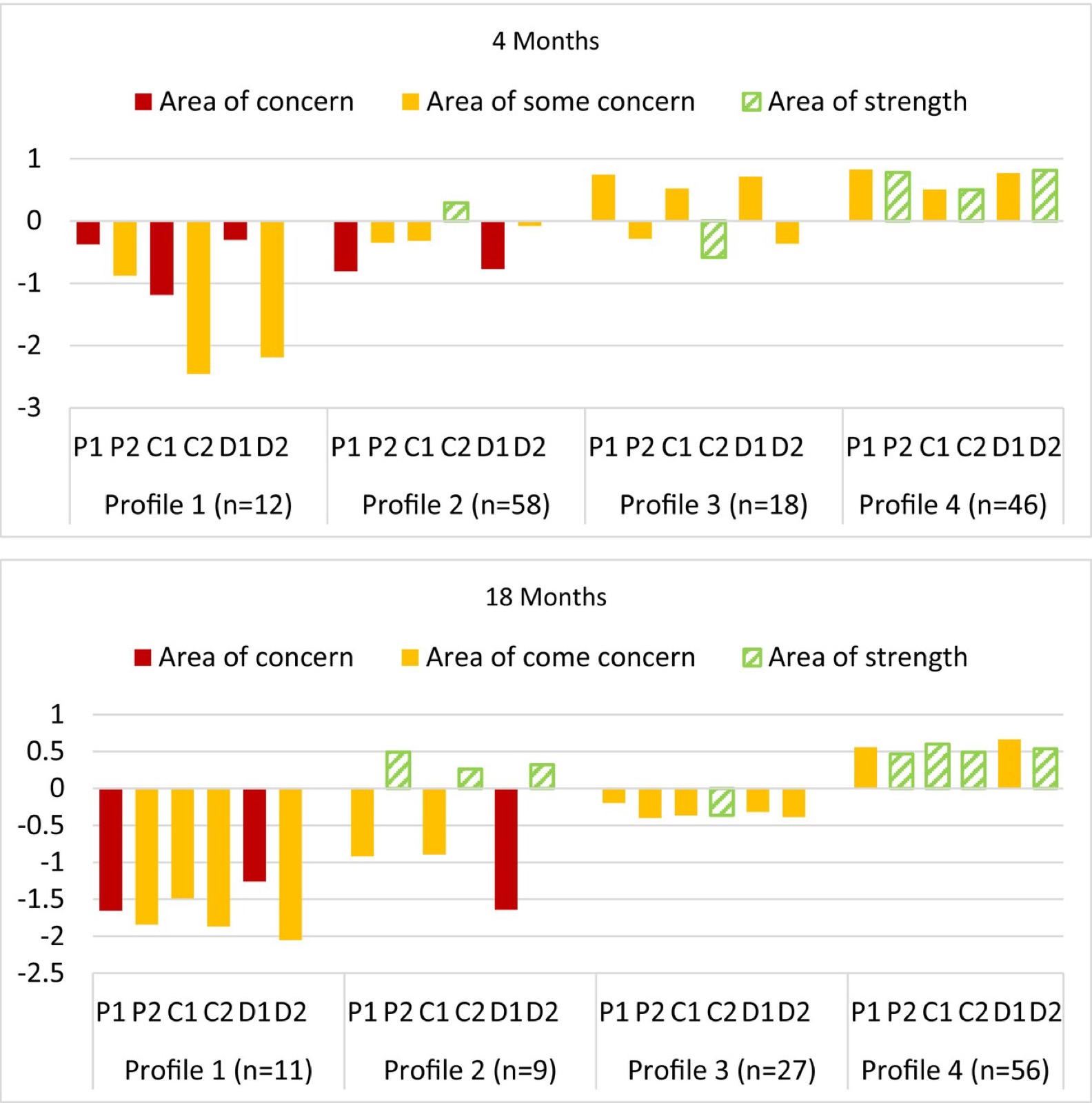
The standardized scores of the PCERA subscales for the four father–child interaction profiles are presented in Figure 1. In Profile 1 (n = 12; 9.0%) all subscale scores were below the mean indicating affective and behavioral dyadic tension. These father–child dyads demonstrated very low levels of positive interaction and very high levels of negative affect. Profile 2, lack of reciprocity (n = 58; 43.3%), was the largest and represented a substantial lack of paternal positive affective involvement, reciprocity, and mutual sharing. In Profile 3, moderately functioning (n = 18; 13.4%), all subscale scores of the father–child interaction were slightly above or below the mean. In Profile 4 (n = 46; 34.3%), reciprocal dyadic connection, all subscale scores were above the mean and represented a well-functioning father–child interaction. The father–child interaction profiles at the 4-month assessment were not associated with background variables.
Subsequently, we examined the relationship between these dyadic profiles and family alliance and family coordination using the auxiliary function. First, no statistically significant differences in the family alliance category were found. Second, regarding family coordination, we found statistically significant differences between the profiles, χ2(3) = 11.86, p = .008. Dyads in the reciprocal dyadic connection profile scored significantly higher than dyads in the lack of reciprocity profile, χ2(1) = 9.15, p = .002 (Table 2).
Table 2 — The distribution of family alliance categories and the descriptives of the family coordination in the different parent–child interaction profiles
For each LPA profile: alliance category, % (cooperative; conflicted; disordered); family coordination, M (SD).
- Father–child interaction, 4 months, Profile 1. Cooperative: 52.1; conflicted: 27.5; disordered: 20.4; family coordination: 12.17 (1.68).
- Father–child interaction, 4 months, Profile 2. Cooperative: 45.9; conflicted: 27.4; disordered: 26.7; family coordination: 10.97 (0.78).
- Father–child interaction, 4 months, Profile 3. Cooperative: 34.7; conflicted: 53.6; disordered: 11.7; family coordination: 10.50 (1.20).
- Father–child interaction, 4 months, Profile 4. Cooperative: 63.7; conflicted: 33.0; disordered: 3.3; family coordination: 14.27 (.76).
- Father–child interaction, 18 months, Profile 1. Cooperative: 18.9; conflicted: 52.8; disordered: 28.3; family coordination: 9.19 (1.53).
- Father–child interaction, 18 months, Profile 2. Cooperative: 44.4; conflicted: 20.3; disordered: 35.3; family coordination: 9.33 (1.67).
- Father–child interaction, 18 months, Profile 3. Cooperative: 32.0; conflicted: 48.3; disordered: 19.7; family coordination: 10.08 (0.97).
- Father–child interaction, 18 months, Profile 4. Cooperative: 65.9; conflicted: 21.2; disordered: 12.9; family coordination: 13.90 (0.68).
- Mother–child interaction, 4 months, Profile 1. Cooperative: 49.1; conflicted: 34.5; disordered: 16.4; family coordination: 10.79 (0.77).
- Mother–child interaction, 4 months, Profile 2. Cooperative: 49.6; conflicted: 42.0; disordered: 8.4; family coordination: 14.71 (1.17).
- Mother–child interaction, 4 months, Profile 3. Cooperative: 48.4; conflicted: 31.1; disordered: 20.6; family coordination: 12.76 (1.00).
- Mother–child interaction, 4 months, Profile 4. Cooperative: 58.7; conflicted: 29.5; disordered: 11.8; family coordination: 12.90 (1.53).
- Mother–child interaction, 18 months, Profile 1. Cooperative: 50.4; conflicted: 27.5; disordered: 22.0; family coordination: 11.06 (1.13).
- Mother–child interaction, 18 months, Profile 2a. Cooperative: 74.9; conflicted: 25.1; disordered: 0; family coordination: 15.75 (2.17).
- Mother–child interaction, 18 months, Profile 3. Cooperative: 37.4; conflicted: 42.2; disordered: 20.4; family coordination: 10.80 (0.73).
- Mother–child interaction, 18 months, Profile 4. Cooperative: 63.1; conflicted: 26.2; disordered: 10.7; family coordination: 13.56 (0.81).
Note. LPA = latent profile analysis; Profile 1 = affective and behavioral dyadic tension; Profile 2 = lack of reciprocity; Profile 3 = moderately functioning; Profile 4 = reciprocal dyadic connection; Profile 2a = maternal affective and behavioral connection.
Latent profiles of father–child interaction at 18 months
The standardized scores of the PCERA subscales for the four father–child interaction profiles are shown in Figure 1. Profile 1 (n = 11; 10.6%), affective and behavioral dyadic tension, consisted of a small group of father–child dyads who scored between one and two standard deviations below the mean in all PCERA subscales. These dyads represent extremely low levels of positive affect and high levels of negative affect. Profile 2 (n = 9; 8.7%), lack of reciprocity, was characterized by a lack of positive aspects of the dyadic interaction, such as reciprocity and mutual sharing of positive emotions. This profile also featured low levels of negative affect. In Profile 3 (n = 27; 26.0%), moderately functioning, father–child dyads scored slightly below the mean on all subscales. Most of the father–child dyads (n = 57; 54.8%) belonged to Profile 4, reciprocal dyadic connection. These dyads scored approximately half a standard deviation above the mean on all subscales, indicating a well-functioning interaction. The profiles of father–child interaction at the 18-month assessment did not show significant associations with background variables.
We then examined the relationship between these dyadic profiles and family alliance and family coordination using auxiliary function. We found a difference in the distribution of alliance categories between the profiles, χ2(6) = 17.15, p = .009. In cooperative families, dyads more often belonged into the reciprocal dyadic connection profile compared to conflicted families, in which dyads more often belonged to affective and behavioral dyadic tension, χ2(2) = 11.63, p = .003, or moderately functioning profiles, χ2(2) = 11.63, p = .003 (Table 2). Regarding family coordination, we found statistically significant differences between the profiles, χ2(3) = 17.66, p = .001. Father–child dyads in the reciprocal dyadic connection profile had higher scores compared to dyads in the affective and behavioral dyadic tension, χ2(1) = 10.35, p = .001, and moderately functioning, χ2(1) = 7.87, p = .005, profiles (Table 2).
Latent profiles of mother–child interaction at 4 months
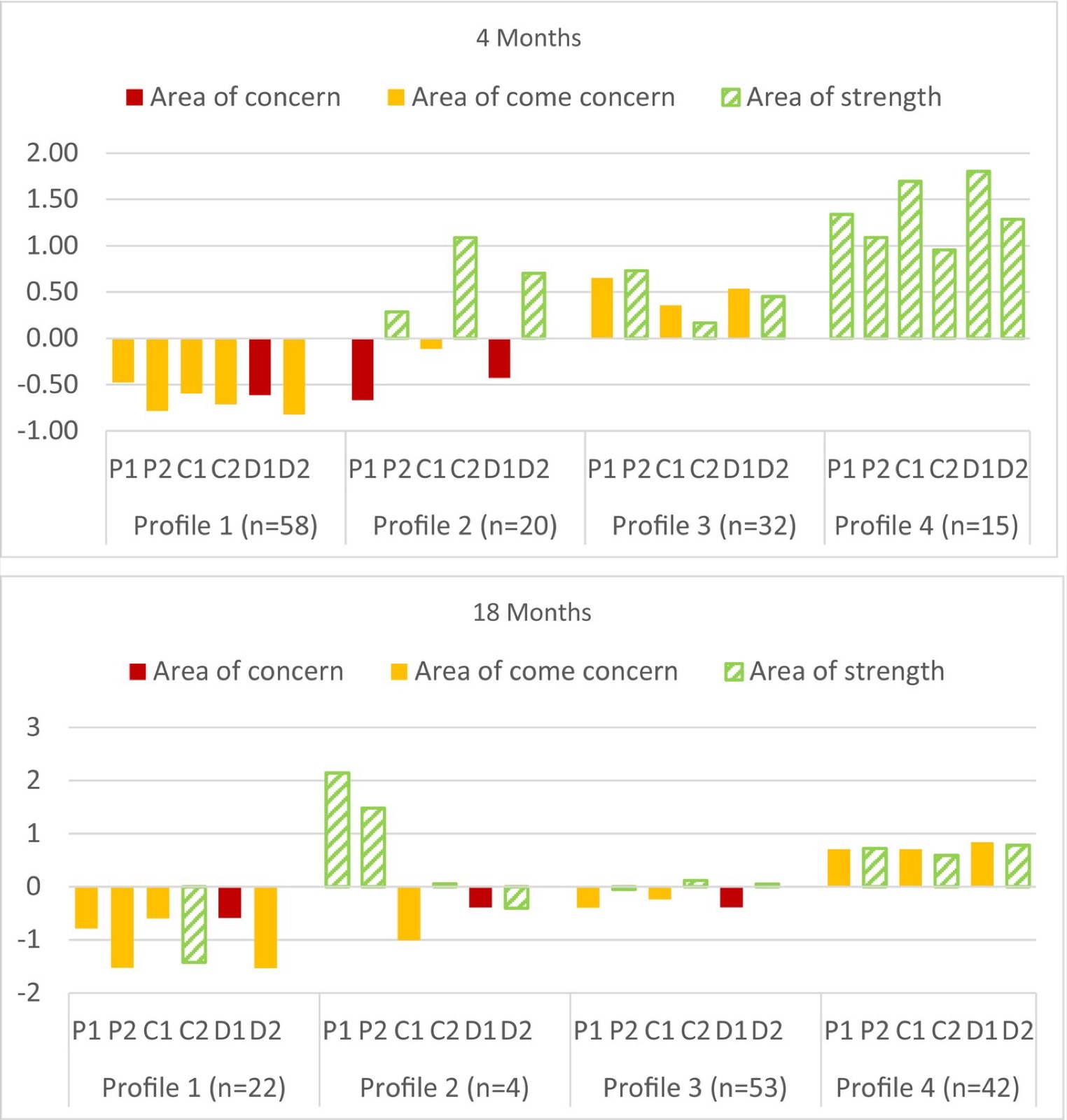
The standardized scores of the PCERA subscales for the four mother–child interaction profiles are presented in Figure 2. Profile 1 (n = 58; 46.4%), affective and behavioral dyadic tension, included almost half of the mother–child dyads. These dyads scored approximately one standard deviation below the mean on all PCERA subscales, indicating an interaction characterized by low levels of positive affect and high levels of negative affect. Profile 2 (n = 20; 16%), lack of reciprocity, showed a clear lack of positive maternal interactive behavior and dyadic reciprocity and mutuality. Profile 3 (n = 32; 25.6%), moderately functioning, included mother–child dyads scoring slightly above the mean on all subscales. Profile 4, (n = 15; 12%), reciprocal dyadic connection, consisted of mother–child dyads scoring significantly above the mean on all subscales, indicating a well-functioning interaction. The mother–child interaction profiles at the 4-month assessment did not demonstrate significant associations with background variables.
We then examined the relationship between these dyadic profiles and family alliance and family coordination using the auxiliary function. The distribution of family alliance category was similar between all mother–child profiles. As a result, the quality of mother–child interaction at 4 months was not found to be associated with triadic family alliance when the child was 18 months old. However, concerning family coordination, a statistically significant difference between the profiles was found, χ2(3) = 8.46, p = .037. Dyads in the lack of reciprocity profile scored significantly higher than dyads in the affective and behavioral dyadic tension profile, χ2(1) = 7.83, p = .005 (Table 2).
Latent profiles of mother–child interaction at 18 months
The standardized scores of the PCERA subscales for the four mother–child interaction profiles are shown in Figure 2. In Profile 1 (n = 22; 18.2%), affective and behavioral dyadic tension, mother–child dyads scored between half and 1.5 standard deviations below the mean on all PCERA subscales. These dyads displayed low positive relatedness and dyadic mutuality, and high negativity and dyadic tension in their interactions. Profile 2 (n = 4; 3.3%), maternal affective and behavioral connection, was characterized by exceptionally high levels of positive maternal affective involvement, sensitivity, and responsiveness (two standard deviations above the mean) and low levels of negative maternal behavior and affect. Profile 3 (n = 53; 43.8%), moderately functioning, included a substantial number of dyads scoring close to the mean on all subscales. In Profile 4 (n = 42; 34.7%), reciprocal dyadic connection, mother–child dyads scored above the mean on all subscales. We found no significant associations between the mother–child profiles and background variables at the 18-month assessment.
When examining family alliance using the auxiliary function, we found a statistically significant difference between the profiles, χ2(6) = 31.25, p < .000. In cooperative families, mother–child dyads more frequently belonged to maternal affective and behavioral connection profile than the moderately functioning profile, χ2(2) = 13.79, p = .001 (Table 2). Concerning family coordination, we found no statistically significant differences between the profiles.
DISCUSSION
The present study had two primary objectives. First, it aimed to examine patterns of dyadic parent–child interaction when the child was 4 months and 18 months old. Second, it examined how the quality of father–child and mother–child interaction individually contributed to the quality of triadic family interaction when the child was 18 months old. In this study, we identified four distinct profiles of father–child and mother–child interaction representing different levels of dyadic functioning in the present sample. Consistent with family systems theory, the quality of parent–child interaction at both 4 months and 18 months was related to the quality of triadic family interaction at 18 months. The functioning of the father–child dyad indicated more robust associations.
The profiles of dyadic parent–child interaction demonstrated similarities in each analysis, although the proportions of dyads in each profile differed. Most father–child dyads belonged to the lack of reciprocity profile during infancy. However, during toddlerhood, only a minority of dyads belonged to this profile. This may reflect the typical developmental changes in early father–child interaction (Genesoni & Tallandini, 2009; Lindstedt et al., 2021; Vreeswijk et al., 2014). In contrast, regarding mother–child dyads during the infancy assessment, most of them belonged to the affective and behavioral dyadic tension profile. It is also important to note that the quality of mother–child interaction during toddlerhood showed less overall variance, and the differences between the profiles were not very pronounced. Additionally, the dyadic interaction profiles demonstrated the variability in child affective and behavioral styles, as well as their levels of regulation. Consequently, the results show how the child's contribution is also related to the quality of triadic family interaction.
Based on our main findings, we suggest that triadic family interaction may benefit from the presence of well-functioning father–child interaction from early infancy. Early father involvement in family life and child-rearing activities supports not only ongoing father involvement in the future but also enhances family interaction competencies in triadic play situations (Simonelli et al., 2016). Successful interaction, in general, requires active participation from all interaction partners, contingency between behaviors, respect for turn-taking, the absence of competition, and the ability to adjust to fluctuating and changing interactions (Favez et al., 2011, 2017). Consequently, a high-quality dyadic relationship demands the active involvement of both partners in the interaction. Indeed, in many of the profiles, the child's interactive style closely resembled the parental interaction style. In a well-functioning father–child dyad, such as the reciprocal dyadic connection profile dyads, the infant also expresses positive affect and communicative behaviors toward the father, resulting in a mutual and reciprocal interaction. This kind of interaction between father and infant at 4 months was associated with higher family coordination when the child was 18 months old. These findings align with previous research reporting associations between high-quality father–infant interaction and coparenting quality (Bernier et al., 2023; Brown et al., 2010; Bureau et al., 2021). Factors such as well-functioning father–child interaction, paternal sensitivity during infancy, and attachment security between father and child have been linked to improved functioning in the coparenting relationship (Brown et al., 2010; Bureau et al., 2021). Moreover, a previous study found that both father–child and mother–child dyadic interactional synchronies were associated with triadic family interactional synchrony when the child was 3 years old, with stronger associations observed for father–child interaction (de Mendonça et al., 2019).
In our study, we observed that early emotional distance and the lack of positive paternal affective involvement and mutual sharing in the father–infant relationship were associated with lower family coordination at 18 months. Interestingly, a similar association was not found during toddlerhood. This difference may be attributed to developmental changes in the father–child relationship. As the child develops and acquires new abilities, the dyadic regulation between parent and child also changes (Bornstein et al., 2008). The interaction patterns appear to be open to change, with the quality of the father–child relationship typically improving from infancy to toddlerhood, as we have previously demonstrated (Lindstedt et al., 2021). Some of the father–child dyads classified as lack of reciprocity at 4 months transitioned into other father–child profiles, as indicated by the fact that the proportions of father–child dyads in the lack of reciprocity profile decreased from 43.3% at the 4-month assessment to only 8.7% at the 18-month assessment. This change may also reflect the increase in paternal caregiving experience from infancy to toddlerhood. For some fathers, it may take more time to establish a strong relationship with their child (Genesoni & Tallandini, 2009; Vreeswijk et al., 2014). Moreover, fathers more frequently have disengaged representations, characterized by emotional distance, toward their child during the prenatal period, which is further associated with lower levels of positive affective involvement, sensitivity, and reciprocity in early interactions with their infant (Lindstedt et al., 2021; Vreeswijk et al., 2015). Consequently, the observed early lack of reciprocity and emotional distance in the father–child dyads at 4 months can be considered a potential risk for further triadic family interaction.
During toddlerhood, it was more common to find affective and behavioral dyadic tension or moderately functioning father–child dyads in families with conflicted alliances. Our results suggest that when fathers are unable to establish a well-functioning relationship with their child, it may contribute to competition and conflict in triadic family interaction. The presence of low levels of positive affect and high levels of negative affect in father–child interaction, along with extremely low dyadic mutuality and reciprocity, was associated with competition and conflict in triadic family interaction, and challenges in cooperation between family members. This finding is consistent with the family systems perspective, which suggests that families are complex systems in which interrelated relationships can significantly affect one another (Cox & Paley, 1997). Therefore, challenges within one subsystem, such as the dyadic relationship between one parent and the child, can indeed impact other systems in the family, including triadic family dynamics.
On the other hand, family alliance appears to be particularly related to maternal marital satisfaction. Previous results from the same project demonstrated that higher maternal marital satisfaction was related to higher-quality triadic family interaction (Korja et al., 2016). When a mother is satisfied with the marital relationship, she may be more likely to support the father–child relationship and reduce gatekeeping behaviors (Allen & Hawkins, 1999). Moreover, according to the father vulnerability hypothesis (Cummings et al., 2004), fathers and their parenting may be particularly sensitive to interparental conflict. As our findings suggest, the quality of the father–child relationship further contributes to the overall quality of triadic family interaction. Therefore, the potential moderating effect of marital relationship quality on the triadic family functioning should be examined in future research.
The associations observed between mother–child interaction and triadic family interaction were limited. Previous research has indicated that both parents' sensitivity during early infancy is linked to higher quality in family alliance and cohesion (Feldman, 2007; Tissot et al., 2015). However, in our study, the quality of mother–child interaction at 4 months was not related to later family alliance. Instead, at 18 months, we found lower family coordination in families where mother–infant interaction had been very negative during infancy. Conversely, higher family coordination and cooperative family alliance was found in families with well-functioning maternal affective and behavioral interaction at 18 months. However, these findings should be interpreted carefully due to the small size of the profile. Nevertheless, this interesting group of mothers offers a potential subject for future research. It has been suggested that mothers may be more capable at maintaining boundaries between their individual family relationships, and these relationships are less affected by external factors (Belsky et al., 1991). This could partially explain the limited associations observed in our study. It needs to be highlighted that fathers and mothers interacted with their child in different situations, which makes it challenging to interpret our results. Additionally, the mother–child interaction profiles demonstrated qualitative differences when compared to the father–child profiles.
The present study has both strengths and limitations. It expanded understanding of parent–child interaction by highlighting the active role of the child and employing LPA to identify specific interaction profiles within the sample. The data are unique in that they encompass interactions of both parents with their child during infancy and toddlerhood, as well as triadic interaction during toddlerhood. This study focused on the individual contributions of father–child and mother–child interactions to the quality of triadic family interaction. However, we were unable to explore family-level associations or longitudinal changes in the profiles due to the limited sample size. Nevertheless, these family-level interactions should be further investigated with targeted study designs. Future studies should also consider including assessments of child temperament, as it is known to influence parent–child interaction (Wilson & Durbin, 2012). The sample in this study consisted of nonclinical, primarily middle-class families, limiting the generalizability of the findings. For practical reasons, the children were videotaped with their parents in different interaction situations, which could potentially affect the results. However, we took ecological validity (Bronfenbrenner, 1977) into account when selecting feeding and diaper change situations for the 4-month assessment, as these situations reflect everyday caretaking experiences for parent–infant dyads. Both situations require parental structuring, mediating, and regulation while facilitating social interaction and mutual sharing. The assessment scale was similar in both situations, providing insights into how parents and children experienced each other during the interaction (Clark, 1985). Moderate stability of positive parenting behaviors across various contexts has been reported, at least in the case of mothers (Goodman et al., 2022; Maas et al., 2013; Masur & Turner, 2001). Nevertheless, different interaction tasks may emphasize different aspects of interaction.
Conclusions
This longitudinal study emphasizes the crucial role of the father–child relationship in shaping family interaction. Well-functioning interactions between fathers and their children, characterized by reciprocal dyadic connections as early as 4 months, appear to have a positive impact on triadic family interaction quality. Further research is needed to examine and understand family-level associations, including how father–child and mother–child relationships interact and complement each other, as well as the potential moderating effects of other variables, such as marital satisfaction.
Implications
Results of this study provide rationale for increasing general awareness among families and professionals regarding the significant impact that well-functioning father–child relationships can have. This awareness may enhance gate-opening attitudes and behaviors of mothers, and father engagement in early child care, further supporting the development of father–child relationships and triadic family interaction. Additionally, the role of fathers could be considered when developing practical policies in perinatal care and interventions targeting support for triadic family interaction. Overall, our findings underscore the importance of supporting early parent–child relationships to promote well-functioning and coordinated triadic family interaction, and the inclusion of fathers in interventions aimed at improving family dynamics.
Complexe Systémique: key points
The study gives an empirical basis to an old intuition of family therapy: what happens in one subsystem reverberates through the whole. Its clinical interest lies in two points. First, the child is an active partner in the interaction, not merely the recipient of parental sensitivity. Second, the father–child dyad appears as an early indicator of triadic coordination, which invites involving fathers from the perinatal period rather than in times of crisis, and seeing the Lausanne Trilogue Play as a useful observation tool in consultation. The limitations are real: fathers and mothers were not filmed in the same situations (play and diaper change with fathers, feeding with mothers), some profiles contain only a handful of dyads, the sample is Finnish, heterosexual and mostly middle-class, and the findings are statistical associations, not causation. The “crucial role” of the father should therefore be read with caution, and not turned into an argument against mothers. Read alongside the article on attachment as a triadic process, and the article on supporting coparenting.
References
Akaike, H. (1987). Factor analysis and AIC. Psychometrika, 52, 317–332. 10.1007/BF02294359
Allen, S. M., & Hawkins, A. J. (1999). Maternal gatekeeping: Mothers' beliefs and behaviors that inhibit greater father involvement in family work. Journal of Marriage and Family, 61(1), 199–212. 10.2307/353894
Asparouhov, T., & Muthén, B. (2014). Auxiliary variables in mixture modeling: Three-step approaches using Mplus. Structural Equation Modeling, 21(3), 329–341. 10.1080/10705511.2014.915181
Beebe, B., Jaffe, J., Markese, S., Buck, K., Chen, H., Cohen, P., Bahrick, L., Andrews, H., & Feldstein, S. (2010). The origins of 12-month attachment: A microanalysis of 4-month mother-infant interaction. Attachment and Human Development, 12(1–2), 3–141. 10.1080/14616730903338985
Belsky, J., Youngblade, L., Rovine, M., & Volling, B. (1991). Patterns of marital change and parent-child interaction. Journal of Marriage and Family, 53(2), 487–498. 10.2307/352914
Bernier, A., Cyr, C., Matte-Gagné, C., & Tarabulsy, G. M. (2023). Parent–child interactions as predictors of coparenting: A longitudinal study of family subsystems. Journal of Family Studies, 29(1), 239–254. 10.1080/13229400.2021.1908909
Bornstein, M. H., Tamis-LeMonda, C. S., Hahn, C. S., & Haynes, O. M. (2008). Maternal responsiveness to young children at three ages: Longitudinal analysis of a multidimensional, modular, and specific parenting construct. Developmental Psychology, 44(3), 867–874. 10.1037/0012-1649.44.3.867
Bowlby, J. (1982). Attachment and loss: Vol. 1. Attachment ( 2nd ed.). Basic Books.
Bretherton, I. (2010). Fathers in attachment theory and research: A review. Early Child Development and Care, 180(1–2), 9–23. 10.1080/03004430903414661
Bronfenbrenner, U. (1977). Toward an experimental ecology of human development. American Psychologist, 32(7), 513–531. 10.1037/0003-066X.32.7.513
Brown, G. L., Schoppe-Sullivan, S. J., Mangelsdorf, S. C., & Neff, C. (2010). Observed and reported supportive coparenting as predictors of infant-mother and infant-father attachment security. Early Child Development and Care, 180(1–2), 121–137. 10.1080/03004430903415015
Bureau, J. F., Deneault, A. A., Yurkowski, K., Martin, J., Quan, J., Sezlik, S., & Guérin-Marion, C. (2021). The interaction of child-father attachment and child-mother attachment in the prediction of observed coparenting. Psychology of Men and Masculinity, 22(3), 512–520. 10.1037/men0000309
Busby, D., Christensen, C., Crane, D. R., & Larson, J. H. (1995). A revision of the dyadic adjustment scale for use with distressed and nondistressed couples: Construct hierarchy and multidimensional scales. Journal of Marital and Family Therapy, 21(3), 289–308. 10.1111/j.1752-0606.1995.tb00163.x
Carone, N. (2022). Family alliance and intergenerational transmission of coparenting in gay and heterosexual single-father families through surrogacy: Associations with child attachment security. International Journal of Environmental Research and Public Health, 19(13), Article 13. 10.3390/ijerph19137713
Christopher, C., Umemura, T., Mann, T., Jacobvitz, D., & Hazen, N. (2015). Marital quality over the transition to parenthood as a predictor of coparenting. Journal of Child and Family Studies, 24(12), 3636–3651. 10.1007/s10826-015-0172-0
Clark, R. (1985). The parent–child early relational assessment: Instrument and manual. University of Wisconsin.
Clarke-Stewart, K. A. (1978). And daddy makes three: The father's impact on mother and young child. Child Development, 49(2), 466–478. 10.2307/1128712
Cox, M. J., & Paley, B. (1997). Families as systems. Annual Review of Psychology, 48, 243–267. 10.1146/annurev.psych.48.1.243
Cox, M. J., & Paley, B. (2003). Understanding families as systems. Current Directions in Psychological Science, 12(5), 193–196. 10.1111/1467-8721.01259
Crane, D. R., Middleton, K. C., & Bean, R. A. (2000). Establishing criterion scores for the Kansas Marital Satisfaction Scale and the Revised Dyadic Adjustment Scale. American Journal of Family Therapy, 28, 53–60. 10.1080/019261800261815
Cummings, E. M., Goeke-Morey, M. C., & Raymond, J. (2004). Fathers in family context: effects of marital quality and marital conflict. In M. E. Lamb (Ed.), The role of the father in child development (pp. 196–221). John Wiley & Sons.
Curran, P. J., West, S. G., & Finch, J. F. (1996). The robustness of test statistics to nonnormality and specification error in confirmatory factor analysis. Psychological Methods, 1(1), 16–29. 10.1037/1082-989X.1.1.16
de Mendonça, J. S., Bussab, V. S. R., & Kärtner, J. (2019). Interactional synchrony and child gender differences in dyadic and triadic family interactions. Journal of Family Issues, 40(8), 959–981. 10.1177/0192513X19832938
Favez, N., Frascarolo, F., Carneiro, C., Montfort, V., Corboz-Warnery, A., & Fivaz-Depeursinge, E. (2006). The development of the family alliance from pregnancy to toddlerhood and children outcomes at 18 months. Infant and Child Development, 15(1), 59–73. 10.1002/icd.430
Favez, N., Frascarolo, F., & Fivaz-Depeursinge, E. (2006). Family alliance stability and change from pregnancy to toddlerhood and marital correlates. Swiss Journal of Psychology, 65(4), 213–220. 10.1024/1421-0185.65.4.213
Favez, N., Frascarolo, F., & Tissot, H. (2017). The family alliance model: A way to study and characterize early family interactions. Frontiers in Psychology, 8, Article 1441. 10.3389/fpsyg.2017.01441
Favez, N., Lopes, F., Bernard, M., Frascarolo, F., Lavanchy Scaiola, C., Corboz-Warnery, A., & Fivaz-Depeursinge, E. (2012). The development of family alliance from pregnancy to toddlerhood and child outcomes at 5 years. Family Process, 51(4), 542–556. 10.1111/j.1545-5300.2012.01419.x
Favez, N., Scaiola, C. L., Tissot, H., Darwiche, J., & Frascarolo, F. (2011). The Family Alliance Assessment Scales: Steps toward validity and reliability of an observational assessment tool for early family interactions. Journal of Child and Family Studies, 20(1), 23–37. 10.1007/s10826-010-9374-7
Feldman, R. (2007). Maternal versus child risk and the development of parent-child and family relationships in five high-risk populations. Development and Psychopathology, 19(2), 293–312. 10.1017/S0954579407070150
Feldman, R., & Masalha, S. (2010). Parent-child and triadic antecedents of children's social competence: Cultural specificity, shared process. Developmental Psychology, 46(2), 455–467. 10.1037/a0017415
Fivaz-Depeursinge, E., & Corboz-Warnery, A. (1999). The primary triangle: A developmental systems view of mothers, fathers and infants. Basic Books.
Fivaz-Depeursinge, E., Favez, N., Lavanchy, C., De Noni, S., & Frascarolo, F. (2005). Four-month-olds make triangular bids to father and mother during Trilogue Play with Still-face. Social Development, 14(2), 361–378. 10.1111/j.1467-9507.2005.00306.x
Frascarolo, F., Favez, N., Carneiro, C., & Fivaz-Depeursinge, E. (2004). Hierarchy of interactive functions in father-mother-baby three-way games. Infant and Child Development, 13(4), 301–322. 10.1002/icd.361
Genesoni, L., & Tallandini, M. A. (2009). Men's psychological transition to fatherhood: An analysis of the literature, 1989-2008. Birth, 36(4), 305–317. 10.1111/j.1523-536X.2009.00358.x
Goodman, S. H., Bakeman, R., & Milgramm, A. (2022). Continuity and stability of parenting of infants by women at risk for perinatal depression. Parenting, 22(1), 11–39. 10.1080/15295192.2021.1877991
Grossmann, K., Grossmann, K. E., Fremmer-Bombik, E., Kindler, H., Scheuerer-Englisch, H., & Zimmermann, A. P. (2002). The uniqueness of the child–father attachment relationship: Fathers' sensitive and challenging play as a pivotal variable in a 16-year longitudinal study. Social Development, 11(3), 301–337. 10.1111/1467-9507.00202
Jacobvitz, D., Hazen, N., Curran, M., & Hitchens, K. (2004). Observations of early triadic family interactions: Boundary disturbances in the family predict symptoms of depression, anxiety, and attention-deficit/hyperactivity disorder in middle childhood. Development and Psychopathology, 16(3), 577–592. 10.1017/s0954579404004675
Kochanska, G., & Kim, S. (2013). Early attachment organization with both parents and future behavior problems: From infancy to middle childhood. Child Development, 84(1), 283–296. 10.1111/j.1467-8624.2012.01852.x
Korja, R., Piha, J., Otava, R., Lavanchy-Scaiola, C., Ahlqvist-Björkroth, S., Aromaa, M., & Räihä, H. (2016). Mother's marital satisfaction associated with the quality of mother-father-child triadic interaction. Scandinavian Journal of Psychology, 57(4), 305–312. 10.1111/sjop.12294
Kwon, K. A., Jeon, H. J., Lewsader, J., & Elicker, J. (2012). Mothers' and fathers' parenting quality and toddlers' interactive behaviours in dyadic and triadic family contexts. Infant and Child Development, 21(4), 356–373. 10.1002/icd.1746
Lagström, H., Rautava, P., Kaljonen, A., Räihä, H., Pihlaja, P., Korpilahti, P., Peltola, V., Rautakoski, P., Österbacka, E., Simell, O., & Niemi, P. (2013). Cohort profile: Steps to the healthy development and well-being of children (the STEPS Study). International Journal of Epidemiology, 42(5), 1273–1284. 10.1093/ije/dys150
Lauretti, A., & McHale, J. (1997, April). Shifting patterns of parenting styles between dyadic and family settings: The role of marital quality [Paper presentation]. Meeting of the Society for Research in Child Development, Washington, DC, USA.
Lauretti, A. F., & McHale, J. (2009). Shifting patterns of parenting styles between dyadic and family settings: The role of marital distress. In M. Russo & A. De Luca (Eds.), Psychology of Family Relationships (pp. 99–113). Nova Science Publishers.
Lindstedt, J., Korja, R., Vilja, S., & Ahlqvist-Björkroth, S. (2021). Fathers' prenatal attachment representations and the quality of father–child interaction in infancy and toddlerhood. Journal of Family Psychology, 35(4), 478–488. 10.1037/fam0000813
Maas, A. J. B. M., Vreeswijk, C. M. J. M., & Van Bakel, H. J. A. (2013). Effect of situation on mother-infant interaction. Infant Behavior and Development, 36(1), 42–49. 10.1016/j.infbeh.2012.10.006
Masur, E. F., & Turner, M. (2001). Stability and consistency in mothers' and infants' interactive styles. Merrill-Palmer Quarterly, 47(1), 100–120. 10.1353/mpq.2001.0003
Mathew, A., & Doorenbos, A. Z. (2022). Latent profile analysis—An emerging advanced statistical approach to subgroup identification. Indian Journal of Continuing Nursing Education, 23(2), 127–133. 10.4103/ijcn.ijcn_24_22
McHale, J., Fivaz-Depeursinge, E., Dickstein, S., Robertson, J., & Daley, M. (2008). New evidence for the social embeddedness of infants' early triangular capacities. Family Process, 47(4), 445–463. 10.1111/j.1545-5300.2008.00265.x
McHale, J. P. (1997). Overt and covert coparenting processes in the family. Family Process, 36(2), 183–201. 10.1111/j.1545-5300.1997.00183.x
McHale, J. P., & Rasmussen, J. L. (1998). Coparental and family group-level dynamics during infancy: Early family precursors of child and family functioning during preschool. Development and Psychopathology, 10(1), 39–59. 10.1017/S0954579498001527
Minuchin, P. (1985). Families and individual development: Provocations from the field of family therapy. Child Development, 56(2), 289–302. 10.2307/1129720
Muthén, L. K., & Muthén, B. O. (2017). Mplus user's guide (8th ed.).
Rochat, P., Striano, T., & Blatt, L. (2002). Differential effects of happy, neutral, and sad still-faces on 2-, 4- and 6-month-old infants. Infant and Child Development, 11(4), 289–303. 10.1002/icd.259
Simonelli, A., Parolin, M., Sacchi, C., De Palo, F., & Vieno, A. (2016). The role of father involvement and marital satisfaction in the development of family interactive abilities: A multilevel approach. Frontiers in Psychology, 7, Article 1725. 10.3389/fpsyg.2016.01725
Tissot, H., Favez, N., Udry-Jorgensen, L., Frascarolo, F., & Despland, J. N. (2015). Mothers' and fathers' sensitive parenting and mother–father–child family alliance during triadic interactions. The Family Journal, 23(4), 374–380. 10.1177/1066480715601110
Tissot, H., Scaiola, C. L., Frascarolo, F., Despland, J. N., Stiefel, F., & Favez, N. (2014). Family alliance as a moderator of the link between maternal postpartum depression and child symptoms assessed by both parents. Journal of Family Issues, 35(11), 1520–1542. 10.1177/0192513X13488522
Tronick, E. (2007). The neurobehavioral and social-emotional development of infants and children. W.W. Norton & Company.
Udry-Jørgensen, L., Tissot, H., Frascarolo, F., Despland, J. N., & Favez, N. (2016). Are parents doing better when they are together? A study on the association between parental sensitivity and family-level processes. Early Child Development and Care, 186(6), 915–926. 10.1080/03004430.2015.1068768
Vreeswijk, C. M. J. M., Maas, A. J. B. M., Rijk, C. H. A. M., Braeken, J., & van Bakel, H. J. A. (2014). Stability of fathers' representations of their infants during the transition to parenthood. Attachment and Human Development, 16(3), 292–306. 10.1080/14616734.2014.900095
Vreeswijk, C. M. J. M., Rijk, C. H. A. M., Maas, A. J. B. M., & van Bakel, H. J. A. (2015). Fathers' and mothers' representations of the infant: Associations with prenatal risk factors. Infant Mental Health Journal, 36(6), 599–612. 10.1002/imhj.21541
Wang, M., & Bodner, T. E. (2007). Growth mixture modeling: Identifying and predicting unobserved subpopulations with longitudinal data. Organizational Research Methods, 10(4), 635–656. 10.1177/1094428106289397
Wilson, S., & Durbin, C. E. (2012). Dyadic parent-child interaction during early childhood: Contributions of parental and child personality traits. Journal of Personality, 80(5), 1313–1338. 10.1111/j.1467-6494.2012.00789.x
Reformatted republication of Latent profiles of dyadic parent–child interaction and associations with triadic family interaction in early childhood, by Johanna Lindstedt, Sari Ahlqvist‐Björkroth, Niina Junttila and Riikka Korja, Family Relations, vol. 73, no 4 (2024), doi: 10.1111/fare.13041, under a CC BY 4.0 licence. Edition and layout: Complexe Systémique, September 2026 — the work has been modified under the terms of the licence (tables presented as lists). Neither the authors nor the publisher are responsible for this edition; the original version prevails.
This is the original article “Latent profiles of dyadic parent–child interaction and associations with triadic family interaction in early childhood”, published in Family Relations (2024) under a CC BY 4.0 licence. Republished by Complexe Systémique: the author’s text is unchanged; only the presentation has been adapted for reading online, as set out at the head of this page.
Read the original articleHow to cite this article
Lindstedt, J., Ahlqvist-Björkroth, S., Junttila, N., et Korja, R. (2024). Latent profiles of dyadic parent–child interaction and associations with triadic family interaction in early childhood. Complexe Systémique. https://app.complexe-systemique.com/en_GB/articles/latent-profiles-of-parent-child-interaction-and-triadic-family-interaction (Original work published in 2024 in Family Relations, 73(4), 2564-2581 (2024); republished in 2024 by Family Relations, https://onlinelibrary.wiley.com/doi/full/10.1111/fare.13041)
To go further
- Explorer l’attachement comme processus triadique : l’entretien d’attachement familialAttachment as a triadic process.
- Ways of Supporting Coparenting in Child and Family Services: Discourses of Involvement, Capacity Building and ReconciliationSupporting coparenting.
- « Qui es-tu donc ? » : ce que l’observation du nourrisson apporte à la thérapie familialeInfant observation.
Related training courses
 Symposium
État des Lieux: a psychological approach to spaces
Replay of the “État des Lieux” conference (Paris, 16 October 2026): Ivy Daure, Maurizio Frisina, Viola Sallay and Gilbert Pregno on places as a clinical resource. In French.
 Certifying course
Training in Systemic Therapy and Interventions – Cycle 1
Certifying training cycle in systemic therapy and interventions – year 1. Courses, supervision and practice, aligned with EFTA/SFTF. In French.
 Certifying course
Training in Systemic Therapy and Interventions – Cycle 2
Certifying training cycle in systemic therapy and interventions – year 2. Clinical complexity, supervision and practice. EFTA/SFTF aligned. In French.
 Certifying course
Training in Systemic Therapy and Interventions – Cycle 3
Certifying training cycle in systemic therapy and interventions – year 3. In-depth intervention, supervision and practice. EFTA/SFTF aligned. In French.
Related articles
 Blog
Adult parentification: when being useful becomes a condition for being loved
Why is it sometimes so hard to hand over? Julien Besse explores parentification and parentalisation, acknowledgement and the place we take in our adult relationships.
 Scientific
Family group conference provision across the lifespan of child welfare intervention: A mixed-method realist-informed evaluation comparing three stages of welfare concern
Early help, child protection or children in care: among 155 UK families, experiences and outcomes of family group conferences vary very little by stage.
 Scientific
Digital Co-Regulation and Dysregulation in Romantic Relationships: A Systemic Model of Technology-Mediated Emotional Processes
Checking, chasing, blocking: 31 interviews show how the phone regulates or dysregulates a couple’s anxiety, with a systemic model of the loop.
 Scientific
“One Can Have All Sorts of Good Intentions but Sometimes in Everyday Life, It Turns Out Differently”: Change Agreements in Couples' Everyday Lives
Six Danish couples followed after an online couple program: their change agreements become guilt-inducing contracts, shared understanding or revealers of inequality.