AI-assisted translation
This version was translated from Italian by Complexe Systémique with the help of artificial intelligence. In case of doubt, the original version prevails.
Connessioni · Family
Once upon a time there was the traditional family
Max and Betty, together since school, separate after ten years of marriage: their story opens and closes this text by Gabriela Gaspari, written at the turn of the millennium. Moving from the bourgeois family glorified by fascism to women’s gains, from the crossed expectations of women and men in therapy to over-invested children and disappointing adolescents, it takes stock of what remains of the “traditional family” in Italy. First published in 2001 in the old series of Connessioni, it was republished by the journal in 2023.
Unofficial English translation. This article is a translation of C’era una volta la famiglia tradizionale, by Gabriela Gaspari, published in Connessioni (Centro Milanese di Terapia della Famiglia), new series, no. 12 (2023), under a CC BY 4.0 licence. Translated by Complexe Systémique in November 2026 with the help of artificial intelligence: the original Italian text has been translated into English and reformatted, which constitutes a modification of the work under the terms of the licence. Paragraphs and subheadings are those of the journal; the note of first publication (Connessioni, no. 8, March 2001) is translated in its place; a few typographical errors on the web page, including proper names (Riane Eisler, Selvini), have been silently corrected; three references cited in the text (Vincenzi Amato, 1988; Lagrave, 1996; Selvini, 2001) are missing from the journal’s bibliography. This translation was made neither by the authors nor by the journal, who are not responsible for its content or for any errors. The original version prevails.
Women have gained time of life and time to live.
Gabriela Gaspari
(first published in Connessioni, no. 8, March 2001)
Max met the admiring gaze of a young woman and fell in love.
The new experience made him rediscover feelings he had forgotten and fully satisfying sex, in which his new partner made him feel “a real man”.
He talked to Betty about it to ask for a separation.
For us Westerners at least, the millennium has changed and, as on the previous occasion of which some memory survives, tomorrow seems to us full of unknowns and threats. There is a widespread feeling that, beyond the metaphor of the number, an era really is ending and that, in a way that is still confused and hard to decode, the “new” is making its way. Nobody knows whether we will be able to recognize it while it is taking shape, whether we are preparing ourselves properly to pass the selection for survival that will take place according to new and unknown criteria, or whether we are among the dinosaurs destined for extinction. We are living in a climate of epiphany, as if caught in an uncontrollable whirlwind of changes that inexorably sweeps us along. Everything is happening so fast that we do not even know whether to hope or to be afraid and, unable to make predictions about the future, not even about what the world will be like in ten years, we are forced to live in the present.
One of the most important points of reference that change seems to be sweeping away is the family, the traditional “brick” of the social structure, the container of our most significant relationships, of our emotions, of the identity we have built for ourselves and of the present, past and future of our history.
Scientific articles that deal with the family by studying it as a phenomenon tell us that it has always changed over time and across cultures, that there has never been a single model of it, and that when we speak of the traditional family we are using a generalization that hides the considerable variety of situations that existed in the past. The families of the rich have always been organized differently from those of the poor and, among the rich, aristocratic families have always had both rules and interests different from those of bourgeois families. Living in the city entails habits and ways of thinking that are considered inappropriate in the countryside, and city dwellers have always made fun of country people, regarding them as coarse and backward.
The size of families, too, has always varied, even though in the past the more complex families, made up of various combinations of couples held together by ties of kinship or affiliation, were a model of organization better suited to survival than the nuclear family.
Moreover, still on the subject of change, the family is the context in which change is most experienced and ritually celebrated: holidays, birthdays and changes of status have always been celebrated in the family or in relation to it.
The family is also an organization in which one does not keep the same role forever and in which one holds more than one at the same time. The career of changes, from child to parent, spouse, uncle or aunt, grandparent and so on, accompanies and punctuates the life cycle.
Given the importance of the functions it performs (including that of giving meaning to changes), it is not surprising that the threat of uncontrollable change should bring disquiet and bewilderment, so much so that many have thought that this time this basic institution was on the point of disappearing. It seems, however, that despite great upheavals the family survives, showing once again that it is hard to replace.
The need to find new forms of family organization has been incredibly strong over the last century, because change has simultaneously affected the fundamental parameters around which the family was conceived and lived in our past:
- a hierarchical social organization and system of values;
- a sharp differentiation between the male and the female role;
- the indissolubility of the marriage bond.
Across time and cultures, there is no memory of a family and social organization that was not based on a kind of unequal complementarity between male and female roles, with the woman in a subordinate position. Only in myths and legends do we find stories in which the positions are reversed. The fabulous Amazons seem to have been born of the imagination of the angriest feminists, as a dream of revenge. But I have heard of a very ancient time in which men and women lived together in a society that gave equal value to the masculine and the feminine (Riane Eisler). The author of the book that sets out this theory coins the name “gylany” for this type of social organization. Obviously, she was a feminist.
What is the family for?
While holding firm over time to the principles of the “natural” difference between the sexes, the family has always appeared as an elastic organization, changing its form in relation to the cultural and environmental context. Although subject to norms, it appears pliable and malleable; it stands between the individual and the social macrosystem and, within the overall flow of change, changes the way in which it goes on performing its functions.
A family normally begins with the formation of a couple that society, through a rite, recognizes as such. Marriage is one of the most important rites of passage, and its first effect is a change of status in the social context. With marriage come changes in role assignments, expectations and forms of recognition. The couple so understood is society’s proposal for meeting individual needs for an intimate relationship and for choosing a partner as a privileged interlocutor for mutual recognition within an attachment relationship. The partner is the fundamental reference figure in shaping one’s own individual identity over the long span of time that runs from entry into adulthood to old age: losing or separating from that person entails a painful process of reorganizing one’s self-image (Cigoli, 1999), while living with them in a distorted relationship requires a kind of self-deception that makes everyone suffer, children included (Andolfi, 1999). Culture supplies the norms of the social context of which the couple is part and within which it provides for its own survival.
The couple is also the first social organization whose task is to provide privately for the individual’s care needs, complementing public organization (Vincenzi Amato, 1988).
Children are born within the couple’s project: they are children of the bond. A fundamental function of the family is to bring into the world and raise children who are “suited” to the social context. This is the most important project that the members of a couple share, the one that projects furthest forward in time, and it welds the personal identity shaped in the couple’s interaction to the identity built on the “vertical” axis of parent–child relationships. The sense of belonging to the family defines boundaries that identify a group and a history.
The birth of siblings who live together in the same family and help to write its history builds the relational context in which responses to the needs for closeness, cooperation and sharing among peers are experienced, through “social” participation in the parents’ couple project.
The relationships that the new family maintains with the families of origin and with those formed by the siblings exemplify the way in which bonds can evolve and be maintained. The bond between generations is the channel for passing on the family history, the group identity, traditions and the knowledge useful for survival, whether a trade or the recipe for minestrone. It is the privileged place for constructing the social self (Edelstein, 1997).
Can one live without a family?
Family organizations can survive even significant changes to the classic structure while continuing to perform their fundamental functions. There can be a family, for instance, without a parental couple, as we see in single-parent families (widowhood, separation, unmarried mothers or fathers) or in polygamous families, in which the couple bond is asymmetrical. There can also be a family without children, whether born to the couple or adopted. In this case the couple invents other ways of satisfying its “altruistic” needs and its projection into the future. I know, for example, a couple who devote themselves to building a family environment to take in disabled adolescents and young adults who, because of their age, could no longer stay in the rehabilitation institutions where their families of origin and the local services had placed them as small children. The couple went into crisis, however, when, unexpectedly, a healthy and intelligent baby boy was born to them.
Only children, ever more numerous, show how the problem of having no brothers or sisters can be solved. One can survive without relatives, too: blood relations can be invented and replaced by friends who are made into “kin”, as immigrants often do in order to feel a bond of belonging to a community.
I have even known a family without a couple and without children; it was made up of three sisters who had divided the traditional tasks and roles among themselves: the eldest met the economic needs with her work, the youngest contributed a more modest income from a part-time job and took care of the house and looked after the middle sister, who was disabled and played the part of the daughter.
Can one live entirely without a family? It seems so; singles seem to prove it, an extreme example of emotional autonomy and freedom from ties. On closer analysis, however, one discovers that most of them have invented some form of family for themselves, and that those who have not managed to do so suffer from loneliness.
The traditional family in Italy
When we think of how much the family has changed or can change, we compare it with the so-called “traditional family”. In our history, this is the ideal family of fascist propaganda, which was in turn inspired by the bourgeois family as it had taken shape at the end of the nineteenth century and established itself in the following century (Scaraffia, 1988). It was obviously based on the principles that ordered society according to a precise hierarchical order, and an important criterion came from the sharp differentiation between the male and the female role. The concept of sex role used today implicitly rests on the idea of a “neutral” human being who takes on a specific sex role distinct from biological sex. At the beginning of the twentieth century, by contrast, the dominant culture upheld a system of norms structured to elaborate gender that rested on a division of roles attributed to nature, that is, based on the physiological difference that made males “naturally” predisposed to develop certain characteristics and take on certain roles complementary to those of females, who were designed by nature to fill others. The conception of masculinity and femininity defined not only different kinds of work, norms of behaviour and relationships between men and women, but also established a criterion of normality concerning the way one feels and experiences emotions and feelings, on which both the educational model and the system of norms and social control that maintained them drew. This idea cut across all types of family organization, in the countryside and in the city, rich and poor alike, and rested on a tradition of great antiquity. Only the changes of the last century have made it possible to call this dogma into question. Gradually but systematically, all the representations of the feminine, the commonplaces and the prejudices that justified the distinction between the sexes and male privilege have been disproved by new models of behaviour.
Since the beginning of the twentieth century, the role of women has changed in ways unthinkable in previous centuries. Thanks to advances in medicine, which have steadily reduced the proportion of deaths in childbirth and of pregnancy-related problems, women’s life expectancy has lengthened until it exceeds men’s by several years (Lefaucheur, 1996). The fall in infant mortality, together with the spread of effective contraceptives under women’s control, has made it possible to reduce the number of pregnancies, which in the past followed one another almost without interruption and, together with breastfeeding and caring for children, filled women’s lives until past the age of forty. Birth control and family planning, women’s conquest of sexual rights and the possibility of economic autonomy have changed the balance of power within the family. Technology has produced household appliances, detergents, nappies and frozen foods that have greatly lightened the work of housewives. Women have gained time of life and time to live.
Starting with the “little schoolmistresses with the red pen” and the women clerks at the post office or the Ministry of Public Works, women begin to appear in the world of work alongside their male colleagues in equal roles. Since then they have literally flooded some sectors of employment. Secondary schools and universities, too, have recorded an ever greater female presence. The classic housewife is ever rarer (Scaraffia, 1988).
The number and quality of services for receiving and educating children are increasing: day nurseries, nursery schools, full-time primary schools, leisure organizations with educational aims, and so on. Mothers can be replaced (Lagrave, 1996).
In schools and in organizations for children, boys and girls are educated together, with the same rules and the same criteria of judgement. New relationships between the genders are born.
The fall in the birth rate and the new criteria of family planning are connected with the rise of a child-centred culture.
Around 1968 the change in cultural values becomes evident; the new values favour emotional autonomy and hedonism. Separation from the families of origin is encouraged, and sharper boundaries are drawn around the nuclear family. Young couples find themselves alone in seeking solutions to the problems of a life ever more crowded with commitments (Scabini, 1995).
Advertising offers models of happiness within easy reach: all you need is to own this or that. Social life becomes ever more competitive, and frustration is the emotion one most often has to reckon with. The referendum on divorce radically changes family law.
With equality between the sexes almost achieved, the reasons why people choose a partner and marry change: no longer out of necessity or obligation, but for love and sexual attraction. The new model for the couple relationship is an equal one, and the condition for staying together is that both agree that the relationship is satisfying. From my experience as a therapist (and from the data on separations and divorces), this seems a condition that is not easy to meet.
The new families
For about twenty years I have been meeting in my work individuals, families and couples who tell me their stories and their problems. Mine is a particular observatory, where I meet only people who share with me the cultural premises that justify psychotherapy and who believe they have problems that can be solved by this kind of help. My experience therefore makes no claim to be generalized so as to draw from it a representative picture of present-day society. These are only some considerations I have arrived at after listening to many stories and taking part, while sincerely trying to be of use, in the suffering and the attempts at change of many people.
Most of the people I have met in therapy in recent years are between 35 and 45 years old, have young or adolescent children, and are going through a moment of crisis in their couple or are on their own, “single” since forever or separated. Women are more numerous and, even when they come because of a problem with a child, they almost always bring problems connected with the couple relationship (Andolfi, 1999). Whether they come to therapy alone or with the partners with whom they have an unsatisfying relationship, they essentially agree in describing the ideal companion:
- He is a man who is open to conversation and capable of a sincere and open exchange on the verbal level.
- He is emotionally present, able to support and to give confirmation and, if necessary, to contain with gentle firmness his partner’s anxieties and fears, allowing her to express herself in a climate of engaged listening.
- He is able to share the burden of family duties in effective teamwork based on empathy and complicity.
- He is a sensitive and attentive companion, protective but not intrusive, willing to encourage and support his partner’s needs for growth.
- He is loyal and reliable, does not run away and does not withdraw into himself in difficult moments.
- He is able to express his own emotions and knows how not only to give but also to ask for and receive help.
- He is a father capable of sacrificing himself for the needs of the children and the family and, at the same time, a husband who has the imagination and the desire to invent time for the couple even when small children create constraints and problems that cannot be solved or that one does not want to solve.
They say they know they are describing Prince Charming and no longer believe in fairy tales, that such a marvel exists almost exclusively in women’s dreams and is very different from the man one can meet in reality.
They describe their partners as incapable of true emotional reciprocity, often closed and elusive, men who do not know how to confide in others and ask for help, but only for confirmation and attention. At times they are felt to be childish, in competition with their own children, yet they behave like “tough guys” who “never have to ask”, because they believe they are emotionally self-sufficient. Another frequent complaint concerns their incapacity for real empathy: they are much more attentive to satisfying their own needs than able to grasp, or willing to meet, those of their partner or children.
Men, on the other hand, complain that their partners are never happy with anything, always ready to complain and criticize, to disqualify them even in public in front of relatives and friends, not very affectionate and always ready to go on a sex strike. They say they feel little valued as fathers too: if they step in to correct the children for their behaviour, their wives rebuke them for doing it the wrong way; if they do not step in, their wives rebuke them for delegating too much or for taking no interest in the children’s upbringing.
Above all they ask for consideration, confirmation and recognition in the difficult construction of their own new male role, which cannot be borrowed from the paternal model (Selvini, 2001). They ask their partners to make them feel unique and special and to be confirmed sexually, faced with a woman who is more active and free, able to make comparisons and who, being economically independent, is able to leave an unsatisfying relationship. They need recognition for their effort, for the difficult choices between the need for economic and professional success, in contexts that are often stressful and competitive, and the time devoted to children, who with all their commitments and activities demand a great deal of it, whereas they themselves generally received little attention from their parents. The time devoted to the couple is too short because of the partner’s limited availability, and it is often experienced as opposed to the time devoted to oneself.
They would like the right to shut themselves away in peace in their cave when they feel the need, leaving the world outside, or to go off to some men-only reserve to recharge, letting the world turn on its own for a while.
This is the generation of those born in the middle of the economic boom. Their parents lived through the Second World War as children, often suffered traumas and abandonment and had to learn to fend for themselves as best they could. After the war they emigrated to seek their fortune in the industrialized cities or in any case threw themselves into the adventure of rebuilding the Italian economy destroyed by the war: they were the main protagonists in building the middle class in our country.
They believed they could exorcize the poverty and fear they had known in childhood and change the world, their own lives and their children’s future by working and making sacrifices, accumulating possessions and sending their children to school so that they would have qualifications and a better social position than their parents.
Women, too, left home in ever greater numbers to work, and the children for whom all this was being done were left with grandparents, in nursery schools, boarding schools or full-time schools, at the parish youth club or playing in courtyards.
On coming home, these children often found tired and distracted parents, fathers with little ability to live and show their emotions, mothers who were “victims” of an insensitive husband and of an overload of commitments and duties. At times the mothers found themselves in the midst of couple crises with no hope or way out. Expectations of the children were high in any case, especially on the mothers’ part, as a reward for the sacrifices made.
This generation grew up in the climate of the seventies and eighties, between the American way of life and left-wing ideology, feminism and co-education, the Years of Lead, life in a “pack” of friends and the joint to share, sometimes the syringe. Along the way, the roles linked to sexual identity were repeatedly thrown into crisis. Boys often had to deal with a mother who was a “victim” or very busy, who, while showing that she wanted a closer and more gratifying relationship with her son, did not in fact have one, and with a father not to be imitated, yet without a better alternative model. Alongside a relationship with the mother that was at once absorbing and frustrating, they had feminist sisters and girlfriends who expected equality, and confused male peers searching for their own identity. Hence, according to some authors (Selvini, 2001), many men developed a kind of emotional autarky and became those adults incapable of sustaining a truly reciprocal intimate relationship, with a great need for confirmation and to feel special, whom their partners describe. Or else they are the “young adults”, a term invented for those children who, though past thirty and economically independent, go on enjoying the advantages of the family while having the freedom of singles.
Girls, by contrast, received a push towards social advancement compared with the previous generation, which made them feel valued and invested with expectations by mothers who fulfilled themselves through them. Success in the struggle to enter territories that had previously been male, and the recognition received thanks partly to the growth of a female consciousness, protected girls more from feeling alone and subtly unimportant, as happened to boys; but the need for support and recognition from their partner remained, together with the need for help in realizing a “successful” image of themselves. Women, too, feel that they reject the maternal model but do not know what to replace it with. If they do not have a partner who gives them male confirmation, they experience anxiety, depression and fear of emotional loneliness, sometimes masked by an aggressive and scornful autonomy. Love becomes of fundamental importance and must be earned, won or captured at all costs. The partner, invested with such high expectations, easily appears inadequate and frustrating.
In the social context, the male role has been increasingly scaled down, while the female role has gained ever more space.
The ways and rules for elaborating gender identity have changed: once, this happened mainly by living through significant experiences and developing a specific culture in groups whose members belonged to the same sex: one felt male or female when recognized as such by one’s peers of the same gender. Today the elaboration of gender takes place in “mixed” groups, where recognition from the same sex is interwoven with recognition from the other sex. The latter is becoming ever more important with the formation of the couple, which has to “invent” within itself, day by day, how to be partners, and possibly parents, and at the same time individuals fulfilling themselves in their own life and work projects. The capacity to give each other confirmation and orientation becomes fundamental for maintaining the couple relationship (Canevaro, 1999). Max and Betty, for example, have been married for ten years. They met when they were eighteen and seventeen respectively; they attended the same school, and he was the leader of a group of students involved in voluntary work. For Betty it was love at first sight: she joined the group and quickly became Max’s main collaborator and the chief supporter of his ideas. They were never apart again; they married after a six-year engagement, as soon as their finances allowed them some independence. Neither had any regrets about leaving their family of origin, where both had felt misunderstood and unimportant. Their relationship began to crack after the wedding: Max had not changed his habits or his lifestyle. Betty, on the other hand, began to lose the wish to follow her husband every evening to share his social commitment with him; she started to stay at home and to ask him to do the same. Max felt betrayed, looked for excuses for Betty and carried on with his commitment. Betty thought her husband did not love her, that she had always come after all the other things that mattered to Max; she went through a period of depression and then recovered, investing more in her work and her friendships. Soon she found herself with more social engagements in the evening than Max. He was still disoriented and hurt by the fact that his Betty, who had idolized him, had revealed to him, while she was still depressed, that she felt nothing, only a slight discomfort, when they made love, and that she had faked orgasm only to please him. When, shortly afterwards, they learned that Francesca was on the way, the couple thought that the baby girl would solve their problems. The little girl was born three years after the wedding and, once the first period of enthusiasm and confusion had passed, the life of the little family settled into a placid routine. Max was often away for work, but had a very affectionate relationship with the child, and Betty worked part-time, looked after their daughter and had resumed a close relationship with her mother, who helped her a great deal by minding her granddaughter. Sexual relations had first become less frequent over time and then disappeared altogether, and conversation concerned only practical problems, but both said they were fine and happy that way. It lasted six years, until one day Max met the admiring gaze of a young woman and fell in love. The new experience made him rediscover feelings he had forgotten and fully satisfying sex, in which his new partner made him feel “a real man”. He talked to Betty about it to ask for a separation.
Being a child
Being born in Italy in the last ten years has meant coming into the world in a society that attaches great importance to children, from conception onwards. For parents, pregnancy is something to reflect on and choose, or a medical problem to be solved (many couples, even young ones, have problems of low fertility or infertility). The need to plan careers leads people to postpone the age at which they have their first child ever further, and the need to be able to count on two salaries to live means they need help in bringing up the baby without one of the two having to give up work. The new mothers and new fathers, able to share parenthood, invent interchangeability as an emotional resource for the child. Sometimes grandparents come back onto the scene to solve and create problems; sometimes babysitters appear as additional members of the family. Day nurseries and then schools are important pathways for growing up, and teachers enter the lives of parents and children as points of reference, as assessors of the child’s abilities and prospects of happiness and well-being, and of the parents’ ability to bring the child to the most coveted goals. The level of expectations placed on children is high, and the risk of disappointment just as high.
Most children grow up in families where the parents’ emotional presence is intermittent (because they are separated or busy elsewhere), and a great deal of time is spent in front of the television or in “recreational” settings constantly supervised by adults who intervene directly, laying down the rules of interaction, punishing or rewarding, finding solutions to problems and making sure that nobody gets bored. As well as being heavily regulated, these settings are covertly competitive, and in them socialization, the ability to be “popular”, as they say in America, is an important criterion of selection. Perhaps there are no longer spaces like the courtyard or the streets of the small village, where children formed relationships freely under adult supervision “from a distance”. Now, for children too, the passing of time has become extremely important, and they are as stressed by their commitments as adults are.
If this is the social context to which children must learn to adapt, the values and skills they need to have are different from those their parents learned. It becomes important to be able to adapt to change, to be able to be at the centre of adults’ attention and to lose it without becoming disoriented, to be able to win and to tolerate well the frustration of losing, to have good strategies for coping with stress, to be at ease in groups but also alone, to be autonomous and mature early and, should the need arise, able to support and advise mum and dad, like Mario, who at the age of ten sent his parents to couple therapy, paying for the first session as a Christmas present.
And those who do not manage? Never before has there been so much attention, and so many services, designed especially for them.
Adolescents and the future
The adolescents I have known came to me following a disappointment. Generally, what brings them is the disappointment their parents have suffered at the hands of a child in whom they had invested so much. It may be a son like Andrea, once a bright child, always happy, good at school, loved by his classmates and esteemed by adults, who as he grows up withdraws and shuts himself away more and more until, at sixteen, he is reduced to a kind of zombie who no longer wants to study, collects terrible marks and stays barricaded in his room at home for hours, perhaps listening to music. Mum and dad cannot explain what is happening to him and do not know how to handle him.
It may also be a son like Lorenzo, who has always been a bit of a disappointment. He struggled at school, but he had bad teachers, women who did not know how to handle him the right way. He is probably dyslexic too. His mother, however, has always followed him closely, and both parents have always believed in him. The disappointment came with the move to secondary school (chosen by Lorenzo). There he turned from a well-behaved boy into a kind of smelly, rude yeti. He tells everyone tall tales and dreams of doing great things as an adult, but meanwhile does nothing, and he probably smokes joints.
There are also types like Elena, just eighteen, who struggled through compulsory schooling and then found and lost many jobs, many “boyfriends” and many groups of friends. At the moment she is at home and no longer wants to do anything. Her parents argue because her father, angry, would like to take a hard line, while her mother is more understanding and believes in dialogue. They argued before, too, about every possible thing.
There is Valeria, aged sixteen, always top of the class until three months ago, when she began to suffer from panic attacks.
There are many others, sad, bored, frightened or confused young people, looking for a chance to grow up (Pietropolli Charmet, 1995).
They usually have parents who love them but who are also disoriented and confused, at an age when difficult reckonings are made, mistakes made in the past still burn and the “best years” are now behind them.
What kind of adults will they become? Better than us, I hope. Our adolescence was not easy either; probably none is, and that is as it should be.
Complexe Systémique: key points
Written in 2001, this text stands as a situated clinical testimony, and Gaspari warns from the outset that it cannot be generalized: an Italian practice, heterosexual couples aged 35 to 45, a binary reading of roles that would be debated today. Its systemic interest lies in setting the complaints side by side. The portrait of the ideal companion and the men’s grievances answer each other like two faces of the same impasse: each partner expects from the other a confirmation that neither the paternal nor the maternal model can provide any longer, and the couple has to invent, day by day, its own rules of mutual recognition. The story of Max and Betty also shows how a child can be called upon to resolve a couple crisis, and how the arrangement that settles in, peaceful on the surface, prepares the break-up. For clinical work, the text invites us to place each partner’s expectations within the history of a generation, that of the post-war parents and of the children of the economic boom, rather than to arbitrate the quarrel of reproaches. Read alongside Carlos Sluzki on the crisis of masculinity, and Ivy Daure on the couple’s life cycle.
References
Andolfi M. (a cura di) (1999), La crisi della coppia: Una prospettiva sistemico-relazionale, Milano, Cortina.
Arnaud Duc N. (1995), Le contraddizioni del diritto, in Fraisse G., Perrot M., (a cura di), Storia delle donne. L’ottocento, Bari, Laterza.
Canevaro A. (1999), Nec sine te nec tecum vivere possum, in Andolfi M., (a cura di), La crisi della coppia, Milano, Cortina.
Cavalli A., de Lillo A. (1993), Giovani anni ’90. Terzo rapporto IARD sulla condizione giovanile in Italia, Bologna, Il Mulino.
Cigoli V. (1999), Il patto infranto, in Andolfi M., (a cura di), La crisi della coppia, Milano, Cortina.
D’Amelia M. (1988), Figli, in Melograni P. (a cura di), La famiglia italiana dall’Ottocento ad oggi, Bari, Laterza.
Dolto F. (1991), I problemi degli adolescenti, Milano, Longanesi.
Edelstein, C. (1997), “Quando l’operatore appartiene a una cultura altra”, Connessioni, dicembre 1997.
Eisler R. (1996), Il calice e la spada, Milano, Nuova Pratiche Ed.
Fraisse G. (1995), Dalla destinazione al destino. Storia filosofica della differenza tra i sessi, in Fraisse G., Perrot M. (a cura di), Storia delle donne. L’ottocento, Bari, Laterza,
La Perriere K. (1999), Terapie con coppie in una società disgregante, in Andolfi M., (a cura di), La crisi della coppia, Milano, Cortina.
Lefaucheur N. (1996), Famiglia: un nuovo regime della riproduzione, in Thebaud F. (a cura di), Storia delle donne: Il Novecento, Bari, Laterza.
Mc Goldrick M., Haiman M., Carter B. (1995), I mutamenti del ciclo di vita della famiglia: una prospettiva sulla normalità, in Walsh F. (a cura di), Ciclo vitale e dinamiche familiari, Milano, Angeli.
Melchiorre V. (1992), Maschio-femmina: Nuovi padri e nuove madri, Milano, Ed. Paoline.
Melograni P. (a cura di) (1988), La famiglia Italiana dall’Ottocento ad oggi, Bari. Laterza.
Oliverio Ferraris A. (1992), Crescere: genitori e figli di fronte al cambiamento, Milano, Cortina.
Oliverio Ferraris A. (1999), Figli di famiglie divorziate e ricomposte, in Andolfi M. (a cura di), La crisi della coppia, Milano, Cortina.
Pietropolli Charmet G. (1995), Un nuovo padre, il rapporto padre figlio nell’adolescenza, Milano, Mondadori.
Scabini E. (1995), Psicologia sociale della famiglia, Torino, Bollati Boringhieri.
Scaraffia L. (1988), Essere uomo, essere donna, in Melograni P. (a cura di), La famiglia italiana dall’Ottocento ad oggi, Bari, Laterza.
Unofficial English translation of C’era una volta la famiglia tradizionale, by Gabriela Gaspari, Connessioni, new series, no. 12 (2023), under a CC BY 4.0 licence. Translation (with the help of artificial intelligence) and layout: Complexe Systémique, November 2026 — the work has been modified under the terms of the licence. Neither the authors nor the journal are responsible for this translation; the original version prevails.
Unofficial English translation of “C’era una volta la famiglia tradizionale”, published in Connessioni (2023) under a CC BY 4.0 licence. Made by Complexe Systémique with the help of artificial intelligence, it does not come from the authors or the journal, who are not responsible for its content; the original version prevails.
Read the original articleHow to cite this article
Gaspari, G. (2023). Once upon a time there was the traditional family (Complexe Systémique, Trans.). Complexe Systémique. https://app.complexe-systemique.com/en_GB/articles/once-upon-a-time-there-was-the-traditional-family (Original work published in 2001 in Connessioni, n. 8 (marzo 2001); republished in 2023 by Connessioni, https://connessioni.cmtf.it/cera-una-volta-la-famiglia-tradizionale/)
To go further
- The crisis of masculinity: an evolutionary perspectiveThe end of the old male territories.
- The couple's life cycle: a clinical compass for navigating marital crisesCrisis as a passage for the couple.
- Contexts and circumstances of the new fatherhood. In search of the paternal instinct: implications for family therapyBeing a father differently.
Related training courses
 Short course
Extramarital affairs in couple therapy: from crisis to forgiveness
One-day online training with Julien Besse: reading the crisis triggered by an extramarital affair, positioning oneself as a couple therapist, rebuilding trust and working on forgiveness up to the repair ritual. Delivered in French.
 Symposium
État des Lieux: a psychological approach to spaces
Replay of the “État des Lieux” conference (Paris, 16 October 2026): Ivy Daure, Maurizio Frisina, Viola Sallay and Gilbert Pregno on places as a clinical resource. In French.
 Webinar
Extramarital affairs: what does the therapist do when the couple explodes?
Replay of the free webinar of 5 November 2026: how to position yourself as a systemic therapist in the crisis of the extramarital affair. Revelation, secrecy, multipartiality.
 Webinar
The three loves
Replay of the free webinar with Dr Robert Neuburger of 1 October 2026: the three loves, attachment and ways of loving. Held in French.
Related articles
 Scientific
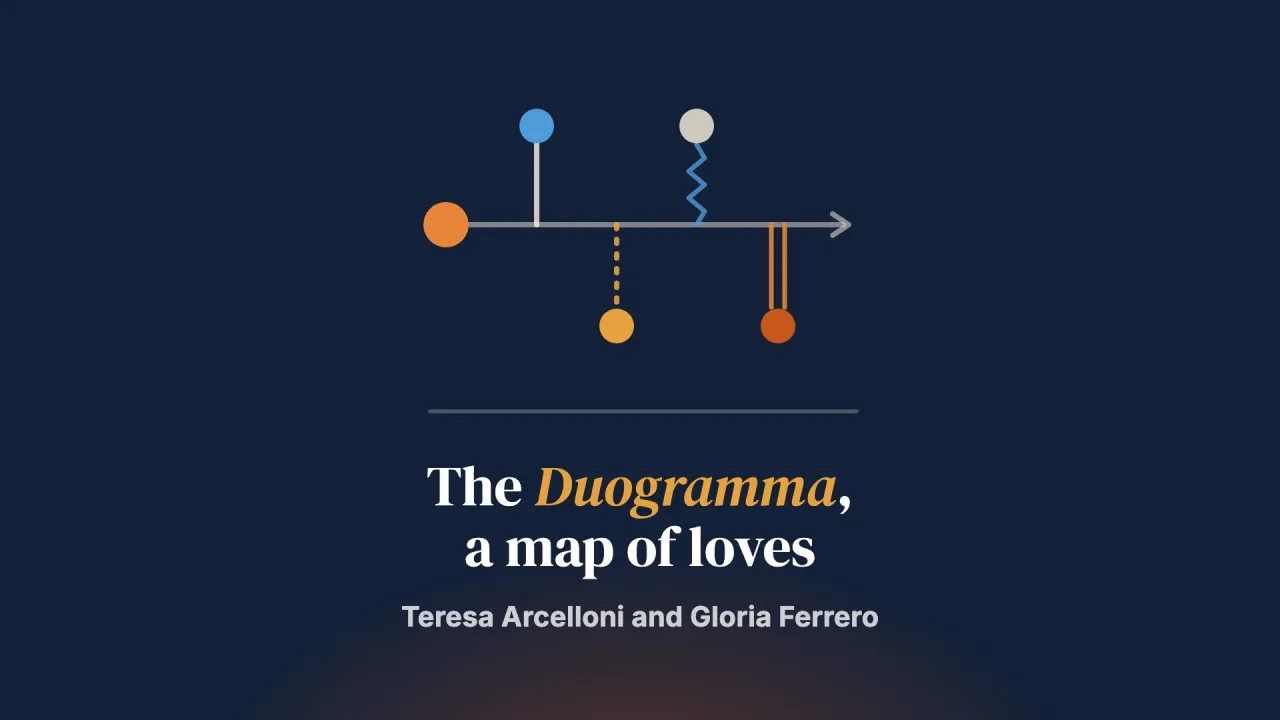
The Duogramma®: An innovative methodology for psychotherapy
A map of the couple relationships lived, desired or rejected since childhood: the Duogramma®, its graphic rules and its use in individual therapy.
 Blog
Capp® groups give parents a place to think together
How does a reflective parenting group work? Jalila Kormachi and Yara Doumit describe how parents revisit a difficult moment and choose what to try next.
 Blog
Challenging in therapy: What a patient taught me
A couples therapy session led me to reflect on confrontation, authenticity and resonance: how to address difficult behaviour without invalidating the person.
 Blog
Adult ADHD: when forgetting turns into a misunderstanding
Forgetting, compensating, tension in the couple: a systemic look at adult ADHD, to understand what is at stake and to look for more fitting forms of support.
Comments 0
Log in to join the discussion. Log in