Attachment & Human Development · Migration
Parent-child border separation and the road to repair: addressing a global refugee phenomenon
Between 2017 and 2021, more than 5,000 children were separated from their parents at the southern border of the United States, and over a thousand have still not been reunited with their families. The team from San Francisco’s Child Trauma Research Program reviews what eight decades of research on attachment, stress and institutionalisation say about these ruptures, then shows, through three families, how Child-Parent Psychotherapy helps to reweave the bond, including with older children and in a multi-family group.
This is a reformatted republication of Parent-child border separation and the road to repair: addressing a global refugee phenomenon, by Karen Jones-Mason, Vilma Reyes, Monica Noriega and Alicia F. Lieberman, published in Attachment & Human Development (Taylor & Francis) (2025), doi: 10.1080/14616734.2024.2401928, under a CC BY 4.0 licence. Prepared by Complexe Systémique in September 2026: the authors’ text is unchanged; the layout has been adapted for reading online, which constitutes a modification of the work under the terms of the licence. The end-of-article statement is grouped in the notes. This edition was made neither by the authors nor by the publisher, who are not responsible for its content or for any errors. The original version prevails.
The impact of forced parent-child separations is indisputable and so is the hope of repair.
Karen Jones-Mason, Vilma Reyes, Monica Noriega and Alicia F. Lieberman
Abstract
As a result of the Department of Homeland Security’s zero-tolerance policy (ZTP), over 5,000 children were separated from their parents at the U.S. southern border from 2017-2021, with over 1,000 still lacking confirmed reunifications. Separations also occur daily due to immigration raids, chaotic processing, and changing immigration policies. This article addresses the most fundamental question faced by families enduring such separations; how to mend attachment bonds that have been suddenly severed, especially within a population likely already traumatized. The paper begins by updating readers about separation in the United States and offers a concise summary of the consequences of child-parent separation. The paper then introduces Child-Parent Psychotherapy (CPP) as an intervention for affected families. This paper also uniquely applies CPP to older children and provides three case examples of its use in treating separated families. Finally, the paper offers general suggestions for supporting these families.
Keywords: Attachment; trauma; family separation; reunification; child-parent psychotherapy
Family separation as the result of forced migration and refugee status has become a global phenomenon that causes lasting damage to the physical and emotional health of countless numbers of children around the world. There is an urgent need to address the damaging sequelae of child-parent separation using intervention strategies that aim to repair the damaging impact of broken attachment on healthy child development. This article has multiple goals. First, we briefly summarize decades of research documenting the devastating impact that abrupt family separation can have on children. Second, we present three case examples where Child-Parent Psychotherapy (CPP) was used as an evidence-based, relationship-focused intervention to restore trust in the attachment relationship following child-parent reunification. Finally, we offer recommendations to help clinicians provide relationship-informed interventions to families who experienced traumatic events in their country of origin and child-parent separation in their new host countries. We hope that this paper will inspire providers and researchers to collaborate in developing a coordinated approach to help children and families afflicted by the scourge of migration-related separation.
Scope of the problem
It is estimated that in the United States over 5,000 children were removed from their parents under the Zero-Tolerance Policy (ZTP) introduced by the U. S. Department of Justice in 2018,1 approximately 400 of whom were under five years of age and at least 295 were U. S. citizens.2 ZTP stipulated that any adult approaching the United States border without documentation would be criminally prosecuted even when applying for asylum and separated from all accompanying minor children. Early reports indicated that children were held for a mean of 154 days, with some in custody for a year.3 The policy rationale was described as “deterrence” (Soboroff, 2020).
The United States District Court in the Southern District of California directed the Department of Human Services (DHS) to halt separating families and ordered reunification in a case titled Ms. L., et al. v. ICE et al., (2018).4 Recently, the federal court has approved a settlement in Ms L. et al., vs. ICE et al., (2023)5 that prohibits the practice of child separation at US borders for eight years.6 Given this time-limited frame, ZTP may be enforced at the US borders again.
The Interagency Task Force on the Reunification of Families (IATFRF) was established in 2021 to identify families that were separated between 20 January 2017, to 20 January 2021, and still needed to be reunified. As of November 2023, the IATFRF reported that over 3,147 children had been reunified but over 1,000 additional children remained without confirmed reunifications.7
Providers, researchers, and the public should keep in mind that children continue to be separated from their parents every day due to a variety of circumstances. For example, separations occur when immigration raids take place at the parent’s place of work, when children arrive at the border with an adult other than a parent or legal guardian (e.g. grandparent), and when Customs and Border Patrol (CBP) detains families separately and releases them at different times and in different places.8 Also deeply concerning is the practice of deporting one parent unbeknownst to the remaining parent, who is left alone with children in a new country (Venta et al., 2024).
Moreover, recall that under the guise of safeguarding the public from COVID-19, starting in 2020, the Trump administration expelled approximately 16,000 unaccompanied children under the Centers for Disease Control and Prevention (CDC) Title 42 policy (1944). Federal courts halted the practice in November 2020.9 These expulsions were abrupt and executed without plans for the children’s safety. Even after the deportation of unaccompanied minors ceased, Title 42 continued to be used against adults and families, with the result that thousands of people accumulated in border towns with high levels of violence.10 Estimates are that approximately 3,000,000 people were deported under Title 42 restrictions, leading some families to send their children alone across the border into the United States.11 Similarly, policies such as the “Migrant Protection Protocol” ((MPP) (otherwise known as the “Remain in Mexico” protocol”) required families to stay in border towns while their cases were pending. Such policies also resulted in families sending their children across the border alone (Mercado et al., 2021; Venta et al., 2024). Most recently, the administration enacted a “Proclamation”12 under sections 212(f) and 215(a) of the Immigration and Nationality Act (“INA”) establishing strict limits on asylum applications, authorizing the deportation of those who do not proactively express fear, and applying increased standards for those applying for asylum. Unaccompanied minors are exempt from the proclamation, increasing the risk that families will again send their children across the border alone.
Sadly, as others have noted, this is not the first time family separation has occurred in the United States (de la Pena et al., 2019). During slavery, families from across the African diaspora were separated when children or parents were sold (Pargas, 2009; Sinha, 2022). Native American children were removed from their families and sent to boarding schools as part of the movement to massacre and colonize the indigenous peoples of the Americas (Adams, 1995; Feir, 2016; Tafoya & Del Vecchio, 2005). During WWII, the families of Americans of Japanese ancestry were forcibly removed from their homes and into internment camps; some families were also separated (Houston & Houston, 1973, Nagata et al., 2019).
The United States is not alone in this practice. Family separation is currently happening in multiple places around the world. For example, recent investigations report that almost 20,000 children were removed from their families in Ukraine and sent to Russia, with the youngest child reported to be about 4 months of age.13 Moreover, Ukrainian children sent to live with relatives in the United States were separated at the border because they were not traveling with their parents.14 Human rights groups report that Uyghur children are separated from their families in China and placed in “child welfare” institutions and boarding schools.15 Other examples abound, lending continued relevance to the topic of this special issue.
Because policies that use family separation as a weapon are present and continuing around the world, there is a growing need for treatment for both the child and the family. CPP provides therapeutic support and guidance for parents in helping their children recover from devastating events such as community and domestic violence, death of a caregiver and separation during times of war or other life-threatening events. The University of California, San Francisco (UCSF) Child Trauma Research Program (CTRP) has been active in treating children separated from their families during ZTP and thereafter.
Consequences of child – parent separation
Research over approximately the last 80 years has demonstrated that not only can abrupt separations have catastrophic developmental consequences for children but even normative relatively short-term separations between parent and child can have measurable effects (Ainsworth et al., 1956; Bowlby, 1951, 1969 [1982]; Jones-Mason et al., 2019). Relevant research can be found in the attachment literature as well as studies examining children exposed to institutionalization.
Attachment theory has its roots in the study of child-parent separation (Bowlby, 1969[1982]). Attachment theory is “ … an ethological and biological theory that conceives of attachment as an instinct or behavioral system within the child to maintain proximity to a source of safety in which to develop, usually the biological parent in humans” (Bowlby, 1969 [1982]; Jones-Mason et al., 2019, p. 3) Decades of research have established that attachments are necessary not only for the survival of the infant but for social and emotional development and even physical health (Cassidy & Shaver, 2016; Sroufe, 2005). John Bowlby’s research, starting with his report for the World Health Organization in 1951, highlighted the negative effects of child separation and coined the term “maternal deprivation” (Bowlby, 1951). His seminal film with James Robertson, “A Two-Year-Old Goes To The Hospital” (Bowlby & Robertson, 1954), demonstrated children’s emotional responses to separation, including grief and anger during normative separations like maternal hospitalization.
Bowlby eventually published his theory in three volumes: Attachment (Bowlby 1969 [1982]), Separation: Anxiety and Anger (Bowlby 1973), and Loss: Sadness and Depression (Bowlby 1980). Bowlby and Robertson identified three stages that children go through when separated from their primary caregivers: protest, despair, and detachment. Protest arises from anger and anxiety about separation from the parent, despair from sorrow and grieving, and detachment as a defensive response (Bowlby, 1973; Bretherton, 1992) His findings showed that children exhibit intense emotional reactions to separation, such as prolonged crying and behavioral changes like rocking or immobility, while reunion typically involves initial detachment followed by ambivalence (Bowlby, 1973).
Later studies confirmed Bowlby’s observations, showing persistent effects of separation on children’s behavior and health (Ainsworth et al., 1956; Heinicke, 1956; Robertson & Robertson, 1971). Research on adults separated from parents during WWII indicated long-term impacts, including heightened stress responses, psychiatric disorders, and health issues identified 60 years later (Eriksson et al., 2014; Pesonen & Raikkonen, 2012). Similar challenges are observed in children facing separations at the border, paralleling the experiences of WWII evacuees (e.g. children leaving a place of great danger, not necessarily understanding what was happening or why, and uncertain that they would ever see their parents again) (Jones-Mason et al., 2019). These studies underscore the enduring influence of disrupted attachment relationships on mental and physical well-being across generations.
Attachment is a regulatory theory. Attachment theory, rooted in Bowlby’s work, asserts that the caregiver-child relationship profoundly influences the child’s emotional and behavioral regulation (Bowlby, 1973). According to Bowlby, there are three key ideas regarding child self-regulation: First, children who trust their caregivers are less likely to experience intense fear; second, expectations about caregiver availability are formed during a sensitive period from around six months to five years old; and third, these expectations form an internal working model (IWM) guiding the child’s behaviors (Bowlby, 1973). Bowlby posited that one of the primary causes of anxiety in young children stems from experiences that undermine their expectations regarding caregiver availability which can include actual separations coupled with inconsistent substitute care and institutional upbringing (even in “well-run” institutions).
Other researchers have suggested that children develop self-regulating capacities by creating attachment strategies to maintain proximity to caregivers; secure children communicate openly, while avoidant children suppress distress, and resistant children seek excessive attention (Cassidy, 1994; Main, 1981; Main & Hesse, 1990). The disorganized classification applies to infants who do not show a consistent pattern of attachment behaviors; the term disorganized actually refers to a breakdown of attachment strategies for organizing responses to the need for comfort and security when under stress. Disorganized behaviors are considered idiosyncratic to each child (Main & Hesse, 1990; Solomon & George, 2016).
Research indicates that attachment influences biological regulation systems, including the autonomic nervous system (ANS), hypothalamic-pituitary-adrenal (HPA) axis, and epigenetic functions, impacting stress responses and health outcomes (Asok et al., 2013; Beach et al., 2016; E. Chen et al., 2011; Shonkoff et al., 2012). These biological activities rely on experiential stimuli, in part provided by the caregiver-child relationship, for normative development, and are thought to be key physiological mechanisms by which stress influences health outcomes (i.e. “gets under the skin”(Soares et al., 2021).
The stress response implicates a number of these systems including the parasympathetic (PNS) and sympathetic (SNS) branches of the autonomic nervous system (ANS), and neuroendocrine, metabolic and immune functions. Two primary stress responses include the sympathetic adrenomedullary (SAM) system, which is part of the SNS branch of the autonomic nervous system (ANS), and the hypothalamic-pituitary-adrenal axis (HPA) (Gunnar & Vazquez, 2006). Figure 1 sets forth a brief summary of the SAM and HPA response. The stress response developed to aid individuals in fleeing from predators or immediate threats, but it was designed to activate only for a short duration. When stress is chronic and/or overwhelming stress can be toxic (Sapolsky, 2004). Existing studies indicate that the persistent triggering of the stress response plays a role in understanding the connections between early adversity and outcomes in development or disease (Bengtsson et al., 2023; Chiang et al., 2023; Danese & McEwen, 2012; Laurent & Powers, 2007). The attachment relationship is generally thought to play a central part in ending the stress response and, therefore, in “buffering” individuals from the negative impact on health of chronic stress (Gunnar, 2017; Gunnar et al., 2015).
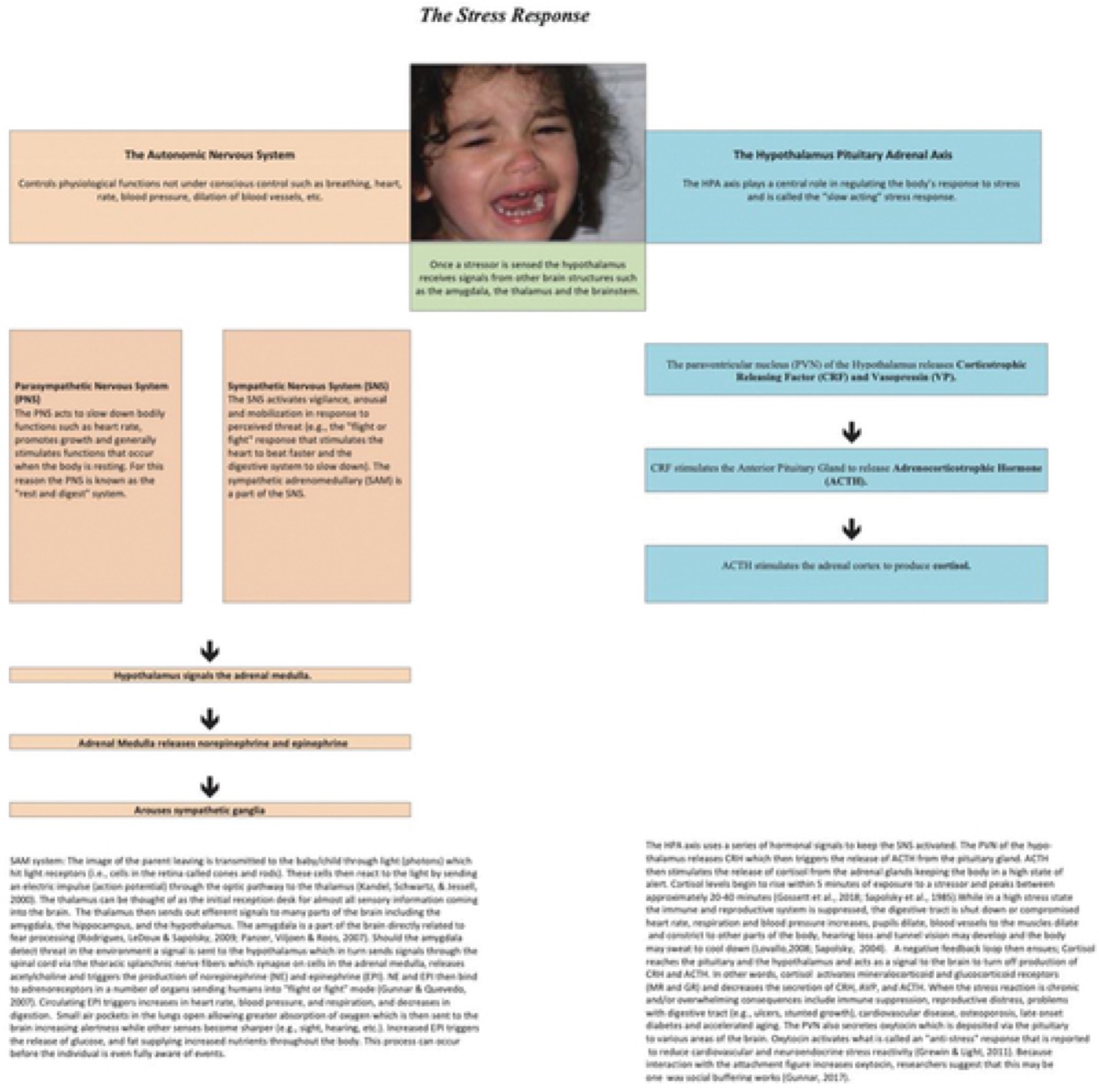
Human and animal studies suggest the attachment relationship shapes HPA regulation (Albers et al., 2008; Berry et al., 2017; Bosquet Enlow et al., 2014; Braarud & Stormark, 2006; Gunnar, Brodersen, Krueger, et al., 1996; Hostinar et al., 2014; Martinez-Torteya et al., 2014; Meaney & Szyf, 2005; Mills-Koonce et al., 2009; Nachmias et al., 1996). Research on human offspring indicates that early in life reduced levels of parental sensitivity correlate with elevated cortisol levels during activities like bathing (Albers et al., 2008) or diaper changing (Morelius et al., 2007).
Even short-term separations or parental disengagement can trigger stress responses in children and impact the stress response in the HPA or ANS (Bosquet Enlow et al., 2014; Bush et al., 2017; Conradt & Ablow, 2010; Jones-Mason et al., 2018, 2023; Moore & Calkins, 2004). Note that generations of animal studies have also reported links between parental separation and changes in cortisol regulation (Feng et al., 2011; Stanton & Levine, 1985; Zhang, 2017). Even when the parent is simply unresponsive or unavailable for a short period, human infants experience disturbances in HPA function. For example, Still-Face Paradigm (SFP) studies report increases in infant cortisol after only two minutes of simple parental disengagement (Grant et al., 2009). Although separation and disengagement are not the same, the measure demonstrates how quickly the stress response is triggered when the parent is merely inaccessible. Attachment studies that measure infant responses during the parental separation phase of the Strange Situation Procedure (SSP) (Ainsworth et al., 1978) indicate that children experience measurable increases in cortisol (Gunnar, Brodersen, Nachmias, et al., 1996; Nachmias et al., 1996; Spangler et al., 1994). Sensitive parenting and secure attachments (suggesting relationships wherein parents were available and responsive) correlate with reduced cortisol reactivity and improved stress regulation during challenges like parental absence or medical procedures (Bosquet Enlow et al., 2014; Feldman, 2009; Feldman et al., 2010; Grant et al., 2009; A. B. Johnson et al., 2018; Letourneau et al., 2011; Wagner et al., 2019). Moreover, one of the evacuee studies reported higher cortisol reactivity in adults separated from their parents in childhood during WWII compared to those who were not separated 60 years later (Eriksson et al., 2014).
Attachment also plays a role in shaping the ANS
Generally, when experiencing distress, secure children, having learned to trust their parents’ responses, show lower ANS arousal and more adaptable stress reactivity compared to insecure children (Jones-Mason et al., 2018). Children with inconsistent or unresponsive caregivers either recover slowly or not at all from distress (Jones-Mason et al., 2018, 2023).
More specifically, increased resting parasympathetic activity (measured by respiratory sinus arrhythmia (RSA)) and decreased RSA under stress are seen as positive signs of social and emotional regulation (Jones-Mason et al., 2018). Infants of highly sensitive parents tend to have higher resting RSA levels compared to those with less sensitive parents (M. Johnson et al., 2017; Kaplan et al., 2008; Kohler-Dauner et al., 2022). Secure infants in free-play scenarios show higher RSA and lower SNS activity (Kohler-Dauner et al., 2022). Insecure infants show greater RSA reactivity during reunions with parents (Groh & Narayan, 2019). Recent research also found that sensitive parenting during challenges is linked to lower PNS reactivity and better PNS and SNS recovery (Jones-Mason et al., 2023).
ANS function in children during separation measures such as the SSP has been variable, but several studies highlight significant differences. For instance, Sroufe and Waters (1977) found that although all children experienced heightened heart rate during the SSP securely attached children had the quickest heart rate recovery upon reunion with their mother compared to insecurely attached children. Disorganized infants exhibited higher heart rates regardless of whether they were alone or with an attachment figure (Spangler & Grossmann, 1993; Willemsen-Swinkels et al., 2000). Avoidant infants showed greater PNS withdrawal, indicating higher allostatic load (Hill-Soderlund et al., 2008). In a foster child sample, those with a history of neglect had the highest SNS reactivity during the SSP (Oosterman et al., 2010). Children with disordered attachment (a term used to refer to both disorganized – controlling and insecure – other classifications) displayed higher SNS responses throughout the SSP, with RSA patterns differing from those with ordered attachment, who showed RSA decreases on the first separation and increases on the second reunion. These studies indicate that both the lack of responsiveness or availability inherent in insensitive parenting as well as the actual absence of the parent trigger an ANS response in children.
In conclusion, multiple stress responses appear to be influenced or shaped by experiences within the attachment relationship. These studies suggest that even short-term separations or parental disengagement under controlled conditions may impact stress regulation systems, such as the HPA axis and ANS. Parental separation may result in chronic activation of the stress response or “toxic stress.” Toxic stress exerts a severe physiological impact on the developing brain and other biological systems, which can result in a broad spectrum of health and developmental issues (Eriksson et al., 2014; Pesonen & Raikkonen, 2012; Shonkoff, 2019).
Institutionalization and deprivation
Children forcibly separated from their parents by immigration policies may encounter serious deprivation during separation. The literature on childhood deprivation is relevant to children separated at the border, who encounter the double impact of separation and deprivation. An amicus brief submitted on behalf of children being held in a Texas detention camp explained,
[Recent visits to] the CBP facility in Clint, Texas, in the El Paso sector, found at least 250 infants, children and teens being held at the facility, some for nearly a month. Some of the children had not showered or bathed or been given a clean change of clothes since arriving at the facility, and they had inadequate access to soap and toothbrushes. Children were filthy and wearing clothes covered in bodily fluids, including urine. They were being given insufficient food, and were forced to sleep on cold concrete floors. At least 15 children at the facility had the flu, and 10 more were being held in medical quarantine. Children as young as seven or eight years old were being asked to care for toddlers they just met.”16 (Brief of Amicus, Flores vs Barr, 2019, pp. 4-5)
A recent report on children aged 6 months to 18 years held at Karnes County Family Residential Center (KCFRC) from June 2018 to October 2020 revealed concerning conditions. Despite the federal Flores settlement, which sets safety standards for children in detention, the median stay was 43 days, exceeding the limits. The report noted significant health issues among the children, including moderate to severe wasting (4.3%), malnutrition risk (11.7%), stunting (22.6%), and severe stunting (5.5%), with no documented efforts to address these concerns. Language barriers were evident, with minimal use of interpreters, impacting the care environment. The conditions described in the amicus brief and in the recent medical report suggest that children, even very young babies, are experiencing what appears to be deprivation and it is occurring at a very sensitive time for development. Accordingly, institutional studies examining the impact of deprivation is relevant here.
Although a comprehensive review of the institutional deprivation studies is beyond the scope of this paper (for a summary of institutional studies see Jones-Mason et al., 2019; Nelson & Fox, 2014), we offer a brief review to illustrate the impact of these conditions and their relevance to children separated at the border. As early as the 1930’s researchers such as Rene Spitz and William Goldfarb noted the profound developmental impact of institutional rearing, including devastating vulnerabilities to disease and death (Goldfarb, 1943; Spitz, 1945, 1946). Today estimates of the number of children in institutionalized care vary from 3·18 million to 9·42 million children (Desmond et al., 2020).
Research consistently shows that institutionalization negatively affects children’s development, leading to compromised cognition, language difficulties, growth delays, and social/behavioral problems (Bick, Fox, et al., 2017; Bick, Luyster, et al., 2017; Bos et al., 2009; Fox et al., 2011; D. E. Johnson et al., 2010; Kreppner et al., 2001, 2007; Li et al., 2017; Perry & Donzella, 2023; Roy et al., 2000; Wade et al., 2022; Windsor et al., 2011)
Institutionalized children typically exhibit lower IQ levels compared to those in foster care (van IJzendoorn et al., 2008). For instance, a UK study monitoring 165 children post-institutionalization found varying degrees of cognitive impairment based on duration: less than 6 months (2.3% impairment rate), 6–24 months (12.0%), and 24–42 months (32.6%) (Rutter et al., 2004). Research also highlights stunted growth among institutionalized infants and toddlers, with one study indicating they may lose approximately one month of linear growth for every 2–3 months in care (Miller & Hendrie, 2000; Pollak et al., 2010). Even when provided with material needs, institutionalized children can suffer stunted growth in socially and emotionally deprived environments (Sonuga-Barke et al., 2010). Long-term effects include symptoms such as antisocial behavior, heightened anxiety, and persistent emotional difficulties into adolescence (Hodges & Tizard, 1989a, 1989b).
Recent studies have delved into the impact of institutionalization on brain development, revealing structural and functional differences compared to non-institutionalized peers (Nelson & Fox, 2014). Imaging studies show reduced brain volume and abnormalities in white matter tracts, potentially affecting neurocognitive and behavioral functioning in institutionalized children (Behen et al., 2009; Herzberg et al., 2018). EEG studies suggest similarities between institutionalized children and those with ADHD (Marshall et al., 2004). Longitudinal studies such as the Bucharest Early Intervention Project (BEIP) demonstrate the enduring effects of institutionalization into adolescence, with persistent differences in brain structure (e.g. lower grey and white matter volume) and cognitive functioning (Sheridan et al., 2022; Wade et al., 2019). Additionally, altered stress response systems, such as the HPA axis and ANS, are observed in children with institutional experience, with implications for their physiological and psychological well-being (Esposito, Koss, et al., 2016; Gunnar et al., 2001; Perry et al., 2022; Shirtcliff et al., 2021).
A recent qualitative study interviewed children who had been institutionalized while living at home, primarily due to economic (like single parenthood or financial hardship) and social factors (such as divorce, substance abuse, and domestic violence) (Ismayilova et al., 2023). Conducted with children aged 8 to 16 years who were interviewed after reunification or during home visits, the study captures their experiences of institutionalization and separation trauma. The children expressed sadness, longing for caregivers, and feelings of abandonment (Ismayilova et al., p. 6–7). Some harbored resentment and detachment toward their parents and exhibited numbness or aggressive behavior (Ismayilova et al., p. 8, 11). They described institutions as overly regimented, lacking stimulation, and providing inadequate education, with reports of violence and minimal privacy (Ismayilova et al., p. 8–9). At the end of the study, one child had a message for parents; “My advice to parents is that they should not send their children to the institutions” (Ismayilova et al., 2023, p. 9).
In conclusion, research consistently underscores the profound and lasting impact of institutionalization on children’s development across multiple domains, necessitating comprehensive support and interventions for this vulnerable population.
Telomeres and epigenetics
Recent investigations have highlighted connections between parental experiences and cellular processes, specifically focusing on telomeres and genetic regulation. Telomeres, repetitive DNA segments located at chromosome ends, play crucial roles in DNA replication and stability (Blackburn & Epel, 2017). Telomeres shorten during cell division until reaching a critical length, halting further division and leading to cell death. Numerous studies have linked shorter telomeres to various adverse health factors such as smoking, alcohol consumption, obesity, and chronic stress (Buxton et al., 2011; Epel et al., 2004; Strandberg et al., 2012; Valdes et al., 2005). Parenting behaviors have also been associated with telomere length, with one study indicating that parental responsiveness moderated the telomere-length-SES association, showing longer telomeres only among children living in low-resource environments (Asok et al., 2013). Other studies found associations between shorter telomeres and extended institutional care during childhood (Drury et al., 2012), loss of a father to death, incarceration, and other various causes (Mitchell et al., 2017), and parental migration (correlating with higher internalizing and externalizing symptoms) (X. X. Chen et al., 2019). One recent study reported that adopted youth with previous institutional experience had shorter telomeres as well as higher levels of depressive symptoms when compared to children who always lived with their families (Heleniak et al., 2023). Note that because the age of adoption did not predict telomere length the authors opined that the outcome might be the result of the experience of institutionalization itself rather than the length of time in an institution (Heleniak et al., 2023).
Finally, research conducted in China among children who were separated from their parents because of agricultural immigration examined telomere length in three groups: children whose parents left for more than six months per year when they were under 6 years of age (early childhood separation), children who were persistently separated from birth (prolonged separation), and children whose parents never left (Wang et al., 2023). Telomeres were measured twice, with measurements occurring one year apart. Children who experienced prolonged separation had significantly shorter telomeres than children who were never separated. No difference in telomere length was detected in children who experienced early childhood separation but were reunified during adolescence compared to children who were never separated. The authors opined that these findings suggest that adolescence may be a period of developmental sensitivity and thus might offer the opportunity to buffer older children from parental separation (Fuhrmann et al., 2015). This study does not indicate whether the participating children experienced any of the other serious traumas that children at the border experienced, but clinicians may keep in mind that adolescence may be a sensitive period and thus an important time for intervention. These findings suggest that parental responsiveness, separation, and institutionalization impact telomere length, especially during early life.
Epigenetic regulation encompasses processes influencing gene expression and phenotypic plasticity without altering DNA sequences (Ashe et al., 2021). Epigenetic changes, notably DNA methylation, regulate gene expression by modifying chromosomes (Rahat et al., 2023). DNA methylation, a stable epigenetic mark, represents a crucial point where environmental experiences intersect with neurobiology (Ellis et al., 2011). Early research in rodents demonstrated that maternal separation during sensitive developmental periods alters DNA methylation and gene expression, particularly in areas related to stress regulation and brain development (Anier et al., 2014; Meaney, 2001; Meaney & Szyf, 2005; Meaney et al., 2007; Weaver et al., 2004; Zaidan et al., 2023). Extant studies suggest that caregiver responsiveness influences gene regulation (Beach et al., 2015; Bock et al., 2014; E. Chen et al., 2011; Jones-Mason et al., 2016; Kang et al., 2013; Provenzi et al., 2020; van IJzendoorn et al., 2010) (for a review of epigenetic studies related to psychopathology and development see O’Donnell and Meaney (2020)).
In studies of institutionalized children, differential methylation of genes associated with compromised immune function and brain development has been observed in four-year-old children living in orphanages compared to peers raised in families (Naumova et al., 2019); in children in middle childhood living in institutions compared to children raised by biological families (Naumova et al., 2012); in adopted children with institutional experience compared to children raised in birth families (Esposito, Jones, et al., 2016), and in adopted children with extended or limited institutional experience compared to non-institutionalized adopted peers (Kumsta et al., 2016). Additionally, studies like the BEIP study have indicated a negative correlation between institutionalization duration and methylation levels in two stress-related genes (Non et al., 2016).
What can clinicians expect to encounter among families who have been separated? As many have pointed out, families coming to the southern border of the United States are frequently fleeing war, domestic or community violence, political or economic upheaval-and sometimes all of the above (Office of Inspector General, 2019). Accordingly, children and parents carry the physiological and emotional marks of multiple traumatic exposures. Then, sometime immediately upon approaching the border, the child is taken away from their only source of safety-the caregiver. They may end up terrified, hungry, cold and alone in a room cared for by nothing but other children and eventually given to strangers. Based on the research presented here, what would the bio-psycho-social impact on the child after separation? Early studies by Bowlby and others suggest that upon removal the children will begin the process of protest, despair and detachment. Audiotapes presented to Congress of children at the border crying for their parents painfully demonstrate protest.17 ANS studies establish that when an attachment figure simply disengages, even for very short period, measurable differences in SNS, PNS and cortisol reactivity are detected (Conradt & Ablow, 2010; Jones-Mason et al., 2023). Accordingly, upon removal the child will protest, the amygdala will send signals to the hypothalamus which in turn will send signals to the adrenal glands which then produce epinephrine. Increased epinephrine will stimulate an increased heart rate, blood pressure, and respiration, and decrease digestion (Jones-Mason et al., 2019). While in this high-stress state, cortisol levels will also increase, pupils dilate, blood vessels to the muscles dilate and constrict to other parts of the body, hearing loss and tunnel vision may develop, and the immune and reproductive system is suppressed (Bhushan et al., 2020; Jones-Mason et al., 2019; Lovallo et al., 2010; Sapolsky, 2004). Without an attachment figure to act as a buffer the stress response will probably continue and consequences could include immune suppression, reproductive distress, problems with the digestive tract (e.g. ulcers, stunted growth), cardiovascular disease, osteoporosis, late-onset diabetes, obesity and accelerated aging (Bhushan et al., 2020). As Bowlby and others showed, even when children were separated from parents for normative reasons such as the mother giving birth to a younger sibling, upon reunification the children showed anger, fits, and regulatory dysfunction that sometimes continued for years. Those removed from attachment figures long enough may detach altogether. Sadly, there are still children who have been separated for years-effectively orphaned. Finally, as the evacuee studies show, the impact on health and psychosocial functioning might be detectable as many as 60 years later. In other words, the physiological and psychological impact of separation may last a lifetime without intervention.
It might also be helpful to note that a small but relatively recent number of studies have reported on the health of families and youth at the border. One study reported that out of 17 adults all but two met the criteria for PTSD (the remaining two had symptoms suggestive of trauma), and out of 9 children all but two met PTSD criteria (PHR, 2020). Many also had diagnoses of depression and anxiety. The children also “ … exhibited reactions that included regression in age-appropriate behaviors, crying, not eating, having nightmares and other sleeping difficulties, loss of developmental milestones, as well as clinging to parents and feeling scared following reunification with their parents” (PHR, 2020, p. 4). These are symptoms identified by Bowlby and others in the early days of attachment research. Another study reported PTSD symptomology among a cohort of high school students whose families had immigrated approximately two years earlier; 60% exceeded clinical cut-off scores (Venta & Mercado, 2019). The same study reported similar findings in a cohort of caregivers who had just arrived in the US; 60% of the children had scores that exceeded clinical cut-off scores for trauma exposure. Another study examined exposure to trauma and other adverse life experiences (ALE) among unaccompanied youth in the US (Cardoso, 2018). Cardoso (2018) confirmed that unaccompanied youth are exposed to ALE’s at multiple points during the migration including in their country of origin, during the journey and after arrival in their host country. These experiences include extreme violence, physical/sexual abuse, abandonment, state-sponsored violence, torture and kidnapping. Among the youth, 56.7% met the criteria for posttraumatic stress disorder, 30% for major depressive disorder, and 30% reported experiencing suicidal thoughts within the past year. The youth were also consistently exposed to traumatic events such as family separation, violence within families and communities, inadequate institutional support, and widespread poverty. Note that several studies have confirmed that minors approaching the US border have experienced extremely high rates of exposure to traumatic events such as emotional, physical and sexual violence resulting in depression, anxiety and PTSD exceeding clinical cut-off scores (Bamford et al., 2021; Cohodes et al., 2021; Mercado et al., 2024; Silva et al., 2022).
The research set forth above suggests that treatment for these families is critical. The question that arises of whether any of these negative developmental outcomes can be reversed. In other words, how do we help these families?
Evidence-Based Interventions to Address Immigration-related Parent-Child Separations: Child-Parent Psychotherapy
Child-Parent Psychotherapy (CPP) (Lieberman et al., 2005, 2006) is an empirically supported treatment that specifically targets the caregiver-child dyad for therapeutic intervention and holds the potential to treat young children (five years of age and younger) who have been forcibly separated from parents under conditions of extreme trauma and/or duress (Chu et al., 2021; Lieberman et al., 2006). Because trauma can damage the child’s confidence that the caregiver is a reliable source of protection CPP seeks to strengthen the caregiver’s ability to provide sensitive caregiving as well as to restore a sense of safety to the child creating a positive developmental life trajectory (Chu et al., 2021; Lieberman et al., 2011).
In the first phase of CPP, the foundational phase, CPP clinicians meet with the caregiver alone for an average of five sessions. This phase is crucial for establishing a robust alliance and conducting a comprehensive evaluation of the caregiver and child’s trauma history. It also involves understanding how these experiences have influenced the child’s functioning and the caregiver’s perception of their relationship. CPP clinicians assist caregivers in understanding the link between a child’s trauma history and their behavioral and emotional expressions by examining and interpreting the underlying meaning of concerning behaviors. They offer developmental advice regarding triggers of trauma, collaborating with caregivers to anticipate and ready themselves and the child for possible triggers. This phase is beyond assessment and provides opportunities to intervene by enhancing the caregiver’s reflective capacity and addressing any concrete needs with daily living such as food insecurity, housing, social services, and legal help (Lieberman et al., 2019).
CPP clinicians understand that the goal of CPP extends far beyond symptom reduction. CPP aims to strengthen trust, responsiveness, and attunement within the parent-child relationship, the most powerful intervention for trauma recovery during early childhood. To that end, the foundational phase is a time to explore the caregiver’s hopes, concerns, and wishes for their child and to invite the caregiver to consider how their own histories may have impacted the parent-child relationship. For example, during the foundational phase the CPP clinician asks the caregiver to recall and share “angel memories,” or benevolent memories of a time they felt especially safe, cared for, and understood. The Angels in the Nursery Interview serves as both an assessment and intervention tool to support caregivers in tapping into their internal sources of protection and psychological safety that they hope to share with their child.
The foundation phase concludes with a feedback session between the CPP clinician and the caregiver. During the feedback session, the caregiver and clinician discuss what they learned during the foundational phase and come to a shared understanding about how past traumatic experiences are connected to current behavioral and emotional challenges in the parent-child relationship. Naming the connection between past traumatic experiences and present challenges early on in treatment creates a courageous space in the therapeutic relationship to acknowledge the impact of trauma on themselves and their child. The caregiver and clinician then decide how the child will be introduced to treatment in a way that acknowledges this connection to what the child experienced and their current socioemotional challenges or behaviors while considering the child’s developmental stage, challenges, and strengths. After the foundational phase begins the core CPP treatment phase which includes introducing the child to CPP. CPP uses six primary treatment modalities:
- Promoting developmental progress through play, physical contact, and language
- Offering unstructured reflective developmental guidance
- Modeling appropriate protective behavior
- Interpreting feelings and actions
- Emotional support and empathic communication
- Crisis intervention, case management, and concrete assistance with problems of living (Lieberman et al., 2015a, pp. 32-39)
The treatment manual also provides clinicians with strategies to deal with “play, sensorimotor disorganization and disruption of biological rhythms; fearfulness; reckless, self-endangering, and accident-prone behavior; aggression; punitive and critical parenting; and the relationship with the perpetrator of the violence and/or absent father … ” (Lieberman et al., 2006, p. 914).
Termination, the last phase of treatment, is planned for with great sensitivity and collaboration with the parent and the child. Preparations for termination begin right from the start when the parent and clinician discuss when treatment will end. As treatment continues, focus is gradually decreased from the challenges addressed in treatment to the positive changes that have occurred and how the past compares to the present (Lieberman et al., 2015b). The process begins in earnest approximately two months before termination. The clinician will perform post-test assessments, utilizing either structured instruments to gauge symptom changes or conducting an informal interview with the parent. Regardless of the approach chosen, the aim is to engage in a reflective discussion with the parent regarding areas of progress, potential contributors to positive changes, lingering challenges, and strategies for addressing both current and future challenges. The parent will also receive psychoeducation regarding continuing fluctuations in trauma, and how, as the child develops, they may have new questions about or have different ways of understanding previous experiences. In addition, the parent is advised that symptoms may return if the child is exposed to new trauma or reminders of previous traumas. The child will be reminded that the intervention may end about six weeks before to allow sufficient time to process the news. The use of various goodbye rituals is also common (e.g. making picture frames, books or cards memorializing the time together) in order to express what the treatment period has meant to them and to say goodbye in a meaningful manner (Lieberman et al., 2015b)
The findings of several randomized trials confirm CPP efficacy with several different samples including insecurely attached low-income Latino toddlers with multiple trauma exposures (Lieberman et al., 1991); maltreated infants (Cicchetti et al., 2006); toddlers of depressed mothers (Chu et al., 2021; Cicchetti et al., 1999; Toth et al., 2006); maltreated preschoolers (Toth et al., 2002) and preschoolers exposed to domestic violence (Ghosh Ippen et al., 2011; Lieberman et al., 2005, 2006).
Innovative research shows that CPP may impact biological processes like cellular aging. Sullivan and colleagues (Sullivan, Merrill et al., 2024) used a quasi-experimental design comparing a sample of children (2–6 years old) who received CPP with children (3–6 years old) who also experienced stress and trauma but no mental health treatment. At baseline, both groups of children showed accelerated epigenetic aging likely attributable to stress and trauma; however, at follow-up, only the children who received CPP showed a disruption in their epigenetic age acceleration. Sullivan and colleagues surmise that CPP intervention appears to buffer trauma-exposed children from biological embedding of trauma by ameliorating pediatric epigenetic aging acceleration in the short term. The finding that CPP positively impacts children’s cellular aging aligns with Sullivan and colleagues’ literature review where dyadic interventions were found to change cellular processes as well as improve children’s cardiac function, advance brain maturation, and decrease inflammation (Sullivan, Roubinov et al., 2024).
Overall, these studies report that children who are treated with CPP have higher rates of secure attachment, better cognitive functioning, lower symptoms of traumatic stress in both mothers and children, fewer behavioral problems, reduced incidence and symptoms of PTSD and may even impact children at the cellular level (Lieberman & Van Horn, 2008; Lieberman et al., 2005, 2006).
CPP for immigration-related parent-child separations
The following de-identified clinical vignettes illustrate how CPP is applied within the context of immigration-related parent-child separations. All procedures were approved by the Institutional Review Board at the University of California, San Francisco (Protocol numbers; 10–04820 (CPP) and 22–35947 (Lazos Familiares)).
Case 1. Regina, a 29-year-old mother of two children: Andrea, who is 14 years old and Joaquin, who is 4.5 years old migrated to California from a rural town in El Salvador. They were fleeing community violence and ongoing threats to their family’s safety and their business. Joaquin presented with insomnia, aggression toward his mother, separation anxiety, low appetite, diminished interest in play, intense meltdowns and impulsive behavior such as running into the street.
During the foundational phase, Regina shared stories about her beautiful hometown and a family local market she worked hard to maintain. She experienced sexual assault from a local gang member and ongoing threats to return to murder her and her children. At the time, she believed that Joaquin did not know this had happened. She fled with her 2 children on an arduous, long journey involving many incidents of witnessing violence and experiencing hunger and cold although she received some aid along the way. Regina cried recalling the betrayal she felt when she finally arrived at her destination to learn that the worst of her suffering would occur upon arrival. Her family was detained and held in a facility commonly referred to as “hielera” (ice box) to describe the freezing holding cells. “It was part of the torture,” the mother said, remembering that she covered her children with foil to try to keep them warm. The fluorescent lights were always on and they were barely able to sleep. Regina made the connection that her child’s insomnia was likely connected to this experience. Andrea was forced to separate from Regina and Joaquin while they were detained. Juaquin clung to his mother and asked in desperation where Andrea was being taken. The CPP clinician and Regina wondered if Joaquin’s separation anxiety and insomnia stemmed from being painfully aware that parents could be separated from their children.
During the feedback session, the CPP clinician helped Regina integrate her own history, the experiences that had impacted the family and how they were connected to their current struggles. We have found that integrating one’s experience to current thoughts, behaviors and feelings fosters a sense of meaning for both child and parent. Joaquin’s experiences of violence, fear and witnessing forced separation are connected to his current anger towards his mother and his fear to separate from her or to sleep at night. His behavior is an understandable reaction to the extreme fear he experienced.
During the initial dyadic session, Joaquin entered the playroom and focused on a particular toy saying, “the soldiers took this toy from me.” Regina added that he was holding a toy just like the one in the playroom and the immigration officer took it from his hand. We prepare with parents by learning as much as we can about their experiences, but are also open to what the children bring once they enter treatment. Regina said she had not realized that the experience of losing his toy had meant so much to him.
During the core intervention phase, Joaquin told his mother, “cuando cierro mis ojos, tengo miedo qué te desaparezcas” (when I close my eyes, I fear you will disappear) shedding light on the extent of his fear. Young children have a universal profound fear of separation from their parents, one that is essential to our survival as a species by keeping children in proximity to their parents, and this fear had become a conviction for him when he witnessed the forced separations. Regina spent many nights continuing to reassure Joaquin and rubbing his back for several months before he was able to eventually sleep through the night again. Andrea would sometimes choose to join the sessions. She was getting individual treatment at her school but Regina said the school-based clinician had never met with her and she believed Andrea had not shared what happened to her at the border. Andrea never talked about her time separated from the family. During one session, Joaquin chose the game Candyland and asked Andrea to join them in the play. Andrea’s character faced some setbacks in the play and she was behind them in the path. Joaquin became visibly anxious and added a magical component to the game rules where his sister had “magic wings” to be able to catch up to him and their mom. Play provides an opportunity for young children to experiment with alternate endings and be able to experience mastery over events they could not control. The CPP clinician and her supervisor discussed ways to integrate Andrea when she joined sessions, knowing how important the sibling relationship was for Joaquin and that Andrea was likely not receiving the trauma-informed therapy services she needed.
After 20 sessions, a mid-assessment took place and Regina reported sub-clinical levels in parental stress and depression as well as decreased levels in Joaquin’s PTSD avoidance. After 8 months of treatment, Regina was able to recognize Joaquin’s behavior as a manifestation of trauma and could help him co-regulate his emotions and manage traumatic triggers such as drop-off to daycare. When Joaquin tried to hit his mother, she would say, “I know you saw people hitting, but I won’t let you hit me” and his aggression diminished over time. Restoring a sense of security in the parental shield benefits both parents and children. Regina grew more confident in her ability to protect and soothe him, as Joaquin restored trust in his mother’s capacity to do so. Andrea continued joining the dyad on some of the sessions creating opportunities for Joaquin to express his fear of sibling separation. In retrospect, a whole-family approach might have led to more integrative treatment. The impact of forced parent-child separations is indisputable and so is the hope of repair.
CPP with older children impacted by immigration-related parent-child separations
While there is empirical evidence for the use of Child-Parent Psychotherapy (CPP) for children birth to five years old (Ghosh Ippen et al., 2011), we have found that the model is helpful when treating school-age children as well, especially when they present with attachment disruptions. Child Trauma Research Program clinicians have applied the foundational principles of CPP in school-based settings through the Tipping Point funded Mental Health Initiative in San Francisco, CA for over 10 years. We have learned that 1) if left untreated, the traumas experienced in early childhood continue to manifest into childhood and adolescence and 2) attachment disruptions need to be treated within a relationship-based model to address the source of wounding. Caregivers continue to be formative relationships through childhood, and attending to the disruptions in these relationships is key to restoring the child/adolescent’s sense of relational safety.
CPP informs a therapeutic approach that includes older siblings called Whole Family Trauma Treatment (WFTT). WFTT is a model designed to meet the needs of a population of children and caregivers dealing with the effects of chronic, systemic, and intergenerational trauma. It is a relationship-based treatment that aims to repair the damaging effects of trauma within children and in the tapestry of relationships that support them. WFTT is a trauma-informed, systemic model that centers and bolsters attachment bonds towards improving the well-being of children and families. Attachment bonds are a powerful mediating force on a developing child, and these relationships dwell within a greater family system. The Whole Family approach engages siblings, cousins, uncles, stepparents, grandparents, chosen family members, and community support as resources in the healing process. Significant and pervasive trauma and adversity can deteriorate family functioning and impair healthy development of children. WFTT is based on evidence from decades of clinical practice research and brings together the most efficacious interventions for treating trauma within a family system. The WFTT model integrates intrapsychic, interpersonal and social interventions to reduce family distress and create the safe haven and secure base that all children need to thrive.
Case 2. Carla (28) and Nelson (8) were from a small village outside of San Pedro Sula, Honduras. During the foundational phase, Carla described their cantón (e.g. village) as a peaceful, rural area where their family had lived for generations. Carla and Nelson’s beloved cantón was irrevocably impacted by the U.S.-backed military coup in 2009 and the extrajudicial murder of community leaders like Berta Cáceres in 2016. According to Carla, after these events their beloved cantón became a hotspot for crime, police corruption, and gender-based violence. When Nelson was approximately 6 years old, Carla began receiving threats from gang members who began to take control of the area. Despite her numerous attempts to seek protection from local authorities, Carla was eventually abducted and sexually assaulted by gang members.
Carla and Nelson fled Honduras shortly thereafter and undertook a treacherous journey through Central America and Mexico to reach the U.S./Mexico border. Unbeknownst to them, Carla and Nelson’s arrival at the U.S./Mexico border coincided with the implementation of the Trump-era “zero-tolerance,” policy of 2018. Along the journey, Carla and Nelson heard rumors about families being separated at the border. According to Carla, Nelson was shaken by these rumors and pleaded with her, “Don’t let them take me away mamá! Promise me!” Carla reassured Nelson that she wouldn’t allow this to happen, attempting to soothe both of their anxieties about the looming risk of separation.
Upon presenting themselves to U.S. Border and Customs Protection (CBP) officials, Carla and Nelson were transported to an overcrowded, cold and windowless holding cell known as, “la hielera” (the ice box, as noted above). Unable to bathe or lay down due to overcrowding, Carla and Nelson grew restless awaiting their fate. After approximately 72 hours, Carla and Nelson along with several other families were ushered into another room where immigration officials ordered the adults to stand against the wall and the children to stand on the opposite side of the room in a single file line. After a few agonizing minutes, immigration officials ordered the children to walk out of the room. Nelson quickly ran to his mother and pleaded with her to not let them take him away. Carla tearfully recalled immigration officials physically removing a desperate Nelson from her arms. Nelson and Carla were then transported to separate detention centers where they would remain for the next 3 weeks.
On the day they were reunified, Carla recalled waiting in a large room with several other mothers who were separated from their children. One by one the children entered the room, often sprinting into their mothers’ open arms. When Nelson’s name was called, no one walked into the room. After several minutes, a reluctant Nelson walked through the door with his head down, refusing to make eye contact with Carla. Carla recalled embracing Nelson with all her strength as her son pulled away from her. According to Carla, Nelson’s first words to her were, “you promised me.”
Six months later, Carla and Nelson sought psychotherapy at a local Latino-serving social services agency. During the intake, Carla expressed concern about the impact of the separation on her relationship with her son. Carla tearfully reported to the intake coordinator that her son was unrecognizable; her once bright and loving son was now withdrawn, angry, and timid. Carla and Nelson engaged in CPP for almost 2 years with a bilingual-bicultural CPP-trained clinician. During dyadic sessions, Nelson engaged in repetitive trauma play where he re-enacted scenes of their separation at the border in the sand tray and drew pictures of his time in detention.
Nelson’s case was transferred to a new CPP clinician when he was approximately 8 years old. Nelson presented to the new clinician as a much older child, often preferring to talk and play video games than to play with toys in the sand tray. During treatment, Nelson presented as a perfectionistic and rigid child who was often irritated by his mother’s attempts to talk about their immigration history. Nelson was also a star student and took pride in his almost perfect report card. Six months into treatment with the new clinician, Nelson developed challenges with suicidal ideation. Nelson tearfully admitted to his mother and clinician of having thoughts of ending his life after he and his mother got into an argument about his screen time. In treatment, Nelson and Carla slowly unpacked how their experience of forced separation shattered Nelson’s ability to trust himself and others to keep him safe. Nelson’s cry for help emerged as a port of entry to support him and his mother in connecting to painful emotions of grief, rage, and resentment in the parent-child relationship. During treatment, the clinician supported Carla and Nelson to find moments of connection and repair through play. Slowly, Nelson became more adept at expressing negative emotions with his mother and Carla strengthened her capacity to hold her son’s dysregulated affect without becoming overwhelmed. These moments of acknowledgment of painful emotions, connection, and repair supported Nelson and Carla in healing their relationship years after their initial separation at the US/Mexico border.
Lazos Familiares: a CPP-based group intervention to address immigration related parent-child separations
Case 3. Lazos Familiares is an 8-week CPP-based, multi-family group intervention for families who experienced immigration-related parent-child separations. Caregivers and children between the ages of 0–17 utilize the group to facilitate the process of reunification after an immigration-related family separation. Lazos Familiares utilizes emotion co-regulation strategies, storytelling, and community care to support Spanish-speaking Latino families in addressing the impact of immigration-related parent-child separations on their relationships, connectedness to community, and collective well-being. Over the course of 8 weeks, families work together to develop a narrative about their story of separation and reunification that honors the child and the caregiver’s perspectives. Lazos familiares also includes intentional community-building activities to facilitate the metabolization of collective traumas of forced migration and discrimination to create opportunities for collective healing. Groups are conducted in Spanish by a team of 3 bilingual-bicultural CPP-trained therapists.
Laura (30), Alfredo (35), Flor (12) and David (7) Campos were referred to the Lazos Familiares multi-family group by the family resource coordinator at David’s elementary school. David was a bright and timid child who presented with pervasive separation anxiety during school pick-up and drop-off. Upon further inquiry, the family resource center coordinator learned that David experienced multiple traumatic separations from his parents during their immigration journey. When David was 3 years old, his father was abducted and extorted by gang members in El Salvador. After narrowly escaping his captors and multiple failed attempts to seek protection from the state, David’s parents made the difficult decision to flee El Salvador and seek asylum in the U.S. During the intake assessment with the Lazos Familiares therapist, Laura tearfully recounted the details of when Alfredo was temporarily separated from the family during their journey through Mexico and again after arriving at the U.S./Mexico border port of entry. After spending over 48 hours in “la hielera,” Alfredo was sent to an immigration detention center in Georgia where he was imprisoned for the next 6 months. Meanwhile, Laura, Flor, and David were sent to a family detention facility in Arizona. There, Laura recalled holding an inconsolable David who feared he would never see his father again after 3 unanticipated separations. After 3 weeks in family detention, Laura, Flor, and David were released from family detention and relocated to the San Francisco Bay Area where they awaited Alfredo's release.
Almost 3 years later, the reunified Campos family joined the Lazos Familiares multi-family group therapy intervention to address ongoing challenges with separation anxiety and posttraumatic stress in David and Flor. During the foundational phase, the clinician learned that both caregivers and both children were struggling with ongoing posttraumatic stress sequelae including nightmares, separation anxiety, and avoidance of reminders of the separations. After reading “Cuando No Estabas Conmigo,” a CPP-informed book about parent-child separations written by Chandra Ghosh Ippen as a large group, each member of the Campos family worked in small groups with their peers to create a narrative about their experience of separation and reunification. Through the power of storytelling, metaphor, and community, the Campos family shared their narratives with one another within the safety of the large group. David’s narrative was titled, “El conejo grande y el conejito chiquito (the big bunny and the little bunny).” With the help of the Lazos Familiares therapists, David shared his story with his parents of how he experienced the multiple separations from his father and what he needed from them now. When asked what “el conejito chiquito (the little rabbit),” needed from his parents now, David replied, “I want them to play with me more and not get mad at me when I don’t want to go to school.” Laura and Alfredo practiced identifying and co-regulating painful emotions with their children, surrounded by other parents who were also learning new ways of connecting with their children. When it was time for caregivers to share their narratives with their children, Alfredo told a harrowing story about the “conejo grande (big bunny),” who tirelessly searched for his family after they were separated by “el monstruo (the monster).” Alfredo, Laura, David, and Flor used the Lazos Familiares group-therapy intervention to re-weave the threads of their relationships to each other and their newfound community in the U.S. Upon hearing the narratives of other families in the group, the Campos family expressed feeling less isolated and more hopeful for the future of their family and community.
Discussion
The above discussion presents three clinical cases involving families who experienced severe trauma while in their country of origin, on their journey north and, as one mother stated, at the border where the real “torture” started. Note that the behaviors and symptoms identified in all the children are similar to those Bowlby and others reported in earlier studies on separation (e.g. aggression, dysregulation (e.g. sleep issues), depression, anger, etc.). We think it is important to note that CCP started treatment by asking parents about their concrete needs (e.g. food, housing, legal assistance, insurance, etc.). CPP is flexible enough to continue for as long as the clinical need remains. Moreover, although CPP is primarily a dyadic parent-child intervention, other family members were invited to join when the clinician concluded that to do so was clinically indicated. Given the layers of trauma and other complexities these families have experienced, consideration of the needs of the whole person is exactly what is necessary.
Separated children are now all different ages, they come from different cultures, speak different languages, and may have single, multiple or other adults as attachment figures. Some children have siblings, some do not. Some of these children may never reunify with or, possibly, never hear from their families again and are forced to create relationships with new attachment figures. Since clinicians must practice culturally competent care, therapists must also learn about the unique aspects of the culture of every family seen in treatment. Therefore, treatment for each family may have diverse goals and approaches. Below are some basic guidelines we believe may be helpful when creating therapeutic interventions with these children and their families.
- We support continuing efforts to reunify children separated from their families. It has been over six years since ZTP. Despite the efforts of the IATFRF and other NGO’s, over 1,000 children may still need to be reunified and some may never be reunified. We hope that at least regular contact with family members is possible if reunification is impossible.
- Clinicians should collaborate with other disciplines. Before beginning therapeutic work, clinicians should determine whether this highly vulnerable population has even their most basic material needs met: safe housing, enough nutritious food, access to medical care, employment, etc. A homeless, hungry, and sick client will have great difficulty responding adequately to treatment. Some have even suggested that it may be unethical to begin treatment before the client’s fundamental survival needs are addressed (de la Pena et al., 2019). Accordingly, the clinical practice should have access to social workers, case managers, lawyers, etc. for the clients. Note that the Ms. L et al., vs. ICE et al., (2023) settlement provides 6 months of housing assistance and some assistance in finding legal representation, although it does not guarantee legal representation (Ms. L et al., v. ICE et al., 2023, pp. 10–13).
- Clients should have regular medical exams that make a point of screening for diseases associated with traumatic stress (e.g. heart disease, diabetes, obesity, and respiratory diseases). As the above discussion indicates, separated families may face a lifetime of medical challenges. The American Academy of Pediatrics states in its policy statement addressing medical care for immigrant children that health coverage should be provided for all children regardless of immigration status (Linton et al., 2019). Yet these families face multiple barriers to obtaining health care such as stigma, lack of culturally sensitive services, fear of immigration consequences, costs of medical care, lack of confidentiality, fear of the medical/mental health system, racial/cultural discrimination, and fundamental lack of information on health providers (Pillai et al., 2023; Place et al., 2021). To provide adequate health care, professionals need to cultivate cultural competence and an understanding of how trauma impacts health outcomes in the immigration context. Some have suggested that an expert support network be established for purposes of consultation in especially complex cases (Mercado et al., 2021). Social work and case management services would be helpful. The current settlement in Ms. L provides help with medical costs by paying for copayments incurred by families when they receive medical care at Federally Qualified Health Centers, but only for a 12-month eligibility period Ms. L et al., vs. ICE et al., (2023, p. 10).
- Arguably, the most fundamental task of the therapeutic intervention is to give these families a safe place where they can talk about the traumatic experiences they have encountered, receive validation, acquire a vocabulary to help adults and children name and understand what happened to them, develop some consciousness about how all these experiences are impacting their family relationships and overall lives, and try to develop coping mechanisms to deal with what may be lifelong challenges. Given the pervasive and layered systemic harm that families have experienced by the time they receive clinical services, it often takes months if not longer to build a therapeutic alliance and to address concrete needs. Multiple needs and multigenerational specialty care add additional complexity to treatment. Offering meaningful clinical services to this population is a huge task and we recommend that therapy be offered without pre-determined time limits. The current Ms. L et al., v. ICE et al., (2023) settlement provides behavioral health services for separated families but for only 3 years (Ms. L et al., v. ICE et al., 2023, pp. 10–13). We must keep in mind that there are not only children who were separated but also children who have been effectively orphaned. Orphaned children should receive interventions designed to help them mourn the parent(s) they lost and develop and maintain new attachment relationships. The plasticity and environmental sensitivity associated with adolescence (Wang et al., 2023) may give these children, as they grow, a new chance to repair physiologically and to create healthy future relationships. Mental health care is crucial for parents not only for their own well-being but also for the health of their children. For example, parents with unresolved trauma and loss are more likely to have children with anxious or disorganized attachments who are at increased risk for negative behavioral, health and physiological outcomes (Jones-Mason et al., 2019; Lyons-Ruth & Jacobvitz, 2016; Pietromonaco & Beck, 2019).
- We encourage taking into account the strengths and protective factors that enable immigrant families to navigate the formidable challenges in their lives. For instance, immigrant families often demonstrate a strong motivation and a deep appreciation for work and education; the children of immigrants benefit from strong family connections and a sense of duty; and immigrant families generally have high educational goals, although achieving these goals can be challenging (Cabrera et al., 2022; Orjuela-Grimm et al., 2022).
- Serious consideration should be given to include the entire family in therapy. Although CCP has traditionally been a dyadic intervention, as the above discussion indicates it is possible and may be appropriate to include other family members in treatment.
- To prevent re-traumatization, trauma-informed care should be integrated into all organizational or institutional entities that come into contact with immigrant populations (e.g. hospitals, law enforcement and immigration agencies) (Mercado et al., 2021). Appropriate funding is necessary for research to document the effectiveness of such care and pinpoint needed adaptations.
- The best way to deal with child-parent separation is to prevent it.18 We are concerned that under the settlement in Ms. L, DHS is only enjoined from implementing a child separation policy for eight years. We are also deeply concerned that the possibility of placing families in detention centers again has been raised in recent years. There is considerable evidence, including evidence presented at the beginning of this article, documenting the human rights abuses practiced in these centers. Note that other countries have banned the practice (Jones-Mason et al., 2019; Shoichet & Bracho-Sanchez, 2019). Professional organizations have also taken an official position opposing family immigration detention (American Medical Association, 2017; Linton et al., 2017). Given the inhumane conditions in the detention centers, we have to take a position against incarcerating families. There have been multiple alternative programs that have high rates of success in terms of families returning to court including the Family Case Management Program (FCMP) (created by the Department of Homeland Security itself in 2015) and the Intensive Supervision Alternative Program (ISAP) (Jones-Mason et al., 2019; Linton et al., 2017).
- We believe that fundamental changes have to be made to immigration practices and procedures to create a system that is more child and family-centered. For example, advocates and professionals around the country have spent years creating a proposal for changes to immigration practice called “Reimagine Children’s Immigration Proceedings.”19 The proposal suggests, among other changes, that immigration proceedings are not even to start until the child is placed safely in a home reducing any time spent in institutional care. The child is also entitled to counsel and if the child loses their request for asylum or protection the government then has the burden of proof to show that the child will be safe upon return to their home country. The report also clearly provides that children should not be separated from their families for immigration enforcement purposes unless it is determined that the parent or family member poses an immediate threat to the child’s safety. Such a conclusion must be promptly reviewed by a judge with expertise in family law.
- Since it appears that separation is continuing not only in the United States but in other countries as well, longitudinal research following these families and documenting the psychobiological consequences of inappropriate separation must happen. Such scientific research could be used in legal actions brought by separated families around the world to obtain compensation, to inform policymakers to increase protections of vulnerable populations (e.g. refugees) and to give human rights advocates the evidence they need to push for an end to this practice not just during times of political or economic upheaval but at any time.
We hope the information and discussion presented here will help clinicians and researchers to repair fractured attachment relationships and to continue pushing for healthy and humane immigration policies. Finally, we wish to emphasize one last time that to help the children victimized by destructive immigration policies we must help the entire family. In the words of John Bowlby that appeared in his original report for WHO and that are too often ignored:
Just as children are absolutely dependent on their parents for sustenance, so … are parents, … dependent on a greater society for economic provision. If a community values its children, it must cherish their parents.
Complexe Systémique: key points
This article holds together two levels that clinical work often keeps apart: the intimate wound of a broken bond and the political decision that produced it. From a systemic perspective, its value is twofold. First, separation is not treated as an individual ‘event’ but as a cut in an attachment system, whose effects can be traced into physiology and into sibling relationships, as when little Joaquin gives his sister ‘magic wings’. Second, repair runs through the system itself: concrete needs first, a parent supported in becoming a shield again, siblings invited in, then a multi-family group in which each family finds a community. Some critical distance is needed: three vignettes without systematic measurement, a team evaluating its own model, and an openly advocacy-driven stance that blends evidence and commitment. Read alongside the Swedish study on the long-term effects of Child-Parent Psychotherapy, and the scoping review on intergenerational trauma in refugee families.
Notes from the original
1 U.S Att’y Gen., Attorney General Sessions Delivers Remarks Discussing the Immigration Enforcement Actions of the Trump Administration (7 May 2018), http://www.justice.gov/opa/speech/attorney-general-sessions-delivers-remarks-discussing-immigration-enforcement-actions. On April 6, 2018, another Sessions memo was released directing federal prosecutors along the southwest border of the United States to adopt immediately a “zero-tolerance policy for all offenses referred for prosecution under [8 U.S. C.] section 1325(a)” Sessions, J. (2018). Memorandum for federal prosecutors along the southwest border: Zero-tolerance for offenses under 8 U.S.C.1325(a) (Office of the Attorney General). Washington, DC: United States Department of Justice.
2 Families were also separated in the prior year after a memorandum was released by the AG in April of 2017 prioritizing the prosecution of immigration offenses. U.S. Department of Health and Human Services, Office of Inspector General. Separated children placed in office of refugee resettlement care (January 2019). HHS OIG Issue Brief OEI- BL-18-00511. Retrieved from https://oig.hhs.gov/oei/reports/oei-BL-18-00511.pdf. The court thereafter expanded the class in Ms. L et al., v. ICE et. al., (2023) to include the children separated after July 2017 until the date of Judge Sabrow’s order. Ms. L et al., v. ICE et al., (2023) Order Granting Plaintiffs Motion to Modify Class Definition, Case No. 18 CV428- DMS-MDD (S.D.C.A., 3/8/2019). Data provided to the ACLU acknowledged that the government also separated 1,556 children from 1 July 2017 to 26 June 2018 (207 under five years of age, five under one year of age, 26 a year of age, 40 two years of age, 76 three years of age and 60 four years of age) Associated Press (25 October 2019). The tally of children separated at border is now over 5,000. PHR (2020) You will never see your child again. Retrieved from: https://phr.org/wp-content/uploads/2020/02/PHR-Report-2020-Family-Separation-Full-Report.pdf.
3 Family separation: By the numbers. Retrieved from; https://www.aclu.org/issues/family-separation. Note that the ACLU is counsel of record for plaintiffs in Ms. L. et al., v. ICE et. al. (2023).
4 Ms. L. et al., v. ICE et al., 310 F. Supp.3d 1133 (S.D. Cal. 2018).
5 In re Ms. L et al., v. ICE, et al., 3:18-cv-428-DMS-AHG (2023). Settlement Agreement. Retrieved from: https://www.aclu.org/documents/ms-l-v-ice-settlement-document-dec-1-2023?
6 ACLU (December 8, 2023). Court Approves Historic Settlement in ACLU’s Family Separation Lawsuit Case: Ms. L v. ICE. Retrieved from; https://www.aclu.org/press-releases/court-approves-historic-settlement-in-aclus-family-separation-lawsuit.
7 Department of Homeland Security (DHS) (September 15, 2023). Interagency Task Force on the Reunification of Families Interim Progress Report, Fact Sheet: A Review by the Family Reunification Task Force on the Second Anniversary of Its Establishment. Retrieved from: https://www.dhs.gov/news/2023/02/02/fact-sheet-review-family-reunification-task-force-second-anniversary-its#:~:text=The%20Task%20Force%20has%20now, them%20the%20opportunity%20for%20reunification. Note that in December, 2023 Judge Sabrow approved a settlement between the ACLU and the government for Ms. L v. ICE. (2023). According to the ACLU the settlement includes:
“An estimated 4,500-5,000 children and their parents are covered under this settlement.
The government will continue to identify families that were separated, fund their reunification in the U.S., and provide a pathway for them to seek asylum here.
Families will have access to benefits to get them on their feet, such as work authorization, housing and legal assistance, and medical services.
The government is barred from reenacting the zero-tolerance policy over the next eight years.”
See ACLU (December 8, 2023). Court Approves Historic Settlement in ACLU’s Family Separation Lawsuit Case: Ms. L v. ICE. Retrieved from; https://www.aclu.org/press-releases/court-approves-historic-settlement-in-aclus-family-separation-lawsuit.
8 KIND (Kids in need of defense) (2017). Betraying Family Values: How Immigration Policy at the United States Border is Separating Families. Retrieved from https://supportkind.org/wp-content/uploads/2017/03/BetrayingFamilyValues_Feb2017.pdf.
9 American Immigration Council (May 25, 2022). A guide to Title 42 expulsions at the border. Retrieved from: https://www.americanimmigrationcouncil.org/research/guide-title-42-expulsions-border#:%7E:text=Before%20the%20practice%20of%20expelling,expel%20nearly%2016%2C000%20unaccompanied%20children; Texas Civil Rights Project V. Wolf – Complaint (Case 1:20-cv −02,035). Retrieved from https://www.aclu.org/cases/texas-civil-rights-project-v-wolf?document=texas-civil-rights-project-v-wolf-complaint.
10 Statista (2024) Ranking of the most dangerous cities in the world in 2024, by murder rate per 100,000 inhabitants (https://www.statista.com/statistics/243797/ranking-of-the-most-dangerous-cities-in-the-world-by-murder-rate-per-capita/.
11 Chishti, M., Bush-Joseph, K. & Montalvo, J. (2024). Migration policy institute; Title 42 Postmortem: U.S. Pandemic-Era Expulsions Policy Did Not Shut Down the Border. Retrieved from: https://www.migrationpolicy.org/article/title-42-autopsy#:~:text=There%20were%20exceptions%20to%20the,children%20to%20cross%20without%20adults; US Customs and Border Protection (July 15, 2024). Nationwide Encounters. Retrieved from https://www.cbp.gov/document/stats/nationwide-encounters.
12 Department of Homeland Security (DHS) (June 7, 2024). Securing the Border. Retrieved from: https://www.federalregister.gov/documents/2024/06/07/2024-12435/securing-the-border. Briefly, the Biden administration’s recent proclamation and rule bring four significant changes to asylum processing. They establish a strict numerical limit on asylum applications. If more than 2,500 individuals per day are encountered between ports of entry over seven days, those without a CBP One app appointment are barred from seeking asylum until the average drops below 1,500 per day for a consecutive week. This restriction, likely ongoing, affects most asylum seekers, exempting only unaccompanied children, trafficking victims, and those facing acute medical emergencies or imminent threats. During the asylum ban, Customs and Border Protection (CBP) will no longer screen for fear of return. Instead, individuals must proactively express fear, despite CBP’s record of intimidating or not documenting these concerns. Only those who “manifest” fear can seek limited, temporary protection under a higher standard. The new rule expands on Biden’s existing asylum ban, which already severely limits access for those without pre-approval or CBP One appointments. This includes narrower exceptions, applying the ban even to those unable to use the CBP One app due to various barriers. There is an increased standard for screening asylum seekers under both the new rule and Biden’s existing ban (for summary see National Immigrant Justice Center (June 5, 2024). Asylum: Frequently asked questions about the latest policy. Retrieved from: https://immigrantjustice.org/staff/blog/new-biden-executive-action-further-eviscerates-right-seek-asylum-frequently-asked.
13 Gall, C., Oleksandr, C. & Engelbrecht, C. Ukraine’s stolen children. New York Times. Retrieved from https://www.nytimes.com/interactive/2023/12/26/world/europe/ukraine-war-children-russia.html?smid=nytcore-ios-share&referringSource=articleShare; United Nations Press Release (August 24, 2023). Deportation, Treatment of Ukraine’s Children by Russian Federation Take Centre Stage by Many Delegates at Security Council Briefing. Retrieved from https://press.un.org/en/2023/sc15395.doc.htm.
14 Jordan, M. Ukrainian Children and Caregivers Are Being Separated at U.S. Border. New York Times. Retrieved from:(https://www.nytimes.com/2022/04/19/us/ukraine-family-separations.html).
15 https://www.hrw.org/news/2019/09/15/china-xinjiang-children-separated-families?gclid=CjwKCAjw3dCnBhBCEiwAVvLcu545wk74QoNwqej7a-0L8H6Cjt5WQ9G7wY0J5qouk-l7FjcOQQblYxoCuiwQAvD_BwE.
16 Brief for the States of California, et al., as Amici Curiae in support of plaintiffs’ application for temporary restraining order, Case No. 2:85-cv-4544-DMG, pp. 4-5, Flores v. Barr, 407 F. Supp. 3d 909 (C.D. Cal 2019, pps. 4–5).
17 Representative Ted Lieu on Immigration. (22 June 2018). Retrieved on 1/1/2019 from https://www.c-span.org/video/?447188-5/representative-ted-lieu-plays-audio-detained-migrant-children.
18 Note that Article 9 of the Convention on the Rights of the Child provides: “1. States Parties shall ensure that a child shall not be separated from his or her parents against their will, except when competent authorities subject to judicial review determine, in accordance with applicable law and procedures, that such separation is necessary for the best interests of the child. Such determination may be necessary in a particular case such as one involving abuse or neglect of the child by the parents, or one where the parents are living separately and a decision must be made as to the child’s place of residence.” United Nations Human Rights, Office of the High Commissioner (11/20/198). Convention on the Rights of the Child. Retrieved from https://www.ohchr.org/en/instruments-mechanisms/instruments/convention-rights-child.
19 Young Center for Children’s Immigrant’s Rights (2020). Reimagine Children’s Immigration Proceedings. Retrieved from: https://www.theyoungcenter.org/reimagining-childrens-immigration-proceedings#:~:text=The%20reimagined%20system%20guarantees%20an,may%20be%20unknown%20or%20uncertain.
Disclosure statement. No potential conflict of interest was reported by the author(s).
References
Adams, D. (1995). Education for extinction: American Indians and the boarding school experience 1875–1928. University Press of Kansas.
Ainsworth, M., Blehar, M. C., Waters, E., & Wall, S. (1978). Patterns of attachment: A psychological study of the strange situation. Erlbaum, Ed.
Ainsworth, M., Boston, M., Bowlby, J., & Rosenbluth, D. (1956). The effects of mother-child separation: A follow-up study. The British Journal of Medical Psychology, 29(3–4), 211–247. https://doi.org/10.1111/j.2044-8341.1956.tb00915.x
Albers, E. M., Riksen-Walraven, J. M., Sweep, F. C., & de Weerth, C. (2008). Maternal behavior predicts infant cortisol recovery from a mild everyday stressor. Journal of Child Psychology and Psychiatry, 49(1), 97–103. https://doi.org/10.1111/j.1469-7610.2007.01818.x
Anier, K., Malinovskaja, K., Pruus, K., Aonurm-Helm, A., Zharkovsky, A., & Kalda, A. (2014). Maternal separation is associated with DNA methylation and behavioural changes in adult rats. European Neuropsychopharmacology, 24(3), 459–468. https://doi.org/10.1016/j.euroneuro.2013.07.012
Ashe, A., Colot, V., & Oldroyd, B. P. (2021). How does epigenetics influence the course of evolution? Philosophical Transactions of the Royal Society B: Biological Sciences, 376(1826), 20200111. https://doi.org/10.1098/rstb.2020.0111
Asok, A., Bernard, K., Roth, T. L., Rosen, J. B., & Dozier, M. (2013). Parental responsiveness moderates the association between early-life stress and reduced telomere length. Development & Psychopathology, 25(3), 577–585. https://doi.org/10.1017/S0954579413000011
Association, A. M. (2017). AMA adopts new policies to improve health of immigrants and refugees. https://www.ama-assn.org/press-center/press-releases/ama-adopts-new-policies-improve-health-immigrants-and-refugees
Bamford, J., Fletcher, M., & Leavey, G. (2021). Mental health outcomes of unaccompanied refugee minors: A rapid review of recent research. Current Psychiatry Reports, 23(8), 46. https://doi.org/10.1007/s11920-021-01262-8
Beach, S. R., Brody, G. H., Barton, A. W., & Philibert, R. A. (2016). Exploring genetic moderators and epigenetic mediators of contextual and family effects: From gene × environment to epigenetics. Development & Psychopathology, 28(4pt2), 1333–1346. https://doi.org/10.1017/S0954579416000882
Beach, S. R., Lei, M. K., Brody, G. H., Dogan, M. V., & Philibert, R. A. (2015). Higher levels of protective parenting are associated with better young adult health: Exploration of mediation through epigenetic influences on pro-inflammatory processes. Frontiers in Psychology, 6, 676. https://doi.org/10.3389/fpsyg.2015.00676
Behen, M. E., Muzik, O., Saporta, A. S., Wilson, B. J., Pai, D., Hua, J., & Chugani, H. T. (2009). Abnormal fronto-striatal connectivity in children with histories of early deprivation: A diffusion tensor imaging study. Brain Imaging and Behavior, 3(3), 292–297. https://doi.org/10.1007/s11682-009-9071-6
Bengtsson, J., Elsenburg, L. K., Andersen, G. S., Larsen, M. L., Rieckmann, A., & Rod, N. H. (2023). Childhood adversity and cardiovascular disease in early adulthood: A Danish cohort study. European Heart Journal, 44(7), 586–593. https://doi.org/10.1093/eurheartj/ehac607
Berry, D., Blair, C., Willoughby, M., Granger, D. A., Mills-Koonce, W. R., & Family Life Project Key Investigators. (2017). Maternal sensitivity and adrenocortical functioning across infancy and toddlerhood: Physiological adaptation to context? Development & Psychopathology, 29(1), 303–317. https://doi.org/10.1017/S0954579416000158
Bhushan, D., Kotz, K., McCall, J., Wirtz, S., Gilgoff, R., Dube, S. R., Powers, C., Olson-Morgan, J., Galeste, M., Patterson, K., Harris, L., Mills, A., Bethell, C., & Burke Harris, N. (2020). Roadmap for resilience: The California surgeon general’s report on adverse childhood experiences, toxic stress, and health. Office of the California Surgeon General.
Bick, J., Fox, N., Zeanah, C., & Nelson, C. A. (2017). Early deprivation, atypical brain development, and internalizing symptoms in late childhood. Neuroscience, 342, 140–153. https://doi.org/10.1016/j.neuroscience.2015.09.026
Bick, J., Luyster, R., Fox, N. A., Zeanah, C. H., & Nelson, C. A. (2017). Effects of early institutionalization on emotion processing in 12-year-old youth. Development & Psychopathology, 29(5), 1749–1761. https://doi.org/10.1017/S0954579417001377
Blackburn, E., & Epel, E. (2017). The telomere effect. Grand Central Publishing.
Bock, J., Rether, K., Groger, N., Xie, L., & Braun, K. (2014). Perinatal programming of emotional brain circuits: An integrative view from systems to molecules. Frontiers in Neuroscience, 8, 11. https://doi.org/10.3389/fnins.2014.00011
Bos, K. J., Fox, N., Zeanah, C. H., & Nelson, C. A. (2009). Effects of early psychosocial deprivation on the development of memory and executive function. Frontiers in Behavioral Neuroscience, 3, 16. https://doi.org/10.3389/neuro.08.016.2009
Bosquet Enlow, M., King, L., Schreier, H. M., Howard, J. M., Rosenfield, D., Ritz, T., & Wright, R. J. (2014). Maternal sensitivity and infant autonomic and endocrine stress responses. Early Human Development, 90(7), 377–385. https://doi.org/10.1016/j.earlhumdev.2014.04.007
Bowlby, J. (1951). Maternal care and mental health. World Health Organization Monograph, Issue. W. H. Organization. http://www.who.int/iris/handle/10665/40724
Bowlby, J. (1969 [1982]). Attachment and loss (Vol. 1). Basic Books.
Bowlby, J. (1973). Separation: Anxiety and anger (Vol. 2). Basic Books.
Bowlby, J. (1980). Loss: Sadness and depression (Vol. 3). Basic Books.
Bowlby, J., & Robertson, J. (1954). A two-year-old goes to hospital. Proceedings of the Royal Society of Medicine-London, 46(6), 425–427. https://doi.org/10.1177/003591575304600603
Braarud, H. C., & Stormark, K. M. (2006). Maternal soothing and infant stress responses: Soothing, crying and adrenocortical activity during inoculation. Infant Behavior and Development, 29(1), 70–79. https://doi.org/10.1016/j.infbeh.2005.08.008
Bretherton, I. (1992). The origins of attachment theory: John Bowlby and Mary Ainsworth. Developmental Psychology, 28(5), 759–775. https://doi.org/10.1037/0012-1649.28.5.759
Bush, N., Jones-Mason, K., Coccia, M., Caron, Z., Alkon, A., Thomas, M., Coleman-Phox, K., Wadhwa, P., Laraia, B. A., Adlar, N. E., & Epel, E. S. (2017). Effects of pre- and post-natal maternal stress on infant temperament and autonomic nervous system reactivity and regulation in a diverse, low-income population. Development & Psychopathology, 29(5), 1553–1571. https://doi.org/10.1017/S0954579417001237
Buxton, J. L., Walters, R. G., Visvikis-Siest, S., Meyre, D., Froguel, P., & Blakemore, A. I. (2011). Childhood obesity is associated with shorter leukocyte telomere length. Journal of Clinical Endocrinology & Metabolism, 96(5), 1500–1505. https://doi.org/10.1210/jc.2010-2924
Cabrera, N., Alonso, A., Chen, Y., & Ghosh, R. (2022). Latinx families’ strengths and resilience contribute to their well-being. https://www.hispanicresearchcenter.org/wp-content/uploads/2022/09/PDF-Latinx-Families-Strengths-and-Resilience-Contribute-to-Their-Well-being.pdf
Cardoso, J. B. (2018). Running to stand still: Trauma symptoms, coping strategies, and substance use behaviors in unaccompanied migrant youth. Children & Youth Services Review, 92, 143–152. https://doi.org/10.1016/j.childyouth.2018.04.018
Cassidy, J. (1994). Emotion regulation: Influences of attachment relationships. Monographs of the Society for Research in Child Development, 59(2–3), 228–249. http://www.ncbi.nlm.nih.gov/pubmed/7984163
Cassidy, J., & Shaver, P. R. (2016). Handbook of attachment: Theory, research, and clinical applications (3rd ed.). Guilford Press.
Chen, E., Miller, G. E., Kobor, M. S., & Cole, S. W. (2011). Maternal warmth buffers the effects of low early-life socioeconomic status on pro-inflammatory signaling in adulthood. Molecular Psychiatry, 16(7), 729–737. https://doi.org/10.1038/mp.2010.53
Chen, X. X., Zeng, C. C., Gong, C., Zhang, L., Wan, Y. H., Tao, F. B., & Sun, Y. (2019). Associations between early life parent-child separation and shortened telomere length and psychopathological outcomes during adolescence. Psychoneuroendocrinology, 103, 195–202. https://doi.org/10.1016/j.psyneuen.2019.01.021
Chiang, J. J., Lam, P. H., Chen, E., & Miller, G. E. (2023). Psychological stress during childhood and adolescence and its association with inflammation across the lifespan: A critical review and meta-analysis. Psychological Bulletin, 148(1–2), 27–66. https://doi.org/10.1037/bul0000351
Chishti, M., Bush-Joseph, K., & Montalvo, J. (2024). Migration policy institute; title 42. U.S. Pandemic-Era Expulsions Policy Did Not Shut Down the Border. Retrieved from: https://www.migrationpolicy.org/article/title-42-autopsy#:~:text=There%20were%20exceptions%20to%20the,children%20to%20cross%20without%20adults
Chu, A. T., Ghosh Ippen, C., & Liberman, A. F. (2021). It’s all about the relationship: The role of attachment in child-parent psychotherapy. Research on Child and Adolescent Psychopathology, 49(5), 591–593. https://doi.org/10.1007/s10802-020-00741-5
Cicchetti, D., Rogosch, F. A., & Toth, S. L. (2006). Fostering secure attachment in infants in maltreating families through preventive interventions. Development & Psychopathology, 18(3), 623–649. https://doi.org/10.1017/s0954579406060329
Cicchetti, D., Toth, S. L., & Rogosch, F. A. (1999). The efficacy of toddler-parent psychotherapy to increase attachment security in offspring of depressed mothers. Attachment & Human Development, 1(1), 34–66. https://doi.org/10.1080/14616739900134021
Cohodes, E. M., Kribakaran, S., Odriozola, P., Bakirci, S., McCauley, S., Hodges, H. R., Sisk, L. M., Zacharek, S. J., & Gee, D. G. (2021). Migration-related trauma and mental health among migrant children emigrating from Mexico and central America to the United States: Effects on developmental neurobiology and implications for policy. Developmental Psychobiology, 63(6), e22158. https://doi.org/10.1002/dev.22158
Conradt, E., & Ablow, J. (2010). Infant physiological response to the still-face paradigm: Contributions of maternal sensitivity and infants’ early regulatory behavior. Infant Behavior and Development, 33(3), 251–265. https://doi.org/10.1016/j.infbeh.2010.01.001
Danese, A., & McEwen, B. S. (2012). Adverse childhood experiences, allostasis, allostatic load, and age-related disease. Physiology & Behavior, 106(1), 29–39. https://doi.org/10.1016/j.physbeh.2011.08.019
de la Pena, C. M., Pineda, L., & Punsky, B. (2019). Working with parents and children separated at the border: Examining the impact of the zero tolerance policy and beyond. Journal of Child & Adolescent Trauma, 12(2), 153–164. https://doi.org/10.1007/s40653-019-00262-4
Desmond, C., Watt, K., Saha, A., Huang, J., & Lu, C. (2020). Prevalence and number of children living in institutional care: Global, regional, and country estimates. The Lancet Child & Adolescent Health, 4(5), 370–377. https://doi.org/10.1016/S2352-4642(20)30022-5
Drury, S. S., Gleason, M. M., Theall, K. P., Smyke, A. T., Nelson, C. A., Fox, N. A., & Zeanah, C. H. (2012). Genetic sensitivity to the caregiving context: The influence of 5httlpr and BDNF val66met on indiscriminate social behavior. Physiology & Behavior, 106(5), 728–735. https://doi.org/10.1016/j.physbeh.2011.11.014
Ellis, B. J., Boyce, W. T., Belsky, J., Bakermans-Kranenburg, M. J., & van Ijzendoorn, M. H. (2011). Differential susceptibility to the environment: An evolutionary–neurodevelopmental theory. Development & Psychopathology, 23(1), 7–28. https://doi.org/10.1017/S0954579410000611
Epel, E. S., Blackburn, E. H., Lin, J., Dhabhar, F. S., Adler, N. E., Morrow, J. D., & Cawthon, R. M. (2004). Accelerated telomere shortening in response to life stress. Proceedings of the National Academy of Sciences, 101(49), 17312–17315. https://doi.org/10.1073/pnas.0407162101
Eriksson, M., Raikkonen, K., & Eriksson, J. G. (2014). Early life stress and later health outcomes—findings from the Helsinki birth Cohort study. American Journal of Human Biology, 26(2), 111–116. https://doi.org/10.1002/ajhb.22502
Esposito, E. A., Jones, M. J., Doom, J. R., MacIsaac, J. L., Gunnar, M. R., & Kobor, M. S. (2016). Differential DNA methylation in peripheral blood mononuclear cells in adolescents exposed to significant early but not later childhood adversity. Development & Psychopathology, 28(4pt2), 1385–1399. https://doi.org/10.1017/S0954579416000055
Esposito, E. A., Koss, K. J., Donzella, B., & Gunnar, M. R. (2016). Early deprivation and autonomic nervous system functioning in post-institutionalized children. Developmental Psychobiology, 58(3), 328–340. https://doi.org/10.1002/dev.21373
Feir, D. (2016). The long term effects of forcible assimilation policy: The case of Indian boarding schools. Canadian Journal of Economics/Revue canadienne d’économique, 49(2), 433–480. https://doi.org/10.1111/caje.12203
Feldman, R. (2009). The development of regulatory functions from birth to 5 years: Insights from premature infants. Child Development, 80(2), 544–561. https://doi.org/10.1111/j.1467-8624.2009.01278.x
Feldman, R., Singer, M., & Zagoory, O. (2010). Touch attenuates infants’ physiological reactivity to stress. Developmental Science, 13(2), 271–278. https://doi.org/10.1111/j.1467-7687.2009.00890.x
Feng, X., Wang, L., Yang, S., Qin, D., Wang, J., Li, C., Lv, L., Ma, Y., & Hu, X. (2011). Maternal separation produces lasting changes in cortisol and behavior in rhesus monkeys. Proceedings of the National Academy of Sciences, 108(34), 14312–14317. https://doi.org/10.1073/pnas.1010943108
Flores vs. Barr. (2019). Brief for states of California, et al. As Amici Curiae supporting plaintiffs. C.D.C.A.
Fox, N. A., Almas, A. N., Degnan, K. A., Nelson, C. A., & Zeanah, C. H. (2011). The effects of severe psychosocial deprivation and foster care intervention on cognitive development at 8 years of age: Findings from the Bucharest early intervention project. Journal of Child Psychology and Psychiatry, 52(9), 919–928. https://doi.org/10.1111/j.1469-7610.2010.02355.x
Fuhrmann, D., Knoll, L. J., & Blakemore, S. (2015). Adolescence as a sensitive period of brain development. Trends in Cognitive Sciences, 19(10), 558–566. https://doi.org/10.1016/j.tics.2015.07.008
Ghosh Ippen, C., Harris, W. W., Van Horn, P., & Lieberman, A. F. (2011). Traumatic and stressful events in early childhood: Can treatment help those at highest risk? Child Abuse and Neglect, 35(7), 504–513. https://doi.org/10.1016/j.chiabu.2011.03.009
Goldfarb, W. (1943). The effects of early institutional care on adolescent personality. The Journal of Experimental Education, 12(2), 106–129. https://doi.org/10.1080/00220973.1943.11010296
Grant, K. A., McMahon, C., Austin, M. P., Reilly, N., Leader, L., & Ali, S. (2009). Maternal prenatal anxiety, postnatal caregiving and infants’ cortisol responses to the still-face procedure. Developmental Psychobiology, 51(8), 625–637. https://doi.org/10.1002/dev.20397
Groh, A. M., & Narayan, A. J. (2019). Infant attachment insecurity and baseline physiological activity and physiological reactivity to interpersonal stress: A meta-analytic review. Child Development, 90(3), 679–693. https://doi.org/10.1111/cdev.13205
Gunnar, M. R. (2017). Social buffering of stress in development: A career perspective. Perspectives on Psychological Science, 12(3), 355–373. https://doi.org/10.1177/1745691616680612
Gunnar, M. R., Brodersen, L., Krueger, K., & Rigatuso, J. (1996). Dampening of adrenocortical responses during infancy: Normative changes and individual differences. Child Development, 67(3), 877–889. https://www.ncbi.nlm.nih.gov/pubmed/8706532
Gunnar, M. R., Brodersen, L., Nachmias, M., Buss, K., & Rigatuso, J. (1996). Stress reactivity and attachment security. Developmental Psychobiology, 29(3), 191–204. https://doi.org/10.1002/(SICI)1098-2302(199604)29:3<191:AID-DEV1>3.0.CO;2-M
Gunnar, M. R., Hostinar, C. E., Sanchez, M. M., Tottenham, N., & Sullivan, R. M. (2015). Parental buffering of fear and stress neurobiology: Reviewing parallels across rodent, monkey, and human models. Social Neuroscience, 10(5), 474–478. https://doi.org/10.1080/17470919.2015.1070198
Gunnar, M. R., Morison, S. J., Chisholm, K., & Schuder, M. (2001). Salivary cortisol levels in children adopted from Romanian orphanages. Development & Psychopathology, 13(3), 611–628. https://www.ncbi.nlm.nih.gov/pubmed/11523851
Gunnar, M. R., & Vazquez, D. (2006). Stress neurobiology and developmental psychopathology. In D. Cicchetti & D. J. Cohen (Eds.), Developmental psychopathology: Developmental neuroscience (pp. 533–577). John Wiley & Sons Inc.
Heinicke, C. M. (1956). Some effects of separating two-year-old children from their parents: A comparative study. Human Relations, 9(2), 105–176. https://doi.org/10.1177/001872675600900201
Heleniak, C., Goff, B., Gabard-Durnam, L. J., Telzer, E. H., Humphreys, K. L., Lumian, D. S., Flannery, J. E., Caldera, C., Shapiro, M., Louie, J. Y., Shen, F., Vannucci, A., Jain, M., Glatt, C. E., & Tottenham, N. (2023). Telomere erosion and depressive symptoms across development following institutional care. Journal of the American Academy of Child and Adolescent Psychiatry. https://doi.org/10.1016/j.jaac.2023.06.011
Herzberg, M. P., Hodel, A. S., Cowell, R. A., Hunt, R. H., Gunnar, M. R., & Thomas, K. M. (2018). Risk taking, decision-making, and brain volume in youth adopted internationally from institutional care. Neuropsychologia, 119, 262–270. https://doi.org/10.1016/j.neuropsychologia.2018.08.022
Hill-Soderlund, A. L., Mills-Koonce, W. R., Propper, C., Calkins, S. D., Granger, D. A., Moore, G. A., Gariepy, J. L., & Cox, M. J. (2008). Parasympathetic and sympathetic responses to the strange situation in infants and mothers from avoidant and securely attached dyads. Developmental Psychobiology, 50(4), 361–376. https://doi.org/10.1002/dev.20302
Hodges, J., & Tizard, B. (1989a). IQ and behavioural adjustment of ex-institutional adolescents. Journal of Child Psychology and Psychiatry, 30(1), 53–75. https://www.ncbi.nlm.nih.gov/pubmed/2925821
Hodges, J., & Tizard, B. (1989b). Social and family relationships of ex-institutional adolescents. Journal of Child Psychology and Psychiatry, 30(1), 77–97. https://doi.org/10.1111/j.1469-7610.1989.tb00770.x
Hostinar, C. E., Sullivan, R. M., & Gunnar, M. R. (2014). Psychobiological mechanisms underlying the social buffering of the hypothalamic–pituitary–adrenocortical axis: A review of animal models and human studies across development. Psychological Bulletin, 140(1), 256–282. https://doi.org/10.1037/a0032671
Houston, J. W., & Houston, J. D. (1973). Farewell to Manzanar: A true story of Japanese American experience during and after the world war II internment. Houghton Mifflin Harcourt.
Ismayilova, L., Claypool, E., & Heidorn, E. (2023). Trauma of separation: The social and emotional impact of institutionalization on children in a post-soviet country. BMC Public Health, 23(1), 366. https://doi.org/10.1186/s12889-023-15275-w
Johnson, A. B., Mliner, S. B., Depasquale, C. E., Troy, M., & Gunnar, M. R. (2018). Attachment security buffers the HPA axis of toddlers growing up in poverty or near poverty: Assessment during pediatric well-child exams with inoculations. Psychoneuroendocrinology, 95, 120–127. https://doi.org/10.1016/j.psyneuen.2018.05.030
Johnson, D. E., Guthrie, D., Smyke, A. T., Koga, S. F., Fox, N. A., Zeanah, C. H., & Nelson, C. A., 3rd. (2010). Growth and associations between auxology, caregiving environment, and cognition in socially deprived Romanian children randomized to foster vs ongoing institutional care. Archives of Pediatrics & Adolescent Medicine, 164(6), 507–516. https://doi.org/10.1001/archpediatrics.2010.56
Johnson, M., Deardorff, J., Davis, E. L., Martinez, W., Eskenazi, B., & Alkon, A. (2017). The relationship between maternal responsivity, socioeconomic status, and resting autonomic nervous system functioning in Mexican American children. International Journal of Psychophysiology, 116, 45–52. https://doi.org/10.1016/j.ijpsycho.2017.02.010
Jones-Mason, K., Alkon, A., Coccia, M., & Bush, N. (2018). Autonomic nervous system functioning assessed during the still-face paradigm: A meta-analysis and systematic review of methods, approach and findings. Developmental Review, 50, 113–139. https://doi.org/10.1016/j.dr.2018.06.002
Jones-Mason, K., Allen, I. E., Bush, N., & Hamilton, S. (2016). Epigenetic marks as the link between environment and development: Examination of the associations between attachment, socioeconomic status, and methylation of the SLC6A4 gene. Brain and Behavior, 6(7), e00480. https://doi.org/10.1002/brb3.480
Jones-Mason, K., Behrens, K. Y., & Gribneau Bahm, N. I. (2019). The psychobiological consequences of child separation at the border: Lessons from research on attachment and emotion regulation. Attachment & Human Development, 23(1), 1–36. https://doi.org/10.1080/14616734.2019.1692879
Jones-Mason, K., Coccia, M., Alkon, A., Melanie Thomas, K. C., Laraia, B., Adler, N., Epel, E. S., & Bush, N. R. (2023). Parental sensitivity modifies the associations between maternal prenatal stress exposure, autonomic nervous system functioning and infant temperament in a diverse, low-income sample. Attachment & Human Development, 25(5), 487–523. https://doi.org/10.1080/14616734.2023.2257669
Kang, H. J., Kim, J. M., Stewart, R., Kim, S. Y., Bae, K. Y., Kim, S. W., Shin, I. S., Shin, M. G., & Yoon, J. S. (2013). Association of SLC6A4 methylation with early adversity, characteristics and outcomes in depression. Progress in Neuro-Psychopharmacology & Biological Psychiatry, 44, 23–28. https://doi.org/10.1016/j.pnpbp.2013.01.006
Kaplan, L. A., Evans, L., & Monk, C. (2008). Effects of mothers’ prenatal psychiatric status and postnatal caregiving on infant biobehavioral regulation: Can prenatal programming be modified? Early Human Development, 84(4), 249–256. https://doi.org/10.1016/j.earlhumdev.2007.06.004
Kohler-Dauner, F., Roder, E., Gulde, M., Mayer, I., Fegert, J. M., Ziegenhain, U., & Waller, C. (2022). Maternal sensitivity modulates child’s parasympathetic mode and buffers sympathetic activity in a free play situation. Frontiers in Psychology, 13, 868848. https://doi.org/10.3389/fpsyg.2022.868848
Kreppner, J. M., O’Connor, T. G., Rutter, M., & English, & Romanian Adoptees Study Teams. (2001). Can inattention/overactivity be an institutional deprivation syndrome? Journal of Abnormal Child Psychology, 29(6), 513–528. https://www.ncbi.nlm.nih.gov/pubmed/11761285
Kreppner, J. M., Rutter, M., Beckett, C., Castle, J., Colvert, E., Groothues, C., Hawkins, A., O’Connor, T. G., Stevens, S., & Sonuga-Barke, E. J. (2007). Normality and impairment following profound early institutional deprivation: A longitudinal follow-up into early adolescence. Developmental Psychology, 43(4), 931–946. https://doi.org/10.1037/0012-1649.43.4.931
Kumsta, R., Marzi, S. J., Viana, J., Dempster, E. L., Crawford, B., Rutter, M., Mill, J., & Sonuga-Barke, E. J. (2016). Severe psychosocial deprivation in early childhood is associated with increased DNA methylation across a region spanning the transcription start site of CYP2E1. Translational Psychiatry, 6(6), e830. https://doi.org/10.1038/tp.2016.95
Laurent, H., & Powers, S. (2007). Emotion regulation in emerging adult couples: Temperament, attachment, and HPA response to conflict. Biological Psychology, 76(1–2), 61–71. https://doi.org/10.1016/j.biopsycho.2007.06.002
Letourneau, N., Watson, B., Duffett-Leger, L., Hegadoren, K., & Tryphonopoulos, P. D. (2011). Cortisol patterns of depressed mothers and their infants are related to maternal–infant interactive behaviours. Journal of Reproductive and Infant Psychology, 29(5), 439–459. https://doi.org/10.1080/02646838.2011.649474
Li, D., Chng, G. S., & Chu, C. M. (2017). Comparing long-term placement outcomes of residential and family foster care: A meta-analysis. Trauma, Violence & Abuse, 20(5), 653–664. https://doi.org/10.1177/1524838017726427
Lieberman, A. F., Chu, A. T., Van Horn, P., & Harris, W. W. (2011). Trauma in early childhood: Empirical evidence and clinical implications. Development & Psychopathology, 23(2), 397–410. https://doi.org/10.1017/S0954579411000137
Lieberman, A. F., Dimmler, M. H., & Ghosh Ippen, C. (2019). Child-parent psychotherapy, a trauma-informed treatment for young children and their caregivers. In C. H. Zeanah (Ed.), Handbook of infant mental health (4th ed. pp. 485–499). The Guilford Press.
Lieberman, A. F., Ghosh Ippen, C., & Van Horn, P. (2006). Child-parent psychotherapy: 6-month follow-up of a randomized controlled trial. Journal of the American Academy of Child and Adolescent Psychiatry, 45(8), 913–918. https://doi.org/10.1097/01.chi.0000222784.03735.92
Lieberman, A. F., Ghosh Ippen, C., & Van Horn, P. (2015a). Child-parent psychotherapy: 6-month follow-up of a randomized controlled trial. Journal of the American Academy of Child and Adolescent Psychiatry, 45(8), 913–918. https://doi.org/10.1097/01.chi.0000222784.03735.92
Lieberman, A. F., Ghosh Ippen, C., & Van Horn, P. (2015b). Don’t hit my mommy!: A manual for child-parent psychotherapy with young children exposed to violence and other trauma (2nd ed.). Zero to Three.
Lieberman, A. F., & Van Horn, P. (2008). Psychotherapy with infants and young children: Repairing the effects of stress and trauma on early attachment. Guilford Pressf.
Lieberman, A. F., Van Horn, P., & Ghosh Ippen, C. (2005). Toward evidence-based treatment: Child-parent psychotherapy with preschoolers exposed to marital violence. Journal of the American Academy of Child and Adolescent Psychiatry, 44(12), 1241–1248. https://doi.org/10.1097/01.chi.0000181047.59702.58
Lieberman, A. F., Weston, D. R., & Pawl, J. H. (1991). Preventive intervention and outcome with anxiously attached dyads. Child Development, 62(1), 199–209. https://www.ncbi.nlm.nih.gov/pubmed/2022136
Linton, J. M., Green, A., Chilton, L. A., Duffee, J. H., Dilley, K. J., Gutierrez, J. R., Keane, V. A., Krugman, S. D., McKelvey, C. D., & Nelson, J. L. (2019). The American Academy of Pediatrics: Policy statement: Providing care for children in immigrant families. Pediatrics, 144(3), e20192077. https://doi.org/10.1542/peds.2019-2077
Linton, J. M., Griffin, M., Shapiro, A. J., Chilton, L. A., Flanagan, P. J., Dilley, K. J., Duffee, J. H., Green, A. E., Gutierrez, J. R., Keane, V. A., Krugman, S. D., McKelvey, C. D., & Nelson, J. L. (2017). Policy statement: Detention of immigrant children. Pediatrics, 139(5), e20170483. file:///Users/karenjonesmason/Downloads/2017-Detention-of-immigrant-children.pdf
Lovallo, W. R., Robinson, J. L., Glahn, D. C., & Fox, P. T. (2010). Acute effects of hydrocortisone on the human brain: An fMRI study. Psychoneuroendocrinology, 35(1), 15–20. https://doi.org/10.1016/j.psyneuen.2009.09.010
Lyons-Ruth, K., & Jacobvitz, D. (2016). Attachment disorganization from infancy to adulthood: Neurobiological correlates, parenting contexts, and pathways to disorder. In J. C. P. R. Shaver (Ed.), Handbook of attachment: Theory, research, and clinical applications (3rd ed. pp. 667–695). Guilford Press.
Main, M. (1981). Avoidance in the service of attachment. Cambridge University Press.
Main, M., & Hesse, E. (1990). Parents’ unresolved traumatic experiences are related to infant disorganized attachment status: Is frightened and/or frightening parental behavior the linking mechanism? In M. T. Greenberg, D. Cicchetti, & E. M. Cummings (Eds.), The John D. and Catherine T. MacArthur Foundation series on mental health and development. Attachment in the preschool years: Theory, research, and intervention (pp. 161–182). University of Chicago Press.
Marshall, P. J., Fox, N. A., & Bucharest Early Intervention Project Core Group. (2004). A comparison of the electroencephalogram between institutionalized and community children in Romania. Journal of Cognitive Neuroscience, 16(8), 1327–1338. https://www.ncbi.nlm.nih.gov/pubmed/15532128
Martinez-Torteya, C., Dayton, C. J., Beeghly, M., Seng, J. S., McGinnis, E., Broderick, A., Rosenblum, K., & Muzik, M. (2014). Maternal parenting predicts infant biobehavioral regulation among women with a history of childhood maltreatment. Development & Psychopathology, 26(2), 379–392. https://doi.org/10.1017/S0954579414000017
Meaney, M. J. (2001). Maternal care, gene expression, and the transmission of individual differences in stress reactivity across generations. Annual Review of Neuroscience, 24(1), 1161–1192. https://doi.org/10.1146/annurev.neuro.24.1.1161
Meaney, M. J., & Szyf, M. (2005). Maternal care as a model for experience-dependent chromatin plasticity? Trends in Neurosciences, 28(9), 456–463. https://doi.org/10.1016/j.tins.2005.07.006
Meaney, M. J., Szyf, M., & Seckl, J. R. (2007). Epigenetic mechanisms of perinatal programming of hypothalamic-pituitary-adrenal function and health. Trends in Molecular Medicine, 13(7), 269–277. https://doi.org/10.1016/j.molmed.2007.05.003
Mercado, A., Garcini, L., Venta, A., & Paris, M. (2021). ‘Remain in Mexico’: Stories of trauma and abuse. Health Affairs, 40(7), 1170–1173. https://doi.org/10.1377/hlthaff.2020.02331
Mercado, A., Venta, A., Morales, F., Palomin, A., Garcini, L., Silva, M., & Domenech Rodriguez, M. M. (2024). Trauma in the American asylum process: Experiences of immigrant families under the migrant protection protocols. Psychological Trauma: Theory, Research, Practice, & Policy, 16(Suppl 2), S379–S388. https://doi.org/10.1037/tra0001368
Miller, L. C., & Hendrie, N. W. (2000). Health of children adopted from China. Pediatrics, 105(6), e76–e76. http://pediatrics.aappublications.org/content/pediatrics/105/6/e76.full.pdf
Mills-Koonce, W. R., Propper, C., Gariepy, J. L., Barnett, M., Moore, G. A., Calkins, S., & Cox, M. J. (2009). Psychophysiological correlates of parenting behavior in mothers of young children. Developmental Psychobiology, 51(8), 650–661. https://doi.org/10.1002/dev.20400
Mitchell, C., McLanahan, S., Schneper, L., Garfinkel, I., Brooks-Gunn, J., & Notterman, D. (2017). Father loss and child telomere length. Pediatrics, 140(2). https://doi.org/10.1542/peds.2016-3245
Moore, G. A., & Calkins, S. D. (2004). Infants’ vagal regulation in the still-face paradigm is related to dyadic coordination of mother-infant interaction. Developmental Psychology, 40(6), 1068–1080. https://doi.org/10.1037/0012-1649.40.6.1068
Morelius, E., Nelson, N., & Gustafsson, P. A. (2007). Salivary cortisol response in mother–infant dyads at high psychosocial risk. Child: Care, Health and Development, 33(2), 128–136. https://doi.org/10.1111/j.1365-2214.2006.00637.x
Nachmias, M., Gunnar, M., Mangelsdorf, S., Parritz, R. H., & Buss, K. (1996). Behavioral inhibition and stress reactivity: The moderating role of attachment security. Child Development, 67(2), 508–522. https://www.ncbi.nlm.nih.gov/pubmed/8625725
Nagata, D. K., Kim, J. H. J., & Wu, K. (2019). The Japanese American wartime incarceration: Examining the scope of racial trauma. The American Psychologist, 74(1), 36–48. https://doi.org/10.1037/amp0000303
Naumova, O. Y., Lee, M., Koposov, R., Szyf, M., Dozier, M., & Grigorenko, E. L. (2012). Differential patterns of whole-genome DNA methylation in institutionalized children and children raised by their biological parents. Development & Psychopathology, 24(1), 143–155. https://doi.org/10.1017/S0954579411000605
Naumova, O. Y., Rychkov, S. Y., Kornilov, S. A., Odintsova, V. V., Anikina, V. O., Solodunova, M. Y., Arintcina, I. A., Zhukova, M. A., Ovchinnikova, I. V., Burenkova, O. V., Zhukova, O. V., Muhamedrahimov, R. J., & Grigorenko, E. L. (2019). Effects of early social deprivation on epigenetic statuses and adaptive behavior of young children: A study based on a cohort of institutionalized infants and toddlers. PLOS ONE, 14(3), e0214285. https://doi.org/10.1371/journal.pone.0214285
Nelson, C. A., & Fox, N. A. (2014). Romania’s abandoned children: Deprivation, brain development, and the struggle for recovery. Harvard University Press.
Non, A. L., Hollister, B. M., Humphreys, K. L., Childebayeva, A., Esteves, K., Zeanah, C. H., Fox, N. A., Nelson, C. A., & Drury, S. S. (2016). DNA methylation at stress-related genes is associated with exposure to early life institutionalization. American Journal of Physical Anthropology, 161(1), 84–93. https://doi.org/10.1002/ajpa.23010
O’Donnell, K. J., & Meaney, M. J. (2020). Epigenetics, development, and psychopathology. Annual Review of Clinical Psychology, 16(1), 327–350. https://doi.org/10.1146/annurev-clinpsy-050718-095530
Office of Inspector General. (2019). Care provider facilities described challenges addressing mental health needs of children in HHS custody. https://oig.hhs.gov/oei/reports/oei-09-18-00431.pdf
Oosterman, M., De Schipper, J. C., Fisher, P., Dozier, M., & Schuengel, C. (2010). Autonomic reactivity in relation to attachment and early adversity among foster children. Development & Psychopathology, 22(1), 109–118. https://doi.org/10.1017/S0954579409990290
Orjuela-Grimm, M., Marti-Castaner, M., Bhatt-Carreno, S., Castro, M. A., Restrepo Henao, A., Pinilla, H., Rodriguez, D., Ruiz, A., Valentin, M., Levine, A. R., Gonzalez, R., Zuleta, M., Pharel, M., Medina, P., & Lewis-Fernandez, R. (2022). Household composition after resettlement and emotional health in adolescent migrants. Journal of Migration and Health, 5, 100103. https://doi.org/10.1016/j.jmh.2022.100103
Pargas, D. A. (2009). Disposing of human property: American slave families and forced separation in comparative perspective. Journal of Family History, 34(3), 251–274. https://doi.org/10.1177/0363199009337394
Perry, N. B., DePasquale, C. E., Donzella, B., & Gunnar, M. R. (2022). Cortisol reactivity and socially anxious behavior in Previously institutionalized youth. Research on Child and Adolescent Psychopathology, 50(3), 375–385. https://doi.org/10.1007/s10802-021-00862-5
Perry, N. B., & Donzella, B. (2023). Emotion regulation as a predictor of patterns of change in behavior problems in previously institutionalized youth. Development & Psychopathology, 1–17. https://doi.org/10.1017/S0954579423000421
Pesonen, A. K., & Raikkonen, K. (2012). The lifespan consequences of early life stress. Physiology & Behavior, 106(5), 722–727. https://doi.org/10.1016/j.physbeh.2011.10.030
PHR. (2020). You will never see your child again: The persistent psychological effects of family separation. Physicians for human rights. P. F. H. Rights. https://phr.org/wp-content/uploads/2020/02/PHR-Report-2020-Family-Separation-Full-Report.pdf
Pietromonaco, P. R., & Beck, L. A. (2019). Adult attachment and physical health. Current Opinion in Psychology, 25, 115–120. https://doi.org/10.1016/j.copsyc.2018.04.004
Pillai, D., Artiga, S., Hamel, L., Schumacher, S., Kirzinger, A., Presiado, M., & Kearney, A. (2023). KFF and LA times survey: Health and health care experiences of immigrants: The 2023 KFF/LA times survey of immigrants. https://www.kff.org/racial-equity-and-health-policy/issue-brief/health-and-health-care-experiences-of-immigrants-the-2023-kff-la-times-survey-of-immigrants/
Place, V., Nabb, B., Gubi, E., Assel, K., Ahlen, J., Hagstrom, A., Baarnhielm, S., Dalman, C., & Hollander, A. C. (2021). Perceived barriers to care for migrant children and young people with mental health problems and/or neurodevelopmental differences in high-income countries: A meta-ethnography. BMJ Open, 11(9), e045923. https://doi.org/10.1136/bmjopen-2020-045923
Pollak, S. D., Nelson, C. A., Schlaak, M. F., Roeber, B. J., Wewerka, S. S., Wiik, K. L., Frenn, K. A., Loman, M. M., & Gunnar, M. R. (2010). Neurodevelopmental effects of early deprivation in postinstitutionalized children. Child Development, 81(1), 224–236. https://doi.org/10.1111/j.1467-8624.2009.01391.x
Provenzi, L., Brambilla, M., Scotto di Minico, G., Montirosso, R., & Borgatti, R. (2020). Maternal caregiving and DNA methylation in human infants and children: Systematic review. Genes, Brain, and Behavior, 19(3), e12616. https://doi.org/10.1111/gbb.12616
Rahat, B., Sharma, R., Ali, T., & Kaur, J. (2023). Chapter 1 - epigenetic regulation of gene expression: An overview of classical and recently discovered novel players. Perinatal and Developmental Epigenetics, 32, 3–45. https://doi.org/10.1016/B978-0-12-821785-6.00010-4
Robertson, J., & Robertson, J. (1971). Young children in brief separation. The Psychoanalytic Study of the Child, 26(1), 264–315. https://doi.org/10.1080/00797308.1971.11822274
Roy, P., Rutter, M., & Pickles, A. (2000). Institutional care: Risk from family background or pattern of rearing? Journal of Child Psychology and Psychiatry, 41(2), 139–149. https://doi.org/10.1111/1469-7610.00555
Rutter, M., O’Connor, T. G., & English, & Romanian Adoptees Study, Teams. (2004). Are there biological programming effects for psychological development? Findings from a study of Romanian adoptees. Developmental Psychology, 40(1), 81–94. https://doi.org/10.1037/0012-1649.40.1.81
Sapolsky, R. M. (2004). Why zebras don’t get ulcers. Henry Holt & Co.
Sessions, J. (2018). Memorandum for federal prosecutors along the southwest border: Zero-tolerance for offenses under 8 U.S.C.1325(a) (office of the Attorney General). United States Department of Justice.
Sheridan, M. A., Mukerji, C. E., Wade, M., Humphreys, K. L., Garrisi, K., Goel, S., Patel, K., Fox, N. A., Zeanah, C. H., Nelson, C. A., & McLaughlin, K. A. (2022). Early deprivation alters structural brain development from middle childhood to adolescence. Science Advances, 8(40), eabn4316. https://doi.org/10.1126/sciadv.abn4316
Shirtcliff, E. A., Hanson, J. L., Phan, J. M., Ruttle, P. L., & Pollak, S. D. (2021). Hyper- and hypo-cortisol functioning in post-institutionalized adolescents: The role of severity of neglect and context. Psychoneuroendocrinology, 124, 105067. https://doi.org/10.1016/j.psyneuen.2020.105067
Shoichet, C. E., & Bracho-Sanchez, E. (2019, May, 23). These doctors risked their careers to expose the dangers children face in immigrant family detention. CNN. https://www.cnn.com/2019/05/23/health/ice-family-detention-whistleblowers-doctors/index.html
Shonkoff, J. P. (2019). Toxic stress: Issue brief on family separation and child detention. Issue Brief Series, 1(1). https://projectlifeline.us/wp-content/uploads/2020/09/Family-Separation-and-Toxic-Stress.pdf
Shonkoff, J. P., Garner, A. S., Siegel, B. S., Dobbins, M. I., Earls, M. F., Garner, A. S., McGuinn, L., Pascoe, J., & Wood, D. L. (2012). The lifelong effects of early childhood adversity and toxic stress. Pediatrics, 129(1), e232–e246. https://doi.org/10.1542/peds.2011-2663
Silva, M. A., McQuaid, J., Rojas Perez, O., & Paris, M. (2022). Unaccompanied migrant youth from Central America: Challenges and opportunities. Current Opinion in Psychology, 47, 101415. https://doi.org/10.1016/j.copsyc.2022.101415
Sinha, A. (2022). A lineage of family separation. Brooklyn Law Review, 87(2), 445–500.
Soares, S., Rocha, V., Kelly-Irving, M., Stringhini, S., & Fraga, S. (2021). Adverse childhood events and health biomarkers: A systematic review. Frontiers in Public Health, 9, 649825. https://doi.org/10.3389/fpubh.2021.649825
Soboroff, J. (2020). Separated: Inside an American tragedy. Harper Collins.
Solomon, J., & George, C. (2016). The measurement of attachment security and related constructs in infancy and early childhood (3rd ed.). The Guilford Press.
Sonuga-Barke, E. J., Schlotz, W., & Rutter, M. (2010). Physical growth and maturation following early severe institutional deprivation: Do they mediate specific psychopathological effects? Monographs of the Society for Research in Child Development, 75(1), 143–166. https://doi.org/10.1111/j.1540-5834.2010.00554.x
Spangler, G., & Grossmann, K. E. (1993). Biobehavioral organization in securely and insecurely attached infants. Child Development, 64(5), 1439–1450. https://www.ncbi.nlm.nih.gov/pubmed/8222882
Spangler, G., Schieche, M., Ilg, U., Maier, U., & Ackermann, C. (1994). Maternal sensitivity as an external organizer for biobehavioral regulation in infancy. Developmental psychobiology, 27(7), 425–437. https://doi.org/10.1002/dev.420270702
Spitz, R. A. (1945). Hospitalism; an inquiry into the genesis of psychiatric conditions in early childhood. The Psychoanalytic Study of the Child, 1(1), 53–74. https://www.ncbi.nlm.nih.gov/pubmed/21004303
Spitz, R. A. (1946). Hospitalism; a follow-up report. The Psychoanalytic Study of the Child, 2(1), 113–117. https://doi.org/10.1080/00797308.1946.11823540
Sroufe, L. A. (2005). Attachment and development: A prospective, longitudinal study from birth to adulthood. Attachment & Human Development, 7(4), 349–367. https://doi.org/10.1080/14616730500365928
Sroufe, L. A., & Waters, E. (1977). Heart-rate as a convergent measure in clinical and developmental research. Merrill-Palmer Quarterly-Journal of Developmental Psychology, 23(1), 3–27.
Stanton, M. E., & Levine, S. (1985). Brief separation elevates cortisol in mother and infant squirrel monkeys. Physiology & Behavior, 34(6), 1007–1008. https://doi.org/10.1016/0031-9384(85)90029-0
Strandberg, T. E., Strandberg, A. Y., Saijonmaa, O., Tilvis, R. S., Pitkala, K. H., & Fyhrquist, F. (2012). Association between alcohol consumption in healthy midlife and telomere length in older men. The Helsinki Businessmen Study. European Journal of Epidemiology, 27(10), 815–822. https://doi.org/10.1007/s10654-012-9728-0
Sullivan, A. D., Roubinov, D., Norona-Zhou, A. N., & Bush, N. R. (2024). Do dyadic interventions impact biomarkers of child health? A state-of-the-science narrative review. Psychoneuroendocrinology, 162, 106949. https://doi.org/10.1016/j.psyneuen.2023.106949
Sullivan, A. D. W., Merrill, S. M., Konwar, C., Coccia, M., Rivera, L., MacIsaac, J. L., Lieberman, A. F., Kobor, M. S., & Bush, N. R. (2024). Intervening after trauma: Child-parent psychotherapy treatment is associated with lower pediatric epigenetic age acceleration. Psychological Science, 35(9), 1062–1073. https://doi.org/10.1177/09567976241260247
Tafoya, N., & Del Vecchio, A. D. (2005). Back to the future: An examination of the native American Holocaust experience. (J. G. Monica McGoldrick, Nydia Garcia-Preto, Ed. 3rd ed.). Guilford Press.
Toth, S. L., Maughan, A., Manly, J. T., Spagnola, M., & Cicchetti, D. (2002). The relative efficacy of two interventions in altering maltreated preschool children’s representational models: Implications for attachment theory. Development & Psychopathology, 14(4), 877–908. https://doi.org/10.1017/s095457940200411x
Toth, S. L., Rogosch, F. A., Manly, J. T., & Cicchetti, D. (2006). The efficacy of toddler-parent psychotherapy to reorganize attachment in the young offspring of mothers with major depressive disorder: A randomized preventive trial. Journal of Consulting & Clinical Psychology, 74(6), 1006–1016. https://doi.org/10.1037/0022-006X.74.6.1006
Valdes, A. M., Andrew, T., Gardner, J. P., Kimura, M., Oelsner, E., Cherkas, L. F., Aviv, A., & Spector, T. D. (2005). Obesity, cigarette smoking, and telomere length in women. Lancet, 366(9486), 662–664. https://doi.org/10.1016/S0140-6736(05)66630-5
van IJzendoorn, M. H., Caspers, K., Bakermans-Kranenburg, M. J., Beach, S. R., & Philibert, R. (2010). Methylation matters: Interaction between methylation density and serotonin transporter genotype predicts unresolved loss or trauma. Biological Psychiatry, 68(5), 405–407. https://doi.org/10.1016/j.biopsych.2010.05.008
van IJzendoorn, M. H., Luijk, M., & Juffer, F. (2008). IQ of children growing up in children’s homes: A meta- analysis on IQ delays in orphanages. Merrill-Palmer Quarterly, 54(3), 341–366. https://doi.org/10.1353/mpq.0.0002
Venta, A., Bautista, A., Cuervo, M., Mercado, A., Garcini, L. M., Colunga-Rodriguez, C., Angel-Gonzalez, M., Preciado-Rodriguez, T. M., Cardenas, F. P., Sotelo, K. V., & Payan, T. (2024). Family separation at the US and Mexico border continues. Journal of the American Academy of Child and Adolescent Psychiatry, 63(7), 670–672. https://doi.org/10.1016/j.jaac.2023.09.546
Venta, A., & Mercado, A. (2019). Trauma screening in recently immigrated youth: Data from two Spanish speaking samples. Journal of Child and Family Studies, 28(1), 84–90. https://doi.org/10.1007/s10826-018-1252-8
Wade, M., Carroll, D., Fox, N. A., Zeanah, C. H., & Nelson, C. A. (2022). Associations between early psychosocial deprivation, cognitive and psychiatric morbidity, and risk-taking behavior in adolescence. Journal of Clinical Child & Adolescent Psychology, 51(6), 850–863. https://doi.org/10.1080/15374416.2020.1864737
Wade, M., Fox, N. A., Zeanah, C. H., & Nelson, C. A., 3rd. (2019). Long-term effects of institutional rearing, foster care, and brain activity on memory and executive functioning. Proceedings of the National Academy of Sciences, 116(5), 1808–1813. https://doi.org/10.1073/pnas.1809145116
Wagner, N. J., Mills-Koonce, W. R., Willoughby, M. T., & Cox, M. J. (2019). Parenting and cortisol in infancy interactively predict conduct problems and callous–unemotional behaviors in childhood. Child Development, 90(1), 279–297. https://doi.org/10.1111/cdev.12900
Wang, S., Zhao, X., Yu, Y., Tao, F., Liu, D., & Sun, Y. (2023). Prolonged rather than early childhood parent–child separation predicts change in molecular markers of cellular aging: A consideration of the role of adolescence. Journal of Youth & Adolescence, 52(1), 165–176. https://doi.org/10.1007/s10964-022-01681-7
Weaver, I. C., Cervoni, N., Champagne, F. A., D’Alessio, A. C., Sharma, S., Seckl, J. R., Dymov, S., Szyf, M., & Meaney, M. J. (2004). Epigenetic programming by maternal behavior. Nature Neuroscience, 7(8), 847–854. https://doi.org/10.1038/nn1276
Willemsen-Swinkels, S. H., Bakermans-Kranenburg, M. J., Buitelaar, J. K., van, I. M. H., & van Engeland, H. (2000). Insecure and disorganised attachment in children with a pervasive developmental disorder: Relationship with social interaction and heart rate. Journal of Child Psychology and Psychiatry, 41(6), 759–767. https://doi.org/10.1111/1469-7610.00663
Windsor, J., Benigno, J. P., Wing, C. A., Carroll, P. J., Koga, S. F., Nelson, C. A., 3rd, Fox, N. A., & Zeanah, C. H. (2011). Effect of foster care on young children’s language learning. Child Development, 82(4), 1040–1046. https://doi.org/10.1111/j.1467-8624.2011.01604.x
Zaidan, H., Wnuk, A., Aderka, I. M., Kajta, M., & Gaisler-Salomon, I. (2023). Pre-reproductive stress in adolescent female rats alters maternal care and DNA methylation patterns across generations. Stress, 26(1), 2201325. https://doi.org/10.1080/10253890.2023.2201325
Zhang, B. (2017). Consequences of early adverse rearing experience(eare) on development: Insights from non-human primate studies. Zoological Research, 38(1), 7–35. https://doi.org/10.13918/j.issn.2095-8137.2017.002
Reformatted republication of Parent-child border separation and the road to repair: addressing a global refugee phenomenon, by Karen Jones-Mason, Vilma Reyes, Monica Noriega and Alicia F. Lieberman, Attachment & Human Development, vol. 27, no 5 (2025), doi: 10.1080/14616734.2024.2401928, under a CC BY 4.0 licence. Edition and layout: Complexe Systémique, September 2026 — the work has been modified under the terms of the licence. Neither the authors nor the publisher are responsible for this edition; the original version prevails.
This is the original article “Parent-child border separation and the road to repair: addressing a global refugee phenomenon”, published in Attachment & Human Development (2025) under a CC BY 4.0 licence. Republished by Complexe Systémique: the author’s text is unchanged; only the presentation has been adapted for reading online, as set out at the head of this page.
Read the original articleHow to cite this article
Jones-Mason, K., Reyes, V., Noriega, M., et Lieberman, A. F. (2025). Parent-child border separation and the road to repair: addressing a global refugee phenomenon. Complexe Systémique. https://app.complexe-systemique.com/en_GB/articles/parent-child-border-separation-and-the-road-to-repair-addressing-a-global-refugee (Original work published in 2024 in Attachment & Human Development, 27(5), 775-810 (2025); republished in 2025 by Attachment & Human Development, https://www.tandfonline.com/doi/full/10.1080/14616734.2024.2401928)
To go further
- Effets à long terme et prédicteurs des résultats de la psychothérapie parent-enfant auprès de jeunes enfants traumatisés et de leurs figures parentales : un suivi à 6 mois d’un échantillon clinique suédoisChild-Parent Psychotherapy, six months on.
- Le trauma intergénérationnel dans les familles réfugiées : une revue exploratoire des perspectives contextuelles et systémiquesRefugee family trauma, read systemically.
- Explorer le trauma intergénérationnel dans les populations en migration forcée : une méta-synthèse qualitativeWhat forced migration passes from one generation to the next.
Related articles
 Scientific
Sickle Cell Disease and Young Couples: Understanding the Influence of Shared and Individual Meaning on Couples’ Experience of Illness
Nine young adult couples facing sickle cell disease: how each partner makes sense of the illness, and how the couple moves from caregiving to equality from one crisis to the next.
 Scientific
Internal Family Systems Therapy as Part of the ‘Family of Systemic Therapies’: A Critical Exploration of Systemic Practice in the Intra-Personal Domain
Does IFS belong to the family of systemic therapies? A critical exploration, grounded in a family court vignette, of systemic work with “parts”.
 Scientific
The Role of Parental Expressed Emotion and Loss-Specific Parental Responses in Children’s Loss-Related Outcomes Following Traumatic Loss: A Mixed-Methods Observational Study
After a road-traffic bereavement, parental criticism goes with the child's depression, positive appraisals of the loss with better well-being.
 Scientific
How Venezuelan mothers and their young children use storytelling to process immigration journeys
Seven Venezuelan mothers tell their young children about crossing the Darién: shared memories or superhero tales, six ways of facing fear together.