BMC Psychiatry · Family
Psychological experiences of parents of adolescent patients with non-suicidal self-injury: a qualitative study based on Bronfenbrenner’s ecological systems theory
In China, the prevalence of non-suicidal self-injury in adolescence is reported to reach 26.9%. What do parents go through when their child is hospitalised for these injuries? Drawing on eighteen interviews, Ya-Li Hu’s team maps this experience onto Bronfenbrenner’s levels: guilt and shame, but also eased conflicts, other children made vulnerable, scarce services and a poorly understood disorder.
This is a reformatted republication of Psychological experiences of parents of adolescent patients with non-suicidal self-injury: a qualitative study based on Bronfenbrenner’s ecological systems theory, by Ya-Li Hu, Yue Shi, Gui-Zhi Qiao and Yan Sun, published in BMC Psychiatry (BioMed Central) (2025), doi: 10.1186/s12888-025-06812-5, under a CC BY 4.0 licence. Prepared by Complexe Systémique in September 2026: the authors’ text is unchanged; the layout has been adapted for reading online, which constitutes a modification of the work under the terms of the licence. The end-of-article statements are grouped in the notes. This edition was made neither by the authors nor by the publisher, who are not responsible for its content or for any errors. The original version prevails.
The social ecosystem of parents of adolescents with NSSI is undesirable.
Ya-Li Hu, Yue Shi, Gui-Zhi Qiao and Yan Sun
Abstract
Background. Non-suicidal self-injury (NSSI)—an increasingly serious mental health issue among adolescents—is closely associated with several mental illnesses. Qualitative studies on parents of adolescents with NSSI behaviors in China—despite some advancements—have neglected to explore it as a result of individual–environment interactions. This qualitative study aimed to investigate the psychological experiences of parents of adolescent patients with NSSI based on Bronfenbrenner’s ecological systems theory, thus placing NSSI among adolescents in its corresponding social context.
Methods. This qualitative study was conducted using face-to-face semistructured interviews between April and September 2024. The questions were set based on the Bronfenbrenner's ecological systems theory before the interview. Parents of adolescent inpatients with NSSI were recruited from the mental health department of a tertiary hospital in northern China. Colaizzi’s seven-step method was used to organize, analyze, and extract the themes from the data.
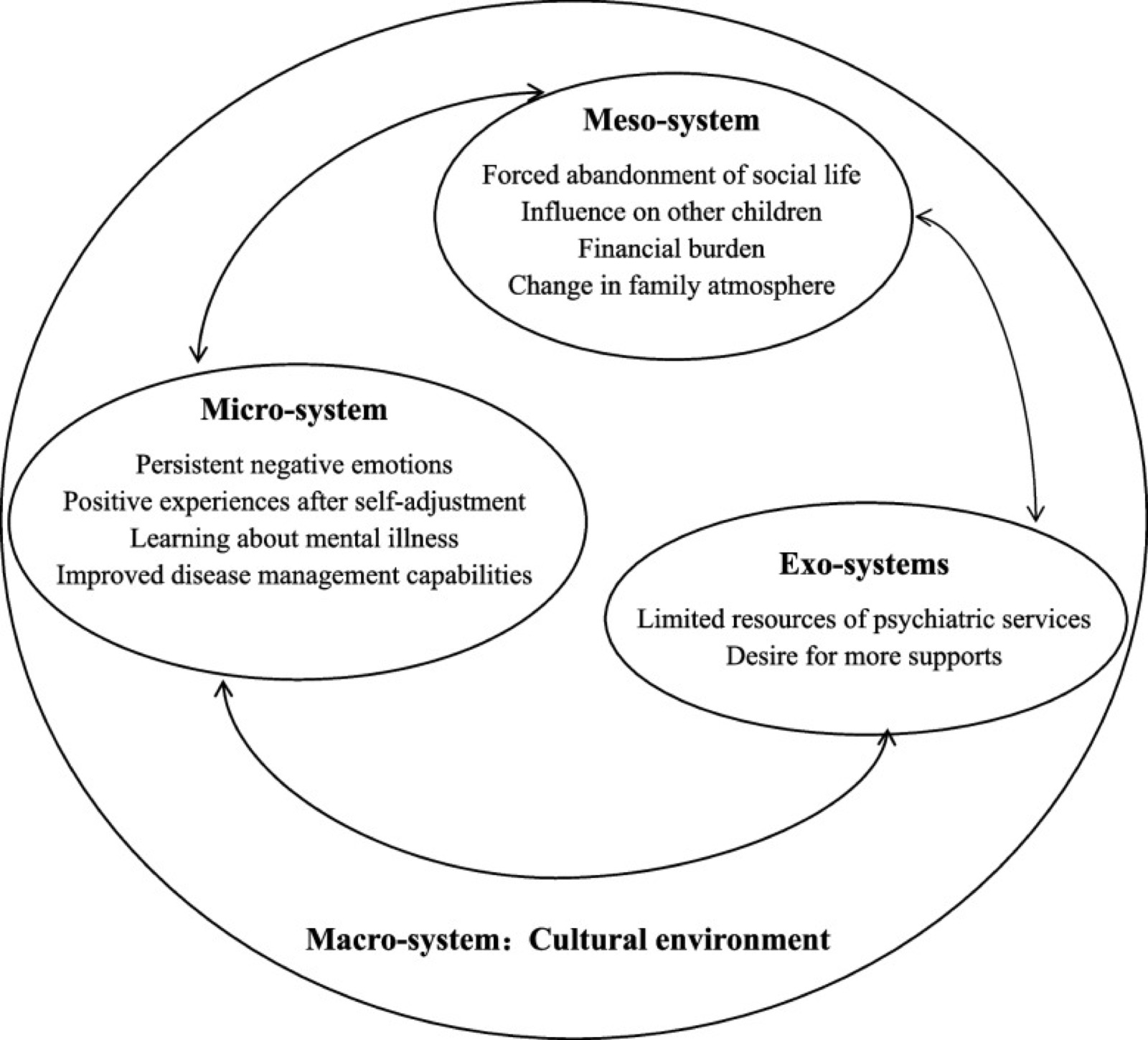
Results. Eighteen parents were interviewed. The following four main themes emerged from the interview data: micro-system—coexistence of caregiver distress and growth (persistent negative emotions, positive experiences after self-adjustment, learning about mental illness, and improved disease management capabilities); meso-system—lifestyle changes (forced abandonment of social life, influence on other children, financial burden, and change in family atmosphere); exo-system—weak support system (limited resources of psychiatric services and desire for more supports); and macro-system—cultural environment.
Conclusions. The social ecosystem of parents of adolescents with NSSI is undesirable. Psychological intervention, online and offline extension services, and the dissemination of professional knowledge may help improve the mental health level and care ability of parents of adolescents with NSSI, thereby reducing adolescent self-injurious behaviors.
Keywords: Non-suicidal self-injury; Ecological systems theory; Parents; Psychological experiences; Qualitative study
Introduction
In recent years, non-suicidal self-injury (NSSI) among adolescents has become a significant public health concern, with increasing prevalence and profound implications for individuals, families, and society. NSSI refers to the deliberate and direct destruction of body tissue without suicidal intent, often manifested through behaviors such as cutting, scratching, burning, or biting oneself [1]. Research have indicated that NSSI is most prevalent during adolescence and early adulthood [2], with international studies reporting that approximately 22.9% of adolescents have engaged in NSSI at least once in their lifetime, and 18.6% have done so in the past year [3]. In China, the prevalence is even higher, reaching 26.9% [4]. Beyond physical harm, NSSI is associated with severe psychological consequences, including depression, anxiety, personality disorders, substance abuse, and an elevated risk of suicide [5, 6]. Given its far-reaching impact, understanding the experiences of parents of adolescents with NSSI is critical, as they play a pivotal role in their children’s recovery and well-being.
Existing research on NSSI has largely focused on individual-level factors, such as emotion regulation difficulties, which are central to many etiological models of NSSI [7–10]. Adolescents experiencing psychological distress often use NSSI as a maladaptive coping mechanism to regulate emotions, such as relieving irritability or numbing emotional pain [8]. However, NSSI is not solely an individual-level phenomenon; it is influenced by a complex interplay of environmental and interpersonal factors. For instance, Nock’s (2009) integrated model highlights the interaction between distal environmental factors (e.g., family environment) and proximal intrapersonal factors (e.g., emotion regulation) in the development and maintenance of NSSI [11]. Family dynamics, in particular, have been identified as a salient distal risk factor, with negative parenting behaviors—such as low parental warmth, excessive criticism, and neglect—being strongly associated with NSSI in adolescents [12–15]. Conversely, supportive family environments can mitigate the risk of NSSI and facilitate recovery [16]. Despite this recognition, the psychological experiences of parents and their role in the NSSI trajectory remain underexplored, particularly in the context of broader social and environmental influences.
Beyond the family, social factors such as peer relationships and school environments also play a critical role in adolescents with NSSI. Peer bullying, for example, has been identified as a significant risk factor, with victims of bullying being more likely to engage in self-injurious behaviors due to difficulties in emotion regulation, anxiety, and depression [17–19]. Schools that fail to foster a sense of belonging or fairness among students may further exacerbate these risks [18]. Parents, as primary caregivers, often find themselves navigating these complex social dynamics while trying to support their children, yet they frequently lack the knowledge and resources to do so effectively [20, 21]. This highlights the need for a more comprehensive framework that considers the interplay of individual, familial, and social factors in understanding NSSI and its impact on parents.
Bronfenbrenner’s ecological systems theory (EST) [22] provides a robust framework for addressing this gap. EST posits that human development is shaped by a series of nested and interacting systems. Micro-systems refer to individuals and include the physiological, psychological, and social factors that they possess, emphasizing individual needs, problems, and advantages. Meso-systems refer to groups and include family and social groups, predominantly referring to the influence of family and surrounding groups on individual development. Exo-systems are extensions of meso-systems, encompassing social structures that influence and define individuals, such as healthcare and education service systems. Finally, macro-systems pertain to the sociocultural environment wherein these three levels of systems exist [23]. This multi-level perspective is particularly relevant to NSSI, as it acknowledges the interplay between individual vulnerabilities and environmental contexts. By applying EST, this study moves beyond isolated factors to explore how interactions across micro-, meso-, exo-, and macro-systems shape the psychological experiences of parents of adolescents with NSSI. For example, the meso-systems focuses on parent–child interactions and family dynamics, the exo-system considers the role of external institutions (e.g., schools, healthcare systems) in influencing parental coping strategies, and the macro-system, in turn, examines how cultural attitudes toward mental health and NSSI may impact parents’ experiences and help-seeking behaviors.
This study represents a key conceptual breakthrough by integrating EST into the study of NSSI and parental experiences. While previous qualitative research has explored parents’ experiences in various settings [24–26], these studies have often overlooked the dynamic interactions between individual and environmental factors. By systematically categorizing parental experiences across the four levels of EST, this study provides a novel, holistic perspective that captures the complexity of NSSI and its impact on families. Furthermore, it highlights the added value of EST in advancing the understanding of NSSI by emphasizing the interconnectedness of individual behavior and the broader social environment. This approach not only deepens our understanding of the challenges faced by parents but also informs the development of multi-level interventions that address the diverse needs of families affected by NSSI.
In summary, this qualitative study aims to explore the psychological experiences of parents of adolescents with NSSI through the lens of Bronfenbrenner’s ecological systems theory. By examining the interplay of individual, familial, and social factors, the study seeks to identify common challenges and unmet needs among parents, providing a foundation for the development of targeted, family-focused interventions. The findings have the potential to inform mental health professionals, policymakers, and educators in designing more effective strategies to support families and reduce the prevalence of NSSI among adolescents.
Methods
Study design
We carried out a phenomenology qualitative study through face-to-face semi-structured interviews with parents of adolescents engaged in NSSI. Data were analyzed using Colaizzi’s seven-step method. The study conformed to the Consolidated criteria for Reporting Qualitative research [COREQ] checklist (see Additional file).
Participants
Purposive sampling methods were used. We selected the parents of inpatient adolescents with NSSI in the Department of Mental Health of a tertiary hospital in Shanxi Province from April to September 2024. The inclusion criteria for adolescents were as follows: 1) engaged in NSSI behavior, and 2) aged 12 to 18 years. Based on the aforementioned criteria for adolescents, the inclusion criteria for parents were as follows: 1) were biological parents of adolescents, and 2) were able to complete the interview with normal intelligence and hearing and a junior high school education or above. The interviews were conducted iteratively, and we considered stopping recruiting more participants when there was no new themes or concepts emerged during the analysis of qualitative information. We screened adolescent patients who met the inclusion criteria through the electronic medical record system and subsequently scheduled appointments with adolescents’ parents who met inclusion criteria.
Data collection
The research team developed a preliminary interview outline based on this study’s purpose, a literature review, and discussions with psychiatrists. Before commencing the interviews, three parents of adolescents who fulfilled the inclusion and exclusion criteria were selected for pre-interviews to further optimize the interview outline. Finally, we prepared an interview guide for each interviewee, listing the main questions and topics for the interview. The semi-structured interview guide was categorized into two sections (see Additional file). The first section (section 1) looked at the adolescent parents’ socio-demographic characteristics: gender, age, level of education, marital status, and the number of children. The second section (section 2) focused on parents’ psychological experiences on NSSI among adolescents based on Bronfenbrenner’s ecological systems theory.
Four authors (Yali Hu, Yue Shi, Guizhi Qiao, and Yan Sun) are female researchers, and they all have course training experience in qualitative research, including theoretical instruction and practical application. Sun Yan is the director of the psychiatric department, a registered psychotherapist of the Chinese Psychological Association, and has 30 years of medical experience in psychiatry. Semi-structured interviews were conducted by two researchers (Yali Hu and Yue Shi) who are licensed to practice mental health counseling, and both have extensive psychological nursing and communication skills. Yali Hu has a master's degree in medicine and has devoted herself to scientific research on non-suicidal self-injury in adolescents for 8 years. Yue Shi has a bachelor's degree in medicine and has been working in psychiatry for 13 years.
Prior to the interview, the respondents were informed of the purpose and significance of the study and promised to strictly follow the principle of confidentiality, utilizing codes instead of names to protect privacy. The interviews were conducted in the showroom of the Department of Mental Health, and the average duration of the interviews was 30–40 min. With the consent of the participants, the whole interview process was recorded in the form of audio recording. If the interviewee did not want to continue the interview for some reason in the middle of the interview, he/she could withdraw from the interview at any time.
Data analysis
Phenomenological research data were derived from the interviewees’ direct, real-life experiences. This approach provides a unique philosophical framework for understanding human experience. By requiring researchers to immerse themselves in the lifeworld, bracket preconceptions, and prioritize description over interpretation, it ultimately reveals the universal meanings inherent in phenomena. Data collection and analysis were performed at the same time. Two researchers transcribed all the recordings verbatim and carefully checked the transcripts against the recordings to ensure accuracy. Further, data analysis was performed through NVivo12 software using the following seven-step phenomenological method elucidated by Colaizzi et al. [27]: 1. The data were carefully read and organized repeatedly to fully familiarize with and understand all the content provided by the participants. 2. Meaningful statements related to the research questions were extracted. 3. These statements were summarized, refined, and encoded. 4. The encoded statements were collated, and meaningful common concepts were identified to form a thematic cluster. 5. The thematic cluster was described in detail. 6. Similar themes and descriptions were compared, and similar views were extracted; thus, a final theme was formed. 7. Data analysis was conducted independently by 2 investigators. In case of disagreement, it was resolved through discussion at the study group meeting to ensure the reliability of the conclusion. The resulting thematic structure was returned to the interviewees for verification. Regarding peer debriefing, we have invited two psychiatrists specializing in qualitative research to review our study. Researchers endeavored to bracket their pre-existing knowledge and assumptions to avoid preconceived biases, achieving phenomenological bracketing (epoche) through maintaining reflective journals. Reflexivity was maintained throughout the research process.
Ethics
Participants were given informed consent prior to the study. The interviewees were pseudonymized by assigning the alphabet P followed by a number in the order of recruitment (e.g., P1, P2, P3). All audio and text records are kept on a password-protected computer.
Results
A total of 18 participants participated in this study, including 13 women (72.22%) and 5 men (27.78%), with a mean age of 47.06 ± 5.589 years. Table 1 presents the sample characteristics.
Table 1 — Socio-demographic characteristics of participants
- Participants (Parents): P1; Gender: Female; Age (in years): 45; Education: College/University; Marital status: Divorced; The number of children: one; Relationship with participants: Daughter; Age (in years): 18; The method of NSSI: Cutting
- Participants (Parents): P2; Gender: Female; Age (in years): 43; Education: Less than high school; Marital status: Married; The number of children: two; Relationship with participants: Daughter; Age (in years): 17; The method of NSSI: Poisoning
- Participants (Parents): P3; Gender: Female; Age (in years): 49; Education: Less than high school; Marital status: Married; The number of children: two; Relationship with participants: Daughter; Age (in years): 15; The method of NSSI: Cutting
- Participants (Parents): P4; Gender: Male; Age (in years): 63; Education: Less than high school; Marital status: Widowed; The number of children: one; Relationship with participants: Daughter; Age (in years): 17; The method of NSSI: Cutting
- Participants (Parents): P5; Gender: Female; Age (in years): 45; Education: High school; Marital status: Married; The number of children: three; Relationship with participants: Son; Age (in years): 16; The method of NSSI: Cutting
- Participants (Parents): P6; Gender: Male; Age (in years): 51; Education: Less than high school; Marital status: Married; The number of children: one; Relationship with participants: Son; Age (in years): 18; The method of NSSI: Cutting
- Participants (Parents): P7; Gender: Female; Age (in years): 49; Education: Less than high school; Marital status: Divorced; The number of children: two; Relationship with participants: Daughter; Age (in years): 15; The method of NSSI: Cutting
- Participants (Parents): P8; Gender: Female; Age (in years): 48; Education: Postgraduate; Marital status: Married; The number of children: two; Relationship with participants: Son; Age (in years): 16; The method of NSSI: Cutting
- Participants (Parents): P9; Gender: Female; Age (in years): 45; Education: Less than high school; Marital status: Divorced; The number of children: one; Relationship with participants: Daughter; Age (in years): 12; The method of NSSI: Cutting
- Participants (Parents): P10; Gender: Male; Age (in years): 45; Education: College/University; Marital status: Married; The number of children: two; Relationship with participants: Daughter; Age (in years): 16; The method of NSSI: Hitting
- Participants (Parents): P11; Gender: Female; Age (in years): 54; Education: Senior high school; Marital status: Married; The number of children: two; Relationship with participants: Daughter; Age (in years): 18; The method of NSSI: Poisoning
- Participants (Parents): P12; Gender: Female; Age (in years): 40; Education: Junior high school; Marital status: Married; The number of children: two; Relationship with participants: Daughter; Age (in years): 15; The method of NSSI: Cutting
- Participants (Parents): P13; Gender: Female; Age (in years): 45; Education: Senior high school; Marital status: Divorced; The number of children: two; Relationship with participants: Daughter; Age (in years): 12; The method of NSSI: Cutting
- Participants (Parents): P14; Gender: Male; Age (in years): 42; Education: Less than high school; Marital status: Married; The number of children: one; Relationship with participants: Son; Age (in years): 16; The method of NSSI: Cutting
- Participants (Parents): P15; Gender: Female; Age (in years): 46; Education: College/University; Marital status: Divorced; The number of children: two; Relationship with participants: Daughter; Age (in years): 13; The method of NSSI: Cutting
- Participants (Parents): P16; Gender: Male; Age (in years): 46; Education: Less than high school; Marital status: Married; The number of children: one; Relationship with participants: Daughter; Age (in years): 18; The method of NSSI: Cutting
- Participants (Parents): P17; Gender: Female; Age (in years): 52; Education: Junior high school; Marital status: Married; The number of children: three; Relationship with participants: Son; Age (in years): 16; The method of NSSI: Cutting
- Participants (Parents): P18; Gender: Female; Age (in years): 39; Education: College/University; Marital status: Divorced; The number of children: one; Relationship with participants: Daughter; Age (in years): 13; The method of NSSI: Cutting
Based on EST, the psychological experiences of parents of adolescents with NSSI can be summarized into 4 themes and 10 sub-themes (Fig. 1).
Theme 1: Micro-system -coexistence of caregiver distress and growth
Subtheme 1: Persistent negative emotions
Anxiety and fear
On seeing their adolescents’ scarred skin, participants experienced a series of negative emotions, such as worried, afraid, anxious, and sad.
“…Every day when I go home, I look in her bedroom and drawers to see if there are medicine boxes and knives. I worry and fear every day …” (P2)
“…I was worried all day. He went out and bought a knife to cut himself. If he had accidentally cut his blood vessels, he would have died …” (P6)
Guilt
Some participants attributed the NSSI behaviors to their lack of concern; some blamed themselves for not fulfilling their parental responsibilities by failing to detect these behaviors in time.
“…When I discovered my daughter's self-injurious behavior, I did not realize that she had psychological problems and did not provide timely help. If she had been treated earlier, she would not have ended up like this …” (P1).
“…When she was young, I only knew to ask her to help me in the restaurant. I did not care about her studies and frequently hit and scolded her … I neglected her growth …” (P7)
Sense of shame
All participants reported a clear sense of stigma, and to prevent their wards from being discriminated against by others, they kept their NSSI behaviors strictly confidential.
“…I did not tell any of my relatives, fearing that they would not understand and would say that my child had mental health issues …” (P3)
“…I did not mention to the school about my child's recent psychiatric hospitalization for the fear of my child being gossiped about by teachers and classmates …” (P8)
Subtheme 2: Positive experiences after self-adjustment
Most parents have scolded, neglected or failed to understand their children. Parents'attitudes may undergo some changes when they saw adolescents being diagnosed with emotional disorders or deliberately hurting themselves. Forgiveness, understanding, and support from parents could help adolescents reduce self-injury.
Parental companionship
Some parents believed that keeping their children company or talking to them when they were in a bad mood helped prevent NSSI behaviors.
“…I have been spending more time with her than before; especially after this hospitalization, I am with her 24 h a day. Her self-injury behaviors have significantly decreased …” (P9).
“…Her father was trying to spend as much time as possible with her, and her father's company gave her a great sense of security …” (P12).
“…After she was discharged from the hospital, I applied to the school for nonboarding. I will try spending more time with her in the future and will be the first to know when she has self-injurious thoughts …” (P13).
Parental understanding
Some parents made compromises and changes after learning about their children’s NSSI. They have been trying to accept their children’s thoughts and opinions.
“…I communicated more with my son and began valuing his ideas and opinions …” (P5).
“…I tried to understand and accept her negative emotions, so she began opening up and talking to me about her self-injury behavior …”(P18).
Lowering academic expectations
Some parents have chosen to lower their expectations of their children’s academic performance and hope that their children will grow up healthily rather than putting pressure on them.
“…I knew he was upset about his studies and hurt himself every time he failed his exams. Children’s physical and mental health is always the priority …”(P8).
“…Her mother is not well educated and is working in a supermarket. She hopes that our daughter will surpass her in all aspects and find a decent job in the future. When she learned that our daughter hurt herself, she lowered her expectations …”(P16).
Subtheme 3: Learning about mental illness
Some parents have started to learn about mental illnesses and how to get along with adolescents to prevent their children from hurting themselves again.
“…I have started acquiring knowledge in psychology and accepting her current depressive state …”(P9).
“…I looked up depression online and realized that it was a disease requiring treatment, not merely relaxation …”(P14).
“…I specifically bought a book to learn about the characteristics of adolescent psychological development and how to interact with him, after which her self-injurious behavior has decreased …”(P15).
Subtheme 4: Improved disease management capabilities
Some families have gained effective coping strategies through accumulated experience in dealing with their children's diseases, and their disease management capabilities have also been enhanced. Some parents are able to supervise effectively.
Removing dangerous objects
Some parents removed hazardous objects from their households to reduce NSSI occurrence among adolescents.
“…I asked my family members not to bring home any dangerous objects …”(P2).
“…The needles, scissors, and knives were locked up at home, but using her pocket money, she still bought some blades, which I would immediately confiscate as soon as I saw them …”(P11).
Medication and psychotherapy adherence
“…After a week of medication and psychotherapy, she now has no NSSI-related thoughts. However, this is only the beginning, and I will supervise her to continue treatment after she is discharged …”(P4).
Theme 2: Meso-system -lifestyle changes
Subtheme 1: Forced abandonment of social life
Caring for adolescents forced some parents to give up their jobs and social circles. Owing to this long-term care burden, parents had limited time and energy for leisure and entertainment activities, which affected their social life.
“…I quit my job and got a psychological counselor’s license myself. Now I mainly focus on treating my child’s disease. I do not care about anything else …”(P8).
“…Now all my thoughts are on my children, and I quit my job. I am not in the mood to dress up, and I usually do not have time to meet my friends …”(P18).
Subtheme 2: Influence on other children
To avoid NSSI recurrence, some parents invested excessive efforts in caring for the affected children, precipitating psychological difficulties for their other children.
“…She has already affected the second child, who is psychologically unbalanced. She says that we are too good to her sister and that everything is about her. She says, ‘Not only does my sister not have to go to school, she can also get anything she wants.’ The younger one does not want to go to school either and is also going for psychological counseling …”(P10).
Subtheme 3: Financial burden
Some parents had to reduce their working hours or resign to take care of their children. Most parents reported that the financial burden was substantial.
“…Psychological counseling institutions are expensive, costing hundreds per hour. I am afraid our family cannot afford it for a long time …”(P3)
“…The doctor said that the medicine had to be taken for a long time, the cost of which is a large expense, and his father has been the sole breadwinner in the family …”(P17)
Subtheme 4: Change in family atmosphere
Parental relationships with—and attitudes toward—their wards play an important role in NSSI occurrence and reduction among adolescents. When parents create a relaxed and harmonious family atmosphere, adolescents’ emotional and behavioral problems change accordingly.
Parental relationship
“…Every time I argued with my wife, I displaced my bad feelings onto my daughter… When I first learned of her self-injurious behavior, I remembered her saying that she felt uncomfortable and depressed in front of us and that she would rather be alone. Later, I spoke with her mother about getting along amicably in the future and creating a harmonious family environment for our children …”(P10).
“…We quarrel frequently because of trivial issues. Her mother has a bad temper. Due to our son’s low mood and self-destructive behavior, we argue less than we did before and generally do not argue in front of him …”(P14).
Parent–child relationship
“…My daughter is actually terrified of her mother. When her mother came to the hospital yesterday, I observed that my daughter was nervous, shaking, and breathless. Her mother did not scold her as soon as they met like before, and she became slightly gentler …”(P16).
“…My temper has become milder, and I communicate calmly with my son; he is willing to open up to me and tell me when he is having self-injurious thoughts …”(P17).
Theme 3: Exo-system -weak support system
Subtheme 1: Limited resources of psychiatric services
The lack of psychiatric services in some regions of our country precipitates difficulties in seeking medical treatment and increases caregivers’ care burden.
“…Our county hospital does not have a psychiatric department. I consulted the psychology teacher at my child's school, but this had no effect, which is why I came to a Grade III A hospital like yours …”(P2).
“…I hope that in the future, a psychiatric clinic is established in our hometown, so that we do not have to travel far for follow-up visits …”(P13)
Subtheme 2: Desire for more supports
Desire for hospital support
Most participants did not know how to avoid triggering children in their daily lives and wanted to learn communication skills for use with children during emergencies. Some participants hoped to receive professional guidance from medical staff to better care for adolescents and prevent NSSI occurrence while at home.
“…I hope that when my child experiences psychological problems at home, we can directly contact the doctor to help her through psychological counseling …”(P4)
“…I hope that the medical staff will teach us how to communicate with our children, such as parenting skills and daily communication …”(P11)
“…After going home, we want to ask the doctor through online consultation how to help the child stop the drug smoothly …”(P14)
“…I want to know that if my child suddenly develops a bad mood, how can I help her calm down …”(P15)
Desire for school support
Most parents expect assistance from school—including emotional support, acceptance, and respect—for their adolescent wards.
“…As his teachers knew that my son engages in self-injurious behavior, we did not let him go to school fearing that he would commit suicide or NSSI at school, and we hoped that the school authorities could help us …”(P6).
“…I hope teachers also have basic psychological knowledge, timely discover and deal with adolescents'emotional problems, take better care of her, and allow her to take a leave …”(P12).
Theme 4: Macro-system -cultural environment
A macro-system describes the sociocultural environment wherein micro-, meso-, and exo-systems are embedded. Almost all parents, as well as relatives around them, lack an understanding of NSSI and exhibit a certain degree of cognitive misunderstanding vis-à-vis the disease. This precipitates an inability to recognize and respond effectively to NSSI in its early stages.
“…At first, I could not understand that she had depression. For any bodily injury, pain, or inflammation, I would definitely take her to a doctor. Once, I accidentally found that her arm was scratched with a knife used for cutting colored paper. I thought nothing at that time …” (P1).
“… I didn't know it was a disease. My relatives thought my daughter was in a rebellious stage …” (P4)
“…When I first discovered that she had scratched herself, I thought she was using an extreme way to relieve stress, but I did not expect it to be depression …”(P9).
Discussion
The study findings demonstrated significant systemic dysfunction within caregivers'socioecological frameworks [22], particularly among parents of adolescents with NSSI behaviors. Caregivers bear prolonged multidimensional burdens, with challenges manifesting across micro-, meso-, exo-, and macro-systems. While the micro-system reveals caregivers’ psychosomatic exhaustion and ambivalent emotional states (e.g., guilt, shame), the meso- and exo-systems highlight familial, school, and healthcare access issues. Critically, medical staff often prioritize adolescent patients’ needs while neglecting parental well-being—a systemic gap requiring urgent attention.
Micro-system: targeted psychological interventions for caregivers
At the micro-system level, parents’ persistent negative emotions (anxiety, guilt, shame) align with prior studies [28–30]. Some parents attribute NSSI behaviors to their own lack of care and experience a strong sense of guilt; meanwhile, some parents believe that their adolescent wards engaging in NSSI behaviors is shameful and are, thus, unwilling to tell others about it, reflecting parents’ helplessness and self-blame due to ineffective coping strategies. Therefore, group-based psychological therapy should be implemented among parents of adolescent patients with NSSI. Beyond its foundational principles [31], MBSR could be tailored for caregivers through 8-week group programs incorporating guided meditation, body scanning, and mindful communication exercises. For example, weekly sessions could focus on reducing parental guilt by reframing self-blame into self-compassion. PERMA Model: To operationalize Seligman’s framework [32], caregiver workshops could be designed to: (1) Cultivate positive emotions via gratitude journaling or strengths-based reflection. (2) Enhance engagement through collaborative problem-solving activities with peers. (3)Strengthen relationships via parent support groups fostering shared experiences. (4) Create meaning by helping parents reframe caregiving as a purposeful journey. (5) Celebrate accomplishments through milestone-based recognition (e.g., mastering a coping skill). Additionally, deep breathing, music therapy, or rational catharsis for stress relief could be integrated into individual counseling to help parents process guilt and shame [33]. These interventions should be delivered through hospital-based caregiver programs. By improving parental mental health, caregivers can better model emotional regulation for their adolescents, indirectly mitigating NSSI recurrence.
This study revealed that along with negative experiences, parents also gain positive experiences in the process of caring for adolescent patients with NSSI. For instance, family relations may become harmonious. The positive feelings and experiences that develop during the care process—that is, the sense of benefitting from the condition—help caregivers improve their ability to cope with negative events, thereby improving their physical and mental health [34]. Therefore, medical staff should adjust their perspective accordingly by focusing on and uncovering parents’ positive experiences during the care process—consistent with the recent positive psychological concept of post-traumatic growth [35].
Meso-system: economic support and family-centered interventions
At the meso-system level, this study found that adolescent NSSI behaviors’ negative impact on families predominantly manifested as an economic burden and adverse effects on other children’s mental health outcomes and parents’ work—consistent with Townsend et al.’s findings [36]. Caring for adolescents with NSSI occurrences necessitates a significant amount of time, and some parents even quit or change jobs. To mitigate the care burden for parents of adolescent patients with NSSI, medical staff can provide online and offline extension services. Medical staff can fully integrate existing social, school, medical institutions, and other relevant resources; strengthen knowledge dissemination through news, websites, and other self-media platforms; and offer professional support to parents for a wide variety of problems. Simultaneously, for the period of adolescent patients’ stay at home, medical staff should use information technology to provide regular follow-up guidance, improve the cognitive level and coping ability of patients’ parents about NSSI, help parents take appropriate care of adolescents, and reduce unnecessary energy consumption. For patients from low-income families requiring multiple visits, follow-up intervals must be reasonably arranged to reduce their round-trip expenses or online diagnosis and treatment services may be offered to help reduce their financial burden.
Studies have underscored the pivotal role of family dynamics in mitigating NSSI among adolescents, with robust family functioning—specifically characterized by emotional intimacy and adaptive relational flexibility—demonstrating significant protective effects [37]. Therefore, it is crucial to develop family-centered interventions that engage family members and empower them to play an active role throughout the therapeutic process. In the future, the potential effectiveness of Family-Involved Acceptance and Commitment Therapy (FI-ACT) could be further explored among adolescent patients with NSSI. FI-ACT integrates the six core processes of traditional ACT (cognitive defusion, acceptance, present moment awareness, self-as-context, values, and committed action) with family systemic interventions, including weekly family sessions. Furthermore, Attachment-Based Family Therapy (ABFT) employs a series of process-oriented, emotion-focused techniques to address maladaptive behavioral patterns, strengthen family relationships—particularly parent-adolescent dynamics—and enhance overall family functioning, ultimately reducing adolescents’ engagement in NSSI [38]. Research also highlights that intergenerational transmission of risk factors and sibling bullying may lead to self-injurious behaviors [39, 40]. These findings underscore the necessity of expanding investigations to include extended family subsystems (e.g., grandparents, siblings) and developing multidimensional family-based intervention frameworks tailored to address these interconnected dynamics.
Exo-system: cross-sector collaboration and parental support
At the exo-system level, our findings emphasized the urgent need for a coordinated healthcare-school-family framework to advance adolescent mental health literacy and address NSSI. The study identified significant gaps in parental awareness, particularly among mothers with limited education, who expressed a strong demand for specialized support—including training in adolescent communication and adaptive parenting strategies. Prior research highlights caregivers’ tendency to misinterpret early NSSI behaviors as typical teenage rebellion [26], often delaying professional intervention until self-injury escalates [41]. To bridge these gaps, healthcare providers should deliver targeted psychoeducation via multimedia platforms (e.g., micro-videos, infographics, pamphlets, and public health portals) to rectify cognitive misconceptions, improve parent–child dynamics, and foster responsive caregiving. Peer-led parent support networks could further facilitate experiential knowledge-sharing among families navigating NSSI challenges.
Concurrently, schools should collaborate with mental health professionals prioritize expert-led workshops on NSSI prevention, routine psychological screenings, tiered interventions for high-risk students (e.g., individualized counseling), and streamlined referrals to mental health institutions. Such systemic integration ensures early identification and continuity of support within educational settings.
Macro-system: societal awareness and professional training
At the macro-system level, societal understanding of adolescent NSSI remained critically underdeveloped. Public health campaigns must prioritize disseminating scientific knowledge and expanding access to psychological services for affected families. Crucially, healthcare and educational systems require standardized training to address systemic shortcomings. The literature reported that healthcare professionals experience significant psychological stress when dealing with adolescent patients with NSSI [42, 43]. Existing literature revealed inconsistent preparedness among professionals: healthcare providers often lack standardized NSSI education and psychosocial training [44–46], while school staff report insufficient knowledge to recognize or address NSSI [47–49]. In addition, perceptions of friends'self-injurious behaviors were associated with adolescents'own self-injury [50]. Comprehensive training programs are urgently needed to equip these stakeholders with skills to support adolescents effectively.
Limitations
While this study provides critical insights into the caregiving experiences of parents of adolescents with NSSI, several constraints warrant consideration.
Although thematic saturation was achieved with 18 participants, this study predominantly focused on maternal experiences, with limited paternal involvement, thereby constraining the generalizability of findings to the broader population of parents of adolescents with NSSI. The observed gender imbalance arises from two interconnected factors: (1) Hospital chaperone policies permitted only one parent to accompany adolescents during NSSI-related clinical consultations, with mothers overwhelmingly fulfilling this role. (2) Mothers are often designated as the primary caregiver, while fathers are positioned as financial providers rather than direct participants in emotional or medical care in Chinese culture. It is hoped that our future research will incorporate a more diverse sample of fathers, such as those from varying socioeconomic backgrounds and geographic locations. By employing a mixed-methods research approach to compare the differences in paternal and maternal subjective experiences of adolescent self-harm, we aim to further supplement the findings of this study.
The absence of assessment regarding the severity (e.g., frequency, methods, medical lethality) and duration of NSSI in the adolescents represented a critical limitation. These unmeasured variables are likely to influence caregivers’ emotional responses, coping strategies, and help-seeking behaviors. For instance, parents of adolescents with high-frequency NSSI may experience heightened helplessness, whereas those confronting medically risky behaviors (e.g., deep tissue cutting) might prioritize urgent clinical interventions over relational repair. By not accounting for these dimensions, the study risks homogenizing diverse parental experiences and overlooking nuanced patterns in how NSSI traits shape family dynamics.
Conclusion
This qualitative study, grounded in EST, illuminates the multifaceted psychological experiences of parents caring for adolescents with NSSI. In the microsystem, parents navigated dual challenges of psychological distress and post-traumatic growth. The mesosystem analysis revealed parents’ experience lifestyle changes, and in the exosystem systemic gaps in healthcare and school support are emphasized. Most crucially, the macrosystem analysis uncovered a persistent societal underestimation of NSSI as a significant mental health concern. These findings suggested that family-centered interventions should be established to address caregiver mental health issues and psychoeducational programs should be developed to enhance the public's NSSI literacy and coping strategies, and the implementation of this ecological intervention framework has the potential to reduce the incidence of NSSI.
Abbreviations
- NSSI: Non-Suicidal Self-Injury
- BPD: Borderline Personality Disorder
- BD: Bipolar Disorder
- MDD: Major Depressive Disorder
- COREQ: Consolidated criteria for reporting qualitative research
- EST: Ecological Systems Theory
Complexe Systémique: key points
For family therapy, the study’s interest lies less in its findings, which are expected (guilt, shame, exhaustion, isolation in the face of distant services), than in its framework: by sorting parental experience according to Bronfenbrenner’s levels, it reminds us that adolescent self-injury also plays out in the parental couple, the siblings, the school, the hospital and the culture. Several excerpts are valuable for clinical work: the father who realises he was displacing his marital conflicts onto his daughter, the younger sister who in turn refuses school, the mother who softens. They argue for seeing the family, not only the person who self-injures, and for working on triangulation and on the place of the other children. The team’s proposals remain mostly psychoeducational and individual (MBSR, the PERMA model), with an opening towards ABFT and family-involved ACT. The limits are significant: short interviews, in hospital, conducted by the care team itself, mostly with mothers, with no measure of the severity of the behaviours, and recommendations that are sometimes general. Read alongside the trial of systemic family therapy after self-harm, and the article on what Chinese families find helpful in family therapy.
Notes from the original
Publisher’s Note. Springer Nature remains neutral with regard to jurisdictional claims in published maps and institutional affiliations.
Acknowledgements. We thank Prof. Linbo Li, a postdoctoral fellow at Capital Medical University, for the guidance of this study.
Clinical trial number. Not applicable.
Authors’ contributions. “YS(Sun) designed the study. YLH and YS(Shi) conducted the interviews, performed the analysis, and interpreted the results. Y S(Shi) and GZQ contributed to the methodology of qualitative research. YLH wrote the original draft of the manuscript. All authors revised the article critically. All the authors have read and approved the final manuscript.”
Funding. This work was supported by the National Key R&D Program of China (2017YFC1311103), and the Science Foundation of Shanxi Bethune Hospital (2023YH06).
Ethics approval and consent to participate. All study procedures for human subjects were performed in accordance with the Declaration of Helsinki and received ethical approval from Shanxi Bethune Hospital (approval notice number YXLL- 2024–075). All participants provided written informed consent before participating in the study. The participants were informed that their data were confidential and that they could withdraw from the study at any time. In addition, even if minors are not directly involved, we will ensure that the research process does not potentially harm or influence any minors.
Consent for publication. Not applicable.
Competing interests. The authors declare no competing interests.
References
1. Leong CH, Wu AM, Poon MM. Measurement of perceived functions of non-suicidal self-injury for Chinese adolescents. Arch Suicide Res. 2014;18(2):193–212. https://doi.org/10.1080/13811118.2013.824828.
2. Plener PL, Kaess M, Schmahl C, Pollak S, Fegert JM, Brown RC. Nonsuicidal self-injury in adolescents. Dtsch Arztebl Int. 2018;115(3):23–30. https://doi.org/10.3238/arztebl.2018.0023.
3. Gillies D, Christou MA, Dixon AC, Featherston OJ, Rapti I, Garcia-Anguita A, Villasis-Keever M, Reebye P, Christou E, Kabir NA, et al. Prevalence and characteristics of self-harm in adolescents: meta-analyses of community-based studies 1990–2015. J Am Acad Child Adolesc Psychiatry. 2018;57(10):733–741. https://doi.org/10.1016/j.jaac.2018.06.018.
4. Liu S, You J, Ying J, Li X, Shi Q. Emotion reactivity, nonsuicidal self-injury, and regulatory emotional self-efficacy: a moderated mediation model of suicide ideation. J Affect Disord. 2020;266:82–89. https://doi.org/10.1016/j.jad.2020.01.083.
5. Brausch AM, Muehlenkamp JJ. Perceived effectiveness of NSSI in achieving functions on severity and suicide risk. Psychiatry Res. 2018;265:144–150. https://doi.org/10.1016/j.psychres.2018.04.038.
6. Nock MK. Self-injury. Annu Rev Clin Psychol. 2010;6:339–363. https://doi.org/10.1146/annurev.clinpsy.121208.131258.
7. Yurkowski K, Martin J, Levesque C, Bureau JF, Lafontaine MF, Cloutier P. Emotion dysregulation mediates the influence of relationship difficulties on non-suicidal self-injury behavior in young adults. Psychiatry Res. 2015;228(3):871–878. https://doi.org/10.1016/j.psychres.2015.05.006.
8. Meng L, Qu D, Bu H, Huo L, Qi L, Yang J, Zheng T, Du X, He K, Wang Y, et al. The psychosocial correlates of non-suicidal self-injury within a sample of adolescents with mood disorder. Front Public Health. 2022;10:768400. https://doi.org/10.3389/fpubh.2022.768400.
9. Emery AA, Heath NL, Rogers M. Parents' role in early adolescent self-injury: an application of self-determination theory. Sch Psychol Q. 2017;32(2):199–211. https://doi.org/10.1037/spq0000204.
10. Hasking P, Whitlock J, Voon D, Rose A. A cognitive-emotional model of NSSI: using emotion regulation and cognitive processes to explain why people self-injure. Cogn Emot. 2017;31(8):1543–1556. https://doi.org/10.1080/02699931.2016.1241219.
11. Nock MK. Why do people hurt themselves? new insights into the nature and functions of self-injury. Curr Dir Psychol Sci. 2009;18(2):78–83. https://doi.org/10.1111/j.1467-8721.2009.01613.x.
12. Hessels CJ, Laceulle OM, van Aken MAG, Resch F, Kaess M. Differentiating BPD in adolescents with NSSI disorder: the role of adverse childhood experiences and current social relationships. Borderline Personal Disord Emot Dysregul. 2018;5:20. https://doi.org/10.1186/s40479-018-0097-5.
13. Baetens I, Claes L, Hasking P, Smits D, Grietens H, Onghena P, Martin G. The relationship between parental expressed emotions and non-suicidal self-injury: the mediating roles of self-criticism and depression. J Child Fam Stud. 2015;24(2):491–498.
14. James KM, Gibb BE. Maternal criticism and non-suicidal self-injury in school-aged children. Psychiatry Res. 2019;273:89–93. https://doi.org/10.1016/j.psychres.2019.01.019.
15. Mcpherson AV, Lewis KM, Lynn AE, Haskett ME, Behrend TS. Predictors of parenting stress for abusive and nonabusive mothers. J Child Fam Stud. 2009;18(1):61–69.
16. Tatnell R, Kelada L, Hasking P, Martin G. Longitudinal analysis of adolescent NSSI: the role of intrapersonal and interpersonal factors. J Abnorm Child Psychol. 2014;42(6):885–896. https://doi.org/10.1007/s10802-013-9837-6.
17. Peng Z, Klomek AB, Li L, Su X, Sillanmäki L, Chudal R, Sourander A. Associations between Chinese adolescents subjected to traditional and cyber bullying and suicidal ideation, self-harm and suicide attempts. BMC Psychiatry. 2019;19(1):324. https://doi.org/10.1186/s12888-019-2319-9.
18. Kidger J, Heron J, Leon DA, Tilling K, Lewis G, Gunnell D. Self-reported school experience as a predictor of self-harm during adolescence: a prospective cohort study in the South West of England (ALSPAC). J Affect Disord. 2015;173:163–169. https://doi.org/10.1016/j.jad.2014.11.003.
19. Arseneault L, Bowes L, Shakoor S. Bullying victimization in youths and mental health problems: 'much ado about nothing'?. Psychol Med. 2010;40(5):717–729. https://doi.org/10.1017/S0033291709991383.
20. Hay C, Meldrum R. Bullying victimization and adolescent self-harm: testing hypotheses from general strain theory. J Youth Adolesc. 2010;39(5):446–459. https://doi.org/10.1007/s10964-009-9502-0.
21. Jantzer V, Haffner J, Parzer P, Resch F, Kaess M. Does parental monitoring moderate the relationship between bullying and adolescent nonsuicidal self-injury and suicidal behavior? A community-based self-report study of adolescents in Germany. BMC Public Health. 2015;15:583. https://doi.org/10.1186/s12889-015-1940-x.
22. Bronfenbrenner U. The ecology of human development: experiments by nature and design. 1979.
23. Bronfenbrenner U. Ecology of the family as a context for human development: research perspectives. Dev Psychol. 1986;22(6):723–742.
24. Zhao Y, Rosa RD, Zhang Q, Zhao W, Xu H, Wang R, Ma L. Lived experiences of parents providing care to young people who self-harm: a protocol for a meta-aggregative synthesis of qualitative studie. BMJ Open. 2022;12(8):e065489. https://doi.org/10.1136/bmjopen-2022-065489.
25. Krysinska K, Curtis S, Lamblin M, Stefanac N, Gibson K, Byrne S, Thorn P, Rice SM, McRoberts A, Ferrey A, et al. Parents' experience and psychoeducation needs when supporting a young person who self-harms. Int J Environ Res Public Health. 2020;17(10):3662. https://doi.org/10.3390/ijerph17103662.
26. Wang X, Huang X, Huang X, Zhao W. Parents' lived experience of adolescents' repeated non-suicidal self-injury in China: a qualitative study. BMC Psychiatry. 2022;22(1):70. https://doi.org/10.1186/s12888-022-03715-7.
27. Colaizzi P. Psychological research as a phenomenologist views it. Existential Phenomenological Alternatives for Psychology. 1978.
28. Ferrey AE, Hughes ND, Simkin S, Locock L, Stewart A, Kapur N, Gunnell D, Hawton K. The impact of self-harm by young people on parents and families: a qualitative study. BMJ Open. 2016;6(1):e009631. https://doi.org/10.1136/bmjopen-2015-009631.
29. Fu X, Yang J, Liao X, Lin J, Peng Y, Shen Y, Ou J, Li Y, Chen R. Parents' attitudes toward and experience of non-suicidal self-injury in adolescents: a qualitative study. Front Psychiatry. 2020;11:651. https://doi.org/10.3389/fpsyt.2020.00651.
30. Yan H, Chunhong W, Huizhu J, Yanhong C, Yan S. Qualitative study on parents' cognition and psychological experience towards adolescent depressive disorder with non-suicidal self-injury behavior. Chin J Mod Nurs. 2023;29(27):3676–3680.
31. Shapiro SL, Brown KW, Thoresen C, Plante TG. The moderation of Mindfulness-based stress reduction effects by trait mindfulness: results from a randomized controlled trial. J Clin Psychol. 2011;67(3):267–277. https://doi.org/10.1002/jclp.20761.
32. Tu M, Wang F, Shen S, Wang H, Feng J. Influences of psychological intervention on negative emotion, cancer-related fatigue and level of hope in lung cancer chemotherapy patients based on the PERMA framework. Iran J Public Health. 2021;50(4):728–736. https://doi.org/10.18502/ijph.v50i4.5997.
33. Kandsperger S, Madurkay J, Schleicher D, Otto A, Ecker A, Brunner R, Jarvers I. Treatment motivation and burden of stress among parents of adolescents with non-suicidal self-injury presenting to a child and adolescent psychiatric emergency service. Psychopathology. 2023;56(1–2):148–161. https://doi.org/10.1159/000526611.
34. Adams HC, Zlomke KR, Rossetti KG. Finding benefit and feeling strain in parenting a child with autism spectrum disorder. J Autism Dev Disord. 2023;53(9):3558–3566. https://doi.org/10.1007/s10803-022-05663-3.
35. Bulzacka E, Lavault S, Pelissolo A, Bagnis Isnard C. Mindful neuropsychology: mindfulness-based cognitive remediation. Encephale. 2018;44(1):75–82. https://doi.org/10.1016/j.encep.2017.03.006.
36. Townsend ML, Miller CE, Matthews EL, Grenyer BFS. Parental response style to adolescent self-harm: psychological, social and functional impacts. Int J Environ Res Public Health. 2021;18(24):13407. https://doi.org/10.3390/ijerph182413407.
37. Gao Y, Wang Y, Wang Z, Ma M, Li H, Wang J, Liu J, Qian H, Zhu P, Xu X. Family intimacy and adaptability and non-suicidal self-injury: a mediation analysis. BMC Psychiatry. 2024;24(1):210. https://doi.org/10.1186/s12888-024-05642-1.
38. Russon J, Smithee L, Simpson S, Levy S, Diamond G. Demonstrating attachment-based family therapy for transgender and gender diverse youth with suicidal thoughts and behavior: a case study. Fam Process. 2022;61(1):230–245. https://doi.org/10.1111/famp.12677.
39. O'Hare K, Watkeys O, Whitten T, Dean K, Laurens KR, Harris F, Carr VJ, Green MJ. Parental and community risk factors for childhood self-harm thoughts and behaviours. J Affect Disord. 2022;310:279–283. https://doi.org/10.1016/j.jad.2022.05.050.
40. Bowes L, Wolke D, Joinson C, Lereya ST, Lewis G. Sibling bullying and risk of depression, anxiety, and self-harm: a prospective cohort study. Pediatrics. 2014;134(4):e1032–1039. https://doi.org/10.1542/peds.2014-0832.
41. Oldershaw A, Richards C, Simic M, Schmidt U. Parents' perspectives on adolescent self-harm: qualitative study. Br J Psychiatry. 2008;193(2):140–144. https://doi.org/10.1192/bjp.bp.107.045930.
42. Yue L, Zhao R, Zhuo Y, Kou X, Yu J. Experiences and attitudes of psychiatric nurses in caring for patients with repeated non-suicidal self-injury in China: a qualitative study. BMC Psychiatry. 2024;24(1):629. https://doi.org/10.1186/s12888-024-06064-9.
43. Hadfield J, Brown D, Pembroke L, Hayward M. Analysis of accident and emergency doctors' responses to treating people who self-harm. Qual Health Res. 2009;19(6):755–765. https://doi.org/10.1177/1049732309334473.
44. Ngune I, Wynaden D, McGough S, Janerka C, Hasking P, Rees C. Emergency nurses' experience of providing care to patients who self-harm. Australas Emerg Care. 2021;24(3):179–185. https://doi.org/10.1016/j.auec.2020.10.004.
45. Egan R, Sarma KM, O'Neill M. Factors influencing perceived effectiveness in dealing with self-harming patients in a sample of emergency department staff. J Emerg Med. 2012;43(6):1084–1090. https://doi.org/10.1016/j.jemermed.2012.01.049.
46. Taliaferro LA, Muehlenkamp JJ, Hetler J, Edwall G, Wright C, Edwards A, Borowsky IW. Nonsuicidal self-injury among adolescents: a training priority for primary care providers. Suicide Life Threat Behav. 2013;43(3):250–261. https://doi.org/10.1111/sltb.12001.
47. Pierret ACS, Anderson JK, Ford TJ, Burn AM. Review: Education and training interventions, and support tools for school staff to adequately respond to young people who disclose self-harm - a systematic literature review of effectiveness, feasibility and acceptability. Child Adolesc Ment Health. 2022;27(2):161–172. https://doi.org/10.1111/camh.12436.
48. Kelada L, Hasking P, Melvin GA. School response to self-injury: Concerns of mental health staff and parents. Sch Psychol Q. 2017;32(2):173–187. https://doi.org/10.1037/spq0000194.
49. Levkovich I, Stregolev B. Non-suicidal self-injury among adolescents: effect of knowledge, attitudes, role perceptions, and barriers in mental health care on teachers' responses. Behav Sci (Basel). 2024;14(7):617. https://doi.org/10.3390/bs14070617.
50. Syed S, Kingsbury M, Bennett K, Manion I, Colman I. Adolescents' knowledge of a peer's non-suicidal self-injury and own non-suicidal self-injury and suicidality. Acta Psychiatr Scand. 2020;142(5):366–373. https://doi.org/10.1111/acps.13229.
Reformatted republication of Psychological experiences of parents of adolescent patients with non-suicidal self-injury: a qualitative study based on Bronfenbrenner’s ecological systems theory, by Ya-Li Hu, Yue Shi, Gui-Zhi Qiao and Yan Sun, BMC Psychiatry, vol. 25, article 366 (2025), doi: 10.1186/s12888-025-06812-5, under a CC BY 4.0 licence. Edition and layout: Complexe Systémique, September 2026 — the work has been modified under the terms of the licence (statements grouped in the notes). Neither the authors nor the publisher are responsible for this edition; the original version prevails.
This is the original article “Psychological experiences of parents of adolescent patients with non-suicidal self-injury: a qualitative study based on Bronfenbrenner’s ecological systems theory”, published in BMC Psychiatry (2025) under a CC BY 4.0 licence. Republished by Complexe Systémique: the author’s text is unchanged; only the presentation has been adapted for reading online, as set out at the head of this page.
Read the original articleHow to cite this article
Hu, Y.-L., Shi, Y., Qiao, G.-Z., et Sun, Y. (2025). Psychological experiences of parents of adolescent patients with non-suicidal self-injury: a qualitative study based on Bronfenbrenner’s ecological systems theory. Complexe Systémique. https://app.complexe-systemique.com/en_GB/articles/psychological-experiences-of-parents-of-adolescent-patients-with-non-suicidal-self-injury (Original work published in 2025 in BMC Psychiatry, 25, 366 (2025); republished in 2025 by BMC Psychiatry, https://bmcpsychiatry.biomedcentral.com/articles/10.1186/s12888-025-06812-5)
To go further
- Efficacité de la thérapie familiale systémique comparée au traitement habituel chez les jeunes après une automutilation : un essai contrôlé randomisé pragmatique, multicentrique, de phase 3Family therapy after self-harm.
- Ce que les familles chinoises trouvent aidant en thérapie familiale face à la dépression à l’adolescence : une étude qualitativeWhat helps Chinese families.
- Évaluation préliminaire d’un modèle intensif de thérapie individuelle et familiale intégrée contre l’automutilation à l’adolescenceAn intensive integrated model.
Related training courses
 Symposium
État des Lieux: a psychological approach to spaces
Replay of the “État des Lieux” conference (Paris, 16 October 2026): Ivy Daure, Maurizio Frisina, Viola Sallay and Gilbert Pregno on places as a clinical resource. In French.
 Symposium
Digital technology, AI and mental health
Conference in Lyon, 11 December 2026: digital technology, artificial intelligence and mental health. Six talks, replay for participants. In French.
 Short course
The suicidal crisis in adolescents and young adults
Training: assessing and supporting the suicidal crisis in adolescents and young adults. Clinical landmarks and systemic tools. In French.
 Symposium
The Abnormal Normals and the Normal Abnormals
Conference replay: six clinicians explore normality — diagnoses, norms, adolescents, therapists. Immediate, lifetime access. Talks in French.
Related articles
 Scientific
Family group conference provision across the lifespan of child welfare intervention: A mixed-method realist-informed evaluation comparing three stages of welfare concern
Early help, child protection or children in care: among 155 UK families, experiences and outcomes of family group conferences vary very little by stage.
 Scientific
“One Can Have All Sorts of Good Intentions but Sometimes in Everyday Life, It Turns Out Differently”: Change Agreements in Couples' Everyday Lives
Six Danish couples followed after an online couple program: their change agreements become guilt-inducing contracts, shared understanding or revealers of inequality.
 Scientific
How can we BeST? meet the needs of adoptive families? Relevant findings from a major Randomised Controlled Trial of infants in foster care in the UK
The BeST? trial (488 infants in care in the UK) reread for adoption: holistic, ongoing assessment of children and a move to dual registration.
 Scientific
The Role of Parental Expressed Emotion and Loss-Specific Parental Responses in Children’s Loss-Related Outcomes Following Traumatic Loss: A Mixed-Methods Observational Study
After a road-traffic bereavement, parental criticism goes with the child's depression, positive appraisals of the loss with better well-being.