International Journal of Environmental Research and Public Health · Family therapy
Psychosocial Interventions to Improve Psychological, Social and Physical Wellbeing in Family Members Affected by an Adult Relative’s Substance Use: A Systematic Search and Review of the Evidence
More than 100 million people worldwide live with a relative’s alcohol or drug use. What do we know about the interventions that help them, in their own right? Ruth McGovern’s team reviewed 58 trials: therapies delivered with the couple or the family improve the relationship and reduce violence, but relatives’ psychological suffering is rarely treated for its own sake.
This is a reformatted republication of Psychosocial Interventions to Improve Psychological, Social and Physical Wellbeing in Family Members Affected by an Adult Relative’s Substance Use: A Systematic Search and Review of the Evidence, by Ruth McGovern, Debbie Smart, Hayley Alderson, Vera Araújo-Soares, Jamie Brown, Penny Buykx, Vivienne Evans, Kate Fleming, Matt Hickman, John Macleod, Petra Meier and Eileen Kaner, published in International Journal of Environmental Research and Public Health (MDPI) (2021), doi: 10.3390/ijerph18041793, under a CC BY 4.0 licence. Prepared by Complexe Systémique in September 2026: the authors’ text is unchanged; the layout has been adapted for reading online, which constitutes a modification of the work under the terms of the licence. Tables 1 and 2 are presented as lists (the graphic symbols of the evidence and gap map in Table 1 are not reproduced); the end-of-article statements are grouped in the notes. This edition was made neither by the authors nor by the publisher, who are not responsible for its content or for any errors. The original version prevails.
When families are involved in treatment, this is most frequently as a means of affecting change in the focal user.
Ruth McGovern, Debbie Smart, Hayley Alderson, Vera Araújo-Soares, Jamie Brown, Penny Buykx, Vivienne Evans, Kate Fleming, Matt Hickman, John Macleod, Petra Meier and Eileen Kaner
Abstract
It is estimated that over 100 million people worldwide are affected by the substance use of a close relative and often experience related adverse health and social outcomes. There is a growing body of literature evaluating psychosocial interventions intended to reduce these adverse outcomes. We searched the international literature, using rigorous systematic methods to search and review the evidence for effective interventions to improve the wellbeing of family members affected by the substance use of an adult relative. We synthesised the evidence narratively by intervention type, in line with the systematic search and review approach. Sixty-five papers (from 58 unique trials) meeting our inclusion criteria were identified. Behavioural interventions delivered conjointly with the substance user and the affected family members were found to be effective in improving the social wellbeing of family members (reducing intimate partner violence, enhancing relationship satisfaction and stability and family functioning). Affected adult family members may derive psychological benefit from an adjacent individually focused therapeutic intervention component. No interventions fully addressed the complex multidimensional adversities experienced by many families affected by substance use. Further research is needed to determine the effect of a multi-component psychosocial intervention, which seeks to support both the substance user and the affected family member.
Keywords: substance use, family, affected other, psychosocial intervention, systematic review
1. Introduction
Alcohol and drug use are common in families [1] and represent a major public health concern [2]. It is estimated that over 100 million people worldwide are affected by a family member’s substance use [3] and suffer significant stress, akin to trauma, which causes psychological, social, and physical problems [3,4]. Whilst worry for the substance-using relative is a defining feature of the impact upon the family [3], the effects can be severe and long lasting [5] including increased physical [6] and psychological health problems [6,7], resulting in high service usage [7]. The multi-dimensional impact of substance use is often aggravated by additional related stressors including interpersonal conflict, financial problems, burden of care, and family disharmony [8,9]. Furthermore, there is established evidence of the association between substance use and intimate partner violence and abuse [10], both in the perpetrator [11] and the victim [12], as well as a correlation between heavy use of substances and the severity of violence [13]. Children are highly vulnerable to the effects of a family member’s substance use, particularly when the substance user is their parent, with evidence of an association with a wide range of harms [14] including abuse and neglect [15]. Children whose parents have a substance use disorder are more likely to suffer an injury [16] and experience health problems [17] than children whose parents do not use substances. Pre-school children are at risk of delays in cognitive and language development [18], and lower educational attainment [19], resulting in poor life chances [17] and they have a high prevalence of substance use disorders [14].
Study Objectives
Despite clear evidence of harm to close family members, substance use has primarily been viewed from an individualistic perspective, with cause, effect, and intervention research focusing upon the person who uses substances [20]. There has, however, been a growing acknowledgement of the importance of involving family members in the treatment of substance users [21,22], underpinned by assumptions that the family may in some way be part of the problem, offer part of the solution, or, more recently, in acknowledgement that affected family members may benefit from treatment “in their own right” [22]. We aimed to systematically search and review the international published evidence for psychosocial interventions for family members affected by an adult relative’s substance use to determine the type of interventions used and what is known about the impact of the interventions at improving their psychological, social, and physical wellbeing. In line with the systematic search and review approach, our review scope was broad to enable us to achieve a best evidence synthesis as well as identifying gaps in the knowledge base [23].
2. Methods
The international literature was searched using electronic databases Medline (OVID), PsycINFO (OVID), CINAHL (EBSCO), SCOPUS, International Bibliography of Social Science (ProQuest), ProQuest Criminal Justice (ProQuest), ProQuest Social Science Journals (ProQuest), ProQuest Sociology (ProQuest), Social Service Abstracts (ProQuest), and Sociological Abstracts (ProQuest). A search strategy using key terms, thesaurus headings, Boolean, and proximity operators was adapted for each database and implemented. Key terms related to the population (e.g., family, significant other, affected other); condition (e.g., alcohol use/abuse/dependency/disorder; drug use/abuse/dependency/disorder); intervention (e.g., family therapy, systemic therapy, conjoint therapy, couples therapy); and study type (e.g., trial, randomized control trial, clinical trial). Full details of the search strategy are available within the Supplementary Material. All databases were searched from inception to November 2020 and no language or geographical restrictions were applied. Two researchers independently screened all titles and abstracts using pre-specified inclusion and exclusion criteria, retrieving full papers for all potentially eligible studies and evaluating in full text. Discrepancies at each stage were resolved by discussion or by consulting a third researcher if consensus could not be reached.
Review Inclusion Criteria
Studies utilising a trial design (randomised controlled trials, controlled trials, randomised trials, and quasi-experimental trials) were included if they measured the effectiveness of psychosocial interventions upon the psychological, social, or physical wellbeing of family members affected by a close adult relative’s substance use. We included trials which used diagnostic and validated tools to measure the relative’s substance use (illicit drug and alcohol use), as well as those which relied upon the affected family members’ report that the relative’s substance use was a concern. Psychological wellbeing included reduced stress, coping, anxiety, or more generic psychological and mental health problems. We defined social wellbeing as measures relating to family and relationships including reduced conflict and violence, improved family communication, and measures of child welfare (e.g., abuse/neglect and change in legal status). Physical wellbeing included reduced physical health symptoms, disease, and health compromising behaviours (e.g., smoking, drug use, diet, and exercise). We defined psychosocial interventions as any non-pharmacological intervention. These include but are not limited to systemic family and couples therapy (approaches involving the family/partner to address problems in their relationships and interactions; helping family members to better understand one another, change negative behaviours, and resolve conflicts); unilateral family interventions (teaching strategies and skills to influence the substance-using relative’s behaviour and motivate change, with the primary aim of increasing treatment seeking behaviour in the substance user); and psychological interventions which recognise that the substance use of a relative can negatively impact family members. The affected family member is the only recipient of the intervention, which typically seeks to enhance their ability to cope, alleviate stress, or address trauma (e.g., forgiveness therapy, stress-strain-coping-support model or five step approach). We included a variety of comparison conditions. This included control conditions of no intervention, wait-list control, alternative active intervention, or interventions which engaged only the focal substance user.
Papers were excluded if: they reported upon smoking or caffeine use only, the substance user was below the age of 18 years, the affected family member was not a direct recipient of at least one of the psychosocial interventions, or if the intervention effect upon the affected family member was not reported in the paper. The methodological quality of each study included was assessed according to the criteria presented in the Cochrane risk of bias tool [24]. This domain-based tool addresses seven domains: random sequence generation and allocation concealment (selection bias); blinding of participants and providers (performance bias); blinding of outcome assessor (detection bias); incomplete outcome data (attrition bias); selective outcome reporting (reporting bias); and other sources of bias. A judgement relating to the risk of bias for each entry is assigned in terms of low, high, or unclear risk. The results of our review are narratively synthesised, grouped according to the intervention type, and organised by outcome. This analytical approach allowed us to consider the effectiveness of a broad range of interventions, which, due to the heterogeneous nature of the outcome tools used, prevented meta-analysis.
3. Results
3.1. Description of Studies
We identified 65 papers (reporting on 58 unique trials) which met our inclusion criteria. The majority (n = 34, 59%) of the trials were conducted in the US; five in Iran; four in Australia; three each in the UK and Sweden; two each in Germany and Spain; and one each from Brazil, Korea, Vietnam, the Netherlands, and Mexico. The sample sizes of the included studies ranged from 12 to 325 individuals, dyads, or families, depending upon the level of intervention (mean sample 103, with a combined total of 5955). As it is not possible to blind intervention recipients to a psychosocial intervention, all of the trials were assessed as being of high risk of selection bias. As the majority also utilised self-report outcome tools, these trials were also at a high risk of performance bias. Additionally, a number of trials did not use random assignment. The psychosocial interventions were delivered to a range of different affected family members: the partner/spouse of the substance user (n = 30), parents and/or children (n = 14) which included child aged <18 years (n= 3), adult child (n = 5), and family (usually a combination of multiple relationship types, n = 14). Of these interventions, 25 trials reported on interventions where a single affected family member was the only recipient of an intervention; 2 trials reported on an intervention which was primarily delivered to the affected family member alone, but they were also given the option to attend a minimal number of sessions conjointly with the substance user; 31 trials reported findings of interventions where the affected family member(s) received a conjoint intervention with the substance user against a control condition. Most of the trials reported on mainly female samples. Thirty-two of the trials reported on psychosocial interventions where the substance-using relative used alcohol only, 11 papers intervened in relation to drug use, and 14 papers included both alcohol and/or drug use. Trials most commonly reported on social outcomes for the affected family member (n = 34 trials), followed by psychological outcomes (n = 27 trials). Health outcomes were rarely reported (n = 8 trials). Figure 1 provides further details of the flow of the studies identified for the review. Table 1 provides an overview of the nature (indicated in table by shape) and size (indicated in table by size of the shape) of the literature with an evidence and gap map. A summary of findings is detailed in Table 2.
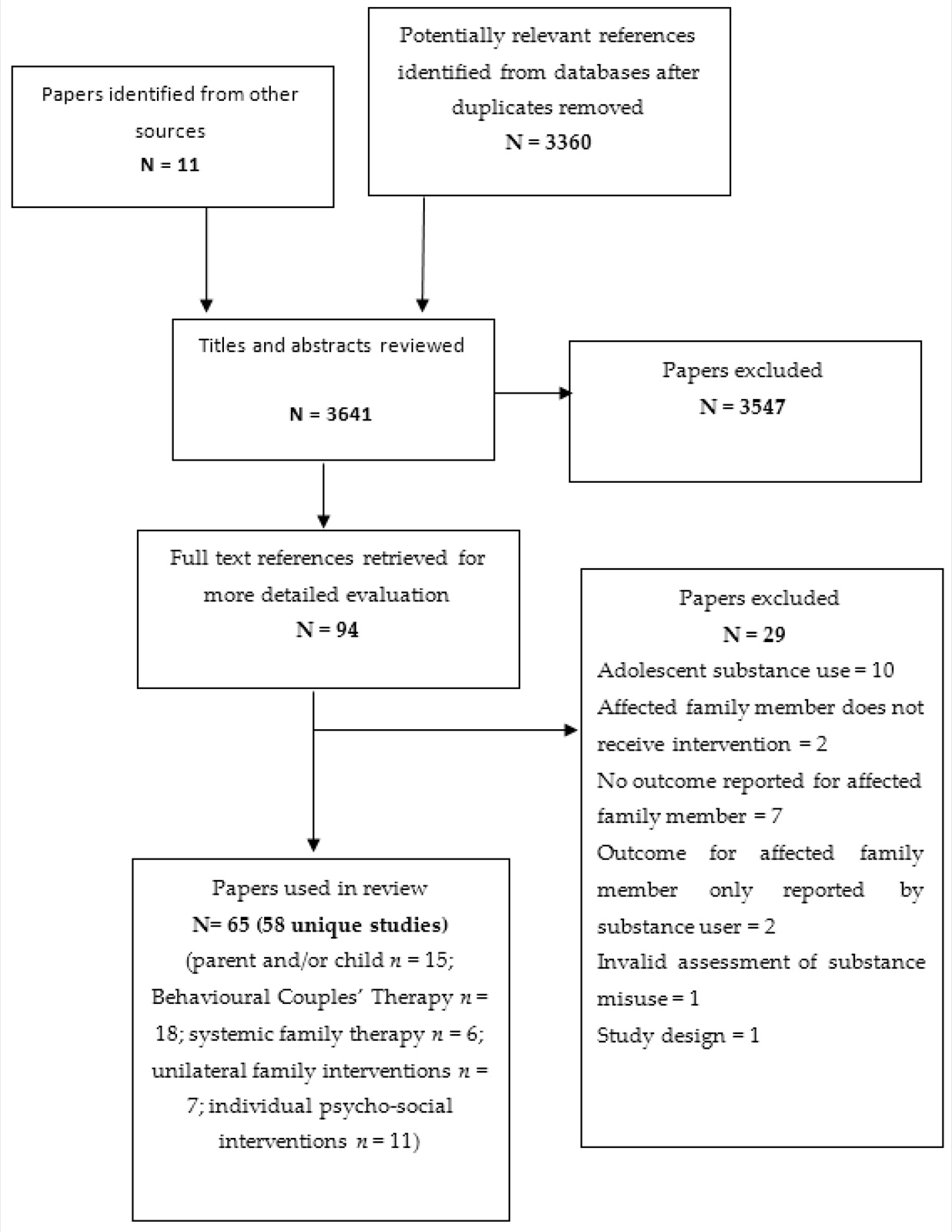
Table 1 — Evidence and gap map.
- Parent/child interventions. Evidence of effect; Evidence of no effect/adverse effect.
- Behavioural couples’ therapy. Evidence of effect; Evidence of no effect/adverse effect.
- Systemic family therapy. Evidence of effect; Evidence of no effect/adverse effect.
- Unilateral family intervention. Evidence of effect; Evidence of no effect/adverse effect.
- Psychosocial interventions. Evidence of effect; Evidence of no effect/adverse effect.
[Graphic symbols of the original map (shape and size) not reproduced.]
Table 2 — Evidence of effectiveness from included studies.
- Parent and Child Intervention
- Parental alcohol use and dependent age children
- Author, Date, Country: Bennun (1988) UK; Participants: n = 12 families; alcohol misusing parents and children; mean age 16 years; Intervention: Milan systems therapy *; Comparison: Problem-solving treatment based on social learning theory *; Experimental Intervention Outcome: Non-Significant (NS) effect on Marital Adjustment Test (MAT) and Family Satisfaction Rating (FS) at 6 months.; Risk of Bias Summary: Unclear
- Author, Date, Country: Lam (2009) USA; Participants: n = 30 families; females and their male alcohol misusing partners, with at least one child aged 8–12 years; Intervention: (1) Parent skills plus BCT (PSBCT); (2) BCT; 24 sessions each; Comparison: IBT; 24 sessions; Experimental Intervention Outcome: PSBCT-improved parental style (Parenting Scale-PS) and both PSBCT and BCT-reduced spousal violence using Timeline Followback Spouse Violence (TLFB-SV) and improved spousal relationship satisfaction on the Dyadic Adjustment Scale (DAS) at 6 and 12 months follow-up.; Risk of Bias Summary: Low
- Parental alcohol use and adult children
- Author, Date, Country: Hansson (2006) Sweden; Participants: n = 82; adult children of parents with alcohol problems; mean age 25.6 years; 61% female alcohol; Intervention: (1) Coping (CBT) only; (2) Coping and alcohol intervention *; Comparison: Alcohol intervention focusing upon the adult child’s drinking only *; Experimental Intervention Outcome: NS on Short Index of Problems (SIP), Symptom Checklist-90 item (SCL-90), Interview Schedule for Social Interaction (ISSI), questionnaire coping with parents’ abuse at 12 months follow-up.; Risk of Bias Summary: Low
- Author, Date, Country: Gustafson (2012) USA; Participants: n = 23; adult children of alcoholic parents, aged 18 years and older; 63% female; Intervention: (1) Computer-based intervention only; (2) Computer-based intervention plus group therapy *; Comparison: Group therapy only *; Experimental Intervention Outcome: No significance test conducted due to small sample size. Self-constructed questionnaire measuring responsibility and blame, depression, anxiety, loneliness, personal growth, positive relations, and self-acceptance completed post intervention.; Risk of Bias Summary: High
- Author, Date, Country: Kingree (2000) USA; Participants: n = 114; adult children of alcoholics, mean age 34.5 years; 32% female; Intervention: Al-anon (family support groups); 12 meetings; Comparison: Substance abuse education classes *; Experimental Intervention Outcome: Improved perceived status benefits (self-constructed questionnaire) and depression (CES-D) at 6 months post treatment; Risk of Bias Summary: Unclear
- Author, Date, Country: Kuhns (1997) USA; Participants: n = 64; adult children of alcoholic parents, mean age 20.4 years; Intervention: (1) Self-help; (2) Psychotherapy; 8 sessions; Comparison: No intervention; Experimental Intervention Outcome: Both self-help and psychotherapy reduced depression on Centre for Epidemiological Studies Depression Scale (CES-D) 3 months post treatment; Risk of Bias Summary: Unclear
- Author, Date, Country: Osterndorf (2011) USA; Participants: n = 12; adult children of alcoholics, 91.7% female; Intervention: Forgiveness therapy; 12 sessions; Comparison: Conflict resolution; 12 sessions; Experimental Intervention Outcome: NS on Enright Forgiveness Inventory (EFI); Anxiety on State-Trait Anxiety Inventory (STAI); anger on State-Trait Anger expression Inventory (STAXI); Beck Depression Inventory (BDI-II), Positive Relations with Others (PRO) at 3-month follow-up.; Risk of Bias Summary: Unclear
- Parental drug use and dependent age children
- Author, Date, Country: Catalano (1999); Haggerty (2008) USA; Participants: n = 130 families; parents in receipt of methadone; 75% female; child aged 3–14 years; Intervention: Focus on Families; parent skill training and case management; 33 sessions; Comparison: Methadone treatment *; Experimental Intervention Outcome: Higher parental involvement (self-constructed questionnaire) at 6-month follow-up. Adolescent males less likely to have an alcohol or marijuana use disorder; NS for females (Composite International Diagnostic Interview—CIDI) at 12–14-year follow-up.; Risk of Bias Summary: Low
- Author, Date, Country: Hojjat (2016) Iran; Participants: n = 57; female children with both parents being dependent upon opium, aged 12–15 years; Intervention: Group assertiveness training; 8 sessions; Comparison: Wait-list control; Experimental Intervention Outcome: Increased happiness (Oxford Happiness Scale) and assertiveness (Gambrill–Richey Assertion Inventory) one month post intervention.; Risk of Bias Summary: High
- Author, Date, Country: Hojjat (2017) Iran; Participants: n = 57; male children aged 14–18 years who have an opium dependent father; Intervention: Emotional intelligence training; 8 sessions; Comparison: No intervention; Experimental Intervention Outcome: Reduced anger (STAXI-(2) at 4-month follow-up.; Risk of Bias Summary: High
- Parental alcohol and/or drug use and dependent age children
- Author, Date, Country: Donohue (2014); Participants: n = 72 substance abusing mothers referred to child welfare for neglect, and their children; Intervention: Family behavioural therapy * plus standard treatment; Comparison: Standard treatment *; Experimental Intervention Outcome: Significant reductions in child maltreatment potential at 6 and 10 months follow-up.; Risk of Bias Summary: Low
- Author, Date, Country: Kelley (2002) USA; Participants: n = 135 families; all female partners of substance abusing male, with at least one child aged 6–16 years; Intervention: (1) BCT; (2) Individual behavioural therapy (IBT); 32 sessions each; Comparison: Couples based psychoeducational attention control (PACT); 32 sessions; Experimental Intervention Outcome: Improved child psychosocial functioning (Pediatric Symptom Checklist—PSC) and relationship satisfaction (DAS) at 6 (in both alcohol and drug using group) and 12 months (drug using group).; Risk of Bias Summary: Low
- Author, Date, Country: Orte (2008) Spain; Participants: n = 93; children of dependent substance misusing parents; mean age 10.6 years; Intervention: Family competence programme; 14 sessions; Comparison: Standard outpatient drug treatment *; Experimental Intervention Outcome: Improved family relationships, parental involvement, family communication, family bonds, and family cohesion (Strengthening Families Programme validated instruments) at 3-month follow-up; Risk of Bias Summary: High
- Author, Date, Country: Bröning (2019) Germany; Participants: n = 218; children of substance misusing parents, aged 8–12 years; 47.7% female; participants excluded if in receipt of additional intervention; Intervention: Psych-educational intervention; 9 sessions; Comparison: Non educational play and fun sessions *; Experimental Intervention Outcome: NS on coping measures (adapted version Stress and Stress Management in childhood and adolescence—SSKJ); self-efficacy (Generalised Self-Efficacy Scale); self-concept (Self-Perception Profile for Children, child version—SPPC); health-related quality of life (KIDSCREEN-27); self-constructed questionnaires on parent relationship, mental distress, and social isolation at 6-month follow-up.; Risk of Bias Summary: Low
- Author, Date, Country: Bartle-Haring (2018) USA; Participants: n = 183 families; children of substance-using mothers, mean age 11.54 years; Intervention: Ecologically based family therapy; 12 sessions; Comparison: Women’s health education; 12 sessions; Experimental Intervention Outcome: Short term immediate decrease (6 months) in alcohol and tobacco followed by an increase (12 and 18 months). NS for cannabis (Timeline Followback—90 item; TLFB-90).; Risk of Bias Summary: Unclear
- Behavioural couples and family therapy
- Interventions for partners/families of an adult who uses alcohol
- Author, Date, Country: Fals-Stewart (2005) USA; Participants: n = 60 dyads; female partners of male alcohol misusers; Intervention: (1) Brief BCT; 18 sessions; (2) standard BCT; 24 sessions; Comparison: (1) Couples psychoeducational attention control (PACT); (2) IBT; 18 sessions each; Experimental Intervention Outcome: Brief and standard BCT significantly improved relationship satisfaction (DAS); however, brief BCT was not equivalent to standard at 12-month follow-up.; Risk of Bias Summary: Low
- Author, Date, Country: Fals-Stewart (2006) USA; Participants: n = 138 dyads; male partners of female alcohol misusers; Intervention: (1) BCT; (2) IBT; 32 sessions each; Comparison: PACT; 32 sessions; Experimental Intervention Outcome: BCT group less acts of violence TLFB-SV and improved relationship (DAS) at 12-month follow-up.; Risk of Bias Summary: Low
- Author, Date, Country: Fals-Stewart (2009b) USA; Participants: n = 100 dyads; same sex couples where one partner has alcohol use disorder; Intervention: BCT; 32 sessions; Comparison: IBT; 32 sessions; Experimental Intervention Outcome: Increased relationship satisfaction (DAS) throughout follow-up period (3, 6, 9, and 12 months).; Risk of Bias Summary: Low
- Author, Date, Country: Halford (2001) Australia; Participants: n = 44 dyads; female partners of alcohol abusing males; Intervention: (1) Stress management; (2) Alcohol focused couples’ therapy; 15 sessions each; Comparison: Non-directive counselling; 15 sessions; Experimental Intervention Outcome: NS results for stress and burden (Relative Stress Scale and General Health Questionnaire—GHQ); relationship satisfaction (DAS and Martial Status Inventory—MSI); and physical aggression within relationship (Conflict Tactics Scale—CTS) at 6-month follow-up.; Risk of Bias Summary: High
- Author, Date, Country: Kuenzler (2003) USA; Participants: n= 50 dyads; partners also drank alcohol; 70% above recommended levels; Intervention: BCT *; Comparison: Family systems therapy *; Experimental Intervention Outcome: NS for partners’ psychological wellbeing as measured by BDI post treatment.; Risk of Bias Summary: High
- Author, Date, Country: Lam (2009) USA; Participants: n = 30 families; females and their male alcohol misusing partners, with at least one child aged 8–12 years; Intervention: (1) Parent skills plus BCT (PSBCT); (2) BCT; 24 sessions each; Comparison: IBT; 24 sessions; Experimental Intervention Outcome: Both PSBCT and BCT reduced spousal violence (TLFB-SV) and improved spousal relationship satisfaction (DAS) at 6 and 12 months follow-up.; Risk of Bias Summary: Low
- Author, Date, Country: McCrady (1986); McCrady (1991) USA; Participants: n = 47 dyads; partners of alcohol abusers; Intervention: (1) Alcohol-focused couple involvement (AFSI); (2) Alcohol behavioural martial therapy (ABMT) *; Comparison: Minimal spouse involvement *; Experimental Intervention Outcome: Increased relationship satisfaction (MAT) and psychological status (Psychosocial Functioning Inventory) in ABMT at 6 months follow-up.; Risk of Bias Summary: Low
- Author, Date, Country: O’Farrell (1985); O’Farrell (1992) USA; Participants: n= 34 dyads; female spouses of male alcoholics; Intervention: (1) Couples attended mutual support group; (2) BCT; 10 sessions each; Comparison: Individual peer counselling *; Experimental Intervention Outcome: BCT significantly higher relationship satisfaction (MAT) and higher martial stability (Martial Stability Inventory—MSI) at 6 and 12 months.; Risk of Bias Summary: Low
- Author, Date, Country: O’Farrell (1993); O’Farrell (1997) USA; Participants: n = 59 dyads; female partners of male alcoholics; Intervention: BCT and relapse prevention; 25 sessions; Comparison: BCT; 10 sessions; Experimental Intervention Outcome: Higher relationship satisfaction (MAT) at 12 months effect not found at 18 or 24 months follow-up.; Risk of Bias Summary: Low
- Author, Date, Country: O’Farrell (2016) USA; Participants: n = 101 dyads; partners of alcohol dependent patients; 29.7% female; Intervention: Group BCT; 23 sessions; Comparison: Standard BCT; 23 sessions; Experimental Intervention Outcome: Group BCT significantly lower relationship satisfaction (DAS) than standard BCT at 3 and 6 months follow-up.; Risk of Bias Summary: Low
- Author, Date, Country: Schumm (2014); USA; Participants: n = 105 dyads; male partners of alcohol dependent females; Intervention: BCT; 26 sessions; Comparison: IBT; 26 sessions; Experimental Intervention Outcome: NS on relationship satisfaction (DAS and Relationship Happiness Scale -RHS) or intimate partner violence (CTS) at 12 months follow-up.; Risk of Bias Summary: Low
- Author, Date, Country: Vedel (2008) Netherlands; Participants: n = 64 dyads; partners (male and female) of alcohol misusers; Intervention: BCT; 10 sessions; Comparison: IBT; 10 sessions; Experimental Intervention Outcome: NS on relationship satisfaction (Maudsley Martial Questionnaire) at 6 months follow-up.; Risk of Bias Summary: Low
- Author, Date, Country: Walitzer (2004) USA; Participants: n = 64 dyads; female partners of problem drinkers; Intervention: (1) Couples alcohol focused; (2) Couples alcohol focused and BCT; 10 sessions; Comparison: Individual focused; 10 sessions; Experimental Intervention Outcome: NS on relationship satisfaction (DAS) or spouse support measures (Partner Interaction Questionnaire and Significant-other Behaviour Questionnaire) at 6 and 12 months follow-up.; Risk of Bias Summary: Unclear
- Author, Date, Country: Walitzer (2013) USA; Participants: n = 64 dyads; female partners of problem drinkers; Intervention: (1) Couples alcohol focused (CAF); (2) CAF and BCT; 10 sessions; Comparison: Individual focused; 10 sessions; Experimental Intervention Outcome: Decrease in conflictual communication in two couple-involved groups (Rapid Martial Interaction Coding System) post treatment.; Risk of Bias Summary: Low
- Interventions for partners/families of an adult who uses drugs
- Author, Date, Country: Fals-Stewart (2001) USA; Participants: n = 36 dyads; female partners of men in receipt of methadone; Intervention: BCT; 24 sessions; Comparison: IBT; 24 sessions; Experimental Intervention Outcome: Increased relationships satisfaction (DAS and MHS) post treatment.; Risk of Bias Summary: Low
- Author, Date, Country: O’Farrell (2017) USA; Participants: n = 61 dyads; male partners of female drug users; 45% of males were also drug users; Intervention: BCT; 26 sessions; Comparison: IBT; 26 sessions; Experimental Intervention Outcome: NS on relationship satisfaction (DAS), lower days separated (% of days) at 12 months follow-up.; Risk of Bias Summary: Low
- Interventions for partners/families of an adult who uses alcohol and/or drugs
- Author, Date, Country: Fals-Stewart (2002) USA; Participants: n = 80 dyads; female partners of male substance misusers; Intervention: BCT; 34 sessions; Comparison: IBT; 22 sessions; Experimental Intervention Outcome: Less male to female acts of violence (CTS) at 12 months follow-up.; Risk of Bias Summary: Low
- Author, Date, Country: Fals-Stewart (2009a) USA; Participants: n = 207 dyads; female partners of substance misusing males; Intervention: BCT; 32 sessions; Comparison: IBT; 32 sessions; Experimental Intervention Outcome: Lower male to female violence (TLFB-SV) at 12 months follow-up.; Risk of Bias Summary: Low
- Author, Date, Country: O’Farrell (2010) USA; Participants: n = 29 dyads; family members other than spouses of substance misusing relative; Intervention: Behavioural family therapy; 24 sessions; Comparison: IBT; 24 sessions; Experimental Intervention Outcome: NS on relationship satisfaction (RHS) at 3 and 6 months follow-up.; Risk of Bias Summary: Low
- Author, Date, Country: Winters (2002) USA; Participants: n = 75 dyads; male partners of female substance misusers; Intervention: BCT; mean 39.5 sessions; Comparison: IBT; mean 38.4 sessions; Experimental Intervention Outcome: Increased relationships satisfaction (DAS and RHS) at 12 months follow-up.; Risk of Bias Summary: Unclear
- Systemic family therapy
- Interventions for families of an adult who uses alcohol
- Author, Date, Country: McKay (1993) USA; Participants: n = 51; family of alcohol misusers; Intervention: Conjoint systemic therapy *; Comparison: Non conjoint alcohol coping *; Experimental Intervention Outcome: NS difference in family functioning as measured on the Family Assessment Device (FAD) at 6 months follow-up.; Risk of Bias Summary: High
- Author, Date, Country: Zweben (1988) USA; Participants: n = 116 dyads; partners (male and female) of alcohol abusers; Intervention: Couples martial therapy *; Comparison: Couples advice counselling *; Experimental Intervention Outcome: NS on Revised Martial Relationship Scale (RMRS), DAS, and Edmonds Martial Conventionality Scale (EMC) at 6, 12, and 18 months follow-up.; Risk of Bias Summary: Low
- Interventions for families of an adult who uses drugs
- Author, Date, Country: Ahmad-Abadi (2017) Iran; Participants: n = 61; co-dependent partners of drug users; Intervention: Communication family therapy; 10 sessions; Comparison: Counselling; 1–3 sessions; Experimental Intervention Outcome: Reduced co-dependency as measured on the Holyoake co-dependency index (HCI) at 3 months follow-up.; Risk of Bias Summary: Unclear
- Author, Date, Country: Ghasemi (2014) Iran; Participants: n = 285; male and female family of methamphetamine users; Intervention: Family empowerment model *; Comparison: No intervention; Experimental Intervention Outcome: Improved quality of life as measured on the Short Form Health Survey-36 post treatment.; Risk of Bias Summary: Unclear
- Author, Date, Country: Li (2014) Vietnam; Participants: n = 83; family members of IV drug users; 100% female; Intervention: Family and user sessions delivered separately; 6 sessions; Comparison: Standard care *; Experimental Intervention Outcome: Improved coping (brief COPE scale) at 3 months only, depression (Zung Self-Rating Depression Scale) at 6-month follow-up only and family functioning (adapted from Family Functioning Scale) at 6 and 12 months.; Risk of Bias Summary: Low
- Interventions for families of an adult who uses alcohol and/or drugs
- Author, Date, Country: Mueser (2012) USA; Participants: n = 108; family of dually diagnosed patients; Intervention: Family intervention * (18-month intervention period); Comparison: Education for family *; Experimental Intervention Outcome: Improved knowledge (self-reported), mental health (as measured by SF-12), worry, and stigma (Family Experiences Interview Schedule—FEIS) at 36-month follow-up.; Risk of Bias Summary: Low
- Unilateral family interventions
- Interventions for families of an adult who uses alcohol
- Author, Date, Country: Barber (1995) Australia; Participants: n = 23; partners of heavy drinkers; 96% female; Intervention: (1) Pressures to Change (individual); (2) Pressures to Change (group) *; Comparison: Wait-list; Experimental Intervention Outcome: NS on Martial consensus scale (MCS), Life Satisfaction Scale (LSS), personal problems (self-report) post treatment and 3 months later.; Risk of Bias Summary: Unclear
- Author, Date, Country: Barber (1996) Australia; Participants: n= 48; mostly partners (daughters and mothers also) of heavy drinkers, 94% female; Intervention: (1) Pressures to Change (individual); (2) Pressures to Change (group) *; Comparison: (1) Wait-list; (2) Al-anon (family support group) *; Experimental Intervention Outcome: Individual-improved marriage discord-measured Drinkers Partner Distress Scale (DPDS), personal problems (self-report). NS on depression (DPDS) post treatment.; Risk of Bias Summary: Unclear
- Author, Date, Country: Barber (1998) Australia; Participants: n = 38, female partners of male heavy drinkers; Intervention: (1) Pressures to Change (individual); (2) Pressures to Change (self-help manual) *; Comparison: (1) Wait-list control; Experimental Intervention Outcome: Individual-improved marriage satisfaction (DPDS), NS on life satisfaction (LSS) only when combined pressures to change groups decreased depression (DPDS) 1 month post treatment.; Risk of Bias Summary: Unclear
- Author, Date, Country: Bischof (2016) Germany; Participants: n = 78; majority female (97.9%) and partners (79.1%), of alcohol-dependent relatives; Intervention: CRAFT *; Comparison: Wait-list control *; Experimental Intervention Outcome: Improvements in mental health on Mental Health Inventory but not on BDI or SCL-90. Improvements in and relationship satisfaction (RHS) at 12 months follow-up.; Risk of Bias Summary: Low
- Author, Date, Country: Eek (2020) Sweden; Participants: n = 94; majority female (92.3%) and partners (86.2%), of mostly alcohol-dependent relatives (94.7%); Intervention: iCRAFT; 10–12 weekly sessions; Comparison: Wait-list control; Experimental Intervention Outcome: All mental health outcomes were NS at 12 and 24 weeks follow-up (as measured by Montgomery–Åsberg Depression Rating Scale-Self Assessment (MADRS-S) and Depression, Anxiety and Stress Scale (DASS)).; Risk of Bias Summary: Unclear
- Author, Date, Country: Miller (1999) USA; Participants: n = 130 family members of alcohol users; Intervention: (1) CRAFT; 12 sessions; (2) Johnson Institute Intervention; 6 sessions; Comparison: Al-anon; 12 sessions; Experimental Intervention Outcome: All outcomes relating to affected family member were NS (as measured on BDI, State-Trait Anxiety Inventory, STAXI, Spouse Enabling Inventory and Spouse Influence Inventory, self-esteem scale (self-reported) and physical symptoms scale (self-reported) Family Environment Scale (FES), DAS, and (RHS) at 3, 6, 9, and 12 months follow-up.; Risk of Bias Summary: Low
- Interventions for families of an adult who uses drugs
- Author, Date, Country: Kirby (1999) USA; Participants: n = 32; family members of drug users; 94.4% female; Intervention: CRAFT; 14 sessions; Comparison: Al-anon; 10 sessions; Experimental Intervention Outcome: All outcomes relating to affected family member were NS (as measured on Family Impact Survey (FIS), Profile of Mood States (POMS), Social Adjustment Scale, and Self-Esteem Scale) post treatment.; Risk of Bias Summary: Unclear
- Psychosocial interventions for the individual affected family member
- Interventions for families of an adult who uses alcohol
- Author, Date, Country: Copello (2009); Velleman (2011) UK; Participants: n = 136 family members of substance misusers; Intervention: Stress-strain-coping-support model; 1 session; Comparison: Self-help manual with similar content; Experimental Intervention Outcome: NS on two validated tools measuring physical and psychological coping (Symptom Rating Test and Coping Questionnaire) at 12 months follow-up.; Risk of Bias Summary: Low
- Author, Date, Country: Cruz-Almanza (2006) Mexico; Participants: n = 35; female partners of alcohol misusing men; Intervention: Rational-Emotive Behavioural Therapy; 18 sessions; Comparison: Wait-list control; Experimental Intervention Outcome: Increased self-esteem (Self-Esteem Inventory), coping (Birmingham Coping Inventory), and likelihood of assertiveness (Assertion Inventory) at 3, 6, and 18 months follow-up.; Risk of Bias Summary: High
- Author, Date, Country: Dittrich (1984) USA; Participants: n = 23 wives of alcoholics; Intervention: Group intervention; 8 sessions (and optional); Comparison: Wait-list control; Experimental Intervention Outcome: Improved self-concept (Tennessee self-concept scale); decreased anxiety (Taylor Manifest Anxiety Scale) and enabling behaviour Memphis Enabling Behaviors Inventory (MEBI) post treatment and 6 months later.; Risk of Bias Summary: Unclear
- Author, Date, Country: Kim (2014) Korea; Participants: n = 29; wives of alcoholics; Intervention: Forgiveness therapy; 12 sessions; Comparison: Standard care *; Experimental Intervention Outcome: Improved resilience and self-esteem at 3-month follow-up.; Risk of Bias Summary: Low
- Author, Date, Country: Osilla (2018); Rodriguez (2018); USA; Participants: n = 306; partners of heavy drinking service members and veterans; 95% female; Intervention: Partners Connect (web-based intervention) *; Comparison: Wait-list control; Experimental Intervention Outcome: Lower anxiety (General Anxiety Scale—GAD-7), depression (Patient Health Questionnaire—PHQ-9), and increased social support (Medical Outcome Study survey). NS relationship quality (Quality of Marriage Index—QMI), anger (State-Trait Anger Expression Inventory—STAXI), or family conflict (Family Environment Scale-FES) at 5 months follow-up.; Risk of Bias Summary: Low
- Author, Date, Country: Rubio (2013) Spain; Participants: n = 188; mainly wives (90.4%) of alcohol misusers; Intervention: Family self-help; 10 sessions; Comparison: Standard care; Experimental Intervention Outcome: Improvements in somatization, depression, anxiety, and phobia as measured on Symptom Checklist—90 (SCL-90), mental health and social role as measured on short form—36 (SF-36) at 6 months follow-up.; Risk of Bias Summary: Low
- Author, Date, Country: Rychtarik (2005) USA; Participants: n = 36; female partners of alcohol misusers; Intervention: (1) Coping skills training (CST); (2) Al-anon *; Comparison: Wait-list control; Experimental Intervention Outcome: CST and Al-anon reduced depression on Beck Depression Inventory (BDI-1A). CTS lower incident of partner violence (self-report) at 12 months follow-up.; Risk of Bias Summary: Low
- Author, Date, Country: Zetterlind (2001) Hansson (2004) Sweden; Participants: n = 39; partners of alcoholics; 92.3% female; Intervention: (1) Coping skills (individual) 5 sessions; (2) CBT (group) 13 sessions; Comparison: Standard information session; 1 session; Experimental Intervention Outcome: NS on coping behaviour scale; the SCL-90, global severity index, Alcohol Use Disorder Identification Test (AUDIT) (affected other alc use) at 12 months follow-up.; Risk of Bias Summary: Low
- Interventions for families of an adult who uses drugs
- Author, Date, Country: Bortolon (2017) Brazil; Participants: n = 335, 88.7% female; mostly mothers (62%) of drug users; Intervention: Tele-intervention; 9 telephone sessions; Comparison: Bibliotherapy; Experimental Intervention Outcome: Twice as likely to modify their co-dependent behaviour (Holyoake co-dependency index—HCI) at 6 months follow-up.; Risk of Bias Summary: Low
- Author, Date, Country: Faghih (2019) Iran; Participants: n = 64; family members of drug dependent relative; 78% female; Intervention: CBT; 16 sessions; Comparison: No intervention; Experimental Intervention Outcome: Reduced burden of care as measured on Zarit Burden Scale at 3 months follow-up.; Risk of Bias Summary: Low
- Interventions for families of an adult who uses alcohol and/or drugs
- Author, Date, Country: Haddock (2003) UK; Participants: n = 36; mostly parents (66.6%) and females (75%) of dually diagnosed relatives; Intervention: CBT; 29 sessions; Comparison: Standard care *; Experimental Intervention Outcome: NS on physical and mental health (GHQ, BDI), Social Behaviour Assessment Schedule (SBAS), and Relatives Cardinal Needs Schedule (RCNS) at 12 months follow-up.; Risk of Bias Summary: Low
* Number of sessions not reported in paper.
3.2. Parental and Child Interventions (15 Trials)
Fifteen trials intervened to address the impact of parental substance use disorder upon the family. The trials varied in who received the intervention and the mechanisms by which they sought to affect change. There were broadly two types of interventions for parents and children affected by parental substance use—those that intervened with the parent to enhance parent skill and those that intervened with the child to address the impact that their parent’s substance use has had upon them. We identified five trials which intervened with the substance-using parent to enhance their parenting skill and family functioning. In these trials, the affected non-using partner and/or child were typically involved to support change within the substance-using parent’s behaviour, for example, to provide a means to practice the newly acquired skill, or to reinforce positive behaviour.
Despite this indirect focus, the interventions examined in these trials were mostly found to be effective at improving family functioning and relationships. At 6 months follow-up, children whose families received parenting skill intervention in addition to methadone treatment (opioid maintenance/detoxification therapy for opioid use disorder) reported significantly more parental involvement and activities with their parent than those children whose parents received standard methadone treatment [25]. One further trial, which combined behavioural couples’ therapy (BCT) with parent skills training for parents in families where the father has an alcohol use disorder, reported significant improvement on parental discipline scales (laxness and over-reactivity) when compared to individual therapy and BCT alone at both 6 and 12 months follow-up [26]. This suggested that parenting was achieved through the addition of parental skills training. Additionally, family therapy has been found to improve family relationships, parental involvement, family communication, family bonds, and family cohesion within families where there is parental substance use disorder [27]. However, a further trial that examined systems therapy in families where a parent has an alcohol use disorder found that this intervention did not significantly improve marital satisfaction or family satisfaction more than the comparison condition of a problem solving approach at 6 months follow-up [28].
A minority of these trials also measured child outcomes, showing some evidence of effect on a small number of very diverse outcomes. Family therapy was found to reduce child maltreatment potential in families where a parent has a substance use disorder at 6 and 10 months follow-up, demonstrating medium effect sizes compared to standard treatment [29]. Behavioural couples’ therapy, provided to parents with either an alcohol or drug use disorder in conjunction with their non-using partners, was found to result in significantly greater psychosocial adjustment in the children at 6 and 12 months when compared to those children whose parents received individual behavioural therapy (IBT) or couples psychoeducational control treatment (PACT) [30]. Two trials that examined the substance use outcomes of children showed mixed results. One trial examining a parenting skill intervention found there was a reduction in alcohol or marijuana use disorder in male children of substance-using parents but not female children [31]. A further trial of family therapy found children aged 8–16 years who participated in family therapy with their substance-using mother had a short-term reduction in alcohol and tobacco. However, at follow-up these children were found to have higher levels of alcohol and tobacco than those children whose mother received a health education intervention [27].
Eight trials examined the effectiveness of interventions which directly intervened with the children of substance-using parents, with a primary focus of addressing the impact their parent’s substance use had upon them. Of these trials, three intervened with dependent age children and five intervened with adult children. The trials examining interventions for dependent age children included a diverse range of interventions, showing mixed and low-quality evidence of effect. One trial randomly assigned children aged 8–12 years old whose parent had a substance use disorder to a psychoeducational intervention or non-educational play and fun sessions. The psychoeducational intervention was not found to result in better mental wellbeing, coping, self-perceived autonomy, or parent–child relationship than non-educational play, with both groups making improvements [32]. Evidence of a reduction in participant anger was reported at 2 months post treatment in a trial of emotional intelligence group training as compared to wait-list control for adolescent boys of fathers with an opiate use disorder [33]. Group assertiveness training for female adolescent children (aged 12–15 years) where both parents have an opiate use disorder reported significant improvements in happiness and assertiveness compared to wait-list control at 6 weeks post treatment [34]. Three trials considered the effectiveness of self-help interventions to improve the wellbeing of adult children of alcohol-using parents. When comparing Al-anon group intervention to education classes, improvements were observed on depression at 6 months follow-up [35]. Similarly, a group accessing self-help intervention resulted in more improvements in depressive symptoms than both a group receiving a psychotherapy intervention and those receiving no intervention [36]. A trial of computer-based self-help intervention found the experimental intervention improved levels of depression and self-acceptance more than the therapy-only group [37]. Two further trials examined interventions for adult children of alcohol-using parents—one examining the effectiveness of forgiveness therapy compared to conflict resolution [38] and another comparing a coping programme to an alcohol programme and a group combining both interventions [39]; however, neither found between-group differences on outcomes measured.
3.3. Behavioural Couples and Family Therapy (19 Trials)
Behavioural couples’ therapy (BCT) typically consisted of a combination of individual drug and alcohol treatment sessions for the substance user and conjoint behavioural couples counselling sessions totalling between 10 and 32 sessions. Within the conjoint sessions, couples were typically encouraged to discuss how the non-using partner can positively support the using partner and were taught how to communicate more effectively and increase positive behavioural exchanges. In additional to examining the impact of the intervention upon the substance user’s alcohol or drug consumption, these trials focused primarily upon the impact of the intervention upon the relationship including incidence of intimate partner violence, conflictual communication, and overall relationship satisfaction. Of the five trials that examined the effectiveness of the intervention at reducing intimate partner violence, four reported reductions. Two trials providing BCT to couples where the male partner used either alcohol or drugs [40] or drugs only [41] reported greater reduction in male to female violence when compared to individual behavioural therapy. In both of these trials, the incidence of violence in the BCT group was around half that of the comparison group at 12 months follow-up, whilst a further trial, which examined the effectiveness of BCT where the female partner used alcohol or drugs, reported significantly reduced male to female acts of violence at 12 month follow-up [42]. The proportion of couples reporting conflictual communication reduced from pre to post treatment with those in couples therapy, whilst conflict in couples where the alcohol-using male received individual therapy increased slightly [43]. In a trial of BCT plus parent skills training for alcohol-using parents, Lam et al. (2009) reported that both the BCT participants and BCT with parent training made clinically meaningful reductions in percentage of days of any violence with effect sizes of small to medium, whilst the individual behavioural therapy did not [26]. Two further trials reported the intervention did not result in greater improvements than the comparison condition—one comparing alcohol-focused couples’ therapy to non-directive supportive counselling for male alcohol users [44], and one examining BCT compared to individual behavioural therapy for women who use alcohol [45].
The majority (91%) of trials which measured the effectiveness of BCT for increasing the level of relationship satisfaction reported significant results when compared to individual therapy. These results were found in partners of drug and/or alcohol users at 3-month [46], 4-month [47], 6-month [46,48,49,50], 12-month [26,30,42,51,52,53], and 18-month follow-up [54]. In addition, partners reported significantly fewer thoughts of separation and divorce from their alcohol-using partner [48] and a lower percentage of days separated from their drug using partner during the follow-up period than controls [51]. Whilst a further trial reported significant improvements between pre and post treatment for partners of alcohol users receiving BCT compared to non-directive supportive counselling, these results had dissipated by 12 months follow-up [44]. In two trials which compared BCT with additional relapse prevention sessions to standard BCT, the authors reported that relapse prevention further increased relationship satisfaction in partners of alcohol users [55,56]. A trial of BCT for male alcohol users, compared to a control of an individual peer intervention, reported no between-group difference in relationship satisfaction at 12, 18, and 24 months follow-up [57]. No between-group effects upon relationship satisfaction were found in trials of BCT versus non-conjoint therapy in partners of alcohol users [45,57,58,59] and alcohol and/or drug users [60].
Three trials examined the effectiveness of BCT upon the psychological wellbeing of the non-using partner. Two trials found that BCT for partners of alcohol users did not improve partner psychological wellbeing significantly more than the control condition [44,61], whilst one trial found that partners who received BCT with their alcohol-using partner had improved psychological wellbeing at 18 months follow-up [54].
3.4. Systemic Family Interventions (6 Trials)
Systemic family therapy typically treats the substance users and their family as a system, recognizing the role of the family in the development and treatment of the adult relative’s substance use. It is generally assumed that positive changes in the family system will result in positive changes in the relative’s substance use. Most of the trials examining the effectiveness of systemic family therapy at improving the wellbeing of the affected family member found significant effects. In the only trial of family therapy not to include the focal user, family members of drug users reported significant reductions in co-dependency in the family therapy group compared to counselling only at post intervention and 90 days post intervention [62]. A trial examining the effectiveness of a long-term family intervention (9–18-month intervention period), for a population dually diagnosed with schizophrenia and substance use disorder, found that participating relatives reported significant improvement in mental health at follow-up 3 years post randomization [63]. Family functioning was found to be significantly improved at 3 and 6 months follow-up in the families of injecting drug users who received 4–6 sessions of family therapy intervention as compared to standard care. Whilst coping and depressive symptoms were found to have improved at 3 months, only the effect for depressive symptoms was maintained at 6 months follow-up [64]. A family-centred empowerment model was found to improve social support and quality of life in family members of methamphetamine users post intervention, when compared to no intervention [65]. No between-group effects upon relationship satisfaction for partners of alcohol users were found in a trial of marital systems therapy versus non-conjoint therapy [66].
3.5. Unilateral Family Interventions (7 Trials)
Unilateral family interventions intervene with the affected family member in order to teach them strategies by which they can support or influence the substance-using family member to address their substance use. The interventions typically include education on the process of change, on how to effectively place pressure upon substance user to action change as well as support to address the affected family member’s behaviour which may enable the relative’s substance use. The primary outcome of unilateral family interventions is, therefore, typically the substance use and/or treatment seeking behaviour of the substance user. We identified a number of trials of unilateral family interventions which also examined the affected family member outcomes. Whilst these trials were found to consistently improve the treatment seeking behaviour and treatment engagement of the substance-using relative, these trials rarely reported improved wellbeing in the affected other. In trials examining various versions of the Pressures to Change approach for family members affected by an adult relative’s alcohol use, no significant differences were found between groups on depression [67,68], personal problems [69], life satisfaction, partner distress [68], and marital discord [68,69]. However, one trial found Pressures to Change improved marriage satisfaction significantly more than the comparison groups of Al-anon and wait-list control [67].
Four trials measured the effectiveness of community reinforcement and family training (CRAFT) and did not demonstrate superiority over comparison interventions for outcomes relating to the wellbeing of the affected family member. CRAFT for family members of alcohol users [70] and drug users [71] were found to result in significant improvements in the mental health of the affected family member [70,71], family cohesion, and problems [70,71]; however, there were no between group differences when compared to Al-anon [70,71] and a Johnson Institute Intervention (confrontational family intervention) [70]. One trial comparing CRAFT to wait-list control for the family members of alcohol users found the intervention improved relationship satisfaction but the effect upon the affected relatives’ mental health was mixed [72]. In contrast, a further trial which compared an internet-based version of CRAFT to wait-list control for the families of alcohol users found no between-group difference in the affected family members’ mental health at follow-up [73].
3.6. Psychosocial Interventions for the Individual Affected Family Member (11 Trials)
Psychosocial interventions for the family members of a substance user are non-pharmacological therapeutic interventions delivered to individuals or groups, which seek to tackle the psychological, social, and personal problems experienced by the affected family member. Trials examining the effectiveness of coping skills interventions for the family members of alcohol users mostly did not find the intervention was effective at improving the affected family member’s wellbeing. In a single trial, coping skills training was found to reduce the incidence of partner physical violence at 6 months follow-up and levels of depression at 12 months follow-up compared to wait-list control [74]. However, two further trials found that coping skills training—one with the family members of alcohol and/or drug users [75,76] and one with the partners of alcohol users [77,78]—did not result in greater improvements in coping [75,76,77,78], psychological wellbeing [77,78], or physical symptoms [75,76] at follow-up points between 3 and 24 months when compared to a manualised self-help intervention [75,76], group-based coping, or standard information [77,78].
Seven trials examined behavioural interventions provided to the family members of alcohol and drug users in order to address interactional problems, enhancing the affected family member’s assertiveness and communication skills. Five of these trials reported improvements in the others’ affected psychological wellbeing for one or more of the reported outcomes. This related to anxiety [79,80], depression [81], self-esteem [82], coping [82], co-dependent behaviour [83], and partner enabling behaviour [80]; one trial reported a reduction in the burden of care for family members of drug users [84]. Conversely, no improvement was reported relating to anxiety in family members of alcohol users [81] or mental health problems in families of drug users [85]. Two trials found behavioural interventions did not improve relationship quality [79,81] or reduce family conflict in family members affected by an adult relative’s alcohol use [79].
One trial which examined the effectiveness of forgiveness group therapy in wives of alcohol users found that the therapy led to improvements in resilience and self-esteem at 3 months follow-up [86].
4. Discussion
We identified an emerging body of literature examining interventions to improve the wellbeing of family members affected by an adult relative’s substance use—signalling a shift away from a largely individualistic perspective upon the focal substance user, to one which includes or focuses upon the wider family. This is welcomed and is indicative of an increasing awareness of the importance of the family within the context of substance use. A wide variety of interventions were identified, with differing mechanisms of impact and outcomes. The findings of our systematic search and review suggest that interventions which integrate substance use treatment for the user with a family focused component may bring about social benefit for the affected family members. These interventions introduce behavioural strategies to improve family functioning and reduce conflict whilst placing emphasis upon teaching the affected adult family members how to support the substance user to reduce or abstain from alcohol or drugs. They are commonly delivered to the substance user and their significant other conjointly, in dyads or family groups. Previous systematic reviews of BCT [87,88,89] have found the intervention to be effective at reducing drug and alcohol use. However, these reviews were primarily focused upon the substance user, with little examination of family outcomes. The summative conclusions of our systematic search and review provide tentative evidence that integrated behavioural interventions for substance-affected families, which situate efforts to reduce or abstain within a family context, may also result in positive outcomes, particularly relating to intimate partner violence, relationship adjustment, and family functioning. There was an absence of evidence that these interventions may positively affect the psychological wellbeing of affected family members however, with none of the trials that examined behavioural family interventions measuring family member mental health outcomes.
Our systematic search and review found a body of trials which examined interventions that were provided directly and solely to the affected other. These interventions often sought to remove the worry (by affecting change in the substance use) or teach the affected family member how to “worry better” through behavioural strategies or skills training. Unilateral family interventions such as CRAFT and Pressure to Change sought to teach families members how to influence their relative’s substance use and treatment-seeking behaviour. Whilst unilateral family interventions were consistently found to be effective at enabling family members to influence the substance-using relative to reduce their use or increase treatment engagement, there was insufficient evidence that this brought psychological or social relief in the affected family members. It is clear that whilst the origins of the stressors may intertwine with the substance use, increasing treatment engagement for the user is not enough to benefit the affected others. Whilst this may alleviate acute worry, it does not do anything to address the long lasting impact of the trauma. Similarly, those interventions which sought to improve the affected users’ ability to cope with the impact of the using relative’s behaviour (without changing the stressor) were insufficient to result in significantly better outcomes for the adult or child family members affected by the substance use of an adult relative. Our review identified some examples of behavioural interventions delivered to the affected family member alone, and that may be effective at improving mental health and wellbeing. These interventions were typically based upon interventions which have previously been found to be effective in general populations for depression and anxiety such as cognitive behavioural therapy [90], or those specifically designed to alleviate stress and enhance skills and had been enhanced by explicit consideration of how the substance use of their relative affects them and their behaviours.
Despite the well documented traumatic impacts substance use is likely to have upon significant others [3,4,9], our search found only a small minority of trials that examined interventions provided directly to the family member in their own right and which specifically sought to intervene to improve family members’ psychological outcomes. The majority of trials of interventions which are delivered exclusively or jointly to affected family members maintain a focus upon reducing the substance use. When families are involved in treatment, this is most frequently as a means of affecting change in the focal user. These interventions do not go far enough in responding to the needs of the family and the multi-dimensional impact of substance use, including the long lasting impact upon the psychological and social wellbeing of the family. Substance use by an adult relative has a substantial impact upon the family. It is clear that addressing substance use is an important first step in the recovery of the family. Conjoint behavioural family therapy may offer promise in improving the social wellbeing and functioning of the family. However, it is likely that affected family members will also need support to recover from the impact. This suggests that both the substance user and the affected other may benefit from additional individual therapeutic sessions, in order to respond to their individual as well as their interpersonal needs. Such an approach would provide the substance-using relative with drug and alcohol treatment and the affected family member with mental health treatment to address the psychological impact, whilst jointly developing behavioural strategies for substance use and its multi-dimensional impact that must be addressed by the intervention.
5. Limitations
Within this review, we have examined all psychosocial interventions for any family member affected by an adult relative substance misuse. Whilst this broad focus is appropriate for the aims of this systematic search and review, this approach limits our ability to draw confident conclusions about the effectiveness of specific interventions at improving specified outcomes, within defined populations. It is important to acknowledge that the nature of the relationship between the family member and the substance misuser is likely to result in differential effects—impacts which may be more or less malleable to change. Our review provides an evidence overview inclusive of summary findings of effect, which introduces the opportunity for future systematic review and meta-analysis of focused review questions as well as evidence which may be used to further investigate promising intervention developments through empirical study.
There are also a number of limitations within the literature. Whilst the studies typically utilised randomised trial design, the strength of evidence is greatly reduced by a high risk of allocation and performance bias and small sample sizes. The trials are typically pilot trials and as such, are not sufficiently powered to conduct reliable statistical testing or cost effectiveness analysis. The results reported in the trials are, therefore, at risk of both type I and type II error, wherein the null hypothesis is either incorrectly rejected or retained. Furthermore, the trials often compared the experimental intervention to active interventions, many of which have an evidence base within adult substance-using populations. The use of active and, on some occasions, highly intensive comparison interventions is likely to reduce the ability of the trial to identify significant effects achieved by the intervention. The majority of the trials were conducted in the USA and those trials that reported on the ethnicity of the participants described a majority white sample (76%). Whilst the common core elements of the affected family member experience have been found across and within cultures, important variation exists [91]. That said, the remaining trials (n = 25) were conducted in eleven different countries, including some trials from low to middle income countries which is important in advancing understanding of cross-cultural variation [21]. Structural subordination and dependence, wherein family members are reliant financially or socially upon the substance-using relative, deepens the strain of a relative’s substance use [91]. As such, the greater number of studies focusing upon female family members is reflective of this. Nonetheless, the paucity of trials examining interventions for male affected family members is a gap within the literature. Although included in the non-specified family member group, no studies specifically examined the effectiveness of interventions for parents of adult substance users and only one trial examined interventions for same sex couples [52].
6. Conclusions
There is a large volume of literature examining psychosocial interventions which have been found to improve the psychological and social wellbeing of family members affected by an adult relative’s substance use. However, these interventions do not go far enough to address the needs often experienced within substance-affected families. There is a need for research which develops and evaluates interventions which seek to address the complex multidimensional adversities experienced by many families affected by substance use. Further research is needed to determine the effect of a multi-component psychosocial intervention, which seeks to support both the substance user and the affected family member, with equal focus upon their needs.
Complexe Systémique: key points
This review has the merit of shifting the question: no longer only “how can the family help the person who uses substances?”, but “what helps the family itself?”. The answer is mixed. Conjoint formats, especially behavioural couples therapy, improve marital satisfaction and family functioning and reduce violence; unilateral approaches such as CRAFT often bring the relative into treatment without relieving those around them. For systemic practice, the finding echoes an old intuition: making a relative the lever of someone else’s change is not enough; family members also need a space of their own to work through worry, shame or trauma. The team argues for mixed formats that combine conjoint and individual sessions. Caution remains warranted: mostly pilot trials, small samples, high risk of bias, predominantly female and North American samples, and one major gap, the parents of adults who use substances. Read alongside the article on family resilience among relatives of people dependent on substances, and the article on substance abuse and intimate partner violence.
Notes from the original
Publisher’s Note: MDPI stays neutral with regard to jurisdictional claims in published maps and institutional affiliations.
Author contributions. R.M. developed the protocol, searched and reviewed the literature, extracted and appraised the data and drafted the manuscript. D.S. reviewed the literature, extracted and appraised the data and commented on the drafted manuscript. H.A. reviewed the literature, extracted and appraised the data and commented on the drafted manuscript. V.A.-S., J.B., P.B., V.E., K.F., M.H., J.M., P.M. and E.K. contributed to the development of the review protocol and commented on the draft manuscript. All authors have read and agreed to the published version of the manuscript.
Funding. This study is funded by the National Institute for Health Research (NIHR) School for Public Health Research (Grant Reference Number PD-SPH-2015). The views expressed are those of the author(s) and not necessarily those of the NIHR or the Department of Health and Social Care. Fuse is a UK Clinical Research Collaboration (UKCRC) Public Health Research Centre of Excellence. Funding for Fuse from British Heart Foundation, Cancer Research UK, National Institute of Health Research, Economic and Social Research Council, Medical Research Council, Health and Social Care Research and Development Office, Northern Ireland, National Institute for Social Care and Health Research (Welsh Assembly Government) and the Wellcome Trust, under the auspices of the UKCRC, is gratefully acknowledged.
Institutional review board statement. Ethical review was not reviewed for this review of literature.
Informed consent statement. Not applicable.
Conflicts of interest. Ruth McGovern is supported by NIHR post-doctoral fellowship. Eileen Kaner is supported via an NIHR Senior Investigators award and the NIHR Applied Research Collaboration, North East and North Cumbria. Jamie Brown has received unrestricted research funding to study smoking cessation from companies who manufacture smoking cessation medications (J&J, Pfizer). The remaining authors have no conflicts of interest to declare.
References
1. Peacock A., Leung J., Larney S., Colledge S., Hickman M., Rehm J., Giovino A.G., West R., Hall W., Griffiths P., et al. Global statistics on alcohol, tobacco and illicit drugs: 2017 status report. Addiction. 2018;113:1905–1926. https://doi.org/10.1111/add.14234
2. GBD 2016 Alcohol and Drug Use Collaborators The global burden of disease attributable to alcohol and drug use in 195 countries and territories, 1990–2016: A systematic analysis for the Global Burden of Disease Study 2016. Lancet. 2018;5:987–1012. https://doi.org/10.1016/S2215-0366(18)30337-7
3. Orford J., Velleman R., Natera G., Templeton L., Copello A. Addiction in the family is a major but neglected contributor to the global burden of adult ill-health. Soc. Sci. Med. 2013;78:70–77. https://doi.org/10.1016/j.socscimed.2012.11.036
4. Orford J. Croom Helm; London, UK: 1987. Coping with Disorder in the Family.
5. Laslett A., Catalano P., Chikritzhs T., Dale C., Doran C., Ferris J., Jainullabudeen A., Livingston M.J., Matthews S., Mugavin J., et al. The Range and Magnitude of Alcohol’s Harm to Others: Beyond the Drinker: Alcohol’s Hidden Costs. AER Foundation; Dublin, Ireland: 2010.
6. Ray G.T., Mertens J.R., Weisner C. Family members of people with alcohol or drug dependence: Health problems and medical cost compared to family members of people with diabetes and asthma. Addiction. 2009;104:203–214. https://doi.org/10.1111/j.1360-0443.2008.02447.x
7. Newton E., Shepherd N., Orford J., Copello A. Could the substance misuse of a relative be an important factor for those seeking help for anxiety and depression? A preliminary prevalence study within improving access to psychological therapies (IAPT) Behav. Cogn. Psychother. 2016;44:723–729. https://doi.org/10.1017/S1352465816000278
8. Orford J., Natera G., Copello A., Atkinson C., Mora J., Velleman R. The Experiences of Family Members in Three Contrasting Cultures. Brunner-Routledge; London, UK: 2005. Coping with alcohol and drug problems.
9. Orford J., Velleman R., Copello A., Templeton L., Ibanga A. The experiences of affected family members: A summary of two decades of qualitative research. Drugs Educ. Prev. Policy. 2010;17:44–62. https://doi.org/10.3109/09687637.2010.514192
10. Cafferky B.M., Mendez M., Anderson J.R., Stith S.M. Substance use and intimate partner violence: A meta-analytic review. Psychol. Violence. 2018;8:110–131. https://doi.org/10.1037/vio0000074
11. Foran H.M., O’Leary K.D. Alcohol and intimate partner violence: A meta-analytic review. Clin. Psychol. Rev. 2008;28:1222–1234. https://doi.org/10.1016/j.cpr.2008.05.001
12. Devries K.M., Child J.C., Bacchus L.J., Mak J., Falder G., Graham K., Watts C., Heise L. Intimate partner violence victimization and alcohol consumption in women: A systematic review and meta-analysis. Addiction. 2014;109:379–391. https://doi.org/10.1111/add.12393
13. Graham K., Bernards S., Wilsnack S.C., Gmel G. Alcohol may not cause partner violence but it seems to make it worse: A cross national comparison of the relationship between alcohol and severity of partner violence. J. Interpers. Violence. 2010;26:1503–1523. https://doi.org/10.1177/0886260510370596
14. McGovern R., Gilvarry E., Addison M., Geijer-Simpson E., Lingham R., Smart D., Kaner E. The association between child adverse health, psychological, educational and social outcomes and non-dependent parental substance misuse: A rapid evidence assessment. Trauma Violence Abus. 2018;21:470–483. https://doi.org/10.1177/1524838018772850
15. Canfield M., Radcliffe P., Marlow S., Boreham M., Gilchrist G. Maternal substance use and child protection: A rapid evidence assessment of factors associated with loss of child care. Child Abus. Negl. 2017;70:11–27. https://doi.org/10.1016/j.chiabu.2017.05.005
16. Baker R., Orton E., Tata L.J., Kendrick D. Risk factors for long-bone fractures in children up to 5 years of age: A nested case-control study. Arch. Dis. Child. 2015;100:432–437. https://doi.org/10.1136/archdischild-2013-305715
17. Cleaver H., Unell I., Aldgate J. Child abuse: Parental Mental Illness, Learning Disability, Substance Misuse, and Domestic Violence. Department for Education; London, UK: 2011. Children’s needs: Parenting capacity.
18. Barnard M. Drug Addiction and Families. Jessica Kingsley Publishers; London, UK: 2007.
19. Berg L., Back K., Vinnerljung B., Hjern A. Parental alcohol-related disorders and school performance in 16-year-olds—A Swedish national cohort study. Addiction. 2016;111:1795–1803. https://doi.org/10.1111/add.13454
20. Velleman R. The policy context: Reversing a state of neglect. Drugs Educ. Prev. Policy. 2010;17:8–35. https://doi.org/10.3109/09687637.2010.514796
21. Rane A., Church S., Bhatia U., Orford J., Velleman R., Nadkarni A. Psychosocial interventions for addiction-affected families in low and middle income countries: A systematic review. Addict. Behav. 2017;74 https://doi.org/10.1016/j.addbeh.2017.05.015
22. Templeton L., Velleman R., Russell C. Psychological interventions with families of alcohol misusers: A systematic review. Addict. Res. Theory. 2010;18:616–648. https://doi.org/10.3109/16066350903499839
23. Grant M.J., Booth A. A typology of reviews: An analysis of 14 review types and associated methodologies. Health Inf. Libr. J. 2009;26:91–108. https://doi.org/10.1111/j.1471-1842.2009.00848.x
24. Higgins J.P.T., Green S. Cochrane Handbook for Systematic Reviews of Interventions Version 5.1.0. [(accessed on 12 December 2020)];2011 Available online: www.cochrane-handbook.org.
25. Catalano R.F., Gainey R.R., Fleming C.B., Haggerty K.P., Johnson N.O. An experimental intervention with families of substance abusers: One-year follow-up of the focus on families project. Addiction. 1999;94:241–254. https://doi.org/10.1046/j.1360-0443.1999.9422418.x
26. Lam W.K., Fals-Stewart W., Kelley M.L. Parent training with behavioral couples therapy for fathers’ alcohol abuse: Effects on substance use, parental relationship, parenting, and CPS involvement. Child Maltreat. 2009;14:243–254. https://doi.org/10.1177/1077559509334091
27. Orte C., Touza C., Ballester L., March M. Children of drug-dependent parents: Prevention programme outcomes. Educ. Res. 2008;50:249–260. https://doi.org/10.1080/00131880802309390
28. Bennun I. Treating the system or symptom? Investigating family therapy for alcohol problems. Behav. Psychother. 1988;16:165–176. https://doi.org/10.1017/S0141347300013628
29. Donohue B., Azrin N.H., Bradshaw K., Van Hasselt V.B., Cross C.L., Urgelles J., Romero V., Hill H.H., Allen D.N. A controlled evaluation of family behavior therapy in concurrent child neglect and drug abuse. J. Consult. Clin. Psychol. 2014;82:706–720. https://doi.org/10.1037/a0036920
30. Kelley M.L., Fals-Stewart W. Couples- versus individual-based therapy for alcohol and drug abuse: Effects on children’s psychosocial functioning. J. Consult. Clin. Psychol. 2002;70:417–427. https://doi.org/10.1037/0022-006X.70.2.417
31. Haggerty K.P., Skinner M., Fleming C.B., Gainey R.R., Catalano R.F. Long-term effects of the Focus on Families project on substance use disorders among children of parents in methadone treatment. Addiction. 2008;103:2008–2016. https://doi.org/10.1111/j.1360-0443.2008.02360.x
32. Broning S., Sack P.-M., Haevelmann A., Wartberg L., Moesgen D., Klein M., Thomasius R. A new preventive intervention for children of substance-abusing parents: Results of a randomized controlled trial. Child Fam. Soc. Work. 2019;24:537–546. https://doi.org/10.1111/cfs.12634
33. Hojjat S.K., Rezaei M., Namadian G., Hatami S.E., Khalili M.N. Effectiveness of emotional intelligence group training on anger in adolescents with substance-abusing fathers. J. Child Adolesc. Subst. Abus. 2017;26:24–29. https://doi.org/10.1080/1067828X.2016.1178614
34. Hojjat S.K., Golmakani E., Norozi Khalili M., Shakeri Chenarani M., Hamidi M., Akaberi A., Ardani R.A. The effectiveness of group assertiveness training on happiness in rural adolescent females with substance abusing parents. Glob. J. Health Sci. 2015;8:156–164. https://doi.org/10.5539/gjhs.v8n2p156
35. Kingree J., Thompson M. Mutual help groups, perceived status benefits, and well-being: A test with adult children of alcoholics with personal substance abuse problems. Am. J. Community Psychol. 2000;28:325–342. https://doi.org/10.1023/A:1005153304710
36. Kuhns M.L. Treatment outcomes with adult children of alcoholics: Depression. Adv. Pract. Nurs. Q. 1997;3:64–69.
37. Gustafson D.H., McTavish F.M., Schubert C.J., Johnson R.A. The effect of a computer-based intervention on adult children of alcoholics. J. Addict. Med. 2012;6:24–28. https://doi.org/10.1097/ADM.0b013e31822b80ca
38. Osterndorf C.L., Enright R.D., Holter A.C., Klatt J.S. Treating adult children of alcoholics through forgiveness therapy. Alcohol. Treat. Q. 2011;29:274–292. https://doi.org/10.1080/07347324.2011.586285
39. Hansson H., Rundberg J., Zetterlind U., Johnsson K.O., Berglund M. An intervention program for university students who have parents with alcohol problems: A randomized controlled trial. Alcohol Alcohol. 2006;41:655–663. https://doi.org/10.1093/alcalc/agl057
40. Fals-Stewart W., Clinton-Sherrod M. Treating intimate partner violence among substance-abusing dyads: The effect of couples therapy. Prof. Psychol. Res. Pract. 2009;40:257–263. https://doi.org/10.1037/a0012708
41. Fals-Stewart W., Kashdan T.B., O’Farrell T.J., Birchler G.R. Behavioral couples therapy for drug-abusing patients: Effects on partner violence. J. Subst. Abus. Treat. 2002;22:87–96. https://doi.org/10.1016/S0740-5472(01)00218-5
42. Fals-Stewart W., Birchler G.R., Kelley M.L. Learning sobriety together: A randomized clinical trial examining behavioral couples therapy with alcoholic female patients. J. Consult. Clin. Psychol. 2006;74:579–591. https://doi.org/10.1037/0022-006X.74.3.579
43. Walitzer K., Dermen K., Shyhalla K., Kubiak A. Couple communication among problem drinking males and their spouses: A randomized controlled trial. J. Fam. Ther. 2013;35:229–251. https://doi.org/10.1111/j.1467-6427.2013.00615.x
44. Halford W.K., Price J., Kelly A.B., Bouma R., Young R.M. Helping the female partners of men abusing alcohol: A comparison of three treatments. Addiction. 2001;96:1497–1508. https://doi.org/10.1046/j.1360-0443.2001.9610149713.x
45. Schumm J.A., O’Farrell T.J., Kahler C.W., Murphy M.M., Muchowski P. A randomized clinical trial of behavioral couples therapy versus individually based treatment for women with alcohol dependence. J. Consult. Clin. Psychol. 2014;82:993–1004. https://doi.org/10.1037/a0037497
46. Winters J., Fals-Stewart W., O’Farrell T.J., Birchler G.R., Kelley M.L. Behavioral couples therapy for female substance-abusing patients: Effects on substance use and relationship adjustment. J. Consult. Clin. Psychol. 2002;70:344–355. https://doi.org/10.1037/0022-006X.70.2.344
47. Fals-Stewart W., O’Farrell T.J., Birchler G.R. Behavioral couples therapy for male methadone maintenance patients: Effects on drug-using behavior and relationship adjustment. Behav. Ther. 2001;32:391–411. https://doi.org/10.1016/S0005-7894(01)80010-1
48. O’Farrell T.J., Cutter H.S., Floyd F.J. Evaluating behavioral marital therapy for male alcoholics: Effects on marital adjustment and communication from before to after treatment. Behav. Ther. 1985;16:147–167. https://doi.org/10.1016/S0005-7894(85)80042-3
49. McCrady B., Noel N., Abrams D.B., Stout R., Nelson H., Hay W. Comparative effectiveness of three types of spouse involvement in outpatient behavioral alcoholism treatment. J. Stud. Alcohol. 1986;47:459–467. https://doi.org/10.15288/jsa.1986.47.459
50. O’Farrell T.J., Schumm J.A., Dunlap L.J., Murphy M.M., Muchowski P. A randomized clinical trial of group versus standard behavioral couples therapy plus individually based treatment for patients with alcohol dependence. J. Consult. Clin. Psychol. 2016;84:497–510. https://doi.org/10.1037/ccp0000089
51. O’Farrell T.J., Schumm J.A., Murphy M.M., Muchowski P.M. A randomized clinical trial of behavioral couples therapy versus individually-based treatment for drug-abusing women. J. Consult. Clin. Psychol. 2017;85:309–322. https://doi.org/10.1037/ccp0000185
52. Fals-Stewart W., O’Farrell T.J., Lam W.K. Behavioral couple therapy for gay and lesbian couples with alcohol use disorders. J. Subst. Abus. Treat. 2009;37:379–387. https://doi.org/10.1016/j.jsat.2009.05.001
53. Fals-Stewart W., Klostermann K., Yates B.T., O’Farrell T.J., Birchler G.R. Brief relationship therapy for alcoholism: A randomized clinical trial examining clinical efficacy and cost-effectiveness. Psychol. Addict. Behav. 2005;19:363–371. https://doi.org/10.1037/0893-164X.19.4.363
54. McCrady B., Stout R., Noel N., Abrams D.B., Nelson H. Effectiveness of three types of spouse-involved behavioral alcoholism treatment. Br. J. Addict. 1991;86:1415–1424. https://doi.org/10.1111/j.1360-0443.1991.tb01727.x
55. O’Farrell T.J., Choquette K.A., Cutter H.S., Brown E.D., McCourt W.F. Behavioral marital therapy with and without additional couples relapse prevention sessions for alcoholics and their wives. J. Stud. Alcohol. 1993;54:652–666. https://doi.org/10.15288/jsa.1993.54.652
56. O’Farrell T.J., Choquette K.A., Cutter H.S. Couples relapse prevention sessions after behavioral marital therapy for male alcoholics: Outcomes during the three years after starting treatment. J. Stud. Alcohol. 1998;59:357–370. https://doi.org/10.15288/jsa.1998.59.357
57. O’Farrell T.J., Cutter H.S., Choquette K.A., Floyd F.J., Bayog R.D. Behavioral marital therapy for male alcoholics: Marital and drinking adjustment during the two years after treatment. Behav. Ther. 1992;23:529–549. https://doi.org/10.1016/S0005-7894(05)80220-5
58. Vedel E., Emmelkamp P.M., Schippers G.M. Individual cognitive-behavioral therapy and behavioral couples therapy in alcohol use disorder: A comparative evaluation in community-based addiction treatment centers. Psychother. Psychosom. 2008;77:280–288. https://doi.org/10.1159/000140087
59. Walitzer K.S., Dermen K.H. Alcohol-focused spouse involvement and behavioral couples therapy: Evaluation of enhancements to drinking reduction treatment for male problem drinkers. J. Consult. Clin. Psychol. 2004;72:944–955. https://doi.org/10.1037/0022-006X.72.6.944
60. O’Farrell T.J., Murphy M., Alter J., Fals-Stewart W. Behavioral family counseling for substance abuse: A treatment development pilot study. Addict. Behav. 2010:35. https://doi.org/10.1016/j.addbeh.2009.07.003
61. Kuenzler A., Beutler L.E. Couple alcohol treatment benefits patients’ partners. J. Clin. Psychol. 2003;59:791–806. https://doi.org/10.1002/jclp.10171
62. Ahmad-Abadi F.K., Maarefvand M., Aghaei H., Hosseinzadeh S., Abbasi M., Khubchandani J. effectiveness of satir-informed family-therapy on the codependency of drug dependents’ family members in Iran: A randomized controlled trial. J. Evid. Inf. Soc. Work. 2017;14:301–310. https://doi.org/10.1080/23761407.2017.1331147
63. Mueser K.T., Glynn S.M., Cather C., Xie H., Zarate R., Smith L.F., Clark E.R., Gottlieb D.J., Wolfe R., Feldman J. A randomized controlled trial of family intervention for co-occurring substance use and severe psychiatric disorders. Schizophr. Bull. 2013;39:658–672. https://doi.org/10.1093/schbul/sbr203
64. Li L., Hien N.T., Lin C., Tuan N.A., Tuan L.A., Farmer S.C., Detels R. An intervention to improve mental health and family well-being of injecting drug users and family members in Vietnam. Psychol. Addict. Behav. 2014;28:607–613. https://doi.org/10.1037/a0033926
65. Ghasemi A., Rahimi Foroshani A., Kheibar N., Latifi M., Khanjani N., Eshagh Afkari M., Taghdisi H.M., Ghasemi F., Shojaeizadeh D., Dastoorpour M. Effects of family-centered empowerment model based education program on quality of life in methamphetamine users and their families. Iran. Red Crescent Med. J. 2014;16:e13375. https://doi.org/10.5812/ircmj.13375
66. Zweben A., Pearlman S., Li S. A comparison of brief advice and conjoint therapy in the treatment of alcohol abuse: The results of the martial systems study. Br. J. Addict. 1988;83:899–916. https://doi.org/10.1111/j.1360-0443.1988.tb01583.x
67. Barber J.G., Gilbertson R. An experimental study of brief unilateral intervention for the partners of heavy drinkers. Res. Soc. Work. Pract. 1996;6:325–336. https://doi.org/10.1177/104973159600600304
68. Barber J.G., Gilbertson R. Evaluation of a self-help manual for the female partners of heavy drinkers. Res. Soc. Work. Pract. 1998;8:141–151. https://doi.org/10.1177/104973159800800201
69. Barber J.G., Crisp B.R. The “pressures to change” approach to working with the partners of heavy drinkers. Addiction. 1995;90:269–276. https://doi.org/10.1046/j.1360-0443.1995.90226912.x
70. Miller W.R., Meyers R.J., Tonigan J.S. Engaging the unmotivated in treatment for alcohol problems: A comparison of three strategies for intervention through family members. J. Consult. Clin. Psychol. 1999;67:688–697. https://doi.org/10.1037/0022-006X.67.5.688
71. Kirby K.C., Marlowe D.B., Festinger D.S., Garvey K.A., La Monaca V. Community reinforcement training for family and significant others of drug abusers: A unilateral intervention to increase treatment entry of drug users. Drug Alcohol Depend. 1999;56:85–96. https://doi.org/10.1016/S0376-8716(99)00022-8
72. Bischof G., Iwen J., Freyer-Adam J., Rumpf H.J. Efficacy of the Community Reinforcement and Family Training for concerned significant others of treatment-refusing individuals with alcohol dependence: A randomized controlled trial. Drug Alcohol Depend. 2016;163:179–185. https://doi.org/10.1016/j.drugalcdep.2016.04.015
73. Eek N., Romberg K., Siljeholm O., Johansson M., Andreasson S., Lundgren T., Fahlke C., Ingesson S., Bäckman L., Hammarberg A. Efficacy of an internet-based community reinforcement and family training program to increase treatment engagement for AUD and to improve psychiatric health for CSOs: A randomized controlled trial. Alcohol Alcohol. 2020;55:187–195. https://doi.org/10.1093/alcalc/agz095
74. Rychtarik R.G., McGillicuddy N.B. Coping skills training and 12-step facilitation for women whose partner has alcoholism: Effects on depression, the partner’s drinking, and partner physical violence. J. Consult. Clin. Psychol. 2005;73:249–261. https://doi.org/10.1037/0022-006X.73.2.249
75. Velleman R., Orford J., Templeton L., Copello A., Patel A., Moore L., Macleod J., Godfrey C. 12-month follow-up after brief interventions in primary care for family members affected by the substance misuse problem of a close relative. Addict. Res. Theory. 2011;19:362–374. https://doi.org/10.3109/16066359.2011.564691
76. Copello A., Templeton L., Orford J., Velleman R., Patel A., Moore L., MacLeod J., Godfrey C. The relative efficacy of two levels of a primary care intervention for family members affected by the addiction problem of a close relative: A randomized trial. Addiction. 2009;104:49–58. https://doi.org/10.1111/j.1360-0443.2008.02417.x
77. Zetterlind U., Hansson H., Aberg-Orbeck K., Berglund M. Effects of coping skills training, group support, and information for spouses of alcoholics: A controlled randomized study. Nord. J. Psychiatry. 2001;55:257–262. https://doi.org/10.1080/080394801681019110
78. Hansson H., Zetterlind U., Aberg-Orbeck K., Berglund M. Two-year outcome of coping skills training, group support and information for spouses of alcoholics: A randomized controlled trial. Alcohol Alcohol. 2004;39:135–140. https://doi.org/10.1093/alcalc/agh024
79. Osilla K.C., Trail T.E., Pedersen E.R., Gore K.L., Tolpadi A., Rodriguez L.M. Efficacy of a web-based intervention for concerned spouses of service members and veterans with alcohol misuse. J. Marital. Fam. Ther. 2018;44:292–306. https://doi.org/10.1111/jmft.12279
80. Dittrich J.E., Trapold M.A. A treatment program for wives of alcoholics: An evaluation. Bull. Soc. Psychol. Addict. Behav. 1984;3:91–102.
81. Rodriguez L.M., Osilla K.C., Trail T.E., Gore K.L., Pedersen E.R. Alcohol use among concerned partners of heavy drinking service members and veterans. J. Marital. Fam. Ther. 2018;44:277–291. https://doi.org/10.1111/jmft.12261
82. de los Angeles Cruz-Almanza M., Gaona-Marquez L., Sanchez-Sosa J.J. Empowering women abused by their problem drinker spouses: Effects of a cognitive-behavioral intervention. Salud Ment. 2006;29:25–31.
83. Bortolon C.B., Moreira T.C., Signor L., Guahyba B.L., Figueiro L.R., Ferigolo M., Tannhauser M.H. Six-month outcomes of a randomized, motivational tele-intervention for change in the codependent behavior of family members of drug users. Subst. Use Misuse. 2017;52:164–174. https://doi.org/10.1080/10826084.2016.1223134
84. Faghih M., Pahlavanzadeh S. The effect of cognitive behavioral therapy on the burden in drug dependent persons’ caregivers: A randomized controlled clinical trial. Iran. J. Nurs. Midwifery Res. 2019;24:131–136. https://doi.org/10.4103/ijnmr.IJNMR_86_18
85. Haddock G., Barrowclough C., Tarrier N., Moring J., O’Brien R., Schofield N., Quinn J., Palmer S., Davies L., Lowens I., et al. Cognitive-behavioural therapy and motivational intervention for schizophrenia and substance misuse. 18-month outcomes of a randomised controlled trial. Br. J. Psychiatry. 2003;183:418–426. https://doi.org/10.1192/bjp.183.5.418
86. Kim H.K., Lee M. Effectiveness of forgiveness therapy on resilience, self-esteem, and spirituality of wives of alcoholics. J. Korean Acad. Nurs. 2014;44:237–247. https://doi.org/10.4040/jkan.2014.44.3.237
87. McCrady B.S., Wilson A.D., Muñoz R.E., Fink B.C., Fokas K., Borders A. Alcohol-focused behavioral couple therapy. Fam. Process. 2016;55:443–459. https://doi.org/10.1111/famp.12231
88. Epstein E.E., McCrady B.S. Behavioral couples treatment of alcohol and drug use disorders: Current status and innovations. Clin. Psychol. Rev. 1998;18:689–711. https://doi.org/10.1016/S0272-7358(98)00025-7
89. Powers M.B., Vedel E., Emmelkamp P.M. Behavioral couples therapy (BCT) for alcohol and drug use disorders: A meta-analysis. Clin. Psychol. Rev. 2008;28:952–962. https://doi.org/10.1016/j.cpr.2008.02.002
90. National Institute for Health and Care Excellence. Depression in Adults: Recognition and Management. NICE; London, UK: 2009.
91. Orford J. How does the common core to the harm experienced by affected family members vary by relationship, social and cultural factors? Drugs Educ. Prev. Policy. 2017;24:9–16. https://doi.org/10.1080/09687637.2016.1189876
Reformatted republication of Psychosocial Interventions to Improve Psychological, Social and Physical Wellbeing in Family Members Affected by an Adult Relative’s Substance Use: A Systematic Search and Review of the Evidence, by Ruth McGovern, Debbie Smart, Hayley Alderson, Vera Araújo-Soares, Jamie Brown, Penny Buykx, Vivienne Evans, Kate Fleming, Matt Hickman, John Macleod, Petra Meier and Eileen Kaner, International Journal of Environmental Research and Public Health, vol. 18, no 4, 1793 (2021), doi: 10.3390/ijerph18041793, under a CC BY 4.0 licence. Edition and layout: Complexe Systémique, September 2026 — the work has been modified under the terms of the licence (tables presented as lists). Neither the authors nor the publisher are responsible for this edition; the original version prevails.
This is the original article “Psychosocial Interventions to Improve Psychological, Social and Physical Wellbeing in Family Members Affected by an Adult Relative’s Substance Use: A Systematic Search and Review of the Evidence”, published in International Journal of Environmental Research and Public Health (2021) under a CC BY 4.0 licence. Republished by Complexe Systémique: the author’s text is unchanged; only the presentation has been adapted for reading online, as set out at the head of this page.
Read the original articleHow to cite this article
McGovern, R., Smart, D., Alderson, H., Araújo-Soares, V., Brown, J., Buykx, P., Evans, V., Fleming, K., Hickman, M., Macleod, J., Meier, P., et Kaner, E. (2021). Psychosocial Interventions to Improve Psychological, Social and Physical Wellbeing in Family Members Affected by an Adult Relative’s Substance Use: A Systematic Search and Review of the Evidence. Complexe Systémique. https://app.complexe-systemique.com/en_GB/articles/psychosocial-interventions-to-improve-psychological-social-and-physical-wellbeing (Original work published in 2021 in International Journal of Environmental Research and Public Health, 18(4), 1793 (2021); republished in 2021 by International Journal of Environmental Research and Public Health, https://www.mdpi.com/1660-4601/18/4/1793)
To go further
- *Résilience familiale* : la perception des proches de personnes dépendantes de substances psychoactivesWhat supports families.
- Abus de substances et *violence entre partenaires intimes* : considérations pour le traitementAlcohol, drugs and violence.
- *Stigmate et blâme* vécus par les mères : le point de vue de mères de personnes qui consomment des substancesHow mothers are judged.
Related training courses
 Symposium
État des Lieux: a psychological approach to spaces
Replay of the “État des Lieux” conference (Paris, 16 October 2026): Ivy Daure, Maurizio Frisina, Viola Sallay and Gilbert Pregno on places as a clinical resource. In French.
 Certifying course
Training in Systemic Therapy and Interventions – Cycle 1
Certifying training cycle in systemic therapy and interventions – year 1. Courses, supervision and practice, aligned with EFTA/SFTF. In French.
 Certifying course
Training in Systemic Therapy and Interventions – Cycle 2
Certifying training cycle in systemic therapy and interventions – year 2. Clinical complexity, supervision and practice. EFTA/SFTF aligned. In French.
 Certifying course
Training in Systemic Therapy and Interventions – Cycle 3
Certifying training cycle in systemic therapy and interventions – year 3. In-depth intervention, supervision and practice. EFTA/SFTF aligned. In French.
Related articles
 Blog
Challenging in therapy: What a patient taught me
A couples therapy session led me to reflect on confrontation, authenticity and resonance: how to address difficult behaviour without invalidating the person.
 Blog
Adult parentification: when being useful becomes a condition for being loved
Why is it sometimes so hard to hand over? Julien Besse explores parentification and parentalisation, acknowledgement and the place we take in our adult relationships.
 Scientific
Digital Co-Regulation and Dysregulation in Romantic Relationships: A Systemic Model of Technology-Mediated Emotional Processes
Checking, chasing, blocking: 31 interviews show how the phone regulates or dysregulates a couple’s anxiety, with a systemic model of the loop.
 Scientific
Transitioning to the Business of a Session in Collaborative-Dialogic Meetings: A Conversation Analysis
How do Open Dialogue therapists move to the business of a session? The open question creates silences and family negotiation: a conversation analysis of ten sessions.