Red Sistémica · Psychopathology
The couple relationship with a partner who has attention deficit and impulsivity disorder, with or without hyperactivity (part 1)
The literature on attention deficit and impulsivity disorder, with or without hyperactivity, is abundant for children; it is far scarcer for adults. Yet AD/HD persists beyond adolescence in more than half of those affected, and weighs on daily life, personal relationships, work and the management of money. The family therapist Estrella Joselevich focuses here on the situations frequently found in couple bonds.
Editor’s note
Red Sistémica republishes this text under the heading “Fragment”: the complete article can be found in no. 81 of Perspectivas Sistémicas. The continuation of the excerpt is the subject of the second part.
“The primary and secondary symptoms have an impact on the bond; they never occur in a vacuum.”
Estrella Joselevich
Introduction
The literature and materials circulated on attention deficit and impulsivity disorder, with or without hyperactivity (1), in children are abundant, some of excellent scientific and clinical quality and of great pedagogical value; those concerning adults are far fewer. That AD/HD continues beyond adolescence in an enormous proportion of people (over 50%) is now being studied: it weighs on daily life, and the areas of personal relationships, performance at work and the management of money would be good examples of this.
It is usual for the symptomatic profile to be more complex in adults and, precisely because they are adults, one observes multiple facets and secondary consequences accumulated in powerful dynamic entanglements. This brings them a series of difficulties in carrying out certain important activities in their lives, such as work, and also weighs on their personal relationships and their affective life. This presentation will refer in particular to the situations frequently found in couple bonds, which circumscribes the theme to be considered.
The person who suffers from AD/HD presents weaknesses relating to self-regulation which, over the course of development, go hand in hand with a deficit in performance and effectiveness in conducting and controlling themselves at will. This entails limitations in the continuous execution of activities, in their sustained accomplishment.
We consider the human being in his biopsychosocial unity and, in working with people who have AD/HD, we situate ourselves in this territory of complex articulations.
AD/HD is neurobiological in its basis, and in its evolution and unfolding contextual characteristics and phenomena actively intervene.
Thus, the quality of interrelationships, the form of communication, beliefs, affects and the organisation of the bond will undoubtedly be participating phenomena. Other aspects, such as socio-economic and cultural factors, will also be weighty variables to be considered in the interaction of the different factors present in this diagnostic picture. And, dynamically, the most typical attitudes and behaviours of these people, like their communication and their emotional manifestations, actively influence others, their relational environment.
In this joint construction, we wish to make clear that our position, supported by solid research data, shows that family dysfunction, for example, does not generate AD/HD, but that it does indeed facilitate the symptoms, helping to trigger them with greater frequency and intensity. These are, characteristically in AD/HD, variable in onset and related to diverse circumstances, internal or external. The environment therefore notably influences its evolution.
Key takeaway
AD/HD has a neurobiological basis: family dysfunction does not produce it. But the context, the quality of bonds, communication, beliefs, socio-economic conditions, strongly modulates the frequency and intensity of the symptoms, and these, in turn, act on those around.
The client with AD/HD and his individual and family development
There are adults with AD/HD who, through their spontaneous ways of living, obtain satisfactions that “fit” their circumstances: more independent, they can seek wider horizons and find or develop their own modes, respecting their interests and their way of being; they thus compensate for the effects of their difficulties. A context endowed with certain support structures, good stimulation and effective communication, in respectful exchanges, is fundamental. A satisfying quality of affective life, in conditions of security and committed emotional contact, is another essential aspect.
When a choice of life more in harmony with one’s own authentic style and interest is not accessible, daily life tends to be more intensely coloured by the symptoms. Likewise, emotional conflicts, strong tensions, stress and fatigue generally contribute to an increased frequency and severity of symptoms.
Among unfavourable environmental factors, marked poverty plays a predominant role as regards the seriousness of the secondary consequences at risk.
When the way of life fits
Independence, wider horizons, one’s own modes respecting interests and way of being; support, stimulation, respectful communication, affective security: the difficulties are compensated for.
When it does not fit
Emotional conflicts, tensions, stress, fatigue, marked poverty: daily life is coloured by the symptoms, more frequent and more severe.
The chronic deficits in the behaviours essential to an effective and coherent life, and their accumulation with secondary consequences, can range from low and perpetually wounded self-esteem, with chronic frustration and poor achievements, to the inability to complete one’s studies at adequate levels of training and qualification, deficient functioning of cognitive processes, the impossibility of keeping a job, of maintaining a satisfying couple relationship or of properly supporting the children’s development. These difficulties, indeed these failures, reach serious horizons with explosive and aggressive attitudes, accidents, significant financial losses, promiscuity or carelessness in sexual relations, addictive tendencies, serious disconnections in the couple, with possible problems that link up in cascade, in self-perpetuating vicious circles.
Characteristic behaviours of the syndrome and their impact on the couple
[…]
The primary and secondary symptoms have an impact on the bond; they never occur in a vacuum… (to be continued).
Notes from the original
(*) The complete article can be found in no. 81 of the journal Perspectivas Sistémicas, corresponding to the months of May-June 2004, on sale at newsstands and in specialised bookshops in the federal capital, or by subscription in the provinces and abroad.
Who is Estrella Joselevich
Estrella Joselevich is a family therapist, postgraduate lecturer in charge at the Faculty of Psychology of the University of Buenos Aires (1995-2004). She took part in joint research with the University of California (United States, 2000-2003) on the “clinical assessment of AD/HD in adults”. She has given seminars on attention deficit hyperactivity syndrome in Argentina and abroad. She was co-author and coordinator of the book Síndrome de Falta de Atención con y sin Hiperactividad en niños, adolescentes y adultos (Paidós, 2000) and is the author of Mejorando su Calidad de Vida (in press, Paidós).
This article is an English translation of “La Relación de Pareja con un Miembro con Síndrome de Déficit de Atención e Impulsividad, ya sea con o sin Hiperactividad”, published by Red Sistémica (first published in Perspectivas Sistémicas, n° 81, mai-juin 2004). Translated and republished with the journal’s permission.
Read the original articleHow to cite this article
Joselevich, E. (2022). The couple relationship with a partner who has attention deficit and impulsivity disorder, with or without hyperactivity (part 1) (Complexe Systémique, Trans.). Complexe Systémique. https://app.complexe-systemique.com/en_GB/articles/the-couple-relationship-with-a-partner-who-has-attention-deficit-and-impulsivity-disorder-with-or-without-hype (Original work published in 2004 in Perspectivas Sistémicas, n° 81, mai-juin 2004; republished in 2022 by Red Sistémica, https://redsistemica.ar/2022/07/19/la-relacion-de-pareja-con-un-miembro-con-sindrome-de-deficit-de-atencion-e-impulsividad-ya-sea-con-o-sin-hiperactividad/)
To go further
- What to look for in a couple: the founding mythThe systemic points of observation of the couple, useful when one partner has AD/HD.
- The everyday couple problems that wear love downThe everyday marital vicious circles that the attention disorder comes to amplify.
- Being a therapist for queer and neurodivergent people — Nath WeberWelcoming neurodivergence in therapy without reducing it to a deficit.
- The couple relationship with a partner who has attention deficit disorder, with or without hyperactivity (part 2)The second part of the article.
Related training courses
 Webinar
Extramarital affairs: what does the therapist do when the couple explodes?
Free webinar: how to position yourself as a systemic therapist in the crisis of the extramarital affair. Revelation, secrecy, multipartiality.
 Webinar
The three loves
Free live webinar with Dr Robert Neuburger, 1 October 2026, 6 pm (Paris): the three loves, attachment and ways of loving. Held in French.
 Certifying course
Training in Systemic Therapy and Interventions – Cycle 1
Certifying training cycle in systemic therapy and interventions – year 1. Courses, supervision and practice, aligned with EFTA/SFTF. In French.
 Certifying course
Training in Systemic Therapy and Interventions – Cycle 2
Certifying training cycle in systemic therapy and interventions – year 2. Clinical complexity, supervision and practice. EFTA/SFTF aligned. In French.
Related articles
 Article
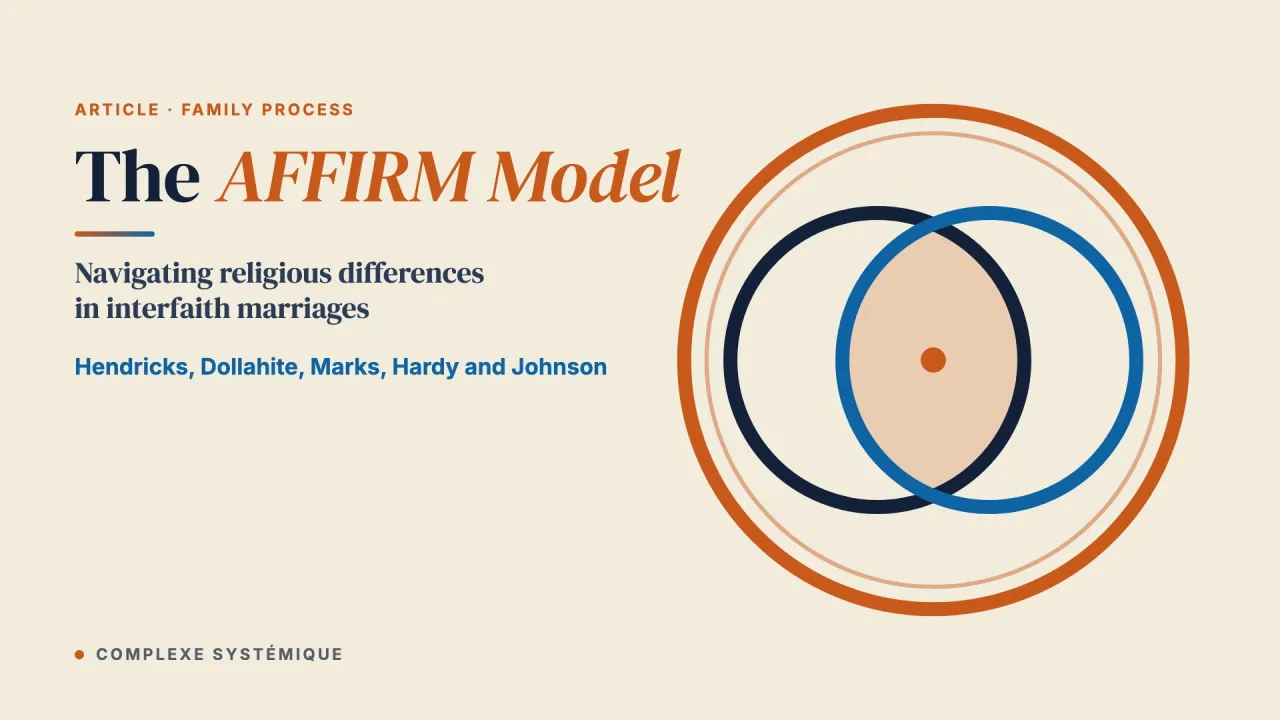
 The AFFIRM Model for Navigating Challenges in Continuously-Interfaith and Divergent-Interfaith Marriages
Thirty happy interfaith couples describe how they navigate their religious differences: five processes, from respecting each other’s choices to religious intimacy, gathered in the AFFIRM model.
 Article
 Toxic, narcissistic, borderline: what therapy speak does to your relationships
Narcissistic, borderline, toxic: therapy speak has left the consulting room. Julien Besse shows how these labels close the debate and relieve us of our own part.
 Article
 Rebuilding trust after infidelity: the 5 behaviours that repair
Infidelity does not doom a couple, but surviving it owes nothing to chance. Five behaviours that restore trust after a betrayal, from a couple therapist’s practice.
 Article
 First Psychological Aid for Families During War: Integrating the Narrative Approach With Emotionally Focused Therapy (EFT)
Three or four meetings for families living under the threat of war: telling their story before a witness, then repairing the attachment cycle disrupted by fear.
Comments 0
Log in to join the discussion. Log in