Red Sistémica · Couples
The couple relationship with a partner who has attention deficit disorder, with or without hyperactivity (part 2)
If you or your partner have AD/HD, whether with hyperactivity or predominantly inattentive, there will be swell: the continuous, repeated and shifting impact of the patterns of behaviour typical of the person affected. In this second part, Estrella Joselevich uses the case of Carla and Roberto to illustrate what the confirmation of the diagnosis changes in a couple, and why it matters to distinguish what stems from the symptoms of AD/HD from what does not.
Editor’s note from Perspectivas Sistémicas
The text below is an excerpt from the second part of the article. The first part was published in Perspectivas Sistémicas no. 81, May–June 2004.
“But there is no doubt that there will be waves. Know it. Take it into account.”
Estrella Joselevich
The swell
If you or your partner have AD/HD, whether with hyperactivity or predominantly inattentive, there will undoubtedly be swell. By swell we mean here the continuous, repeated and shifting impact of the patterns of behaviour typical of the person with AD/HD. The quality of these waves will depend on the weather, the depth of the water, the coastline, the winds, the tides, the storms, the dead calm, the disasters (earthquakes, tidal waves or others), the drifting ice, the sandy or pebbly beach, the small bays, the cliffs… And it will also depend on artificial phenomena, such as the dredging of channels, the breakwaters, the piers, the rocks and stones put in place, the passage of various kinds of vessels, the presence of seaplanes. Thus the waves will be immense, tiny, weak, very strong, regular, high or low, disorderly, breaking four at a time or one by one, colliding with one another or not, forming whirlpools or not, because countless aspects take part and come into play. Much the same is true of the signs of AD/HD and their complexities.
But there is no doubt that there will be waves. Know it. Take it into account.
Carla and Roberto
Clinical vignette
Carla and Roberto come to consult the specialist on Roberto’s initiative, after discovering that one of their children has AD/HD and noticing a resemblance to “so many things I used to do or that happened to me”. He says he has been inattentive all his life; he remembers that his school exercise books were “decorated” with “Incomplete” in red pen, that he always got bad marks and punishments for bad behaviour (he did not easily accept rules, he was restless, doing his homework was a struggle, he forgot his things, made silly mistakes). He also keeps images of how, when something pleased or interested him a great deal, he would get down to it, do it or remember it. “I built up a poor image of myself; sometimes I see myself as half a failure.”
Carla is tired of Roberto always being “in his own world”, of his being impulsive:
“He decides suddenly and on his own, he doesn’t even listen to me and, frankly, when it comes to household matters, it makes no difference whether I’m alone or with him; he doesn’t keep to schedules, he is always late, he commits to taking care of things around the house, starts them and leaves them unfinished to move on to something that interests him more; it always seems that he only pays attention to the last thing that passes under his nose.” “Now I believe, I am convinced, that I don’t matter to him. I used to think he loved me, not any more, even if he says he does, that he loves me.” Carla feels that he is not really present, in contact with her, even when he is there; he is constantly devoted to something that attracts him at that moment, only takes care of what he likes and jumps from one thing to another.
“I can’t count on him for chores, organisation, responsibility. He is more like one more child: he creates work. If I get angry, he panics and gets on with it, otherwise he puts it off. He is a good person, I have tried to help him, but I am not made for that, or it is no use to him. It doesn’t work like this.”
The specialist, after a thorough assessment, identified intense symptoms suggesting severe AD/HD, as well as anxious tendencies.
Communicating the diagnosis, distinguishing the circuits
Questions immediately arise about how to communicate this diagnostic impression: how to do it, and whether it should be done with both members of the couple simultaneously, so many doubts to be resolved at each consultation. Receiving confirmation of a diagnosis of AD/HD usually has a strong effect on the person, with a whole review of their history and identity. For this reason, one usually chooses to offer two or three individual sessions, in addition to maintaining those of the couple. At the same time, it is essential that the partners recognise and monitor the dysfunctional patterns, the deficient interactions that are fed by the core symptoms of AD/HD. This is fundamental in order to link the negative outcomes of certain interrelations or certain events to the symptomatic behaviours typical of AD/HD, instead of assuming things such as: “I don’t matter to him”, “he doesn’t love me”, “he is selfish” or “he resents me”. Knowledge and emotional contact will enable the couple to assess the facts on the basis of clearer and more balanced notions, and will contribute to better rapprochements and to the flow of affection.
Assuming
“I don’t matter to him”, “he doesn’t love me”, “he is selfish”, “he resents me”.
Linking to the symptoms
Recognising the deficient interactions fed by AD/HD, in order to assess the facts on the basis of clearer and more balanced notions.
Both members of the couple will also identify other sources of individual problems unrelated to the symptoms of AD/HD. Of course, and fortunately!, these are not everything; many other things happen to each of us, and it is worth trying to distinguish the phenomena. That is why we encourage couples to put these deficits into perspective, since they do not describe a single absolute and are not the only source of disturbance. In reality, each bond constitutes a unique functioning of modalities or conflicts, each relationship is a singular form of combination. Nevertheless, it is no small thing to be able to discriminate at least some of the so many conflicts that a couple may undergo!
And if AD/HD is not the worst thing that can happen, failing to recognise this disorder will bring more difficulties. It is therefore extremely important to distinguish at least these circuits of problems in order to achieve greater well-being. Of course, this recognition will not be the universal panacea that magically solves everything, but it will offer valuable help in opening up new paths and may help to avoid severe conflicts…
Editor’s note
The excerpt published by the journal stops here, on the threshold of the next section of the article, entitled “What each member of the couple is like and what they bring…”.
Who is Estrella Joselevich
Estrella Joselevich, psychologist, is a family therapist and lecturer in charge of postgraduate teaching at the Faculty of Psychology of the University of Buenos Aires (1995-2004). She took part in a joint research project with the University of California (United States, 2000-2003) on the “clinical assessment of AD/HD in adults”. She has given seminars on attention deficit hyperactivity disorder in Argentina and abroad. She was co-author and coordinator of the book Síndrome de falta de atención con y sin hiperactividad en niños, adolescentes y adultos (Paidós, 2000) and is the author of Mejorando su calidad de vida (Paidós, in press). Contact: estrellaj@arnet.com.ar.
This article is an English translation of “La relación de pareja con un miembro con síndrome de déficit de atención e impulsividad, ya sea con o sin hiperactividad (2ª parte)”, published by Red Sistémica (first published in Perspectivas Sistémicas, n° 82, juillet-août 2004). Translated and republished with the journal’s permission.
Read the original articleHow to cite this article
Joselevich, E. (2022). The couple relationship with a partner who has attention deficit disorder, with or without hyperactivity (part 2) (Complexe Systémique, Trans.). Complexe Systémique. https://app.complexe-systemique.com/en_GB/articles/the-couple-relationship-with-a-partner-who-has-attention-deficit-disorder-with-or-without-hyperactivity-part-2 (Original work published in 2004 in Perspectivas Sistémicas, n° 82, juillet-août 2004; republished in 2022 by Red Sistémica, https://redsistemica.ar/2022/07/19/la-relacion-de-pareja-con-un-miembro-con-sindrome-de-deficit-de-atencion-e-impulsividad-ya-sea-con-o-sin-hiperactividad-2/)
To go further
- What you need to know about couple therapy: reflections for couples and professionalsThe basic reference points for supporting a couple, whatever the disorder involved.
- Being a therapist for queer and neurodivergent people — Nath WeberWelcoming neurodivergence in therapy without reducing it to a deficit.
- The everyday couple problems that wear love downLateness, tasks left undone, lack of presence: the small wear and tear that erodes the bond.
- The couple relationship with a partner who has attention deficit and impulsivity disorder, with or without hyperactivity (part 1)The first part of the article.
Related training courses
 Webinar
Extramarital affairs: what does the therapist do when the couple explodes?
Free webinar: how to position yourself as a systemic therapist in the crisis of the extramarital affair. Revelation, secrecy, multipartiality.
 Webinar
The three loves
Free live webinar with Dr Robert Neuburger, 1 October 2026, 6 pm (Paris): the three loves, attachment and ways of loving. Held in French.
 Certifying course
Training in Systemic Therapy and Interventions – Cycle 1
Certifying training cycle in systemic therapy and interventions – year 1. Courses, supervision and practice, aligned with EFTA/SFTF. In French.
 Certifying course
Training in Systemic Therapy and Interventions – Cycle 2
Certifying training cycle in systemic therapy and interventions – year 2. Clinical complexity, supervision and practice. EFTA/SFTF aligned. In French.
Related articles
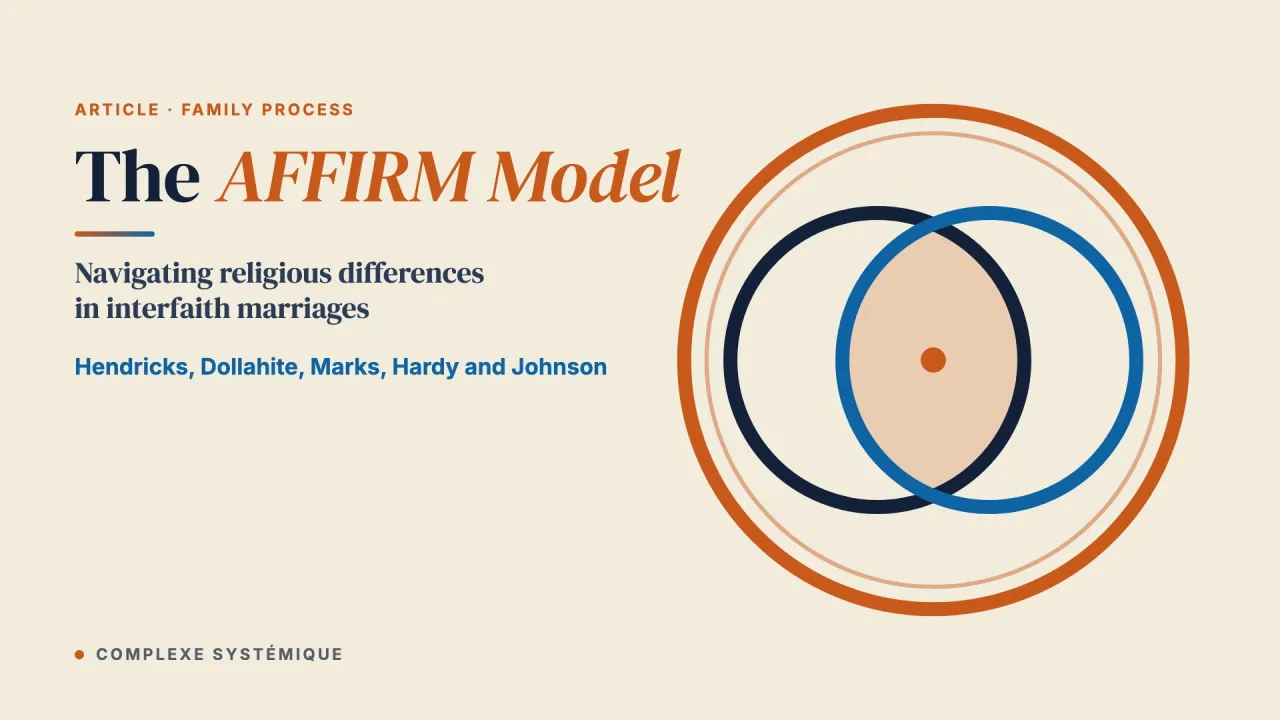 Article
 The AFFIRM Model for Navigating Challenges in Continuously-Interfaith and Divergent-Interfaith Marriages
Thirty happy interfaith couples describe how they navigate their religious differences: five processes, from respecting each other’s choices to religious intimacy, gathered in the AFFIRM model.
 Article
 Toxic, narcissistic, borderline: what therapy speak does to your relationships
Narcissistic, borderline, toxic: therapy speak has left the consulting room. Julien Besse shows how these labels close the debate and relieve us of our own part.
 Article
 Silence in therapy: a polysemic presence
From Heidegger to Palo Alto, silence is not an absence but a message. Defensive, strategic, reflective or shared: its forms, its functions and its risks.
 Article
 Rebuilding trust after infidelity: the 5 behaviours that repair
Infidelity does not doom a couple, but surviving it owes nothing to chance. Five behaviours that restore trust after a betrayal, from a couple therapist’s practice.
Comments 0
Log in to join the discussion. Log in