Nordic Journal of Psychiatry · Psychiatry
The family model in child and adult mental health services
In Stockholm, public child psychiatry and a private adult psychiatry service jointly adopted The Family Model, Adrian Falkov’s tool for mapping with the family how one member’s mental illness affects the others. Eleven families say what they gained: an overall view, a common language, the impetus to take back control. They also name its limits: too late, sometimes too heavy, powerless against fatigue with care.
This is a reformatted republication of The family model in child and adult mental health services, by Camilla Linderborg, Bente Weimand, Adrian Falkov and Margareta Östman, published in Nordic Journal of Psychiatry (Taylor & Francis) (2025), doi: 10.1080/08039488.2025.2570252, under a CC BY 4.0 licence. Prepared by Complexe Systémique in September 2026: the authors’ text is unchanged; the layout has been adapted for reading online, which constitutes a modification of the work under the terms of the licence. The abbreviations table is presented as a list; the online supplemental material (interview guide) is not reproduced; the disclosure statement is in the notes. This edition was made neither by the authors nor by the publisher, who are not responsible for its content or for any errors. The original version prevails.
TFM is a model that highlights the reciprocal nature of parental and child mental health.
Camilla Linderborg, Bente Weimand, Adrian Falkov and Margareta Östman
Abstract
Introduction. This study is based on a development project among selected child and adult mental health services in Sweden. Its goal was quality enhancement by using a family approach. The Family Model (TFM) is a family-focused practice developed in Australia and implemented for several years. In accordance with trust-based research, experiences voiced by the family are investigated.
Aim. The aim of the study was to gain knowledge regarding the experiences of both youth and adult family members when using TFM under the supervision of child and adult mental health services.
Method. Eleven families were recruited and interviewed in focus groups or individually in a qualitative study based on principles of naturalistic inquiry.
Results. Family members found that the model provided them with the opportunity to deal preemptively with their issues. It worked well in conjunction with the mental health services they were being provided by giving them clear objectives. The presence of competent clinicians was considered essential for success.
Conclusion. The Family Model proved useful in mental health clinical practice in families with concurrent mental illness in youth and adults. Our findings may assist providers in developing a parallel family-focused practice that offers child and adult clinical services.
Keywords: Mental health services; trust-based care; innovation; The Family Model; family focus
Introduction
Mental illness in both adults and youth is increasing and is now classified as the most common disease in the world [1]. Consequently, mental health services must make adjustments, and new ways of working are continuously being introduced in both child and adult psychiatry [2]. In this regard, there has been heightened international recognition of the value of family-focused practice [3]. In accordance with these findings, it was decided to introduce a general conversation tool with a family focus called The Family Model (TFM) [4] as part of the mental health services in the Stockholm region, especially when more than one family member suffered from mental illness. During this process, the therapists’ experiences of implementing TFM within CAMHS (Child and Adolescent Mental Health Services) and AMHS (Adult Mental Health Services) have been investigated [5]. The results of this study showed that the model was considered useful, particularly in treating families with more than one member suffering mental unhealth. TFM was found to be a helpful treatment adjunct in both child and adult mental health services.
Introducing new treatment models requires a process involving trust [6]. In using a trust-based focus [7], a fundamental principle is to determine what patients and next-of-kin think about the model. The views of those participating in the new intervention are of significance if they benefit the target group [3,8]. Accordingly, the intention of our study was to elucidate the experiences of family members with mental health problems who have employed TFM as a complement to their treatment plan. This might provide recommendations for TFM’s use in clinical practice where there are mental health issues in more than one family member (often in both children and parents).
Applying a change project in clinical practice
If a change project is to succeed in everyday clinical practice, it requires full support from management and staff, favorable conditions, and an explicit willingness to change [7,9]. Sweden’s welfare sector has been described by the Trust Delegation [10] as being increasingly detail-driven, focused on specialization, and in need of increasing the level of trust among both staff and citizens [11]. This provided a starting point for a paradigm shift in that sector, where the pendulum may swing from an era of top-down control to one focusing on the core encounters between patients and practitioners.
The project
A project was implemented by Child and Adolescent Psychiatry (CAMHS) and Prima Adult Psychiatry in Stockholm (AMHS). Its primary objective was to influence treatment strategies in everyday clinical practice so that they become evermore familyoriented, especially in families where youth and adults have concomitant mental health problems and simultaneous treatment contacts. A secondary goal was to encourage coordination between different healthcare providers for the convenience of families and the saving of resources. The knowledge gained by the project aimed at influencing routine clinical procedures.
Research has shown that 50% of parents of children or adolescents requiring specialist psychiatric care themselves screen positive for a psychiatric diagnosis [12,13]; and that one-third of close relatives of adult psychiatric patients report mental health problems of their own, often because of their family situation [14].
Initially, the project evaluated the incidence among participating services of families with multiple mental health problems. We found that half of all patients at the CAMHS outpatient units and one-third at the AMHS outpatient unit were living in families that have more than one person with mental health issues [15]. These findings, together with staff availability problems at both AMHS and CAMHS, highlight the need for services to try new treatment strategies, given the emphasis in recent years on individual therapy [2,16]. Furthermore, the project also tabulated clinicians’ and managers’ opinions of the TFM innovation [5], showing overall support for the model, although implementation strategies differed between the two organizations.
A third phase of the project focused on the experiences of those subject to The Family Model.
Family-focused interventions
Evidence for the positive effects of family-focused interventions (FFI) is increasing. A meta-analysis of different interventions for families with parental mental illness has found a 40% reduced risk of children developing the same illness as their parents [17]. Furthermore, systematic reviews of prevention programs for the children of parents who are substance abusers have also found evidence of a reduction in the children’s problems [18,19].
Family-focused practice (FFP) can help practitioners and clinicians map a family’s overall situation, influence the direction of treatment toward a clearer family perspective, reinforce the child’s input, and enhance collaboration and coordination between services [20]. There are different models available that offer a family-oriented approach in treatment. Some, like Beardslee’s Family Intervention (BFI) [21] and Solantaus Let’s Talk about Children (LT) [22], focus on parenting, while family therapy seems increasingly uncommon in everyday clinical life. We also considered other FFI but decided on TFM for this project because it required a short training period for therapists and was useful in all professional categories at CAMHS and AMHS. It also handles the entire family’s situation and sees children and adults in a common context where family members share each other’s respective positions and experiences. Furthermore, TFM could be adopted simultaneously at both CAMHS and AMHS with potential input on cooperation strategies. An additional factor was that the National Board of Health and Welfare wanted to evaluate the feasibility of TFM in influencing the family perspective, as well as the collaboration between child and adult psychiatry in a Swedish context.
The family model
TFM can be used as a theoretical framework and as an intervention tool to enhance clinical FFP. It maps ill-health and development among both children and parents and also highlights protective factors, resources, and resilience. TFM has been internationally proven to be of value in families with complex or extensive care needs from specialized psychiatry [23,24], but it has not been tested previously in a Swedish care context.
The family model as a tool
TFM provides a visual illustration of the key elements (domains) involved in understanding how mental and physical illness in one family member can affect others, and how through their understanding and responses they can, in turn, influence the experience of the unwell person. It emphasizes the reciprocal role of relationships in determining both good and poor outcomes for all family members. TFM demonstrates the key areas of focus and associated interactions using six domains and ten bidirectional arrows (Figure 1).
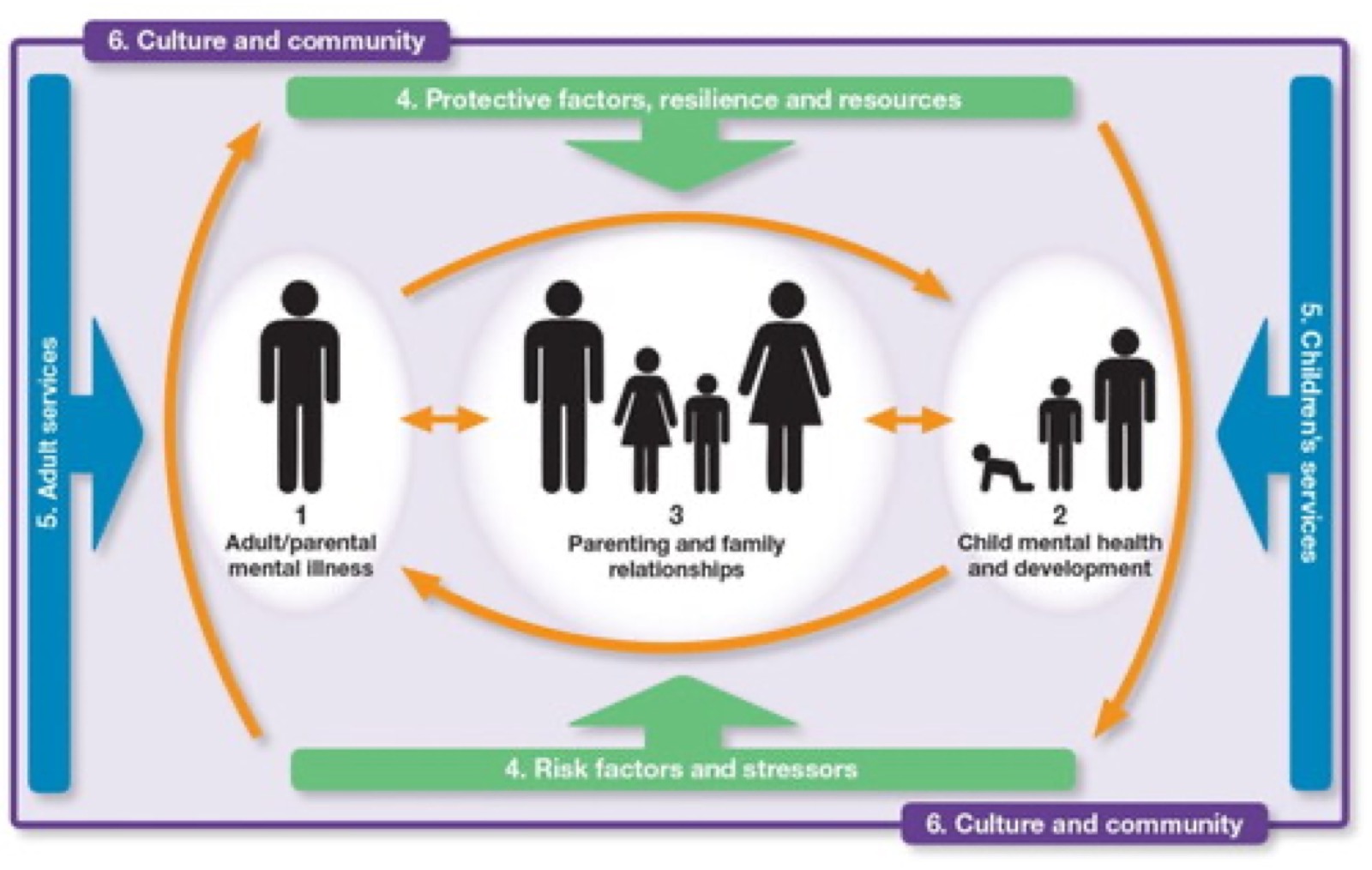
TFM can be used in a single session [25], or over two to three sessions, where families and clinicians go through the six dimensions together to map the family’s needs. This mapping includes the parent’s mental illness, the child’s mental health and development, relationships in the family, risk factors and stressors, protective factors, resilience and resources, care support for children and parents, and other factors related to culture and environment. The work is done with the support of the pedagogical image shown in Figure 1. What families and therapists jointly come up with in their mapping is used for planning interventions. TFM conversations focus on relationships and new possibilities for the family and are the key to establishing a treatment plan.
In this study, TFM has been used to complement regular clinical treatment structure. However, the model could be applied in a more preliminary (intake) setup. The conversation prompted by TFM has been conducted with one or two therapists present. The model has been shown to meet the project’s need for a concise, proven, family-focused intervention that includes an individual, family, and system perspective on mental illness where one or more family members have such issues.
Aim
The aim of the study was to gain knowledge regarding the experiences of both youth and adult family members when using TFM under the supervision of child and adult mental health services.
Method
This qualitative study has a descriptive, exploratory design intended to elicit an in-depth understanding of participants’ experiences, including youth and adults [26–28]. Since the families involved were accustomed to both individual and family-oriented treatment approaches, personal interviews or focus groups interviews were conducted, according to the preference of family members.
Ethical considerations
The study was financed by CAMHS and AMHS and initiated by The Swedish National Board of Health and Welfare. It was assessed and approved by heads of operations and the Swedish Ethics Review Authority (Dnr: 2024-00651-01) as part of a service development project for quality enhancement. All participants gave their informed, written consent to participate. Data were transcribed anonymously by removing or altering all identifiable details. The procedures in the study have been designed and implemented in accordance with the Declaration of Helsinki [29] and have followed the Swedish Ethics Review Act of 2003.
Context
The Swedish mental health service organizations in this study, CAMHS and AMHS, are distinct, different providers. In the Stockholm region some services are run as public healthcare while others are run privately. CAMHS is public AMHS is private. The region encompasses about two million inhabitants and the units that initially implemented TFM serve approximately 170,000 people. Experienced clinicians are often more family focused at CAMHS, while younger clinicians are more accustomed to working on an individual basis. The services we included were all outpatient facilities. TFM was carried out by regular therapists who were trained in the model in a two-day session. All therapists had extensive professional experience in mental health services and varied professional backgrounds (i.e, social workers, nurses, psychiatrists, psychologists, and other treatment staff) and worked at either CAMHS or AMHS.
Participant inclusion criteria and recruitment
Participants were required to be in a treatment plan utilizing TFM for at least the past three months. They also had to understand and speak Swedish and be patients or next-of-kin of someone receiving CAMHS or AMHS services. The patients at AMHS had a diversity of general mental disorders, including depression. Those at CAMHS were in an intermediate care unit and had complex and often multi-year healthcare contacts. Children present during the TFM study were ages 0 to 17, while the children who participated in the interviews were from 9 to 17 years of age. The ethical review excluded children under the age of 7 as participants in the interviews. Recruitment was based on convenient sampling, giving preference to geographic accessibility and desire to participate. Our aim was to obtain feedback from a broad range of family members.
In total 20 individuals from 11 families comprised the cohort. The study took place between June and October 2024. Eight of the family interview subjects were recruited from CAMHS and three from AMHS. Six families were involved in more than two ongoing treatment options with different mental health services. Children were either silently present or and participated in five of the family interviews. The families came from various parts of Stockholm and were of different cultural backgrounds.
Procedure
The interviews were conducted, according to each family’s preference, either at their home or at the clinic where they were receiving treatment. A semi-structured interview guide was used (see Appendix). All interviews were recorded and transcribed verbatim. Each lasted for 30 to 45 min. Participants were given a movie ticket for their help with the study.
Analysis
The interviews were analyzed according to principles in Naturalistic Inquiry by Lincoln and Guba [28], where participants’ descriptions of reality are the focus. The analyses tried to inductively explore and systematize data regarding the participants’ experiences of implementing and using TFM. We used triangulation to increase the credibility of the analysis. Each interview was reviewed for an overall perspective by three coauthors (CL, MÖ, BW), whose reflections were noted. The scrutiny included an iterative process in which CL and MÖ continuously revised the descriptions against the original interview data. They each read the transcribed material several times, searching for interpretations and meaning units, and labeling these with codes [30,31]. Codes and recurrent themes were recorded, and parallel mind maps produced. The meaning units were then organized and reorganized into preliminary and final themes which, in the process, were discussed by CL, BW, and MÖ until agreement was reached. Each family was given a number, with an added letter for mother (M), father (F), or child (C), in order to identify which participant was quoted in the Results section.
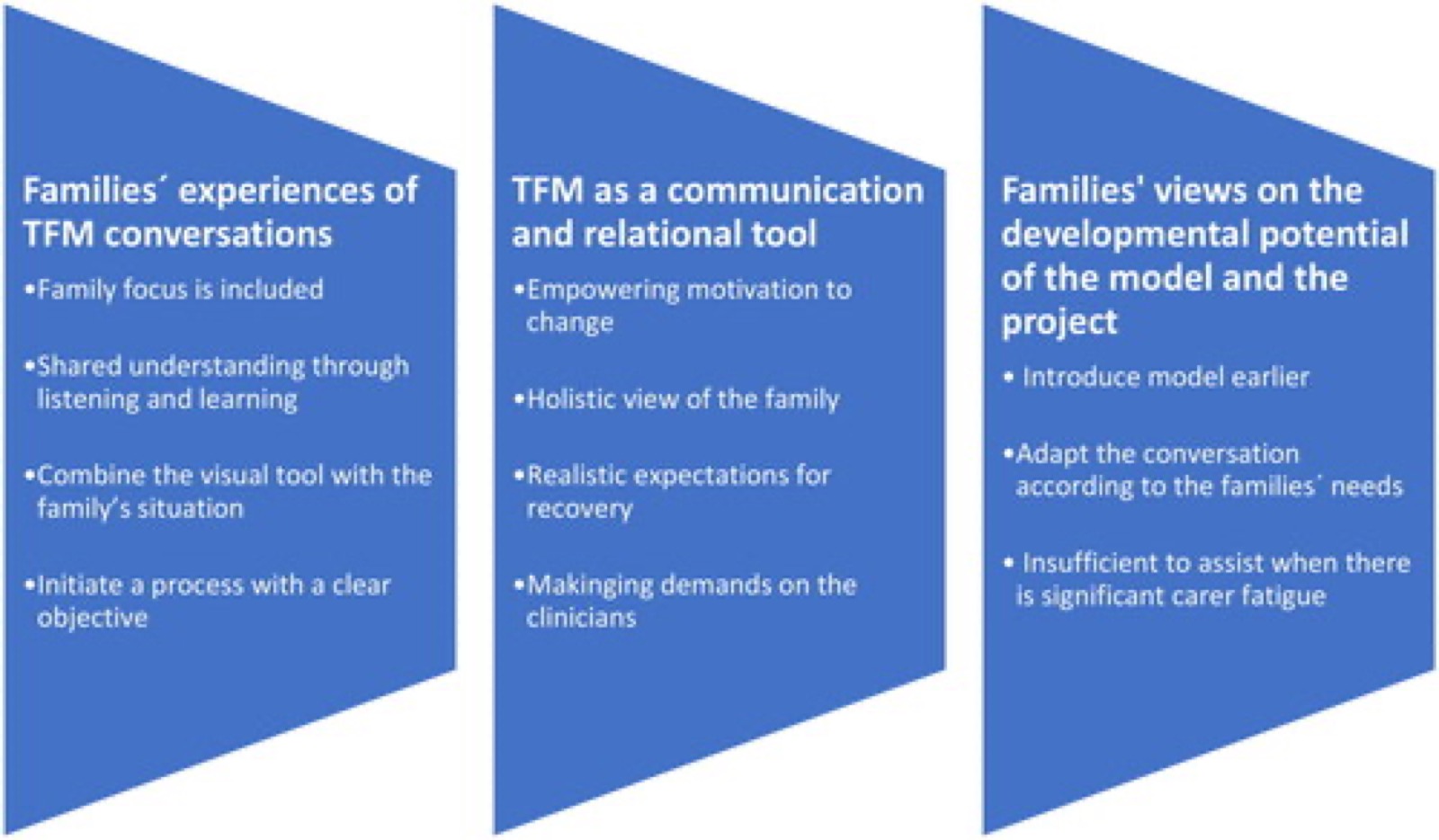
Families’ experiences of TFM conversations at CAMHS and AMHS
Under the theme of the families’ experiences, four-sub themes were distinguished: a) the inclusion of a family focus, b) shared understanding through listening and learning, c) combining the visual tool with the family’s situation, and d) initiating a process with a clear objective. TFM underscores the importance of the family in any situation confronting them that they have not previously experienced. Initially family members who sought care saw themselves as individual ‘patients’. The model, however, showed them that treatment work might involve the family as a whole, including everyone’s strengths and weaknesses. This was expressed by some participants as ‘I think everyone in the family is affected when someone feels bad … so there is a value in also taking care of those around you and not just those who are defined as patients’ (5 M). ‘It’s better to include the whole family because then you get to hear what the others think, too, and how they feel about things … The model opens up the whole family’ (11 M). One parent stated the value of having treatment include both parents and children by commenting ‘The child understands that it is not only about what it does or does not do, but also about how other things affect one’s coping or such’ (5M).
Shared understanding through listening and learning
Both children and parents described the value of other family members taking part in the conversations, noting that it establishes a balance between family members. One teenager said that TFM was an eye-opener for her. ‘I noticed that I thought a lot about my parents … [but] never really thought about myself before. This often caused me to react very aggressively, which I have realized, and have now asked for help for’ (7 C). The speaker could acknowledge that some things were due to her parents’ circumstances, and not everything was caused by her own situation. This increased her perspective on others in the family and gave her a new opportunity to focus on her own feelings and actions. ‘I thought it helped me understand my parents a little more’.
One interviewee described the importance of partner participation thus: ‘It became as if my partner became more visible … It helps me a lot’ (1 M), while others stressed the importance of the partner being given space in the treatment situation, as this affects the feeling of balance in the relationship.
Combining the visual tool with the family’s situation
Family members felt that TFM as a visual tool facilities a family-oriented perspective. ‘It focuses on the family and not just on the person who is suffering from mental illness’ (1 M); ‘It is simple and quickly understood’ (6 M); It is experienced as ‘a joint exploration … a good, positive experience without requiring previous psychiatric contact’ (1 F). The model ‘somehow visualizes …. You get a greater understanding of each other and understanding always leads to some kind of change’ (5 M).
TFM was seen by some respondents as helping the family become more manageable: ‘This simple use of the areas of the model helps me a great deal and I think it helps my other family members as well’ (3 M). Furthermore, TFM shows the interviewees, especially those with very extensive healthcare experiences, ‘what factors they can influence and what they cannot influence’ (3 M). Some described how they continued the work themselves, without the support of therapists. ‘The model is more adequate than anything else we have been offered … and we continue to work on parts of the model on our own’ (8 M). TFM also increased family members’ understanding of the mental health resources available to them.
Initiating a process with a clear objective
Several family members described how TFM conversations clarified each person’s capacity to handle a given situation. ‘I definitely think this accelerated my self-esteem, or my improvement, or my well-being. The model gives you the impetus to feel that you can manage on your own’ (4 M). A family member with extensive healthcare experience stated that the conversations ‘help everyone work toward the same goal’, often making it ‘easier for therapists and for the person who is a care recipient to have a clear picture that "we work like this"’ (11 M).
It has also been said of TFM that ‘it sets something in motion’ (3 M). One family member stated that ‘it started a process in my head like … things are a little more connected to each other’ (7 M). Another commented on a feeling of ‘gratitude that things are moving in the right direction’ (1 M). ‘The model provides a common language. You learn concepts that help you reflect and see ways forward … many aspects, more of culture and society …. It actually led somewhere … dare to believe and ride it out!’ (1 F).
Furthermore, family members have also described how working with the model broadens perspectives and contributes to less self-focus and self-criticism. As one youth said, ‘Mom, chill a little!’ (3 M). The model emphasizes how pleasant it feels to be able to cope with concrete tasks. ‘It is very nice when things become concrete’ (4 M). One parent described it as an increased ability to handle conflicts with a troublesome teenager. ‘With the model, it is easier to highlight things other than problems …. We have this problem, we know that … but we need to handle everything else around us as well’. (11 M)
TFM as a communication and relational tool
Under the theme communication, four sub-themes were distinguished: a) empowering motivation to change, b) holistic view of the family, c) realistic expectations, and d) making demands on clinicians.
Empowering motivation to change
Several family members described how trust developed when they worked with certain aspects of the family plan, and that they found this work stimulating: ‘It’s fun to use this model’ (11 M). The model is also described as creating a certain sense of security in the ongoing work, while also stimulating the family to initiate changes.
Holistic view of the family
Several family members emphasized that the model provides them with a more holistic view of their situation regarding ill health and influences from the surrounding society: ‘I like this format of the model, to have things summarized in some way’ (2 F); ‘It really becomes a holistic view’ (1 F): ‘It doesn’t get so mixed up’ (7 F); ‘It becomes obvious what the different pieces of the puzzle are, and where you might need to work on something, or what already works, so that you don’t change it and go off in the wrong direction’ (4 M).
Family members have described how previous treatment programs were often based on an isolated approach, where ‘the range of care is very focused on the individual, an approach which I feel is stupid’ (4 M). ‘I think it’s problematic to take one problem at a time because that’s not what life is really like …. It’s very positive that you try to see the whole’ because ‘it’s a whole in a family’ (8 M). ‘The really important thing is that things are boiled down and it becomes a family plan; the way forward is the important thing’ (2 F).
Realistic expectations for recovery
Family members stated that TFM offered them realistic expectations from their treatment efforts. Even though mapping and conversations about vulnerability are perceived by some as distressing, the model provides balance in supporting conversations which can inspire hope and trust in one’s own abilities. ‘Instead of "hoping that someone will step in" … I must deal with this myself’ (5 M).
Making demands on clinicians
Families described how they saw the model affecting clinicians. It allowed therapists to view the total situation and put that knowledge to good use, broadening the therapist’s understanding of their family’s situation. ‘The advantage of the model is that it helps you to visualize. The disadvantage is that it places demands on the therapist. It is easy for it to become a flat conversation … but with the right therapist, I think it becomes useful’ (8 M).
Family members also emphasized the importance of therapists understanding the context, ‘how complex everything is, that there are so many pieces’ (7 M). A parent described how her clinician went from being a good individual therapist to ‘trying to have a family perspective’ (5 M), changing the discourse to a child and family-focused conversation. Several parents noted that ‘it is good that the model allows both family and individual conversations’ (11 M, 4 M, 5 M).
Families’ critical views on the developmental potential of the model and the project
Under this theme, three sub-themes were distinguished: a) earlier timing, b) adapt the conversation according to the family’s needs, and c) insufficient to assist with significant carer fatigue.
Introduce model earlier
The family members interviewed, including the young people participating, highlighted the value of introducing TFM into the treatment plan as soon as possible, preferably as part of the introduction. They wanted the model to continuously follow developments in the family system. ‘I wish that the model would come in early, so that we can all follow the events that the family is going through …. One should use it as a tool during the whole journey’ (9 F). Several family members recommended that the interval between the conversations should be kept relatively short to avoid a protracted process: ‘You should do it quite closely initially … and make it so that you can plan accordingly’ (7 F).
Adapt the conversation according to a family’s needs
One parent stated that TFM′s introduction needs to be adapted in accordance with the health of all family members. ‘I had anxiety at the beginning of the conversations, while it gave hope to my husband’ (1 M). Another said: ‘The model allows for emotional conversations … also vulnerabilities’ (9 M). One mother described it as very difficult to discuss shortcomings: ‘It was hard to say that I was not good enough’ (5 M).
One parent mentioned the difficulty of visualizing hope after a conversation about a severe problem: ‘I felt very bad when I experienced all these heavy problems, but I soon realized that it would get better’ (1 M).
Interviewees also feared that hopes they raised might be shattered in the conversations promted by TFM. A daughter who ‘once again opened up to a therapist and expected help … experienced a conversation that gave nothing to her. I think to myself every time that she will get help. Therefore it is better if the model shows what you can expect from a conversation’ (4 M).
Insufficient to assist when there is significant carer fatigue
There were some family members who had had extensive contacts with the healthcare system, some who had seen up to 60 prior clinicians, and who therefore chose to decline participating in TFM. This applied to both parents and young people. Several individuals confirmed that the model failed to engage some family members: ‘The model may not help the ones with carer fatigue’ (4 M). A parent described one of those young people: ‘He has met too many therapists … he’s tired, very tired, and doesn’t want to talk to anyone’ (10 F). However, the same parent also stated, ‘Lately, he has started to come out and participate, since the conversations within the rest of the family have started to have an effect’ (10 F).
Discussion
There is a need for more studies of health promotion interventions in real settings to complement impact studies. Such research would show whether interventions are acceptable to the intended recipients [32], and would especially influence feasibility studies [33,34]. TFM is a model that highlights the reciprocal nature of parental and child mental health. The correlation is of considerable importance in health and illness dynamics [35,36,37]. By examining the experiences of family members who use TFM, research might illuminate factors of importance for children’s wellbeing that result from supporting their parents, and vice versa.
Our analysis shows that TFM offers families living with severe mental illness the opportunity to collectively explore a more complex picture of their situation, including their strengths and weaknesses, thereby providing them with ‘a holistic view of the family’. Moreover, the structured organization of the model can help families engage in such a way that they themselves take responsibility for the family plan. Families found that TFM ‘empowered motivation to change’ in confronting various aspects of their mental illness, and that the model was useful in its current form. However, in the absence of larger studies of family members’ experiences of TFM, our results can only convey some individual experiences, without the possibility to generalize.
Since there are very few theoretical models that incorporate trust-based strategies in FFI, one may profit by looking at other disciplines that employ the trust-based concept. According to the research developed by Lencioni [37], three aspects are important for developing trust in a group: transparency, participation, and acknowledging a leader who exercises control. Our results reflect a similar attitude, with family members praising the transparency that the model provides as a communication tool for open discussions. They also voiced a newfound desire to actively participate in solving their own problems and in relating to leadership with trust and security.
Method discussion
This clinical development project is based on SALAR’s [8] call for more research involving clinical studies in real settings. In the case of our trust-based project, we invited service users to participate in the developmental process, thereby challenging traditional research frames. The involvement by all family members in the treatment plan improves outcomes through greater awareness, more support, and better communication [38,39]. A qualitative approach was chosen to explore the introduction of TFM in both child and adult psychiatry; no similar study could be found for a deeper understanding of this process. Focus group and individual interviews are established models for assessing an innovation [28,40]. It has been shown that focus group interviews work well with small groups of people who know each other [41]. However, since the focus group leader was employed by one of the service providers included in the project, advantages and disadvantages in analyzing the material might result. We tried to minimize this impact by carrying out triangulation analysis to increase the credibility of the results [28,42]. The project was developed in collaboration with clinicians, users, and management involved in the conditions for starting the change process, which may be considered a strength. A complementary survey that reaches more participants might be another way of confirming or challenging our findings.
Conclusions
Family members reported that TFM provided them with opportunities to deal with their mental health situation in a more autonomous way. Their input, together with results from a study investigating the experiences of TFM therapists [5], showed that the model in its present form might be applied in both child and adult mental health clinical practice.
Perspectives offered by family members on the developmental potential of the project represent valuable insights for services that consider implementing TFM in clinical practice. Future research may evaluate the financial and systemic consequences of healthcare organizations applying the model and thereby enhance the utility of working with TFM.
Abbreviations
- AMHS. Adult mental health services.
- CAMHS. Child and adolescent mental health services.
- FFI. Family-focused interventions.
- FFP. Family-focused practice.
- SALAR. Swedish Agency for Health Technology Assessment and Assessment of Social Services.
- TFM. The Family Model.
Complexe Systémique: key points
The systemic interest of this text is that it listens to families where the organisation of care usually splits them apart: a child seen in child psychiatry, a parent in adult psychiatry, two services that do not talk to each other. The Family Model offers a shared map, with its reciprocal influences between the parent’s health, the child’s and family relationships, and families say they found in it an overall view, a common language and the wish to take back control. Their reservations are just as instructive for practice: the tool often comes too late, can rekindle anxiety when shortcomings are named, is only as good as the therapist who carries it, and slides off those who have already met too many clinicians. The study remains modest: eleven conveniently recruited families, a thinly described analysis, a facilitator employed by one of the services evaluated. Read alongside the article on what helps or hinders a family focus in adult psychiatry, and the evaluation of Kidstime workshops.
Notes from the original
Disclosure statement. No potential conflict of interest was reported by the author(s).
References
WHO. 2024. Mental health of adolescents. Available from: https://www.who.int/news-room/fact-sheets/detail/adolescent-mental-health.
SALAR. Psykiatrin i siffror. Uppdrag Psykisk Hälsa; 2021. https://www.uppdragpsykiskhalsa.se/psykiatrin-i-siffror/.
Reupert A, Bee P, Hosman C, et al. Editorial perspective: prato Research Collaborative for change in parent and child mental health: principles and recommendations for working with children and parents living with parental mental illness. J Child Psychol Psychiatry. 2022;63(3):350–353. doi: 10.1111/jcpp.13521.
Falkov A. The Family Model. Parent Fam Ment Health. 2017;2(2):1004.
Linderborg C, Grant A, Weimand BM, et al. Experiences of clinicians and managers in the implementation of a family focused model in child and adult psychiatry. Front Psychiatry. 2024;15:1360375. doi: 10.3389/fpsyt.2024.1360375.
Hancock PA, Kessler TT, Kaplan AD, et al. How and why humans trust: a meta-analysis and elaborated model. Front Psychol. 2023;14:1081086. doi: 10.3389/fpsyg.2023.1081086.
Bringselius L. Kultur och värdegrundsarbete ur ett tillitsperspektiv. (Samtal om tillit i styrning; Nr 6). Ministry of Finance, Government Offices of Sweden; 2019. https://tillitsdelegationen.se/wp-content/uploads/2019/10/kultur-ochvrdegrundsarbete-ur-ett-tillitsperspektiv.pdf.
SALAR (SBU). Patientdelaktighet i hälso- och sjukvården. En sammanställning av vetenskapliga utvärderingar av metoder som kan påverka patientens förutsättningar för delaktighet. Stockholm: Swedish Agency for Health Technology Assessment and Assessment of Social Services (SBU); 2017. Rapport nr 260.
Hultberg A, Ahlborg G, Jr., Jonsdottir IH, et al. Hälsa på arbetsplatsen. En sammanställning av kunskap och metoder. Institutet för stressmedicin, ISM-rapport 21. Borås: Bording AB; 2018.
SOU. SOU 2018:47. Med tillit växer handlingsutrymmet – Tillitsbaserad styrning och ledning av välfärdssektorn, Finansdepartementet: stockholm. (Statens-offentliga-utredningar; Nr. 2018:06); 2018.
Øllgaard Bentzen T, Bringselius L. Translating trust as a magic concept in public sector reforms: a comparative study of the Danish and Swedish trust reform. Int Public Manage J. 2023;26(5):764–784. doi: 10.1080/10967494.2023.2223198.
Campbell TCH, Reupert A, Sutton K, et al. Prevalence of mental illness among parents of children receiving treatment within child and adolescent mental health services (CAMHS): a scoping review. Eur Child Adolesc Psychiatry. 2021;30(7):997–1012. doi: 10.1007/s00787-020-01502-x.
Hjern A. Barn och ungdomspsykiatrisk vård hos ungdomar i Stockholm som är anhöriga till föräldrar med psykisk sjukdom eller missbruk [Child and adolescent psychiatric care in adolescents in Stockholm who are relatives of parents with mental illness or substance abuse]. Rapport 8 från projektet “Barn som anhöriga” från CHESS, Stockholms universitet/Karolinska Institutet [Report 8 from the project “Children as next of kin” from CHESS, Stockholm University/Karolinska Institutet] Vol. 1. Stockholm: NKA; 2023. doi: 10.3389/fpsyt.2022.781556.
Ostman M, Hansson L. Children in families with a severely mentally ill member. Prevalence and needs for support. Soc Psychiatry Psychiatr Epidemiol. 2002;37(5):243–248. doi: 10.1007/s00127-002-0540-0.
Linderborg C, Rydén G, Berntsson A, et al. Stor andel multipel psykisk ohälsa i familjer aktuella för behandlingsinsatser i Barn- och Vuxenpsykiatri. Erfarenheter av endagsinventering i klinisk vardag. [Large proportion of multiple mental illness in families eligible for treatment in child and adult psychiatry. Experiences of one-day inventory in everyday clinical practice]. SMT. 2022;99(1):114–123. doi: 10.62607/smt.v99i1.37874.
Lindgren E, Söderberg S, Skär L. The gap in transition between child and adolescent psychiatry and general adult psychiatry. J Child Adolesc Psychiatr Nurs. 2013;26(2):103–109. doi: 10.1111/jcap.12027.
Siegenthaler E, Munder T, Egger M. Effect of preventive interventions in mentally ill parents on the mental health of the offspring: systematic review and meta-analysis. J Am Acad Child Adolesc Psychiatry. 2012;51(1):8–17.e8. doi: 10.1016/j.jaac.2011.10.018.
Bröning S, Wiedow A, Wartberg L, et al. Targeting children of substance-using parents with the community-based group intervention TRAMPOLINE: a randomised controlled trial–design, evaluation, recruitment issues. BMC Public Health. 2012;12(1):223. doi: 10.1186/1471-2458-12-223.
Park S, Schepp KG. A systematic review of research on children of alcoholics: their inherent resilience and vulnerability. J Child Fam Stud. 2015;24(5):1222–1231. doi: 10.1007/s10826-014-9930-7.
Foster K, Maybery D, Reupert A, et al. Family-focused practice in mental health care: an integrative review. Child & Youth Services. 2016;37(2):129–155. doi: 10.1080/0145935X.2016.1104048.
Bearslee WR, Wright EJ, Gladstone TRG, et al. Long-term effects from a randomized trial of two public health preventive interventions for parental depression. J Fam Psychol. 2007;21(4):703–713. doi: 10.1037/0893-3200.21.4.703.
Solantaus T, Toikka S. The effective family programme: preventative services for the children of mentally ill parents in Finland. Int J Ment Health Promot,. 2006;8(3):37–44. doi: 10.1080/14623730.2006.9721744.
Hoadley B, Smith F, Wan C, et al. Incorporating children and young people′s voices in children and adolescent mental health services using the family model. Soc Incl. 2017;5(3):183–194. doi: 10.17645/si.v5i3.951.
Hoadley B, Falkov A, Agalawatta N. The acceptability of a single session family focused approach for children/young people and their parents attending a child and youth mental health service. Adv Ment Health. 2018;17(1), 44–54. doi: 10.1080/18387357.2018.1480398.
Falkov A, Grant A, Hoadley B, Donaghy M, et al. The Family Model: A brief intervention for clinicians in adult mental health services working with parents experiencing mental health problems. Aust NZJ Psychiatry. 2020;54(5):449–452. doi: 10.1177/0004867420913614.
Dahlgren L, Emmelin M, Winkvist A. Qualitative methodology for international public health. Umeå: Umeå Universitet. Print och Media; 2007.
Kvale S. Den kvalitativa forskningsintervjun [The qualitative research interview]. Lund: Studentlitteratur; 1997.
Lincoln YS, Guba E. Naturalistic inquiry. Beverly Hills (CA): Sage; 1985.
WMA. World Medical Association Declaration of Helsinki – Ethical Principles for Medical Research Involving Human Subjects; 2013. Available from: https://www.wma.net/policies-post/wma-declaration-of-helsinki-ethicalprinciplesformedical-research-involving-human-subjects/.
Braun V, Clarke V. Using thematic analysis in psychology. Qual Res Psychol. 2006;3(2):77–101. doi: 10.1191/1478088706qp063oa.
Kvale S, Brinkmann S. Interviews: learning the craft of qualitative research interviewing. 3rd ed. Thousand Oaks (CA): Sage; 2015.
Green LW, Glasgow RE. Evaluating the relevance, generalization, and applicability of research: issues in external validation and translation methodology. Eval Health Prof. 2006;29(1):126–153. doi: 10.1177/0163278705284445.
Bowen DJ, Kreuter M, Spring B, et al. How we design feasibility studies. Am J Prev Med. 2009;36(5):452–457. doi: 10.1016/j.amepre.2009.02.002.
Glasgow RE, Klesges LM, Dzewaltowski DA, et al. Evaluating the impact of health promotion programs: using the RE-AIM framework to form summary measures for decision making involving complex issues. Health Educ Res. 2006;21(5):688–694. doi: 10.1093/her/cyl081.
Birkeland B, Weimand BM, Ruud T, et al. Perceived quality of life in partners of patients undergoing treatment in somatic health, mental health, or substance use disorder units: a cross-sectional study. Health Qual Life Outcomes. 2017;15(1):172. doi: 10.1186/s12955-017-0750-5.
Speyer LG, Hall HA, Hang Y, et al. Within-family relations of mental health problems across childhood and adolescence. J Child Psychol Psychiatry. 2022;63(11):1288–1296. doi: 10.1111/jcpp.13572.
Lencioni P. The five dysfunctions of a team: a leadership fable. Coll Univ. 2020;95(1):77–78.
Stolper H, van Doesum K, Steketee M. Integrated family approach in mental health care by professionals from adult and child mental health services: a qualitative study. Front Psychiatry. 2022;13:781556. doi: 10.3389/fpsyt.2022.781556.
Hanson CL, Crandall A, Barnes MD, et al. Family-Focused Public Health: Supporting Homes and Families in Policy and Practice. Front Public Health. 2019;7:59. doi: 10.3389/fpubh.2019.00059.
Wibeck V. Fokusgrupper Om fokuserade gruppintervjuer som undersökningsmetod [Focus groups: about focused group interviews as a research method]. Lund: Studentlitteratur; 2010.
Glesne C, Peshkin A. Becoming qualitative researchers: an introduction. White Plains (NY): longman; 1992.
Graneheim UH, Lindgren BM, Lundman B. Methodological challenges in qualitative content analysis: a discussion paper. Nurse Educ Today. 2017;56:29–34. doi: 10.1016/j.nedt.2017.06.002.
Reformatted republication of The family model in child and adult mental health services, by Camilla Linderborg, Bente Weimand, Adrian Falkov and Margareta Östman, Nordic Journal of Psychiatry, vol. 79, no 8 (2025), doi: 10.1080/08039488.2025.2570252, under a CC BY 4.0 licence. Edition and layout: Complexe Systémique, September 2026 — the work has been modified under the terms of the licence. Neither the authors nor the publisher are responsible for this edition; the original version prevails.
This is the original article “The family model in child and adult mental health services”, published in Nordic Journal of Psychiatry (2025) under a CC BY 4.0 licence. Republished by Complexe Systémique: the author’s text is unchanged; only the presentation has been adapted for reading online, as set out at the head of this page.
Read the original articleHow to cite this article
Linderborg, C., Weimand, B., Falkov, A., et Östman, M. (2025). The family model in child and adult mental health services. Complexe Systémique. https://app.complexe-systemique.com/en_GB/articles/the-family-model-in-child-and-adult-mental-health-services (Original work published in 2025 in Nordic Journal of Psychiatry, 79(8), 615-622 (2025); republished in 2025 by Nordic Journal of Psychiatry, https://www.tandfonline.com/doi/full/10.1080/08039488.2025.2570252)
To go further
- Les facteurs qui peuvent faciliter ou freiner une approche centrée sur la famille dans le traitement des parents ayant un trouble psychiqueA family focus in adult psychiatry.
- Les ateliers KidstimeWorkshops for children of ill parents.
- Siblings+ ?Siblings facing parental illness.
Related training courses
 Symposium
État des Lieux: a psychological approach to spaces
Replay of the “État des Lieux” conference (Paris, 16 October 2026): Ivy Daure, Maurizio Frisina, Viola Sallay and Gilbert Pregno on places as a clinical resource. In French.
 Symposium
Digital technology, AI and mental health
Conference in Lyon, 11 December 2026: digital technology, artificial intelligence and mental health. Six talks, replay for participants. In French.
 Short course
The suicidal crisis in adolescents and young adults
Training: assessing and supporting the suicidal crisis in adolescents and young adults. Clinical landmarks and systemic tools. In French.
Related articles
 Scientific
Family group conference provision across the lifespan of child welfare intervention: A mixed-method realist-informed evaluation comparing three stages of welfare concern
Early help, child protection or children in care: among 155 UK families, experiences and outcomes of family group conferences vary very little by stage.
 Scientific
How can we BeST? meet the needs of adoptive families? Relevant findings from a major Randomised Controlled Trial of infants in foster care in the UK
The BeST? trial (488 infants in care in the UK) reread for adoption: holistic, ongoing assessment of children and a move to dual registration.
 Scientific
Implementing Family Group Decision-Making within statutory child protection social work in Scotland: Challenges and opportunities
Family group decision-making offered automatically in Scottish child protection: families find a voice, social workers doubt the plans, and everyone wants it offered earlier.
 Scientific
Parenting after critical illness: a biopsychosocial review of post-intensive care syndrome, family systems, and child outcomes
After post-intensive care syndrome, parenting falters, the co-parent is worn down and children help in silence. A biopsychosocial review proposes how to spot them.