Red Sistémica · Family therapy
The identity of difference. To the rhythm of family therapy in Brazil
In July 1995, in São Paulo, a brief therapy conference brought together Gianfranco Cecchin, Jay Haley, Humberto Maturana, Haim Omer and Michael Mahoney. Claudio Des Champs and Fernando Torrente took the opportunity to ask four of the most important Brazilian family therapists – Rosa Macedo, Ivan Capelato, Carlos Molina Loza and Ovidio Waldemar – how they see the panorama of family therapy in their country, its entry into the university, its integration with other theories and the mark their culture leaves upon it. Each of them also answers the two questions the journal puts to all its interlocutors: what do you call change, and where is psychotherapy heading?
“What is still missing, to my eyes, is understanding that the game does not consist only in receiving, but in holding a dialogue: we too have things to say and to add.”
Carlos Molina Loza
In July 1995 we had the opportunity to attend a brief therapy conference held in São Paulo, Brazil (1). There we were able to talk with some of the most important family therapists of that country, in addition to the presence of renowned foreign guests such as Gianfranco Cecchin, Jay Haley and Humberto Maturana, Haim Omer (Israel), Michael Mahoney and others, whose exclusive interviews we shall present in the coming issues. On that occasion, Rosa Macedo, Ivan Capelato, Ovidio Waldemar and Carlos Molina Loza (2) shared with us their points of view on the current panorama of family therapy in Brazil, its insertion into the universities, its integration with other theories and the mark of its culture.
Continuing the section inaugurated in the previous issue, we put to our interlocutors the questions on change and on the future of psychotherapy, from a “Brazilian perspective”.
The organisation of this event, which was a success, was in the hands of José Carlos Vitor Gomes (Workshopsy) and of Dr Jeffrey Zeig, president of the Milton Erickson Foundation.
Rosa Macedo, constructive experience
How did you come to brief and systemic therapy, and how are these currents arriving in Brazil?
Systemic therapy arrived in Brazil a short time ago, at least in an institutionalised form. Brief therapy, on the other hand, has been practised here for a long time on a psychodynamic basis, in the wake of Bleger, of Pichon-Rivière (with his concept of the operative group) and of all the Argentines who came here in the 1960s and 1970s.
The psychology developed in the universities was for a long time psychodynamic; psychoanalysis was taught as a theory of personality. Clinical training took place in the psychoanalytic training institutes, institutions which have the characteristic of being very closed.
In this context, many other tendencies in psychology and psychotherapy developed, precisely because of that attitude of psychoanalysis.
For example gestalt therapy and psychodrama, the current which, I believe, has the largest number of followers and of trained people. This took place outside the framework of the psychoanalytic institutes and outside the academic framework of the universities. All these currents met with a very strong demand for further training on the part of psychologists who wanted to devote themselves to clinical practice.
A very important milestone in this process was the official creation of postgraduate courses in the universities, in the 1970s. A characteristic of master’s and doctoral work has been precisely the dialogue between theory and practice, between research and clinical training.
For my part, I have been working at the PUC (Pontifical Catholic University of São Paulo) since 1957, where I began as a research assistant. My field of specialisation was the psychology of human development.
For many years I used the traditional model: diagnosis, guidance for the parents, questions of children, of adolescents and of families.
I would do part of the work and I would refer the child or the adolescent to another professional who did the individual therapy work. Then the well-known stories would begin: as soon as the child was better, the family would leave. I found myself at an impasse as regards my way of working, because the answers were ineffective. At that moment a psychiatrist arrived in São Paulo who had taken a course on family therapy with Rappaport in Topeka, and I went to do a seminar with him. That was in 1979. From that moment I began to buy Minuchin’s books. I began to read, to receive information about the courses on systemic theory, and I realised that this orientation was coherent with the Piagetian conception of development that was mine. All my life I have worked with constructivism, with the concept of development as a process and not as a result; so I thought this would be a very useful approach and coherent with my way of thinking. That was when I made the journey to Massachusetts to take an intensive course coordinated by Carlos Sluzki at the Family Center of the Berkshires, in Pittsfield. Besides Carlos Sluzki, that course included Salvador Minuchin, Celia Falicov, Ignacio Maldonado, Braulio Montalvo, and others. I found what I was looking for. From then on I continued with courses and seminars without interruption.
How would you describe your model of clinical work today?
In our team of seven teachers, some of whom are former students of the doctoral programme itself, all the work of these years has consisted in developing a common universe of discourse, so as to be able to run the programme without divergences in the way of thinking; and since systemic theory and family therapy evolve and transform themselves, we accompany that evolution.
I have no doubt that, just as there are several psychoanalyses, there are also several systemic models; so I would say that we have a systemic way of thinking and that we accept, as a position towards the world, a constructivist position. That said, in practice there are differences between us. So that we do not transmit a closed model of family therapy: we show, rather, how family therapy evolves, taking care to compare the definition of the problem, the definition of the symptom, the theory of change of each of the currents. We discuss these questions a great deal so that everyone can integrate them in accordance with their own training.
Thus each of us has a predominant line. I would say that I am rather constructivist, close to the ideas of Maturana and of Prigogine himself.
Lately we have been working a great deal – including by supervising some doctoral theses – on the theme of the production of meaning in therapy: how meaning is constructed in therapy, around the dialogue between constructivism and social constructionism. I believe that one of the interesting things about our field is precisely the fact that it is changing all the time.
On that subject, what place do these new ideas find in Brazil, in relation to other, more orthodox models of psychotherapy?
I believe they are rapidly gaining more and more space. There are already in Brazil new nuclei of production in centres that shape opinion.
We have moreover worked a great deal at the political level, on spreading these ideas. In 1994 we founded the Paulista Association of Family Therapy, which is not necessarily systemic, because at first the aim was to attract all the lines, without the predominance of any one of them, with many psychodramatists for example. And there is now a whole movement in Brazil to form regional centres, with the intention of making the Brazilian Association of Family Therapy official at the congress that is to be held in Gramado at the beginning of August, with the possibility of forming networks, of getting to know people, of exchanging knowledge.
The work of the university, through research and doctoral theses, is of very great value, since it effectively shows results of work in other interdisciplinary fields. We have presented many theses proposing systemic models of functioning for the family courts, forensic medicine, violence, showing in a systematised way that it is possible to work differently; that the psychologist who works in the family court does not need to go on being the person from whom the judge requests an opinion, an opinion that is returned to them with a result they cannot understand. By introducing precisely what we call a contextualised diagnosis, we seek to modify the system of work in a systemic way: by convening the persons involved, by offering the judge a detailed opinion, with the position of the various people involved, of the families or of the networks, and so on.
We do this with the hospital as well, taking advantage of the few people who work in the public system.
What is meant by “change”? How can we see it?
That is one of the central and most discussed points. I believe that systems have a flexibility, a capacity for modification, for adaptation according to what happens in the context, and this occurs permanently. The question is how to transform experience into knowledge; how to take advantage of the transformations, of the changes that occur under the effect of interrelations, of the context that changes; how to turn the perception of these events to account in order to use it as knowledge in similar future situations.
I believe firmly in people’s evolutionary capacity and I believe that people change continually; but there are changes that are adjustments, adaptations, small conquests, and there are others that are fundamental, qualitative leaps at certain conjunctures where several factors come into play. Ever since my time as a developmental psychologist, I have believed in that. Piaget’s assimilation-accommodation scheme is a simple scheme that lies at the base of these questions: a continuous process of assimilation of information, of gestures, of feelings, which at a given moment meets a point of intersection such that something new occurs…
Those bifurcation points Prigogine speaks of…
Exactly: something new appears, a qualitative leap or change. And it is not something that happens all at once, in a magical way: it is a process that is not unicausal, that is not linear; it is rather that, given the confluence of the multiple factors of the most diverse nature that come together and influence one another, there comes a moment when it changes, when one passes to another level of functioning. And I believe that this occurs at the level of persons as well as at that of systems.
And the question is to work at and to manage to understand this process better and better, in order to be able to make people aware that this can happen and to take advantage of it when it does.
Where is psychotherapy heading? What will the psychotherapy of the future be like?
Very clearly: in this world we live in, made of such rapid transformations, of mutations that constitute real ruptures between the generations, psychotherapy will go on being a necessary practice. But I believe it will have to move more and more out of the private practice of the consulting room; therapy needs to find ever more accessible and dynamic models, ever more focused on the problem, briefer and less costly. I also believe it very important – and our scientific output aims at this objective – that the work should have two aspects: an aspect of prophylactic intervention and an aspect of therapeutic intervention. Educational booklets, groups of parents, groups of young people, and the application of the knowledge of our field to all the other areas that are not traditionally included in therapy: to name only a few, the processes of mourning, the phenomenon of Aids, and so on. And, on the other hand, not to neglect, not to close the dialogue with other currents, with other fields, in order to widen the possibilities of action according to needs.
Ivan Capelato, the culture of care
Could you tell us what your model of work is like?
I work along two lines: a line of non-orthodox psychoanalytic thought, in accordance with the ideas of Françoise Dolto, and a line related to the thought of Gregory Bateson, Weakland, Virginia Satir, that is to say the theory of communication, of double binds, of the identified patient, and so on. And I was moreover a student of Ronald Laing.
I devote myself to high-risk patients, that is to say adolescents and children presenting psychoses, psychopathies, borderline disorders, and so on. My work includes the family: I always work with the parents. First I make sure that the parents join with me in a certain way, I place myself as a point of reference for them; and at that moment, when I manage to make their suffering centre on me, I begin a work of guidance which is called “mothering” (mothering, in English), in which I intervene with the parents so that they themselves, in their turn, intervene with the children in order to bring them out of the phase in which they are stuck. Mothering means that this mother is going to take care of her child again, to touch the child, to reduce verbalisation, to increase physical contact and to build – and here constructivist thought is entirely at stake – alternatives so that this child or this adolescent may move on to the next phase. When I manage to get the parents to do this work, when I judge that they are capable of entering the model of mothering, I bring in the young patient and I begin a psychoanalytic work with them, while keeping the parents in the mothering work.
In one of the lectures, you referred to an anthropological experience with an indigenous community, the Krahô…
The Krahô are a Brazilian tribe that is today almost destroyed, but which, in the 1980s, when I went there, had almost no contact with the white man. I lived in the tribe, I was baptised by it and I was introduced into a system of mothering which is theirs, spontaneous, culturally organised.
The Krahô structure was a hierarchical structure in which someone always takes care of someone: the chief takes care of the adults, who in their turn take care of the children. This structure is a very beautiful structure, which brings out neither the problems of separation nor those of loss. A child loses their mother through death, and the tribe is already organised in such a way that any woman of the tribe becomes the mother of any child. The adult is therefore the caregiver: the woman has the function of mother, the man has the function of father, even without being father or mother. The child, in the life of the Krahô, has the right to take any adult and call them father or mother, and that person immediately behaves like a father or a mother, interrupts what they are doing and prepares to take care. Thus, if the real mother is not present, the child will call “mother” the woman who is nearest, or the one for whom they feel the most liking.
The inverse process of adoption in our culture, where it is the parents who choose the child they are going to adopt…
Exactly the opposite. So it is the child who makes the choice: if the child needs a father to ask for something, because for example their father has gone hunting, then the child chooses a male adult and calls him “father”, and the Krahô leaves everything he was doing and takes care of the child. The Krahô have the same structure as the Cheyenne of North America (“cheyenne” means “human being” and “krahô” means “the people”, the people who walk, who think, who live). For the Krahô as for the Cheyenne, the child is the most important thing in the world, because children mean the future: if they are not well cared for now, the future is compromised. The Krahô have a notion which is exactly the one I work on with families, the notion of “limit”, of setting limits. When the Krahô have to take the child to bathe, they take the child by the hand and lead the way; they do not explain, they take care.
In a passage of one of his books, Watzlawick comments on the problems of parents who try to convince their children that they must go to school by means of arguments (“because school is good”, or “it will be useful to you in the future”, and so on), instead of setting certain limits by saying: you must go to school because you have to go, nobody likes school but you have to go. A clearly double-binding situation…
Exactly. Here in Brazil we have a very serious problem in the schools. The dropout rate is very high. We are living through a phase in which university students too abandon their studies. And this is in part the consequence of the double-binding wish of the parents: “You must like school.” Few are those who manage to keep school in an agreeable flavour, and they are precisely those whose family is close: “I know you don’t like school, it is not necessary for you to like it, but you have to go; I don’t want you to like school, I want you to finish your studies.” There is a wish divorced from the double bind.
This experience of living with the Krahô, for ten years, therefore reinforced in me the idea of mothering and the certainty that the human being must always be cared for, until they reach autonomy. One of the things that most distress me in my country is the very high rate of suicides among adolescents (fifteen suicides a day), the very high use of drugs and alcohol, depression among adolescents and children, psychosomatic problems, gastric and intestinal cancer, anorexia, bulimia; and I attribute this to the fact that the adolescent and the child no longer find the father or the mother. They come home from school and the house is empty; when the father and the mother arrive, the child does not find a father and a mother, but two equals, like siblings; because the father is so full of complaints that he cannot take care, because he himself has neither containment nor points of reference; and there is no one taking care of him either: the government does not take care, the institutions do not take care. So we live in a great orphanage, and the consequences are the problems we were speaking of above.
I have spoken a great deal of the need for the school to become a reference, for the school to do “mothering”, for the teacher to be trained in it. There is a kind of generalised neglect, and mothering is a response to that: that the institutions should take up this lost function of care again, so that parents can take on their functions once more: being present, setting limits, accompanying to school, and so on.
Key takeaway
Mothering as Capelato uses it is not a prescription addressed to the mother: it is a chain of care. Among the Krahô, the chief takes care of the adults, who take care of the children; and any adult can be called “father” or “mother” by the child who needs one. What Capelato asks of institutions – the school included – is to take up this lost function again, so that parents can in their turn take up theirs.
How did you manage to make the systemic ideas, the Batesonian notion of mind as a social phenomenon, compatible with the ideas of psychoanalysis, the psychic apparatus, and so on?
I left the psychoanalytic institution and I unbound myself from the group. I began to do this work alone. But Dolto’s work allows this integration. I managed to keep the structures and I added to them work with the formulations of antipsychiatry, the studies on the double bind, and so on. I have the idea that psychoanalytic work is made easier when the family is on its side. One of the things that always worried me is that when the psychoanalyst works well with the child or with the adolescent, the family withdraws him, because the child’s suffering is the family’s suffering. When the mothering of the family is done, the family becomes an accomplice of the treatment and not an antagonist. But it was a solitary piece of work. I received a great deal of criticism.
Carlos Molina, the permanent metaphor
How do you see the panorama of systemic family therapy in Brazil?
As we are at a congress that has brought in celebrities, my answer is marked by that fact. Hearing what they say and seeing the reaction of the public, I think that therapy in Brazil is doing very well. I believe there is a past, including a relationship with Buenos Aires, which brings about among our colleagues a devalued image of themselves: they are not aware of the value of what they do.
Since the meeting organised in Bahia eight years ago, where a formal presentation of the therapists of the South to those of the North took place, there have been more exchanges, which has allowed the regional differences to disappear.
Not only through an increase in information, but because we realised that we were doing similar things. According to my assessment, there has therefore been an increase in communication, a rise in the publication and discussion of books.
What is still missing, to my eyes, is understanding that the game does not consist only in receiving, but in holding a dialogue: we too have things to say and to add. For example, if I go to Buenos Aires, I am not going to prepare an asado: about that you know far more than I do, I am going to learn how to prepare an asado (and I hope you will do it well so that I can enjoy it). But if I am invited to cook, I can make a feijoada, which will delight you.
To come back to therapy in Brazil, I think we are reinventing according to a reality that has a different, singular demand. For example, if we want to speak of the systemic treatment of families of Afro-Brazilian influence, we are the best authorities on the matter. What we have discovered and worked out on this theme is not to be found in the other books. I believe I learned that from a foreign person, Edith Illmans. She used to tell us that Americans and Europeans work to learn to make metaphors, to think, to perceive and to intervene metaphorically; and she used to tell us that we lived metaphorically and that we were a permanent metaphor. For example, when in a theoretical course we say that we are going to see what a metaphor is, we immediately turn to literature and refinements; whereas a metaphor is saying “I’m done for”. In Brazil there are many expressions, and metaphors constantly structure our life.
But when we enter the consulting room, we think that metaphor is a grammatical or poetic construction, and there we complicate things. I believe that the great discovery we are making is that of using with families this “easy” way of living, which is not thought out, which simply happens. For example, I believe there is nothing worse than facing a couple who are looking for that third party (who may be God) so that this third party will take sides and change the other member of the couple. What can be done to escape the question of gender – “as a man, I see things this way” – and to be able to see them otherwise? I will give an example: to the couple who consult me, I say that I want to give them a small task: “I want you to imagine that the husband is an animal, a crow, and to imagine that the wife is another animal, a viper, and I ask you to make up a story of the meeting between the crow and the viper, but without thinking about the people.” When they make up the story, I ask them to have no commitment to literature, to formal aesthetics, because that is where a more spontaneous aesthetics arises.
When they bring me the story, it possesses significant elements used by that couple: “I really do see that sometimes you see me like that, sometimes you see me as if I were a crow, but sometimes I see myself as if I were a viper.” I believe, like Maturana, that thinking is an elaboration of a feeling and of an emoting. If we allow the feeling and the emoting of a couple to be transformed into a little story (which need not have an ending nor be a parable, barely a tale), we hand them a metaphorisation without having to say “this means that”, which provokes a salutary confusion and makes that couple bring us more elements at the level of these metaphorical elaborations. I am not trying to propose a type of treatment based on that, but a resource. I say that we are good in this field, because whenever my training tasks include metaphorical tasks, the result is very rich.
I know that this is very frightening; and yet this exercise of construction without commitment means that, when one is facing the clients, one can let fantasy go, as Whitaker used to say: “Everything that appears to me in my soul and in my fantasy is not only mine, it is ours, because it happened between us, and it belongs to us.” I believe that this metaphorical use, the use of oneself in a metaphorical expression, this confrontation, helps us to face difficult situations, for example with the couple.
What do you call change?
I identify with the strategic sides of Erickson and with the experiences of Whitaker, and I like to speak of growth. It is not only a matter of being able to resolve the specific difficulties we face, but of growing in such a way that this difficulty is resolved and that the person becomes capable of resolving other situations. I have concerned myself with follow-up as it is done in Palo Alto, but I want to see not only whether the problem they came with has found a solution, but also whether there has been, in the face of other difficulties, an attitude of overcoming. If that is so, there has been change. I also use as an influence the person of the therapist. I am more concerned with my own change than with the change of the people. If I concern myself a great deal with them, I occupy the place of concern that people should have for themselves; if I concern myself with my space as a person in this relationship, I model this relationship in such a way that people concern themselves with their own space as persons in this relationship.
Where do you think therapy is evolving towards? What will the therapy of the future be like?
I have some experiences of working in the form of talks with groups of parents worried about their children at school. I believe that, without speaking of a preventive therapy, what I imagine, for example in order to escape from that terrifying trio one forms with the couple, would be the group of couples. In this group, the couples would not necessarily have to have similar problems, nor to meet every week. It remains a therapeutic context. It is a multiplying factor of growth processes, but one that must not be taken as a permanent companion throughout long processes. That is my fantasy about the therapy of the future.
Ovidio Waldemar, art and technique
Where do you think psychotherapy is heading?
Traditionally, the link of psychotherapy with art and with technique is stressed; it always has a little of both. Depending on the period, the emphasis has been placed more on technical questions than on artistic ones. The artistic part I connect with the work, with the person of the therapist, with intuition and sensitivity.
For a long time, family therapy placed the emphasis on the therapist as technician; Haley was one of those. This is opposed to psychoanalysis, for example, which places the emphasis on the person of the therapist, but only on the artistic, on the intuitive. Faced with this fundamental aspect of psychoanalysis – working a great deal on the person of the therapist, what the therapist felt being reality, the counter-transference – I believe that family therapy responded with a reaction in the opposite direction. Currently, in the training institutes for systemic therapy, there is a tendency to work more with the person of the therapist; that is being recovered. It is increasingly taught that training must be continuous and that it cannot fit into one, two or three years: according to Andolfi, it takes ten years to become a mature therapist. It seems to me that today we must live more and more with this balance between technique and art, in the sense of working on the person of the therapist, on intuition. The general factors of psychotherapy, which are said to be common to all schools, have to do with the factors that maintain the therapeutic relationship in all psychotherapies. The basis of psychotherapy is the therapeutic relationship. What I mean by all this is that family therapy behaves more humbly, because it has realised the limits of stressing only the technical aspects. There are important advances at the technical level, but this is limited and depends more and more on multidisciplinary work.
From there, what I see for the future is a very great potential and, at the same time, great dangers. We remain at the crossroads. The potential, I believe, is that we already know enough, in therapy, about how to help people. Research is important, but a comparison can be made with another field: we already know how to produce food, we already know how to combat pollution, we already know how to work preventively, we already have the knowledge to help humankind live better; but we do not have the social organisation that would allow us to apply this knowledge to produce the common good. It therefore seems to me that the systemic therapist must today devote a good part of their work to what lies outside psychotherapy, as a citizen, as a political being. It is so because this leads to an awareness in which, for the part to evolve, the whole must change. Fritjof Capra (*) speaks of the new paradigm, in which one no longer thinks today from the part to the whole but, on the contrary, from the whole to the part.
In family therapy in particular, a good part of our colleagues are shut up in psychotherapy inside the private consulting room, and lose a total vision of the social.
The potential, then, is that there are opportunities and knowledge already available to be applied; the danger is that people go on looking for more and more techniques.
In relation to other types of therapeutic model – the cognitive therapies, biological therapy – how might the systemic fit in with them?
Given the idea that we already have a great deal of knowledge, it seems to me that the ideal would be for us to work in multidisciplinary teams; ideally, no one should work alone, we should all meet monthly with colleagues to discuss the difficult cases, which are the ones that require group work. Of course, the most serious psychiatric cases need a team from the outset: a psychiatrist, a family therapist or an individual therapist, an occupational therapy, a protection service (social work).
Collaboration is therefore necessary; today, anyone who claims to know the way does not know it. Facts are multidetermined, and one must be humble and know what one’s limits are and when one needs to work with others.
But, once again, social organisation prevents us. Only the State can have the money needed to promote this type of multidisciplinary collaboration in the most serious cases.
In the end, what happens is that people find themselves obliged to work alone, because it is not only a question of will: different conditions are created. Bleger used to say that working alone is a way of damaging one’s narcissism, for lack of becoming aware of our limits.
What do you call clinical change?
I think there must be a minimal consensus between the family and the therapist, by which they conclude that what has been obtained so far is enough. Because sometimes the family believes it is better and leaves, and the therapist believes it is not enough. At other times, the therapist believes the patient or the family has improved, but they are not satisfied.
Fundamentally, I believe therapy must be seen as a development in stages, and that at each of them there are particular objectives. Mainly, the systemic family therapist sees change as a symptomatic and focal improvement on which there is consensus between the client and the therapist. I would not go into the idea of a change of structure. I think that on this point there is still a great deal of confusion in our field.
That would be the description of change from the clinical point of view; and from the theoretical point of view, how does change occur, how does one reach those aims defined clinically in the contract?
I think that the therapeutic system creates new alternatives, beyond those of the client.
The client has their limits and the therapist does not have them. In this new system, by bringing their own rhythm and receiving the rhythm of the family – what Whitaker called the “dance of the family” –, the therapist creates a new rhythm which makes possible alternatives that did not exist before or which, if they existed, were blocked.
I see change as a change of context which makes the appearance of alternatives possible.
Key takeaway
Four definitions of change answer one another from one interview to the next: for Rosa Macedo, the qualitative leap of a continuous process of assimilation and accommodation; for Carlos Molina, the growth that makes one capable of resolving the following difficulties as well; for Ovidio Waldemar, a symptomatic and focal improvement on which client and therapist agree – and, theoretically, a change of context that makes alternatives appear.
Notes from the original
(1) We refer to the Brief Therapy Conference held in São Paulo from 4 to 7 July 1995, under the patronage of the Milton Erickson Foundation. We thank its organiser, José Carlos Vitor Gomes, through whose kindness our participation and the conducting of these interviews were made possible.
(*) This is the famous physicist and essayist Fritjof Capra, author of works such as The Turning Point, Toronto, Bantam Ed., 1982.
This series of interviews, which makes up the article, was published in no. 42 of Perspectivas Sistémicas, July-August 1996.
(2) Who they are
Rosa Macedo, doctor of psychology, is one of the pioneers of family therapy in Brazil. She founded the postgraduate programme in clinical psychology at the PUC (Pontifical Catholic University of São Paulo). She currently coordinates the Family and Community area within the postgraduate programme of that same university.
Ivan Capelato holds a master’s degree in psychology and is a psychoanalyst and family therapist. He teaches at the Catholic University of Campinas and on the training course for paediatricians of the Campinas Maternity Hospital.
Ovidio Waldemar is a physician and family therapist, and directs an important training centre in Porto Alegre, in Rio Grande do Sul.
Carlos Molina Loza is a psychologist and family therapist, a recognised trainer in the speciality in Belo Horizonte, where he lives, and throughout Brazil.
This article is an English translation of “La identidad de la diferencia. Al ritmo de la terapia familiar en Brasil”, published by Red Sistémica (first published in Perspectivas Sistémicas, n° 42, juillet-août 1996). Translated and republished with the journal’s permission.
Read the original articleHow to cite this article
Des Champs, C., & Torrente, F. (2022). The identity of difference. To the rhythm of family therapy in Brazil (Complexe Systémique, Trans.). Complexe Systémique. https://app.complexe-systemique.com/en_GB/articles/the-identity-of-difference-to-the-rhythm-of-family-therapy-in-brazil (Original work published in 1996 in Perspectivas Sistémicas, n° 42, juillet-août 1996; republished in 2022 by Red Sistémica, https://redsistemica.ar/2022/06/27/la-identidad-de-la-diferencia-al-ritmo-de-la-terapia-familiar-en-brasil/)
To go further
- Therapist confidences: Claudio Des ChampsOne of the two authors of this report, thirty years later, on his own path.
- Conversations on systemic biology. Interview with Humberto MaturanaOne of the guests of the São Paulo congress, whose ideas come back in Macedo and in Molina.
- Systemic therapy: its origins, its present and its future. Interview with Jay HaleyThe other great guest of 1995, and the figure of the therapist-technician that Ovidio Waldemar discusses.
Related training courses
 Certifying course
Training in Systemic Therapy and Interventions – Cycle 1
Certifying training cycle in systemic therapy and interventions – year 1. Courses, supervision and practice, aligned with EFTA/SFTF. In French.
 Certifying course
Training in Systemic Therapy and Interventions – Cycle 2
Certifying training cycle in systemic therapy and interventions – year 2. Clinical complexity, supervision and practice. EFTA/SFTF aligned. In French.
 Certifying course
Training in Systemic Therapy and Interventions – Cycle 3
Certifying training cycle in systemic therapy and interventions – year 3. In-depth intervention, supervision and practice. EFTA/SFTF aligned. In French.
 Certifying course
Training in Systemic Therapy and Interventions – Cycle 4
Certifying training cycle in systemic therapy and interventions – year 4. Clinical integration, supervision and certification. EFTA/SFTF. In French.
Related articles
 Article
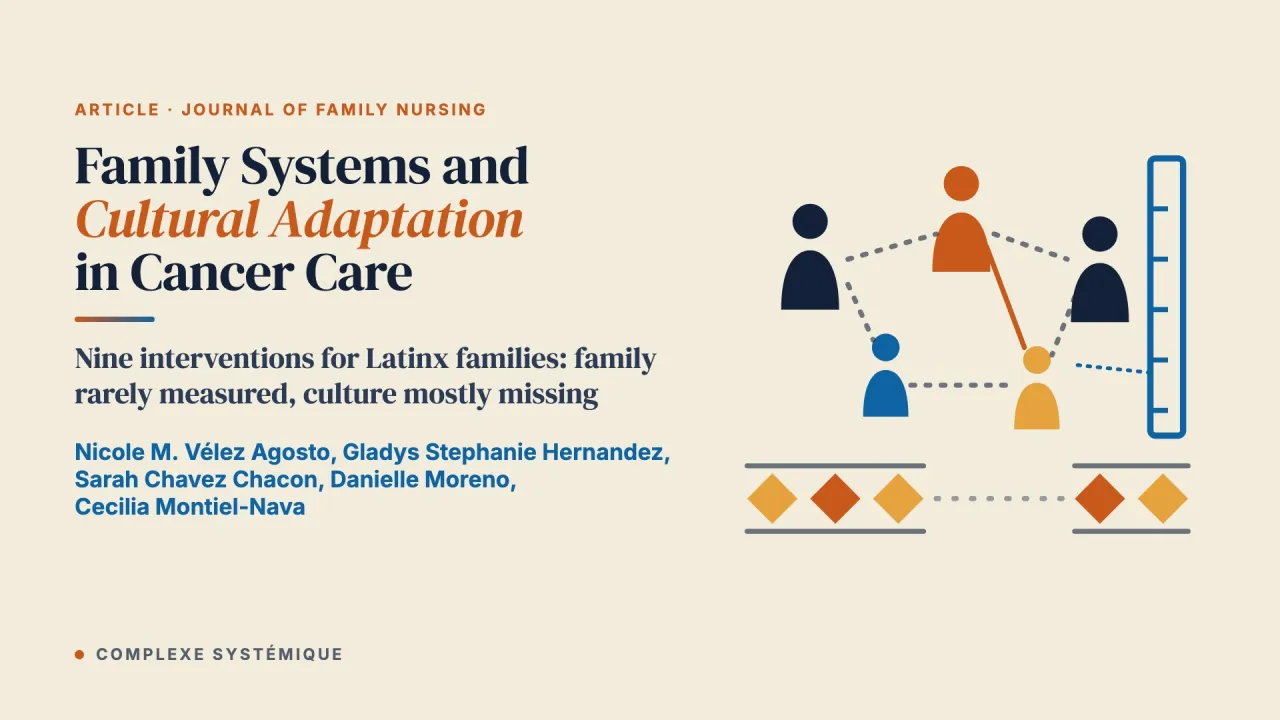
 Family Systems and Cultural Adaptation in Psychosocial Cancer Interventions for Latinx Families: A Critical Review
Nine family-based psychosocial cancer interventions under scrutiny: few measure the family as a system, and the culture of Latinx families is almost absent.
 Article
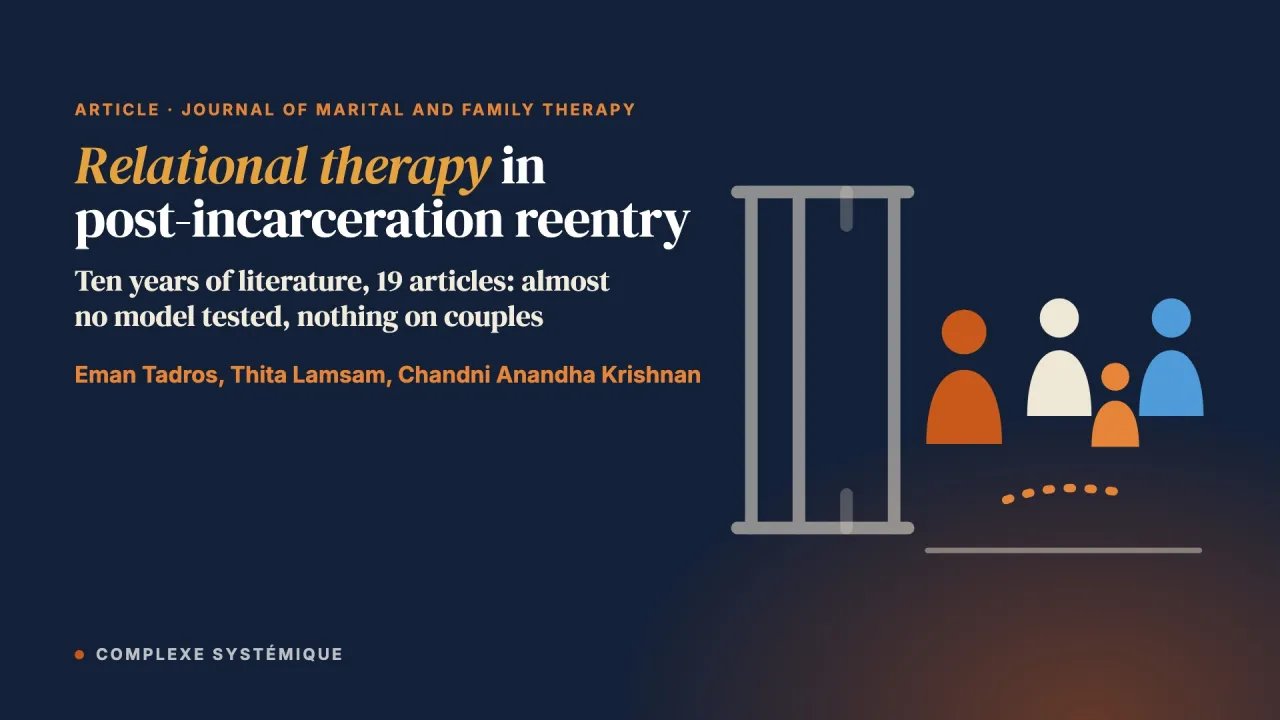
 Relational Therapy in Post‐Incarceration Reentry: A Scoping Review
What does the literature say about relational therapy after prison? A review of 19 articles: decisive family bonds, almost no tested model, nothing on couples.
 Article
 Multi‐Family Therapy in East and Southeast Asia—A Systematic Review and Meta‐Synthesis
17 studies in China, Hong Kong and Singapore: multi-family therapy mainly improves symptoms, but families describe a relational change that scales capture poorly.
 Article
 Shaping the Therapist, Shaping the Field: A Narrative Review of the Person‐of‐the‐Therapist Training (POTT) Approach
Thirty sources, three periods: the history of Harry J. Aponte’s training, which turns the therapist’s wounds and “signature theme” into a clinical tool.
Comments 0
Log in to join the discussion. Log in