Children · Family
Understanding Parental Representations Across the Perinatal Period: A Systematic Review of Empirical Findings and Clinical Implications
Even before birth, parents imagine their child and think of themselves as parents. A team at Sapienza University of Rome reviewed 28 studies on these representations, from pregnancy to the end of the first year: balanced representations go hand in hand with reflective functioning and secure attachment, distorted or disengaged ones with depression, hardship and isolation. Fathers, couples and family diversity nonetheless remain understudied.
This is a reformatted republication of Understanding Parental Representations Across the Perinatal Period: A Systematic Review of Empirical Findings and Clinical Implications, by Renata Tambelli, Ludovica Del Proposto and Francesca Favieri, published in Children (MDPI) (2025), doi: 10.3390/children12081051, under a CC BY 4.0 licence. Prepared by Complexe Systémique in September 2026: the authors’ text is unchanged; the layout has been adapted for reading online, which constitutes a modification of the work under the terms of the licence. The tables are presented as lists (the merged cells of Table 3 are rendered as heading–value pairs); end-of-article statements are grouped in the notes. This edition was made neither by the authors nor by the publisher, who are not responsible for its content or for any errors. The original version prevails.
Parental mental representations are not static but dynamic and susceptible to change over time, especially as parents engage in direct caregiving experiences.
Renata Tambelli, Ludovica Del Proposto and Francesca Favieri
Abstract
Background/Objectives: Parental mental representations play a crucial role in shaping early parent–child relationships, particularly during the perinatal period. These internal models influence caregiving behaviors, emotional attunement, and the intergenerational transmission of attachment. The present systematic review aims to address this gap by examining the nature of both maternal and paternal mental representations in the perinatal period (involving pregnancy and the first postnatal time), with a particular emphasis on reflective functioning, and by outlining the variables that are influenced by these representations. Methods: Following PRISMA guidelines, eligible peer-reviewed studies were identified through a comprehensive literature search of major scientific databases (Scopus, Web of Science, PsychArticle/PsycInfo). Qualitative assessment and detailed description were carried out. Results: In total, 28 studies were selected and analyzed. Findings reveal that while representations tend to organize around shared psychological domains—such as expectations regarding the child, parental identity, and the anticipated relationship—there is significant heterogeneity in how these are conceptualized and measured across studies. Risk factors such as maternal depression, low social support, and adverse life experiences were consistently linked to disengaged or distorted representations, whereas balanced representations were associated with greater RF, emotional availability, and protective relational contexts. Conclusions: Overall, the review highlights the clinical relevance of assessing parental mental representations and RF during the perinatal period, suggesting that early, targeted interventions may enhance parental sensitivity and promote secure parent–infant bonds. Future research should adopt integrated theoretical models, include diverse family configurations, and evaluate the efficacy of preventive programs that support reflective and adaptive representations.
Highlights
What are the main findings?
- Parental mental representations (PMRs) develop during pregnancy and continue to evolve in the postnatal period.
- The current literature shows significant methodological heterogeneity and an underrepresentation of fathers and dyadic perspectives.
What is the implication of the main finding?
- Early identification of nonbalanced PMRs may help prevent relational difficulties and promote secure attachment.
- Future studies should adopt longitudinal, systemic, and culturally inclusive approaches to better capture the complexity of early parenthood and inform preventive mental health strategies.
Keywords: parental mental representation, reflective functioning, dyadic relationship, parent–infant interaction
1. Introduction
Parental mental representations play a fundamental role in shaping the nature and quality of the parent–child relationship [1]. Since Bowlby’s introduction of the concept of internal working models [2], increasing attention has been paid to how parents mentally represent their children [3]. Pregnancy and generally the perinatal period are significant moments during which parents begin to form and then develop these representations of the child, initiating a psychological process that facilitates the child’s individuation and transition from an internal, imagined presence to a real, external one [4]. The perinatal period refers to a critical developmental window, encompassing the time from pregnancy through the first year postpartum, characterized by profound biopsychosocial change for both parents and infants, involving the emergence of parental identity, the establishment of early caregiving patterns, and the formation of foundational parent–child bonds [3,4,5].
This process aligns with Stern’s [5] distinction between two parallel worlds: the objective reality of the child and the subjective realm of parental mental representations. The latter encompasses not only real-life interactions but also—and perhaps more significantly—parents’ fantasies, hopes, fears, memories, and projections regarding their child’s future. Research has examined the content and structure of these representations, highlighting their importance in understanding how early caregiving experiences and prenatal perceptions shape future relational dynamics [1]. Evidence supports the idea that such representations influence both the quality of parent–infant relationships and child development outcomes [6].
A central component in the development of these representations is reflective functioning, defined as the capacity to understand one’s own and others’ behaviors and mental states [7]. Reflective functioning allows individuals to access emotional memories related to their own attachment and affective histories and relational experiences and to draw on these experiences to provide a secure relational base for their child. Given that attachment ‘experiences are strictly linked to regulation of affect, any framework aiming to understand attachment security and its intergenerational transmission must incorporate affective mentalization as the ability to reflect on emotions and how they relate to behaviors [8].
Reflective functioning, therefore, not only supports affect regulation and secure attachment, but also contributes directly to the formation and organization of parental mental representations. Through the ability to mentalize, parents can interpret their own and their child’s behaviors in terms of underlying thoughts and feelings, thereby enriching and structuring the internal image they hold of the child. This reflective stance allows for a more nuanced, flexible, and emotionally attuned representation, which is crucial for promoting sensitive caregiving. In this sense, reflective functioning serves as both a foundation and a dynamic regulator of parental representations, reinforcing their developmental significance from the prenatal period onward [1,9].
Among the most frequently investigated aspects of parental representations are expectations regarding one’s new identity as a parent, perceptions of the unborn child, anticipated lifestyle changes, and emotional reactions toward the future parent–child relationship. These representations often include imagined parenting characteristics (of oneself and one’s partner) and projected attributes of the child—both physical and psychological—especially after meaningful prenatal experiences such as feeling fetal movements or undergoing ultrasound scans [4].
Most studies on parental mental representations have primarily focused on mothers, with far less attention devoted to paternal representations. This is despite the importance of identifying similarities and differences in maternal and paternal attitudes and behaviors, and their respective influences on child development [10]. Research on fatherhood often emphasizes paternal well-being, attachment, and the quality of father–child interactions [11,12,13,14,15,16,17,18,19,20]. More recently, studies have also addressed prenatal bonding, psychological adjustment during the transition to fatherhood, and paternal expectations and representations [21,22,23].
In exploring parental and parent–child relationships, it is essential to consider how the transition to parenthood affects individual and dyadic identity, stress levels, and psychological adaptation [24]. Central to this process is the development of parental identity, emotional involvement in the pregnancy, and the evolving relationship with the unborn child. Equally important are the parent’s capacity to imagine the child, the quality of couple dynamics, and the ability to mentalize the child’s internal states—expressed through emotional availability, sensitivity, and responsiveness to imagined needs and feelings [25,26].
Over time, theoretical models of parental representations have evolved alongside changing conceptions of motherhood and fatherhood. These models also furnished the possible categorization of main parental mental representation, based on their coherence, emotional tone, and narrative structure. Balanced/integrated representations are characterized by coherence, emotional openness, and a view of the child as a separate individual with strengths and vulnerabilities, with personal temperament and behaviors. Parents with integrated representation express empathy and realistic expectations and can reflect on both positive and negative aspects of the relationship [1,4,6].
On the negative side of parental representation, which may be ascribed as nonbalanced representation [22], we can find distorted representations, characterized by confusion and rigidity, or excessive idealization, which may include contradictory statements or unrealistic expectations. We encounter disengaged representations that are expressively and emotionally flat, offer superficial description, and are lacking in detail, often being marked by emotional detachment or minimization of the importance of the parent–child bond. As reported by Vreeswijk’s review [6], these typologies are clinically relevant, as they have been shown to predict different patterns of early caregiving behavior and child attachment.
However, despite a growing body of empirical research, a comprehensive synthesis that integrates findings on both maternal and paternal representations is still lacking. Understanding parental mental representations is not only essential for developmental research but also has practical implications for the early identification of parenting difficulties and for designing targeted interventions aimed at enhancing parental sensitivity and mentalization, thereby fostering secure attachment and emotional well-being in children [27]. The present systematic review aims to address this gap by examining the nature of both maternal and paternal mental representations in perinatal period, including studies focusing on both the prenatal stage (from conception to childbirth) and the postnatal stage (up to 12 months postpartum), with a particular emphasis on reflective functioning, and by outlining the variables that are influenced by these representations. This approach allows us to capture the continuity and transformation of parental mental representations across a developmental continuum that is essential for understanding early relational health.
2. Materials and Methods
2.1. Research Strategies
This systematic review was conducted according to the Preferred Reporting Items for Systematic Reviews and Meta-Analyses (PRISMA) guidelines for meta-analysis [28]. The research was conducted in Scopus, PsycArticles and PsycInfo databases using keywords related to parenting and maternal and paternal mental representations. Specific scripts and databases are reported in Table 1. All original papers published in peer-reviewed journals up to 15 May 2025 were searched, without any date filtering. Our efforts searching the databases and saving records for systematic review were conducted between 14 May 2025 and 15 May 2025.
Table 1 — Script and dataset for systematic search.
- Script: Parent* OR caregiver* OR mother* OR father* AND mental representation* OR reflective functioning; Databases: Scopus; APA PSYCARTICLES/APA PSYCINFO; Web of Sciences.
2.2. Eligibility Criteria
Studies included in this systematic review examined parents’ mental representations. Specific inclusion criteria were (a) studies involving biological parents; (b) studies in which interviews were administered during pregnancy and/or (c) in the postnatal period; and (d) studies employing instruments specifically developed and/or validated for the assessment of parental mental representations, in both their balanced and integrated and nonbalanced (i.e., poor, distorted and disengaged) expression. To guarantee an adequate level of control and reduce heterogeneity, studies were excluded if they (a) involved nonbiological parents (e.g., adoptive parents) or parents who had undergone (b) Medically Assisted Reproduction or In Vitro Fertilization; (c) focused on high-risk families (i.e., in cases of addiction, or physical/mental health diagnosis affecting the parent or infant); or (d) involved adolescent parents. Finally (e) reviews, theoretical papers, or conference abstracts were excluded, as were (f) studies published in languages other than English or Italian.
2.3. Data Collection Process
Data selection and subsequent extraction were carried out by identifying studies through title and abstract screening. From the selected articles, information was extracted regarding participants (gender, age, sample size), the assessment period (gestational month, postpartum period), the instruments used to assess parental mental representations, the dimensions investigated, the psychological variables considered, and finally the main findings.
2.4. Quality Assessment Methods
The quality of each paper included in the final stage of the systematic review was explored. This assessment was conducted through the adaptation of the Higgins’ tool for risk of bias [29,30], structured to assess bias for the following domains: (I) sampling bias: the inclusion of small, unbalanced, or incomplete datasets, often drawn from non-representative populations (e.g., specific cultural, ethnic, or clinical groups), limiting the applicability of the findings to the general population; (II) method bias: the frequent use of non-standardized, non-validated, or ad hoc instruments—such as self-developed questionnaires or interviews lacking sufficient description—raises concerns about the reliability and replicability of the findings; (III) results bias: unclear results, or data not clearly explained in the results section, qualitative analyses or lack of disclosure of the effect size; (IV) discussion bias: minimal elaboration on the main focus of the study, weakening the overall interpretative value.
Each domain was evaluated according to the following code: no or low risk = 0; medium risk = 1; high risk = 2. Two independent reviewers (F.F., L.D.P.) evaluate each full text according to the indication reported in Table 2. Discordance was solved with the mediation of a third supervisor (R.T.). The global quality of the review, considering the percentage of the studies with low–medium–high risk of bias, was reported in a graphical summary (Figure 1).
3. Results
3.1. Study Selection and Inclusion
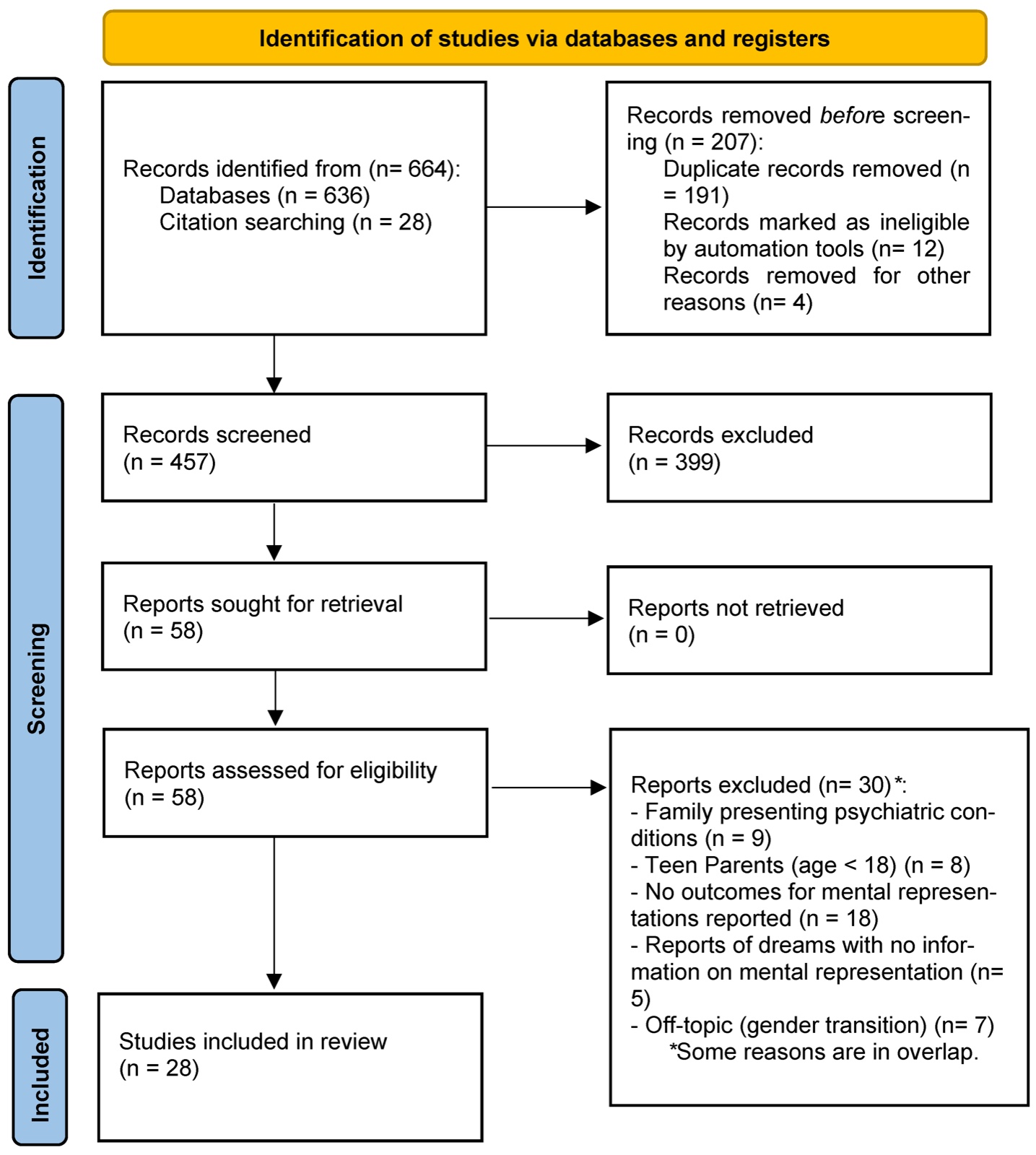
Flow diagrams report the search process and inclusion of the records. After the first screening phase, 86 articles were eligible for full-text checking. At the end of the process, 58 articles were excluded (see Figure 1 for detailed information); in the final sample, 28 studies were included in this systematic work.
3.2. Quality Assessment
The qualitative analysis used to identify the risk of bias for each study in the following domains—(i) sampling, (ii) methodology, (iii) results, and (iv) discussion—highlighted that 96% of the studies reported a low risk of error, while 3% (1/28) reported a moderate risk of error, indicating overall good quality among the included studies, with no studies presenting a high risk of error. The analysis of the domains revealed that the moderate risk of bias was primarily due to issues in the sampling and methodology domains. Many authors did not sufficiently clarify the inclusion criteria for participants (e.g., [31]), while others included small or heterogeneous samples (e.g., [4]) or did not explicitly describe the characteristics of the participants (e.g., [32]).
3.3. Characteristics of the Included Studies
The total sample of the review included approximately 8848 parents, with a range of sample sizes from 23 [4] to 1646 [31]. The large number of studies focused on mothers (66.54%), while studies including exclusively fathers were 17.38%, and the couples of parents were included in 16.07% of the studies. The age of parents ranged from 16 [33] to 50 years [34], despite not all these studies clearly reported this information (see Table 2 and Table 3 for details).
Overall, 19 out 28 studies adopted structured and semi-structured interviews [4,22,23,32,34,35,36,37,38,39,40,41,42,43,44,45]. In particular, 16 studies [4,22,23,32,34,35,36,37,38,39,41,43,44,45,46,47] used validated tools, such as the Working Model of the Child Interview (WMCI) [48], the Interview of Maternal Representations during Pregnancy [Intervista sulle rappresentazioni materne in gravidanza (IRMAG)] [4], the Clinical Interview for Parents During Pregnancy [Colloquio per Genitori in Gravidanza (CGG)] [49,50], the Interview on Maternal Representations [51], and the Interview of Paternal Representations during Pregnancy [Intervista sulle rappresentazioni paterne in gravidanza] [36]. Meanwhile, Delmore-Ko and colleagues [40], Ilicali & Fisek [42], and Madsen and colleagues [52] adopted ad hoc tools (ie., The Prenatal Interview, Maternal Representations Interview, and Father Attachment Interview).
Nine studies [31,33,53,54,55,56,57,58,59] used exclusively self-report instruments. Specifically, they used the What Being a Parent of a New Baby is Like-Revised (WPL-R) [60], the Subjective Family Picture Test, The Pie [61], the Infant Characteristics Questionnaire (ICQ) [62], the Childbearing Attitudes Questionnaire [63], the Maternal Self-Definition Questionnaire (MSDQ) [64], the Representations of Unborn Baby (RUB-M), and the Child Concept Questionnaire [65]. Coleman and colleagues [33] (1999) also used an ad hoc tool, the Prenatal Maternal Expectations Scale (PMES), while Gress-Smith et al. [54] and Pajulo et al. [56] used exclusively self-report tools created ad hoc, specifically the Prenatal Experiences Scale for Mexican Americans (PESMA), an adapted version of the PMES, and the Prenatal Parental Reflective Functioning Questionnaire (PRF-Q).
In general, all studies included in the systematic review investigated both maternal and paternal mental representations before birth, either longitudinally [23,31,33,34,35,39,40,41,45,46,47,52,53,57,58,59] to assess changes over time (e.g., pre-postpartum), or by focusing exclusively on representations during the prenatal phase [4,22,32,36,37,42,43,44,54,55,56].
Several studies explored characteristics of both maternal and paternal mental representations, while others considered their relationship with other constructs. The further paragraphs furnish deepen insight into the main outcomes of the studies.
3.3.1. Parental Mental Representations
During pregnancy, parents develop mental representations of themselves and their unborn child, which are essential for bonding and caregiving [4]. These representations evolve across pregnancy and peak in complexity around the seventh month [43]. By this stage, most mothers have a distinct maternal identity, though integration between self-as-woman and self-as-mother is still ongoing. Fathers also develop representational models, shaped in part by social referencing, i.e., the degree to which their parental identity is influenced by others’ expectations [36].
Social referencing correlates negatively with flexibility and emotional involvement in both mothers and fathers [4,36]. Specifically, among mothers, social referencing is negatively correlated with openness to change, suggesting that socially anchored representations tend to be less flexible and adaptive [4]. Similarly, in fathers, social referencing is inversely associated with richness of perception, emotional engagement, openness to change, and the emergence of fantasies [36].
Representations of the unborn child, for mothers, often reflect the partner’s traits while shifts postnatally tend to align child representations with the mother’s self-image [4,42]. Over time, representations of self, child, and partner differentiate, reflecting the processes of identity formation and individuation [45]. In the early postnatal period, studies report gradual increases in maternal self-confidence, information-seeking related to the child, and identification with pregnancy. These trends suggest that pregnancy supports a growing sense of independence, embodiment, and the anticipation of fulfillment in motherhood [58]. Simultaneously, decreases were observed in maternal worries, sexual interest, and negative feelings related to infant care—such as discomfort with public breastfeeding or irritation at the disorder linked to childrearing [58].
For fathers, self-representations are strongly correlated with child representations across multiple dimensions [36]. Fathers with integrated representations thus hold a mental image of the child that is richer, more emotionally involved, flexible, coherent, and imbued with fantasy. Like maternal trends, integrated/balanced representations were the most common, while restricted/disinvested and non-integrated/ambivalent types were less frequent [36,37].
Maternal representations appear to remain largely stable over time, especially among those with balanced representations [47]. A similar pattern is found in fathers, those with nonbalanced representations tend to show greater changes after birth, while balanced ones remain more stable [22].
3.3.2. Parental Mental Representations and Reflective Functioning
Parental reflective functioning (PRF) is closely related to representational quality. Low prenatal PRF is associated with disengaged representations, while high postnatal PRF predicts balanced ones [32,35,44,56]. However, inconsistencies emerge across the studies, with some individuals showing high PRF alongside distorted representations [35].
Mothers consistently show higher reflective functioning than fathers across domains involving the child, couple relationship, and their own parents [44]. Fathers tend to reflect less on mental states and their implications for behavior. Both parents demonstrate greater reflective capacity when discussing the child rather than their past or their partner.
First-time mothers outperform experienced mothers and fathers in considering mental states and acknowledging their variability, though no gender difference appears in recognizing the opacity of mental states [56]. Finally, paternal reflective functioning is linked to caregiving style: low PRF is associated with instrumental or detached involvement, while moderate-to-high PRF predicts expressive and emotionally engaged parenting [32].
3.3.3. Parental Mental Representations and Risk Factors
Four studies have investigated parental mental representations in at-risk and non-at-risk samples [31,34,37,55]. Ammaniti and colleagues [37] found that at-risk mothers—exposed to depression, low socioeconomic status, abuse, and poor support—were less likely to develop integrated/balanced representations and scored lower on dimensions such as coherence and openness to change. Pajulo et al. [55] similarly reported that at-risk mothers had less functional representations across various domains, especially regarding their partner, reflecting relational difficulties. Rusanen et al. [31] highlighted that those supportive relationships fostered more positive prenatal expectations, whereas depressive symptoms—identified as the strongest risk factor—were linked to more negative caregiving representations. Interestingly, higher maternal education and younger age were also associated with more negative or inconsistent expectations. Vreeswijk and colleagues [34] found that balanced representations were more frequent in mothers postnatally, while fathers showed increased distorted representations after birth. Maternal representations were more sensitive to prenatal risk, and families in which both parents held balanced representations reported fewer risk factors overall [22,23,34].
3.3.4. Parental Representations and Child Attachment
Three studies examined the association between parental representations and subsequent child attachment, using the Strange Situation Procedure (SSP; [66]) [39,41,46]. Benoit et al. [39], using the Working Model of the Child Interview (WMCI; [48]), found that balanced representations during pregnancy were strongly associated with secure attachment at 11 months. This predictive continuity was evident for balanced and distorted categories, but not for disengaged ones. Huth-Bocks et al. [41] further confirmed this association and demonstrated that maternal representations were more strongly influenced by prenatal risk factors—such as demographic risks and domestic violence—than the attachment outcome itself. Maternal self-representations were closely linked to child representations, and lower levels of prenatal social support were associated with less balanced maternal representations. In contrast, greater prenatal support predicted postnatal support, which was associated with more secure attachment. Similarly, balanced representations were consistently linked to secure attachment at one year of age. Tambelli et al. [46], using IRMAG and IRPAG interviews [4,36], explored how maternal and paternal prenatal representations influence emotional availability and attachment. For mothers, prenatal representations had a direct predictive effect on both attachment and emotional availability, whereas emotional availability alone did not directly affect attachment style. In contrast, among fathers, prenatal representations predicted emotional availability, which in turn influenced infant attachment. However, neither paternal representations nor emotional availability directly predicted attachment classification, highlighting distinct pathways in maternal and paternal contributions to early attachment formation.
3.3.5. Parental Mental Representations and Postnatal Experience
Five studies examined how parents’ prenatal mental representations relate to their postnatal psychological adjustment and experience of parenting [40,53,54,57,59].
Delmore-Ko et al. [40], in their longitudinal exploration, identified distinct parental attitudes—enthusiasm, anxiety, coping, uncertainty, and socialization—with mothers generally reporting higher stress and depression, and fathers experiencing an higher reduction in marital satisfaction in the months after the birth, referring to the quality of the relationship with the partner, although this dissatisfaction is reported also by the mothers. Both parents anticipated challenges despite some positive expectations. Flykt et al. [53] found that high prenatal expectations for emotional closeness and autonomy predicted lower parental stress after birth, although some moderate expectations also influenced stress levels differently for mothers and fathers. Mothers’ expectations about their own relationship with the child improved postpartum, while views on their partner’s involvement declined. Gress-Smith et al. [54] showed that family and paternal support, along with maternal role fulfillment, were linked to fewer depressive symptoms, particularly among younger, married, and more educated mothers. Paternal well-being was not clearly associated with prenatal child representations. Pearce and Ayers [57] and others confirmed that both prenatal expectations and postnatal evaluations affect the mother–infant bond, with postnatal perceptions having a stronger influence. Negative prenatal expectations increased the risk of weaker bonding. Thun-Hohenstein and colleagues [59] found no direct prenatal predictors of maternal competence, though child desirability related to better mother–infant interaction. Maternal competence was higher in younger, more educated mothers and those with male infants.
Table 2 — PICOS’ table of the studies included in the systematic review.
- Alismail et al., 2021 [35]. Sample Size/Parent: 47 mothers · Mean Age (M)/Age Range (AR): M = 25.74 · Assessment Period: Third trimester to 7 months postpartum · Assessment Tool for Mental Representations: WMCI (PP); PI-R; PDI (PP) · Investigated Dimensions (Outcomes): Associations between maternal reflective functioning (prenatal and postnatal) and maternal representations at 7 months postpartum. · Main Findings: Representations categorized as distorted (38.3%), balanced (36.2%), and disengaged (25.5%). Lower prenatal MRF levels were associated with disengaged representations. Higher MRF was linked to balanced representations. No significant difference in MRF scores between distorted and disengaged groups. Some inconsistencies found (e.g., high MRF with distorted representations).
- Ammaniti et al., 1992 [4]. Sample Size/Parent: 23 primiparous mothers · Mean Age (M)/Age Range (AR): M = 29 AR = 20–34 years · Assessment Period: 28–32 weeks of pregnancy · Assessment Tool for Mental Representations: IRMAG · Investigated Dimensions (Outcomes): Content and structure of maternal representations. · Main Findings: Clear differentiation between self as mother and baby representations. Strong positive correlations across matched dimensions of self and baby representations. Social dependency inversely related to openness to change. Baby’s characteristics perceived as more similar to the father than to the mother. Mothers emphasized differentiation from their own mothers.
- Ammaniti et al., 2006 [36]. Sample Size/Parent: 130 fathers · Mean Age (M)/Age Range (AR): M = 33 AR = 23–52 years · Assessment Period: 28–32 weeks of pregnancy · Assessment Tool for Mental Representations: IRPAG · Investigated Dimensions (Outcomes): Organization of paternal representations and parenting styles. · Main Findings: Positive correlations between self and baby representations. Correlation between richness of perceptions, openness to change, emotional engagement, and the emergence of fantasies Three representation types: Integrated (n = 72), Restricted/Disinvested (n = 44), Ambivalent/Unintegrated (n = 14)
- Ammaniti et al., 2013 [37]. Sample Size/Parent: 666 mothers (411 low-risk; 255 at psychosocial/depressive risk) · Mean Age (M)/Age Range (AR): M = 31.67 AR= 23–43 years · Assessment Period: Mid-6th to mid-7th month of pregnancy · Assessment Tool for Mental Representations: IRMAG · Investigated Dimensions (Outcomes): Prevalence of representation categories in risk vs. non-risk groups. · Main Findings: Three representation categories identified: Integrated, Restricted/Disinvested, Ambivalent/Unintegrated. Risk-group mothers showed lower scores across most dimensions and higher social dependency. Self-as-mother representations more articulated than representations of the child.
- Bailes et al., 2024 [38]. Sample Size/Parent: 297 mothers · Mean Age (M)/Age Range (AR): M = 31.17 AR: 21–44 years · Assessment Period: Second trimester to 6 months postpartum · Assessment Tool for Mental Representations: WMCI · Investigated Dimensions (Outcomes): Link between perception richness, pregnancy acceptance, intention, sensitivity, and warmth. · Main Findings: Greater pregnancy intentionality predicted higher acceptance and perception richness in the third trimester. These elements mediated higher caregiver sensitivity and warmth in early interactions.
- Benoit et al., 1997 [39]. Sample Size/Parent: 96 mothers · Mean Age (M)/Age Range (AR): M = 29.17 AR = 20–39 years · Assessment Period: Third trimester to 12 months postpartum · Assessment Tool for Mental Representations: WMCI · Investigated Dimensions (Outcomes): Predictive validity and stability of maternal representations; associations with attachment classification. · Main Findings: Balanced WMCI representations were strongly associated with secure attachment (Strange Situation). Prenatal WMCI categories remained stable at 11 months, particularly balanced and distorted types. No stability for disengaged representations. Significant concordance between prenatal WMCI and infant attachment classifications
- Coleman et al., 1999 [33]. Sample Size/Parent: 31 mothers · Mean Age (M)/Age Range (AR): M = 25 AR = 16–32 years · Assessment Period: Third trimester to 3 weeks postpartum · Assessment Tool for Mental Representations: PMES; WPL-R · Investigated Dimensions (Outcomes): Prenatal expectations and postnatal maternal attitudes. · Main Findings: Higher PMES scores predicted more positive postnatal maternal attitudes (WPL-R). Low PMES scores correlated with negative postnatal adjustment. Moderate prenatal expectations did not predict more positive postnatal attitudes.
- Delmore-Ko et al., 2000 [40]. Sample Size/Parent: 59 first-time parent couples · Mean Age (M)/Age Range (AR): M (mothers) = 27.3 AR (mothers) = 18–40 years M (fathers) = 30.1 AR (fathers) = 19–48 · Assessment Period: Third trimester to 18 months postpartum · Assessment Tool for Mental Representations: Prenatal Interview · Investigated Dimensions (Outcomes): Future parenting expectations and relationship changes. · Main Findings: Four maternal themes: Enthusiasm, Anxiety, Coping, Uncertainty. Five paternal themes: same as mothers plus Socialization. Couples showed the highest adjustment in the third trimester. Marital satisfaction declined after parenthood for both parents.
- Flykt et al., 2011 [53]. Sample Size/Parent: 378 parent couples · Mean Age (M)/Age Range (AR): M (mothers) = 33.3 M (fathers) = 34.2 · Assessment Period: Second trimester to 12 months postpartum · Assessment Tool for Mental Representations: Subjective Family Picture Test (child-related items) · Investigated Dimensions (Outcomes): Parental expectations and parenting stress. · Main Findings: High prenatal expectations of intimacy and autonomy with the baby associated with lower parenting stress at 2 and 12 months. Maternal expectations about emotional intimacy with the baby predicted lower stress more than paternal ones. Moderate paternal expectations of autonomy predicted lower stress at 2 months. Mothers’ expectations positively changed postnatally; paternal expectations remained mostly stable.
- Gress-Smith at al., 2013 [54]. Sample Size/Parent: 210 mothers · Mean Age (M)/Age Range (AR): M = 27.4 · Assessment Period: Third trimester · Assessment Tool for Mental Representations: PESMA · Investigated Dimensions (Outcomes): Maternal expectations and their correlates. · Main Findings: Higher expectations of maternal role fulfillment and partner support were linked to lower depressive symptoms and higher perceived support. Married/cohabiting women had higher expectations of partner support. Higher expectations of satisfaction from motherhood were associated with readiness to become a mother, greater financial difficulty, and previous childcare experience. High family support expectations were linked to younger age, fewer children, higher education, and financial challenges
- Huth-Bocks et al., 2004 [41]. Sample Size/Parent: 206 mothers · Mean Age (M)/Age Range (AR): M = 25.4 AR = 18–40 years · Assessment Period: Third trimester to 1 year postpartum · Assessment Tool for Mental Representations: WMCI · Investigated Dimensions (Outcomes): Predictive value of maternal representations for attachment quality. · Main Findings: Strong correlations between representations of the child and of the self as mother. Negative childhood attachment experiences linked to lower prenatal support and less secure prenatal representations. More prenatal risk factors correlated with less secure representations. Secure prenatal representations predicted more secure mother–infant attachment.
- Ilicali, Fisek, 2004 [42]. Sample Size/Parent: 45 primiparous mothers · Mean Age (M)/Age Range (AR): M = 22.96 · Assessment Period: 4–8th month of pregnancy to 7 months postpartum · Assessment Tool for Mental Representations: Entretien R1, MRI · Investigated Dimensions (Outcomes): Maternal representations before and after birth. · Main Findings: Pregnant women often identified their future children with their husbands; postpartum, this shifted toward self-identification. Mothers sought differentiation from their own mothers, favoring idealized maternal roles. Postpartum narratives were more coherent, flexible, and richer than prenatal ones.
- Innamorati et al., 2010 [43]. Sample Size/Parent: 162 mothers divided into: Early pregnancy (EP, n = 55), Mid pregnancy (MP, n = 51), Late pregnancy (LP, n = 55) · Mean Age (M)/Age Range (AR): M (EP) = 30.3 M (MP) = 30.2 M (LP) = 31.8 · Assessment Period: Varies by group (pre-5th month, 6–7th month, 8–9th month) · Assessment Tool for Mental Representations: The Breakfast Inteview MIPS · Investigated Dimensions (Outcomes): Evolution of the maternal constellation. · Main Findings: Mid-pregnancy (MP) mothers scored highest on all four themes (growth concern, affective involvement, support, identity transformation). Maternal constellation peaked in richness and specificity during the 6–7th month.
- Lis et al., 2000 [44]. Sample Size/Parent: 112 first-time parent couples · Mean Age (M)/Age Range (AR): M (mothers) = 24 M (fathers) = 28 · Assessment Period: 7th month of pregnancy · Assessment Tool for Mental Representations: CGG Reflective Functioning Scale · Investigated Dimensions (Outcomes): Parenting styles and reflective function. · Main Findings: Most common score was 3 on reflective function. Mothers scored higher than fathers. Reflective function was lower in the “child” area than in others.
- Lis et al., 2004 [32]. Sample Size/Parent: 112 fathers · Mean Age (M)/Age Range (AR): M = 28 · Assessment Period: 7th month of pregnancy · Assessment Tool for Mental Representations: CGG Reflective Functioning Scale · Investigated Dimensions (Outcomes): Parenting styles and reflective function. · Main Findings: Low reflective functioning predicted instrumental or observer parenting styles. Moderate-to-high reflective functioning predicted expressive style.
- Madsen et al., 2007 [52]. Sample Size/Parent: 41 fatehrs · Mean Age (M)/Age Range (AR): - · Assessment Period: 6th month of pregnancy to 5 months postpartum · Assessment Tool for Mental Representations: Father Attachment Interview · Investigated Dimensions (Outcomes): Paternal reflective functioning and caregiving representations. · Main Findings: Fathers’ ability to reflect on their child’s mental states was associated with their own caregiving models (especially with maternal caregiving). Reflective functioning was predicted by internalized models based on closeness, compassion, and understanding.
- Pajulo et al., 2001 [55]. Sample Size/Parent: 380 mothers (84 at risk) · Mean Age (M)/Age Range (AR): M = 27.5 · Assessment Period: 3rd to 8th month of pregnancy · Assessment Tool for Mental Representations: IRMAG · Investigated Dimensions (Outcomes): Content of maternal representations and risk factors. · Main Findings: At-risk mothers showed lower scores in representations of the baby, self as mother and woman, their partner, and their own mother. Positive representations of the baby were more similar across risk and non-risk groups.
- Pajulo et al., 2015 [56]. Sample Size/Parent: Pilot: 124 mothers, 82 fathers|Cohort: 600 mothers, 600 fathers · Mean Age (M)/Age Range (AR): M (mothers in cohort) = 30.1 M (fathers in cohort) = 32.1 · Assessment Period: 20–32 weeks of gestation · Assessment Tool for Mental Representations: P-PRFQ PI · Investigated Dimensions (Outcomes): Development of a prenatal reflective functioning questionnaire. · Main Findings: Mothers scored higher in considering mental states and relational flexibility. Both mothers and fathers showed similar levels of perceived opacity of mental states. Maternal reflective functioning correlated with PI scores.
- Pearce and Ayers, 2004 [57]. Sample Size/Parent: 51 mothers · Mean Age (M)/Age Range (AR): M = 31 · Assessment Period: Week 39 of gestation to 3 weeks postpartum · Assessment Tool for Mental Representations: ICQ, Mother–Baby Self-Rating Scale · Investigated Dimensions (Outcomes): Stability of maternal perception and its relation to bonding. · Main Findings: Expectations during pregnancy correlated with postnatal perceptions and mother–infant bonding. No association found between expectation–evaluation mismatch and poor bonding or postnatal distress. Negative expectations were associated with higher risk of poor bonding.
- Ruble et al., 1990 [58]. Sample Size/Parent: Cross-sectional: 667 mothers|Longitudinal: 48 mothers · Mean Age (M)/Age Range (AR): M (cross-sectional) = 29 AR (cross-sectional) = 18–42 M (longitudinal) = 29 AR (longitudinal) = 18–37 · Assessment Period: Cross-sectional: 2 years pre-conception to 3 months postpartum Longitudinal: 9th month pregnancy to 16 months postpartum · Assessment Tool for Mental Representations: CAQ MSDQ · Investigated Dimensions (Outcomes): Changes in self-definition. · Main Findings: Self-perceptions were stable by the 9th month. Postpartum women felt more involved and protective. Across phases: increases in maternal self-confidence and information-seeking; decreases in maternal concerns and sexual interest.
- Rusanen et al., 2018 [31]. Sample Size/Parent: 1646 mothers · Mean Age (M)/Age Range (AR): M = 30.2 · Assessment Period: 32nd week of pregnancy to 24 months postpartum · Assessment Tool for Mental Representations: RUB-M · Investigated Dimensions (Outcomes): Moderating factors in the development of maternal representations. · Main Findings: Positive expectations about bonding, caregiving, and routines were linked to better family atmosphere. Stress, anxiety, and depressive symptoms were associated with more negative expectations. Higher maternal education was linked to fewer positive expectations and more caregiving concerns.
- Tambelli et al., 2020 [46]. Sample Size/Parent: 50 first-time parent couples · Mean Age (M)/Age Range (AR): M (mothers) = 33.88 M (fathers) = 36.90 · Assessment Period: 7th month of pregnancy to 18 months postpartum · Assessment Tool for Mental Representations: IRMAG-R IRPAG-R EAS Strange Situation · Investigated Dimensions (Outcomes): Prenatal representations, emotional availability, and infant attachment. · Main Findings: Strong links between prenatal representations, emotional availability, and attachment categories. For mothers, prenatal representations directly influenced attachment. For fathers, emotional availability mediated the link with attachment quality.
- Theran et al., 2005 [47]. Sample Size/Parent: 180 mothers · Mean Age (M)/Age Range (AR): M = 25 AR = 18–40 years · Assessment Period: Third trimester to 1 year postpartum · Assessment Tool for Mental Representations: WMCI · Investigated Dimensions (Outcomes): Stability and change in maternal mental representations · Main Findings: 71% showed stable representations over time. Balanced representations were most stable. Nonbalanced types were associated with low income, single parenting, and prenatal abuse.
- Thun-Hohenstein et al., 2008 [59]. Sample Size/Parent: 73 mothers · Mean Age (M)/Age Range (AR): M = 29.2 AR = 19–39 years · Assessment Period: Third trimester to 3 months postpartum · Assessment Tool for Mental Representations: CCQ · Investigated Dimensions (Outcomes): Predictive value of prenatal representations on early mother–infant interaction. · Main Findings: No link between maternal competence and predictive variables. Desirability of unborn child predicted eye contact in still-face procedure. Readiness for interaction was linked to prenatal relational representations. Higher parental competence found in mothers of boys, younger mothers, and those with more education.
- Vizziello et al., 1993 [45]. Sample Size/Parent: 42 mothers · Mean Age (M)/Age Range (AR): M = 29 AD = 20–35 years · Assessment Period: 7th month of pregnancy to 4 months postpartum · Assessment Tool for Mental Representations: Interview on Maternal Representations · Investigated Dimensions (Outcomes): Role of maternal representations in early bonding and clinical assessment. · Main Findings: Four representation themes: Desire-driven, Defensive, Fear-based, Disorganized. Representations of self as woman and of partner were stable; those of self as mother and of the baby were less stable. Integration process occurred between maternal and female identity.
- Vreeswijk et al., 2014 [22]. Sample Size/Parent: 243 fathers · Mean Age (M)/Age Range (AR): M = 34.01 AD = 27–49 years · Assessment Period: 26th week of pregnancy · Assessment Tool for Mental Representations: WMCI PAAS · Investigated Dimensions (Outcomes): Meaning of the unborn child for the father. · Main Findings: Fathers were more often in the “disengaged” category, mothers in “balanced”. Prenatal attachment quality was negatively associated with depressive and anxious traits. Younger age, first-time fatherhood, and higher education linked to better prenatal attachment.
- Vreeswijk et al., 2014 [23]. Sample Size/Parent: 217 fathers · Mean Age (M)/Age Range (AR): M = 34.11 Range = 22.31–49.60 · Assessment Period: Week 26 of pregnancy to 6 months postpartum · Assessment Tool for Mental Representations: WMCI · Investigated Dimensions (Outcomes): Stability and predictors of paternal representations. · Main Findings: Over half had nonbalanced representations prenatally. Fathers with nonbalanced prenatal representations more likely to change postnatally. First-time fathers had more balanced prenatal representations. No significant effect of paternal mental well-being on representations. Conscientious and agreeable fathers had more balanced representations across time
- Vreeswijk et al., 2015 [34]. Sample Size/Parent: 294 mothers 225 fathers · Mean Age (M)/Age Range (AR): M (mothers) = 31.60 AR (mothers) = 17–42 M (fathers) = 34.09 AR (fathers) = 22–49 · Assessment Period: 26th week of pregnancy to 6 months postpartum · Assessment Tool for Mental Representations: WMCI · Investigated Dimensions (Outcomes): Prenatal risk factors and stability of representations. · Main Findings: Mothers were more likely to develop balanced and less likely disengaged representations postpartum. Fathers showed similar patterns but increased distorted representations after birth. Maternal prenatal risk was linked to distorted representations; no such link in fathers. Disengaged prenatal mothers remained disengaged; balanced fathers remained balanced postnatally.
WMCI = Working Model of the Child Interview; PDI = Parent Development Interview; IRMAG = Interview on Maternal Representations in Pregnancy (Intervista sulle Rappresentazioni Materne in Gravidanza); IRPAG = Interview on Patern Representations in Pregnancy (Intervista sulle Rappresentazioni Paterne in Gravidanza); PMES = Prenatal Maternal Expectations; WPL-R = What Being the Parent of a New Baby is Like- Revised; CGG = Consultation for Expectant Parents (Colloquio per Genitori in Gravidanza); P-PRFQ = Prenatal Parental Reflective Functioning Questionnaire; PI = Pregnancy Interview; ICQ = Infant Characteristics Questionnaires; CAQ = Childbearing Attitudes Questionnaire; MSDQ = Maternal Self-Definition Questionnaire; RUB-M = Representations of Unborn Baby; EAS = Emotional Availability Scales; PAAS = Paternal Antenatal Attachment Scale.
Table 3 — Details of demographic variables and risk factors reported by the studies.
- Alismail et al., 2021 [35]. Marital Status: 51% single · Race/Ethnicity: 78.7% black · Education: 27.7% high school; 44.7% college · Income (yearly): 70% < 30,000 $
- Ammaniti et al., 1992 [4]. n/a
- Ammaniti et al., 2006 [36]. n/a
- Ammaniti et al., 2013 [37]. Depressive risk; Psychosocial Risk Assessed via CES-D: Low risk = 411 mothers; High risk = 255 mothers
- Bailes et al., 2024 [38]. Marital Status: 15% single · Race/Ethnicity: 85% Caucasian · Education: 75% bachelor’s degree or higher · Income (yearly): median 90,000–150,000 $
- Benoit et al., 1997 [39]. Marital Status: 5% single · Race/Ethnicity: Caucasian · Education: Range = 9–27 years · Income: Upper-middle-class background
- Coleman et al., 1999 [33]. Marital Status: 16% single · Education: 42% bachelor’s degree or higher · Employing: Full time
- Delmore-Ko et al., 2000 [40]. Marital Status: Average of marriage = 4.2 · Education: 35% bachelor’s degree or higher · Employing: Both parents = full time · Psychological Risk: Stress; depressive symptoms; self-esteem; marital adjustment
- Flykt et al., 2011 [53]. n/a
- Gress-Smith at al., 2013 [54]. Marital Status: 7% divorced; 15% single · Race/Ethnicity: 86% Mexican · Education: 5.7% bachelor’s degree or higher · Economic hardship: Average = −0.03 · Depressive Symptoms: Range = 0–25; average = 5.4 · Social support: Middle-high
- Huth-Bocks et al., 2004 [41]. Marital Status: 50% single · Race/Ethnicity: 63% Caucasian · Education: 13% bachelor’s degree or higher · Income (monthly): Range = 0–$9500; Average = $1451 · Domestic violence in life: 75% · Domestic violence in pregnancy: 44%
- Ilicali, Fisek, 2004 [42]. Marital Status: Average = 2 years · Education: Average = 11 years
- Innamorati et al., 2010 [43]. Race/Ethnicity: 100% Italian · Education: 17% middle school or lower
- Lis et al., 2000 [44]. Socioeconomic status Assessed via Four-Factor Index: Medium socioeconomic level
- Lis et al., 2004 [32]. Education: 52% high school · Socioeconomic status Assessed via Four-Factor Index: Medium socioeconomic level
- Madsen et al., 2007 [52]. n/a
- Pajulo et al., 2001 [55]. Risk conditions group screening for any of the variables considered: Depressive symptoms; Risk for addiction; Social Environmental difficulties; Lack for social support.
- Pajulo et al., 2015 [56]. Marital Status: 98% married · Education: 68% high levels · Income (monthly): 24% < 2000 €
- Pearce and Ayers, 2004 [57]. Marital Status: 100% in a relationship · Race/Ethnicity: 76% European · Education: 27% bachelor’s degree or higher · Socioeconomic status: Class 2–3 = 88%
- Ruble et al., 1990 [58]. Race/Ethnicity: 98% Caucasian · Education: 70% bachelor’s degree or higher
- Rusanen et al., 2018 [31]. Education: 33.4% bachelor’s degree or higher · Income (monthly): 74% < 2000 € · Psychological Screening: Anxiety; Depressive symptoms; Family Atmosphere.
- Tambelli et al., 2020 [46]. Psychological Screening: Anxiety; Depressive symptoms; Emotional Availability.
- Theran et al., 2005 [47]. Psychological Screening: Depressive symptoms
- Thun-Hohenstein et al., 2008 [59]. Education: 44% Low · Psychological Screening: Depressive symptoms
- Vizziello et al., 1993 [45]. n/a
- Vreeswijk et al., 2014 [22]. Education: 64.2% bachelor’s degree or higher · Employing: 96.6% · Psychological Screening: Anxiety; Depressive symptoms
- Vreeswijk et al., 2014 [23]. Education: 65.4% > 9 years · Employing: 96.3%
- Vreeswijk et al., 2015 [34]. Education: 64% > 9 · Employing: 87% of mothers; 97.9% of fathers · First child: 51.6%
CES-D = Center for Epidemiological Studies-Depression Scale.
4. Discussion
This systematic review synthesized the current state of knowledge on parental mental representations in the perinatal period and their role in influencing parent–infant interaction and positive child development. The qualitative synthesis offered critical insights into their structure, determinants, and implications for early relational development. Overall, parental mental representation appears to be shaped by a complex interplay of individual, relational, and contextual factors, with important implications for child development and clinical practice. Also, significant themes for future research and intervention programs emerge.
An initial result that clearly emerged is the heterogeneity in methods for the exploration of the representations that may influence the outcomes, reporting inconsistent findings. This lack of consistency ranged from divergent constructs (e.g., representational balance, coherence, emotional tone) to the use of different tools (e.g., IRMAG/IRPAG, WMCI, PAI, PDI-R2), reducing the comparability of the studies. While some studies highlighted the predominance of integrated or balanced paternal representations [36,37], others found a higher prevalence of disengaged representations [22,23]. However, these discrepancies would reflect cultural differences and emphasize the need to consider country-specific parenting norms and values, as well as further explore how for mothers and fathers’ parent reflective functions may affect the representation of child, and future parent–infant relationships. Through this work, although parental mental representations converged towards common and general dimensions, ascribed to thinking about parents’ experience (future or current ones) and the physical, mental, and lifestyle characteristics of their child (or future child), a non-univocal approach emerged. As suggested by some authors, the range of representational qualities may differ in depth, coherence, and affective tone across the different coding systems. In this systematic review, the need for a unified theoretical framework emerges, especially in order to provide strong evidence for clinical applicability [67,68].
Interestingly, multiple risk and protective factors influencing the development of prenatal mental representations and the future parent–child relationship and child well-being in terms of healthy development emerged via the studies. Risk factors include depressive symptoms, low education, and socioeconomic status, family psychiatric history, significant life stressors (e.g., losses and separations), and a lack of social support. Individuals with such risk factors in their medical or psychosocial history often encounter difficulties in developing prenatal representations of the child with an impact on the quality of the future dyadic relationship [31,34,37,41,55]. For instance, in the study by Rusanen et al. [31], mothers with significant psychosocial risks were more likely to express distorted prenatal representations, characterized by fear, emotional disconnection, and idealization. Similarly, Ammaniti et al. [37] found that a lack of emotional support and unresolved losses in family history were associated with disengaged parental narratives, especially in fathers. Longitudinal evidence suggested that, in this frame of risk, more challenges in establishing secure parent–infant bonding are reported [26,69].
On the other hand, protective factors were reported in contributing to more balanced and reflective mental representation, such as positive relationships, e.g., a positive family environment, supportive friendships, and strong partner relationships. This evidence underlines the critical importance of providing comprehensive support both prenatally and postnatally, especially considering the well-documented link between balanced parental representations and secure infant attachment [39,41,46]. It is important to consider that parental mental representations are not static but dynamic and susceptible to change over time, especially as parents engage in direct caregiving experiences, and this aspect should be considered for further analysis of protective and risk factors. In fact, representations may evolve in response to postnatal experiences, such as daily interactions with the infant, co-parenting dynamics, and perceived parental competence. Attention toward both risk and protective factors—as aspects affecting, from a biopsychosocial perspective, both parent and child health—is also supported by the evidence on the neurobiological and psychophysiological correlates of parental representations, suggesting that these internal models are linked to emotional regulation capacities and caregiving-related brain activity. Parents with more coherent and emotionally rich representations may show enhanced activation in brain regions involved in empathy and emotional attunement when interacting with their infant [70]. Therefore, infants protected by a rich and stimulating environment can grow positively and achieve developmental milestones.
Moreover, the representations’ flexibility generally supported by empirical evidence highlights the importance of longitudinal monitoring and context-sensitive interventions, aimed at promoting more adaptive representational styles during the early parenting journey [26]. As the established associations between nonbalanced representations and various psychosocial risk factors, preventive and early intervention strategies should be prioritized during the prenatal period. Results of this systematic summarization suggest the importance of exploring the validity and applicability of programs (e.g., video-feedback interventions or mentalization-based approaches) aimed at developing more reflective, integrated representations of the infant. These interventions could be beneficial for at-risk populations, such as those with a history of trauma, low social support, or elevated psychological distress. Developing and validating tools that can detect changes in parental representations over time is essential to monitor intervention efficacy and personalize support [67].
Another interesting core of this systematic review is the role of reflective functioning (RF) in mental representation. Higher levels of RF are associated with more balanced mental representations. The still few studies on fathers confirmed that moderate-to-high RF correlates with greater preparedness for childbirth and early parenting, increased emotional involvement, and a stronger identification as active co-parents [32,35]. Mothers generally demonstrate higher RF than fathers [56], although the underlying reasons for this gender difference remain unclear due to limited research. While the association between RF and parental representations is generally confirmed by the studies [32,35], the reasons why mothers typically exhibit higher RF than fathers are still poorly understood [56]. A suggestive explanation may be ascribed to the still deep-rooted cultural bias on gender roles in parenthood. Fathers may face structural and emotional barriers to becoming fully engaged co-parents, particularly in contexts where maternal caregiving remains the normative ideal and this aspect, would affect paternal RF and shape mental representations of child and parenting. As a consequence, discrepancies between maternal and paternal representations may impact co-parenting quality, thereby influencing the child’s emotional climate and affecting the family system in unpredictable ways [71]. Studies are needed to explore whether this gender gap is due to biological, psychological, or sociocultural factors, or to differences in caregiving experience and societal expectations. Moreover, longitudinal studies could clarify how RF evolves over time and interacts with contextual factors such as stress, support, and parental mental health. Understanding these developmental trajectories would allow for the more precise identification of at-risk parents and inform the design of tailored interventions aimed at enhancing RF during the perinatal period [67]. Expanding research on RF in diverse populations, especially including both parents and culturally varied samples, would be essential to capturing the complexity of modern parenting and promoting secure early relationships in a range of family contexts.
Limitations
Despite providing meaningful insights into parental mental representations, this review presents several limitations. First, the heterogeneity of the included studies—particularly in terms of assessment tools and constructs—poses challenges for comparison and synthesis. Various instruments (e.g., WMCI, IRMAG/IRPAG, PAI, PDI-R2) differ in focus, structure, and theoretical underpinnings, limiting the ability to draw unified conclusions about parental representations. Second, most studies focus predominantly on mothers, with paternal representations being under-investigated or explored using non-standardized tools. This creates a gender bias that hinders a comprehensive understanding of how both parents contribute to early relational development. Third, many studies are cross-sectional and lack longitudinal follow-up, preventing the assessment of developmental trajectories of representations and their evolving impact on parent–child interactions. Fourth, several included studies are dated, often reflecting sociocultural contexts that may differ substantially from current family structures and parenting norms. This temporal gap limits the generalizability of findings to today’s diverse parenting scenarios. Finally, few studies adopt a dyadic or systemic lens capable of capturing the interactions between partners and their joint mental representations, despite growing evidence on the relevance of co-parenting dynamics.
5. Conclusions
Considering the evidence reviewed, parental mental representations, despite the specific characteristics and differences between mother and father, emerge as a dynamic and multifaceted construct, shaped by individual, relational, and contextual factors. The consistency of associations between balanced representations and parental sensitivity, attachment security, and psychological well-being highlights their central role in early relational development. Moreover, the positive parenting that emerges as related to these representations is confirmed to impact the general health of the child, from physical to mental one across the lifespan [72]. However, the field would benefit from a clearer conceptualization of what constitutes the different expression of representations and how this construct evolves over time. Future studies should adopt longitudinal, dyadic, and interdisciplinary approaches that integrate neurobiological, cognitive–affective, and contextual variables. Moreover, theoretical frameworks such as attachment theory [2], the mentalization-based approach [1,67], and models of co-parenting [73] offer valuable lenses for capturing the complexity of the transition to parenthood, and for this reason further studies must still refer to those classic models to develop new and innovative perspectives. Finally, research should inform early preventive and restorative interventions—especially those that enhance reflective functioning and support vulnerable parents—thus promoting not only individual well-being but also healthier family systems (e.g., [74]). Clinically, the results of this study emphasize the relevance of assessing parental mental representations during the perinatal period to identify early relational risks and guide tailored interventions. The association between nonbalanced representations and psychosocial risk factors highlights the need for preventive programs—such as reflective functioning training or video-feedback interventions—especially among vulnerable populations.
Complexe Systémique: key points
This review is a reminder that a child exists in their parents’ minds long before birth, and that this imagined baby already bears the trace of the parents’ own attachment history, of their couple and of those around them. From a systemic standpoint, two findings stand out: for mothers, the unborn child first resembles the other parent before coming closer to themselves, and representations are built through differentiation from one’s own mother, which makes pregnancy a moment of intergenerational reorganisation. Yet the review remains caught in what it criticises: it excludes adoptive parents, medically assisted pregnancies, at-risk families and adolescent parents, and most studies are maternal, dyadic and sometimes dated. Data on fathers, the couple and coparenting are thin, and both the quality assessment and the count of excluded studies contain inconsistencies. For perinatal practice, the useful idea is simple: explore the imagined baby, the imagined other parent and family echoes, in couple sessions as much as individually. Read alongside the family attachment interview, which thinks of attachment in threes, and the case for mentalization-informed perinatal mental health.
Notes from the original
Disclaimer/Publisher’s Note: The statements, opinions and data contained in all publications are solely those of the individual author(s) and contributor(s) and not of MDPI and/or the editor(s). MDPI and/or the editor(s) disclaim responsibility for any injury to people or property resulting from any ideas, methods, instructions or products referred to in the content.
Author contributions. Conceptualization, R.T., L.D.P. and F.F.; methodology, F.F.; formal analysis, L.D.P., investigation, L.D.P. and F.F., resources, R.T.; data curation, L.D.P. and F.F.; writing—original draft preparation, L.D.P. and F.F.; writing—review and editing, F.F. and R.T.; supervision, R.T.; funding acquisition, R.T. All authors have read and agreed to the published version of the manuscript.
Institutional review board statement. Not applicable.
Informed consent statement. Not applicable.
Conflicts of interest. The authors declare no conflicts of interest.
Funding statement. This work was supported by the Italian Ministry of Research via the grant PRIN-2022 (CUP MASTER B53D23014300006—CUP B53D23014300006).
References
1. Slade A., Grienenberger J., Bernbach E., Levy D., Locker A. Maternal reflective functioning, attachment, and the transmission gap: A preliminary study. Attach. Hum. Dev. 2005;7:283–298. https://doi.org/10.1080/14616730500245880
2. Bowlby J. Attachment and Loss: Volume 1. Basic Books; New York, NY, USA: 1969.
3. Rosenblum K.L., Dayton C.J., Muzik M. Infant social and emotional development: The emergence of self in a relational context. In: Zeanah C.H., editor. Handbook of Infant Mental Health. 3rd ed. The Guilford Press; New York, NY, USA: 2009. Chapter 5.
4. Ammaniti M., Baumgartner E., Candelori C., Perucchini P., Pola M., Tambelli R., Zampino F. Representations and narratives during pregnancy. Infant Ment. Health J. 1992;13:167–182. https://doi.org/10.1002/1097-0355(199223)13:2<167::AID-IMHJ2280130207>3.0.CO;2-M.
5. Stern D.N., Anders T.F. The motherhood constellation: A unified view of parent-infant psychotherapy. Arch. Gen. Psychiatry. 1997;54:387–388. https://doi.org/10.1001/archpsyc.1997.01830160115014
6. Vreeswijk C.M., Maas A.J.B., van Bakel H.J. Parental representations: A systematic review of the working model of the child interview. Infant Ment. Health J. 2012;33:314–328. https://doi.org/10.1002/imhj.20337
7. Fonagy P., Steele M., Steele H., Leigh T., Kennedy R., Mattoon G., Target M. Attachment, the reflective self, and borderline states: The predictive specificity of the Adult Attachment Interview and pathological emotional development. In: Goldberg S., Muir R., Kerr J., editors. Attachment Theory: Social, Developmental and Clinical Perspectives. Analytic Press; Hillsdale, NJ, USA: 1995. pp. 223–279. Chapter 9.
8. Fonagy P., Gergely G., Jurist E., Target M. Affect Regulation, Mentalization, and the Development of the Self. Other Press Other Books; New York, NY, USA: 2002.
9. Zeegers M.A.J., Colonnesi C., Stams G.J.J.M., Meins E. Parental mentalizing, sensitivity, and the quality of parenting: A meta-analytic review. Dev. Rev. 2017;42:13–33.
10. Buttitta K.V., Smiley P.A., Kerr M.L., Rasmussen H.F., Querdasi F.R., Borelli J.L. In a father’s mind: Paternal reflective functioning, sensitive parenting, and protection against socioeconomic risk. Attach. Hum. Dev. 2019;21:445–466. https://doi.org/10.1080/14616734.2019.1582596
11. Cabrera N., Tamis-LeMonda C.S., Bradley R.H., Hofferth S., Lamb M.E. Fatherhood in the twenty-first century. Child Dev. 2000;71:127–136. https://doi.org/10.1111/1467-8624.00126
12. Grossmann K., Grossmann K.E., Fremmer-Bombik E., Kindler H., Scheuerer-Englisch H., Zimmermann A.P. The uniqueness of the child–father attachment relationship: Fathers’ sensitive and challenging play as a pivotal variable in a 16-year longitudinal study. Soc. Dev. 2002;11:301–337. https://doi.org/10.1111/1467-9507.00202
13. Hjelmstedt A., Collins A. Psychological functioning and predictors of father–infant relationship in IVF fathers and controls. Scand. J. Caring Sci. 2008;22:72–78. https://doi.org/10.1111/j.1471-6712.2007.00537.x
14. Lundy B.L. Paternal socio-psychological factors and infant attachment: The mediating role of synchrony in father–infant interactions. Infant Behav. Dev. 2002;25:221–236. https://doi.org/10.1016/S0163-6383(02)00123-6
15. Paquette D. Theorizing the father-child relationship: Mechanisms and developmental outcomes. Hum. Dev. 2004;47:193–219. https://doi.org/10.1159/000078723
16. Ramchandani P., Stein A., Evans J., O’Connor T.G. Paternal depression in the postnatal period and child development: A prospective population study. Lancet. 2005;365:2201–2205. https://doi.org/10.1016/S0140-6736(05)66778-5
17. Sarkadi A., Kristiansson R., Oberklaid F., Bremberg S. Fathers’ involvement and children’s developmental outcomes: A systematic review of longitudinal studies. Acta Paediatr. Int. J. Paediatr. 2008;97:153–158. https://doi.org/10.1111/j.1651-2227.2007.00572.x
18. Steele H., Steele M., Fonagy P. Associations among attachment classifications of mothers, fathers, and their infants. Child Dev. 1996;67:541–555. https://doi.org/10.2307/1131831
19. Trautmann-Villalba P., Gschwendt M., Schmidt M.H., Laucht M. Father–infant interaction patterns as precursors of children’s later externalizing behavior problems: A longitudinal study over 11 years. Eur. Arch. Psychiatry Clin. Neurosci. 2006;256:344–349. https://doi.org/10.1007/s00406-006-0642-x
20. Van IJzendoorn M.H., De Wolff M.S. In search of the absent father—Meta-analyses of infant-father attachment: A rejoinder to our discussants. Child Dev. 1997;68:604–609.
21. Lindstedt J., Korja R., Vilja S., Ahlqvist-Björkroth S. Fathers’ prenatal attachment representations and the quality of father–child interaction in infancy and toddlerhood. J. Fam. Psychol. 2021;35:478. https://doi.org/10.1037/fam0000813
22. Vreeswijk C.M., Maas A.J., Rijk C.H., van Bakel H.J. Fathers’ experiences during pregnancy: Paternal prenatal attachment and representations of the fetus. Psychol. Men Masculinity. 2014;15:129–137. https://doi.org/10.1037/a0033070
23. Vreeswijk C.M., Maas A.J.B., Rijk C.H., Braeken J., van Bakel H.J. Stability of fathers’ representations of their infants during the transition to parenthood. Attach. Hum. Dev. 2014;16:292–306. https://doi.org/10.1080/14616734.2014.900095
24. Sadler L.S., Slade A., Close N., Webb D.L., Simpson T., Fennie K., Mayes L.C. Minding the Baby: Enhancing reflectiveness to improve early health and relationship outcomes in an interdisciplinary home visiting program. Infant Ment. Health J. 2013;34:391–405. https://doi.org/10.1002/imhj.21406
25. Nijssens L., Bleys D., Casalin S., Vliegen N., Luyten P. Parental attachment dimensions and parenting stress: The mediating role of parental reflective functioning. J. Child Fam. Stud. 2018;27:2025–2036. https://doi.org/10.1007/s10826-018-1029-0
26. Dayton C.J., Levendosky A.A., Davidson W.S., Bogat G.A. The child as held in the mind of the mother: The influence of prenatal maternal representations on parenting behaviors. Infant Ment. Health J. 2010;31:220–241. https://doi.org/10.1002/imhj.20253
27. Luyten P., Nijssens L., Fonagy P., Mayes L.C. Parental reflective functioning: Theory, research, and clinical applications. Psychoanal. Study Child. 2017;70:174–199. https://doi.org/10.1080/00797308.2016.1277901
28. Page M.J., McKenzie J.E., Bossuyt P.M., Boutron I., Hoffmann T.C., Mulrow C.D., Shamseer L., Tetzlaff J.M., Akl E.A., Brennan S.E., et al. The PRISMA 2020 statement: An updated guideline for reporting systematic reviews. BMJ. 2021;372:n71. https://doi.org/10.1136/bmj.n71
29. Higgins J.P.T., Savović J., Page M.J., Elbers R.G., Sterne J.A. Assessing risk of bias in a randomized trial. In: Higgins J.P.T., Thomas J., Chandler J., Cumpston M., Li T., Page M.J., Welch V.A., editors. Cochrane Handbook for Systematic Reviews of Interventions. The Cochrane Collaboration and John Wiley Sons Ltd.; Oxford, UK: 2019. pp. 205–228. Chapter 8.
30. Tambelli R., Tosto S., Favieri F. Psychiatric Risk Factors for Postpartum Depression: A Systematic Review. Behav. Sci. 2025;15:173. https://doi.org/10.3390/bs15020173
31. Rusanen E., Lahikainen A., Pölkki P., Saarenpää-Heikkilä O., Paavonen E.J. The significance of supportive and undermining elements in the maternal representations of an unborn baby. J. Reprod. Infant Psychol. 2018;36:261–275. https://doi.org/10.1080/02646838.2018.1462476
32. Lis A., Zennaro A., Mazzeschi C., Pinto M. Parental styles in prospective fathers: A research carried out using a semistructured interview during pregnancy. Infant Ment. Health J. 2004;25:149–162. https://doi.org/10.1002/imhj.10089
33. Coleman P., Nelson E.S., Sundre D.L. The relationship between prenatal expectations and postnatal attitudes among first-time mothers. J. Reprod. Infant Psychol. 1999;17:27–39. https://doi.org/10.1080/02646839908404582
34. Vreeswijk C.M., Rijk C.H., Maas A.J.B., van Bakel H.J. Fathers’ and mothers’ representations of the infant: Associations with prenatal risk factors. Infant Ment. Health J. 2015;36:599–612. https://doi.org/10.1002/imhj.21541
35. Alismail F., Stacks A.M., Wong K., Brown S., Beeghly M., Thomason M. Maternal caregiving representations of the infant in the first year of life: Associations with prenatal and concurrent reflective functioning. Infant Ment. Health J. 2022;43:311–327. https://doi.org/10.1002/imhj.21951
36. Ammaniti M., Tambelli R., Odorisio F. Intervista clinica per lo studio delle rappresentazioni paterne in gravidanza: IRPAG. Età Evol. 2006;85:34–44.
37. Ammaniti M., Tambelli R., Odorisio F. Exploring maternal representations during pregnancy in normal and at-risk samples: The use of the interview of maternal representations during pregnancy. Infant Ment. Health J. 2013;34:1–10. https://doi.org/10.1002/imhj.21357
38. Bailes L.G., Fleming B., Ford J., Macfarlane M., Carrow C., Humphreys K.L., Zeanah C.H. Prenatal representations link pregnancy intention to observed caregiving. J. Reprod. Infant Psychol. 2024;10:1–12. https://doi.org/10.1080/02646838.2024.2424927
39. Benoit D., Parker K.C., Zeanah C.H. Mothers’ representations of their infants assessed prenatally: Stability and association with infants’ attachment classifications. J. Child Psychol. Psychiatry. 1997;38:307–313. https://doi.org/10.1111/j.1469-7610.1997.tb01515.x
40. Delmore-Ko P., Pancer S.M., Hunsberger B., Pratt M. Becoming a parent: The relation between prenatal expectations and postnatal experience. J. Fam. Psychol. 2000;14:625–640. https://doi.org/10.1037/0893-3200.14.4.625
41. Huth-Bocks A.C., Levendosky A.A., Bogat G.A., Von Eye A. The impact of maternal characteristics and contextual variables on infant–mother attachment. Child Dev. 2004;75:480–496. https://doi.org/10.1111/j.1467-8624.2004.00688.x
42. Ilicali E.T., Fisek G.O. Maternal representations during pregnancy and early motherhood. Infant Ment. Health J. 2004;25:16–27. https://doi.org/10.1002/imhj.10082
43. Innamorati M., Sarracino D., Dazzi N. Motherhood constellation and representational change in pregnancy. Infant Ment. Health J. 2010;31:379–396. https://doi.org/10.1002/imhj.20261
44. Lis A., Zennaro A., Mazzeschi C. Application of the reflective self-function scale to the clinical interview for couples during pregnancy. Psychol. Rep. 2000;87:901–918. https://doi.org/10.2466/pr0.2000.87.3.901
45. Vizziello G.F., Antonioli M.E., Cocci V., Invernizzi R. From pregnancy to motherhood: The structure of representative and narrative change. Infant Ment. Health J. 1993;14:4–16. https://doi.org/10.1002/1097-0355(199321)14:1<1::AID-IMHJ2280140102>3.0.CO;2-S.
46. Tambelli R., Trentini C., Dentale F. Predictive and incremental validity of parental representations during pregnancy on child attachment. Front. Public Health. 2020;8:439–449. https://doi.org/10.3389/fpubh.2020.439449
47. Theran S.A., Levendosky A.A., Anne Bogat G., Huth-Bocks A.C. Stability and change in mothers’ internal representations of their infants over time. Attach. Hum. Dev. 2005;7:253–268. https://doi.org/10.1080/14616730500245609
48. Zeanah C.H., Benoit D., Hirshberg L., Barton M.L., Regan C. Mothers’ representations of their infants are concordant with infant attachment classifications. Dev. Issues Psychiatry Psychol. 1994;1:9–18.
49. Zennaro A., Ascari M. Il colloquio con giovani coppie in attesa del primogenito. In: Lis A., Venuti P., De Zordo M.R., editors. Il Colloquio Come Strumento Psicologico. Giunti; Firenze, Italia: 1995.
50. Lis A., Zennaro A. A semistructured interview with parents-to-be used during pregnancy: Preliminary data. Infant Ment. Health J. 1997;18:306–323. https://doi.org/10.1002/(SICI)1097-0355(199723)18:3<306::AID-IMHJ7>3.0.CO;2-K.
51. Stern D.N. The representation of relational patterns: Developmental considerations. In: Sameroff A.J., Emde R.N., editors. Relationship Disturbances in Early Childhood: A Developmental Approach. Basic Books; New York, NY, USA: 1989.
52. Madsen S.A., Lind D., Munck H. Men’s abilities to reflect their infants’ states of mind. Nord. Psychol. 2007;59:149–163. https://doi.org/10.1027/1901-2276.59.2.149
53. Flykt M., Lindblom J., Punamäki R.-L., Poikkeus P., Repokari L., Unkila-Kallio L., Vilska S., Sinkkonen J., Tiitinen A., Almqvist F., et al. Prenatal expectations in transition to parenthood: Former infertility and family dynamic considerations. J. Fam. Psychol. 2009;23:779–789. https://doi.org/10.1037/a0016468
54. Gress-Smith J.L., Roubinov D.S., Tanaka R., Cirnic K., Gonzales N., Enders C., Luecken L.J. Prenatal expectations in Mexican American women: Development of a culturally sensitive measure. Arch. Women’s Ment. Health. 2013;16:303–314. https://doi.org/10.1007/s00737-013-0350-2
55. Pajulo M., Savonlahti E., Sourander A., Piha J., Helenius H. Prenatal maternal representations: Mothers at psychosocial risk. Infant Ment. Health J. 2001;22:529–544. https://doi.org/10.1002/imhj.1016
56. Pajulo M., Tolvanen M., Karlsson L., Halme-Chowdhury E., Öst C., Luyten P., Mayes L., Karlsson H. The prenatal parental reflective functioning questionnaire: Exploring factor structure and construct validity of a new measure in the Finn brain birth cohort pilot study. Infant Ment. Health J. 2015;36:399–414. https://doi.org/10.1002/imhj.21523
57. Pearce H., Ayers S. The expected child versus the actual child: Implications for the mother–baby bond. J. Reprod. Infant Psychol. 2005;23:89–102. https://doi.org/10.1080/0264683042000325528
58. Ruble D.N., Brooks-Gunn J., Fleming A.S., Fitzmaurice G., Stangor C., Deutsch F. Transition to motherhood and the self: Measurement, stability, and change. J. Pers. Soc. Psychol. 1990;58:450. https://doi.org/10.1037/0022-3514.58.3.450
59. Thun-Hohenstein L., Wienerroither C., Schreuer M., Seim G., Wienerroither H. Antenatal mental representations about the child and mother–infant interaction at three months post partum. Eur. Child Adolesc. Psychiatry. 2008;17:9–19. https://doi.org/10.1007/s00787-007-0622-3
60. Pridham K.F., Chang A.S. What being the parent of a new baby is like: Revision of an instrument. Res. Nurs. Health. 1989;12:323–329. https://doi.org/10.1002/nur.4770120508
61. Touliatos J., Perlmutter B.F., Straus M.A. Handbook of Family Measurement Techniques. Sage Publications; Newbury Park, CA, USA: 1990.
62. Bates J.E., Freeland C.A.B., Lounsbury M.L. Measurement of infant difficultness. Child Dev. 1979;50:794–803. https://doi.org/10.2307/1128946
63. Lowe N.K. Self-efficacy for labor and childbirth fears in nulliparous pregnant women. J. Psychosom. Obstet. Gynecol. 2000;21:219–224. https://doi.org/10.3109/01674820009085591
64. Deutsch F.M., Brooks-Gunn J., Fleming A., Ruble D.N., Stangor C. Information seeking and maternal self-definition during the transition to motherhood. J. Pers. Soc. Psychol. 1988;55:420–431. https://doi.org/10.1037/0022-3514.55.3.420
65. Gloger-Tippelt G. A process model of the pregnancy course. Hum. Dev. 1983;26:134–148. https://doi.org/10.1159/000272877
66. Ainsworth M.D.S., Blehar M.C., Waters E., Wall S. Patterns of Attachment, a Psychological Study of the Strange Situation. 1st ed. Psychology Press; New York, NY, USA: 2015.
67. Slade A. Parental reflective functioning: An introduction. Attach. Hum. Dev. 2005;7:269–281. https://doi.org/10.1080/14616730500245906
68. Zeanah C.H., Benoit D. Clinical applications of a parent perception interview in infant mental health. Child Adolesc. Psychiatr. Clin. N. Am. 1995;4:539–554. https://doi.org/10.1016/S1056-4993(18)30418-8
69. Schechter D.S., Coots T., Zeanah C.H., Davies M., Coates S.W., Trabka K.A., Randall D.M., Liebowitz M.R., Myers M.M. Maternal mental representations of the child in an inner-city clinical sample: Violence-related posttraumatic stress and reflective functioning. Attach. Hum. Dev. 2005;7:313–331. https://doi.org/10.1080/14616730500246011
70. Rutherford H.J., Booth C.R., Luyten P., Bridgett D.J., Mayes L.C. Investigating the association between parental reflective functioning and distress tolerance in motherhood. Infant Behav. Dev. 2015;40:54–63. https://doi.org/10.1016/j.infbeh.2015.04.005
71. Schoppe-Sullivan S.J., Altenburger L.E., Bower D.J. Investment in fatherhood and the quality of fathers’ interactions with their preschool-aged children. J. Fam. Psychol. 2015;29:541–552.
72. Chen Y., Haines J., Charlton B.M., VanderWeele T.J. Positive parenting improves multiple aspects of health and well-being in young adulthood. Nat. Hum. Behav. 2019;3:684–691. https://doi.org/10.1038/s41562-019-0602-x
73. Cowan P.A., Cowan C.P. When Partners Become Parents: The Big Life Change for Couples. Basic Books; New York, NY, USA: 1992.
74. Sanders M.R., Kirby J.N., Tellegen C.L., Day J.J. The Triple P-Positive Parenting Program: A systematic review and meta-analysis of a multi-level system of parenting support. Clin. Psychol. Rev. 2014;34:337–357. https://doi.org/10.1016/j.cpr.2014.04.003
Reformatted republication of Understanding Parental Representations Across the Perinatal Period: A Systematic Review of Empirical Findings and Clinical Implications, by Renata Tambelli, Ludovica Del Proposto and Francesca Favieri, Children, vol. 12, no 8, 1051 (2025), doi: 10.3390/children12081051, under a CC BY 4.0 licence. Edition and layout: Complexe Systémique, September 2026 — the work has been modified under the terms of the licence (tables presented as lists). Neither the authors nor the publisher are responsible for this edition; the original version prevails.
This is the original article “Understanding Parental Representations Across the Perinatal Period: A Systematic Review of Empirical Findings and Clinical Implications”, published in Children (2025) under a CC BY 4.0 licence. Republished by Complexe Systémique: the author’s text is unchanged; only the presentation has been adapted for reading online, as set out at the head of this page.
Read the original articleHow to cite this article
Tambelli, R., Del Proposto, L., et Favieri, F. (2025). Understanding Parental Representations Across the Perinatal Period: A Systematic Review of Empirical Findings and Clinical Implications. Complexe Systémique. https://app.complexe-systemique.com/en_GB/articles/understanding-parental-representations-across-the-perinatal-period-a-systematic-review (Original work published in 2025 in Children, 12(8), 1051 (2025); republished in 2025 by Children, https://www.mdpi.com/2227-9067/12/8/1051)
To go further
- Explorer l’attachement comme *processus triadique* : l’entretien d’attachement familialAttachment thought of in threes.
- Penser à la génération suivante : plaidoyer pour une approche de la santé mentale périnatale et intergénérationnelle informée par la *mentalisation*Mentalization in the perinatal period.
- *Attentes dyadiques* de coopération et de soutien lors du passage à la parentalitéThe couple before birth.
Related training courses
 Symposium
État des Lieux: a psychological approach to spaces
Replay of the “État des Lieux” conference (Paris, 16 October 2026): Ivy Daure, Maurizio Frisina, Viola Sallay and Gilbert Pregno on places as a clinical resource. In French.
 Symposium
Digital technology, AI and mental health
Conference in Lyon, 11 December 2026: digital technology, artificial intelligence and mental health. Six talks, replay for participants. In French.
 Short course
The suicidal crisis in adolescents and young adults
Training: assessing and supporting the suicidal crisis in adolescents and young adults. Clinical landmarks and systemic tools. In French.
Related articles
 Scientific
Family group conference provision across the lifespan of child welfare intervention: A mixed-method realist-informed evaluation comparing three stages of welfare concern
Early help, child protection or children in care: among 155 UK families, experiences and outcomes of family group conferences vary very little by stage.
 Scientific
“One Can Have All Sorts of Good Intentions but Sometimes in Everyday Life, It Turns Out Differently”: Change Agreements in Couples' Everyday Lives
Six Danish couples followed after an online couple program: their change agreements become guilt-inducing contracts, shared understanding or revealers of inequality.
 Scientific
How can we BeST? meet the needs of adoptive families? Relevant findings from a major Randomised Controlled Trial of infants in foster care in the UK
The BeST? trial (488 infants in care in the UK) reread for adoption: holistic, ongoing assessment of children and a move to dual registration.
 Scientific
The Role of Parental Expressed Emotion and Loss-Specific Parental Responses in Children’s Loss-Related Outcomes Following Traumatic Loss: A Mixed-Methods Observational Study
After a road-traffic bereavement, parental criticism goes with the child's depression, positive appraisals of the loss with better well-being.