The British Journal of Social Work · Violence
Using the Capability Approach in Social Work with Children Experiencing Post-Separation Parental Stalking
When a father keeps stalking the mother after separation, the violence settles into the children’s lives: relocations, shelters, fear at school, imposed contact. Drawing on eighteen accounts from Finnish children and young people, Anna Nikupeteri’s team uses Sen and Nussbaum’s capability approach to identify what these children value, what prevents them from living it, and how social work can protect them.
This is a reformatted republication of Using the Capability Approach in Social Work with Children Experiencing Post-Separation Parental Stalking, by Anna Nikupeteri, Merja Laitinen, Anna Gupta and Enni Mikkonen, published in The British Journal of Social Work (Oxford University Press) (2023), doi: 10.1093/bjsw/bcac163, under a CC BY 4.0 licence. Prepared by Complexe Systémique in September 2026: the authors’ text is unchanged; the layout has been adapted for reading online, which constitutes a modification of the work under the terms of the licence. This edition was made neither by the authors nor by the publisher, who are not responsible for its content or for any errors. The original version prevails.
To create safe conditions, social workers need to take children’s statements on their fathers seriously.
Anna Nikupeteri, Merja Laitinen, Anna Gupta and Enni Mikkonen
Abstract
This article analyses Finnish children’s experiences of post-separation parental stalking as a form of domestic violence and explores how the capabilities approach (CA) can help social workers understand the issue and support children. The data consist of thematic interviews with eighteen children and young people (aged 4–21 years) whose father or stepfather has stalked their mothers after separation. The theory-driven data analysis was carried out by utilising the CA as the theoretical framework. Our findings show that parental stalking undermines children’s well-being by compromising their safety and reducing their capabilities to use their agency. The study deepened our understanding of issues that children value in their lives and of their possibilities to exercise their agency under parental stalking. Our findings suggest that social workers can support children’s agency and their chances of living out their values through interventions which provide internal and external protection. It is important that social workers create a situated understanding of children’s experiences through a relationship in which children are considered sentient individuals who are listened to and valued. The article offers a novel contribution to the application of the CA in social work involving children exposed to parental stalking.
Introduction
Domestic violence does not always end after separation. Instead, it may continue as stalking perpetrated by the ex-partner or as parental stalking when children are involved. Stalking involves intense and pursuing activity consisting of repeated, coercive and controlling behaviours, such as following, harassing and threatening, that cause fear and distress in the victims. It can include visual or physical proximity; nonconsensual communication and spoken, written or implied threats. It can also involve acts that, taken individually, do not constitute illegal behaviour—such as sending gifts—but the context in which they take place may turn them into abusive experiences (e.g. Spitzberg and Cupach, 2014; Logan and Walker, 2017; Fissel et al., 2020). Nowadays digital communication and surveillance through different devices, apps and social networking forums provide a multitude of ways for perpetrators to stalk their victims (Woodlock, 2017; Nikupeteri et al., 2021). Moreover, the COVID-19 pandemic has increased the victims’ vulnerability, particularly because they have been confined to their homes and technology provides perpetrators with new ways to control, threaten and isolate them (Bracewell et al., 2022).
The most prevalent form of partner stalking is one in which a male perpetrator targets his female partner (e.g. Spitzberg and Cupach, 2007; Fissel et al., 2020). According to the study conducted by Kuehner et al. (2012), from a total of sixty-eight women and ten men fulfilling the criteria for having been victims of stalking, only one man and every third woman were stalked by their ex-partner. An EU-wide survey on violence against women shows that in Finland, 40 per cent of the women over the age of 15 years who reported stalking experiences named their partner as the perpetrator. In the UK, the main form of stalking (48 per cent) was also that perpetrated by women’s partners (European Union Agency for Fundamental Rights, 2012). Stalking is more physically violent and poses a higher risk of lethal violence when the victim and the stalker have been in a sexual relationship and there has been prior domestic violence in the relationship (Farnham et al., 2000; DeKeseredy et al., 2017; Bendlin and Sheridan, 2021).
Stalking targeted at the mother creates a victimising environment for her children. Children may be the perpetrator’s means to get in contact with the ex-partner or they may be direct targets of violent acts and even death threats (Nikupeteri and Laitinen, 2015; Løkkegaard et al., 2019; Nikupeteri et al., 2021). Children can be harmed not just by witnessing violence but also via the range of tactics that perpetrators often use: psychological/emotional abuse, manipulation, monitoring and micromanagement of activities and isolation from sources of support (e.g. Nikupeteri and Laitinen, 2015; Callaghan et al., 2018; Katz et al., 2020). When there are children in common, the perpetrator can use custody issues and contact arrangements as reasons for harassing the ex-partner (Humphreys et al., 2019; Katz et al., 2020). The stalking parent can take legal action, such as filing lawsuits concerning child custody and making false reports by accusing the other parent of child abuse. The stalker may also use professionals as a means to further victimise the other parent, for example, by expressing concern for the children’s well-being when spending time with the mother (e.g. Løkkegaard et al., 2019; Bracewell et al., 2022). Child contact issues also increase the risk of severe physical violence (Bendlin and Sheridan, 2021). Parental stalking thus poses a major threat to children’s well-being, their rights and their freedom to exercise their agency. The complex and subtle nature of stalking and its impacts on children pose a challenge for social workers in addressing and promoting the best of the child, and therefore new theoretical knowledge is needed to analyse the phenomenon.
This article is part of a larger Finnish project called ‘Children’s Knowing Agency in Private, Multiprofessional and Societal Settings—the Case of Parental Stalking’ exploring children’s experiences of and their agency and rights in parental stalking. In the present study, we utilise the capability approach (CA) conceived by Sen (1999, 2005) and further explored by Nussbaum (2011) as the theoretical framework for analysing children’s experiences of parental stalking. Our research question is: ‘What does the CA reveal about children’s experiences of parental stalking?’ In previous research we have approached children’s experiences drawing on the theory of coercive control through which we analysed gender dynamics and power imbalances in parental stalking (Katz et al., 2020; Nikupeteri et al., 2021). The CA as a multidimensional theoretical framework enables us to analyse further children’s experiences of parental stalking, where their capabilities to exercise their agency is threatened. It also helps to analyse day-to-day qualitative harm and losses caused by the father’s stalking behaviour and their cumulative effects on children, ultimately depriving children of their capabilities (Sen, 1999; Logan and Walker, 2017). Further, it enables the exploration of factors that promote children’s rights and well-being in these situations (Hart and Brando, 2018).
The three key concepts of the CA are ‘capabilities’, ‘functionings’ and ‘conversion factors’. Capabilities refer to the effective freedom of individuals to live a life that they have a reason to value. The difference between a capability and functioning is same as the difference between freedom (opportunity) to achieve something and an achievement (outcome) (Robeyns, 2003). Individuals have different abilities to convert means or resources into valuable opportunities (capabilities) or outcomes (functionings). Differences can arise even with the same set of personal means for a variety of reasons or ‘conversion factors’. Robeyns (2005) differentiates three sets of conversion factors: personal, socio-structural and cultural and institutional.
Nussbaum (2011) argues for the compilation of a list of the fundamental capabilities necessary for human well-being, although a definitive list of capabilities for all people has been contested, for example, by Sen (2005). A number of researchers have argued for children’s capabilities to be given particular attention (Biggeri et al., 2006). The CA is often regarded as a way of operationalising human rights, shifting the focus from formal rights to the ability of people to exercise these rights in practice. Burchardt and Vizard (2009) compiled a provisional list of children’s capabilities that incorporates the United Nations Convention on the Rights of the Child as follows: The capability to
- be alive,
- live in physical security,
- be healthy, including physical and mental health,
- be knowledgeable, to understand and reason and to have the skills to participate in society,
- enjoy a comfortable standard of living, with independence and security,
- engage in productive and valued activities,
- enjoy individual, family and social life,
- participate in decision-making, have a voice and influence, as appropriate to the child’s stage of development,
- express oneself and have self-respect,
- know that one is protected and treated fairly under the law.
Although each capability has intrinsic value, it can be instrumental for other capabilities. For example, a child’s capability to be in good health is an end in itself, but also a means of realising the child’s capability to be educated. Children’s abilities to convert capabilities into functionings depend on adults’ decisions that can constrain their agency, often but not always in order to secure their well-being (Biggeri et al., 2011). In the context of domestic violence, studies show that violence and abuse affect negatively children’s capabilities by causing multiple losses and pain, but they also show that children have multifaceted agency in that they have hope for the future and can respond to and cope with domestic violence (e.g. Morris et al., 2015; Arai et al., 2021).
By using the CA to analyse children’s experiences, we seek to deepen our understanding of factors that impede and promote children’s capabilities. Identifying these factors can help social workers to promote the well-being and rights of children exposed to parental stalking and to support the safety of the children (see IASSW, 2014; Stanley and Humphreys, 2015). Increasing attention has been paid on how the CA can inform social work research and practice (Den Braber, 2014; Gupta et al., 2016; Hickle, 2020). This article offers a novel contribution to the application of the CA in social work with children exposed to parental stalking.
Methodology
Sample, data and method
The article draws on interviews with eighteen children and young people (fifteen girls and three boys, aged 4–21 years) whose father or stepfather have stalked their mothers after separation. The data were collected by the first and second authors in collaboration with experts on domestic violence—social workers and psychologists—who work with victims of stalking at the national Stalking Support Center in Finland. The experts contacted families meeting the following criteria: (1) The family’s clienthood was prolonged due to the father’s stalking, (2) the child was or had been a client and (3) the child was otherwise suitable as a participant considering the family situation or the child’s age and stage of traumatisation. In most instances, the stalker was the child’s biological father and in some cases stepfather. All the children lived with their mothers. Many were in contact with their father, at least under supervision. As for some children, there was or had previously been a restraining order against the father.
The experts conducted thematic interviews with the children, involving altogether six individual and six pair interviews with siblings (twelve children). The following themes for the interviews were formed in collaboration with the researchers and the experts: children’s experiences of stalking; their emotions, relationships, resources and needs for help and their encounters with professionals. The interviews were conducted between the years 2012 and 2019, they lasted from 18 to 105 min and they were audio recorded and transcribed. The language of the interviews was Finnish and they were transcribed and translated into English for joint analysis.
Ethical considerations
As the research participants were children in a particularly vulnerable situation, ethical considerations were highly important. First, ethical permission for the study was given by the Research Ethics Committee of the University of Lapland based on the research ethics guidelines of the Finnish National Board on Research Integrity (2019). Second, the research permit was endorsed by the two local divisions of the Stalking Support Center. Third, a written informed consent was given by the children and their mothers. The children were informed that they were free to withdraw from the study at any phase and that they could decline to discuss issues with which they felt uncomfortable. In the data collection, a child-centred approach was embraced, including the principle of children’s right to participation, agency and protection (Eriksson and Näsman, 2012). The experts adapted the interviews to the age and developmental stage of the child. The risk of possible harmful consequences caused by children’s participation was critically evaluated. The experts payed careful attention to the children’s reactions during the interviews and after each interview offered them an opportunity to discuss the feelings that the interviews possibly caused.
Data analysis
In the analysis, we adopted a theory-driven method (Layder, 1998), where the CA was utilised as a flexible, analytic framework. We started the analysis by reading and coding the data from the perspectives of capabilities, functionings, conversion factors and how the children exercised their agency (Robeyns, 2005; Nussbaum, 2011). After coding the data, we systematically went through the concepts included in the theory-driven approach. First, we paid attention to the children’s hopes, desired capabilities and actual functionings, and conceptualised three dimensions of continuations and disruptions caused by the stalking in the children’s lives. The dimensions—existential, social and physical–spatial—describe similarities and differences between children’s experiences. Second, based on Sen’s (2005, 2009) and Robeyns’ (2005) sets of conversion factors, we identified individual, relational, institutional and socio-structural and cultural factors that influenced the children’s capabilities. Next, we will describe our results using anonymised excerpts from the children’s narratives with pseudonyms.
Results
Capabilities and functionings impacting children’s agency and well-being
The data show that the children’s hopes serve as a basis for the desired capabilities, whilst their actual functioning is restricted by their fathers’ stalking behaviours, thereby limiting their capacity to realise these capabilities (Sen, 2005; Nussbaum, 2011). The desired capabilities and actual functionings are interwoven as dimensions of continuity and disruptions in children’s lives and appear on the existential, social and physical–spatial levels (Table 1).
Table 1 — Dimensions of continuity and disruptions in the children’s lives
Children’s hopes and desired capabilities
- Existential continuity. Have an ‘ordinary’ family; Feel safe.
- Social continuity. Keep rewarding relationships; Spend time with friends; Be able to see/not to see father.
- Physical and spatial continuity. Move and play freely; Engage in education fully.
Actual functionings
- Existential disruptions. Unpredictability of life due to stalking behaviour; Living with insecurity, fear; Fear of being alone; Feeling different, stigmatised.
- Social disruptions. Worries about mother, siblings and pets; Impaired friendships, bullying at school; Reluctant meetings with father.
- Physical and spatial disruptions. Constant changes in daily life; Frequent relocations and school disruptions; Restrictions of space and moving freely.
This table shows three dimensions of continuity and disruptions in the children’s lives regarding children’s hopes and desired capabilities and actual functionings. The dimensions are: existential, social and physical and spatial.
The children’s possibilities for ‘existential continuity’ were based on their wishes to have an ‘ordinary’ family and to feel safe at home, in the community and at school/kindergarten.
Interviewer 1: Well … is there still something … what kind of wishes do you have? Close to school and friends. What else? What comes to your mind Jesse, what would you wish for? (…)
Jesse: That dad doesn’t know where we are and that kind of stuff.
Interviewer 1: Yeah …
Joonas: And that life would change back to the ordinary way it was earlier.
Interviewer 1: Yeah. What would it be like if it were ordinary life?
Jesse: That dad would no longer … do anything.
Interviewer 2: If it were ordinary life, would you meet your dad then?
Joonas: At times.
Feeling safe means that the various spheres of life are free from harassment. However, the children’s narratives were permeated with anxiety and fear caused by the father’s stalking. The children said that they felt insecure both at home and in public places, were afraid when meeting the father and tried to adjust to his unpredictable behaviour, as described in a sibling interview:
Maija: We couldn’t be at home anymore. (…) And then at the end it got to a point where, as we were at our dad’s parents … he found out that we were there. So it wasn’t safe to be there either, so then, the only place where we could go at that point was the shelter. But it wasn’t safe to be there [at the shelter] either, so then (…)
Milla: (…) there were suspicions that somehow … through insider information dad had found out that, first of all, we are there at the shelter.
Regarding existential disruptions, the children brought forth experiences of injustice and being different compared with other children. According to Aurora, it was unfair that they have had to flee to shelter so many times. Many children thought that their experiences were unexplainable and that if they disclosed them, they would not be understood by other children without similar experiences (Callaghan et al., 2017). Consequently, some of the children kept silent:
At the beginning it was really difficult for me to talk about it, so maybe I kind of like, somehow, felt ashamed. But I always had friends who didn’t know about it, and I didn’t want to tell them. But then I had family friends who knew about it, and it was easier to talk to them. (Liisa)
The second dimension is related to children’s opportunities to have ‘social continuity’ in their lives. In terms of hopes, the children mentioned issues such as keeping up mutually rewarding relationships, meeting friends and choosing whether to see their father or not. In contrast to social continuity, the children were worried about the well-being and security of their mothers, siblings, friends and pets. Their social relationships were impaired because they needed to evaluate the potential risks of going out, being with friends outside or having their friends sleep over in their home.
You did not necessarily want those friends to visit you that much. And then sometimes, even when he had called, I got a certain feeling, or I kind of didn’t dare to go anywhere. (Taina)
In some cases, disclosing one’s experiences to a schoolmate led to bullying, because stalking did not make sense to other children (also Callaghan et al., 2017).
… Well, I only had one friend there, because the others were always saying bad things about me, and so on. (Piia)
The data show that the children were often reluctant to meet their fathers. Many, especially older children, had a good understanding of how the father’s controlling dynamics operated within the family relations. Some stated that the main reason why they did not want to see their father was the poor quality of the child–father relationship. Some children started feeling more secure over time when the father reduced his stalking behaviour because of new interests, such as finding a new partner. They also felt more secure when they no longer were in contact with their father, for example, in one case where the father had passed away. Overall, the children gained a sense of safety after limiting or discontinuing contact with the father:
It has been a relief for me in the sense that I have been able to set boundaries. And to decide that I don’t want to be in contact with him because I saw how he treated and still is treating my siblings who are in contact with him. (Katja)
The third dimension of children’s capabilities and functionings includes their possibilities for ‘physical and spatial continuity’. The children’s hopes and desired capabilities concerned their ability to move and play freely and to engage in education by achieving at school. The data show that these aspirations were disrupted because of constant changes in the children’s daily lives, their repeated relocations and restrictions concerning their space and moving freely outside. The physical and spatial disruptions escalated social ones, for example, when children lost their friendships because of moving to a new city and changing to a new school. In the following, Aurora discusses her wish for a safe relocation and a stable life:
Interviewer: What would you wish for, as to what happens next?
Aurora: Well, that the move [to a new location] goes well and, in the sense that there wouldn’t be a need to go to a shelter. That life would go on well enough. (…) Daddy wouldn’t find us anymore and … (…) And yet we would see our friends.
Based on the narratives, the corrosive nature of the physical and spatial disruptions of the children’s capabilities for well-being and agency affected their social and educational development. Matti, whose father had escaped abroad, said that he felt better and safer but still needed his mother’s support in moving about. Taina brought forth negative effects on school attendance caused by being in contact with her father:
Many times, especially [after meeting the father] … if the next day has been a school day, so (…) it has been hard to concentrate, as you get somehow … or sometimes you wonder if you said something wrong and if he got angry, or, anyway, you get this lousy feeling after you have been forced to see him. (Taina)
On the whole, the data show that the children have ordinary hopes, but their fathers’ stalking behaviours causing existential, social, physical and spatial disruptions had adverse effects on them. The data also make visible the complexity and contradictory nature of the desired capabilities of the children. For example, they wish to be like others and to have a relationship with their father, but they also want to feel safe.
Conversion factors impacting children’s agency and well-being
The data contain children’s descriptions of positive and negative conversion factors (Robeyns, 2005) that influenced their capabilities not only at the levels of the individual and relations, but also at the institutional, socio-structural and cultural levels. The conversion factors are illustrated in Table 2.
Table 2 — Positive and negative aspects of conversion factors
- Individual. Positive: Ability to deal with stalking experiences; Positive memories; Safety routines and strategic ways of exercising agency; Emotional distance to father; Hobbies, studying. Negative: Fear, anxiety; Negative memories; Contradictory feelings.
- Relational. Positive: Physical distance to father; Closeness to mother and siblings; Trusting relationships with friends and safe adults. Negative: Influence of others, e.g. relatives; Disrupted friendships.
- Institutional. Positive: Trusting relationship with professionals; Professionals valuing children’s experiences; Physical surroundings; safe relocations, security arrangements; Supervised or suspended contacts with father; Shelters; Therapeutic discussions; Peer groups. Negative: Professionals not listening to children; Untrustworthy professional activities/decisions; Insufficient professional interventions; Short-term help.
- Socio-structural and cultural. Positive: Cultural/legal norms in Finland: Child’s age—agency to say no to contact with a father; Possibilities for self-determined family relations; Education, school system; Court decisions: restraining orders, imprisonment; Broad understanding of the concept of family. Negative: Cultural/legal norms in Finland: Child’s age—lack of agency to say no to contact with a father; Lack of self-determined family relations; Adhering too strictly to norms and stereotypes regarding family.
This table illustrates the positive and negative aspects of conversion factors that influenced the children’s capabilities. The conversion factors are: individual, relational, institutional and socio-structural and cultural.
The data show that conversion factors at the individual level involve memories, emotions and actions which affect children’s ability to deal with fear and to exercise their agency for developing means to stay safe and, in the most severe cases, to stay alive. Distancing oneself emotionally from harmful experiences and memories related to the father strengthened the children’s agency (see also Morris et al., 2015). The children’s potential to realise their capabilities was related to the father’s commitment to change his harmful behaviour. For example, Maria started to visit her father again after he had gone through substance abuse treatment. Furthermore, one’s positive memories and ability to deal with stalking experiences served as a conversion factor influencing the child’s capabilities.
Many of the children described hobbies and studying as their coping mechanisms, which we perceive as positive factors affecting their agency. The children also described various safety routines that they follow in order to have a sense of control over their environment, such as going outside with a dog. Some children deliberately took different positions in social relationships to secure well-being. For example, older children in the family began to take responsibility for the safety of their mother and siblings. Some of the children were critical in forming relationships and formed only those that enhanced their own well-being:
But then, with friends it affects the most, the same thing. You are quite critical, and it’s really … well, in principle it is difficult to make friends because, anyway, there is this tough critique. Or an exact pattern that you accept, in that sense. (Tiina)
Our analysis also showed that ‘relational conversion factors’ were interwoven with the individual factors that affected the children’s agency and well-being. In terms of positive conversion factors, many children found that, in addition to a physical distance to their father, their well-being depended greatly on the relationships with their mother and siblings, maternal relatives, sports coaches and selected friends. Particularly, the mother–child relationship was important both in terms of physical and emotional closeness:
In general, we have talked quite a lot with mum. Already before they separated we talked quite a lot about our family’s situation, and we didn’t try to hide it. Or pretend that everything is normal and everything is fine. Instead mum always highlighted that things like this shouldn’t really happen. (Katja)
Although the role of the mother, siblings and relatives was often a supportive one, negative effects emerged if they persuaded the children to keep in contact with the father against their will or if the mother was blamed for the family breakdown:
And always when we met somewhere, like by chance in the yard, so grandma [on the father’s side] always said that it would be nice if you visited us and so on. But then, when went there, she said maybe not to us but to mum that it [break up] is mum’s fault, so I myself didn’t want [to visit there] either, as you knew that it wasn’t true. (Liisa)
The data also show that ‘institutional conversion factors’ impact children’s agency and well-being. The children’s narrations regarding institutional factors varied depending on the age of the child. Young children were limited in their narration related to professionals and some could not distinguish the roles of professionals helping the family, whilst older children were able to evaluate the services and the professionals’ action. However, all children perceived their relationships with professionals as positive if the interaction was effective and if they could feel that their wishes and feelings were listened and responded to. The children valued therapeutic discussions with professionals and with other children who also had experienced stalking. Older children placed value on being able to say whether they want to live with the father or the mother:
Interviewer: Do you remember saying which one you want to live with?
Minttu: Mum.
Interviewer: What do you think, were you listened to?
Minttu: Well you could make the decision in principle. Or at least say your own opinion about the matter, I think it has been really important that they ask our opinion on things.
In terms of other positive institutional factors, we also identified, supervised and suspended contacts with the father and devices that increased the children’s capabilities to actually feel safe. Younger children emphasised concrete, physical devices, such as locks and alarm systems. Safe premises enabled the children to keep a physical distance to their father:
Well, like, it’s a little safer here [at the shelter] and dad probably doesn’t know that we are this far away. He doesn’t know that we are here [in this town/municipality]. Now he won’t come after us. Like in [the previous shelter]. (Aurora)
As for negative institutional factors, older children mentioned short-term professional help that ends when the stalking seems to be over and does not provide any concrete help. For example, some children pointed out child protection authorities who operate at the administrative level and do not actually help children in their life situations:
Interviewer: Have there been people providing help from the outside, as in this shelter, of course, and the work done here. (…)
Milla: Well, at some point, there was the child protection.
Maija: That’s right.
Milla: But I didn’t feel that we had the kind of … kind of support person, in any way. I mean, maybe just officially, took care of issues. But I myself don’t feel there was any concrete help that would’ve benefitted us. Just made these sessions possible and so on. So, in that sense yes, but nothing kind of … visible. And especially because there have always been glitches and interruptions in communication on their side.
Regardless of age, the children were critical towards professional practices which did not acknowledge the severity of their situation. Even young children perceived the contradiction between a jail sentence or restraining order imposed on the father and the father’s continued presence in their lives (see Humphreys et al., 2019; Katz et al., 2020). In this study, two siblings discussed problems related to their parents’ shared custody and professionals’ sharing of information concerning the children. In the case of these siblings, child protection workers let the father know, intentionally or unintentionally, the new address of the mother and children (also Callaghan et al., 2017).
I think it was when we moved there … In this [locality] when we [moved] to our apartment, it didn’t last long [without contact with the father], but then probably child protection had leaked our new address. (…) He of course argued a lot for … before mother got sole custody, the fact that he has a right to know where we live, or where we children live. But mum lives in the same place as we, so … (Milla)
According to the data, also ‘socio-structural and cultural conversion factors’ affect children’s well-being and agency. The Finnish legal, organisational and cultural context played a crucial role in how the children’s agency was acknowledged and what professional measures were taken to tackle the impacts of stalking. Mostly, socio-structural and cultural factors became visible in the children’s possibilities to determine their family relations by themselves. The data show that particularly younger children were typically in a subjugated position in relation to their parents and that they had little control over the way in which they are in contact with their father:
Well, sometimes [we stayed overnight at dad’s] or went to eat at dad’s or something, but, when we didn’t really want to go, so then he, he got angry or insulted when we didn’t dare to tell him. Then we asked mum to tell him, but he didn’t believe her and thought she’d made it up. (Taina)
Older children had more possibilities to influence issues that concern themselves (see also Dixon and Nussbaum, 2012). Although social workers must ascertain a child’s views, the data show that children themselves may have to be aware of their right to be heard. For example, the children’s awareness of their rights as citizens learnt at school was an important factor supporting them in making decisions that concern themselves:
Minna: Then, you have quite many rights.
Interviewer: Yes, that’s true. How do you know that a 12-year-old…?
Minna: From the social studies book [at school].
Interviewer: So, you learnt at school, in social studies that when you’re 12 years old you can decide whether you go [to meet the father], and you said that to the counsellor in the meeting?
Minna: Mmmh. Yes, we are taught that the rights, you have more rights when you turn 12.
A few key factors that affected the children’s ability to exercise their agency and, in some cases, compromised their well-being were related to cultural and social expectations regarding family and to the family preservation ideology of the Finnish child welfare system (Pösö et al., 2014). Some of the children regarded the cultural conception of family as a significant factor affecting their well-being and possibilities to exercise their agency:
I kind of think that they shouldn’t necessarily support the family’s staying together, instead they should support the children’s wellbeing. They [professionals] don’t always … home is not always the best place to be. Maybe it is also about children wanting to protect their parents. (…) Or a child may feel guilty about talking against his/her parent or telling others what [the parent] has done and [the child] ends up saying that [he/she] does not want to be separated from [the parent]. (Katja)
Overall, the conversion factor analysis showed that the factors can be contradictory and cause complexities in children’s lives. Although the conversion factors contain various positive aspects protecting children and their resilience when experiencing father’s stalking, contradicting aspects of the factors can also form a chain of negative effects on children’s lives (Wolff and De-Shalit, 2007) that they have to resist and mitigate.
Discussion
Our investigation of children’s experiences revealed that parental stalking undermines hopes and desired capabilities, which are fundamental issues in view of children’s well-being and the realisation of their rights. The impacts and harm that stalking inflicts on children, such as fear, pain, loss, mixed feelings and a desire for ordinary life, are very similar to the harm that children experience in other forms of domestic violence and abuse (e.g. Morris et al., 2015; Arai et al., 2021). However, this study emphasises the multiple manifestations of stalking after parental separation and the resultant types of harm that go beyond violence and extend to children’s different spheres of life. Providing help and protection to these children should therefore be based on multidimensional framework (see Logan and Walker, 2017). The findings suggest that social workers can support children’s capabilities under parental stalking through interventions that provide internal and external protection (Figure 1).
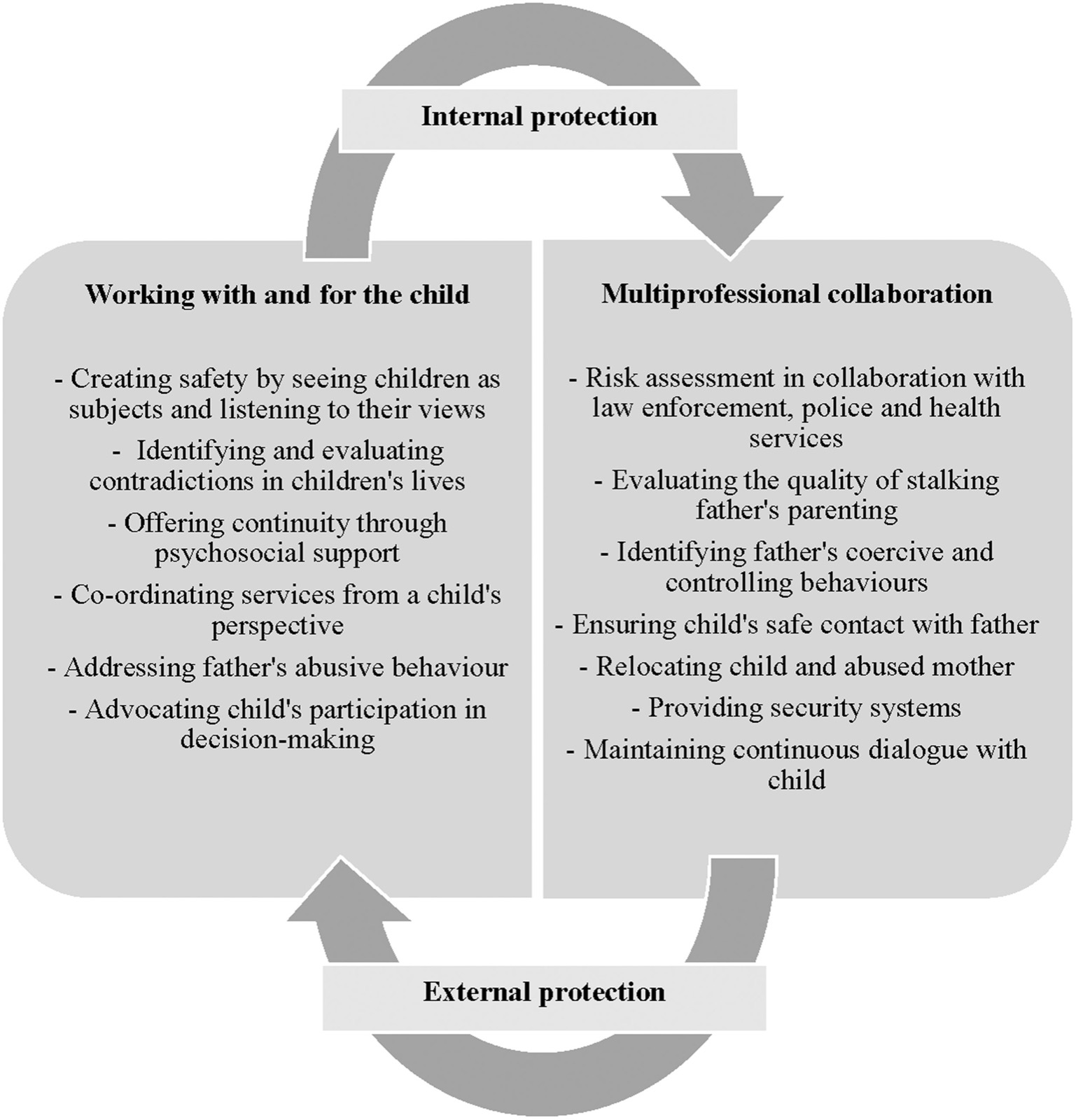
Our findings emphasise the role of social workers in supporting children’s capabilities by providing internal protection so that children can achieve existential continuity. Internal protection means creating safety for children in the uncertainty and fear caused by the father’s stalking. In comparison to many other forms of domestic violence and abuse, this aspect is highlighted in stalking. Father’s stalking behaviour can continue even if the mother and children are relocated, the father is convicted to jail or the father has escaped abroad. The father can attack after a long period of silence and use proxy stalkers to keep track of the victims (Logan and Walker, 2017; Nikupeteri et al., 2021). This requires that professionals acquire a situated understanding of the child’s lived experiences that is developed through a relationship in which children are seen as individuals and able to feel that they are listened to and valued (also Arai et al., 2021; Tisdall et al., 2021). The child-professional dialogue would include questions such as: ‘What are your hopes and aspirations?’ (capabilities); ‘what is life like for you now?’ (functionings) and ‘how is this different from what you expect from life?’ (desired capabilities). To become listened to has an important role in helping children engender a feeling of safety, practice coping skills and create relationships with safe adults (also Morris et al., 2015; Arai et al., 2021).
The findings show the complexities of individual situations and that children’s aspirations can be contradictory. For example, the children expressed conflicting emotions related to their fathers, such as disgust and fear, but also closeness to him and a desire for a shared home. Also, moving to a new town created a feeling of relief and safety, but it also engendered unpredictability, which disrupted one’s wishes for security and continuity and created feelings of loneliness and shame. Moreover, some positive and negative conversion factors were intertwined, creating contradictions in decision-making concerning the realisation of safety. The contradictions occurred, for example, in making decisions relating to whether the children wanted or did not want to see their fathers. It is important that social workers deal with these complexities by offering psychosocial support so that children can become knowledgeable agents who understand and reason out their experiences (also Burchardt and Vizard, 2009; Morris et al., 2015; Arai et al., 2021). Professional practice drawing on the CA should use power with rather than power ‘over’ in order to make a positive difference in functionings and to avoid damaging personal identities that children have a reason to value (Entwistle and Watt, 2013).
Furthermore, our findings highlight the role of social workers and other professionals in creating safe external conditions for children (Nussbaum, 2011). The crucial issue is children’s relationships with their mothers and particularly their fathers, which is a central theme in other studies on domestic violence as well (e.g. Holt, 2015; Morris et al., 2015). In terms of social continuity, providing protection to a child is to a great extent dependent on keeping up the relationships that children consider rewarding. For example, many children find their mother as a significant supporter (also Katz, 2015; Morris et al., 2015). To create safe conditions, social workers need to take children’s statements on their fathers seriously (Arai et al., 2021; Tisdall et al., 2021) and, if needed, to impose limits on some parental rights in order to protect children’s capabilities and rights (Dixon and Nussbaum, 2012; Holt, 2015). This is important, as a child’s contacts can involve a risk of severe violence (Bendlin and Sheridan, 2021). Social workers should utilise the whole range of child–father contact options available, from supervised exchange and visits to suspending the father’s contact with the child and find ways to ensure that the stalker is a ‘good enough’ father (Holt, 2015). As Holt (2015) suggests, abusive fathers should be approached as a ‘risk’ in the context of post-separation father–child contacts and they need to be held responsible for their abusive behaviour before the potential for safe contact can be considered.
Our findings highlight the importance of external protection of the physical and spatial aspects of children’s everyday lives. External safety measures, such as providing security systems and relocating the child and abused mother, play crucial role in stalking-related safety planning. Protecting the child requires strong agency from social workers to address the father’s abusive behaviour on behalf of the child, to report the father’s offences and to help impose protective judicial measures such as restraining orders against the father. Social workers need to critically reflect on the institutional and cultural perceptions related to family and parenting that can promote or hinder the process of helping children to exploit their capabilities. This includes identifying the dynamics of coercive and controlling behaviours when assessing the father’s post-separation parenting, where abusive behaviour against children can be hidden under the mask of ‘caring’ fathering (Katz et al., 2020). Moreover, it is important to be aware of the perpetrator’s potential strategy to involve professionals in further victimisation (Løkkegaard et al., 2019; Bracewell et al., 2022). Helping children requires that professionals hold knowledge on stalking as a specific form of domestic violence and abuse. They also need to be able to determine if a child’s need for help derives from father’s stalking behaviour.
Creating internal and external protection requires risk assessment through collaboration between social workers, law enforcement and health service professionals (also Løkkegaard et al., 2019). In this collaboration, social work has an important role in coordinating services with a child-centric orientation (cf. Pösö et al., 2014) and advocating children’s participation when making decisions on child matters. Stalking as a course of conduct that can escalate or deescalate over time (Logan and Walker, 2017) emphasises the importance of professionals’ continuous dialogue with children to ensure their best interest, to safeguard their well-being and to successfully evaluate the need for protective measures. Discussing with children the factors that impede or promote security helps professionals to develop safety plans that enable children to have more control over their lives in terms of managing their emotions and their physical and social circumstances, amongst other things (see Morris et al., 2015; Logan and Walker, 2017; Nikupeteri and Laitinen, 2021; Bracewell et al., 2022). In this study, linkages between choice, control and well-being were evident in the narratives of the older children. Consequently, it is also important that younger children are able to participate in making decisions concerning their own lives (Dixon and Nussbaum, 2012).
There are some limitations concerning the study. The methodological ones relate to the qualitative method and the relatively small body of data. Also, the specific context of the study can be considered a limitation: The study was conducted in Finland which, as a Nordic welfare society, has a comprehensive and advanced welfare system providing social and health services for all families (Pösö et al., 2014). The Finnish social security system supports children to realise their desired capabilities in ways not available in most other countries. In terms of future research, it would be important to study the capabilities of children based on more comprehensive data collected in different contexts.
Conclusion
Our study demonstrated how the CA can help social workers to understand children’s experiences and to operationalise their rights when they are exposed to parental stalking. The CA as an analytic framework enabled us to create a nuanced understanding of the multidimensional and interlinked factors affecting these children’s agency and well-being. To provide children with real opportunities to lead a life that they value, social workers need to engage in a dialogue with children about the multi-level factors that influence their capabilities and well-being. Our findings show that social workers can support children’s capabilities under parental stalking by providing internal and external protection.
Complexe Systémique: key points
Post-separation stalking extends coercive control by other means, and the child often becomes its channel: messenger, pretext for litigation, target. The article has two merits for systemic practice. First, it shows that institutions are part of the stalking system, whether they hinder it (shelters, restraining orders, suspended contact) or feed it (a leaked address, administrative help without presence, the ideology of family preservation). Second, it shifts the focus from deficit to what the child values: an ‘ordinary’ family, friends, the right to see or not to see their father. The three questions it proposes (your hopes, your life now, the gap between them) transfer easily into sessions. The remaining task is not to confuse listening with delegation: a child who ‘chooses’ to see the father sometimes does so to protect that parent. Limits: eighteen Finnish accounts, collected by specialist teams, without the voices of mothers or fathers. Read alongside the article on children’s fear in groups addressing parental stalking, and the article on what children exposed to domestic violence value in social work.
Notes from the original
Acknowledgements. We thank all the children who participated in this study. Also, we thank the reviewers for their careful reading and insightful comments and suggestions that lead to improve the quality of this manuscript.
Funding. This study was funded by the Academy of Finland (Grant No. 308470).
References
Arai L., Shaw A., Feder G., Howarth E., MacMillan H., Moore T. H. M., Stanley N., Gregory A. (2021) ‘Hope, agency, and the lived experience of violence: A qualitative systematic review of children’s perspectives on domestic violence and abuse’, Trauma, Violence & Abuse, 22(3), pp. 427–38. https://doi.org/10.1177/1524838019849582
Bendlin M., Sheridan L. (2021) ‘Risk factors for severe violence in intimate partner stalking situations: An analysis of police records’, Journal of Interpersonal Violence, 36(17–18), pp. 7895–916.
Biggeri M., Ballet J., Comim F. (eds) (2011) Children and the Capability Approach, Basingstoke, Palgrave Macmillan. https://doi.org/10.1057/9780230308374
Biggeri M., Libanora R., Mariani S., Menchini L. (2006) ‘Children conceptualizing their capabilities: Results of a survey conducted during the first Children’s World Congress on Child Labour’, Journal of Human Development, 7(1), pp. 59–83. https://doi.org/10.1080/14649880500501179
Bracewell K., Hargreaves P., Stanley N. (2022) ‘The consequences of the COVID-19 lockdown on stalking victimisation’, Journal of Family Violence, 37(6), pp. 951–7. https://doi.org/10.1007/s10896-020-00201-0
Burchardt T., Vizard P. (2009) ‘Developing an equality measurement framework: A list of substantive freedoms for adults and children’, Equality and Human Rights Commission, Manchester.
Callaghan J. E. M., Alexander J., Sixsmith J., Fellin L. C. (2018) ‘Beyond “witnessing”: Children’s experiences of coercive control in domestic violence and abuse’, Journal of Interpersonal Violence, 33(10), pp. 1551–81. https://doi.org/10.1177/0886260515618946
Callaghan J. E. M., Fellin L. C., Mavrou S., Alexander J., Sixsmith J. (2017) ‘The management of disclosure in children’s accounts of domestic violence: Practices of telling and not telling’, Journal of Child and Family Studies, 26(12), pp. 3370–87. https://doi.org/10.1007/s10826-017-0832-3
DeKeseredy W. S., Dragiewicz M., Schwartz M. D. (2017) Abusive Endings: Separation and Divorce Violence against Women, Oakland, University of California Press. https://doi.org/10.1525/california/9780520285743.001.0001
Den Braber C. (2014) ‘The introduction of the capability approach in social work across a neoliberal Europe’, Journal of Social Intervention: Theory and Practice, 22(4), pp. 61–77.
Dixon R., Nussbaum M. (2012) ‘Children’s rights and a capabilities approach: The question of special priority’, Public Law & Legal Theory Working Papers No. 384. Chicago, University of Chicago Law School.
European Union Agency for Fundamental Rights. (2012) Violence against Women: An EU-Wide Survey. Luxembourg, Publications Office of the European Union. https://fra.europa.eu/en/publications-and-resources/data-and-maps/survey-data-explorer-violence-against-women-survey (accessed 24 May 2022).
Entwistle V. A., Watt I. S. (2013) ‘Treating patients as persons: A capabilities approach to support delivery of person-centered care’, The American Journal of Bioethics, 13(8), pp. 29–39. https://doi.org/10.1080/15265161.2013.802060
Eriksson M., Näsman E. (2012) ‘Interviews with children exposed to violence’, Children & Society, 26(1), pp. 63–73.
Farnham F. R., James D. V., Cantrell P. (2000) ‘Association between violence, psychosis, and relationship to victim in stalkers’, Lancet (London, England), 355(9199), p. 199. https://doi.org/10.1016/S0140-6736(99)04706-6
Finnish National Board on Research Integrity. (2019) The Ethical Principles of Research with Human Participants and Ethical Review in the Human Sciences in Finland, Helsinki, Finnish National Board on Research Integrity. https://www.tenk.fi/sites/tenk.fi/files/Ihmistieteiden_eettisen_ennakkoarvioinnin_ohje_2019.pdf (accessed 25 April 2022).
Fissel E. R., Reyns B. W., Fisher B. S. (2020) ‘Stalking and cyberstalking victimization research: Taking stock of key conceptual, definitional, prevalence, and theoretical issues’, in Chan H. C. O., Sheridan L. (eds), Psycho-Criminological Approaches to Stalking Behavior: An International Perspective, pp. 11–35, Hoboken, New Jersey, Wiley.
Gupta A., Featherstone B., White S. (2016) ‘Reclaiming humanity: From capacities to capabilities in understanding parenting in adversity’, The British Journal of Social Work, 46(2), pp. 339–54. https://doi.org/10.1093/bjsw/bcu137
Hart C. S., Brando N. (2018) ‘A capability approach to children’s well‐being, agency and participatory rights in education’, European Journal of Education, 53(3), pp. 293–309. https://doi.org/10.1111/ejed.12284
Hickle K. (2020) ‘Introducing a trauma‐informed capability approach in youth services’, Children & Society, 34(6), pp. 537–51. https://doi.org/10.1111/chso.v34.6
Holt S. (2015) ‘Post-separation fathering and domestic abuse: Challenges and contradictions’, Child Abuse Review, 24(3), pp. 210–22. https://doi.org/10.1002/car.v24.3
Humphreys C., Diemer K., Bornemisza A., Spiteri‐Staines A., Kaspiew R., Horsfall B. (2019) ‘More present than absent: Men who use domestic violence and their fathering’, Child & Family Social Work, 24(2), pp. 321–9. https://doi.org/10.1111/cfs.v24.2
Katz E. (2015) ‘Recovery-promoters: Ways that mothers and children support one another’s recoveries from domestic violence’, British Journal of Social Work, 45(Suppl. 1), pp. 153–69.
Katz E., Nikupeteri A., Laitinen M. (2020) ‘When coercive control continues to harm children: Post‐separation fathering, stalking and domestic violence’, Child Abuse Review, 29(4), pp. 310–24. https://doi.org/10.1002/car.v29.4
Kuehner C., Gass P., Dressing H. (2012) ‘Mediating effects of stalking victimization on gender differences in mental health’, Journal of Interpersonal Violence, 27(2), pp. 199–221. https://doi.org/10.1177/0886260511416473
Layder D. (1998) Sociological Practice: Linking Theory and Social Research, London, Sage.
Logan T. K., Walker R. (2017) ‘Stalking: A multidimensional framework for assessment and safety planning’, Trauma, Violence & Abuse, 18(2), pp. 200–22. https://doi.org/10.1177/1524838015603210
Løkkegaard S. S., Hansen N. B., Wolf N. M., Elklit A. (2019) ‘When daddy stalks mommy: Experiences of intimate partner stalking and involvement of social and legal authorities when stalker and victim have children together’, Violence against Women, 25(14), pp. 1759–77. https://doi.org/10.1177/1077801219826738
Morris A., Humphreys C., Hegarty K. (2015) ‘Children’s views of safety and adversity when living with domestic violence’, in Stanley N., Humphreys C. (eds), Domestic Violence and Protecting Children: New Thinking and Approaches, pp. 18–33, London, Jessica Kingsley Publications.
Nikupeteri A., Katz E., Laitinen M. (2021) ‘Coercive control and technology-facilitated parental stalking in children’s and young people’s lives’, Journal of Gender-Based Violence, 5(3), pp. 395–412. https://doi.org/10.1332/239868021X16285243258834
Nikupeteri A., Laitinen M. (2015) ‘Children’s everyday lives shadowed by stalking: Postseparation stalking narratives of Finnish children and women’, Violence and Victims, 30(5), pp. 830–45. https://doi.org/10.1891/0886-6708.VV-D-14-00048
Nikupeteri A., Laitinen M. (2021) ‘Creating inner and outer safety: Findings from a research study on Finnish women’s and children’s experiences of post-separation stalking’, in Bardbury-Jones C., Isham L. (eds), Understanding Gender-Based Violence. An Essential Textbook for Nurses, Healthcare Professionals and Social Workers, pp. 63–77, Switzerland, Springer.
Nussbaum M. (2011) Creating Capabilities: The Human Development Approach, Cambridge, Harvard University Press. https://doi.org/10.4159/harvard.9780674061200
Pösö T., Skivenes M., Hestbæk A.-D. (2014) ‘Child protection systems within the Danish, Finnish and Norwegian welfare states—time for a child centric approach?’, European Journal of Social Work, 17(4), pp. 475–90. https://doi.org/10.1080/13691457.2013.829802
Robeyns I. (2003) ‘The capability approach: an interdisciplinary introduction’. In Training course preceding the Third International Conference on the Capability Approach, Pavia, Italy. https://commonweb.unifr.ch/artsdean/pub/gestens/f/as/files/4760/24995_105422.pdf (accessed 24 May 2022).
Robeyns I. (2005) ‘The capability approach: A theoretical survey’, Journal of Human Development, 6(1), pp. 93–117. https://doi.org/10.1080/146498805200034266
Sen A. (1999) Development as Freedom, Oxford, Oxford University Press.
Sen A. (2005) ‘Human rights and capabilities’, Journal of Human Development, 6(2), pp. 151–66. https://doi.org/10.1080/14649880500120491
Sen A. (2009) The Idea of Justice, Cambridge, Harvard University Press.
Spitzberg B. H., Cupach W. R. (2007) ‘The state of the art of stalking: Taking stock of the emerging literature’, Aggression and Violent Behavior, 12(1), pp. 64–86. https://doi.org/10.1016/j.avb.2006.05.001
Spitzberg B. H., Cupach W. R. (2014) The Dark Side of Relationship Pursuit: From Attraction to Obsession and Stalking, 2nd edn, New York, Routledge.
Stanley N., Humphreys C. (2015) Domestic Violence and Protecting Children. New Thinking and Approaches, London and Philadelphia, Jessica Kingsley Publishers.
Tisdall E. K. M., Morrison F., Warburton J. (2021) ‘Challenging undue influence? Rethinking children’s participation in contested child contact’, Journal of Social Welfare and Family Law, 43(1), pp. 8–22. https://doi.org/10.1080/09649069.2021.1876305
Wolff J., De-Shalit A. (2007) Disadvantage, Oxford, Oxford University Press. https://doi.org/10.1093/acprof:oso/9780199278268.001.0001
Woodlock D. (2017) ‘The abuse of technology in domestic violence and stalking’, Violence against Women, 23(5), pp. 584–602. https://doi.org/10.1177/1077801216646277
Reformatted republication of Using the Capability Approach in Social Work with Children Experiencing Post-Separation Parental Stalking, by Anna Nikupeteri, Merja Laitinen, Anna Gupta and Enni Mikkonen, The British Journal of Social Work, vol. 53, no 2 (2023), doi: 10.1093/bjsw/bcac163, under a CC BY 4.0 licence. Edition and layout: Complexe Systémique, September 2026 — the work has been modified under the terms of the licence. Neither the authors nor the publisher are responsible for this edition; the original version prevails.
This is the original article “Using the Capability Approach in Social Work with Children Experiencing Post-Separation Parental Stalking”, published in The British Journal of Social Work (2023) under a CC BY 4.0 licence. Republished by Complexe Systémique: the author’s text is unchanged; only the presentation has been adapted for reading online, as set out at the head of this page.
Read the original articleHow to cite this article
Nikupeteri, A., Laitinen, M., Gupta, A., et Mikkonen, E. (2023). Using the Capability Approach in Social Work with Children Experiencing Post-Separation Parental Stalking. Complexe Systémique. https://app.complexe-systemique.com/en_GB/articles/using-the-capability-approach-in-social-work-with-children-experiencing-post-separation (Original work published in 2022 in The British Journal of Social Work, 53(2), 900-920 (2023); republished in 2023 by The British Journal of Social Work, https://academic.oup.com/bjsw/article/53/2/900/6693662)
To go further
- Les qualités de la *peur* des enfants dans des groupes d’action thérapeutique consacrés au harcèlement parental après la séparationChildren’s fear in the face of parental stalking.
- Ce que les enfants exposés aux *violences conjugales* apprécient dans leurs rencontres avec le travail social : une revue systématique orientée vers la pratiqueWhat children value in social work.
- The mechanisms of coercive control: a systemic perspectiveThe mechanisms of coercive control.
Related articles
 Scientific
Family group conference provision across the lifespan of child welfare intervention: A mixed-method realist-informed evaluation comparing three stages of welfare concern
Early help, child protection or children in care: among 155 UK families, experiences and outcomes of family group conferences vary very little by stage.
 Scientific
Internal Family Systems Therapy as Part of the ‘Family of Systemic Therapies’: A Critical Exploration of Systemic Practice in the Intra-Personal Domain
Does IFS belong to the family of systemic therapies? A critical exploration, grounded in a family court vignette, of systemic work with “parts”.
 Scientific
Implementing Family Group Decision-Making within statutory child protection social work in Scotland: Challenges and opportunities
Family group decision-making offered automatically in Scottish child protection: families find a voice, social workers doubt the plans, and everyone wants it offered earlier.
 Blog
Toxic, narcissistic, borderline: what therapy speak does to your relationships
Narcissistic, borderline, toxic: therapy speak has left the consulting room. Julien Besse shows how these labels close the debate and relieve us of our own part.