Australian and New Zealand Journal of Family Therapy · Family therapy
‘What Is the Place of Theory in Contemporary Family Therapy?’ Theorising the Concept of the Therapeutic Relationship
Research keeps saying it: the therapeutic relationship is what makes therapy effective. Does that mean theory matters little? Rudi Dallos and Arlene Vetere argue the opposite: the relationship is the most complex thing therapy does, and it calls for a theory. Their lead: attachment, Bowlby’s secure base and renewed attention to emotion, even in disagreements with families about diagnosis.
This is a reformatted republication of ‘What Is the Place of Theory in Contemporary Family Therapy?’ Theorising the Concept of the Therapeutic Relationship, by Rudi Dallos and Arlene Vetere, published in Australian and New Zealand Journal of Family Therapy (Wiley) (2025), doi: 10.1002/anzf.70039, under a CC BY 4.0 licence. Prepared by Complexe Systémique in September 2026: the authors’ text is unchanged; the layout has been adapted for reading online, which constitutes a modification of the work under the terms of the licence. This edition was made neither by the authors nor by the publisher, who are not responsible for its content or for any errors. The original version prevails.
It is from this warm, rich soil of safety that curiosity starts to flourish.
Rudi Dallos and Arlene Vetere
Abstract
The paper argues that the findings that the key ingredient of any successful form of psychotherapy is the therapeutic relationship needs to be theorised and subjected to research. There has been a danger that the therapeutic relationship can be dismissed as an intangible concept consisting of features such as being ‘nice’, ‘respectful’ and ‘pleasant’ with people, couples and families. Instead, the paper argues that it is one of the most important areas that requires the development of a strong theoretical basis and supporting research. It is argued that a strong candidate for a relevant and clinically applicable theory is attachment theory and its links with contemporary neuroscience. The paper discusses how attachment theory can provide a map for how to adapt the therapeutic relationship to provide a sense of safety in relation to individual differences and different family patterns.
Key Points
- Awareness of theory is essential to inform clinical practice, especially formulation.
- Critical reflection on the conceptual and empirical basis of theory is essential for effective and ethical practice.
- The therapeutic relationship is a key component of therapy and an important candidate for theory building.
- Theories of the nature of the therapeutic are limited.
- A combination of concepts from attachment theory and systemic therapy provides a convincing conceptual candidate for theory building regarding the therapeutic relationship.
We begin this paper by referring back to one of the ideas that inspired this symposium. This is described as coming out of a discussion between Glenn Larner and David Pocock regarding Peter Rober's book Becoming an Effective Family Therapist (Rober 2024). One of the conclusions Rober makes is that the research evidence shows that effective therapy is strongly related both to the therapeutic alliance and to therapist qualities. So, given that the therapeutic relationship is central, what is the role of theory, if any?
Asked in this way, is there arguably an implicit assumption that the therapeutic alliance is in itself not something that we need to theorise about? That it is something that we know about is just common sense like being ‘nice’ to family members. We want to suggest just the opposite. It is arguably the most complex and sophisticated thing that we do as therapists and thus it is mostly needed to be researched and understood. For us, theory is the basis on which we, and others, hold ourselves ethically accountable for our systemic practice: ideas, formulation and action. Thus, it is ethically more sound to work with theory and that is verified through evidence rather than theory that does not have established validity. Alongside this, we also believe that there is something mystical, and even magical, about the encounter between human beings, the complexity of which we may never be able to fully understand. There is perhaps some danger as well that, like theorising humour, we might kill what we are trying to look at.
That caveat aside, in this paper we look at some theorising about the therapeutic relationship and related research: not just in whether it works but rather what it is. More broadly, although these two related questions capture some of the core issues relating to the question of theorising in and about systemic psychotherapy, we can think about this question even more broadly. Is it possible not to theorise? What would this mean, that we do not think about what we are doing but that we just proceed on the basis of intuition, ‘common sense’, pragmatically? We find the thinking of the constructivist George Kelly (1955) useful here. He coined the phrase ‘man the scientist’ to refer to the idea that to be human means to be continually engaged in forming and testing hypotheses about the world. He termed these hypotheses as constructs. According to Kelly, we use these constructs to explain and importantly, to predict what will happen to us in the future based on what we have learnt about the past—our constructs are anticipatory. Similarly, Bowlby (1988) developed the idea of ‘working models’ to capture a similar idea that we form models of our relationships based on what we have experienced, for example, in our childhood. However, this brings in the idea that ‘theory’ can be theory with a big ‘T’, as in grand (macro) theories, or small ‘t’ with local (micro) theories, as in our moment-to-moment predictions of what will happen in our relationships. Another way of thinking about this is that in systemic family therapy, we have ‘big’ theories like the theory that families can be understood as systems and relationships can be described with patterns (Minuchin 1974) or as systems of linguistic meaning-making (Anderson and Goolishan 1988; White 1995). In fact, the later, social constructionist theories also point to the more micro-level theories of what happens in conversations to create local meanings in families. For example, O'Reilly and Kiyimba (2023) use conversation analysis to explore examples of therapeutic encounters in mental health contexts to illustrate how theory can inform practice. Likewise, in systemic family therapy we can think of the therapist as forming theories ‘in the moment’, for example, what shall I ask or enquire about next? What activity might I suggest? What line of argument might I explore further?. Similarly, Peter Rober has described therapists' inner conversations and how they inform practice (2024).
It is also important to recognise that theorising, especially at this more micro- level, is something that family members are also doing. So, the question then also becomes not just about do family therapists need theory? But about what theories do family members use? We can also think about this as recursive layers: what theory do members of a family have about what theories I am using? How collaborative and transparent are we or can we be about sharing our theories with each other?
Theory considered in these ways can also be described as formulation (Johnstone and Dallos 2013). This raises for us a fundamental issue for systemic family therapy, namely the elephant in the room—medical diagnosis. Whether we like it or not, many families and services we are involved with, who refer families to us, use a core theory that people have ‘real’ conditions that are named and described as forms of mental illness, which operate as diagnostic labels. And worrying for us is the increased use of such descriptions and labelling, often atheoretical: See, for example, the rise in the diagnosis of autism, which is reaching epidemic proportions. Description is not explanation—theory attempts an explanation. Even more worrying is the approach that human experiences of distress can be explained as forms of mental illness that takes on the status of uncontested fact. It is seen as just a ‘reality’, and this assumption is supported by ‘evidence’ from, for example, brain scans and genetic inheritance of conditions, and so on. In fact, we argue that it is highly contestable because with the diagnoses of autism, ADHD, depression and anorexia, the findings of brain differences in CAT scans can equally be explained by unprocessed trauma and early adverse relational attachment experiences.
So, there are two issues here: What theory do we hold about the relationship between diagnosis and explanation? And even if we do not want to subscribe to diagnosis as explanation, how do we talk with families when they do hold diagnostic descriptions as explanations, for example, of their child's behaviour? For us, this is one of the places where we come back to the issue we started with in this paper—the therapeutic relationship. How can we form a close, genuine, open relationship with parents, for example, when we might fundamentally disagree with their theory that a diagnosis of ADHD is the best way to understand their child? Do we return here to note that often people begin, as did Peter Rober in talking about the therapeutic relationship, by thinking about the outcome research—with how effective something is? But we need to know about the process; for example, ‘how’ do some therapists manage to construct a positive and effective relationship, despite disagreeing with a family about their explanations of the problems? We need to know how and why the therapeutic relationship works. This is the process research, and included in this is trying to define what it is that we are looking at, and for.
Lest we forget, it is the therapist who makes psychotherapy, and other helping professions, effective. Accumulating research demonstrates that in practice, as well as in clinical trials, much of the variability in outcomes is attributable to the therapist, regardless of the treatment being delivered. (Wampold 2011, 37)
This quotation from Bruce Wampold's (2011) research highlights that we need to understand how the therapist contributes to this finding of effectiveness. A description of a good alliance is not the same as an explanation of the dynamics. For us, it has clear implications for the continuing well-being of the practitioner and how they contribute to the development of trust in the therapeutic relationship. Two of Wampold's findings speak clearly to this: (a) the therapist's capacity to notice, understand, monitor and manage their own arousal responses in challenging moments in the therapy; and (b) the therapist's commitment to developing a collaborative formulation that points to the direction of therapeutic travel. The second finding shows the need for clarity of theory in the origin and development of shared ideas in the therapy. We have an ethical responsibility to be clear about the ideas and resonances we bring to the therapy as much as we are interested in the ideas and resonances that clients bring, especially in relation to desired change and the direction of change. This speaks to the continuing need for reflective supervision and therapist self-care as acts of love. The first finding draws directly on modern attachment theory's emphasis on understanding physiological arousal and co-regulation (Schore and Schore 2008, 2017). Wampold's review of the extant research on the therapeutic alliance makes clear that effective therapists form strong alliances across a range of clients and their life contexts (Wampold 2017).
But how do they do this? For us, one clue lies in the possibility, which also goes back to the roots of systemic family therapy, that they are attending not just to what is being said but how it is being said. In other words, we are connecting with the emotions, the pain, distress, hurt and fear that the parents are feeling. This emphasis on communication and communication as simultaneously multi-layered was central to early systemic family therapy. It was central to the theories of the Bateson et al. (1956) team, for example, the double-bind theory. Arguably in contemporary systemic therapy, the focus has become so much on ‘meaning-making’ that we have marginalised emotion or ‘emotion-making’ and thus the relationship between these processes.
1 Interpersonal Trust and Attachment Theory
We would like to start our systemic therapy–related teaching with a quote from John Bowlby:
For not only young children, it is now clear, but human beings of all ages are found to be at their happiest and to be able to deploy their talents to best advantage when they are confident that, standing behind them are one or more trusted persons who will come to their aid should difficulties arise. The person trusted provides a secure base from which his (or her) companion can operate. (Bowlby 1973, 41)
And Bowlby was right—it does only need to be one other person. The therapist may be the first person ever trusted after a client's repeated experience of harm, disappointment and/or distrust. He described this as the ‘secure base’ that he saw as a fundamental prerequisite for therapy. In his terms, the therapeutic alliance consists of this experience of having a trusted person, like a parent figure, that we can be confident is ‘standing behind’ us and is available to come to our aid. This person is seen as providing a base from which we can explore and take risks confidently that we can return to them to guide and advise us. In Gottman's research, this trust has three pillars: accessibility, responsiveness and engagement (2011). Sheehan and Vetere (2023) further developed the concept and practice of interpersonal trust as a form of therapeutic love within the tradition of agape. Love is seen as the impulse that says ‘yes’ to the request for assistance and the implicit call to meet. ‘What is this feeling of love I have as I sit before you? I look into your eyes as you speak of your fear and distress as yet again your body seems to fail you. We have had this discussion many times over the years. I am aware of my own physical frailties as you speak, my desire to support you and help you find some relief from the gnawing fears that grow stronger with the years, to offer comfort and reassurance, and even perhaps to help you find some peace. I know you trust me—that together we have created the safety that you need when you are afraid. I know my presence calms you, and then you are able to think. This is love in action’.
It is also notable that when Bowlby talked about ‘deploying our talents to best advantage’, this resonates with contemporary findings from neuroscience, which have demonstrated that our abilities to think, reflect, see our options and problem-solve increase when we feel safe and are in an optimal state of arousal regulation (Porges 2022; Van der Kolk 2014; Siegel 2016; Vetere 2024). Our clinical experience over 45 years has been that very few of the people we have worked with have had such a figure in their childhood or in their current relationships. Attachment theory uses terms like secure/insecure attachment strategies to describe this (Bowlby 1973; Crittenden and Landini 2011).
But as systemic therapists, there are immediately some important questions that arise. Primarily, safe for whom, how and when? We find attachment theory helpful in starting to think about what constitutes an emotional threat. Some people may come for therapy anxious that they will be ‘made’ to talk about things they are uncomfortable addressing. Others are happy to talk about feelings but do not want to be criticised. These would broadly fall into dismissing/deactivating and preoccupied/hyperactive attachment strategies (Mikulincer and Goodman 2006; Ainsworth et al. 1978; Dallos and Vetere 2022). We have found that if we get this wrong, people may be very unwilling to return. We have developed a schema for thinking about this:
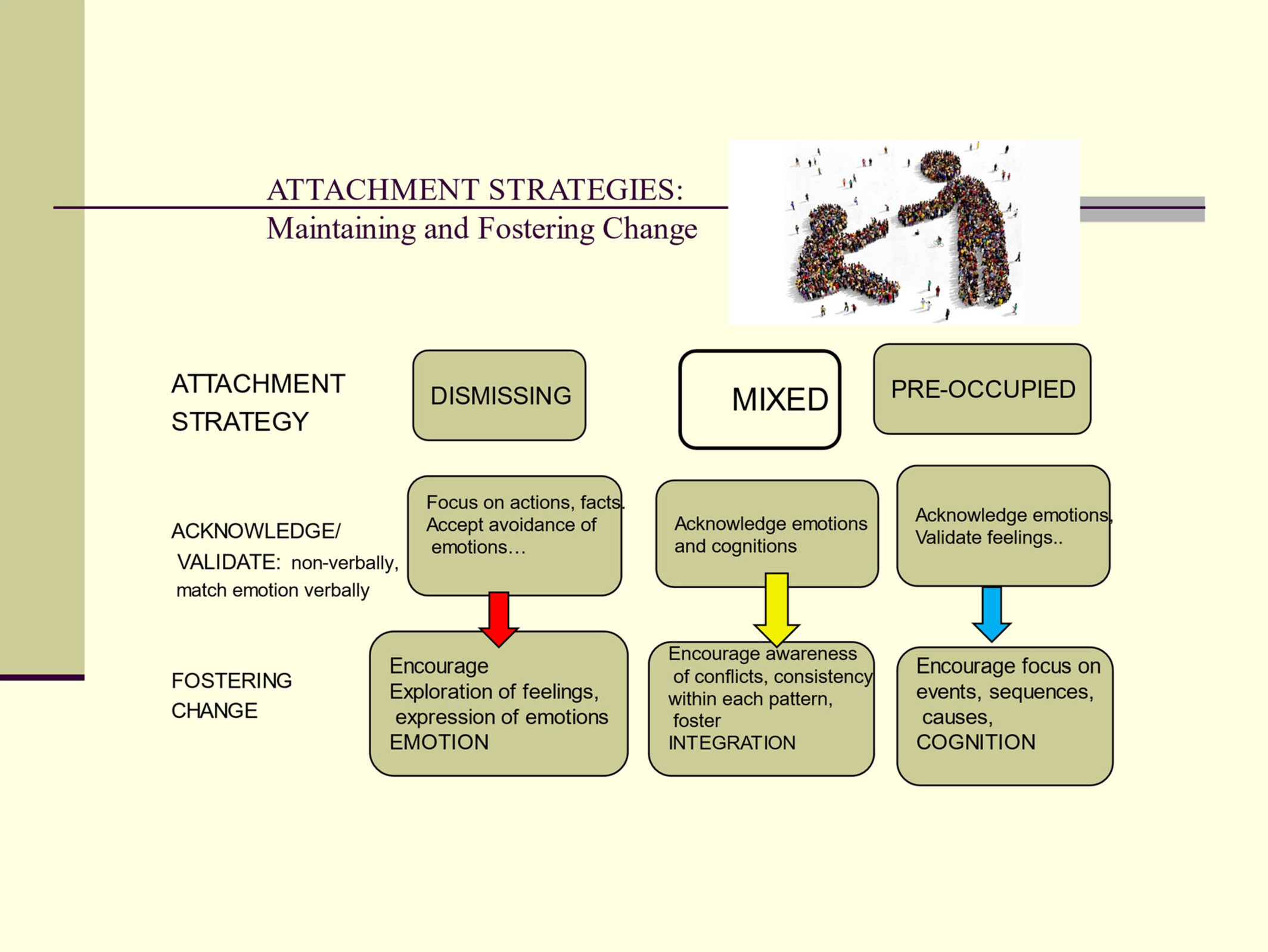
This centres on trying to meet people initially with where they feel emotionally safe and comfortable. For the dismissing patterns, we focus on facts and explanations and gradually encourage exploration of feelings, whereas for the preoccupied patterns, we focus on emotions and gradually focus on cognition and patterns.
But when we are working with family groups, it is already too limiting. What feels safe for one member of the family may not be so for another. In a piece of research interviewing children about their experience of family therapy, we were surprised that many of them found it an aversive and unsafe experience (Strickland-Clark et al. 2000). They mentioned that they felt intimidated being in a room full of adults, being in the spotlight, and felt blamed for the problems in the family, wary that their parents might punish them after the session if they said the wrong thing. This research illustrates the ethical value of research—it might have been easy to assume that because systemic therapy adopts a non-blaming approach, it would be better for the referred child. Of course, parents can also feel unsafe. In one family with a 14-year-old daughter presenting with anorexia, RD asked how they wanted to start: Should everyone have a chance to say why they had come, what would be helpful, or shall we just talk all together? The father and daughter said yes having a chance to have their say sounded good, but the mother said she did not want that since at home whenever she spoke her mind, she felt her daughter, and often her husband, would criticise her. It felt unsafe for her to have the possibility of that happening in the session. RD acknowledged what had been said, thanked them all for their feedback and explored what talking about talking might be like in this new context. He proceeded slowly and explored what safe connections can feel like and how they could create those conditions here.
Perhaps inevitably in a paper on this topic, we flow towards not just asking whether theory is useful anymore in systemic family therapy but what theories ‘we’ find useful. So now we are straying into one of our favourite theoretical frameworks, namely attachment theory. Attachment theory has been extensively researched and has evolved further into a theory of adaptation in the face of relational danger, safety and protection, and co-regulation of arousal responding, although it is worth mentioning that attachment theory was always an amalgam of theoretical perspectives: psychodynamic, cognitive neuroscience, evolutionary biology, ethology and systemic theory—a developmental theory of the social regulation of emotion in family groups. The secure base is regarded as a self-correcting system based on feedback (co-regulation): This child and the parent are seen to interact to maintain a comfortable emotional state that is not overly excited and anxious nor overly flat and inactive. The child is encouraged to explore and take risks as well as to be confident that they will be comforted and reassured as needed.
2 Conceptualising the Therapeutic Relationship
But Bowlby's ideas are just one of a variety of conceptualisations about the therapeutic relationship. The origins can be traced further back to psychodynamic theory and the centrality of the relationship to promoting change. This includes the ideas of unconscious dynamics being played out in the therapeutic relationship such as transference and counter transference, projection, and projective identification. The therapist engaged in extensive personal therapy to avoid becoming unhelpfully entangled and resonant with the client's unconscious processes. In person-centred therapy (Rogers 1972), the therapeutic relationship was also seen as central, and the central features of it were seen as acceptance, genuineness, warmth and unconditional positive regard. The role of the therapist in this relationship was to listen, empathise and not attempt to overtly direct the therapy. In another example, a sort of meta-model not particularly tied to a therapeutic model can be seen in Bordin's (1979) view of the therapeutic relationship as containing three key components: the relational/emotional connection, a shared view of what are the problems to be addressed and an agreement about what should be done about it. He suggested that all three needed to be present. For example, I might find my therapist to be kind, sympathetic and nice, but if we disagree on what the problem is and what to do about it, the positive feelings may deteriorate. For us, the most common example of a challenge to the formation of a trusting therapeutic relationship is a reluctance to accept diagnostic labels as explanations for problems when in fact they are descriptions, and nor would we want to support medication as the primary solution to relational distress (Dallos and Vetere 2022). This means we try to remain open, present and interested in divergent viewpoints, sometimes exploring how we might talk about these matters, and tracking the relational consequences of differences in opinions. Very often, we are asked to assist people in adapting and living with their diagnoses, whether or not they bring relief to the people concerned. Supervision is key for us in both managing and balancing our responses and in holding the safety and trust in the therapeutic relationship in mind at all times.
3 Systemic Therapy and the Therapeutic Relationship
In systemic family therapy, the therapeutic relationship has been conceptualised in various ways. Minuchin (1974) has written more extensively, for example, referring to the process of ‘joining’ the family and ‘accommodating’ to the family. Joining emphasises the actions of the therapist, whereas accommodating emphasises the adjustments the therapist makes to facilitate joining. Interestingly, and not too dissimilar to Bowlby (1973), Minuchin saw himself as becoming like a member of the family, such as an uncle or grandparent. Part of this activity was to reflect on what feelings and thoughts this would trigger for the therapist and how to employ these to facilitate change. Springing from this, Minuchin would sometimes employ the therapeutic relationship strategically, for example, deliberately and temporarily allying with one family member to reveal hidden conflicts or triangulations.
Perhaps, one of the most influential positions adopted in UK-based systemic family therapy has been the concept of neutrality or curiosity most clearly described by the Milan group (Cecchin 1987). Here, the therapeutic relationship is not seen in individual terms but as a relationship to the family system. The therapists try to support the system but attempt to avoid becoming drawn into the family emotional dynamics or taking sides with any members of the family. Although described as a stark contrast to psychodynamic practice, there is an interesting resonance in the systemic therapist attempting a sort of cool detachment to the therapist offering a ‘blank screen’. We can note that the Milan team were all originally psychodynamically trained and worked with families with long-standing and deeply entrenched difficulties with disordered eating and psychosis. The development of their emotionally cooler positioning with the aid of circular questioning was designed to facilitate a more reflective and cognitive space for family members who found it emotionally harder to disentangle themselves.
What was exciting in our early experience of systemic family therapy was the openness and visibility of systemic family therapy, initially being able to see transcripts of therapeutic conversations that had taken place. This was especially in contrast to psychodynamic practice, which was ‘private’, where we could not see what exactly the therapist had done and said. With the advent of video recording, this became all the more exciting as we could see what therapists like Minuchin actually say and do in sessions. In this little sequence, we have a little window into seeing what Minuchin does in a session and how he responds to a mother saying she is nervous. This was in part because she was told a famous therapist would come to co-consult to their current family therapist.
Suzanne—mother, Marcy—daughter
Suzanne:: um I was—I have to tell you I'm very nervous about today coming to see you (gazes at Minuchin)
Minuchin:: uh, uh so am I, so that's good w- we are nervous together.
Minuchin and Suzanne shake hands
Suzanne:: hh … he … laughing
Minuchin:: you see that's why I am smoking
Suzanne:: okay? (looking to Marcy)
Marcy:: No, I am not so anxious
Minuchin:: No? so you see we should learn from her …
The extract is taken from the paper by Peter Muntigla and Horvatha (2016). Conversational analysis helps us to look into detail at what happens in therapy (Peter Muntigla and Horvatha 2016). Interestingly, here we do not see so much of Minuchin's structural family theory but the use of a bit of playful humour to engage with the mother and with some teasing of the daughter. But we would also suggest that we can see how he is carefully but rapidly building a secure base or warm relationship with both of them. Part of this is an acknowledgement of the anxiety that the mother is feeling but also an admission from Minuchin that he is also feeling anxious. Interestingly, conversational analysis is a theory of how language use follows predictable patterns but what we think it reveals here is Minuchin's theory about how to connect with people emotionally and that this is central to the therapy. As an aside, we can note the historical nature of this extract taken from Minuchin's work back in 1974, when cigarette smoking still happened in therapy sessions. Maybe the contemporary equivalent is looking at our mobile phones?
4 Conclusion
The aim of this series of papers was to promote discussion broadly regarding the role of theory in contemporary systemic family therapy. We can add here that certainly in the UK, many senior family therapists seem enchanted not just by psychological and sociological theory but also by philosophy. They might even go so far as to suggest that what we need is less psychological theory and more philosophical reflection, which is made clear in this paper and our stand in this regard. We return to Lewin's concept that ‘There is Nothing More Practical Than A Good Theory’ (Lewin 1939) and add that in theory, we think there is perhaps nothing more practical than a good theory about the therapeutic relationship. As stated at the start of this article, we need theory to aid formulation practice, but even more importantly, as the base on which we are ethically accountable for practice—for what we know, and how we know it. Nowhere is this more important than in the questions we raised concerning diagnosis. We should not forget, for example, that a diagnosis of ADHD, autism or psychosis may be something that is likely to be for life. What are the ethical questions in assigning a child as young as three years old to a diagnostic label when the probable multiple, intersecting causes may just as likely be related to adaptation to dangerous experiences than to a biologically inherited disorder.
Formulation is a crucial practice in all the psychotherapies, whereby explanations for experience are brought together with an evidence base for practice within an ethical framework of conduct. This guides and directs action for all participants, within an iterative process of feedback and action. Formulation is emancipatory in intent and provides accountability for practice. But, for example, parents might disagree and suggest that they need a diagnosis to get access to essential support for their child at school, and our perceived reluctance to support their ideas about this might be seen as unsympathetic and damage our therapeutic relationship with them. Our focus would be on helping to secure the support their child needs, expanding the view of their child, and recruiting and supporting the parents' resources rather than relying on descriptions of behaviour or diagnoses to determine the ways forward.
We think the field of the systemic psychotherapies has made an important contribution to these dilemmas by supporting and attempting collaborative and integrative formulation practices. For example, the position of curiosity and invitations for families to work together with us through ongoing, iterative exploration of problems and relationships around them is exceptionally helpful. But we theorise that we are not predominantly concerned with developing ‘new meanings’ but in establishing a safe base from which exploration can be fostered. It is from this warm, rich soil of safety that curiosity starts to flourish and families are able to take the risk of moving away from the unsafe certainty (Mason 2022) of diagnostic labelling to developing helpful relational theories about their lives. In this, as therapists, we pay attention to the weave of content and process, mediated by shared and reflective observation. Exploration and formulation—what we might call a collaborative assessment of difficulties—is not a one-off activity. Our practice of following the feedback in meetings, checking our developing understandings with all concerned and remaining open to revising such understandings in the light of ‘new’ information keeps us accountable to all for our thinking and actions (Vetere and Dallos 2003).
Complexe Systémique: key points
This text has the liveliness of a symposium position paper rather than the rigour of a study: it argues that the therapeutic relationship should stop being the ‘common factor’ whose effect is noted without being explained. The proposal is clear: safety before meaning. Before co-constructing new meanings, each family member must feel safe enough to explore, and what reassures one may threaten another, as shown by the children who experience the family session as a courtroom or the mother who fears being criticised. The grid based on attachment strategies, starting from facts with some and from emotions with others, is simple and directly usable. The excerpt in which Minuchin answers a mother’s anxiety by admitting his own serves as a demonstration. The case against diagnosis, asserted more than substantiated, and the weight given to neuroscience are open to debate; the practical question remains: how to keep the alliance with parents who hold on to their child’s diagnosis? Read alongside the article on the relational reframe in attachment-based family therapy, and the article on neutrality in therapy.
References
Ainsworth, M. D. S., R. M. C. Blehar, E. Waters, and S. Wall. 1978. Patterns of Attachment: A Psychological Study of the Strange Situation. Erlbaum.
Anderson, H., and H. A. Goolishan. 1988. “Human Systems as Linguistic Systems: Preliminary and Evolving Ideas About the Implications for Clinical Theory.” Family Process 27: 371–393.
Bateson, G., D. Jackson, and J. Weakland. 1956. “Toward a Theory of Schizophrenia.” Behavioral Science 1: 25–264.
Bordin, E. S. 1979. “The Generalizability of the Psychoanalytic Concept of the Working Alliance.” Psychotherapy: Theory, Research and Practice 16, no. 3: 252–260. https://doi.org/10.1037/h0085885.
Bowlby, J. 1973. Attachment and Loss. Vol. 2: Separation: Anxiety and Anger. Basic Books.
Bowlby, J. 1988. A Secure Base. Basic Books.
Cecchin, G. 1987. “Hypothesizing, Neutrality and Circularity Revisited: An Invitation to Curiosity.” Family Process 26: 405–414.
Crittenden, P., and A. Landini. 2011. Assessing Adult Attachment. Norton.
Dallos, R., and A. Vetere. 2022. Systemic Therapy and Attachment Narratives. Applications in a Range of Clinical Settings. 2nd ed. Routledge.
Gottman, J. 2011. The Science of Trust. Norton.
Johnstone, L., and R. Dallos. 2013. Formulation in Psychology and Psychotherapy. 2nd ed. Routledge.
Kelly, G. A. 1955. The Psychology of Personal Constructs. W.W. Norton.
Lewin, K. 1939. “Field Theory and Experiment in Social Psychology: Concepts and Methods.” American Journal of Sociology 44: 868–896.
Mason, B. 2022. “Towards Positions of Safe Uncertainty.” Human Systems: Therapy, Culture and Attachments 2: 54–63.
Mikulincer, M., and G. Goodman. 2006. Dynamics of Romantic Love. Norton.
Minuchin, S. 1974. Families and Family Therapy. Tavistock Publications.
O'Reilly, M., and K. Kiyimba. 2023. Communicating With Families: Taking the Language of Mental Health From Research to Practice. Palgrave.
Peter Muntigla, B., and A. O. Horvatha. 2016. “A Conversation Analytic Study of Building and Repairing the Alliance in Family Therapy.” Journal of Family Therapy 38: 102–119. https://doi.org/10.1111/1467-6427.1210.
Porges, S. W. 2022. “Polyvagal Theory: A Science of Safety.” Frontiers in Integrative Neuroscience 16: 871227.
Rober, P. 2024. Becoming and Effective Family Therapist. Routledge.
Rogers, C. 1972. Becoming Partners: Marriage and Its Alternatives. Delacourte Press.
Schore, J. R., and A. N. Schore. 2008. “Modern Attachment Theory: The Central Role of Affect Regulation in Development and Treatment.” Clinical Social Work Journal 36: 9–20.
Schore, J. R., and A. N. Schore. 2017. “ Regulation Theory and Affect Regulation Psychotherapy: A Clinical Primer.” In Neurobiology and Mental Health Clinical Practice, 44–61. Routledge.
Sheehan, J., and A. Vetere. 2023. “What's Love Got to do With it? A Systemic View of Agape. Human Systems, Online First.” https://doi.org/10.1177/26344041231205288.
Siegel, D. 2016. Mind: A Journey to the Heart of Being Human. Norton.
Strickland-Clark, L., D. Campbell, and R. Dallos. 2000. “Children's and Adolescent's Views on Family Therapy.” Journal of Family Therapy 22, no. 3: 324–341.
Van der Kolk, B. 2014. The Body Keeps the Score. Penguin.
Vetere, A. L., and R. Dallos. 2003. Working Systemically With Families: Formulation, Intervention and Evaluation. Karnac.
Vetere, A. 2024. “We Cannot Find Peace in Restlessness. How the Neurtoscience Supports Psychotherapeutic Practice.” Human Systems 4, no. 2: 84–95.
Wampold, B. 2011. “ Qualities and Actions of Effective Therapists.” In Continuing Education in Psychology. American Psychological Association.
Wampold, B. 2017. “ How to Use Research to Become More Effective Therapists.” In Routine Outcome Monitoring in Couple and Family Therapy, edited by T. Tilden and B. Wampold. Springer.
White, M. 1995. Re-Authoring Lives: Interviews and Essays, 3–21. Dulwich centre Publications.
Reformatted republication of ‘What Is the Place of Theory in Contemporary Family Therapy?’ Theorising the Concept of the Therapeutic Relationship, by Rudi Dallos and Arlene Vetere, Australian and New Zealand Journal of Family Therapy, vol. 46, no 4 (2025), doi: 10.1002/anzf.70039, under a CC BY 4.0 licence. Edition and layout: Complexe Systémique, September 2026 — the work has been modified under the terms of the licence. Neither the authors nor the publisher are responsible for this edition; the original version prevails.
This is the original article “‘What Is the Place of Theory in Contemporary Family Therapy?’ Theorising the Concept of the Therapeutic Relationship”, published in Australian and New Zealand Journal of Family Therapy (2025) under a CC BY 4.0 licence. Republished by Complexe Systémique: the author’s text is unchanged; only the presentation has been adapted for reading online, as set out at the head of this page.
Read the original articleHow to cite this article
Dallos, R., et Vetere, A. (2025). ‘What Is the Place of Theory in Contemporary Family Therapy?’ Theorising the Concept of the Therapeutic Relationship. Complexe Systémique. https://app.complexe-systemique.com/en_GB/articles/what-is-the-place-of-theory-in-family-therapy-theorising-the-therapeutic-relationship (Original work published in 2025 in Australian and New Zealand Journal of Family Therapy, 46(4), e70039 (2025); republished in 2025 by Australian and New Zealand Journal of Family Therapy, https://onlinelibrary.wiley.com/doi/full/10.1002/anzf.70039)
To go further
- Anatomy of the Relational Reframe in Attachment‐Based Family TherapyThe relational reframe.
- Neutrality in therapy: deconstructing a myth?Neutrality in therapy.
- Creating a common language: how SFBT reflects current principles of change and common factorsCommon factors.
Related training courses
 Certifying course
Training in Systemic Therapy and Interventions – Cycle 1
Certifying training cycle in systemic therapy and interventions – year 1. Courses, supervision and practice, aligned with EFTA/SFTF. In French.
 Certifying course
Training in Systemic Therapy and Interventions – Cycle 2
Certifying training cycle in systemic therapy and interventions – year 2. Clinical complexity, supervision and practice. EFTA/SFTF aligned. In French.
 Certifying course
Training in Systemic Therapy and Interventions – Cycle 3
Certifying training cycle in systemic therapy and interventions – year 3. In-depth intervention, supervision and practice. EFTA/SFTF aligned. In French.
 Certifying course
Training in Systemic Therapy and Interventions – Cycle 4
Certifying training cycle in systemic therapy and interventions – year 4. Clinical integration, supervision and certification. EFTA/SFTF. In French.
Related articles
 Article
 Toxic, narcissistic, borderline: what therapy speak does to your relationships
Narcissistic, borderline, toxic: therapy speak has left the consulting room. Julien Besse shows how these labels close the debate and relieve us of our own part.
 Article
 Family Systems and Cultural Adaptation in Psychosocial Cancer Interventions for Latinx Families: A Critical Review
Nine family-based psychosocial cancer interventions under scrutiny: few measure the family as a system, and the culture of Latinx families is almost absent.
 Article
 Relational Therapy in Post‐Incarceration Reentry: A Scoping Review
What does the literature say about relational therapy after prison? A review of 19 articles: decisive family bonds, almost no tested model, nothing on couples.
 Article
 Multi‐Family Therapy in East and Southeast Asia—A Systematic Review and Meta‐Synthesis
17 studies in China, Hong Kong and Singapore: multi-family therapy mainly improves symptoms, but families describe a relational change that scales capture poorly.