Psychology and Psychotherapy: Theory, Research and Practice · Psychiatry
Parents who experience psychosis: A qualitative exploration
What is it like to raise children while experiencing psychosis? In Manchester, Claire Harries and Anja Wittkowski’s team interviewed at length five mothers and three fathers seen in early intervention services. Their accounts describe a struggle made of fear and shame, children who quieten the voices, and services so focused on risk that parenting feels like living under surveillance.
This is a reformatted republication of Parents who experience psychosis: A qualitative exploration, by Claire I. Harries, Debbie M. Smith, Lynsey Gregg, Rory Allott and Anja Wittkowski, published in Psychology and Psychotherapy: Theory, Research and Practice (Wiley) (2023), doi: 10.1111/papt.12458, under a CC BY 4.0 licence. Prepared by Complexe Systémique in September 2026: the authors’ text is unchanged; the layout has been adapted for reading online, which constitutes a modification of the work under the terms of the licence. The end-of-article statements are gathered in the notes. This edition was made neither by the authors nor by the publisher, who are not responsible for its content or for any errors. The original version prevails.
When I’m with my children, I hear nothing. But when I’m on my own I can hear those voices.
Amir, quoted by Claire I. Harries, Debbie M. Smith, Lynsey Gregg, Rory Allott and Anja Wittkowski
Abstract
Objectives. Psychosis can present parents with complex parenting challenges and significant adverse outcomes for parents and their children have been reported. However, remarkably little is known about how parenting is experienced by these parents. Therefore, this qualitative study aimed to understand the lived experiences of parents with psychosis, including how parenting support was experienced.
Design and Methods. Using interpretative phenomenological analysis (IPA), eight biological parents (five mothers and three fathers) with psychosis were recruited and interviewed from early intervention in psychosis services in the Northwest of England.
Results. Three superordinate themes and seven subordinate themes were identified. Theme 1 ‘Living with the Struggle: Painfully Disconnected’ captured a persistent parenting struggle that distanced parents from their children and support due to all-consuming experiences of psychosis, fear and risk-focused service support. Theme 2 ‘Desired and Vulnerable Position: Comfortably Connected’ captured parental experiences of symptom relief through connection with their children, alongside parental need to be integrated with the systems around them. Theme 3 ‘Exposed: Parenting Under a Spotlight’ represented parental experiences of inescapable observation and judgement from the systems around them.
Conclusions. Novel insights into the role of misaligned parent and service priorities in parental perceptions of powerlessness, shame and disconnection from their children, valued parenting identities, and system supports are presented. Systemic interventions that target stigma, provide system-wide psychoeducation and promote person-centred, compassionate and meaningful connections between parents and the systems they live within are needed to promote better parenting outcomes.
Practitioner Points
- Parental status should be asked about and recognised by services and practitioners.
- Practitioners should move away from risk-focused approaches and provide systemic interventions that target stigma and promote family-centred, compassionate and meaningful connections between parents and the systems they live within.
- Practitioners should compassionately support parents, including supporting them to connect with and maintain their parental identity.
INTRODUCTION
Approximately 440,000 adults in the UK experience psychosis (McManus et al., 2016) and over a third are parents (Radley, Barlow, & Johns, 2022a). Parents who experience psychosis face a multitude of challenges (Campbell et al., 2018), including difficulties in managing responsibilities (Strand et al., 2020), balancing their own and their children's needs (Khalifeh et al., 2009) and relationships (Ackerson, 2003; Gregg et al., 2021). These difficulties have been associated with adverse social, emotional and behavioural outcomes in children (Mowbray et al., 2006; Rasic et al., 2014). Despite the prevalence of parents who experience psychosis and the recognised adverse parenting outcomes, remarkably little is known about how these parents experience and navigate parenthood, including their experiences of parenting support (Radley, Sivarajah, et al., 2022; Strand et al., 2020). Consequently, parental support needs remain inadequately understood (Bee et al., 2014) which limits developments in evidence-based practice (Skivington et al., 2021).
To our knowledge, only five qualitative studies have sought parental views about how experiences of psychosis impact parenting. In Sweden, Strand et al. (2020) explored the experiences of 15 parents experiencing psychosis using thematic analysis (Braun & Clarke, 2006), while Boström and Strand (2021) explored the experiences of six parents experiencing psychosis and their seven children using interpretative phenomenological analysis (IPA; Smith & Osborn, 2003). In the United Kingdom, Evenson et al. (2008) analysed the narratives of ten fathers experiencing psychosis using IPA, while Radley, Barlow, & Johns (2022b) explored the accounts of 12 parents with psychosis using reflexive thematic analysis (Braun & Clarke, 2006, 2020). A family perspective was also sought by Radley, Barlow, & Johns (2022c) in the United Kingdom, who explored the perspectives of five parents, four children, three partners and one grandparent about how psychosis impacts the family unit using multiperspective IPA (Larkin et al., 2019; Smith et al., 2009). Across these five studies, challenges in managing parent–child relationships alongside experiences of psychosis were highlighted. However, none of these studies sought parental views about parenting support accessed or offered. Additionally, studies that have explored parenting in relation to wider mental health difficulties have mostly restricted their focus to maternal experiences (e.g. Dolman et al., 2013), thus overlooking the integral role of fathers (Bakel & Hall, 2020). Moreover, only three qualitative studies exploring parenting experiences in psychosis were conducted in the United Kingdom (Evenson et al., 2008; Radley, Barlow, & Johns 2022b; Radley, Barlow, & Johns, 2022c), and significant socio-economic and political change has occurred since 2008. In particular, the impact of parenting has become more recognised (Allen, 2011); Early Intervention in Psychosis services (EIPs) have become embedded in health care provision (National Institute for Health and Excellence [NICE], 2016) and the National Health Service (NHS) have committed to improving services for parents and children (The NHS Long Term Plan; NHS England, 2019).
The NHS long-term plan (NHS, 2019) proposes the implementation of evidence-based family-focused practice (FFP) approaches (Bee et al., 2014). If we are to improve parenting outcomes, an in-depth understanding of how parenting is experienced by mothers and fathers who experience psychosis, including their experiences of support, is required. Thus, we sought to explore the experiences of parents who experience psychosis. The primary aim was to explore how these parents experienced parenting, the meanings they assigned to their experiences, and the support offered to them. We specifically addressed the question ‘What is it like to be a parent who experiences psychosis?’
METHOD
Design
This qualitative study employed IPA (Smith & Osborn, 2003), which promotes in-depth exploration of the lived experiences of people with complex experiences (Larkin et al., 2006; Smith et al., 2009) and allows exploration of patterns and divergences within and across participant narratives (Murray & Wilde, 2020). This methodology, which allowed the consideration of a high level of personal detail and lived experience (Larkin et al., 2006), was chosen because this study sought to make sense of a small group of parents' experiences and views relative to individual meaning (Smith & Osborn, 2003). A double hermeneutic phenomenological approach was employed to encourage ‘insider perspective’ of parents' experiences. Facilitated by use of a reflective diary and discussions with the wider research team, exploration of the first author's own world and interpretive account in relation to parents' attempts to make sense of their own personal and social experiences (Smith, 2004; Tuffour, 2017) was an important part of the research process.
Ethics statement
Relevant approvals were obtained from NHS Research Ethics Committee (REC), the Health Research Authority, the local NHS Trust. Experts by experience were consulted during the research design process, in line with best practice UK legislative frameworks (HRA, 2021).
Participant inclusion and exclusion criteria
Participants were eligible if they were a biological, stepparent or kinship parent to children aged 0–18 who they had at least weekly contact with. Participants had to have experienced non-affective psychosis within the preceding 2 years as determined by a Diagnostic and Statistical Manual of mental disorders, fifth edition (DSM-V) symptom checklist (American Psychiatric Association [APA], 2013), were able to give informed consent and were registered with a general practitioner. Due to the requirement of IPA for individuals to talk in detail about their experiences (Smith et al., 2009), participants who were not proficient in English were excluded.
Recruitment
Participants were recruited from Early Interventions Services (EISs) in the Northwest of England. With the assumption that parents who experience psychosis are a hard-to-reach group (Wolfenden et al., 2022) due to stigma (Lacey et al., 2015), a convenience sampling approach, informed by purposive sampling, was adopted to ensure that participants could provide data relevant to the study aims.
Practitioners working at EISs identified eligible parents via caseload review, facilitated by an NHS collaborator. Practitioners contacted and provided eligible participants with a study advert and participant information sheet. Participants were required to complete a consent to contact form to indicate their interest in taking part, following which the first author made contact to determine eligibility, describe study procedures and discuss ethical considerations. Participants had 24 h to consider their participation, before being re-contacted, when an interview was arranged for a convenient time for the participant.
Data collection and analysis
Time was spent meeting with participants to promote rapport and participant comfort. Informed consent, verbally obtained over the telephone or in person, was audio-recorded using an encrypted device. Demographic information was collected to contextualise individual narratives and the overall sample. The first author conducted in-depth, semi-structured interviews with participants, which were recorded separately to consent procedures (see Appendix 1). A topic guide, which was developed in consultation with the literature, research team and experts by experience, was used flexibly with open-ended questions to explore areas most salient to participants (Smith et al., 2009; Smith & Osborn, 2003). The first author also conducted a pilot interview with a research team member to trial the appropriateness of the topic guide, allowing for refinements (Malmqvist et al., 2019). Following the interviews, participants were supported to reflect on their participation and were given a debrief sheet and signposted to support organisations. Participants were offered a £10 Amazon voucher for taking part.
The recommended dynamic stages of IPA were employed (Smith & Osborn, 2003). The first author listened to each interview several times to ensure content familiarisation, following which they transcribed interviews verbatim and subsequently checked them against audio recordings. To promote participant anonymity, participants were assigned a pseudonym and all identifiable information was omitted. The first author re-read each transcript multiple times and ‘bracketed’ any pre-existing assumptions, beliefs and initial reflections to gain awareness of any potential influences on interpretations of participants' narratives (Smith et al., 2009). The second author read each transcript and noted their own reflections.
The first author subsequently line-by-line coded each transcript using Microsoft Word, noting descriptive, linguistic and conceptual comments (Smith et al., 2009). Using these comments, patterns were explored within individual transcripts using Microsoft Excel, resulting in the development of exploratory comments and subordinate and superordinate themes. Themes were re-checked against each transcript to ensure the derived themes reflected each participant's narrative. Next, the first author led on exploring higher-level convergences across all transcripts using ‘post-it’ notes, following which superordinate and subordinate themes were defined. The final step involved translating the themes into a narrative account within the write-up.
Reflexive positioning
Acknowledging that qualitative research is influenced by researcher positioning (Smith et al., 2009), the role of reflexivity and considering the subjective positioning of researchers was an important process. Authors varied in age, gender, ethnicity and clinical experience. The first author was a white British practising trainee clinical psychologist who had several years of experience working with people who experienced psychosis. One author was a practising clinical psychologist working in adult psychosis services, one author was a practising clinical and academic psychologist specialising in perinatal psychology, and two authors were academic psychologists specialising in health psychology and psychosis research. The authors had a variety of personal experiences of parenting. Acknowledging that all authors were all interested in improving parental service provision, caution was applied to ensure this subjective position did not influence interpretative accounts towards a suggestion for parenting support that was not reflected in parents' narratives.
The research was approached from a critical realist (Bhaskar, 1978) positioning, underpinned by a constructivist epistemology. This positioning enabled consideration of why participants drew upon certain discourses to construct their realities, exploration of the impact of societal mechanisms and structures on discursive processes and consideration of the position of participants discourses within the societal structures and systems they lived within. The use of a reflective diary and regular supervision supported these processes.
Trustworthiness and rigour
To ensure that themes were ‘trustworthy’ and grounded in the data, the approach to analysis was iterative and reflexive (Tobin & Begley, 2004). In-depth discussions were held between the first and second author following analysis of each interview, ensuring that interpretation of themes was consistent with participants' stories, thus minimising risk of interpretations being influenced by researcher positioning (Smith et al., 2009). A reflective log and discussions with the research team supported the reflexive process (Yardley, 2000), particularly in promoting the incorporation of multiple perspectives to ensure balanced interpretations, the uncovering of unconscious influences, and in supporting authors in remaining ‘true’ to narratives while applying a ‘critical analytic lens’.
RESULTS
Participant characteristics
Eight biological parents (five mothers and three fathers) participated, representing an adequate sample size to achieve rich phenomenological insight (Noon, 2018; Smith et al., 2009). Interviews took place between April 2021 and March 2022, either over the telephone (n = 6), in a mental health care clinic (n = 1) or in the participant's home (n = 1), depending on participant preference and COVID-19 restrictions at the time. Interviews lasted between 67 and 93 minutes (M = 77, SD = 9).
Participants were aged 25 to 43 years (M = 33, SD = 6.6). Participants had between one and four children each (M = 2.6, SD = 1.2), with a total of 16 children between them (female = 8; male = 8). Children were aged 1 to 18 years (M = 7.6, SD = 5.2). Three parents lived with their children and partner, two lived with their children only and three lived alone. The majority were white British (n = 5), two were black African and one was white European. Five were single and three were married or in long-term relationships. Two lived in social housing, one lived with their parents and four rented privately. Four were unemployed, three worked part-time and one worked full time. Education was completed to GCSE (n = 1), A-level (n = 3), university (n = 1) and adult diploma (n = 3) level.
Qualitative findings
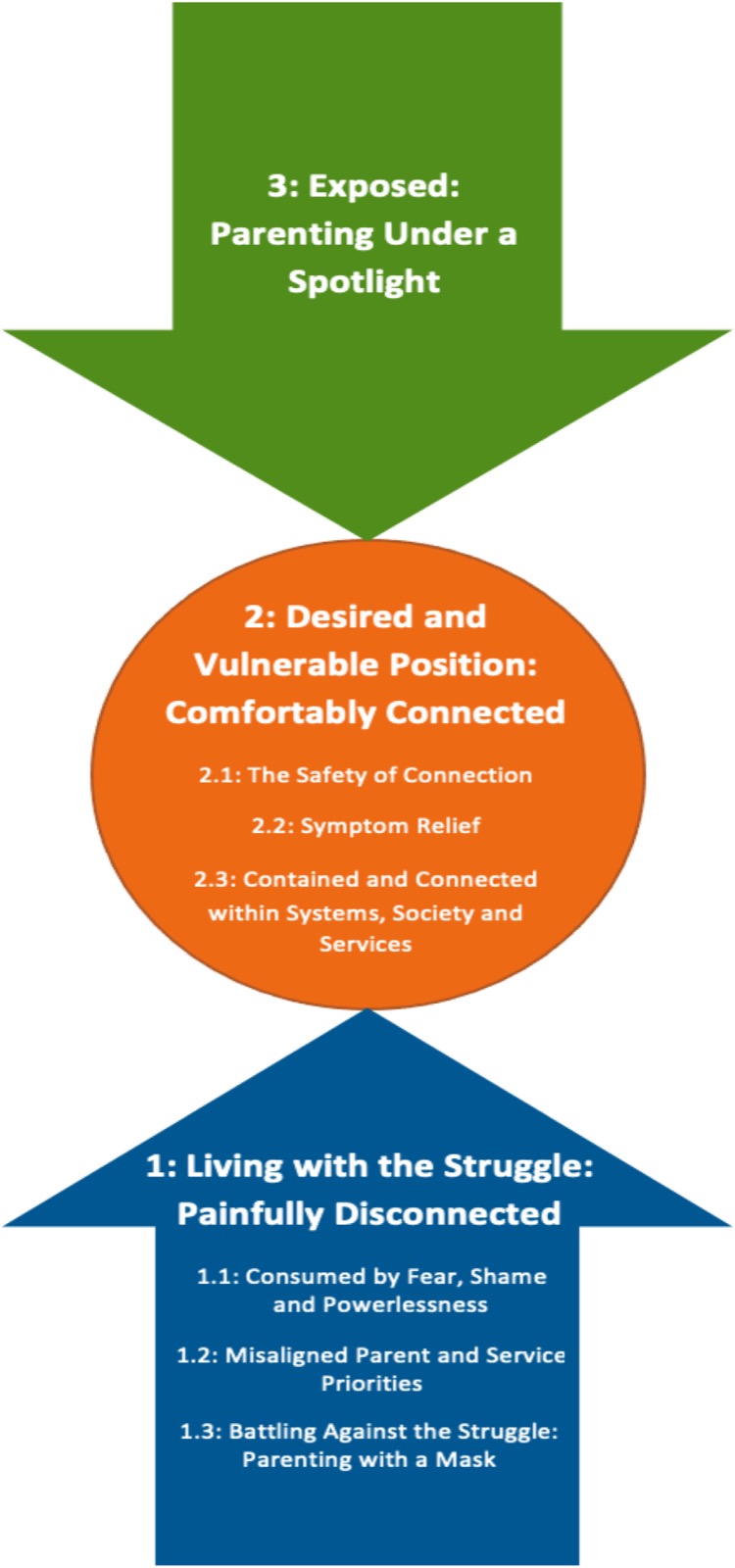
Three superordinate themes were generated: (1) Living with the Struggle: Painfully Disconnected, (2) Desired and Vulnerable Position: Comfortably Connected and (3) Exposed: Parenting Under a Spotlight. Figure 1 now represents the relationship between the three superordinate themes and six subordinate themes. The figure represents the influence of a persistent parenting struggle on a precariously balanced, hard-to-reach and hard-to-maintain desired position of parenting with comfort and connection: a vulnerable position threatened by inescapable experiences of exposure. The need for systemic intervention to promote parental experiences of connection, stability and security is indicated. Illustrative quotes are provided to highlight parent voice.
Superordinate theme 1: Living with the struggle: Painfully disconnected
Parents described a persistent and sometimes unmanageable parenting struggle impacted by intolerable distress and fears associated with experiences of psychosis, concerns about negatively impacting or losing their children and perceptions of powerlessness and shame. An incongruence between parental support needs and experiences of receiving risk-focused support exacerbated parents' sense of helplessness and a polarised sense of self. Consequently, parents were caught between hiding, performing and proving their parenting ability, leaving them feeling exhausted and disconnected from their children and a valued parenting identity. This theme consisted of three subordinate themes.
I'm not a parent anymore. Because of the psychosis. I feel like psychosis has destroyed my life. (Sharon)
Subordinate theme 1.1: Consumed by fear, shame and powerlessness
All parents described feeling consumed by an inescapable sense of fear and shame that thwarted their sense of safety. The fast pace that parents adopted to speak about fears of separation or harm coming to their children reflected a sense of desperation to escape fear. Several parents described feeling defenceless to voices that exploited their biggest fears, principally harm coming to their children, resulting in a ‘very strong sense of impending doom’ (Darren). Although not for all, this fear was unbearable for some, including Vanessa, who described feeling powerless to losing her son:
Frightened! Because some silly voice in your head, it can take my boy away. Very frightened, very not in control and not empowered. Very hopeless. (Vanessa)
Profound guilt and shame were associated with perceptions of parenting failure, particularly when parents were unable to maintain child contact, felt unable to manage parenting demands or felt consumed by thoughts or voices that capitalised on perceptions of ‘failure’. Parents who were limited from seeing their children, but not those that had continued contact, reflected feeling painfully alone, leading some to consider suicide. Janet described feeling inconsolable, desperately longing for reconnection: ‘I was crying the whole time…I found myself calling her name at night’. For others, fears about separation prevented parents from getting close to their children:
It's hard work. Especially when you've got like loads of paranoia and when you think that someone's gonna hurt your children all the time. You're kind of like distancing yourself away from your children so like you don't get hurt. (Sharon)
Parents' narratives about the emotional consequences of parenting while experiencing psychosis contained notable pauses, sighs, and tearfulness, particularly around descriptions of ‘depression’, ‘guilt’ and ‘fear’. Experiences of psychosis could exacerbate parenting challenges, resulting in parents feeling overwhelmed: ‘I struggle to keep up with the speed that she goes’ (Darren). Age-incongruent responsibilities were sometimes displaced onto children. When parents recognised this, guilt and shame were experienced profoundly:
They'd be worrying about me cause I was walking like a zombie, so that had an impact on them…Because they think, “look, my lovely bubbly mum is all of a sudden not alright, what's happening, are we doing anything wrong?” (Vanessa)
All parents described an unremitting fear of impacting their children negatively. Janet described being consumed by ‘worry that [daughter] will be bullied’ after experiencing ‘meltdowns’ in her neighbourhood. A sense of shame often accompanied fear, including for Lucy, who described feeling haunted by memories of her son witnessing her distress:
I sort of had a bit of a moment when I was sort of crying, shouting, “oh they're filming me, they're filming me. We need to ring the police.” And sort of he witnessed that. And it's just a bit scary to think of the impact that might have on him. (Lucy)
Compared to mothers, fathers reflected particularly profound experiences of feeling ‘ashamed’ and ‘embarrassed’ about a ‘limited’ ability to ‘provide’, reflecting a possible double male-based stigma associated with psychosis and gendered parenting roles. Chris reflected:
I know it plays on my head as if, if I didn't have these mental health issues, if I didn't have the psychosis, I wouldn't be in this position. I'd be still in work, I'd still be working and I'd be providing everything I could for her [voice quivers]. (Chris)
Subordinate theme 1.2: Misaligned parent and service priorities
Parents reflected that parenting difficulties were exacerbated by an absence of compassionate service support. Parental needs were described to be inadequately considered by services, contrasting with the centrality of their parenting identities in their lives. In particular, fathers more than mothers perceived services to discount the contribution of parenting to their experience of distress and described that a family systems approach was missing:
Nothing really came up about being a dad I don't think whilst I was in hospital. Cos they were very much trying to sort of look at you as an individual, and yeah they didn't really ask me about what it was like missing my daughter. (Darren)
Chris reflected feeling consumed by frustration and disappointment about the lack of support available to single fathers, which served to distance him from his children and resulted in him feeling unsupported by a system that he perceived to be stigmatising:
The amount of help you get as a single dad with mental health is shocking…There's nothing there at all. Literally. (Chris)
Many parents reflected that services unhelpfully focused on risk, an aversive threat-focus perceived as ‘overkill’. A barrier to talking about parenting difficulties was presented, creating distance between parents and the compassionate support they desired, while intensifying parental experiences of mistrust:
Even though every day is a struggle for me, it doesn't necessary mean that he's in danger. And I feel like when, when you first come round from, when you first come out with “listen I'm struggling and I'm being honest,” straight away all of these alarms start going off with social services. It makes you worse. (Lauren)
All but one parent reflected feeling exasperated by repeated practitioner-led risk-focused questions that served to undermine their sense of being heard and understood. Vanessa reflected:
You feel like screaming. You feel like saying like, “now listen, just help.” You just, you just wanna say, excuse my language, “shut up, and can you please try to understand”.
Parents reflected a fundamental need to remain close to their children; a consideration that was not perceived to be wholly supported by services. Sharon demonstrated significant distress associated with feeling that her parenting needs were disregarded, leaving her feeling isolated and desperately longing to have her voice heard: ‘No one's listening to me about what my children need. They need to come home’.
Subordinate theme 1.3: Battling against the struggle: Parenting with a mask
The language that parents used to describe parenting while experiencing psychosis conveyed a sense of endurance; a challenging ‘parenting performance’ that was fronted by a parenting façade that parents hoped would protect themselves, their children and their parenting identity:
I try to stay strong, so a lot of people don't know about my mental health. In fact nobody does. Cos I wear a face full of make-up and I put a strong, strong act on. (Lauren)
The parenting struggle was amplified for those who faced parental challenges without family or peer support. A sense of dependence on the ability to use different ‘hats’ was described which allowed these parents to function despite experiencing emotional distress. Janet reflected:
As a single parent you just put on a hat, and you're like, I have to play both the roles. So feeling helpless is not acceptable
Other parents reflected detaching from emotional pain and attempting to ‘project a happy persona’ (Darren), to allow themselves to fulfil their parenting roles to combat distress and promote connection with their children. Lucy described:
I think there's an element of faking it…fake it until you make it, where you're faking sort of being happy and positive, but from it, it sort of turns into real happiness. (Lucy)
Parents often faced the parenting battle alone. Fears about parenting ‘failure’ and losing their children, exacerbated by societal stigma and lack of support, amplified parent's need to ‘prove’ and ‘protect’ their parental identity. For some, protection meant ‘staying inside’ to defend against threatening voices and fears about the outside world. For others, protecting meant concealing their mental health difficulties from their children, family and society by exerting control over their words and actions. Chris described battling against displaying distress in front of his daughter, attempting to protect a ‘strong’ identity by hiding tears.
Superordinate theme 2: Desired and vulnerable position: Comfortably connected
This theme captured parents desired parenting position: an environment within which they felt safely connected to their children and their parenting identity and supported by systems around them. However, this position was vulnerable, difficult to balance and could be easily tipped by the conditions around parents which could quickly force parents back into the struggle. This theme consisted of three subordinate themes.
Subordinate theme 2.1: The safety of connection
When describing their feelings about relationships with their children, parents spoke softly, reflecting a sense of safety, relief and comfort, with words including ‘joy’, ‘love’, ‘pure’ and ‘hope’ featuring. When describing being with her children, Sharon reflected: ‘It feels like I'm at home, like I'm safe’.
The safety and comfort that parents experienced when they were with their children were cherished states, contrasting with the fear of disconnection that was central in the struggle. For many, the fear of other people invading this position led to ‘protective’ parenting. Several parents, including Lauren, reflected a need to stay especially close to their children to combat fears about harm coming to their children or their relationship: ‘I'm very erm protective over him’. Several parents reflected that their desire to ensure a close relationship with their children stemmed from painful memories of their own childhoods, within which relationships with their parents featured abuse and insecurity. For these parents, being close with their own children offered an opportunity to remedy the pain of their past:
I kind of missed a full family unit, which is why I decided my family is gonna be full. (Vanessa)
Physical closeness to children was particularly important for parents who lived apart from their children. Parental fears about being permanently disconnected from their children and families were distressing experiences. Some parents, including Darren, described utilising experiences of psychosis to promote a sense of resolve and reconnection; a product of feeling desperately fearful about the prospect of long-term disconnection:
I thought my wife had killed herself, and I thought my baby was like motherless and someone was looking after her. But, yeah, then I sort of did this thing where I sort of re-started time and made time go backwards so my wife wasn't dead again. (Darren)
Some parents described an especially close relationship with their children. For many, this was associated with children providing safety from distress: ‘That my little boy is my saviour. He saves me’ (Lauren), protecting parents from suicidal thoughts and behaviours, or thoughts about being ‘worthless’:
I love it, I love it. Cos it's like, sometimes in my head I could be the worst person in the world. But then to have her there, clinging to me and everything like that, it reminds me I'm not [voice quivers]. (Chris)
Subordinate theme 2.2: Symptom relief
A sense of wonder was evident in parents' narratives when they described the powerful ‘relief’ from distress that they experienced when they were with their children, and parents projected pride when describing joyful connection with their children: ‘the moments of love and joy that you have, and pride’ (Lucy).
For some, distressing experiences of psychosis were relieved through relationships that they held with their children only; a relief not presented by other relationships. Crucially, parents reflected that significant symptom relief was experienced only when they were physically with their children. Amir reflected:
When I'm with my children, I hear nothing. But when I'm on my own I can hear those voices. (Amir)
Some parents reflected insight into the role that relational comfort with their children played in promoting symptom relief. Chris described experiencing respite from experiencing distressing thoughts and voices when he was with his children, conceptualising the contact as a ‘cure’: ‘It pretty much just like mends my head’. Other parents, including Lucy, reflected that contact with their children provided temporary, but valuable distraction from distress:
I think because you're sort of engaging in sort of activities with him, and sort of playing and joking around, it can just sort of make you forget about the negatives for a bit. (Lucy)
Relief from distress was conceptualised by some parents as a special ‘power’; a tool to fight suffering promoted by the responsibility of parenthood. Parenthood represented a ‘turning point’ for some, presenting an opportunity to overcome difficult life experiences: ‘I'm a better person now. I think it's definitely strengthened me as a person’ (Darren).
Although relief from distress was welcomed, some parents reflected guilt associated with a sense of reliance on their children to alleviate their distress. Chris reflected: ‘I can't use my daughter as a crutch’. A sense of shame was demonstrated in these parents' narratives, reflecting the overpowering pull of the parenting struggle. Thus, a delicate emotional balance between appreciating relief and experiencing guilt was presented. Darren summarised: ‘It's been both a blessing and curse’.
Subordinate theme 2.3: Contained and connected within systems, society and services
Feeling connected to and contained within the systems parents lived within was highly valued within parents' narratives: ‘I know that people are around me, so I'm safe’ (Amir). For parents who had good family and peer support, a sense of relief was communicated when they described being able to rely on family systems for childcare support. However, many parents were not afforded this support: ‘I wish there was something there that I could just grasp for help’ (Chris). Among these parents, a strong message of parents requiring additional, reliable and consistent service support was notable:
For me, the most important thing, erm, if the person is going through that alone, is having someone that they can count on. (Janet)
Parents described longing to be understood by their family and peer networks to ‘fit in’ and combat experiences of stigma. The desired role of compassion featured heavily in parental reflections about the desired characteristics of supportive others. Parents wanted to be supported by professionals who were on their ‘level’ who they could ‘click with’. A compassionate approach was seen as particularly important for professionals to harness when discussing parenting challenges. Janet described that a social worker's nurturing approach eradicated a barrier of shame that previously prevented her from accessing support:
She was like a mother figure. And that, this was when I opened up to her about the voices. (Janet)
Similarly, several parents reflected a desire to be connected with others with lived experience of psychosis to promote a sense of support and to reduce feelings of ‘difference’. These parents wanted to be integrated with parenting communities, while simultaneously learning strategies to combat the parenting struggle. Chris reflected:
It would just give her [daughter] a better grasp on things. Just hearing it…and seeing other people and other people interacting with their kids that are the same. And it's just, yeah it would make her realise that her daddy's not the only one, it's not weird. (Chris)
Superordinate theme 3: Exposed: Parenting under a spotlight
This theme conceptualised how parents experienced the seemingly inescapable watch of peer, family and wider systems. Parenthood itself was experienced as exposing, particularly in challenging parents' sense of identity. But experiences of psychosis subjected parents to further observation and judgement, for which parents reflected anger. For some, experiences of psychosis served a double-edged exposing function in which they were subjected both to increased observation due to societal stigma about the impact of psychosis on ‘safe’ parenting, in addition to paranoid thoughts about being observed:
It's horrible. Because I think everyone's judging me. Even down to like my mental health team that I'm under. I don't want that. I think, ‘you all think I can't deal with it. You think I'm not…you all think I'm bad’. Cos of this social service thing now, I think they're all…feel like they're watching me. (Lauren)
Stigma associated with psychosis caused parents to feel ‘really small’ (Darren). Resultantly, parents could feel disconnected from their authentic selves and parenting identities, ‘because people look down on it’ (Chris). Some parents acknowledged the role of psychiatric diagnoses in generating additional pressure to ‘hide’ or ‘perform’, and parental expressions of distress could be pathologised. In such cases, parents experience of comfort and connection with their children was thwarted and the struggle was exacerbated, silencing parents from expressing their needs:
I feel like I can't say anything. Because I'm scared that they're gonna think I'm poorly. Cos once you've been poorly they're constantly looking out for it. (Sharon)
Several parents reflected that support services were experienced as threatening, causing an amplification of fear. The language that Lauren used to describe her experiences with mental health services reflected exasperation; a lasting legacy of mistrust and feelings of being trapped by surveillance: ‘You go to one service and you've got a million behind you that are coming in’. Similarly, Sharon described feeling like she was living under constant examination with her daughter due to others' perceptions of her being ‘dangerous’. Several parents noted experiencing an increase in paranoid thoughts following social services involvement. Some described feeling exposed and vulnerable when staff talked about parenting in front of their families. Consequently, several parents described feeling undermined and stuck between proving their parenting and hiding to protect:
I feel like I'm on a dive line. And I feel like if I step out of place in the slightest, that's it. (Lauren)
The ‘label’ of being a parent who experienced psychosis was experienced as particularly challenging for fathers. Chris reflected a sense of shame and wished to conceal his distress from his daughter to protect his valued identity: ‘I don't like to admit that I've got like mental health issues with my daughter’. Similarly, Amir was presented with a dilemma within which he enjoyed the exposure associated with a respected fathering status, ‘They will show more respect because they know you are not like other people that do not have kids’, but he wished for his experiences of psychosis to remain hidden to protect his valued parenting identity.
DISCUSSION
This study was one of the first to explore the parental experiences of mothers and fathers who experienced psychosis in the United Kingdom using IPA. The aims of the study were met fully; this study provides novel insights into how parenting with psychosis was experienced and how parents experienced the support offered to them. Three key themes were developed. Parents experienced a polarised and vulnerable sense of parenting identity; a polarisation that was pulled by the gravity of parents' perceptions of powerlessness and shame consequent of distressing experiences of psychosis and fears of parenting ‘failure’. Parents' attempts to balance relief with reliance on their children to alleviate their distress thwarted their sense of parenting satisfaction. Parents' desire to protect their connection with their children and parenting identity was further compromised by an inescapable sense of observation resultant of societal stigma and service contact that was perceived to be misaligned with their needs.
Novel insights into factors that influence parental experiences of security and connection in the specific context of psychosis are presented. In particular, the respite from distressing experiences of psychosis that parents were afforded through contact with their children was experienced as both a relief and burden: a polarising pull resulting in an oscillation between experiences of relief and shame that impacted parents' sense of connection with their children and parenting identity. This finding augments previous research in parents with broader experiences of SMI, highlighting the influence of shame on parents' sense of relationship security (Chan et al., 2019; Chen et al., 2021; Montgomery et al., 2006; Tjoflåt & Ramvi, 2013). The centrality of fear and shame, particularly around parents' perceptions of the negative impact of psychosis on their children, also echoes findings seen in studies and reviews of parents who experienced SMI (Ackerson, 2003; Dolman et al., 2013; Harries et al., 2022; Mulvey et al., 2021). These findings parallel recent research suggesting that children of parents who experience SMI can experience inflated responsibility to support their parents (Strand et al., 2020; Villatte et al., 2022), which may contribute to parents' sense of shame.
The adverse impact of stigma on parents' sense connection to their authentic selves found within the current psychosis-specific parenting sample extends findings from previous studies of mothers and fathers who experience SMI (e.g. Chen et al., 2021; Diaz-Caneja & Johnston, 2004; Nicholson et al., 1998; Parrott et al., 2015; Savvidou et al., 2003). However, this study suggested that fathers experienced shame particularly profoundly, especially around their perceptions of their ability to ‘provide’. Shame appeared to be exacerbated by barriers uniquely impacting fathers, including service access limitations; a possible gendered stigma (Reupert et al., 2021; Reupert & Maybery, 2009) posing additional challenges to fathers who experience psychosis.
The powerful role of an aversive practitioner-led risk-focus in impeding parents' ability to connect with service support, communities around them and a secure parenting identity enhances previous research that highlights that crisis-orientated services can pose a barrier to parents accessing support (Jones et al., 2016; Mulligan et al., 2021). This finding suggests that services with a high-threat focus can amplify problem-based narratives both for parents, families and services. These perceptions and narratives appeared to actively distance parents from the support they perceived to need and were offered. A possible systemic and transgenerational attachment function is suggested (Bowlby, 1969, 1988), within which health care providers and wider networks might support, or undermine, parents' capacity to feel connected and secure within themselves, with their children, and the systems around them (Reupert & Mayberry, 2007).
Clinical implications
This study found that systemic practice change is needed, in line with recent calls to reduce stigma and promote connectedness across family and health care networks for parents experiencing multiple adversities (Goodyear et al., 2022; Reupert et al., 2022). Interventions are needed to target stigma and promote understanding and meaningful connections between parents and the networks around them. Psychoeducation across family, school and wider health and social care networks could facilitate movement towards system-wide understanding to foster parents' sense of security in exploring relationships with their parenting identity, their children and the communities around them. A framework of compassionate and inclusive support for parents who experience psychosis, facilitated by parents with lived experience of psychosis, could help to target stigma that appears to underpin system-wide fears that pose a barrier to parents feeling secure in their parenting relationships. A system-wide shift to promote parents' sense of security and comfort across multiple levels of the system (Bronfenbrenner, 1992) is indicated.
Strengths, limitations and future research
Our findings significantly contribute to the dearth of qualitative literature exploring the parenting and support experiences of parents who experience psychosis. The inclusion of both mothers and fathers represents a strength, allowing for in-depth exploration of maternal and paternal experiences in a UK health care context.
Although in-depth exploration of parents' narratives using IPA allowed for a deeper exploration of participant experiences, some limitations should be considered. The sample was small and consisted of predominantly white British biological parents (mostly mothers), thus possibly limiting the transferability of study findings to other parenting populations and to other fathers who experience psychosis. Future research should aim to explore the experiences of broader samples of fathers who experience psychosis. Additionally, the parents included in the study had children spanning a wide age range. Thus, the transferability of findings to specific ages of children is limited. Future studies should explore the experiences of parents with children in discrete age brackets.
The purposive nature of sampling for this study also represents a possible limitation because parents who participated might have been especially knowledgeable about parenting and psychosis. Future research should replicate the findings across mothers and fathers living in different socio-political contexts and health care systems internationally before the study findings can be considered transferable to other contexts, especially those outside of EIPs in the Northwest of England.
CONCLUSIONS
The present study provided novel insights into how parents who experience psychosis experienced their parenting role and support from services. The influence of parental perceptions of exposure and disconnection on parental functioning was highlighted. Parents who experience psychosis need to be compassionately supported by and connected to family, peer and service networks. This study indicated that reliable and relatable network supports are integral to promoting parental engagement with support and optimism for better parent and child outcomes.
APPENDIX 1: TOPIC GUIDE
How would you describe yourself as a parent?
How do you feel about being a parent? How you feel about your child(ren)?/ Yourself? How do you think other people see you as a parent?
Can you describe how you have managed at different points throughout being a parent?
What are the challenges?/positives? How have things changed over time? How do you feel about this?
Can you tell me about your experience of psychosis and being a parent?
How do you feel?/cope? How do you think your children feel?/cope?
Can you tell me about your experience of receiving support for parenting with psychosis?
Could your experience have been improved with different support? Describe the aspects of parenting that you would value support with? What impact would that have on you/children? When/Where/How/Who? Barriers?
Complexe Systémique: key points
What stands out here is the relational paradox these eight parents describe: their children are both the place where the voices fall silent and the source of shame at leaning on them too much. The symptom is read in the bond, and the bond is played out under the gaze of services. For systemic practice, the lesson is twofold. First, the question “are you a parent?” is not an administrative detail: ignoring it means treating an individual cut off from what holds them together. Second, a risk assessment conducted without alliance produces what it fears: parents hide, perform, withdraw, and paranoia finds confirmation in real surveillance. Fathers, rarely seen by services, describe a specific shame linked to the provider role. Working with the family, the school and peers with lived experience can open a space where speaking about difficulties no longer means loss. Limits: a small sample, mostly white British and maternal, recruited by the teams themselves. Read alongside the study on supporting parents with severe mental illness, and the article on Let’s Talk About Children.
Notes from the original
Author contributions. Claire Harries: Conceptualization; data curation; formal analysis; methodology; project administration; visualization; writing – original draft; writing – review and editing. Debbie Smith: Data curation; formal analysis; methodology; supervision; validation; writing – review and editing. Lynsey Gregg: Conceptualization; methodology; writing – review and editing. Rory Allott: Conceptualization; resources; writing – review and editing. Anja Wittkowski: Conceptualization; investigation; methodology; project administration; supervision; validation; writing – review and editing.
Acknowledgements. The authors would like to express their gratitude to the individuals who volunteered to take part in this research. Without them, this research would not exist.
Funding information. Funding for this research was not provided. This study was facilitated by the Great Manchester Local Clinical Research Network.
Conflict of interest statement. All authors declare that they have no conflicts of interest.
References
Ackerson, B. J. (2003). Coping with the dual demands of severe mental illness and parenting: The Parents' perspective. Families in Society, 84(1), 109–118. https://doi.org/10.1606/1044-3894.69
Allen, G. (2011). Early intervention: The next steps. HM Government. https://assets.publishing.service.gov.uk/government/uploads/system/uploads/attachment_data/file/284086/early-intervention-next-steps2.pdf
American Psychiatric Association. (2013). Diagnostic and statistical manual of mental disorders ( 5th ed.). Author.
Bakel, H. J. V., & Hall, R. A. (2020). The father-infant relationship beyond caregiving sensitivity. Attachment & Human Development, 22(1), 27–31. https://doi.org/10.1080/14616734.2019.1589058
Bee, P., Bower, P., Byford, S., Churchill, R., Calam, R., Stallard, P., Pryjmachuk, S., Berzins, K., Cary, M., Wan, M., & Abel, K. (2014). The clinical effectiveness, cost-effectiveness and acceptability of community-based interventions aimed at improving or maintaining quality of life in children of parents with serious mental illness: A systematic review. Health Technology Assessment, 18(8), 1–249. https://doi.org/10.3310/hta18080
Bhaskar, R. (1978). A realist theory of science ( 2nd ed.). Harvester.
Boström, P. K., & Strand, J. (2021). Children and parents with psychosis—Balancing between relational attunement and protection from parental illness. Journal of Child & Adolescent Psychiatric Nursing, 34(1), 68–76. https://doi.org/10.1111/jcap.12302
Bowlby, J. (1969). Attachment and loss. Basic Books.
Bowlby, J. (1988). A secure-base: Parent-child attachment and healthy human development. Basic Books.
Braun, V., & Clarke, V. (2006). Using thematic analysis in psychology. Qualitative Research in Psychology, 3, 77–101. https://doi.org/10.1191/1478088706qp063oa
Braun, V., & Clarke, V. (2020). One size fits all? What counts as quality practice in (reflexive) thematic analysis. Qualitative Research in Psychology, 18(3), 328–352. https://doi.org/10.1080/14780887.2020.1769238
Bronfenbrenner, U. (1992). Ecological systems theory. Jessica Kingsley Publishers.
Campbell, L. E., Hanlon, M. C., Galletly, C. A., Harvey, C., Stain, H., Cohen, M., van Ravenzwaaij, D., & Brown, S. (2018). Severity of illness and adaptive functioning predict quality of care of children among parents with psychosis: A confirmatory factor analysis. Australian & New Zealand Journal of Psychiatry, 52(5), 435–445. https://doi.org/10.1177/0004867417731526
Chan, S. Y. Y., Ho, G. W. K., & Bressington, D. (2019). Experiences of self-stigmatization and parenting in Chinese mothers with severe mental illness. International Journal of Mental Health Nursing, 28(2), 527–537. https://doi.org/10.1111/inm.12558
Chen, L., Reupert, A., & Vivekananda, K. (2021). Chinese mothers' experiences of family life when they have a mental illness: A qualitative systematic review. International Journal of Mental Health Nursing, 30(2), 368–381. https://doi.org/10.1111/inm.12834
Chen, L., Vivekananda, K., Reupert, A., & Guan, L. (2021). Parenting experiences of Chinese mothers living with a mental illness. BMC Psychiatry, 21(1), 589. https://doi.org/10.1186/s12888-021-03581-9
Diaz-Caneja, A., & Johnson, S. (2004). The views and experiences of severely mentally ill mothers-a qualitative study. Social Psychiatry and Psychiatric Epidemiology, 39(6), 472–482. https://doi.org/10.1007/s00127-004-0772-2
Dolman, C., Jones, I., & Howard, L. M. (2013). Pre-conception to parenting: A systematic review and meta-synthesis of the qualitative literature on motherhood for women with severe mental illness. Archives of Women's Mental Health, 16(3), 173–196. https://doi.org/10.1007/s00737-013-0336-0
Evenson, E., Rhodes, J., Feigenbaum, J., & Solly, A. (2008). The experiences of fathers with psychosis. Journal of Mental Health, 17(6), 629–642. https://doi.org/10.1080/09638230701506259
Goodyear, M. J., Zechmeister-Koss, I., Bauer, A., Christiansen, H., Glatz-Grugger, M., & Paul, J. L. (2022). Development of an evidence-informed and codesigned model of support for children of parents with a mental illness- 'It takes a Village' approach. Frontiers in Psychiatry, 12, 806884. https://doi.org/10.3389/fpsyt.2021.806884
Gregg, L., Calam, R., Drake, R. J., & Wolfenden, L. (2021). Expressed emotion and attributions in parents with schizophrenia. Frontiers in Psychiatry, 12, 799626. https://doi.org/10.3389/fpsyt.2021.799626
Harries, C. I., Smith, D. M., Gregg, L., & Wittkowski, A. (2022). Parenting and serious mental illness (SMI): A systematic review and Metasynthesis. Clinical Child and Family Psychology Review, 1–40. https://doi.org/10.1007/s10567-023-00427-6
Health Research Authority. (2021). UK policy framework for health and social care research. https://www.hra.nhs.uk/planning-and-improving-research/policies-standards-legislation/uk-policy-framework-health-social-care-research/uk-policy-framework-health-and-social-care-research/.
Jones, M., Pietilä, I., Joronen, K., Simpson, W., Gray, S., & Kaunonen, M. (2016). Parents with mental illness–a qualitative study of identities and experiences with support services. Journal of Psychiatric and Mental Health Nursing, 23(8), 471–478. https://doi.org/10.1111/jpm.12321
Khalifeh, H., Murgatroyd, C., Freeman, M., Johnson, S., & Killaspy, H. (2009). Home treatment as an alternative to hospital admission for mothers in a mental health crisis: A qualitative study. Psychiatric Services, 60(5), 634–639. https://doi.org/10.1176/appi.ps.60.5.634
Lacey, M., Paolini, S., Hanlon, M. C., Melville, J., Galletly, C., & Campbell, L. E. (2015). Parents with serious mental illness: Differences in internalised and externalised mental illness stigma and gender stigma between mothers and fathers. Psychiatry Research, 225(3), 723–733. https://doi.org/10.1016/j.psychres.2014.09.010
Larkin, M., Shaw, R., & Flowers, P. (2019). Multiperspectival designs and processes in interpretative phenomenological analysis research. Qualitative Research in Psychology, 16(2), 182–198. https://doi.org/10.1080/14780887.2018.1540655
Larkin, M., Watts, S., & Clifton, E. (2006). Giving voice and making sense in interpretative phenomenological analysis. Qualitative Research in Psychology, 3(2), 102–120. https://doi.org/10.1191/1478088706qp062oa
Malmqvist, J., Hellberg, K., Möllås, G., Rose, R., & Shevlin, M. (2019). Conducting the pilot study: A neglected part of the research process? Methodological findings supporting the importance of piloting in qualitative research studies. International Journal of Qualitative Methods, 18, 160940691987834. https://doi.org/10.1177/1609406919878341
McManus, S., Bebbington, P. E., Jenkins, R., & Brugha, T. (2016). Mental health and wellbeing in England: The adult psychiatric morbidity survey 2014. NHS Digital. https://discovery.ucl.ac.uk/id/eprint/1518055/
Montgomery, P., Tompkins, C., Forchuk, C., & French, S. (2006). Keeping close: Mothering with serious mental illness. Journal of Advanced Nursing, 54(1), 20–28. https://doi.org/10.1111/j.1365-2648.2006.03785.x
Mowbray, C. T., Bybee, D., Oyserman, D., MacFarlane, P., & Bowersox, N. (2006). Psychosocial outcomes for adult children of parents with severe mental illnesses: Demographic and clinical history predictors. Health & Social Work, 31(2), 99–108. https://doi.org/10.1093/hsw/31.2.99
Mulligan, C., Furlong, M., McGarr, S., O'Connor, S., & McGilloway, S. (2021). The family talk Programme in Ireland: A qualitative analysis of the experiences of families with parental mental illness. Frontiers in Psychiatry, 12, 783189. https://doi.org/10.3389/fpsyt.2021.783189
Mulvey, P., Terpstra, B., Rabe-Hemp, C., & McDermott, C. (2021). Mothering through mental illness: Exploring the experiences of motherhood for criminally involved women on mental health probation. Crime & Delinquency, 0, 1–27. https://doi.org/10.1177/00111287211047538
Murray, C. D., & Wilde, D. J. (2020). Thinking about, doing and writing up research using interpretative phenomenological analysis. In Handbook of theory and methods in applied Health Research. Edward Elgar Publishing.
National Institute of Care and Excellence. (2016). Implementing the early intervention in psychosis access and waiting time standard: Guidance. https://www.nice.org.uk/guidance/qs80/resources/implementing-the-early-intervention-in-psychosis-access-and-waiting-time-standard-guidance-2487749725
NHS England. (2019). NHS long term plan. https://www.england.nhs.uk/long-term-plan/
Nicholson, J., Sweeney, E. M., & Geller, J. L. (1998). Mothers with mental illness: I. the competing demands of parenting and living with mental illness. Psychiatric Services, 49(5), 635–642. https://doi.org/10.1176/ps.49.5.635
Noon, E. J. (2018). Interpretive phenomenological analysis: An appropriate methodology for educational research. Journal of Perspectives in Applied Academic Practice, 6(1), 75–83. https://doi.org/10.14297/jpaap.v6i1.304
Parrott, F. R., Douglas, L. M., & Parrott, J. (2015). Mental illness and parenthood: Being a parent in secure psychiatric care. Criminal Behaviour and Mental Health, 25(4), 258–272. https://doi.org/10.1002/cbm.1948
Radley, J., Barlow, J., & Johns, L. C. (2022a). Sociodemographic characteristics associated with parenthood amongst patients with a psychotic diagnosis: A cross-sectional study using patient clinical records. Social Psychiatry and Psychiatric Epidemiology, 57(9), 1897–1909.
Radley, J., Barlow, J., & Johns, L. C. (2022b). The needs and experiences of parents with psychosis: A qualitative interview study. Journal of Child and Family Studies, 1–13.
Radley, J., Barlow, J., & Johns, L. C. (2022c). A family perspective on parental psychosis: An interpretative phenomenological analysis study. Psychology and Psychotherapy: Theory, Research and Practice, 00, 1–18. https://doi.org/10.1111/papt.12443
Radley, J., Sivarajah, N., Moltrecht, B., Klampe, M.-L., Hudson, F., Delahay, R., Barlow, J., & Johns, L. C. (2022). A scoping review of interventions designed to support parents with mental illness that would Be appropriate for parents with psychosis. Frontiers in Psychiatry, 12, 787166. https://doi.org/10.3389/fpsyt.2021.787166
Rasic, D., Hajek, T., Alda, M., & Uher, R. (2014). Risk of mental illness in offspring of parents with schizophrenia, bipolar disorder, and major depressive disorder: A meta-analysis of family high-risk studies. Schizophrenia Bulletin, 40(1), 28–38. https://doi.org/10.1093/schbul/sbt114
Reupert, A., Gladstone, B., Hine, H. R., Yates, S., McGaw, V., Charles, G., Drost, L., & Foster, K. (2021). Stigma in relation to families living with parental mental illness: An integrative review. International Journal of Mental Health Nursing, 30(1), 6–26. https://doi.org/10.1111/inm.12820
Reupert, A., & Maybery, D. (2007). Families affected by parental mental illness: A multiperspective account of issues and interventions. American Journal of Orthopsychiatry, 77(3), 362–369. https://doi.org/10.1037/0002-9432.77.3.362
Reupert, A., & Maybery, D. (2009). Fathers' experience of parenting with a mental illness. Families in Society, 90(1), 61–68. https://doi.org/10.1606/1044-3894.3846
Reupert, A., Straussner, S. L., Weimand, B., & Maybery, D. (2022). It takes a village to raise a child: Understanding and expanding the concept of the “village”. Frontiers in Public Health, 10, 756066. https://doi.org/10.3389/fpubh.2022.756066
Savvidou, I., Bozikas, V. P., Hatzigeleki, S., & Karavatos, A. (2003). Narratives about their children by mothers hospitalized on a psychiatric unit. Family Process, 42(3), 391–402. https://doi.org/10.1111/j.1545-5300.2003.00391.x
Skivington, K., Matthews, L., Simpson, S. A., Craig, P., Baird, J., Blazeby, J. M., Boyd, K. A., Craig, N., French, D. P., McIntosh, E., Petticrew, M., Rycroft-Malone, J., White, M., & Moore, L. (2021). A new framework for developing and evaluating complex interventions: Update of Medical Research Council guidance. British Medical Journal, 374, n:2061. https://doi.org/10.1136/bmj.n2061
Smith, J. A. (2004). Reflecting on the development of interpretative phenomenological analysis and its contribution to qualitative research in psychology. Qualitative Research in Psychology, 1, 39–54. https://doi.org/10.1191/1478088704qp004oa
Smith, J. A., Larkin, M. H., & Flowers, P. (2009). Interpretative phenomenological analysis: Theory, method and research. Sage Publications Ltd.
Smith, J. A., & Osborn, M. (2003). Interpretative phenomenological analysis. In J. A. Smith (Ed.), Qualitative psychology: A practical guide to research methods. Sage Publications Ltd..
Strand, J., Boström, P., & Grip, K. (2020). Parents' descriptions of how their psychosis affects parenting. Journal of Child and Family Studies, 29(3), 620–631. https://doi.org/10.1007/s10826-019-01605-3
Tjoflåt, M., & Ramvi, E. (2013). I am me! Experiencing parenting while dealing with One's own bipolar disorder. Social Work in Mental Health, 11(1), 75–97. https://doi.org/10.1080/15332985.2012.736465
Tobin, G. A., & Begley, C. M. (2004). Methodological rigour within a qualitative framework. Journal of Advanced Nursing, 48(4), 388–396. https://doi.org/10.1111/j.1365-2648.2004.03207.x
Tuffour, I. (2017). A critical overview of interpretative phenomenological analysis: A contemporary qualitative research approach. Journal of Healthcare Communications, 2(4), 52. https://doi.org/10.4172/2472-1654.100093
Villatte, A., Piché, G., & Benjamin, S. (2022). Perceived support and sense of social belonging in young adults who have a parent with a mental illness. Frontiers in Psychiatry, 12, 793344. https://doi.org/10.3389/fpsyt.2021.793344
Wolfenden, L., Calam, R., Drake, R. J., & Gregg, L. (2022). The Triple P positive parenting program for parents with psychosis: A case series with qualitative evaluation. Frontiers in Psychiatry, 13, 1–15. https://doi.org/10.3389/fpsyt.2022.791294
Yardley, L. (2000). Dilemmas in qualitative health research. Psychology & Health, 15(2), 215–228. https://doi.org/10.1080/08870440008400302
Reformatted republication of Parents who experience psychosis: A qualitative exploration, by Claire I. Harries, Debbie M. Smith, Lynsey Gregg, Rory Allott and Anja Wittkowski, Psychology and Psychotherapy: Theory, Research and Practice, vol. 96, no 3 (2023), doi: 10.1111/papt.12458, under a CC BY 4.0 licence. Edition and layout: Complexe Systémique, September 2026 — the work has been modified under the terms of the licence. Neither the authors nor the publisher are responsible for this edition; the original version prevails.
This is the original article “Parents who experience psychosis: A qualitative exploration”, published in Psychology and Psychotherapy: Theory, Research and Practice (2023) under a CC BY 4.0 licence. Republished by Complexe Systémique: the author’s text is unchanged; only the presentation has been adapted for reading online, as set out at the head of this page.
Read the original articleHow to cite this article
Harries, C. I., Smith, D. M., Gregg, L., Allott, R., et Wittkowski, A. (2023). Parents who experience psychosis: A qualitative exploration. Complexe Systémique. https://app.complexe-systemique.com/en_GB/articles/parents-who-experience-psychosis-a-qualitative-exploration (Original work published in 2023 in Psychology and Psychotherapy: Theory, Research and Practice, 96(3), 590-607 (2023); republished in 2023 by Psychology and Psychotherapy: Theory, Research and Practice, https://bpspsychub.onlinelibrary.wiley.com/doi/full/10.1111/papt.12458)
To go further
- Soutenir les parents ayant une *maladie mentale sévère* : le point de vue et l’expérience des professionnels de la santé et du socialSupporting parents.
- Une pratique fondée sur les données probantes développée in situ : *Let’s Talk About Children* et la consolidation de ses données probantesLet’s Talk About Children.
- Les ateliers Kidstime : évaluation d’une *intervention multifamiliale* pour les enfants de parents ayant un trouble psychiqueKidstime workshops.
Related training courses
 Symposium
Digital technology, AI and mental health
Conference in Lyon, 11 December 2026: digital technology, artificial intelligence and mental health. Six talks, replay for participants. In French.
 Short course
The suicidal crisis in adolescents and young adults
Training: assessing and supporting the suicidal crisis in adolescents and young adults. Clinical landmarks and systemic tools. In French.
Related articles
 Article
 Family group conference provision across the lifespan of child welfare intervention: A mixed-method realist-informed evaluation comparing three stages of welfare concern
Early help, child protection or children in care: among 155 UK families, experiences and outcomes of family group conferences vary very little by stage.
 Article
 “One Can Have All Sorts of Good Intentions but Sometimes in Everyday Life, It Turns Out Differently”: Change Agreements in Couples' Everyday Lives
Six Danish couples followed after an online couple program: their change agreements become guilt-inducing contracts, shared understanding or revealers of inequality.
 Article
 How can we BeST? meet the needs of adoptive families? Relevant findings from a major Randomised Controlled Trial of infants in foster care in the UK
The BeST? trial (488 infants in care in the UK) reread for adoption: holistic, ongoing assessment of children and a move to dual registration.
 Article
 The Role of Parental Expressed Emotion and Loss-Specific Parental Responses in Children’s Loss-Related Outcomes Following Traumatic Loss: A Mixed-Methods Observational Study
After a road-traffic bereavement, parental criticism goes with the child's depression, positive appraisals of the loss with better well-being.