Trauma, Violence, & Abuse · Violence
Defining Bidirectional Violence in Intimate Relationships: A Scoping Review of Conceptual and Operational Challenges
When both members of a couple use and suffer violence, should we speak of bidirectional, mutual or reciprocal violence, or of a victim–perpetrator overlap? A Portuguese team reviews 82 publications and finds a fragmented vocabulary, often applied without looking at motives or control. It proposes a minimal definition that assumes neither symmetry nor moral equivalence between partners, and a systemic reading explicitly offered as one lens among others.
This is a reformatted republication of Defining Bidirectional Violence in Intimate Relationships: A Scoping Review of Conceptual and Operational Challenges, by Andreia Machado, Marta Sousa and Olga Cunha, published in Trauma, Violence, & Abuse (SAGE) (2026), doi: 10.1177/15248380261462179, under a CC BY 4.0 licence. Prepared by Complexe Systémique in September 2026: the authors’ text is unchanged; the layout has been adapted for reading online, which constitutes a modification of the work under the terms of the licence. The four tables are presented as lists. This edition was made neither by the authors nor by the publisher, who are not responsible for its content or for any errors. The original version prevails.
The presence of violence by both partners does not necessarily imply symmetry in intent, impact, or responsibility.
Andreia Machado, Marta Sousa and Olga Cunha
Abstract
Bidirectional Violence (BV) in intimate relationships has become an increasingly recognized yet inconsistently defined phenomenon. This conceptual fragmentation presents a significant challenge to research, clinical practice, and policy development. This scoping review, conducted according to the PRISMA and PRISMA-ScR guidelines, aimed to map how BV has been conceptually defined and operationalized in empirical and theoretical studies. A total of 82 peer-reviewed articles, published between 1995 and January 2025, were analyzed, encompassing a range of disciplines and methodologies. Findings revealed considerable heterogeneity in terminology, ranging from typological approaches (Johnson, 1995) to specific concepts like “bidirectional violence,” “mutual violence,” “reciprocal violence,” and “victim–perpetrator overlap,” as well as the lack of consensus in their definitions and usage. Based on this evidence, we propose an integrative, minimal definition of BV, informed by systemic perspectives, which highlights the relevance of relational dynamics, motivational asymmetry, and escalation patterns for understanding violence involving both partners. The review highlights the urgent need for conceptual clarity and standardized operational frameworks to guide research, improve clinical assessment, and support more effective policy responses to intimate partner violence involving both partners.
Keywords: bidirectional violence, intimate partner violence, conceptual definitions, systemic approach, Johnson’s typology
Introduction
Intimate partner violence (IPV) is a major public health concern and a serious violation of human rights, with far-reaching physical, mental, social, and economic consequences (Gunarathne et al., 2023; Laskey et al., 2019). Although traditionally conceptualized as male-perpetrated violence driven by power and control over a female partner—a perspective widely adopted in research, policy, and interventions (Bates, 2016; Langhinrichsen-Rohling et al., 2012; Laskey et al., 2019; Mennicke & Wilke, 2015)—research has increasingly documented bidirectional patterns in which both partners perpetrate and experience violence (Langhinrichsen-Rohling et al., 2012; Lysova et al., 2024; Machado et al., 2024). One of the most influential contributions to this model came from Johnson (1995, 2006), who proposed an IPV typology that included four distinct categories: intimate terrorism (IT), violent resistance (VR), situational couple violence (SCV), and mutual control (MC). While IT aligns with the classical patriarchal and unidirectional perspectives (Bates, 2016), other types suggest a bidirectional pattern in which both partners engage in IPV (Bates, 2016; Johnson, 2006).
Research has consistently suggested that bidirectional IPV is the most prevalent form of IPV across different samples (e.g., clinical, community, and students) and continents (Langhinrichsen-Rohling et al., 2012; Lysova et al., 2024; Machado et al., 2024). Although public perceptions often downplay the severity of bidirectional violence (BV), viewing it as involving lower offender risk, less harm to victims, and greater victim responsibility (Ahmed et al., 2024), research suggests that BV can result in more severe consequences than unidirectional violence, including heightened psychological and physical harm (Behnken et al., 2018; Hellmuth, Jaquier, Swan, & Sullivan, 2014; Palmetto et al., 2013; Ulloa & Hammett, 2016).
Despite the growing recognition of BV, literature remains marked by conceptual inconsistencies and methodological limitations. While some studies conceptualize BV as symmetrical in terms of frequency or intensity, others emphasize gender-based asymmetries in intimate partner conflicts (Hamel et al., 2022; Langhinrichsen-Rohling et al., 2012). BV often reflects complex dynamics, including physical differences between men and women, divergent motivations and causes of violence, varied consequences (Palmetto et al., 2013; Ridings et al., 2021), subjective experiences of victimization, and severity of inflicted injuries—particularly when one partner acts primarily in self-defense (Hamel et al., 2022; Langhinrichsen-Rohling et al., 2012; Mennicke & Wilke, 2015). Further complicating the study of BV is the persistent inconsistencies in its definition and operationalization (Cunha et al., 2025; Lysova et al., 2024; Machado et al., 2024; Santiago et al., 2025; Stover et al., 2025). This phenomenon has been labeled in different studies with a panoply of terms such as mutual violence, symmetrical violence, reciprocal violence, victim-offender overlap, and situational violence, each reflecting slightly different theoretical assumptions (Hines & Douglas, 2018; Machado et al., 2024; Muftić et al., 2012). This terminological fragmentation contributes to conceptual confusion and hinders the accumulation of systematic knowledge.
To address this gap, a scoping review of the scientific literature on BV in intimate relationships was conducted to understand the key issues and challenges related to its definition and operationalization. Based on this analysis, an integrative definition of the phenomenon will be proposed, and its implications for research, clinical practice, and public policy will be discussed.
Method
Protocol and Registration
This scoping review followed the framework proposed by Peters et al. (2022) and the Preferred Reporting Items for Systematic Reviews and Meta-Analyses (PRISMA) guidelines and extensions specific to scoping reviews (PRISMA-ScR; Tricco et al., 2018). This review has been registered on the OSF REGISTRIES [Project DOI: 10.17605/OSF.IO/TYHK9].
Eligibility Criteria
Studies were eligible if they included an explicit definition or conceptualization of bidirectional IPV or related constructs (e.g., mutual violence, reciprocal violence, and SCV), regardless of whether they articulated a broader theoretical framework. Studies that did not include an explicit definition of bidirectional IPV or a related construct were excluded. The inclusion criteria were primary or original studies, reviews, systematic reviews, commentaries, reports, and guidelines written in Portuguese, Spanish, or English and published between 1995 and January 2025. Reviews, systematic reviews, commentaries, reports, and guidelines were included because they provide explicit conceptual definitions of BV and related constructs, which are central to the aims of this scoping review. These types of papers often synthesize and critically examine definitions across multiple sources, offering a broader perspective on conceptualizations that may not be captured in empirical studies alone. Their inclusion therefore allowed for a more comprehensive mapping of how bidirectional IPV has been defined and conceptualized over time.
Information Sources and Search Process
The following equation was used: (“mutual violence” OR “bidirectional* violence” OR “symmetrical violence” OR “perpetrator-victim role” OR “situational partner violence” OR “victim-perpetrator overlap” OR “couple violence” OR “reciprocal violence” OR “mutual control”) AND (defin* OR classif* OR Concept*). In January 2025, two reviewers conducted a search using the equation across five electronic databases, PubMed, B-on, Web of Science, and SCOPUS, to examine titles, abstracts, and keywords.
Study Selection
All titles and abstracts retrieved through the search strategy were imported into Rayyan (Ouzzani et al., 2016). During the initial screening phase, the two reviewers independently assessed the titles and abstracts to determine their eligibility. The same two reviewers independently evaluated the full text of the selected studies. Any disagreements between reviewers were resolved through discussion until a consensus was reached. If no agreement was reached, a third reviewer resolved the disagreement. The level of agreement between the raters was strong, with a Cohen’s kappa coefficient of .87.
Data Extraction and Analysis
A detailed codebook was developed to guide data extraction from all included papers. Extracted information included study identification (e.g., title, author(s), and year of publication), sample characteristics (e.g., gender, sample size, age, and study setting), study design (e.g., methodology), research objectives, and the explicit conceptual or operational definitions of BV or related constructs provided by the authors. Definitions were extracted verbatim from each article.
Multiple definitions were extracted only when explicitly articulated within the same article, primarily in theoretical or review papers, but studies were classified according to the definition most clearly aligned with the study’s primary conceptual framing. In empirical studies, coding focused on the definition explicitly linked by the authors to the operationalization or measurement of bidirectional violence, rather than on all conceptual discussions presented in the text. Two reviewers independently extracted data, including definitions. Discrepancies between the two raters were first reviewed and resolved through discussion. A third reviewer was available to intervene when consensus could not be reached. Based on the extracted definitions, an analysis grid to categorize studies according to the terminology used to describe BV and the presence of an explicit typological framework. Although multiple terminological or conceptual references may co-occur within the same article, categorization was based solely on the definitions explicitly provided by the authors, without reinterpretation or inference. When definitional excerpts were similar across studies, but labeled differently (e.g., mutual violence, bidirectional violence, reciprocal violence), classification followed the terminology explicitly used by the authors. Johnson’s typologies were coded only when explicitly defined and applied by the authors, rather than when referenced solely for contextual purposes. No classifications or inferences were made based on measurement strategies, analytic methods, operationalization, or observed patterns of violence in the absence of an explicit definition; only definitions explicitly stated by the authors were included. Table S1 should be understood as a transparent documentation of the extracted definitional excerpts used to inform categorization, rather than as a comprehensive representation of each article’s broader conceptual orientation.
Quality Assessment
The quality of the included studies was assessed using the Quality Assessment Tool for Studies with Diverse Designs (QATSDD; Sirriyeh et al., 2012), a 16-item instrument designed to evaluate the methodological quality of qualitative, quantitative, mixed-methods, and multi-method studies. Each item is rated on a scale of 0 to 3, with higher scores reflecting stronger methodological rigor. The maximum total score is 42 for purely qualitative or quantitative studies and 48 for mixed-methods research. The total score is then converted into a percentage, providing an overall quality rating. Based on the final score, studies are classified as low quality (≤50%), moderate quality (51%–74%), or high quality (≥75%; Hines & Douglas, 2019). While the tool was originally developed for primary research, several of its criteria are applicable to review and commentary papers. For items that were not relevant to non-empirical studies, we noted them as not applicable, and these items were excluded from the total score calculation. In line with the aims of this scoping review, the quality assessment was conducted for descriptive and contextual purpose only and was not used as a criterion for study inclusion or to evaluate the adequacy or validity of the definitions identified.
Results
Before presenting the results, it is important to note that the categories used in this review reflect dominant definitional tendencies within the literature rather than mutually exclusive or empirically uniform constructs. Several definitions of bidirectional IPV share substantial conceptual overlap, and distinctions between categories often reflect differences in emphasis (e.g., symmetry, control, temporal framing) rather than fundamentally different phenomena. Accordingly, the classifications presented should be interpreted as heuristic tools to organize a fragmented field, rather than as definitive taxonomies. Additionally, in several studies, there is a lack of alignment between how concepts are defined and how they are operationalized in empirical analyses. When highly similar definitional formulations appeared across studies classified into different categories, this reflected differences in how authors explicitly framed their work within distinct conceptual or terminological traditions, rather than indicating substantive differences in the phenomena described.
Selection of Evidence Sources
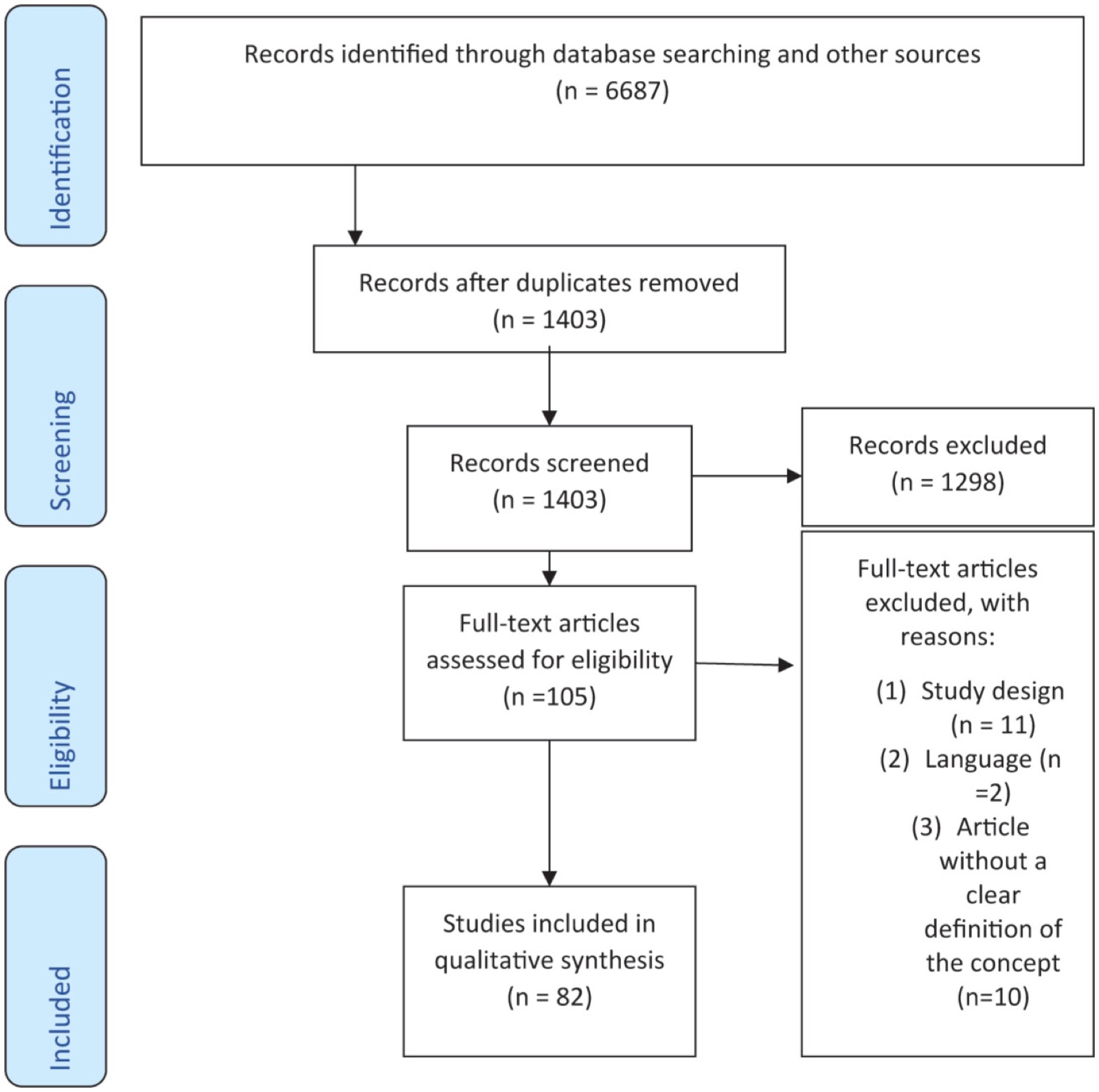
In total, 6,640 articles were identified from the selected databases. After removing duplicates, 1,356 articles remained for screening based on titles and abstracts, and 47 additional studies were identified through manual searching. Subsequently, 1,298 articles were excluded because they did not meet the eligibility criteria. A full-text review of 105 articles led to the exclusion of 23. Ultimately, 82 articles were deemed eligible and included in the scoping review (see Figure 1).
Quality Assessment
This scoping review included articles classified as low (n = 15), acceptable (n = 54), and high (n = 13) quality based on the QATSDD scoring procedures and thresholds (see Table 1). The highest quality scores were achieved by Hines and Douglas (2019) and Chen and Chan (2021), with scores of 88% and 85%, respectively. Eleven studies received scores around 70% (see Table 1). Among the low-quality studies, only one (Straus & Gozjolko, 2016) scored below 40%.
Table 1 — Sample Characteristics of the Included Studies.
- Author (year): Afifi et al. (2012); Country, Setting: USA, community; Sample size, gender: 25,778, both; Men: 11,850; women: 13,928; Sample mean age (SD): NA; BV measure: CTS; Data collection: Face to face interviews; Design: Quantitative; Quality percentage and category: 62%, acceptable
- Author (year): Ahmed et al. (2024); Country, Setting: Canada, community; Sample size, gender: 2,248, both; Sample mean age (SD): 37.9 (13.6); BV measure: 3 questions about perpetrator risk; Data collection: Self-administered Web-based survey; Design: Quantitative; Quality percentage and category: 69%, acceptable
- Author (year): Ali et al. (2016); Country, Setting: N/A; Sample size, gender: 123 articles; Sample mean age (SD): N/A; BV measure: N/A; Data collection: N/A; Design: Literature review; Quality percentage and category: 58%, acceptable
- Author (year): Arteaga et al. (2015); Country, Setting: Spain, clinical; Sample size, gender: 162, both; Sample mean age (SD): 36.40 (8.9); BV measure: CTS-2; Data collection: Self-administered Face to face; Design: Quantitative; Quality percentage and category: 79%, high
- Author (year): Babcock et al. (2019); Country, Setting: USA, community; Sample size, gender: 360 (180 couples); both; Sample mean age (SD): Men: 32.0 (10.2); Woman: 29.9 (9.4); BV measure: CTS-2; Emotional Abuse Inventory (EA); Data collection: Self-administered Face-to-face; Design: Quantitative; Quality percentage and category: 55%, acceptable
- Author (year): Bates (2016); Country, Setting: N/A; Sample size, gender: N/A; Sample mean age (SD): N/A; BV measure: N/A; Data collection: N/A; Design: Literature review; Quality percentage and category: 42%, low
- Author (year): Behnken et al. (2018); Country, Setting: USA, community; Sample size, gender: 763, women; Sample mean age (SD): NA; BV measure: CTS-2; Data collection: Face to face interviews; Design: Quantitative; Quality percentage and category: 62%, acceptable
- Author (year): Bermea and van Eeden-Moorefield (2023); Country, Setting: N/A; Sample size, gender: N/A; Sample mean age (SD): N/A; BV measure: N/A; Data collection: N/A; Design: Literature review; Quality percentage and category: 67%, acceptable
- Author (year): Brown and Chew (2018); Country, Setting: Singapore, forensic; Sample size, gender: 150, both; Men: 99; Woman: 96; Sample mean age (SD): NA; BV measure: CTS-2; Data collection: Self-administered Face to face; Design: Quantitative; Quality percentage and category: 79%, high
- Author (year): Caetano et al. (2024); Country, Setting: USA, clinical; Sample size, gender: 1,037, both; Men: 484; Women: 550; Sample mean age (SD): 35.2; Men: 36.5; Women: 34; BV measure: CTS-2 PA scale; Data collection: Face to face interviews; Design: Quantitative; Quality percentage and category: 76%, high
- Author (year): Capaldi and Kim (2007); Country, Setting: N/A; Sample size, gender: N/A; Sample mean age (SD): N/A; BV measure: N/A; Data collection: N/A; Design: Literature review; Quality percentage and category: 67%, acceptable
- Author (year): Capinha et al. (2022); Country, Setting: Portugal, community; Sample size, gender: 1,392, both; Men: 312; Women: 1078; Sample mean age (SD): 34.95 (12.80); Male: 42.67 (13.17); Female: 32.74 (11.79); BV measure: CTS-2; Data collection: Self-administered Web-based survey; Design: Quantitative; Quality percentage and category: 74%, acceptable
- Author (year): Carranza et al. (2022); Country, Setting: Canada, community; Sample size, gender: 1,018, both; Sample mean age (SD): 19.84 (2.95); BV measure: CTS-2; Data collection: Self-administered Web-based survey; Design: Quantitative; Quality percentage and category: 62%, acceptable
- Author (year): Chen and Chan (2021); Country, Setting: China, community; Sample size, gender: 7,466, both; Sample mean age (SD): 40.95 (8.66); BV measure: CTS-2; Data collection: Self-administered Face to face; Design: Quantitative; Quality percentage and category: 83%, high
- Author (year): Conroy and Crowley (2022); Country, Setting: USA, community; Sample size, gender: 398; both; Sample mean age (SD): 20.0 (1.70); BV measure: Specific questions, 28-item measure; Data collection: Self-administered Web-based survey; Design: Quantitative; Quality percentage and category: 62%, acceptable
- Author (year): Conroy, Crowley, and DeSanto (2024); Country, Setting: N/A; Sample size, gender: 44 studies; both; Sample mean age (SD): N/A; BV measure: N/A; Data collection: N/A; Design: Systematic review; Quality percentage and category: 75%, high
- Author (year): Conroy, Griffin et al. (2024); Country, Setting: N/A; Sample size, gender: 34 studies; Sample mean age (SD): N/A; BV measure: N/A; Data collection: N/A; Design: Systematic review; Quality percentage and category: 75%, high
- Author (year): Crane et al. (2014); Country, Setting: USA, forensic; Sample size, gender: 68, male; Sample mean age (SD): 39.13 (8.71); BV measure: CTS-2; Data collection: Self-administered Face to face; Design: Quantitative; Quality percentage and category: 67%, acceptable
- Author (year): Cunha et al. (2023); Country, Setting: Portugal, community; Sample size, gender: 336, both; Male: 52; Female: 280; Sample mean age (SD): 35.02 (11.67); BV measure: CTS2; Data collection: Self-administered Web-based survey; Design: Quantitative; Quality percentage and category: 67%, acceptable
- Author (year): Dempsey (2005); Country, Setting: N/A; Sample size, gender: N/A; Sample mean age (SD): N/A; BV measure: N/A; Data collection: N/A; Design: Literature review; Quality percentage and category: 50%, low
- Author (year): Dokkedahl and Elklit (2019); Country, Setting: N/A; Sample size, gender: 70 studies; both; Sample mean age (SD): N/A; BV measure: N/A; Data collection: N/A; Design: Systematic review; Quality percentage and category: 75%, high
- Author (year): Dumont et al. (2022); Country, Setting: France; forensic; Sample size, gender: 215; Male; Sample mean age (SD): 39.85; BV measure: N/A; Data collection: Documental; Design: Quantitative; Quality percentage and category: 62%, acceptable
- Author (year): Eckstein (2017); Country, Setting: USA; community; Sample size, gender: 840; both; Sample mean age (SD): NA; BV measure: CTS-2 PA scale; Partner Abuse Scale-Physical; Index of Psychological Abuse; Data collection: Self-administered Web-based survey; Design: Quantitative; Quality percentage and category: 75%, high
- Author (year): Fernández-Montalvo et al. (2019); Country, Setting: Spain, clinical; Sample size, gender: 122, both; Male: 91; Female: 31; Sample mean age (SD): 36.6; BV measure: CTS-2; Data collection: Face to face interview; Design: Quantitative; Quality percentage and category: 64%, acceptable
- Author (year): Frías (2017); Country, Setting: Mexico, community; Sample size, gender: 114,242, women; Sample mean age (SD): NA; BV measure: CTS; Specific questions; 11 items assessing CB; Data collection: NA; Design: Quantitative; Quality percentage and category: 71%, acceptable
- Author (year): Frye et al. (2006); Country, Setting: USA, community; Sample size, gender: 331; Sample mean age (SD): 37.5 (12.3); BV measure: Specific questions; Canadian Violence Against Women Survey; 1 item from Danger Assessment; Data collection: Telephone interview; Design: Quantitative; Quality percentage and category: 69%, acceptable
- Author (year): Graham et al. (2012); Country, Setting: Canada, community; Sample size, gender: 14,063, both; Male: 6,009; Female: 8,054; Sample mean age (SD): NA; BV measure: Specific items; Data collection: Computer-assisted telephone interview; Design: Quantitative; Quality percentage and category: 43%, low
- Author (year): Graham-Kevan and Archer (2003); Country, Setting: UK, community, forensic, clinical; Sample size, gender: Both Students: 113; Shelter women: 44; Women Male prisoners: 108; Sample mean age (SD): 33.0; BV measure: CTS; Controlling Behaviors Scale; Data collection: NA; Design: Quantitative; Quality percentage and category: 57%, acceptable
- Author (year): Hamel (2009); Country, Setting: N/A; Sample size, gender: N/A; Sample mean age (SD): N/A; BV measure: N/A; Data collection: N/A; Design: Critical literature review; Quality percentage and category: 50%, low
- Author (year): Hardesty et al. (2015); Country, Setting: USA, clinical; Sample size, gender: 190, female; Sample mean age (SD): 35.72 (7.28); BV measure: CTS2; PMWI; HARASS; Data collection: Face to face interview; Design: Quantitative; Quality percentage and category: 64%, acceptable
- Author (year): Hardesty et al. (2016); Country, Setting: USA, community; Sample size, gender: 154, female; Sample mean age (SD): 35.85 (7.14); BV measure: CTS2; PMWI; Boundary Ambiguity Scale; HARASS; Data collection: Face to face interview; Design: Quantitative; Quality percentage and category: 71%, acceptable
- Author (year): Hardesty et al. (2024); Country, Setting: N/A; Sample size, gender: N/A; Sample mean age (SD): N/A; BV measure: N/A; Data collection: N/A; Design: Literature review; Quality percentage and category: 58%, acceptable
- Author (year): Hellmuth, Jaquier, Gordon et al. (2014); Country, Setting: USA, clinical; Sample size, gender: 180, female; Sample mean age (SD): N/A; BV measure: CTS2; Data collection: Self-administered Face to face interviews; Design: Quantitative; Quality percentage and category: 45%, low
- Author (year): Hellmuth, Jaquier, Swan, and Sullivan (2014); Country, Setting: USA, community; Sample size, gender: 369, female; Sample mean age (SD): 36.67 (8.95); BV measure: Psychological Maltreatment of Women Inventory-Short version (PMSI-S); CTS2; PMWI-S; Sexual Experiences Survey; Data collection: Self-administered Face to face interviews; Design: Quantitative; Quality percentage and category: 74%, acceptable
- Author (year): Hines et al. (2007); Country, Setting: USA, clinical; Sample size, gender: 190, male; Sample mean age (SD): NA; BV measure: Specific questions; Data collection: Telephone interview; Design: Quantitative; Quality percentage and category: 48%, low
- Author (year): Hines and Douglas (2010); Country, Setting: USA, clinical and community; Sample size, gender: 822, male; Community: 520; clinical: 302; Sample mean age (SD): Community: 43.68 (10.88); clinical: 43.68 (10.88); BV measure: CTS2; specific questions; Data collection: Telephone interview Self-administered Web-based survey; Design: Quantitative; Quality percentage and category: 64%, acceptable
- Author (year): Hines and Douglas (2018); Country, Setting: USA, clinical and community; Sample size, gender: 2,212, male; Community: 1,601; clinical: 611; Sample mean age (SD): Community: 41.77 (11.35); Clinical: 43.89 (9.18); BV measure: CTS2; 9 items of the PMWI; 12 items assessing legal/administrative aggression; Data collection: Self-administered Web-based survey; Design: Quantitative; Quality percentage and category: 88%, high
- Author (year): Hines and Douglas (2019); Country, Setting: USA, clinical and community; Sample size, gender: 2,212, male; Community: 1,601; Clinical: 611; Sample mean age (SD): Community: 41.77 (11.35); Clinical: 43.89 (9.18); BV measure: CTS2; 9 items of the PMWI; Data collection: Self-administered Web-based survey; Design: Quantitative; Quality percentage and category: 93%, high
- Author (year): Holmes et al. (2019); Country, Setting: USA, forensic; Sample size, gender: 227, women; Sample mean age (SD): 35.0; BV measure: CTS2; Data collection: Face-to-face interviews; Design: Quantitative; Quality percentage and category: 67%, acceptable
- Author (year): Hu et al. (2021); Country, Setting: China, community; Sample size, gender: 1,301, women; Sample mean age (SD): 27.2 (7.3); BV measure: CTS2 (adapted); Data collection: Self-administered Web-based survey; Design: Quantitative; Quality percentage and category: 69%, acceptable
- Author (year): Jasinski et al. (2014); Country, Setting: USA, community; Sample size, gender: 16,000, both; Male: 8,000; Female: 8,000; Sample mean age (SD): Male: 41.11 (10.76); Female: 41.29 (11.45); BV measure: CTS; questions from the Canadian Violence Against Women Survey; Data collection: Telephone interviews; Design: Quantitative; Quality percentage and category: 50%, low
- Author (year): Jennings et al. (2012); Country, Setting: USA, community; Sample size, gender: 1,488, both; Sample mean age (SD): 15.5; BV measure: Specific questions; Data collection: Face to face interviews; Design: Quantitative; Quality percentage and category: 60%, acceptable
- Author (year): Johnson (1995); Country, Setting: N/A; Sample size, gender: N/A; Sample mean age (SD): N/A; BV measure: N/A; Data collection: N/A; Design: Literature review; Quality percentage and category: 42%; low
- Author (year): Johnson (2006); Country, Setting: N/A; Sample size, gender: N/A; Sample mean age (SD): N/A; BV measure: N/A; Data collection: N/A; Design: Literature review; Quality percentage and category: 42%, low
- Author (year): Krantz and Nguyen (2009); Country, Setting: Vietnam, community; Sample size, gender: 883, female; Sample mean age (SD): NA; Design: Quantitative; Quality percentage and category: 60%, acceptable
- Author (year): Langhinrichsen-Rohling (2010); Country, Setting: N/A; Sample size, gender: N/A; Sample mean age (SD): N/A; BV measure: N/A; Data collection: N/A; Design: Literature review; Quality percentage and category: 58%, acceptable
- Author (year): Langhinrichsen-Rohling et al. (2012); Country, Setting: N/A; Sample size, gender: N/A; Sample mean age (SD): N/A; BV measure: N/A; Data collection: N/A; Design: Literature review; Quality percentage and category: 58%, acceptable
- Author (year): Leonard et al. (2014); Country, Setting: USA, community; Sample size, gender: 634 couples, both; Sample mean age (SD): 28.7 (6.3); BV measure: CTS2, Autonomy/Relatedness Scale; Data collection: Self-administered; Design: Quantitative; Quality percentage and category: 62%, acceptable
- Author (year): Lysova et al. (2024); Country, Setting: N/A; Sample size, gender: N/A; Sample mean age (SD): N/A; BV measure: N/A; Data collection: N/A; Design: Literature review; Quality percentage and category: 67%, acceptable
- Author (year): Love et al. (2020); Country, Setting: N/A; Sample size, gender: 149 studies; Sample mean age (SD): N/A; BV measure: N/A; Data collection: N/A; Design: Meta-analysis; Quality percentage and category: 58%, acceptable
- Author (year): Machado et al. (2024); Country, Setting: N/A; Sample size, gender: 42 studies; Sample mean age (SD): N/A; BV measure: N/A; Data collection: N/A; Design: Systematic review; Quality percentage and category: 75%, high
- Author (year): Marcus (2012); Country, Setting: USA, community; Sample size, gender: 1,294 couples, both; Sample mean age (SD): 22.1 (1.72); BV measure: Specific questions; Data collection: Face-to-face interviews; Design: Quantitative; Quality percentage and category: 60%, acceptable
- Author (year): Mennicke and Wilke (2015); Country, Setting: USA, community; Sample size, gender: 16,000, both; Sample mean age (SD): 39.4 (12.2); BV measure: National Violence Against Women Survey; Data collection: Telephone interviews; Design: Quantitative; Quality percentage and category: 62%, acceptable
- Author (year): Mitchell et al. (2021); Country, Setting: USA, forensic; Sample size, gender: 147, female; Sample mean age (SD): 36.68; BV measure: CTS2; PMWI; Data collection: Face to face interviews; Design: Quantitative; Quality percentage and category: 64%, acceptable
- Author (year): Muftić et al. (2012); Country, Setting: USA, forensic; Sample size, gender: 1,256, both; Sample mean age (SD): 32.9 (9.7); BV measure: Police report (victim, offender, or victim-offender); Data collection: Police records; Design: Quantitative; Quality percentage and category: 69%, acceptable
- Author (year): Muñiz-Rivas et al. (2022); Country, Setting: N/A; Sample size, gender: N/A; Sample mean age (SD): N/A; BV measure: N/A; Data collection: N/A; Design: Literature review; Quality percentage and category: 50%, low
- Author (year): Norris et al. (2017); Country, Setting: Africa, community; Sample size, gender: 158, male; Sample mean age (SD): NA; BV measure: CTS2 PA scale (adapted); Data collection: Computer-assisted Self-administered; Design: Quantitative; Quality percentage and category: 76%, high
- Author (year): Olson (2002); Country, Setting: USA, community; Sample size, gender: 31, both; Sample mean age (SD): NA; BV measure: CTS, in-depth interviews; Data collection: Face to face interviews; Design: Qualitative; Quality percentage and category: 52%, acceptable
- Author (year): Palmetto et al. (2013); Country, Setting: USA, clinical; Sample size, gender: 618, female; Sample mean age (SD): NA; BV measure: Date and Family Violence and Abuse Scale, Conflict in Adolescent Dating Relationships Inventory (CADRI); Data collection: Computer-assisted Self-administrated; Design: Quantitative; Quality percentage and category: 55%, acceptable
- Author (year): Park and Kim (2019); Country, Setting: N/A; Sample size, gender: N/A; Sample mean age (SD): N/A; BV measure: N/A; Data collection: N/A; Design: Meta-analysis; Quality percentage and category: 58%, acceptable
- Author (year): Portwood and Heany (2007); Country, Setting: N/A; Sample size, gender: N/A; Sample mean age (SD): N/A; BV measure: N/A; Data collection: N/A; Design: Commentary; Quality percentage and category: 50%, low
- Author (year): Pu et al. (2022); Country, Setting: USA, community; Sample size, gender: 354, both; Male: 151; Female: 203; Sample mean age (SD): NA; BV measure: CTS2S; Data collection: Self-administered Web-based survey; Design: Quantitative; Quality percentage and category: 48%, low
- Author (year): Renner and Whitney (2012); Country, Setting: USA, community; Sample size, gender: 10,187, both; Sample mean age (SD): 21.80 (1.70); BV measure: Specific questions; Data collection: Face to face interviews; Design: Quantitative; Quality percentage and category: 64%, acceptable
- Author (year): Richards et al. (2017); Country, Setting: USA, community; Sample size, gender: 12,379, both; Sample mean age (SD): Male: 28.51 (1.89); Female: 28.31 (1.81); BV measure: CTS2 (adapted); Data collection: Face to face interviews; Design: Quantitative; Quality percentage and category: 60%, acceptable
- Author (year): Ridings et al. (2021); Country, Setting: USA, forensic; Sample size, gender: 403, female; Sample mean age (SD): 25.17 (5.96); BV measure: CTS2; Data collection: Computer-assisted Face to face interviews; Design: Quantitative; Quality percentage and category: 48%, low
- Author (year): Rosen et al. (2005); Country, Setting: USA, community; Sample size, gender: 15 couples, both; Sample mean age (SD): Male: 36; Female: 35; BV measure: CTS, semi-structured interview; Data collection: Self-administered Face to face interviews; Design: Qualitative; Quality percentage and category: 64%, acceptable
- Author (year): Segundo et al. (2022); Country, Setting: USA, community; Sample size, gender: 360, women; Sample mean age (SD): 21.9 (5.39); BV measure: CTS2; Data collection: Self-administered Web-based survey; Design: Quantitative; Quality percentage and category: 55%, acceptable
- Author (year): Simpson et al. (2007); Country, Setting: USA, community; Sample size, gender: 273 couples, both; Sample mean age (SD): Male: 41.6 (9.2); Female: 39.7 (9.0); BV measure: CTS2; Data collection: Self-administered; Design: Quantitative; Quality percentage and category: 62%, acceptable
- Author (year): Stith et al. (2011); Country, Setting: USA, community; Sample size, gender: 15 couples, both; Sample mean age (SD): Male: 38; Female: 33; BV measure: CTS2; Data collection: Self-administered; Design: Qualitative; Quality percentage and category: 61%, acceptable
- Author (year): Stith and Spencer (2024); Country, Setting: N/A; Sample size, gender: N/A; Sample mean age (SD): N/A; BV measure: N/A; Data collection: N/A; Design: Commentary; Quality percentage and category: 50%, low
- Author (year): Stover et al. (2025); Country, Setting: N/A; Sample size, gender: N/A; Sample mean age (SD): N/A; BV measure: N/A; Data collection: N/A; Design: Scoping review; Quality percentage and category: 75%, high
- Author (year): Straus (2011); Country, Setting: N/A; Sample size, gender: N/A; Sample mean age (SD): N/A; BV measure: N/A; Data collection: N/A; Design: Literature review; Quality percentage and category: 58%, acceptable
- Author (year): Straus and Gozjolko (2014); Country, Setting: 32 countries, community; Sample size, gender: 13,877, both; Male: 3,886; Female: 9,991; Sample mean age (SD): NA; BV measure: CTS2, Dominance Scale; Data collection: NA; Design: Quantitative; Quality percentage and category: 52%, acceptable
- Author (year): Straus and Gozjolko (2016); Country, Setting: USA, community; Sample size, gender: 14,252, both; Male: 4,097; Female: 10,175; Sample mean age (SD): NA; BV measure: NA; Data collection: NA; Design: Quantitative; Quality percentage and category: 26%, low
- Author (year): Suomi et al. (2019); Country, Setting: Australia, clinical; Sample size, gender: 212, both; Sample mean age (SD): 43.6 (13.0); BV measure: Hurt, Insult, Threaten, Scream (HITS) Scale; Data collection: Face to face interviews; Design: Quantitative; Quality percentage and category: 55%, acceptable
- Author (year): Tillyer and Wright (2013); Country, Setting: USA, community; Sample size, gender: 4,275, both; Sample mean age (SD): 28.43 (1.84); BV measure: Specific questions; Data collection: Self-administered; Design: Quantitative; Quality percentage and category: 79%, high
- Author (year): Ulloa and Hammet (2016); Country, Setting: USA, community; Sample size, gender: 7,187, both; Male: 2,876; Female: 4,311; Sample mean age (SD): W1: 22.38 (1.80); W4: 29.12 (1.74); BV measure: CTS adapted; Data collection: Face to face interviews; Design: Quantitative; Quality percentage and category: 62%, acceptable
- Author (year): Vasconcelos et al. (2023); Country, Setting: Portugal, community; Sample size, gender: 138, both; Male: 23; Female: 115; Sample mean age (SD): 38.98 (7.34); BV measure: Inventário de Violência Conjugal (IVC); Data collection: Self-administered Web-based survey; Design: Quantitative; Quality percentage and category: 67%, acceptable
- Author (year): Walby and Towers (2018); Country, Setting: England and Wales, community; Sample size, gender: 1,678, both; Male: 366; Female: 1,312; Sample mean age (SD): NA; BV measure: Closed and open questions; Data collection: Face to face interviews; Design: Quantitative; Quality percentage and category: 67%; acceptable
- Author (year): Wei et al. (2020); Country, Setting: China, community; Sample size, gender: 578, male; Sample mean age (SD): N/A; BV measure: 5 questions from the Intimate Partner Violence among Gay and Bisexual Men Scale (IPV-GBM); Data collection: Self-administered Web-based survey; Design: Quantitative; Quality percentage and category: 64%, acceptable
- Author (year): Whitaker et al. (2007); Country, Setting: USA, community; Sample size, gender: 11,370, both; Male: 5,219; Female: 6,151; Sample mean age (SD): 22.0 (1.7); Male: 22.1 (1.70); Female: 21.9 (1.7); BV measure: Specific questions; Data collection: NA; Design: Quantitative; Quality percentage and category: 60%; acceptable
- Author (year): Zweig et al. (2014); Country, Setting: USA, community; Sample size, gender: 3,745, both; Male: 1,768; Female: 1,956; Sample mean age (SD): NA; BV measure: Items from the Forshee’s scale; Items adapted from different scales; Data collection: Self-administered Paper and pencil; Design: Quantitative; Quality percentage and category: 67%; acceptable
Note. BV = Bidirectional Violence; CTS = Conflict Tactics Scale; PMWI = Psychological Maltreatment of Women Inventory; HARASS = Harassment in Abusive Relationships: Self-report Scale.
Study Characteristics
The included studies were published between 1995 (Johnson, 1995) and 2025 (Stover et al., 2025), with a notable increase in publications after 2010. Almost half of the included studies were conducted in the United States (n = 41, 50%), while the remaining studies were conducted in a variety of other countries (see Table 1). The sample sizes in quantitative studies ranged from 68 (Crane et al., 2014) to 25,778 participants (Afifi et al., 2012). Approximately half of the studies used mixed-gender samples (n = 32; 56.14%), with a quarter focusing exclusively on women (n = 16; 27%), and a residual number included only men (n = 7; 12.5%). The reported mean age of participants ranged from 15.5 years (Jennings et al., 2012) to 43.89 years (Hines & Douglas, 2018, 2019), although 15 studies did not report this information. Data were collected primarily in community settings (48%), with smaller proportions obtained from clinical and forensic contexts. The Conflict Tactics Scale (CTS/CTS2) was the most common measure.
Conceptual Definitions of Bidirectional Violence in Intimate Relationships
This review identified two predominant conceptual approaches to intimate violence involving both partners: one focusing on the typological analysis of interactive violence dynamics, and another employing specific concepts to describe the co-occurrence of violent behaviors (see Table S1, Supplemental Files).
Typological Perspectives on Violence Involving Both Partners: The Johnson’s Typology
A significant proportion of studies (n = 40) conceptualized violence involving both partners through frameworks that, while clearly describing this dynamic, did not use consensual or systematic terminology to explicitly classify this pattern of violence. Within this approach, Johnson’s (1995, 2006) typology emerged as the predominant framework for describing violence dynamics. The definition most frequently applied and detailed by these articles was “Situational Couple Violence” (SCV; 40 papers; see Table S1). SCV is described as cases in which both partners resort to violent behaviors during marital conflicts, in the absence of an ongoing pattern of coercive control characteristics of Intimate Terrorism (IT). Such violence typically results from situational stressors, emotional escalation, or ineffective conflict management and is generally of lower severity and episodic in nature.
Although SCV emerges as the most frequently applied category among studies referencing Johnson's typology, other categories, particularly Violent Resistance (VR) and Mutual Violent Control (MVC), also meaningfully contribute to the conceptualization of violence involving both partners. VR appeared in 16 papers (see Table S1) and refers to instances in which one partner uses physical aggression as a reactive strategy in response to a sustained pattern of coercive control, typically exercised by the other partner. In such cases, violence is not symmetrical in either motivation or intent. Rather, it emerges as defensive behavior, often employed to de-escalate immediate threats or assert physical autonomy in the context of persistent victimization. For instance, several articles describe patterns in which the respondent identifies both victimization and perpetration but situates their own use of violence within narratives of fear, retaliation, or protection (Stith et al., 2011; Straus & Gozjolko, 2014). When the relational context is not considered, particularly in studies relying solely on self-report instruments such as CTS, this type of asymmetrical dynamic risk is misclassified as mutual or BV. MVC, in contrast, refers to relationships in which both partners simultaneously exert control over one another through violence. In this configuration, each individual engages in coercive strategies, often within a volatile and escalating relational pattern. A few studies included in this review (15) report findings consistent with this conceptualization, namely, the presence of reciprocal controlling behaviors, high levels of aggression, and a chronic escalation of conflict (see Table S1).
The absence of explicit terminology in these 40 studies did not imply ambiguity in the dynamics described. On the contrary, there is a clear characterization of the overlap of roles between victim and perpetrator, with statistical coding of participants as “victim-perpetrators” or “bidirectional involvement” being common, even without the use of a specific theoretical term (Arteaga et al., 2015; Behnken et al., 2018).
Specific Concepts and Their Distinctions for the Co-Occurrence of Violence
Four concepts emerged across the literature that explicitly label violence involving both partners: bidirectional violence, mutual violence, victim–perpetrator overlap, and reciprocal violence (see Table 2). Each term reflects a specific analytical focus, temporal frame, and relational dynamics, although these distinctions are not consistently applied across studies.
Table 2 — Key Conceptual Distinctions Between Terms Describing IPV Involving Both Partners.
- Term: Bidirectional violence; Level of analysis: Dyad (couple); Temporal frame: Across the relationship (not episode-specific); Relational dynamic: Both partners have engaged in perpetration and victimization within the same relationship; Interaction required?: No; Symmetry assumed?: No; Typical context of use: Epidemiological studies; prevalence data
- Term: Mutual violence; Level of analysis: Dyad (couple); Temporal frame: Same incident or conflict episode; Relational dynamic: Simultaneous or co-occurring violence; Interaction required?: Yes; Symmetry assumed?: Often assumed; Typical context of use: Conflict- or event level-specific IPV studies
- Term: Reciprocal violence; Level of analysis: Dyad (couple); Temporal frame: Across multiple episodes; dynamic; Relational dynamic: Interactive, retaliatory, or escalating pattern; Interaction required?: Conceptually Yes; Symmetry assumed?: No; Typical context of use: Relational/clinical studies on IPV dynamics
- Term: Victim–perpetrator overlap; Level of analysis: Individual; Temporal frame: Over time or across different relationships; Relational dynamic: One person alternates between or occupies both roles; Interaction required?: No; Symmetry assumed?: No; Typical context of use: Criminology; trauma and developmental research
Note. IPV = intimate partner violence.
The most frequently employed term was “bidirectional violence” (BV), identified in 26 studies (see Table S1), typically defined as the co-occurrence of violent behaviors perpetrated by both members of an intimate couple, with each partner, at different times or episodes, acting as both perpetrators and victims. This type of violence may occur in a single incident or throughout the relationship, but it does not necessarily imply symmetry in terms of frequency, severity, motivation, or impact (Arteaga et al., 2015; Capinha et al., 2022). Across studies, BV is generally used as a broad descriptive term, with relatively limited specification regarding interactional processes or contextual factors.
Secondly, “mutual violence” (MV) appeared in six studies (see Table S1), generally referring to the presence of violent acts by both partners, with each being both a victim and a perpetrator. Across the six studies that explicitly employed the term “mutual violence,” definitions often described the co-occurrence of violent acts by both partners, in some cases within the same incident or conflict episode. However, this characterization was not consistently specified across all studies. In several cases, definitions appeared to implicitly assume symmetry, without clearly specifying differences in severity, motivation, or impact between partners (Afifi et al., 2012; Chen & Chan, 2021). At the same time, other studies explicitly problematize assumptions of symmetry and emphasize the importance of relational dynamics (Dokkedahl & Elklit, 2019). In most cases, these studies did not include an explicit empirical assessment of symmetry beyond the co-occurrence of acts. Overall, mutuality is sometimes described in terms of event-level simultaneity, although this emphasis is not consistent across all uses of the term (Afifi et al., 2012; Ahmed et al., 2024). Importantly, this characterization reflects tendencies in how MV is defined in the reviewed literature, rather than a uniform or consistently operationalized construct across studies.
The term “victim-offender overlap” was used in six studies (see Table S1) and refers to the phenomenon in which an individual experiences both the roles of victimization and perpetration of IPV, either within the same relationship or across different relationships and time points. In the six studies using the concept of victim–perpetrator overlap, authors consistently defined it at the individual level, referring to persons who have both experienced victimization and perpetrated IPV. Some studies conceptualized this overlap as occurring sequentially over time (i.e., role shifts), whereas others explicitly allowed for the simultaneous occupation of victim and perpetrator roles (Jennings et al., 2012; Tillyer & Wright, 2013; Whitaker et al., 2007). It was often studied with broader psychosocial or criminological factors and has been associated with an increased frequency and severity of IPV (Jennings et al., 2011; Whitaker et al., 2007).
Finally, another term found was “reciprocal violence,” in four studies (see Table S1). In these studies, reciprocal violence was described as a patterned, interactional process in which violent acts are linked through retaliation, escalation, or emotional reactivity across multiple episodes (Bates, 2016; Langhinrichsen-Rohling et al., 2012; Pu et al., 2022). These definitions tend to emphasize relational interdependence between acts of violence, rather than simultaneity within a single incident. However, as with other concepts, the extent to which these interactional dynamics are empirically assessed varies across studies. This characterization reflects the definitional framing adopted by these authors, rather than a uniform empirical assessment of escalation processes.
Key Conceptual Distinctions
When examining explicitly defined concepts (BV, MV, reciprocal violence, and victim–perpetrator overlap), several key distinctions emerge, although these should be interpreted as general tendencies rather than strict or universally applied boundaries. First, the level of analysis varied. While BV, MV, and reciprocal violence generally refer to the dyadic or relational level (i.e., the couple; Babcock et al., 2019; Capaldi & Kim, 2007), victim–perpetrator overlap is primarily individual-centered, focusing on how one person may simultaneously or sequentially occupy both the roles of victim and perpetrator (Jennings et al., 2012; Muftić et al., 2012).
Second, these concepts differ in their temporal framing. MV is often described as temporally narrow, referring to violence occurring within the same incident or conflict episode; however, some studies use the term more broadly without explicitly restricting it to a single event (Afifi et al., 2012; Dokkedahl & Elklit, 2019). In contrast, BV and reciprocal violence may refer to patterns unfolding across multiple episodes (Crane et al., 2014; Pu et al., 2022; Whitaker et al., 2007). The victim–perpetrator overlap extends further, encompassing role shifts that occur over time and potentially across different relationships (Jennings et al., 2012; Tillyer & Wright, 2013). This temporal distinction aligns with the episodic nature of the previously detailed SCV, which often manifests in multiple instances rather than a single isolated event.
Third, the relational dynamics implied by each term vary in terms of complexity. BV indicates the presence of aggression from both partners but does not specify interaction or intent (Arteaga et al., 2015; Capaldi & Kim, 2007; Capinha et al., 2022). MV may emphasize co-occurrence, sometimes within the same incident, but does not consistently capture broader relational patterns (Ahmed et al., 2024). In contrast, reciprocal violence tends to emphasize an interactive and potentially escalating process in which each partner’s aggression contributes to a cycle of conflict (Pu et al., 2022; Whitaker et al., 2007). This makes reciprocal violence the most relational dynamic of the four (Langhinrichsen-Rohling, 2010). This focus on the interdependence of violent acts is a fundamental characteristic of SCV dynamics (Ali et al., 2016; Johnson, 2006).
Fourth, assumptions regarding symmetry vary across concepts and studies. MV tends to be assumed to be symmetrical, although this assumption is increasingly being questioned in different studies in terms of severity, motivation, and impact (Ahmed et al., 2024; Capaldi et al., 2018; Dokkedahl & Elklit, 2019; Muftić et al., 2012). Other concepts, especially reciprocal violence and victim–perpetrator overlap, more explicitly recognize the possibility of asymmetry between partners. This critical distinction resonates strongly with the findings in the previous section, where studies employing Johnson's typology consistently highlight the frequent asymmetry of violence in SCV, even when both partners are involved (Bates, 2016; Johnson, 2006).
Finally, the use of different terms across disciplines and research designs differs. BV and MV are common in population-based IPV studies (Capinha et al., 2022; Cunha et al., 2023). Reciprocal violence is more prominent in relational or therapeutic research (Babcock et al., 2019; Pu et al., 2022), while victim–perpetrator overlap is often used in criminology, developmental studies, or trauma-informed approaches (Arteaga et al., 2015; Jennings et al., 2012; Tillyer & Wright, 2013).
Conceptual Debates and Controversies
The literature also highlights several conceptual and methodological challenges that continue to shape scholarly debates surrounding violence involving both partners in intimate relationships. One of the most salient issues is terminological inconsistency: terms such as BV, MV, reciprocal IPV, victim-perpetrator overlap, and gender symmetry are often used in overlapping or inconsistent ways, despite reflecting distinct theoretical frameworks and relational dynamics (Ahmed et al., 2024; Machado et al., 2024). This inconsistency is further exacerbated by a significant number of studies (n = 40) that describe violence involving both partners using typological frameworks, primarily Johnson’s, without explicitly employing these specific terms.
A second critical concern in many empirical studies is the limited assessment of the relational context. Several authors argue that any meaningful interpretation of interpersonal violence involving both partners must account for contextual variables, such as motivational intent, control dynamics, escalation patterns, and differential harm, without which classifications such as “mutual” or “bidirectional” risk becoming overly simplistic or even misleading (Graham et al., 2012; Stover et al., 2025). This emphasis on context aligns with the detailed descriptions found in studies that use Johnson's typology, which consistently highlights the importance of understanding underlying motivations (e.g., reactive vs. coercive control) and the often asymmetrical impact of violent acts, moving beyond a simple count of perpetration to truly grasp the relational dynamics. Furthermore, high rates of violence involving both partners have been documented in specific populations, including individuals with substance use disorders, mental health conditions, LGBTQIA+ identities, and families with young children (Cunha et al., 2023; Holmes et al., 2019; Suomi et al., 2019).
Challenges in the Operationalization of Violence Involving Both Partners
Beyond conceptual heterogeneity, the operationalization of violence involving both partners also presents significant challenges that directly impact the comparability and synthesis of empirical findings. These challenges stem primarily from the diversity of measurement instruments and the methodological approaches used to identify and quantify these dynamics.
One of the main sources of inconsistency is the heterogeneity of measurement procedures. This review revealed that although the CTS and its various versions (e.g., CTS2) were predominant, the diversity of instruments used leads to the phenomenon being measured inconsistently. This lack of standardization may contribute to situations in which studies that, on the surface, appear to address the same phenomenon capture distinct facets of violence, making the direct comparison of prevalence rates or dynamics particularly challenging.
Additionally, methodological approaches to identifying bidirectionality also vary considerably, affecting its operationalization. Some studies simply report the co-occurrence of perpetration and victimization based on individual reports without a more in-depth dyadic analysis (Afifi et al., 2012; Ahmed et al., 2024). Others use more sophisticated dyadic designs (Pu et al., 2022; Whitaker et al., 2007), but even within these, the criteria for classifying instances as “bidirectional” or “mutual” diverge. For instance, while some studies may consider “bidirectional” any report of aggression by both partners (Cunha et al., 2023; Santiago et al., 2025), others require a certain frequency or a specific reactive pattern (Dokkedahl & Elklit, 2019; Frías, 2017).
Finally, the design type has an impact on operationalization. While cross-sectional studies are useful for providing prevalence data, they limit the ability to capture the dynamic and cyclical nature inherent in concepts such as reciprocal violence. In contrast, longitudinal studies allow for a better understanding of temporal patterns and role shifts (e.g., victim-perpetrator overlap over time), thereby shaping how bidirectionality is operationalized to reflect these temporal aspects. Similarly, qualitative studies often provide rich, nuanced descriptions of relational dynamics that are difficult to capture through quantitative operationalization, highlighting the gap between conceptual understanding and the empirical measurement of the phenomenon.
Discussion
This scoping review provides a synthesis of how violence involving both partners in intimate relationships has been conceptually defined and operationalized across the literature. While interest in BV has grown markedly since the early 2000s (Cunha et al., 2025; Lysova et al., 2024; Machado et al., 2024), the field remains conceptually and methodologically heterogeneous. The findings highlight persistent inconsistencies in terminology, definitional boundaries, and measurement approaches, which complicate the accumulation and integration of knowledge.
One of the most salient issues is terminological inconsistency. Our review identified two predominant conceptual approaches for describing the bidirectional patterns of IPV. The first centers on a typological analysis of interactive violence dynamics, primarily based on Johnson’s (1995) typology. This approach, while providing rich descriptions of dynamics such as the SCV, contributes to the absence of a unified nomenclature. Within Johnson’s framework, other subtypes, such as VR and MVC, demonstrated that violence involving both partners cannot be adequately captured through a singular lens or by relying solely on the frequency of violent acts. Instead, these typologies highlighted the importance of assessing motivational intent, control dynamics, and relational history to accurately classify and understand the patterns of aggression within intimate partnerships.
The second approach draws on four specific terms—BV, MV, victim–perpetrator overlap, and reciprocal violence—to describe the co-occurrence of violent behaviors. Although these terms are often used interchangeably or inconsistently, the present review suggests that they reflect different conceptual emphases and analytical lenses rather than clearly delineated or empirically distinct forms of violence (Ahmed et al., 2024; Machado et al., 2024), differing, for example, in their level of analysis (e.g., person-centered, couple), temporal framing, relational dynamics, interactional processes, symmetry, and contextual emphasis. Critically, the present review does not assume that categories such as MV, BV, and reciprocal violence represent empirically distinct phenomena. Rather, these labels often refer to highly similar operational definitions, with differences reflecting authors’ terminological preferences and theoretical framing rather than substantively different forms of violence. The lack of definitional clarity complicates both the synthesis of empirical findings and accumulation of theory-driven knowledge.
Rather than advancing a novel typology or privileging a specific theoretical perspective, the present review contributes an integrative, minimal definition of bidirectional IPV grounded in the common elements observed across existing conceptualizations. This definition is intended to reduce terminological ambiguity while preserving theoretical flexibility for future research and practice. Therefore, drawing on the findings of this review, we propose the following working definition of bidirectional IPV intended to capture the core elements consistently present across existing conceptualizations. BV is defined as a pattern of IPV in which both members of an intimate partnership engage in perpetration and victimization of aggressive behaviors (e.g., physical, verbal, emotional, sexual, or controlling acts) within the same relationship, regardless of whether such behaviors occur symmetrically or simultaneously. This definition deliberately avoids assumptions about symmetry, simultaneity, or equivalence between partners. Moreover, this definition is not intended to imply moral, motivational, or functional equivalence between partners. As highlighted in prior research (Babcock et al., 2019; Langhinrichsen-Rohling et al., 2012), the presence of violence by both partners does not necessarily imply symmetry in intent, impact, or responsibility. Rather, the proposed definition delineates a minimal conceptual core that can accommodate heterogeneity in motivations, severity, and relational dynamics observed across studies. Within this broad definitional framework, several authors—including those adopting systemic or relational perspectives—interpret how BV unfolds in practice, highlighting patterns of escalation, interactional processes, and contextual factors such as emotional regulation and communication difficulties (Ahmed et al., 2024; Conroy, Griffin, et al., 2024). However, these interpretative frameworks should be understood as theoretical lenses applied to bidirectional IPV, rather than as defining features of the construct itself.
Adopting a systemic interpretation of BV can enable more context-sensitive interventions, focused on transforming relational patterns rather than assigning individual blame. Within this framework, the couple is understood as a dynamic and mutually influential system in which violence is both a symptom and a maladaptive mechanism of interaction. Crucially, this perspective represents one possible lens through which BV may be understood, rather than a defining feature of the construct itself. These conceptual and methodological challenges have significant real-world implications for research, practice, and policy, and are further explored below (Tables 3 and 4).
Table 3 — Key Findings of the Scoping Review.
- Key findings: The literature reveals two dominant approaches: (1) typological frameworks (especially Johnson’s typology), and (2) use of specific terms—bidirectional violence, mutual violence, reciprocal violence, and victim–perpetrator overlap.
- Key findings: The four specific terms vary in level of analysis, temporal frame, relational dynamics, interactional focus, assumptions about symmetry, and contextual emphasis.
- Key findings: Across these conceptual traditions, bidirectional violence consistently refers to the co-occurrence of perpetration and victimization by both partners within the same intimate relationship, regardless of simultaneity or symmetry.
- Key findings: Bidirectional Violence should be viewed as a cyclical and dysfunctional relational pattern rather than simply as the co-occurrence of two perpetrators. Evaluating context, motivation, and emotional escalation is essential for understanding how bidirectional violence unfolds in practice.
Table 4 — Implications for Research, Practice, and Policy.
- Implications: There is a critical need for clearer definitions, improved methodological consistency, and theory-informed models that explicitly distinguish between definitional criteria and interpretative frameworks, particularly regarding motivation, control dynamics, and escalation processes.
- Implications: A systemic, relational understanding of Bidirectional Violence—focused on interactional patterns and emotional dysregulation—can inform more tailored interventions. Interventions should avoid assigning moral equivalence but address the complex dynamics maintaining cycles of bidirectional aggression.
- Implications: Oversimplified or “one-size-fits-all” policies risk overlooking coercive control cases and fail to protect vulnerable populations. A more nuanced policy framework recognizing relational and systemic dynamics is needed to guide targeted prevention and intervention strategies
- Implications: Future research should prioritize the development of standardized, theory-driven definitions and measures that go beyond frequency counts to capture motivation, emotional regulation, and relational context.
Implications for Research and Prevalence Estimates
Terminological and operational inconsistencies directly compromise the ability to conduct robust research and to generate reliable prevalence estimates. The diversity of measurement instruments, particularly the varied use of the CTS and its subscales as well as different recall periods and administration methods, limits the comparability of findings across studies (Dokkedahl & Elklit, 2019; Langhinrichsen-Rohling et al., 2012). This lack of standardization leads to a fragmented evidence base in which findings cannot be easily aggregated or meta-analyzed, hindering the cumulative advancement of knowledge (Ahmed et al., 2024). Consequently, the reported prevalence rates of BV may vary widely depending on the specific operational definition and methodology employed (Cunha et al., 2025; Frías, 2017), making it difficult to establish accurate epidemiological trends and identify at-risk populations.
Implications for Reporting and Intervention
The confusion surrounding BV also affects how individuals report their experiences, and how professionals intervene. For victims of VR who have used violence in self-defense, a lack of distinction between their actions and their abusers can create a barrier to seeking help, as they may fear being labeled as perpetrators (Babcock et al., 2019; Bates, 2016). From an intervention standpoint, the systemic definition proposed in this paper—one that moves beyond a simplistic victim-perpetrator dichotomy—is crucial for tailoring responses (Cunha et al., 2023). A systemic approach encourages practitioners to focus less on unilateral blame and more on the dysfunctional relational patterns and emotional dysregulation that fuel the cycle of violence without creating moral equivalence between fundamentally different behaviors (Hardesty et al., 2024).
Implications for Surveillance Systems, Prevention, and Policy
At a broader level, the lack of a consistent definition affects surveillance systems, prevention strategies, and policies. Public health and criminal justice systems rely on clear definitions to track trends, allocate resources, and design effective preventive campaigns. An oversimplified definition of BV can obscure the nature of violence, potentially underestimating its severity or misallocating resources away from the most vulnerable populations (Johnson, 2006; Langhinrichsen-Rohling, 2010). A policy framework that fails to distinguish between different types of violence involving both partners may implement “one-size-fits-all” interventions that may be less effective or insufficiently targeted. This review advocates a policy shift toward a more nuanced understanding of IPV, one that recognizes the systemic and relational factors at play, to develop targeted and effective prevention and intervention strategies (Lysova et al., 2024).
Limitations and Future Directions
While this review offers a comprehensive synthesis of how violence involving both partners is conceptualized in the literature, several limitations must be acknowledged. These limitations concern not only the methodological design of the review but also broader epistemological and empirical challenges within the field.
First, the scope of this review was limited to articles published in English, Spanish, or Portuguese, which may have led to the exclusion of relevant studies published in other languages or cultural contexts. Furthermore, the exclusion of gray literature, such as doctoral theses, technical reports, or institutional documents, may have precluded the inclusion of emerging or practice-based insights into dyadic violence. A second limitation is that many studies rely on individual self-reports and cross-sectional designs, limiting their capacity to capture relational dynamics, escalation patterns, and shifts in perpetrator-victim roles over time (Dokkedahl & Elklit, 2019; Leonard et al., 2014). Without dyadic data or longitudinal follow-up, it becomes difficult to determine whether violence occurs simultaneously, sequentially, or in cycles of retaliation, or to assess contextual factors such as emotional dysregulation, coercive control, or trauma (Langhinrichsen-Rohling, 2010). A third limitation concerns the methodological quality of the included studies. Of the 82 manuscripts, only 13 were rated as high-quality, while 15 were rated as low-quality. The predominance of manuscripts with low or merely acceptable quality may undermine the reliability of the data and, consequently, the robustness of our findings.
Finally, certain epistemological tensions in the field may also contribute to the inconsistencies observed in the conceptualization of BV. Divergent theoretical frameworks, particularly feminist, systemic, and criminological approaches, frequently offer conflicting interpretations of similar empirical patterns. These tensions influence not only how violence is labeled (e.g., mutual, reciprocal, or bidirectional) but also what aspects are foregrounded or excluded in the analysis, such as structural gender dynamics versus relational or contextual factors. Addressing these epistemological divides is crucial for advancing a pluralistic and nuanced understanding of IPV involving both partners.
A further limitation concerns the limited representation of diverse populations in the reviewed literature. Notably, the literature reviewed rarely includes sexual and gender minority individuals, older adults, individuals with disabilities, or people in non-heteronormative or non-cohabiting relationships, limiting the applicability of current conceptualizations of bidirectional IPV across diverse populations.
Given these limitations, future research should address these gaps by adopting more nuanced and integrative approaches. In particular, the field would benefit from the development of standardized measurement tools that move beyond frequency counts to include motivational asymmetry, emotional regulation, and the relational context. Longitudinal and dyadic designs are also essential for tracing the evolution of roles within violent dynamics and distinguishing reactive behaviors from patterns of coercion.
Conclusion
This review identified significant conceptual inconsistencies in the definition and operationalization of BV in intimate relationships. By systematically synthesizing studies, this study highlights the need for a more integrated and context-sensitive understanding of BV. The proposed systemic definition advances this field by providing a minimal conceptual core, while systemic theory offers a compelling lens to interpret BV as a dynamic and relational phenomenon. Such an approach challenges the notion of moral and functional symmetry, advocating instead for context-sensitive analysis that considers motivational asymmetries, power dynamics, and the emotional intensity underpinning violent episodes. Recognizing that BV frequently arises in relationships characterized by dependency, unresolved trauma, and poor conflict resolution skills, systemic theory provides a compelling lens through which to design both research and intervention. This conceptual shift has the potential to improve research precision, guide tailored interventions, and inform policies that better reflect the complexity of violent relational dynamics.
Complexe Systémique: key points
This review does a real service: it shows that “mutual”, “reciprocal” and “bidirectional” violence often cover the same figures, mostly gathered with the CTS, which counts acts without saying who is afraid of whom. For couple work, the lesson is twofold. On one side, noting that both partners have been violent says nothing about the function of those acts: violent resistance to coercive control is not escalating situational violence, and confusing the two can expose the person most at risk. On the other, when violence really is situational, reading the escalation cycle as a relational pattern opens up work that simply naming a culprit does not allow. The team is honest enough to present the systemic reading as one lens among others, without moral equivalence; still, screening for coercive control and assessing safety must come before any conjoint session. Read alongside the article on the long journey to violence-focused couple therapy, and the study of how couple therapists decide whether to continue when violence becomes the issue.
Notes from the original
Declaration of conflicting interests. The authors declared no potential conflicts of interest with respect to the research, authorship, and/or publication of this article.
Funding. This work was conducted at HEI-Lab: Digital Human-Environment Interaction Lab, Lusófona University, and supported by the Foundation for Science and Technology—FCT (Portuguese Ministry of Science, Technology and Higher Education), under the grant UIDB/05380/2020. This work was also conducted at the Psychology Research Centre (PSI/01662), School of Psychology, University of Minho, supported by the Foundation for Science and Technology (FCT) through the Portuguese State Budget (UIDB/01662/2020).
References
*Afifi T. O., Henriksen C. A., Asmundson G. J., Sareen J. (2012). Victimization and perpetration of intimate partner violence and substance use disorders in a nationally representative sample. The Journal of Nervous and Mental Disease, 200(8), 684–691. https://doi.org/10.1097/NMD.0b013e3182613f64
*Ahmed S., Maaike Helmus L., Lysova A. (2024). Public perception of bidirectional intimate partner violence. Journal of Criminal Justice, 90, Article 102149. https://doi.org/10.1016/j.jcrimjus.2023.102149
*Ali P. A., Dhingra K., McGarry J. (2016). A literature review of intimate partner violence and its classifications. Aggression and Violent Behavior, 31, 16–25. https://doi.org/10.1016/j.avb.2016.06.008
*Arteaga A., Fernández-Montalvo J., López-Goñi J. J. (2015). Prevalence and differential profile of patients with drug addiction problems who commit intimate partner violence. The American Journal on Addictions, 24(8), 756–764. https://doi.org/10.1111/ajad.12302
*Babcock J. C., Snead A. L., Bennett V. E., Armenti N. A. (2019). Distinguishing subtypes of mutual violence in the context of self-defense: Classifying types of partner violent couples using a modified conflict tactics scale. Journal of Family Violence, 34(7), 687–696. https://doi.org/10.1007/s10896-018-0012-2
*Bates E. A. (2016). Current controversies within intimate partner violence: Overlooking bidirectional violence. Journal of Family Violence, 31(8), 937–940. https://doi.org/10.1007/s10896-016-9862-7
*Behnken M. P., Duan Y., Temple J. R., Wu Z. H. (2018). Injury and psychiatric disorder in low-income women experiencing bidirectional intimate partner violence. Violence and Victims, 33(2), 259–274. https://doi.org/10.1891/0886-6708.VV-D-15-00066
*Bermea A. M., van Eeden-Moorefield B. (2023). Conceptualizing Johnson’s typology of intimate partner violence in queer relationships. Journal of Family Violence. Advance online publication. https://doi.org/10.1007/s10896-023-00494-x
*Brown J., Chew D. (2018). Prevalence of types of perpetration: Gender and patterns of intimate partner violence within a prison sample in Singapore. Journal of Aggression, Maltreatment & Trauma, 27(8), 883–901. https://doi.org/10.1080/10926771.2017.1410744
*Caetano R., Cunradi C., Ponicki W. R., Alter H. J. (2024). Gender moderates the association between posttraumatic stress disorder and mutual intimate partner violence in an emergency department sample. Academic Emergency Medicine: Official Journal of the Society for Academic Emergency Medicine, 31(2), 140–148. https://doi.org/10.1111/acem.14826
*Capaldi D. M., Kim H. K. (2007). Typological approaches to violence in couples: A critique and alternative conceptual approach. Clinical Psychology Review, 27(3), 253–265. https://doi.org/10.1016/j.cpr.2006.09.001
Capaldi D. M., Shortt J. W., Tiberio S. S., Low S. (2018). Violence begets violence: Addressing the dual nature of partner violence in adolescent and young adult relationships. In Wolfe D. A., Temple J. R. (Eds.), Adolescent Dating Violence: Theory, Research, and Prevention (pp. 341–364). Elsevier Academic Press. https://doi.org/10.1016/B978-0-12-811797-2.00014-1
*Capinha M., Rijo D., Pereira M., Matos M. (2022). The prevalence, directionality, and dyadic perpetration types of intimate partner violence in a community sample in Portugal: A gender-inclusive inquiry. European Journal on Criminal Policy and Research, 1–18. Advance online publication. https://doi.org/10.1007/s10610-022-09514-w
*Carranza A. B., Wallis C. R. D., Jonnson M. R., Klonsky E. D., Walsh Z. (2022). Nonsuicidal self-injury and intimate partner violence: Directionality of violence and motives for self-injury. Journal of Interpersonal Violence, 37(3–4), 1688–1707. https://doi.org/10.1177/0886260520922372
*Chen M., Chan K. L. (2021). Characteristics of intimate partner violence in China: Gender symmetry, mutuality, and associated factors. Journal of Interpersonal Violence, 36(13–14), NP6867–NP6889. https://doi.org/10.1177/0886260518822340
*Conroy N. E., Crowley C. G. (2022). Extending Johnson’s typology: Additional manifestations of dating violence and coercive control. Journal of Interpersonal Violence, 37(15–16), NP13315–NP13341. https://doi.org/10.1177/08862605211005149
*Conroy N. E., Crowley C. G., DeSanto D. L. (2024). Assessing the state of empirical research on Johnson’s typology of violence: A systematic review. Journal of Family Violence, 39, 23–45. https://doi.org/10.1007/s10896-022-00416-3
*Conroy N. E., Griffin S. M., Crowley C. G., DeSanto D. L. (2024). Conceptual misrepresentations and methodological misapplications: A systematic review of misuses of Johnson’s typology of violence. Journal of Family Violence, 39(1), 47–63. https://doi.org/10.1007/s10896-023-00514-w
*Crane C. A., Hawes S. W., Mandel D. L., Easton C. J. (2014). The occurrence of female-to-male partner violence among male intimate partner violence offenders mandated to treatment: A brief research report. Violence and Victims, 29(6), 940–951. https://doi.org/10.1891/0886-6708.VV-D-12-00136
*Cunha O., Caridade S., Machado A., Peixoto M. M. (2023). Bidirectional intimate partner violence during COVID-19 in Portugal: Prevalence and psychosocial correlates. European Journal on Criminal Policy and Research, 31, 881–900. https://doi.org/10.1007/s10610-023-09565-7
Cunha O., Sousa M., Faria S., Pinto A. F., Machado A. (2025). Instruments to assess bidirectional intimate partner violence: A systematic review. Trauma, Violence, & Abuse. Advance online publication. https://doi.org/10.1177/15248380251358230
*Dempsey M. M. (2005). What counts as domestic violence? A conceptual analysis. William and Mary Journal of Women and the Law, 12(2), 301–333.
*Dokkedahl S., Elklit A. (2019). Understanding the mutual partner dynamic of intimate partner violence: A review. Partner Abuse, 10(3), 298–335. https://doi.org/10.1891/1946-6560.10.3.298
*Dumont N., Martrille L., Albuisson E., Baland-Peltre K., Marchand E. (2022). Examining men as victims of intimate partner violence in a French forensic department. Forensic Science International, 337, Article 111368. https://doi.org/10.1016/j.forsciint.2022.111368
*Eckstein J. J. (2017). Intimate terrorism and situational couple violence: Classification variability across five methods to distinguish Johnson’s violent relationship types. Violence and Victims, 32(6), 955–976. https://doi.org/10.1891/0886-6708.VV-D-16-00022
Fernández-Montalvo J., López-Goñi J. J., Arteaga A., Haro B. (2019). Gender differences in unidirectional and bidirectional intimate partner violence in addictions. The American Journal of Drug and Alcohol Abuse, 46(1), 1–9. https://doi.org/10.1080/00952990.2019.1660886
*Frías S. (2017). Challenging the representation of intimate partner violence in Mexico: Unidirectional, mutual violence and the role of male control. Partner Abuse, 8(2), 146–167. https://doi.org/10.1891/1946-6560.8.2.146
*Frye V., Manganello J., Campbell J. C., Walton-Moss B., Wilt S. (2006). The distribution of and factors associated with intimate terrorism and situational couple violence among a population-based sample of urban women in the United States. Journal of Interpersonal Violence, 21(10), 1286–1313. https://doi.org/10.1177/0886260506291658
*Graham K., Bernards S., Flynn A., Tremblay P. F., Wells S. (2012). Does the relationship between depression and intimate partner aggression vary by gender, victim-perpetrator role, and aggression severity? Violence and Victims, 27(5), 730–743. https://doi.org/10.1891/0886-6708.27.5.730
*Graham-Kevan N., Archer J. (2003). Physical aggression and control in heterosexual relationships: The effect of sampling. Violence and Victims, 18(2), 181–196. https://doi.org/10.1891/vivi.2003.18.2.181
Gunarathne L., Bhowmik J., Apputhurai P., Nedeljkovic M. (2023). Factors and consequences associated with intimate partner violence against women in low- and middle-income countries: A systematic review. PLoS One, 18(11), Article e0293295. https://doi.org/10.1371/journal.pone.0293295
*Hamel J. (2009). Toward a gender-inclusive conception of intimate partner violence research and theory: Part 2—New directions. International Journal of Men’s Health, 8(1), 41–59. https://doi.org/10.3149/jmh.0801.41
Hamel J., Dutton D., Lysova A. (2022). Intimate partner homicides and the battered person syndrome. In Russell B., Hamel J. (Eds.), Gender and domestic violence: Contemporary legal practice and intervention reforms (pp. 129–164). Oxford University Press.
*Hardesty J. L., Crossman K. A., Haselschwerdt M. L., Raffaelli M., Ogolsky B. G., Johnson M. P. (2015). Toward a standard approach to operationalizing coercive control and classifying violence types. Journal of Marriage and the Family, 77(4), 833–843. https://doi.org/10.1111/jomf.12201
*Hardesty J. L., Crossman K. A., Khaw L., Raffaelli M. (2016). Marital violence and coparenting quality after separation. Journal of Family Psychology: JFP: Journal of the Division of Family Psychology of the American Psychological Association (Division 43), 30(3), 320–330. https://doi.org/10.1037/fam0000132
*Hardesty J. L., Ogolsky B. G., Akinbode T. D. (2024). Coparenting and intimate partner violence. Family Court Review, 62(1), 131–145. https://doi.org/10.1111/fcre.12769
*Hellmuth J. C., Jaquier V., Gordon K. C., Moore T. M., Stuart G. L. (2014a). Examining the prevalence, bidirectionality, and co-occurrence of sexual intimate partner violence among women during pregnancy and postpartum. Partner Abuse, 5(4), 407–419. https://doi.org/10.1891/1946-6560.5.4.407
*Hellmuth J. C., Jaquier V., Swan S. C., Sullivan T. P. (2014b). Elucidating posttraumatic stress symptom profiles and their correlates among women experiencing bidirectional intimate partner violence. Journal of Clinical Psychology, 70(10), 1008–1021. https://doi.org/10.1002/jclp.22100
*Hines D. A., Brown J., Dunning E. (2007). Characteristics of callers to the domestic abuse helpline for men. Journal of Family Violence, 22(2), 63–72. https://doi.org/10.1007/s10896-006-9052-0
*Hines D. A., Douglas E. M. (2018). Influence of intimate terrorism, situational couple violence, and mutual violent control on male victims. Psychology of Men & Masculinity, 19(4), 612–623. https://doi.org/10.1037/men0000142
*Hines D. A., Douglas E. M. (2019). An empirical test of Johnson’s typology of intimate partner violence in two samples of men. Partner Abuse, 10(2), 180–198. https://doi.org/10.1891/1946-6560.10.2.180
*Hines D. A., Douglas E. M. (2010). Intimate terrorism by women towards men: Does it exist? Journal of Aggression, Conflict and Peace Research, 2(3), 36–56. https://doi.org/10.5042/jacpr.2010.0335
*Holmes S. C., Johnson N. L., Rojas-Ashe E. E., Ceroni T. L., Fedele K. M., Johnson D. M. (2019). Prevalence and predictors of bidirectional violence in survivors of intimate partner violence residing at shelters. Journal of Interpersonal Violence, 34(16), 3492–3515. https://doi.org/10.1177/0886260516670183
*Hu R., Xue J., Lin K., Sun I. Y., Wang X. (2021). Bidirectional intimate partner violence among Chinese women: Patterns and risk factors. Journal of Interpersonal Violence, 36(21–22), NP12252–NP12278. https://doi.org/10.1177/0886260519888523
*Jasinski J., Blumenstein L., Morgan R. (2014). Testing Johnson’s typology: Is there gender symmetry in intimate terrorism? Violence and Victims, 29(1), 73–88. https://doi.org/10.1891/0886-6708.vv-d-12-00146
*Jennings W. G., Reingle J. M., Staras S. A., Maldonado-Molina M. M. (2012). Substance use as a risk factor for intimate partner violence overlap: Generational differences among Hispanic young adults. International Criminal Justice Review, 22(2), 139–152. https://doi.org/10.1177/1057567712442943
*Johnson M. P. (1995). Patriarchal terrorism and common couple violence: Two forms of violence against women. Journal of Marriage and the Family, 57(2), 283–294. https://doi.org/10.2307/353683
*Johnson M. P. (2006). Conflict and control: Gender symmetry and asymmetry in domestic violence. Violence Against Women, 12(11), 1003–1018. https://doi.org/10.1177/1077801206293328
*Krantz G., Nguyen D. V. (2009). The role of controlling behaviour in intimate partner violence and its health effects: A population based study from rural Vietnam. BMC Public Health, 9, 143. https://doi.org/10.1186/1471-2458-9-143
*Langhinrichsen-Rohling J. (2010). Controversies involving gender and intimate partner violence in the United States. Sex Roles: A Journal of Research, 62(3–4), 179–193. https://doi.org/10.1007/s11199-009-9628-2
*Langhinrichsen-Rohling J., Misra T. A., Selwyn C., Rohling M. L. (2012). Rates of bidirectional versus unidirectional intimate partner violence across samples, sexual orientations, and race/ethnicities: A comprehensive review. Partner Abuse, 3(2), 199–230. https://doi.org/10.1891/1946-6560.3.2.199
Laskey P., Bates E. A., Taylor J. C. (2019). A systematic literature review of intimate partner violence victimisation: An inclusive review across gender and sexuality. Aggression and Violent Behavior, 47, 1–11. https://doi.org/10.1016/j.avb.2019.02.014
*Leonard K. E., Winters J. J., Kearns-Bodkin J. N., Homish G. G., Kubiak A. J. (2014). Dyadic patterns of intimate partner violence in early marriage. Psychology of Violence, 4(4), 384–398. https://doi.org/10.1037/a0037483
*Love H. A., Spencer C. M., May S. A., Mendez M., Stith S. M. (2020). Perpetrator risk markers for intimate terrorism and situational couple violence: A meta-analysis. Trauma, Violence & Abuse, 21(5), 922–931. https://doi.org/10.1177/1524838018801331
*Lysova A., Hanson K., Mackay J. (2024). Bidirectional and unidirectional intimate partner violence: A comprehensive review. Partner Abuse, 16(1), 30–58. https://doi.org/10.1891/PA-2024-0039
*Machado A., Sousa C., Cunha O. (2024). Bidirectional violence in intimate relationships: A systematic review. Trauma, Violence & Abuse, 25(2), 1680–1694. https://doi.org/10.1177/15248380231193440
*Marcus R. F. (2012). Patterns of intimate partner violence in young adult couples: Nonviolent, unilaterally violent, and mutually violent couples. Violence and Victims, 27(3), 299–314. https://doi.org/10.1891/0886-6708.27.3.299
*Mennicke A., Wilke D. J. (2015). Predicting bidirectional intimate partner violence: Demographic and historical factors that influence initiating threats or use of violence by IPV victims. Journal of Aggression, Maltreatment & Trauma, 24(9), 1002–1021. https://doi.org/10.1080/10926771.2015.1074135
*Mitchell E. T., Whittaker A. M., Raffaelli M., Hardesty J. L. (2021). Child adjustment after parental separation: Variations by gender, age, and maternal experiences of violence during marriage. Journal of Family Violence, 36(8), 979–989. https://doi.org/10.1007/s10896-021-00252-x
*Muftić L. R., Finn M. A., Marsh E. A. (2012). The victim-offender overlap, intimate partner violence, and sex: Assessing differences among victims, offenders, and victim-offenders. Crime & Delinquency, 61(7), 899–926. https://doi.org/10.1177/0011128712453677
*Muñiz-Rivas M., Povedano-Díaz A., Musitu-Ochoa G. (2022). From bidirectionality to victimization: A theoretical approach to offline and online violence in adolescent relationships. Revista Sobre la Infancia y la Adolescencia, 22, 34–53. https://doi.org/10.4995/reinad.2022.17117
*Norris A. H., Decker M. R., Weisband Y. L., Hindin M. J. (2017). Reciprocal physical intimate partner violence is associated with prevalent STI/HIV among male Tanzanian migrant workers: A cross-sectional study. Sexually Transmitted Infections, 93(4), 253–258. https://doi.org/10.1136/sextrans-2016-052873
*Olson L. N. (2002). Exploring “common couple violence” in heterosexual romantic relationships. Western Journal of Communication, 66(1), 104–128. https://doi.org/10.1080/10570310209374727
Ouzzani M., Hammady H., Fedorowicz Z., Elmagarmid A. (2016). Rayyan—A web and mobile app for systematic reviews. Systematic Reviews, 5, 210. https://doi.org/10.1186/s13643-016-0384-4
*Palmetto N., Davidson L. L., Breitbart V., Rickert V. I. (2013). Predictors of physical intimate partner violence in the lives of young women: Victimization, perpetration, and bidirectional violence. Violence and Victims, 28(1), 103–121. https://doi.org/10.1891/0886-6708.28.1.103
*Park S., Kim S. H. (2019). Who are the victims and who are the perpetrators in dating violence? Sharing the role of victim and perpetrator. Trauma, Violence & Abuse, 20(5), 732–741. https://doi.org/10.1177/1524838017730648
Peters M. D. J., Godfrey C., McInerney P., Khalil H., Larsen P., Marnie C., Pollock D., Tricco A. C., Munn Z. (2022). Best practice guidance and reporting items for the development of scoping review protocols. JBI Evidence Synthesis, 20(4), 953–968. https://doi.org/10.11124/JBIES-21-00242
*Portwood S. G., Heany J. F. (2007). Responding to violence against women: Social science contributions to legal solutions. International Journal of Law and Psychiatry, 30(3), 237–247. https://doi.org/10.1016/j.ijlp.2007.03.007
*Pu D. F., Rodriguez C. M., Dimperio M. D. (2022). Factors distinguishing reciprocal versus nonreciprocal intimate partner violence across time and reporter. Journal of Interpersonal Violence, 37(15–16), NP13654–NP13684. https://doi.org/10.1177/08862605211001475
*Renner L. M., Whitney S. D. (2012). Risk factors for unidirectional and bidirectional intimate partner violence among young adults. Child Abuse & Neglect, 36(1), 40–52. https://doi.org/10.1016/j.chiabu.2011.07.007
*Richards T. N., Tillyer M. S., Wright E. M. (2017). Intimate partner violence and the overlap of perpetration and victimization: Considering the influence of physical, sexual, and emotional abuse in childhood. Child Abuse & Neglect, 67, 240–248. https://doi.org/10.1016/j.chiabu.2017.02.037
*Ridings L. E., Beasley L. O., Bohora S., Espeleta H. C., Silovsky J. F. (2021). The role of social support on depression among vulnerable caregivers reporting bidirectional physical violence. Journal of Interpersonal Violence, 36(5–6), NP2800–NP2822. https://doi.org/10.1177/0886260518767913
*Rosen K. H., Stith S. M., Few A. L., Daly K. L., Tritt D. R. (2005). A qualitative investigation of Johnson’s typology. Violence and Victims, 20(3), 319–334. https://doi.org/10.1891/vivi.20.3.319
Santiago J., Silva M., Cunha O., Machado A. (2025). Prevalence of bidirectional intimate partner violence in a sample of college students in Portugal. Journal of Family Violence. Advance online publication. https://doi.org/10.1007/s10896-025-00915-z
*Segundo J., Cantos A. L., Ontiveros G., O’Leary K. D. (2022). Risk factors of female-perpetrated intimate partner violence among Hispanic young adults: Attachment style, emotional dysregulation, and negative childhood experiences. International Journal of Environmental Research and Public Health, 19(21), Article 13850. https://doi.org/10.3390/ijerph192113850
*Simpson L. E., Doss B. D., Wheeler J., Christensen A. (2007). Relationship violence among couples seeking therapy: Common couple violence or battering? Journal of Marital and Family Therapy, 33(2), 270–283. https://doi.org/10.1111/j.1752-0606.2007.00021.x
Sirriyeh R., Lawton R., Gardner P., Armitage G. (2012). Reviewing studies with diverse designs: The development and evaluation of a new tool. Journal of Evaluation in Clinical Practice, 18(4), 746–752. https://doi.org/10.1111/j.1365-2753.2011.01662.x
*Stith S. M., Amanor-Boadu Y., Miller M. S., Menhusen E., Morgan C., Few-Demo A. (2011). Vulnerabilities, stressors, and adaptations in situationally violent relationships. Family Relations: An Interdisciplinary Journal of Applied Family Studies, 60(1), 73–89. https://doi.org/10.1111/j.1741-3729.2010.00634.x
*Stith S. M., Spencer C. (2024). Commentary: 25 years after Johnson’s typology of intimate partner violence the impact of Johnson’s typology on clinical work. Journal of Family Violence, 39, 143–148. https://doi.org/10.1007/s10896-023-00654-z
*Stover C. S., Krauss A., Yeterian J., DeMoss L., Funaro M., Webermann A., Presseau C., Portnoy G. A. (2025). Scoping review of bidirectional intimate partner violence using dyadic data. Trauma, Violence & Abuse. Advance online publication. https://doi.org/10.1177/15248380251316193
*Straus M. A. (2011). Gender symmetry and mutuality in perpetration of clinical-level partner violence: Empirical evidence and implications for prevention and treatment. Aggression and Violent Behavior, 16(4), 279–288. https://doi.org/10.1016/j.avb.2011.04.010
*Straus M. A., Gozjolko K. L. (2014). “Intimate Terrorism” and gender differences in injury of dating partners by male and female university students. Journal of Family Violence, 29(1), 51–65. https://doi.org/10.1007/s10896-013-9560-7
*Straus M. A., Gozjolko K. L. (2016). Concordance between partners in “intimate terrorism”: A comparison of two typologies. Aggression and Violent Behavior, 29, 55–60. https://doi.org/10.1016/j.avb.2016.06.003
*Suomi A., Dowling N. A., Thomas S., Abbott M., Bellringer M., Battersby M., Koziol-McLain J., Lavis T., Jackson A. C. (2019). Patterns of family and intimate partner violence in problem gamblers. Journal of Gambling Studies, 35(2), 465–484. https://doi.org/10.1007/s10899-018-9768-9
Tillyer M., Wright E. (2013). Intimate partner violence and the victim-offender overlap. Journal of Research in Crime and Delinquency, 51(1), 29–55. https://doi.org/10.1177/0022427813484315
Tricco A. C., Lillie E., Zarin W., O’Brien K. K., Colquhoun H., Levac D., Moher D., Peters M. D. J., Horsley T., Weeks L., Hempel S., Akl E. A., Chang C., McGowan J., Stewart L., Hartling L., Aldcroft A., Wilson M. G., Garritty C., Lewin S., . . . Straus S. E. (2018). PRISMA extension for scoping reviews (PRISMA-ScR): Checklist and explanation. Annals of Internal Medicine, 169(7), 467–473. https://doi.org/10.7326/M18-0850
*Ulloa E. C., Hammett J. F. (2016). The effect of gender and perpetrator-victim role on mental health outcomes and risk behaviors associated with intimate partner violence. Journal of Interpersonal Violence, 31(7), 1184–1207. https://doi.org/10.1177/0886260514564163
*Vasconcelos D., Machado A., Caridade S., Cunha O. (2023). The influence of bidirectional intimate partner violence on the parent-child relationship. Journal of Family Violence, 40, 741–753. https://doi.org/10.1007/s10896-023-00650-3
*Walby S., Towers J. (2018). Untangling the concept of coercive control: Theorizing domestic violent crime. Criminology & Criminal Justice, 18(1), 7–28. https://doi.org/10.1177/1748895817743541
*Wei D., Hou F., Cao W., Hao C., Gu J., Peng L., Li J. (2020). Effects of emotion regulation and perpetrator-victim roles in intimate partner violence on mental health problems among men who have sex with men in China. Epidemiology and Psychiatric Sciences, 29, e159. https://doi.org/10.1017/S2045796020000712
*Whitaker D. J., Haileyesus T., Swahn M., Saltzman L. S. (2007). Differences in frequency of violence and reported injury between relationships with reciprocal and nonreciprocal intimate partner violence. American Journal of Public Health, 97(5), 941–947. https://doi.org/10.2105/AJPH.2005.079020
*Zweig J. M., Yahner J., Dank M., Lachman P. (2014). Can Johnson’s typology of adult partner violence apply to teen dating violence? Journal of Marriage and Family, 76(4), 808–825. https://doi.org/10.1111/jomf.12121
Reformatted republication of Defining Bidirectional Violence in Intimate Relationships: A Scoping Review of Conceptual and Operational Challenges, by Andreia Machado, Marta Sousa and Olga Cunha, Trauma, Violence, & Abuse, advance online publication (2026), doi: 10.1177/15248380261462179, under a CC BY 4.0 licence. Edition and layout: Complexe Systémique, September 2026 — the work has been modified under the terms of the licence (tables presented as lists). Neither the authors nor the publisher are responsible for this edition; the original version prevails.
This is the original article “Defining Bidirectional Violence in Intimate Relationships: A Scoping Review of Conceptual and Operational Challenges”, published in Trauma, Violence, & Abuse (2026) under a CC BY 4.0 licence. Republished by Complexe Systémique: the author’s text is unchanged; only the presentation has been adapted for reading online, as set out at the head of this page.
Read the original articleHow to cite this article
Machado, A., Sousa, M., et Cunha, O. (2026). Defining Bidirectional Violence in Intimate Relationships: A Scoping Review of Conceptual and Operational Challenges. Complexe Systémique. https://app.complexe-systemique.com/en_GB/articles/defining-bidirectional-violence-in-intimate-relationships-a-scoping-review-of-conceptual (Original work published in 2026 in Trauma, Violence, & Abuse, publication en ligne anticipée (2026); republished in 2026 by Trauma, Violence, & Abuse, https://journals.sagepub.com/doi/10.1177/15248380261462179)
To go further
- Le long et double parcours vers une thérapie de couple centrée sur la violence : une étude qualitative multiperspective avec des couples et leurs thérapeutesWhen violence enters therapy.
- Est-ce suffisamment sûr ? Une étude IPA sur la manière dont les thérapeutes de couple donnent sens à leur décision d’arrêter ou de poursuivre la thérapie de couple quand la violence devient l’enjeuAssessing safety in session.
- Abus de substances et violence entre partenaires intimes : considérations pour le traitementAlcohol, drugs and partner violence.
Related training courses
 Symposium
État des Lieux: a psychological approach to spaces
Replay of the “État des Lieux” conference (Paris, 16 October 2026): Ivy Daure, Maurizio Frisina, Viola Sallay and Gilbert Pregno on places as a clinical resource. In French.
 Webinar
Extramarital affairs: what does the therapist do when the couple explodes?
Free webinar: how to position yourself as a systemic therapist in the crisis of the extramarital affair. Revelation, secrecy, multipartiality.
 Webinar
The three loves
Free live webinar with Dr Robert Neuburger, 1 October 2026, 6 pm (Paris): the three loves, attachment and ways of loving. Held in French.
 Certifying course
Training in Systemic Therapy and Interventions – Cycle 1
Certifying training cycle in systemic therapy and interventions – year 1. Courses, supervision and practice, aligned with EFTA/SFTF. In French.
Related articles
 Blog
Adult ADHD: when forgetting turns into a misunderstanding
Forgetting, compensating, tension in the couple: a systemic look at adult ADHD, to understand what is at stake and to look for more fitting forms of support.
 Blog
Adult parentification: when being useful becomes a condition for being loved
Why is it sometimes so hard to hand over? Julien Besse explores parentification and parentalisation, acknowledgement and the place we take in our adult relationships.
 Scientific
Sickle Cell Disease and Young Couples: Understanding the Influence of Shared and Individual Meaning on Couples’ Experience of Illness
Nine young adult couples facing sickle cell disease: how each partner makes sense of the illness, and how the couple moves from caregiving to equality from one crisis to the next.
 Scientific
Digital Co-Regulation and Dysregulation in Romantic Relationships: A Systemic Model of Technology-Mediated Emotional Processes
Checking, chasing, blocking: 31 interviews show how the phone regulates or dysregulates a couple’s anxiety, with a systemic model of the loop.